A Young Sailor Blocked The Old Man At The Submarine Memorial, Then Learned Who Once Commanded It
Chapter 1: The Old Man Stopped Beside The Black Submarine
The first thing Nicholas Carter saw was the cane.
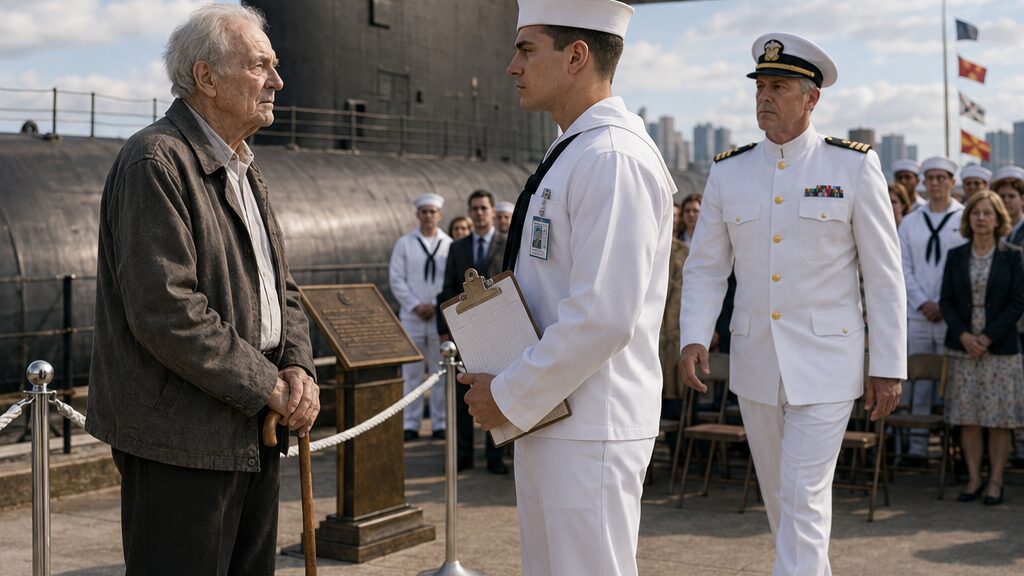
It touched the waterfront walkway with a dry wooden tap, softer than the gulls above the harbor and steadier than the wind moving through the rows of small flags. The old man holding it had stopped just outside the rope line, facing the black submarine as if he had arrived at a grave.
Robert Harris had not meant to draw attention.
He had come early because his legs moved slowly now and because he disliked being watched while he crossed open spaces. The memorial walkway was longer than he remembered from the photograph the museum had mailed him, a pale strip of concrete running beside the water toward the preserved submarine. The vessel sat low and dark against the morning, its rounded hull absorbing the light. Fresh bunting had been tied along the rail. Folding chairs faced a small stage. White uniforms moved everywhere, bright against the black steel.
For a moment, Robert forgot the people.
He stood with both hands on the worn handle of his cane and looked at the submarine’s bow. The museum had repainted her since the last time he had seen her in person. The numbers were sharp now. The deck plates were clean. The railings had no rust. She looked almost younger than she had any right to look.
Robert did not.
His gray-brown jacket hung loosely from his shoulders. The cuffs were shiny with age. His shirt collar would not lie flat no matter how carefully he had pressed it in the motel room that morning. One shoe had a darker polish mark than the other. He had noticed it in the elevator and decided not to care.
In his inside pocket, folded twice along a crease already beginning to tear, was the invitation.
He had taken it out three times in the taxi. He had read the first line each time, then stopped before reaching the words that made the paper feel heavier than it was. He had not come for those words. He had come because the date on the invitation matched a promise he had spent thirty-eight years failing to keep properly.
A young sailor in white approached from the checkpoint table. He was tall, clean-shaven, and tense in the way of someone trying not to look young. His cover sat straight. His shoes shone. A laminated access card hung against his chest. He glanced first at Robert’s cane, then at Robert’s jacket, then past him toward the chairs where invited guests were beginning to take seats.
“Sir,” the sailor said, polite enough on the surface. “This area is closed for a private ceremony.”
Robert looked at him.
“I know.”
The sailor waited, as if the old man might explain that he had wandered to the wrong place. When Robert did not, the sailor’s eyes moved to the rope line.
“Public viewing starts at two. You can come back after the dedication.”
Robert drew the folded invitation from his pocket. He did it slowly, partly because his fingers were stiff and partly because sudden movement had never improved a misunderstanding.
“I was invited.”
The sailor took the paper. He gave it a quick look, not a full read. Robert noticed the way his eyes searched for the modern things first: barcode, badge number, printed credential, something to scan.
“This is an old format,” the sailor said.
“It came in the mail.”
“Yes, sir, but I need you to check in at the guest table.”
Robert pointed with the cane handle, not lifting the tip from the ground. “That table?”
“Yes, sir.”
“I was headed there.”
The sailor did not move aside. Behind him, another sailor glanced over. A museum volunteer adjusted a row of programs on a chair. Two men in suits paused near the donor tent and looked toward Robert with mild impatience, as if a delay had already formed around him.
The wind carried the smell of salt and diesel from the marina beyond the memorial. Somewhere inside the submarine, a metal hatch clanged. The sound went through Robert’s chest so quickly that he had to tighten his hand around the cane.
The sailor noticed the tightening.
“Do you need assistance?” he asked.
Robert heard the question beneath the question. Are you lost? Are you unwell? Should someone remove you gently?
“No,” Robert said.
“Then I need you to wait outside the rope until we verify this.”
Robert glanced past him to the submarine. Near the forward rail, a bronze plaque had been mounted on a low stone base. He could see only part of it from where he stood, but the engraved dates were clear enough. One of them was wrong.
His mouth went dry.
He had expected the ceremony to be painful. He had not expected the first wound to be a number.
The sailor still held the invitation. “Sir?”
Robert looked back at him. “You have the guest list?”
“At the table.”
“Then check the name.”
“I will, but I need you to step back first.”
Robert did not step back. He did not step forward either. He simply stood where the walkway narrowed beside the submarine’s shadow.
The young sailor’s expression tightened. It was not cruelty Robert saw there, not yet. It was embarrassment. A man with polished shoes and a temporary responsibility had met an old man who did not move when told.
“Sir,” the sailor said, lowering his voice, “we have senior Navy leadership coming in. We have Gold Star families, donors, press. I can’t have unauthorized visitors inside the ceremony area.”
Unauthorized.
Robert let the word settle and pass.
There had been a time when men had waited for his authorization to dive, surface, fire, rescue, withdraw, return. There had been a time when his signature could move vessels across oceans. That time was gone, and he had let it go willingly. Authority had weight. He did not miss the weight.
But the submarine before him was not gone. The names were not gone. The promise was not gone.
“Son,” Robert said quietly, “I came because I was asked to come.”
The sailor’s jaw flickered at the word son. “And I’m asking you to follow the procedure.”
A few more people had begun to look. Robert felt their attention like weather: not sharp enough to cut, but cold across the skin. An elderly couple in the second row watched openly. A local reporter lifted a phone, then lowered it. Another sailor came half a step closer, waiting to see whether Nicholas wanted help.
Robert could have ended it there.
He could have said the title. He could have given his full name with the weight people still placed on it when they saw it printed correctly. He could have watched the young man’s face change and felt the old machinery of rank grind back into place.
Instead he held out his hand.
“My invitation.”
The sailor hesitated before returning it. Robert folded the paper once, carefully, along the tired crease.
“What is your name?” Robert asked.
“Nicholas Carter.”
“Are you assigned to this ceremony, Nicholas Carter?”
“Yes, sir.”
“Then check the name before you decide the man.”
Nicholas flushed.
The line was not loud. It did not carry far. But it carried far enough for the second sailor to hear, and for the museum volunteer to glance up from the programs.
Nicholas looked down at the access sheet clipped to his board. “Your name?”
“Robert Harris.”
Nicholas ran his finger down the list. Robert watched the movement. Too fast. Too certain. The page was not long enough to contain everyone invited; Robert could tell that from the spacing. It was a checkpoint sheet, not the full ceremony program.
Nicholas reached the bottom.
He looked up.
“I don’t have a Robert Harris on this sheet.”
Robert’s hand tightened again, but his voice stayed even. “Then you do not have the full sheet.”
Nicholas’s courtesy thinned. “Sir, please step away from the honored guest entrance.”
The old title struck Robert harder than the refusal.
Honored guest.
He looked beyond the rope at the empty front row. There were printed cards on the chairs. He could not read them from there. He did not want to. The chair they had reserved for him mattered less than the names they had failed to speak correctly for years.
The cane tapped once as he shifted his weight. The sound was small, but Nicholas looked down at it as if it confirmed everything he believed.
Robert stepped to the side of the walkway, not backward, but far enough that a family in dark clothing could pass through the checkpoint. The mother guided a boy by the shoulder. The boy stared at Robert’s cane. Robert gave him a faint nod, and the boy looked away.
Nicholas watched the family pass, then turned back.
“Thank you,” he said, but the words were not gratitude. They were dismissal.
Robert stood beside the rope line, the black submarine at his left, the ceremony gathering without him. His invitation rested in his pocket. His cane stood planted between both hands. The wrong date on the plaque glinted in the morning light.
Nicholas returned to the guest table, checked the visible access sheet once more, and spoke with the authority of a man relieved to have paper on his side.
“Your name is not on the list, Mr. Harris. I need you to move away from the honored guests.”
Chapter 2: The Invitation Nicholas Refused To Read Twice
Nicholas Carter had been told three things before the ceremony began.
Do not let the donors stand in the sun. Do not let the press cross the rope. Do not let anyone without proper credentials near the front row.
The instructions had come from three different people in five different tones, all of them carrying the same warning: if something went wrong, someone junior would be blamed. Nicholas understood that part well. He had been in uniform long enough to know that responsibility often rolled downhill and stopped on the cleanest shoes.
His shoes were spotless.
He had checked them twice in the reflection of the museum glass before taking his place by the guest table. The ceremony was not large, but it mattered. The submarine behind him had drawn veterans, families, local officials, donors, reporters, and senior Navy leadership. The captain would arrive shortly. The museum coordinator was already moving fast enough to make everyone around her nervous.
Nicholas had been proud when he was assigned to the entry point. It meant someone trusted him to look sharp, speak clearly, and keep order.
Then the old man appeared with the cane and the tired paper.
At first Nicholas thought it would be simple. A confused visitor, maybe a veteran from another era, had wandered too close to the ceremony ropes. Be respectful, redirect him, keep the line moving. That was the job.
But the man had not reacted like a confused visitor.
He had not apologized. He had not explained too much. He had not become angry or embarrassed in the usual way. He had only looked at Nicholas with a patience that made Nicholas feel, absurdly, like he was the one being inspected.
That irritated him.
Nicholas returned to the table and opened the access binder again. The first page listed museum trustees. The second listed families. The third listed donors and local officials. The fourth listed Navy personnel. He scanned the H section twice, though there were only three names under it.
No Robert Harris.
A museum volunteer handed programs to guests without looking at him. The stack in front of her was thinner than it should have been.
“Where’s the full program folder?” Nicholas asked.
She blinked. “Nancy had it.”
“Where is she?”
“Inside, I think. Or by the donor tent.”
Nicholas looked toward the tent. Men in dark suits stood beneath the white canopy, talking with a woman in a navy dress who seemed to be checking her phone, a clipboard, and the sky all at once. That had to be Nancy Rivera. She was too far away to call without making a scene.
The old man remained beside the rope.
Not leaving. Not arguing. Just standing.
Guests noticed things like that. Reporters noticed. Senior officers noticed even when they pretended not to. Nicholas felt the day beginning to lean out of shape.
He walked back to the old man.
“Mr. Harris,” he said, careful with the name because names mattered even when people were wrong, “I checked the access sheet. You are not listed.”
Robert Harris reached into his pocket again and unfolded the invitation.
“You looked at the sheet. You did not read this.”
“I did read it.”
The old man held the paper out, but not close enough to push it into Nicholas’s chest. “Read it again.”
Nicholas glanced over his shoulder. Two sailors watched from near the rope. One of the donors had stopped speaking. The elderly couple in the second row had turned in their seats. Nicholas could feel the shape of the moment becoming public.
He took the invitation.
The paper was thick, cream-colored, and softened at the fold. The museum crest sat at the top. The printed lines were formal, older in style than the digital passes most guests carried. A line near the middle had been smudged by moisture or age.
Robert Harris was clear enough.
Beneath it, before the name, was a word Nicholas could not fully read. It might have been Mr. It might have been Adm. The period was visible. The letters before it were faded.
“You see the name,” the old man said.
“I see a name,” Nicholas answered. “I don’t see a valid access code.”
“This was mailed.”
“Sir, anyone can print an invitation.”
That was when the air changed.
The sentence had come out harder than Nicholas intended. He heard it after he said it and wished he had chosen different words. But wishing did not call words back. The nearby volunteer’s hand paused over the program stack. One of the sailors looked at the ground.
The old man took the sentence without flinching. Only his thumb moved along the cane handle, tracing a smooth spot worn into the wood.
“I did not print that,” Robert said.
“I’m not accusing you of anything.”
“You already did.”
Nicholas felt his neck grow warm. “I’m saying I cannot verify this.”
“You can check with the coordinator.”
“She’s busy.”
“I have waited in worse places.”
The line was quiet. It should not have bothered Nicholas. It did.
A man in a gray suit stepped around them with a woman wearing pearls. The man glanced at Robert’s jacket, then at Nicholas, and seemed to decide which one mattered.
“Is there a problem?” the man asked.
“No, sir,” Nicholas said quickly. “Just checking credentials.”
The man nodded as if satisfied that the world remained properly sorted, then crossed the rope line after showing a phone pass.
Robert watched him go.
Nicholas held out the invitation. “You can wait by the public bench until we confirm.”
“I was asked to sit in the front row.”
A short laugh escaped from one of the sailors behind Nicholas. It was not loud, and it died almost immediately, but Nicholas heard it. So did Robert.
Nicholas turned slightly. “Stand by,” he told the sailor.
The sailor straightened.
Nicholas faced Robert again. “Mr. Harris, the front row is reserved.”
“Yes.”
“For honored guests.”
Robert’s eyes moved toward the submarine, not the chairs. “So I was told.”
There it was again, that calm pressure. Nicholas felt as if every ordinary sentence he used became smaller after the old man answered it. He did not like being made to feel small by someone who had arrived without a pass, without a proper jacket, without even the sense to understand how ceremonies worked now.
He lowered his voice. “Sir, I need you to understand. This is an official Navy-supported event. We can’t let someone walk in because they have an old piece of paper.”
Robert folded the invitation and placed it back in his pocket.
“No,” he said. “You cannot let someone walk in because he is old. That seems to be the rule you trust.”
Nicholas stiffened. “That is not what I said.”
“It is what you have shown me.”
A few feet away, the volunteer whispered into a radio. The donor couple pretended not to listen. The line had slowed behind the table. Nicholas saw a reporter’s phone rise again, this time not lowering.
He imagined the captain arriving to find a disorderly checkpoint, an unverified old man near the rope, guests watching, and Nicholas failing at the one task assigned to him.
That fear moved through him faster than judgment.
“Mr. Harris,” he said, clipped now, “step away from the access point.”
Robert’s face changed then, but not much. Something behind his eyes closed.
He turned slightly toward the submarine. From where they stood, the bronze plaque near the bow was visible. Nicholas had passed it a dozen times that morning and read none of it. It was part of the background, like the water and the flags.
Robert read it.
“The second patrol date is wrong,” he said.
Nicholas blinked. “Excuse me?”
“The plaque lists May seventeenth. It should be May sixteenth.”
A donor behind Nicholas muttered, “Oh, for heaven’s sake.”
Nicholas’s patience broke in the smallest possible way. He did not shout. He did not touch the old man. But he stepped closer than he should have and let his voice carry.
“Sir, you don’t get to rewrite Navy history from the sidewalk.”
The words landed cleanly.
The sailors heard. The volunteer heard. The guests nearest the front row heard. The old man with the cane stood in the thin strip of morning sun beside the black submarine, the invitation hidden again in his worn jacket, and for the first time his face showed something Nicholas had not expected.
Not anger.
Not humiliation.
Grief.
Chapter 3: The Date On The Plaque Was Wrong
Nancy Rivera had lost the honored speaker.
Not the person. Not yet. Only the page.
The ceremony binder had been complete when she placed it on the museum office table at seven-thirty that morning. She knew because she had checked the tabs twice while drinking coffee that had gone cold before she finished half of it. Trustee remarks, Navy remarks, family acknowledgments, donor recognition, memorial correction, honored speaker.
Now the honored speaker tab held nothing but a blank plastic sleeve.
Nancy stood in the small office behind the museum lobby, one hand on the open binder and the other pressed to her forehead. Through the window she could see the submarine’s black hull and the white uniforms moving in crisp lines that looked orderly only from a distance. Her radio crackled with half messages.
“Need two more chairs near—”
“Press is asking about—”
“Captain Allen is ten minutes out—”
The last one tightened her stomach.
John Allen was not a difficult man, but he noticed details. The ceremony mattered to him. It mattered to the museum. It mattered to the families who had written letters for months asking why the corrected dedication had taken so long. It mattered to donors whose checks had repaired the deck plates, to veterans who had not seen each other in years, to reporters waiting for a dignified Memorial Day segment.
And somewhere between the printer, the office, and the guest table, Nancy had misplaced the page that told everyone where Robert Harris belonged.
She turned to the museum volunteer in the doorway. “Check the copier again.”
“I did.”
“Check under the tray.”
“I did.”
“Then check again.”
The volunteer disappeared.
Nancy flipped to the guest list. The full list had Robert Harris on it. Of course it did. She had typed the name herself from the old Navy correspondence. But the simplified checkpoint list—the one Nicholas Carter had at the entrance—had been created for scanning passes and seating categories. The honored speaker had been placed on a separate protocol sheet because Captain Allen was supposed to greet him personally.
That had seemed efficient last night.
Now it seemed unforgivable.
Her radio crackled again. “Ms. Rivera, we have a visitor issue at the rope.”
Nancy closed her eyes. “What kind of visitor issue?”
“Older gentleman. Says he’s invited. Carter says he’s not on the access sheet.”
Nancy opened her eyes.
“What name?”
A burst of static answered first.
Then: “Harris. Robert Harris.”
For one second the office seemed to tilt.
Nancy grabbed the binder and stepped into the hallway too quickly, bumping her hip against the doorframe. She did not stop. She passed the exhibit case of submarine models, the wall of crew photographs, the donation plaque, and the temporary display about the memorial correction. Outside the glass doors, sunlight flashed hard off the harbor.
She saw him before she reached the walkway.
An elderly man stood beside the rope line with a cane in both hands. His jacket looked too warm for the day. His shoulders were narrow. His face was turned toward the submarine plaque, not toward the people watching him. Nicholas Carter stood near him, rigid with the expression of a young man who believed firmness could repair uncertainty.
Nancy also saw the guests looking.
That was the part she hated first, before guilt caught up. Not the mistake itself, but its public shape. A private error could be corrected. A public slight became a story before anyone knew what had happened.
She hurried toward them. “Carter.”
Nicholas turned, relief and defensiveness crossing his face together. “Ma’am, this gentleman isn’t on my sheet. He has an old paper invitation without a code.”
Nancy looked at Robert.
Up close, she saw that the invitation was not in his hand. He had put it away. That small fact made her feel worse.
“Mr. Harris?” she asked.
“Yes.”
“I’m Nancy Rivera, the museum coordinator. I apologize for the confusion.”
Robert nodded once. He did not help her by smiling.
Nicholas said, “He also claims the plaque date is wrong.”
Nancy looked sharply at him. “Claims?”
Nicholas’s mouth closed.
Robert’s gaze remained on the bronze plaque. Nancy turned toward it despite herself. The dedication text had been reviewed by the board, the Navy liaison, two historians, and the engraver. She could recite the first paragraph by memory. The second patrol date read May 17.
“It should be May sixteenth,” Robert said.
Nancy held the binder tighter. “The record we used said seventeenth.”
“The summary record often does.”
“You’ve seen the other record?”
Robert looked at her then. His eyes were pale and tired, but clear. “I signed it.”
Nicholas shifted behind her. Someone nearby whispered.
Nancy felt the morning noise recede.
She had handled veterans before, and families, and men who remembered things differently than documents did. Memory could sharpen facts or blur them. She knew that. But there was nothing blurred in the way Robert Harris had spoken. No performance. No insistence. Just the weight of a sentence placed carefully where it belonged.
“You signed the after-action report?” she asked.
Robert did not answer immediately. His thumb moved once along the cane handle.
“I signed several things that day.”
Nancy’s radio crackled again. She lowered the volume without looking.
The donor in the gray suit stepped closer. “Ms. Rivera, is this going to delay the ceremony?”
Nancy turned. “Please take your seat.”
He looked offended but obeyed.
Nicholas said, quieter now, “Ma’am, his name wasn’t—”
“I know why his name wasn’t there,” Nancy said. She regretted the sharpness at once, but she did not soften it. “The protocol page is missing from my binder.”
Nicholas glanced at Robert, then away.
Nancy opened the binder against her arm and showed the blank sleeve under the honored speaker tab. “Mr. Harris, you are listed in the master file. I need to retrieve the final program page.”
Robert looked toward the front row. “The ceremony can begin without me.”
“No,” Nancy said, too quickly.
He seemed almost saddened by her urgency. “It has before.”
She did not know what to do with that.
A gust moved through the flags along the rail. The cane tapped once as Robert adjusted his stance. Nancy noticed then that his gaze had drifted past the plaque to the memorial wall farther down the walkway, where the names were arranged in bronze beneath the submarine’s shadow.
“Would you like to wait inside?” she asked. “There’s a chair in the archive room.”
“I would like to stand here a moment.”
Nicholas looked as if he wanted to object, but Nancy gave him a glance that stopped him.
“Of course,” she said.
Robert moved slowly away from the rope line toward the bench near the memorial wall. Halfway there, he paused and leaned the cane against the bench to steady himself with one hand on the rail. Without the cane, he looked suddenly older. Not weaker, exactly. More exposed.
Nancy watched him study the names.
She had seen many people stand before that wall. Some searched. Some touched letters. Some took pictures. Robert did none of those things. He stood with his hand on the rail and seemed to be listening for something beneath the wind.
The volunteer came running from the museum doors with a single photocopied page.
“Found this near the copier,” she said breathlessly. “It was stuck under the lid.”
Nancy took it.
The top corner was smudged, and a line of toner streaked across the first name. The title, however, was clear enough.
Admiral Harris remarks.
Below it, the printed first name had blurred into a gray mark. The last name remained.
Harris.
Nancy looked from the page to the old man standing by the memorial wall, his cane leaning beside him like something temporarily set down at a grave.
For the first time that morning, she stopped thinking about the schedule.
She looked at Nicholas Carter, whose face had gone still.
“Find Captain Allen,” she said. “Now.”
Chapter 4: John Allen Saw The Face From The Archive
John Allen heard the cane before he saw the man.
It was a single tap on concrete, nearly swallowed by the harbor wind and the murmur of guests taking their seats. Still, the sound reached him as he came through the museum corridor with his cover tucked beneath his arm and two staff members trying to speak to him at once. One was asking about the order of remarks. The other had a question about the local reporter’s position near the stage. John answered both without slowing, but the tap pulled his attention toward the glass doors.
Outside, beyond the reflection of flags and water, a small knot of people had formed near the rope line.
John did not like knots before ceremonies.
Ceremonies were fragile things. From a distance they looked formal, controlled, inevitable. Up close they depended on missing chairs, working microphones, correct names, water bottles hidden behind podiums, nervous families, and young sailors who had slept badly but still had to stand as if carved from stone.
He had learned that as an ensign. He had learned much harder things later.
“Captain Allen,” Nancy Rivera said, coming fast from the side corridor with a paper in her hand. “We found the missing remarks page.”
“Good.”
“But there’s an issue at the entrance.”
“I can see that.”
“It’s Robert Harris.”
John stopped.
The staff member beside him nearly walked into his shoulder. The corridor noise thinned around the name.
“What did you say?”
Nancy held out the photocopy. “The page is smudged, but the title is clear. Admiral Harris remarks. Nicholas didn’t have the protocol sheet. He stopped him at the rope.”
John did not take the page at first. He looked through the glass.
The old man stood near the bench by the memorial wall, one hand resting on the rail, his cane leaning beside him. His gray-brown jacket moved slightly in the wind. His head was turned toward the names. A young sailor stood several feet away, too stiff, his face drained of the confidence that posture tried to supply.
John had seen that face before, but not in life.
It had been in a command history archive, printed under fluorescent light, grainy at the edges: a younger Robert Harris standing beside a submarine crew after a mission no instructor ever summarized cleanly. In the photograph his hair had been dark, his jaw sharper, his eyes already carrying the look of a man who had learned that correct decisions could still leave names behind.
John had been twenty-four when he first read the case study. The instructor had not called it heroic. He had called it command. That distinction had stayed with him longer than the facts.
Now the man from the archive was outside in an old jacket, being made to wait beside a rope.
John took the photocopy from Nancy. “Who stopped him?”
She looked toward the entrance. “Carter.”
John knew the sailor only slightly. New to ceremonial support. Sharp uniform. Eager. Too eager, perhaps. But John had no interest in anger yet. Anger would be easy, and ease rarely improved a bad moment.
“Did Admiral Harris identify himself?”
Nancy hesitated. “Not by title.”
“Of course he didn’t.”
John put his cover on.
By the time he stepped outside, the guests had settled into the kind of silence people make when pretending not to listen. A gull cried over the water. The submarine’s black hull rose to his right, polished for ceremony, dark enough to reflect broken shapes of white uniforms and folding chairs.
Nicholas saw him first.
“Captain,” he said, too quickly.
John did not answer. His eyes were on Robert.
The old man turned at the sound of the voice. For a moment, John saw not the admiral from the archive, not the signature under old reports, not the name officers still spoke with a certain care. He saw an eighty-two-year-old man who had been standing too long in the sun.
Then Robert’s hand reached for the cane.
John crossed the last few yards and stopped at a respectful distance. He did not salute. Not yet. Robert was in civilian clothes, and more importantly, this was not a stage cue to perform before an audience. John simply stood straight enough for everyone to see the change.
“Admiral Harris,” he said.
The words moved through the ceremony area more sharply than any command.
A program slipped from someone’s hand. One of the sailors near the rope straightened so fast his shoulder hit the post. Nicholas did not move at all.
Robert looked at John without surprise. If anything, he looked weary that the word had finally been said.
“Captain Allen,” he replied.
John felt the old training in that voice. Quiet. Level. No effort to claim the room. That made the room yield more completely than force would have.
“I apologize,” John said.
Robert’s eyes flicked once toward Nicholas, then back. “For what?”
John understood the question. He wished he had not.
“For failing to meet you properly.”
“That is not the part that matters.”
Behind him, Nicholas inhaled but said nothing.
Nancy stepped closer with the smudged page. “Admiral Harris, we found the remarks sheet. Your seat is ready. I’m sorry for the mix-up.”
Robert looked at the paper, then toward the front row. “Has the correction been made?”
Nancy paused. “The memorial correction?”
“The patrol date.”
She opened her mouth, then closed it. “We used the summary record.”
John turned toward the plaque.
May 17.
He felt a slow discomfort settle at the base of his neck. He had reviewed the ceremony packet himself, but not the engraving proof. He had trusted the museum’s research, the file summary, the tidy version of history prepared for public display.
Robert had seen the mistake from the sidewalk.
“It should be May sixteenth,” Robert said.
John looked back at him. “You’re certain.”
Robert gave him the barest glance. “I was there.”
No one spoke.
The wind lifted the corner of Nancy’s photocopy. A child coughed somewhere in the chairs. The donor in the gray suit looked suddenly fascinated by his shoes.
John turned to Nicholas. “Carter.”
Nicholas swallowed. “Captain.”
“Did Admiral Harris ask you to check the name?”
Nicholas’s face tightened. “Yes, sir.”
“Did you check the full protocol list?”
“I only had the access sheet, sir.”
“That was not my question.”
Nicholas looked past John for half a second, toward Robert, then back. “No, sir.”
John held the silence long enough for it to be felt, not long enough to become spectacle. “Stand by.”
“Yes, sir.”
Robert shifted his weight. The cane tapped once as he did. John heard a few guests react to the sound now, as if the cane itself had changed rank.
That troubled him.
He stepped closer to Robert and lowered his voice. “Sir, we can move you inside until we correct this.”
Robert looked at the submarine. “I have been outside before.”
John did not know what memory the words came from, but he felt their edge.
“The ceremony is waiting for you,” he said.
Robert’s mouth moved, almost a smile and not one at all. “The ceremony can wait for the truth.”
Nancy glanced from one man to the other. “I can have the plaque correction announced in the opening remarks. The engraving itself will take time.”
“The plaque can wait,” Robert said. “Names should not.”
John felt that land harder.
“The order of remembrance?” he asked.
Robert did not answer immediately. He looked back toward the memorial wall, where the names sat in neat bronze lines beneath the submarine’s shadow.
“There was a man under my command,” Robert said. “Jack Davis.”
Nancy looked at the program page. “I don’t remember that name in the remarks.”
“No,” Robert said. “You would not.”
A bell sounded near the stage, the soft signal that the ceremony was about to begin. Guests turned forward by habit, then looked back again. The room of open air waited.
John had imagined meeting Robert Harris many times in his career, usually in the clean lines of formal respect. A handshake. A photograph. A rehearsed sentence about honor. He had not imagined the admiral standing by a rope in a worn jacket, asking for a missing name.
John straightened and turned toward the assembled guests.
“Ladies and gentlemen,” he said, voice carrying without strain, “we will begin in a few minutes.”
Then he faced Robert again, not as a handler to an honored speaker, but as an officer to a man whose silence had already corrected more than the program.
“Admiral Harris,” John said, “we are ready when you are.”
The watching sailors went still.
Robert’s face did not soften. Recognition had not relieved him. If anything, it had brought the pain closer to the surface.
He reached for his cane, wrapped his hand around the worn wooden handle, and looked once more at the wall of names before allowing John to guide him toward the front row.
Chapter 5: The Ceremony Was Never Meant For Applause
The front-row chair had a white card on it.
Admiral Robert Harris.
The printed title looked too large to Robert, too clean. It sat on the seat as if the ceremony had been waiting for a title instead of a man. For a moment he stood before it, aware of the eyes on his back, the shifting uniforms, the guests pretending not to stare.
John Allen reached to move the card.
Robert stopped him with a small lift of his hand.
“Leave it.”
John paused. “Yes, sir.”
Robert lowered himself into the chair slowly. His knee objected first, then his hip, then the old wound beneath his ribs that weather still found when it wanted him to remember. The cane rested against his right leg. He placed one palm over the handle and looked ahead at the submarine.
From the front row, she filled the world.
The ceremony began with the national anthem, then an invocation, then Nancy Rivera at the podium. Her voice was steady, but Robert saw the tension in her hand each time she turned a page. She thanked the families, the Navy representatives, the donors, the museum volunteers. She spoke of preservation, education, sacrifice. All good words. All true enough. All too smooth.
Robert listened as one listens to weather outside a closed room.
He had spent half a lifetime in rooms where words were chosen because the wrong ones could move ships, end careers, break families. Ceremony language was safer. It polished rough edges until people could place flowers without cutting their hands.
But memory had rough edges for a reason.
Nancy introduced John Allen, and the captain stepped to the podium. He did not overcorrect. Robert respected that. John did not announce the morning’s mistake. He did not turn toward Nicholas or demand public shame. He spoke instead about stewardship, about the danger of inherited stories becoming decoration.
Then he said Robert’s name.
“Today we are honored by the presence of Admiral Robert Harris, whose command history is inseparable from the vessel behind us and from the correction this memorial has long owed.”
A murmur went through the seats, not loud, but unmistakable. Robert felt it move around him like a change in current.
Nicholas stood near the rope line, eyes forward, face pale beneath his cover. Robert did not look at him long. Shame was a hard enough place without being pinned there.
John continued. “Admiral Harris commanded the rescue coordination following the final emergency patrol connected to this submarine’s active service. Many men came home because of decisions made under impossible conditions. Some did not. Today’s dedication recognizes not only the vessel, but the names and records that must be preserved accurately.”
Robert’s hand closed on the cane.
Impossible conditions.
He disliked the phrase. It sounded noble from a podium. At the time it had been noise, salt, battery alarms, incomplete reports, men waiting for orders that could save one compartment and doom another. It had been a radio operator’s voice breaking only once. It had been Jack Davis laughing the night before because someone had ruined coffee again and saying that after all this, he wanted nothing more heroic than a quiet porch.
The applause began when John stepped back.
It was respectful. Not wild. Not the worship of a crowd hungry for a spectacle. Still, it reached Robert like something he had not asked to carry. People turned toward him. A few rose. Then more followed, uncertain whether standing was required or merely right.
Robert did not rise.
He bowed his head once, enough to acknowledge them, not enough to accept what was not his alone. His hand remained on the cane. He waited for the sound to end.
When Nancy returned to the podium, she glanced at him before reading the next section.
“Today we also dedicate the corrected patrol marker and recognize the service record amendments submitted for permanent display.”
Corrected patrol marker.
Robert looked at the bronze plaque near the bow. May seventeenth still shone in the sun.
A correction spoken aloud was not nothing. He knew that. Records changed slowly. Engravings took time. Institutions moved like large ships; turn them too quickly and something broke. But he had not come for the date alone.
Nancy read the official language of the dedication. She named the patrol. She named the year. She named the crew as a collective. She spoke of courage, endurance, sacrifice.
Robert waited.
The first list began.
He heard names he knew. Some from memory. Some from letters. Some from reports. The spoken names moved into the air and vanished over the water, each one briefly alive in a stranger’s mouth.
Then the list turned.
Then it ended.
Robert sat very still.
For several seconds he thought perhaps he had missed it. Age could do that. Sound slipped now and then, especially outdoors. He looked down at the program in his lap. Nancy had given it to him before the ceremony began, a fresh copy, no smudge. His own remarks were folded inside.
The order of remembrance was printed on the second page.
Jack Davis was not there.
Robert read the list again, slower.
Not there.
The paper bent slightly under his thumb.
Onstage, a museum volunteer placed a wreath on its stand. Cameras lifted. John sat two chairs away, watching the ceremony with the solemn discipline of a man determined to get the rest right.
Robert felt the old compartment close around him.
Jack Davis had been twenty-seven. He had written letters in block print because he said cursive made him look like he was pretending to be educated. He had once fixed a jammed hatch with one hand bleeding and joked that the submarine owed him a raise. In the last confirmed message from his section, he had asked if the aft team made it clear.
Not if he would make it.
If they did.
Robert had given the order that sealed the sequence. He had given it because the alternative would have taken more men. He had signed the report. He had written letters. He had stood in uniform before families and accepted their grief because command required someone to stand there.
Jack’s sister had not screamed. Robert remembered that most clearly. She had stood on the porch of a small house, holding the folded notice in both hands, and said, “Just don’t let them make him a number.”
Robert had promised.
Thirty-eight years later, Jack Davis was still close enough to a number that the official remembrance had passed him by.
John leaned slightly toward him. “Sir?”
Robert looked up. He realized his hand had begun to tremble on the program.
“I need the archive file,” Robert said.
John’s eyes sharpened. “Now?”
“Yes.”
Nancy was introducing the next speaker. The ceremony was moving as ceremonies moved, forward because forward was easier than stopping.
John lowered his voice. “We can address any correction after the remarks.”
Robert turned to him.
The look was not harsh. That made it worse.
“Captain,” Robert said, “after is how names disappear.”
John absorbed that. Then he nodded once.
Robert stood before anyone announced him.
A ripple moved through the front rows. Nancy faltered at the podium. John rose beside him, not to lead him, only to be ready if age betrayed balance. Robert took the cane in his right hand and the program in his left.
Every face seemed to turn toward him.
For the first time that day, the title on the chair mattered less than the missing name on the page.
Robert looked toward the memorial wall.
“Before I speak,” he said, voice low but clear enough for the first rows to hear, “there is a sailor we have not yet remembered.”
Chapter 6: The Name Robert Would Not Let Disappear
The archive room was colder than the ceremony grounds.
Museum cold, Robert thought. The kind meant to protect paper from the living.
The room sat behind the main exhibit hall, past a display of old instruments and a glass case of faded crew photographs. Its shelves were narrow, its table too small for the number of boxes Nancy had pulled from storage. A fluorescent light hummed overhead. Outside, through the closed door, the ceremony had stalled into a low murmur.
Robert stood at the table because sitting felt too much like surrender. His cane rested in his hand, the tip planted on the floor beside a cardboard box marked Patrol Records. John Allen stood across from him. Nancy moved quickly but carefully through folders, her earlier urgency changed into something quieter.
Nicholas Carter waited near the door.
No one had asked him to enter. No one had told him to leave. He stood there as if accepting that uncertainty was part of the correction.
Nancy opened a folder with both hands. “The museum file has Davis listed under auxiliary transfer notes, not the main crew roster.”
Robert closed his eyes briefly.
Auxiliary transfer notes.
A living man could vanish under tidy categories.
“He was attached for the emergency systems refit,” Robert said. “Temporary assignment. He stayed aboard when the fault cascade began because he knew the aft junction better than anyone.”
John looked down at the folder. “That may be why the public roster missed him.”
“It is why the public roster should have been checked twice.”
Nancy’s face tightened, but she did not defend herself. “You’re right.”
Robert did not want victory in that. He wanted the past to stop requiring proof from men too old to keep bringing it.
Nancy slid a photocopy toward him. “Is this the after-action summary you mentioned?”
Robert looked.
The page was thin, copied from a copy. Black marks blurred near the edges. But the structure of it was familiar enough to make the room fall away.
He saw the column headings. Compartment status. Evacuation sequence. Casualty confirmation. Command authorization.
And there, near the bottom, in language flattened by procedure, was the line that had lived under his skin for decades.
DAVIS, JACK — temporary systems specialist, aft section, unaccounted at sequence seal; later confirmed lost.
Robert’s hand moved before he meant it to. The cane lifted slightly and touched the edge of the paper, not covering the name.
Nancy watched the gesture.
“His sister wrote to the museum years ago,” she said. “I saw a scanned letter in the correspondence file. It was marked unresolved.”
Robert stared at the name.
“She wrote to me first.”
John’s eyes rose.
Robert kept his gaze on the page. “After the funeral. She asked me what he did at the end. Not how he died. What he did.”
The room waited.
Robert had spent years learning how not to tell this story. Not because it was secret anymore. Because every telling made the air smell like hot metal and battery acid again. Because people wanted clean grief. They wanted the last sentence to fit on a plaque.
“He stayed at the junction panel,” Robert said. “The aft team could not clear without power transfer. Manual override had failed twice. He knew a way around it.”
Nicholas shifted near the door, barely audible.
Robert continued, his voice still level. “He bought them four minutes. Maybe less. Enough.”
John looked down.
Nancy’s hand had gone still on the folder.
“I wrote that in the full report,” Robert said. “I wrote it plainly. But by the time the public summary was prepared, he was temporary personnel attached to a systems note. The men he saved were listed correctly. Jack was not.”
Nancy turned to another folder. “The public dedication used the summary.”
“Yes.”
“Admiral Harris, I’m sorry.”
Robert looked at her then. “Do not spend the apology on me.”
The words were not sharp, but they moved through the room with more force than accusation.
Nancy nodded once.
John pulled a chair back. “Sir, sit for a moment.”
Robert almost refused. Pride rose first, then fatigue answered it with honesty. He lowered himself into the chair. The cane remained upright between his knees, both hands folded over the handle.
Nicholas had not moved from the door.
Robert noticed him there, young face drawn tight, white uniform immaculate in a room full of old paper.
“You can come in, Carter,” Robert said.
Nicholas looked startled. “Sir?”
“This is not a punishment room.”
Nicholas stepped inside.
John watched him but said nothing.
Robert turned back to Nancy. “You said there was a letter.”
Nancy found it in a digital printout, the ink newer than the grief it carried. She placed it beside the report.
The letter was short. The museum copy had no envelope, no photograph, only words typed into a record years after they were first written.
Robert did not need to read it. He knew the lines before his eyes found them.
Please do not let my brother become only temporary personnel. His name was Jack Davis. He was twenty-seven. He liked black coffee and bad jokes. Someone came home because he stayed.
Robert folded his hand over his mouth.
The room did not look away out of politeness. It looked away because some grief makes witnesses feel like intruders.
John broke the silence carefully. “We can correct the record.”
“You can correct the display,” Robert said. “The record has been waiting.”
Nancy gathered the summary, the letter, and the ceremony program. “I’ll revise the order of remembrance before you speak.”
“No.”
She stopped. “No?”
Robert looked at the printed program, at his own name, at the clean title that had caused so much trouble only after it became useful.
“Do not tuck him into a revised list and move on.”
John understood first. “You want to say his name yourself.”
“I came to hear it said correctly.” Robert touched the cane handle. “If no one else is ready, I will do it.”
Nicholas’s voice came from near the door, rougher than before. “Sir, I didn’t know.”
Robert turned his head.
Nicholas stood rigid, but the stiffness had changed. It was no longer authority. It was a young man trying not to step away from what he had done.
“No,” Robert said. “You did not.”
Nicholas swallowed. “I should have checked.”
“Yes.”
The single word hurt more than a lecture would have. Nicholas accepted it without flinching.
Robert looked back at the report. “But this room is full of people who should have checked. Including me.”
John frowned. “Sir?”
“I knew the public summary was wrong years ago. I wrote letters. Then I stopped. I told myself institutions move slowly. I told myself I had done my part.”
His fingers tightened on the cane.
“Jack’s sister asked one thing of me. Not rank. Not ceremony. Not applause. A name.”
Nancy lifted the letter gently, as if it had become fragile only after being understood. “We can place this in the display.”
“You can,” Robert said. “But first the people outside should know why the missing name matters.”
John’s gaze moved to the door, to the waiting ceremony beyond it. “They’re expecting a dedication speech.”
Robert slowly rose from the chair. This time no one tried to help him before he asked. That, too, was a correction.
He took the report in one hand and the cane in the other. The tip touched the floor once, steady.
“I did not come to be honored,” he said. “I came because Jack Davis’s sister once asked me not to let the Navy forget him.”
Chapter 7: Nicholas Learned What Protocol Could Not Teach
Nicholas Carter had wanted the floor to open beneath him twice that day.
The first time was when Captain Allen said Admiral Harris.
The second was in the archive room, when he heard Robert Harris say Jack Davis had become temporary personnel in a summary.
The first shame had been personal. It burned hot and obvious. Nicholas had blocked an admiral from entering a ceremony held partly to honor him. He had spoken over a man whose name belonged in training histories. He had stood too close, trusted the wrong sheet, and let his fear of looking incompetent turn into disrespect.
The second shame was quieter and worse.
It had nothing to do with rank.
Nicholas stood at the edge of the ceremony area after the archive room emptied, holding his cover under one arm and watching guests shift in their seats. No one knew exactly what had happened behind the museum doors. They knew only that the ceremony had paused, that Captain Allen had gone in with the old man, that Nancy Rivera had returned carrying papers like they might break if she held them wrong.
The submarine sat behind the stage, black and silent.
Nicholas had looked at it all morning as a backdrop. A symbol. A thing to guard.
Now he could not look at it without thinking of compartments and dates and a man named Jack Davis staying at a junction panel so others could clear.
The ceremony resumed, but it did not regain its earlier smoothness. That was not Nancy’s fault. Her voice was steadier than Nicholas expected when she returned to the podium and announced that the order of remembrance would be corrected before the closing remarks. She did not blame anyone. She did not explain too much. She simply said the museum had confirmed a missing name in the archival record and that Admiral Harris would address it.
At the word admiral, a few guests turned to look again at Robert.
He sat in the front row with the same old jacket, the same cane, the same tired posture. The title had changed the air around him, but it had not changed him. If anything, he seemed more alone now than when Nicholas had blocked him at the rope.
That unsettled Nicholas.
He had expected power to look different once revealed. He had expected a straightened back, a colder tone, maybe a glance that would put him in his place. But Robert had not used the reveal like a weapon. He had barely used it at all. The captain and the coordinator and the guests moved around him with new care, and Robert seemed only to carry more weight.
Nicholas was still standing near the rope when the mistake happened.
A museum volunteer lifted a small box from the program table, bumped the bench beside it, and knocked Robert’s cane to the ground. It fell with a wooden clatter that cut through the low ceremony murmur.
Robert turned in his chair.
Nicholas moved before thinking. He stepped across the walkway, bent, and picked it up. The handle was smooth from years of use, warmer than he expected from lying in the sun. For one irrational moment, he held it too carefully, as if returning it wrong would deepen everything.
He brought it to Robert.
“Sir,” he said.
Robert looked at the cane first, then at him. He took it without hurry.
“Thank you, Carter.”
The simple use of his name made Nicholas’s throat tighten.
He should have returned to his post. Instead he remained beside the chair, not close enough to crowd, not far enough to escape.
“I owe you an apology, sir.”
Robert rested both hands over the cane handle. “For what?”
Nicholas had heard that question before, when Captain Allen offered his own apology. It felt different aimed at him. There was no anger in it, but there was no easy path either.
“For how I treated you at the entrance.”
Robert waited.
Nicholas glanced toward the stage, where Nancy was speaking with a volunteer near the podium. Captain Allen stood nearby, looking over the revised program. No one seemed to be listening, but Nicholas kept his voice low anyway.
“I should have checked the full list,” he said. “I should have found Ms. Rivera. I should not have assumed your invitation was fake.”
Robert said nothing.
Nicholas forced himself not to fill the silence too quickly. That, he had begun to understand, was another kind of fear.
“And I should not have spoken to you that way,” he added.
Robert’s eyes remained on the submarine. “Because I was an admiral?”
Nicholas looked down.
The answer he wanted to give was no. The honest answer took longer.
“At first,” he said, “yes. When Captain Allen said it, I thought that was the reason I had done something terrible.”
Robert turned his head slightly.
Nicholas felt heat rise in his face again, but he did not look away. “Then I heard about Jack Davis.”
The old man’s fingers tightened on the cane, not much.
Nicholas continued. “I treated you like someone I could move out of the way because you didn’t look important. If you had just been an old man with the wrong paper, I would still have been wrong.”
Robert watched him then.
Nicholas was used to inspections that checked buttons, posture, hair, shoes. This one seemed to reach the place beneath all that, the place that had wanted so badly to be seen as squared away that it had stopped seeing the person in front of him.
“My first assignment like this,” Nicholas said. “That isn’t an excuse.”
“No,” Robert said.
Nicholas nodded once. “I know.”
The answer should have hurt. It did. But it also relieved him. The old man was not trying to make his shame softer than it was.
Robert looked toward the water. “A uniform can make a young man feel he has become the institution.”
Nicholas swallowed. “Yes, sir.”
“It can make an old man forget he once made the same mistake.”
Nicholas looked at him, surprised.
Robert’s expression did not change. “I have trusted documents that were incomplete. I have believed quiet men were fine because they did not complain. I have let procedure move faster than care.”
The ceremony sound drifted around them. A microphone hummed. Someone adjusted a wreath stand.
Nicholas said, “But you corrected it.”
“Not soon enough.”
There was no self-pity in the words. Only fact. Nicholas felt then that Robert Harris’s rank was not the largest thing about him. The largest thing was what he still allowed to trouble him.
Nancy approached from the podium area with a revised sheet in her hand. “Admiral Harris, we’re ready when you are.”
Robert nodded, then began to stand.
Nicholas stepped forward by instinct, ready to help. Robert’s glance stopped him—not harshly, but clearly. Nicholas stepped back. Robert rose slowly on his own, cane planted, shoulder tightening once before he steadied.
When he was upright, he looked at Nicholas again.
“You wanted to apologize,” Robert said.
“Yes, sir.”
“Do not apologize because of who I was.”
Nicholas stood very still.
Robert’s voice stayed low, meant for him more than for the crowd. “Ask yourself who you thought I was allowed to be.”
Nicholas had no answer.
Robert did not require one. He turned toward the podium, and Captain Allen moved beside him—not leading, not rescuing, just walking at the pace Robert set.
Nicholas remained near the front row, the sentence still open inside him.
Who you thought I was allowed to be.
An old man with a cane. A problem at a rope. A delay. A body to move away from honored guests.
He looked toward the entrance where the public bench sat beyond the ceremony line. A different elderly veteran had arrived during the delay, standing uncertainly with a folded cap in his hands while a younger sailor checked passes. The sailor glanced at the man’s worn jacket and then at the access sheet.
Nicholas crossed the walkway before the moment could harden into another mistake.
“Take your time,” he told the sailor.
The sailor looked surprised. “He’s not on the sheet.”
“Then check the full list.”
The elderly veteran gave Nicholas a cautious look.
Nicholas stepped aside from the rope, not because he knew who the man was, but because he did not.
Chapter 8: One Tap Beside The Forgotten Name
Robert Harris had spoken before rooms that could move fleets.
He had spoken in secure briefings where every word became a line in someone else’s orders. He had spoken to families with folded hands and empty chairs between them. He had spoken into radios when static made men sound already half gone. He had spoken under flags, under fluorescent lights, under weather, under pressure.
The microphone at the submarine memorial felt heavier than all of those.
He stood behind it with the corrected sheet in one hand and his cane in the other. The wind moved across the harbor and lifted the corner of the paper. Captain Allen stood to one side. Nancy Rivera stood to the other, holding the archive copy of the after-action report. Nicholas Carter had returned to the edge of the ceremony area, not hiding now, not drawing attention either.
Robert looked out at the guests.
Some had risen slightly when he approached, then sat when he motioned with two fingers for them not to stand. He saw veterans, families, donors, volunteers, young sailors trying to keep their shoulders square, a child leaning against his mother, a local reporter with her phone lowered for once.
He saw people waiting for the admiral.
That was not who he needed them to hear.
He set the corrected sheet on the podium. The cane remained upright beside him, his hand resting on the handle.
“I was invited here to speak about service,” Robert began.
The microphone carried his voice more strongly than he felt it. He adjusted his distance from it.
“That is a large word. It is often polished before it is handed to the public. We use it at ceremonies because it is true, but also because it is easier than naming what service costs.”
No one moved.
Robert looked toward the black hull behind the chairs. “This vessel carried men who were trained to disappear beneath the surface and do difficult work without applause. Many of their names are already on your programs. One was not.”
He unfolded the corrected sheet.
“Jack Davis.”
The name went into the air plainly.
Robert waited after saying it. He had learned long ago that a name deserved a moment before explanation.
“Jack Davis was attached temporarily to an emergency systems refit during the patrol remembered here today. Because of that word—temporarily—his name slipped between records. But he was not temporary to the men who came home because he stayed at his station.”
Nancy lowered her eyes.
Robert continued, careful now, each sentence placed where it could stand without decoration. “The public summary says he was unaccounted for at sequence seal. That is accurate. It is not complete. He remained at the aft junction long enough for others to clear. He did not ask whether he would be remembered. He asked whether they made it out.”
The front rows were silent in a different way now. Not the silence of rank. Not the silence of embarrassment. A listening silence.
Robert’s hand tightened once on the cane.
“I signed the full report. I wrote letters. I believed, for too long, that because I had written the truth somewhere, the truth would find its way here.”
He looked at the memorial wall beyond the chairs.
“It did not.”
The wind lifted the flags along the submarine rail.
“Jack’s sister once asked me not to let the Navy make him a number. I gave her my word. Today I am late keeping it.”
No one tried to save him from the sentence.
That mattered.
Robert turned one page, though he did not need it. “The museum has confirmed the archival record. Captain Allen and Ms. Rivera have agreed that Jack Davis’s name will be added to the corrected display, and the patrol date on the plaque will be amended from the summary date to the operational date.”
A low murmur moved through the audience. Nancy nodded once, visibly, for the families and reporters and volunteers.
Robert lifted his eyes again.
“But I need to say something else before we finish.”
The cane tip shifted on the stage with a soft sound.
“This morning, before anyone checked an archive, I was stopped at that rope. The young sailor who stopped me has already heard what I needed to say to him.”
Nicholas’s face tightened, but Robert did not turn him into the center.
“What happened there is not important because I once held rank. It was wrong before anyone knew my title. A man should not have to prove importance before receiving patience. An old coat should not erase a lifetime. A cane should not make someone invisible. A missing code should not cancel courtesy.”
No applause came. He was grateful. Applause would have made it too easy.
“If this memorial teaches anything, let it teach that many who served will arrive quietly. Some will come alone. Some will bring papers that are faded, names that are misspelled, memories that do not fit the simplified record. Some will come only to stand for a minute beside a name. Let them stand.”
He looked at Captain Allen.
“I ask that this memorial keep a bench open near the wall for any veteran, any family member, any old sailor who comes without a camera, without a donor badge, without someone to explain who they used to be.”
John Allen nodded. “It will be done.”
Robert believed him, not because John was a captain, but because he had listened before answering.
Robert looked back at the audience. “Rank ends. Command ends. Even memory changes hands. But decency at the gate should not require a search through someone’s past.”
He folded the paper.
“That is all.”
Only then did the applause begin.
It rose slowly, uncertain at first, then fuller. Some stood. Robert did not stop them this time, but he did not feed on it either. He stepped back from the microphone, and John offered an arm with his eyes rather than his hand. Robert gave the smallest shake of his head. He could manage the steps.
Nancy took the papers from the podium and held them against her chest. She was crying quietly, not in a way meant to be seen. Nicholas stood at the rope line, face still, eyes wet but open.
Robert descended from the small stage one careful step at a time.
The ceremony closed without flourish. The wreath was placed again, this time after Jack Davis’s name had been spoken. The families came forward. Veterans touched the wall. The reporter recorded the plaque, then put her phone away. Guests began to leave in softened clusters, their voices low.
By late afternoon, the harbor light had turned gold along the submarine’s curved hull. Folding chairs were being stacked. The donor tent came down. Sailors moved ropes and gathered programs from empty seats.
Robert remained by the memorial wall.
The cane supported more of him now. Fatigue had entered his bones fully, patient and undeniable. Still, he did not leave.
Nancy approached with a folder. “Admiral Harris.”
“Robert is enough now.”
She accepted the correction with a small nod. “Robert. The display change will go before the board this week. Captain Allen has already signed the request for the Navy liaison.”
“Good.”
“And the bench,” she said. “We’ll place it there.” She pointed to a spot near the wall, not centered, not ceremonial, but shaded in the afternoon. “No plaque with your name unless you approve it.”
He looked at her.
She gave a careful, sad smile. “I thought I should ask before assuming.”
“That is wise.”
A little distance away, Nicholas spoke to the older veteran he had helped through the rope earlier. He was not performing kindness. He was listening while the man showed him something folded in his wallet. When the man finished, Nicholas did not rush him.
Robert watched for a moment, then looked back at the wall.
Nancy left him alone.
The newly corrected name was not there yet. It would take tools, paperwork, signatures, time. For now, Jack Davis existed on a sheet inside a folder, in the memory of those who had heard, and in the place on the bronze where Robert’s eyes had already made room for him.
Captain Allen came to stand beside him as the sun lowered.
“Sir,” John said softly, “your car is ready when you are.”
Robert nodded but did not move.
John waited.
After a while, Robert said, “When the new line is added, make sure it does not say temporary.”
“It won’t.”
“Systems specialist is enough.”
“Yes, sir.”
Robert shifted closer to the wall. The cane tip touched the concrete. He raised it slightly, then set it down once beneath the blank space where Jack’s name would go.
One tap.
Not a salute. Not a command. Not a signal anyone else needed to understand.
Just a promise arriving late, but arriving.
Nicholas had stopped near the walkway. Robert sensed him before seeing him. The young sailor stood at a respectful distance, as if he had finally learned that respect was not measured only in posture.
“Admiral Harris,” Nicholas said.
Robert turned.
Nicholas held the old invitation in both hands. “You left this in the archive room.”
Robert took it. The crease had deepened. The smudged title was still barely readable.
“Thank you, Carter.”
Nicholas looked toward the wall. “Will you come back when the name is added?”
Robert folded the invitation and placed it in his jacket pocket.
“I don’t know.”
The answer seemed to surprise him.
Robert looked at the submarine one last time. Its black hull held the evening light without giving much back.
“Sometimes coming back is not the same as being ready,” he said.
Nicholas nodded as if he would think about that for longer than the walk back to his post.
Robert began toward the exit. He moved slowly, the same old man in the same worn coat, cane tapping the concrete with no more authority than it had carried that morning. Guests had gone. Cameras were down. No one announced him now.
At the rope line, Nicholas stepped aside before Robert reached it.
Not dramatically. Not with a salute. Just enough to clear the way without making the gesture about himself.
Robert paused beside him.
“Carter.”
“Yes, sir?”
“Check the full list.”
Nicholas’s mouth moved into something almost like a smile, though his eyes remained serious.
“Yes, sir.”
Robert continued down the waterfront walkway. Behind him, the submarine memorial settled into evening, and the empty space on the wall waited for the name that would no longer be temporary.
Nicholas watched the old man leave in the same worn coat he had arrived in, understanding at last that the coat had never been the measure of the man.
The story has ended.