A Young Officer Blocked The Old Mechanic, Then The Base Commander Saluted Him
Chapter 1: The Old Man At The Tarmac Gate
The gate guard looked at Raymond Carter’s badge for too long.
Not long enough to read it properly, Raymond thought. Only long enough to decide it looked wrong.
A hot morning wind moved dust across the entrance road in pale sheets. Beyond the gate, past the low concrete barriers and the yellow security line, the airfield opened wide under the sun. The old helicopter sat in the distance with its nose turned slightly east, dark green skin dulled by years of weather and use. Men and women in pressed uniforms moved around it with measured purpose. Rows of folding chairs had been set up near the tarmac. A small podium stood under a canopy. Red, white, and blue bunting fluttered from the rail beside it.
Raymond stood alone at the checkpoint in a faded work jacket, dark trousers, and shoes that had been polished so many times the leather had grown thin at the creases. His gray hair showed beneath a plain cap. On his chest hung a visitor badge in a cloudy plastic sleeve. The edges were worn soft. The clip had lost most of its shine.
The guard frowned at it.
“Sir, this is old format.”
Raymond kept both hands still at his sides. His right hand wanted to drift toward the small wrench in his jacket pocket, the way it had done all morning. He stopped it.
“Yes,” he said.
The guard waited, as if the answer had more coming.
Raymond gave him nothing else.
Behind the guard, another uniformed man leaned out from the booth and glanced toward the road. A delivery truck had pulled in behind Raymond’s daughter’s car, its driver already drumming fingers on the steering wheel. The day was scheduled tightly. Raymond could feel that old machinery of time and command grinding all around him: movement orders, ceremony rehearsals, access lists, names checked against names. He had lived inside that kind of machine for most of his adult life.
He had also learned how easily men disappeared inside it.
“Do you have a current invitation?” the guard asked.
Raymond opened the inside pocket of his jacket and removed a creased envelope. He handed it over without hurry.
The guard slid out the card. It was thick paper, formal, with the base seal printed in blue at the top. Raymond had not liked the card when it came in the mail. Too clean. Too certain about what the day was supposed to mean. It had named the aircraft, the hour, the commander, the ceremony. It had not named the man Raymond had come for.
The guard turned the card over. “There’s no scan code.”
“No.”
“Most of these have a scan code.”
“This one came by mail.”
The guard looked at him again. Not unkindly. Not yet. Only uncertain, with the impatience of someone who had been given rules but not enough authority to understand exceptions.
Raymond knew that look. He had seen it in young lieutenants staring at weather reports, in mechanics staring at cracked housings, in pilots staring at orders they could not love but had to carry.
“Purpose of visit?” the guard asked.
“The decommissioning.”
The guard’s eyes moved from the invitation to Raymond’s jacket, then to the cap, then down to his shoes. “Are you with maintenance?”
Raymond’s fingers tightened once, then relaxed. “No.”
The man in the booth called out, “Guest list?”
The guard took the black clipboard from inside the window and ran his finger down the first page. Then the second. The pages snapped in the wind. “Last name?”
“Carter.”
The guard scanned. “I have Carter, Anna, family guest.”
“My daughter.”
“Raymond?”
“Yes.”
The guard kept searching. “I don’t see you under VIP seating.”
“I didn’t ask for a seat.”
The guard’s expression changed. It was a small thing, the shift from uncertainty to assumption. Raymond saw it clearly because he had spent a lifetime reading faces before orders were spoken. The guard thought he understood now. An old man, a relative, poorly dressed, confused about where he was supposed to go.
The man in the booth said, “Ceremony guests park west side. Maintenance access is east.”
Raymond looked past them both.
The helicopter stood beyond the bright line of the tarmac, low and broad, with its rotor blades secured and its side door open. The sunlight caught the old rivet lines. The left service panel, the one that had never sat flush after the winter test at Fort Ransom, still had the faint uneven seam near the lower hinge.
Raymond’s chest tightened.
Thirty-nine years, he thought. And they still never fixed the seam.
“Sir?” the guard said.
Raymond brought his eyes back. “I need to reach the aircraft before the ceremony begins.”
The guard lowered the clipboard slightly. “The aircraft area is restricted until cleared.”
“I understand.”
“Are you expected by someone?”
Raymond thought of the envelope at home with the commander’s letter inside. He thought of the official signature, the careful phrases, the invitation to attend as an honored guest. He thought of Anna telling him to call ahead, to have someone meet him, to stop insisting on doing hard things the hard way.
He had not called.
“I was invited,” Raymond said.
The guard glanced down again. “But if you’re not on the active access sheet, I can’t just let you walk out there.”
Raymond nodded once. “Then call someone who can check the old program list.”
“The what?”
“The original aircraft program list.”
The guard stared at him.
A burst of turbine sound rose from somewhere beyond the hangars. The wind carried the smell of fuel, dust, and sun-warmed rubber. Raymond closed his eyes for a second, not from weakness, but because the sound had reached into a place in him that remained twenty years younger, then thirty, then nearly forty. A night runway. Rain on metal. A crew chief’s hand slapping the side panel twice. A voice in his headset saying, She’ll hold, sir, if you let her.
When he opened his eyes, the guard was still watching.
“Sir, I don’t have an old program list.”
“No,” Raymond said softly. “Most people don’t.”
The guard’s face tightened, embarrassed now because he did not know whether he was being corrected. He lifted the visitor badge again and squinted at the faded number printed below Raymond’s name.
“This code doesn’t match our current system.”
“It wouldn’t.”
“Then what is it?”
Raymond let the silence sit between them. There were answers that opened doors and answers that opened graves. He had not come to do either at the gate.
The delivery truck behind him honked once, a short irritated sound. The guard looked past Raymond and sighed.
“Step to the side for a moment, please.”
Raymond did. Slowly. His knees were stiff from the ride, and the heat had already found the old ache in his lower back. He moved beside the concrete barrier and waited with his hands folded in front of him.
Anna’s car was parked just beyond the visitor lane. She stood beside it with her arms crossed, watching through the windshield glare. She had wanted to walk in with him. He had asked her not to.
The guard spoke into a radio. Raymond heard only pieces.
“Elderly male visitor… old badge format… says he needs aircraft access… Carter… no, not listed VIP…”
The words floated over the road, ordinary and sharp.
Raymond looked down at the badge on his chest. The plastic had yellowed. The photograph inside was not the old official portrait, not the one with stars on his shoulders and a flag behind him. It was a field-access badge from the aircraft’s first test program, taken on a cold morning when his face had been leaner and his hair still dark. He had kept it because the crew chief had laughed at the picture.
You look like a man trying to arrest the photographer, sir.
Raymond had told him to get back to work.
The guard returned with the envelope and badge. “Sir, we can let you through to visitor staging. But you’ll need clearance from the ceremony officer before going near the aircraft.”
“That will do.”
“You’ll be escorted from the inner checkpoint.”
Raymond accepted the card and slipped it back into his jacket. “Thank you.”
The guard gave him a temporary paper pass and pointed toward the walking lane. “Follow the cones. Don’t cross the red line unless someone tells you.”
Raymond nodded.
As he passed through the gate, the guard added, not cruelly but not gently either, “Maintenance check-in is still east side, if that’s where they meant to put you.”
Raymond stopped.
For a moment, the sun, the dust, the fluttering bunting, the distant helicopter, and the young man’s voice all seemed to narrow into a single point. He could have turned around. He could have said what his rank had been. He could have watched the guard’s posture change.
Instead, he looked back and said, “You may want to check the name again.”
The guard blinked.
Raymond continued down the marked lane.
The tarmac widened before him. The helicopter grew larger with every step. It looked smaller than he remembered and heavier than any machine had a right to look. Its side bore fresh ceremonial markings, but underneath, Raymond could still see the old scars: patched metal near the tail boom, paint variation along the door frame, the stubborn seam at the service panel.
He stopped just inside the outer rope line.
The name came out before he could stop it.
“Raven Three.”
Not loud. Barely more than breath.
But he heard it, and the aircraft seemed to hear it too.
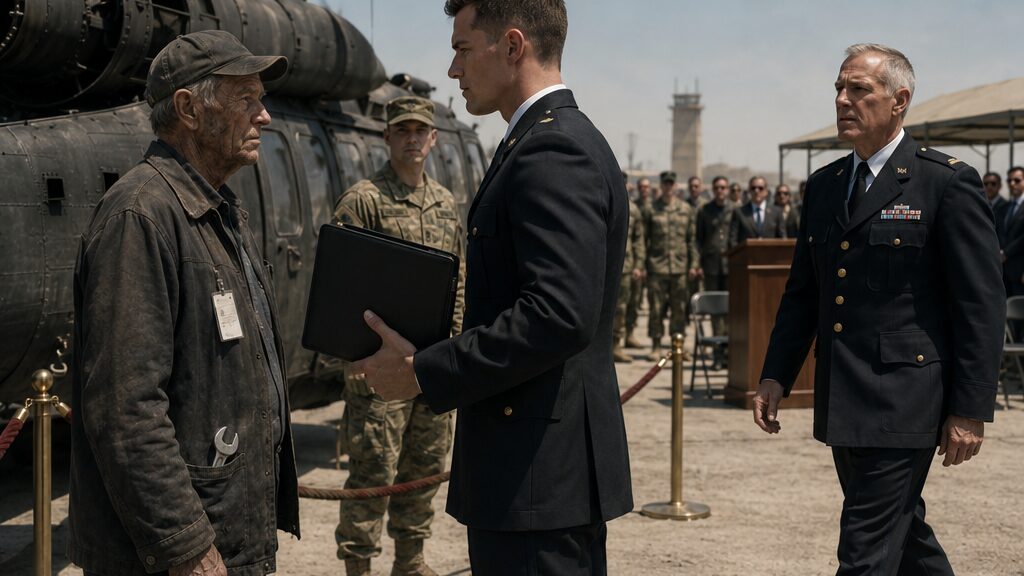
A young officer in a crisp uniform stepped from behind a row of chairs, a black folder tucked under one arm. His eyes dropped first to Raymond’s worn jacket, then to the old badge, then to the line Raymond had crossed by half a shoe.
“Sir,” the officer said, already moving toward him. “You can’t be here.”
Chapter 2: The Officer With The Black Folder
Timothy Lee had checked the ceremony route three times before eight in the morning and still did not trust it.
The tarmac was too open. The guest list had too many amendments. The public affairs officer kept changing seating labels. The helicopter crew had requested last-minute access to the display area, then the maintenance crew had asked to bring in a cart of old parts for the exhibit table. Every exception made the day feel less secure in Timothy’s hands.
And the base commander had been clear.
No mistakes today.
Timothy had heard those words as instruction. He had also heard the part no one said aloud: not from you.
He was young enough that senior officers still called him promising, which meant he was old enough to know the compliment had teeth. Promising officers could become trusted officers, or they could become cautionary stories. The line between the two was often no wider than a missed badge, a misplaced guest, a moment of hesitation in front of the wrong people.
So he kept the black ceremony folder under his arm like it was armor.
Inside were the access sheets, guest categories, seating maps, sequence notes, emergency contacts, and a printed photograph of every scheduled speaker. Timothy had organized the pages himself, tabbed them by color, and written in the margins where the public affairs officer had been vague. He had not slept much, but the folder was clean.
Clean mattered.
Order mattered.
Then he saw the old man standing too close to the aircraft.
At first Timothy thought maintenance had sent someone early. The man’s dark jacket hung loose at the shoulders. His cap was plain. His trousers had the flat, tired shape of clothes worn for function, not ceremony. He stood with the stillness of someone waiting to be told where to go, but his eyes were fixed on the helicopter in a way Timothy did not like.
Not curious. Familiar.
That was worse.
Timothy stepped around the first row of chairs, passing two enlisted soldiers aligning stanchions near the rope line. “Sir,” he called. “You can’t be here.”
The old man turned.
His face was lined deeply, the skin weathered by more than age. His eyes were calm, almost too calm. The visitor badge on his chest swung slightly in the wind.
“I was told to follow the cones,” the old man said.
“The cones lead to visitor staging. You’ve crossed into the restricted ceremony area.”
The old man looked down. One shoe did rest past the red painted line on the tarmac. He moved it back.
“Thank you,” he said.
The answer should have ended the matter. A confused visitor corrected, a minor issue resolved. But the old man did not leave. He remained near the rope, only feet from the helicopter’s open side door.
Timothy opened the folder. “Name?”
“Raymond Carter.”
Timothy turned to the guest list. Carter, Anna appeared under family guest. Carter, Raymond appeared on a secondary page, handwritten in blue ink, no seating assignment, no category mark. That was the kind of loose end Timothy hated.
“You’re with Anna Carter?”
“She brought me.”
“That doesn’t answer the category.”
The old man watched him quietly. “I don’t know what category they chose.”
Timothy looked up. “Sir, everyone on this tarmac has a category.”
The old man’s mouth moved slightly, not quite a smile. “That sounds like the Army.”
Timothy did not smile back.
A heat shimmer lifted from the concrete behind the helicopter. Farther off, an engine test coughed to life near the hangar, a low vibration rolling across the airfield. A group of ceremony guests had begun gathering near the canopy. Some wore dress uniforms. Some wore dark suits. A few turned their heads toward Timothy and the old man.
Timothy felt the attention before he saw it.
He lowered his voice. “Do you have current aircraft-area authorization?”
The old man touched the badge on his chest. “This is what they sent me through with.”
“That is a visitor pass, not aircraft authorization.”
“It used to be enough.”
Timothy’s eyes narrowed. There it was. The tone he had heard before from older men who thought age made rules optional. Men who remembered some earlier version of the base and expected the present to bend around it.
“This is not about what used to be enough,” Timothy said. “This is an active ceremony zone.”
“I understand.”
“Then you need to stand with the visitors until seating begins.”
“I need two minutes at the aircraft before that.”
“For what purpose?”
The old man’s right hand shifted toward his jacket pocket.
Timothy’s focus sharpened. “Sir, keep your hand visible.”
The hand stopped immediately.
The old man looked at him, and for the first time Timothy felt something other than irritation. Not fear exactly. Pressure. The old man’s eyes did not challenge him, but they did not submit either.
Slowly, the old man brought his hand away from the pocket. “There’s a wrench,” he said. “Small. Nothing else.”
“A wrench?”
“Yes.”
“Why are you carrying a wrench onto a secured tarmac?”
The old man did not answer quickly enough.
Timothy closed the folder halfway. “Sir, are you part of the maintenance crew?”
“No.”
“Were you asked to bring a tool?”
“In a manner of speaking.”
“That’s not an answer.”
“No,” the old man said. “It probably isn’t.”
The enlisted soldier nearest the rope glanced over. Timothy felt the glance like a hand on his back. Every second of this exchange made the tarmac less controlled.
He looked toward the canopy. The public affairs officer was checking the microphone. The first row of reserved seats had name cards clipped to the backs. The base commander had not arrived yet, which meant Timothy had no senior officer beside him to absorb a mistake. If he let an unauthorized man with a tool approach the aircraft and something went wrong, the responsibility would fall exactly where it should: on him.
“Sir,” Timothy said, “I’m going to ask you to move away from the aircraft.”
The old man’s gaze drifted once toward the helicopter.
Only once.
But Timothy caught it, and something about that look irritated him more than refusal would have. It was too personal, as if the old man had more right to the aircraft than the crew preparing it, more right than the commander scheduled to speak about it, more right than Timothy holding the list.
“This will only take a moment,” the old man said.
“No, sir. It won’t.”
The old man’s jaw tightened faintly.
Timothy softened his voice, but not his words. “I understand these events can be confusing. We have a designated area for guests who need assistance.”
The change in the old man was almost invisible. His shoulders remained steady. His hands did not move. But something went still behind his eyes, like a door closing without sound.
“I don’t need assistance,” he said.
Timothy heard the edge in it and mistook it for pride. “Then you should have no problem following instructions.”
The enlisted soldier looked away.
A few guests near the canopy had stopped pretending not to watch.
The old man nodded once. “What is your name, son?”
Timothy stiffened. “Lieutenant Timothy Lee.”
“Lieutenant Lee,” the old man said. “You can check the name again.”
“I have checked it.”
“Check the older list.”
“There is no older list in my folder.”
“I’m aware.”
The words landed quietly, but Timothy felt heat rise in his neck. He did not like being made to look unprepared by a man carrying an outdated badge and a wrench.
“Sir, I’m not going to debate access procedure with you in front of formation personnel.”
“I’m not debating.”
“Then step back.”
The old man stepped back.
Again, that should have ended it. Yet he remained facing the aircraft, not Timothy, and that small refusal to be embarrassed made Timothy feel as if he had lost ground instead of gained it.
A cart rattled behind them. Two maintenance workers pushed a covered display crate toward the exhibit table. Their uniforms were clean but practical, sleeves rolled, hands darkened from work. Timothy looked from them to Raymond’s jacket and made the simple decision that seemed obvious.
“If you’re waiting for someone from maintenance,” Timothy said, “you can stand with the maintenance people until we sort this out.”
The words carried farther than he intended.
One of the formation soldiers turned his head.
The old man looked at Timothy then, fully.
Not angry. That would have been easier. Anger could be managed, documented, contained. This was disappointment, and somehow it made Timothy feel younger than he was.
“I’m not ashamed to stand with maintenance,” the old man said.
“Good.”
“But that is not why I came.”
Timothy opened the black folder again, pretending to read because he needed something to do with his hands. “Until your status is verified, that’s where you’ll wait.”
The old man’s fingers touched the edge of the visitor badge, steadying it against the wind.
For one second, Timothy noticed the code printed beneath the cloudy plastic. Not a modern access string. Not a guest number. Four letters, a dash, and three faded digits.
RAVN-003.
The old man saw him notice.
Timothy looked away first. “This way, sir.”
Chapter 3: The Badge They Refused To Check
Raymond had stood in worse places than the maintenance line.
That was what he told himself as Timothy Lee guided him away from the rope, past the front row of ceremony chairs, past the podium with its polished microphone, past the soldiers pretending not to watch an old man being corrected in public.
He had waited in rain beside grounded aircraft. He had waited in hospital corridors for names no one wanted to say aloud. He had waited outside command tents while younger men with cleaner consciences argued about maps. Waiting did not trouble him.
Being mistaken did not trouble him much either.
Being handled carelessly in front of the aircraft did.
“Here,” Timothy said.
The maintenance crew stood near a rolling table covered with a blue cloth. A few old components had been arranged for display: a rotor fragment, a cracked instrument housing, a flight helmet with the visor down. The crew chief on duty gave Raymond a quick look, then looked to Timothy.
“Is he with us?”
“Pending verification,” Timothy said.
Raymond heard the phrase and almost admired its usefulness. It could mean anything. It could turn a man into a problem without calling him one.
“I’m with myself,” Raymond said.
The maintenance crew chief glanced at him, unsure whether to laugh. He did not.
Timothy turned back. “Sir, I need to see the badge again.”
Raymond unclipped it from his jacket and handed it over.
The plastic sleeve had grown warm from his chest. Timothy held it by the corner, as if age could rub off. He studied the photograph, then Raymond’s face, then the faded code.
“This picture is decades old.”
“Yes.”
“Why are you using a decades-old badge?”
“Because it was issued for that aircraft.”
Timothy’s eyes flicked to the helicopter. “This aircraft?”
Raymond said nothing.
“Sir.”
“Yes.”
“You understand how that sounds.”
“I understand many things about how things sound.”
Timothy exhaled through his nose. He opened the black folder and slid out the handwritten amendment page. “Your name appears here without category, seat, or escort assignment. That means I verify before granting access. That is my job.”
“It is.”
“Then help me do it.”
“I have.”
“No, you’ve given me an old badge, an unscannable invitation, and partial answers.”
Raymond accepted that because it was true enough from Timothy’s side. He had chosen partial answers. He had chosen an old jacket and the badge no one used anymore. He had chosen not to call Charles Moore ahead of time, not to let the base send a car, not to sit under a canopy while someone recited a version of history that left out the man he had come for.
Choices had costs.
He could feel Anna watching from beyond the guest area. She had finally made it through the gate and now stood near the outer chairs, her purse clutched in both hands. Even at a distance, Raymond could read the worry in the line of her mouth.
Timothy held up the badge. “This code doesn’t exist in the current system.”
“No.”
“Then what is it?”
“Original program access.”
The maintenance crew chief looked over more sharply this time.
Timothy noticed. His face tightened. “Original program access to what?”
Raymond’s eyes moved to the helicopter.
The aircraft sat in the sun with its side door open and a ceremonial rope across the step. Fresh placards had been installed near the display stand. Raymond could read the large print from where he stood: SERVICE. COURAGE. INNOVATION.
Fine words.
Too clean.
“What did you call it earlier?” Timothy asked.
Raymond looked back.
“When you came through,” Timothy said. “You said something.”
Raymond considered denying it. Not because he cared about being caught, but because names had weight. Some names did not belong in the mouths of people who had never heard them shouted through static.
“Raven Three,” he said.
The young enlisted soldier by the rope turned his head again. He was barely more than a boy, with sunburn at the edge of his collar and a face still learning how to hide curiosity.
Timothy frowned. “That’s not on the ceremony program.”
“It wouldn’t be.”
“Why?”
“Because the program was written after people started calling her by the safe name.”
The maintenance crew chief stepped closer. “Sir, how do you know about that call sign?”
Timothy lifted one hand slightly, stopping him. “I’m handling this.”
Raymond looked at the crew chief. “Panel twenty-two still sticks?”
The crew chief blinked. “What?”
Raymond pointed with two fingers, not toward the door, but low on the aircraft’s left side. “Lower hinge line. If they painted over it for the ceremony, it will look flush from ten feet. It isn’t. There’s a slight rise under the third fastener.”
The young enlisted soldier took one step without meaning to, eyes going to the aircraft.
Timothy’s voice sharpened. “Sir, do not point toward the aircraft.”
Raymond lowered his hand.
The crew chief stared at the helicopter, then back at Raymond. “That panel isn’t listed on the public display.”
“No,” Raymond said. “It wouldn’t be.”
Timothy closed the folder hard enough that the pages snapped. “This is exactly the issue. You know enough to sound convincing, but you are still not cleared.”
Raymond took the badge when Timothy pushed it back toward him. “Then check the name again.”
“I checked the name.”
“You checked the list in your folder.”
“That is the active list.”
“Then your active list is incomplete.”
A flush rose along Timothy’s cheekbones. He glanced toward the ceremony guests. More of them were looking now. Two soldiers in formation had shifted their eyes without moving their heads. The public affairs officer stood frozen near the microphone, pretending to adjust the stand.
Timothy stepped closer and lowered his voice, but Raymond heard the strain in it. “Sir, I am trying very hard to be respectful.”
Raymond clipped the badge back onto his jacket. “Try being accurate.”
The silence after that was not loud, but it spread.
Timothy’s expression changed. For the first time, anger broke through the polished surface. Not rage. Something more brittle. A young man who felt his control slipping and mistook the feeling for insult.
“Do you have any current identification proving aircraft access?” he asked.
“My invitation.”
“No scan code.”
“My badge.”
“Not current.”
“My name.”
“Not properly categorized.”
Raymond nodded. “Then I suppose you have your answer.”
Timothy looked at his jacket pocket. “And the wrench?”
Raymond’s hand covered it before he thought. The gesture was small, protective, and it was a mistake.
Timothy saw it.
“Remove it from your pocket, please.”
Raymond did not move.
“Sir.”
The maintenance crew chief shifted uneasily. The young enlisted soldier stared at the ground.
Raymond slowly reached into his pocket and withdrew the wrench.
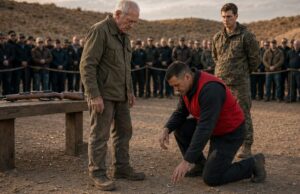
It was small, old, and darkened with use. The handle had been polished by someone’s hand over many years. A strip of worn tape circled the middle, and beneath the tape, barely visible, were two scratched initials.
Timothy held out his hand.
Raymond did not give it to him.
“It belongs to someone,” Raymond said.
“It is a tool in a restricted area.”
“It is not for use.”
“Then why bring it?”
Raymond looked at the helicopter. “Because I made a promise.”
Timothy’s mouth tightened. “To whom?”
Raymond closed his fingers around the wrench. “Someone not on your list.”
Again, the young enlisted soldier looked up.
Timothy turned slightly toward him. “Back to your position.”
The soldier obeyed, but his eyes lingered on Raymond for half a second too long.
Timothy spoke into his radio. “Control, this is Lee at ceremony staging. I need verification on an elderly male visitor, possible maintenance affiliation, carrying an unauthorized tool near the aircraft. Name Raymond Carter. Current status unknown.”
Raymond heard Anna say his name from behind the chairs.
He did not turn. If he turned, he might see the hurt on her face. If he saw it, he might give up the thing he had come to do, and he had not carried the wrench all these years to surrender at the edge of the tarmac.
The radio crackled. A voice asked for category.
Timothy looked at Raymond once, then answered, “Unknown maintenance visitor.”
Raymond closed his eyes.
For a moment, he was not on the tarmac. He was inside the old aircraft in winter dark, one hand braced against the frame, one voice in his headset laughing through fear, saying, If they forget the officers, sir, that’s history. If they forget the mechanics, that’s sin.
Raymond opened his eyes.
The helicopter waited in the sun, close enough to touch and still out of reach.
Chapter 4: The Promise Inside The Aircraft
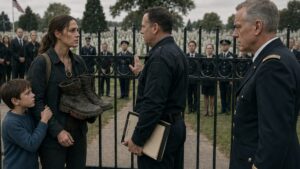
Anna Carter had watched men in uniform underestimate her father before, but never from this close and never while he let them.
She stood beyond the first row of chairs with her purse held against her stomach, the way she used to hold books in school when she wanted to disappear. The tarmac heat came up through the soles of her shoes. The canopy shade did not reach her. Around her, ceremony guests murmured in low voices, each of them pretending not to follow the old man being held near the maintenance table.
Her father looked smaller from a distance.
That frightened her more than the officer’s tone.
Raymond Carter had never been a large man in the way people imagined command. Even in his official portraits, he had looked lean and contained, with the unsmiling focus of a man who had already read the bad weather coming. But when Anna was young, rooms had changed around him. People had lowered their voices. Phones had been answered faster. Drivers had held doors. Young officers had stood straighter before he said a word.
Now a lieutenant half his age had placed him beside a display crate as if he were a misplaced tool.
Anna stepped out from behind the chairs.
“Dad.”
Raymond turned only when she reached him. His face softened, but not enough to hide the strain near his eyes.
“You should be seated,” he said.
“So should you.”
“I’m all right.”
“You’re not.”
Timothy Lee stood several yards away speaking into his radio, the black folder tucked under one arm. His shoulders were rigid. He kept glancing toward the guests, then toward the helicopter, then back at Raymond as if the old man might vanish into the aircraft if unwatched.
Anna lowered her voice. “Come with me. We can leave.”
Raymond looked at her for a long moment. “No.”
The answer was quiet, but Anna knew that tone. It was the same voice he had used when doctors told him to rest, when neighbors offered help with the gutters, when she asked him to move into a smaller place closer to her. It did not rise. It did not harden. It simply stood where it was.
“This is exactly what I was afraid of,” she said.
He glanced toward Timothy. “The lieutenant is doing what he thinks he was told to do.”
“He treated you like you wandered in from a bus stop.”
Raymond’s mouth tightened, not quite in pain and not quite in amusement. “I have waited at bus stops.”
“That isn’t the point.”
“No,” he said. “It isn’t.”
A gust of wind pushed dust along the tarmac. The blue cloth over the display table lifted at one corner, and the maintenance crew chief pressed it down with his palm. The small wrench remained in Raymond’s hand, partly hidden by his fingers.
Anna saw it and felt the old frustration rise.
“You brought it,” she said.
Raymond looked down. “Yes.”
“I asked you not to.”
“You asked me to think about not bringing it.”
“Dad.”
He turned the wrench once in his palm. The metal was dark, almost black in the grooves. The strip of tape around the handle had been replaced so many times that it looked like part of the tool itself. Anna had seen it in his desk drawer when she was a child, in a small wooden box with papers she was not allowed to touch. Later, after her mother died, she had found him sitting at the kitchen table with the wrench lying in front of him and a glass of water untouched beside his hand.
She had never asked enough. He had never offered enough.
“I don’t understand why it has to be today,” she said.
Raymond’s eyes went to the helicopter.
“Because after today, she becomes an exhibit.”
“She?”
He nodded toward the aircraft. “That machine carried men who were young when they climbed in and old when they climbed out. Some didn’t get the chance to grow old at all. A machine like that shouldn’t be retired with a clean story.”
Anna looked at the helicopter. To her, it was metal, paint, old rotors, ceremonial ribbons, and a crowd waiting to be moved by words already printed on note cards. To her father, it seemed to be a room filled with voices.
“You could have called ahead,” she said. “You could have told Commander Moore you were coming.”
“He knows I was invited.”
“But not like this.”
Raymond did not answer.
Anna folded her arms tighter. “You wore that jacket on purpose.”
The corner of his mouth moved faintly. “It’s a good jacket.”
“It makes them think you’re maintenance.”
“There are worse things to be mistaken for.”
“That’s not what I mean.”
“I know.”
She looked at the wrench again. “Whose was it?”
For a moment she thought he would refuse. His fingers closed around the handle, and the silence between them filled with aircraft noise from the far hangar.
Then he said, “The crew chief’s.”
Anna waited.
Raymond lifted the wrench slightly. “He kept this in his left sleeve pocket. Said issued tools walked away, but ugly tools stayed loyal.”
“What was his name?”
Raymond’s eyes stayed on the aircraft. “The ceremony program won’t say.”
“That isn’t what I asked.”
“No.”
“Dad.”
He drew a slow breath. “He was the reason Raven Three came home from her first winter test.”
Anna let the name settle. Raven Three. She had heard him say it earlier, almost under his breath. It had sounded less like a call sign than a prayer.
“What happened?” she asked.
Raymond looked past the rope line, past the podium, past the people setting up history in neat rows. “The official report said equipment deviation and command judgment preserved the aircraft.”
“And the truth?”
“The truth was a crew chief crawled into a space no one should have entered while rotors were still cycling down and found the failure before it killed the next crew.”
Anna felt the heat leave her hands. “Did he die?”
“No.”
The answer came too fast.
Raymond looked at the wrench. “But he paid.”
The maintenance crew chief nearby had stopped pretending not to listen. He kept his head turned away, but his hands were still on the blue cloth.
“Paid how?” Anna asked.
Raymond’s throat moved once. “He signed a statement taking responsibility for an unauthorized inspection. It kept the program from being shut down. It kept the pilots from being grounded under suspicion. It kept my order from becoming a hearing before men who had already decided what they wanted to believe.”
“And you let him?”
The words left her before she could soften them.
Raymond closed his eyes briefly.
Anna regretted it at once, but he did not rebuke her. He never rebuked her when she stepped on old wounds. He only absorbed the blow as if he had been expecting it.
“I was his commander,” he said. “Nothing happened under me that I did not carry.”
“That isn’t an answer.”
“It is the only one I have.”
Timothy’s radio crackled again. He turned away from them, speaking sharply now. The ceremony guests had grown restless. A public affairs officer checked a watch. Somewhere behind the hangar, an engine test flared and then settled into a low growl.
Anna stepped closer to her father. “You are seventy-eight years old. You do not owe a machine anything.”
“No.”
“You do not owe this base anything.”
His face changed then. Not much, but enough that she knew she had reached the wrong place.
“I don’t owe the base,” he said.
The wrench lay across his palm.
Anna understood before he finished.
“You owe him.”
Raymond nodded once.
Her anger thinned, leaving fear behind. “Then let me help you. Tell them who you are.”
“No.”
“Why?”
“Because if they open the gate for a general, they still haven’t learned why the gate should have been opened for an old man with a promise.”
“That sounds noble,” she said, and her voice cracked despite her effort. “It also sounds like punishment.”
Raymond looked at her then, fully. “Maybe.”
The honesty stopped her.
For years she had believed his silence was a wall he built to keep everyone out. Now, standing beside him on the tarmac, she saw it differently. It was not a wall. It was weight. He had been holding it in place with both hands for so long that he no longer knew how to set it down without hurting someone.
Timothy turned back toward them. “Mr. Carter.”
Raymond slipped the wrench into his pocket but kept his hand over it.
Before Timothy could continue, the maintenance crew chief spoke quietly.
“Sir,” he said, not to Timothy but to Raymond, “what did you call the aircraft?”
Timothy frowned. “That’s not relevant.”
The crew chief did not look away from Raymond. “Raven Three?”
Raymond’s eyes sharpened.
Behind the display table, near the open flap of the temporary museum tent, a woman in a navy blazer had paused with a stack of ceremony programs in her hands. Anna had noticed her earlier moving between the exhibit cases and the archive van, directing enlisted personnel with a quiet authority of her own.
The woman looked from Raymond to the helicopter.
Then she looked at his badge.
“Excuse me,” she said. “Did you say Raven Three?”
Raymond did not answer.
The woman lowered the programs slowly. “Where did you hear that name?”
Timothy stepped between them. “Ma’am, we’re handling a verification issue.”
But the woman was no longer listening to him. Her eyes had fixed on the faded code beneath Raymond’s badge sleeve.
RAVN-003.
Anna watched the woman’s face change.
Not recognition yet.
Alarm.
The woman turned and walked quickly toward the museum tent, the programs still clutched in one hand.
Chapter 5: The Photograph In The Base Archive
Margaret Lewis knew the smell of old military paper better than she knew the smell of her own kitchen.
It was dust, glue, aging ink, and cardboard warmed by bad storage. It lived in folders that had crossed oceans, in binders no one had opened since base names changed, in photographs that curled at the edges and tried to take the past with them. Most people came to the museum for polished artifacts: helmets under glass, restored aircraft panels, maps with clean arrows and simple captions.
Margaret trusted the boxes more.
Boxes admitted that memory was messy.
She entered the temporary archive room behind the exhibit tent and set the ceremony programs on a metal chair. The room had been made from a side office usually used for equipment storage. Two folding tables held labeled crates, a laptop, a portable scanner, and a stack of acid-free folders she had brought from the museum building before dawn. The air conditioner rattled in the wall and lost its battle against the heat every few minutes.
Raven Three.
She had not heard that name spoken aloud in years.
Not in the official tours. Not in the decommissioning script. Not in the glossy historical panel approved by public affairs. The aircraft’s formal designation appeared everywhere, followed by its decades of service, mission categories, modernization phases, and final assignment. The call sign Raven Three lived in older records, the ones written before public relations softened sharp edges.
Margaret opened the first crate and searched the tabbed folders.
Initial Test Program.
Winter Evaluation.
Incident Review.
Access Badges.
Her hand stopped.
Outside, through the canvas wall, the ceremony noise shifted: chairs scraping, voices gathering, a microphone squealing once before someone corrected it. Margaret ignored it. She lifted the Access Badges folder and carried it to the table.
The first page held a copied roster from the original aircraft program. Names. Codes. Branch assignments. Civilian support. Maintenance team. Command staff.
She ran her finger down the code column.
RAVN-001.
RAVN-002.
RAVN-003.
The name beside it made her stand still.
Carter, Raymond.
The title next to it was not “visitor.” It was not “maintenance.” It was not even the later rank she had seen in articles from the base archive.
Program Commander.
Margaret stared at the page until the letters stopped moving under her eyes.
Then she reached for the photo box.
A young enlisted soldier ducked into the room. “Ma’am?”
“Not now.”
“Lieutenant Lee wants to know if you have any record of an unknown maintenance visitor named Raymond Carter.”
Margaret looked up.
The soldier seemed to realize, too late, that he had stepped into something larger than an errand. His sunburned neck flushed.
“Say that again,” she said.
He swallowed. “Unknown maintenance visitor. Raymond Carter.”
Margaret closed the folder carefully, because anger made people careless and careless people damaged records.
“Tell Lieutenant Lee,” she said, “not to remove that man from the tarmac.”
The soldier hesitated. “Ma’am, he asked for verification.”
“He’s about to get it.”
The soldier left at a near-run.
Margaret pulled open the photo box. Inside were sleeves of black-and-white contact sheets, color prints from later decades, and several large photographs mounted on brittle backing. She had requested these for the exhibit but had been told to use only images already cleared for public display. The cleared images were beautiful and useless: aircraft in flight, crews saluting, commanders shaking hands, everyone arranged where history could behave.
She needed the one that did not behave.
She found it in the second sleeve.
The photograph had faded toward yellow. A helicopter sat behind a line of men in heavy jackets, its rotors blurred slightly from motion. Snow or sleet streaked across the frame. Near the left landing gear stood a younger Raymond Carter, lean-faced, dark-haired, wearing a field jacket rather than dress uniform. Beside him was a maintenance man with one hand on the aircraft’s panel and the other raised as if telling the photographer to hurry.
Margaret turned the print over.
The handwritten caption had bled slightly into the paper, but it was still legible.
Raven Three winter evaluation. Program Commander Raymond Carter with ground crew after panel failure inspection.
The maintenance man’s name appeared below in smaller script. The letters had been partly smudged, but enough remained for her to see that he had not appeared in the ceremony materials.
She set the photo down and reached for the incident file.
The public affairs officer pushed through the doorway, looking irritated. “Margaret, we’re three minutes from seating. Why did you pull programs?”
“Because they may be wrong.”
“They were approved.”
“That doesn’t make them right.”
The officer looked at the open folders, then at her. “Please don’t do this today.”
Margaret almost laughed. The plea was so tired, so familiar. Don’t complicate the event. Don’t disturb the donors. Don’t embarrass the command. Don’t introduce uncertainty after the plaques have been printed.
History, in her experience, was mostly people asking archivists not to do things today.
She opened the incident file.
Inside was a typed report, several maintenance notes, a command summary, and a handwritten page sealed in a plastic sleeve. The report used careful language: unauthorized inspection, procedural deviation, command discretion, no loss of aircraft, no casualty. The maintenance notes were more direct. Panel twenty-two misalignment. Hinge stress. Field correction. Manual override inaccessible from standard position.
At the bottom of one page, in old grease pencil, someone had written: Carter refused to let crew fly again until panel was opened.
Margaret looked back at the photograph.
The old man on the tarmac had pointed to that panel by touch.
The public affairs officer’s voice softened, but only because fear had entered it. “What exactly are you saying?”
“I’m saying the man Lieutenant Lee is calling an unknown maintenance visitor appears to be the founding program commander.”
“That’s not possible. The honored guest list—”
“Does not include him properly.”
“Commander Moore would know.”
“Then we should ask him.”
“He’s in transit from headquarters.”
Margaret picked up the photograph, the access roster, and the incident notes. “Call him.”
The officer did not move.
Margaret looked at him. “Now.”
Outside, a radio snapped and Timothy Lee’s voice came through someone’s speaker near the tent entrance.
“Control, Lee. If verification is inconclusive, I’m moving him outside the ceremony perimeter.”
Margaret’s hand tightened around the photograph.
The public affairs officer finally pulled out a phone, stepped aside, and began calling.
Margaret did not wait. She carried the documents out of the archive room and into the heat.
The tarmac brightness hit her eyes. She saw the helicopter first, then the maintenance table, then the old man standing quietly beside it with his daughter near his shoulder. Lieutenant Lee was in front of him, folder open again, posture stiff with authority borrowed from paper.
The young enlisted soldier reached Timothy before Margaret did and spoke quickly. Timothy’s head turned toward the archive tent, annoyed.
Margaret kept walking.
She was halfway across the staging area when the public affairs officer called after her, “Commander Moore is on the line.”
She stopped and took the phone.
The voice on the other end was clipped, moving, surrounded by the faint noise of a vehicle. “This is Moore.”
“Sir, Margaret Lewis, base museum archive.”
“Yes?”
She looked at the photograph in her hand, then at the old man near the helicopter.
“Sir,” she said, keeping her voice low, “the man on your tarmac is not maintenance.”
There was a short silence.
Margaret turned the photograph over and read the caption once, to be certain.
“He is Raymond Carter. Program Commander for Raven Three.”
The silence changed.
When Charles Moore spoke again, his voice had lost all impatience.
“Where is he standing?”
“Beside the maintenance display. Lieutenant Lee is preparing to remove him.”
“Do not let that happen.”
“Sir—”
“I’m two minutes out.”
Margaret looked toward the base road. In the distance, a dark command vehicle turned past the hangar and accelerated toward the tarmac.
On the phone, Charles Moore said, quieter now, “And Ms. Lewis?”
“Yes, sir?”
“If that is who you say it is, nobody touches him before I get there.”
Chapter 6: When The Commander Saluted First
Charles Moore saw the old man before the vehicle stopped moving.
At first there was only the shape of him: slight, dark-jacketed, standing near the maintenance table under the hard white sun. The tarmac shimmer blurred the edges of everything. Soldiers in formation held steady. Guests turned their heads. A lieutenant stood in front of the old man with a black folder, shoulders squared in the dangerous confidence of someone who did not yet understand the size of his mistake.
Then Charles saw the badge.
Even from a distance, even through yellowed plastic and glare, memory did what rank and age could not prevent. It carried him backward so fast his hand tightened on the door handle before the driver fully braked.
RAVN-003.
Charles stepped out.
The driver began to say something, but Charles was already walking.
The tarmac noise thinned around him. Helicopter crew near the rope line straightened. The public affairs officer froze beside the podium. Margaret Lewis stood near the archive tent with a photograph held against her chest. Timothy Lee turned toward him with visible relief, the kind a junior officer feels when command arrives to confirm his version of events.
Charles did not look at him yet.
He looked at Raymond Carter.
The old man had changed and not changed. The hair was gray now, the face lined deeper, the body narrowed by years and old injuries. The dress uniform was gone, replaced by a worn jacket and a visitor badge older than half the officers on the field. But the stillness was the same. Charles had seen that stillness once in a storm-lit operations room when everyone else was talking too loudly. He had been a junior officer then, too eager, too afraid to show it, holding a map upside down until Raymond Carter quietly turned it in his hands and said, The weather does not care how badly you want the mission.
Charles had never forgotten the humiliation.
He had also never forgotten the lesson.
Timothy stepped forward. “Sir, we have a verification issue. This individual—”
Charles passed him without stopping.
The words died.
Raymond watched him approach. No surprise showed on his face. No satisfaction either. Only a weary recognition, as if Charles were another item on a long list the day had finally brought due.
Charles stopped three paces away.
For a second, he was not the base commander. He was twenty-six again, rain-soaked, exhausted, standing beside a field radio while Carter decided which bad option might leave the most men alive.
Charles brought his heels together.
Then he saluted.
The tarmac went silent in layers.
First the maintenance crew. Then the soldiers nearest the rope. Then the guests under the canopy. Even the public affairs officer lowered the microphone cable he had been pretending to fix.
Raymond did not return the salute immediately.
His eyes moved over Charles’s uniform, the polished insignia, the command badge, the face of the young officer he had once corrected without raising his voice. Something like sadness passed through him, gone before most people could have named it.
Then Raymond raised his right hand and returned the salute.
It was slower than it would have been years ago. The angle was still exact.
Charles lowered his hand only after Raymond did.
“General Carter,” he said.
The words moved across the tarmac like wind through dry grass.
Timothy Lee went pale.
Raymond’s expression tightened faintly. “Charles.”
No title. No correction. No performance.
Charles felt the old habit of deference settle into him so naturally that it almost hurt. “Sir, I was not informed you had arrived.”
“I arrived quietly.”
“So I see.”
Timothy found his voice, thin and formal. “Sir, I wasn’t aware—”
Charles turned then.
The lieutenant stopped.
For a moment Charles saw himself in Timothy’s face: young, pressed, frightened of error, eager to prove that discipline meant never being fooled. It kept Charles from speaking as sharply as he wanted.
“What were you aware of, Lieutenant?” he asked.
Timothy swallowed. “The badge was outdated. The invitation didn’t scan. He was carrying a tool near the aircraft. His name wasn’t properly categorized.”
Raymond looked away toward the helicopter.
Charles heard the lesson hidden there before Raymond said anything. Timothy’s facts were not all false. That made the wrongness worse, not better. A man could stack accurate details into a cruel conclusion if he placed them badly enough.
Charles held out his hand. “The folder.”
Timothy handed it over.
Charles opened it, found the amended guest page, and saw the handwritten entry: Carter, Raymond. No category. No seat. No escort.
His jaw tightened.
This was not only Timothy’s failure. The institution had prepared a ceremony for memory and misplaced the living man who carried it.
Charles closed the folder. “Who entered this amendment?”
“The ceremony office, sir.”
“Who verified it?”
Timothy did not answer.
Charles looked at him until he did.
“I did, sir.”
“And when the badge did not match your current system?”
“I requested verification.”
“Under what category?”
Timothy’s eyes dropped. “Unknown maintenance visitor.”
The words sounded worse in the silence than they had over the radio.
Anna Carter stood near her father’s shoulder, one hand pressed against the strap of her purse. Charles recognized her from a family photograph on Raymond’s old office shelf, though the girl in that photograph had worn braids and a gap-toothed smile. Now she watched him with guarded anger, as if every uniform on the tarmac had become the same uniform.
Charles could not blame her.
Margaret approached and handed him the photograph and the copied access roster.
Charles looked down.
There they were in winter light: Raymond Carter with the aircraft behind him, younger but unmistakable; the crew around him; the old call sign marked on the back. Charles had seen versions of this image, but not this print. Not this caption. Not the maintenance man’s name written below Raymond’s.
He looked back at Raymond. “Sir, your original access code is still in the archive.”
Raymond touched the badge lightly. “That’s where it belongs.”
“It belongs wherever you choose to wear it.”
Raymond did not respond.
A murmur rose near the canopy, then died when Charles looked that way. He handed the folder back to Timothy, but kept the photograph.
“Lieutenant Lee,” he said.
“Yes, sir.”
“You will not move General Carter anywhere.”
“No, sir.”
“You will not refer to him as an unknown visitor again.”
Timothy’s throat worked. “No, sir.”
Raymond spoke then, quietly. “Commander.”
Charles turned back at once.
“That is enough.”
It was not a request.
Charles felt the rebuke, gentle as it was. He had been preparing to restore the hierarchy in the same public space where Timothy had broken courtesy. It would have been satisfying. It also would have made Raymond the instrument of Timothy’s embarrassment, and Raymond Carter had never spent authority that cheaply.
Charles lowered his voice. “Sir, I owe you an apology.”
“No,” Raymond said. “You owe me nothing yet.”
Yet.
The word landed between them.
Charles glanced toward the helicopter. “Then tell me what you need.”
Raymond’s hand went to his jacket pocket. This time no one told him to keep it visible. He drew out the small wrench.
Timothy saw it and looked as if the tool had changed weight before his eyes.
Raymond held it in his palm. “I came to put this where it should have gone years ago.”
Charles looked at the wrench, then at the photograph. The maintenance man beside the aircraft, hand on the panel, face half turned from the camera.
The missing name.
Charles understood part of it, not all. Enough to feel shame move from the present into the past.
“The ceremony is for the aircraft,” Charles said carefully. “And for the people who served with her.”
Raymond’s eyes stayed on the helicopter. “Not all of them.”
The public affairs officer shifted near the podium. Guests waited in rows of heat and silence. The soldiers remained at attention, though no one had ordered them to.
Charles stepped closer. “Sir, we can seat you in the front row. We can correct the introduction. I can delay the program.”
Raymond looked at him then.
The old authority was still there. Not in the badge, not in the title Charles had spoken, not in the stunned quiet around them. It was in the way Raymond Carter could make a man understand he had offered the wrong solution without insulting him.
“I did not come for a chair,” Raymond said.
Charles said nothing.
Raymond closed his hand around the wrench.
“I came for someone whose name is not on your program.”
Chapter 7: The Name Missing From The Ceremony
Raymond did not like the way everyone began making room for him.
It happened without an order. The soldiers nearest the rope shifted their boots back by a fraction. The maintenance crew chief stepped away from the display table. The public affairs officer moved aside as if the path to the podium had always belonged to Raymond and only now had the air remembered it.
That was the danger of titles. They rearranged rooms too quickly.
Charles Moore stood beside him with the photograph in one hand and Timothy Lee’s black folder in the other. The commander’s face remained controlled, but Raymond could see the anger under it. Not loud anger. Worse. The kind that began assigning responsibility.
“Sir,” Charles said, “we can delay five minutes. Ten, if needed.”
Raymond looked at the helicopter. Its open door had a ceremonial ribbon stretched across the step. Beyond it, inside the dim cabin, the old floor plates caught small patches of sun. He could almost see the winter mud ground into the edges, though he knew it had been cleaned a hundred times since.
“Delay it,” Raymond said.
Charles nodded to the public affairs officer, who hurried toward the podium.
A murmur moved through the guests. The microphone clicked.
“Ladies and gentlemen,” the officer said, voice too bright, “we’ll begin shortly. Thank you for your patience.”
Patience. Raymond nearly smiled at that.
Timothy stood two paces behind Charles, holding himself so rigidly that he looked younger than before. His eyes had not lifted fully since Charles spoke Raymond’s title. The folder had been taken from him, but he still held his hands as if it were there, as if his authority had left a shape in his fingers.
Raymond did not look at him long. Shame had its place. So did mercy. Neither one mattered yet.
Margaret Lewis approached with the archive folder held carefully against the wind. “General Carter,” she said.
Raymond turned his eyes to her. “Raymond is enough.”
She hesitated. “Sir, I found the access roster and the winter evaluation photograph.”
“I saw.”
“There’s also an incident file.”
The tarmac seemed to grow quieter around that sentence.
Raymond’s hand closed over the wrench in his pocket. “I know.”
Margaret lowered her voice. “The official ceremony panel uses the final service summary. It doesn’t include the crew chief’s name.”
“No.”
“It mentions a panel failure and command intervention.”
“Those are words.”
“Yes,” she said. “They are.”
Anna stood close enough that Raymond could feel her waiting, not pushing this time, only holding herself beside him. He could sense the questions in her body: the old accusation, the new understanding, the fear that he would take all the blame because taking blame had become easier than explaining it.
Charles opened the archive photograph again. “Sir, tell me what should be corrected.”
Raymond looked at him, then at the podium, then at the rows of soldiers who had been ordered there to honor a machine they mostly knew through prepared remarks. He thought of how easy it would be to let Charles fix the day in the way commanders fixed ceremonies. Add a paragraph. Change an introduction. Seat Raymond in the front row. Say his rank properly. Apologize. Move on.
That would make the room feel better.
It would not make the record true.
“Where is the display card?” Raymond asked.
Margaret led them to the table near the helicopter. A clear stand held the printed card under a protective sheet. It described the aircraft’s years of service, the modernization program, the final missions, the units that had flown it. At the bottom, in neat type, it thanked commanders, pilots, aircrew, and support personnel.
Support personnel.
Raymond read the phrase once.
Men could vanish inside a phrase like that.
Anna read it too. “That’s all?”
Margaret’s face tightened. “The short version, yes.”
“The short version is often the dishonest one,” Raymond said.
No one answered.
He took the wrench from his pocket and placed it on the blue cloth beside the card. The small tool looked poor and stubborn among the polished exhibit pieces.
Timothy’s gaze went to it immediately.
Raymond saw the movement and spoke without turning. “Lieutenant Lee.”
Timothy straightened. “Sir.”
“You asked me who it belonged to.”
“Yes, sir.”
Raymond looked at the wrench. “A crew chief who knew this aircraft better than any commander did.”
Timothy’s face colored, but Raymond did not stop.
“He found a defect during the winter evaluation. Not in a report. Not in a briefing. With his hand on the skin of the machine, in weather that made every joint stiff and every order late. He told me the aircraft was not ready to fly.”
Charles looked at the photograph. “And you grounded it.”
“I delayed the test.”
“That decision saved the crew?”
Raymond’s mouth tightened. “It saved the next crew.”
Anna’s eyes moved to him.
Raymond picked up the incident file from Margaret’s folder. The paper inside had aged to a dull cream color. His own signature appeared on the command summary. The crew chief’s statement sat behind it.
“He had entered the panel without authorization,” Raymond said. “That is what the report says.”
Margaret said quietly, “Was that true?”
Raymond looked at the aircraft. “He entered it because I looked at the weather, looked at the schedule, listened to men above me pressing for results, and told myself the vibration report could wait until after the flight.”
No one moved.
“The crew chief did not wait,” Raymond said. “He opened the panel, found the hinge stress, and stopped the aircraft from flying. Afterward, the program was under pressure. A failure before approval could have ended it. Men in offices wanted a clean answer.”
Anna’s voice was low. “So they blamed him.”
“He signed the statement.”
“Why?”
“Because if the aircraft was grounded by command error, the investigation widened. The program stopped. The crews attached to it scattered. The men who had built it lost years of work. He believed the machine was worth saving.”
“And you?” Anna asked.
Raymond did not avoid her eyes. “I let the statement stand.”
The hurt in her face was not simple. It was old and new at once, anger at him and grief for him and grief for someone she had never met.
Charles spoke with care. “Sir, you were under command pressure.”
“Yes.”
“You may not have had another option.”
“There is always another option,” Raymond said. “Sometimes a man is too tired, too proud, or too afraid to take it.”
Timothy lowered his eyes again. This time Raymond knew he was listening not as an officer defending himself, but as a man hearing a language he had almost learned too late.
Raymond touched the wrench. “The crew chief came to see me after the file closed. He did not ask me to reopen it. He did not ask for his name back. He said, ‘If they forget the officers, sir, that’s history. If they forget the mechanics, that’s sin.’”
Anna’s hand went to her mouth.
“I promised him,” Raymond said, “that if this aircraft ever stood in public as a proud thing, his name would stand with it.”
Margaret’s eyes shone, though her voice stayed steady. “What was his name?”
Raymond looked down at the incident file.
For all these years he had carried it privately, as if speaking it in the wrong room might cheapen it. But this was the room. This hot strip of concrete, this old aircraft, these young soldiers watching from formation, this lieutenant who had mistaken clothing for truth, this commander who had inherited an incomplete ceremony.
Raymond said the name.
The maintenance crew chief on duty removed his cap.
No one had told him to.
Charles turned to the public affairs officer. “Can the program be corrected before we begin?”
The officer looked overwhelmed. “The printed copies are already placed.”
“Then we correct it aloud.”
Raymond shook his head. “Not as an apology to me.”
Charles looked back.
Raymond turned toward Timothy. The young officer met his eyes at last.
“You made the call,” Raymond said.
Timothy swallowed. “Sir?”
“You called me an unknown maintenance visitor.”
Timothy’s face tightened as if struck.
Raymond’s voice remained even. “Before these soldiers, before these guests, before the people who heard you. If this correction is read, it should be read by someone who understands what was missed.”
Charles started to speak, then stopped.
Timothy looked at the podium. Then at the formation. Then at the wrench.
His hands were no longer shaped around the missing folder. They were open now, empty and uncertain.
“I can do that,” he said, though his voice nearly failed.
Raymond watched him for a moment. “Do not do it because I was a general.”
Timothy’s eyes lifted.
“Do it because he was maintenance,” Raymond said.
The words held him in place.
Then Timothy nodded once, turned toward the podium, and walked across the tarmac in front of the same soldiers who had watched him send Raymond to the maintenance line.
Chapter 8: The Wrench Beside The General’s Name
By late afternoon, the heat had softened, but the helicopter still held the sun.
It held everything, Raymond thought. Heat, oil, old voices, official words, forgotten hands. Machines remembered differently than people. They did not care who had signed the report. They held the mark of every tool that had opened them, every boot that had climbed in, every frightened palm pressed against the frame in bad weather.
The ceremony had not gone the way the program said it would.
Timothy Lee had stood at the podium with no folder in his hands. At first his voice had been formal and thin, but he did not rush. He read the aircraft’s service record. He corrected the missing name. He said the crew chief had identified the panel failure during winter evaluation and that his work had preserved the aircraft’s future service. He did not decorate the statement. He did not excuse the omission. When he reached the end, he looked once toward the maintenance table and said the name again, clearly.
Only then did he add Raymond’s.
Not as the center of the story. Not as a thunderclap. As the program commander who had returned to complete a promise made long ago.
Some people turned in their chairs. Some whispered when they saw the old man in the worn jacket standing beside the display instead of in the front row. Charles Moore had offered him the honored seat twice. Raymond had declined twice. On the third time, Charles had stopped asking and stood beside him instead.
That had been enough.
Now the guests had mostly drifted toward the reception hangar. The soldiers had been dismissed. A few lingered in small groups, speaking quietly around the display table. The public affairs officer was arranging for a corrected card to be printed. Margaret Lewis had already placed a temporary handwritten insert beneath the protective sheet, her script neat and dark.
The crew chief’s name stood below the aircraft’s service history.
Raymond stood before it for a long while.
Anna remained at his side.
“You never told Mom?” she asked.
The question did not accuse him. Not now.
Raymond shook his head. “Not all of it.”
“Why?”
“Because she knew when I was carrying something. She didn’t always need the shape of it.”
Anna looked at him. “I did.”
He closed his eyes once.
That was the kind of wound a man could not salute away.
“Yes,” he said. “You did.”
She nodded, but it hurt her. He could see that. It should have. Silence kept some promises and broke others. He had been slower to admit the second part.
Near the podium, Timothy stood alone with the black folder tucked under one arm again. It looked different now. Less like armor. More like paper.
Charles spoke with Margaret near the display case. The maintenance crew chief was beside them, offering practical suggestions about how to secure the wrench without damaging it. Life, Raymond thought, always returned to the hands of people who knew how things were actually held together.
“Dad,” Anna said.
He looked at her.
“Did you avoid these ceremonies because of him?”
Raymond touched the visitor badge on his jacket. The old plastic had caught dust along its bottom edge.
“Partly.”
“And the rest?”
He watched two young soldiers walk past the helicopter. One of them glanced toward him, hesitated as if deciding whether to salute, then chose not to when Raymond lowered his eyes. Good, Raymond thought.
“The rest was because command gets polished after it is over,” he said. “Men stand at podiums and make decisions sound cleaner than they were. I got tired of hearing survival turned into a speech.”
“You were part of the survival.”
“Yes.”
“You were also part of the hurt.”
Raymond nodded. “Yes.”
Anna took that in. Then, gently, she reached for his hand.
He let her.
Her fingers were warm. Stronger than he expected. Or perhaps he was weaker than he liked to admit.
“I’m glad you came,” she said.
Raymond looked back at the helicopter. “So am I.”
Charles approached with the maintenance crew chief and Margaret. Timothy followed several steps behind.
“Sir,” Charles said, “the case is ready.”
The display case stood beside the aircraft’s open door, newly cleared of one decorative plaque that had said little and taken up too much room. Inside lay the archive photograph, a copy of the corrected service text, and the incident summary with certain sensitive lines covered by a clean archival strip. Margaret had insisted that even temporary truth should be handled properly.
There was an empty cradle at the bottom for the wrench.
Raymond took the tool from the blue cloth.
For a moment the tarmac disappeared.
He was back in winter dark, wind cutting under his collar, aircraft skin slick with freezing rain. The crew chief was beside him, sleeves soaked, face gray with exhaustion and anger. Men were shouting near the hangar. Someone wanted the report now. Someone wanted blame before the coffee cooled.
The crew chief had pressed the wrench into Raymond’s hand.
Hold onto it, sir. You’ll remember better if it weighs something.
Raymond had almost given it back.
He had kept it for thirty-nine years.
Now the tool lay in his palm, small and ugly and loyal.
He placed it in the cradle.
No music rose. No one applauded. The only sound was the tarmac wind and the soft click of Margaret closing the case.
Raymond preferred it that way.
Charles stood very still. “The permanent display will be corrected before the aircraft moves to the museum.”
“See that it is,” Raymond said.
“I will.”
Raymond looked at him. “Not for me.”
Charles nodded. “For him. And for everyone under that line that said support personnel.”
The answer was good enough.
Timothy stepped forward then. His face had changed since morning. The confidence was not gone, but it had been stripped down to something that might one day become steadier.
“General Carter,” he said.
Raymond waited.
Timothy swallowed. “I owe you an apology.”
“You gave the correction.”
“That wasn’t the apology.”
Raymond said nothing.
Timothy looked at the badge, then the wrench inside the case, then finally at Raymond’s face. “I treated you like a problem because I couldn’t categorize you. I thought if the folder didn’t explain you, then you didn’t belong.” He stopped, jaw tightening. “I’m sorry. Not because of your rank. Because I should have treated you better before I knew it.”
The words were not smooth. That made Raymond trust them more.
He glanced at Charles, who wisely stayed silent.
“Lieutenant Lee,” Raymond said, “rules matter.”
“Yes, sir.”
“Security matters.”
“Yes, sir.”
“But a rule is not a place to hide from judgment.”
Timothy absorbed that without flinching.
Raymond unclipped the old visitor badge from his jacket. The plastic sleeve resisted at first, caught in the fabric. Anna helped free it, careful not to bend it. Raymond held it a moment, looking at the younger face sealed inside.
Then he handed it to Margaret.
“This belongs in the file,” he said.
Margaret accepted it with both hands. “Are you sure?”
“It did its last job.”
Timothy looked at the badge as it left Raymond’s hand. “Sir, may I ask something?”
Raymond turned.
“Why didn’t you say who you were?”
Anna looked away, as if she too had asked this question in too many forms.
Raymond considered the young man. He could have answered with pride. He could have answered with pain. He could have said that age made a man tired of proving himself to boys with folders, or that command meant nothing if it had to be shouted over courtesy.
Instead he looked toward the display case.
“Because if my name was the only thing that changed your mind,” he said, “then you would have learned the wrong lesson.”
Timothy’s eyes lowered.
Raymond softened his voice. “But you learned. That matters.”
The lieutenant nodded once, and Raymond saw the effort it took him not to excuse himself. That, too, mattered.
The sun slipped lower behind the hangar. Shadows from the rotor blades stretched across the tarmac like long hands. Guests were leaving now. The ceremony chairs stood unevenly, some empty programs fluttering on the seats. The aircraft no longer looked like a stage piece. It looked old again. Tired, scarred, and honest.
Raymond liked it better that way.
Anna took his arm as they began walking toward the visitor lane. Charles started to follow, but Raymond stopped him with a small shake of his head.
“No escort.”
Charles hesitated, then understood. He brought his heels together, but did not salute this time. He only bowed his head slightly, one commander to another, one man to another.
Raymond walked slowly. His back ached. His knees complained with each step. The old jacket hung loose on him, and the place where the badge had been clipped looked strangely bare.
At the edge of the tarmac, Anna glanced at him. “Are you all right?”
Raymond looked back once.
Through the open space beside the helicopter, he could see the display case catching the late light. The corrected card was temporary. The photograph was faded. The wrench was small enough that many visitors might miss it if they walked too quickly.
But it was there.
Beside the commander’s name. Beneath the aircraft’s history. Not hidden in a drawer. Not carried alone in an old man’s pocket.
Raymond breathed in the smell of dust and fuel and cooling metal.
“Yes,” he said.
And for the first time in years, the word felt almost true.
The story has ended.