The Young Officer Pinned a Small Gold Star Where the Old Sailor’s Memory Was Missing
Chapter 1: The Empty Mark on the Old Sailor’s Blazer
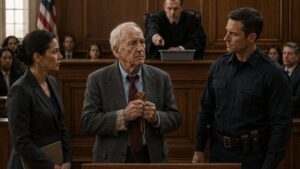
Richard Harris stopped walking when the ship came into view.
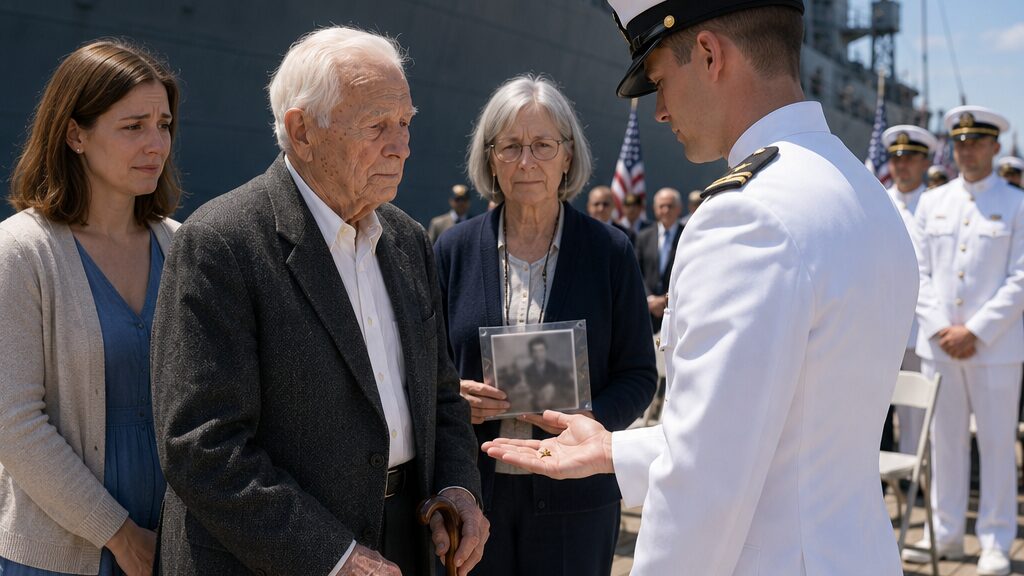
The cane in his right hand touched the wooden pier once, then stayed there, planted hard enough that the rubber tip flattened against the boards. Ahead of him, the gray hull rose above the water like a wall brought back from another lifetime. White uniforms moved along the rail. Flags snapped in the salt wind. Folding chairs had been lined in patient rows beneath a pale morning sky, and a brass bell near the ceremony platform had already been polished bright enough to catch the sun.
Ashley did not notice he had stopped until her hand reached for his elbow and found only the sleeve of his blazer pulled tight under her fingers.
“Grandpa?”
Richard looked at the ship’s name painted in black across the hull. He had seen it in the newspaper clipping Ashley brought to his kitchen table three weeks earlier. He had seen it on the invitation she printed in large type because she thought his eyes were the reason he kept pushing it away. He had seen it in dreams long before the Navy put fresh paint on steel and invited families to remember what official programs called courage.
The wind carried the smell of harbor water, diesel, rope, and hot coffee from a table near the guest check-in.
“Maybe we ought to let them start without us,” he said.
Ashley turned fully now. She was dressed too carefully for a pier, in a blue dress under a light jacket, with her hair pinned back in a way that told Richard she had tried to make the morning matter. She looked at the line of guests ahead of them, then at him.
“We just got here.”
“That’s no reason to stay.”
Her mouth tightened, not in anger, but in the way it did when she was trying not to sound worried. “You promised me ten minutes.”
“I promised to come down to the pier.”
“You knew what I meant.”
Richard shifted his weight before answering. The cane helped, but not enough. His left knee had been bothering him since before sunrise, and the old ache in his shoulder woke with the damp air. He did not mind pain he could name. It was the other kind, the kind already rising behind his ribs, that made him want to turn back.
At the check-in table, a pier security attendant waved the next guests forward. A few people in ceremony clothes moved around Richard and Ashley with the polite caution people gave old men when they feared a delay might become a fall. No one was unkind. That almost made it worse.
Ashley lowered her voice. “They saved us seats. I called twice.”
“You called twice?”
“I didn’t want them putting you in the back.”
Richard looked at her then. She meant it as love. He could hear that. She had spent the past year trying to pull him back toward the world by organizing things: doctor visits, church lunches, neighborhood barbecues, veterans’ breakfasts he never attended. She had mistaken a closed door for something that only needed a firmer hand on the knob.
“I can sit in the back,” he said.
“You shouldn’t have to.”
He did not tell her that the back was where he had survived most things.
A volunteer at the table smiled as they approached. “Good morning. Name?”
Ashley answered before Richard could. “Harris. Richard Harris. He’s a Navy veteran.”
The volunteer’s smile grew bright and official. “Thank you for your service, sir.”
Richard gave the small nod he had perfected over half a century. Not refusal. Not acceptance. A narrow passage between the two.
The volunteer checked a list, found his name, and lifted two paper programs. “We have reserved guest assistance seating just to the left of the platform. Someone can help escort—”
“I can walk,” Richard said.
Ashley’s fingers brushed his sleeve again. “Grandpa.”
“I can walk,” he repeated, softer.
The volunteer’s expression flickered with embarrassment. “Of course, sir. I only meant—”
“I know what you meant.”
He took the program because it gave his hand something to do. The paper trembled slightly until he pressed it against his blazer.
That was when Ashley noticed the mark.
It was small and almost invisible unless the light struck the fabric from the side: four tiny pinholes and a faint rubbed place on the left side of his dark blazer, above the heart. The cloth there had aged differently from the rest, as if something had protected it for years and then vanished.
Ashley touched the empty spot before thinking.
“What happened there?”
Richard moved the program over it. “Nothing.”
“That’s not nothing. Was something pinned there?”
“A long time ago.”
“What?”
He started forward. “A thing.”
She fell into step beside him, careful to match his pace though she was impatient by nature. “You wore this blazer for a reason.”
“I wore it because you said the brown one made me look like I was waiting for a bus.”
Despite herself, Ashley smiled a little. “It does.”
“There you go.”
But she kept glancing at the place under the program. Richard could feel her looking. He had almost worn a different coat. Then he had stood in front of the closet that morning and chosen this one because the invitation said shipboard memorial, and there were rules even if no one else knew them. A man did not stand before a ship in a cardigan.
They passed a display of old signal flags hung along a temporary rope near the pier rail. Their colors snapped and folded in the wind: red, yellow, blue, white. Children from a visiting school group pointed at them while a museum volunteer explained how sailors once talked across distance without speaking.
Richard slowed despite himself.
Ashley noticed. “Do you remember those?”
He looked at the flags, then at the ship. “You don’t remember flags. You read them.”
“What do they say?”
He did not answer. The flags on display were not arranged into any proper message, only decoration for people with cameras.
A young sailor near the ceremony platform called instructions to two others carrying a wreath. Beyond them, officers in white dress uniforms moved with the calm urgency of people trying to make remembrance happen on schedule.
A row of chairs sat to the left of the platform, marked with small reserved signs. Ashley guided him toward them. Richard saw the widows’ row near the front, saw the folded hands, the careful hats, the shoulders bent by years rather than age alone. He saw a place beside them and felt the pier boards tilt under his shoes.
“No,” he said.
Ashley stopped. “No what?”
“Not there.”
“They reserved—”
“Not there.”
His voice was still quiet, but something in it made her release his sleeve.
A few guests glanced their way, then looked off quickly. Richard hated that more than staring. The ceremony program bent in his hand. His cane tapped once against the pier, a small hard sound lost beneath the gulls and rigging.
Ashley leaned closer. “Tell me what’s wrong.”
“The ship is wrong.”
“What does that mean?”
“It means I shouldn’t have come.”
He turned as far as his knee would allow. Behind them, the exit gate stood open. Past it were the parking lot, Ashley’s car, the ordinary city streets, the kitchen table where his morning coffee would still be sitting cold because she had rushed him out before he could finish it. He could go home. He could hang the blazer back in the closet with the empty mark facing the wall.
Then a voice behind him said, “Sir?”
Richard did not turn at first. Ashley did.
A young Navy officer stood a few paces away in white dress uniform, one hand resting lightly against the folder tucked under his arm. He had the clean, composed face of a man trained to notice what was out of place without making anyone feel accused by it. His eyes moved from Richard’s cane to the program covering his blazer, then to Richard’s face.
“Are you Mr. Harris?” the officer asked.
Richard’s grip tightened around the cane.
Ashley answered. “Yes. This is my grandfather.”
The officer stepped closer, but not too close. “Lieutenant William Thompson. I’m assisting with today’s ceremony.”
Richard gave the same narrow nod he had given at check-in. “Lieutenant.”
William’s gaze dropped once, quickly, to the corner of the program where it no longer fully covered the faint empty mark.
When he looked back up, something in his expression had changed. The ceremony noise continued around them, chairs scraping and flags cracking in the wind, but the young officer seemed suddenly to be standing in a quieter place.
“Sir,” William said, “were you a signalman?”
Richard did not move.
Ashley looked from one man to the other. “Grandpa?”
Richard’s hand slid the program higher over his chest.
“Not anymore,” he said.
William did not smile. He did not thank him again. He only lowered his folder a fraction and gave Richard the full attention no one had given him since he stepped onto the pier.
“No, sir,” he said. “I suppose not.”
Chapter 2: The Officer Who Noticed What Was Missing
William Thompson had learned to spot disorder before it became visible to anyone else.
A loose rope. A missing chair in a reserved row. A microphone cable where an older guest might trip. The chaplain’s program printed in the wrong order. Two young sailors laughing too loudly near the widows’ row because no one had yet taught them the difference between being nervous and being careless.
He had been making corrections all morning without leaving a trace of himself behind. That was how a ceremony should work. If everything went well, no one remembered the person who moved the chairs.
Then Richard Harris looked at the signal flags.
It was not a glance of curiosity. William had seen plenty of those. Children looked at the flags like decorations. Guests looked at them like background for photographs. The museum volunteers looked at them with the pride of people who knew the script. Richard looked at them and became still, the way a man did when a voice called his name from another room.
William had checked the guest list earlier. Richard Harris was marked simply as Navy veteran, invited through family registration. No rank. No unit. No note requesting acknowledgment. The seating chart put him in guest assistance near the platform because Ashley Harris had asked for close access and minimal stairs.
But the empty mark on Richard’s blazer did not belong to a man who wanted assistance seating.
It was small, almost hidden under the program. Four pinholes and a pale pressure mark, the kind made by something worn often and removed unwillingly. William had seen old lapel pins, service pins, ship reunion badges. He had seen veterans wear their history in clusters. Richard wore absence.
“Signalman?” William asked.
The old man’s eyes narrowed, though his voice stayed even. “I said not anymore.”
“Yes, sir.”
Ashley looked uncertain. “He doesn’t talk about it much.”
Richard’s jaw tightened. “Because there isn’t much to say.”
William knew enough not to argue with that kind of sentence. It was rarely true, and never an invitation.
“Your seats are ready,” he said instead. “But if you prefer the rail for a moment, I can hold them.”
Ashley seemed relieved. “That would be kind.”
Richard did not thank him. He turned back toward the water, and Ashley followed, leaving William with the strange feeling that he had just stepped near something fragile without knowing whether he had protected it or disturbed it.
He walked toward the staging area, where a museum volunteer was arranging laminated photographs on a portable display table. The woman had silver hair cut at her chin, reading glasses hanging from a cord, and a stack of archival folders weighted by a brass paperweight shaped like an anchor.
“Lieutenant Thompson,” she called without looking up. “If anyone asks, the 1940s signal display is decorative. The flags do not spell anything. I’ve already had three people try to decode them.”
William glanced back. Richard still stood near the rail, cane planted, Ashley beside him with both hands around her program.
“Kathleen,” he said, “do we have photographs of signalmen from the old crew?”
Kathleen Johnson stopped aligning the folders. “That depends which old crew. Every reunion group thinks theirs is the old crew.”
“The one tied to today’s memorial.”
Her expression shifted from busy to attentive. “Why?”
William lowered his voice. “There’s a guest. Richard Harris. Navy veteran. He reacted to the flags.”
Kathleen set down a photograph. “Harris?”
“You know the name?”
“I know an R. Harris from one of the ship logs.” She opened the top folder, then another beneath it. “Signal division, temporary assignment during a recovery operation. But the file is thin. Some of the late additions never made it into the main roster.”
William watched her fingers move through photocopies, typed lists, scanned notes. The ceremony around them continued to assemble itself. Sailors carried the wreath into position. The sound technician tested the microphone with two soft taps. Guests took their seats. The ship loomed above it all, indifferent and exact.
Kathleen slid out a plastic sleeve. “Here.”
The photograph inside was blurred at the edges and creased across one corner. A line of young sailors stood near a rail, squinting in hard sunlight. Their faces had the open, unfinished quality of men not yet old enough to imagine being remembered. One of them, second from the left, wore a small star-shaped pin above his breast pocket. Another, half-turned as if someone had called his name, held a signal flag rolled under one arm.
Kathleen tapped the half-turned sailor. “This may be Harris. Hard to say. The notation on the back says ‘R.H., signal watch.’ No first name.”
William leaned closer. The young man in the photo had Richard’s long face before age had drawn it downward. Same guarded mouth. Same left shoulder slightly raised, as if bracing against wind or command.
“And the star?” William asked.
Kathleen adjusted her glasses. “Unofficial, I think. Some divisions used little pins among themselves. Watch teams, rescue teams, signal crews. Keepsake things. Not awards. More like belonging.”
William looked again at Richard across the pier. Ashley was speaking to him, but the old man seemed to be listening to the water.
“There’s a mark on his blazer,” William said. “Same size.”
Kathleen grew quiet.
“What?” he asked.
She turned the photograph over inside the sleeve and studied the back. “There was another sailor in this group. Not pictured clearly. The name is smudged on every copy I’ve seen. It became a problem for the exhibit because the memorial program names the ship and operation, but one crew notation doesn’t match the final roster.”
“Missing from the record?”
“Maybe misfiled. Maybe transferred. Maybe dead before the paperwork caught up. The Navy was not always neat with grief.”
William looked toward the ceremony platform. Dennis Roberts, the senior officer presiding over the event, had arrived and was speaking with the chaplain. In less than half an hour, everything would begin. There would be remarks, a bell, wreath placement, names read from an approved list.
“What does today’s program say about Harris?” William asked.
Kathleen checked another sheet. “Nothing. He’s not part of the formal recognition. Family guest.”
William felt the small discomfort of a schedule going wrong. The ceremony had been rehearsed. Every name had been cleared. Every movement assigned. He was not supposed to add meaning because an old man looked too long at flags.
But he kept seeing the empty mark.
“Do we have any of those stars?” he asked.
Kathleen blinked. “Originals? No.”
“Replicas?”
“For the educational display, yes. Brass-painted, mostly for children. They’re not official.”
“I’m not asking for official.”
Kathleen studied him for a moment. “Lieutenant.”
“I know.”
“People are sensitive about symbols.”
“I know that too.”
She opened a small wooden drawer beneath the display table. Inside were spare labels, ribbon pieces, brass clips, and three little star-shaped pins wrapped in tissue. They were simple, no larger than a dime, handmade for the museum’s signal exhibit. Not gold, not truly. Just polished enough to catch light.
William picked one up. It seemed too small to carry the charge he felt in it.
“That’s for children to pin on a card after the tour,” Kathleen said gently.
“Good,” William said. “Then it isn’t pretending to be anything else.”
A young sailor hurried up with a question about reserved seating. William answered, redirected him, and told another to move two chairs out of the sun. His voice stayed calm. His hands did not. He kept the small star closed in his palm until its points pressed into his skin.
When he looked back, Richard was no longer at the rail. Ashley had guided him toward the side seating, but he had stopped again near the display of flags. He was reading the colors now, even though they were not a message.
William walked toward him.
“Sir?”
Richard glanced at him. “Lieutenant.”
“I spoke with Ms. Johnson from the archive.”
Ashley straightened. “Is something wrong?”
“No, ma’am.”
Richard gave a dry sound that was not quite a laugh. “That usually means yes.”
William opened his hand. The little star lay in his palm, bright against the white glove he had removed and folded under his fingers.
Richard’s eyes went to it, and for the first time since William had met him, the old man seemed less guarded than struck.
“It isn’t official,” William said. “It isn’t an award. It isn’t a replacement for anything that was earned.”
Richard looked away. “Then you’d better put it back.”
William did not move. “Ms. Johnson found an old photograph. There was a sailor who wore one like this.”
Richard’s mouth hardened. “Lots of boys wore things.”
“Yes, sir.”
“Pictures lie by leaving out the part that matters.”
William absorbed that. He heard, beneath it, something too sharp to be irritation.
“What part did it leave out?” Ashley asked softly.
Richard turned on her with no anger, only exhaustion. “Ashley.”
The ceremony bell was tested once behind them. Its note carried over the pier and faded into the water.
Kathleen approached, holding the plastic-sleeved photograph. “Lieutenant,” she said quietly, but her eyes were on Richard. “There’s something else.”
Richard saw the photograph and took half a step back. His cane scraped against the pier boards.
Kathleen stopped at once. “I’m sorry.”
William looked from her to Richard. “What is it?”
Kathleen held the sleeve close to her chest as if suddenly aware that paper could bruise. “The old photo has one name missing from the record.”
Richard’s face did not change. That was how William knew the name was not missing to him.
Chapter 3: A Small Gold Star Before the Ceremony Began
The star in the young officer’s palm was too bright.
Richard had seen real gold turn dull in salt air. He had seen brass green at the edges. He had seen polished things made useless by smoke, seawater, and the trembling hands of boys who had never expected to hold anything heavier than a signal flag.
This little star had no weight at all. That was the trouble with it.
“It’s not mine,” Richard said.
William Thompson stood before him with his cap tucked under one arm and the small pin held carefully in his bare hand. Behind him, the ceremony had begun to gather its own rhythm: programs folding, chairs creaking, officers speaking in low voices, the chaplain checking the page from which he would read. Above them, the ship’s gray side threw a long shadow across the pier rail.
Ashley stood near Richard’s left side, close enough to help but no longer touching him. She had learned, in the last few minutes, that touching could feel like holding him in place.
“No, sir,” William said. “It isn’t.”
That answer unsettled Richard more than an argument would have.
Kathleen Johnson stood a few steps back with the photograph held at her side, turned inward so he would not have to see it unless he chose. Richard appreciated that. He resented that he appreciated it.
The young officer looked too new for the old kind of silence. His uniform was clean, his face smooth, his posture trained but not yet worn down by carrying orders he did not like. Richard wanted to dismiss him as a boy playing at reverence, except William had noticed the empty mark. People did not notice absence unless they had been taught to look.
“What do you want from me?” Richard asked.
William’s expression stayed steady. “Nothing.”
“Everybody wants something at these things.”
Ashley flinched, but William only nodded once, as if Richard had given a useful correction.
“I wanted to offer it,” he said. “That’s all.”
Richard stared at the pin. “Offer it for what?”
“For coming.”
“I didn’t come for you.”
“No, sir.”
“I didn’t come for the Navy either.”
William did not ask who he had come for. That was another point in his favor.
The wind shifted, and the flags along the display rope snapped sharply. Red, yellow, blue, white. Meaningless in their current order. Decoration. Richard’s eyes moved despite himself.
Ashley followed his gaze. “You said you read them.”
“Once.”
“What would they say if they were real?”
Richard swallowed. The answer rose before he could stop it. Hold position. Await signal. Do not leave.
He turned his face toward the water.
The morning light threw silver across the harbor, the same cruel brightness that memory always kept. He could still see a younger deck, slick and canted, men shouting through smoke, a signal lamp blinking through weather that had swallowed half the world. He could see a boy beside him with a grin too quick for fear and a small gold star pinned crooked because no one had told him it was crooked and Richard had not bothered to fix it.
The boy had been proud of it. Not because it meant bravery. Because it meant he belonged somewhere.
“Grandpa,” Ashley said.
Richard realized his hand had tightened so hard around the cane that his fingers ached.
William stepped slightly to one side, blocking the view of the chairs and the guests without making a show of it. “Sir, may I ask who had the first one?”
“No.”
The answer came too fast.
William lowered his hand. “Understood.”
That should have ended it. Richard could have nodded, taken his place at the edge of the ceremony, endured ten minutes, and gone home. He had survived harder things than kindness.
But Ashley was looking at him with confusion that had begun to soften into fear.
She had seen him angry at mail delays, stubborn about doctors, impatient with television anchors, quiet on holidays. She had not seen him afraid of a pin small enough to lose between two boards of the pier.
Richard hated himself a little for showing her.
“I gave it away,” he said.
Ashley’s eyes moved to the empty mark on his blazer. “Your star?”
“It was never much of a star.”
Kathleen’s hand tightened around the photograph sleeve.
William waited.
Richard wished the young officer would interrupt, or misunderstand, or say something official enough for him to dislike. Instead, William stood there with the plain patience of a man holding a door open without asking whether someone intended to pass through.
“It was from our signal watch,” Richard said. “A foolish little thing. Somebody’s uncle cut them out in a machine shop, I think. We wore them like we’d been knighted.”
Ashley gave a small, breathless smile, then lost it when she saw his face.
“There was another boy,” Richard said. “He wore his crooked. Always crooked.”
No one spoke.
“He was younger than he admitted. We all knew. He thought lying up made him sound like a man. His mother wrote letters with pressed flowers in them.” Richard looked at the star in William’s hand and felt the old deck move under him. “When it was over, there were families waiting for boxes and letters and men who could explain why the wrong sons came home.”
Ashley’s eyes shone, but she held still.
“I had nothing to give his mother,” Richard said. “Nothing that made sense. So I gave her mine.”
“The star,” Ashley whispered.
Richard nodded once.
William looked down at the little pin in his palm. “Then this one isn’t to replace that.”
Richard looked at him sharply.
“It couldn’t,” William said. “And I wouldn’t ask it to.”
The ceremony microphone gave a soft hum. Dennis Roberts had taken his place near the platform. A few guests turned to watch the delay at the rail. Richard felt attention gathering, the very thing he had come to avoid.
He shifted the cane and stepped back. “Lieutenant, I appreciate the thought.”
William understood the refusal. Richard saw it in his face. But the young officer did not retreat.
“My grandfather never served,” William said. “He fixed fishing boats in Maine. He used to say a repair only matters if you know what broke. I don’t know what broke here, Mr. Harris. Not all of it. But I know something was carried a long time.”
Richard said nothing.
“This is not an award,” William continued. “It isn’t from the Navy. It isn’t for display. It’s a thank-you for carrying what nobody else saw.”
The words were simple enough that Richard could not defend himself from them.
Ashley turned away briefly and pressed her fingers beneath one eye.
Richard looked at the ship, at the flags, at the chairs, at the old widows waiting in the front row, at Kathleen holding a photograph that had not known how to keep all its names. He looked last at the star.
His voice, when it came, was almost too low for anyone but William to hear. “You pin that on me, people will think they know what it means.”
“Yes, sir.”
“They won’t.”
“No, sir.”
Richard let out a breath. “And you’re still asking?”
William met his eyes. “I’m asking whether you’ll let one person mean it correctly.”
The cane tip pressed against the pier. Richard felt Ashley beside him, not pushing now. Waiting. That was new.
He took the program from his chest and lowered it.
The empty mark showed in the sunlight: four old pinholes, a faint square of preserved cloth, a small absence where time had been less weathered. William stepped forward with the care of someone approaching a folded flag. He placed the star against the mark but did not push the pin through.
“Here?” he asked.
Richard closed his eyes for one second.
The boy in memory laughed with the star crooked above his pocket. The boy said he would fix it later. The boy never got later.
“Straight,” Richard said.
William adjusted it by the width of a breath.
Richard opened his eyes. “Now.”
The pin slid through the old fabric. Richard felt the tiny pressure against his chest as if the point had gone much deeper. William fastened the clasp, then stepped back.
For a moment, no one moved.
The star caught the morning sun. It was too new, too clean, too small. It looked nothing like the one Richard had given to a mother whose hands shook so badly he had closed her fingers around it himself. Yet it sat over the old mark as if the blazer had been waiting, not for the same thing to return, but for someone to admit something had been gone.
William offered his hand.
Richard looked at it for a long moment before taking it. The young officer’s grip was firm but not strong for show. Richard gave one careful shake. Around them, the ceremony noise thinned into a pocket of silence.
“Thank you, sir,” William said.
Richard nearly told him not to. He had told many people not to. Not because gratitude offended him, but because it always arrived too wide, covering things it could not possibly know.
This was different. Smaller. More dangerous.
He released William’s hand and touched the star with two fingers.
“The first one belonged to someone else by the end,” he said.
William did not ask. Ashley did not ask. Even Kathleen lowered her eyes.
Richard looked toward the ship, and the sunlight blurred for a moment along the rail.
“The boy who deserved it never got old enough to wear one.”
Chapter 4: The Name Richard Would Not Say Aloud
Ashley had always thought silence meant refusal.
Her grandfather had built most of her childhood out of short answers. Yes, if she asked whether he wanted coffee. No, if she asked whether he needed help. Later, when she was old enough to drive him to appointments, he developed a third kind of answer: a look toward the window that meant the subject had been closed before she opened it.
She had mistaken that for stubbornness because stubbornness was easier to love.
Inside the pier museum room, with the door half closed against the ceremony noise outside, Ashley watched him sit at a small table beneath framed photographs of ships and crews and realized his silence had weight. It did not block feeling. It held it upright.
Richard sat with his cane leaning against the chair beside him and both hands folded over the head of it, though he no longer needed it while seated. The new gold star caught a pale stripe of light from the high window. It looked almost too cheerful against his dark blazer.
Kathleen Johnson placed the old photograph on the table between them, still inside its clear sleeve.
“You don’t have to look at it,” she said.
Richard gave a faint breath through his nose. “Then why put it there?”
“So you know I’m not hiding it.”
He studied her for a moment. “Archivists always think paper is mercy.”
Kathleen accepted that without defense. “Sometimes paper is only paper.”
Ashley stood behind an empty chair, unsure whether to sit. William had returned to the pier to answer a call from Dennis Roberts about the ceremony delay. Before leaving, he had looked once at Richard, as if asking permission to carry the moment outside. Richard had not given it. William had gone anyway, but gently.
The museum room smelled of old varnish, dust, and coffee cooling in a paper cup. Through the wall came the muffled movement of guests taking seats. Ashley could hear someone testing a microphone again, then a low wave of voices.
“We should go back,” Richard said.
Ashley almost laughed. Ten minutes ago he had wanted to leave. Now he wanted the ceremony because the room was worse.
“They can wait a few minutes,” she said.
“For what?”
“For you.”
He turned his eyes on her. “Don’t start.”
The old phrase, familiar and sharp, would once have made her step back. Today it sounded tired.
“I’m not starting anything,” she said. “I’m trying to understand why that little star made you look like someone opened a door you nailed shut.”
Richard’s hand tightened on the cane head.
Kathleen lowered herself into the chair opposite him. She moved slowly, not because she was old, but because she knew speed could feel like pressure. “Mr. Harris, the ceremony program includes the recovery operation and the ship’s service period. It names officers. It names the men lost from the primary roster. But there’s an annotation in one of the supplemental logs. A signal watch notation. One sailor appears in the watch record, then nowhere else.”
Richard’s gaze dropped to the plastic sleeve.
Ashley finally sat. “Is that the boy?”
Richard did not answer.
Kathleen turned the photograph so it faced him. “The back says R.H., signal watch, and one other initial we can’t read. There’s a smear where the last name should be.”
Richard’s face changed very little, but Ashley saw the small motion at the corner of his mouth, as if he had tasted something bitter.
“Paper gets wet,” he said.
“In the archive copy, yes.”
“Not just paper.”
Kathleen looked down.
Ashley sat very still. Outside, a bell rang once, then stopped. Not the ceremony bell this time, only someone moving it, but Richard’s shoulders rose as if bracing for impact.
“Grandpa,” she said, “what was his name?”
He stared at the photograph. The young men in it were all nearly the same age to Ashley, though she knew Richard would say there were differences that mattered. One had his cap tilted back. One stood too straight. One looked half-ready to laugh. The half-turned one Kathleen believed was Richard seemed not to trust the camera.
Richard touched the edge of the sleeve but did not pull it closer.
“Names are not decorations,” he said.
“No one said they were.”
“They become decorations. On walls. In speeches. Printed wrong on programs by people who never had to hear them called in the dark.”
Ashley felt her throat tighten. “Then tell me so I don’t get it wrong.”
He looked at her then, and for a moment she saw not anger, not even grief, but a kind of alarm. As if she had stepped too close to a rail in high wind.
“You think you want that,” he said.
“I do.”
“You want the clean part. A name. A sad thing. A reason to put your hand over mine and say you’re sorry.”
The words stung because they were close enough to something true. Ashley looked down at her program, folded once across her lap.
“I wanted today to help you,” she said.
“I know.”
“I thought if people thanked you—”
“They have thanked me all my life for things they don’t know.”
He was not harsh. That made it harder.
Kathleen rested both hands flat on the table. “Mr. Harris, I don’t need the name for the ceremony if you don’t want it spoken today. But if the record is wrong, someone should know.”
Richard’s eyes stayed on the photo. “He was not supposed to be on that watch.”
Ashley looked up.
“He traded,” Richard said. “Another boy was sick. Fever. Shaking so bad he couldn’t tie his own laces. The officer of the watch didn’t want to hear about it, so we fixed it among ourselves. Boys think fixing a thing means moving it where no one sees.”
He stopped.
Ashley did not breathe.
“The weather came fast,” Richard continued. “Faster than they told us it could. We were running signals between ships because the radio was bad, then worse. Lamps, flags, hands, guesses. Everything gray. Everything wet. You couldn’t tell where the water stopped and the sky began.”
His fingers moved over the cane head, thumb following a groove worn by years.
“The boy with the crooked star was next to me. He kept saying he could see the other light. I told him he couldn’t. He said he could. Then the deck went sideways.”
Kathleen closed her eyes briefly.
Ashley wanted to reach for him, but the memory seemed to surround him so completely that touching him would be like grabbing a man underwater.
“When it settled, he was pinned.” Richard’s voice had gone flat, stripped of anything that might invite comfort. “Not badly enough to kill him right away. Badly enough that we both knew.”
The room held still around them.
“He asked whether his mother would know he stayed at his post. That was what he asked me. Not whether he’d live. Not whether help was coming. He asked if his mother would know he didn’t run.”
Richard looked at Ashley, and now there was something almost pleading beneath the restraint.
“I told him yes.”
Ashley’s eyes burned. “Did she?”
Richard’s gaze returned to the photograph. “I went to see her after. I had a letter from the chaplain and a box with nothing in it that smelled like him. I told her he was brave. I gave her my star because his had gone with his jacket. I thought that would make the promise true.”
“And did it?” Ashley asked.
He shook his head once. “She asked me his last words.”
Ashley’s chest tightened.
“I gave her the brave part,” he said. “Not the scared part.”
Kathleen’s voice was low. “Being scared doesn’t make him less brave.”
Richard looked at her as if she had said something kind and useless.
“He was seventeen,” he said.
Ashley felt the word move through the room like cold water.
“You said he lied about his age,” she whispered.
“We all lied about something.”
“What was his name?”
Richard’s hand covered the star before he seemed to realize it. His palm hid the small bright points completely.
He looked toward the closed door. Outside, the ceremony guests had grown quieter. The official world was waiting.
“No,” he said.
Ashley drew back, not from anger this time but from recognition. He was not withholding a story to punish her. He was guarding the last place where the boy had not yet been turned into a line.
Kathleen reached for the folder beside her. “There may be another issue.”
Richard’s eyes sharpened.
“I didn’t want to raise it until I checked, but the sealed notation in the supplemental archive says the watch trade was later reviewed. It suggests the boy wasn’t unauthorized. Someone approved the change after the fact.”
Richard’s face went still.
Kathleen opened the folder and removed a copied sheet covered with faded type and a dark diagonal stamp. She did not slide it toward him yet.
Richard’s voice dropped. “That’s not possible.”
“It’s signed by an officer from the recovery board.”
“No.”
Ashley looked between them. “What does that mean?”
Kathleen hesitated. “It means Mr. Harris may have spent many years believing the boy was on that watch because of an informal trade. But the notation says the transfer was entered into the duty record before the storm hit.”
Richard pushed his chair back an inch. The cane slipped and struck the floor.
Ashley caught it before it fell.
For the first time all morning, Richard looked less like a man refusing memory than a man watching memory refuse him.
Chapter 5: The Ceremony Remembered Ships but Not the Promise
By the time Richard returned to the pier, the ceremony had already begun without him.
No one had announced the delay. No one had said the old man in the dark blazer was the reason the first remarks came three minutes late or that a young officer had stepped away from the seating chart with a handmade star in his palm. The Navy knew how to smooth the edges of human interruption. The microphone was clear. The flags moved on schedule. The wreath waited under the hands of two sailors standing straight enough to make their shoulders ache.
Richard took the side aisle with Ashley walking beside him and Kathleen a few steps behind. William saw them from near the platform and turned his head just enough to show he had noticed, not enough to draw attention.
That was a kindness too.
The star on Richard’s blazer felt heavier now that Kathleen’s paper had unsettled the old shape of guilt. He had spent decades carrying the memory in one arrangement: a sick boy in one bunk, a younger boy taking his watch, a storm, a promise, a mother’s hands, a star transferred from survivor to grief. He had hated himself for not stopping the trade. Hated himself for giving the mother only the clean part. Hated himself for letting ceremonies speak around the boy because the truth seemed too tangled and too small for official programs.
Now a sealed notation said the boy had been assigned.
Not a stolen place. Not a hidden mistake. Not boys fixing a thing in the dark.
Richard did not know whether relief or anger was the worse betrayal.
Ashley guided him to the reserved chair at the left of the platform, but he remained standing until the chaplain’s opening prayer ended. His knee pulsed. His fingers had gone stiff around the cane. When he finally sat, he placed the cane upright between his shoes and held it there like a mast.
Dennis Roberts stood at the lectern in white uniform, his face solemn beneath the brim of his cap. Behind him, the ship’s rail cut a clean line against the sky.
“We gather today,” Dennis said, “not to glorify loss, but to remember service. Ships are steel, wood, wire, and work. But memory belongs to people.”
Richard almost smiled at the sentence, but it failed before reaching his mouth.
Memory belonged to people, yes. That was why people made such a mess of it.
Ashley leaned close. “Are you all right?”
He kept his eyes on the platform. “That question has never improved anything.”
She sat back, but her shoulder remained near his.
A Navy chaplain read from a prepared page. Dates. Waters. Names of ships involved. Weather conditions described with the gentleness of official language. Challenging seas. Limited visibility. Loss of communication. Rescue efforts.
Richard listened and felt the old deck beneath each phrase.
Limited visibility meant a signal lamp disappearing between walls of rain.
Loss of communication meant men shouting into wind until their voices ripped.
Rescue efforts meant hands slipping from hands, ropes thrown too late, a boy asking about his mother while metal groaned around his legs.
The program in Richard’s lap listed names in neat columns. He had scanned it earlier and found none of the missing letters that had lived in his head longer than most of the living had known him. He did not need the name printed to remember it. That was not the wound.
The wound was hearing the ship remembered whole while one frightened boy remained split in two: brave enough for his mother, scared enough for Richard, absent enough for paper.
William approached during a musical pause and crouched slightly beside Richard’s chair, keeping his voice below the sound of a hymn played softly through the speakers.
“Sir, Captain Roberts asked whether you’d be willing to meet him after the wreath placement.”
Richard looked at him. “You told him?”
“I told him there may be a record correction. I didn’t tell him the part that belongs to you.”
Richard studied the young officer’s face. “You always choose words that carefully?”
“Today I’m trying to.”
A gull cried overhead. One of the widows in the front row dabbed at her eye with a folded handkerchief.
Richard touched the star. “That paper Kathleen found. You saw it?”
“Yes, sir.”
“What did you make of it?”
William did not answer quickly. “That a man can be wrong about the reason something happened and still be right about what it cost.”
Richard looked away.
On the platform, Dennis invited the two sailors forward with the wreath. They moved in step, young faces solemn, gloves bright against the dark greenery. The wreath was lowered near the rail where it would later be carried to the water. The crowd rose.
Ashley reached for Richard’s elbow. He waved her off, then regretted the sharpness of it when her hand withdrew.
He stood slowly. His knee resisted. The cane tapped once against the deck, louder in his ear than the music, louder than the gulls, louder than the ship sounds around him.
The gold star caught sunlight as he straightened.
Across the platform, William saw it. So did Dennis Roberts.
For one second, Richard was aware of eyes moving toward him. Not many. A few. Enough. The old panic rose: people mistaking a symbol for a story, gratitude widening into something that flattened the dead.
But William had not said, This is for your service.
He had said, for carrying what nobody else saw.
Richard’s breath steadied.
The chaplain read the names on the official list. Each one was followed by the small ringing of the bell. A clean sound. A final sound. A sound that pretended each life could be held in one note.
Richard counted them.
The boy’s name did not come.
Of course it did not. The sealed notation had been found too late. The program had already been printed. The official list had already been approved. Ceremonies were machines built before grief arrived.
Ashley’s hand appeared near his sleeve but did not touch. “Grandpa,” she whispered, “we can talk to them after.”
After. Later. Privately. Correct the record. Add a line. Send an email. Place the truth where it would not disturb the order of chairs.
Richard had wanted that all morning. He had wanted to pass through unnoticed. He had wanted to leave the past undisturbed because disturbed things did not return neatly to their boxes.
The bell rang for the last printed name.
Silence followed.
Dennis Roberts returned to the lectern. “Before we close, we acknowledge all whose labor and sacrifice supported the recovery effort, including those whose names were not preserved with the care they deserved.”
It was a good sentence. Respectful. Broad enough to include everyone and therefore almost no one.
Richard felt the star against his chest.
Not a replacement. Not an award. A thank-you for carrying what nobody else saw.
He looked toward Kathleen. She stood near the side of the platform, the folder held against her ribs. Her face was attentive, not urging.
Then he looked at Ashley. His granddaughter’s eyes were wet, but she was not asking him to be brave in a way that comforted her. She was only there.
Richard sat back down.
The motion surprised even him.
Ashley blinked. “Grandpa?”
“Not here,” he said.
Her face fell for a moment before she caught herself. “Okay.”
He heard the disappointment she tried to hide. He could have let her keep it. He had let people misunderstand him for less.
Then he added, “Not like that.”
She turned to him.
Richard kept his gaze on the ship. “A name shouldn’t be squeezed between closing remarks and parking instructions.”
Ashley’s breath shifted.
William came again after the final hymn, as guests began to rise and speak in soft voices. He did not ask the question in public. He only said, “Captain Roberts can meet you by the rail.”
Richard nodded.
The walk took longer than it should have. Guests parted gently. Some looked at the star, some at the cane, some at the old man’s face. Richard kept moving.
Dennis Roberts waited near the rail with his cap under one arm. Up close, he looked less like a ceremony and more like a man trying to stand correctly inside one.
“Mr. Harris,” Dennis said. “Lieutenant Thompson told me there may be a name we failed to include.”
Richard looked past him to the water.
“Failed is a heavy word,” he said.
“Yes, sir. It is.”
Kathleen stepped forward with the folder. “The notation should be reviewed formally, but I believe there is enough to open a correction.”
Dennis nodded. “We can handle that privately and make sure it is done properly.”
Richard’s fingers moved over the cane head.
Privately. Properly. The words had comfort in them. They also had hiding.
Dennis seemed to understand the struggle before Richard answered. “Or,” he said, quieter, “if you want the name spoken today, we can do that without turning it into a performance.”
Richard looked at him then.
The crowd behind them continued to thin. Chairs scraped. Programs folded. A child asked a question and was hushed. The ship remained, gray and patient, holding sunlight on its rail.
Dennis did not lean in. “Your choice, Mr. Harris. Corrected privately or spoken aloud.”
Richard touched the gold star once.
For most of his life, he had believed the choice had already been made by weather, paperwork, and fear.
Now everyone waited as if he still had one.
Chapter 6: The Salute Came After the Old Sailor Chose to Stand
Richard asked them to wait until the chairs were almost empty.
Dennis Roberts did not argue. William Thompson did not hurry him. Kathleen Johnson stayed near the museum table with the folder held flat in both hands, as if the paper inside had become less an archive than a small fragile passenger. Ashley stood beside Richard without offering her arm, though he knew she wanted to.
The crowd loosened slowly. Some guests went toward the parking lot. Some lingered by the ship rail, taking photographs in the bright late-afternoon light. The widows’ row emptied last. One woman paused near Richard, looked at the star on his blazer, and gave him a nod so slight it might have been meant only for herself.
He returned it.
When the pier grew quiet enough for water sounds to be heard between voices, Dennis approached.
“We can do this here,” he said. “No microphone.”
Richard looked toward the lectern. “Good.”
“No announcement.”
“Better.”
“Only the people already involved.”
Richard’s mouth moved faintly. “That sounds almost sensible.”
A small smile touched Dennis’s face and vanished.
William stood to the side, cap tucked beneath his arm, the sun bright along the edge of his white sleeve. He looked younger now that the formal ceremony had passed. Or maybe Richard was only seeing him without the shield of schedule.
Kathleen came forward with the notation. “Mr. Harris, you don’t have to read it.”
“I know what paper says now,” Richard said. “I need to say what paper doesn’t.”
Ashley looked at him. “Do you want me to stand back?”
“No.”
The answer surprised them both.
She moved closer, not touching. Richard set his cane in front of him and used it to rise from the chair. His knee caught halfway. William shifted as if to help, then stopped himself. Richard noticed and, despite everything, approved.
Standing took longer than it used to. There was a time when he could rise from a chair in one motion, already reaching for a line, a lamp, a signal, a task. Now his body negotiated every inch. The cane held. The pier held. Ashley’s presence held without pressing.
When he was upright, he looked at the ship.
“I need to face her,” he said.
Dennis stepped aside.
The gray hull filled Richard’s vision. The painted name seemed less sharp in the falling sun. The ship before him was not the same steel, not the same deck, not the same weather, but ships had a way of inheriting ghosts. Men said names carried tradition. They did not always admit they carried unfinished business too.
Richard lifted his left hand to the gold star.
His fingers covered it.
“I gave the first one to his mother,” he said.
No one interrupted.
“She lived in a white house with green shutters. I remember that because I stood outside too long looking at them. There were flowers by the walk. Purple ones. I had rehearsed what to say all the way there, and when she opened the door, every word left me.”
Ashley’s eyes stayed on him.
“She knew before I spoke. Mothers do, I suppose. Or maybe the uniform told her. Maybe my face did.” Richard swallowed. “I had a letter. Official. Clean. It said he had performed his duties under dangerous conditions. It said his conduct reflected credit. It did not say he cried out for her. It did not say he was brave and frightened in the same breath.”
William’s jaw tightened.
“I told her the brave part,” Richard said. “I told myself the other part would hurt her. Maybe that was true. Maybe I was protecting myself. I don’t know anymore.”
The harbor wind moved between them. Somewhere behind the pier building, a door closed.
“She asked if he stayed at his post. I said yes. That part was true. She asked if he suffered. I said no.” Richard closed his eyes briefly. “That part was mercy, or cowardice. I have never been able to tell.”
Ashley made a small sound, not quite a sob. Richard did not look at her because he knew if he did, he might stop.
“I gave her my star. It wasn’t official. Just a watch token. We wore them because we were boys and wanted proof that we belonged to one another.” His fingers pressed the new star through the blazer cloth. “I told her his had been lost. I said he would want her to have one. She held it like it was heavier than it was.”
Kathleen’s eyes had filled, but she kept the folder steady.
Richard drew a breath.
“His name was Jerry Lewis.”
The name came out plainly. No music. No bell. No microphone to make it larger or safer than it was.
For a moment, the pier seemed to absorb it.
Ashley repeated it softly. “Jerry Lewis.”
Richard looked at her then, and something in his face loosened with pain.
“He was seventeen. He said he was eighteen. He wore his star crooked because he pinned it in a mirror too small to show his whole chest. He could read a signal faster than any of us when he was calm. He was almost never calm.”
William’s eyes dropped for a second.
“He took a watch that I thought he shouldn’t have taken,” Richard said. “All these years, I thought we had put him there by hiding a trade. I thought if I had spoken, argued, done anything, he might have been below when the weather hit.”
Kathleen held the notation closer. “The duty change was approved.”
“I hear you.”
“It matters.”
“Yes,” Richard said. “It does.”
He looked at the ship again.
“It matters because I was wrong about why he was there. It does not change that he was there. It does not change that I came home with a star and he did not come home with breath.”
Dennis removed his cap.
Richard’s voice grew rougher but did not break. “I have let that boy be brave in public and scared only in my head. That was not fair to him. He was both. He deserves both. His mother deserved both too, but I was too young to give it to her and too old, later, to forgive myself.”
Ashley stepped closer now. “Grandpa.”
He turned slightly. “You wanted today to help me.”
She nodded, tears slipping down her face.
“I know. I made you feel foolish for that.”
“No.”
“Yes.” He did not say it harshly. “You were trying to bring me where people remember. I was afraid they would remember wrong.”
Ashley looked at the star. “Did we?”
Richard followed her gaze.
The new pin was small, almost childlike. Polished brass, handmade, unofficial, unimportant to anyone who needed importance stamped and signed. It sat exactly where William had placed it, straight over the old mark.
“No,” Richard said. “Not all wrong.”
Dennis stepped forward, not to take over, but to enter the moment with care. “Mr. Harris, with your permission, the archive will be corrected to include Jerry Lewis in the watch record. We’ll mark the notation for review, and we’ll preserve your statement only as you want it preserved.”
Richard gave a tired half-smile. “Statement. That makes it sound sturdy.”
“Memory, then,” Dennis said.
Richard considered him. “Put down that he stayed at his post.”
Kathleen nodded.
“And put down that he was scared.”
Ashley looked at him sharply.
Richard kept his eyes on Kathleen. “Not as shame. As truth.”
Kathleen’s voice was unsteady. “I will.”
William stepped closer. “Sir.”
Richard turned.
The young officer’s face carried the question before his mouth did. Richard saw that William wanted to thank him, but understood now that thanks could land wrong if thrown too broadly.
Instead, William said, “I’ll remember his name.”
Richard’s fingers lifted from the star.
“That is a better thing to say.”
Dennis put his cap back under his arm and straightened. The movement was quiet, but it changed the air. William seemed to understand before Richard did; he stepped beside Dennis, not ahead of him.
Dennis raised his right hand in a formal salute.
Not to the star. Not to the ceremony. Not to the version of service that fit easily into a program.
To Richard, standing with one hand on his cane after finally speaking the name.
William raised his hand too.
Richard did not move at first. His own hand remained at his side. Age had taken some gestures and made them slower, but it had not taken the knowledge of what they meant. The salute held steady. No crowd gathered. No applause rose to rescue the silence from itself.
Ashley stood very still beside him.
Richard shifted the cane slightly, found his balance, and lifted his hand.
The return was not crisp. His elbow ached. His fingers trembled. The angle would have earned correction from a petty officer long dead.
But Dennis held his salute as if nothing about it needed fixing.
Richard lowered his hand first.
The others followed.
The harbor wind passed over the pier, moving the flags behind them in a meaningless pattern that, for one strange second, looked almost like a message.
Ashley looked down and saw her grandfather’s right hand resting on the cane. The fingers, which had been locked around it all morning, had finally loosened.
Chapter 7: The Star Stayed Small Enough to Carry Home
By evening, the pier had almost forgotten the ceremony.
The folding chairs were stacked in uneven columns near the platform. The microphone had been removed from its stand. The wreath was gone from the rail, carried down to the water with a quietness Ashley had not watched closely enough because she had been watching her grandfather breathe.
Only a few people remained. A museum volunteer collected programs left behind on seats. Two young sailors coiled a cable with the seriousness of men grateful for work that gave their hands somewhere to be. Kathleen Johnson stood near the archive table, placing the photograph and notation back into their folder, slower than necessary. William Thompson spoke with Dennis Roberts by the gangway, both of them turned partly toward Richard without staring.
Richard sat alone on a bench facing the ship.
Ashley had asked whether he wanted the car brought closer. He had said no. Then she had asked whether he wanted water. He had said no to that too. After the third question, he had looked at her over the top of his glasses and said, “You are wearing out a perfectly good evening.”
So she stopped asking and sat beside him.
For a while, neither of them spoke.
The late sun had softened the ship’s gray sides until they looked almost blue. The flags that had snapped so sharply in the morning now moved with less force, their bright colors folding and unfolding without message. Richard’s cane rested across his knees. His right hand lay on it, loose now, the fingers curved but no longer clenched.
The small gold star remained pinned to his blazer.
Ashley had noticed him cover it twice since the salute. Not hide it. Cover it. The gesture was not shame, exactly. It looked more like a man protecting a candle from wind.
She looked at the water rather than at him when she finally spoke.
“I’m sorry I pushed you.”
Richard did not answer right away.
A gull landed on the far railing, reconsidered the company, and flew off.
“I thought bringing you here would be good,” Ashley said. “I thought maybe if you heard people say thank you, it would…” She stopped because every ending she could find sounded too small. Help. Heal. Make things easier. “I don’t know what I thought.”
Richard adjusted the cane across his knees. “You thought like a granddaughter.”
“That isn’t an answer.”
“It’s the only one you’re getting.”
She almost smiled, then felt tears rise again and looked away.
Richard sighed softly. “Ashley.”
“I’m fine.”
“No one believes that sentence past the age of twelve.”
She wiped under one eye with the back of her finger. “I wanted to fix something.”
“I know.”
“And I made you stand in front of it instead.”
He looked at the ship for a long moment. “Maybe it was tired of standing alone.”
Ashley turned toward him.
He did not look back at her yet. His gaze stayed on the hull, the rail, the last light holding along the edge of steel. “I have been angry at ceremonies for years. They make a shape around grief and call it complete. A bell, a wreath, a list, a folded program. Then everyone goes home feeling memory has behaved itself.”
“You don’t think today did that?”
“I think today tried.” He touched the star with two fingers. “Then that young officer ruined the neatness.”
Ashley followed his hand. “William?”
“He noticed the wrong thing.”
“The missing star?”
Richard nodded. “Everybody sees what old men have left. Cane. Slow walk. Bad knee. Empty chair beside them where a wife used to be. He saw what was missing before age took it.”
Ashley sat with that.
Across the pier, William glanced their way and then gave them privacy again. Ashley understood why Richard respected him. The young officer had a rare discipline: he knew when attention was a gift and when it was a weight.
“Do you want to keep it on?” she asked.
Richard looked down at the star as if the question had not occurred to him.
“I don’t mean now,” she said. “I mean after we go home.”
His mouth tightened with thought. “I don’t know.”
“You don’t have to decide tonight.”
“That is the first sensible thing you’ve said today.”
She laughed once, quietly, and this time the tears did not take the sound away.
Richard’s fingers covered the star again, and for a moment Ashley could not see it at all. His hand was veined and thin, spotted by age, the knuckles enlarged. She remembered that hand tying her shoes when she was small, correcting the grip on her fishing pole, sliding envelopes of birthday money across the kitchen table as if the money had appeared by accident. She had known that hand her whole life. She had not known what it had closed around in a white house with green shutters.
“Can I ask one thing?” she said.
“You will whether I approve or not.”
“Did you ever tell Grandma?”
Richard’s face softened, but not easily. “Some.”
“Not all?”
“No.”
“Why?”
He looked at the cane. “Your grandmother had a way of hearing the part I didn’t say. Some nights that was mercy. Some nights it was worse.” He paused. “She knew the star was gone. She asked once if I wanted another. I told her no. She never asked again.”
Ashley imagined that quiet. Her grandmother at the closet door, seeing the empty mark. Richard pretending not to see her see it. A whole marriage making room around an absence.
“She would have liked William,” Ashley said.
“She would have fed him too much.”
“She fed everyone too much.”
“She believed thin men were a public failure.”
Ashley smiled. The pier blurred again, but gently this time.
Kathleen approached after a while, carrying the folder against her chest. She stopped a respectful distance away. “Mr. Harris?”
Richard looked up.
“I’ll begin the correction request tomorrow. Captain Roberts said he’ll support it, and Lieutenant Thompson will add a note about today’s statement only if you approve the wording.”
Richard nodded once. “No hero language.”
Kathleen’s expression warmed with sad understanding. “No hero language.”
“No glorious sacrifice.”
“No.”
“Put that he was assigned to signal watch. Put that he stayed at his post. Put that his name was Jerry Lewis.”
“I will.”
Richard hesitated, then added, “And put that he was seventeen if the record allows.”
Kathleen held his gaze. “Even if the enlistment form says otherwise?”
“Especially then.”
She nodded. “I’ll be careful.”
He looked down at the star. “Careful is better than clean.”
Kathleen received that like an instruction she intended to keep. She turned to Ashley. “I can send the archive copy to you too, if Mr. Harris wants.”
Ashley did not answer for him.
Richard noticed. After a moment, he said, “Send it.”
Kathleen smiled faintly. “I will.”
When she left, Richard watched her return to the museum room. “You learned something,” he said.
Ashley turned. “What?”
“You didn’t answer for me.”
She looked at her hands. “I’m trying.”
“Don’t strain yourself.”
This time they both smiled.
William came over as the last sailors finished clearing the platform. He had removed his gloves, and without them he looked less ceremonial, more human. He stopped in front of Richard but did not stand at rigid attention.
“Sir,” he said. “Captain Roberts asked me to let you know there’ll be no public post or photograph unless you request it.”
Richard’s eyebrows lifted slightly. “He thinks I know what a public post is?”
William almost smiled. “He thought Ms. Harris might.”
Ashley raised both hands. “I’m not posting anything.”
Richard glanced at her. “You say that like you once considered it.”
“I considered a nice picture before I understood anything.”
“That is the most honest sentence spoken on this pier today.”
William looked relieved by the humor but did not lean on it. “Also, sir, Ms. Johnson asked me to return this.”
He held out a small folded piece of card, the kind used on the children’s display table. Richard took it.
On it, in careful handwriting, were three words: For carrying him.
Ashley looked at William.
He said, “It was the label from the drawer where the replica stars were kept. She thought the pin should have a record too.”
Richard stared at the card a long time.
The gift remained small. A brass-painted star. A handwritten card. A young officer’s attention. None of it could balance a mother’s doorway, a boy’s last question, or the years Richard had spent refusing to forgive survival.
But it did not try to.
That was why he could hold it.
He tucked the card into the inside pocket of his blazer, close to the star’s clasp.
“Thank you, Lieutenant,” he said.
William’s face changed slightly. Not pride. Not satisfaction. Something quieter.
“Yes, sir.”
Richard reached for the cane. Ashley rose but did not help until he looked at her and gave the smallest nod. Then she offered her arm. He took it, not because he could not stand without her, but because refusing had become a habit he no longer wished to feed.
They walked slowly toward the parking lot.
The pier boards gave back the sound of the cane: tap, pause, tap. In the morning, Ashley had heard the sound as evidence of frailty. Now it seemed like a kind of signal, steady and plain, announcing that Richard was still moving under his own command.
At the car, she opened the passenger door. He lowered himself into the seat with care, then handed her the cane. She almost placed it in the trunk out of habit, but he shook his head.
“Back seat,” he said.
She laid it gently across the back, where it rested in the last stripe of sunlight coming through the rear window.
Before closing his door, Ashley saw Richard look down at the star again. His fingers rose over it, covering it from her view.
Then, slowly, he moved his hand away.
The star was small against the dark blazer. Not impressive. Not official. Not enough for what it touched. But it caught the evening light and held it.
Ashley stood outside the open door. “Do you want to stop somewhere before home?”
“No.”
“Coffee?”
“No.”
“Dinner?”
He looked at her with familiar suspicion. “Are you asking because I need to eat or because you do?”
“Both can be true.”
He considered this. “Drive first. We’ll see if hunger survives your turns.”
She laughed and closed the door.
When she got behind the wheel, Richard was still looking toward the pier through the windshield. William stood near the gate with Dennis Roberts. Kathleen was just visible through the museum window, bending over the archive table. The ship rose behind them all, gray and quiet.
Ashley started the car but did not pull away.
“Grandpa?”
“Hm.”
“I’ll remember his name.”
Richard kept his eyes forward. “Say it.”
“Jerry Lewis.”
He closed his eyes briefly.
“And yours,” she added.
His eyes opened.
She gripped the steering wheel. “I don’t mean like a program. I mean… I’ll remember both. Not one instead of the other.”
Richard turned his face toward her. For a moment, she saw the old habit rise in him, the instinct to deflect, to make the sentence smaller before it reached him.
He let it pass.
“That would be all right,” he said.
Ashley nodded, afraid to say more.
She shifted the car into drive. As they left the lot, the ship disappeared behind the museum building, then reappeared once in the side mirror, smaller now but still catching light along the rail.
Richard reached into his blazer and touched the folded card inside the pocket. Then his hand settled over the star, not hiding it this time, only feeling where it was.
At the first stop sign, Ashley glanced at him. “Do you want to come back sometime? Not for a ceremony. Just to come.”
Richard watched a family cross the street ahead of them, a child skipping over a crack in the pavement while the adults moved slowly behind.
“Maybe,” he said.
That was more than she expected.
They drove three blocks before he spoke again.
“Next year,” he said, “we bring flowers for him first.”
Ashley kept both hands on the wheel.
“For Jerry,” she said.
Richard looked out the window, where the evening had begun to settle over the harbor.
“For Jerry,” he said. “Then we can see about the rest of us.”
The story has ended.