The Old Veteran Left His Coffee Untouched When a Young Man Took His Booth
Chapter 1: The Booth by the Window Stayed Empty Until Larry Arrived
By ten forty-five every Thursday morning, the booth by the front window at Margaret’s diner sat empty without anyone saying why.
It was not the best booth. The vinyl on the left side had split years ago and been repaired with a strip of silver tape that lifted whenever the room got warm. The window caught glare from the street after noon. In winter, a thin draft worked its way around the frame and touched the ankles of whoever sat closest to the glass. But the regulars knew better than to slide into it, even when the counter was full and the two round tables near the door were taken by men in work boots.
Margaret Harris never put a RESERVED sign there. She had tried once, a long time ago, and the man it was meant for had noticed before he even sat down.
“Don’t make me special,” Larry Bennett had said.
So she had taken the sign away.
Now she protected the booth in smaller ways. A coffee pot left near the counter. A damp rag on the table until he arrived. A quiet look at anyone who came in too early and pointed toward the window.
On that Thursday, the diner was louder than usual. Rain earlier in the morning had pushed construction crews, delivery drivers, and town clerks inside for hot coffee and early lunch. The fluorescent lights hummed above the ceiling tiles. Plates clicked in the kitchen pass-through. Grease snapped on the grill. Somewhere near the end of the counter, two men argued mildly about a baseball game neither of them had watched all the way through.
Emma Collins balanced three menus under her arm and wiped the window booth for the second time.
“You already did that one,” Margaret said from behind the register.
Emma looked at the table, then at the door. “I know.”
Margaret did not smile, but her voice softened. “He’ll be here.”
Emma had worked at the diner only four months. Long enough to know which regular wanted lemon with water, which wanted eggs runny, and which wanted conversation only if they started it first. Larry Bennett had been easy to serve because he asked for almost nothing.
Coffee. One egg. Wheat toast. Sometimes oatmeal if the weather was bad. He always left more money than the bill required, folded once beneath the saucer. He never complained. He never sent anything back. He never asked why the booth was empty.
At ten fifty-eight, his truck rolled past the window and eased into the space by the curb.
It was an old blue pickup with dulled paint and one rust-colored line running over the rear wheel. Larry sat behind the wheel for several seconds after shutting off the engine. Through the glass, Emma saw his gray head bowed slightly, both hands resting on the steering wheel as if he were waiting for something inside himself to settle.
Then he opened the door.
He did not move like a man trying to look frail. He moved like a man measuring the cost of each motion and refusing to complain about the price. One hand on the door frame. One careful step to the curb. Shoulders squared enough to suggest old discipline, though time had lowered them. He wore a plain blue shirt tucked into dark trousers, a light jacket folded over one arm though the day was mild. His hair was thin and silver, combed back with water or habit.
A bell chimed when he entered.
Margaret lifted the coffee pot without asking.
“Morning, Larry.”
“Morning, Margaret.”
His voice was low, roughened but steady. He gave Emma a small nod as he passed. Not quite a smile. Not unfriendly, either. Just enough to prove he had seen her.
Emma set a white mug at the window booth before he reached it. She had learned that part. Handle turned to the right. Spoon on the napkin. Creamers left untouched because he never used them.
Larry paused with his hand on the back of the booth.
For a moment, he looked not at the seat, but through the window. Across the street stood the closed pharmacy, the flag outside the post office shifting in wet wind, and the narrow sidewalk where people kept moving because their day still had instructions. His gaze stayed there longer than usual.
“Coffee’s fresh,” Emma said.
He turned back. “Thank you.”
He slid into the booth slowly. The tape on the vinyl whispered under him. He placed his jacket on the seat beside him and rested both hands around the mug after Margaret filled it. Steam touched his face. He did not drink right away.
Margaret came over with the pot still in her hand. “You eating today?”
Larry looked at the menu though everyone knew he did not need it. “One egg. Toast.”
“You want bacon with that?”
He shook his head. “Not today.”
Margaret studied him just long enough for him to notice.
“I’m all right,” he said.
“I didn’t ask.”
“No,” he said, and one corner of his mouth moved. “But you were circling it.”
She let out a small breath through her nose. “Egg and toast.”
When she left, Larry lifted the mug. His fingers were large, veined, and slightly bent at the knuckles. A faint tremor passed through his right hand before he steadied it with the left. He brought the coffee halfway to his mouth, then stopped.
Outside, a woman in a raincoat hurried past the window. Behind her, a young boy jumped over a puddle while his mother tugged him along. Larry watched them go, his eyes following until the glass reflected only the diner’s interior back at him.
He set the mug down without drinking.
The booth still smelled faintly of coffee and old vinyl. It had once smelled like lavender hand cream, too, but that was memory playing tricks on him. Memory did that more often now. It put things back where they had been and dared him to reach for them.
A plate appeared in front of him. One egg, toast cut diagonally, a small cup of jelly.
Emma waited a second. “Anything else?”
“No, ma’am.”
She was too young to be called ma’am and too polite to correct him.
He unfolded his napkin and placed it across his lap. The egg yolk shone under the ceiling lights. The toast cooled. The coffee steamed.
At the counter, somebody laughed too loudly. The kitchen bell rang. Rainwater dripped from a coat hung near the door.
Larry picked up his fork but did not cut the egg.
He had woken before dawn that morning, as he often did in the week before the anniversary. Not because of any single dream. The bad dreams were mostly gone, or else they had learned to come disguised as ordinary rooms. A hallway too narrow. A phone ringing unanswered. His wife’s hand on the back of a chair, there when he turned, gone when he blinked.
He had stood in his kitchen at home and opened the cupboard where two mugs sat on the bottom shelf. One blue. One white with a hairline crack near the handle. He had almost made coffee there.
Then he had closed the cupboard and driven to Margaret’s.
The bell over the diner door rang again. Harder this time, pushed by a burst of wet air and male voices.
Four men came in wearing dark work shirts, mud on their boots, and the impatient hunger of people who had already lost half a day to weather. One of them, broad through the shoulders, with close-cut hair and a tattoo running down one forearm, scanned the room before the door had finished swinging shut.
Jason Carter.
Larry did not know his name yet. He only saw the younger man’s eyes move over the counter, the round tables, the crowded booths, then stop on the empty-looking space across from Larry’s untouched plate.
Not empty, Larry thought.
Just quiet.
Jason said something to the men behind him, and one of them laughed. Margaret looked up from the register. Emma froze with a coffee pot in one hand.
Jason pointed toward the window booth.
Larry lowered his fork to the edge of his plate.
The coffee in the white mug had stopped steaming.
Chapter 2: The Young Man Thought Silence Meant Permission
Jason Carter did not walk toward the booth as if he meant to ask.
He came with the confidence of a man who had already decided the room made sense from where he stood. The diner was full. His crew was wet. His lunch break was short. An old man sat alone at a four-person booth with a plate he had barely touched and coffee going cold in front of him.
To Jason, that was the whole story.
Emma stepped into his path with menus pressed to her chest. “I can clear a counter spot in just a minute.”
Jason looked past her. “There’s a booth.”
“That one’s taken.”
His eyes shifted to Larry. “By him?”
Larry kept his hands folded loosely beside his plate. He had learned long ago that the first move in any hard moment was not always a move at all. Sometimes it was letting the other person show you what kind of trouble had entered the room.
Margaret came from behind the register. “Jason, I’ve got two stools opening up.”
“I’ve got four guys.” He gave a short, humorless laugh. “And he’s got a whole table.”
One of the men behind him muttered, “Leave it.”
Jason did not.
He stopped at the end of Larry’s booth. Close enough that Larry could see rain caught in the stitching of his dark polo shirt. Close enough that the light from the window drew a shine along the tattoo on his forearm. It was not a cruel face, exactly. Tired, maybe. Tight around the mouth. A man carrying a bad morning and looking for somewhere to put it.
“You waiting on people?” Jason asked.
Larry looked up. “No.”
“Then you mind moving to the counter?”
The diner quieted by degrees. Not all at once. Conversations thinned. A fork tapped a plate and stopped. The man at the register turned with his receipt still in his hand.
Larry glanced toward the counter. Every stool was taken except one near the end, squeezed between a delivery driver and a coat draped over another seat.
“If Margaret needs the table,” Larry said, “I can move.”
Margaret’s face changed. “I don’t need the table.”
Jason heard only the first part. “There. See? He said he can move.”
Larry reached for his napkin. He folded it once, then again, careful with the corners. The movement steadied his fingers. He did not look at the people watching, though he could feel them. A public room had weight when it turned its attention on you. He had felt that weight in airports, hospitals, church basements, places where people were trying to be kind and failing. He had felt worse. That did not make this small thing painless.
Emma took a step forward. “Sir, you don’t have to—”
Jason cut in. “Nobody’s kicking him out. I’m asking for a little common sense.”
Larry slid his jacket from the seat beside him.
The white mug sat untouched near his right hand. The coffee had gone dark and still.
Jason saw the plate. “You haven’t even eaten.”
A few heads turned more sharply at that. It was not loud, but it landed.
Larry picked up the mug. The tremor came before he could stop it. The ceramic clicked once against the saucer.
Jason’s eyes dropped to his hand.
Something like embarrassment flashed across his face, but it came out as impatience. “Look, I’m not trying to be rude. But some people actually have places to be.”
Margaret said his name. Not loudly. Not softly. A warning.
Larry set the mug down. He could have said many things. That he had arrived before the rush. That the booth had been empty because Margaret kept it that way. That he had paid for meals in this room for years without anybody knowing. That there were mornings when getting into the truck took more will than some men spent in a week.
Instead he said, “I can move if she needs the table.”
The words made something in Margaret’s eyes shine. She looked away.
Jason exhaled as if the matter were settled and reached for Larry’s plate. “Here, I’ll help you—”
A hand closed around Jason’s wrist before he touched it.
Not hard enough to hurt. Hard enough to stop.
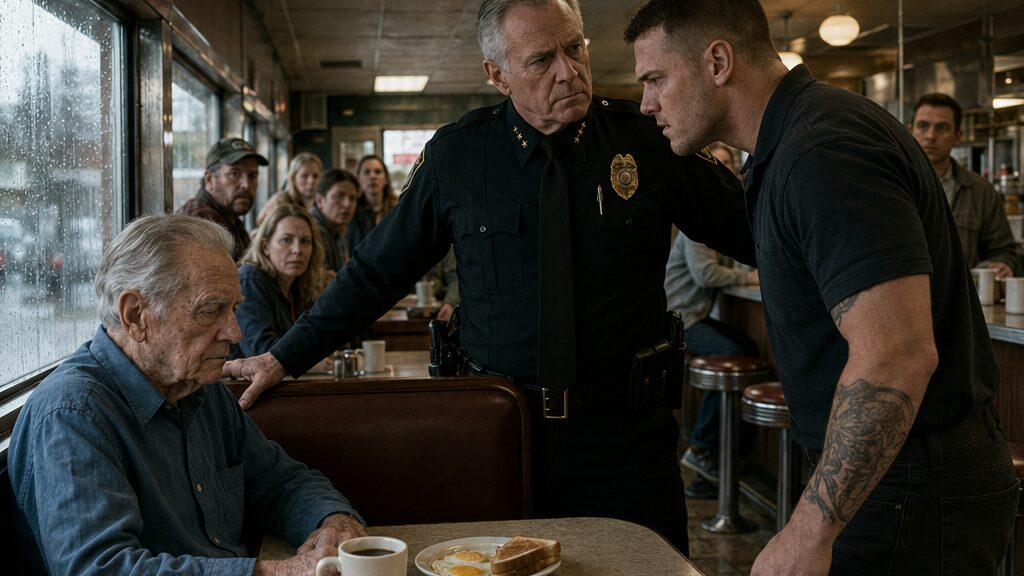
Police Chief Steven Reed stood between them in a black uniform still damp at the shoulders from the rain. He had come in through the side door near the restrooms, the way he often did when he wanted coffee without ceremony. Gray hair, badge, nameplate, belt polished from habit. His face held the flat calm of a man who had stepped between people before and knew the danger in letting anger decide the distance.
“Move your hand,” Steven said.
Jason looked at the hand on his wrist, then at the badge. “Chief, I’m not doing anything.”
“You were about to.”
“I asked him to move. He said he could move.”
Steven released him only after Jason pulled back. Then the chief turned slightly, placing his body between Jason and the booth. It was not dramatic. It was simply exact. A door closing.
Larry’s shoulders tightened. “Steven.”
The chief did not look at him. “No.”
One word. Low enough that only the people nearest heard it.
Jason gave a strained laugh. “Are we really doing this over a table?”
Steven faced him fully. “You think this is about a table?”
“What else is it about?”
The diner had gone silent enough for the grill to sound too loud.
Steven pointed, not at Larry, but at the mug. “That man has paid for that seat every Thursday for years. Even when all he orders is coffee. Even when he leaves before drinking it.”
Larry closed his eyes.
Margaret whispered, “Steven.”
But the chief had seen Jason reach for the plate. He had seen Larry fold himself smaller in a room that owed him better. His restraint had limits, even if Larry’s did not.
Jason’s jaw worked. “How was I supposed to know that?”
“You weren’t,” Steven said. “That’s the point.”
The answer cut through the room more sharply than a shout.
Jason’s crew shifted behind him. One man stared at the floor. Another took a slow step back toward the door. Jason’s face reddened, and for the first time his certainty seemed to look for somewhere to stand.
Larry pushed himself upright.
The movement brought everyone’s eyes back to him. He disliked that more than Jason’s words. He took a dollar from his shirt pocket, then another, though his bill would be more than that. His fingers were clumsy. Emma moved as if to help, then stopped when Margaret touched her arm.
“Larry,” Steven said, quieter now.
Larry placed the bills beside the saucer. “I lost my appetite.”
Jason looked at him then, really looked, but it was too late to make the looking gentle.
“You don’t have to go,” Margaret said.
“No.” Larry put on his jacket. “I know.”
He lifted the mug half an inch, as if he meant to drink after all. Then he set it back down. Full. Cold. Unfinished.
He stepped past Steven. The chief shifted to make room, but his eyes stayed on Jason.
At the door, Larry paused.
Not for Jason. Not for the room. For the booth, maybe. For the plate cooling under the lights. For some version of himself who had once sat there across from a woman who knew when to talk and when to let silence do its work.
The bell rang softly above him as he left.
Jason stood beside the booth with his hands at his sides.
Steven waited until the door closed. Then he looked at the younger man and said, “You don’t know what that seat is costing him.”
Chapter 3: A Police Chief Can Stop a Fight, Not a Wound
The rain had stopped, but the sidewalk still held the morning in broken reflections.
Larry made it three storefronts before Steven caught up with him. Not running. Steven Reed had too much pride in uniform for that. But his stride was long enough that the gap closed quickly, and by the time Larry reached his truck, the chief was there beside him, breathing a little harder than he wanted to show.
“Larry.”
Larry had one hand on the door handle. He looked at the wet blue paint, not at Steven. “You left your coffee getting cold.”
“So did you.”
“That one was paid for.”
Steven’s mouth tightened. “I’m sorry.”
Larry opened the truck door but did not climb in. “You didn’t ask me to move.”
“No. I made it worse another way.”
That brought Larry’s eyes to him.
Steven stood with his cap tucked under one arm. Without the hat, the rain had flattened his gray hair and made him look older than he usually allowed. He had been police chief for twelve years, a patrol officer long before that, and a boy in this town before either of those things. He knew how to enter a room and make people adjust. He knew how to stop a fight. He knew how to sound certain even when he was guessing.
With Larry, certainty had always felt dangerous.
“You stopped him from taking my plate,” Larry said.
“I also turned you into the center of the room.”
Larry did not answer.
A delivery truck passed, sending water hissing along the curb. Across the street, the post office flag snapped once in the wind. Larry watched it, his face unreadable.
Steven lowered his voice. “He had no right.”
“Most people don’t when they hurt you.”
“He needed correcting.”
“He needed lunch.”
Steven stared at him.
Larry’s expression did not change, but something tired moved through it. “That doesn’t excuse him. I know that. But hunger and pride make poor company.”
“Don’t make him smaller,” Larry said. “He did that himself.”
The words were mild. They landed hard anyway.
Steven looked back toward the diner window. Inside, shapes moved around the booth. Nobody had sat there. The white mug remained where Larry had left it, a pale spot against the brown table.
“You should let people stand up for you sometimes,” Steven said.
Larry gave the smallest smile. “You think I don’t know how standing up looks?”
“That isn’t what I meant.”
“I know what you meant.”
For a moment, neither man spoke.
Steven had known Larry Bennett for nearly twenty years, though “known” was too large a word for what Larry allowed. He knew Larry had served. He knew Larry’s wife had been named Helen, though no one said the name often anymore. He knew the booth by the window had become a Thursday habit after the VA clinic moved two towns over and Larry began stopping at Margaret’s on the drive back. He knew Larry paid in cash, tipped too much, and once fixed Margaret’s back door hinge without telling her.
He did not know what Larry saw when he looked out that window. He did not know why some Thursdays Larry ate and some Thursdays he did not. He did not know why, every year around this same week, Larry came in looking as if sleep had become a room he could not enter.
Steven had almost said more inside. He had almost told Jason that Larry had earned better. That he was not some old man taking up space. That if Jason knew half of what Larry had carried—
But that was the trap. Steven knew just enough to be tempted into using Larry’s life as a weapon.
Larry reached into his jacket pocket and pulled out his keys. They hung from a plain metal ring, no decorations, no old insignia, nothing announcing anything.
“Come back in,” Steven said. “Margaret will make you another plate.”
“No.”
“You shouldn’t leave because of him.”
“I’m not leaving because of him.” Larry looked through the window again. “I’m leaving because if I stay, everyone will try not to stare. That’s worse.”
Steven had no answer for that.
Larry climbed into the truck slowly. His hand trembled once against the steering wheel. He closed it into a fist until the tremor passed.
Steven stood by the open door. “What do you want me to do?”
Larry looked at him then, and for the first time that morning his voice lost some of its gentle distance.
“Nothing that makes him hate me.”
Steven frowned. “Hate you?”
“A man like that,” Larry said, “if you shame him too hard in public, he’ll need someone to blame for how small he feels. Don’t let it be me.”
“He ought to feel small.”
“No.” Larry shook his head. “He ought to feel wrong. There’s a difference.”
The truck cab smelled faintly of old upholstery and peppermint. A folded grocery list lay on the passenger seat, though only three items were written on it. Steven noticed because noticing small things was part of his job. Bread. Batteries. Coffee filters.
Larry followed his glance and turned the paper over.
“I’ll talk to him,” Steven said.
“Talk, then. Don’t perform.”
The word stung because it was fair.
Larry pulled the door halfway closed, then stopped. “And Steven?”
“Yes?”
“Next time you want to protect my dignity, ask me what I’m willing to spend.”
The door shut before Steven could answer.
He watched the blue truck pull from the curb, signal at the corner, and disappear behind the hardware store. Only then did he put his cap back on.
Inside the diner, the room had not recovered. People were speaking again, but softly, as if the walls had become thinner. Jason and his crew were gone. The booth by the window remained empty. Emma stood near it with the coffee pot in her hand, staring at the mug Larry had left behind.
Margaret was at the table, gathering the plate.
“Don’t clear it yet,” Steven said without thinking.
Margaret looked at him. “Why?”
He had no good reason. Maybe because the full mug seemed like evidence. Maybe because clearing it felt too much like erasing the shape of what had happened.
Margaret lifted the saucer.
Beneath it were folded bills. More than the egg and toast. More than the coffee. Enough, Steven saw, to cover several cups at the counter too.
Emma counted under her breath and stopped when she understood.
“He paid for Jason’s coffee,” she said.
Margaret’s mouth pressed into a thin line. She looked toward the door Larry had used, then at Steven.
“No,” she said quietly. “He paid before Jason ordered it.”
Steven stood there, rain drying on his shoulders, while the white mug cooled on the table between them.
For the first time all morning, the police chief had no idea what to correct.
Chapter 4: The Rumor Traveled Faster Than the Truth
By noon, Jason Carter had told himself the story four different ways, and in every version he sounded less wrong.
He had not shoved the old man. He had not cursed at him. He had not thrown food or made some scene worth the way everyone had stared. He had asked a question in a crowded diner after a wet morning had knocked half the county’s vehicles off schedule. That was all.
A booth for four. One man sitting alone. Cold coffee. Untouched food.
Anybody else would have wondered the same thing.
Jason drove the tow truck back to the yard with his jaw tight and his left hand pressed hard on the wheel. The wipers dragged across the windshield though the rain had stopped, smearing beads of water into gray streaks. His crew was quiet in the cab behind him. That made it worse. If they had joked, he could have snapped back. If they had agreed with him, he could have settled into anger. Their silence left him trapped with his own thoughts.
At the red light by the pharmacy, the younger coworker in the passenger seat finally said, “Chief Reed seemed pretty serious.”
Jason stared at the light. “Chief Reed likes being serious.”
“I’m just saying.”
“What?”
“Nothing.”
“No, say it.”
The coworker looked out the window. “Maybe that old man’s got something going on.”
Jason laughed once. “Everybody’s got something going on.”
The light changed. He hit the gas harder than needed, and the truck lurched forward.
At the towing yard, the morning’s work waited in a row of muddy tires and dented bumpers. A sedan with its front end crumpled sat near the fence. Two pickups needed paperwork. The office printer was jammed again. The phone rang before Jason had his jacket off.
Work should have helped. Work usually narrowed things. Hook the chain. Check the invoice. Call the customer. Move the vehicle. Small problems that had visible edges.
But all afternoon the diner kept returning to him in pieces.
The old man folding his napkin.
The little click of the mug against the saucer.
Steven Reed’s hand on his wrist.
You weren’t. That’s the point.
Jason hated that sentence most of all. It had followed him out of the diner and climbed into the truck beside him. It had sat in the office while he filled forms. It had waited near the soda machine while he tried to swallow a sandwich he did not want.
Around two, a woman came for the crumpled sedan and cried in the parking lot because insurance would not cover what she owed. Jason lowered the storage fee without telling her. He did not think of it as kindness. He thought of it as one less conversation.
By three, the story had already reached the parts counter at the hardware store.
The delivery driver who had been at the diner told the man behind the register that Jason Carter had nearly pulled a plate away from an old veteran. The man behind the register told a customer that Chief Reed had almost arrested somebody over Margaret’s window booth. The customer told someone at the post office that Larry Bennett had been kicked out of the diner. By late afternoon, the story had grown teeth.
Jason heard pieces of it when he stopped for fuel.
A man near the cooler lowered his voice badly. “That’s him.”
Jason turned. “You need something?”
The man looked away. “No.”
Jason paid for gas and left without buying the coffee he had come in for.
At the yard, he found Steven Reed waiting beside the office door.
The chief was out of the rain now, cap in hand, uniform dry except at the cuffs. He did not lean on the door or fold his arms or do any of the things men did when they wanted to look bigger. That irritated Jason more than a threat would have.
“I’m working,” Jason said.
“I can see that.”
“Then say what you came to say.”
Steven glanced toward the tow trucks. “You busy tonight?”
Jason stared at him. “You asking me to dinner?”
“No. I’m asking if you have five minutes to hear something without answering every sentence.”
Jason almost walked past him.
Instead he opened the office door, went inside, and left it open behind him. Steven followed.
The office smelled like oil, wet floor mats, old coffee, and paper heated too long by the printer. Jason sat behind the desk because it was his desk and he needed the advantage of something. Steven remained standing.
“I didn’t know he was a veteran,” Jason said before the chief could speak.
Steven nodded. “I believe you.”
That took some of the force out of Jason’s next words. He had expected a fight. He had prepared for one.
“I asked him to move. That’s it.”
“You reached for his plate.”
Jason looked down at the invoices. “I was trying to help.”
“No, you weren’t.”
The words were quiet enough that Jason had to absorb them rather than push against them.
Steven continued, “You were trying to make the room agree with you.”
Jason’s face warmed. “You don’t know what I was trying to do.”
“I know what it looked like.”
“Yeah, well, maybe everybody in that diner should stop looking so hard.” Jason pushed the chair back. “He had a four-person booth. We had four people. We had twenty minutes. That’s not a crime.”
“No.”
“Then what is this?”
Steven set his cap on the corner of the desk. “A chance to stop being proud before proud does more damage.”
Jason shook his head. “You always talk like that?”
“When I’m tired.”
“Of me?”
“Of men thinking embarrassment is the same as injustice.”
The office went still except for the printer clicking uselessly in the corner.
Jason looked away first. Through the window, he could see the row of trucks outside, their hooks hanging like bent fingers. He had spent ten years building a reputation as someone who showed up fast, charged fair, and did not let people talk down to him. His father had left bills. His mother had left silence. The world, as far as Jason had learned it, divided itself into people who moved and people who got moved around.
Larry Bennett had looked like the second kind.
That was what Jason did not want to say.
Steven picked up his cap. “Margaret found your coffee paid for.”
Jason frowned. “What?”
“At the diner. Larry left enough under his saucer.”
Jason leaned back slowly. “I didn’t order coffee.”
“He paid before you did.”
“For who?”
Steven held his eyes. “For the counter.”
Jason said nothing.
“He does that sometimes,” Steven said. “Not every week. Not when money’s tight, I’d guess. But often enough Margaret knows not to make a production of it.”
Jason’s first feeling was suspicion, because shame often wore that mask before it showed its real face. “So what? That’s supposed to make me feel bad?”
“No,” Steven said. “If it does, that part’s on you.”
He left after that.
Jason sat alone in the office with the printer jammed, the invoices unfinished, and the day no less heavy than before. Outside, one of his drivers started a truck. The engine coughed, caught, and settled.
He tried to picture Larry Bennett paying for strangers’ coffee while Jason stood over him talking about people who had places to be.
The picture would not hold still.
He stayed late at the yard, long after the crew left. He told himself he was catching up on paperwork. He told himself the diner story would be forgotten by morning. Small towns loved a fresh offense, but they loved the next one just as much.
At seven, he locked the office and walked to his truck.
The rain had cleared completely. The pavement reflected a pale strip of evening sky. As he opened the door, he noticed something on the passenger seat: a folded receipt from Margaret’s diner. He must have shoved it there without thinking after leaving.
No food listed. No coffee. Just a line where the register had printed: PAID.
Under it, in Margaret’s handwriting, were three words.
He was early.
Jason stood with the truck door open, reading the words until they stopped looking like an accusation and started looking like something worse.
A fact.
Chapter 5: Margaret Knew the Booth Was Never Just a Seat
Margaret Harris unlocked the diner before sunrise the next morning and found herself looking at the window booth before she turned on the lights.
In the gray wash before opening, the booth seemed smaller. Just two benches, one table, a window with water marks on the glass. No audience. No raised voices. No old man folding himself out of everyone’s way.
She stood there with the keys still in her hand.
The cook came in through the back a few minutes later, carrying a crate of eggs and humming under his breath. The kitchen lights flicked on. The hum of the refrigerator deepened. Pipes clicked in the walls. The diner woke the way it always did, one ordinary sound at a time.
Margaret filled the first pot of coffee herself.
She did not need to. Emma would be in by six thirty. The cook could manage it. But there were mornings when a person needed something hot to hold that was not memory.
The white mug Larry used sat upside down on the shelf behind the counter.
There were a dozen like it, heavy and plain, bought from a restaurant supplier years ago. Over time, most had acquired chips or gray spoon marks or faint coffee stains near the rim. Larry’s was not marked with his name. Margaret had never allowed herself to do that. But she knew it by the tiny rough spot near the handle, where the glaze had bubbled in firing. Her thumb found it every time.
She took the mug down, turned it over, then set it back upside down.
Not today, she thought.
Emma arrived with damp hair, tying her apron as she came in. Her eyes went straight to the window booth.
“Do you think he’ll come?”
“No.”
Margaret said it too quickly.
Emma stopped. “You don’t know that.”
“I know enough.”
They worked the first hour mostly in silence. Two clerks from the courthouse came in for biscuits. A delivery driver took coffee to go. An older couple split pancakes at the counter and pretended not to look at the empty booth.
By eight, the story had returned, softened at the edges but still carrying the shape of the day before. People asked without asking. They glanced at Margaret, then at the booth, then at the mug shelf. One woman said, “I heard there was trouble.” Margaret answered, “There was weather.” The woman understood that was all she would get.
Emma refilled sugar jars with more care than sugar jars required.
Finally she said, “I should’ve said something.”
Margaret was counting change into the register. “You did.”
“Not fast enough.”
“You’re twenty-two years old. A grown man with anger in his shoulders walked past you.”
Emma’s cheeks colored. “He wasn’t going to hurt me.”
“That isn’t the measure.”
Emma twisted the lid onto a sugar jar. “Larry looked so… used to it.”
Margaret closed the register drawer harder than necessary.
The bell over the door rang before she could answer. Steven Reed stepped inside in plain clothes: dark jacket, jeans, cap pulled low. Somehow he looked less official and more burdened.
“Coffee?” Margaret asked.
“Yes.”
“Counter.”
“I figured.”
He sat near the end. Emma poured without asking and moved away.
Margaret placed the mug in front of him. Not Larry’s mug. Steven noticed anyway.
“Any word?” he asked.
Margaret wiped the counter though it was clean. “No.”
“You call?”
“He wouldn’t answer if he didn’t want to.”
Steven nodded. “That sounds like him.”
For a while, they let the morning traffic fill the space between them. Plates went out. Coffee went cold. The booth stayed empty.
Emma came back from the kitchen carrying toast and paused near the counter. “Can I ask something?”
Margaret looked at her.
“Why that booth?”
Steven’s hand tightened around his cup.
Margaret almost said it was not her story. It wasn’t. She had guarded that truth for years because Larry had never asked her to tell it, and because there were some forms of loyalty that looked like silence. But yesterday had shown her the other edge of silence. It could protect a man, yes. It could also leave him alone in a room full of people who did not know what they were stepping on.
She looked toward the booth.
“When the VA clinic moved out past Brook Road,” she said, “Larry’s wife used to drive him there on Thursdays.”
Emma stayed still.
“Appointments wore him out. Not just the doctor part. The waiting room. The forms. The men sitting around trying not to look at each other. Helen knew he wouldn’t talk about it at home.”
Helen.
The name entered the diner softly, like someone opening a door in another room.
“So she brought him here after,” Margaret continued. “Same booth every time. She’d order pie even when it was too early. He’d say coffee was enough. She’d order him toast anyway.”
Steven looked down at his cup.
Emma’s voice lowered. “When was that?”
“Years ago. Before you worked here. Before your mother moved back, maybe.” Margaret folded the towel in her hands. “At first he sat facing the door. Always facing the door. Then one morning Helen sat on that side before he could, and he had to take the window seat.”
“Why?”
“She told him the street was better company than fear.”
Emma looked toward the window.
Margaret could still see it if she let herself. Helen Bennett with silver beginning at her temples, lipstick a shade too bright for morning, one hand on Larry’s wrist when the room got loud. Larry thinner then, eyes sharper, carrying the kind of alertness that made rest look like work. Helen talking about ordinary things with deliberate stubbornness. The price of peaches. A neighbor’s dog. Whether Margaret’s pie crust had improved or declined.
Week by week, Larry had begun to look out the window instead of watching the door.
“That booth helped him come back to town,” Margaret said. “Not all at once. But enough.”
Emma set the toast down untouched. “And after she died?”
“He kept coming.”
Steven said quietly, “Every Thursday.”
Margaret nodded. “At first, he ordered two coffees. Then one. Some days he ate. Some days he didn’t. But he came.”
Emma’s eyes shone, and Margaret wished she had not made the girl carry this. But maybe carrying a little truth was better than standing helpless beside a lie.
“Jason doesn’t know any of that,” Emma said.
“No,” Margaret said. “And Larry would say he shouldn’t have to.”
The bell rang again. Everyone turned too quickly.
It was not Larry.
A customer stepped in, hesitated under all those eyes, then removed his cap and asked if they were open.
Margaret told him they were.
The morning moved on. Eggs broke on the grill. Coffee poured. Coins changed hands. Around ten fifty-five, the room became aware of itself. Even customers who did not know why looked toward the window when no truck pulled up outside.
At eleven, Emma took Larry’s mug from the shelf and held it for a moment.
Margaret saw and almost told her to put it down.
Instead she said, “Turn it upside down.”
Emma did.
The white mug rested behind the counter, waiting without being offered.
By noon, the booth had been used twice by strangers. Margaret allowed it because keeping it empty would have made absence too visible. But each time someone slid into the seat, she felt a small resistance in herself, as if the room had lost its manners.
After the lunch rush, Steven stood to leave.
At the register, he paused. “If Jason comes in?”
Margaret’s expression hardened. “He eats if he’s hungry. He leaves if he’s proud.”
Steven almost smiled. “Fair.”
When he was gone, Emma wiped the window booth again. She worked slowly, her cloth moving in circles over the table where Larry’s mug had sat.
“I thought being nice was enough,” she said.
Margaret looked over.
“To older people, I mean. I thought if I was gentle and didn’t rush them, that was respect.”
Margaret picked up the coffee pot. “Gentle is good.”
“But it isn’t the same.”
“No,” Margaret said. “It isn’t.”
Emma folded the cloth. “What is?”
Margaret thought of Helen taking the door-facing seat. Larry learning to look out the window. The bills under the saucer. The mug turned upside down because no one had earned the right to use it that morning.
“Letting a person keep the parts of themselves you don’t understand,” she said.
Near eleven the next Thursday, the booth was empty again.
This time, everyone noticed.
Chapter 6: The Veteran Returned Before Anyone Was Ready
Larry Bennett sat in his truck outside the diner the following Thursday for nearly nine minutes.
He knew because the dashboard clock had lost three minutes sometime in February, and he had never corrected it. It read 10:54 when he pulled to the curb. It read 11:03 when his hand finally left the keys.
Inside, the booth by the window waited.
He could see it through the glass. Empty, wiped clean, sunlight lying across the table. There was no sign. Margaret had kept that promise. No reserved card, no folded napkin, no little public declaration of his importance. Just the booth, ordinary to anyone who did not know better.
That helped.
Not enough to make the door easy.
Larry looked down at his hands. They had behaved badly that morning. Buttons had taken longer. The coffee canister at home had slipped and scattered grounds across the counter. He had stood there looking at the dark mess and almost laughed because Helen would have said, “Well, now the kitchen’s awake.”
He had swept it up, put on the blue shirt because it was clean, and driven into town.
Now he sat with the engine off while traffic passed behind him. A delivery van. A sedan. A woman walking two small dogs that barked at nothing. Ordinary life had a stubbornness he admired and resented in equal measure.
He reached for the grocery list on the passenger seat, turned it over, then turned it back. Bread. Batteries. Coffee filters. He had bought none of them.
“Go in,” he said aloud.
His voice sounded too large in the cab.
When he opened the door, a sharp pain ran through his knee. He waited it out, one hand on the steering wheel, one on the door frame. By the time he stood, he had the expression he used in public: mild, contained, available for brief conversation but not inspection.
The bell over the diner door rang.
The room did not fall silent. That was how he knew Margaret had warned them, or threatened them, or both. Conversations continued with unnatural care. Forks moved. The grill hissed. Someone laughed half a second too late at something not funny.
Larry stopped just inside.
Margaret stood behind the counter with a pot in her hand. Emma was near the register. Steven sat two stools from the end, out of uniform again, reading a newspaper he was not reading.
Too many people did not look at Larry.
That was almost worse than staring.
“Morning,” Larry said.
The room answered in scattered murmurs.
Margaret came around the counter. For one dangerous second, Larry thought she might hug him. She did not. She stopped at the proper distance and tilted her head toward the booth.
“Coffee’s fresh.”
“Usually is.”
“Don’t start complimenting me. I won’t know what to do.”
He let that corner of his mouth move, and some of the room breathed again.
He walked to the booth. No one helped him. He was grateful for that. His knee complained as he lowered himself into the seat, but he managed without grabbing the table. Small victories were best when nobody applauded them.
Emma came over with the white mug.
He noticed before she set it down.
The rough spot near the handle met his thumb when he reached for it. Same mug. Same weight. She had turned the handle to the right.
“Thank you,” he said.
“You’re welcome.”
Her voice nearly caught. She corrected it by standing straighter. That, he respected.
Margaret filled the mug. The steam rose between them.
“You eating?” she asked.
“One egg. Toast.”
“You sure?”
He looked at her.
She nodded once. “One egg. Toast.”
When she left, Larry wrapped both hands around the mug. He could feel the room trying not to gather itself around him. Kindness had become a net, and everyone was holding a corner.
Steven slid into the opposite side of the booth without asking.
Larry looked at him over the steam. “That seat’s taken?”
“It is now.”
“By the police department?”
“By a man who knows when he ought to apologize sitting down.”
Larry considered him. “You apologizing again?”
“I didn’t do it well the first time.”
“You did it plenty.”
“No.” Steven folded the newspaper and set it beside him. “I made a wall of myself.”
“You’re built for it.”
“That doesn’t mean you asked for one.”
Larry’s thumb moved over the mug’s rough spot.
Steven lowered his voice. “I told Jason not to come near you unless he meant it.”
Larry’s eyes shifted to the window. “That why he’s outside?”
Steven turned.
Across the street, beside a tow truck parked near the post office, Jason Carter stood with both hands shoved into his jacket pockets. He was not looking at the diner directly. He looked toward it, away, then back again, like a man trying to cross a road no one else could see.
The room noticed the change in Larry’s face before it found Jason. Then the current moved through the diner. Heads turned. A fork paused halfway to someone’s mouth.
Steven began to rise. “I’ll talk to him.”
Larry’s hand moved, not fast, but enough.
Steven stopped.
“Sit down,” Larry said.
The chief sat.
Margaret appeared near the booth, plate in hand, her face tight. “Larry.”
“I see him.”
“You don’t owe him anything.”
“No.”
Emma stood behind Margaret, holding the coffee pot with both hands.
Larry looked around the diner then. At the regulars pretending not to wait. At the counter where strangers knew just enough to be curious and not enough to be ashamed. At Margaret, who wanted to protect him from the world by controlling the doorway. At Steven, who wanted to stop harm before Larry had to spend himself answering it.
He had been protected by good people before. Sometimes protection felt like love. Sometimes it felt like being placed behind glass.
Larry lifted the mug and drank.
The coffee was hot enough to sting.
“There,” Margaret said softly, though no one knew what she meant.
Larry set the mug down. “Let the room be normal.”
No one answered.
He looked at Margaret. “That includes you.”
Her mouth opened, then closed. She set the plate down in front of him. One egg. Toast cut diagonally. Jelly in the small cup.
“Normal,” she said.
“Best you can manage.”
She gave him a look that would have frightened a younger man, then returned to the counter.
Steven remained across from him. “You want me to leave?”
“In a minute.”
Outside, Jason had not moved.
Larry cut into the egg. The yolk spread slowly across the plate. His appetite was not strong, but he took a bite because leaving the food untouched again would give the room too much to interpret.
Steven watched him eat. “He’s ashamed.”
Larry swallowed. “That’s not the same as ready.”
“No.”
“You ashamed?”
Steven looked down. “Some.”
“Good. Don’t waste it.”
The chief laughed once under his breath, surprised into it. “You always this hard on people you like?”
“Harder.”
For the first time that morning, the booth felt almost like itself.
Larry looked out the window again. Jason stood across the street, shoulders hunched against a wind that was not there. He seemed younger from that distance. Not innocent. Not harmless. Just younger.
Larry remembered being young and certain. He remembered how easily fear could disguise itself as authority, how pride could make a man reach for things that did not belong to him. He had learned those lessons in places far from diners, and he had not learned them gently.
He lifted one hand.
Not high. Not forgiving. Not welcoming enough to be mistaken for absolution.
Just enough for Jason to know he had been seen.
Across the street, Jason straightened.
Steven saw the gesture and said nothing.
Jason took one step off the curb, then stopped as a car passed between them. When it was gone, he remained where he was, staring at the diner door as if the distance had doubled.
Larry picked up his fork again.
“He’ll come in when standing out there costs more than entering,” he said.
Steven looked at him. “And if he doesn’t?”
Larry cut a piece of toast and dragged it through the yolk. “Then he’ll have learned something about the price of not entering.”
Outside, Jason turned toward his truck, then back toward the diner.
Larry watched him through the glass, the white mug warm beneath his hand.
Chapter 7: Jason Sat Down Instead of Standing Over Him
Jason Carter crossed the street like a man approaching a house where bad news had already arrived.
He waited for two cars to pass, though he had time to cross before either reached him. Then he stepped off the curb, stopped once at the center line, and looked toward his tow truck as if some forgotten emergency might save him. None did. The truck sat where he had parked it. The diner waited. Larry Bennett sat in the window booth with a white mug under one hand.
When Jason reached the door, he did not open it right away.
Inside, Larry saw the shape of him through the glass. The younger man’s shoulders rose and fell once. His tattooed arm hung stiffly at his side. His other hand touched the door handle, let go, then returned to it.
Steven Reed had left the booth and gone back to the counter, though not far. Margaret stood near the register pretending to count bills. Emma carried a plate to the wrong table, caught herself, and turned around with cheeks flushed.
Larry ate one more bite of toast.
The bell rang.
The diner did not go silent this time, but it tried to. Larry could feel the room fighting its own curiosity. A spoon stirred too long in an empty cup. Someone cleared his throat and then seemed ashamed of the sound.
Jason stood just inside the door.
He looked first at Steven. That was a mistake and he seemed to know it. His eyes moved to Margaret, then finally to Larry. The distance between the door and the booth could not have been more than twenty feet. Jason made it seem farther.
Margaret said, “You eating?”
Jason glanced at her. “No, ma’am.”
“Then don’t block the door.”
A few people breathed through their noses. Not quite laughter. The kind of almost-laughter that knew better.
Jason stepped aside. “I came to talk to Mr. Bennett.”
Larry did not correct the name. He only moved his fork to the edge of his plate.
Steven turned slightly on his stool. “You remember what I said?”
Jason’s jaw tightened. “I remember.”
Larry looked at Steven. “Chief.”
One word. It was enough.
Steven faced forward again, but his shoulders did not loosen.
Jason came to the booth. This time he stopped at a careful distance, not near the plate, not near the mug, not close enough to make Larry look up more than he chose.
“I owe you an apology,” Jason said.
The sentence came out clean, as if he had practiced it outside.
Larry waited.
Jason swallowed. “I was out of line. I embarrassed you. I shouldn’t have touched your plate. I shouldn’t have talked to you like that.”
Larry still said nothing.
Jason shifted his weight. “That’s all.”
“Is it?”
The question was mild. It reached Jason harder than Steven’s grip had.
Jason looked back toward the door, then at the booth. “I don’t know.”
Larry gestured to the seat across from him.
Jason blinked.
“If you’re going to talk to me,” Larry said, “sit down.”
A shadow of panic crossed Jason’s face. Standing had allowed him to perform apology. Sitting required him to remain.
He slid into the opposite bench.
The vinyl made the same whisper it had made under Larry every Thursday for years. Jason looked too large for the booth, too restless. His knees nearly touched the table. His hands curled and uncurled on his thighs until he noticed and placed them flat.
The room resumed itself in fragments. Margaret poured coffee at the counter. Emma moved between tables. Steven stayed within hearing distance but did not turn around.
Larry lifted the mug.
The tremor came just as the rim neared his mouth. It was small but visible. A brief betrayal from bone and nerve. Some days he could hide it. Some days he could not. He lowered the mug before the coffee spilled.
Jason’s hand moved before he thought better of it.
He touched the saucer, not Larry’s hand, and pushed the mug back toward the center of the table until it was steady. Then he withdrew as if the ceramic had burned him.
“Sorry,” Jason said.
Larry looked at the mug. “For that?”
“For all of it.”
“That’s a large basket.”
Jason exhaled, almost a laugh, but it failed. “Yes, sir.”
Larry disliked sir when it was used as distance. He let it pass.
Emma came by with the coffee pot. She looked at Jason, then at Larry.
“More?” she asked.
Larry glanced at his mug. “Warm it.”
She poured carefully, raising the level without overflowing it. Steam rose again. Jason watched, and Larry noticed that he watched the mug now as if it had become something he was not allowed to misunderstand.
When Emma left, Jason said, “Chief Reed told me you paid for coffee.”
“I paid my bill.”
“For the counter.”
Larry picked up his fork. “Sometimes.”
“Why?”
“Because I can. Some weeks.”
“That’s it?”
“What were you hoping for?”
Jason rubbed both hands over his face. “I don’t know. Something that makes sense.”
Larry cut a piece of egg. “Most decent things don’t, at first.”
Jason looked at him then, not defensively, but with the raw irritation of someone trying to accept a kindness he had not earned.
“I thought you were taking advantage,” he said.
“Of the booth?”
“Of people being nice to you.”
Larry set the fork down. “People have been nice to me in ways I didn’t want.”
Jason glanced toward Margaret.
“She keeps that seat for you.”
“She does.”
“And you don’t want that?”
Larry looked out the window. Sunlight had moved across the table and rested at the edge of Jason’s sleeve. Outside, the post office flag lifted and fell.
“I want to sit where my wife sat me,” Larry said.
Jason did not move.
Larry had not meant to say it that plainly. The words were on the table now, beside the plate, beside the mug, small and unadorned.
“Your wife?” Jason asked.
“Helen.”
The name still required care. Larry let it settle before continuing.
“She used to bring me here after appointments. I didn’t like waiting rooms. Didn’t like people behind desks asking questions they had on paper but not in their eyes. Didn’t like men my age pretending not to hear each other breathe.”
Jason’s face changed, not dramatically. Just enough.
Larry touched the mug handle. “First time we came, I sat facing the door. Second time, too. Third time, she took that side before I could.”
He nodded toward Jason’s seat.
“She said the street was better company than fear.”
Jason looked down at the bench beneath him.
Larry’s voice stayed even. “So I learned to look out the window. After a while, I could eat. After a while, I could hear plates drop and not think what my body wanted me to think. After a while, this became just a diner.”
Margaret had stopped moving near the register. Steven’s newspaper had lowered, though he did not turn. Larry knew the room was listening no matter how politely it pretended otherwise.
He did not tell them everything. He did not tell Jason about the first year home, when Helen had stood between him and every sudden noise until both of them were tired of his shame. He did not tell him about the morning she died, or the month after when Larry drove to the diner and sat in the truck for forty minutes before going home. He did not tell him that some Thursdays he came only because a promise made to the dead could still move a living body.
He told him only what the moment could hold.
“When she got sick,” Larry said, “she made me promise I wouldn’t stop going places just because people might look. I’ve broken that promise more than once.”
Jason’s mouth tightened. “Yesterday?”
“Yesterday made it harder.”
Jason took that without flinching, though it cost him.
“I didn’t know,” he said.
“No.”
“I should have.”
Larry looked at him. “How?”
Jason opened his mouth, closed it, then looked away.
“That’s the part you’re circling,” Larry said. “You couldn’t know about Helen. You couldn’t know about the clinic. You couldn’t know why that booth matters.”
Jason nodded slowly.
“But you knew I was old,” Larry said. “You knew I was alone. You knew I wasn’t fighting you. That was enough to be careful with me.”
The words did not rise. They did not need to.
Jason stared at the table. His face had gone pale in a way anger never made it. For the first time since Larry had seen him, the younger man seemed to have nowhere to put his hands.
“I’m sorry,” he said again.
Larry took a sip of coffee. The heat steadied him.
“I believe you’re ashamed,” he said.
Jason looked up.
“That’s not the same as being sorry. Not yet.”
The sentence struck, but Jason did not defend himself. That was the first useful thing he had done.
“What do I do?” he asked.
Larry studied him. There were easy answers. Pay the bill. Shake hands. Say the right sentence loud enough for the room to hear. Let Steven nod, let Margaret soften, let everyone go home with a clean ending.
Larry had lived too long to trust clean endings.
“I won’t help you hate yourself,” he said. “That’s just pride turned inward.”
Jason’s eyes sharpened with confusion.
“And I won’t pretend nothing happened,” Larry continued. “That’s just lying to make the room comfortable.”
Jason swallowed. “Then what?”
Larry slid the jelly cup toward the center of the table, though he did not want it. “Sit there a minute.”
Jason waited.
“Not standing over me. Not explaining yourself. Not trying to get forgiven fast. Just sit.”
It sounded almost too simple.
Maybe that was why it worked.
Jason sat.
The diner kept moving around them. Plates traveled from kitchen to tables. Coins clicked at the register. The cook called an order through the pass-through. A child in the corner booth asked for more syrup. Ordinary life gathered itself, and this time Larry did not feel trapped behind glass.
After a minute, Jason said quietly, “My dad used to sit with his back to walls.”
Larry looked at him.
“He wasn’t military. Nothing like that. Just mean when he was scared, I guess. I told myself I’d never be like him.” Jason gave a small, bitter shake of his head. “Then yesterday I saw a table and made it a fight.”
Larry did not rescue him from the admission.
Jason leaned forward slightly. “I don’t want to be that man.”
“Then don’t be him next time it costs you something.”
Jason nodded once. He looked toward the counter, then back at Larry. “Can I pay for your meal?”
“No.”
The answer came so quickly that Jason almost smiled despite himself. “Okay.”
“You can pay for yours.”
“I’m not eating.”
“Then you can order.”
Jason looked toward Margaret. “Toast?”
Larry picked up his fork again. “Start small.”
Jason raised one hand awkwardly. Margaret stared at him a moment before coming over.
“What?”
“Toast,” Jason said.
“You want coffee?”
He hesitated.
Larry pushed the mug half an inch, not offering it, only reminding him what the table held.
“Yes,” Jason said. “Coffee.”
Margaret’s eyes moved between them. Then she nodded and left.
Jason sat across from Larry, waiting for coffee like a man waiting for a verdict he had not earned and could not rush.
When Margaret returned, she placed a different mug in front of him.
Jason looked at Larry’s white one, then at his own.
He understood enough not to ask.
Chapter 8: The Coffee Was Fresh, and No One Made a Speech
The next Thursday, nobody saved the booth by pretending not to save it.
That was the difference Larry noticed first.
The window booth sat empty at ten fifty. No rag left across the table, no chair angled in warning, no regular shifting his body to discourage strangers. The booth was simply empty, the way a place can be available without being announced.
Larry sat in his truck and watched it for less than a minute.
He had bought bread, batteries, and coffee filters that week. The grocery list was gone from the passenger seat. In its place sat a folded envelope addressed to the VA clinic, a bill he needed to mail and had delayed for no good reason. Ordinary failures. Ordinary errands. He had begun to trust ordinary things again, a little.
When he stepped out of the truck, his knee hurt. His hand trembled as he locked the door. The morning wind pushed at his jacket, and for one second he missed Helen so sharply that the sidewalk seemed to tilt.
Then he heard the diner bell as someone else entered, and the sound steadied him.
Inside, Margaret looked up from the register.
“Morning, Larry.”
“Morning.”
No one else greeted him too loudly. No one stopped eating. Steven Reed was not there. That helped more than Larry would have admitted.
Emma came from behind the counter carrying the white mug. She did not hurry. She did not look as if she were presenting something sacred. She set it on the table after Larry sat down, handle to the right.
“Coffee’s fresh,” she said.
“Good.”
“You eating?”
“One egg. Toast.”
She wrote it down though she knew. That helped too.
Larry wrapped his hand around the mug. The rough place near the handle met his thumb. He lifted it and drank before the room could decide whether to notice.
The coffee was hot, slightly bitter, and exactly right.
Outside, traffic moved past the window. The post office flag turned in a mild wind. A woman in a red coat crossed the street carrying two paper bags. Nothing in the view asked to be remembered, which was sometimes the kindest thing a morning could offer.
Margaret brought the plate herself. “Egg’s a little runny.”
“Supposed to be.”
“Toast isn’t burned.”
“Day’s young.”
She gave him the look, then left him alone.
He ate slowly. Not because anyone watched. Because the food was hot and his appetite had returned in pieces, shy as an animal. Half the toast. A bite of egg. Coffee. The jelly stayed sealed.
Around eleven fifteen, Jason Carter entered.
Larry saw him in the window reflection before the bell rang. The younger man wore the same dark work shirt, clean this time, and stood just inside the door with less drama than before. He did not look at the booth first. He looked at Margaret.
“You got room at the counter?” he asked.
Margaret pointed with the coffee pot. “End stool.”
Jason sat there.
That was all.
He ordered coffee and toast. When Emma poured for him, he thanked her without trying to make his gratitude visible to the room. Larry respected that. A man could turn apology into another kind of performance if he was not careful.
For several minutes, they did not speak.
The diner carried on. The cook scraped the grill. A regular complained about the price of fuel. Someone at the back table laughed too hard at a harmless joke. Emma dropped a spoon, winced at the noise, then looked toward Larry before she could stop herself.
Larry raised his mug slightly.
She smiled and went back to work.
Jason finished his toast, took his bill, and walked to the register. Margaret rang him up. He paid cash.
Then he added another bill.
Margaret looked down at it. “You overpaid.”
“For the next veteran who comes in.”
The words were quiet. Not whispered. Not announced.
Margaret studied him long enough that Jason shifted on his feet.
“You want a name on that?” she asked.
“No.”
“You want me to tell Larry?”
Jason’s eyes moved, just once, toward the booth. Larry looked out the window, giving him the mercy of not being watched.
“No,” Jason said. “It’s not for him to carry.”
Margaret folded the bill and placed it beneath the register drawer, where she kept things that were not exactly payments and not exactly secrets.
Jason turned to leave.
At the door, he paused. Then he came to the booth, stopping where he had stopped the week before, careful but not frightened of the distance.
“Mr. Bennett.”
Larry looked up.
Jason held his cap in both hands. “My crew’s got a call out past Brook Road. I’ll be near the clinic.”
Larry said nothing, but his thumb stilled against the mug.
“If you ever need a tow,” Jason said, “or if the truck gives you trouble, you can call the yard. No charge.”
Larry’s eyes narrowed a little, not unkindly. “That charity?”
Jason shook his head. “No, sir. That’s me knowing what I’m good for and offering it without taking your plate.”
A small silence opened between them.
Larry set his mug down. “I pay my bills.”
“I figured.”
“You can give me the regular rate.”
Jason almost argued. Then he caught himself. “Yes, sir.”
Larry nodded. “Truck’s old. It’ll happen.”
“I’ll answer.”
There it was. Not forgiveness. Not exactly. Something sturdier in its plainness.
Jason put his cap back on and left.
Through the window, Larry watched him cross to the tow truck. Jason did not look back until he reached the driver’s door. When he did, Larry lifted the mug, not his hand.
Jason nodded once and got in.
Margaret came by with the coffee pot after the tow truck pulled away. “Warm it?”
Larry looked into the mug. There was still half a cup left.
“Yes.”
She poured. Steam rose, turning the window briefly silver.
“You hear what he did?” Margaret asked.
“I heard enough.”
“He put money down.”
“For coffee?”
“For someone who needs it.”
Larry took that in. “Good.”
“You want me to tell him anything next time?”
“No.”
Margaret waited.
Larry looked at her. “Let him keep the part he did right without making him stand under it.”
Her face softened in spite of herself. “Helen would’ve liked that.”
The name entered the booth and sat across from him.
Larry’s throat tightened. He looked out the window until the street came clear again.
“She would’ve liked the toast better if you burned one corner,” he said.
Margaret laughed. It was small and rough, and she turned away before it became anything else.
When Larry finished eating, he did something he had not done in a long while. He remained after the plate was cleared. He sat with both hands around the mug and let the room move without preparing to leave it. No one asked if he was all right. No one thanked him for service. No one told him he was brave for coming back to a diner.
At the counter, Emma served a man in a faded work jacket and told him there was coffee already covered if he wanted it. The man looked confused, then grateful, then embarrassed by his own gratitude. Emma did not explain. She only poured.
Larry watched the coffee darken the man’s cup.
He thought of Jason outside in the rain, unable to come in. He thought of Steven’s hand stopping a wrist. He thought of Helen taking the seat that faced the door and forcing him to look at the street until the street became only a street.
After a while, he took the envelope from his jacket pocket. The VA bill. He smoothed it on the table, then tucked it back away. He would mail it on the way home.
When he stood, his knee resisted. He put one hand on the table, steady but not hiding. Emma saw and did not move to help. Margaret saw and did not comment. Respect, Larry thought, had a shape when people finally stopped decorating it.
At the register, Margaret rang up the meal.
Larry placed the exact amount on the counter.
Then he added a folded bill.
Margaret looked at it. “Larry.”
“For the next one,” he said.
She picked it up and saw writing on the outside in his careful block letters.
For the next one.
Her eyes lifted to his. “You sure?”
“No.” He put on his jacket. “But I’m doing it.”
The bell rang softly as he left.
Outside, the morning had warmed. Larry crossed to his truck without hurry. Before opening the door, he looked back through the diner window.
The booth by the window was empty again, but not abandoned.
The white mug sat on the table, waiting to be cleared, a thin ribbon of steam still rising from the coffee he had finished.
Larry touched two fingers to the truck door, steadying himself against the old blue metal. Then he climbed in, started the engine, and drove toward the post office with the envelope beside him and the taste of fresh coffee still on his tongue.
The story has ended.