The Quiet Recruit Stood At Attention Until The Protected Bully Kicked Him Twice
Chapter 1: The Recruit Who Never Broke Attention
The locker door tore loose just as Anthony bent to untie his boot.
Its upper hinge snapped with a metallic crack, and the tall steel panel pitched forward, sharp corner aimed at the back of his skull.
Jonathan caught it one-handed.
The impact rang through his arm. For half a second, he stood between two rows of lockers with the door balanced against his palm as if someone had passed him an empty tray.
Then he let it drop.
The panel struck the rubber mat beside Anthony with a crash that turned every head in the corridor.
Anthony jerked upright. “What happened?”
“Loose hinge,” Jonathan said.
“You caught that?”
Jonathan flexed his fingers once and bent to retrieve his field bag. “It hit the bench first.”
It had not.
Anthony looked from the bench to the dented panel. Before he could say more, a stream of exhausted recruits pushed through the barracks entrance, boots scraping, canteens knocking against belts. Their afternoon exercise had ended with a timed carry across churned ground, and the sour smell of sweat and wet canvas followed them inside.
Jonathan moved with the group.
He had learned to move exactly that way during his first week: neither fast enough to be noticed nor slow enough to be corrected. He took the middle place in lines, answered in the fewest words possible, and never volunteered for demonstrations. On obstacle drills, he finished comfortably behind the strongest recruits. During grappling instruction, he allowed clumsy holds to remain clumsy rather than exposing how quickly he could escape them.
It should have made him invisible.
Instead, Brandon Mitchell had begun watching him.
Brandon leaned against the locker-room entrance now, broad shoulders filling the doorway. He wore temporary squad-leader insignia on his training uniform even though the day’s formal instruction was finished. He had the habit of touching it whenever someone hesitated before obeying him.
His gaze settled on the fallen locker door.
“White.”
Jonathan stopped.
“Come here.”
The others continued past, some glancing back before disappearing into the steam beyond the shower partition.
Jonathan approached and stood at attention.
Brandon’s mouth tilted. “You like that position, don’t you?”
Jonathan kept his eyes forward.
“I asked you a question.”
“I stand as required.”
The answer was neutral. Brandon heard insolence in it anyway.
Anthony came up behind Jonathan carrying both their bags. “The hinge broke. Maintenance should probably—”
“Did I ask you?” Brandon said.
Anthony’s shoulders tightened.
Brandon stepped toward him. “Maybe you want to explain why your section finished last on the carry.”
Anthony had stumbled near the final marker. Jonathan had taken part of his load without being ordered, shifting the weight while an instructor’s attention was elsewhere. If Brandon forced the issue, Anthony would either admit the help or accept another public dressing-down.
Jonathan moved half a step.
It was barely noticeable, but it placed him between them.
Brandon noticed.
“Something to say, White?”
“The hinge should be reported before someone gets hurt.”
The corridor quieted around them. Brandon looked past Jonathan at Anthony, then back again.
“You protecting him?”
“No.”
“Then move.”
Jonathan remained where he was for one breath too long.
Brandon smiled without warmth. “Locker room. Both of you.”
Inside, steam hung under the fluorescent lights. Water tapped steadily from the shower heads into the drainage channels. Recruits stripped off soaked shirts, opened lockers, and lowered themselves onto benches with the dull movements of people too tired to talk.
Jonathan put his equipment in exact order: belt folded, boots aligned, shirt rolled inward so the mud stayed contained.
Anthony sat beside him.
“You shouldn’t have done that,” he murmured.
“The door could have hit you.”
“Not that.”
Across the room, Brandon was correcting a recruit for leaving a towel on the floor. His voice carried over the running water.
Anthony kept his head down. “His brother is Paul Mitchell.”
“I know.”
“No, you know Paul’s a squad leader. You don’t know what that means here.” Anthony glanced toward Brandon. “Complaints get rewritten. People remember things differently after Paul talks to them. Brandon calls it discipline, and by the next morning everybody else does too.”
Jonathan slid his bag under the bench.
“Then don’t give him anything to rewrite.”
Anthony gave a strained laugh. “That’s what everyone tries.”
A recruit near the showers dropped a soap container. Brandon kicked it away before the man could retrieve it.
“You move that slowly outside the wire,” Brandon said, “someone dies.”
The recruit stared at the floor. His hands were trembling from fatigue.
Brandon nudged the container farther with his boot. “Pick it up.”
The man took one step.
Jonathan rose first, crossed the wet tile, and picked up the container. He placed it on the bench, not in Brandon’s waiting hand.
Brandon’s eyes hardened.
“That belong to you?”
“No.”
“Then why are you involved?”
“It was in the walkway.”
Someone shut off a shower. The sudden reduction in noise made the room feel smaller.
Brandon circled Jonathan slowly. “You’ve been here six days, White. You think you understand how this unit works?”
“No.”
“Yet you keep answering like you do.”
Jonathan said nothing.
Brandon stopped directly in front of him. “You ever fight before?”
The question brought a pressure behind Jonathan’s ribs that had nothing to do with the afternoon exercise.
He saw a different floor. Painted concrete. A red smear below someone’s ear. Three sets of hands pulling at his shoulders after the danger was already over.
He fixed his attention on the drainage channel between Brandon’s boots.
“A little,” he said.
“A little what?”
“Civilian training.”
Brandon looked at Jonathan’s narrow shoulders and then turned to the room.
“You hear that? Civilian training.”
A few recruits smiled because Brandon expected them to.
“What kind?” he asked.
“Mixed.”
“Mixed,” Brandon repeated. “That mean you watched videos in your mother’s garage?”
“No.”
Jonathan’s voice remained level. That was the mistake.
Brandon was not asking for information. He was asking Jonathan to soften his eyes, lower his voice, and display the fear everyone else had learned to perform.
“Try that answer again,” Brandon said.
Jonathan met his gaze.
“No.”
The word did not rise above the dripping water, yet every recruit heard it.
Brandon’s cheeks darkened.
Anthony stood from the bench. “He just means—”
“Stay where you are.”
Anthony stopped.
Brandon came close enough that Jonathan could smell mint beneath the sweat on his breath. “You think being calm makes you tough?”
Jonathan did not answer.
“You think because you don’t flinch, nobody can put you in your place?”
Jonathan felt the old heat moving through his forearms. He pushed his thumbs against the seams of his trousers and returned fully to attention.
The posture gave every muscle an instruction. Heels aligned. Knees loose. Hands open. Jaw unclenched.
Control began with the body.
Brandon mistook it for surrender.
He turned toward the room and raised his voice.
“Nobody leaves.”
The recruits nearest the exit stopped. A towel slipped from someone’s hand and landed soundlessly on the damp floor.
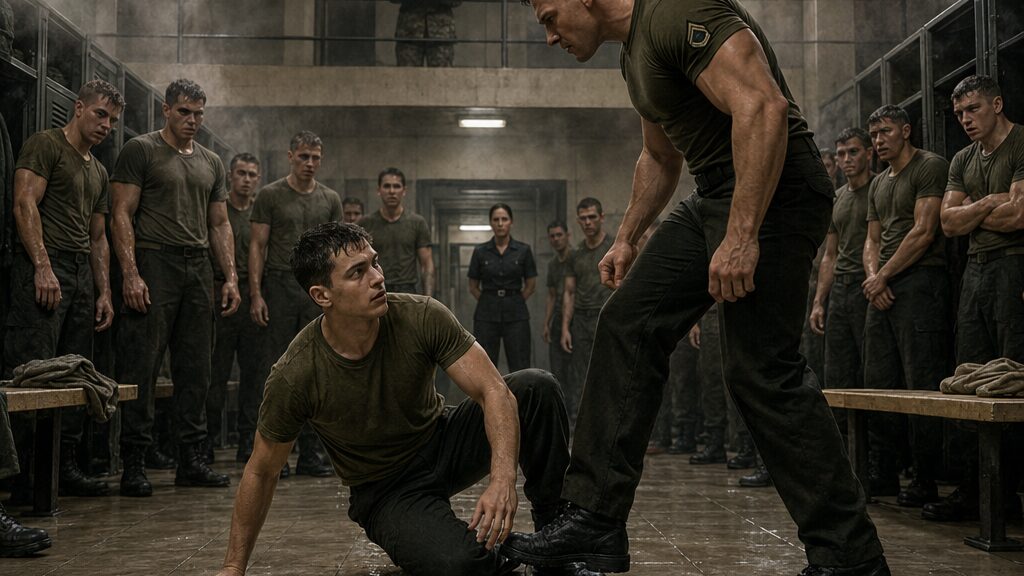
Brandon pointed to a clear section of wet tile between the benches and the shower threshold.
“You, White. Right there.”
Jonathan stepped into the open space.
Water had spread from the showers in a thin reflective sheet. Above them, behind the fogged glass of the observation balcony, a shadow passed and vanished.
Brandon faced him.
“Stand at attention.”
Jonathan drew his heels together.
Chapter 2: The First Kick Across The Wet Tile
Brandon placed his right boot behind Jonathan’s ankle before lowering his voice.
The movement was small enough that a tired observer might have mistaken it for a change of stance. Jonathan felt the pressure against the back of his heel and understood exactly what was coming.
“You’re going to answer me again,” Brandon said. “This time, you’ll sound like a recruit.”
Jonathan stared at a rust stain beneath the far bench.
The locker room had become unnaturally still. Steam drifted across the overhead lights. Water continued tapping into the drains, each drop distinct now that nobody spoke.
Brandon’s temporary insignia caught the light when he leaned closer.
“Have you fought before?”
“Yes.”
The boot pressed harder against Jonathan’s ankle.
“Yes, what?”
“Yes.”
A nervous sound escaped someone near the lockers. Not quite laughter. Not yet.
Brandon’s face changed.
He swept Jonathan’s legs from beneath him.
The ceiling jumped into view. Jonathan turned as he fell, chin tucked, right forearm guiding the descent without taking the full impact. His shoulder struck first, then his hip. Cold water soaked through the back of his shirt.
The room inhaled as one.
Pain flashed along Jonathan’s side, sharp but manageable. His left hand closed around the edge of the loose wooden bench beside him.
The bench lifted slightly.
It would have been easy.
One pull would drag it across Brandon’s shins. One turn would bring Jonathan upright with the heavy frame between them. In another place, at another time, the movement would already have been complete before thought reached it.
His fingers tightened.
Painted concrete.
A man curled on his side.
Voices shouting that it was over.
Jonathan opened his hand.
The bench settled onto the tile.
Brandon looked down at him. “Now you understand the tone?”
Jonathan pushed himself onto one knee.
He could hear breathing around the room—quick, shallow, carefully hidden. Anthony had taken a step forward, but the recruit beside him held an arm across his chest.
Jonathan rose.
Water ran from his sleeve and dripped from his fingertips. He checked his balance, placed his feet shoulder-width apart, then deliberately brought his heels together again.
Attention.
Brandon’s smile weakened.
Jonathan looked at him. “Are you finished?”
For a second, no one moved.
Then someone near the showers gave a short, startled laugh.
It stopped immediately, but the damage was done.
Brandon turned toward the sound. “Who was that?”
No one answered.
His eyes moved across the silent faces. These were the same recruits who stepped aside when he entered, who accepted extra tasks and swallowed insults because Paul Mitchell’s name stood behind him. Yet now several were looking not at Jonathan on the wet floor but at Brandon.
They had seen him attack a smaller recruit who had not raised a hand.
Worse, they had seen the smaller recruit rise as though the humiliation had failed.
Brandon faced Jonathan again. “You think that was funny?”
“No.”
“Then why are they laughing?”
Jonathan’s hands remained open at his sides. “You should ask them.”
Another dangerous answer. Calm. Direct. Free of the deference Brandon required.
Brandon took hold of Jonathan’s shirt just below the throat.
Jonathan did not resist, but his weight shifted almost imperceptibly. Anthony saw it. So did the figure who had stopped outside the half-open locker-room door.
Captain Catherine Garcia had been walking toward the company office when she heard the first impact. From the corridor, she could see only Jonathan’s back, Brandon’s fist twisted in his shirt, and the wet space that the others refused to enter.
Her gaze dropped to Jonathan’s feet.
Balanced.
Not frozen. Not helpless.
Prepared.
Inside the room, Brandon pulled Jonathan closer. “You’re making a mistake.”
Jonathan looked at the hand gripping his shirt. “Let go.”
The words were quiet enough to offer Brandon a way out.
Brandon released him with a shove.
Jonathan absorbed it without stepping back.
The witnesses felt the change before they understood it. Brandon was still larger. He still wore the insignia. His brother still controlled their daily assignments and evaluations.
But the room no longer belonged to him.
Brandon felt it too.
He walked a slow circle, shaking out his shoulders as if preparing for an authorized drill. “Civilian training,” he said. “Show us.”
Jonathan remained at attention.
“That an order?” he asked.
Brandon’s jaw tightened. “You questioning my authority?”
“You’re not conducting instruction.”
The sentence landed harder than the fall had.
Anthony closed his eyes briefly.
Brandon’s authority had always depended on everyone behaving as though it were greater than it was. Jonathan had not insulted him. He had simply named the boundary.
Brandon looked toward the doorway.
Catherine stepped back into the corridor before he could see her. She did not enter. Not yet. She wanted to know whether Brandon would stop when no visible authority forced him to.
Above the steam-clouded room, another observer stood behind the balcony glass.
Base Commander Margaret Taylor had come to inspect the company’s post-exercise procedures without announcement. A series of injury reports had bothered her—not because any single one was remarkable, but because the language describing them was too similar. Slips. Misunderstandings. Unstructured horseplay. No responsible party identified.
She watched Brandon gesture at the recruits.
“Clear the space.”
Nobody moved at first.
“Now.”
Benches scraped. Men edged backward until an open lane formed between Jonathan and the lockers.
Jonathan glanced toward the exit. Brandon shifted to block it.
That choice answered a question.
This was not instruction. It was not discipline. It was a performance, and Brandon needed Jonathan trapped inside it.
“Put your hands up,” Brandon said.
“No.”
“You afraid?”
“Yes.”
The honesty drew several startled looks.
Brandon grinned. “Of me?”
Jonathan’s eyes stayed on his. “Of what happens if you continue.”
The grin vanished.
Brandon stepped forward until their boots nearly touched. “You still think you’re warning me.”
Jonathan said nothing.
His silence no longer looked submissive. It looked measured.
Brandon drove a finger into his chest. “You came in here thinking you were better than us.”
“No.”
“You hide in the middle. You hold back in drills. You answer like none of this matters.”
Jonathan felt the accusations strike closer than Brandon knew.
He had held back. He had hidden. He had allowed instructors to record a false picture because the true one frightened him more than failure did.
But Brandon was not asking for truth. He was demanding a public collapse.
“You want respect?” Brandon said. “Earn it.”
“I’m not asking for yours.”
The nervous laughter came again, this time from more than one throat.
Brandon’s face emptied.
He stepped backward.
Jonathan saw the distance opening between them and knew it was not retreat. Brandon turned his hips slightly. His weight shifted onto the planted leg. His shoulders angled as though he meant to drive the sole of his boot into Jonathan’s ribs and send him into the metal lockers.
Jonathan could move aside.
The nearest clear path was blocked by a bench. The tile was slick. Anthony and two other recruits stood directly behind him.
If he retreated, Brandon’s kick might continue into them.
If he countered, every movement after the first would matter.
Jonathan heard his old instructor’s voice from years before: The danger ends when you decide it ends. Not when your anger is satisfied.
Brandon drew breath.
Jonathan let his heels separate.
Then Brandon launched the kick.
Chapter 3: Three Seconds Before The Room Went Silent
Jonathan caught Brandon’s ankle inches from his ribs.
The impact drove his forearm backward, but his hand closed around the boot while his other palm controlled the shin. Brandon’s planted foot slid on the wet tile.
Surprise crossed his face before fear could replace it.
Jonathan stepped outside the captured leg, turned his hips, and cut his foot behind Brandon’s support ankle.
There was no struggle. No exchange of blows. No wild motion.
One pivot.
One sweep.
Brandon’s body rose almost sideways before his back struck the tile with a flat, heavy crash.
The air left him in a broken grunt.
Jonathan remained above him holding the captured leg.
Three seconds had not passed.
His right hand was already moving.
It released the shin and drew back, elbow close, weight settling for the downward strike that training and memory had welded into him. Brandon lay exposed beneath his shoulder. The line to the jaw was clear. The next movement would end any chance of Brandon rising quickly.
A different face replaced Brandon’s.
Painted concrete beneath it. Blood at the ear. Jonathan’s own fist descending after there had been no need left.
Then he heard water.
A single shower head had not been closed completely. Drops struck the tile in a slow, hollow rhythm.
Jonathan stopped.
His fist hung beside his ribs.
One drop.
Two.
He opened his hand.
Brandon’s leg fell to the floor.
Jonathan stepped back beyond kicking distance and brought his heels together. Water ran from his uniform. His chest rose once, then steadied.
Attention.
For several seconds, nobody seemed able to process the sight: Brandon Mitchell gasping on his back, Jonathan standing over him without a mark on his knuckles.
Anthony stared at Jonathan’s lowered hand. He had seen it start forward. More importantly, he had seen it stop.
Brandon dragged in a breath. “He attacked me.”
No one answered.
“He set me up.” Brandon rolled partly onto one elbow and winced. “You all saw it.”
The recruit near the shower looked away.
Brandon’s voice sharpened. “He’s trained. He baited me.”
Jonathan kept his gaze forward. The effort required to hold still now was greater than the effort the sweep had taken. His pulse hammered against his throat. Every nerve in his body expected another attack.
Captain Catherine entered.
“Do not move.”
The command cut through the room.
Brandon lowered himself back onto the tile. Jonathan remained where he was.
Catherine looked first at the spacing: the open lane, the shifted benches, Brandon’s position near the center, Jonathan’s wet shoulder from the earlier fall. Then she looked at the witnesses.
“Who initiated physical contact?”
Silence.
Brandon pointed from the floor. “He did. He grabbed my leg.”
Catherine’s gaze went to Jonathan. “Did you?”
“Yes, Captain.”
Murmurs stirred around the room.
“Why?”
“He kicked at my ribs.”
“That’s a lie,” Brandon said. “It was a training demonstration.”
“Authorized by whom?” Catherine asked.
Brandon hesitated. “He challenged me in front of the squad.”
“That was not my question.”
Brandon’s face tightened with pain and anger. “He concealed combat training. Look at him. Nobody moves like that by accident.”
Catherine turned to Jonathan. “Is that true?”
Jonathan felt every eye settle on him.
This was the moment he had tried to avoid since arriving—the skill no longer deniable, the questions that would follow, the old record waiting somewhere beyond them.
“I have training,” he said.
“How much?”
He did not answer immediately.
Catherine noticed.
So did Brandon.
“There,” Brandon said. “He came in here pretending he couldn’t fight. He wanted this.”
Jonathan’s hands curled once before he flattened them against his trousers.
“I did not want this.”
“You could have walked away.”
“You blocked the exit.”
Brandon looked toward the doorway as if the room itself had betrayed him.
Catherine faced the witnesses. “Did he block the exit?”
Anthony’s mouth opened.
Before he could speak, footsteps sounded on the metal stairs leading down from the observation balcony.
Everyone looked up.
Base Commander Margaret Taylor appeared behind the railing, notebook in one hand. Steam drifted between the lower room and the glass above her, but there was no mistaking the insignia on her uniform or the authority in the way Catherine straightened.
Margaret descended without hurry.
Brandon’s expression changed from outrage to calculation. He pushed himself higher despite the pain.
“Commander, this recruit assaulted me during corrective instruction.”
Margaret reached the final step and stopped beside the loose locker door.
“Corrective instruction,” she repeated.
“Yes, Commander.”
“With the showers running?”
Brandon said nothing.
“After formal training had ended?”
“He was insubordinate.”
Margaret opened her notebook. “His exact words?”
Brandon looked around the room.
No one supplied them.
Margaret turned a page. Jonathan saw writing already there. Several lines. Times. Positions. His own name near the bottom, underlined once.
She had not arrived after the fall.
She had watched.
Brandon understood it at the same moment. Color drained from his face.
Margaret looked at Jonathan. “Why did you stop?”
The question struck harder than an accusation.
Jonathan’s gaze shifted involuntarily toward the dripping shower head.
Catherine followed it.
“I heard the water,” he said.
Margaret waited.
Jonathan could not explain more without opening the door he had spent years holding shut.
Brandon gave a bitter laugh from the floor. “That doesn’t mean anything.”
Margaret’s eyes moved to Jonathan’s right hand. “It may.”
A medic entered with a folded stretcher, followed by another member of staff. Catherine ordered the witnesses to remain where they were and directed the medic toward Brandon.
As they assessed his back and breathing, Brandon kept talking.
“He planned it. Check his records. Ask why someone with that kind of training is pretending to be ordinary.”
Each word found the uncertainty Jonathan had created himself.
His intake form. Civilian athletics. No detailed combat history. No account of the gym. No explanation for the discipline he had mistaken for secrecy.
Catherine stepped closer to him. “You will surrender your training access until this is reviewed.”
Jonathan swallowed. “Yes, Captain.”
“You will report to medical and then remain available for questioning.”
“Yes, Captain.”
Brandon heard the restriction and smiled despite the pain. “He’s done.”
Margaret closed her notebook.
“No one is done until the facts are established.”
She looked around at the recruits, lingering on those who avoided her eyes.
“This room is now secured. No calls, no messages, no discussion outside formal interviews.”
Her gaze settled on Brandon.
“And this is not the first report in which your name has appeared.”
The smile disappeared.
Catherine’s expression sharpened, but she did not look surprised.
Jonathan did.
Margaret placed the notebook beneath her arm and nodded toward the door.
“Captain Garcia, secure every statement before Squad Leader Paul Mitchell has an opportunity to improve anyone’s memory.”
Chapter 4: The Report That Proved Too Little
The medic turned Jonathan’s hands over beneath the examination lamp and frowned at the clean skin across his knuckles.
“No swelling. No abrasions. No impact marks.”
Captain Catherine stood against the wall of the medical station with her arms folded. “Meaning?”
“Meaning he didn’t punch anyone tonight.”
Across the narrow room, Jonathan sat on the edge of a treatment cot while the medic pressed along his shoulder and ribs. Damp fabric clung coldly to his back. His side ached where he had struck the tile, but the pain felt distant beside the knowledge that every answer he had avoided was moving toward him now.
The medic lifted Jonathan’s arm.
“Bruising here. Likely from the first fall.”
Catherine’s eyes narrowed. “First?”
Jonathan looked at the floor.
The medic released him. “That is what the impact pattern suggests.”
Catherine waited until the medic stepped into the adjoining room.
“You told me Brandon kicked at your ribs.”
“Yes, Captain.”
“You did not tell me there had already been another attack.”
Jonathan kept his hands flat on his thighs. “I thought you saw it.”
“I saw enough to know you were trained. I did not see the first contact clearly.”
The silence that followed felt heavier than the locker room’s steam.
Catherine moved a metal chair into the center of the room. “Stand.”
Jonathan rose automatically and brought his heels together.
“Sit.”
He remained upright for half a breath.
Her voice sharpened. “That was not a test.”
Jonathan sat.
Catherine placed a blank statement form on the table beside him. “You keep using attention like a wall. Someone gives an order, and you disappear behind posture. That may look disciplined from across a parade ground. In an inquiry, it looks like concealment.”
“I’m not trying to conceal what happened.”
“You concealed the first kick.”
Jonathan looked toward the closed door. Through it came the muted roll of a stretcher wheel and Brandon’s voice demanding that someone call Paul.
“I did not think it mattered after the second.”
“It matters because it establishes escalation. It matters because a single counter can be self-defense or retaliation depending on what happened before it. It matters because silence leaves space for someone else to write the story.”
The words landed with uncomfortable precision.
Catherine slid the form closer. “Start at the beginning.”
Jonathan described the question, the order to stand, the boot behind his ankle. He left out nothing physical. Yet when Catherine asked why he had not reported earlier intimidation, his answer became thin.
“It was manageable.”
“For whom?”
He did not reply.
Catherine took the form when he finished. “Stay here.”
The company interview room was two doors down. By the time Jonathan was escorted there, Anthony sat beneath a fluorescent panel with his elbows locked against his sides.
Catherine stood behind the desk. Margaret occupied the corner without speaking, notebook closed in her lap.
Anthony looked at Jonathan only once.
“Tell us what you saw,” Catherine said.
Anthony swallowed. “Brandon was on the floor when I turned around.”
Jonathan felt something in him sink.
Catherine did not react. “You were in the locker room throughout.”
“I was changing.”
“Did Brandon order everyone to remain?”
Anthony rubbed his palms against his trousers. “There was a lot of noise.”
“There was almost no noise,” Margaret said.
Anthony’s eyes flicked toward her.
Catherine leaned forward. “Did Brandon kick Jonathan before Jonathan caught his leg?”
“I didn’t see the start.”
Jonathan watched Anthony’s shoulders creep upward. Fear had reduced him to the same posture Jonathan had worn for six days, only without the formal shape.
Catherine dismissed him without accusation.
When the door shut, Margaret opened her notebook. “He saw more.”
“Yes,” Catherine said.
“And believes silence will protect him.”
Jonathan looked down.
Margaret noticed. “You disagree?”
“No, Commander.”
“You did the same thing.”
Jonathan raised his eyes.
Margaret tapped the closed notebook once. “Different reason. Same result.”
Catherine placed Jonathan’s intake file on the desk. The folder was thin. Too thin.
“You listed civilian athletics,” she said. “No combat disciplines.”
“They were athletics.”
“That answer would be clever if it were not also incomplete.”
She turned the file around. A printed page had been clipped inside. Competition records. Regional brackets. Jonathan’s name appeared beside multiple weight divisions and advanced classifications.
He recognized the dates before he read them.
Catherine tapped the page. “These were discoverable in less than an hour.”
“I stopped competing.”
“You did not stop knowing how.”
“No.”
“Why omit it?”
Jonathan stared at his name in black type.
Because he had wanted to enter the base as someone who had never stood over another man while three people pulled at him.
Because skill invited demonstrations. Demonstrations invited praise. Praise made people forget that control could fail.
“I did not want special attention.”
Margaret’s expression remained unreadable. “You have it now.”
The door opened before Jonathan could answer.
Paul Mitchell entered carrying a file thicker than Jonathan’s intake packet. He was broader than Brandon but less theatrical, his uniform immaculate despite the hour. His face held the controlled strain of someone who had already decided what the facts must mean.
“My brother is being transported for imaging,” he said. “Possible spinal injury.”
Catherine gestured toward the empty chair. “You were told to wait outside.”
“I was also told a recruit concealed professional-level combat training and used it against a member of my squad.”
“Your brother initiated physical contact.”
“That is disputed.”
“Not by the commander.”
Paul glanced toward Margaret. His confidence faltered but did not disappear.
“With respect, Commander, observation from above may not capture provocation.”
Margaret’s voice stayed level. “I saw your brother create distance and launch a kick.”
Paul set the thick file on the desk. “Then we need context for what White intended.”
Jonathan looked at the folder.
Paul opened it to a document bearing a civilian authority stamp and Jonathan’s full name. Several sections had been blacked out, but the line near the top remained visible.
DISCIPLINARY DISPOSITION—WITHDRAWN AFTER COMPLETION OF CONDITIONS.
Catherine read it without touching the page.
Paul faced Jonathan. “You failed to disclose an incident involving serious bodily injury.”
Jonathan’s throat tightened.
“It was withdrawn,” Catherine said.
“The victim was hospitalized.”
The room seemed to contract around the paper.
Margaret studied Jonathan. “Is that true?”
He could have explained. He could have said the other man had attacked someone younger. He could have said the fight began as protection.
But those facts did not change how it ended.
“Yes, Commander.”
Paul pushed the document across the desk.
“My brother may have violated procedure,” he said. “But this recruit entered training under false pretenses, concealed a violent history, and waited until he had witnesses before displaying exactly what he can do.”
Jonathan heard the shape of a convincing lie built from pieces of truth.
Paul turned to Catherine.
“I want White removed from the company before morning.”
Chapter 5: The Fight Jonathan Refused To Describe
Jonathan recognized the old report before Catherine uncovered the first full paragraph.
The paper lay face down on a desk in an empty training classroom. Its lower corner had been folded once, and a faded blue stamp showed through the thin sheet.
He knew the stamp. He had watched an administrator press it onto three copies while his mother sat beside him without speaking.
Catherine closed the classroom door.
“Sit.”
Jonathan remained standing.
She pulled out the chair herself. “Not at attention. Not this time.”
He lowered himself into it.
The room smelled faintly of dry marker and floor polish. Tactical diagrams remained on the board from an earlier lesson, arrows turning around boxed positions. At the far wall, a clock clicked loudly through the silence.
Catherine sat across from him and turned the report over.
“You said the record was withdrawn.”
“It was.”
“That is not the same as saying the event did not happen.”
“No.”
“Paul wants you removed before formation.”
Jonathan looked at the paper rather than her. “Will I be?”
“I have not decided what I will recommend.”
The answer contained no comfort.
Catherine read from the summary. “Civilian training facility. One injured male. Multiple witnesses. No weapon. No charges pursued after restitution, counseling, and a disciplinary agreement.”
She stopped.
“This version says you intervened in an assault.”
Jonathan’s jaw tightened.
“Who was being assaulted?”
“A younger trainee.”
“By the man you injured?”
“Yes.”
“Then why hide it?”
Because the beginning made him sound noble.
The ending did not.
Jonathan rested his forearms on his knees. Sitting made him feel exposed. Standing at attention gave his body clean boundaries. In the chair, his hands had nowhere prescribed to go.
“The younger trainee had been cornered behind the gym,” he said. “The other man was older. He hit him twice.”
“You stepped in.”
“Yes.”
“And then?”
Jonathan watched the second hand move around the clock.
“He swung at me.”
“You defended yourself.”
“Yes.”
Catherine waited.
The room refused to let the answer remain sufficient.
Jonathan looked toward the tactical diagrams. “I put him down.”
“How?”
“A trip. Then a strike.”
“One strike?”
“No.”
The clock clicked.
Catherine’s voice softened, which made the question harder. “How many?”
“I don’t know.”
The memory did not return as a sequence. It came in fragments: the smell of rain through the open service door, someone shouting his name, a shoe scraping uselessly against painted concrete.
“He stopped fighting,” Jonathan said. “I didn’t.”
Catherine remained still.
“Nobody had to pull me into it,” he continued. “Three people had to pull me off.”
The words entered the room and changed it.
Catherine looked down at the report again. “The injured man suffered a fractured cheekbone and a head injury.”
“Yes.”
“You were seventeen.”
“Yes.”
“The conditions were completed. Counseling, restitution, suspension from competition.”
“Yes.”
“Your coach described the first intervention as justified and everything after it as rage.”
Jonathan pressed his palms together until the knuckles blanched.
“He was right.”
Catherine turned another page. “Why did you join?”
The question surprised him.
“I wanted structure.”
“You already had discipline.”
“I had rules.”
“That is not the same thing?”
“No.”
Rules had told him when to bow, when to stop a drill, where to place his hands. They had failed in the alley behind the gym because there had been no referee between him and the anger.
He had come to the military believing discipline might become something deeper than instructions. Yet from the day he arrived, he had hidden the very weakness that needed testing.
Catherine leaned back. “When Brandon was on the floor tonight, you started a follow-up strike.”
Jonathan’s eyes rose sharply.
“I saw enough through the doorway,” she said. “Commander Taylor saw the rest.”
His hand remembered the motion. Elbow close. Shoulder dropping.
“I stopped.”
“Yes.”
“I heard the water.”
“Why did that matter?”
Jonathan took a breath.
During counseling, he had been taught to choose a sound before sparring—a bell, a clap, a spoken word—and use it as a boundary. Years later, ordinary noises could still become the line between action and excess if he let them.
“It reminded me the danger had ended.”
Catherine studied him. “You are asking me to believe that a dripping shower prevented another serious injury.”
“No.”
“Then what are you asking me to believe?”
“That I prevented it.”
The answer sounded harder than he intended.
Catherine’s eyes narrowed.
Jonathan looked away. “The water only gave me a second to choose.”
That changed something in her expression, but not enough to release him.
“You understand that withholding this history may be grounds for removal even if the locker-room force was defensive.”
“Yes.”
“You also understand that Brandon’s conduct does not erase your omission.”
“Yes.”
“Then stop answering as though accepting punishment is the same as telling the truth.”
Jonathan flinched more visibly than he had when he struck the floor.
Catherine pushed the report aside. “You have made yourself easy to discipline and difficult to know. That is not honesty. It is control of a different kind.”
He looked at her.
She had found the flaw beneath the posture: if he offered no explanation, no desire, no anger, then no one could examine the part of him he feared. He could accept any consequence and still keep that part hidden.
Jonathan opened his hands.
“I thought if nobody knew what I could do, I would never be asked to prove it.”
“And if Brandon attacked someone else?”
The question cut cleanly.
Anthony trembling beside the lockers. The exhausted recruit watching his soap container slide across the floor. Every person who had waited for someone else to become the target.
“I knew what he was doing,” Jonathan said.
“Before tonight?”
“Yes.”
“How long?”
“Since my second day.”
Catherine’s face hardened. “You reported nothing.”
“No.”
“Why?”
“I told myself it was not serious enough.”
“But?”
Jonathan stared at the report.
“But I was relieved it was not aimed at me.”
The admission left no dignity to hide behind.
Catherine did not soften it. “Until it was.”
“Yes.”
A knock sounded at the door.
Catherine gathered the report but did not open the door immediately. “Your stopping matters. Your honesty now matters. Neither cancels what you concealed.”
“I understand.”
“No,” she said. “You are beginning to.”
She opened the door.
Anthony stood in the dim corridor, pale and rigid. A staff member waited several steps behind him, but Anthony’s attention fixed on Jonathan.
“I need to change my statement,” he said.
Catherine stepped into the corridor. “Why?”
Anthony glanced both ways.
“Paul talked to us before the interviews. Not inside the secured area. Through the washroom window.”
Jonathan rose from the chair.
“What did he say?” Catherine asked.
Anthony’s lips trembled once. “He said Brandon was conducting corrective training. He said we should only describe what we were sure of.”
“That is not an instruction to lie.”
“He told me being sure meant remembering who signs our evaluations.”
Catherine’s face became very still.
Anthony looked at Jonathan. Shame pulled his eyes downward.
“I saw the first kick,” he said. “I saw all of it.”
Chapter 6: The Brother Who Called Fear Discipline
Margaret placed Brandon’s removed insignia in the center of the hearing table before anyone spoke.
The small piece of metal made almost no sound, yet every person in the room looked at it.
Brandon sat with a support brace beneath his uniform and anger drawn tightly across his face. Paul occupied the chair beside him. Catherine stood near the wall with a folder under one arm. Anthony and Jonathan waited opposite them.
Margaret remained standing.
“This is not a trial,” she said. “It is an administrative determination based on conduct, safety, and command responsibility. If anyone mistakes that for informality, the door is behind you.”
No one moved.
She opened her notebook.
“Captain Garcia, summarize only what is established.”
Catherine spoke without ornament. Brandon had ordered the recruits to remain after training. He had no authorization to conduct combative instruction in the locker room. He had initiated physical contact twice. Jonathan had used one takedown and had not struck Brandon afterward. Witness statements had initially conflicted. At least one witness now alleged pressure from Paul.
Paul’s fingers tightened against the table.
“I told them not to speculate,” he said.
Anthony looked at the floor.
Margaret turned to Paul. “Did you mention evaluations?”
“I reminded them that accuracy affects trust.”
“That was not the question.”
Paul held her gaze. “Yes.”
Brandon shifted in his chair. “Because they were about to turn me into the villain for correcting insubordination.”
Catherine looked at him. “Kicking a recruit from behind is not correction.”
“He knew what he was doing. He wanted me to react.”
Jonathan said nothing.
Margaret closed the notebook. “We will reconstruct the positions.”
They returned to the locker room.
The steam was gone. The tile had dried, leaving pale water marks around the drains. The broken locker door rested against the wall. Without exhausted bodies and running showers, the room looked smaller and less forgiving.
Anthony pointed to the place where Jonathan had stood.
“Here.”
Margaret indicated the wet-tile line still visible near the shower threshold. “Recruit White, take your original position.”
Jonathan approached, then stopped short of the mark.
Catherine watched him. “Problem?”
“Yes, Captain.”
Brandon gave a humorless laugh. “Now he has a problem following orders.”
Jonathan faced Margaret. “Brandon ordered me to stand there. He did not have authority to conduct the exercise. I will assist with reconstruction, but I will not repeat that position as though the order was valid.”
Paul turned toward him. “This is exactly what I meant. He challenges authority by choosing which orders deserve obedience.”
Margaret’s gaze remained on Jonathan. “Will you stand beside the mark and indicate your position?”
“Yes, Commander.”
“Do so.”
Jonathan stepped to the edge and pointed.
The distinction was slight, but it changed the room. He was no longer using compliance to disappear.
Anthony marked Brandon’s first position, then showed how he had moved behind Jonathan’s ankle.
Brandon interrupted. “I was demonstrating balance.”
“With no instructor present?” Catherine asked.
“I was acting squad leader.”
“Temporary rank does not create authority you were never assigned.”
Anthony moved toward the lockers. “After Jonathan got up, Brandon stood here.”
He placed one boot near a drain.
“Then he backed up.”
“How far?” Margaret asked.
Anthony counted the tile seams. “Almost three steps.”
That distance destroyed the claim of accidental contact. It showed preparation.
“He cleared space first,” Anthony added. “He told us to move.”
Paul shut his eyes briefly.
Brandon saw it. “You believe him?”
Paul did not answer.
Margaret asked Jonathan to demonstrate only the direction of the incoming kick. Jonathan used his hand to indicate the line toward his ribs and the recruits behind him.
“Could you retreat?” she asked.
“Not safely. The bench was behind my left leg. Anthony and two others were behind my right.”
“Could you block?”
“Yes.”
“Why did you not?”
“A block would leave him standing and able to strike again.”
Brandon leaned forward despite his brace. “So you decided to put me on my back.”
“Yes.”
The blunt admission filled the room.
Paul stepped between them. “He did exactly what he intended. That matters.”
“It does,” Margaret said. “So does what your brother intended.”
Paul’s face tightened.
She turned to him. “How many complaints involving Brandon have you redirected?”
“They were not formal complaints.”
“How many?”
“Three.”
Catherine opened her folder. “Five.”
“Two were misunderstandings.”
“According to reports you amended.”
Paul looked toward Brandon, then away.
“I stopped worse incidents,” he said. “You think I encouraged him? I pulled him out of fights. I reassigned people before things escalated. I kept him working because every time he failed publicly, he got worse.”
Brandon stared at his brother. “You told them that?”
Paul’s voice dropped. “I kept trying to prevent you from ruining yourself.”
“You kept me here because you needed everyone to think you could control me.”
“That is not true.”
“It is exactly true.”
Paul’s restraint cracked. “I protected you because no one else ever did.”
Brandon’s face changed, wounded pride becoming something younger and uglier. “You protected yourself. Now you’re sacrificing me because the commander saw.”
Paul looked at the insignia in Margaret’s hand.
For years, he had treated consequences as threats from which Brandon needed rescue. Standing in the dry locker room, he seemed to understand what that rescue had taught.
He turned to Margaret.
“Jonathan never threatened him,” Paul said. “Not before either attack.”
Brandon recoiled as if struck.
Paul continued, each word costing him. “The second kick was not instruction. Brandon was angry because the room laughed.”
The admission removed the last shelter from the violence.
Margaret nodded once. “Your honesty is late. It is still entered.”
Brandon pushed himself upright, pain whitening his face. “So that’s it? He hides a record, breaks my back, and gets called disciplined?”
“Your back is not broken,” Catherine said.
“He could have killed me.”
Jonathan’s eyes moved to the drain.
Margaret noticed.
She faced him. “Recruit White, one final question.”
He stepped forward.
“If placed in the same position again, with the same attack coming, would you use the same sweep?”
Jonathan looked at the dry tile, then at the metal locker behind where Brandon had fallen.
“No, Commander.”
Brandon seized on the answer. “There. He knew it was excessive.”
Margaret raised one hand, silencing him.
Jonathan did not retreat into attention. He remained with his feet naturally set and his hands open.
“No,” he repeated. “Not on that floor.”
Chapter 7: The Name Written Above The Locker Room
Margaret turned her notebook toward Jonathan.
Beside his name, written in firm block letters, were two words.
Stopped himself.
Jonathan read them twice.
They sat in the balcony office above the locker room, where the glass offered a clear view of the tile below. The broken locker door had been removed. The benches had been returned to their places. A staff member was drying the last damp patch near the shower drain.
From this height, the space where Brandon had fallen looked small.
Margaret closed the notebook halfway, leaving the words visible.
“You said you would not use the same sweep again,” she said. “Explain that answer.”
Catherine stood near the door. Brandon and Paul waited below under supervision, separated from the recruits who had witnessed the incident.
Jonathan remained seated.
The impulse to stand at attention had followed him into the office, but he had resisted it. Catherine had made the expectation clear the night before: posture would not answer questions for him.
“The lockers blocked my retreat,” he said. “The bench blocked the left side. There were recruits behind me.”
“That explains why you countered.”
“Yes, Commander.”
“It does not explain why you would choose differently.”
Jonathan looked through the glass.
“When I caught his leg, his planted foot was already sliding. I could have turned him toward the bench and controlled his descent.”
“Could you have done that safely?”
“Not completely.”
“And the sweep?”
“Faster. More certain.”
Margaret waited.
Jonathan forced himself to continue.
“The floor made it more dangerous. I knew it was wet. I also knew he would land hard.”
Catherine shifted slightly, but her face remained neutral.
“Did you intend to injure him?” Margaret asked.
“No.”
“Did you intend to put him down with enough force that he could not attack again?”
“Yes.”
The word stayed in the room.
Jonathan did not soften it.
Margaret opened the notebook fully. “What should you have done?”
“Redirected the kick. Trapped the leg against my body. Forced him off balance without cutting the support foot.”
“Would that have ended the confrontation?”
“Maybe not.”
“So the safer action could have exposed you to another attack.”
“Yes.”
“And you are still saying you should have attempted it.”
Jonathan looked at his own hands.
“I am saying I had another option. I did not choose it.”
“Why?”
Because Brandon had kicked him once already. Because the laughter had vanished from the room. Because some part of Jonathan had wanted the next movement to be final.
He could have described only the lockers, the wet tile, the people behind him. Every detail was true.
None of them was the whole truth.
“I was angry,” he said.
Catherine’s eyes sharpened.
Jonathan continued before fear closed him again.
“I did not strike from anger. But anger made the harder takedown easier to choose.”
Margaret leaned back.
“Then why should I retain you?”
Jonathan felt the old answer rise: because he had stopped; because Brandon had attacked; because the witnesses had confirmed it.
He let those answers pass.
“You should not retain me because I won,” he said. “You should retain me only if what I did after matters more than what I hid before.”
“And what did you do after?”
“I stopped. I reported the full sequence when ordered. I admitted the record. I admitted the choice was not perfect.”
Margaret’s expression gave nothing away.
“And what did you hide?”
“My history. Brandon’s earlier behavior. My reason for avoiding combat instruction.”
“Why?”
“I thought silence was control.”
The words no longer felt like confession. They felt like identification.
Margaret closed the notebook.
“Silence allowed Brandon’s conduct to continue. It allowed Paul to shape previous incidents. It allowed your intake file to present a false picture.”
“Yes, Commander.”
“Control that protects only your image is not discipline.”
“No, Commander.”
The office door opened.
Catherine stepped aside as Brandon entered with a careful, rigid gait. Paul followed. Anthony was brought in last and took a place near the wall.
Brandon looked at Jonathan before noticing the insignia in Catherine’s hand.
His face hardened.
Catherine stood in front of him.
“Brandon Mitchell, your temporary squad-leader rank is revoked effective immediately. The decision is based on unauthorized barracks violence, abuse of assumed authority, and deliberate escalation after an opportunity to disengage.”
She placed the insignia on the table beside him.
Not on his chest. Not at his feet.
There was no audience beyond those responsible for the truth.
Brandon stared at the metal.
“What about him?” he asked.
“Recruit White remains under separate review.”
“He admitted he used excessive force.”
Jonathan looked at him. “I admitted I had another option.”
“That is the same thing.”
“No,” Margaret said. “It is the difference between accountability and excuse.”
Brandon’s mouth tightened.
Margaret turned to Paul. “Your handling of prior complaints, alteration of incident descriptions, and contact with witnesses during a secured inquiry will undergo formal command review. Until that review is complete, you are removed from evaluative authority over this training group.”
Paul nodded once.
He did not look relieved.
Brandon turned toward him. “Say something.”
Paul’s gaze rested on the insignia.
“I should have let the first consequence reach you,” he said.
Brandon gave a short laugh. “So now this is your lesson?”
“No.” Paul finally looked at him. “It is mine.”
The answer seemed to wound Brandon more deeply than accusation would have. He pushed the chair back and stood too quickly, flinching when his back tightened.
“You all needed someone to blame.”
Margaret did not stop him from looking around the room.
Anthony did not lower his eyes this time.
Neither did Jonathan.
Catherine escorted Brandon and Paul out separately. Anthony lingered near the door.
“I’m sorry,” he said to Jonathan.
Jonathan knew he meant the first statement, the warning whispered too late, every time fear had dressed itself as caution.
“So am I,” Jonathan said.
Anthony seemed surprised.
“I saw what was happening before the locker room,” Jonathan continued. “I said nothing.”
Anthony nodded. The apology did not erase either silence, but it left them standing on the same side of it.
When he had gone, Margaret opened a second folder.
“Your removal from training was considered,” she said.
Jonathan waited.
“You will remain. Your intake omission will be documented. You will complete additional evaluation and supervised combatives assessment before returning to unrestricted instruction.”
Catherine placed a form before him.
Jonathan read the heading.
ACCELERATED COMBAT ASSESSMENT.
The words exposed exactly what he had come to the base to bury.
Margaret watched him. “You may refuse. If you do, you will continue under standard restrictions while command determines whether your concealed background presents an unacceptable risk.”
“And if I accept?”
“Your ability will no longer be hidden. Neither will your judgment. Both will be tested.”
Jonathan touched the edge of the paper.
He remembered moving through drills at half speed. Letting holds remain. Choosing the middle of every line. Making himself small enough that no one would ask what his hands knew.
Invisibility had not protected anyone.
He signed.
Later that morning, the recruits assembled outside the barracks.
Jonathan approached the formation while conversations faded around him. Anthony shifted just enough to leave space in the line, but he did not gesture or call attention to it.
Jonathan took the place.
Across the yard, Catherine watched with a clipboard under one arm. Margaret stood on the balcony above the locker room, her notebook closed.
No one applauded. No one congratulated him. Brandon’s empty position remained visible near the front, and Paul was nowhere on the field.
An instructor called the formation to attention.
Jonathan brought his heels together.
This time, the posture belonged to him.
He stood without lowering his eyes, without hiding inside the order, and without needing anyone in the line to fear what he could do.
The story has ended.