The Quiet Private Needed Three Seconds to Break the Lie Controlling the Entire Base
Chapter 1: The Baton Rose Above the Rain
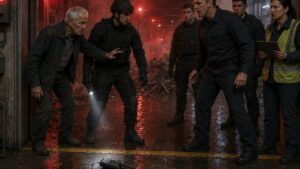
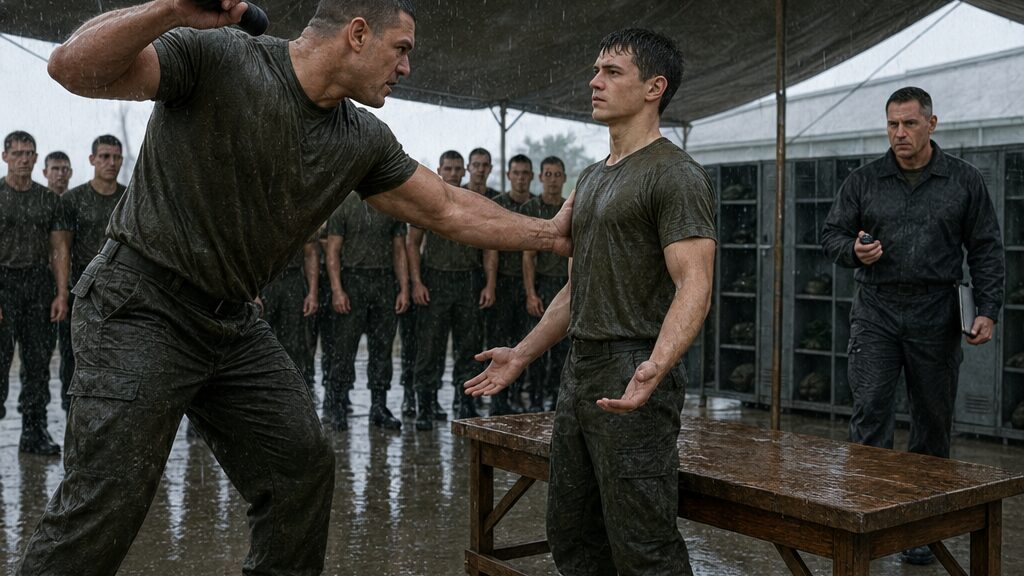
The baton rose above Samuel White’s head while rain streamed off its black rubber shaft.
Justin Green held it one-handed, as if the weight meant nothing. Water ran from his cropped hair, along the hard edge of his jaw, and down the front of his training shirt. He was nearly twice Samuel’s width through the shoulders. Behind him, a loose half circle of soldiers stood beneath the temporary equipment shelter, watching with the stillness of men who had seen this ritual before.
“Three seconds,” Justin said. “That’s all you’ll last.”
Samuel kept his hands open at his sides.
The assembly square had become a sheet of shallow water. Boots had churned the surface into brown streaks during morning drill, and the wind drove rain beneath the shelter roof in cold diagonal lines. Twenty feet away, the instructors were occupied with a damaged radio and a vehicle blocking the service lane.
Justin had chosen his moment carefully.
Samuel looked at the baton, then at Justin’s forward foot.
“Don’t swing that,” he said.
A few soldiers laughed, but not because anything was funny. The sound came quickly and died just as fast.
Only thirty seconds earlier, Samuel had been trying to stay invisible.
The break whistle had sent the platoon toward canteens, benches, and the row of portable field lockers under the shelter. Samuel had stepped aside to let two men pass. His wet shoulder had brushed the open metal door of Justin’s locker.
The door rattled against its frame.
Samuel had stopped immediately.
“My mistake,” he said.
Justin had turned from the equipment table with a towel around his neck. He looked at the locker, then at Samuel, as though deciding how large the insult should become.
“You touched my gear.”
“The door was open. I bumped it.”
“You calling me careless?”
“No.”
Samuel had reached to steady the door. Justin slammed it shut hard enough to make the neighboring lockers jump.
The soldiers nearest them moved back without appearing to move. One bent over his canteen. Another became interested in tying a boot already tied.
Justin stepped close enough that Samuel could smell the sharp soap on his wet shirt.
“New arrivals apologize on their knees.”
Samuel had heard him use that voice before.
Not those exact words. The tone.
Two nights earlier, from the far end of the barracks, he had seen Justin block John Baker beside the laundry room door. Justin had spoken too quietly for anyone else to hear. John had stared at the floor and held a loaded duffel above his head until his arms shook.
Samuel had gone back to folding his shirts.
It was not his business, he had told himself. Interference became attention. Attention became questions. Questions reached backward.
Now John stood near the shelter’s support post, his face pale beneath the rain shadow.
Samuel looked Justin in the eye. “I apologized for the locker.”
“That wasn’t an apology.”
“It was the one you’re getting.”
The circle widened.
Justin smiled, but the expression did not reach his eyes. His upcoming leadership assessment had become common barracks knowledge. He had spent weeks making sure everyone also knew he expected to win it. He corrected posture without being asked. He shouted cadence louder than the designated leaders. He treated every hesitation around him as proof of authority.
Samuel’s refusal landed where witnesses could see it.
Justin planted a palm against Samuel’s chest and shoved.
Samuel let one foot slide back. He absorbed the force without stumbling and returned to the same balanced stance, hands still open.
That made the smile disappear.
“You think standing there makes you tough?”
“No.”
“What does it make you?”
“Finished with this.”
Justin glanced around at the watching soldiers. Whatever response he had expected—fear, anger, pleading—Samuel had denied him all three.
Justin reached past him and opened a long equipment case.
John’s head lifted sharply.
The heavy training baton was meant for controlled defensive drills. Its padded exterior softened impact but did not make it harmless. A full swing could split skin, break fingers, or drop a man before he understood what had happened.
Justin drew it out and tested the grip.
Someone muttered, “Green, leave it.”
Justin turned his head just enough to silence the voice.
Then he faced Samuel again.
“Three seconds,” he said. “Let’s see if you can stay finished.”
The present snapped tight around them.
Samuel watched the baton’s angle. Justin held it high over his right shoulder, but his left hand floated near Samuel’s chest. He intended to shove first, pin Samuel against the folding table, then bring the baton down while everyone watched.
Samuel knew because he had been taught to see intention before movement.
He hated that knowledge.
He hated the old instinct waking in his legs, the cold calculation of distance and weight. For years, he had practiced letting insults pass through him. He had joined the military to become useful under rules, not dangerous in secret. He had promised himself that no one would ever look at him and see the man who had trained him.
Justin stepped forward.
Samuel spoke once more.
“Put it down.”
Justin drove his left hand toward Samuel’s chest.
The world narrowed.
Samuel moved outside the shove. His right hand closed on Justin’s collar near the shoulder seam. His left guided the charging arm past his body. Justin’s own weight continued forward, too committed to stop.
The baton began its downward arc.
Samuel turned his hips.
There was no pause between the movements. No struggle. No exchange of blows.
Justin’s boots left the ground.
His expression changed first from fury to confusion, then from confusion to naked alarm as his body rolled across Samuel’s hip. Samuel felt the path of the fall and altered it by inches, pulling Justin’s head away from the metal corner of the table.
Justin struck the center instead.
The folding table collapsed with a flat explosive crack. Its wooden surface split beneath his back, and the steel legs kicked outward. The baton flew from his hand, bounced once, and spun through a puddle.
Samuel released the collar before Justin stopped moving.
He stepped away.
His hands opened again.
For one second, the only sounds were rain on canvas and Justin dragging air into his lungs.
Then boots struck the flooded square behind the crowd.
Drill Sergeant Michael Torres pushed between two frozen soldiers, a stopwatch still in his hand from the interrupted practice interval.
His eyes moved from the baton in the puddle to Samuel’s empty hands, then to Justin lying amid the broken table.
Michael looked down at the stopwatch.
The display read 00:03.
Chapter 2: The Number Written in Wet Ink
“He set me up.”
Justin’s accusation came from inside the wreckage before anyone offered to help him stand.
His face had gone gray beneath the flush of embarrassment. One hand gripped the broken edge of the table, while the other pressed against his ribs. The soldiers surrounding him avoided his eyes now. Their earlier laughter had vanished with the baton.
Michael Torres did not answer.
He clicked the stopwatch off and pointed toward the weapon in the puddle.
“Who issued that?”
No one spoke.
Michael’s gaze settled on Samuel. “Move away from him.”
Samuel took two steps back.
“Hands where I can see them.”
They were already open, but Samuel raised them to chest height.
Justin pushed himself upright. A broken table leg scraped across the concrete. “He knew what he was doing. He waited until I moved.”
“You had a training baton,” Michael said.
“He grabbed me.”
“You had a training baton.”
Justin looked around for support and found only faces suddenly fascinated by the rain. “It was correction. He came at me.”
Samuel said nothing.
Michael turned to him. “Did you strike Private Green?”
“No, Sergeant.”
“Did you throw him?”
“Yes, Sergeant.”
“Why?”
“He raised the baton and shoved.”
Justin barked a humorless laugh. “Listen to him. Calm as anything. Like he practiced the statement.”
Michael’s eyes narrowed. Samuel saw the moment Justin’s accusation found a place to live. Calmness could look like control. It could also look like preparation.
“Medical station,” Michael ordered. “Both of you. Nobody leaves this area until statements are taken.”
At the medical station, Justin’s injuries became less dramatic and more damaging to his version of events.
He had bruising across his back and one forearm, a strained shoulder, and a shallow cut where a piece of the table had caught his sleeve. Nothing was broken. His head had never struck the ground or the table edge.
The medic rotated Justin’s neck, checked his pupils, then glanced at Samuel.
“You placed him flat?”
Samuel looked at the floor. “I changed the fall.”
Justin stopped rubbing his shoulder. “What does that mean?”
The medic answered without looking at him. “It means you could have landed worse.”
Michael stood in the doorway with his arms folded. His expression did not soften, but something in it shifted.
Samuel had one reddened patch on his chest from the shove. No other injury.
“Show me,” Michael said.
Samuel looked up.
“The movement. Slow.”
Justin began to object, but Michael silenced him with a glance.
Samuel stood beside an empty examination cot. He kept his explanation minimal. “His hand came here. I stepped outside it. Took the collar. Continued the direction he was already moving.”
“You lifted him?”
“No.”
“You’re saying Green threw himself?”
“I’m saying his momentum supplied most of it.”
Justin’s jaw tightened. “You made me go through that table.”
Samuel met his eyes. “I kept your head from hitting its edge.”
The room went still.
Michael studied Samuel’s hands as if they were evidence.
Back in the training office, rain tapped against the narrow windows. Michael opened the soaked field log on his desk. Water had blurred several entries into blue-gray clouds. He wrote the time, location, and names, pressing hard enough to score the page beneath.
Under the incident description, he printed:
TOTAL NEUTRALIZATION: 00:03.
It was the kind of dry humiliation that normally would have drawn a grin from him. None came.
Ashley Rodriguez entered carrying a plastic document sleeve and the recovered baton. She worked in training administration and had the precise, unsentimental manner of someone accustomed to repairing other people’s careless records.
She read Michael’s entry.
“Is that official terminology?”
“It records what happened.”
“It sounds like a joke.”
“Green announced the time before he started.”
Ashley looked from Justin to Samuel. “Started what?”
“A fight,” Justin said.
“An unauthorized baton drill,” Samuel said at the same moment.
Ashley laid the baton on the desk.
“Those are different reports.”
Michael rubbed a thumb across his jaw. “That’s why nobody is leaving.”
Statements followed.
Justin described an aggressive new private who had bumped his locker, refused correction, and used specialized combat training to ambush a senior soldier. He admitted holding the baton but claimed he intended only to frighten Samuel.
Samuel described the open locker, the apology, the demand to kneel, the shove, and the raised weapon.
“Where did you learn the technique?” Michael asked.
Samuel looked at the wet log.
“At home.”
“What kind of home teaches that?”
Samuel did not answer.
Michael leaned forward. “Private White, this was not luck. You read his approach, redirected an armed man twice your size, controlled where his head landed, and stopped without a follow-up. That is trained behavior.”
“Yes, Sergeant.”
“Was it included in your enlistment history?”
“There was no certification.”
“I didn’t ask for certification.”
Samuel’s fingers had begun to close. He forced them open on his knees.
Ashley noticed. She noticed everything.
Michael lowered his voice. “I need to know whether you concealed material background information.”
“It wasn’t employment. It wasn’t a school.”
“What was it?”
Samuel thought of a concrete floor in winter. Bare feet. A voice correcting his breathing after he had been knocked down. The rule that anger made movement slow. The worse rule that mercy made a person weak.
He pushed the images away.
“I learned young.”
“That is not an answer.”
“It is the answer I can give.”
Michael sat back.
Until then, the room’s suspicion had leaned toward Justin because of the baton. Samuel felt it redistribute. Not evenly, but enough.
Ashley closed the document sleeve. “The incident report can wait for equipment verification.”
Michael looked at her.
“The baton has an issue number,” she said. “I want the checkout record.”
Justin’s eyes flicked toward Michael and away.
Samuel saw it.
Michael saw Samuel see it.
The drill sergeant closed the wet training log.
“Private Green remains under medical restriction. Private White, you’re confined to barracks and official appointments pending review.”
Samuel stood.
Michael’s next words stopped him at the door.
“One more question. Did you enter this service with an incomplete background disclosure?”
Samuel kept his back straight.
“I answered every question I was asked.”
Michael’s voice hardened. “That wasn’t my question.”
Samuel turned. The soaked page lay open between them, the three-second entry dark and sharp among the blurred ink.
“No, Sergeant,” Samuel said. “It wasn’t.”
Chapter 3: The Quiet Kid Had Seen This Before
Three seconds had been scratched into the condensation above Samuel’s bunk.
The numbers were large enough to be read from the barracks aisle. Someone had drawn a crude broken table beneath them. Two soldiers at the far end stopped talking when Samuel entered, then waited until he passed before whispering again.
He wiped the marks away with his sleeve.
The moisture disappeared. The faint trails left by the finger did not.
John Baker sat on the lower bunk opposite, polishing boots that were already clean. His movements were quick and uneven. He did not look up until Samuel opened his locker.
“You should be happy,” John said.
Samuel removed his wet shirt and hung it carefully. “Why?”
“Green can’t lift his arm over his head.”
“That won’t last.”
“The story will.”
Samuel closed the locker. “Stories change.”
John gave a short laugh. “Not this one. Half the base already thinks you broke him in one move. The other half thinks you were trained in some underground cage.”
“Neither is true.”
John finally looked at him. “You did break a table with him.”
“He broke it with his weight.”
“That sounds worse.”
Samuel sat on the edge of his bunk. His fingers had tightened without permission. He opened them one at a time.
John watched.
“You do that a lot.”
“Do what?”
“Check your hands.”
Samuel rested them on his thighs.
Outside, boots struck the covered walkway. Every passing voice seemed to contain the same phrase: three seconds.
John lowered his voice. “What did Green say before he swung?”
“You were there.”
“I couldn’t hear all of it.”
“He wanted me to kneel.”
John’s polishing cloth stopped.
Samuel waited.
After a moment, John said, “He likes that.”
The words were nearly lost beneath the sound of rainwater draining from the roof.
“What did he make you do?” Samuel asked.
John stared at the toe of his boot. “Nothing.”
“I saw you by the laundry room.”
John’s head snapped up.
Samuel regretted the sentence as soon as it left him. Not because it was false, but because of what it revealed.
“You saw?”
“Yes.”
“And you walked away.”
Samuel held his gaze. “Yes.”
John stood and crossed the narrow space between the bunks. His anger came without volume.
“He called it a strength test. Put wet sandbags in a duffel and made me hold it over my head. Said if I dropped it, I’d do it again outside. I couldn’t feel two fingers the next morning.”
“Did you report it?”
“To who?”
“Michael.”
John’s expression changed. It was not quite disbelief. It was the look of someone realizing the person before him had been more naive than expected.
“You think Torres never noticed?”
Before Samuel could answer, the barracks door opened.
A runner summoned him to the interview room.
Michael waited inside with a blank statement form. Ashley sat at the end of the table with three equipment records in separate sleeves.
Michael pointed to the chair.
Samuel sat.
“We’re going to try your background again,” Michael said. “Not the version you think is safe. The useful version.”
Samuel looked at Ashley. “Is this disciplinary?”
“It becomes whatever the facts require,” she said.
Michael slid the blank form toward him. “Where did you learn to move like that?”
Samuel studied the empty lines.
His guardian had never called it training. Training suggested progress, rules, an end point. What Samuel remembered was repetition shaped by mood. A missed step meant the exercise started again. A slow reaction meant falling harder. By twelve, he could read weight shifting through a shoulder. By fourteen, he knew how to guide a larger body toward the safest or most damaging surface in a room.
The choice had depended on who was watching.
“A relative taught me,” Samuel said.
“Military?”
“No.”
“Law enforcement?”
“No.”
“Competitive fighter?”
“No.”
“What, then?”
Samuel’s mouth felt dry. “A man who believed being ready to hurt someone was the only way not to be hurt.”
Michael’s pen stopped.
Samuel continued before silence could close over him again.
“He made me practice against larger people. Sometimes adults. The point was not to trade blows. It was to make them miss, use their balance, and finish before they recovered.”
“Finish how?” Ashley asked.
Samuel looked at his hands.
“However he ordered.”
Michael’s tone softened by a degree. “Why wasn’t this disclosed?”
“There was nothing official to disclose. No club. No record. No charges involving me.”
“Why hide it here?”
“Because I didn’t join to be that person.”
Michael sat back, but Samuel could not tell whether the answer had helped.
The interview ended with more empty spaces than filled ones.
On the covered walkway, John was waiting.
“They talked to me,” he said.
Samuel stopped.
“What did you tell them?”
“That Green was loud. That you looked calm.”
“Anything about the laundry room?”
John’s eyes moved toward the open square. “No.”
“You said he hurt your hand.”
“I said that to you.”
Samuel felt the old impulse rise: say nothing, expose nothing, survive the moment. It had protected him for years. Now it stood between John and the truth like a locked door.
“You should tell them.”
John’s face hardened. “Easy for you to say now. You dropped him in front of everyone. I still have to sleep in the same barracks.”
“You think he’ll come back?”
“I think people like him don’t disappear because one table breaks.”
John walked away.
Samuel remained under the shelter, listening to rain strike the square. He understood then what his silence had done. He had believed it kept him separate from Justin’s world. Instead, it had left John alone inside it.
In the training office, Ashley compared the baton’s serial number with the equipment ledger.
The scheduled drill list showed no baton work that week.
The checkout page showed something else.
She carried it to Michael’s desk and placed it beside his handwritten account of the three-second neutralization.
Michael read the signature line once, then again.
The baton had been released under his training authority.
Chapter 4: The Sergeant Who Called Fear Discipline
Ashley Rodriguez placed the baton checkout record beside Michael Torres’s handwritten three-second entry.
The two pages did not agree with each other.
One claimed a sudden fight had erupted during a rain break. The other showed that the weapon had been released three days earlier under Michael’s training authority, despite no baton drill appearing anywhere on the schedule.
Michael stared at his signature.
“I didn’t hand it to Green yesterday.”
Ashley remained standing across his desk. “That is not what the record says.”
“It says I authorized access to the equipment cage.”
“For what purpose?”
“Supplemental practice.”
“Whose?”
Michael looked through the office window toward the assembly square. The broken table had been removed, but two pale wooden fragments remained beside a drain. Rain had washed the bloodless scene clean without settling anything.
“Green was preparing for leadership assessment.”
“With an impact weapon?”
“With defensive equipment.”
Ashley tapped the schedule. “No instructor assigned. No control officer. No listed participants.”
“He was drilling movement.”
“Or collecting tools for his private correction sessions.”
Michael’s eyes sharpened. “Be careful.”
“I am being careful. That is why I brought the original instead of adding it to the incident packet.”
The distinction landed harder than an accusation. She was giving him one opportunity to explain before the record became impossible to contain.
Michael picked up the stopwatch from his desk. He pressed the top button.
The numbers began moving.
He stopped them at one second, reset, then started again.
Ashley watched him reach three and click the button.
“Why did you write ‘total neutralization’?”
“Because that is what happened.”
“You mocked Green in front of the platoon.”
“He had just attacked a private with equipment he had no authorization to use.”
“Equipment released under your authority.”
Michael set the stopwatch down.
He remembered the soldiers beneath the shelter, their faces arranged in the disciplined blankness men wore when they knew more than they intended to say. He remembered Justin on the broken table and Samuel standing three feet away with both hands open.
His own line returned to him: Three seconds, Green. You finally told the truth.
At the time, it had felt like control restored.
Now it looked like distance. A quick public cruelty to make certain no one connected Justin’s actions to the training culture Michael had permitted.
“I authorized extra access,” Michael said. “Not hazing.”
Ashley slid another sleeve from her folder. Inside were copies of equipment-damage reports.
A torn laundry-room strap. A dented storage cabinet. A burst sandbag found near the barracks stairwell. Each report had been treated as carelessness. Each included Justin’s name as either witness or reporting soldier.
“Patterns do not care what you called them,” Ashley said.
The closed command review began an hour later.
Samuel sat on one side of a long table. Justin sat opposite him with his right arm supported in a sling he did not strictly need. Michael stood near the wall. Ashley arranged the documents in front of the reviewing officer, who read in silence while an aide recorded the meeting.
Justin spoke first.
“I was doing what Sergeant Torres expected.”
Michael’s head turned.
The reviewing officer looked up. “Explain.”
“New arrivals come in soft. They freeze during pressure drills. Sergeant Torres told squad leaders not to let standards slip between formal sessions.”
“I told you to maintain discipline,” Michael said.
Justin gave him a level look. “You told me fear shows where the weakness is.”
Samuel saw Michael absorb the words without denying them.
Justin continued. “I pushed them. Yes. But nobody complained because it worked. Baker’s endurance times improved. The others stopped hesitating. White was different. He wanted me to make a move.”
Samuel’s hands tightened beneath the table.
The reviewing officer faced him. “Did you provoke Private Green?”
“No.”
“You refused a lawful instruction from a senior soldier.”
“He ordered me to kneel because I touched his locker.”
“That instruction was not lawful,” Ashley said.
The officer’s gaze shifted to her.
She placed the baton record on top of the incident file. “Nor was the weapon use authorized.”
Justin leaned forward. “He was waiting for it. Look at him. He never panicked. He knew exactly where the table was.”
Samuel could feel every eye in the room asking the same question.
He had known where the table was.
He always knew where the hard edges were.
The reviewing officer asked, “Private White, before Green raised the baton, did you believe he intended to injure you?”
“Yes.”
“Why?”
Samuel glanced at John’s absent chair along the wall. No witness had been asked to attend this stage.
“His posture. His grip. The shove.”
“Only that?”
Samuel hesitated.
Michael saw it. “Answer completely.”
Samuel looked at him. The instruction carried more than authority now. It carried fear.
“I had seen him isolate another recruit before.”
Justin’s expression shifted.
“Who?” the officer asked.
Samuel did not answer.
“You are alleging a pattern while refusing to identify evidence.”
“I’m not identifying someone who hasn’t agreed to be named.”
Justin gave a small, bitter smile. “Convenient.”
The officer closed the file. “What I see is unauthorized conduct by Green, possible excessive force by White, inadequate equipment control, and inconsistent supervision.”
“Excessive?” Michael said. “Green walked away with bruises.”
“He went through a table.”
“He was redirected away from the baton.”
The officer’s voice cooled. “And you appear unusually invested in a technical defense of a private whose background you cannot verify.”
Michael stopped.
Samuel understood the trap before anyone said it aloud. If Michael defended him too strongly, he exposed his own familiarity with the kind of informal violence under review. If Michael withdrew, Samuel became the simplest place to contain the incident.
The command’s proposed classification arrived before noon.
Mutual misconduct during an unsanctioned confrontation.
Justin would receive a conduct penalty for possession of training equipment. Samuel would receive one for escalation and failure to disengage. The supervisory issue would be handled internally.
Ashley read the draft twice.
“This excludes the demand that White kneel.”
“Uncorroborated,” the reviewing officer said.
“It excludes the first shove.”
“Disputed.”
“It excludes every equipment report connected to Green.”
“Not directly relevant to yesterday’s event.”
Michael stood at the end of the table, jaw rigid.
Samuel watched him say nothing.
The meeting ended, but Samuel was asked to remain.
An unsigned conduct warning was placed before him. The language was narrow and clean. It did not accuse him of starting the fight. It stated only that he had participated in an avoidable physical confrontation and had failed to disclose relevant prior training during initial questioning.
“If you accept this,” the reviewing officer said, “your restriction will be lifted after administrative review. Your private family history will not be pursued unless it contains criminal or enlistment-relevant material.”
Samuel read the final paragraph.
The incident would be closed without findings concerning prior conduct by other personnel.
He looked at Michael.
The drill sergeant’s face gave him nothing.
Samuel had spent years learning how to survive offers like this. Do not argue. Do not volunteer. Take the door left open and close it behind you.
The warning required only his signature.
The reviewing officer slid a pen across the table.
“Accept responsibility for your part,” he said, “and this does not have to follow you.”
Samuel placed his open hand beside the pen.
On the other side of the door, someone removed the three-second story from an unofficial noticeboard. Inside the room, the larger lie waited for Samuel to protect it with his name.
Chapter 5: The Statement Samuel Refused to Shorten
Samuel pushed the unsigned conduct warning back across the table.
The pen rolled after it and stopped against the reviewing officer’s folder.
“I won’t sign that.”
Michael’s eyes lifted from the wall. Ashley, who had remained to certify the paperwork, did not move.
The reviewing officer folded his hands. “Which part do you dispute?”
“The part where yesterday begins with the fight.”
“It begins with your participation in it.”
“No. It begins before that.”
Justin had been removed from the room, but Samuel could still feel his presence in the language of the document. Everything had been reduced to a moment where both men touched each other. The order to kneel was gone. The baton checkout was a clerical issue. John’s shaking arms did not exist.
The officer drew the warning back. “Then give us a complete statement.”
Samuel looked at the blank pages Ashley placed before him.
He had always believed truth became dangerous when made too large. Give only what was demanded. Leave nothing extra that could be turned in another direction.
Now the short answers had already been turned against him.
“I saw Green corner John Baker two nights before the incident,” he said.
Michael’s posture changed.
Samuel continued. “Near the laundry room. Green had him holding a loaded duffel above his head. John’s arms were shaking.”
“Did you hear an order?” the officer asked.
“No.”
“Did you see physical contact?”
“No.”
“Then what exactly did you witness?”
“A recruit who looked afraid and a senior soldier preventing him from leaving.”
“Did you report it?”
Samuel’s throat tightened.
“No.”
The aide’s pen scratched across paper.
“Why not?”
“Because I didn’t want attention.”
The answer sounded smaller in the room than it had inside his head.
The officer leaned back. “So you believed Green was dangerous, saw him mistreat another recruit, chose not to report it, and later remained near him during a confrontation.”
“Yes.”
Justin’s argument had gained something real now. Samuel had known more than he first admitted. He had not planned the fight, but he had recognized the pattern and stayed silent.
Michael said, “Tell them why you avoid attention.”
Samuel looked toward him.
The drill sergeant no longer sounded suspicious. He sounded like a man asking Samuel to open a door both of them feared.
“My guardian trained me from childhood,” Samuel said.
The words came slowly, each one measured against years of refusal.
“He believed pain prevented weakness. He made me practice falls on concrete. He brought in men larger than me and told them not to stop when I asked. If I got angry, he said anger wasted time. If I hesitated, he repeated the exercise.”
No one interrupted.
Samuel’s right hand had curled against his thigh. He opened it.
“He taught me how to control where someone lands. How to use walls, furniture, corners. How to hurt people before they could decide whether they wanted to hurt me.”
Ashley’s expression remained composed, but her pen had stopped.
“Was this abuse?” the reviewing officer asked.
Samuel looked at the bare tabletop. “That word was never used in the house.”
“Why did you not include it in your enlistment history?”
“There was no charge. No school. No employment. When the forms asked whether I had combat qualifications, the honest answer was no.”
Michael said, “But you knew you had ability beyond standard recruits.”
“Yes.”
“Why hide that here?”
Samuel breathed once through his nose.
“Because when I move like he taught me, I can hear him approving.”
The confession changed the room more than any technical evidence had.
Samuel looked at Michael. “I didn’t want that part of me to be useful. So when I saw Green with John, I told myself staying out of it was restraint.”
John had been right. Samuel had walked away.
The reviewing officer asked, “What happened during the three seconds?”
Samuel placed both hands on the table, palms visible.
“First second: Green shoved with his left hand and began the baton swing with his right. I moved outside the shove.”
The aide wrote.
“Second second: I took his collar and redirected his arm. His weight was already forward.”
“Third?”
“I turned him over the table.”
“You chose the table.”
“I chose the open space beside it. When he went higher than I expected, his head was aimed at the metal corner.”
Samuel touched two fingers to the edge of the desk.
“I pulled his collar toward me and rotated his shoulder. That moved his head inward. His back took the table.”
Michael stared at the placement of Samuel’s fingers.
“You changed the throw after committing to it,” he said.
“Yes.”
“Why?”
“So he wouldn’t strike his head.”
The reviewing officer looked at the medical report. “You had time to make that decision?”
“There was time inside the movement.”
Three seconds had sounded like nothing when Justin used them as a threat. Now Samuel understood how much they contained: warning, fear, old instruction, choice.
“And after he landed?” the officer asked.
“I let go.”
“Why no follow-up?”
“He no longer had the baton.”
Michael exhaled and looked away.
Samuel’s statement had not made him innocent of everything. It made his failure visible. He could have named the pattern earlier. He could have stood beside John before the baton ever rose. Instead, he had waited until violence reached his own body.
“I should have reported what I saw,” Samuel said. “I didn’t. That belongs in the record too.”
The reviewing officer studied him. “You understand that admission may expose you to separate corrective action.”
“Yes.”
“And you still refuse the warning?”
“It says the confrontation was avoidable without saying who had the power to avoid it.”
Silence held for several seconds.
Then Michael stepped away from the wall.
“I used Green,” he said.
The reviewing officer turned sharply.
Michael’s voice remained controlled. “I knew he pressured new arrivals. I told myself he was enforcing standards. Performance improved after he focused on certain recruits, and I accepted the results without asking what produced them.”
“Sergeant,” the officer warned.
“You wanted a complete statement.”
Ashley watched him with the same unforgiving attention she gave the records.
Michael looked at Samuel. “I called it discipline because that made it useful to me.”
Before anyone could respond, the door opened.
John Baker stood in the threshold holding a thin notebook against his chest.
A staff member behind him began to object, but John raised the notebook.
“I was told Private White named me.”
Samuel stood halfway, then stopped.
John entered and placed the notebook on the table. Its cover was bent and stained at the corners.
“I wrote down the dates,” he said. “Not just mine.”
The reviewing officer opened it.
Each entry was brief: location, demand, witness, injury or damage. Laundry room. Storage stairwell. Equipment shelter. A sandbag exercise that had never appeared on a schedule.
The officer turned several pages.
Then his hand stopped.
Michael saw the date before he saw the words.
John had recorded an incident three weeks earlier in which Justin forced two recruits to repeat a night movement drill after lights-out.
At the bottom of the entry, John had written:
Sergeant Torres came through at 22:40. Green told him he was correcting hesitation. Torres said, “Then make sure it works,” and walked out.
The notebook lay open between them.
No one could reduce the problem to a broken table anymore.
Chapter 6: What the Broken Table Could Not Prove
A replacement table stood in the exact puddled position of the one Justin had shattered.
The rain had weakened to a cold mist, but the assembly square still reflected the gray morning sky. White tape marked the locations of the field locker, the fallen baton, Samuel’s starting position, and the place where Justin’s boots had left the ground.
The command review had moved outside because paper could establish access, timing, and prior reports, but it could not show what three seconds of force looked like.
Samuel faced the table with his hands open.
Justin stood ten feet away without his sling. The bruising had darkened along one side of his neck. He kept his eyes on the tape rather than Samuel.
Michael held the stopwatch.
Ashley stood beside the reviewing officer with the corrected equipment records and John’s notebook sealed in a clear sleeve. Several instructors observed from behind the marked area. The wider platoon had been kept away.
“This is a reconstruction,” the reviewing officer said. “No full-speed contact. No impact. Every movement stops on command.”
Samuel nodded.
Justin folded his arms. “He’ll make it look clean now.”
The officer turned to him. “You will have the same opportunity to demonstrate your account.”
Justin’s jaw shifted.
Samuel moved to his taped mark. A staff member took Justin’s role first, raising an inert foam replica of the baton.
Michael clicked the stopwatch.
“First second,” Samuel said.
The staff member drove his free hand forward. Samuel stepped outside the line. He did not hurry. At reduced speed, the geometry became obvious: remaining still would have trapped him between Justin and the table; moving backward would have kept him inside the baton’s arc.
“Stop.”
Michael froze the count.
Ashley walked around them. “Your right hand?”
“Still open.”
“And his baton?”
“Beginning to descend.”
Michael reset the stopwatch.
“Second second.”
Samuel closed his right hand on the staff member’s collar and guided the extended arm with his left. He shifted his hips beneath the advancing center of weight.
“Stop.”
The staff member was off balance but upright.
The reviewing officer looked at Justin. “Did White strike you before this position?”
“No.”
“Did he pull you toward him?”
Justin hesitated. “He grabbed me.”
“That was not the question.”
“Yes. He pulled.”
Michael started the final interval.
“Third second.”
Samuel rotated only far enough to show the path, then released the staff member and stepped back.
“Full movement would carry him toward the table,” Samuel said. “When Green’s feet left the ground, his head moved toward this corner.”
He placed his palm above the metal edge.
“I shortened the turn and pulled the collar inward.”
The reviewing officer frowned. “Would that not increase impact?”
“To the back, yes. It reduced rotation of the head.”
The medic from the previous day confirmed it. “The bruising pattern supports a flat landing. No head contact. No neck compression.”
Justin gave a quiet scoff. “So now he gets credit for putting me through furniture.”
Samuel looked at him. “No.”
The single word cut through the technical discussion.
“I’m explaining why you got up.”
Justin’s face hardened, but he did not answer.
The reviewing officer ordered the second reconstruction.
Justin took his marked position. Samuel stood where he had stood beneath the shelter, though this time no weapon was raised.
“Show us the initial interaction,” the officer said.
Justin planted his feet. “I told him to move away from my locker.”
Samuel said nothing.
“What happened next?”
“He got disrespectful.”
“What did you say?”
Justin looked toward Michael.
The drill sergeant’s expression remained still.
“I told him new arrivals follow correction.”
“Did you order him to kneel?”
Justin’s silence lasted too long.
“Yes.”
“And when he refused?”
“I moved him back.”
“Show us.”
Justin stepped forward.
His left hand rose automatically toward Samuel’s chest. His right shoulder pulled back as though making room for the baton. At the same time, his fingers reached toward Samuel’s collar.
Michael clicked the stopwatch off.
No one had told Justin to grab the collar.
He froze with his hand inches from Samuel’s shirt.
Ashley looked down at the witness statements. Two had described the same sequence: crowding, chest shove, collar control.
Justin slowly lowered his arm.
The reviewing officer said, “You claimed White seized you without warning. You have just demonstrated the same approach the witnesses attributed to you.”
“I was showing what happened.”
“You were showing what you intended.”
Justin stepped away from Samuel. For the first time since the fight, his size seemed less like certainty than something he had spent years maintaining.
“You all wanted this,” he said.
The words were directed at Michael.
“You wanted recruits afraid of failing. You wanted them faster, quieter, harder. When somebody dragged behind, you sent me to fix it.”
“I never sent you with a baton,” Michael said.
“You didn’t have to. You gave me access. You saw Baker that night.”
Michael accepted the accusation without looking away. “I did.”
Justin laughed once, but there was no triumph in it. “Now everyone acts shocked because White made me look weak.”
The reviewing officer asked, “Why did you choose the baton?”
Justin’s eyes moved to the table.
“He refused in front of them.”
“That is not an operational reason.”
“No.”
“Was he threatening you?”
“No.”
“Was he advancing?”
“No.”
“Then why?”
Justin’s answer came through clenched teeth.
“Because he embarrassed me.”
The admission settled the question that the records could not. Michael’s failures had created room for the assault. Justin had still chosen to make it.
The review reconvened inside.
The findings separated the responsibilities rather than blending them for convenience. Justin had used unauthorized equipment during a coercive confrontation and initiated unjustified force. His leadership assessment was canceled, and his status was reduced pending formal discipline.
Michael retained command responsibility but lost control of the evaluation program. His equipment permissions were suspended, and the platoon’s reporting and close-combat procedures would be rebuilt under outside oversight.
Samuel received corrective counseling for failing to report the earlier incident involving John. No misconduct finding was attached to the defensive action.
Ashley opened the field log to the rain-stained page.
Michael took a black pen and drew one line through his first entry—not enough to erase it, only enough to show that it had been incomplete.
Beneath it, he wrote:
Unauthorized baton assault. Verbal warning issued by Private White. Defensive neutralization completed in 00:03. No follow-up force.
He set the pen down.
“The record can also be removed,” Michael said to Samuel. “The three-second wording has already become a barracks story. Leaving it may keep turning you into something you did not ask to be.”
Samuel looked at the corrected entry.
Three seconds had begun as Justin’s promise to humiliate him. Then it became a joke, an accusation, a mystery, and evidence. Erasing the number would silence the rumor eventually.
It might also return the whole event to the place Samuel knew best: hidden, contained, survivable.
Michael waited.
“Do you want it removed?” he asked.
Samuel placed one open hand on the edge of the log.
He knew now that the answer would decide whether the record showed only what he could do—or why he had finally chosen to do it.
Chapter 7: By Morning, Everyone Knew the Whole Story
By morning, a copy of the corrected incident finding waited inside every barracks briefing folder.
No photograph accompanied it. No dramatic title. Only a page of close-spaced text describing an unauthorized baton, a verbal warning, three seconds of defensive force, and the absence of any follow-up strike.
Samuel read his copy standing beside his bunk.
At the bottom, beneath the formal findings, was a new instruction requiring every recruit and instructor to report coercive “corrective exercises” outside scheduled training.
Across the aisle, John Baker held the same page.
“They left the time in,” he said.
Samuel folded the document once. “I asked them to.”
John studied him. “Why?”
“Because removing it would make the rest easier to forget.”
The answer seemed to trouble John more than reassure him. He looked toward the barracks door, where two recruits had stopped before entering after seeing Samuel inside.
They waited until he stepped away from the aisle.
The story had spread overnight, but not the way it had after the fight. Then, Samuel had been a rumor: the quiet private who had launched Justin Green through a table before anyone could blink.
Now the base knew about the baton record, the hidden hazing, and Michael Torres’s admission. Yet the fuller truth had not erased the simpler legend. It had given people more reasons to watch Samuel carefully.
At breakfast, an empty place remained on either side of him.
On the covered walkway, conversations lowered as he passed. One senior soldier moved aside so abruptly that his shoulder struck the wall.
Samuel recognized the pattern.
The space once made for Justin was now being offered to him.
He hated it.
John caught up outside the training office. He carried his bent notebook beneath one arm.
“I filed the complete statement,” he said.
Samuel stopped.
“All the names?”
John nodded. “Only the ones who agreed. The others can decide for themselves.”
“What changed your mind?”
John glanced at the soldiers crossing the square. “You told them you saw me and walked away.”
Samuel did not defend himself.
“You could’ve left that part out,” John continued. “Would’ve made you look better.”
“It happened.”
“That’s why I wrote mine.”
John entered the administration building without waiting for a response.
Inside, Ashley Rodriguez was replacing the old equipment checkout forms with controlled issue sheets requiring an instructor’s signature, purpose, and return time. The original field log lay open on her desk.
Michael stood beside it.
He no longer carried the stopwatch on its cord. It rested on the table, separate from him.
Samuel approached.
“You made a decision?” Michael asked.
Samuel looked at the corrected entry. The first wording remained visible beneath the single line through it.
TOTAL NEUTRALIZATION: 00:03.
Below it, Michael’s correction gave the number context.
“Leave both,” Samuel said.
Michael frowned. “Both?”
“The wrong entry and the correction.”
“The first one made the incident sound like sport.”
“Yes.”
“Why preserve it?”
“So whoever reads the correction can see how fast the truth was reduced.”
Michael looked at the page for a long moment.
“I thought mocking Green would restore order,” he said. “It only taught everyone to laugh at the man on the ground instead of asking why the baton was in his hand.”
Samuel’s gaze moved to the stopwatch.
“You knew what he was doing before that day.”
“I knew enough to stop it.”
The admission no longer sounded forced from him. That did not make it smaller.
Michael closed the log.
“Green’s leadership eligibility is gone. He remains assigned here under discipline until command decides his placement. My evaluation authority has been transferred.”
Samuel nodded.
“No speech?” Michael asked.
“I don’t know what you want me to say.”
“Neither do I.”
That was the first honest uncertainty Samuel had heard from him.
A week after the fight, the platoon assembled again on the same square.
The rain had cleared. Sunlight struck the puddles trapped in shallow cracks, and the replacement folding table stood beneath the temporary shelter. The damaged locker door had been straightened but still carried a pale dent where Justin had slammed it.
Michael called Samuel forward.
A new defensive-control block had been added to the training schedule. The lesson would cover disengagement, proportional response, and mandatory reporting after coercive contact.
Samuel had agreed to demonstrate one movement.
As he crossed the square, the formation grew quiet.
Justin stood in the second rank. His bruises had faded to yellow along his neck. He wore no leadership marker. When Samuel approached, Justin shifted one step aside without being told.
The path opened in front of Samuel.
For a moment it looked exactly like the final image the barracks stories had promised: the feared quiet private crossing the base while everyone made room.
Samuel stopped.
“Close the gap,” he said.
No one moved.
Michael watched from beside the table.
Samuel looked along the formation. “I said close the gap.”
Boots scraped against concrete. The soldiers stepped inward, cautious and uncertain, until the empty corridor disappeared.
Samuel chose John as his partner.
John came forward reluctantly. “You sure?”
“No full speed.”
“That isn’t what I meant.”
Samuel understood. John had seen Justin fly. He had heard the table break.
Samuel raised both hands, palms visible.
“You can stop whenever you want.”
John nodded.
Samuel positioned him beside the table and showed the first second: the line of the shove, the sidestep that removed the target without answering force with force.
He stopped.
“This is where you speak,” Samuel said.
Several soldiers looked confused.
“Say what happened. Say who touched whom. Say where the weapon is. Silence doesn’t make the danger smaller.”
He showed the second second: an open hand closing only long enough to control the collar, the other guiding the arm away.
Then the third: a measured turn that placed John off balance without lifting him or driving him into the table.
Samuel released him immediately.
John regained his footing.
No crash followed. No baton skipped through a puddle. No one laughed.
Samuel stepped back and opened his hands again.
“Three seconds is enough to stop someone,” he said. “It isn’t enough to explain why you had to.”
Michael gave no applause command.
The formation remained silent, but the silence had changed. It was no longer the blank obedience that had protected Justin, nor the uneasy distance that had formed around Samuel.
One recruit near the back raised a hand and asked to see the first step again.
Samuel gestured him forward.
This time, nobody moved aside.
They moved closer.
The story has ended.