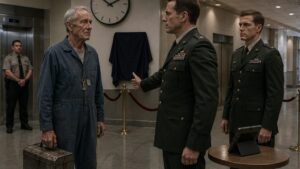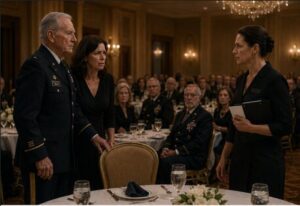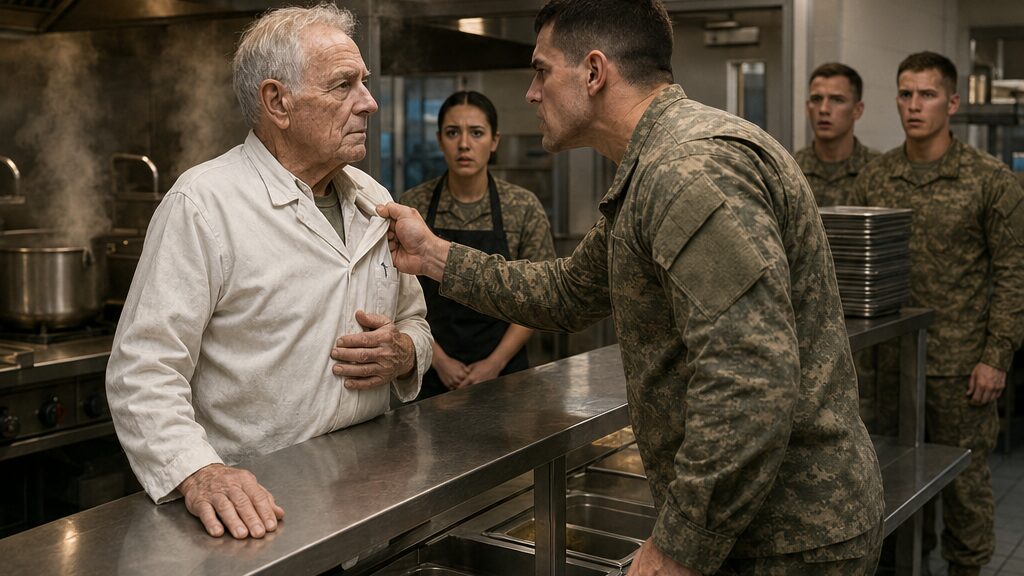
The Soldier Grabbed an Old Cafeteria Worker, Then Learned Who Built His Command
Chapter 1: The Old Man Behind the Steel Counter
The service door no longer appeared on any current floor plan, but Charles Campbell’s old key still turned in the lock.
It resisted halfway, metal grinding against metal, then yielded with a hollow snap that carried into the dark kitchen beyond. Charles stood still for a moment, one hand on the handle, listening.
No alarm.
No shout from the corridor.
Only the low mechanical breathing of refrigeration units and the faint rattle of an exhaust hood warming somewhere deeper inside the building.
He stepped through and closed the door behind him.
At seventy-eight, Charles had learned not to hurry merely because the world expected old men to apologize for moving slowly. He crossed the receiving area with a measured gait, his left knee stiff beneath dark trousers. Over his plain shirt he wore a white kitchen jacket, yellowed slightly at the cuffs and softened by years of washing. The inner pocket had been repaired with three uneven blue stitches that pulled the cloth into a small ridge against his chest.
Inside that pocket rested a folded sheet of paper protected by waxed cloth.
He touched it once, then removed his hand.
The kitchen had changed. The old floor drains were gone. The ovens were digital. Stainless-steel prep tables stood where wooden butcher blocks had once absorbed the blows of cleavers and anxious fists. Yet the room retained its old shape. Charles could still trace the service route without looking: dry storage to the west, cold lockers near the rear, serving line through the double doors.
He found the stock kettles in the same bay.
A young woman in camouflage and a black apron looked up from a crate of onions.
“Sir?”
Charles stopped.
She held a paring knife but lowered it at once. Her name tape read GREEN.
“The kitchen isn’t open to visitors,” she said.
“I’m not visiting.”
Her eyes moved over the jacket, the scuffed shoes, the folded paper in his hand.
“Contract staff check in at the front office.”
“I was told to begin before six.”
“Told by who?”
Charles unfolded the invitation. Rain had softened the cream paper at one corner, and the ink had bled along an old crease. The header carried the insignia of a command that had ceased to exist two decades earlier.
The soldier read it twice.
“This office isn’t here anymore.”
“I’m aware.”
“It says commemorative meal support.”
“That is why I came.”
She looked toward the double doors. Beyond them, voices rose from the dining room where tables were being aligned for inspection.
“You’re Mr. Campbell?”
“Charles is fine.”
“Specialist Melissa Green.” Her voice lowered. “Staff Sergeant Ramirez is running the preparation detail. He’s not expecting extra volunteers.”
“He may not be expecting the meal either.”
She blinked.
Charles nodded toward the crate. “Those onions are for the stew?”
“Yes.”
“They’re too sweet.”
Melissa stared at him as if he had criticized the flag.
“They’re what supply sent.”
“The original recipe used yellow storage onions. Less sugar. They held their shape after four hours.”
She glanced at the printed production sheet clipped above the table. “This says two hours.”
“The sheet is wrong.”
“That sheet came from the memorial committee.”
Charles set his invitation beside the clipboard. “Then the memorial committee has forgotten what it is memorializing.”
Before she could answer, a metallic knock sounded from behind them.
The nearest steam kettle shuddered against its mounting.
Melissa turned. “That’s been doing that since yesterday.”
Charles crossed the floor more quickly than she expected. He did not touch the control panel. Instead he crouched, braced one hand against the warm steel housing, and listened to the pipe beneath it.
The knocking came again—three hard blows, then a thin whistle.
“Shut the feed valve,” he said.
“We’re supposed to leave it on for the sanitation test.”
“Shut it.”
Something in his tone made her move. Melissa reached behind the kettle and turned the wheel. The whistle died, but the pipe continued to tremble.
Charles pointed to the pressure gauge. “The needle is sticking.”
“It was checked last month.”
“It’s lying.”
He took the handle of a long spoon from a nearby rack and tapped the gauge lightly. The needle jumped from twenty pounds to nearly sixty.
Melissa’s face changed.
Charles straightened. “If the relief valve is scaled shut, this kettle becomes a bomb with a lid.”
She killed the power and reached for the wall phone.
The double doors burst open before she could lift the receiver.
Staff Sergeant Nicholas Ramirez entered with a clipboard pressed against his thigh. He was tall, broad through the shoulders, and carried himself with the contained impatience of a man who believed every delay had chosen him personally.
“Green, why is Kettle Two offline?”
“Pressure gauge fault.”
“It passed maintenance.”
“The gauge was stuck.”
Nicholas looked at Charles. “Who is this?”
Melissa handed him the invitation. “He says he was asked to help with the memorial recipe.”
Nicholas read the first line, then the obsolete command title beneath it.
“This is not valid.”
“It was valid when it was issued,” Charles said.
Nicholas gave him a short, humorless glance. “So was the cavalry.”
Melissa’s mouth tightened.
Nicholas set the invitation on the steel table. “Sir, this is a controlled food-preparation area. You came through an unauthorized entrance.”
“It was unlocked by a key.”
“That makes it worse.”
“The front office was not open.”
“Then you wait.”
Charles looked toward the stock table. The beef had already been portioned. Bay leaves sat in a stainless cup. Beside them lay three sealed jars of tomato paste that did not belong in the old recipe.
“You’ve changed the stew,” he said.
Nicholas followed his gaze. “We standardized it.”
“For appearance?”
“For consistency.”
“It will taste wrong.”
“It will taste approved.”
Charles reached past him, took the production sheet, and uncapped the marker hanging from its chain. He crossed out the tomato paste and changed the cooking time from two hours to four.
Nicholas snatched the sheet away.
“You don’t alter my production plan.”
“It was not your recipe.”
“It is my dining facility today.”
Charles studied him. Under the sharpness lay fatigue. Nicholas’s uniform was immaculate, but the skin beneath his eyes was dark. On the clipboard, half covered by his hand, Charles saw a heading: COMMAND FOOD SERVICE EVALUATION.
That explained part of it.
Not all.
Nicholas turned to Melissa. “Restore the kettle and continue prep.”
“Staff Sergeant, the gauge—”
“Maintenance cleared it.”
“Maintenance missed it.”
Nicholas’s jaw shifted. “Who told you that?”
Melissa looked at Charles.
Nicholas followed her eyes and gave a quiet exhale. “Of course.”
Charles said, “The pressure is unsafe.”
“You were a cook?”
“Among other things.”
“When?”
“A while ago.”
Nicholas stepped closer. “Then you know strangers don’t walk into active military kitchens and begin issuing instructions.”
“I did not issue one until the kettle was dangerous.”
“You told my soldier to shut down inspected equipment.”
“I kept your soldier from standing beside it.”
For a moment the only sound was the chop of knives at the far table. Two junior soldiers had stopped pretending not to listen.
Nicholas noticed them.
His voice hardened. “Green, take your station. Sir, collect your paper and leave through the loading entrance.”
Charles looked at the doorway leading to the dining hall. Beyond it, workers were setting white tablecloths beneath a temporary memorial display covered by brown paper.
“I came to prepare one dish.”
“You came without current authorization.”
“I was invited.”
“By an office that no longer exists.”
Charles picked up the invitation. Its softened fold aligned with the ridge of blue stitches beneath his jacket. He could have supplied a title. A phone number. A name that would make Nicholas’s clipboard suddenly feel lighter in his hands.
He did none of those things.
“Call the number written on the back,” Charles said.
Nicholas turned the invitation over. The ink there had run until only three digits remained clear.
“This?”
“The rest can be recovered.”
“By a museum, maybe.”
Melissa said, “Staff Sergeant, I can check the archive directory.”
“No. You can finish the onions.”
Charles saw her lower her eyes.
It was a familiar movement. He had seen it in command posts, hospital corridors, aircraft bays—the small physical retreat of a competent person deciding whether the truth was worth the cost of saying it again.
His silence had once made room for others to speak.
Now it seemed to be closing the room around her.
Nicholas pointed toward the loading corridor. “We are done.”
Charles reached inside his jacket for the waxed cloth, intending to remove it before anyone handled the coat. The edge of the folded paper appeared above the pocket.
Nicholas saw it.
His expression sharpened. “What is that?”
“Nothing that belongs to you.”
“Take it out.”
Charles covered the pocket with his hand.
Nicholas stepped between him and the door. “That looks like a casualty roster.”
The knives stopped completely now.
Melissa stared at the faded corner of the paper.
Nicholas’s voice rose so the whole kitchen could hear it.
“Where did you get restricted memorial property?”
Chapter 2: The Names Hidden Inside His Jacket
“He stole a casualty roster.”
Nicholas’s accusation crossed the serving line before Charles did.
Soldiers preparing the dining room looked up from stacks of trays and folded napkins. A civilian worker near the beverage station froze with a coffee urn in both hands. Even the sanitation inspector, standing near the entrance with a tablet, turned toward the kitchen doors.
Charles remained behind the stainless-steel counter.
Nicholas stood on the other side, one palm extended.
“Hand it over.”
“No.”
The refusal was quiet enough that several witnesses leaned closer without realizing they had moved.
Nicholas’s face tightened. “That document may contain protected information.”
“It contains names.”
“Exactly.”
“Names are not contraband.”
“They are when you take them from a restricted office.”
“I did not.”
“Then show me.”
Charles drew the waxed cloth partly from his pocket, keeping the folded roster inside it. The covering had gone pale where his thumb had pressed it over many years.
“You may inspect the outer page,” he said. “You may not unfold it here.”
Nicholas looked around at the watching soldiers. Charles could see the calculation form behind his eyes. A private uncertainty had become a public test. Whatever Nicholas did next would be measured by the people he supervised.
“Staff Sergeant,” Melissa said from the doorway, “the paper looks old.”
Nicholas did not turn. “Back to your station.”
“It doesn’t match the current memorial packet.”
“Specialist.”
She fell silent, but did not move.
Nicholas reached across the counter.
Charles drew the roster back.
The movement was small. Nicholas interpreted it as defiance.
“You entered through an unauthorized door, interfered with equipment, altered an approved production order, and now you’re refusing to surrender what appears to be government property.”
“The kettle was unsafe.”
“That is not the issue.”
“It was when someone could have been injured.”
Nicholas lowered his hand. For one second his voice softened.
“Sir, I’m trying to give you a way out of this. Put the paper down. Walk out the loading entrance. We can call this confusion instead of theft.”
Charles heard the offer for what it was: not kindness, but an attempt to restore a clean surface before the inspector began asking questions.
“You have already called it theft.”
“I can correct that.”
“Can you?”
Nicholas glanced at the soldiers again.
Charles understood then that Nicholas could have stepped back. He could have asked Melissa to verify the invitation. He could have requested military police without touching anyone. He could have treated uncertainty as uncertainty.
Instead he needed the room to watch him remain in control.
Nicholas pointed to the roster. “Put it on the counter.”
Charles’s hand stayed over the stitched pocket.
“No.”
Nicholas came around the end of the serving line.
The sanitation inspector took a step forward. “Staff Sergeant, perhaps we should—”
“I have it.”
Nicholas stopped within arm’s reach of Charles. Up close, he was almost a head taller. The name Ramirez sat square above his right chest pocket. His rank was centered. His sleeves were rolled with exact symmetry.
Charles looked at the man’s hands. Clean nails. Faint scar across the left knuckle. A tremor so slight most people would miss it.
“Move away from the pocket,” Nicholas said.
“You may check the paper,” Charles replied. “You may not turn those names into evidence against a stranger.”
Something flickered in Nicholas’s expression—confusion first, then anger at having been confused in public.
He seized the front of Charles’s jacket.
The fabric tightened across Charles’s chest. His left shoulder struck the edge of the steel counter. Pain flashed down his arm, but he kept his feet.
A breath went through the room.
Nicholas’s fist twisted into the white cloth directly above the pocket. The old seam gave with a soft ripping sound.
The waxed cloth slipped halfway out.
Three uneven blue stitches pulled free one by one, exposing the water-softened corner of the roster.
Charles placed his palm flat on the counter to steady himself.
He did not strike Nicholas’s wrist.
He did not raise his voice.
He lifted his eyes and held the younger man’s gaze.
“Release the jacket.”
Nicholas did not.
For the first time, Melissa saw something in Charles that had nothing to do with age. His body remained slightly stooped, his shoulder pinned by the grip, yet the room seemed to arrange itself around his stillness. His words had not been loud, but they carried the shape of an order stripped of rank and ceremony.
One of the junior soldiers shifted backward.
Nicholas noticed.
His grip tightened.
“Tell me where you got it.”
Charles looked down at the visible names.
The paper was stained along one edge. The typed lines had faded, but three entries remained readable beneath the torn pocket.
“Specialist David Brown,” Charles said. “Twenty-six years old. Vehicle recovery section. Broke his left wrist at Fort Irwin and refused evacuation until the last truck cleared the lane.”
Patricia’s husband’s name seemed to alter the air.
Charles continued.
“Sergeant Scott Johnson. Thirty-four. Radio maintenance. Had a daughter who thought every antenna on the horizon belonged to him.”
The sanitation inspector slowly lowered her tablet.
“Captain Robert King. Twenty-nine. Forward medical detachment. Allergic to onions, though he ate the stew every year because Brown told him refusing it was bad luck.”
Melissa looked toward the production sheet with the crossed-out ingredients.
Nicholas’s grip loosened by a fraction.
Charles said, “There are nine more names under your hand.”
“How do you know them?” one of the junior soldiers asked.
Nicholas turned his head sharply. “No one asked you.”
Charles kept his eyes on Nicholas.
“The old emergency-kitchen procedure required the west gas line closed before any generator transfer,” he said. “Two cooks stayed at each kettle. One watched pressure. One watched flame. No one worked alone during casualty reception.”
Melissa stared at him. “That procedure isn’t in the current manual.”
“No,” Charles said. “It was written after the first night.”
“The first night of what?” she asked.
Nicholas released the jacket.
The torn pocket sagged. Charles caught the roster before it fell and folded the waxed cloth around it again.
No one spoke.
Nicholas stepped back, but the retreat made him look less in control than the grip had. His face reddened beneath the fluorescent lights.
“You memorized names,” he said. “That doesn’t prove ownership.”
“No,” Charles replied. “It proves memory.”
The distinction seemed to anger Nicholas more.
He turned toward Melissa. “Call military police.”
“Staff Sergeant—”
“Now.”
Melissa hesitated.
Charles looked at her. “Make the call.”
Her eyes searched his face.
“Are you sure?”
“No,” he said. “But do it correctly.”
She lifted the wall phone.
Nicholas retrieved his clipboard and began speaking to the inspector in clipped, procedural phrases: unauthorized access, possible removal of protected material, interference with inspected equipment. Each phrase flattened what had happened into something official enough to survive retelling.
Charles adjusted the torn jacket. The pocket hung open, blue thread dangling against the white cloth.
The junior soldier who had spoken approached by one step.
“Sir,” he said quietly, “do you need medical?”
“No.”
“Your shoulder hit the counter.”
“It has met worse counters.”
The young man almost smiled, then thought better of it.
Military police arrived within minutes: two officers, one carrying a body camera, the other a small evidence bag. Nicholas met them at the dining-room entrance and gave his version before they reached Charles.
Melissa remained near the onions, hands clenched at her sides.
The older officer asked Charles whether he would surrender the document temporarily.
“I will allow you to inspect the first page in my presence.”
“Why only the first?”
“Because the reverse contains private notes.”
“Classified?”
“No.”
“Personal?”
“Yes.”
Nicholas interjected, “He doesn’t get to set conditions.”
The officer looked at him. “Staff Sergeant, I’m speaking with him.”
The room shifted again, this time only slightly.
Charles unwrapped the roster and placed the first page flat on the steel counter. The officer examined the paper without touching the handwritten reverse. The typeface, unit designation, and old watermark were unmistakably decades old.
“This didn’t come from any current office,” the officer said.
Nicholas folded his arms. “It could have come from the memorial archive.”
The officer glanced at the torn pocket, then at the body camera.
“We’ll verify.”
He turned to Charles. “Sir, I need your identification.”
Charles handed him a state driver’s license.
The officer read it.
“Charles Campbell?”
“Yes.”
“Any middle initial?”
“No.”
The second officer, younger and silent until then, looked toward the military police desk sergeant standing just inside the doorway.
The desk sergeant had come down personally after hearing the call involved memorial property. He was studying Charles now with a narrowed, unsettled gaze.
“Campbell,” he repeated.
Charles met his eyes.
The desk sergeant looked past him toward the covered display on the dining-room wall, as though trying to see through the brown paper.
“I’ve seen that name before,” he said.
Chapter 3: An Invitation Filed Under a Dead Command
The current installation database rejected Charles Campbell before anyone asked whether the database might be incomplete.
The security clerk entered the name twice, checked the date of birth, then turned the monitor so the military police desk sergeant could see the red banner across the screen.
NO ACTIVE CREDENTIAL. NO CURRENT SPONSORSHIP. NO VERIFIED CEREMONIAL ACCESS.
Nicholas stood near the door of the small security office, arms folded.
“There,” he said. “That settles it.”
Charles sat in a molded plastic chair beneath a bulletin board covered with visitor regulations. His torn pocket had been pinned closed with a black binder clip supplied by Melissa. The blue threads still hung beneath it.
“It settles that I am not active,” Charles said.
Nicholas gave a short laugh. “You said you were invited.”
“I was.”
“By a ghost command.”
The clerk held up the rain-softened invitation. “The issuing authority is listed as United States Army Readiness and Training Command, Memorial Affairs Office.”
“That command was dissolved,” the desk sergeant said.
“Twenty-one years ago,” Charles replied.
Nicholas looked at him. “You knew that.”
“Yes.”
“And you still walked into a restricted facility with this.”
“It directed me to report to the service entrance before six.”
“There is no service entrance on the current plan.”
“There was this morning.”
The desk sergeant rubbed his jaw. He had stopped treating Charles like a confused trespasser, but he had not yet decided what else to make of him.
“Who sent the invitation?”
Charles looked at the blurred signature.
“Patricia Brown.”
“Contact number?”
“Damaged.”
“Email?”
“She does not use it.”
Nicholas pushed away from the wall. “Convenient.”
Charles turned his head. “Not for her.”
Something in the answer checked Nicholas, though only briefly.
The desk sergeant placed the roster beneath a document lamp. Its watermark dated it more than thirty years earlier. The paper was not part of any modern archive packet, and the typed unit title matched records that had already been declassified.
“This isn’t current protected material,” he said.
Nicholas’s shoulders stiffened. “He still may have removed it from the memorial collection.”
“Possible,” the sergeant said. “Not established.”
The small correction landed heavily.
Charles could have ended the uncertainty. He could have asked for the installation commander by name. He could have described the old headquarters office down to the cracked window beside the flag stand. Instead he looked through the security-office glass at Melissa waiting in the corridor.
She had been removed from kitchen duty pending review.
Her apron was gone. A counseling form rested against her leg.
Silence, Charles thought, was beginning to charge interest.
The dining facility manager arrived carrying a binder and an expression of controlled alarm. Behind him came the installation historian, a thin civilian with dust on one sleeve from dismantling the memorial display.
The manager spread old event requests across the desk.
“We found a catering support note from the memorial committee,” he said. “It lists one volunteer.”
Nicholas leaned forward.
The manager read, “‘C. Campbell—traditional preparation, family authorization.’ No rank. No credential number.”
“Who approved it?” asked the desk sergeant.
The manager pointed to an annotation. “P. Brown requested it. The routing code went to an archived organizational mailbox. It never reached current food-service operations.”
Charles looked down.
Patricia had invited him. The system had buried the invitation beneath a dead title, just as he had known it might.
He had come anyway.
The historian examined him with open curiosity. “Mr. Campbell, how did you know the old service key would still work?”
Charles said, “Because no one replaces a lock that no longer appears on a plan.”
“That’s not really an answer.”
“It is the answer the building provides.”
Nicholas exhaled impatiently. “We have an unauthorized entrant using obsolete access and vague personal knowledge. That does not make him legitimate.”
“No,” Charles said. “It makes your first concern reasonable.”
Everyone looked at him.
Nicholas seemed least prepared for agreement.
Charles continued. “I should have reported through the current office. I assumed the invitation had been routed correctly. When it had not, I chose the old door instead of demanding proper verification.”
Melissa looked up through the glass.
Nicholas seized on the admission. “Exactly.”
Charles turned toward him. “Your concern was reasonable. Your conduct was not.”
The desk sergeant looked down, perhaps to hide a reaction.
A kitchen runner appeared at the doorway. “Specialist Green asked me to bring this.”
She carried a thick ledger bound in cracked green cloth.
The dining facility manager frowned. “Where did that come from?”
“Behind the old recipe cabinet.”
Melissa entered after her, despite Nicholas’s immediate glare.
“I was told to wait outside,” she said. “I did. Then the manager asked for historical production records.”
Nicholas said, “You were not authorized to search.”
“I was authorized to retrieve the memorial recipe.”
She opened the ledger to a page browned at the edges. Beside a handwritten list of ingredients were two initials in blue ink: C.C.
Under them appeared a line: Family meal—do not change onions. Four-hour simmer.
Charles felt the room narrow around the page.
Melissa pointed to another note. “Same handwriting appears on the roster envelope.”
The historian leaned closer. “And the date is the week after the accident.”
Nicholas reached for the ledger.
“I’ll secure that as evidence.”
Melissa kept one hand on it. “Evidence of what?”
His eyes hardened.
The manager intervened. “Give it to me.”
Nicholas took the ledger anyway. He turned slightly, blocking the others’ view, then slipped the loose recipe page from the binding.
Charles saw it.
So did Melissa.
Nicholas held the page by its edge. “This needs to be preserved separately.”
“Put it back,” Melissa said.
“It’s already detached.”
“It wasn’t.”
The room became very still.
Nicholas looked at the desk sergeant. “I will include it with my incident report.”
Charles watched Melissa’s fear contend with anger. She opened her mouth, then closed it.
Again, silence was making a choice for someone.
“Specialist Green did not admit me,” Charles said. “She found me inside.”
Nicholas looked over. “Your statement is noted.”
“She also identified th
Chapter 4: The Photograph No One Was Supposed to Uncover
The photograph showed Charles Campbell standing behind the same stainless-steel counter where Nicholas Ramirez had grabbed him less than an hour earlier.
He was forty years younger in the image, broad-shouldered and dark-haired, his sleeves rolled beneath a white kitchen jacket. Around him, cooks and officers moved through a dining hall crowded with folding cots, field telephones, and families holding paper cups. Four stars were visible at his collar.
The installation historian carried the framed photograph into the security corridor with both hands.
No one spoke at first.
Melissa looked from the photograph to Charles. The younger face in the frame had fewer lines, but the eyes were unchanged.
Nicholas came out of the manager’s office holding his incident report.
“What is that?”
The historian turned the brass label toward him.
Nicholas read it once, then again.
His fingers tightened around the pages.
The desk sergeant looked at Charles. “General Campbell?”
Charles rose carefully from the plastic chair.
“Not anymore.”
The title had already changed the corridor. The clerk who had denied his access straightened. One of the military police officers shifted his boots as if uncertain whether to salute. Melissa stood very still, anger and disbelief replacing fear.
Nicholas did not move.
The historian said, “Sir, this photograph was part of the original emergency-support display. It was removed during renovation.”
“Put it back under its cover,” Charles said.
The historian hesitated. “The label identifies you as the commander.”
“I can read it.”
“Then why didn’t you tell anyone?”
Charles looked at the torn pocket held shut by the binder clip.
“Because the kitchen did not need a retired general. It needed someone who remembered the recipe.”
Nicholas found his voice. “This proves you served here. It doesn’t resolve the access violation.”
The desk sergeant turned toward him.
Nicholas continued, more carefully, “The procedure still applies. Rank or former rank does not authorize someone to enter a restricted area.”
“He is correct,” Charles said.
Nicholas blinked.
Charles faced the desk sergeant. “My identity does not repair the way I entered. I should have verified the invitation through the current command.”
Nicholas seized the opening. “Then the report stands.”
“No,” Melissa said.
Her voice was small, but it carried.
Nicholas looked at her.
She pointed to the pages in his hand. “Not the part where you said he was combative. Not the part where you said I let him in. And not the part where you called grabbing him necessary.”
The manager glanced away.
The desk sergeant held out his hand. “Let me see the report.”
Nicholas did not surrender it immediately.
Then footsteps sounded from the dining-room entrance.
The installation commander arrived without an entourage, though a public affairs officer and an aide followed several paces behind. Robert Davis was fifty-eight, silver beginning at his temples, his uniform immaculate without looking arranged for effect.
He saw the photograph first.
Then he saw Charles.
Robert stopped.
For an instant, the years left his face. He was no longer an installation commander entering an incident scene. He was a young lieutenant standing in a command post, waiting to be corrected.
“Sir,” Robert said.
Charles raised one hand before the word could become anything larger.
“No.”
Robert understood. He lowered his voice. “Charles.”
That was almost worse. The familiarity made the truth intimate rather than ceremonial.
Nicholas’s incident report bent in his grip.
Robert crossed the corridor and studied Charles’s torn jacket, the binder clip, and the darkening bruise near his shoulder.
“What happened?”
“An access dispute became something else.”
Robert looked toward Nicholas.
The staff sergeant came to attention. “Sir, an unauthorized individual entered the facility, interfered with operations, and appeared to possess protected memorial material.”
“Did you touch him?”
Nicholas’s jaw tightened. “I restrained him when he refused to surrender the document.”
Robert looked back at Charles.
“Was restraint necessary?”
“No.”
The answer landed without emphasis.
Robert’s face hardened, but Charles spoke before he could issue an order.
“The kitchen remains behind schedule. The kettle needs maintenance. Specialist Green should be returned to duty unless someone can identify a legitimate reason she was removed.”
Nicholas said, “She disobeyed supervisory direction.”
“She identified an unsafe condition.”
“After following his instruction.”
Charles turned to Robert. “Do not clear her because of who I was. Review what she did.”
Robert nodded once to the manager. “Restore Specialist Green to duty pending formal review.”
Relief crossed Melissa’s face, followed quickly by caution. Pending review was not innocence.
The historian carried the photograph back into the dining hall, and Charles followed. Robert walked beside him while the others remained behind.
The brown paper had been removed from part of the memorial wall. Empty hooks and pale rectangles marked where older displays had hung. The photograph was placed temporarily on the serving counter, aligned so that the counter in the image seemed to continue into the present one.
Robert looked at it.
“I had forgotten this existed.”
“You were not here yet.”
“I came the following year.” Robert’s gaze remained on the younger Charles. “You made every new officer work one meal in this facility.”
“Not every officer.”
“Everyone you thought might mistake support work for lesser work.”
Charles said nothing.
Robert lowered his voice. “I owe you an apology.”
“For what?”
“For allowing the memorial committee to build tomorrow around you without confirming you would attend.”
Charles looked toward the tables being dressed in white cloth.
“Tomorrow is not about me.”
“The program says otherwise.”
Robert took a folded booklet from his aide and handed it over.
On the cover was the title of the commemorative meal. Inside, beneath the list of the dead, a full page carried Charles’s photograph and a heading:
THE COMMANDER WHO SAVED THE INSTALLATION
Charles read the first paragraph. It described him as decisive, tireless, and singularly responsible for converting the dining facility into an emergency family-support center after the training disaster.
He closed the booklet.
“Who approved this?”
“The memorial committee. Public affairs refined the language.”
“Refined.”
Robert heard the accusation. “The families wanted your contribution recognized.”
“Some of them.”
“Patricia signed the final concept.”
Charles looked at him sharply.
Robert continued, “She insisted you be invited. She said you had avoided the last eleven anniversaries.”
“That does not make this accurate.”
“The building did become the support center because of your order.”
“The cooks made it work. Drivers brought the families. Medics slept on this floor. Chaplains used storage closets because there was nowhere else.”
“You coordinated it.”
“I signed papers while other people carried weight.”
Robert studied him. “You always did this.”
“Did what?”
“Removed yourself from anything that sounded like praise.”
“Praise is not the danger here.”
“What is?”
Charles opened the program again and tapped the heading.
“This turns memory into comfort. One commander saved the installation. One decision restored order. No uncertainty. No failure. No one has to ask what happened before this photograph was taken.”
Robert’s expression changed.
The dining hall noise continued around them, but more quietly now. Workers were listening without appearing to listen.
Robert said, “The investigation cleared you.”
“The investigation distributed responsibility.”
“That is not the same as guilt.”
“No.”
Charles’s thumb pressed into the folded program.
“It is also not innocence.”
The public affairs officer approached. “Sir, the guests arrive tomorrow at eleven. If there are concerns with the language, we can make adjustments.”
Charles handed back the booklet.
“Remove my page.”
Robert shook his head. “That will create questions.”
“There should be questions.”
Before Robert could answer, the main doors opened.
Patricia Brown entered carrying a small covered dish against her hip. She was slight, silver-haired, and walked with the stubborn balance of someone who refused assistance before it was offered.
She saw Robert first, then the photograph on the counter.
Finally she saw Charles.
Her expression did not soften.
She set the dish down and crossed the room.
Charles felt the old roster press against his chest beneath the binder clip.
Patricia stopped close enough to see the tear in the jacket. Her eyes moved to the loose blue threads.
She reached out but did not touch them.
“Those stitches,” she said.
Charles remained silent.
Patricia looked up at him.
“Why have you brought my husband’s roster back?”
Chapter 5: The Order He Never Forgave Himself For
“The jacket belonged in the kitchen,” Patricia said. “The roster belonged with the families.”
Her words emptied the room more effectively than an order.
Robert directed the staff to continue preparations and led Nicholas, the manager, and the military police back toward the offices. Melissa remained near the kitchen doors until Patricia glanced at her.
“Give us a little time.”
Melissa nodded and left.
Charles followed Patricia into the memorial storage room behind the dining hall. Metal shelves held folded banners, framed unit crests, and boxes labeled by year. The air smelled of cardboard, dust, and old fabric.
Patricia closed the door.
“Take it out.”
Charles removed the binder clip and eased the roster from the torn pocket. The blue threads hung against his fingers.
He placed the waxed cloth on a table but did not unwrap it.
Patricia watched him.
“You carried it all this time?”
“Not all of it.”
“How long?”
“Eleven years.”
“The same eleven years you stopped coming.”
Charles looked at the boxes rather than at her.
Patricia gave a quiet, bitter laugh. “You chose your absence with military precision.”
“I wrote every year.”
“You wrote to the committee. You sent corrections to the names. You paid for flowers no one knew came from you.” She touched the wrapped roster. “You did everything except stand in the room.”
“The room did not need me.”
“That was not your decision to make.”
Charles met her eyes then.
Patricia had aged, but grief had preserved certain expressions exactly. He remembered the first time she had looked at him this way—three days after the accident, when he had stood on her porch in dress uniform and told her David would not be coming home.
“You asked me to cook,” he said.
“I asked you to attend.”
“The invitation said preparation support.”
“Because I knew you would refuse anything that sounded like honor.”
Charles almost smiled. “You remembered.”
“I had eleven years to study your methods.”
She unwrapped the waxed cloth.
The roster unfolded with a dry whisper. Twelve typed names filled the front. On the reverse, in Charles’s handwriting, were addresses, children’s ages, allergies, unfinished claims, and notes about each family visit.
Patricia traced David Brown’s name without touching the ink.
“You added these after you came to see us.”
“Yes.”
“You wrote that Catherine was seven.”
“She corrected me. She had turned eight two weeks earlier.”
“She still remembers that.”
Charles closed his eyes briefly.
Patricia looked at the torn jacket. “Do you know where those stitches came from?”
“David repaired the pocket.”
“You never told me.”
“It seemed small.”
“It was the last thing he sewed.”
Charles’s hand stilled.
Patricia lifted the loose blue thread. “The emergency kitchen ran out of aprons the second night. You were carrying canned goods from the loading dock in this jacket. The pocket caught on a crate.”
“I remember.”
“David said a general should know better than to carry three cans in one pocket.”
“He was correct.”
“He repaired it with thread from the laundry kit. He had never sewn anything in his life.”
The memory came back whole: David leaning under a bare utility bulb, tongue pressed against his upper lip as he forced a thick needle through the cloth. Around them, phones rang without pause. Families slept against one another on cots. The casualty list had not yet been released.
David had handed back the jacket and said, It will hold until morning, sir.
Morning had not held.
Patricia released the thread.
“The jacket is not your punishment,” she said.
Charles looked at her.
“You wear it every year in your house, don’t you?”
He did not answer.
“You cook the stew alone. You read the names. Then you fold the roster and disappear again.”
“I remember them.”
“Memory is not the same as presence.”
Charles turned toward the shelf of banners.
“The exercise should not have proceeded on that schedule.”
Patricia’s face tightened, but she did not interrupt.
“Higher headquarters wanted the readiness certification completed before the quarter closed,” he continued. “Weather delayed the first movement. Maintenance reported two vehicles borderline but serviceable. The range officer requested another day. I approved compression.”
“The investigation found the brake failure was hidden.”
“The brake failure began the chain.”
“And the missing radio relay extended it.”
“Yes.”
“And the medical detachment had been sent to the wrong grid.”
“Yes.”
“None of which you ordered.”
“I signed the schedule.”
“You signed many things.”
“That one mattered.”
Patricia came around the table. “Do not make yourself more powerful than you were merely so you can be more guilty.”
The sentence struck harder than anger.
Charles said, “Nine people died after a decision bearing my name.”
“Twelve.”
He looked at the roster.
“Nine at the site,” Patricia said. “Three later. You always separate them because the official report did.”
“I know how many died.”
“Then say twelve.”
Charles’s jaw tightened.
“Twelve,” he said.
Patricia’s eyes shone, but her voice remained steady.
“You were cleared because one signature did not create the accident. But you were never blameless, Charles. That is the part everyone tries to make easier for you.”
He looked at her sharply.
“I am not here to absolve you,” she said. “David deserved the extra day. So did the others. Maybe it would have changed nothing. Maybe it would have changed everything. We will never know.”
Charles lowered his head.
Patricia continued, “But the dead did not ask you to vanish. Their families did not ask you to turn every anniversary into a sentence you served alone.”
He rested both hands on the metal table.
For years, silence had seemed like the only honest posture. Praise felt obscene. Attendance felt like claiming a place among those who had lost more. He had called it humility because the other word was harder.
Avoidance.
A knock interrupted them.
Melissa entered before either answered. She held a copy of Nicholas’s report.
“I’m sorry,” she said. “But you need to see this.”
Charles took the pages.
The report stated that Melissa had knowingly admitted an unverified civilian and abandoned safe supervisory procedures. It recommended formal counseling and removal from memorial-duty assignments pending review.
“He changed it,” she said. “The first draft said he found you inside. This version says I escorted you through the kitchen.”
Patricia’s face hardened.
Melissa looked at Charles. “The evaluation team arrives tomorrow. If this stays in the file, I lose my recommendation for advanced training.”
Charles read the line again.
His own admission was included. His warning about the kettle was described as disruptive interference. Nicholas’s grip was reduced to “minimal physical guidance.”
Silence had not protected dignity. It had created space for the most confident version of events to become official.
Charles folded the report.
“Where is Robert?”
“In the commander’s office.”
Charles wrapped the roster and returned it to the torn pocket. The cloth sagged, unable to hold it securely.
Patricia handed him the binder clip.
“This time,” she said, “do not hide behind being humble.”
They found Robert in the dining hall reviewing the altered memorial program. Nicholas stood several yards away speaking with the manager.
Robert looked up as Charles approached.
“I was coming to find you.”
“Reopen the incident.”
Robert glanced at Melissa. “It is already under review.”
“Not privately.”
The room quieted.
Charles placed Nicholas’s report on the steel counter.
“Review his conduct, Specialist Green’s actions, the handling of the ledger, and my unauthorized entry.”
Robert studied him. “Your entry can be resolved.”
“I do not want it resolved. I want it examined.”
“Charles—”
“And reopen the historical section of tomorrow’s program.”
Robert’s expression changed.
Charles continued. “Include the schedule compression. Include my approval. Include the investigation’s findings without turning them into absolution.”
Nicholas had stopped speaking now.
Robert lowered his voice. “You understand what that will do.”
“Yes.”
“It may shift the entire memorial.”
“It should.”
Robert looked toward Patricia. She gave him no assistance.
Charles placed one hand over the broken stitches.
“For eleven years, I believed silence kept me from using rank to protect myself. Today it allowed someone else to carry the cost.”
Melissa looked down.
Charles faced Robert.
“Open all of it.”
Chapter 6: The Apology That Came for the Wrong Reason
“Sir, had I known who you were—”
“That is the part you still do not understand.”
Nicholas stopped across the commander’s conference table.
It was barely seven in the morning. The memorial meal was four hours away. Outside the closed doors, carts rolled through the corridor and kitchen staff called temperatures to one another. Inside, the torn white jacket lay folded between Charles and Nicholas.
Robert sat at the head of the table. Melissa occupied a chair near the wall, present as a witness. The dining facility manager had brought the original ledger and both versions of Nicholas’s report.
Nicholas looked as though he had not slept. His uniform remained precise, but the certainty had gone out of his posture.
“I was trying to apologize,” he said.
“You were explaining the condition under which you would have behaved differently.”
Nicholas’s eyes dropped to the jacket.
Charles continued. “You are sorry you grabbed a retired general.”
“I am sorry I grabbed you.”
“Why?”
“Because it was wrong.”
“Was it wrong before you saw the photograph?”
Nicholas said nothing.
Robert shifted in his chair but did not intervene.
Charles let the silence remain until it belonged to Nicholas rather than shielding him.
Finally Nicholas said, “I believed you had stolen the roster.”
“You believed that was possible.”
“Yes.”
“You also knew it was unverified.”
“Yes.”
“Your first concern was legitimate. I entered through an obsolete door. My invitation was not current. I refused to surrender a document you could not identify.”
Nicholas looked up, surprised again by the concession.
Charles said, “You had authority to stop me. You had no authority to invent certainty.”
Nicholas’s mouth tightened.
Robert opened the ledger. “The historian states a recipe page bearing the initials C.C. was attached here when Specialist Green found it.”
“It was loose,” Nicholas said.
Melissa spoke from the wall. “It became loose when you pulled it out.”
Nicholas looked at her.
She held his gaze this time.
Robert placed the detached page beside the binding. “Why remove it?”
“To preserve evidence.”
“Why did your report omit that the initials matched Mr. Campbell’s name?”
Nicholas took a breath. “At the time, the initials proved nothing.”
“Then why remove the page?” Charles asked.
Nicholas’s hands closed at his sides.
The kitchen noise outside seemed suddenly loud: a metal tray falling, someone calling for more stock, the hum of the ventilation system.
Nicholas said, “Because everyone was already looking at me.”
Robert’s expression hardened. “Explain.”
Nicholas stared at the tabletop.
“The inspector was there. The staff had stopped working. Green was questioning the production sheet. He had shut down a kettle maintenance had cleared.” He gestured toward Charles without meeting his eyes. “Nothing was where it was supposed to be.”
“So you made it appear orderly,” Charles said.
“I tried to keep control.”
“By removing information that complicated your position.”
Nicholas’s face flushed. “I had an evaluation. After the supply failure last quarter, I was told one more visible breakdown would end my promotion recommendation.”
Melissa said, “The kettle could have injured someone.”
“I know that now.”
“You knew the gauge jumped.”
“I knew after he touched it.”
Charles watched Nicholas carefully. The younger man’s fear was real. So was the choice he had built from it.
“My father was a command sergeant major,” Nicholas said abruptly. “When something went wrong, he said the room always knew who was in charge by who moved first. He never waited for uncertainty.”
“Did that make him correct?” Charles asked.
Nicholas looked at him.
“No.”
“Then do not offer him as an alibi.”
Nicholas swallowed.
Robert slid the two incident reports across the table. “The first says Mr. Campbell was found inside the facility. The second says Specialist Green admitted him.”
Nicholas looked toward Melissa.
She sat straighter but did not speak.
“I changed it,” he said.
“Why?” Robert asked.
“Because if she admitted him, the breakdown belonged to a subordinate failure. If he entered without anyone knowing, it belonged to me.”
Melissa’s breath caught.
There it was. Not confusion. Not inherited pressure. A decision.
Nicholas faced her. “I’m sorry.”
Her expression did not soften. “Would you have said that if he had only been an old cook?”
Nicholas looked at Charles, then back at her.
“No,” he said.
The honesty did not repair anything, but it changed the room.
Robert leaned back. “You will be removed from supervisory duty pending formal action. I can arrange reassignment away from the dining facility before the guests arrive.”
Charles shook his head.
Robert frowned. “Given the circumstances, separation is prudent.”
“Quiet reassignment protects the appearance of order,” Charles said. “That is how this began.”
Nicholas looked up.
Robert lowered his voice. “The memorial is not the place for disciplinary proceedings.”
“No. But neither is it a stage on which the institution pretends nothing happened.”
Public affairs had already replaced Charles’s tribute page with a shorter introduction. The revised programs sat in boxes outside the conference room. Even now, workers were arranging the old photograph at the front of the hall.
Robert said, “What are you proposing?”
“That Specialist Green be cleared in the written record before the meal. That the witnesses provide statements. That the handling of civilian and junior personnel be reviewed beyond this one incident.”
“And Staff Sergeant Ramirez?”
Charles looked at Nicholas.
“Consequences should come through the proper process.”
Nicholas’s shoulders loosened slightly.
Charles continued. “But process is not concealment. He remains available to answer for what he wrote and what he did.”
The relief disappeared.
Robert tapped the table once. “Understood.”
Melissa stood. “May I return to the kitchen?”
Robert nodded. “Your duty status is restored. The report will state that immediately.”
She moved toward the door, then paused beside the folded jacket.
“I can find someone to repair that.”
Charles looked at the broken blue stitches.
“Not yet.”
Melissa left.
Nicholas picked up the jacket, perhaps intending to hand it across the table. The torn pocket fell open in his hands. He tried to align the ripped seam, but the cloth would not hold.
He placed it on the steel counter outside the conference room when they entered the dining hall.
The photograph had been mounted behind the lectern. In it, the younger Charles wore the same jacket, pocket intact, working among cooks and frightened families.
Nicholas stood before the image.
“I thought authority meant no one saw you hesitate,” he said.
Charles lifted the jacket from the counter.
“No. It means they can trust what you do after you have.”
The front doors opened.
The first memorial guests entered carrying programs that still described Charles Campbell as the commander who had saved the installation. Families moved toward the tables. A public affairs officer hurried to Robert with a final copy of the tribute speech.
Charles looked at the pages, then at the names pressing against his torn pocket.
The room was ready to honor a version of him that had never existed.
Chapter 7: When the Dining Hall Learned His Name
“General Charles Campbell.”
Robert’s voice carried across the dining hall, and the room changed before Charles took a single step.
Forks paused above plates. Chairs stopped scraping. Several older guests turned toward the serving line, searching for the decorated figure described in their programs.
They found an elderly man in a worn white kitchen jacket.
The pocket had been fastened again with the black binder clip. Three broken blue threads remained visible beneath it. A bruise darkened the skin above his collar. Behind him, the restored photograph showed a younger Charles wearing the same jacket at the same counter, four stars visible beneath the open cloth.
Nicholas stood near the kitchen entrance without his clipboard.
Recognition moved through the room in fragments. A widow covered her mouth. One of the junior soldiers who had watched the confrontation lowered his eyes. The sanitation inspector stared at the hand with which Nicholas had gripped the jacket, as though the gesture were still occurring.
Robert waited beside the lectern.
Charles did not move toward him.
Instead he crossed to the first table and placed a bowl of stew before Patricia.
She tasted it.
“The onions are right,” she said.
Only then did Charles approach the front.
The public affairs officer handed Robert the prepared tribute. Robert glanced at Charles, received no objection, and began.
“More than three decades ago, following one of the darkest days in this installation’s history, General Campbell transformed this dining facility into the center of an emergency response that supported—”
Charles placed two fingers on the pages.
Robert stopped.
The silence that followed was not ceremonial. It was uncertain.
Charles looked across the room. Families of the dead sat nearest the front. Behind them were active-duty soldiers, civilian employees, local veterans, and officers who knew him only through framed photographs and polished command histories.
On every table lay a program calling him the commander who had saved the installation.
He lifted the prepared speech.
The first paragraph praised his leadership. The second described decisive action. The third called the tragedy an unforeseeable convergence of failures overcome by extraordinary command.
Charles removed the pages from the lectern.
He folded them once and set them aside.
Then he took the roster from his torn pocket.
The waxed cloth made a faint crackle in the microphone.
“These are the names we came for,” he said.
No title preceded the words. No introduction followed them.
Charles unfolded the roster.
“Specialist David Brown.”
Patricia lowered her spoon.
“Sergeant Scott Johnson. Captain Robert King.”
He continued through all twelve names, speaking each one at the pace of a person entering a room. No one shifted. No one reached for a phone. The kitchen ventilation filled the spaces between them.
When he finished, Charles turned the page.
Handwritten notes covered the reverse.
“I visited every family after the accident. I wrote down what I was afraid I might forget.”
He read only a few.
A daughter who had just turned eight. A mother who needed help with a claim. A soldier’s allergy to onions. A broken wrist at Fort Irwin. A promise to repair a fence that remained unfinished.
The names ceased to be a list. The room could no longer hold them at a respectful distance.
Charles laid the paper flat on the lectern.
“This program describes me as the man who saved this command.”
Robert looked down.
“That statement is incomplete enough to be false.”
A ripple passed among the officers.
Charles continued before anyone could rescue the moment.
“The dining staff turned this building into a family-support center. Drivers brought relatives through the night. Medics worked until they could not stand. Chaplains slept in storage rooms. Junior soldiers carried food, cots, telephones, and messages no one wanted to deliver.”
He looked toward the old photograph.
“I gave an order. Others made it real.”
He paused.
“Before that order, I gave another one.”
Patricia watched him without blinking.
“The exercise schedule had been delayed. Readiness certification was at risk. Maintenance concerns had been raised. The range requested more time. I approved a compressed timeline.”
The room tightened.
“The official investigation found a brake failure, a missing radio relay, a medical unit sent to the wrong grid, and several other causes. It did not find one person responsible for all twelve deaths.”
Charles’s hand rested beside the roster.
“That finding was correct.”
He looked at the families.
“It does not erase my signature.”
Robert took one step toward the lectern, not to stop him, but as though the confession had physical weight.
Charles said, “For years I believed staying away from this memorial was a form of humility. I told myself the families did not need a retired commander occupying their grief. That was partly true.”
His fingers touched the torn pocket.
“The rest was cowardice dressed as restraint.”
Patricia’s chin trembled once.
Charles did not look away from her.
“I could remember the dead alone and never risk hearing what their families thought of me. I could refuse praise without accepting questions. Silence allowed me to appear humble while remaining in control.”
No applause came. That was a mercy.
Charles turned toward Melissa.
“Yesterday, Specialist Green identified an unsafe kettle and tried to verify an unclear invitation. Her judgment was questioned. A false report placed her career at risk.”
Melissa stood near the kitchen doorway, hands folded tightly in front of her.
“The written record has been corrected,” Robert said from beside the lectern. “Specialist Green is cleared of wrongdoing. The incident remains under formal review.”
Charles nodded.
Two junior soldiers rose from a table near the back.
The first spoke without looking at Nicholas. “Sir, I witnessed Staff Sergeant Ramirez grab Mr. Campbell’s jacket. I did not intervene.”
The second stood beside him. “Neither did I.”
The sanitation inspector lifted her hand. “I observed the same conduct. My original notes will be submitted.”
The admissions did not cleanse the room. They made its silence visible.
Charles faced the guests again.
“The wrong done yesterday did not become wrong when someone found four stars in an old photograph.”
Nicholas’s face tightened.
“It was wrong when an apparently unimportant man was treated as though uncertainty removed his dignity. It was wrong when a junior soldier’s truthful concern became inconvenient. It was wrong when witnesses decided rank was required before respect became their responsibility.”
He stopped there.
The public affairs officer seemed to expect a final line. Something polished. Something that could be quoted beneath the photograph.
Charles gave none.
He refolded the roster.
Robert stepped forward. “General Campbell—”
“Charles.”
Robert accepted the correction. “What would you have this command do now?”
Charles looked toward the serving counter.
Nicholas stood beside it, separated from the guests by the same sheet of stainless steel across which he had reached the previous morning.
“Review what happened,” Charles said. “Do not hide it inside a reassignment. Examine how civilians and junior personnel are treated when their concerns interrupt appearances. Correct the process that buried an invitation because an old command name no longer fit a current box.”
Robert nodded.
“And Staff Sergeant Ramirez?” he asked.
Every eye found Nicholas.
Charles could feel the room preparing for punishment as spectacle.
He would not give it that.
“His formal consequences belong to the process he denied others.”
Nicholas looked up.
“But the meal belongs to the families.”
Charles lifted one serving apron from the counter and held it out.
“Staff Sergeant Ramirez, return to the line.”
Nicholas did not move.
Charles’s voice remained level.
“Not to be displayed. Not to be forgiven. Serve the people whose names and grief you tried to turn into evidence.”
The distance between them was no more than twenty feet.
Nicholas crossed it slowly.
Chapter 8: He Left Wearing the Same White Jacket
Nicholas removed his supervisory badge before he stepped behind the counter.
He placed it beside the production sheet, then tied the black serving apron around his waist. No one instructed him where to stand. He took the empty position between Melissa and the dining facility manager and reached for the ladle.
His first serving was too full. Stew spilled over the rim and spotted the tray.
Melissa slid him a cloth.
“Wipe the bowl before you hand it over.”
Nicholas did.
The families came through the line without ceremony. Some recognized him from the confrontation. Others did not. Charles stood at the far kettle, portioning vegetables with his good arm while his bruised shoulder stiffened beneath the jacket.
Nicholas did not seek his eye.
After several minutes, he set down the ladle.
“Specialist Green.”
Melissa continued arranging bowls.
“I changed the report to blame you,” he said. “You did not admit him. You reported the kettle correctly. I knew both things when I wrote it.”
The kitchen staff could hear him. So could the two junior soldiers carrying trays nearby.
Melissa looked at him.
Nicholas swallowed.
“I am sorry.”
He did not mention Charles’s rank.
He did not mention the evaluation or his father.
Melissa folded the cloth once. “Put the correct statement in writing.”
“I will.”
“And do not ask me to tell anyone you are a good person because you admitted it.”
“I won’t.”
She handed him another bowl.
“Then keep serving.”
Nicholas picked up the ladle.
Charles returned to the stock table.
The apology did not repair the torn pocket or erase the grip. It did something smaller and more useful: it named the person who had first carried the cost.
When the final guests had been served, Melissa found a sewing kit in the manager’s office. She sat beside Charles at the end of the counter and removed the binder clip.
“I’m not much better at this than whoever did it the first time,” she said.
“He was not trained.”
“That explains the stitches.”
“It does not excuse them.”
Melissa smiled faintly.
She threaded a needle with blue cotton and drew the torn edges together. Beside David Brown’s three uneven stitches, she added three more. Hers were smaller but no straighter.
Charles watched the needle pass through the old cloth.
“Why blue?” he asked.
“It was the only color in the kit.”
“That was his reason too.”
Melissa tied off the thread and pressed the repaired pocket flat.
“It will hold.”
Charles looked toward Patricia.
She had heard.
“Until morning,” Patricia said.
The words caught him before he could guard against them.
For a moment he saw David under the utility bulb, handing back the jacket while the phones rang.
Charles placed the roster inside the repaired pocket.
Then he removed it again.
The installation historian had prepared a case in the memorial alcove. The old photograph stood at its center, but Charles asked that it be shifted to one side. He placed the casualty roster beneath the glass, front page visible.
On the reverse, the private family notes remained protected by a second backing sheet.
Beside the roster he added a written account. It named the schedule compression, the maintenance warnings, the investigation findings, and his own approval. It also named the cooks, drivers, medics, chaplains, civilian employees, and young soldiers who had turned the dining hall into a place of refuge.
The heading carried no rank.
It read: ACCOUNT BY CHARLES CAMPBELL, COMMANDER AT THE TIME.
Robert read the final page.
“This will change how the installation tells the story.”
“It should change how it remembers it.”
Robert nodded. “The review of yesterday’s incident will be public within the limits of personnel law. We are also establishing an independent reporting channel for civilian staff and junior soldiers assigned to support facilities.”
Melissa stood nearby. “And obsolete invitations?”
“The archive and current protocol offices will share a verification register.”
Charles glanced at her. “A less poetic solution.”
“A working one,” she said.
Across the room, Nicholas finished wiping the serving line. Military process would decide his discipline. He knew that. No promise had been offered.
Before leaving, he approached Charles.
“I wrote the corrected statement.”
“Good.”
Nicholas waited.
Charles did not rescue him from the silence.
Finally Nicholas said, “I treated you the way I thought I was allowed to treat someone who could not matter to my career.”
Charles looked at him.
“That is closer to the truth.”
“I don’t know how to repair it.”
“You begin by not making the injured person supervise your improvement.”
Nicholas lowered his eyes.
“Yes, sir.”
Charles’s expression sharpened.
Nicholas corrected himself.
“Yes.”
He walked away.
Patricia joined Charles near the public entrance. Most of the tables had been cleared. The memorial case caught the afternoon light, making the roster’s old paper appear almost gold beneath the glass.
“Will you disappear again?” she asked.
Charles looked toward the service corridor he had used that morning. The old door remained beyond the kitchen, hidden from current maps and convenient to anyone wishing to arrive unseen.
“No.”
“Next year?”
“I will use the front entrance.”
“That was not the question.”
Charles considered her.
“I will come.”
Patricia nodded as if accepting a debt payment, not a promise.
Robert offered Charles a ride. Charles declined. The walk to the visitor lot was not far, and his knee would tolerate it if he did not hurry.
He crossed the dining hall in the same worn white jacket. The new blue stitches sat beside the old ones over an empty pocket.
No one called the room to attention.
No one announced him.
The kitchen staff continued their work. Melissa checked the repaired kettle gauge. Nicholas carried a stack of trays toward the wash station under supervision. Patricia remained beside the families.
Charles reached the main doors and pushed them open.
Behind him, the roster stayed beneath glass with the names facing outward and his full account beside them.
He left through the public entrance.
The story has ended.