The Young Guard Dropped an Old Veteran’s Gate Tag Before Learning Why He Came Back
Chapter 1: The Badge That No Longer Scanned
Steven Bennett reached the main gate just before the sun began to harden the pavement.
The base had changed its face since the last time he had come through without stopping. New cameras sat above the guard booth like black glass eyes. The old chain-link fence had been replaced by taller steel panels. Even the sign looked younger, its blue letters bright enough to make the morning seem freshly painted.
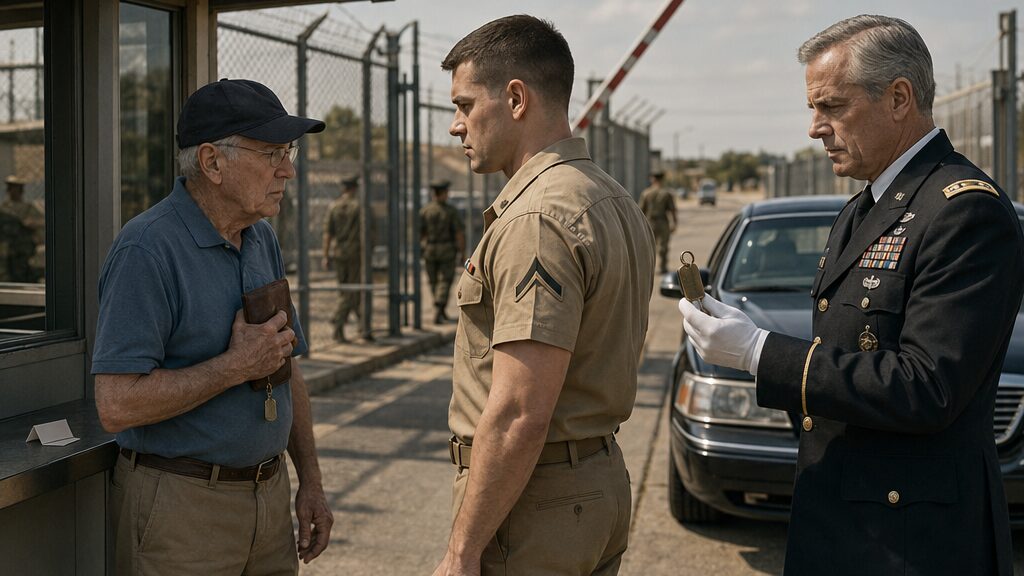
Steven stood at the painted white line with his cap pulled low, one hand resting against the outside seam of his khaki pants, the other holding an old leather badge sleeve.
The sleeve had gone soft around the corners. Its clear plastic window was yellowed from years in glove compartments, desk drawers, and shirt pockets. Inside was an access badge with his photograph from another decade, maybe two. His hair had been darker then. His mouth had been set in the same careful line.
A brass tag hung beside it on a small key ring.
He had rubbed his thumb over the tag all the way from the parking area. He did it without noticing now, the way a man might check a pulse. The stamped number was faint but still there: BLDG 14. The old infirmary.
Behind the brass tag, folded twice, was a visitor card filled out in his small square handwriting. The ink had bled a little where his palm had rested on it too long before dawn. On the front was his name. On the back was the name he had not said aloud that morning.
He had planned to say very little.
Just let me in long enough to leave this.
That was the sentence he had practiced on the drive. Not because it was complicated, but because his voice had betrayed him once in the kitchen while he wrote the card. He had stopped, gripped the edge of the table, and waited until the room steadied.
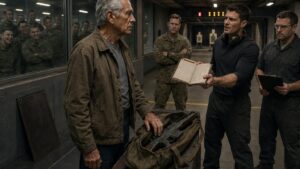
The young serviceman at the booth took the badge sleeve through the window without looking at Steven’s face.
“Purpose of visit?”
“Building Fourteen.”
The serviceman glanced up then. He was broad through the shoulders, tan uniform pressed sharp, black boots clean enough to catch a stripe of sunlight. His name tape read REED.
“Building Fourteen isn’t open to visitors.”
“I know.”
“Then what’s your purpose of visit?”
Steven did not answer quickly enough.
The young man’s eyes dropped to the badge, then to the scanner mounted below the window. He passed the badge across it.
A dull beep came back.
The young man tried again.
The same beep.
He looked at the screen, then at the badge, then at Steven. This time he looked properly, but not kindly. His eyes lingered on Steven’s cap, the glasses, the blue polo shirt, the careful posture of an old man who knew what part of his body hurt and what part might if he moved too fast.
“This badge is expired.”
“It may be.”
“It doesn’t may be. It is.”
Steven put his free hand into his pocket and felt the folded visitor card. “I was told the front office might still have my name.”
“Who told you that?”
Steven thought of the phone call, the hold music, the transfer, the woman who had said there was demolition work scheduled and anything left near the old infirmary would need to be cleared before the fence went up. She had not told him permission would be easy. She had only said, “You can try the gate, Mr. Bennett.”
“A clerk,” Steven said.
“What clerk?”
“I didn’t get her name.”
The serviceman’s jaw tightened at that. Steven watched the little change with more sadness than surprise. A young man at a gate learned to distrust unclear answers. Steven had once learned the same thing, in another uniform, in another kind of heat.
The young man stepped out from the booth and came around the striped barrier. Up close he was taller than Steven had guessed. Not rude yet. Not quite. But he had decided something.
“Sir, I need you to step out of the lane.”
“I’m not trying to cause trouble.”
“Then step out of the lane.”
Steven moved where he was told. The asphalt beyond the booth sloped slightly toward a drainage grate. He felt it in his knees before he saw it.
A white government van idled behind him. Farther back, another car waited, its driver leaning sideways to see what was taking so long. Steven adjusted his grip on the badge sleeve. The brass tag tapped softly against the plastic.
Brandon Reed heard it. His eyes flicked down.
“What’s that?”
“Old tag.”
“What kind of tag?”
Steven closed his hand around it. Not tightly, just enough.
“It belonged here.”
“That doesn’t answer the question.”
A black-uniformed security officer watched from near the second lane. He had not approached yet, but Steven could feel the situation growing around him. A stopped vehicle, an old badge, a young guard with rules to prove, a line beginning to form. Small things made their own weather at a gate.
Brandon held out his hand.
“I need to see everything attached to that badge.”
Steven placed the leather sleeve in his palm. He meant to keep the visitor card tucked safely in his pocket until he reached someone who could help. But when he let go of the sleeve, the folded card shifted upward with it. One white corner showed.
Brandon noticed.
“What’s in your pocket?”
“A visitor card.”
“Take it out.”
Steven’s fingers stayed where they were. The card seemed suddenly too thin for the weight it carried.
“Mr. Reed,” he said, because the name was there on the uniform and names mattered, “I can explain it inside.”
“You can explain it right here.”
The words landed harder than their volume. The driver in the van looked away. A junior guard inside the booth stopped typing.
Steven nodded once. Slowly, he drew out the folded card.
Before Brandon could take it, the wind pressed along the lane and lifted the loose edge. Steven pinned it with his thumb. For one foolish second he saw himself younger, quicker, able to catch what mattered before it slipped.
The gate speaker crackled. Somewhere inside the base, machinery gave a metallic cough.
Brandon took the card, unfolded the front, and frowned.
“This isn’t signed by an escort.”
“I haven’t been assigned one.”
“Then it’s not valid.”
“I was hoping—”
“Sir, hope isn’t clearance.”
Steven lowered his eyes. Not in surrender. In control. He could feel the old anger in his chest, the kind that wanted to speak in a voice he had spent years refusing to use on young men.
The brass tag swung once from Brandon’s hand.
“Building Fourteen,” Brandon read from the old tag. “That building’s restricted today.”
“Yes.”
“Why would you have a tag for a restricted building?”
Steven looked past him, through the gate.
Beyond the booth, the road curved left toward the administrative offices. If a man followed it far enough, then cut behind the maintenance sheds and went past the low brick wall with the cracked capstones, he would find what was left of Building 14. Or what had been left of it last month. White paint peeling from the window frames. A flagpole with no flag. A garden that was mostly weeds if you did not know where to look.
He had seen it in a photograph Mary Collins had mailed him two weeks ago, clipped from an announcement about redevelopment. The infirmary would come down. The land would become training space. The base had no obligation to preserve a building no one used anymore.
Steven understood that.
He also understood promises.
“It opened a side door once,” he said.
Brandon stared at him. “Once?”
“A long time ago.”
The answer did not help. Steven knew it as soon as he said it.
Brandon handed the badge sleeve back but kept the visitor card. The card looked wrong in his young hand. Too fragile. Too private.
“Sir, I need you to empty your pockets.”
Steven looked at the card.
Brandon followed his gaze. “You’ll get it back.”
The black-uniformed officer began walking toward them.
Steven drew one breath, let it settle, and placed the badge sleeve against his own chest as if anchoring himself to it. His hand closed around the brass tag again, thumb over the old number.
The young guard stepped closer.
“Pockets, sir.”
Steven heard the van’s engine behind him, the scrape of Brandon’s boot on the grit, the dry click of the barrier arm settling into place. The base waited beyond them, clean and guarded and almost entirely new.
He slipped his hand toward his pocket.
Chapter 2: The Card Fell Face Down
Brandon Reed had been told his problem was confidence.
Not lack of it. The other kind.
The gate supervisor had pulled him aside three weeks earlier after a civilian contractor talked him into waving through a second truck without checking the passenger list. Nothing had happened. Nothing except a warning, a report, and the quiet embarrassment of being told that being polite was not the same as being careful.
Since then Brandon had made himself careful.
He checked badges twice. He repeated questions exactly. He watched hands, pockets, shoes, eyes. He did not let soft voices move him faster than procedure allowed. He had learned that people at gates often had reasons, and most reasons sounded personal when they were not enough.
The old man in front of him had too many incomplete pieces.
Expired badge. No escort. Restricted building. Unclear clerk. Old tag. Folded card.
Brandon kept his voice level. “Place everything from your pockets on the hood.”
There was no hood. They were in the pedestrian side of the lane, near the booth wall. He pointed to the narrow metal counter below the window instead.
The old man gave him a look then. Not defiant. Worse. Patient.
Brandon disliked that look. It made him feel younger than he was.
Steven Bennett removed a handkerchief first. Folded clean. Then a small pill case. Then a set of car keys on a plain ring. Then, after a pause, he placed the leather badge sleeve on the counter, the brass tag still attached.
The tag made a tiny sound against the metal.
Brandon reached for it.
The old man’s fingers shifted.
“Please,” Steven said quietly. “Careful with that.”
Brandon stopped for half a second.
The request was not sharp. It did not sound like an order. It sounded as if the old man were asking someone to hold a glass that was already cracked.
That softness irritated Brandon more than a challenge would have. A line of cars waited. The security officer was closer now. The gate camera was above them. The old man had already delayed traffic with a badge that no longer worked, and now he wanted ceremony over a dirty piece of brass.
“I need to inspect it,” Brandon said.
“I understand.”
But the old man did not let go quickly. When he finally did, the brass tag slipped against the badge sleeve. The visitor card, half tucked beneath it, slid off the counter before Brandon could catch it.
The card fell face down on the pavement.
Steven bent at once.
Too fast for his age, Brandon thought, and reached out automatically, blocking him at the shoulder.
“Stand back.”
Steven froze halfway down, one hand hovering inches above the pavement. His glasses had slipped lower on his nose. The brim of his cap hid his eyes.
“It’s just a card,” Brandon said.
Steven’s hand closed slowly into a fist, then opened again.
“Yes,” he said.
The black-uniformed officer reached them. “Problem?”
“Expired credential,” Brandon said. “Unverified visitor. Restricted destination.”
The officer looked at Steven, then at the items on the counter. “Sir, are you carrying any weapons?”
“No.”
“Anything sharp?”
“No.”
“Any medical devices we need to know about?”
Steven almost smiled. It never quite formed. “Only the usual old-man machinery.”
The officer did not smile back.
Brandon picked up the fallen card. It had landed in a smear of dust near the drainage grate. On the front, the handwriting was neat: Steven Bennett. Visitor. Building 14.
He turned it over.
On the back, in the same hand but slower, was written: For Mary Collins. Tell him I kept my word.
Brandon read it twice and understood none of it.
“This doesn’t explain your access,” he said.
Steven’s eyes lifted. “No. It doesn’t.”
“Who is Mary Collins?”
“A widow.”
“Is she expecting you?”
“No.”
The officer shifted his stance. “Sir, I’m going to ask you to keep your hands visible.”
Steven nodded.
Brandon heard his own breath and the van engine and the low buzz of the scanner inside the booth. He became aware, too late, of how the scene looked. An old man bent and stopped. A card in the dirt. Two uniforms around him. The kind of moment people watched from car windows and remembered incorrectly.
The old man did not ask for the card again.
That made Brandon feel more uncomfortable than if he had.
He placed it on the counter beside the pill case and picked up the brass tag. It was heavier than it looked. The edges were worn smooth, the hole stretched slightly oval where the ring had rubbed through years of use. The stamped number was shallow but readable.
BLDG 14.
Below it, almost lost to tarnish, were three smaller letters.
INF.
“Infirmary?” Brandon said before he could stop himself.
Steven’s face changed.
Not much. A slight tightening at the mouth. A stillness that came from somewhere deeper than age.
“Yes.”
The security officer glanced toward the inner road. “Building Fourteen’s old medical?”
“Was,” Steven said.
Brandon looked at the tag again. “Why do you have it?”
Before Steven could answer, a dark sedan rolled through the second gate lane and stopped beyond the barrier. It did not belong in the waiting line. The driver got out first, then opened the rear door.
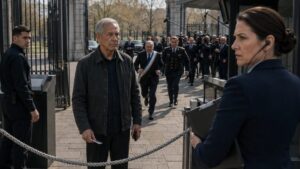
The man who stepped out wore a dark formal uniform and white gloves.
Every young guard at the gate knew Mark Harris by posture before rank. He had the kind of stillness that made others adjust themselves around him. Brandon straightened without deciding to.
The security officer stepped back.
Mark Harris looked first at Brandon, then at the old man, then at the items laid out on the counter.
“What’s the delay?”
“Expired credential, sir,” Brandon said. “Unverified visitor requesting access to a restricted demolition area.”
Mark’s gaze moved to Steven.
For a moment, he looked like any senior officer interrupted on a busy morning. Controlled. Impatient in a disciplined way. Ready to solve a small problem and continue toward a larger one.
Then he saw the brass tag in Brandon’s hand.
His expression did not break. It narrowed.
“Where did you get that?”
Brandon thought the question was for him and began, “It was attached to his—”
“Not you.”
Steven stood with his hands visible and empty. He looked past Brandon to the officer in the dark uniform.
“It was issued to me,” Steven said.
Mark stepped closer. The white gloves made his hands seem ceremonial, almost unreal beside the dust on the pavement. He held one out, palm up.
Brandon placed the tag there.
Mark did not pinch it between two fingers the way Brandon had. He received it flat in his palm, the way someone might receive a folded flag from a case.
He tilted it toward the light.
“Building Fourteen infirmary,” he said.
Steven said nothing.
Mark looked at the old man’s face again. His eyes moved to the badge sleeve, the cap, the folded visitor card, the handkerchief and pill case arranged like evidence on a counter.
Then his voice changed.
“Mr. Bennett,” he said, quiet enough that the drivers behind them could not hear, “may I ask why you’re standing outside my gate?”
Brandon felt the heat rise up his neck.
Not because he had been shouted at. He had not.
Because Mark had used the old man’s name as if it should have already mattered.
Steven’s eyes lowered toward the card. “I was trying to reach Building Fourteen before they closed it off.”
Mark followed the glance.
Brandon picked up the card quickly, brushed at the dust with his thumb, then stopped when he realized he might be smearing the ink.
Mark noticed that, too.
“Give it to me,” he said.
Brandon handed it over.
Mark read the back. For Mary Collins. Tell him I kept my word.
No one spoke.
The barrier arm behind them lifted for the dark sedan’s driver, then lowered again with a soft mechanical hum. Somewhere down the road, heavy equipment reversed, three beeps carrying through the morning air.
Mark folded the card along the crease it already had. Carefully. Exactly.
Then he turned to Brandon.
“Return Mr. Bennett’s things.”
Brandon reached for the badge sleeve, the handkerchief, the pill case. His hands felt too large. He had not broken anything, but everything now looked mishandled.
Steven accepted each item without comment.
When Brandon held out the brass tag, Mark did not let him pass it over.
“I’ll carry this to the office,” Mark said. “If Mr. Bennett permits.”
Steven looked at the tag in the white-gloved palm.
For the first time since Brandon had stepped out of the booth, the old man hesitated.
Then he gave a small nod.
The gesture was not permission given to rank. It was trust granted to a stranger who had finally understood that the object was not trash.
Mark turned toward the inner gate.
“Mr. Bennett,” he said, “come with me.”
Brandon stepped aside.
Steven moved forward slowly, his shoulders still drawn in from the search, his empty hand brushing once against the pocket where the card had been.
As he passed, Brandon wanted to say something. An apology, maybe. An explanation. Procedure had required certain things. The badge had not scanned. The building was restricted. He had done what he had been trained to do.
But the old man’s card had fallen face down in the dirt, and procedure had not bent to pick it up first.
So Brandon said nothing.
Mark paused at the open lane and looked back.
“Reed,” he said.
“Yes, sir.”
“You’re coming, too.”
Chapter 3: The Officer Knew the Old Number
Mark Harris had been on his way to a budget meeting when the driver slowed near the main gate.
At first he saw only delay. A van idling too long. A guard out of position. A black-uniformed officer standing with the posture of someone preparing to write a report. In his calendar, the demolition briefing began in twenty minutes, and Building 14 was one of six items on a list of structures that had outlived their usefulness.
Then he saw the brass tag.
For one strange second, the morning folded in on itself.
His father had kept a box in the garage when Mark was a boy. Not a display box. Nothing polished. Just a cardboard carton full of old base things no one had wanted to throw out: cracked mugs from closed offices, a broken nameplate, a faded photograph of men standing outside the infirmary, and a ring of brass tags marked with building numbers. Mark remembered lifting one and asking why anyone kept keys to doors that had been replaced.
His father had said, “Because someone used them when the doors still mattered.”
Mark had not thought of that sentence in years.
Now he led Steven Bennett through the inner gate toward the security office, carrying the tag in his gloved hand. Brandon Reed followed half a pace behind, quieter than he had been outside. The black-uniformed officer returned to the lane, but not before glancing once more at Steven, as if reassessing the shape of him.
The security office smelled of toner, coffee, and floor polish. Two junior guards straightened when Mark entered. One began to speak, then saw Steven and stopped.
“Clear the side desk,” Mark said.
A guard moved a stack of clipboards.
Steven stood just inside the doorway. He did not take the chair offered to him until Mark said, “Please.”
Even then, he sat on the front edge, cap in his hands, knees close together. His badge sleeve rested on his thigh. Without the brass tag attached, it looked lighter and somehow incomplete.
Mark placed the tag on the clean desk.
Not near the computer keyboard. Not in the plastic tray for confiscated items. In the center of the cleared space.
Brandon noticed. Mark saw him notice.
“Mr. Bennett,” Mark said, “I’m Captain Harris. I apologize for the delay at the gate.”
Steven looked up. “Your guard was doing his job.”
The answer was generous enough to sting someone who had not earned it.
Brandon shifted near the wall.
Mark removed one glove, then the other. He laid them beside the tag. “Doing the job correctly includes knowing when an object deserves care.”
Steven’s gaze rested on the tag. “Most objects don’t.”
“That one does.”
“You know it?”
“I know what it is. I don’t know how it came to you.”
Steven’s hand tightened once around his cap.
Mark waited.
The old man did not fill silence quickly. Some people used silence to punish. Steven seemed to use it to keep from spilling more than he meant to.
“It was on the west door,” Steven said at last.
“The infirmary?”
“Yes.”
“You served there?”
“Some.”
The word was too small for the way he said it.
Mark leaned back, letting the answer stand. “Your badge is expired.”
“I expected that.”
“Your visitor card isn’t signed.”
“I expected that too.”
Brandon looked over. “Then why come through the main gate?”
Steven turned the cap slowly in his hands. The brim had a sweat line along its edge though the office was cool.
“Because side gates close,” he said. “Fences move. Roads get renamed. But the main gate remembers a person longer than the rest of a place.”
No one answered that.
A junior guard at the far computer pretended not to listen.
Mark picked up the visitor card, read the front again, then the back. “Mary Collins.”
Steven’s expression changed by less than a stranger would notice. Mark noticed.
“She’s connected to Building Fourteen?”
“Her husband was.”
“Service member?”
Steven nodded once.
“Is he buried here?”
“No.”
“Was he treated here?”
Steven rubbed his thumb along the cap seam. “For a little while.”
Mark lowered the card.
He had spent enough years around service records to know the shape of an unfinished answer. Men like Steven did not hide things because they were dramatic. They hid them because the thing had edges.
Outside the office window, the morning moved on. Vehicles passed through the gate. The scanner beeped properly for people with the right plastic, the right database entry, the right present-day proof.
Mark looked at the brass tag.
“Building Fourteen is scheduled to be fenced off today,” he said. “Demolition starts later this week.”
“I know.”
“You came to leave the card.”
“Yes.”
“At the building?”
“At the garden.”
Brandon frowned. “There’s a garden?”
Steven did not look at him. “There was.”
Mark remembered a rectangle of neglected green behind the old infirmary, mostly hidden by utility boxes and a low brick wall. He had walked past it during the site survey and seen nothing but weeds, a rusted latch, and two cracked concrete benches. The demolition officer had called it dead space.
“What is the significance of the garden?” Mark asked.
Steven’s eyes went to the window. From the chair, he could see a strip of road and, beyond it, the base flag moving in the wind.
“It was where they put men who were well enough to want air but not well enough to be seen by everyone.”
Mark let that settle.
Brandon’s face had gone still.
The office door opened, and a civilian clerk stepped in holding a tablet against her chest. “Captain Harris, they’re looking for you at administration. The demolition contractor is asking whether Building Fourteen can be locked down early.”
“Angela,” Mark said, “I need you to check a visitor access issue first.”
Angela Carter’s eyes moved from Mark to Steven to Brandon, then to the old badge on Steven’s knee. Her professional expression tightened in the way civilian staff learned from years of balancing courtesy against rules.
“If the badge is inactive, I’ll need a sponsor code.”
“There may not be one.”
“Then I’ll need a current record.”
Mark gestured to the brass tag. “Start with Building Fourteen infirmary.”
Angela looked at the tag but did not touch it. “That building’s archive is incomplete.”
Steven gave the faintest nod, as if she had confirmed something he already knew.
Mark asked, “Can you pull paper logs?”
Angela hesitated. “For Building Fourteen? Maybe. But if this is about access, paper logs won’t override current security.”
“I’m not asking them to override it.”
“What are you asking them to do?”
Mark looked at Steven.
He could order an escort. He could call the gate cleared and take responsibility. He could walk the old man to the garden himself and be done before the meeting missed him. Rank made many things simple if a man cared more about the result than the meaning of how it happened.
But the old man had not come asking for a favor from rank. He had come with an expired badge, a folded card, and a tag that once opened a door.
“I’m asking them to tell us what we’re holding,” Mark said.
Angela’s gaze returned to the brass tag. Something in Mark’s voice changed her posture. Not much, but enough. She tucked the tablet under one arm.
“I’ll check records.”
“Now.”
She nodded. “Now.”
As she left, Brandon finally spoke.
“Captain.”
Mark looked at him.
Brandon swallowed. “Should I return to the gate?”
Mark glanced at Steven. “No. You’ll stay.”
Brandon’s eyes flicked toward the old man. “Yes, sir.”
Steven adjusted the badge sleeve on his knee. “He doesn’t need to.”
The room went quiet.
Mark studied him. “You’d rather he not?”
“I’d rather he not be punished for not knowing what I didn’t tell him.”
Brandon looked down.
Mark’s answer came slowly. “Staying isn’t punishment.”
Steven looked at the brass tag on the desk.
“No,” he said. “Sometimes it isn’t.”
Angela returned faster than Mark expected, but her face had lost its office calm. She held a thin folder instead of the tablet. The folder was gray, bent along one corner, and marked with a number in faded pencil.
“I found a cross-reference,” she said.
She placed the folder beside the brass tag.
Mark opened it.
The first page was a photocopy of an older log, the print faint and uneven. Date columns. Key numbers. Initials. Building access. Most lines were routine maintenance, supply delivery, night inspection.
Then he saw the line Angela had circled.
Bldg 14 west infirmary key issued 2300. Bennett, S.
Beside it were three names under remarks, written in a cramped hand.
One of them was Collins.
Mark looked up.
Steven had seen the page. His face had not changed, but his hand had stopped moving on the cap brim.
Outside, the heavy equipment beeped again, closer this time.
Angela said quietly, “The contractor just called. They’re putting the fence around Building Fourteen within the hour.”
Chapter 4: The Records Had Forgotten His Name
Angela Carter had spent eleven years learning that bases remembered machines better than people.
A generator could be traced through six transfers, three maintenance contracts, and a forgotten serial number stamped under rust. A person, if he had served before the right database migration, could vanish behind smudged ink, retired forms, and boxes nobody wanted to own.
She carried the gray folder against her chest as she led them across the administrative building’s narrow hall. Captain Harris walked beside Steven Bennett, not ahead of him. Brandon Reed followed behind them with his hands clasped at his belt, the way a young guard stood when he had no authority left to use but still did not know where to put it.
Angela did not dislike guards like Reed. They were trained to stop what did not fit, and the old man did not fit anything cleanly. His badge was too old, his destination closed, his explanation too thin, his object too specific. On paper, he was exactly the kind of problem a gate should pause.
But paper had failed plenty of people.
She unlocked the records room with her card and pushed the door open with her shoulder. The room was cooler than the hallway, lined with shelves of boxed files and white archive bins. A humming copier sat in the corner. A clock above the old service counter clicked too loudly, as if counting down toward the demolition fence.
Steven stopped at the threshold.
Angela noticed. “Sir?”
He looked into the room, not with confusion, but recognition of a kind she could not place. “Smells the same.”
“The records room?”
“Old paper and floor wax.” He touched the brim of his cap. “Different building. Same smell.”
Angela softened despite herself. “You can sit here.”
Steven took the chair she indicated, near the service counter. Captain Harris remained standing. Reed chose the wall again.
Angela set the gray folder down and opened it. “The digital system has no active profile for Steven Bennett with current base access. There are three inactive entries, but two belong to dependents from the eighties, and one is incomplete.”
“Incomplete how?” Harris asked.
“No discharge record attached, no modern veteran status marker, no active sponsor. Just a name, one medical billet note, and cross-references to paper logs from Building Fourteen.”
Steven folded his hands over his cap. “That sounds about right.”
Angela looked at him. “You’re not surprised?”
“I was never much good at staying in the right file.”
Brandon glanced up.
The remark should have been almost funny. It was not. It sat in the room with a quiet weight.
Angela turned the folder so Harris could see the photocopied log. “This is the line I found. Bennett, S. West infirmary key, issued at 2300. Remarks list three last names. Collins is one of them.”
Steven’s gaze did not leave the page.
“Do you know the other two?” Angela asked.
“Yes.”
She waited for names.
He did not give them.
Captain Harris stepped closer to the counter. “Mr. Bennett, I don’t want to press you. But Building Fourteen is being fenced soon. If we are going to justify access, I need enough to understand what happened.”
Steven breathed through his nose. His hands were still except for one finger pressing the edge of his cap.
“What happened was ordinary,” he said. “That’s the part people don’t like.”
Angela had expected a story that began with battle language or something polished by years of telling. Steven’s voice carried none of that. It was almost dry.
“Ordinary?” Brandon asked before he could stop himself.
Steven looked at him, and the young guard’s face tightened as if bracing for correction.
“Men came in hurt,” Steven said. “Some worse than others. We ran out of beds first, then clean blankets, then daylight. Building Fourteen had a west door because the front hall got too crowded. That key opened it.”
He did not look at the brass tag. No one had brought it from the security office without care. Captain Harris had it now, folded into a clean handkerchief on the counter between them.
Angela took a slow breath. “Were you medical staff?”
“Corpsman.”
The word changed the room by inches.
Not enough for a salute. Not enough for anyone to perform anything. But Angela saw Brandon’s shoulders settle and saw Harris lower his eyes briefly toward the folder, as if the title had made the old paper heavier.
Angela typed into the terminal at the records desk. The old archive index loaded in square, stubborn blocks of text.
“Do you remember a year?” she asked.
Steven looked toward the clock. “I remember rain.”
Angela stopped typing.
Steven’s mouth tightened. “That won’t help your search.”
“No,” she said gently. “Probably not.”
Captain Harris asked, “Was Collins one of the men brought through the west door?”
Steven nodded.
“And Mary Collins is his widow?”
“Yes.”
“Does she know you came today?”
“No.”
Brandon shifted. “Why not?”
Angela almost turned on him, but Steven answered.
“Because promises aren’t invoices. You don’t send notice before you pay them.”
Brandon looked down.
The copier hummed and clicked though no one had touched it. Outside the records room, a phone rang twice and stopped. Angela worked through the index, searching Building Fourteen, then infirmary, then the names in the remarks. Two entries opened into maintenance records. One into a casualty transport note so heavily redacted by time, water damage, and bad scanning that half the page was pale gray.
“Here,” she said.
Captain Harris leaned over.
The scanned image showed a transfer list. Names, partial initials, a receiving station, handwritten amendments. One line was marked with Collins. The first name had blurred into the crease of the original page.
Steven looked once, then away.
Angela lowered her voice. “I can print it.”
“No.”
The answer came too fast.
She withdrew her hand from the mouse.
Steven closed his eyes for half a second. “No, thank you.”
Captain Harris studied him. “You don’t need the record?”
“I need the garden.”
Angela watched the old man’s face. In the gate lane, she had seen an access problem. In the records room, he became something worse for paperwork: a living remainder. The system could not approve him because it had forgotten what category to place him in.
She typed again, using the old building number. A new index page loaded.
“There was a memorial planting behind Building Fourteen,” she said. “Not formal. Maintenance notation from years back. Three shrubs, two benches, one brick border.”
Steven’s hands moved once over his cap. “There were four shrubs.”
Angela looked at the record. “It says three.”
“One died the first summer.”
No one spoke.
She clicked into the maintenance notes. The final entry was recent: SITE CLEARANCE. REMOVE UNSALVAGEABLE LANDSCAPE MATERIALS. NO HISTORIC HOLD.
Angela felt heat rise in her face, not from guilt exactly, but from the bluntness of the words. Unsalvageable. Material. No hold.
She turned the screen slightly so Captain Harris could see.
His jaw set. “Can the clearance be paused?”
Angela shook her head. “The contractor can pause work if command requests it, but the fencing crew is already staged. I can call, but they’ll ask for an authorization code.”
“Use mine.”
“That pauses entry, not site prep.”
“Then call anyway.”
Angela picked up the desk phone. It took two transfers and one clipped exchange with a contractor who sounded as if he had already had a long morning. While she spoke, Steven sat motionless in the chair. Brandon remained by the wall, eyes on the floor, but Angela saw him glance at the visitor card lying beside the folder.
He had placed it there carefully. She did not know when.
“Yes,” Angela said into the phone. “Building Fourteen exterior garden. No, I’m not asking about the whole structure. Just the west-side garden. Hold fencing for command review.”
She listened.
Captain Harris watched her.
“They say they can hold the inner section for thirty minutes,” she said, covering the receiver. “After that the safety crew takes it.”
Steven stood.
It was not dramatic. He simply rose, one hand braced on the chair, the other picking up his cap. But everyone in the room moved as if the action had given orders.
Captain Harris folded the brass tag back into the handkerchief and held it out.
Steven did not take it immediately.
“Mr. Bennett,” Harris said, “you should carry it.”
Steven’s eyes went from the handkerchief to the captain’s face. “It opens nothing now.”
“Maybe not officially.”
Steven accepted it.
Angela finished the call and hung up. “You’ll need an escort.”
“I’ll go with him,” Harris said.
Steven looked at Brandon. The young guard straightened before anyone spoke.
“He should come,” Steven said.
Brandon’s eyes lifted, startled.
Captain Harris asked, “Are you sure?”
Steven slipped the handkerchief-wrapped tag into his pocket. “He was at the gate.”
That was all he said.
Angela gathered the folder and the visitor card. “I’ll come too. If the contractor asks for paperwork, someone should be there to disappoint him properly.”
For the first time that day, Steven almost smiled.
They left the records room together. In the hallway, the sound of heavy machinery rolled faintly through the walls. Steven walked slowly but did not ask anyone to slow down. The others did it anyway.
Angela held the folder close, her thumb marking the page where the old log had remembered what the database had not.
As they stepped into the afternoon glare, a maintenance truck passed carrying orange fencing in its bed.
Steven stopped just long enough to watch it turn toward Building Fourteen.
Chapter 5: The Promise Behind the Gate
Steven had not meant to bring anyone with him.
In his mind, the morning had been simple. He would show the badge, explain as little as possible, reach the old garden, place the folded card, stand there long enough to say the name once, and leave before anyone asked him to turn memory into a story.
Now there were four of them walking the base road: Captain Harris in dark formal uniform, Angela Carter with the gray folder under her arm, Brandon Reed in tan uniform, and Steven Bennett in a blue polo shirt that had begun to cling at the back.
The road curved exactly where he remembered, but everything beyond the curve had changed.
The old exchange building was gone. The training center had a glass front. A row of young service members crossed at a marked walkway, laughing at something on a phone until they saw Captain Harris and straightened. None of them looked twice at Steven. That did not bother him. Invisibility had its uses. A man could move through a place without disturbing it if no one asked what he carried.
Only Brandon looked at him too often.
Steven could feel the young guard’s glances: quick, guilty, searching for an opening. The boy wanted to apologize. Steven hoped he would not, at least not yet. Apologies given too early often asked the injured person to do work he had not agreed to do.
They passed a maintenance shed painted dull gray. Beyond it, through a break between two buildings, Steven saw the roofline of Building Fourteen.
His step shortened.
Captain Harris noticed but did not touch him. “Do you need a moment?”
“No.”
The word was true enough to keep walking.
Building Fourteen sat lower than the newer structures, a long brick rectangle with peeling white trim and boarded windows. Yellow caution tape crossed the front steps. A contractor’s sign stood near the curb. The old flagpole was still there, bare as bone.
Steven looked away from the front entrance and toward the west side.
“The garden’s back there,” he said.
Angela checked her phone. “They said they’d hold the west section, but not for long.”
Brandon stepped ahead, then caught himself. “Sir—Mr. Bennett. The ground might be uneven.”
Steven heard the correction. So did everyone else.
“It always was,” Steven said.
They followed the narrow service path around the building. Weeds grew through cracks in the concrete. A rusted utility box leaned away from the wall. Near the back corner, the low brick border appeared, half swallowed by grass. The two benches remained, though one had split down the middle and sagged toward the earth.
The garden was smaller than memory, but most places were.
Steven stopped at the edge.
There had been four shrubs once. Three planted in a neat row because a lieutenant liked things measured. The fourth, a thin stubborn thing near the wall, had been planted by a patient who said rows looked too much like inspection. It had died that first summer, just as Steven told Angela. The dead space it left was still visible if a person knew where to look.
“Mr. Bennett?” Captain Harris said.
Steven had not realized he had closed his hand around the folded visitor card.
Angela stood back near the path, speaking quietly into her phone to someone from site control. Brandon stayed by the tape, looking at it as though it were a rule he could understand and therefore trust.
Steven unfolded the card halfway.
Mary Collins’s name was not on the back. Her husband’s was.
He had written Mary on the front of his own thought because she was the living one, the one who had sent the photograph, the one whose short note had carried more restraint than grief.
I don’t know if you remember him, Mr. Bennett. They say they’re tearing down the old building. I thought you might want to know.
As if he could have forgotten.
The card trembled once in Steven’s hand.
Brandon saw. He took one step forward, then stopped.
Captain Harris said, “You don’t have to explain this to us.”
“No,” Steven said. “I don’t.”
The caution tape snapped in the breeze.
He looked at Brandon.
“But he should know what he stopped.”
The young guard’s face tightened, not in offense. In readiness.
Steven kept his eyes on the garden while he spoke. “Collins came through the west door because the front hall was full. He was younger than you. Most of them were. He kept asking if somebody had told Mary.”
No one moved.
“I told him I didn’t know. That was the truth. He asked me to tell her he wasn’t afraid. That was not the truth, but he wanted it sent anyway.”
Angela lowered her phone.
Steven folded the card along its crease, then unfolded it again. “Later he changed it. He said, ‘Tell her I kept my word.’ I never knew which word he meant. Maybe to come home. Maybe to do his job. Maybe something he said in a kitchen before he left.”
Brandon’s voice was barely above the wind. “Did you tell her?”
Steven looked at the broken bench. “I wrote. I called once. She thanked me like I had brought something useful. I hadn’t.”
Captain Harris said, “You carried the message.”
“I carried words. Not him.”
The old anger came then, not hot but worn smooth from years of being held. Steven let it pass through his hands into the card.
“Afterward, someone planted this little garden. Unofficial. No plaque. No dedication. Men sat here when they could stand being outside but not being seen. Collins never sat here. He didn’t make it that far. But his name belonged near the place where he tried.”
Angela wiped at the corner of her eye with one quick professional motion and turned away, as if checking the path.
Brandon looked younger than he had at the gate. “I dropped the card.”
“Yes,” Steven said.
“I shouldn’t have.”
“No.”
The answer was not cruel. It was clean.
Brandon swallowed. “I thought you were trying to get past a rule.”
“I was.”
That startled him.
Steven turned slightly. “Rules are fences. Some keep harm out. Some keep memory out. You have to learn which kind you’re standing behind.”
Brandon looked at the yellow tape.
Captain Harris did too.
Angela returned from the path. “They’ll hold the crew another twenty minutes, but they won’t let anyone past the tape without a safety release. The ground near the wall has been flagged.”
Steven looked at the garden. The place he needed was six steps beyond the tape, near the dead space where the fourth shrub had been.
Captain Harris’s voice hardened into command. “I can authorize—”
“No,” Steven said.
The captain stopped.
Steven did not look at him. “I didn’t come here so somebody could break rules because my hands shake.”
No one answered.
He took the brass tag from his pocket. Angela had wrapped it well, but he unfolded the handkerchief and let the brass rest against his palm.
“West door had a latch,” he said. “Not a lock, not at the end. Just a latch after they changed the hardware. This tag used to hang beside it so whoever had the night watch remembered which door opened when the hall was crowded.”
Brandon stared at the tag. “It still opens the garden?”
Steven shook his head. “No. But it reminds me where the latch was.”
He walked to the far end of the tape where the brick border met the wall. The rusted garden latch was half hidden under vine and flaked paint. Not a door latch anymore, just the remains of a small service gate in the brick border, locked open by age and bent metal.
Steven leaned down.
His breath caught at the effort.
Brandon stepped forward again.
This time Steven raised one hand without looking back.
Brandon stopped.
Steven touched the old latch with the brass tag. Metal met metal with a soft, dull click.
The sound was almost nothing.
But his eyes closed.
For one moment, the hot afternoon, the contractor sign, the caution tape, the young guard, the captain, the clerk, all of it thinned. Steven smelled wet canvas and disinfectant. Heard rainwater running off the west awning. Heard a young man asking for Mary.
Then the wind moved the tape against his arm, and the present returned.
He straightened slowly.
“The card goes there,” he said, pointing to the dead space beside the wall.
Angela looked toward the road. “The crew is coming.”
Two workers in hard hats appeared beyond the shed, carrying more orange fencing.
Brandon turned toward Captain Harris. “Sir, request permission to speak to site control.”
“For what purpose?”
“To ask them to hold their line at the walkway until Mr. Bennett places the card.”
Angela said, “They already said no one crosses without release.”
Brandon looked at Steven. This time he did not look guilty. He looked certain, and afraid of being wrong.
“Then I’ll ask properly,” he said.
Steven studied him.
The young guard did not ask forgiveness. He did not reach for the card. He did not call Steven a hero or sir in a voice full of sudden decoration.
He simply stood beside the tape and waited for permission to try.
Steven handed him the folded card.
“Don’t drop it,” he said.
Brandon took it with both hands.
Chapter 6: Permission Before the Old Steps
Brandon Reed walked toward the contractors with the folded card held flat between both palms.
It was the strangest thing he had ever carried on duty. Lighter than any weapon, less official than any form, and somehow more dangerous to mishandle than either. He could still see it falling face down on the pavement at the gate. The small white rectangle in the dirt. The old man bending. His own hand stopping him.
He had told himself all morning that he had followed procedure.
The sentence had become less useful every time he repeated it.
The two workers stopped when they saw his uniform. One held a roll of orange fencing against his shoulder. The other looked past Brandon toward Captain Harris and straightened a little.
“West side is closed,” the first worker said. “We were told twenty minutes. Time’s up.”
“I understand,” Brandon said.
He heard himself and hated how young he sounded.
The worker shifted the roll. “Then you understand we need to put the fence in.”
“There’s an old garden inside the line.”
“There’s overgrown landscaping inside the line.”
Brandon kept the card steady. “A veteran needs to place this there.”
The second worker glanced at Steven. “We can’t have anybody wandering through a demolition zone.”
“He won’t wander.”
“Liability says nobody crosses the tape without release.”
Brandon looked back once.
Steven stood near the old latch, not leaning on anyone. Angela was beside him with the folder. Captain Harris watched silently, letting Brandon handle the moment he had created. That silence felt heavier than an order.
Brandon turned back. “Who can give the release?”
“Site supervisor.”
“Where is he?”
“Front side.”
“Call him.”
The first worker sighed. “Look, no offense, but we’ve got a schedule.”
Brandon felt the old gate voice rise in him, the voice that liked rules because rules made fear sound professional. He almost used it.
Then he looked at the folded card.
No offense. That was what people said before making a person smaller.
“Please call him,” Brandon said. “I’m not asking you to ignore safety. I’m asking you to let command review one six-foot section before you fence it out.”
The worker studied him, then looked again at Captain Harris.
“Fine,” he said, and took out his phone.
Brandon returned to the garden without claiming victory.
Steven watched him approach.
“They’re calling the supervisor,” Brandon said. “I didn’t promise more than that.”
“Good.”
The word landed quietly, but Brandon felt it all the same.
Captain Harris glanced at his watch. “We may have only minutes.”
Steven nodded.
Angela opened the gray folder and removed the photocopied log. She had slipped it into a protective sleeve. “Mr. Bennett, there’s something else in the archive notes. I didn’t mention it inside because I wasn’t sure it mattered.”
Steven looked at her.
“The remarks column lists Collins and two others. But on the reverse scan, there’s an initials column for attending corpsman. S.B.” She paused. “The entry doesn’t say what happened, but it shows you signed the west key back in at 0410.”
Steven’s eyes moved to the old building.
Angela’s voice softened. “That means you stayed with them.”
The wind lifted the edge of the folder. Steven reached out and pressed it down, not for the paper, but for something in himself.
“There wasn’t anywhere else to be.”
Brandon looked at the card in his hands. “You were with Collins when he said it?”
Steven nodded.
“And you remembered the words exactly?”
“Words are easy.”
No one asked what was hard.
The site supervisor arrived in a white hard hat, irritated before he reached them. Captain Harris met him halfway. Their conversation was short and low. Angela joined with the folder and pointed to the old maintenance notation. The supervisor looked at the garden, then at Steven, then at Brandon holding the card like a fragile instrument.
At last he lifted one hand. “Three minutes. One person inside the line. No one near the wall. If the ground shifts, you step back immediately.”
Captain Harris turned. “Mr. Bennett?”
Steven looked at the tape.
The old path beyond it had broken into uneven slabs. Grass grew high along the edge. The place for the card was not far, but distance had changed its rules since he was young.
Brandon stepped closer, then stopped before crossing into Steven’s space.
“Mr. Bennett,” he said, and his voice lowered without becoming soft. “Would you permit me to walk beside you until the brick border?”
Steven looked at him.
Brandon held the card out, still with both hands. “Not to take you. Just to make sure the ground doesn’t.”
The answer did not come quickly.
Captain Harris did not intervene. Angela did not look away.
Steven took the card from Brandon. He held it against his chest for one breath.
“You can walk beside me,” he said. “Don’t pull.”
“Yes, Mr. Bennett.”
Brandon lifted the caution tape high enough for Steven to step under. He did not touch him. Once inside the taped area, he kept half a step away, close enough to catch a fall, far enough not to claim the man’s balance before it was offered.
The garden smelled of dust and sun-baked weeds. Steven moved slowly, each step placed with care. The cracked concrete shifted once under his shoe, and Brandon’s hand opened, ready, but he did not reach.
At the brick border, Steven stopped.
The dead space of the fourth shrub lay near the wall, a shallow hollow where leaves had collected. He lowered himself carefully. His knee objected; his breath shortened. Brandon bent too, not beside him like an equal in the memory, but near enough to be useful if asked.
Steven unfolded the visitor card.
On the back, beneath Mary Collins’s name, he had written the words in ink dark enough to outlast the afternoon.
He kept his word.
He pressed the card into the hollow and weighed it with a small flat stone from the border.
For a moment, no one made a sound.
Then Steven took the brass tag from his pocket and set it briefly beside the card. Not leaving it. Only letting it touch the place.
“I was late,” he said.
The sentence was barely audible.
Brandon heard it because he was close.
Steven lifted the tag again and closed it in his hand.
“You weren’t late today,” Brandon said.
Steven looked at him then, and Brandon knew at once that the words had been too easy. True, maybe. Not enough.
The old man’s eyes were wet but steady. “Today wasn’t the day I meant.”
Brandon lowered his gaze.
The site supervisor called from the path, “Time.”
Steven did not move.
Captain Harris’s voice answered, “One moment.”
The supervisor started to object, then saw Harris’s face and did not.
Steven remained crouched by the hollow. His hand rested on the brick border, fingers curled around the brass tag. When he finally stood, Brandon stepped closer.
“May I?” Brandon asked.
Steven gave the smallest nod.
Brandon offered his forearm, not his hand. Steven used it only for the first push, then let go. They walked back through the broken garden at the same careful pace.
At the tape, Brandon lifted it again.
On the safe side, Angela closed the folder. Captain Harris stood with his cap held against his side.
No one saluted. No one spoke loudly. The workers waited, quieter now, the roll of orange fencing lowered to the ground.
Steven looked once more at the card by the wall.
Angela said, “Mary Collins should know.”
Steven’s fingers tightened around the brass tag.
“She knows enough.”
“Maybe,” Angela said. “But not this.”
He turned toward her.
She did not push further.
Captain Harris said, “We can send the record. Or not. Your choice.”
The phrase your choice seemed to move through Steven slowly.
All day, the base had asked for proof. Badge. Sponsor. Record. Release. It had asked him to explain himself in pieces small enough for other people to approve.
Now the choice came back to him, and he did not know what to do with it at first.
He looked at the card, then at Brandon.
“There was another name,” Steven said.
Brandon waited.
“Not in the log.”
Angela’s hand tightened on the folder.
Captain Harris asked, “Someone else from that night?”
Steven shook his head once.
He looked at Building Fourteen, at the boarded windows and the west door that would never open again.
“Mine,” he said. “Or who I was before that door.”
The workers began setting the orange fence posts along the path, careful now not to step into the garden. Steven watched them make a boundary around what was left.
This time, it did not feel quite like being kept out.
Chapter 7: The Guard Who Lowered His Voice
By evening, the base had begun to look ordinary again.
That was what troubled Steven most.
The orange fencing stood around the west garden now, bright and practical. The workers had finished their line and gone on to the next section of their list. The heavy equipment sat quiet beyond Building Fourteen, its metal arm lowered like an animal sleeping before work. Shadows from the utility poles stretched over the cracked path where Steven had walked with Brandon beside him.
The card remained in the hollow by the wall.
Steven had looked back only once as they left. Not because he feared it would move, but because he knew it would not. A small folded card beneath a flat stone was not much defense against weather or demolition or time. Still, it was more than the place had held that morning.
Angela Carter had asked him, before they left the garden, whether she could make a copy of the old log for Mary Collins.
Steven had said yes after a long pause.
Not because Mary needed a record to believe him. She had believed him for decades, which in some ways was harder. But paper, handled carefully, could sometimes help the living put down what they had carried politely for too long.
Captain Harris had promised no ceremony. He had not used that word, but Steven heard it in what he did not say. No photographer. No sudden announcement. No hand on the shoulder while someone made meaning in front of strangers. Only a copy of the page, a note from the base records office, and Angela’s assurance that the card would be collected respectfully before demolition reached the garden.
Steven had asked that the card stay until the last safe hour.
Angela had written it down.
Now he sat in the passenger seat of a small base utility cart as Brandon drove him back toward the main gate. Captain Harris had been called away to the meeting he had missed. Angela had returned to records with the gray folder held against her chest like something warmer than paper.
That left Brandon.
The young guard drove carefully, both hands on the wheel, though the road was empty. He had offered the cart only after asking whether Steven preferred to walk. Steven had almost said yes from habit. Then his knees answered for him before pride could, and he had nodded.
The brass tag rested in Steven’s palm.
At the garden, he had put it back into his pocket, but halfway to the gate he took it out again. Dust still marked the edges where it had fallen at the gate. A faint line of grime had settled into the stamped letters.
BLDG 14. INF.
He rubbed it once with his thumb and stopped.
Some dirt belonged to a thing.
Brandon slowed near the curve before the gate. “Mr. Bennett?”
Steven looked toward him.
“I owe you an apology.”
The words came stiffly, as if Brandon had carried them too long and they had dried out.
Steven turned the tag over. “For what part?”
Brandon’s hands tightened on the wheel.
It was not the response he expected. Steven knew that. He did not ask to be cruel. He asked because apologies, like records, needed accuracy.
Brandon kept his eyes on the road. “For stopping you from picking up the card.”
Steven waited.
“For assuming you were trying to get around me. For handling the tag like it was nothing. For making you empty your pockets in front of everyone.”
The cart hummed forward.
“And,” Brandon added, quieter, “for being more worried about looking wrong than doing right.”
Steven looked out at the fence line. The main gate was ahead, its booth windows turning gold with the low sun. The barrier arm lifted for an outgoing truck, then lowered again.
“You were doing the job as you understood it,” Steven said.
“That’s what I told myself.”
“It was true.”
Brandon glanced at him.
Steven closed his fingers around the tag. “It just wasn’t the whole truth.”
The cart rolled to a stop near the security office. The same lane where Steven had stood that morning lay only a few yards away. The pavement had been swept; the smear of dust near the drainage grate was gone. Nothing marked where the visitor card had fallen.
That seemed right and wrong at the same time.
A junior guard stepped from the booth as Brandon helped Steven down from the cart without touching him. The guard looked from Steven’s cap to the old badge sleeve to Brandon’s face.
“This the old guy from earlier?” the junior guard asked.
Brandon’s head turned.
The change in him was small, but Steven saw it clearly. At the gate that morning, Brandon had used authority like a wall. Now he used it like a door he was responsible for holding correctly.
“His name is Mr. Bennett,” Brandon said.
The junior guard blinked. “Right. Sorry.”
Brandon did not make more of it. He did not embarrass the guard, did not look at Steven to see if the correction had pleased him. He simply reached for the sign-out clipboard and set it on the counter.
“Mr. Bennett is departing through the main gate,” he said. “Log it correctly.”
The junior guard nodded and wrote.
Steven felt the correction move through him more deeply than a salute would have.
Captain Harris had recognized the tag. Angela had found the record. The garden had received the card. But this—this was different. This was the place where the day had gone wrong, and Brandon had changed the shape of it without asking anyone to watch.
Steven set his cap on his head and adjusted the brim. “You don’t have to stand so straight around me.”
Brandon looked almost embarrassed. “Yes, Mr. Bennett.”
“That wasn’t an order.”
“No, Mr. Bennett.”
Steven sighed, but there was no anger in it.
Brandon reached into his pocket and pulled out a folded white handkerchief. For one sharp instant Steven thought it was the visitor card, and his chest tightened.
But Brandon unfolded it.
Inside lay the brass tag.
Steven looked at his own empty palm.
He had not felt Brandon take it. Then he remembered setting it on the cart seat when he climbed down. The young guard must have seen it there.
The tag looked different. Not polished bright. Not scrubbed clean. The dust from the pavement was gone, but the tarnish remained, the worn edges, the old letters, the history no shine should erase.
“I wiped off the grit,” Brandon said. “Only the grit.”
Steven took it slowly.
Brandon held it out flat, as Captain Harris had done, not pinched between fingers.
The tag settled into Steven’s palm with its familiar weight.
“Thank you,” Steven said.
Brandon nodded. He looked toward the gate, then back. “May I ask one thing?”
“You can ask.”
“The other name,” Brandon said. “The one you said was yours.”
Steven looked past the barrier arm to the civilian parking area beyond the fence. His car waited in the last row, smaller than it had seemed that morning.
“When I came through that west door,” he said, “I thought if I did everything right, I could keep all of them alive.”
Brandon did not answer.
“That was the young man I left there. The one who believed there was a correct way to carry every hurt thing if his hands were steady enough.”
The gate speaker crackled once, then went silent.
Brandon’s voice was low. “And now?”
Steven rubbed his thumb over the stamped number. “Now I know steady hands don’t save everything.”
He slipped the tag back onto the ring beside the badge sleeve.
“But they still matter.”
Brandon looked down at his own hands.
For a moment, Steven saw him as he had been at the start of the day: broad-shouldered, certain, impatient with anything that did not fit the scanner. Then he saw him at the garden, holding a folded card as if the wind itself had been entrusted to him.
People did not become noble all at once. Steven did not trust sudden transformations. But a man could lower his voice. He could correct a name. He could learn to ask before reaching.
Sometimes that was where respect began.
The junior guard returned the clipboard. “You’re signed out, Mr. Bennett.”
Steven took the pen and added his own signature beneath the line. His hand shook enough to make the last letters uneven. He did not cross them out.
Brandon walked with him toward the pedestrian exit. The barrier arm was raised for a passing vehicle, and evening light spilled through the gap beyond the gate.
At the line where base pavement met the civilian walkway, Brandon stopped.
He did not salute.
Instead, he removed his cap, held it against his side, and waited until Steven had both feet beyond the gate.
“Mr. Bennett,” he said.
Steven turned.
Brandon stood straighter, but not stiffly. His voice did not perform for the booth or the cameras or the junior guard watching from inside.
“Thank you for letting me come with you.”
Steven looked at him for a long moment.
He thought of Mary Collins opening whatever envelope Angela would send. He thought of the card beneath the stone, the fourth shrub that had died, the west latch making its tiny dull click when touched by brass. He thought of a young man named Collins asking for words to travel farther than he could.
Then he thought of the boy at the gate who had dropped the card and the guard standing before him now, careful with silence.
“You came the right way at the end,” Steven said.
Brandon swallowed. “I’ll remember.”
Steven nodded once. “See that you do more than that.”
Brandon held his gaze. “Yes, Mr. Bennett.”
Steven walked toward the parking area. He moved slowly, but not because he wanted anyone to watch. Behind him, the gate returned to its rhythm: engines, scanners, clipped instructions, the rising and falling arm.
At his car, Steven paused before opening the door.
The brass tag hung beside the old badge. He lifted it once, letting the fading light catch the stamped number. For years he had thought the tag belonged to a locked door behind him. Now it felt less like a key to the past than a small weight keeping the present honest.
He placed it carefully in the cup holder, where it would not slide.
Before he started the engine, he looked back.
At the gate, Brandon Reed was speaking to the junior guard. Steven could not hear the words, but he saw the younger man point—not sharply, not with irritation—toward the sign-out clipboard, then toward the lane where visitors waited.
Teaching, maybe.
Or learning aloud.
Steven turned the key. The engine coughed, caught, and settled.
He drove away without waving.
The base receded in the rearview mirror, bright fence, guard booth, lowered barrier, all of it growing smaller. Somewhere beyond those walls, behind orange fencing and old brick, a folded card rested in a garden that had almost been called unsalvageable.
For Mary Collins. For the man who kept his word. For the young corpsman who had believed steadiness could defeat loss. For the old man who had come back without asking to be recognized, and had been seen anyway.
At the first red light outside the base, Steven reached down and touched the brass tag once.
Not to check that it was there.
To let it be.
The story has ended.