The Rainy Morning When a Little Girl’s Drawing Gave a Forgotten Veteran a Reason to Keep Going
Chapter 1: The Empty Seat Across From Him
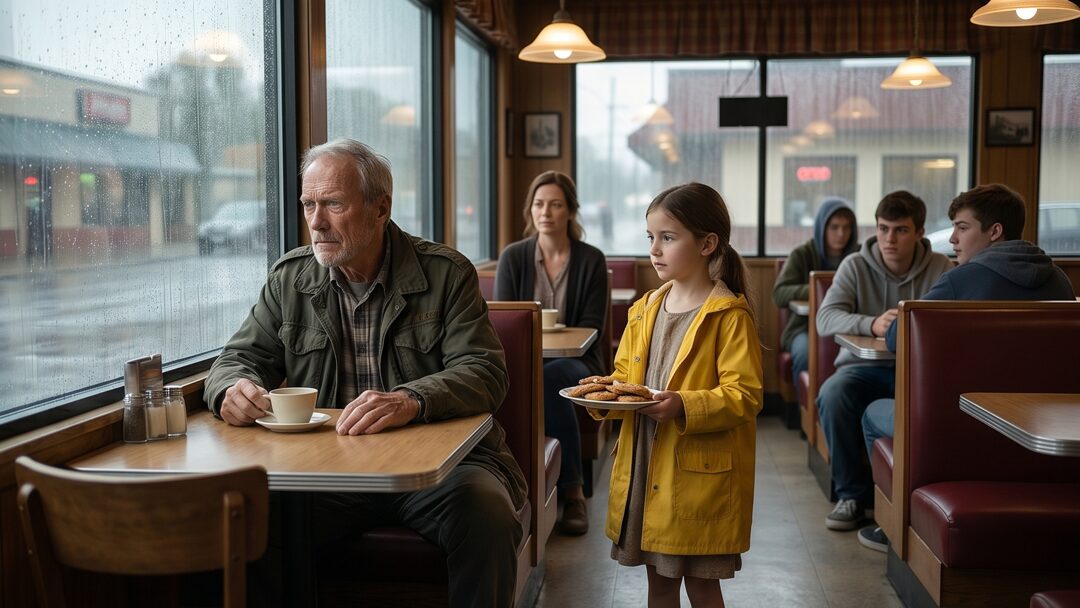
The seat across from Raymond Williams had been empty for nearly an hour.
He stared at it as if someone might still arrive.
Rain slid down the diner window beside him in crooked silver lines. Outside, the parking lot shimmered beneath a gray morning sky. Inside, coffee cups clinked, plates scraped, and conversations rose and fell like waves breaking somewhere far away.
Nobody at the diner paid much attention to the old man sitting alone by the window.
That was usually how Raymond preferred it.
Today, it felt different.
His coffee had gone cold twenty minutes ago. He hadn’t touched it.
The waitress had asked twice if he wanted a refill. Both times he had politely declined.
Now he sat with his forehead resting lightly against the cool glass, watching the rain blur the world outside.
The empty seat remained untouched.
A group of teenagers occupied two booths near the center of the diner. Their laughter bounced across the room. They weren’t being cruel. They were simply young enough to believe that every moment belonged to them.
One of them nearly knocked over a glass while telling a story. The others burst into laughter.
Raymond glanced over.
For a second, he imagined another group of young men laughing around another table long ago.
Then the memory vanished.
He turned back toward the rain.
The bell above the front door jingled.
More customers entered.
Families.
Churchgoers.
Travelers escaping the weather.
The diner filled steadily.
Nobody sat across from him.
Nobody ever did.
A hand appeared beside his table.
“You sure I can’t get you that refill?”
Raymond looked up.
Robert Allen stood there holding a coffee pot.
The diner owner had aged almost as much as Raymond. His hair had turned mostly white. Deep lines framed his eyes.
Raymond managed a faint smile.
“I’m fine, Robert.”
“You said that thirty minutes ago.”
“I’m still fine.”
Robert nodded.
Neither man mentioned the obvious.
That Raymond came here every year.
That he always chose the same booth.
That he always stared at the same empty chair.
That he always left before noon.
Robert shifted awkwardly.
“Well. Let me know if you need anything.”
“I will.”
The owner hesitated.
For a moment, it looked as though he wanted to say something more.
Instead he simply walked away.
Raymond watched him go.
Kind man.
Good man.
But like everyone else, Robert had learned not to ask questions.
And Raymond had spent years teaching people exactly that lesson.
Leave it alone.
Don’t worry about me.
I’m fine.
The lie had become easier with practice.
Outside, rain struck harder against the glass.
He rubbed a thumb across the edge of his wedding band.
The ring was old and worn smooth.
Another habit.
Another thing he never explained.
The teenagers erupted into another round of laughter.
A child somewhere dropped a spoon.
Coffee smelled rich and bitter.
Life continued.
And somehow Raymond felt farther away from it than ever.
His gaze drifted again toward the empty chair.
The chair wasn’t special.
Just vinyl and chrome.
But every year he found himself looking at it.
Remembering.
Waiting.
As if memory could somehow become flesh.
As if absence could sit down and order breakfast.
His chest tightened.
He looked away.
Across the diner, a little girl sat beside her mother.
She had been coloring earlier.
Now she wasn’t coloring anymore.
She was watching him.
Raymond noticed her only briefly.
Children looked at people.
That was normal.
Adults learned not to.
He gave her a small nod.
She quickly looked down at her table.
The moment passed.
Or so he thought.
At the booth near the window, Kathleen Moore peeked back toward the old man.
“Mom.”
Deborah looked up from her coffee.
“Hm?”
“The man over there.”
Deborah followed her daughter’s gaze.
She immediately knew which man Kathleen meant.
The veteran.
Everyone noticed him eventually.
Most simply didn’t know what to do with the feeling that came afterward.
“He looks sad,” Kathleen whispered.
Deborah glanced again.
The old man’s shoulders seemed heavy.
Not physically.
Something else.
Like he was carrying a weight nobody else could see.
“Maybe he’s just tired,” Deborah said.
Kathleen frowned.
“He looks lonely.”
Deborah didn’t answer.
Because she thought her daughter might be right.
Across the room, Raymond stared through the rain again.
The empty seat remained waiting.
Kathleen studied him for another minute.
Then another.
The more she watched, the more she noticed things.
The untouched coffee.
The way he never looked at his phone.
The careful posture.
The small American flag pin attached to his old jacket.
The sadness in his eyes whenever he glanced at the empty chair.
Children noticed strange things adults overlooked.
Sometimes because they hadn’t yet learned what was supposed to matter.
The diner noise seemed louder suddenly.
The teenagers laughed again.
A television over the counter played a football recap.
Someone complained about gas prices.
Life moved forward.
The old man sat completely alone.
Kathleen looked down at the folded piece of paper hidden beside her coloring book.
Then she looked back toward Raymond.
An idea began to form.
It frightened her immediately.
Her mother noticed the expression.
“What are you thinking?”
Kathleen hesitated.
“A weird thing.”
“Those are usually your favorite kind.”
The little girl bit her lip.
Then she lowered her voice.
“Do you think… I could go talk to him?”
Deborah blinked.
“What?”
“The man.”
Kathleen glanced toward Raymond again.
“He looks like he needs somebody.”
For a moment, Deborah didn’t know what to say.
The request caught her completely off guard.
Her eyes moved from her daughter to the veteran sitting alone by the rain-streaked window.
Then back again.
Kathleen’s expression was serious.
Not childish curiosity.
Not mischief.
Concern.
Real concern.
Deborah looked toward Raymond once more.
The old man never lifted his eyes from the empty seat across from him.
And for the first time that morning, someone was preparing to cross the room.
Chapter 2: The Drawing Folded Inside Her Pocket
“Talk to him?”
Deborah kept her voice low.
Kathleen nodded.
The courage that had pushed the words out suddenly seemed to abandon her. Her stomach tightened.
Maybe it was a bad idea.
Maybe strangers weren’t supposed to do things like that.
Across the diner, Raymond remained unaware of the conversation. He sat motionless beside the rain-streaked window, one hand wrapped around a coffee cup he no longer drank from.
Deborah looked at him again.
“He might want to be left alone.”
Kathleen followed her gaze.
“He doesn’t look like he wants to be left alone.”
The answer surprised Deborah.
Not because it was clever.
Because it was honest.
Children often saw things adults worked hard to ignore.
Deborah rested her elbows on the table.
“Do you know him?”
“No.”
“Do you know why he’s here?”
Kathleen shook her head.
“No.”
“Then why are you worried about him?”
The little girl looked down at the edge of her coloring book.
For several seconds she didn’t answer.
Finally she said, “Because nobody else is.”
Deborah felt something shift uncomfortably inside her chest.
She glanced around the diner.
People were talking.
Eating.
Laughing.
Checking phones.
Watching television.
Living ordinary lives.
And in the middle of all of it sat an old man who seemed somehow separate from everyone else.
Not rejected.
Just unseen.
The difference felt important.
Kathleen reached into her jacket pocket.
Her fingers touched the folded paper hidden there.
She had drawn it the night before.
Not for Raymond.
She hadn’t known he existed.
She had simply been drawing people who helped others.
Teachers.
Firefighters.
Soldiers.
Her grandfather had served years ago, though he had died before she was old enough to remember him clearly.
The stories remained.
The uniforms.
The photographs.
The framed flag hanging in her grandmother’s hallway.
Children collected pieces of history differently than adults.
To Kathleen, soldiers belonged in the same category as people who protected others.
Simple.
Important.
Good.
She pulled the folded paper halfway out before sliding it back into her pocket.
Deborah noticed.
“What is that?”
“My drawing.”
“The one you were working on yesterday?”
Kathleen nodded.
Deborah smiled.
“You’ve been carrying it around all morning?”
A small shrug.
The drawing suddenly felt important.
Though Kathleen wasn’t entirely sure why.
Across the diner, one of the teenagers leaned back in his booth and laughed loudly enough to draw attention from several tables.
Ryan Martin wiped tears from his eyes.
“That guy actually believed her.”
“No way.”
“I swear.”
The boys laughed again.
Their conversation wasn’t about Raymond.
It wasn’t about anything important.
Just stories and jokes and the endless confidence of being seventeen.
Still, the noise made Kathleen glance toward them.
Then toward Raymond.
The contrast bothered her.
The old man looked tired.
Not sleepy.
Tired in a way she couldn’t explain.
As if he had been carrying something heavy for a very long time.
A waitress stopped beside his table.
She asked him something.
He answered politely.
Then she left.
The conversation lasted less than ten seconds.
Afterward, he returned to staring at the empty chair.
Kathleen noticed that immediately.
The chair.
She had noticed it before.
Now she couldn’t stop noticing it.
Nobody was sitting there.
Nobody seemed expected.
Yet Raymond looked at it over and over.
As if it mattered.
As if someone belonged there.
“Mom.”
“What?”
“Why does he keep looking at that seat?”
Deborah followed her gaze.
“I don’t know.”
Neither of them looked away.
For a moment the empty chair seemed stranger than the man himself.
A question without an answer.
At the counter, Robert Allen was drying a coffee mug.
He glanced toward Raymond.
Then quickly looked away.
Kathleen noticed that too.
Adults were strange.
Everyone seemed aware of the old man.
Nobody spoke to him.
Nobody asked questions.
Everyone acted as though some invisible rule existed.
Leave him alone.
The realization made her more determined.
Not less.
Deborah seemed to sense it.
“Honey.”
“What?”
“If you decide to talk to him, you need to be respectful.”
“I know.”
“And if he doesn’t want to talk, that’s okay.”
“I know.”
“And you don’t have to do it.”
Kathleen looked back toward Raymond.
The old man shifted slightly.
For a second he seemed older than before.
Smaller somehow.
Not physically.
Just alone.
“I think I do.”
Deborah studied her daughter.
Part of her wanted to stop this entirely.
Not because it was wrong.
Because it was uncertain.
Because adults spent years learning to avoid awkward situations.
Children walked directly into them.
The little girl slid from the booth.
Then froze.
Her courage vanished as quickly as it had arrived.
“What if he thinks I’m weird?”
Deborah smiled.
“Then you’ll survive.”
“What if he gets mad?”
“I don’t think he will.”
“What if I say the wrong thing?”
“Everybody says the wrong thing sometimes.”
Kathleen considered that.
Not very comforting.
But probably true.
The teenagers laughed again.
One of them noticed Kathleen standing beside her booth.
“What are you doing?”
The question wasn’t mean.
Just curious.
Still, several faces turned toward her.
Kathleen immediately felt heat rush into her cheeks.
“Nothing.”
Ryan looked toward Raymond.
Then back at her.
Understanding appeared.
“You talking about the old guy?”
His tone wasn’t cruel.
It was casual.
That somehow felt worse.
Kathleen nodded slightly.
A few teenagers exchanged amused looks.
One shrugged.
Another smiled.
Not mocking exactly.
But not understanding either.
The attention made Kathleen want to sit back down immediately.
Deborah saw it happening.
Saw her daughter’s courage beginning to collapse.
She leaned forward.
“Kathleen.”
The little girl looked back.
“If you think something kind should be done, then do it.”
Simple words.
Nothing dramatic.
Yet they settled something inside her.
Kathleen took a breath.
Then another.
She reached into her pocket and touched the folded drawing.
Still there.
She looked toward the counter.
Fresh cookies sat beneath a glass display case.
Warm.
Golden.
Waiting.
An idea formed.
A better idea than simply saying hello.
She walked toward the counter.
Robert looked up.
“What can I get you?”
Kathleen pointed.
“The cookies.”
Robert smiled.
“Good choice.”
A few minutes later she stood holding a small plate.
Three warm cookies.
Chocolate chip.
The heat reached through the ceramic.
She carefully balanced the plate with both hands.
Then she reached into her pocket.
The folded drawing.
Beside it sat several crumpled dollar bills.
Months of allowance money saved for no particular reason.
Her fingers tightened around them.
The diner suddenly seemed much larger than before.
The distance between tables felt enormous.
Everyone appeared busy.
Yet somehow she felt as though everyone might be watching.
Maybe nobody was.
Maybe that was part of being brave.
Doing something before finding out.
She looked once more toward her mother.
Deborah gave a small nod.
Nothing more.
Kathleen swallowed hard.
Then she turned toward the booth by the window.
Toward the old veteran.
Toward the empty chair.
Toward the question nobody else seemed willing to ask.
Holding the plate of cookies carefully against her chest, Kathleen began walking across the diner.
Chapter 3: The Date He Never Talks About
The moment Kathleen stepped away from her table, Raymond looked at the empty chair again.
His chest tightened.
The chair hadn’t always been empty.
Not in his mind.
Not on this day.
He rubbed his thumb against the edge of his wedding band.
A habit older than most of the people inside the diner.
Rain tapped softly against the window.
The sound pulled him backward.
Not into a complete memory.
Just fragments.
A muddy road.
A helicopter.
A voice laughing.
A promise never fulfilled.
Raymond closed his eyes briefly.
When he opened them, the diner returned.
Coffee.
Conversations.
Silverware.
Rain.
The familiar annual ritual.
He hated calling it that.
Yet it had become one.
Every year on this date he came to the same diner.
The same booth.
The same chair across from him left empty.
Nobody asked why.
And he never volunteered the answer.
That arrangement suited everyone.
Or so he told himself.
At the counter, Robert watched him for a moment before turning away again.
The owner knew enough to understand the date mattered.
Not enough to understand everything.
Years earlier he had asked.
Only once.
Raymond remembered it clearly.
You waiting for somebody?
The question had landed harder than Robert intended.
Since then neither man mentioned it.
Yet every year Robert quietly reserved the booth whenever he saw Raymond’s truck in the parking lot.
No sign.
No conversation.
Just the same booth waiting.
A kindness disguised as routine.
Raymond appreciated that.
Even if he never said so.
A burst of laughter from the teenagers pulled him back into the present.
One of them nearly dropped a basket of fries.
The others mocked him immediately.
Normal.
Young.
Alive.
Raymond watched them briefly.
Then looked away.
The sight always carried two emotions.
Warmth.
And loss.
His friend had laughed like that.
The one who should have been sitting across from him.
The one connected to this date.
The one Raymond never talked about.
A soldier remembered by fewer people every year.
That thought hurt more than it used to.
Not because memory faded.
Because it felt as though the world had stopped caring.
Schools moved on.
News moved on.
Communities moved on.
The people who remembered grew older.
Then fewer.
Then fewer still.
Sometimes Raymond wondered what happened after the last person remembered.
The question haunted him.
He rarely admitted it even to himself.
A shadow crossed the floor beside his booth.
He didn’t notice immediately.
His attention remained fixed on the rain.
On the chair.
On a memory that refused to stay buried.
At the counter, Robert suddenly looked up.
His eyes widened slightly.
He glanced toward Deborah.
Then toward Kathleen.
Understanding arrived.
The little girl was actually doing it.
She was crossing the diner.
Carrying a plate of cookies.
Several customers noticed.
The movement drew attention naturally.
A child carrying food through a crowded room always did.
The teenagers looked over.
One nudged Ryan.
Ryan followed his gaze.
“What is she doing?”
Nobody answered.
Because they didn’t know.
Kathleen kept walking.
Each step felt harder than the last.
The cookies trembled slightly on the plate.
The folded drawing remained tucked beneath her arm.
The crumpled bills rested in her pocket.
Halfway there she nearly turned around.
The veteran still hadn’t seen her.
That made retreat tempting.
Safe.
Easy.
Then she looked at him again.
The old man seemed completely alone despite being surrounded by people.
Something inside her refused to walk away.
So she continued.
At his booth, Raymond stared at the empty chair.
A memory surfaced unexpectedly.
A younger voice.
A joke.
A promise to meet again someday.
The promise had never been fulfilled.
Not because either man wanted that.
Because war rarely asked permission.
His jaw tightened.
The diner blurred slightly.
He blinked.
For a second he thought age was finally catching up with his eyes.
Then he realized someone was standing beside the table.
Small.
Silent.
Waiting.
Raymond turned.
A little girl stood there holding a plate of cookies.
For a moment neither of them spoke.
The noise of the diner seemed strangely distant.
Even the teenagers had fallen quieter.
Kathleen suddenly forgot every sentence she had prepared.
Her heart hammered.
The veteran looked surprised.
Not annoyed.
Not angry.
Just surprised.
The realization gave her enough courage to stay.
She tightened her grip on the plate.
Took a breath.
And finally spoke.
“Excuse me, sir.”
Chapter 4: Cookies, Crumpled Bills, and a Promise
Raymond blinked at the little girl standing beside his table.
For a second he thought she might have mistaken him for someone else.
Children didn’t usually walk up to strangers carrying cookies.
Especially not strangers who looked like him.
“Excuse me, sir.”
Her voice was small but steady.
The plate trembled slightly in her hands.
Raymond straightened in his seat.
“Hello.”
The girl swallowed.
Up close, she looked younger than he had first guessed.
Eight, maybe nine.
She glanced briefly toward her mother across the diner.
The woman offered an encouraging nod.
Then the girl looked back at him.
“Can I sit here for a minute?”
She pointed at the empty chair.
The question hit Raymond harder than it should have.
His eyes drifted automatically to the seat.
The seat nobody occupied.
The seat he never allowed anyone to occupy.
For a moment he almost said no.
Not out of anger.
Out of habit.
Out of the same instinct that had spent years building walls around him.
Leave things alone.
Don’t explain.
Don’t invite questions.
But something in the girl’s nervous expression stopped him.
He cleared his throat.
“Of course.”
The relief on her face was immediate.
She carefully set the plate down.
Then climbed into the chair.
The same chair.
The chair that had been empty all morning.
Several people nearby noticed.
Conversations softened.
Not stopped.
Just softened.
Curiosity drifted quietly through the room.
Raymond became aware of it immediately.
He disliked being the center of attention.
The girl pushed the plate toward him.
“I got these for you.”
Raymond stared.
Three chocolate chip cookies.
Still warm.
The smell reminded him of kitchens and holidays and things he hadn’t thought about in years.
“You didn’t have to do that.”
“I wanted to.”
“Why?”
The question escaped before he could stop it.
The girl hesitated.
Apparently she had been preparing for that.
“You looked sad.”
A few words.
Nothing more.
Yet they landed with surprising force.
Raymond almost laughed.
Not because it was funny.
Because children had a way of stepping directly around the lies adults accepted.
Sad.
Not tired.
Not distracted.
Not busy.
Sad.
The word sat heavily between them.
“I suppose I do.”
The girl nodded as though she had confirmed something important.
For several seconds neither spoke.
Then she reached into her pocket.
Raymond assumed she was pulling out a napkin.
Instead she placed several crumpled dollar bills beside the plate.
One.
Two.
Three.
Four.
Five.
Every bill looked folded and unfolded dozens of times.
Raymond stared.
“What is this?”
The girl’s face turned red.
But she didn’t take the money back.
“My allowance.”
Raymond blinked.
“What?”
“I saved it.”
The room had grown quieter.
Not silent.
But quieter.
The teenagers had stopped laughing.
Even Robert behind the counter was pretending not to watch while very obviously watching.
Raymond looked from the money to the girl.
Then back again.
“No, sweetheart. You keep that.”
She shook her head immediately.
“No.”
A firmness entered her voice.
The determination surprised him.
“I brought it for you.”
“You don’t need to do that.”
“I know.”
“Then why?”
The girl took a breath.
Fear flickered across her face.
Then she reached into her pocket again.
This time she removed a folded piece of paper.
The edges were creased from being carried around all morning.
Carefully she unfolded it.
Then placed it beside the money.
A child’s drawing.
Crayons.
Bright colors.
Simple shapes.
A soldier standing beneath an American flag.
Above him was a crooked sun.
The kind only children drew.
Raymond stared without speaking.
The girl’s fingers twisted together nervously.
“My grandma says people forget things.”
Nobody in the diner moved.
Nobody interrupted.
The television above the counter continued playing silently.
Rain tapped softly against the windows.
“My grandpa was a soldier,” she continued.
“I don’t remember him very much.”
Raymond listened.
“My grandma tells me stories so I won’t forget.”
The old man’s throat tightened.
The girl pointed at the drawing.
“I made that yesterday.”
“You did?”
She nodded.
Then looked down.
“I didn’t know I was going to meet you.”
Something shifted inside Raymond.
Small.
Painful.
Dangerous.
Because it touched a place he usually kept buried.
The place that still wanted to believe people remembered.
The place he had spent years convincing himself was foolish.
Across the room, Deborah wiped discreetly at one eye.
She wasn’t crying.
Not exactly.
She was simply feeling more than expected from breakfast.
Kathleen took another breath.
Then pushed the drawing closer.
“I wanted you to have it.”
Raymond looked at the picture.
His hands remained motionless in his lap.
Accepting it felt strangely difficult.
Not because he didn’t want it.
Because he did.
Too much.
The realization frightened him.
If he accepted it, he would have to admit it mattered.
And if it mattered, then maybe all the walls he’d built weren’t protecting him at all.
Maybe they were only keeping everything good out.
His fingers trembled slightly.
He hoped nobody noticed.
The girl did.
But she misunderstood.
She thought he was upset.
“I’m sorry if it’s not very good.”
The apology snapped something inside him.
Raymond immediately shook his head.
“No.”
His voice came out rough.
“No. It’s beautiful.”
The relief on her face was instant.
A smile appeared.
Small.
Genuine.
The kind adults spent years forgetting how to make.
Then Kathleen looked down at the money.
At the drawing.
At the cookies.
And finally back at Raymond.
The room seemed to hold its breath.
She gathered every ounce of courage she possessed.
Then she said quietly,
“I want to buy your lunch with my allowance money.”
Raymond froze.
The girl pushed the crumpled bills toward him.
Her eyes never left his.
“You earned it.”
Chapter 5: What the Drawing Actually Meant
Nobody moved.
For several seconds the entire diner seemed suspended between one heartbeat and the next.
Raymond stared at the crumpled bills.
Five dollars.
A small fortune to a child.
Almost nothing to an adult.
Yet somehow it felt heavier than anything he had held in years.
His vision blurred.
He blinked hard.
The girl sat waiting.
Not demanding.
Not expecting.
Simply offering.
The simplicity of it hurt.
Because there was no agenda behind it.
No ceremony.
No obligation.
No holiday speech.
Just kindness.
Pure and undeserved.
Raymond looked down at the drawing.
The paper shook slightly as he picked it up.
His hands weren’t usually unsteady.
Today they were.
He unfolded the page completely.
The soldier stood beneath a bright flag.
The sun shone overhead.
A child had drawn it.
Nothing extraordinary.
At least at first glance.
Then Raymond noticed something.
His breath caught.
The soldier wasn’t alone.
Near the edge of the paper stood another figure.
Smaller.
Almost hidden.
The second figure had been drawn in lighter crayon.
As though Kathleen had nearly forgotten to include him.
Or perhaps wanted him standing slightly behind.
Watching.
Present.
Raymond stared.
A memory surfaced instantly.
Two soldiers standing side by side in an old photograph.
One taller.
One shorter.
One laughing because he could never keep a serious expression long enough for pictures.
The memory struck so suddenly that Raymond nearly dropped the page.
The room faded.
For one terrible second he saw another face.
Young.
Alive.
Gone.
Then the moment passed.
The drawing remained in his hands.
Kathleen noticed his expression change.
“Are you okay?”
Raymond swallowed.
He couldn’t answer immediately.
His throat had tightened too much.
Finally he nodded.
“Yeah.”
It wasn’t entirely true.
But it wasn’t entirely false either.
The little figure on the edge of the page stared back at him.
A coincidence.
Of course it was.
A child couldn’t possibly know.
Yet the resemblance was enough.
Enough to crack open a door he had spent years keeping shut.
Across the diner, Robert quietly stopped polishing glasses.
The owner had known Raymond for years.
He had never seen him look quite like this.
Not broken.
Not weak.
Just… exposed.
The difference mattered.
Raymond lowered the drawing carefully onto the table.
“You said your grandmother tells stories?”
Kathleen nodded.
“So people won’t forget.”
The words landed softly.
Yet they carried more weight than the girl realized.
Forget.
That was the real fear.
Not aging.
Not loneliness.
Not even grief.
For years Raymond had convinced himself that grief was the problem.
It wasn’t.
The problem was forgetting.
Or worse.
Being forgotten.
He stared at the drawing again.
At the bright sun.
At the flag.
At the second figure standing near the soldier.
And suddenly he understood why this day always hurt.
Not because someone had died.
Because every year there seemed to be fewer people left who remembered he had lived.
Kathleen tilted her head.
“Did I do something wrong?”
Raymond looked up immediately.
“No.”
The answer came out stronger than intended.
Several nearby customers glanced over.
Raymond barely noticed.
“You didn’t do anything wrong.”
The girl relaxed.
“Okay.”
For a moment they sat in silence.
Then Raymond surprised himself.
He spoke.
Not because he planned to.
Because the words simply arrived.
“I had a friend.”
The sentence was quiet.
Yet it carried across the nearby tables.
The teenagers looked over.
Ryan paused mid-conversation.
Nobody interrupted.
Raymond stared at the drawing.
“He used to laugh all the time.”
A faint smile touched his face.
“Didn’t matter how bad things got.”
Kathleen listened carefully.
“He thought every problem could be fixed with enough jokes.”
The smile faded.
“He was wrong about that.”
Silence settled.
Nobody pushed him to continue.
Yet nobody looked away either.
For years Raymond had avoided these conversations.
Today he found himself unable to stop.
“This date.”
He glanced toward the rain outside.
Then toward the empty chair.
“I come here every year.”
Kathleen followed his gaze.
To the chair.
The mystery finally made sense.
Or part of it.
“He sat there?”
Raymond nodded.
The simple question struck closer to the truth than most adults ever managed.
“He should have.”
The words came out barely above a whisper.
Kathleen looked at the chair.
Then back at him.
Children understood absence differently.
Not fully.
But honestly.
“I’m sorry.”
Raymond closed his eyes briefly.
When he opened them again, the room looked different.
Not because anything had changed.
Because he had.
He had spoken aloud.
The thing he usually carried alone.
The burden felt slightly lighter.
Not gone.
Just shared.
A small payoff.
A small relief.
Enough to matter.
Then movement caught his attention.
The teenagers were standing.
Ryan and two of his friends had left their booth.
The laughter that had filled the diner all morning was gone.
They exchanged uncertain glances as they approached.
Not confidently.
Not dramatically.
Like people unsure whether they belonged in the moment at all.
Raymond watched them come closer.
And for the first time all morning, he found himself wondering what would happen next.
Chapter 6: The Room That Finally Saw Him
Ryan stopped a few feet from Raymond’s table.
Now that he was standing there, he looked much younger than he had from across the diner.
The confidence that came easily among friends seemed harder to find.
His two companions hung back.
Not afraid.
Just uncertain.
Raymond waited.
The drawing still rested on the table in front of him.
The crumpled allowance money remained untouched beside it.
Kathleen sat quietly, watching.
Ryan rubbed the back of his neck.
“Sir?”
Raymond looked up.
“Yeah?”
The teenager glanced at the empty chair.
Then at the drawing.
Then back at Raymond.
“I just wanted to say… I’m sorry.”
The words sounded awkward.
Unrehearsed.
Real.
Raymond frowned slightly.
“For what?”
Ryan gave a short, embarrassed laugh.
“For not noticing, I guess.”
The answer surprised Raymond.
The teenager looked around the diner.
“I’ve seen you in here before.”
Raymond hadn’t expected that.
“You have?”
Ryan nodded.
“A few times.”
The admission carried more meaning than the young man realized.
Seen.
Not remembered.
Not known.
But seen.
Raymond had spent years assuming he was invisible.
Apparently that wasn’t entirely true.
Ryan looked down briefly.
“We always just kind of…” He searched for the right word. “Walked past.”
Nobody spoke.
The silence wasn’t uncomfortable.
It simply allowed the truth room to exist.
“You didn’t do anything wrong,” Raymond said.
Ryan shook his head.
“Maybe not. But I don’t think I did anything right either.”
Something shifted across the room.
Not dramatically.
Quietly.
A woman near the counter lowered her newspaper.
An older man paused halfway through his breakfast.
People were listening now.
Not because they wanted a show.
Because they recognized something honest happening.
Ryan glanced at Kathleen.
“She noticed.”
The little girl immediately looked down at her lap.
Embarrassed by the attention.
A small smile touched Raymond’s face.
“Yeah.”
“Most of us didn’t.”
The teenager shoved his hands into his pockets.
“My grandfather served too.”
That caught Raymond’s attention.
Ryan looked surprised by his own confession.
As if he hadn’t intended to say it aloud.
“He passed away last year.”
The words came out softer.
“I kept meaning to ask him questions.”
Raymond remained silent.
“I thought there’d be time.”
Ryan swallowed.
“There wasn’t.”
The diner grew quieter.
Not because everyone was listening.
Because many of them suddenly found themselves remembering someone.
A parent.
A grandparent.
A friend.
Someone they had meant to call.
Someone they had assumed would always be there.
The feeling moved through the room like a slow tide.
Raymond recognized it immediately.
Regret.
Not dramatic regret.
Ordinary regret.
The kind carried by decent people.
Ryan looked toward the drawing.
“Can I see it?”
The request came carefully.
As though he understood it mattered.
Raymond hesitated.
Then surprised himself again.
He handed it over.
Ryan accepted the paper gently.
The teenager studied it for several seconds.
The bright flag.
The soldier.
The small second figure standing nearby.
The crooked sun.
A child’s understanding of gratitude.
Nothing polished.
Nothing perfect.
Yet somehow more meaningful than most formal ceremonies Raymond had attended.
Ryan passed it to one of his friends.
Then another.
The drawing moved carefully from hand to hand.
Not treated as artwork.
Treated as something important.
Kathleen watched in disbelief.
She had expected the veteran to keep it.
She had never imagined anyone else would want to see it.
Robert finally left the counter and approached the table.
“You know,” he said quietly, “I’ve been saving this booth for years.”
Raymond looked up.
The owner shrugged awkwardly.
“I figured somebody should.”
Several customers turned toward him.
Robert suddenly looked uncomfortable.
Public speaking clearly wasn’t his favorite activity.
“I always wondered who the chair was for.”
Raymond lowered his eyes.
The answer sat between them.
No longer hidden.
Not fully explained.
But understood.
Robert nodded toward the empty seat.
“Friend of yours?”
“Best one I ever had.”
The admission seemed to settle over the diner.
No speeches followed.
No dramatic reaction.
Just understanding.
The kind that arrives when somebody finally tells the truth.
A woman near the window quietly mentioned her father.
An older customer spoke briefly about a brother.
One memory led to another.
Not because anyone wanted attention.
Because honesty invites honesty.
Raymond listened.
For years he had believed nobody cared.
Now he sat surrounded by evidence that caring and remembering were not the same thing.
People forgot to say things.
Forgot to ask questions.
Forgot to reach out.
But they still carried memories.
Still carried regrets.
Still carried love.
The realization altered something fundamental inside him.
Maybe he had been wrong.
Not about grief.
About people.
Kathleen slid the allowance money closer again.
“You still haven’t taken it.”
Several customers smiled.
Raymond laughed softly for the first time that morning.
A real laugh.
Small.
Rusty.
But real.
“I don’t think I can take your money.”
“You have to.”
“Why?”
“Because I already decided.”
The certainty in her voice made Robert chuckle.
Raymond looked around the diner.
The room felt different now.
Not because everyone suddenly respected veterans.
Not because one act of kindness had magically transformed society.
Because people were paying attention.
For a few minutes, they had chosen to notice one another.
That was enough.
More than enough.
He folded the drawing carefully.
Then slipped it into the inside pocket of his jacket.
Close to his heart.
The gesture did not go unnoticed.
Kathleen smiled.
Ryan smiled.
Even Robert seemed relieved.
The drawing had found its place.
Eventually the conversations resumed.
Breakfast continued.
Coffee was poured.
Life moved forward.
Yet something remained changed.
Raymond glanced toward the rain-streaked window.
Then toward the door.
For the first time all morning, he thought about leaving.
Not escaping.
Simply leaving.
And that distinction mattered.
He slowly rose from the booth.
The drawing rested safely inside his jacket.
The empty chair stood beside him.
Not abandoned.
Remembered.
As Raymond reached for his coat, every person in the diner seemed to realize the same thing.
The morning was ending.
What happened next would depend entirely on him.
Chapter 7: Walking Back Into the Rain
The teenagers reached the door before Raymond did.
Nobody said anything.
Ryan simply stepped forward and pulled it open.
The gesture was so quiet that it took Raymond a moment to understand what was happening.
Rain whispered outside.
Cool air drifted into the diner.
Raymond stopped.
Ryan held the door without speaking.
The other teenagers stepped aside.
Not out of obligation.
Out of respect.
The kind that cannot be demanded.
Only chosen.
Raymond looked at them for a long moment.
Then nodded.
“Thank you.”
Ryan smiled slightly.
“No, sir. Thank you.”
The old veteran almost argued.
Old habits remained difficult to break.
Deflect praise.
Avoid attention.
Move on.
Instead he simply accepted the words.
That alone felt like progress.
Behind him, Kathleen slid off her chair.
“Wait.”
Raymond turned.
The little girl hurried across the diner.
Her shoes squeaked slightly against the floor.
She stopped in front of him.
Breathing hard.
As if she had nearly missed something important.
Maybe she had.
Raymond waited.
The room grew quiet again.
Not expectant.
Just attentive.
Kathleen looked up at him.
“Can I ask one more thing?”
“Sure.”
The question seemed to matter deeply.
She thought about it for several seconds before speaking.
Then she asked,
“Will you come back?”
The simplicity of the question struck him harder than any speech could have.
Will you come back?
Not tomorrow.
Not next week.
Someday.
The question carried a meaning she probably didn’t fully understand.
Because Raymond had already made a decision before arriving that morning.
A private decision.
One he had never shared with anyone.
This had been meant to be the last year.
The last visit.
The last rainy Sunday.
The last breakfast across from an empty chair.
He was tired.
Tired of carrying memory alone.
Tired of reopening old wounds.
Tired of pretending the ritual still helped.
The plan had been simple.
Come one final time.
Leave.
Never return.
Nobody knew that.
Not Robert.
Not the people in the diner.
Certainly not Kathleen.
Yet somehow her question reached directly into that hidden place.
Will you come back?
Raymond glanced toward the booth.
The empty chair remained where it had always been.
But it no longer looked quite the same.
The chair had represented absence.
Loss.
A promise broken by circumstances neither man could control.
Today it represented something else.
Memory.
Connection.
The possibility that remembering did not have to be lonely.
His hand moved instinctively to the drawing tucked inside his jacket.
He could feel the folded paper through the fabric.
A child’s drawing.
Crayons.
Bright colors.
An unexpected gift.
Yet somehow it felt like proof.
Proof that memory survived in ways he had never considered.
Proof that stories traveled.
Proof that gratitude did not belong to one generation.
Kathleen waited patiently.
The entire diner seemed to wait with her.
Raymond looked down at the little girl.
Then at Deborah.
Then at Robert.
Then at Ryan standing beside the open door.
Ordinary people.
Nothing extraordinary about them.
And yet they had changed his morning.
Perhaps something larger than that.
A faint smile appeared.
This time it came easily.
“Yeah,” he said.
“I think I will.”
Kathleen grinned.
The expression lit up her entire face.
For a moment Raymond saw exactly why hope survives.
Not because the world becomes perfect.
Because people keep giving it away to one another.
One small act at a time.
The tension inside him loosened.
Not disappeared.
Some wounds never fully disappear.
His friend was still gone.
The years were still gone.
The grief remained.
But it no longer felt like something he had to carry alone.
That difference mattered.
More than he could explain.
Raymond stepped toward the door.
Then stopped once more.
He turned back toward Kathleen.
“I should tell you something.”
The little girl looked up.
“The drawing.”
She nodded eagerly.
“I’ll keep it.”
Her smile widened.
“Good.”
Raymond laughed softly.
“I mean it.”
“I know.”
For some reason those two words nearly broke him again.
I know.
Not because she understood everything.
Because she understood enough.
Outside, the rain continued falling.
Gentler now.
Steady.
Clean.
Raymond stepped through the doorway.
The cool air touched his face.
For years rain had felt like memory.
Heavy.
Lonely.
Difficult.
Today it felt different.
Not lighter.
Just less empty.
Behind him, Ryan still held the door.
Robert stood near the counter.
Deborah wrapped an arm around Kathleen’s shoulders.
Life would continue for all of them.
The morning would become a story.
Then a memory.
Then perhaps something carried forward.
Raymond paused on the sidewalk.
He looked up into the gray sky.
Then down at the diner window.
Through the glass he could see the booth.
The empty chair.
And for the first time in years, he did not feel compelled to go back to it.
He reached into his jacket.
Pulled out the folded drawing.
Carefully opened it.
The colors seemed brighter against the gray day.
The soldier.
The flag.
The second figure standing nearby.
The crooked sun.
Raymond smiled.
Not because the pain was gone.
Because memory was still alive.
A few moments later he folded the drawing again and tucked it safely beneath his arm.
Then he turned and walked into the rain.
Not away from the world.
Back toward it.
The story has ended.