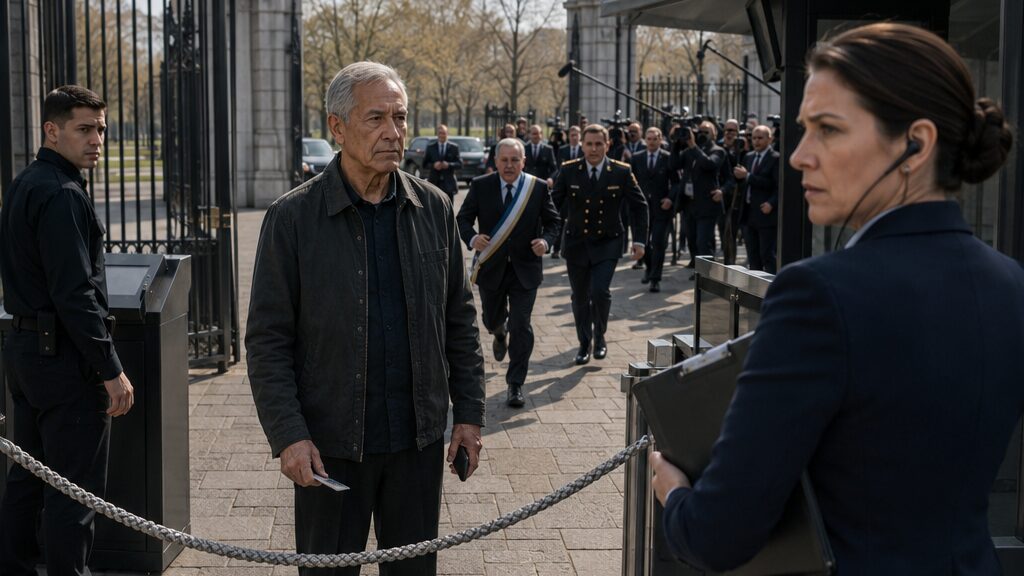
They Barred the Quiet Old Strategist From the Gate Built on His Own Rules
Chapter 1: The Man Who Did Not Match the Gate
“Stop. You’re ruining the aesthetic.”
The words reached Robert Hernandez just as the Mayor’s black vehicle turned beneath the steel archway.
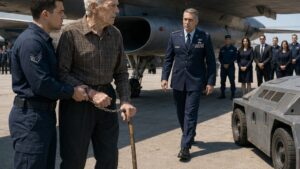
A red light swept across Robert’s faded field jacket. Beyond the checkpoint, camera operators pivoted toward the arriving convoy, their cables taped into perfect black lines along the pavement. White chairs faced a temporary pavilion draped in university blue. Officers in pressed uniforms stood behind polished barriers marked with silver placards.
Katherine Taylor stepped squarely into Robert’s path.
She wore an event headset, a fitted navy blazer, and the expression of someone holding twenty mistakes behind her teeth.
“You need to move away from the main entrance,” she said. “Now, please.”
Robert looked past her at the layered defenses: retractable bollards, inspection mirrors, armed guards, two vehicle lanes narrowing into one. A decorative rope had been stretched between chrome posts near the pedestrian gate. A small sign read DIAMOND TIER.
“I have an appointment,” he said.
His voice was low enough that Katherine leaned closer, then immediately appeared to regret doing so.
“With whom?”
“Patrick Campbell.”
“The Chancellor?”
“Yes.”
Katherine glanced at his plain slacks, worn shoes, and the weather-softened jacket whose cuffs had been repaired by hand. Her eyes rested on him for less than a second before moving to the cameras.
“The Chancellor is receiving officials,” she said. “You cannot arrive unannounced during a secured inspection.”
“I was invited.”
“Then you’ll be on the list.”
Robert reached into his jacket slowly. A gate guard shifted his weight but did not raise his hands. Robert withdrew a narrow leather case and opened it.
The credential inside had no hologram, no colored access stripe, and no current photograph. It bore the old seal of the university and a number stamped into the lower corner.
Matthew Brown, the younger guard at the pedestrian terminal, held out his hand.
“I can check it, sir.”
Katherine touched two fingers to her headset.
“Mayor’s vehicle entering Lane One. Press position hold. No movement behind the interview mark.”
Matthew carried the credential to his screen. Robert stood where Katherine had stopped him, feeling the gate’s shadow cut across his shoes.
A vehicle alarm chirped. One of the inspection arms rose before the previous sedan had fully cleared the secondary sensor.
Robert watched the next driver creep forward.
“You’re opening that arm too early,” he said.
Matthew looked up.
“What?”
“The second vehicle is entering the dead space before the first clears visual confirmation.”
The senior guard beside the lane turned toward the equipment. The raised arm lowered abruptly, stopping the second vehicle. A technician checked the monitor and gave a quick hand signal.
Matthew’s gaze sharpened.
Katherine’s did not.
“Sir, please don’t interfere with security operations.”
“I wasn’t interfering.”
“You were distracting personnel during an active arrival.”
Robert let the answer pass.
Matthew typed the credential number. The screen flashed, cleared, then returned a gray box.
NO ACTIVE RECORD.
He tried again.
“Number’s valid length,” he said. “But the system isn’t finding a current profile.”
Katherine gave a small, impatient breath.
“Because it’s obsolete.”
“The number is four digits,” Matthew said. “Our issued credentials are—”
“I know what our credentials look like.”
“This one may be archival.”
The Mayor’s vehicle stopped near the pavilion. A press aide raised three fingers. Katherine’s headset filled with overlapping voices, some audible even to Robert.
“Two minutes to live.”
“Donor group approaching east walkway.”
“Where is the Chancellor?”
Katherine pressed the earpiece harder.
“Matthew, return the card. We do not have time for an archival search.”
“He says the Chancellor is expecting him.”
“Everyone says someone is expecting them on inspection day.”
Robert accepted the credential when Matthew brought it back.
“Is there another entrance?” he asked.
Katherine’s expression softened for the first time, though not with kindness. It was the professional patience reserved for a problem she intended to remove.
“There’s a visitor holding point beyond the outer wall. Someone can speak with you after the official arrivals.”
“I was asked to be inside before the dedication.”
“By whom?”
“I told you.”
“No, you gave me a first name.”
Robert looked at her.
That seemed to unsettle Katherine more than anger would have. He did not straighten, raise his voice, or invoke age. He simply waited for her to decide whether a quiet answer deserved verification.
Behind her, assistants adjusted a banner by two inches. A uniformed officer brushed dust from a podium. The Mayor stepped from the vehicle, smiling before his shoes reached the ground.
Katherine moved closer to Robert.
“You cannot stand here dressed like this while the cameras are live.”
There it was.
Not the missing record. Not the old seal. Not security.
Robert slid the credential back into its case.
“Dressed like what?”
Katherine glanced toward the press line.
“This event has a controlled visual standard. You are in the primary background.”
“I’m standing at a gate.”
“A gate being filmed.”
She pointed toward a narrow space beside a concrete security wall, partially hidden behind a parked service vehicle.
“You can wait there.”
Robert followed her hand. The holding point had no chair, no shelter, and no sightline to the entrance. It was not where visitors were processed. It was where unwanted things were placed until the cameras left.
Matthew shifted beside the terminal.
“Ma’am, I can call the Chancellor’s security liaison.”
“No.”
“It would take a minute.”
“We don’t have a minute.”
Katherine unclipped a blank temporary slip from the desk and wrote VISITOR REVIEW across it. She handed it to Robert without meeting his eyes.
“Take this to the holding point.”
Robert did not accept it immediately.
A memory moved through him—not an image, only a voice from years earlier insisting that categories were useful until they became substitutes for thought.
He took the slip.
“Thank you,” he said.
Katherine’s relief came too quickly.
Robert walked toward the concrete wall. The vehicle barrier lowered behind him with a mechanical thud. Through the rails he saw the university grounds, the new tactical center’s glass frontage, and a covered plaque near its entrance.
He had spent the last three weeks telling himself he could attend, sit in the back, give Carol the notebook, and leave before anyone built a ceremony around him.
Patrick had offered a car and escort.
Robert had refused both.
He had said a university teaching operational judgment should be capable of admitting one old instructor without a procession.
Now he stood outside its gate wearing a visitor slip that proved nothing.
The leather notebook in his jacket pressed against his ribs. He pulled it out to check that the folded page inside had not slipped loose.
The cover was scarred, its corners rounded by years of field tables, aircraft floors, and briefing rooms. He opened it only far enough to see the first line written across the inside cover.
Matthew, returning from the terminal, caught sight of the handwriting.
He stopped.
Above every training-room door in the security wing, the same sentence had been printed in black block letters:
Before you classify the person, classify what you actually know.
Matthew looked from the words to Robert’s face.
“Sir,” he said quietly, “where did you get that?”
Chapter 2: The Old Credential and the Diamond Rope
Matthew kept his voice below the radio traffic.
“Where did you learn that sentence?”
Robert closed the notebook.
“From the man who wrote it.”
Matthew glanced toward Katherine. She was twenty yards away, positioning two donors behind the Diamond Tier rope while speaking into her headset.
“That line is in our manual.”
“I know.”
“It’s printed in every training room.”
“So I’ve heard.”
Matthew studied him with the uneasy concentration of a guard who had found a detail that did not fit the available categories.
“Did you teach here?”
“A long time ago.”
“Your credential number—was it issued when the university opened?”
Robert put the notebook back inside his jacket.
“You were right to check.”
“That isn’t an answer.”
“No. It’s an observation.”
Matthew looked at the terminal. The Mayor’s press detail was forming a half circle beyond the gate. A live camera pointed toward the pavilion, its red tally light not yet illuminated.
“I can contact the Chancellor’s office,” he said.
“You offered.”
“Katherine stopped me.”
Robert’s gaze moved to the decorative rope. The silver cord sagged slightly between its chrome posts, too ornamental to secure anything and too visible to misunderstand.
“What does Diamond Tier mean?” he asked.
Matthew’s mouth tightened.
“Donor access. Senior guests. Special sponsors.”
“Security classification?”
“No, sir.”
“Operational necessity?”
“No.”
“Then why is it controlling the entrance lane?”
Matthew looked toward Katherine again.
“Today, everything’s controlling everything.”
A voice burst from Katherine’s headset as she approached.
“Taylor, the Mayor’s press secretary says the north background is contaminated. We can still see a service cart and someone near the wall.”
Katherine turned instantly. Her eyes found Robert.
“I moved him out of the interview frame.”
“He’s still visible on the wide camera.”
“I’ll handle it.”
The line went dead.
For a moment, Katherine closed her eyes. When she opened them, the irritation had not vanished, but Robert saw the fear beneath it.
“Mr. Hernandez, you need to go beyond the exterior checkpoint.”
“Your guard is verifying my appointment.”
“No, he isn’t.”
Matthew stepped forward.
“Ma’am, his credential may be from the founding archive. The number is older than the current database, and he has material from our training manual.”
Katherine looked at the notebook-shaped outline beneath Robert’s jacket.
“Material?”
“He knew the first principle.”
“Anyone can read a sign.”
“It’s handwritten in his notebook.”
Katherine’s face changed. Not toward belief. Toward suspicion.
“Sir, may I see it?”
Robert shook his head.
“Why not?”
“Because it’s mine.”
“You’re carrying restricted instructional material at a secured military installation.”
“It was not restricted when it was written.”
Matthew’s eyes flicked toward him.
Katherine reached for the temporary visitor slip clipped loosely between Robert’s fingers.
“This is no longer valid.”
She took it before he could answer, folded it once, and placed it in her pocket.
Robert looked at the empty space in his hand.
“You issued that less than five minutes ago.”
“I issued it before you began using internal phrases to influence a guard.”
“I answered his question.”
“You’re creating confusion during a live security event.”
Robert’s voice remained level.
“Confusion is not the same as contradiction.”
Matthew inhaled sharply. He knew that sentence too.
Katherine heard the reaction.
“This is exactly what I mean,” she said. “You are trying to establish authority you cannot document.”
Robert could have told her.
He could have given his full position, the founding year, the office Patrick still kept for him despite twelve years of absence. He could have named the men whose signatures appeared beneath his on the university charter. He could have asked Matthew to open the first edition of the manual and compare the author photograph.
Instead, he felt the old resistance rise in him.
He had spent too many years watching rank used to end questions rather than improve them. If his name was the only thing that made their judgment work, then the judgment had already failed.
“Patrick told me to come before the dedication,” he said. “He offered an escort. I declined it.”
Katherine stared at him.
“You declined a secured escort to a fortified installation during a VIP inspection?”
“Yes.”
“Why?”
“Because I wanted to arrive as myself.”
She looked again at his jacket.
“And this is how you chose to present yourself?”
Robert’s face did not move, but Matthew looked away.
Katherine’s headset crackled.
“Taylor, confirm the north background is clear. This is your final warning.”
Her shoulders stiffened.
Robert saw the exact moment the event became more important to her than the truth in front of her.
Katherine pressed the transmitter.
“North background will be clear in thirty seconds.”
She released it.
“Mr. Hernandez, I nearly lost this contract last year because an unauthorized family member entered a memorial shot. I was told this morning that one unscripted visual mistake would end my work here. I have the Mayor, the board, senior command, and twelve donors arriving through one gate. I cannot reorganize security because an unknown man carries an old card and knows a sentence from a wall.”
“That sounds difficult,” Robert said.
The sympathy made her angrier.
“You think I’m being unreasonable.”
“I think your pressure is real.”
“And?”
“And pressure reveals which rules you actually trust.”
Matthew lowered his eyes.
Katherine stepped closer.
“Do not lecture me at my own checkpoint.”
“It isn’t your checkpoint,” Matthew said before he could stop himself.
Silence fell among the three of them.
Katherine turned slowly.
“What did you say?”
Matthew’s face flushed.
“I mean operational control remains with security.”
“And temporary event access was delegated to me by General Miller’s office. You know that.”
“Yes, ma’am.”
“Then perform your assignment.”
Matthew looked at Robert.
Robert gave him no rescue.
Instead he said, “You noticed something that didn’t fit. What comes next?”
“Verification,” Matthew answered.
“Then verify it.”
Katherine removed her phone from her blazer pocket and checked the countdown displayed on the event schedule.
“Not now.”
Matthew did not move.
“Guard.”
His posture straightened automatically.
“Clear the lane.”
The training in his body defeated the question in his mind. He stepped aside.
Robert felt disappointment settle deeper than the insult. Matthew had seen the contradiction. He had named the correct action. Then hierarchy had closed over him like the steel arm across the vehicle lane.
A cluster of donors approached, badges flashing silver against tailored jackets. Katherine unhooked the Diamond Tier rope and smiled them through.
One man glanced at Robert.
“Is this line open?”
“It is for your group,” Katherine said.
The rope clicked back into place after they passed.
Robert looked toward the tactical center. Beneath the covered plaque, two empty chairs waited in the front row. One was meant for him. The other, Patrick had said, would be held for Carol.
He checked his watch.
Carol’s car would arrive soon.
He had promised himself she would not have to see her father’s work turned into a footnote again.
Yet he had not even crossed the gate.
“Mr. Hernandez,” Katherine said, loud enough for the nearby officers and press assistants to hear, “this area is for Diamond Tier members and VIPs only. Please step aside.”
Several faces turned.
Robert stood on the wrong side of a silver rope that could not stop a child.
He looked at Matthew, then at Katherine.
For years, he had answered disappointment by leaving before anyone could turn it into spectacle.
The outer road lay behind him.
The gate lay ahead.
For the first time that morning, walking away felt less like dignity than surrender.
Chapter 3: The Call That Emptied the Pavilion
“The university has standards,” Katherine said.
Robert reached into his jacket.
Matthew’s attention snapped to his hand. Katherine took half a step back, then saw the plain black phone and exhaled through her nose.
“Calling security will not change the access list.”
“I’m not calling security.”
Robert selected a number he had avoided using for almost a year.
Inside the pavilion, applause rose as the Mayor approached the interview mark. An assistant counted down with her fingers. Three. Two.
Patrick Campbell’s voice came through the phone.
“Robert?”
The relief in it was immediate.
Robert watched the vehicle barrier lower again.
“Patrick? It’s me. I’m in your lobby, but your front desk says I don’t meet the dress code.”
There was a silence.
Not confusion. Recognition.
“Where are you?”
“At the main gate.”
“Stay there.”
The line ended.
Robert put the phone away.
Katherine stared at him.
“You called the Chancellor directly?”
“Yes.”
“You expect me to believe that?”
“No.”
The camera’s red light came on.
Inside the pavilion, the Mayor began speaking about partnership, discipline, and public trust. Patrick stood just beyond the interview frame, waiting to be introduced.
An aide hurried to him and whispered.
Patrick’s face emptied.
He stepped into the camera shot.
The Mayor paused mid-sentence.
Patrick said something Robert could not hear, then walked away from the podium at a pace that became a run before he reached the pavilion steps.
The press detail reacted as one organism. Heads turned. Camera operators swung their lenses. The Mayor looked toward the gate, exchanged a startled glance with an aide, and followed.
General Joseph Miller came out behind them.
At first Katherine appeared relieved.
“There must be an incident.”
Matthew did not answer.
Patrick crossed the inner road without waiting for the marked pedestrian route. His academic robe, worn for the dedication, snapped behind him. Joseph removed his cap as he came. Senior administrators spilled from the pavilion in their wake, followed by the Mayor’s press secretary, two camera crews, and enough officers to make the gate guards straighten as if pulled by wires.
Katherine touched her headset.
“What’s happening?”
No one answered.
The procession was not spreading toward the vehicle lanes or the control room.
It was coming directly toward Robert.
Katherine turned to him.
He could see the calculation in her eyes trying to rebuild the world fast enough to survive what was approaching.
“Who are you?”
Robert looked at the covered tactical center plaque beyond the gate.
“That’s what you were trying to verify.”
Patrick reached them first, breathing hard.
“Robert.”
He stopped an arm’s length away, as though unsure whether an embrace would be welcomed. Robert spared him the decision.
“You’re late,” Robert said.
Patrick almost laughed, but shame caught the sound.
“You were supposed to call when you arrived.”
“I did.”
“I meant before this.”
“You offered an escort.”
“And you refused it.”
“Yes.”
Patrick looked at the rope, the blank space where Robert’s temporary slip had been, and Katherine’s hand still pressed to her headset.
“What happened?”
Katherine stepped forward.
“Chancellor Campbell, this individual was not on the active list. His credential did not validate, and he declined to provide verifiable identification. We are in the middle of a secured—”
“This individual?”
Patrick’s voice was quiet.
Katherine stopped.
The Mayor arrived with his press detail. The nearest camera lifted. Robert saw himself reflected in the lens: faded jacket, old shoes, no badge.
Joseph reached the group and took in the scene more slowly than Patrick had. His eyes found Robert, and the command reserve left his face.
“Sir.”
Robert nodded once.
Joseph turned to Matthew.
“Why is Mr. Hernandez outside the checkpoint?”
Matthew swallowed.
“His credential returned no active record, General. I requested archival verification.”
“And?”
“I was instructed to clear the lane.”
Joseph looked at Katherine.
She straightened.
“I was operating under the event access authority delegated by your office.”
“You were delegated coordination.”
“And told to prevent unverified individuals from entering the VIP background.”
Robert watched Joseph’s jaw set. The General wanted a clean fault line. Katherine had offered him one, but it ran back toward his own command.
Patrick stepped to the terminal and held out his hand.
“Robert’s credential.”
Robert gave him the leather case.
Patrick opened it. His thumb rested on the stamped number.
“Fourteen,” he said.
The Mayor leaned closer.
“What does that mean?”
“It means the credential predates almost every building on this installation.”
Patrick handed it to Matthew.
“This number is not inactive. It is in the founding archive.”
Matthew looked down at the card as if its weight had changed.
Katherine’s face had gone pale, but she tried once more.
“He did not identify himself.”
“I gave you my name,” Robert said.
“Hernandez is not an uncommon name.”
“No.”
“You said you knew the Chancellor.”
“I do.”
“Anyone could say that.”
“Yes.”
Her voice thinned.
“Then how was I supposed to know?”
Robert did not answer.
That question was larger than she intended, and he was not prepared to let her escape it by making the answer his fame.
Joseph stepped beside the terminal.
“You were supposed to know by following the verification process when evidence contradicted your assumption.”
Katherine looked at Matthew.
“He had no active record.”
“He had an archival credential,” Matthew said, more firmly now. “And knowledge of restricted training language.”
“I was protecting the event.”
Joseph’s gaze hardened.
“You just denied entry to the man who wrote the tactical manual you were trained on.”
The words moved through the gate faster than any shouted command.
Officers turned fully toward Robert. One of the camera operators lowered his equipment for a second, then raised it again. The Mayor’s expression shifted from alarm to recognition. Patrick closed his eyes briefly.
Katherine looked at Robert as though the faded jacket had become a disguise designed to trap her.
“I didn’t know,” she said.
Robert looked past her at the gate, now standing open.
The security arm was raised. The Diamond Tier rope had been unhooked. Patrick moved aside to create a clear path, and the senior officers did the same.
Robert could cross now.
Every barrier that had resisted his card and his voice had opened at the sound of his title.
He did not move.
Joseph noticed first.
“Sir?”
Robert withdrew the weathered notebook.
The cameras followed the motion.
He ran one thumb along the damaged edge of its cover. Inside were two hands, not one—his own compact annotations and the slanting script of the man whose name would appear in smaller letters on the plaque beyond the gate.
Joseph had called Robert the author.
Patrick had allowed the same simplification to anchor an entire dedication.
Robert looked at them both.
“Not alone, I didn’t.”
Chapter 4: The Name Missing From the Manual
Patrick unhooked the silver rope himself.
“Come inside, Robert.”
The gate stood open. Officers had cleared a path. Beyond them, the glass front of the tactical center reflected the crowd that had abandoned the pavilion to gather around one man in a faded jacket.
Robert remained where Katherine had stopped him.
Patrick’s hand stayed on the rope.
“We can discuss everything privately,” he said.
“You were already discussing it privately.”
Patrick’s eyes moved toward the cameras.
The Mayor’s press detail had formed a loose perimeter, but no one had ordered the lenses down. Katherine stood beside the checkpoint terminal with her arms held rigidly at her sides. Matthew still carried Robert’s old credential between both hands.
Joseph stepped closer.
“Sir, the dedication is due to begin.”
“That appears to be the problem.”
Robert opened the weathered notebook.
The first pages carried his compact handwriting: dates, diagrams, corrections compressed into margins. Farther in, a second hand appeared. The letters leaned forward, impatient and dark, sometimes crossing out whole paragraphs before replacing them with five words.
Robert turned the book toward Joseph.
“Read that.”
Joseph looked down.
“Classification is a tool,” he read. “Not permission to stop thinking.”
“Whose handwriting?”
Joseph’s brow tightened. He had seen the sentence in printed editions, though not the page from which it came.
“I assumed yours.”
“So did everyone else.”
Patrick’s face changed before Joseph’s did.
“Robert,” he said carefully, “not here.”
Robert closed the notebook.
“Why not here? The lesson happened here.”
The Mayor stepped away from his press secretary. “Chancellor, perhaps we should suspend the interview.”
Patrick nodded without looking at him.
Joseph ordered the gate returned to normal operations. The crowd was moved back, the cameras asked to hold position, and Robert was escorted—not through the VIP lane, but into the small security room beside the checkpoint.
He crossed the threshold only because the room belonged to the gate.
Inside, monitors displayed each entrance angle. A printed copy of the university’s tactical manual sat beneath a bank of radios. Its cover bore Robert’s name in large letters.
Patrick shut the door.
Katherine remained outside until Robert noticed.
“She comes in.”
Joseph hesitated.
“She is part of the incident,” Robert said. “Unless you intend to decide what happened without the person who made the decision.”
Joseph opened the door.
Katherine entered without her headset. Without the constant voices in her ear, she seemed smaller, though not less guarded. Matthew followed and stood near the terminal.
Patrick drew a chair out for Robert.
Robert did not sit.
“Where is the dedication plaque?” he asked.
“At the tactical center,” Patrick said.
“What does it say?”
Patrick looked toward the glass.
“Robert—”
“Read it.”
Patrick’s jaw tightened. He removed a folded program from inside his robe. The dedication text had been printed on the back.
“The Robert Hernandez Center for Applied Tactical Judgment,” he read. “‘Established in honor of the strategist whose doctrine transformed modern operational decision-making.’”
“And the acknowledgment?”
Patrick’s gaze remained on the paper.
“‘With appreciation for the early contributions of colleagues and field instructors.’”
Robert waited.
“That’s all?” Carol’s father had a name, but Patrick did not speak it because it did not appear.
Joseph looked from the program to the notebook.
Robert opened to a page marked by a strip of faded cloth. Two columns ran down it. On the left were his diagrams for checkpoint sequencing. On the right, the other handwriting cut through them.
You keep designing for the person who fits the expected threat. What happens when the truth arrives looking harmless?
Below it, Robert had written:
Then judgment must precede category.
Joseph’s eyes stopped on the exchange.
“This is the foundation of Chapter Two,” he said.
“Yes.”
“Who wrote the question?”
Robert ran his thumb across the edge of the cloth marker.
“Carol Martinez’s father.”
The room held only the hum of the monitor fans.
“He was not an ‘early contributor,’” Robert continued. “He argued with every system I built until it accounted for the human being standing in front of it. Half the principles you attribute to me began as his objections.”
Patrick folded the program.
“We discussed shared attribution.”
“We discussed it until I stopped answering your calls.”
“That was not consent.”
“No,” Robert said. “It was silence. You found it convenient.”
Patrick looked toward the closed door. Outside, the Mayor and the press waited for him to restore order.
“The center required funding,” he said. “Your name secured it. Donors knew your work. They did not know every instructor who shaped it.”
“He wasn’t every instructor.”
“I know that.”
“Does the plaque?”
Patrick’s voice lowered.
“The agreement was already signed when you objected.”
“And who signed it?”
Patrick did not answer.
Robert knew.
The Chancellor had inherited the university’s debts, aging facilities, and political demands. He had kept programs alive by learning how to package history into names officials recognized. He had also studied under Robert long enough to know exactly what had been lost in that packaging.
Joseph lifted the printed manual from the desk and placed it beside the open notebook.
The published sentence appeared in bold type beneath Robert’s name. The question that had produced it was nowhere.
Matthew stared at the two pages.
“That’s what I recognized,” he said. “The writing inside the cover.”
Robert nodded.
Katherine’s eyes moved from the notebook to the manual.
“So the rule I broke was written by the man the ceremony barely mentions.”
“You did not break a sentence,” Robert said. “You stopped asking what you actually knew.”
Her mouth tightened.
“I knew he wasn’t on the list.”
“You knew the current system could not find an archival credential.”
“I knew he didn’t follow the arrival process.”
“You knew I had been given no access to that process,” Robert said.
Katherine looked at him, surprised by the change in pronoun.
Patrick interrupted.
“We will correct the acknowledgment.”
“When?”
“After today. Properly. With Carol’s approval.”
Robert looked at the covered plaque on one of the monitors.
“Carol is due here now.”
Patrick checked his phone.
A message appeared before he could answer. His expression told Robert who had arrived.
Joseph saw it too.
“I can meet her at the secondary entrance.”
“No,” Robert said. “She comes through this gate.”
Patrick opened the security-room door.
Carol Martinez stood beyond the checkpoint beside a waiting vehicle, holding an invitation in one hand. She was watching the officials clustered around the gate, the abandoned press position, and Robert’s faded jacket visible through the doorway.
Her gaze settled on the notebook.
Then on Patrick’s folded program.
She entered without waiting to be invited.
“Is that the plaque text?” she asked.
Patrick held the paper at his side.
Carol looked at Robert.
“You told me you were coming to make sure they got it right.”
“I came.”
“That isn’t what I asked.”
Robert felt the old instinct to retreat into precision. To explain that he had objected, that Patrick had promised revisions, that the final language had not been sent to him.
Carol stepped closer.
“Did you know they were putting your name over the door?”
“Yes.”
“Did you know what they were doing with my father’s?”
Robert looked down at the two sets of handwriting.
“I knew enough to object,” he said. “I chose not to come.”
Chapter 5: What Robert’s Silence Allowed Them to Build
Carol did not raise her voice.
“That sounds cleaner than it was.”
The words struck harder for being quiet.
Patrick moved the group into a briefing room above the gate. Its glass wall overlooked the lanes below, where vehicles were again being screened and waved through. From that height, the people at the checkpoint looked small enough to fit inside categories.
Carol remained standing near the door. Robert placed the notebook on the long table between them.
“I wrote to Patrick,” he said.
“You wrote one letter.”
“Three.”
“You stopped answering after the third.”
Patrick removed his ceremonial robe and laid it over a chair. Without it, he looked less like the Chancellor and more like the former student who had once brought Robert draft doctrine at midnight.
“We continued asking for his involvement,” Patrick said.
Carol turned on him.
“And when he withdrew, you used that as permission.”
Patrick accepted the blow.
“We were trying to keep the project alive.”
“With my father’s work reduced to ‘colleagues.’”
“The original donor proposal named both men.”
“What changed?”
Patrick looked at Robert, then at the Mayor waiting outside with Joseph.
“Recognition studies,” he said. “Funding consultants. They argued that Robert’s name carried national value. A dual dedication tested poorly with donors unfamiliar with your father.”
Carol gave a short, disbelieving breath.
“So you market-tested memory.”
“No. We tried to secure a center that would preserve the doctrine.”
“You preserved the name that sold.”
Patrick leaned both hands on the table.
“The university was facing program cuts. This center funded new training, archival restoration, and scholarships. I made a compromise.”
“You made it with someone else’s contribution.”
Robert watched Carol’s fingers curl around the back of a chair.
Her father had spent his career refusing credit when there was work left to do. That modesty had made him easy to praise vaguely and erase specifically. Robert had once promised that would not happen.
After the funeral, the notebook had stayed locked in Robert’s desk for six years.
When Patrick first proposed the center, Robert sent corrections. Then more corrections. Each new draft placed his own name higher and his colleague’s lower. He had begun returning envelopes unopened.
At the time, refusal had felt principled.
Now the building stood beyond the glass.
His silence had not prevented the distortion. It had removed the last obstacle to it.
Carol touched the notebook but did not open it.
“Why didn’t you give me this before?”
“I thought the archive should receive it.”
“That isn’t what I asked.”
Robert looked at her.
Because your father’s handwriting still sounded alive.
The answer remained behind his teeth.
“I wasn’t ready,” he said.
Carol nodded once, without mercy.
“That is at least true.”
A knock interrupted them. Joseph entered with Katherine and Matthew.
Katherine no longer wore the navy event blazer. She had folded it over one arm, leaving the plain white blouse beneath. A laminated schedule hung from her neck, its margins crowded with handwritten changes.
Joseph closed the door.
“Ms. Taylor’s contract has been suspended pending review.”
“No,” Robert said.
Katherine looked at him sharply.
Joseph’s posture stiffened.
“Sir, she exceeded her authority and interfered with security verification.”
“Yes.”
“Then suspension is appropriate.”
“Perhaps. But if you decide before examining who built the conditions, you are doing the same thing she did.”
Joseph’s face cooled.
“My office did not instruct her to judge clothing.”
“No,” Katherine said. “You instructed me to keep all uncredentialed people out of the VIP background. The Chancellor’s team gave me donor tiers. The press office changed the Mayor’s entrance twice. Security gave me one lane, then reclaimed half of it. And this morning I was told that one more visual mistake would end my contract.”
Her voice shook once, and she stopped it.
Joseph said, “None of that required what you said to Mr. Hernandez.”
“No.”
The admission silenced him.
Katherine placed the schedule on the table.
“I could have called the liaison. Matthew asked me to. I chose not to because Mr. Hernandez did not look like anyone the Chancellor would be waiting for.”
Robert watched her.
She did not soften it or ask to be forgiven.
“I decided the answer before verification,” she said. “The pressure made the decision urgent. It did not make it correct.”
Matthew looked down.
Joseph turned toward him.
“You identified an anomaly.”
“Yes, General.”
“And allowed a civilian coordinator to prevent verification.”
“She had delegated access control.”
“You are security.”
“Yes, General.”
Matthew’s face flushed, but he did not hide behind Katherine.
“I knew the next step. I didn’t take it.”
Robert looked through the glass at the checkpoint. The decorative rope had been restored. A donor showed a silver badge and was passed through without opening his bag.
“There,” Robert said.
Everyone followed his gaze.
The guard at the lane waved the donor onward while another visitor at the ordinary entrance emptied her pockets into a tray.
Joseph frowned.
“That is event protocol.”
“It is category replacing judgment.”
“The donor was pre-cleared.”
“Was his bag?”
Joseph said nothing.
Patrick’s phone vibrated repeatedly on the table. He turned it face down.
“The Mayor is waiting,” he said. “The broadcast window closes in eighteen minutes. We can postpone the plaque unveiling and issue a correction after a formal review.”
“Then the same people who built this will investigate themselves after the cameras leave,” Carol said.
Patrick looked wounded.
“That is not fair.”
“No,” she replied. “It is familiar.”
Robert opened the notebook to the page Joseph had read downstairs.
His colleague’s slanted handwriting crossed the center:
A system reveals its priorities when two rules collide.
Below it, Robert had added years later:
The person in authority chooses which rule survives.
He had taught that line hundreds of times. He had not applied it when grief collided with responsibility.
Patrick saw where he was looking.
“What are you asking me to do?”
Robert closed the notebook.
“Stop the ceremony.”
Patrick’s face hardened.
“The center has donors, elected officials, and national press waiting. Halting it publicly could jeopardize commitments that took years to secure.”
“Then we know which rule survives.”
“That is easy for you to say. You don’t run this institution.”
“No. I left you to do it while criticizing the result from a distance.”
The admission shifted the room.
Carol’s eyes lifted.
Robert continued before pride could close his throat.
“I refused the escort because I wanted to prove the university could recognize judgment without recognizing me. That was not humility. It was a test no one knew they were taking.”
Patrick’s anger faltered.
“I could have updated the credential. I could have answered your calls. I could have stood beside Carol before today and told the donors whose work they were buying. I did none of those things.”
Katherine looked at him with something other than fear now.
Robert picked up the printed event schedule.
“What happened at the gate was not one person failing one famous man. Your command delegated judgment to optics. Your office ranked access by donation. I hid behind silence. She chose appearance over evidence. Matthew saw the contradiction and obeyed anyway.”
Joseph’s jaw worked.
“You want a public inquiry during the dedication?”
“No.”
“What, then?”
Robert turned the schedule over and drew one line through the printed entrance sequence.
“We begin the inspection again.”
Patrick stared at him.
“From where?”
Robert pointed through the glass at the outer checkpoint.
“The gate.”
The Mayor’s press secretary opened the door without knocking.
“Chancellor, we need a decision now. We are live in twelve minutes.”
Patrick looked at the tactical center, the waiting officials, and the covered plaque carrying the name that had secured everything.
Robert held his gaze.
“I will attend,” he said, “only if the entire inspection restarts outside that rope.”
Chapter 6: The Inspection Began Again Outside the Rope
Robert walked away from the open VIP lane.
The officials behind him did not understand at first. Patrick had agreed to suspend the prepared dedication, but everyone assumed Robert would enter the tactical center while revised remarks were arranged.
Instead, he passed through the gate in the wrong direction.
Matthew hurried after him.
“Sir, where are you going?”
“To arrive.”
Robert stepped beyond the outer checkpoint and stopped on the public side of the steel barrier. The same red scanner passed over his faded jacket. The same cameras turned to follow.
Joseph joined the gate commander at the terminal.
“Reset the pedestrian station,” he ordered. “Standard unknown-visitor procedure.”
The commander glanced at the Mayor, the Chancellor, and the press.
“General?”
“You heard me.”
Katherine stood several yards away holding her folded blazer. Robert looked at her.
“You were responsible for arrival coordination.”
“Was.”
“You know the sequence.”
She hesitated, then approached the station.
The Diamond Tier rope still divided the walkway.
Robert pointed to it.
“Does that barrier serve security?”
“No.”
“Remove it.”
Katherine unclipped the silver cord. For a moment she held it in both hands, the symbol of an entire morning reduced to braided fabric. Then she coiled it and set it beneath the desk.
The lanes became visually equal.
Robert approached Matthew.
“Good morning,” he said.
Matthew understood.
“Identification, sir.”
Robert gave him the leather case.
Matthew opened it and read the name without reacting to it.
“Purpose of visit?”
“Dedication ceremony. Appointment with Chancellor Patrick Campbell.”
“Are you listed?”
“I don’t know.”
Matthew entered the credential number. The same gray box appeared.
NO ACTIVE RECORD.
The press shifted closer.
Robert waited.
Matthew looked at the card, then at the screen. His hand hovered over the event liaison number.
“What do you actually know?” Robert asked.
Matthew answered carefully.
“The credential format is obsolete but physically consistent with early university issue. The number falls outside the active database. The bearer knows internal doctrine and claims a direct appointment.”
“What do you not know?”
“Whether the credential is authentic and whether the appointment is current.”
“What follows?”
“Verification through an independent channel.”
Matthew picked up the secure phone.
Katherine watched his movements. “The event liaison won’t have archival access.”
Matthew paused.
That was the point where he had yielded before.
He checked the procedural directory attached beneath the terminal.
“Founding records office,” he said.
The listed extension rang twice.
While he waited, a donor vehicle approached the inner lane. A guard moved to lift the barrier at the sight of its silver pass.
Joseph raised one hand.
“Full inspection.”
The donor lowered the window, confused.
“But we’re Diamond Tier.”
“Today you’re a vehicle entering a military installation,” Joseph said.
The inspection mirror went beneath the chassis.
At the pedestrian desk, Matthew gave the archive clerk Robert’s credential number. He listened, asked for a secondary identifier, then turned to Robert.
“Year of issue?”
Robert told him.
“Original sponsoring office?”
“Founding Command Group.”
Matthew repeated it into the phone.
A printer beneath the terminal shuddered. One sheet emerged, bearing an archival photograph of Robert at forty-one, his hair dark, his expression no more patient than it was now.
Matthew compared the faces.
“Identity confirmed,” he said.
The archive record continued printing.
FOUNDING FACULTY.
PERMANENT HONORARY ACCESS.
MANUAL AUTHORSHIP FILE ATTACHED.
Matthew did not look toward Patrick for permission.
He entered the confirmation code and printed a temporary badge.
“Appointment still requires verification,” he said.
Patrick stepped forward.
“I confirm it.”
Robert shook his head.
“You are standing at the gate because of the dispute.”
Patrick stopped.
Matthew called the Chancellor’s office instead. An administrator inside answered and confirmed Robert’s scheduled attendance from the official calendar.
Only then did Matthew place the badge on the desk.
“Mr. Hernandez, you are cleared to enter.”
Robert took it.
“What changed?”
Matthew glanced at the cameras and then forced himself to look only at Robert.
“The evidence didn’t change. I followed it farther.”
Robert nodded.
“That is the inspection.”
A reporter called out, “Mr. Hernandez, was this a publicity demonstration?”
“No.”
“Do you believe the university discriminated against you?”
Robert looked toward Katherine.
She stood beside the absent rope, neither protected nor condemned by it.
“I believe several people made choices under pressure,” he said. “Some choices were worse than others. The point of training is to know which pressure does not excuse which failure.”
Another reporter asked whether Katherine should be dismissed.
Robert did not answer for her.
Katherine stepped toward the microphones.
“I was given conflicting instructions,” she said. “I was not instructed to judge his clothing. That was my decision.”
The bluntness quieted the questions.
Joseph came beside her.
“My command approved an event plan that gave donor classifications operational influence at a secured entrance. That was ours.”
Patrick followed.
“And my office built the event around prestige categories because we believed they would protect funding and presentation. They did neither.”
The Mayor’s press secretary whispered urgently to him, but the Mayor waved her back.
Patrick faced the cameras.
“The dedication will not proceed as scripted.”
A murmur moved through the donors.
One of them stepped forward.
“Chancellor, commitments were made around this center and its naming.”
Patrick’s face tightened.
Robert watched him choose.
“The commitments were made to an institution that teaches judgment,” Patrick said. “If correcting our record threatens them, then the record matters more.”
Carol stood at the edge of the press group. She did not smile, but some guarded tension left her shoulders.
Joseph ordered the inspection restarted across all lanes. Bags were checked by procedure rather than badge color. Visitor claims were verified without regard to clothing. Event staff were moved away from security decisions. The Mayor waited in the ordinary pedestrian line and emptied his pockets into a tray.
The image would lead every report, Robert knew.
He disliked that it pleased the cameras.
But dislike was no longer enough reason to disappear.
They moved at last toward the tactical center.
The Diamond Tier rope remained under the desk.
At the entrance, the covered plaque waited beneath blue cloth. Rows of guests had been turned to face it. No music played. No one had been told whether there would still be a ceremony.
Patrick approached Robert.
“We can postpone until a new plaque is made.”
“No.”
“Then what do you want them to see?”
Robert opened the notebook.
He removed the faded strip of cloth marking the shared page and handed the book to Carol. She held it against her chest, startled by its weight.
Then Robert walked to the plaque.
He pulled away the blue covering.
His own name appeared above the doors in letters large enough to be read from the gate.
Below it, the dedication credited unnamed colleagues.
Robert took the notebook back from Carol and opened it to her father’s slanting question.
He placed it across the engraved words ROBERT HERNANDEZ.
The old pages covered his name but left the smaller acknowledgment visible beneath.
The cameras clicked.
Patrick stood beside him, pale but steady.
Robert looked at the waiting audience.
“The building is not the correction,” he said.
Then he rested one hand on the notebook containing two men’s work.
“The truth is.”
Chapter 7: The Gate Opened Only After the Truth
Robert removed the prepared speech from the lectern and laid it facedown.
A university seal gleamed at the top of the first page. Beneath it, Patrick’s staff had written remarks about legacy, vision, and one man’s extraordinary contribution. Robert had not read past the opening paragraph.
The audience waited.
Behind him, the weathered notebook still rested across his engraved name. Its pages shifted in the breeze from the open doors, exposing first his compact handwriting, then the slanted corrections beside it.
Patrick stood near the plaque without his ceremonial robe. Joseph had taken his place among the officers rather than on the platform. Katherine remained at the edge of the gathering, holding the coiled Diamond Tier rope against her folded blazer. Matthew stood at the entrance checkpoint, where he could hear Robert but still see the gate.
Carol was in the front row.
Robert placed both hands on the sides of the lectern.
“This center was supposed to honor a doctrine,” he said. “Instead, we built it around a name.”
No applause followed. He had asked for none.
“The name above the door is mine. The judgment inside the doctrine was never mine alone.”
He turned toward the open notebook.
“Carol’s father and I disagreed for most of our working lives. I designed systems. He asked who those systems would fail. I classified threats. He asked what our categories made us stop seeing.”
Carol watched him without blinking.
Robert’s gaze moved toward the gate visible through the glass frontage.
“This morning, the university followed a list, recognized a donor badge, rejected an archival credential, and moved an inconvenient person away from a camera. Every individual action could be explained. Together, they exposed what the institution had chosen to value.”
Patrick lowered his eyes.
Robert continued.
“The easiest version of this story is that an event planner insulted a famous man and powerful people arrived to correct her. That version would be satisfying. It would also be false.”
Katherine’s fingers tightened around the silver rope.
“She made a harmful judgment,” Robert said. “She has admitted it. Matthew recognized a contradiction and did not act on it. General Miller’s command allowed presentation categories to influence security procedure. Chancellor Campbell’s office built the day around names that attracted attention and money.”
He paused.
“And I allowed all of it to grow around my silence.”
Carol’s expression shifted, but only slightly.
Robert looked directly at her.
“I knew the dedication language was wrong. I objected from a distance, then stopped answering when the answers became difficult. I told myself refusing the ceremony protected the truth from spectacle.”
The notebook page lifted and fell.
“What it protected was me.”
The confession seemed to change the size of the room. The tactical center no longer felt like a monument awaiting praise. It felt like a place under examination.
Robert left the lectern and lifted the notebook from the plaque.
He carried it to Carol.
“Your father wrote the question that became the center of the manual,” he said. “I turned it into procedure. He kept turning procedure back toward people.”
Carol did not reach for the book.
“You promised he wouldn’t disappear behind your name.”
“I did.”
“And then you disappeared too.”
“Yes.”
“Leaving Patrick to use whichever name worked.”
“Yes.”
Robert held the notebook between them.
“I am sorry.”
Carol’s eyes moved to the worn cover. “Sorry does not restore the years.”
“No.”
“It does not fix every edition with your name above his work.”
“No.”
“It does not make this building honest because you admitted it in front of cameras.”
“No.”
Her hand finally closed around the notebook.
“But it is the first time you have said what you did without calling it grief.”
Robert released it.
Carol opened to the marked page. Her thumb rested beside her father’s handwriting, not on it.
Patrick stepped toward them.
“The center will be renamed,” he said. “Both names, equal size. The digital manuals can be corrected immediately. Printed editions will carry a formal authorship statement and the original working pages will be archived with Carol’s approval.”
Carol looked at him.
“Not appreciation for contributions.”
“No.”
“Authorship.”
“Yes.”
Patrick glanced at Robert.
“And the university will review how we turned your objections into silence we could use.”
Robert nodded once.
Joseph moved forward next.
“Beginning with the next training cycle, inspections will include unknown-visitor scenarios,” he said. “No staged VIP sequence. No advance indication of which arrival matters.”
Matthew looked toward him.
Joseph added, “Personnel will be evaluated not only on whether they notice a contradiction, but whether they pursue the authorized verification path when someone above them prefers convenience.”
Katherine set the coiled rope on an empty chair.
“My contract review should continue,” she said. “I made the choice I made.”
Patrick studied her.
“It will continue.”
She accepted that without protest.
“But,” he said, “you will be asked to participate in redesigning the event-access process. Not as punishment. Not as absolution. Because you know where the pressures accumulate.”
Katherine looked toward Robert.
He gave no reassuring smile. She did not need one.
“I’ll do it,” she said.
The Mayor’s press detail remained along the wall, cameras lowered but not gone. One reporter began to raise a hand.
Robert stepped away from the lectern.
“The dedication is finished.”
There was scattered movement in the audience, the beginning of the applause people offered when unsure what else to do.
Robert lifted one hand.
The sound stopped before it fully formed.
He looked at Carol.
“May I show you where we argued over the first checkpoint model?”
She closed the notebook.
“After you tell me why you kept this from me for six years.”
Robert felt the old barrier rise—the instinct to protect the rawest part by replacing it with useful facts.
This time he did not step behind it.
“Because when I read his handwriting,” he said, “I could still hear him correcting me. I was afraid that giving the book away would make the silence final.”
Carol held his gaze.
“Then you should have told me.”
“Yes.”
She did not forgive him. She walked beside him into the training hall anyway.
Later, after the officials had left and the cameras had been packed into their cases, Robert returned alone to the main gate.
The blue coverings were gone. The Diamond Tier sign had been removed. The chrome posts stood against the security wall waiting to be taken away.
Matthew was at the pedestrian station.
Robert approached without wearing the temporary badge.
Matthew looked up.
“Good afternoon, sir.”
Robert placed no credential on the desk.
“I’m here to visit the tactical center.”
“Name?”
“Robert Hernandez.”
“Appointment?”
“None.”
Matthew did not smile or salute.
“Identification, please.”
Robert handed him the old leather case.
Matthew inspected the credential, checked the archival procedure, and called the center to confirm whether unscheduled visitors were being accepted. He asked Robert to wait on the ordinary side of the barrier while he verified the answer.
Robert waited.
A delivery driver arrived behind him with a clipboard. Matthew acknowledged him, finished Robert’s verification, then processed the driver with the same attention.
At last the gate arm rose.
“You’re cleared to enter, Mr. Hernandez.”
Robert accepted the credential.
No Chancellor ran from a pavilion. No General announced his name. No camera recorded the moment.
Matthew opened the pedestrian gate.
Robert looked through it at the path beyond, then back at the young guard.
“What changed?”
Matthew considered the question before answering.
“I stopped deciding which visitor mattered before I knew who was standing in front of me.”
Robert stepped across the threshold.
Behind him, the gate closed with the same mechanical thud as before.
This time, it had opened for the right reason.
The story has ended.