The Rifle Nobody Checked Twice and the Retired Armorer Everyone Stopped Listening To
Chapter 1: The Scratch Nobody Wanted To Notice
Anthony Hall saw the scratch before anyone else noticed the rifle.
The mark was no longer than a thumbnail and sat near the rear of the bolt carrier, hidden where most eyes would slide past it. It wasn’t dramatic. It wasn’t broken metal or a missing part. Just a thin silver line cutting through a dark finish.
But Anthony stopped walking.
Around him, the armory had already come alive. Drawers opened and closed. Tools clicked against benches. A radio murmured somewhere in the back. Young soldiers moved in and out carrying training rifles scheduled for inspection after the previous week’s field exercise.
Anthony stood beside the rack and stared.
A trainee carrying paperwork nearly bumped into him.
“Sorry, sir.”
Anthony stepped aside.
“No problem.”
The trainee continued walking.
Anthony didn’t.
At seventy-two, he had learned that important problems rarely announced themselves. They arrived quietly, dressed as routine.
He reached for the rifle.
“Morning, Anthony.”
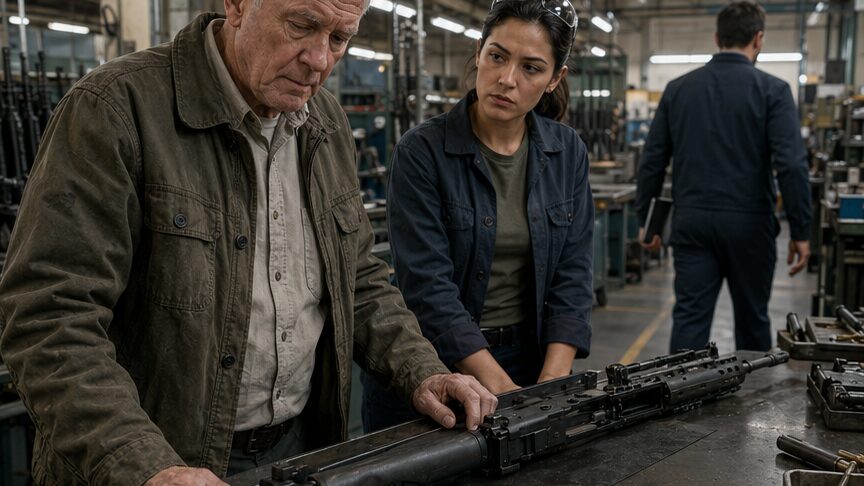
Stephanie Ramirez looked up from a maintenance bench.
The young technician sat surrounded by cleaning kits and partially disassembled weapons. Her dark hair was tied back, safety glasses resting on top of her head.
“Morning.”
“You found something?”
Anthony turned the rifle slightly under the overhead light.
“Maybe.”
Stephanie smiled.
“You always say maybe.”
“Because most things aren’t certain.”
She laughed softly and returned to her work.
Anthony pulled a small notebook from his pocket.
The cover was worn smooth from years of handling. Corners curled. Several pages were held together with aging tape.
Most people assumed it contained personal notes.
In reality, it held patterns.
Serial numbers.
Dates.
Observations.
Small details that rarely mattered until suddenly they did.
Anthony wrote down the rifle’s identification number.
Then he placed the weapon on a bench and cycled the bolt slowly.
Metal slid.
Stopped.
Then continued.
A slight hesitation.
Almost nothing.
Almost.
His eyes narrowed.
Stephanie noticed.
“What is it?”
“Feel this.”
She walked over.
Anthony handed her the rifle.
She cycled the action twice.
Three times.
“Feels normal.”
“Again.”
She did.
A pause.
Tiny.
Barely noticeable.
Stephanie shrugged.
“I don’t know.”
Anthony nodded.
Neither answer surprised him.
Years ago he could identify problems by sound alone. Not because his hearing had been exceptional but because he had spent decades listening.
Every rifle developed habits.
Most people saw equipment.
Anthony saw behavior.
A loud voice echoed from the far side of the room.
“Everyone, quick update.”
Kevin Mitchell entered carrying a tablet.
The new operations supervisor looked younger than most people expected for the position. Early forties. Sharp haircut. Constantly moving.
Anthony had known him for three months.
Three months had been enough.
Kevin preferred numbers.
Timelines.
Efficiency charts.
Anthony preferred evidence.
The two approaches didn’t always agree.
Kevin stopped near the center aisle.
“As most of you know, command wants answers regarding last week’s training malfunction.”
Several technicians looked up.
The incident had already become rumor.
A rifle had jammed during an exercise.
Nobody had been hurt.
The report classified it as minor.
Still, headquarters wanted documentation.
Kevin continued.
“Initial review suggests improper handling during post-training maintenance.”
Anthony glanced toward the rifle on the bench.
Improper handling.
Maybe.
Maybe not.
Timothy Robinson entered moments later.
The training officer carried a folder beneath one arm.
“The trainees involved already received corrective instruction.”
Kevin nodded.
“There you go. Simple enough.”
Anthony said nothing.
Simple explanations often arrived before accurate ones.
The meeting ended.
People returned to work.
Kevin crossed the room.
“Morning, Anthony.”
“Kevin.”
“You still helping out a few days a week?”
“Last I checked.”
Kevin smiled politely.
The kind of smile people used when discussing weather.
“Good.”
Then he noticed the rifle.
Anthony noticed him noticing.
“What have you got there?”
Anthony pointed toward the scratch.
Kevin leaned closer.
Nothing in his expression changed.
“Wear mark.”
“Possibly.”
“These rifles get used.”
Anthony nodded.
“They do.”
Kevin straightened.
“Anything connecting it to the training incident?”
“No.”
“Then I wouldn’t lose sleep over it.”
Kevin moved away.
Conversation finished.
At least for him.
Anthony watched him leave.
The comment wasn’t rude.
That almost made it worse.
Being dismissed politely still meant being dismissed.
Stephanie returned to her station.
“You think he’s wrong?”
Anthony sat beside the rifle.
“I think he wants the answer before the question is finished.”
She considered that.
“Maybe he’s right.”
“Maybe.”
Anthony opened his notebook again.
Another serial number.
Another page.
Another observation.
Stephanie glanced down.
“You really write everything in that thing.”
“Not everything.”
“What decides what goes in?”
Anthony looked at the scratch.
“Things people stop looking at.”
The morning passed.
Rifles arrived.
Rifles left.
Paperwork accumulated.
Lunch came and went.
By midafternoon Anthony had examined eleven weapons from the same training batch.
Three carried similar marks.
Not identical.
Related.
His concern deepened.
Patterns mattered more than individual mistakes.
Near closing time, he carried the notebook toward a storage shelf and paused.
A fourth rifle sat waiting for inspection.
Anthony picked it up.
Checked the serial number.
Then slowly cycled the bolt.
The hesitation returned.
Small.
Predictable.
Real.
His pulse quickened.
Not from fear.
From certainty.
He opened the notebook.
The previous serial numbers sat across two pages.
Now a fourth joined them.
Four rifles.
Same unit.
Same maintenance cycle.
Same unusual wear.
Outside, the late sun stretched long shadows across the armory floor.
Anthony stood alone beside the bench.
The scratched bolt gleamed beneath fluorescent lights.
Somewhere nearby, Stephanie laughed at a joke he couldn’t hear.
The room felt ordinary.
Routine.
Safe.
Exactly the kind of place where important warnings disappeared.
Anthony looked around.
Nobody was watching.
Quietly, he wrote one final note beneath the serial numbers.
Check all rifles from Batch 17.
Then he closed the notebook and slipped it into his pocket.
Chapter 2: The New Supervisor’s Decision
The meeting room smelled faintly of coffee and printer toner.
Anthony sat near the back while Kevin Mitchell stood beside a projection screen displaying maintenance schedules.
Most of the seats were occupied.
Technicians.
Training staff.
Administrative personnel.
Timothy Robinson sat near the front reviewing documents.
Stephanie arrived moments before the meeting began and slipped into a chair beside Anthony.
Kevin cleared his throat.
“Let’s keep this short.”
That sentence alone made Anthony suspicious.
Important conversations rarely stayed short.
Kevin tapped the screen.
Charts appeared.
Maintenance hours.
Inspection costs.
Staffing allocations.
Budget figures.
“The audit team arrives next month.”
A few people exchanged looks.
Kevin continued.
“We need to improve efficiency before they get here.”
Efficiency.
Another word Anthony had heard his entire life.
Sometimes it meant improvement.
Sometimes it meant shortcuts.
The screen changed.
Several inspection procedures disappeared from the workflow chart.
Anthony leaned forward.
Slowly.
Carefully.
Kevin spoke with confidence.
“We’re eliminating redundant manual checks.”
The room remained quiet.
Anthony wasn’t surprised.
Most people hadn’t spent decades touching the equipment.
To them the changes looked reasonable.
One less inspection here.
A shortened review there.
A few minutes saved.
Anthony raised a hand.
Kevin sighed almost invisibly.
“Yes, Anthony?”
“The secondary bolt inspection.”
Kevin nodded.
“What about it?”
“Why remove it?”
“Because we already inspect the assembly during maintenance.”
“Not the same thing.”
Kevin folded his arms.
“We’ve reviewed the process.”
Anthony glanced around the room.
Most people avoided eye contact.
Not hostile.
Just uncomfortable.
Kevin continued.
“The duplicate check catches almost nothing.”
Anthony spoke calmly.
“It only needs to catch one thing.”
Silence.
Kevin smiled politely.
“The data doesn’t support keeping it.”
Anthony almost answered immediately.
Instead, he paused.
Age had taught him something valuable.
The first response was rarely the most useful one.
“The data only includes problems people found.”
Kevin’s expression hardened slightly.
“Exactly.”
Anthony knew that look.
Conversation over.
Decision already made.
The rest of the meeting moved on.
When it finally ended, people filed toward the exit.
Stephanie lingered.
“You think the inspection matters that much?”
Anthony watched Kevin speaking with administrators across the room.
“I wouldn’t argue about it if I didn’t.”
She hesitated.
“Things change.”
“They should.”
Anthony stood.
“But changes still have to answer the same question.”
“What question?”
He picked up a discarded checklist from the table.
“What’s protecting us after we stop looking?”
Stephanie considered that.
No answer came.
Later that afternoon Anthony returned to the armory floor.
Several rifles awaited processing.
He moved methodically.
Inspect.
Record.
Cycle.
Observe.
Repeat.
Hours passed.
Near sunset he stopped again.
Another rifle.
Another hesitation.
Anthony felt his stomach tighten.
He checked the serial number.
Then checked his notebook.
The number belonged to Batch 17.
Just like the others.
He examined the bolt under magnification.
There.
The same wear pattern.
Not identical.
Related.
He opened the notebook.
Five entries now.
Five rifles.
Too many for coincidence.
Footsteps approached.
Kevin.
“What are you doing?”
Anthony didn’t look up.
“Working.”
Kevin glanced at the notebook.
“You still chasing that scratch?”
Anthony pointed toward the component.
“Take a look.”
Kevin leaned closer.
For a moment Anthony thought he might actually see it.
Instead Kevin straightened.
“I see normal wear.”
Anthony nodded.
“That’s what worries me.”
Kevin exhaled.
“Anthony, you’re good at what you do.”
The sentence sounded kind.
It wasn’t.
Not really.
It carried the tone people used before explaining why experience no longer mattered.
“But?”
Kevin looked uncomfortable.
“But sometimes experience makes people hold onto old concerns.”
Anthony closed the notebook.
Slowly.
Carefully.
“You think that’s what this is?”
“I think you’re looking for a bigger problem than exists.”
Kevin checked his watch.
“We have real deadlines.”
Then he walked away.
Anthony remained standing beside the bench.
The armory grew quieter as staff headed home.
One by one lights shut off in distant rooms.
He stared at the rifle.
Then at the notebook.
The worn cover looked older than he remembered.
For a moment he wondered whether Kevin was right.
Maybe he was seeing ghosts inside routine maintenance.
Maybe retirement had arrived without him noticing.
Maybe the notebook had become a habit rather than a tool.
Anthony opened it again.
The serial numbers stared back.
Five rifles.
Same batch.
Same marks.
Same hesitation.
His doubt lasted less than a minute.
Patterns did not care about feelings.
A cart rattled across the room.
Stephanie pushed a container of equipment toward storage.
She stopped when she saw him.
“You still here?”
“Looks like it.”
She approached.
Anthony handed her the latest rifle.
She cycled the action.
Once.
Twice.
Then her brow furrowed.
Very slightly.
“What was that?”
Anthony said nothing.
She tried again.
A tiny pause.
Metal catching for the briefest instant.
Stephanie looked up.
The expression on her face changed.
Not belief.
Not yet.
But uncertainty.
The first crack in certainty often mattered most.
Anthony reached for the notebook.
Then froze.
Across the bench sat another rifle waiting for inspection.
Same model.
Same training unit.
He checked the serial number.
His eyes narrowed.
Batch 17.
Again.
Stephanie watched him open the notebook.
Without a word, he wrote down another number.
Chapter 3: Stephanie Starts Looking Closer
Stephanie had always believed that equipment either worked or didn’t.
That was how she had been trained.
Failures left evidence.
Successful systems produced results.
Simple.
Practical.
Measurable.
Anthony Hall complicated that belief.
Two days after the meeting, she found herself staring at a rifle bolt through a magnifying lamp for nearly ten minutes.
The mark was tiny.
Almost embarrassing to spend time on.
Yet she couldn’t stop looking.
Anthony sat across the workshop repairing a sling mount.
He hadn’t mentioned the scratch again.
That bothered her more than if he had.
People who wanted attention repeated themselves.
Anthony rarely did.
He simply kept recording things.
The notebook appeared several times each day.
A serial number.
A date.
A note.
Then back into his pocket.
The habit seemed harmless.
Until she noticed he never wrote casually.
Every entry had a reason.
Stephanie returned to her workstation and opened maintenance records on her computer.
Mostly out of curiosity.
At least that was what she told herself.
Batch 17 appeared repeatedly.
Inspection completed.
Maintenance completed.
Cleared for training.
Everything looked normal.
Yet she kept remembering the hesitation in the bolt.
Tiny.
But real.
A voice interrupted her thoughts.
“Problem?”
She looked up.
Timothy Robinson stood beside the bench.
“No.”
“You look concerned.”
“I’m checking records.”
Timothy smiled.
“Still helping Anthony solve the mystery scratch?”
The words were joking.
Mostly.
Stephanie forced a smile.
“Just being thorough.”
“Nothing wrong with that.”
He walked away.
Still, she felt slightly embarrassed.
Maybe everyone else was right.
Maybe Anthony simply disliked procedural changes.
Maybe she was wasting time.
By late afternoon the workshop emptied.
Only a handful of staff remained.
Stephanie opened another maintenance file.
Then another.
Then another.
Something unexpected appeared.
Not evidence.
An absence.
One inspection field showed incomplete data.
She frowned.
Opened the next record.
Same issue.
Then another.
The missing information appeared irregularly.
Not enough to trigger alerts.
Enough to feel wrong.
She stood and crossed the room.
Anthony was organizing tools.
“Can I ask you something?”
“Always.”
She pulled up a chair.
“How do you know when something’s a pattern?”
Anthony wiped his hands with a cloth.
“You don’t.”
She blinked.
“That’s helpful.”
“It isn’t supposed to be.”
A faint smile touched his face.
“You collect enough pieces that the pattern eventually introduces itself.”
Stephanie thought about the records.
“What if the pieces don’t fit?”
“Then they’re probably not the right pieces.”
He returned to his work.
Conversation finished.
Or so she thought.
A moment later Anthony added quietly, “Most mistakes happen because people stop looking after the first answer.”
The sentence followed her for the rest of the evening.
Near closing time she accessed archived maintenance logs.
The older records loaded slowly.
Several files were incomplete.
Some missing signatures.
Some missing timestamps.
Annoying.
But not unusual.
Then she found something else.
A maintenance procedure revision.
Six months old.
Stephanie opened the document.
Her eyes narrowed.
The secondary bolt inspection had been shortened once before Kevin officially removed it.
Only slightly.
Just enough to save time.
She checked dates.
Compared records.
Cross-referenced maintenance batches.
Her pulse quickened.
Batch 17 had been among the first groups processed under the revised workflow.
Not proof.
Not even close.
But enough to keep her from leaving.
An hour later the armory was nearly empty.
Anthony prepared to go home.
“You staying late?”
Stephanie nodded.
“Just finishing something.”
He glanced toward her screen.
“Don’t stay too late.”
“You say that every time.”
“One day you’ll listen.”
She laughed.
Anthony headed for the exit.
Halfway there he stopped.
“Stephanie.”
She looked up.
“The notebook isn’t magic.”
“What?”
“The answers aren’t in there.”
He tapped the pocket of his jacket.
“They’re usually somewhere people forgot to check.”
Then he left.
The door closed behind him.
Silence settled across the armory.
Stephanie stared at the maintenance database.
People forgot to check.
She opened another archive.
Then another.
Then another.
The records became increasingly messy the further back she searched.
Old uploads.
Incomplete scans.
Manual corrections.
And then she found something impossible.
A maintenance log referenced an inspection document that did not exist.
She checked again.
Same result.
The inspection had supposedly been completed.
The supporting log was gone.
Stephanie searched other entries.
More missing documents appeared.
Not many.
Enough.
Her heartbeat accelerated.
The issue wasn’t limited to one rifle.
Or one inspection.
Or one week.
The missing records stretched back months.
She sat alone beneath the fluorescent lights staring at the screen.
For the first time, Anthony’s notebook made complete sense.
Patterns.
Not answers.
Patterns.
Outside, darkness settled over the parking lot.
Inside, the cursor blinked beside another missing file.
Stephanie reached for a notepad and began writing down document numbers.
One after another.
When she finally looked up, nearly an hour had passed.
The list contained far more entries than she expected.
She stared at it.
Then at the database.
Then back at the list.
Somewhere in those missing records was a reason.
And suddenly she wasn’t sure the trainees had been responsible for anything at all.
Chapter 4: What The Records Don’t Explain
The following Monday, Anthony arrived before sunrise.
The armory felt different when empty.
No conversations.
No rattling equipment carts.
Only the steady hum of ventilation and rows of rifles waiting beneath fluorescent light.
He liked those hours.
Machines rarely lied.
People sometimes did.
Anthony unlocked a storage cabinet and removed three maintenance binders. Most records were digital now, but old habits survived in forgotten corners. Some reports still existed on paper, especially during periods when procedures changed.
He carried the binders to a worktable.
The notebook came out beside them.
Serial numbers.
Dates.
Wear patterns.
Six rifles now.
All from Batch 17.
All showing similar signs.
Not enough evidence to convince anyone.
Enough evidence to keep looking.
A shadow crossed the doorway.
Stephanie.
“You really do come in before everyone else.”
Anthony smiled.
“So do you.”
She set a folder onto the table.
“I brought something.”
Anthony waited.
She opened the folder.
Pages covered with maintenance references appeared.
Missing document numbers.
Missing inspections.
Missing supporting records.
Far more than he expected.
Anthony studied the pages silently.
“How many?”
“I stopped counting after twenty-two.”
His eyebrows rose.
That got his attention.
Stephanie noticed.
“That’s bad, isn’t it?”
“Depends.”
“On what?”
“Whether they’re random.”
Her shoulders sank.
“They don’t feel random.”
“No.”
They did not.
The two spent the next hour comparing records.
The pattern emerged slowly.
Missing files clustered around specific maintenance periods.
Not everywhere.
Not every unit.
Specific dates.
Specific revisions.
Anthony turned pages carefully.
His fingers had become slower over the years.
Not weaker.
Just deliberate.
He eventually stopped at a procedure update.
The date matched one Stephanie had already identified.
Anthony tapped the paper.
“This.”
Stephanie leaned closer.
“The inspection revision?”
“Look here.”
A handwritten approval sat near the bottom.
Not unusual.
Except for the timing.
The revision became active months before most staff realized it had changed.
Anthony checked another file.
Then another.
The same sequence appeared repeatedly.
A process shortened quietly.
Documentation incomplete.
Nobody questioning it because the changes seemed minor.
The armory began filling with people.
Conversations started.
Tools clicked.
Normal work resumed around them.
Yet Anthony could feel the investigation taking shape.
Not proof.
Direction.
By midmorning Kevin Mitchell approached their table.
He glanced at the spread of records.
“You two starting your own audit?”
Stephanie straightened slightly.
Anthony remained seated.
“Just reviewing maintenance history.”
Kevin looked at the binders.
“Why?”
Anthony answered.
“Because I still don’t understand the wear patterns.”
Kevin rubbed his forehead.
“We’ve already discussed this.”
“We discussed it.”
Kevin’s expression tightened.
“Anthony.”
The tone carried warning.
Not anger.
Frustration.
“There’s no evidence linking those marks to the training malfunction.”
“Not yet.”
Kevin looked toward Stephanie.
“You too?”
She hesitated.
Only briefly.
“I’m checking records.”
“That’s not what I asked.”
Silence stretched.
Finally Stephanie said, “Something feels off.”
Kevin sighed.
“Feeling isn’t evidence.”
Then he walked away.
Anthony watched him leave.
“You should’ve let me answer.”
Stephanie crossed her arms.
“I wanted to.”
Anthony studied her for a moment.
Trust had started forming.
Carefully.
Like a bridge built one plank at a time.
Neither of them mentioned it.
The rest of the day passed inside storage archives.
Boxes.
Old reports.
Maintenance histories.
Anthony found himself kneeling beside a lower shelf searching through records from nearly a year earlier.
His knees protested.
Age always collected payment eventually.
He stood slowly.
Stephanie pretended not to notice.
Anthony appreciated that.
Late in the afternoon he discovered something unexpected.
A maintenance log referenced inspection data from a date that no longer existed in the archive.
Not missing paperwork.
Missing entire entries.
He checked again.
Same result.
The timestamp sequence skipped forward.
As if someone had removed a section and never expected anyone to compare versions.
Anthony copied the details into his notebook.
Stephanie watched.
“Another pattern?”
“Maybe.”
“You always say maybe.”
He smiled faintly.
“Still true.”
The armory doors opened.
A woman entered carrying a case file.
Professional posture.
Measured movements.
Observant eyes.
She introduced herself to Kevin first.
Then Timothy.
Conversations spread quickly across the room.
Anthony heard the name before he saw her paperwork.
Elizabeth Campbell.
Safety investigator.
The audit had arrived earlier than expected.
Anthony closed his notebook.
Across the room, Elizabeth spoke with Kevin while glancing occasionally toward the maintenance area.
Toward the rifles.
Toward the records.
Toward the problem nobody seemed able to define.
Something told Anthony the next phase had just begun.
And for the first time in days, he felt more certain than doubtful.
The missing records did not explain everything.
But they explained too much to ignore.
Chapter 5: The Wrong Conclusion
Elizabeth Campbell believed in evidence.
Not theories.
Not instincts.
Evidence.
That belief had served her well through years of investigations.
It served her again as she reviewed reports from the training incident.
The conference room table held neat stacks of documents.
Maintenance summaries.
Training records.
Witness statements.
Equipment reviews.
Most pointed toward the same conclusion.
Operator error.
A trainee had mishandled a rifle during post-exercise procedures.
The resulting malfunction created the incident.
Minor.
Preventable.
Case closed.
At least on paper.
Elizabeth sat across from Timothy Robinson.
“You’re confident?”
Timothy nodded.
“Very.”
“And the equipment?”
“No significant defects found.”
Elizabeth made notes.
The answer fit the documentation.
That mattered.
Later she met Kevin Mitchell.
His presentation was organized.
Professional.
Detailed.
Efficiency metrics.
Updated procedures.
Budget concerns.
The story remained consistent.
Nothing immediately raised alarms.
Yet something lingered in the back of her mind.
Not evidence.
Absence.
The same feeling investigators often experienced when every answer arrived too smoothly.
That afternoon she toured the armory.
Technicians worked quietly.
Equipment moved through inspection stations.
Everything appeared orderly.
Anthony Hall sat at a bench reviewing a rifle.
Elizabeth recognized him immediately.
People had already mentioned him.
Retired armorer.
Part-time support.
Concerned about maintenance procedures.
The descriptions varied.
The meaning remained similar.
Old-school.
Stubborn.
Attached to outdated methods.
Elizabeth approached.
“Mr. Hall?”
Anthony looked up.
“That’s me.”
“I’m Elizabeth Campbell.”
“I know.”
A faint smile touched his face.
“You’ve been popular conversation.”
“So have you.”
Elizabeth pulled up a chair.
For several seconds neither spoke.
Anthony continued examining the rifle.
Not performing for her.
Not trying to impress her.
Simply working.
Eventually she asked, “You think the reports are wrong.”
“I think they’re incomplete.”
“Based on what?”
Anthony reached for his notebook.
The worn cover immediately drew her attention.
Years of use showed in every crease.
He opened it.
Pages filled with observations.
Serial numbers.
Dates.
References.
Nothing dramatic.
Just records.
“You keep all this yourself?”
“I keep what I notice.”
Elizabeth reviewed several pages.
Interesting.
Not conclusive.
Interesting.
“What exactly are you trying to prove?”
Anthony considered the question.
Then shook his head.
“That’s the wrong question.”
Elizabeth waited.
“I’m trying to understand.”
The answer surprised her.
Most people wanted validation.
Anthony seemed interested in something else.
Still, evidence mattered.
And evidence remained limited.
By the end of the week Elizabeth completed her preliminary review.
The draft report practically wrote itself.
No direct equipment failure established.
Maintenance procedures adequate.
Training error remains most probable cause.
She stared at the wording before signing.
Technically accurate.
Based on available information.
Yet something about it felt unfinished.
The next morning she distributed copies.
Timothy approved immediately.
Kevin appeared relieved.
The matter seemed settled.
Only Anthony remained silent.
He read the report standing near the inspection benches.
Then folded it carefully.
No argument.
No protest.
No dramatic confrontation.
Just quiet acceptance.
For some reason that bothered Elizabeth more than anger would have.
Later she found him alone.
“You disagree.”
Anthony slipped the report into a folder.
“It doesn’t matter.”
“It should.”
He shrugged.
“You followed the evidence you had.”
The statement carried no bitterness.
That made it harder.
Elizabeth watched him return to work.
For the first time, he looked tired.
Not physically.
Something deeper.
A man reaching the point where repeating himself no longer felt worthwhile.
Across the room Stephanie Ramirez sat at a computer.
Her expression looked tense.
Focused.
Determined.
Elizabeth noticed her glance repeatedly between archived records and a handwritten list.
Eventually Stephanie stood.
A stack of printouts rested in her hands.
She stared at them for several seconds.
Then at Anthony.
Then back at the pages.
Elizabeth could not hear her whisper.
But she saw the realization arrive.
The kind that changes everything.
Stephanie hurried toward the archive room clutching the documents.
And Elizabeth suddenly wondered whether the report she had signed was already becoming outdated.
Chapter 6: The Pattern In The Numbers
Anthony almost stopped looking.
For two days he considered it.
The report was finished.
Management appeared satisfied.
The investigation had moved on.
Life inside the armory returned to routine.
Part of him wanted to let it go.
He was seventy-two years old.
Retirement waited patiently whether he welcomed it or not.
Maybe Kevin had been right.
Maybe he was holding onto problems nobody else could see.
Yet every morning the notebook remained in his pocket.
And every morning he opened it.
On Thursday afternoon Stephanie appeared beside his bench carrying a box of archived files.
Her expression alone told him something had changed.
“You were right.”
Anthony immediately shook his head.
“About what?”
“The records.”
She set the box down.
Papers spilled across the table.
Missing logs.
Inspection references.
Procedure updates.
Anthony leaned forward.
Stephanie pointed toward several maintenance dates.
“Look.”
He did.
At first the information seemed disconnected.
Then the pattern emerged.
Slowly.
Clearly.
The shortened inspection process matched every affected batch.
Not every rifle developed wear.
Only those processed under specific staffing conditions.
Specific shifts.
Specific workflow changes.
Anthony’s pulse quickened.
Not because they had solved the mystery.
Because they finally had direction.
For the next several hours they worked together.
Numbers covered the table.
Serial records.
Maintenance histories.
Inspection schedules.
Anthony filled page after page in his notebook.
The worn book no longer looked like a collection of observations.
It looked like evidence.
Late in the evening Stephanie stopped suddenly.
“Wait.”
Anthony looked up.
“What?”
She pointed toward two separate records.
Different months.
Different units.
Same maintenance revision.
Same wear pattern.
Same follow-up issue.
Anthony checked another file.
Then another.
The connection held.
Not perfect.
Strong.
Very strong.
The fault wasn’t caused by careless trainees.
The fault emerged when inspection changes allowed subtle bolt wear to pass unnoticed.
The wear accumulated.
The hesitation increased.
Eventually a malfunction appeared.
Anthony sat back slowly.
After days of uncertainty, the pieces finally aligned.
Not completely.
Enough.
Stephanie stared at the spread of paperwork.
“What do we do now?”
Anthony looked toward the darkened armory.
Years ago the answer would’ve been simple.
Present evidence.
People listen.
Problem solved.
Life had taught him otherwise.
“First,” he said quietly, “we make sure we’re right.”
The next morning they presented their findings to Elizabeth.
She reviewed the records carefully.
Far more carefully than before.
Questions followed.
Then more questions.
Good questions.
The kind that tested conclusions instead of protecting them.
By afternoon she requested additional documentation.
By evening she requested more.
The investigation reopened without officially reopening.
Nobody said it aloud.
Everyone felt it.
Kevin Mitchell looked increasingly uncomfortable.
Not because he was guilty.
Because certainty was slipping away.
Timothy Robinson resisted harder.
The trainee explanation still seemed easier.
Cleaner.
Familiar.
Anthony understood.
People preferred answers that fit neatly inside existing reports.
Unfortunately, the rifles didn’t care about paperwork.
Three days later Elizabeth approached Anthony carrying a folder.
“You may want to see this.”
Inside were technical reviews from another facility.
Anthony read silently.
Then again.
The same wear pattern had appeared elsewhere.
Not frequently.
Enough.
A warning buried inside years of documentation.
Missed.
Ignored.
Forgotten.
Anthony closed the folder.
For the first time since this began, hope replaced frustration.
The pattern was real.
Not imagined.
Not nostalgia.
Not age.
Real.
Across the room Stephanie smiled when she saw his expression.
“You found something.”
“We found something.”
She looked surprisingly pleased by the correction.
Then a notification appeared on the operations board.
A major training exercise scheduled for the following week.
Dozens of rifles.
Multiple units.
Full deployment simulation.
Anthony stared at the announcement.
The timing could not have been worse.
Or more important.
Because if their conclusions were correct, the exercise would test every assumption the investigation had uncovered.
And if they were wrong, there would be nowhere left to hide behind theories.
Only results.
Chapter 7: Before Someone Gets Hurt
The morning of the training exercise arrived cold and gray.
Anthony reached the range before most of the participants.
Rows of vehicles lined the staging area.
Soldiers moved equipment between tables.
Instructors reviewed schedules.
The atmosphere carried the familiar energy of organized preparation, the kind that always existed before large exercises.
He stood near a rack of rifles and watched.
For decades he had trusted routines.
Routines prevented mistakes.
But routines only worked when people respected them.
A clipboard rested beneath his arm.
His notebook remained in his jacket pocket.
Worn.
Creased.
Heavy with weeks of observations.
Stephanie arrived carrying inspection documents.
She looked tired.
Nobody had been sleeping much.
“You hear anything?”
Anthony shook his head.
“No decisions yet.”
Elizabeth had spent days reviewing evidence.
The investigation remained active.
The exercise, however, remained scheduled.
Timothy Robinson approached from across the range.
“Morning.”
Anthony nodded.
Timothy glanced toward the rifle racks.
“We’ve already inspected everything.”
The statement sounded defensive.
Anthony understood why.
Everyone knew the investigation now.
Everyone knew the questions surrounding the maintenance procedures.
Nobody wanted problems to appear today.
Least of all Timothy.
“Let’s hope that’s enough,” Anthony said.
Timothy exhaled.
Then walked away.
Nearby, soldiers began collecting assigned equipment.
Anthony watched each rifle disappear from the rack.
One after another.
Some carried serial numbers he recognized.
The notebook had trained his memory.
Certain numbers stayed with him.
Batch 17 among them.
Stephanie noticed him staring.
“You still remember them.”
“Some.”
“That’s not normal.”
Anthony smiled faintly.
“No.”
The exercise began shortly after sunrise.
Commands echoed across the training area.
Groups moved through scenarios.
Equipment cycled through drills.
For nearly an hour nothing happened.
Anthony hated how relieved he felt.
Part of him wanted proof.
Another part hoped he had spent weeks chasing shadows.
The second possibility became less likely when a range officer hurried toward Timothy.
Anthony noticed the change immediately.
Not panic.
Concern.
Timothy listened.
His expression tightened.
Then both men moved quickly toward one section of the range.
Stephanie saw it too.
“What happened?”
Anthony was already walking.
The distance felt longer than it was.
By the time they arrived, several instructors surrounded a firing position.
Nobody appeared injured.
That mattered.
Anthony focused on the weapon.
A rifle sat open on a bench.
The bolt partially locked.
Refusing to cycle correctly.
His stomach sank.
Not because he was surprised.
Because he wasn’t.
Timothy turned toward him.
For a moment neither man spoke.
Then Timothy stepped aside.
Anthony approached the bench.
Years of habit took over.
He didn’t rush.
Didn’t perform.
Didn’t announce conclusions.
He simply examined the rifle.
His fingers moved across the receiver.
The bolt.
The wear surfaces.
Then he manually cycled the mechanism.
Once.
Twice.
The hesitation appeared.
Exactly where he expected.
Exactly how he expected.
The range noise faded into the background.
Anthony looked at the serial number.
Batch 17.
Stephanie saw his expression.
“Same one?”
Anthony nodded.
No satisfaction existed in the answer.
Only weight.
Elizabeth arrived minutes later.
She listened to reports.
Examined equipment.
Asked questions.
Unlike before, nobody seemed eager to dismiss possibilities.
The malfunction had occurred during a controlled exercise.
No injuries.
No disaster.
Yet the timing mattered.
Because it happened after weeks of warnings.
Anthony stepped away from the crowd.
He suddenly felt older than usual.
Not weak.
Just tired.
The kind of tired that came from carrying a concern nobody wanted.
A voice interrupted his thoughts.
Kevin Mitchell.
He stood several feet away.
For once, he seemed uncertain.
“I should’ve looked harder.”
Anthony glanced at him.
The admission appeared genuine.
“I should’ve pushed harder,” Kevin added.
Anthony shook his head.
“This isn’t about blame.”
Kevin laughed quietly.
“Maybe not. Doesn’t make me feel better.”
Neither spoke for several seconds.
The range continued operating around them.
Life rarely paused for lessons.
Eventually Elizabeth approached holding several documents.
“The serial number matches your records.”
Anthony nodded.
“My records aren’t the important part.”
“They are now.”
He looked toward the malfunctioning rifle.
The scratched bolt remained visible beneath the open receiver.
The same small detail that nobody wanted to notice.
The same detail that started everything.
Elizabeth followed his gaze.
“You saw this weeks ago.”
“I saw a possibility.”
“And kept looking.”
Anthony slipped the notebook from his pocket.
The cover looked even more worn under daylight.
He handed it to her.
Elizabeth turned several pages.
Dates.
Numbers.
Observations.
Nothing dramatic.
Just patience.
The kind most investigations never had enough of.
She closed the notebook carefully.
For the first time since they met, she looked at him differently.
Not as a concerned retiree.
Not as a stubborn former armorer.
As someone who had earned the right to be heard.
The exercise continued under revised procedures.
Additional inspections followed.
Several rifles were removed from service pending review.
The investigation was no longer a question.
Only the outcome remained uncertain.
And for the first time in weeks, Anthony felt something he hadn’t allowed himself to feel.
Not victory.
Relief.
Chapter 8: The Person Who Finally Listened
Three weeks later, the armory felt familiar again.
Not because everything had returned to normal.
Because it hadn’t.
Several procedures had changed.
Inspection requirements had been restored.
Documentation standards expanded.
Additional reviews now existed where shortcuts once lived.
The changes were practical.
Quiet.
Easy to miss unless someone knew where to look.
Anthony noticed every one.
He stood beside a workbench watching technicians move through the updated process.
The secondary bolt inspection had returned.
Not as a favor.
Not as a tribute.
As policy.
That mattered more.
Stephanie approached carrying a rifle.
She placed it on the bench.
“Want to check my work?”
Anthony raised an eyebrow.
“You asking or testing me?”
“Maybe both.”
He laughed.
The sound surprised him.
The last few weeks had contained very little laughter.
He inspected the rifle.
Methodical.
Deliberate.
Then handed it back.
“Looks good.”
“That’s all?”
“Do you want a certificate?”
She rolled her eyes.
“You’re impossible.”
“That’s what people tell me.”
The armory doors opened.
Elizabeth Campbell entered.
She no longer carried investigation folders.
Only a small envelope.
Anthony suspected what it contained.
He hoped he was wrong.
Recognition made him uncomfortable.
Elizabeth approached.
“Morning.”
“Morning.”
She handed him the envelope.
Inside sat a formal summary from the completed review.
Anthony skimmed the pages.
The findings were straightforward.
Procedure changes contributed to overlooked wear patterns.
Maintenance documentation failures complicated detection.
Additional inspections likely prevented future incidents.
No dramatic language.
No hero stories.
Just facts.
Anthony appreciated that.
“You don’t seem excited,” Elizabeth said.
“I’ve spent most of my life hoping reports would be boring.”
She laughed softly.
“Fair enough.”
A comfortable silence followed.
Eventually Elizabeth spoke again.
“For what it’s worth, you were right.”
Anthony folded the document.
“No.”
She frowned.
“No?”
“I noticed something.”
He glanced toward Stephanie.
“Other people helped figure out what it meant.”
Elizabeth smiled.
That answer explained him better than any personnel file ever could.
Across the room Kevin Mitchell walked over.
The conversation immediately became awkward.
Kevin noticed.
“Don’t stop on my account.”
Anthony waited.
Kevin rubbed the back of his neck.
“I owe you an apology.”
Anthony sighed quietly.
“There it is.”
“What?”
“The thing everybody thinks matters most.”
Kevin looked confused.
“The apology?”
Anthony nodded.
Kevin stared at him.
“You don’t want one?”
“It’s not that.”
Anthony searched for the right words.
“People make mistakes. The important part is whether they learn anything before someone gets hurt.”
Kevin absorbed that.
Then slowly nodded.
The tension eased.
Not because everything was fixed.
Because nobody needed to win.
By lunchtime Elizabeth departed.
The investigation had ended.
Her work was finished.
Before leaving, she shook Anthony’s hand.
“Take care of yourself.”
“I’ll try.”
“You should listen when people tell you to slow down.”
Anthony glanced toward the armory.
“That’s unlikely.”
She laughed and left.
The afternoon settled into routine.
Tools clicked.
Parts moved.
Checklists filled.
Anthony found himself standing alone beside the same bench where he had first noticed the scratch.
For a moment he stared at the surface.
The memory remained clear.
A tiny mark.
A small hesitation.
An ignored concern.
Nothing looked important at the beginning.
That was the lesson.
Not every problem arrived loudly.
The notebook rested in his hand.
He opened it.
The final pages held weeks of investigation.
Questions.
Patterns.
Evidence.
History.
He considered throwing it away.
Instead, he closed it.
The notebook had never been about proving he was useful.
Somewhere along the way he finally understood that.
A voice interrupted his thoughts.
Stephanie.
She stood nearby holding several training manuals.
“We need to talk.”
Anthony immediately became suspicious.
“That’s never good.”
“It is this time.”
She set the manuals onto the bench.
“We’re starting a new armorer training program next month.”
Anthony waited.
“And?”
“And I told them you should teach it.”
He blinked.
“They have instructors.”
“They do.”
She folded her arms.
“But they don’t have you.”
Anthony looked away.
Toward the workstations.
Toward the racks of rifles.
Toward younger technicians learning the trade.
The invitation carried more weight than any report.
Because it wasn’t about being right.
It wasn’t about being needed.
It was about passing something forward.
“I don’t know,” he said.
Stephanie smiled.
“You will.”
Anthony looked at the notebook again.
Then slipped it into his pocket.
The familiar weight settled against his jacket.
Not a burden.
Not proof.
Just a record of paying attention.
Finally, he nodded.
“All right.”
Stephanie grinned.
“Good.”
She gathered the manuals and headed back across the armory.
Anthony watched her go.
For years he had worried about becoming invisible.
About reaching the point where experience no longer mattered.
Standing there, he realized the fear had never been entirely about age.
It had been about connection.
About whether anyone would listen.
Someone had.
That was enough.
The story has ended.