They Tried To Remove The Old Man Until A Marine Opened His Photo Pouch
Chapter 1: The Old Man At The Wrong Side Of The Rope
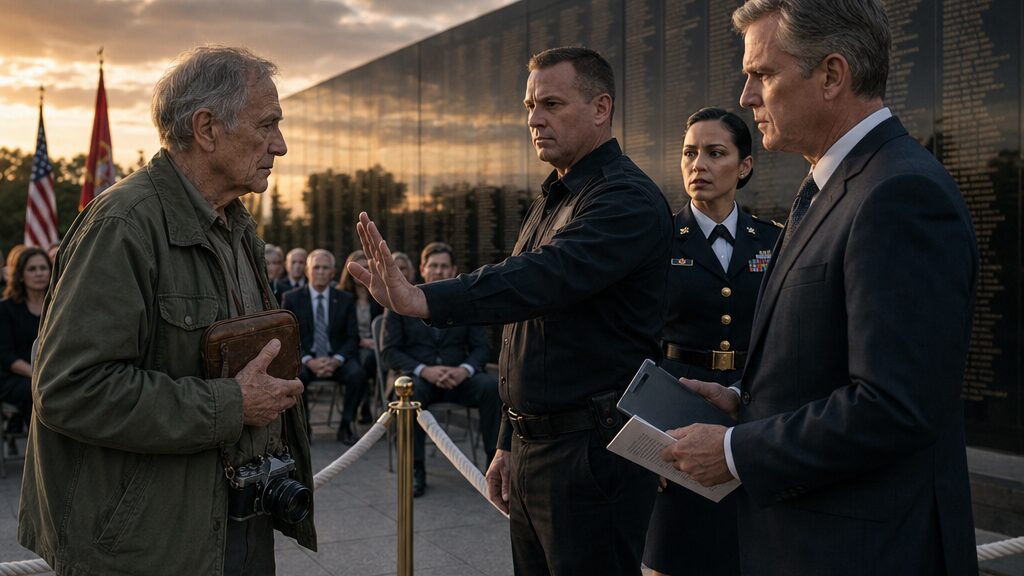
The security officer’s hand came up before Samuel Martin could take the last three steps to the wall.
“Sir, this section is closed.”
The words were not loud. That made them worse. They were spoken in the practiced voice people used when they wanted an old man to obey without making a scene.
Samuel stopped with one shoe on the edge of the red carpet runner and the other still on the sidewalk. A white rope hung between brass stands in front of him, low enough for a younger man to step over, high enough to remind him he had not been invited past it.
Beyond the rope, the black memorial wall caught the sunset and turned it into a long sheet of fire. Names ran across the polished stone in pale rows. Folding chairs faced the small platform where a microphone waited under a cloth cover. A color guard stood near the flags. Families in pressed clothes gathered in soft clusters, holding programs, carnations, folded tissues. The men in suits moved briskly, checking watches and seating charts.
Samuel stood outside all of it.
His green field jacket was old enough that the elbows had gone thin. The cuffs were frayed. The camera hanging from his neck rested against his chest like something that had grown there. Its metal edges were worn smooth from years of being held. A leather pouch, darker with age at the corners, was tucked beneath his left arm.
He looked at the security officer’s hand, then at the wall.
“I need to go there,” Samuel said.
“Family seating is already arranged, sir.”
“I don’t need a seat.”
The officer glanced at the camera, then at the pouch. “Photography is restricted during the ceremony.”
Samuel’s fingers closed around the pouch before he thought to stop them. “I’m not here to take pictures.”
The security officer gave him the quick, polite look that did not believe him. Samuel had seen that look at pharmacies, bus stations, front desks, and places with reception tables. It measured the jacket, the shoes, the slowed walk, the face lined enough to be mistaken for confusion. It found an answer before asking the right question.
A man in a dark suit crossed from the platform with a tablet in one hand and a folded program in the other. His gray hair was neat, his tie held with a silver clip, his steps quick with the importance of someone whose mistakes would be visible.
“What’s going on?” he asked.
The security officer lowered his voice. “He says he needs to get to the wall.”
The suited man looked at Samuel. Not at his eyes first. At the camera. At the jacket. At the rope between them.
“Sir, I’m Jonathan Roberts with the memorial foundation. We’re about five minutes from beginning. If you’re looking for general visitation, the wall will reopen after the dedication.”
Samuel watched a woman in the front row straighten a small flag in her lap. He could see, past her shoulder, the far panel where the T names began. Thomas would be there. Andrew Thomas. He had not needed a map to know the approximate place. He had carried the name too long for that.
“I only need a minute,” Samuel said.
Jonathan smiled in the way people smiled when they were already refusing. “I’m afraid we can’t have people moving around the family section right now. There are Gold Star families present. This is a sensitive event.”
Samuel looked down.
Sensitive.
The word settled somewhere under his ribs. He had carried a man’s face for forty years in a pouch so old the stitching had begun to give. He had wrapped that face in tissue, placed it between cardboard, kept it away from light, heat, damp, and the careless hands of people who thought old things were only old. He had taken three buses and walked four blocks because his knees did not trust stairs anymore. He had come while the sun was still up because he was afraid he would lose his nerve after dark.
But the event was sensitive.
“Yes,” he said. “I know.”
Jonathan’s smile tightened. “Then you understand.”
Samuel could have told him the wall was not a backdrop. He could have said the names were not decorations for donors and local cameras. He could have reached into the pouch and placed the photograph in the man’s clean, efficient hand.
He did none of those things.
The rope moved slightly in the evening breeze. Its white braid brushed the front of Samuel’s jacket, then fell back.
“I’ll stand at the edge,” he said. “No trouble.”
The security officer shifted his weight. Jonathan folded the program once against his tablet.
“Sir,” Jonathan said, and now the gentleness had a harder center, “we can’t verify who you are. We have a schedule. Please step back from the rope.”
Samuel felt heat in his face, though the air had cooled. Around them, people were beginning to notice. Not openly, not rudely, but in side glances and shortened conversations. A few chairs creaked as guests turned. The camera on his chest seemed heavier.
He stepped back half a pace.
The old habit rose in him without permission: make yourself smaller, keep the lens covered, do not block the corpsman, do not speak unless you have to, keep moving, keep looking. He had spent years training himself to stand where no one noticed him until a shutter clicked. Now he was being noticed for all the wrong reasons.
His thumb found the cracked edge of the camera body. The leather strap had darkened where sweat and rain had soaked into it long ago. He remembered another strap, another heat, a young Marine laughing because Samuel had told him to stop squinting at the sun.
The memory passed through him so quickly he almost lost balance.
“Sir?” the security officer said.
Samuel lifted his eyes to the wall again. The names blurred, then steadied.
“Andrew Thomas,” he whispered.
It came out before he could swallow it back.
Not loud enough for the crowd. Barely loud enough for the rope.
But someone heard.
A woman in dress blues had been standing near the platform, speaking to a member of the color guard. She turned at the name. The sunset struck the brass on her uniform and made it flash once, sharply. Her posture was straight, her face composed, but her attention had shifted completely.
Captain Kathleen Rivera looked past Jonathan Roberts, past the security officer, and fixed on the old man with the camera.
Samuel did not see her at first. He was still looking at the wall, searching the polished black stone as if the name might turn toward him.
“Andrew Thomas,” he said again, softer this time.
Kathleen took one step away from the platform.
Jonathan noticed her moving. “Captain, we have it handled.”
Samuel looked down at the pouch under his arm.
The corner of a white backing card had slipped out from beneath the flap.
Kathleen saw it. She saw the old camera, too, not as a problem now but as a question.
“Mr. Roberts,” she said, her voice controlled, “give me a moment.”
The security officer’s hand lowered an inch.
Samuel tightened his grip on the pouch, not to hide it, but because it felt suddenly as if the evening might take from him the one thing he had come to give.
Chapter 2: The Photograph He Never Mailed Home
Earlier that afternoon, Samuel had almost left the photograph on the kitchen table.
It had rested beside his empty coffee cup, wrapped in thin paper, the leather pouch open beside it. The room was small and clean, with blinds that rattled when buses passed outside. A calendar hung near the refrigerator, though he no longer wrote appointments on it. The memorial date had been circled in pencil months ago, then erased, then circled again so lightly that only he would know it had ever been marked.
He stood over the table in his shirt sleeves, looking at the wrapped photograph as if it might make the decision for him.
“You waited long enough,” he said.
His voice sounded strange in the kitchen. Too rough for the quiet. Too old for the man he had been speaking to.
The camera lay beside the pouch. He had cleaned it the night before, though he had not loaded film in years. There was no reason to wear it. That was what he told himself while fastening the strap around his neck anyway. His fingers remembered the motion better than his mind did.
The camera had once been an assignment, then a tool, then evidence, then a punishment. After he came home, it had sat in a box for nine years. Later, when the box started to smell of dust and cardboard, he moved it to a shelf. Later still, he placed it on the table each morning as if its silence required attendance.
He had photographed men who were young enough to believe letters always arrived and promises could outrun war. He had taken pictures of muddy boots, card games, taped helmets, hands around tin cups, tired faces pretending not to be afraid. Some pictures had been mailed. Some had been lost. Some had been taken too close to the end of things.
Andrew Thomas had asked for only one.
“Make me look brave,” the young Marine had said.
Samuel had looked over the camera and answered, “You’re asking the wrong machine.”
Andrew had laughed then, one quick bright sound under a hard white sky.
That was the sound Samuel still heard when he touched the pouch.
By noon, he had put on the green field jacket. By twelve-ten, he had taken it off. By twelve-twenty, he had put it on again. The sleeves felt heavier than wool had any right to feel. There were newer jackets in the closet. Cleaner ones. But the green one had pockets deep enough for the pouch, and its wear seemed honest. He had no medals on it. No patches. Nothing that asked a stranger to decide who he had been.
At the bus stop, he sat at the far end of the bench.
A teenager glanced at the camera and then back at a phone. A woman with grocery bags shifted them away from his shoes. A man in work clothes gave him a nod that Samuel returned too late. Traffic moved in dull flashes. Heat rose from the pavement even though the day was beginning to cool.
The bus doors sighed open.
Samuel climbed slowly, holding the rail with his right hand and the pouch with his left. The driver waited, not impatiently, but with that public patience that made him aware of every joint. He paid, moved down the aisle, and took a seat near the middle.
The city slipped by in pieces: laundromat windows, flags at a used-car lot, a school fence, a mural fading on brick. Twice he nearly pulled the cord early. Once, at a red light, he looked down at his hands and saw dirt under the nails that was not there.
He had avoided memorials for years by telling himself that the dead did not need him to stand in front of stone. He had mailed copies to archives when asked, answered letters from museums when he could, and ignored every invitation that used the words honored guest. He had told himself that memory handled properly was better than memory performed.
But the original photograph of Andrew Thomas had stayed with him.
Not because he meant to keep it. At first there had been confusion, then evacuation, then a wrong address, then returned mail, then a silence he did not know how to break. Later, shame hardened around the delay. Each year made the act feel more impossible. What did a man write after ten years? After twenty? After forty?
I had this and did not send it.
I was there and came home.
He got off two blocks early because the bus turned toward a street blocked by ceremony traffic. Volunteers had put up temporary signs. A sheriff’s vehicle sat with its lights dark. The memorial flags were visible above the low roofs, lifting and falling in the wind.
Samuel stopped at the corner.
He could see the wall from there, or part of it: polished black stone, chairs lined in careful rows, the platform, the rope. People were arriving in families. They touched one another’s elbows, smoothed collars, spoke quietly. Some carried flowers. Some carried faces they had spent years training into calm.
Samuel’s left hand went to the pouch.
“Just the picture,” he told himself. “Not the story.”
The traffic light changed. He did not move.
Across the street, the ceremony program was being handed out by volunteers. A woman pointed guests toward the family section. Jonathan Roberts moved briskly near the platform, speaking into a headset, his suit coat open, one hand slicing the air in small corrections. Everything looked arranged. Everything had a place.
Samuel looked down at his shoes.
He thought of turning back. He could mail the photograph tomorrow. He could leave it with the foundation office. He could slip it into an envelope and let someone else decide whether it reached Nicole Thomas. He could go home, put the camera on the table, make coffee he would not drink, and tell himself that trying had been enough.
The wind lifted the flap of his pouch. He pressed it closed.
Andrew Thomas had been twenty-three in the photograph. Younger than the security officer at the rope. Younger than the volunteers straightening the chairs. Younger than the man he had become in his daughter’s imagination.
Samuel crossed the street.
At the entrance, a ceremony volunteer smiled at him and offered a program.
“Family name?” the volunteer asked.
Samuel hesitated. “Thomas.”
The volunteer looked down at a clipboard. “Thomas family is already checked in.”
“I’m not family.”
The smile thinned but did not disappear. “Veterans’ seating is on the right if you registered.”
“I didn’t.”
“Oh.” The volunteer glanced at his camera. “General seating is full, sir. The wall will be open after the dedication.”
“I only need to reach one name.”
The volunteer’s eyes moved past him toward the rope and the platform, toward people with badges and answers. “I’m sorry. The family section is already closed.”
Samuel nodded as if he had expected nothing else.
Then he walked toward the rope anyway.
Chapter 3: When The Marine Opened The Leather Pouch
Captain Kathleen Rivera had spent the hour before the ceremony correcting small things that were not small to the people who had come to grieve.
A flag angle. A microphone cable. A chair left empty in the second row by mistake. The pronunciation list folded in the wrong order. A volunteer laughing too loudly behind the platform because nerves had nowhere else to go.
She had learned that respect often lived in details most people never noticed.
So when Jonathan Roberts waved her off and told her he had “handled” the old man at the rope, Kathleen looked first at the details.
The old man was not drunk. He was not lost. His shoulders were slightly stooped, but his feet were planted with care. The camera around his neck was old, not decorative. It had the worn dullness of a tool handled for years. The leather pouch under his arm was held close to his ribs, protected in the way people protected medicine, letters, or something breakable.
Then she heard him whisper the name.
Andrew Thomas.
Kathleen knew the name from the program. Every name on the dedication list had crossed her desk that morning. She had checked the spelling twice, then again after lunch. Andrew Thomas was on the third panel, family row two, represented by his daughter.
Jonathan stepped between Kathleen and the old man as she approached. “Captain, we’re very close to start. He doesn’t have credentials.”
Kathleen did not look away from Samuel. “Sir,” she said to him, “are you here for Andrew Thomas?”
The old man’s mouth moved once before sound came. “Yes.”
“What is your name?”
He looked at the rope. “Samuel Martin.”
Jonathan exhaled. “We can sort this out afterward. The families are seated. Media is ready. We can’t have—”
Kathleen turned her head just enough to stop him. “Please give us a little room.”
The security officer straightened. Jonathan’s jaw tightened, but he stepped back half a pace.
Kathleen lowered her voice. “Mr. Martin, do you have something with you for Sergeant Thomas?”
Samuel’s fingers tightened on the pouch. The title struck him visibly, though Kathleen could not tell whether it comforted or wounded him.
“Not Sergeant,” he said softly.
Kathleen paused.
“Lance corporal,” Samuel said. “He didn’t live long enough for the promotion paperwork to catch him.”
The words were plain. They carried no accusation. That made Jonathan look down at his tablet.
Kathleen felt the first shift inside herself, small but unmistakable. Not recognition yet. Attention.
“May I see what you’re carrying?” she asked.
Samuel did not answer immediately. Around them, the rows of families were settling. Programs rustled. A microphone gave a low pop as someone tested the sound. The sunset had moved down the wall, leaving the names bright at the edges and dark in the grooves.
Samuel looked at Kathleen’s hands.
She understood then and held them open, palms visible.
“I’ll be careful,” she said.
His thumb worked the old buckle loose. The leather had stiffened with age, and one corner of the flap had been repaired with darker thread. Inside were backing cards and paper sleeves, each fitted precisely, not stacked carelessly. Samuel removed one sleeve and held it for a moment before passing it to her.
Kathleen took it with both hands.
The photograph inside was black and white, the edges slightly curled. Four young Marines stood in harsh sunlight beside a vehicle blurred by dust. One was laughing at something beyond the frame. One looked away. One had his hand raised to block the glare. The fourth stood almost in the center, not posing exactly, but caught in the second before a smile settled fully on his face.
Kathleen turned the backing card over.
In pencil, careful and faded: Andrew Thomas. Morning patrol. Original.
Below that were numbers and letters she recognized as unit notation, not decorative, not invented by someone collecting souvenirs. Her eyes moved to the camera on Samuel’s chest, then back to the photograph.
“Mr. Martin,” she said, quieter now, “were you with his unit?”
Samuel looked at the wall. “Some days.”
Jonathan leaned in despite himself. “What is that?”
Kathleen did not hand it to him.
She looked at Samuel again. “Were you a Marine?”
He seemed almost embarrassed by the question. “Yes.”
The security officer’s posture changed first. Not dramatically. His shoulders went back, and the hand that had been hovering near the rope dropped to his side.
Jonathan blinked at Samuel as if the old jacket had rearranged itself into something he should have recognized sooner.
Kathleen felt heat crawl up the back of her neck. She had not been rude to him, not exactly. But she had allowed the machinery around him to treat him as an interruption before she asked the only question that mattered.
She turned the photograph back over and saw Andrew Thomas again, young and sunlit and unaware of the wall that would someday hold his name.
“Mr. Martin,” she said, “may I ask why you need to reach the wall before the ceremony?”
Samuel’s eyes stayed lowered. “Because after the ceremony, people will want to talk.”
“They may still want to talk now.”
“I know.” His hand moved once toward the pouch, then stopped. “I only came to leave what belongs there.”
Kathleen looked at the photograph. “With his family?”
Samuel’s mouth tightened.
That was answer enough to open a hundred questions, none of which belonged in the aisle.
Jonathan checked the platform, then the families, then Kathleen. “Captain, we’re already delayed.”
Kathleen held the photograph against its backing card with careful fingertips. “Then we’ll be delayed correctly.”
Jonathan stared at her.
She gave the photograph back to Samuel, not by the edge alone, but with the flat respect of returning something living. “Mr. Martin, would you permit me to look at the next one?”
Samuel looked at her then.
His eyes were pale, tired, and guarded by years of not asking anyone to understand. For a moment she thought he would close the pouch and leave. Instead he nodded once.
Kathleen did not reach in. She waited.
Samuel drew out another sleeve.
Behind the first row of chairs, someone stood so suddenly that the metal legs scraped the pavement.
Kathleen turned.
A woman had stepped into the aisle, one hand pressed against the program folded at her chest. Her face had lost its ceremony calm.
“What did you say?” the woman asked.
Samuel’s hand froze over the open pouch.
Kathleen knew who she was before she looked at the seating chart.
Nicole Thomas stared at the photograph in Samuel’s hand as if the dead had spoken from across the rope.
Chapter 4: A Daughter Sees A Stranger Holding Her Father
Nicole Thomas had learned to recognize when people were about to be careful with her.
They lowered their voices too late. They touched her elbow without asking. They said her father’s name as if it were made of glass, then watched her face to see if it broke. At ceremonies, they thanked her for sacrifice she had been too young to understand when it was made. They spoke of honor. They spoke of service. They almost never spoke of Andrew Thomas as if he had once taken up space in an ordinary room.
So when she heard his name from the aisle behind her, spoken by an old stranger in a worn green jacket, she stood before she knew she was standing.
“What did you say?”
The question came out sharper than she intended. Several heads turned. The program in her hand folded under her fingers, creasing across the printed list of names.
Captain Kathleen Rivera stepped slightly aside, not blocking her, not inviting her forward either. The security officer looked uncertain. Jonathan Roberts wore the tight expression of a man watching the ceremony slip out of his hands one second at a time.
The old man did not move.
His hand hovered over a leather pouch held open against his ribs. A black-and-white photograph was half out of its sleeve. Nicole could see only a pale corner and the dark line of someone’s shoulder.
Kathleen spoke first. “Ms. Thomas, this is Samuel Martin.”
Nicole looked at Samuel’s face. It gave her nothing easy. He did not smile, did not offer comfort, did not perform sorrow. He seemed older than the stone behind him, but his eyes were alert in a way that made her more cautious, not less.
“You knew my father?” she asked.
Samuel’s mouth tightened.
“Yes.”
The answer was too small for the damage it did.
Nicole had heard many people say they knew her father. Some had gone to school with him. Some had served near him. Some had known her mother and claimed that was close enough. She had grown up with versions of Andrew Thomas built from secondhand stories: brave Andrew, funny Andrew, handsome Andrew, quiet Andrew, Andrew who would have loved her, Andrew who never saw her finish kindergarten, Andrew whose absence entered every family gathering before the food did.
But this old man said yes as if it cost him something.
“What is that?” she asked, looking at the photograph.
Samuel’s fingers closed a little. “A picture.”
“Of him?”
He did not answer quickly enough.
Nicole stepped closer to the rope. “Of him?”
Kathleen’s voice was low. “It appears to be.”
Nicole heard the carefulness in it and hated it. “Appears?”
Jonathan moved in. “Ms. Thomas, we can take this to the side tent for privacy. We’re moments from beginning, and I don’t want—”
“I don’t care what you want,” Nicole said.
The words cracked through the aisle. A woman in the front row lowered her eyes. Jonathan stopped.
Nicole felt heat rise in her throat. She had promised herself she would make it through the dedication cleanly. No scene. No sharp edges. She would sit, stand when told, accept the folded flag display later, shake hands, let people say her father’s name, and go home. She had not prepared herself for an old man holding a photograph like a wound.
Kathleen looked at Samuel. “May we step into the tent?”
Samuel looked toward the wall.
Nicole saw it then: he had not been trying to reach the chairs. He had been trying to reach the names.
“I’ll come,” she said, before he could refuse.
The side tent stood beyond the platform, open on three sides, with folding tables holding extra programs, water bottles, and a box of white carnations. The sounds of the ceremony softened there but did not disappear. Microphone feedback hummed and was cut off. Chairs scraped. A volunteer whispered into a radio.
Samuel stood near the tent’s edge, still holding the pouch. Kathleen placed herself close enough to help, far enough not to own the moment. Jonathan lingered by the table, checking his watch until Kathleen looked at him and he stopped.
Nicole folded her arms because she did not trust her hands.
“Show me,” she said.
Samuel removed the photograph from its sleeve.
He did not hold it out immediately. He looked at it once himself, and something passed over his face too quickly to name. Then he placed it on the empty table, turned toward Nicole, and stepped back.
That small movement undid some part of her anger. He did not push it at her. He did not ask her to be grateful.
Nicole leaned over the table.
Four young Marines stood in a hard white glare. The photograph was grainy but clear. Dust hung in the background. One man looked away, one laughed, one blocked the sun with his palm. The man near the center had a narrow face, dark hair, and a smile just beginning, as if someone had caught him before he could decide whether to be serious.
Nicole stopped breathing.
She had seen pictures of her father before. Formal ones. A boot camp photograph. A wedding photograph where he looked too young for the suit. A faded snapshot of him holding her as an infant, his face turned away because whoever took it had moved too soon.
But she had never seen this expression.
This was not a symbol. Not a framed portrait placed on a mantel every Memorial Day. Not the face from the official packet.
This was a man interrupted by sunlight.
Nicole touched the edge of the table, not the photograph. “When was this?”
Samuel looked at the ground. “The morning of his last patrol.”
The tent seemed to lose its air.
Jonathan shifted beside the programs. “Mr. Martin, perhaps we should—”
Kathleen said, “Let her ask.”
Nicole stared at the image. “Why do you have this?”
Samuel’s hand tightened on the camera strap. “I took it.”
“You took it.”
“Yes.”
“And you kept it?”
There it was. The thing she had not meant to throw at him, thrown anyway.
Samuel did not defend himself. “Yes.”
Nicole lifted her eyes. “My mother died never seeing this. My grandmother died with one picture of him in uniform by her bed. And you had this?”
Kathleen’s face changed, but she said nothing.
Samuel absorbed the words without flinching. That almost made Nicole angrier. She wanted him to explain too fast, to excuse himself poorly, to become someone she could blame without complication.
Instead he looked at the photograph as if he had been blaming himself longer than she had been alive.
“I tried once,” he said. “The envelope came back.”
“Once?”
His eyes closed for half a second. “Once was all I could make myself do then.”
Nicole wanted to call that unforgivable. She wanted the word to be clean. But his voice was not asking to be forgiven.
She looked back at the photograph. Her father’s smile had not changed. It had waited through all her anger, all Samuel’s silence, all the years neither of them could repair.
“What was he doing?” she asked.
Samuel’s face turned slightly toward her.
“In the picture,” she said. “Why is he smiling?”
For the first time, Samuel’s hand loosened on the pouch.
“He had just stolen half a warm soda from another Marine and claimed it was evidence,” Samuel said.
Nicole blinked.
Kathleen looked down, almost smiling before she caught herself.
“He said no jury would convict him,” Samuel added.
The image shifted again. The young man in the photograph was no longer only a father lost before memory. He was a twenty-three-year-old making a ridiculous legal argument over stolen soda in dust and heat.
Nicole pressed her lips together. The sound that rose in her chest was too broken to be a laugh, too warm to be only grief.
Jonathan’s phone buzzed against the table. He checked it, then looked toward the platform.
“We need to make a decision,” he said carefully. “This is extraordinary. If Mr. Martin is willing, we could include him in the program. A surprise recognition, perhaps before the name-reading. The audience should know who he is.”
Samuel looked up.
Nicole saw the old man’s face close.
“No,” he said.
Jonathan lifted both hands, gentle now, persuasive. “Mr. Martin, I understand humility, but this could mean a great deal to the families.”
Samuel reached for the photograph with careful fingers.
“It already means enough,” he said.
Nicole watched him slide her father’s face back toward the sleeve.
She almost stopped him.
Chapter 5: The Ceremony Wanted A Hero, Not A Witness
Behind the memorial platform, Samuel could hear the ceremony trying to begin without him.
A microphone clicked. A chair leg dragged across pavement. The color guard received a quiet instruction. Somewhere beyond the tent, families waited with folded programs in their laps while the sunset thinned into blue at the top of the wall.
Jonathan Roberts stood near a stack of printed schedules, speaking in a lowered voice that still carried the shape of urgency.
“We can do this respectfully,” he said. “One minute. Maybe two. Captain Rivera introduces you as a Marine veteran and photographer. You don’t have to make a speech. Just stand while we acknowledge your service and your connection to Lance Corporal Thomas.”
Samuel held the leather pouch against his side.
“No.”
Jonathan drew in a breath through his nose. He was trying not to show frustration. Samuel could give him that much credit. The man was not cruel. He had the face of someone who believed deeply in smooth surfaces and did not understand why grief kept leaving fingerprints.
“This foundation has worked for years to make sure men like Andrew Thomas are remembered,” Jonathan said. “A living witness arriving with an original photograph—Mr. Martin, people should see that.”
“They should see him,” Samuel said.
Jonathan paused.
Samuel looked toward the tent table where the photograph lay in its sleeve, not yet returned to the pouch. Nicole stood on the other side of it, arms folded, eyes fixed on nothing. Kathleen remained near the opening of the tent, watching the platform and listening to every word.
Jonathan softened his tone. “They will. That’s the point.”
“No,” Samuel said. “The point is you want a moment.”
The words were quiet. They landed harder because of it.
Jonathan’s face colored. “I want the ceremony to honor the fallen.”
“You want it to go well.”
“Yes,” Jonathan said, unable to hide the edge now. “I do. Because if it goes badly, families leave feeling worse than when they came. Donors ask questions. The county asks questions. The news clips the wrong ten seconds. Respect takes planning.”
Samuel looked at him then.
For a brief moment, Jonathan’s impatience seemed less like vanity and more like fear. He was holding too many expectations in both hands and mistaking control for care. Samuel knew something about that. A camera had once given him the same illusion.
“Planning helps,” Samuel said. “It doesn’t replace listening.”
Kathleen lowered her eyes.
Jonathan opened his mouth, then shut it.
Samuel took the photograph from its sleeve again. The evening light had dimmed enough that the image looked softer, as if the four young Marines were receding into fog. Andrew’s almost-smile remained clear.
He had taken the picture fast. Too fast to think. The patrol was forming up, packs checked, rifles slung, jokes thin over nerves. Andrew had been complaining about warm soda and bad luck. Samuel remembered telling them to stand still. One frame, maybe two. He had meant to take more when they came back.
Not every failure was dramatic. Some were as small as saving film.
Nicole’s voice came from across the table. “You said it was the morning of his last patrol.”
Samuel nodded.
“Were you there when he died?”
The tent became very still.
Jonathan looked away. Kathleen did not. The distant ceremony noises seemed to move farther off, like sounds underwater.
Samuel slid the photograph back into its sleeve. His fingers did not shake, but it took effort.
“No,” he said. “Not at the end.”
Nicole’s face changed, not with relief.
Samuel forced himself to continue. “I was sent back with another team before they moved out. Different assignment. I argued about it.”
“With who?”
“Anyone standing close enough.”
It was not a joke, but Nicole’s mouth tightened as if she recognized the shape of one.
Samuel looked toward the wall. “Andrew asked me to send a picture home if anything happened. That morning, after I took this, he tapped the camera and said, ‘Don’t make me look too scared.’”
Nicole looked down quickly.
“I told him the camera didn’t know how to lie that well,” Samuel said.
His thumb rubbed the old seam of the pouch. “He said his daughter would forgive me if I tried.”
Nicole’s head came up.
Samuel had not meant to say that part yet. Perhaps he had not meant to say it ever. The words stood between them now, fragile and irreversible.
“My father said that?”
“Yes.”
“He mentioned me?”
Samuel looked at the photograph because looking at her was too difficult. “More than once.”
Nicole’s arms loosened from their fold. “I was little.”
“He knew exactly how little. He complained about missing your teeth coming in as if the whole Marine Corps had arranged it against him.”
Kathleen turned away for a moment. Jonathan looked at the table.
Nicole pressed two fingers to her mouth, then dropped her hand. “Why didn’t you send it?”
Samuel nodded once, almost to himself. There was the question. Not cruel. Not unfair. Only late.
“Because I came home with too many pictures,” he said. “And not enough men.”
No one interrupted.
“At first there were lists and bags and letters and people asking me to identify faces. I told myself I was waiting until I knew where to send it. Then the envelope came back. Then I told myself a copy would be better than the original. Then I told myself your family had enough pain.” His voice roughened, and he stopped until it steadied. “After a while, every reason was just another way not to admit I had failed him.”
Nicole stared at him.
Samuel expected anger. He could bear that. He had carried worse versions of it inside himself and given them her voice many times.
But Nicole only asked, “Did he suffer?”
Kathleen’s posture changed, a small instinctive movement, but she did not step in.
Samuel looked at Nicole fully.
“I don’t know,” he said. “I won’t pretend I do.”
Nicole closed her eyes.
It would have been easy to lie gently. People did it at memorials all the time. Peacefully. Quickly. No pain. Brave until the end. He had watched families receive those phrases as if they were blankets too thin for the weather.
Samuel had no blanket to offer.
“What I know,” he said, “is the morning. I know he stole soda. I know he fixed another Marine’s strap without being asked. I know he talked about you like you were weather he wanted to get home to. I know he was smiling when I took the picture because for one second he forgot to be afraid.”
Nicole kept her eyes closed, but tears had slipped beneath them.
Jonathan cleared his throat carefully. “That’s exactly why people should hear from you.”
Samuel’s hand closed over the photograph.
“No.”
Jonathan looked almost wounded by the refusal. “Mr. Martin—”
“No,” Samuel said again, not louder, only firmer. “If you put me on that platform, they’ll look at me. They’ll clap because they won’t know what else to do. Someone will say service, someone will say sacrifice, and Andrew will turn into a story about the man who brought the picture.”
Kathleen looked at Jonathan. “He’s right.”
Jonathan’s brows lifted. “Captain—”
“He is not part of your program.”
“He came to a public dedication.”
“He came to return something.”
The sentence settled the tent.
Samuel had not asked her to defend him. For a moment that made him want to leave even more. Respect was dangerous when it turned a man visible. Yet Kathleen did not look proud of herself. She simply stood there, making space around his refusal.
Jonathan folded the schedule in half, then unfolded it. “The ceremony can’t wait much longer.”
“Then begin,” Kathleen said.
“With what adjustment?”
Kathleen looked at Nicole, then Samuel. “The name-reading stays. No surprise introduction.”
Jonathan waited.
Kathleen added, “When we reach Andrew Thomas, pause.”
Samuel looked at her.
She did not explain the pause to Jonathan. She did not ask Samuel to promise anything into it.
Nicole wiped her face with the heel of her hand. Her anger had not disappeared. It had changed shape and sat beside grief now, both of them looking at the same old man.
Samuel returned the photograph to its sleeve and held it out toward her.
Nicole stepped back.
“Not yet,” she said.
His hand remained in the air for a second before he lowered it.
“I need to ask you something first,” she said.
The microphone outside gave a clear tone. A voice welcomed the families and guests to the dedication.
Nicole looked at the pouch, then at Samuel.
“What did my father say after you took the picture?”
Chapter 6: The Name On The Wall Was Not Enough
Kathleen Rivera had read names before.
She had read them at ceremonies in clean halls with polished floors, at gravesides where wind pulled at the flag, in school gyms where children sat cross-legged and did not know why the adults were quiet. She knew how to hold each name long enough to let it exist, not so long that the list became unbearable. She knew how to keep her voice level when dates made the room colder.
But as the dedication began, the printed program in her hand felt insufficient.
The county official spoke first. Then Jonathan Roberts stepped to the microphone, composed again, his suit smoothed, his voice steady. If the people seated before the wall noticed that the ceremony had nearly cracked open behind the platform, they gave no sign. Families faced forward. Veterans removed caps. The color guard stood still as carved wood.
Kathleen watched from beside the platform steps.
Samuel stood near the side tent, not hidden, not presented. The old camera hung against his field jacket. The leather pouch was held under his left arm, thinner now in some invisible way, as if the photograph inside had begun moving toward its rightful place. Nicole stood several feet from him. Not close. Not distant. Her eyes were on the wall.
Jonathan spoke of dedication, remembrance, community, duty. The words were proper. The crowd received them properly. Yet Kathleen could not stop seeing the photograph: Andrew Thomas caught in sunlight, alive in a way stone could not hold.
She glanced down at her own copy of the name-reading list.
Andrew Thomas sat in the third grouping. Middle of the page. Clean black type.
Lance Corporal Andrew Thomas.
A line. A rank. A name.
Not the stolen soda. Not the strap fixed for another Marine. Not the daughter he spoke of like weather he wanted to get home to.
Kathleen had built much of her life around procedure. Procedure kept rifles pointed safely, families notified correctly, flags folded properly, ceremonies from becoming chaos. But procedure could also become a wall of its own. It could keep out the inconvenient human thing that had come limping up with an old camera and no badge.
Jonathan finished and introduced the color guard.
The flags moved. The audience rose. Kathleen rose with them, but her mind stayed on the side tent, where Nicole had asked Samuel what Andrew said after the photograph.
Kathleen had heard his answer from just beyond the opening.
“He said, ‘Tell her I looked toward home.’”
Samuel had spoken the sentence like he had been carrying it in his mouth for decades and only now found the place to set it down.
Nicole had not answered. She had pressed her folded program to her chest with both hands, then turned away before anyone could decide what her silence meant.
Now, as the anthem ended and the guests sat, Kathleen looked at the program again.
The printed ceremony had no room for that sentence.
She stepped quietly to Jonathan as the first speaker approached the microphone.
“We need to adjust the name-reading,” she said.
His eyes flicked toward the audience. “Not now.”
“Yes, now.”
“We already agreed. Pause at Thomas.”
“More than pause.”
Jonathan’s jaw tightened, but he kept his public face. “Captain, we are in the middle of the ceremony.”
Kathleen kept her voice low. “Exactly.”
The first speaker began, thanking the families. Kathleen waited until a soft round of applause covered the silence near the platform, then handed Jonathan the folded pronunciation sheet.
“No surprise tribute,” she said. “No introduction of Samuel. No calling him up.”
“I understood that.”
“When we reach Andrew Thomas, I read his name.”
Jonathan looked at her. “You were already scheduled for the final roll.”
“I read his name separately.”
“That changes the order.”
“It changes the behavior.”
He stared at her as if the word had struck the wrong part of him.
Kathleen continued, “Then we give Ms. Thomas and Mr. Martin room at the wall. No camera crews. No announcement. No explanation.”
“The news volunteer is already set up on the right side.”
“Move them.”
Jonathan looked toward the wall, toward the seated families, toward Samuel. For a moment the old impatience returned to his face. Then he saw Nicole standing alone with the folded program pressed flat between her hands.
His shoulders lowered.
“I’ll move them,” he said.
Kathleen nodded once.
It was not absolution. It was an action. For tonight, that was enough.
The ceremony moved forward. A local veteran spoke briefly, then stopped before his voice failed. A family representative placed a wreath. The carnations were passed along the front row. Behind the audience, the sky deepened. The wall no longer reflected fire; it reflected faces, flags, small movements of grief.
Kathleen took her place at the microphone for the roll.
The list began cleanly.
She read the first name. Then the second. After each, a bell sounded once from near the color guard. The sound traveled across the stone and came back softened.
She did not hurry.
Each name had to survive being spoken.
When she reached the third grouping, she saw Samuel move from the edge of her vision. Not forward yet. Only straighter. He held the pouch open now. His hand was inside it.
Nicole’s eyes were fixed on Kathleen.
The next name left Kathleen’s mouth and entered the evening.
The bell answered.
Then there was only one name between the ceremony and Andrew Thomas.
Kathleen read it. The bell sounded. The echo faded.
She looked down at the page though she no longer needed to.
Jonathan, standing near the news volunteer, gave one small nod. The volunteer lowered the camera. The security officer stepped away from the rope and held it aside without making a show of it.
Kathleen looked toward Samuel.
The old man had removed the photograph from its sleeve. Even from the platform, she could see the pale rectangle in his hand. He held it carefully, not as evidence now, not as defense, but as something finally allowed to leave him.
Kathleen leaned toward the microphone.
“Lance Corporal Andrew Thomas,” she said.
No bell sounded yet.
The silence opened.
Samuel stepped toward the wall with the original photograph in his hand.
Chapter 7: He Gave Her The Last Morning Back
Samuel had crossed fields under fire with less awareness of his own feet.
The space between the side of the platform and the wall could not have been more than twenty paces, but every step felt exposed. The rope had been lowered. No one stopped him now. That was almost harder than being blocked.
The audience had turned toward him, but not all at once. It happened in a wave of quiet recognition that he was not part of the printed ceremony and yet had been allowed into it. A few people leaned to see what he carried. A veteran in the third row removed his cap and held it against his knee. Somewhere near the back, a child whispered and was hushed.
Samuel kept his eyes on the wall.
The photograph trembled once in his hand. He steadied it with his thumb along the backing card. He had held cameras steady in dust storms, on moving transport, beside men yelling for medics. He could hold one piece of paper still.
Kathleen stood at the microphone without speaking. She had left the silence open around Andrew Thomas’s name. She did not fill it with explanation. For that, Samuel was grateful in a way he did not know how to show.
Nicole stood a few steps from the wall, no longer in the family row, no longer in the side tent. Her folded program hung at her side. Her face was pale under the ceremony lights, but her eyes stayed on the photograph, not on Samuel.
The black stone reflected them both as dim shapes. Samuel saw his own old face layered over rows of names, the camera hanging from his neck, the field jacket sagging at the shoulders. For a moment, the reflection made him look like a ghost who had arrived late to his own accounting.
Then he found the name.
Andrew Thomas.
The letters were clean. Too clean for the noise Samuel carried with them.
He stopped in front of the wall and let the photograph rest against his palm.
He had imagined this moment badly for years. In some versions, he placed the picture at the base of the wall and walked away before anyone could speak. In others, he mailed it anonymously and never came near the stone. Sometimes, on nights when sleep would not hold him, he imagined Andrew himself taking it from him with that half-smile and saying something careless enough to be mercy.
None of those versions had included Nicole.
She stood beside him now, close enough that he could hear how carefully she breathed.
Samuel turned the photograph so she could see it again. “He said I should send it home if anything happened.”
Nicole did not reach for it.
“I should have,” he said.
The bell near the color guard remained silent. The whole ceremony seemed to be holding its breath with it.
Samuel looked at Andrew’s name. “I told myself there would be a right way. Then I told myself there was no right way. Those are not the same thing, but I used them the same.”
Nicole’s eyes moved from the photograph to his face.
He expected judgment there. He deserved some portion of it. But what he saw was grief trying to decide where anger belonged after so many years.
“I don’t know what I’m supposed to do with that,” she said.
Her voice was not loud. It did not need to be.
Samuel nodded. “You don’t owe me anything for it.”
He held the photograph with both hands.
The last morning came back not as battle, but as light.
Andrew had been standing near the vehicle, sleeves rolled, helmet strap loose because he was always being told to fix it. Another Marine had cursed at a pack buckle. Dust lifted around their boots. Someone had found warm soda and made a ceremony of distributing it badly. Andrew had taken the can, drunk from it, and declared it official evidence that morale was low.
Samuel had lifted the camera.
“Stand still.”
“For history?” Andrew had asked.
“For focus.”
Andrew had laughed, and then his face had changed, not into fear, but into something gentler. He looked past Samuel toward a horizon that held nothing visible but heat.
“You got kids, Martin?”
“No.”
“That’s too bad. Mine makes me famous every time I come home.”
“Famous?”
“She points at me like I’m somebody.”
Samuel had adjusted the lens. “Maybe you are.”
Andrew had looked back at him, young and sunburned and trying not to let homesickness show in front of the others. “Then make me look that way.”
Samuel had taken the picture.
After the shutter clicked, Andrew tapped the camera body with two fingers. “Tell her I looked toward home.”
At the time, Samuel had thought it was another joke dressed as something serious. Men did that. They wrapped fear in humor, longing in complaints, tenderness in noise. He had not known those words would harden inside him until they became almost impossible to speak.
Now he spoke them again, not to the crowd, not to the microphone, but to Nicole.
“He said, ‘Tell her I looked toward home.’”
Nicole’s face folded, but she did not look away.
Samuel turned the photograph over carefully. The pencil marks had faded, but they were still there: Andrew Thomas. Morning patrol. Original.
“I wrote it down so I wouldn’t lose it,” Samuel said. “Then I kept it so long I became the thing keeping it from you.”
Nicole’s fingers rose, stopped, lowered again.
Samuel understood. The photograph had arrived both as gift and injury. It gave back a face and proved a withholding. Both could be true. He could not ask her to choose only the kinder one.
He looked at the name on the wall. “I came today because I saw the dedication notice in the paper. Your father’s name. The county. The families.” He swallowed. “I thought if I left it here, I could finally say I brought it home.”
Nicole’s voice was rough. “But that isn’t bringing it home.”
“No,” Samuel said. “It isn’t.”
The answer seemed to pass through her like wind.
Samuel held the photograph out.
Not to the stone.
To her.
Nicole stared at it as if it might vanish. Around them, no one moved. Jonathan stood near the news volunteer, one hand half raised as if to stop the camera from lifting again. Kathleen remained at the microphone, silent and straight, guarding the pause from becoming spectacle.
Nicole took the photograph by its edges.
Samuel let go.
For a second, his hands stayed in the shape of holding it.
Then they were empty.
The emptiness did not feel clean. It felt terrifying. The pouch under his arm, lighter by one original print, seemed suddenly older. He had imagined relief as something warm. Instead it was a deep ache, like blood returning to a limb held numb too long.
Nicole looked down at her father’s face.
The ceremony lights caught the wetness on her cheeks. She touched the backing card with one finger, not the image. “He looks younger than I thought.”
“He was,” Samuel said.
She gave a broken breath that might have become a laugh if it had known how. “I’m older than he ever got to be.”
Samuel closed his eyes briefly.
“Yes.”
Nicole held the picture against her chest, then stopped herself and looked at it again, afraid perhaps of bending it, perhaps of losing even one detail to her own need.
Samuel reached into the leather pouch and removed the empty sleeve. He set it carefully on the ledge below Andrew’s name.
“This protected it,” he said. “It can stay here, if you want. The original belongs with you.”
Nicole nodded.
The bell sounded then.
One clear note.
It moved across the wall, across the seated families, across Samuel’s empty hands. The sound did not absolve him. It did not return Andrew. It did not erase forty years. But it marked the moment when the photograph stopped being punishment and became memory shared.
Kathleen stepped back from the microphone. She did not salute. Not then. A salute would have turned the attention toward Samuel, and she seemed to understand that his courage was not in standing there as a veteran. It was in letting the photograph leave him.
Nicole looked from the picture to the camera around Samuel’s neck.
“Does it still work?” she asked.
Samuel looked down, surprised by the question.
“The camera,” she said.
“I don’t know.”
“When did you last use it?”
He rubbed his thumb over the worn metal edge. “For a person? Forty years.”
Nicole looked at the wall, at the name, then back at him. Her grief was still there. So was anger. But something else had entered the space between them, fragile and demanding care.
“My father doesn’t have any new pictures with me,” she said.
Samuel did not understand at first.
Then he did, and the old fear moved through him with such force that he almost stepped back.
Nicole held the photograph beside her father’s name.
“Would you take one more?”
Chapter 8: The First New Photograph In Forty Years
After the ceremony ended, no one rushed the wall.
That was Kathleen’s doing.
Samuel saw it in the way she spoke quietly to the volunteers, in the way the security officer guided people toward the reception tables instead of the memorial panels, in the way Jonathan kept the news volunteer near the platform and not near Nicole. No announcement had been made. No one had been told to leave the old man alone. Yet space opened around him as deliberately as if it had been drawn with chalk.
Respect, Samuel thought, could be as simple as not stepping closer.
The families moved slowly into the evening. Some touched the wall. Some left flowers. Some stood with heads bowed and lips moving. The bell was silent now. The flags shifted in the night breeze. The polished stone reflected small pools of light and the dark shapes of people who had not finished saying goodbye.
Nicole remained by Andrew Thomas’s name.
She had placed the original photograph in a clean sleeve Kathleen found from the foundation archives, then held it flat against a program folder to keep it safe. Every few minutes she looked at it again, as if checking that her father’s face had not retreated back into history.
Samuel stood a little apart with the camera in both hands.
He had opened the back once, checked the mechanism, and closed it again. His fingers remembered what to do. That made the fear worse. A machine forgiving a man was not the same as a man forgiving himself.
Kathleen approached without the hard sound of command in her steps. “Mr. Martin?”
Samuel looked up.
She held a small archival envelope. “For the sleeve you left at the wall. I’ll make sure it’s preserved with the memorial record, unless Ms. Thomas wants it.”
Samuel nodded. “Thank you.”
“I also spoke with the foundation office.” She glanced toward Jonathan, who stood near the last row of chairs, hands in his pockets, no tablet now. “If you are willing, copies of any other photographs can be handled privately. Family by family. No display without permission. No press release.”
Samuel looked at her for a long moment.
She did not add anything. She did not tell him it would heal people. She did not say he owed it. She let the offer remain only an offer.
“I’ll think on it,” he said.
“Yes, sir.”
The word sir was not loud. It was not for others to hear. It sat between them with careful weight.
Samuel’s throat tightened unexpectedly.
Kathleen seemed to understand, because she looked toward the wall instead of watching his face.
Jonathan came over slowly. He stopped farther away than he had before.
“Mr. Martin,” he said.
Samuel turned.
Jonathan had folded his schedule until it was a narrow strip in one hand. His neatness had frayed a little. Not enough to humiliate him. Enough to make him human.
“I was wrong at the rope,” Jonathan said.
Samuel waited.
“I thought I was protecting the ceremony.” Jonathan glanced at Nicole. “I was protecting the order of it. That’s not the same.”
“No,” Samuel said. “It isn’t.”
Jonathan accepted the correction with a small nod. “If you decide to work with the foundation, Captain Rivera’s conditions stand. Private contact. Family permission. No public use without consent.”
Samuel looked at him carefully.
Jonathan added, “And if you decide not to, that stands too.”
It was not a grand apology. It was better than one. It changed something that would happen tomorrow.
Samuel nodded once. “All right.”
Jonathan stepped back.
Nicole turned from the wall. “Mr. Martin?”
The camera grew heavier in Samuel’s hands.
She stood beside Andrew’s name with the photograph held carefully against her chest. Her face was tired now, the anger drained down to something quieter but not gone. Samuel was glad it was not gone. He would not have trusted the evening if everything had become gentle too quickly.
“You don’t have to,” she said.
He looked at the camera.
How many times had he raised it and caught a man just before absence? How many faces had come through the lens and stayed there after the bodies were gone? For forty years he had told himself the camera took. It took light. It took likeness. It took a second from the living and preserved it past their permission.
But Andrew had asked.
Tell her I looked toward home.
Nicole was asking too, not for history, not for ceremony, but for a picture in which loss and living stood in the same frame.
Samuel lifted the camera and stopped.
“Where?” he asked.
Nicole looked surprised by the practical question. Then she glanced at the wall and shifted slightly, standing beside her father’s engraved name but not covering it. She held the old photograph against her heart, angled so Andrew’s young face could catch the light.
Kathleen stepped back at once. The security officer moved a chair out of the frame without being asked. Jonathan quietly stopped a volunteer from crossing behind Nicole. None of them made a speech out of helping.
Samuel adjusted the focus.
The viewfinder darkened the world into a small square.
Nicole stood inside it, older than her father had lived to be, holding the morning he had never carried home. The wall behind her reflected Samuel’s outline faintly, camera raised, shoulders bent, face hidden by the machine that had once made him witness and now asked him to choose what kind.
His finger rested above the shutter.
For one breath, he was back in dust and glare, Andrew laughing over warm soda, tapping the camera as if it were a mailbox.
Then the night returned.
Nicole looked at him through the lens. She was not smiling. She did not need to. Her face held grief, anger, wonder, and something like permission.
Samuel pressed the shutter.
The click was small.
No applause followed it. No one called attention to it. The sound belonged to the three of them, to the wall, to the name, to the photograph that had waited too long and arrived at last.
Samuel lowered the camera.
Nicole looked down at the old photograph in her hands. “Thank you,” she said.
He shook his head once. “For taking this one, yes. For the other, I’m late.”
She considered that. “Yes.”
The honesty steadied him.
Then she added, “But you brought it.”
Samuel looked at Andrew’s name.
“I did.”
Kathleen came to stand beside them, not between them. In the wall’s reflection, the three figures appeared faintly joined by the dark shine of stone: Nicole with the photograph, Samuel with the camera, Kathleen standing guard over the quiet they had earned.
Kathleen lifted her hand slowly to the edge of her cover.
Samuel saw the salute begin and almost looked away.
But she did not make it large. She did not turn him into a spectacle. Her hand rose, held for one restrained second, and lowered. It was not a demand that he become anything. It was acknowledgment of what had already been there before anyone noticed.
Samuel’s eyes stung.
He gave no salute back. His hands stayed on the camera. That was the only answer he had.
Kathleen accepted it.
Across the memorial grounds, volunteers gathered programs from empty chairs. The flags snapped softly. A carnation rolled from the base of the wall and stopped near Samuel’s shoe. He bent slowly, picked it up, and placed it beneath Andrew Thomas’s name beside the empty sleeve.
Nicole watched him.
Then, with careful hands, she placed the photograph’s protective folder inside her coat.
Samuel touched the camera once, lightly.
For the first time in forty years, it did not feel only like a burden.
It felt like something that could still carry light.
The story has ended.