He Carried a Baby’s Photograph Across Three States, Then the Parade Stopped for One Forgotten Promise
Chapter 1: The Grave Reserved for Important People
The first thing Jack Anderson saw when he reached the cemetery was the barricade.
Not the rows of white headstones.
Not the memorial flags.
Not the grave he had spent three days traveling to visit.
The barricade.
Metal fencing stretched across the entrance road while workers in matching jackets hurried between tents and camera platforms. Beyond them, military personnel moved in carefully organized patterns.
Jack stopped walking.
For a moment he wondered if he had the wrong date.
Then he spotted a banner hanging near the entrance.
VIP INSPECTION CEREMONY.
He closed his eyes briefly.
Of course.
After nearly thirty years of coming here, something finally stood in the way.
His prosthetic leg ached from the drive. The long walk from the parking area had not helped.
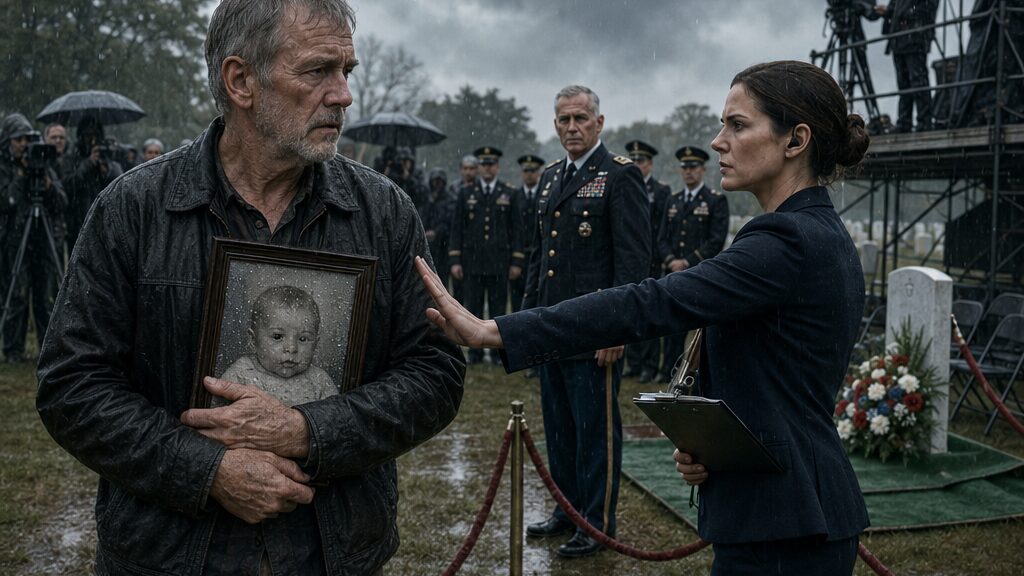
Carefully he adjusted the framed photograph under his arm.
The glass reflected the pale morning sky.
A newborn boy stared back from the picture.
Frank Anderson.
Three months old.
Named after a man who had never met him.
Jack resumed walking.
He had not driven across three states to turn around because someone scheduled a ceremony.
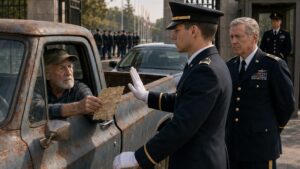
A young soldier standing near the checkpoint noticed him approaching.
“Sir, visitors need to use the alternate entrance today.”
Jack nodded.
“That’s fine.”
The soldier pointed toward a distant path.
“The cemetery itself is restricted near the central section.”
Jack’s gaze drifted toward the middle rows.
His destination sat there.
Section Four.
Row Nine.
Frank Thompson.
The soldier followed his eyes.
“Sorry, sir.”
Jack offered a faint smile.
“It’s alright.”
It wasn’t.
But there was no point arguing with a kid following orders.
He moved toward the alternate route.
The walk took nearly twenty minutes.
By the time he reached the second checkpoint, several television crews had arrived.
Politicians stepped from black vehicles.
Staff members rushed around carrying folders and radios.
Jack waited patiently until someone noticed him.
A woman in a navy blazer finally approached.
She looked exhausted.
And annoyed.
“Can I help you?”
Jack lifted the framed photograph slightly.
“I’m here to visit a grave.”
She glanced at his worn jacket.
His scuffed boots.
The weathered backpack hanging from his shoulder.
Then she looked at the photograph.
“Which grave?”
“Frank Thompson.”
Something changed in her expression.
Not sympathy.
Calculation.
She checked a clipboard.
Then checked it again.
“No.”
Jack blinked.
“No?”
“That section is closed.”
“I only need a few minutes.”
“It’s unavailable.”
Jack shifted his weight.
“My friend is buried there.”
The woman looked toward the ceremony preparations.
“Sir, we’re preparing for an inspection.”
“I understand.”
“Then you understand why access is restricted.”
Jack remained silent.
She interpreted that silence as agreement.
It wasn’t.
He simply didn’t know how to explain something people rarely understood.
The woman extended a hand.
“Angela Wright.”
Jack nodded.
“Jack Anderson.”
“Mr. Anderson, I’m coordinating today’s event.”
She spoke quickly.
Efficiently.
As if solving a scheduling problem.
“We have military leadership arriving. Government representatives. Media coverage.”
Jack looked past her.
Toward the headstones.
“Frank’s grave is being used?”
Angela glanced at the clipboard again.
“Yes.”
The answer landed harder than expected.
“Used?”
“For photographs.”
Jack stared.
Angela seemed unaware of how the word sounded.
Or perhaps she didn’t care.
“The politicians are doing a photo opportunity at that location.”
For several seconds neither spoke.
Finally Jack asked quietly,
“At his grave?”
“At the memorial section.”
She corrected herself immediately.
Corporate language.
Safer language.
Cleaner language.
The kind that made uncomfortable truths disappear.
Jack looked down at the photograph in his hands.
Three months old.
Still too young to sit upright.
His wife had spent nearly an hour taking pictures.
She wanted the perfect one.
Jack had wanted one Frank would have liked.
He wasn’t sure whether he succeeded.
“I came a long way.”
Angela checked her watch.
“So did many people.”
The answer felt rehearsed.
Jack had heard versions of it before.
Not here.
Elsewhere.
Hospitals.
Government offices.
Airports.
Places where people reduced human stories to processing times.
He took a slow breath.
“I’ll stay out of the way.”
“No.”
“I won’t interrupt anything.”
“No.”
The second refusal arrived even faster.
Angela pointed toward the parking area.
“You need to leave the restricted zone.”
Something tightened inside him.
Not anger.
Something older.
More familiar.
The feeling of becoming invisible while standing directly in front of someone.
A photographer walked past carrying equipment.
Another worker adjusted flags.
Nobody noticed the conversation.
Nobody noticed the veteran holding a baby photograph.
Nobody except an elderly visitor standing nearby.
The man glanced at Jack.
Then at the photograph.
Then looked away.
Jack swallowed.
“Today is important.”
Angela folded her arms.
“Today is important for everyone involved.”
The sentence sounded reasonable.
Which somehow made it worse.
Reasonable words often hid unreasonable choices.
A radio crackled at Angela’s shoulder.
She answered immediately.
As Jack waited, he noticed movement near the center of the cemetery.
Workers were gathering around one specific headstone.
His headstone.
Frank’s.
A camera crew positioned lights.
Someone adjusted flowers.
Someone else measured angles.
They were arranging a dead man’s grave like a stage set.
When Angela finished the call, Jack spoke again.
“Why that one?”
“What?”
“Why Frank’s grave?”
Angela glanced toward the activity.
“Historical significance.”
Jack almost laughed.
Historical significance.
The phrase somehow managed to erase an entire human life.
Frank had been funny.
Frank had been stubborn.
Frank had snored louder than anyone in their unit.
Frank had wanted a family.
Historical significance.
Angela checked another message.
“We’re done here.”
Jack looked toward the grave once more.
Then down at the photograph.
His hand tightened around the frame.
“We made a promise.”
Angela sighed.
The kind of sigh someone makes when a conversation refuses to end.
“Sir—”
“I told him I’d come back.”
She rubbed her forehead.
“Please don’t do this.”
“Do what?”
“Create a scene.”
Jack glanced around.
He stood alone.
Quiet.
Holding a baby photograph.
The irony almost hurt.
“I’m not creating one.”
Angela’s voice hardened.
“Then leave before security gets involved.”
For the first time, something flashed across Jack’s face.
Not anger.
Disappointment.
Deep enough to be mistaken for exhaustion.
Angela noticed it.
For a brief moment uncertainty flickered behind her eyes.
Then the radio crackled again.
And the moment vanished.
Jack looked at the photograph one last time.
At the tiny face inside the frame.
At the name written beneath it.
Frank Anderson.
He lifted the picture slightly.
Not as evidence.
Not as an argument.
Simply because it felt wrong not to.
“My son.”
Angela stared.
Jack’s voice remained quiet.
“His name is Frank.”
A faint crease appeared between her brows.
“He was born three months ago.”
Neither moved.
Jack looked toward the distant grave.
Then back at her.
“I named him after the man buried there.”
Chapter 2: The Name Inside the Photograph
Angela said nothing at first.
The noise of the event filled the silence between them.
Vehicles arriving.
Radios crackling.
Footsteps on gravel.
Jack watched her process the information.
For a second he thought something might change.
Not sympathy.
Just enough humanity to make room for a conversation.
Instead she glanced at her watch again.
“We still can’t allow access.”
Jack nodded slowly.
He had expected that answer.
The strange thing was that hearing it still hurt.
“Why tell me his name?” Angela asked.
Jack looked at the photograph.
“Because you asked me to leave.”
“I didn’t ask.”
“You ordered.”
Angela’s jaw tightened.
“You’re making this difficult.”
“No.”
He looked toward the graveyard.
“I’m trying not to.”
The words landed harder than he intended.
Angela turned away briefly and spoke into her radio.
Jack waited.
Patience had become a habit over the years.
You learned patience when hospitals delayed appointments.
When government paperwork disappeared.
When every staircase became an obstacle.
When memories followed you longer than people did.
Angela finished her call.
“Look, Mr. Anderson. I understand this matters to you.”
Jack wasn’t sure she did.
But he let her continue.
“We’ve spent six months preparing for today.”
She pointed toward the gathering crowd.
“Military leadership. State officials. Reporters.”
Her voice softened slightly.
“If anything goes wrong, everyone notices.”
Jack looked around.
Nobody seemed worried about anything except schedules.
“What exactly goes wrong if I visit a grave?”
Angela opened her mouth.
Then closed it.
The answer sounded different when spoken aloud.
A nearby worker saved her.
“Angela, media team needs approval on the western platform.”
“Coming.”
She turned back to Jack.
“You need to stay outside the restricted area.”
Then she left.
Just like that.
Conversation over.
Decision final.
Jack stood alone near the barrier.
The photograph felt heavier now.
A gust of wind rattled the fencing.
He found a nearby bench and sat carefully.
His prosthetic clicked against the concrete.
For a while he simply watched people move.
Everyone appeared busy.
Purposeful.
Important.
Nobody seemed to notice the cemetery itself.
Only the event happening inside it.
Jack placed the photograph beside him.
The baby smiled at nothing.
Too young to understand names.
Too young to understand promises.
A shadow fell across the bench.
Jack looked up.
The elderly visitor from earlier stood there.
“Mind if I sit?”
Jack shook his head.
The man lowered himself carefully.
For several moments neither spoke.
Then the stranger glanced at the photograph.
“That’s a handsome kid.”
Jack smiled faintly.
“My wife says he got lucky.”
The old man chuckled.
“Probably true.”
His eyes drifted toward the name beneath the picture.
The smile disappeared.
“Frank?”
Jack nodded.
The man’s gaze sharpened.
“Frank Thompson?”
Jack turned toward him.
“You knew him?”
“Not personally.”
The man leaned back.
“But I know the name.”
A strange tension entered Jack’s chest.
Not hope.
Something close.
The visitor extended a weathered hand.
“Former Army.”
Jack shook it.
The grip remained firm despite age.
The man stared toward the central cemetery section.
“Ridge Forty-Seven.”
Jack froze.
Most people had forgotten.
That battle existed mostly in reports now.
Footnotes.
Statistics.
A few names carved into stone.
“You remember it?”
The man laughed softly.
“Hard to forget.”
Jack looked away.
The bench suddenly felt smaller.
The old veteran studied him.
Then studied the prosthetic.
Recognition flickered.
Not complete.
Not yet.
“You were there.”
Jack didn’t answer.
The silence answered anyway.
The older man nodded slowly.
“I thought so.”
A memory stirred behind Jack’s eyes.
Dust.
Smoke.
Radio chatter.
The sound of Frank laughing the night before everything changed.
Jack pushed it away.
Not here.
Not today.
The old veteran pointed toward the photograph.
“So that’s why?”
Jack looked down.
“Part of why.”
The man waited.
Jack rarely talked about Frank.
Most people wanted the military version.
The heroic version.
The clean version.
The truth wasn’t clean.
The truth never was.
“I come every year.”
The old man nodded.
“I figured.”
“Same day.”
“How long?”
Jack calculated briefly.
“Twenty-eight years.”
The older veteran stared.
Not because of the number.
Because of what the number meant.
Twenty-eight years of returning.
Twenty-eight years of carrying something unfinished.
Neither spoke for a while.
Then the man asked quietly,
“Does his family come?”
Jack looked toward the rows of white headstones.
“No.”
“What happened?”
“I don’t know.”
The answer surprised the man.
Jack understood why.
Most people assumed he knew everything about Frank.
The reality was more complicated.
After the war, life scattered everyone.
Addresses changed.
Records disappeared.
Families moved.
Years passed.
All Jack ever had was a promise.
The old veteran nodded slowly.
No further questions.
Perhaps he recognized the look in Jack’s eyes.
Some stories stop where words fail.
A sudden burst of activity interrupted them.
Security personnel began moving through the area.
More barriers appeared.
A supervisor carried a stack of signs.
RESTRICTED ACCESS.
AUTHORIZED PERSONNEL ONLY.
The event was expanding.
Not shrinking.
Jack watched workers close the final route leading toward Section Four.
The last possibility disappeared.
The old veteran noticed.
“So that’s it?”
Jack looked at the photograph.
A tiny smile stared back.
Unaware of disappointment.
Unaware of history.
Unaware that he carried another man’s name.
Jack carefully picked up the frame.
He brushed dust from the corner.
Then he stood.
The movement hurt.
His prosthetic complained immediately.
The old veteran rose as well.
“You leaving?”
Jack nodded.
For a moment.
Only a moment.
He considered explaining everything.
The promise.
The battlefield.
The request.
All of it.
Instead he said the thing he always said.
The safer thing.
“I’ll come back another day.”
The words sounded false before they finished leaving his mouth.
Both men knew it.
Anniversaries didn’t move.
Promises didn’t move.
This day mattered.
The old veteran looked toward the graveyard.
Then back at Jack.
“What happened between you and Frank?”
Jack’s gaze settled on the photograph.
A memory flashed.
Blood.
Smoke.
A grin through exhaustion.
A voice saying something impossible.
Something that had followed him for nearly three decades.
Jack swallowed.
Then turned away.
“I should go.”
The old veteran didn’t stop him.
Jack adjusted the backpack strap across his shoulder.
Lifted the photograph.
And began limping toward the parking area.
Behind him, the ceremony preparations continued.
Ahead of him, the long road home waited.
For the first time in twenty-eight years, he was leaving before reaching the grave.
Chapter 3: The Battle Nobody Likes Discussing
The first drops of rain hit the pavement before Jack reached his truck.
He stopped.
Not because of the weather.
Because his leg suddenly felt heavier than usual.
As if every step away from the cemetery carried its own weight.
He stood beside the driver’s door and looked back.
The rows of white markers were barely visible beyond the fencing.
Section Four couldn’t be seen at all.
Frank was somewhere beyond the barriers.
A few hundred yards away.
Might as well have been another country.
Jack rested a hand on the truck.
Rain tapped softly against the photograph’s glass.
He wiped it away immediately.
The gesture felt automatic.
Protect the picture.
Protect the promise.
Protect what remained.
The first year after Ridge Forty-Seven, he’d come carrying flowers.
The second year, a letter.
The third year, nothing.
Just himself.
The offerings changed.
The promise never did.
A distant drumbeat rolled across the cemetery.
The ceremony was beginning.
Jack closed his eyes.
And despite every effort, memory found him.
Ridge Forty-Seven.
Twenty-eight years earlier.
The mountain had looked harmless from a distance.
Most disasters did.
Frank Thompson had been sitting beside him on an ammunition crate the night before deployment.
Young.
Dirty.
Exhausted.
Alive.
“You ever think about names?” Frank had asked.
Jack remembered laughing.
“What kind of question is that?”
“The kind people ask before terrible missions.”
“You planning on dying tomorrow?”
Frank had grinned.
“No.”
Then after a pause:
“But if I do, somebody ought to remember me properly.”
Jack remembered throwing a ration packet at him.
Frank had thrown it back.
For several minutes they’d argued about stupid things.
Sports teams.
Bad coffee.
Who cheated worse at cards.
The sort of conversation that seemed meaningless until it became the last one.
Rain pulled Jack back to the present.
He opened his eyes.
The cemetery remained where it had always been.
Only farther away now.
A vehicle passed behind him.
Military personnel heading toward the ceremony.
Nobody noticed him.
The forgotten visitor.
The unwanted guest.
He unlocked the truck.
Then stopped.
Something inside him refused to climb into the driver’s seat.
Not yet.
Instead he turned and started walking again.
Not toward the entrance.
Toward the outer fence line.
He told himself he only wanted one last look.
Nothing more.
The rain strengthened.
By the time he reached the perimeter road, his jacket was damp.
A few reporters hurried past carrying equipment.
Nobody paid attention.
Good.
Jack preferred it that way.
He followed the fence until he found a section overlooking the cemetery’s central grounds.
The view wasn’t perfect.
But it was enough.
Enough to see movement around Frank’s grave.
Enough to see cameras.
Enough to see people smiling for photographs.
Jack looked away.
The memory returned before he could stop it.
Ridge Forty-Seven.
The day everything broke.
Gunfire.
Dust.
Chaos.
Men shouting over radios.
The mountain collapsing into confusion.
And Frank.
Always moving.
Always helping someone.
Even when common sense demanded retreat.
Jack remembered the explosion.
Not clearly.
Memory never preserved explosions correctly.
Only fragments survived.
A flash.
Pressure.
Silence.
Then pain.
When he woke, half the world had disappeared.
His leg.
Several friends.
Entire sections of the hillside.
Frank had still been alive then.
Barely.
Jack remembered crawling.
Remembered trying to reach him.
Remembered the blood.
Most of all, he remembered the argument.
“You need a medic.”
Frank had laughed.
“You need two.”
“I’m not leaving.”
“You are.”
Jack stared through the rain.
The memory sharpened.
Not enough.
Never enough.
Twenty-eight years later pieces remained missing.
Yet one detail survived untouched.
Frank grabbing his sleeve.
Holding him there.
Forcing eye contact.
“If you ever have a kid…”
Jack’s throat tightened.
The rest came back slowly.
“If you ever have a kid, give him my name.”
Jack had thought the request was ridiculous.
Even then.
Especially then.
Frank had been smiling.
Actually smiling.
As if they were discussing baseball instead of death.
“You’ll do it?”
Jack had promised.
Because people promise impossible things in impossible moments.
Because saying no felt cruel.
Because neither of them truly believed it would matter.
The rain intensified.
Jack opened his eyes.
The fence blurred behind sheets of water.
Twenty-eight years.
And the promise had followed him through every one.
Marriage.
Jobs.
Hospitals.
Middle age.
Everything.
Then finally, three months ago, his son arrived.
Frank Anderson.
Promise fulfilled.
Almost.
A whistle cut through the rain.
Sharp.
Commanding.
Official.
Jack looked toward the cemetery.
An inspection group had entered the grounds.
Senior officers.
Military escorts.
Visitors.
One figure stood out immediately.
Tall.
Decorated.
Moving with practiced authority.
The commander leading the inspection.
Jack watched the group advance through the cemetery.
Closer.
Closer.
Toward Section Four.
Toward Frank.
Toward the grave he still couldn’t reach.
He turned away.
Enough.
There was nothing left to do.
The promise would have to wait.
Again.
Jack started walking back toward the parking area.
His limp was more pronounced now.
Rainwater collected around the prosthetic joint.
Each step produced a faint mechanical click.
Step.
Click.
Step.
Click.
Behind him, the inspection party continued moving through the cemetery.
Ahead of him waited the truck.
The drive home.
The disappointment.
The familiar silence.
Then a voice echoed across the grounds.
Not loud.
But sudden.
Sharp enough to stop movement.
Jack didn’t hear the words.
Only the tone.
The kind of tone that makes people pay attention immediately.
He glanced back.
The inspection party had stopped.
Completely.
The commander wasn’t walking anymore.
He was staring.
Directly at Jack.
At first Jack assumed someone else stood behind him.
He turned.
Nobody.
When he looked back, the commander’s eyes remained fixed on him.
Not on his face.
Not on the photograph.
On his leg.
On the prosthetic.
The commander’s expression changed.
Confusion.
Recognition.
Shock.
Then he took one step forward.
And said something to the officer beside him.
The officer turned quickly.
Looked at Jack.
Then looked again.
Jack felt a strange unease crawl through him.
The commander raised a hand.
Not in greeting.
Not in farewell.
In realization.
As though a forgotten memory had suddenly returned.
And for the first time that day, someone inside the cemetery seemed to know exactly who he was.
Chapter 4: The Survivor from Ridge Forty-Seven
The commander broke formation.
That alone was enough to make several officers glance at one another.
Inspection schedules were precise. Routes were planned. Stops were timed.
Yet the commander ignored all of it.
He stepped away from the delegation and continued staring at Jack.
Rain darkened his uniform.
An aide hurried after him.
“Sir?”
The commander didn’t answer.
Jack stood motionless near the perimeter road, unsure whether he should leave or stay.
The inspection group had stopped entirely now.
Several politicians looked confused.
Camera operators lowered their equipment.
Something unexpected was happening.
The commander crossed the grass.
When he finally reached Jack, he stopped several feet away.
His eyes remained fixed on the prosthetic leg.
Not the modern components.
Not the polished joints.
The old damage above it.
The scars.
The way Jack walked.
Recognition settled fully across the man’s face.
“Jack Anderson?”
Jack frowned.
The voice sounded familiar.
Not personally familiar.
Institutionally familiar.
A voice accustomed to command.
“Yes.”
The commander stared another moment.
Then he extended his hand.
“Eric Robinson.”
Jack shook it automatically.
The name registered a second later.
He had heard it before.
Years ago.
Reports.
Promotions.
Command appointments.
The realization surprised him.
Eric Robinson was not supposed to know who he was.
Apparently Eric felt differently.
“You were at Ridge Forty-Seven.”
Jack hesitated.
Then nodded.
A strange silence followed.
Not awkward.
Respectful.
Several officers had gathered nearby now.
Watching.
Listening.
One of them spoke quietly.
“Sir?”
Eric ignored him.
Instead he asked Jack a question nobody had asked in decades.
“How long has it been since you’ve visited?”
Jack glanced toward the cemetery.
“Twenty-eight years.”
Every year.
He didn’t need to add that part.
Something in Eric’s expression suggested he already understood.
The commander looked at the photograph.
“Your grandson?”
“My son.”
That answer surprised everyone.
Including Eric.
Jack almost smiled.
Almost.
“He arrived three months ago.”
Eric studied the photograph carefully.
Then he saw the name written beneath it.
Frank Anderson.
The commander’s eyes lifted.
Slowly.
Jack knew exactly what question was coming.
“What does Frank mean to you?”
Jack looked toward Section Four.
Toward the grave hidden behind the event.
“My best friend.”
The words sounded too small.
Too simple.
They always did.
Eric followed his gaze.
Then looked back toward the cemetery.
The realization hit him immediately.
“The grave.”
Jack nodded.
“Frank Thompson.”
Several nearby officers exchanged looks.
One of them whispered something under his breath.
The name carried weight.
Not because Frank had become famous.
Because Ridge Forty-Seven still lived in military history.
Not publicly.
Among soldiers.
Among people who studied casualty reports and impossible decisions.
Eric remained silent for several seconds.
Then he asked quietly,
“They blocked you?”
Jack could have answered with anger.
Or bitterness.
Or humiliation.
Instead he said what he always said.
“They had reasons.”
Eric’s jaw tightened.
The answer irritated him.
Not because it was wrong.
Because it sounded familiar.
The kind of answer soldiers gave while protecting everyone except themselves.
A voice interrupted.
“Commander Robinson?”
Angela Wright approached rapidly.
Her expression shifted the moment she realized who stood in front of her.
Concern.
Confusion.
Professional caution.
“Sir, we’re about to begin the next portion of the inspection.”
Eric turned toward her.
“This man was denied access?”
Angela straightened immediately.
“The cemetery section is restricted for today’s ceremony.”
“Why?”
“Security requirements.”
“Why that grave?”
Angela hesitated.
For the first time all day she seemed uncertain.
“The historical display plan selected it.”
“Who approved that?”
The question landed harder than expected.
Angela glanced toward several officials.
Nobody answered.
Eric waited.
Rain drummed softly against uniforms and tents.
Finally Angela spoke.
“Sir, the decision was made months ago.”
“After anyone checked whether family or visitors still came?”
Silence.
Jack watched the exchange carefully.
Something about it bothered him.
Not because Eric was defending him.
Because he wasn’t comfortable being defended.
Especially publicly.
He had spent decades avoiding exactly this kind of attention.
Angela crossed her arms.
“The event isn’t about one individual.”
Eric looked at her.
No anger.
No raised voice.
Only disappointment.
“That’s exactly the problem.”
The words silenced everyone nearby.
A politician cleared his throat.
Nobody listened.
Eric looked back toward Jack.
“What did you bring?”
Jack held up the photograph.
The rain had spotted the glass.
He wiped it gently.
“My son.”
Eric studied it again.
Something softened in his face.
“He carries Frank’s name.”
Jack nodded.
The commander looked away.
Toward the cemetery.
Toward the grave hidden behind ceremony preparations.
Toward a place meant for remembrance that had somehow become a backdrop.
An officer approached quietly.
“Sir, the media team is waiting.”
Eric never took his eyes off Section Four.
“Let them wait.”
The officer froze.
The answer spread through nearby personnel almost immediately.
Something was changing.
Jack could feel it.
Not victory.
Not yet.
But possibility.
For the first time that day, the outcome no longer felt decided.
Eric turned toward Angela.
“What exactly happened when he arrived?”
Angela opened her mouth.
Then stopped.
Because dozens of people were listening now.
Because the story sounded different outside planning meetings and schedules.
Because saying it aloud would expose what had really happened.
Eric waited.
Rain continued falling.
Nobody moved.
Finally Angela answered.
And for the first time, the entire inspection began hearing the story of a veteran who had come carrying a child’s photograph and been told he was ruining the view.
Chapter 5: The Order That Stopped the Parade
The parade had already begun moving when Eric Robinson raised his hand.
Across the cemetery grounds, drums echoed through the rain.
Soldiers marched in precise formation.
Officials stood beneath umbrellas.
Media crews positioned themselves for the perfect shot.
Everything had been choreographed.
Everything except what happened next.
“Stop the parade.”
The command traveled through radios first.
Then through officers.
Then through confused organizers.
The drums ceased abruptly.
The silence that followed felt louder than the music.
Angela stared.
“So you’re stopping the entire event?”
Eric looked at her.
“I’m correcting it.”
Nearby officials exchanged uneasy glances.
One politician stepped forward.
“Commander, perhaps we can resolve this afterward.”
Eric’s gaze shifted toward him.
“After what?”
“The ceremony.”
“The ceremony honoring sacrifice?”
The politician said nothing.
Eric nodded once.
As if confirming something to himself.
Then he turned away.
Jack wished he hadn’t.
The attention had become overwhelming.
Everywhere he looked, people were watching.
Reporters.
Soldiers.
Staff.
Strangers.
He wanted none of it.
He only wanted to reach Frank.
Nothing more.
Eric seemed to understand.
Because when he spoke again, his voice remained calm.
“This isn’t about publicity.”
No cameras.
No speeches.
No grand gesture.
Just a simple statement.
Yet somehow it carried more weight than anything else said that day.
Angela looked genuinely frustrated now.
Months of preparation were unraveling.
Schedules were collapsing.
People above her would demand explanations.
Jack saw the pressure in her face.
For the first time he understood part of her mistake.
She had spent so long protecting the event that she stopped seeing the people inside it.
That didn’t excuse her.
But it explained her.
Eric motioned toward the photograph.
“Tell me about him.”
Jack followed his gaze.
The child smiled from inside the frame.
“He was born in March.”
“And his name?”
“Frank.”
Eric nodded.
The surrounding officers listened quietly.
Jack shifted uncomfortably.
He hated speaking in front of groups.
Always had.
Yet somehow the words emerged.
“Frank Thompson asked me for one thing.”
Nobody interrupted.
“He asked me that if I ever had a son, I’d give him his name.”
A few people smiled.
Others looked away.
The request sounded simple.
Almost ordinary.
Until one considered the years between the promise and its fulfillment.
Eric spoke softly.
“You remembered.”
Jack laughed once.
Without humor.
“Hard to forget.”
That answer carried more truth than most realized.
Twenty-eight years.
Twenty-eight anniversaries.
Twenty-eight visits.
Every year another reminder that he remained alive while Frank did not.
The rain intensified.
A reporter lowered a camera.
Not out of respect.
Because something more important than a photograph was unfolding.
Eric looked toward the cemetery center.
Then toward the soldiers standing in formation.
Rows of men and women waiting for orders.
Waiting for meaning.
Suddenly he seemed to make a decision.
A permanent one.
He stepped toward the nearest officer.
“Clear the field.”
The officer blinked.
“Sir?”
“All of it.”
The command spread outward.
Confusion followed.
Then movement.
Officers relayed instructions.
Soldiers adjusted positions.
Rows shifted.
The parade route changed.
A corridor began opening across the grass.
Directly toward Section Four.
Directly toward Frank’s grave.
Gasps moved through the gathered crowd.
Nobody had planned this.
Nobody expected it.
Yet the path continued widening.
A living passage through uniforms and ceremony.
Angela stared in disbelief.
The politicians said nothing.
There was nothing to say.
The symbolism was too obvious.
Too powerful.
For years Jack had avoided attention.
Now an entire military formation was stepping aside for him.
The irony nearly made him uncomfortable enough to leave.
Almost.
Then he looked down at the photograph.
Frank Anderson.
Three months old.
The promise deserved completion.
No matter how awkward the journey became.
Eric returned to his side.
“You came all this way.”
Jack nodded.
“Then finish it.”
The words struck deeper than they should have.
Not because of authority.
Because of permission.
For years Jack had treated remembrance like a duty.
Something endured.
Something survived.
Something carried.
He had never considered that he might be allowed to finish grieving.
The path stood open before him.
Rain falling.
Soldiers waiting.
The grave somewhere ahead.
Jack took a breath.
Then another.
Finally he stepped forward.
The crowd parted completely.
No applause.
No cheering.
Only silence.
The respectful kind.
The kind Frank would have appreciated.
Jack walked.
Step.
Click.
Step.
Click.
His prosthetic echoed softly across the wet ground.
Nobody spoke.
The photograph remained tucked safely beneath his arm.
Ahead, white headstones stretched into the rain.
And somewhere among them waited the friend he had spent twenty-eight years trying to reach.
At the edge of Section Four, Jack finally saw the stone.
Frank Thompson.
Waiting exactly where it had always been.
Chapter 6: What Frank Actually Asked For
Jack stopped in front of the headstone.
The world behind him disappeared.
The crowd.
The parade.
The officials.
The cameras.
None of them mattered anymore.
Only the stone.
Only the name.
Only the years compressed into the few feet separating him from the grave.
He lowered himself carefully to one knee.
The motion hurt.
He barely noticed.
Rain slid across the polished surface of the marker.
Frank Thompson.
Beloved Son.
Beloved Friend.
The familiar words greeted him.
Twenty-eight years.
And they still hit the same way.
Jack set the photograph against the headstone.
The small frame rested securely at its base.
For a long moment he simply looked at it.
The old name.
The new face.
Connected by a promise neither could fully understand.
“I made it.”
The words came out rough.
Unused.
Nobody heard them except the dead.
And maybe that was enough.
Jack stared at the photograph.
Then at the stone.
Then back again.
The memory arrived without warning.
Not fragmented this time.
Not broken.
Complete.
Ridge Forty-Seven.
Smoke filling the air.
The mountainside collapsing into chaos.
The terrible certainty that somebody would not leave alive.
For twenty-eight years Jack remembered only pieces.
The explosion.
The blood.
The guilt.
But kneeling beside the grave, another detail returned.
One he had spent decades avoiding.
Frank had not been trapped.
Not at first.
Frank had a choice.
Jack saw it clearly now.
A wounded group remained pinned behind damaged cover.
Extraction was possible.
But only if someone stayed behind.
Only if someone delayed the attack.
Only if someone accepted the cost.
Jack remembered shouting.
Arguing.
Trying to stop him.
Frank had laughed.
Even then.
Especially then.
“You always think stubborn means smart.”
Jack squeezed his eyes shut.
The memory continued anyway.
“I can help.”
“No.”
“You don’t get to decide.”
“I’m deciding.”
Jack remembered trying to move.
Trying to stand.
The damaged leg refused.
Frank grabbed his shoulder.
Forced him still.
Not because Jack was weak.
Because Frank had already made his choice.
The realization struck harder than any memory before it.
For years Jack believed he caused Frank’s death.
Believed a mistake.
A decision.
A failure.
Had put him in that position.
But that wasn’t what happened.
Frank saw the situation.
Frank chose.
Frank stayed.
Jack opened his eyes.
Rain blurred the headstone.
Or perhaps something else did.
He wasn’t sure.
Another memory surfaced.
The final conversation.
The one that had haunted him longest.
“If you ever have a kid…”
Jack looked down at the photograph.
Frank Anderson.
Three months old.
The promise fulfilled.
Almost.
The rest of the sentence returned.
Not piece by piece.
All at once.
“Give him my name.”
Frank had smiled.
Then added something Jack never allowed himself to remember.
“Not so you keep looking backward.”
Jack stared.
The words echoed through him.
Frank’s voice.
Clear.
Young.
Certain.
“Do it so somebody keeps moving forward.”
Jack lowered his head.
For nearly three decades he carried the wrong burden.
Not remembrance.
Punishment.
He had turned a promise into a sentence.
Turned memory into guilt.
Turned survival into something requiring repayment.
A step sounded behind him.
Then another.
But nobody interrupted.
Nobody approached.
The space remained his.
Jack wiped rain from the photograph.
His hand trembled slightly.
“He’s a good kid.”
A foolish statement.
The baby was three months old.
Yet somehow it felt important.
“He cries too much.”
A weak laugh escaped him.
“His mother says he got that from me.”
Silence.
Then another breath.
Another truth.
The hardest one.
“I’m sorry.”
The words hung there.
For years he thought they belonged to Frank.
Now he realized they belonged to himself.
Sorry for surviving.
Sorry for failing.
Sorry for every imagined mistake.
Sorry for things that never required apology.
Rain continued falling.
The burden began loosening.
Not disappearing.
Never disappearing.
Just changing shape.
A memory instead of a punishment.
A promise instead of a debt.
Jack looked up.
Beyond the rows of headstones stood Eric Robinson.
Exactly ten paces away.
Motionless.
Saluting.
Not for the cameras.
Most had stopped recording.
Not for the politicians.
Many had already lowered their umbrellas.
Not for ceremony.
For Frank.
For Jack.
For something both men represented.
The commander hadn’t moved.
Neither had the soldiers behind him.
A line of silent figures standing in the rain.
Witnessing.
Remembering.
Jack looked back at the photograph.
Then gently adjusted it against the stone.
For the first time in twenty-eight years, he no longer felt like he was leaving something unfinished.
The story has ended.