The Old Veteran Held One Folded Letter While Everyone At The Ceremony Looked Past Him
Chapter 1: The Hand That Blocked The Letter
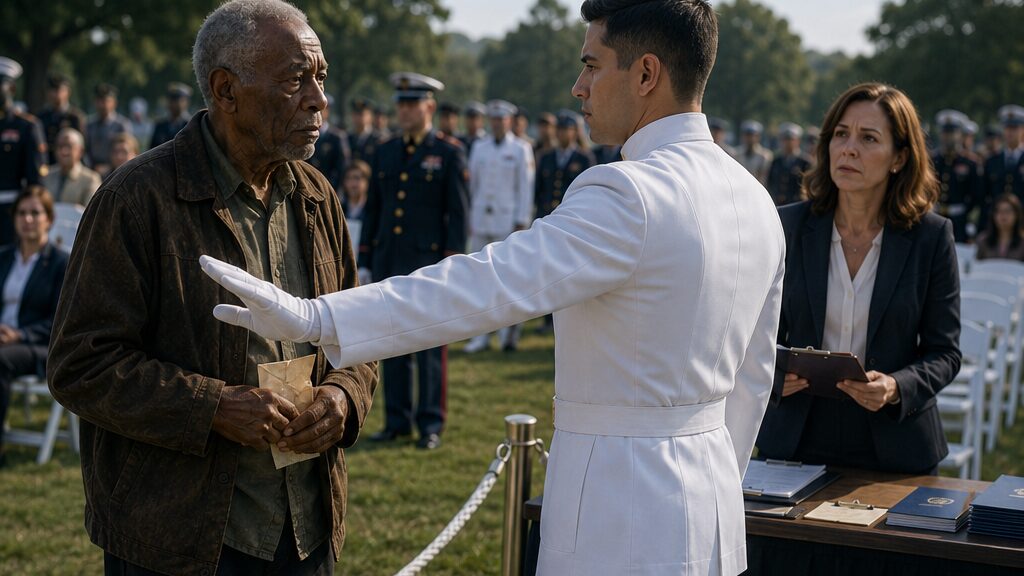
The officer’s hand came up before Donald Brown could say his name.
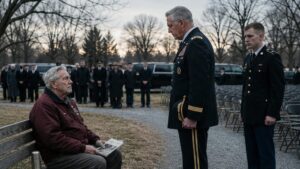
It stopped inches from the center of Donald’s chest, flat-palmed, white-gloved, polished enough that the morning sun flashed across the seams. Behind that hand, beyond the rope line and the folding tables, rows of dress uniforms stood in bright order across the lawn. Brass buttons caught the light. Shoes shone black against the trimmed grass. A flag moved slowly above the memorial platform, its cloth snapping once in the wind and then settling back into a solemn ripple.
Donald stood on the other side of the rope in his brown jacket.
It was the best one he owned. He had brushed it twice before leaving the house and used a damp cloth on the cuffs where the fabric had gone shiny from age. The collar still sat wrong against his neck. One sleeve had faded more than the other. Beside the men in white dress uniforms and the families in dark Sunday clothes, he looked like someone who had taken a wrong turn and ended up at a ceremony meant for other people.
The young officer looked him over once.
“Sir, this area is restricted.”
Donald heard the word sir. He heard the warning underneath it.
“I understand,” Donald said.
His voice came out lower than he meant. He had not used it much that morning. He had driven forty minutes with the radio off, both hands on the wheel, the folded letter resting in the inside pocket of his jacket like a second heartbeat.
The officer’s nameplate read Martinez. His jaw was clean, his hair close-cut, his uniform so white it seemed almost separate from the dust and grass and heat. He stood straight in the way young men stood when they had been trusted with a boundary.
Donald reached slowly toward his coat.
Martinez’s hand rose another inch.
“Please keep your hands where I can see them.”
Donald stopped.
A woman at the check-in table glanced up from a stack of folders. Two volunteers beside her were passing out programs, smiling at guests, directing people toward the rows of white chairs. For a moment her eyes moved over Donald the way the officer’s had: jacket, old shoes, no visible badge, no lanyard, no printed invitation in his hand.
Then she looked down again.
Donald let his hand remain in the air, open.
“I have a letter,” he said.
“Registration is at the table,” Martinez said. “If your name isn’t listed, you’ll need to wait outside the ceremony area until we verify.”
“I was told to come here.”
“By who?”
Donald looked past the officer toward the platform.
At the center of it stood a covered plaque draped in dark blue cloth. Beside it were three framed photographs set on easels. He could not see the faces from where he stood, but he knew one of them. He had known it young. He had known it thin and sunburned and laughing in a place where laughter had always sounded borrowed. He had known it looking over a tin cup of bad coffee and saying, Brown, if I don’t get home, don’t let them make me braver than I was.
A family moved around Donald, careful not to touch him. A woman in a black dress pulled a child closer as they passed. The child looked at Donald’s shoes, then at the officer’s hand, then away.
Donald swallowed.
“Steven Baker,” he said.
Martinez’s expression did not change.
“This ceremony is for several service members, sir. Family and listed guests only.”
Donald nodded once, because the words were not unreasonable. That was the trouble with them. They sat in the air cleanly, as if nothing in them could wound.
“I know who it’s for.”
“Then you understand why we can’t allow disruptions.”
The word landed softly. Disruptions.
Donald had been called worse by men with less polish. He had been called boy by men who needed him to carry ammunition. He had been called lucky by men who did not know what luck smelled like after smoke cleared. He had been called survivor by a chaplain who meant kindness and still made Donald want to put his fist through a wall.
But disruption, here, with Steven’s name on the lawn and Steven’s daughter somewhere among the chairs, made the inside of his jacket feel too tight.
He tried again, slower this time. “I’m not here to disrupt anything.”
Martinez looked over his shoulder at the table. “Ms. Hall?”
The woman with the folders looked up again. She had a clipboard tucked beneath one arm and a pen held between two fingers. “Is there a problem?”
“Gentleman says he was invited by one of the honorees.”
A slight pause followed. It was not laughter. No one laughed. But the volunteers heard it. One of them stopped sliding programs into a neat stack. A man in uniform near the rope line turned his head.
Donald felt the shape of the folded letter through the fabric of his coat.
“I didn’t say invited,” he said quietly. “I said told.”
Martinez’s eyes returned to him. “Sir, these families have waited a long time for today. We’re asking everyone to respect the process.”
Donald could have taken the letter out quickly. He could have pushed it past the white glove. He could have raised his voice enough for the people in the first row to hear him. There were sentences inside him with sharp edges. He had spent years not saying them.
Instead, he moved as if the officer had not already judged the motion.
Two fingers into the inside pocket. Slow. Careful. He drew out a small rectangle of paper, folded twice, softened along every crease. It had been white once. Now it had the color of old bone. The corners had rounded from years of being opened and closed and held without opening. He kept his thumb over the weakest edge, the one that had almost torn the winter after his wife died.
Martinez looked at the paper, then at Donald.
“That isn’t an official pass.”
“No,” Donald said. “It isn’t.”
The wind moved across the lawn. The blue cloth over the plaque shifted and settled. Somewhere behind the platform, a microphone gave a brief squeal before someone lowered the volume.
Donald held the letter out.
Martinez did not take it.
The young officer’s hand remained between them, palm open, no longer just stopping Donald’s body but stopping the letter too. Donald’s arm began to tremble. Not much. Enough that he saw Martinez notice.
“Sir,” Martinez said, softer now, though not kinder. “Please step aside. You’re holding up the entrance.”
Donald looked behind him.
No line had formed. A few guests had slowed, but the other side of the table remained open. People were still being waved through. The ceremony was not being held up by him. It was being held up in him.
The woman from the table came around at last. Her heels pressed small marks into the grass. Up close, Donald saw that she was younger than he first thought, perhaps in her forties, with tired eyes and a badge clipped crookedly to her blazer. The badge read Sarah Hall.
“May I see it?” she asked.
Donald looked at Martinez’s hand.
Sarah noticed it too.
For the first time, the officer lowered his arm.
Donald placed the letter in Sarah’s hand, but he did not let go immediately. His fingers remained on the edge, dark and knotted against the pale paper.
“It’s old,” he said.
“I’ll be careful.”
That was when Donald released it.
Sarah unfolded the first crease. The paper made almost no sound. It had been opened too many times for that. Her expression stayed professionally blank as she glanced down.
Then she stopped.
Donald watched the change happen in the smallest places: the pen lowering in her hand, her shoulders losing their administrative firmness, the line between her brows deepening not with suspicion now, but with attention.
She read silently.
Martinez shifted his weight.
“Ms. Hall?” he said.
Sarah did not answer him. She opened the second crease with more care than the first. Donald could see only the back of the page, thin with age, the old fold lines making a cross through it.
Her lips moved around the first line without speaking.
Donald remembered the line.
Brown, if this reaches you in one piece, then I probably didn’t.
The lawn seemed to grow quieter, though the ceremony continued around them. Programs rustled. A chair leg scraped. Someone laughed softly far away and stopped as if the sound had wandered into the wrong place.
Sarah looked up from the page.
“Mr. Brown,” she said.
Donald’s eyes went to hers.
Not Don. Not sir. Not gentleman.
Mr. Brown.
Martinez heard it too. His face tightened.
Sarah looked back down and read another part, not aloud, but far enough that her eyes reached the middle of the page. Donald knew what waited there. Steven’s uneven handwriting. The dark place where rain had once spotted the ink. The line Donald had not known how to obey for thirty-six years.
If there is ever a day they say my name in front of my family, I want Donald Brown standing there if he can bear it.
Sarah’s hand went still.
She looked at the old man in the worn brown jacket, then at the polished ceremony beyond him, then at the empty spaces on her clipboard.
“Were you,” she asked carefully, “the man he wrote about?”
Chapter 2: The Name Missing From The Roster
Sarah Hall had checked the roster four times before sunrise.
She had checked it in her kitchen with coffee she forgot to drink, then again in the parking lot with the folders spread across her passenger seat, and twice more beneath the white canopy while volunteers taped down extension cords and straightened the registration signs. The names were alphabetized, cross-referenced, color-marked by family, veteran guest, command staff, and public attendee. She had built the ceremony around those lists because lists were how a morning like this avoided turning grief into confusion.
Donald Brown was not on any of them.
His name did not appear under Baker. It did not appear under unit guests. It did not appear under late confirmations. It did not appear on the handwritten sheet the senior officer had given her two days earlier with names he said must not be overlooked.
Yet the letter in her hand had named him.
Sarah stood beside the check-in table with the old paper half-folded against her clipboard, suddenly aware of the absurd contrast between them. Her clipboard was new, plastic, efficient, bright with sticky notes. The letter was thin enough for sunlight to pass through if she lifted it. The ink had faded brown in places. The handwriting sloped as if written in haste or pain.
Ryan Martinez watched her with controlled impatience.
“Is he listed?” he asked.
Sarah did not answer immediately. The question had been simple ten minutes ago. Now it felt like asking whether a person existed because a sheet of paper had made room for him.
“Let me check again,” she said.
Ryan’s mouth tightened. “The ceremony begins in twenty.”
“I know.”
She returned to the table. Donald did not follow until she gestured for him. He came slowly, not because he could not move faster, she thought, but because speed would make him look like he was asking for permission to be seen. He stood at the corner of the canopy, away from the main flow of guests, the way people stand when they are accustomed to making themselves smaller in public spaces.
A volunteer leaned toward Sarah. “Do you need me to call the senior officer?”
“Not yet.”
The volunteer glanced at Donald. “Should he wait near security?”
Donald heard it. Sarah saw that he heard it. His eyes remained on the folded letter, now lying beside her roster.
“No,” Sarah said, sharper than intended. “He can wait here.”
Ryan stepped closer. “Ms. Hall, with respect, we can’t let anyone walk in with an old personal note and claim placement in the program.”
“I’m not suggesting we do.”
“Then what are we doing?”
Sarah opened the binder.
The page for Baker, Steven A. was clipped behind a blue divider. Family representative: Brenda Johnson. Reserved seating: four. Memorial plaque line confirmed. Photograph delivered. Remarks approved. No additional veteran representative listed.
She turned to the unit guest list. Nothing.
She checked handwritten additions. Nothing.
She checked the folder of letters donated by families for the display table. Nothing.
Donald Brown existed nowhere except on the paper Steven Baker had apparently written years before anyone planned this ceremony.
Sarah looked at the letter again.
She had read only enough to understand its force. She had stopped before the lower half because something in Donald’s face had told her the page was not simply evidence. It was a room he had been living in alone. She had no right to walk through it without him.
“Mr. Brown,” she said, “did someone from the organizing office contact you?”
Donald’s thumb rubbed once along the side seam of his jacket. “No.”
“How did you know about today?”
He looked toward the chairs. “Newspaper.”
Ryan exhaled quietly.
Sarah looked at him.
The officer’s expression was not cruel. That made it harder. He was doing what he believed the morning required. He saw holes in a procedure and tried to close them. But there had been something careless in the way he had closed this one, something too easy about his white-gloved hand rising before the old man finished speaking.
“You came because of an announcement?” Ryan asked.
Donald nodded. “Said they were rededicating the plaque. Said family would be here.”
“Mr. Brown,” Sarah said, “did you know Steven Baker personally?”
Donald’s eyes lifted.
The answer was there before he spoke. It changed his face, not dramatically, but the way a window changes when someone turns on a light inside a dark room.
“Yes.”
“Were you in his unit?”
Donald looked down at the letter. “Close enough.”
Ryan’s brow moved. “Close enough isn’t something I can put on a security form.”
Donald gave a faint nod, almost accepting the rebuke for the sake of ending it. Sarah felt a flicker of frustration, not at him exactly, but at the morning’s neat categories. Family. Guest. Staff. Public. She had made those boxes. She had believed they were respectful.
“Do you have identification?” she asked gently.
Donald took out a worn wallet. His driver’s license was tucked behind a pharmacy card and a folded receipt. Sarah checked it only because she had to. Donald Brown. Address local. Date of birth placing him in his late seventies.
Ryan looked over her shoulder.
“It confirms his name,” he said. “Not his access.”
Sarah ignored him and opened the ceremony binder again. In the back pocket was a packet of archival notes, scanned documents the planning committee had used to verify names and dates. She had skimmed them for spelling corrections, not stories. Now she pulled them free and searched for Baker.
The senior officer’s voice rose faintly from the platform as he tested the microphone. “We’ll begin seating family in five minutes.”
The words made everyone at the table move faster. Volunteers shuffled programs. A security aide adjusted the rope line. Guests crossed the grass in small groups, shoes dampened by morning dew.
Donald stood still.
Sarah found Steven Baker’s archival sheet. Service dates. Unit. Date of loss. Surviving family. Next of kin. A scanned photograph of a much younger man with laughing eyes and ears that stuck out slightly from under his cap.
No mention of Donald.
She turned the page.
Nothing.
She turned another.
At the bottom of a copied memo, nearly hidden beneath a note about transferred records, she saw one line: Personal effects incomplete. Field correspondence unrecovered.
Her hand paused.
Field correspondence.
She looked at the old letter on her clipboard.
“Where did you get this?” she asked.
Donald did not answer right away.
Ryan stepped in. “Sir, we need a direct answer.”
Donald folded his hands in front of him. They were broad hands, the nails clean, the knuckles swollen. Sarah noticed a small scar running white across the back of one thumb.
“He gave it to me,” Donald said.
Ryan blinked. “Steven Baker gave you that letter?”
Donald nodded.
“Before he died?”
Donald’s eyes moved toward the platform again.
“Before,” he said.
Sarah felt the morning tilt.
The roster in front of her had been built from official records, family forms, committee emails, and confirmed guest lists. Useful things. Necessary things. But Steven Baker had apparently left a request that never reached an office, never entered a file, never became a printed name on a chair card.
Sarah turned the letter slightly, careful not to expose the parts Donald had not offered.
“Mr. Brown,” she said, “may I confirm only the line where he names you? I don’t need to read the rest.”
Donald looked at her for a long moment.
Then he nodded.
Sarah lifted the paper just enough to read the middle section again. The sentence had an uneven break in it, as if Steven had stopped writing and begun again with more effort.
If there is ever a day they say my name in front of my family, I want Donald Brown standing there if he can bear it.
Sarah’s throat tightened.
She closed the paper along its old folds and placed it beside the roster. For a moment the two documents lay side by side: one official and clean, one private and nearly worn through. Only one of them had made room for the man standing before her.
Ryan said, quieter now, “That still doesn’t explain why he isn’t listed.”
“No,” Sarah said. “It explains that our list may not be enough.”
The announcement system gave a soft chime. Guests began moving toward the reserved rows. A volunteer at the far end of the table picked up a small card and called toward the seating area.
“Brenda Johnson? Family for Steven Baker?”
Donald’s head turned.
A woman in a navy dress near the front row raised her hand. She was in her fifties, maybe early sixties, composed in the brittle way people become composed when they have already decided not to cry in public. A younger relative touched her elbow, and she stepped toward the reserved seating.
Donald’s shoulders changed.
It was not much. Sarah might have missed it if she had not been watching him so closely. The old man drew back from the table, almost one full step, as if the name itself had pushed him.
“Mr. Brown?” Sarah said.
Donald’s hand moved to the folded letter.
He had not taken it back, but his fingers hovered above it now, protective and afraid.
“I shouldn’t be in her way,” he said.
Ryan looked toward Brenda, then back at Donald. “You know her?”
Donald’s face closed gently.
“No,” he said.
But he kept looking at Brenda Johnson as if he had been carrying her name almost as long as he had been carrying the letter.
Chapter 3: The Daughter Who Remembered A Different Story
Brenda Johnson had learned young that ceremonies could make strangers feel close to the dead.
They came with polished shoes and careful voices. They said Steven Baker’s name like it had always belonged to them. They stood beside flags and plaques and photographs, speaking of sacrifice with the comfort of people who had not had to set an extra place at a table for someone who would never come home. They meant well. Brenda knew that most of them meant well.
Still, each ceremony took something.
This one had already taken the morning. It had taken the quiet hour she usually spent with coffee before opening the box where she kept her father’s things. It had taken the breath out of her when she saw his photograph enlarged on an easel, a young man forever younger than she was now. It had taken her patience when a volunteer asked whether she was Steven Baker’s granddaughter.
Now it gave her Donald Brown.
She noticed him first because he stepped backward when her name was called.
That was not the movement of a guest looking for his seat. It was the movement of a man trying not to be noticed after already being noticed too much. He stood beside the check-in table in an old brown jacket, his shoulders slightly rounded, one hand near a folded paper. The young officer who had been posted at the entrance stood too close to him. Sarah Hall, the coordinator Brenda had exchanged emails with for weeks, had that tight, careful look people wore when a problem had grown too human for procedure.
Brenda slowed.
The relative beside her whispered, “Is everything all right?”
“I don’t know.”
Sarah saw Brenda watching and straightened. “Ms. Johnson, we’re just confirming something.”
Confirming. Brenda had come to dislike that word during the planning. Confirming spelling. Confirming dates. Confirming the placement of flowers. Confirming whether her father’s middle initial should appear on the plaque even though no plaque could confirm the way he whistled while washing dishes or the way he held her small hand with two fingers because his palm was too large.
Her eyes returned to the old man.
“Is he with the ceremony?” she asked.
No one answered quickly enough.
The old man lowered his gaze.
Ryan Martinez stepped in with professional smoothness. “Ma’am, we’re resolving a guest list question. Please continue to your seat.”
Brenda looked at him. “A guest list question involving my father?”
The officer hesitated.
Sarah said, “Mr. Brown has a letter that appears to mention Steven Baker.”
At the sound of the name, the old man’s hand closed over the folded paper.
Brenda felt something cold enter her chest.
“My father’s letters are with me,” she said.
It came out sharper than she intended, but no one at the table looked surprised. People forgave sharpness from family at memorials. They did not understand that grief did not always come as tears. Sometimes it came as inventory.
Sarah spoke gently. “This may be a different letter.”
“There are no different letters.”
The old man looked up then.
His eyes were not pleading. That unsettled her more than if they had been. They were tired, yes, and guarded, but not confused. Not opportunistic in the way she had feared. He looked at her as though he knew exactly who she was and had been dreading this moment since before she arrived.
“You’re Brenda,” he said.
Not Ms. Johnson. Not ma’am. Brenda.
She stiffened. “How do you know my name?”
His fingers touched the folded paper, then moved away. “Your father wrote it.”
For a moment the lawn seemed to widen around her. The chairs, the easels, the covered plaque, the clean rows of uniforms all remained where they were, but she felt as if she had been moved several feet from herself.
“My father died when I was a child,” she said.
“I know.”
“Then you don’t know me.”
“No,” Donald said. “I don’t.”
The honesty stopped her more effectively than an apology would have.
Sarah kept still, the letter held between them like something that could bruise if mishandled. Ryan watched Brenda now, not Donald, as if her reaction would determine what kind of problem this became.
Brenda forced her attention back to the old man’s face.
Donald Brown. Sarah had said the name a moment later, maybe before, maybe after. Brenda had heard it in pieces through the rush in her ears. Brown. The name stirred something old, something from overheard adult conversations and tight silences at kitchen tables.
Brown made it back.
She had been eight years old when she first heard that. An uncle had said it in the backyard after too many beers, thinking Brenda was inside with the other children.
Brown made it back, but Steven didn’t.
Her mother had snapped at him to shut his mouth. Then the screen door had closed, and no one had explained anything.
After that, Donald Brown became less a man than a shadow attached to a sentence. The one who came back. The one who did not come to the funeral. The one her mother would not discuss. The one whose name made older veterans lower their voices if Brenda entered the room.
And now he stood at her father’s memorial with an old letter.
Brenda’s hands curled around the strap of her purse. “You knew my father.”
Donald nodded.
“You served with him.”
Another nod, smaller.
“And all this time,” she said, “you never came to my mother. You never came to me.”
His face did not defend itself.
That made her angrier.
The ceremony staff continued moving around them, pretending not to listen. A volunteer set down programs too carefully. Someone adjusted the microphone again on the platform. The honor guard shifted near the flag, waiting for the morning to resume its proper shape.
Brenda stepped closer to Donald.
“What is that paper?”
Sarah began, “Ms. Johnson—”
“I’m asking him.”
Donald looked at the folded letter. His thumb moved over one crease with such familiarity that Brenda saw at once he had done it hundreds of times.
“It belongs to your father,” he said.
“If it belonged to my father, it should have been with his things.”
“Yes,” Donald said.
The answer was soft, and it carried no excuse.
Brenda’s throat tightened in a way she hated. “Why wasn’t it?”
Donald took a breath. His chest rose slowly beneath the worn jacket. For the first time, she saw age in him not as frailty, but as weight. He had not simply grown old. He had carried something into old age.
“I was asked to hold it,” he said.
“By my father?”
“Yes.”
“Then why bring it now?”
Donald looked past her toward the covered plaque. His eyes stopped on her father’s photograph. Brenda did not turn. She knew the photograph already: Steven Baker at twenty-six, grinning as if someone just outside the frame had said something foolish.
“Because today they say his name in front of his family,” Donald said.
The words struck somewhere under Brenda’s ribs.
Sarah looked down at the letter, then away.
Ryan shifted, uncomfortable now in a way that had nothing to do with security.
Brenda heard herself ask, “What does that mean?”
Donald did not answer.
His silence was not empty. It was full of things she could feel but not yet see. That made the silence feel like another refusal, and she had lived too long with refusals wrapped in good intentions. Her mother refusing to explain. Veterans refusing to finish stories. Records refusing to hold what mattered. Now this old man refusing to open the one thing that might tell her why his name had haunted the edges of her father’s memory.
“You don’t get to appear at the end,” Brenda said. “Not like this.”
Donald looked at her then, and for an instant the guardedness slipped. Pain crossed his face so plainly that she almost stepped back.
But he only said, “No, ma’am.”
The old-fashioned address cut through her anger in an unexpected way. It did not sound like distance. It sounded like surrender.
Brenda hated that too.
“Do you know what it was like,” she said, keeping her voice low because the front rows were filling now, “growing up with half a story? Do you know what it was like hearing people say your name and then stop when I walked into the room?”
Donald’s fingers trembled once against the paper.
“Yes,” he said.
The answer was so quiet she almost missed it.
Brenda stared at him.
He did not explain. He did not reach for pity. He did not say he had suffered too, though suddenly she understood that he had. That understanding did not soften her. Not yet. It only complicated the anger she had kept clean for decades.
Sarah glanced toward the platform. “Ms. Johnson, they’re about to begin seating the family.”
Brenda did not move.
The old man lowered his eyes, as if releasing her from the conversation before she had decided whether to leave.
“I didn’t come to take anything from you,” he said.
“Then what did you come for?”
Donald’s mouth tightened.
For a moment she thought he might finally unfold the letter. Instead he pressed it closer to his chest, the same way someone might protect a wound from being touched in public.
“I came because I should have come sooner,” he said.
That was not enough. It was almost enough to make her cry, which made it worse.
Brenda stepped back.
“My father’s name,” she said, each word measured now, “should not be used by someone who disappeared.”
Chapter 4: The Letter Donald Would Not Read Aloud
Donald had not expected Brenda Johnson’s voice to sound like Steven’s.
Not the whole of it. Not the softness. Steven had owned a reckless kind of cheer, a way of making even complaint sound like it might turn into a joke if the day allowed. Brenda’s voice carried none of that. Hers had edges, careful and grown, sharpened by years of having to protect a memory from people who wanted to arrange it neatly.
But when she said disappeared, Donald heard Steven.
Not in accusation. In absence.
He stood near the side of the ceremony platform where Sarah Hall had guided him after Brenda walked away. The platform’s wooden steps were behind him, the rows of white chairs ahead, the registration canopy a little distance off to the left. People were taking seats now. Programs opened and closed. Uniformed attendees spoke quietly into the morning. The whole lawn had returned to motion as if the moment at the rope line had been folded away like a mistake.
Donald wished it could be.
Sarah stood beside him with the clipboard hugged against her chest. She had given the letter back to him, and he had returned it to the inside pocket of his jacket, where it belonged and did not belong.
“I’m sorry,” she said.
Donald looked at her. “For what?”
“For how that happened.”
He considered the answer. The easy thing would have been to accept the apology and let it close what she could close. But Sarah had not raised the hand. Sarah had not written the roster. Sarah had not been in the room thirty-six years ago when Steven Baker folded a page badly because one corner of it had already gone damp.
“You read careful,” Donald said. “That matters.”
Sarah’s eyes lowered.
The wind shifted, carrying the smell of cut grass and warm electrical cords from the sound equipment. Behind the platform, someone tested the microphone again, this time with two fingers tapping lightly against it. Each tap moved through Donald’s ribs.
Sarah turned the clipboard in her hands. “Mr. Brown, I need to ask something, and you can tell me no.”
He almost smiled. “Most people ask after they decide.”
“I’m trying not to be most people.”
That made him look at her more directly. Her face was tired, but not careless. She had the look of someone who had spent the morning believing organization was kindness and was now learning it could miss the person standing nearest the table.
She nodded toward his jacket pocket. “If that letter says Steven Baker wanted you here, it may help if Brenda hears that from the page itself.”
Donald’s hand went to the pocket before he could stop it.
Sarah noticed. “I don’t mean all of it. Only the line you let me read.”
Donald looked at the chairs. Brenda sat in the front row now, her shoulders upright, her hands folded around the program in her lap. A young relative sat beside her. Brenda’s gaze was fixed on the covered plaque, but Donald could see by the stillness of her head that she was not seeing the cloth or the platform.
“She’s got a right to be angry,” he said.
“That doesn’t mean you have to stand there with no explanation.”
“I had years to explain.”
Sarah said nothing.
That was almost worse. Donald had learned how to move through argument. Silence gave him too much room.
He took out the letter.
The paper seemed smaller in daylight than it did in his kitchen, beneath the yellow lamp where he unfolded it on certain nights and stopped at the same paragraph. Here, among the clean programs and pressed uniforms, it looked too fragile to have survived so much. He rested it on his palm.
Sarah did not reach for it.
Donald opened the first fold.
There was Steven’s handwriting, thin in places, hurried in others. Donald did not need to read it. The page had lived behind his eyes long enough that he could see it in darkness.
Brown,
If this reaches you in one piece, then I probably didn’t.
He stopped there, though he had not spoken aloud.
The first time he had read those words, his hands had been bandaged. A clerk had handed him the envelope with the rest of what had been gathered from the mud, the metal, the ruined pockets of men who had not come back complete. Donald had seen Steven’s name and sat down before opening it. He remembered a nurse asking if he needed water. He remembered saying no because his mouth had become something that could not accept water.
He had opened it anyway.
Now he opened the second crease.
The middle of the page showed the line Sarah had seen. Steven had pressed harder there, as if he needed the words to stand up on their own.
If there is ever a day they say my name in front of my family, I want Donald Brown standing there if he can bear it.
Sarah read it from where she stood, her eyes moving once across the sentence. She did not touch the paper.
“That’s enough,” she said softly. “That is enough to tell them you belong here.”
Donald gave a slow shake of his head.
“It says if I can bear it.”
Sarah waited.
“That part matters.”
“Can you?”
He looked toward Brenda. “Some days I thought so.”
“And today?”
Donald folded the letter halfway, then stopped. His thumb rested above the last paragraph, the one he had not let Sarah read, the one that had made him stay away from every ceremony before this one and come to this one anyway.
“I bore it wrong,” he said.
Sarah’s brow tightened. “What does that mean?”
“It means I thought carrying it was the same as answering it.”
He had carried Steven in drawers and coat pockets, through jobs where nobody knew why he hated sudden noises, through church services where people sang too loudly, through his wife’s illness, through her burial, through birthdays Brenda never knew he remembered because he had no right to send a card. He had carried the letter as if keeping it safe could make up for keeping himself away.
Sarah looked toward the platform. The senior officer was speaking with two members of the honor guard. The program would begin soon. Everything official was gathering itself.
“You could let me tell the senior officer,” she said. “He can make room for you without making it a scene.”
Donald folded one crease carefully. “Making room isn’t the same as knowing why.”
“Then tell them why.”
His hand tightened, and the old paper bent slightly. He loosened his grip at once, ashamed of the mark his fingers nearly made.
“I can’t stand up there and turn Steven’s daughter into an audience for my guilt.”
“That may not be what she hears.”
“It’s what I hear.”
The words came out too fast. Sarah looked away, giving him the mercy of not watching his face.
Donald drew a breath. The air moved hard through his chest.
He had not told Brenda the story because the story did not belong cleanly to him. He could say Steven had laughed the night before. He could say Steven had been afraid and angry and twenty-six and tired. He could say they had argued about who would take the next run, and Donald had won the argument because he was older, because he had pulled rank in the small way soldiers did when there was no time for formalities. He could say Steven had gone anyway when the call changed, when Donald could not move fast enough on his injured ankle, when everything narrowed to smoke and shouting.
He could say he had lived because Steven moved.
But then Brenda would have to carry that too.
A burst of feedback came from the speakers. Several people winced. Ryan Martinez, near the far side of the platform, turned toward the sound and then toward Donald.
Their eyes met.
Ryan looked different now. Not kind. Not yet. But the certainty had drained from him. He looked like a man standing beside a door he had closed too quickly, hearing voices from the other side.
Donald looked away first.
Sarah followed his glance and saw Ryan. Her mouth pressed thin.
“He should apologize,” she said.
“He’s young.”
“That isn’t an excuse.”
“No,” Donald said. “But it’s a reason not to make him smaller than he was trying to make me.”
Sarah studied him. “You don’t owe him that.”
Donald folded the letter once more. “No.”
The answer surprised her. It surprised him too. He had spent much of his life confusing mercy with debt. This was not debt. He knew that now. It was choice, and choice was heavier.
He slid the letter back into his pocket, but the final crease remained warm beneath his fingers.
Sarah said, “Mr. Brown, what do you want me to do?”
The question came without procedure in it.
Donald looked at Brenda in the front row. He looked at Steven’s photograph. He looked at the empty chair beside the family section, marked by a small card he could not read from where he stood.
“Don’t read it for me,” he said.
Sarah nodded slowly. “All right.”
“And don’t tell her I’m owed anything.”
Sarah’s eyes glistened, though her voice stayed steady. “What should I tell her?”
Donald’s hand remained against his pocket.
“Tell her,” he said, then stopped.
There was no clean sentence. Not yet.
Behind them, footsteps approached and slowed.
Donald did not turn immediately. He knew from Sarah’s face who had come near enough to hear.
Ryan Martinez stood a few feet away, his white gloves held at his side now instead of raised. His eyes moved from Donald’s jacket pocket to Sarah’s face and then back to Donald.
“What did Steven Baker ask you to do?” Ryan said.
Donald looked at the young officer.
For the first time since the entrance, Ryan’s voice held no command.
Donald did not answer.
But Ryan’s face changed as if the silence had answered enough.
Chapter 5: The Empty Chair Becomes The Question
Ryan Martinez had been trained to notice gaps.
An unsecured bag under a chair. A person moving against the flow of a crowd. A missing credential. A name absent from a roster. A family member standing in the wrong section. A line opening where no line should open.
He had not been trained to notice the shape of an old man’s restraint.
That morning, when Donald Brown first approached the rope, Ryan had seen only the gaps. No badge. No official invitation. No name on the list. Worn jacket. Old shoes. A folded paper too small and too private to matter in an event built on verified documents.
Ryan had filled those gaps with suspicion because that was faster than filling them with care.
Now he stood beside the platform as the ceremony delayed itself in tiny, visible ways. The senior officer spoke quietly with Sarah Hall. A volunteer adjusted the family seating cards. The honor guard waited near the flag, faces fixed forward in the practiced patience of people who knew delay must not look like confusion.
And in the front row, one chair remained empty.
It sat beside Brenda Johnson.
The card on it had been placed that morning by Sarah herself. Ryan remembered checking the row for spacing, making sure the family section had a clear path to the platform. The card did not have a name. It read Family Representative in dark, clean letters.
Brenda had not put anyone there.
The empty chair seemed to grow more visible by the second.
Donald Brown stood several yards away, near the shadow of the platform. His hands were folded in front of him. The letter was back inside his jacket; Ryan could see the faint square of it pressing against the fabric when the wind moved the coat. Donald did not look toward the chair as if he wanted it. That, more than anything, unsettled Ryan.
A man trying to force his way into a ceremony would look for the open seat.
Donald looked as if the seat were looking for him, and he did not trust himself to answer.
Sarah came toward Ryan with the binder held tight against her side. Her voice stayed low. “We need to make a call.”
Ryan glanced at the senior officer. “He’s asking who stands for Baker.”
“Brenda is listed as family representative.”
“She doesn’t want him near the platform.”
“I know.”
“Then that decides it.”
Sarah looked at him for long enough that Ryan felt the old defensiveness rise, automatic and unwelcome.
“What?” he said.
“Does it?”
Ryan’s jaw tightened. “It’s her father.”
“And Steven Baker’s letter names Donald Brown.”
“A letter no one can fully verify before the program starts.”
Sarah’s expression did not change, but he saw disappointment pass through her eyes. It was brief. That made it worse.
“I’m not saying put him on the microphone,” she said. “I’m saying we may be about to honor a man while ignoring the one request he left that doesn’t fit our paperwork.”
Ryan looked toward Donald.
The old man stood alone. No one had told him where to stand, so he had chosen the place least in the way. That too struck Ryan now with quiet force. Donald had not stepped into the family section. He had not approached the platform. He had not demanded that anyone read the letter. He had not even corrected Ryan in front of the volunteers when he could have.
Ryan looked down at his gloves.
The right one had a faint grass stain near the palm from when he had adjusted a rope stake earlier. He rubbed at it with his thumb. The mark did not come out.
“What exactly does the letter say?” he asked.
Sarah’s gaze moved toward Donald. “Enough.”
“That isn’t an answer.”
“It’s the only one I can give without Mr. Brown’s permission.”
Ryan let out a breath. “You’re protecting him now?”
“I’m respecting him.”
The words landed cleanly.
Ryan had spent the morning using respect as a reason to control movement, lower voices, keep the schedule intact. He had called it respect for the families, respect for the ceremony, respect for the fallen. And some of that was true. But truth could still bruise when used too quickly.
A senior officer called from the platform edge, “Ms. Hall?”
Sarah turned. “Yes, sir.”
“We need to begin. Who stands for Baker?”
The question carried farther than intended. Brenda heard it. So did Donald.
Ryan watched Donald’s face.
The old man did not move.
Sarah hesitated. Her clipboard lowered slightly, as if paper had finally reached the limit of what it could decide.
Brenda rose from the front row. “I stand for my father.”
Her voice was steady, but Ryan could see the strain in her neck.
The senior officer nodded. “Of course.”
Then Brenda’s eyes moved to Donald.
Something passed between them. Not forgiveness. Not even understanding. Recognition of a wound, maybe. Recognition that both of them had been standing in different parts of the same unfinished story.
Donald stepped forward one pace.
Ryan tensed before he could stop himself.
Donald saw it.
The old man stopped.
The shame of that small reaction moved through Ryan with surprising heat. Even now, after the letter, after overhearing enough to understand that Donald was not confused, Ryan’s body still treated him as a disruption.
Donald’s hand went into his jacket.
This time Ryan did not lift his own.
Donald drew out the folded letter and held it at his side, not out to anyone. The paper looked smaller than before, almost weightless. Yet Ryan had the sudden sense that the entire ceremony had begun revolving around it.
Brenda looked at the letter, then away.
“I don’t want a stranger standing for him,” she said.
Donald nodded. “You shouldn’t.”
The answer seemed to unbalance her.
Sarah whispered, “Mr. Brown—”
Donald lifted one hand slightly, not to silence her harshly, only to stop the machinery of help from starting again.
He looked at Brenda. “That chair is yours to fill.”
“It’s not a chair,” Brenda said. “It’s all I have room for today.”
Donald accepted that too.
Ryan felt something inside him give way. Not collapse. Loosen.
The senior officer waited, visibly aware now that the schedule had become secondary to something unnamed. Guests in the first few rows watched without turning their heads fully. Programs rested open in laps. No one spoke.
Brenda sat back down slowly, leaving the empty chair beside her.
Donald remained standing.
Ryan moved closer to him, stopping at a respectful distance this time. “Mr. Brown.”
Donald turned his head.
The name felt different in Ryan’s mouth than sir. It carried more risk.
“Did Steven Baker ask for that chair?” Ryan asked.
Donald’s fingers tightened on the letter. For a moment Ryan thought he had asked too much.
Then Donald looked at the empty seat.
“He asked for a place,” Donald said.
Brenda’s face changed.
Donald kept his eyes on the chair, not on her. “Said if I couldn’t stand there honestly, leave room for what I couldn’t say.”
The sentence moved across the row like a quiet wind.
Sarah closed her eyes briefly.
Ryan looked from the empty chair to Donald’s hand. The old man was not trying to claim honor. He was measuring whether obedience to a dead friend meant stepping forward or staying back.
“Why didn’t you answer sooner?” Ryan asked, though the question came out softer than he expected.
Donald did not look at him with anger. That almost made it harder.
“Because sometimes people ask for truth when what they need first is time.”
Ryan had no answer.
The senior officer approached Sarah again, his voice lowered now. They spoke briefly. Sarah pointed to the binder, then to the letter, then shook her head at some question Ryan could not hear. The senior officer’s expression became grave.
The microphone waited.
The flag moved.
The empty chair waited too.
Ryan saw his own morning with a clarity that made him want to step away from it. His hand, raised. Donald’s letter stopped in the air. The old man’s arm trembling. The volunteers listening. The word disruption lying between them like something official.
He had thought authority meant preventing disorder.
Now he understood that he had mistaken a man’s grief for disorder because it arrived in worn clothes and carried no printed badge.
Brenda stood again.
This time she did not face the platform. She faced Donald.
“I don’t know what he wrote,” she said.
Donald’s face remained still, but the letter moved slightly in his hand.
“No,” he said.
“And I don’t know what you kept from us.”
“No.”
Her eyes shone. “But if my father asked for a place, I won’t be the one to remove it.”
The words did not welcome him. They made room for him. For that moment, room was enough.
Sarah looked to the senior officer, who nodded once and turned toward the microphone.
Ryan stepped back from the path between Donald and the front row.
Donald did not take it.
He looked at Brenda. “Not unless you say.”
The old man’s refusal was so quiet that some guests did not hear it. Ryan did.
Brenda’s mouth tightened. She looked at the empty chair. Then she looked at Donald’s folded letter.
“I can’t say that yet,” she whispered.
Donald bowed his head once. “Then I’ll stand here.”
Ryan watched him remain beside the platform, close enough to be seen, far enough not to claim what had not been given.
The senior officer glanced toward Sarah and asked, “Who should stand for Steven Baker?”
Sarah looked at the empty chair, then at Brenda, then at Donald.
For the first time all morning, Ryan understood that the answer was not on any list.
Chapter 6: The Officer Learns What Silence Protected
Ryan had two choices, and both of them exposed him.
He could keep the ceremony moving by treating Donald Brown as an unresolved irregularity. It would be simple. The senior officer wanted a name. Brenda Johnson was listed. The program could proceed with Brenda standing for her father, Donald left near the platform edge, the letter tucked back into his jacket like something almost considered and then set aside.
No one would blame Ryan.
Not publicly.
Or he could admit, in front of Sarah, the senior officer, Brenda, and everyone close enough to see, that the morning’s first judgment had been wrong. Not merely incomplete. Wrong.
He looked at Donald.
The old man seemed unaware that he had become the hinge on which Ryan’s pride was turning. Donald stood with his shoulders slightly rounded, the folded letter held now in both hands. The paper had begun to bow at the center from age and handling. The creases were dark, nearly soft enough to split. Ryan could see tiny breaks along one fold where white fibers showed through the yellowed surface.
Years, Ryan thought.
Not proof found in a drawer that morning. Not a prop. Years.
Sarah stood beside the senior officer, speaking low. Brenda remained near the front row, one hand on the back of the empty chair. Her anger had not left her face, but it had changed direction. It no longer aimed only at Donald. It had widened toward all that had been missing.
Ryan walked toward Donald.
This time he stopped before entering the old man’s space.
“Mr. Brown,” he said.
Donald looked up.
Ryan had apologized before in his life. To superior officers, to family, to people inconvenienced by security checks. Most apologies had been procedural: regret for delay, regret for confusion, regret for necessary caution. This one would not fit that shape.
“I was wrong to stop you the way I did.”
Donald’s face did not change.
Ryan continued, because stopping would turn the apology into a gesture meant for himself. “I should have asked before I decided who you were.”
A program rustled nearby. Ryan knew people could hear him. The knowledge made his ears warm.
Donald glanced toward the front row. “This isn’t the time.”
“I know.”
“Then don’t spend it on me.”
The answer was not rejection. It was direction.
Ryan swallowed. “What do you want done?”
Donald looked at the letter, then at Brenda. “What I want stopped mattering a long time ago.”
“That isn’t true.”
Donald’s eyes returned to him. There was no bitterness there. Only exhaustion and something more difficult: patience.
“You’re still young enough to think wanting and owing are separate things.”
Ryan had no answer.
Sarah approached. Her voice was low. “The senior officer can acknowledge that Steven Baker left a private request. He won’t read the letter unless Mr. Brown permits it.”
Brenda heard and stepped nearer. “A private request to who?”
Sarah looked to Donald.
Donald’s thumb slid under one flap of the letter.
Ryan saw the hesitation move through him. The old man could end speculation now. He could open the page, point to the line, and make everyone who doubted him smaller. He could make Ryan’s mistake stand naked in the middle of the lawn.
Instead, Donald held the letter closed.
“He wrote it to me,” he said.
Brenda’s voice tightened. “Why?”
Donald took in the question like a blow he had agreed to receive.
“Because he didn’t know if what he wanted would reach you any other way.”
“My mother never saw it.”
“No.”
“Why?”
Donald looked down.
For the first time that morning, Ryan saw shame clearly on the old man’s face. Not the shame of being blocked. Something older. Something he had not defended against because he believed some part of it belonged to him.
“I couldn’t bring it,” Donald said.
Brenda stared at him. “You couldn’t?”
Donald’s hand closed around the letter, then opened again before the paper could crease further.
“I came once,” he said. “Years ago. I got as far as the street. There was a bicycle in the yard. Pink streamers on the handles.”
Brenda’s lips parted.
Donald did not look at her. “You were outside. Your mother was on the porch. I had the letter in my pocket. I sat in my truck until it got dark.”
The ceremony around them seemed suspended by threads. The first rows were too quiet. The senior officer had stepped back, giving the family distance without abandoning the moment.
Brenda’s voice was barely audible. “I don’t remember that.”
“No reason you should.”
“Why didn’t you come in?”
Donald’s answer took time.
“Because I had made a story in my head where bringing the letter helped. Then I saw you laughing with those streamers, and I thought maybe the kindest thing I could do was not put war back in your house.”
Brenda’s eyes filled, but her face hardened against it. “So you chose for us.”
“Yes.”
The word stood alone. No excuse beside it.
Ryan looked down at his gloves again. He had thought his error was the morning’s harm. It was part of it. But here was a deeper harm, made not from cruelty but from a man deciding that silence could protect what truth might break.
Brenda turned away, one hand pressed to her mouth.
Donald took one step back, giving her room even from his confession.
Sarah wiped quickly beneath one eye and pretended she had not.
Ryan looked at the senior officer, then at the program in the officer’s hand. The schedule had lost its authority. The ceremony would happen, but it would no longer be the ceremony they had printed.
“Mr. Brown,” Ryan said, “the record says field correspondence was unrecovered.”
Donald nodded once.
“If you kept that letter, no one here had a way to know.”
Donald’s gaze sharpened slightly. “Don’t dress it up for me.”
Ryan stopped.
Donald’s voice stayed low. “I kept it. Reasons don’t change that.”
Brenda turned back. “Did he ask you to keep it from us?”
“No.”
“Did he ask you to give it to us?”
Donald closed his eyes for a moment.
Then he opened the letter.
Not fully. Only the first fold, then the second, until the page rested between his hands. Ryan saw the handwriting from where he stood but not the words. Donald looked at the lower part of the page, the part Sarah had not read, and something in his face seemed to age another ten years.
“He asked me,” Donald said, “to stand where his name was spoken if I could bear it. And if I couldn’t, to make sure there was still room for the truth.”
Brenda whispered, “What truth?”
Donald folded the page back before answering.
“That he loved you before he knew you well enough to miss you properly.”
Brenda’s breath broke.
Donald held the letter out.
Not to Sarah. Not to Ryan. To Brenda.
She did not take it.
Her hands rose halfway, then stopped as if the air between them were too crowded with years.
Donald waited.
Ryan understood then what Donald had protected at the entrance. Not himself. Not even only the letter. He had protected Brenda from receiving her father’s words in the middle of a public correction, protected Sarah from having to read private grief as evidence, protected Ryan from being exposed before he had the courage to understand what he had done.
The man Ryan had blocked had been protecting everyone else from the full force of the thing he carried.
Ryan stepped aside, clearing the path between Donald and Brenda though no one had asked him to. This time his hand did not rise. It opened slightly at his side, palm angled toward the grass, a useless gesture and still the only one he could offer.
“Ms. Johnson,” Sarah said softly, “you decide what happens next.”
Brenda looked at Sarah, then at Ryan, then at Donald.
Donald’s arm remained extended, but there was no demand in it. The letter trembled once in the wind.
At last Brenda reached out.
Her fingers touched the edge of the paper, and Donald did not let go immediately. For one breath, both of them held it together.
Brenda looked into his face.
“What should be read?” she asked.
Donald’s eyes lowered to the page between them.
“That’s yours to decide now,” he said.
Chapter 7: The Ceremony Turns Without Applause
Donald felt the letter leave him before Brenda fully took it.
For years it had lived against his body, in drawers near his bed, in the pocket of the jacket he wore only when the day asked more from him than errands. Even when he was not carrying it, he had known where it was. The top drawer. Under the folded handkerchief. Inside the old Bible after his wife died because he could not think of another place quiet enough. It had become less an object than a weight he had learned to stand beneath.
Now Brenda Johnson held it with both hands.
She did not unfold it right away. Her fingers rested along the creases the way someone might touch a face in a photograph. Donald saw her notice the worn places, the softened edges, the small dark spot near the bottom where rain or blood or some other old weather had blurred the ink. Her expression tightened at the sight of that damage, as if the paper itself had been injured on its way to her.
The senior officer waited at the microphone.
The lawn waited with him.
Donald heard the little sounds that remained when a crowd tried not to become a crowd: a child shifting in a chair, fabric moving against fabric, the flag rope tapping once against the pole. No one clapped. No one called out. No one saluted him into being more than he was. For that, Donald was grateful.
Brenda opened the first fold.
Then the second.
Her eyes moved over the page. Donald looked away before she reached the first line. He did not need to watch her meet her father there. That belonged to her.
Ryan Martinez stood several feet to Donald’s right, hands at his sides. The white gloves looked different now. Earlier one of them had been a wall. Now they seemed like something Ryan did not quite know what to do with. Sarah Hall stood near the check-in table, the binder open in her arms, no longer pretending the binder was enough.
Brenda read in silence.
Once, her mouth moved around a word without sound.
Donald knew where she was.
Brown, if this reaches you in one piece, then I probably didn’t.
He closed his eyes.
The morning folded inward. For one breath he smelled wet canvas, metal, smoke, Steven’s cheap soap, the bitter coffee they drank from dented cups. Then the lawn returned. Cut grass. Polished shoes. Flowers arranged too neatly at the base of a covered plaque.
Brenda lowered the letter slightly.
Her eyes found Donald.
“You read this all these years?” she asked.
“Yes.”
“All of it?”
Donald nodded.
“And you stopped yourself from bringing it?”
“Yes.”
She looked back at the paper. Her face moved through anger, grief, and something too fragile to name. Donald did not reach for comfort. Comfort from him would have asked too much of her.
The senior officer stepped away from the microphone and approached quietly. “Ms. Johnson,” he said, “we can continue however you wish.”
Brenda’s laugh was small and broken, not amusement at all. “I don’t know what I wish.”
No one corrected her. No one hurried her.
That, Donald thought, was the first respectful thing the ceremony had done.
Brenda looked at the empty chair beside her. The card still rested on the seat: Family Representative. She touched it once, then lifted it away and held it with the letter.
“My father wrote,” she said, her voice unsteady but clear enough for the front rows to hear, “that if his name was ever spoken in front of his family, he wanted Donald Brown standing there if he could bear it.”
The words moved through the seated guests without ceremony. A few heads turned toward Donald. He kept his gaze on the ground near his shoes.
Brenda continued, softer now. “He also wrote that if Donald couldn’t stand there, the chair should stay empty. Not because no one loved him. Because some things don’t fit in a program.”
Sarah pressed the binder against herself.
The senior officer bowed his head once, accepting correction without making a display of it. “Then we’ll leave the chair as it is,” he said.
Donald looked up.
Brenda was still watching him.
“Unless,” she said, “you can bear it now.”
The question did not feel like an invitation to take a place. It felt like permission to stop refusing one.
Donald’s knees ached. His hands felt colder than the morning allowed. Part of him wanted the side of the platform, the edge of the ceremony, the old habit of standing where nobody had to decide what to do with him.
But Steven’s photograph faced the chairs. Steven’s daughter held the letter. The empty place waited without demanding he become a hero to fill it.
Donald stepped forward.
Only one step at first.
Ryan moved at the same time, and Donald’s body remembered the raised hand before his mind could stop it. He paused.
Ryan saw it. Pain crossed the young officer’s face, quick and controlled.
Then Ryan did something simple.
He stepped back and opened his right hand toward the aisle, palm low, not touching Donald, not guiding him as if he were weak, only clearing the path he had blocked before.
Donald looked at that hand.
The same glove. The same palm. A different meaning.
He walked past it.
No one applauded. The absence of applause held the moment together. Donald reached the front row and stood beside the empty chair, not in front of it. Brenda did not sit. She stood on the other side, her father’s letter held between them. The senior officer returned to the microphone.
“We gather,” he began, voice steadier now, “to remember those whose names were preserved in record, and those whose full stories were carried by the people who came home.”
Donald did not hear all of it. He heard Steven’s name when it came. He heard Brenda breathe in sharply. He heard the flag snap once above them. He heard his own heart, still foolishly alive after all these years.
When the cloth was pulled from the plaque, the metal caught sunlight. Steven Baker’s name was there, clean and permanent, the letters too polished to tell anyone that the man had hated overcooked beans, cheated badly at cards, and once traded his dry socks to Donald after a rainstorm without admitting he had done it.
Brenda looked at the plaque for a long time.
Then she unfolded the lower part of the letter again.
“May I read the last lines?” she asked Donald.
The answer had once belonged to him. Now it did not.
“If you want to,” he said.
Brenda looked down and read, not to the whole crowd exactly, but not hiding either.
“Don’t let them make me a hero if it costs the truth. Tell Brenda I was scared and I loved her. Stand there only if you remember me honest.”
Her voice broke on honest.
Donald felt something inside him loosen with a pain so clean it was almost mercy.
Brenda folded the letter back along its old lines. She did not give it back.
Donald was glad and wounded by that gladness.
After the ceremony, people rose quietly. Some came near, but most seemed to understand that the front row was not a place for handshakes yet. The senior officer spoke briefly with Brenda, then with Sarah. The empty chair remained empty until a volunteer came to collect programs and stopped, uncertain.
“Leave it,” Brenda said.
The volunteer nodded and moved away.
At the check-in table, Sarah opened the binder one last time. Donald stood beside her while she wrote his name by hand on the page where the printed list had failed to hold him.
Donald Brown.
She did not add a title. She did not add a rank. Only his name, in dark ink, beside Steven Baker’s file.
“I’ll make sure the record is corrected,” she said.
Donald nodded. “Paper forgets easy.”
Sarah looked at him. “Not this time.”
Ryan approached after most guests had begun drifting toward the parking area. He had removed his gloves. Without them, his hands looked young.
“Mr. Brown,” he said.
Donald turned.
Ryan swallowed. “I’m sorry.”
The words were plain. No explanation walked ahead of them. No procedure followed behind.
Donald looked at the young man for a moment. Then he nodded once.
“Remember it,” Donald said.
Ryan’s eyes lowered. “I will.”
Brenda came to Donald last. The letter was in her hand now, held carefully but no longer fearfully.
“I don’t know what to do with all of this,” she said.
Donald looked at the paper. “Neither did I.”
That drew the faintest breath of a smile from her, gone almost as soon as it appeared.
“My mother should have seen it,” she said.
“Yes.”
“I should have seen it.”
“Yes.”
She waited, maybe for another reason, maybe for him to make the old choice smaller.
Donald could not.
“I thought silence was kindness,” he said. “I was wrong.”
Brenda looked toward the plaque. “Maybe it was also all you could do then.”
He did not accept that fully. He did not reject it either.
The wind lifted one corner of the letter. Brenda folded it closer to her chest, in the place Donald had carried it when he arrived.
“You’re not taking it back,” she said.
“No.”
“I may want to ask you about him.”
Donald felt the morning open in a way he had not prepared for. “If you do, I’ll answer what I can.”
“And if I’m still angry?”
“Then I’ll answer quieter.”
Brenda’s eyes filled again. This time she let them.
Donald stepped away from the front row, from the empty chair, from Steven’s polished name. His jacket felt wrong without the square of paper inside it. Lighter, yes, but also unfamiliar, as if a part of him had gone numb and feeling was just beginning to return.
At the rope line, Ryan stood aside before Donald reached it.
No hand rose to stop him.
Donald walked through the open space and onto the public side of the lawn. Behind him, Sarah closed the binder. Brenda remained near the plaque with the letter in her hands. The flag moved above them all, not as proof of anything, only as cloth in the wind.
Donald paused once near the sidewalk and looked back.
The chair was still empty.
For the first time, it did not look abandoned.
The story has ended.