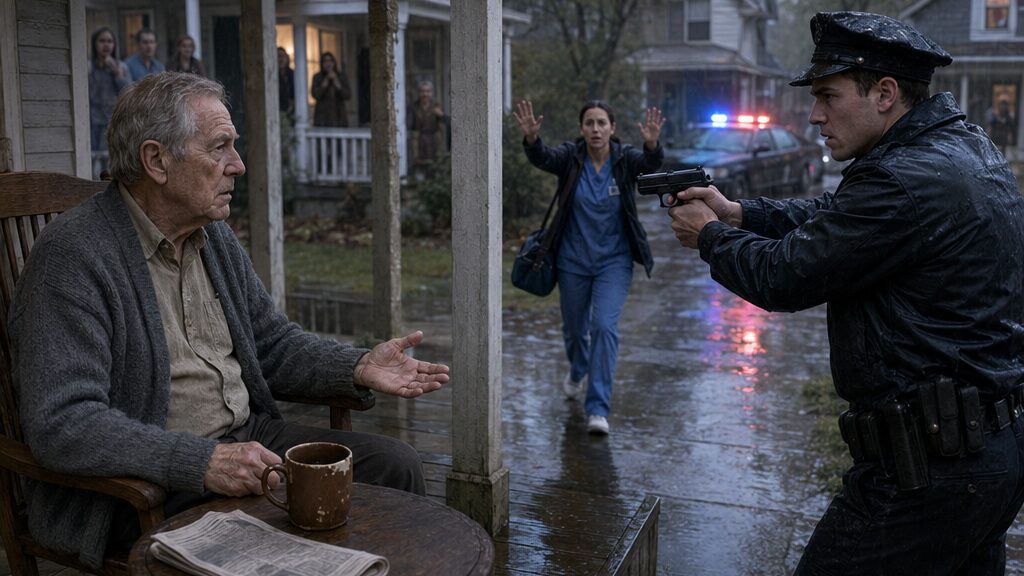
When the Officer Aimed at His Coffee Mug, the Old Veteran Refused to Raise His Voice
Chapter 1: The Coffee Mug Under the Officer’s Gun
The gun was already pointed at William Roberts when the rainwater rolled off the porch roof and dropped into his coffee.
He had been reaching for the mug with two fingers, the same careful way he reached for everything now, when the young officer shouted from the walkway.
“Sir, do not move.”
William stopped.
The newspaper lay folded across his lap, damp at one corner where the wind had pushed mist under the porch awning. His left slipper rested near the leg of the small round table. His right hand hovered four inches above the chipped brown mug Katherine Hill had once tried to replace and he had refused to throw away.
The officer stood beside the wet front walk with both hands locked around his pistol. His rain jacket shone under the gray morning light. Behind him, the police cruiser pulsed blue and red against the slick street, coloring the puddles like warning lights in a hospital hall.
William looked at the pistol first, then at the face behind it.
Young. Too young to have learned how much damage fear could do before anyone meant harm.
“I said don’t move,” the officer shouted.
William lowered his hand slowly until it rested open on the arm of the wooden chair.
Across the street, a curtain shifted in Anna Mitchell’s front window. Two houses down, a neighbor stood half-hidden behind a porch post, phone angled outward. Another figure watched from a car that had stopped at the curb. No one stepped forward. No one called out that William Roberts sat there every morning at seven-thirty with the same coffee, the same newspaper, the same cardigan buttoned wrong at the top because his fingers stiffened in wet weather.
The officer’s boots splashed as he moved closer.
“Put down what’s in your hand.”
William looked at his empty palm.
“It’s down,” he said.
His voice came out quiet, rough from the morning. It did not carry far. Rain filled the spaces between words.
The officer’s shoulders tightened. “The object on the table. Move away from it.”
William turned his eyes toward the mug. Brown ceramic, white crack near the rim, coffee gone pale with rain. He had bought it years ago from a church basement sale because it fit his hand better than the tall mugs Deborah liked to send him on Father’s Day. It had survived two kitchen drops, a dishwasher he never used anymore, and one night when he had sat with it until sunrise after the doctor told him driving was no longer wise.
Now the black mouth of a pistol hovered over it from ten feet away.
William felt the old part of himself wake first, not the frightened part. The old part counted distance, breath, hands, eyes. It noticed the officer’s finger, not fully tight but close. It noticed the cruiser door left open. It noticed the neighbor’s phone.
“Officer,” William said, “that’s coffee.”
“Do not reach for it.”
“I won’t.”
“Stand up.”
William did not stand.
Not because he meant to defy him. Because standing took time now. Because the porch chair was low and his knees needed warning. Because sudden motion scared young men who had already decided the world was full of threats.
The officer saw only delay.
“Sir, stand up now.”
William placed both palms on the chair arms, then stopped again. He could feel every eye on him. The wet street. The phone. The curtain. The bright cruiser lights washing over his porch boards. He had been watched before while men decided whether he was useful, weak, wrong, or in the way. He had promised himself a long time ago never to answer panic with panic.
So he lifted his right hand instead.
Palm open.
Slow.
Empty.
The officer stepped forward hard. “Keep your hands where I can see them.”
“They’re where you can see them,” William said.
His voice did not rise, and that seemed to make the officer angrier.
The front door behind William was still open a crack. The morning’s warmth escaped around the frame. On the hallway table inside sat the pill organizer Katherine had filled two days earlier. Monday, Tuesday, Wednesday. Blue, white, half a yellow tablet. Ordinary things. Small things. Things no one saw from the street.
The officer’s radio crackled. A dispatcher’s voice came through broken by rain and static.
“Possible elderly male, front porch, object in hand, caller states confused and possibly armed.”
William heard the words. Possibly armed.
A sound left someone across the street, half gasp, half whisper.
The officer’s eyes flicked to the mug, then back to William.
“There’s been a report,” he said.
“I can hear that.”
“Are you alone in the house?”
“Yes.”
“Any weapons inside?”
William thought of the kitchen knives in the drawer, the old tool chest in the back room, the walking cane Deborah kept insisting he use. He thought of the locked wooden box in his closet, empty except for folded papers he had not unfolded in years.
“No,” he said.
The officer’s jaw hardened. “Do you understand I need you to comply?”
William nodded once.
“Then stand up.”
William tried.
He shifted forward, palms pressing into the chair. His knee caught under the small table. The table wobbled. The mug slid half an inch, ceramic scraping against painted metal.
The officer’s gun lifted higher.
“Stop!”
William froze with his body bent halfway out of the chair. Pain flashed through his hip. Coffee trembled at the edge of the mug. The newspaper slipped from his lap and opened across the porch boards, a headline smearing under the rain blown in from the steps.
A car door slammed somewhere behind the cruiser.
“Stop pointing that at him!”
Katherine Hill came running up the sidewalk in blue scrubs, hair pulled back badly, one shoe splashing through a puddle deep enough to soak her ankle. She carried no umbrella. Her breath came hard.
The officer turned his head but did not lower the weapon.
“Ma’am, stay back.”
“That’s William Roberts,” she said. “He’s my patient. He’s not armed.”
“Stay back.”
“He can’t stand fast. His right knee locks. You’re making him rush.”
William closed his eyes for half a second. Not from relief. From shame that she had to say it in front of everyone.
Katherine moved to the edge of the walkway, hands raised but still coming. “William, don’t move. Just stay still.”
“I am still,” he said.
The officer looked between them. “Ma’am, I said stay back.”
“You heard the call wrong,” Katherine said. “Or somebody made it wrong. That’s his coffee.”
The word hung there.
Coffee.
The officer’s eyes dropped again to the mug. His arms did not lower at once. First his elbows softened. Then the pistol dipped toward the porch boards. Then, only after another breath, he brought it down against his vest, still in his grip but no longer aimed at William’s chest.
The neighborhood seemed to exhale without deserving to.
William finished standing.
He did it slowly, because there was no other way to do it. His cardigan pulled crooked at the buttons. One slipper had shifted under his heel. The newspaper lay open and ruined at his feet. He stood behind the table with the chipped mug between him and the young officer, and for the first time the officer had to look up.
Katherine came onto the first porch step. “Are you hurt?”
William shook his head.
“Sir,” the officer said, and now the word had changed shape. It sounded less like command and more like something he had misplaced.
William looked at him.
The officer swallowed. Rain ran from the brim of his cap. “We received a call.”
“So you said.”
“There was concern.”
William glanced across the street. Anna Mitchell’s curtain fell back into place.
Katherine saw the glance. “Who called?”
The officer did not answer.
A supervisor’s vehicle turned onto the street then, tires hissing on wet pavement. The flashing lights painted the porch again. Another uniform stepped out, older, broader, already wearing the expression of someone arriving after the dangerous part and wanting the paperwork to be simple.
The young officer stepped back toward him.
Katherine climbed onto the porch beside William, but he noticed she stood half a pace in front of him, as if her body could undo what had already happened.
The supervisor asked a low question William could not hear.
The young officer looked once at the mug, once at Katherine, then toward the neighbors who were pretending not to stare.
“He wouldn’t comply,” Tyler Wilson said.
Chapter 2: The Porch Becomes a Neighborhood Courtroom
Deborah Smith found her father on his knees with a towel in his hand, wiping coffee from the porch boards as if the worst thing that had happened that morning was a spill.
“Dad.”
William looked up from the dark stain spreading between two planks. The rain had thinned to a mist, but the porch still dripped steadily from the roof edge. The newspaper lay in the trash can beside the steps, its pages curled and gray. The chipped mug sat on the small table, empty now, turned so the crack faced the house.
Deborah stood at the bottom step with her purse still over one shoulder and her phone clutched in her hand. She had driven over too fast; he could tell by the way she was breathing through her nose, trying not to show she was scared.
“You should not be kneeling,” she said.
“I dropped coffee.”
“Someone pointed a gun at you.”
He folded the towel once, then twice. “The coffee was also there.”
Her face tightened. “Do not do that.”
“Do what?”
“Make it small so nobody else has to feel bad.”
William pressed one palm against the chair and rose carefully. His knee gave its usual complaint. Deborah moved as if to help him, then stopped when he gave her the look he had used since she was fifteen and trying to carry groceries he could still lift.
Across the street, Anna Mitchell’s front door opened.
Deborah turned immediately.
Anna stepped out under a clear plastic umbrella, though the rain had nearly stopped. She was in a pale sweater and dark pants, her hair pinned neatly as if neatness could make the morning decent. She looked first at Deborah, then at William, then at the porch floor.
“I wanted to check,” Anna called. “I wanted to make sure he was all right.”
Deborah’s laugh was short and humorless. “Now you want to check?”
Anna’s mouth parted. “I didn’t know it was going to happen like that.”
William set the towel on the table beside the mug. “Come out of the rain, Anna.”
“She can stay exactly where she is,” Deborah said.
Anna took one step closer anyway, stopping at the wet walkway where Tyler had stood. She looked at the boards, at the chair, at the mug. Her eyes lingered there.
“I called because I saw something in his hand,” Anna said.
“My father drinks coffee on this porch every morning.”
“I know that.”
“Then what did you think you saw?”
Anna gripped the umbrella handle with both hands. “He was sitting strangely. He didn’t answer when I waved. Then I saw him lift something dark, and I thought—”
“You thought what?”
Anna’s gaze flicked toward William, asking for rescue.
He did not give it. Not because he wanted Deborah to punish her, but because the question deserved air.
“I thought he might be confused,” Anna said. “Or holding something he shouldn’t.”
Deborah stepped onto the porch. “You called the police because an old man didn’t wave back?”
“No,” Anna said, too quickly. “No, because last week the delivery driver said Mr. Roberts shouted at him.”
William blinked.
Deborah turned. “Did you?”
William remembered the delivery worker stepping onto the porch with earbuds in, leaving Katherine’s medical supplies in the rain instead of under the chair. William had called, “Not there.” The young man had not heard. William had raised his voice once, sharp enough to surprise himself.
“I asked him to move a box,” William said.
Anna seized on it with visible relief. “People were concerned.”
“People,” Deborah repeated.
A curtain moved in the house next door. A phone disappeared behind blinds.
William felt the street gathering itself around them, pretending to be doors and windows.
Katherine arrived before Deborah could speak again. She came from the clinic car parked at the curb, still in her blue scrubs, carrying a small medical bag and wearing the expression of someone who had already argued with two people on the phone.
“I called the agency,” she said, climbing the porch steps. “They know I’m still coming.”
Deborah looked at her. “Still coming? Why would that be in question?”
Katherine’s face changed just enough.
William saw it.
“What did they say?” he asked.
“Nothing final.”
Deborah turned fully toward her. “What does that mean?”
“It means there was an incident report,” Katherine said. “And because law enforcement was involved, they have to review whether the home environment is safe.”
“The home environment?” Deborah pointed toward the street. “The danger was out there.”
“I know.”
“Then say that.”
“I did.”
Anna’s umbrella trembled slightly. “I only reported what I thought I saw.”
The words settled harder than an accusation.
William looked at her then, really looked. Anna Mitchell had lived across from him for eight years. He knew when her trash pickup came, which flowers she tried to grow in spring, how she overwatered them in July. He knew her husband had died before William moved in because she still wore her wedding ring and turned it when sirens passed. He did not know what she feared at night. He had never asked.
“I believe you,” he said.
Deborah stared at him. “Dad.”
“I believe she reported what she thought she saw.”
Anna’s shoulders loosened.
Then William added, “That does not make it what happened.”
Anna’s eyes lowered.
For a moment, nobody spoke. A car passed slowly, too slowly, the driver turning to look. The porch, William realized, had become a place people inspected. The chair was evidence. The mug was evidence. His knee, his cardigan, his wet newspaper, the slow way he stood—everything had become something to interpret.
Deborah’s phone buzzed.
She looked at it, then went still.
“What?” Katherine asked.
Deborah did not answer. Her thumb moved over the screen once. Her face drained first, then flushed.
“Deborah,” William said.
She turned the phone toward him.
The video was only nine seconds long. It began after Tyler already had the gun raised. It showed William half rising, the table wobbling, the mug sliding. There was no sound at first, then someone gasped. The frame shook. Katherine did not appear before the clip ended.
Under it, posted by a neighborhood account William did not recognize, were the words:
Old man on Maple Street made police draw this morning. Anyone know what happened?
Deborah pulled the phone back before he could read the comments.
But William had already seen enough.
By late afternoon, the street had learned to lower its voice when he opened the front door.
He tried to bring the newspaper inside, forgetting he had thrown it away. He stood in the doorway a moment, one hand on the knob, feeling foolish for missing a ruined thing.
Katherine checked his blood pressure at the kitchen table and said nothing about how high it was until the second reading. Deborah paced between the sink and the window, making calls in a voice that sounded more like a lawyer than a daughter. Anna’s umbrella was gone from the walkway, but William could still see the round dry mark where she had stood.
His phone buzzed once after dinner.
Deborah had left it on the table because he never remembered where he set it down. The screen lit with a message from a number he did not know. A neighbor had sent the video again.
This version had a caption added across the bottom in white letters.
The old man who made police draw.
William sat with his hands folded beside the chipped mug and watched the words repeat over his own silent body.
Chapter 3: The Nurse Knows What Silence Means
Katherine put the chipped mug into the sink the next morning harder than she meant to, and the sound made William turn from the kitchen window.
“How many times did you teach men not to shout?” she asked.
The question sat between them with the unwashed dishes.
William was standing in his socks beside the table, one hand resting on the chair back. His porch was visible through the window beyond him, empty except for the wooden chair and the round table. He had not taken his coffee outside. He had told himself it was because the air was too damp.
Katherine turned on the faucet. Water struck the mug and splashed over the crack near the rim. She had come in with her usual soft knock, taken one look at the untouched porch, and stopped pretending this was an ordinary visit.
“I don’t know what you mean,” William said.
“Yes, you do.”
She scrubbed the mug with a yellow sponge. The stain inside did not lift. Neither did the thin brown line where the ceramic had cracked years ago.
“You sat there yesterday with a gun pointed at you,” she said, quieter now. “And you used the same voice you use when my new trainees drop pill bottles.”
William pulled out his chair. “That is a very specific voice.”
“It is. And I’ve heard you use it before.”
He sat because standing had begun to make his knee tremble. “People listen better when you don’t shout.”
“Sometimes people write reports when you don’t shout.”
He looked away.
Katherine shut off the water.
The silence after the faucet felt larger than the running water had. Outside, a delivery truck rolled past without stopping. William watched it slow near Anna Mitchell’s house, then continue down the block.
Katherine dried the mug carefully. “The agency called again.”
His fingers tightened around the chair arm.
“They want documentation from the police before they decide anything,” she said. “I told them there was no threat in this house.”
“They have rules.”
“They have fear with letterhead.”
That almost made him smile. Almost.
She set the mug in front of him. “Give a statement, William.”
“No.”
“You haven’t even heard what they need.”
“I heard enough.”
“They need your version.”
“My version is simple. A neighbor called. An officer came. Nobody was hurt.”
Katherine leaned both hands on the table. “That is not your version. That is the version you give when you want everyone else to sleep.”
William looked at the mug. There was still water caught along the crack.
Years ago, in a place hotter than any porch in Tennessee, a young soldier had screamed for his mother while three other men screamed different orders over him. William had been younger than Tyler Wilson then. His hands had been quicker. His knees had not yet learned weather. He had pressed both palms down and said, “Look at me. Breathe where I can see you.” He had learned that men in terror grabbed, fired, ran, begged, cursed, prayed. He had learned that calm was not gentleness. Sometimes calm was the only wall left standing.
He had also learned that calm did not save everyone.
Katherine was watching his face.
He reached for the mug but did not lift it.
“You went somewhere,” she said.
“No.”
“Yes.”
He let out a slow breath. “I was a medic.”
“I know.”
“No,” he said, and the edge in his voice surprised them both. He softened it. “You know I served. People know words. They don’t know what they mean.”
Katherine pulled out the chair across from him and sat.
He regretted speaking as soon as he had done it. Explanation was a door. Once opened, people walked through carrying questions they thought they had earned.
But Katherine did not ask for a story.
She said, “Then tell them what the words mean.”
William looked toward the porch again. “If I tell it wrong, it becomes another thing people use.”
“If you tell nothing, they’re already using you.”
Before he could answer, her phone rang. She glanced at the screen, then stood.
“It’s the clinic.”
She took the call in the hallway, but his hearing was not as poor as Deborah believed. He caught fragments: incident, safety review, patient cooperative, no, I was present, no, he did not threaten anyone.
William sat very still.
On the kitchen counter lay the replacement mug Deborah had bought him last Christmas. Tall, blue, printed with Best Dad in letters too large to ignore. He had never used it. It looked too cheerful for his hand.
Katherine came back with her mouth pressed thin.
“They’re not suspending me,” she said. “Not yet.”
“Not yet,” he repeated.
“They want to see whether the police report describes any risk factors.”
He nodded.
“Don’t nod like that.”
“How should I nod?”
“Like you understand this is not over.”
He did understand. That was the trouble.
By noon, Deborah drove him to the clinic for his scheduled appointment because Katherine had another patient and because Deborah wanted to talk where he could not escape to the porch.
The clinic hallway smelled of antiseptic and wet coats. William sat near the wall while Deborah checked him in. A television above the waiting area played silently with captions about road closures. People glanced at him the way people glanced at anyone old in a clinic: quickly, then away, as if age might ask something of them.
A police officer entered through the sliding doors.
Not Tyler. Older. He removed his cap, spoke to the receptionist, and never looked at William.
Still, William’s right hand flattened on his knee.
Deborah saw.
Her anger changed shape.
She sat beside him. “Dad.”
“I’m fine.”
“I hate that answer.”
“It has served me.”
“It served everyone else.”
He turned his head slightly.
She lowered her voice. “You think staying calm means they don’t win. But yesterday they got to call you dangerous, confused, noncompliant—whatever word they choose—and you’re helping them by being noble in private.”
He looked toward the receptionist’s desk. The officer laughed softly at something the clerk said. Ordinary. Harmless. Still, William counted his hands.
Deborah touched his sleeve. “I’m not asking you to perform. I’m asking you not to disappear.”
That struck closer than she knew.
The clinic receptionist called his name. Katherine appeared from the side hallway just as he stood, her expression telling him she had come between appointments.
“There’s one more thing,” she said.
William stopped.
“A police supervisor left a message at your house while we were driving. I picked it up when I went back for your medication list.”
Deborah stood. “And?”
Katherine looked at William, not Deborah.
“They’re asking whether you intend to provide a statement by Friday. The message said if you don’t, the report will stand as written.”
William felt the hallway narrow. The television captions changed above them. Someone coughed. Rain ticked against the clinic windows.
He thought of the wet newspaper, the phone screens, Anna’s umbrella, Tyler’s pistol lowering too late. He thought of all the official words that could be placed over a life if a man allowed a blank space to remain.
Katherine held out the message slip.
William did not take it at first.
Then he did, folding it once between thumb and forefinger, the same way he used to fold a newspaper before setting it on the porch table.
Deborah waited for him to say he would call. Katherine waited for him to say he would try.
William looked at the folded paper in his hand.
“A quiet man,” he said, “is easy to write over.”
Chapter 4: The Paper That Made Fear Official
“Subject failed to comply,” Deborah read, and the paper in her hands made a sharper sound than rain ever had.
William sat beside her in the police station lobby with his hat resting on his knee. The lobby chairs were molded plastic, too low for him, lined along a wall beneath framed photographs of officers shaking hands at public events. His folded statement request lay in his coat pocket, unanswered. Deborah had insisted on coming in person because phone calls, she said, let people hide behind hold music.
She held the report close enough for him to see the words but not long enough for him to take it.
“Subject appeared confused,” she continued. “Subject failed to follow verbal commands. Subject reached toward unknown object despite repeated orders.”
William looked at the vending machine across the room. A packet of crackers hung crooked behind the glass.
Deborah lowered the report. “Dad.”
“I heard.”
“Did you?”
He looked at her then.
Her eyes were red in a way anger could not fully explain. She had slept badly. So had he, though neither of them had mentioned it. At three in the morning he had walked to the kitchen and found the chipped mug in the sink where Katherine had left it to dry. He had touched the crack with one finger and gone back to bed without water.
Deborah tapped the paper with two fingers. “This makes it sound like you caused it.”
“I didn’t write it.”
“That’s exactly the problem.”
The police supervisor had given them the copy with a practiced expression and careful sympathy. He was somewhere behind the frosted-glass door now, speaking in a low voice to someone William could not see. The station smelled like printer toner, wet uniforms, and old coffee. Not home coffee. Burned coffee. Coffee made to keep people awake through paperwork.
William reached for the report.
Deborah hesitated before handing it over.
The paper had been folded once. His eyes caught on the crease, and without meaning to, he thought of the newspaper on his porch, opened by rain and ruined under his slipper. This paper was dry. That made it worse. Dry paper lasted.
He read slowly.
Unknown object.
Repeated orders.
Failed to comply.
No injury.
No injury seemed to be offered as proof that nothing worth changing had happened.
A door opened down the hallway.
Tyler Wilson stepped out with the supervisor, his uniform neat, hair still damp at the edges as if he had showered at the station. He stopped when he saw William. The stop was small, but William noticed it before Deborah did.
Deborah stood.
The supervisor lifted a hand. “Ms. Smith, we’re still reviewing.”
“Reviewing what? Whether a coffee mug was armed?”
Tyler’s face tightened. He looked toward the supervisor, then back at William. “Mrs.—”
“Ms.,” Deborah said.
“Ms. Smith,” Tyler corrected. “I responded to information I had at the time.”
William watched the young man’s hands. Empty now. Held stiffly at his sides.
The supervisor said, “Officer Wilson acted based on the call details and his visual assessment.”
“His visual assessment was wrong,” Deborah said.
The supervisor’s voice stayed even. “That is why we are asking Mr. Roberts for a statement.”
William folded the report along the existing crease. “Your paper already has one.”
“Sir?”
“His.”
Tyler looked down.
The supervisor glanced at Tyler. “Officer Wilson’s report is standard procedure. Your statement would be added.”
“Added,” Deborah said. “Not corrected.”
“We can’t correct what we haven’t fully reviewed.”
William felt Deborah gather herself for another round, but before she could speak, the dispatcher behind the counter called the supervisor over. The supervisor stepped away with the report copy still in Deborah’s hand and his own folder tucked under one arm.
Tyler remained in the hallway.
For a few seconds, no one moved.
Then Tyler said, quietly, “It was raining.”
Deborah stared at him. “What?”
He looked at William, not her. “The porch was shadowed. Dispatch said there was an object. The caller said possibly armed. I saw you move.”
William said nothing.
Tyler swallowed. “I saw the mug after.”
“After what?” Deborah asked.
Tyler’s jaw shifted.
After the gun.
After the command.
After the old man bent halfway out of his chair and froze.
Tyler did not say any of that. He said, “After Ms. Hill came up.”
Deborah’s voice lowered. “But you still wrote unknown object.”
Tyler looked toward the counter where the supervisor stood with the dispatcher. “At the time of response, it was unknown.”
“At the time of the report?”
He did not answer.
William folded the report again, making it smaller.
Tyler saw the motion. Something like shame passed over his face, but it did not stay long enough to become courage.
The supervisor returned before Deborah could press him.
“We’ll schedule a formal review if Mr. Roberts wants to dispute any language,” the supervisor said. “Until then, this is preliminary.”
“Preliminary things travel,” William said.
The supervisor blinked. “Sir?”
William placed the folded report in his coat pocket. “Nothing.”
Deborah closed her eyes for half a second.
On the drive home, she did not turn on the radio. Her phone buzzed in the cup holder again and again. She ignored it until they reached a red light, then glanced down.
“It’s spreading,” she said.
William looked out the passenger window. The city gave way to smaller streets, then the older homes near Maple. Wet leaves stuck to curbs. A child’s bicycle lay on a lawn, one wheel spinning slightly in the wind.
“The video?” he asked.
“Another account picked it up. They’re asking if anyone knows whether you have dementia.”
He kept his hands folded over the head of his cane, though he had not used the cane to enter the station. Deborah had put it in the car anyway.
“I forget names sometimes,” he said.
“This is not funny.”
“I wasn’t making it funny.”
Her fingers tightened on the steering wheel. “They don’t know you.”
“No.”
“So help them.”
He did not answer.
When they pulled onto Maple Street, two neighbors who had been talking by a mailbox stopped mid-conversation. One lifted a hand late, awkwardly. William nodded. Deborah did not.
His porch looked smaller than it had before the report. The chair was in the same place. The round table too. The absence of the newspaper made the table look staged, as if someone had removed one piece of evidence and left another.
Inside, Katherine had left a voicemail on the kitchen phone.
Deborah pressed play before taking off her coat.
Katherine’s voice filled the room, controlled but strained. “William, it’s me. The agency called again. They received notice that the police report lists noncompliance and possible confusion. I told them I was present and that you were not a threat. They still have to review whether visits continue under current safety guidelines. I’m coming tomorrow unless they order me not to. Please call me.”
The machine clicked.
Deborah looked at William.
He kept his eyes on the chipped mug beside the sink.
“Dad,” she said, and this time the anger was gone. “They may suspend Katherine’s visits.”
Chapter 5: The Man Who Refuses to Trade Humiliation
Deborah came through the front door with a local reporter’s number written on the back of a grocery receipt.
William saw the blue ink before he saw her face.
“No,” he said.
She stopped in the hallway with her keys still in her hand. “You don’t even know what I’m asking.”
“I can read a phone number.”
“It’s not a television crew. It’s one reporter. She covers city issues.”
“No.”
Deborah dropped her purse onto the small table by the door. The sound made the mail jump. “So that’s it? They get to write you up as confused, the neighbors get to pass around a video, Katherine might get pulled, and you want to sit on the porch like none of it matters?”
William was in his chair by the front window, the chipped mug on the side table, untouched. He had made coffee that morning and poured half of it down the sink. It had tasted like metal.
“It matters,” he said.
“Then act like it.”
He turned the mug slightly so the crack faced away from him. “I am.”
“No, you’re enduring. You’re very good at enduring. That is not the same thing.”
He looked out the window. Across the street, Anna Mitchell’s trash cans were lined perfectly at the curb though pickup was not until morning. She had not come over again. He had seen her twice through the window, both times lowering her head as if checking her steps.
Deborah followed his gaze. “She submitted a statement.”
William’s hand stilled on the mug.
“How do you know?”
“The supervisor called. He said we’re entitled to review it at the meeting if you attend.”
“If.”
“She described you as unpredictable.”
The word entered the room quietly and sat down between them.
William looked at his daughter. “Anna wrote that?”
Deborah’s mouth twisted. “She wrote that she had observed behavior changes, agitation with a delivery worker, and unusual porch activity.”
“Unusual porch activity,” William repeated.
“You drink coffee outside.”
“Not lately.”
“That is not the point.”
He knew it was not. He also knew, with a pinch of discomfort under the ribs, that Anna had not invented everything from nothing. He had shouted at the delivery worker. He had forgotten to bring in his trash cans twice. He had stood on the porch one night at two in the morning because he thought he heard someone calling, only to realize the sound came from the television next door. Fear did not need much to build a house.
Deborah unfolded the grocery receipt and set it on the table beside the mug. “Let someone write the truth.”
“Which truth?”
“The one where an officer pointed a gun at a seventy-six-year-old veteran holding coffee.”
William’s eyes sharpened. “Leave veteran out of it.”
“Why?”
“Because that’s not why he was wrong.”
Deborah stared at him, frustrated into silence.
He softened his voice. “If he was wrong only because I served, then he’d be right to do it to some other old man.”
The receipt lay there with the reporter’s number facing up. Deborah did not pick it back up.
Later that afternoon, Katherine took him to the review office because Deborah had a work call and because William suspected his daughter needed an hour not to look at him. The municipal building had beige walls and polished floors that reflected everyone’s shoes. Katherine wore a cardigan over her scrubs, as if trying to look less like a witness and more like family.
They waited on a bench outside a conference room.
William heard Tyler before he saw him.
The young officer’s voice came through the partly open door, lower than it had been on the porch, stripped of command.
“I saw what dispatch told me to see,” Tyler said.
The supervisor answered too quietly for William to catch the words.
Tyler spoke again. “I’m not saying that excuses it.”
Katherine looked at William. He did not move.
Inside the room, Tyler continued. “My dad always said the worst call is the one you underplay. He hesitated once on a domestic because the guy was old and crying. Then there was a knife in the couch cushion. He still talks about it. Every training, every story—it’s always the thing you don’t see.”
A chair scraped.
The supervisor said something about procedure.
Tyler answered, “I know. But when Ms. Hill said coffee, I already knew. I think I knew before she said it.”
William looked down at his hands.
They were not young hands. The skin had thinned; the veins stood like small blue cords. On the porch, those hands had been treated as proof of danger because they moved slowly toward a mug.
Katherine whispered, “William.”
He shook his head once.
Not now.
The door opened. Tyler stepped out and stopped when he saw them. For a second he looked like the young man from the porch again—not because he was armed, but because he did not know what to do with his hands.
“Mr. Roberts,” he said.
William nodded.
Tyler looked at Katherine, then at the floor. “The formal review is Thursday.”
“I know.”
“I’ll be there.”
William waited.
Tyler added, “I just wanted you to know.”
Katherine’s eyebrows lifted, but she did not speak.
William said, “Knowing is only useful if it changes what you do.”
Tyler took the words without flinching, though color rose along his neck. “Yes, sir.”
The sir made William tired.
When they got home, Anna Mitchell was standing on the sidewalk in front of his house with an envelope in both hands.
Katherine slowed the car.
“Keep going,” William said.
“She’s waiting for you.”
“I can see that.”
Katherine pulled into the driveway anyway.
Anna did not approach until William had stepped carefully out of the car. She looked older than she had across the street with her umbrella. There were hollows under her eyes. The envelope shook slightly.
“I gave them a statement,” she said.
“I heard.”
“I didn’t mean unpredictable like dangerous.”
Katherine made a small sound but held it in.
William rested one hand on the car door. “What did you mean?”
Anna looked toward her own house. “After my husband died, I started noticing things. Sounds. People standing where they don’t usually stand. I thought it made me careful.”
“It made you certain,” William said.
Her eyes filled. “Yes.”
He waited.
“I should have come over,” she said. “I should have asked if you were all right.”
“Yes,” he said.
She looked at the envelope, then held it out. “This is a copy of what I wrote. I thought you should see it from me.”
William did not take it.
For the first time since the porch, Anna looked directly at him and did not look away. “I was afraid of being wrong after I called. So I kept making myself right.”
That was the first honest thing anyone had said about the morning.
William accepted the envelope.
Inside the house, Deborah returned just before dinner. She found the reporter’s number still beside the mug and the unopened envelope from Anna beside it.
“You didn’t call,” she said.
“No.”
“You did take Anna’s statement.”
“Yes.”
“And?”
“And it is worse than she meant it to be.”
Deborah let out a breath through her teeth. “Meaning?”
“Meaning good intentions can still leave marks.”
He picked up the chipped mug and carried it to the sink. Deborah followed, wary now, as if he had finally stepped onto ground she could not read.
“Are you going Thursday?” she asked.
William rinsed the mug, dried it with the towel Katherine liked folded over the oven handle, and placed it gently in the center of the kitchen table.
Then he looked at his daughter.
“Ask Katherine to bring this to the review.”
Chapter 6: The Porch Video Enters the Review Room
The porch video played without sound, and in the silence William looked more dangerous than he had ever felt.
On the screen at the front of the municipal review room, his own body rose halfway from the chair in a stiff, broken motion. The table wobbled. The mug slid. Tyler’s pistol stayed fixed at the edge of the frame. The clip cut off before Katherine arrived, before the word coffee entered the morning, before the young officer’s arms lowered and the street remembered to breathe.
The room was small enough that everyone had to watch together.
William sat at one side of the table with Deborah to his left and Katherine to his right. The chipped mug rested on a folded paper napkin in front of him because Katherine had insisted it not sit directly on municipal furniture. Beside it lay the official report, Anna’s statement, and a printed screenshot from the video with the caption still visible at the bottom.
The old man who made police draw.
Tyler sat across from him in uniform. The supervisor sat near the end with a folder open. Anna Mitchell was two seats away from Tyler, hands clasped so tightly her knuckles had gone pale.
The video looped once before the supervisor reached to stop it.
Deborah spoke first. “That clip is incomplete.”
“We understand that,” the supervisor said.
“Do you? Because the report reads like the clip. It stops before the truth arrives.”
William looked at the mug.
Katherine shifted beside him. He could feel her wanting to speak. She had a folder full of notes: his medication schedule, her visit logs, her written account of Tyler lowering the weapon after she identified the mug. She had built him a wall of paper.
He appreciated it.
He was also tired of standing behind walls.
The supervisor looked at William. “Mr. Roberts, if you’d like to give your account, now would be the time.”
Deborah’s hand moved under the table and touched his sleeve.
William did not stand. Standing would make the room think about age before words. He stayed seated and placed both hands flat on the table.
“I was drinking coffee,” he said.
No one interrupted.
“I had the newspaper. It was raining. My knee was bad that morning, which is common when it rains. Officer Wilson told me to stand. I tried too quickly because there was a gun pointed at me.”
Tyler looked down.
William continued, “The table moved. The mug moved. That is what you saw.”
The supervisor made a note.
William stopped until the pen stopped too.
“I do not object to officers being careful,” William said. “I object to careful turning into certain after the truth is visible.”
Deborah’s eyes flicked to him, surprised by the firmness in his voice.
The supervisor folded his hands. “The officer had information from dispatch indicating a possible weapon.”
Anna inhaled sharply but did not speak.
William turned toward her. “Mrs. Mitchell saw something.”
Anna’s lips parted.
“She saw an old man who did not wave. She saw a dark object. She saw him move slowly. She saw, maybe, a man who had been acting different than she expected.”
Anna stared at the table. “I’m sorry.”
William nodded once, but did not let the apology end the matter.
“Fear fills in what it cannot see,” he said.
The words made Tyler lift his head.
William reached for the mug.
Everyone watched his hand.
He noticed that, and because he noticed it, he moved the same way he had on the porch: slow, fingers open, no sudden grip. He lifted the mug by the handle and held it at chest height.
Tyler looked away.
Not quickly enough to hide it.
“This is the unknown object,” William said.
The room stayed still.
“It is chipped. It leaks if filled too high. My daughter hates it.”
Deborah gave a short, wounded laugh before covering her mouth.
“I kept it because it fits my hand,” William said. “That morning, my hand was treated like a threat because someone had already named it one.”
The supervisor looked at the report.
Tyler’s face had gone pale around the mouth.
William set the mug down. The ceramic made a small, ordinary click.
“I was a medic,” he said.
Deborah grew very still. Katherine turned her eyes toward him but kept her body quiet.
“I am not saying that to ask for better treatment than another man. I am saying it because I learned something in rooms and roads where people were afraid. The first story you tell yourself can keep someone alive. It can also make you stop seeing them.”
The supervisor’s pen hovered.
William saw a different room for half a breath: dust in the air, too much shouting, a young man with blood on his sleeve reaching for something no one could identify. A canteen. A weapon. A letter. A hand grabbed wrong. A command shouted too soon. William’s palms pressing down, his voice trying to cut through fear without becoming part of it.
He did not tell the room all of that. Some memories did not become clearer by being made public.
He said only, “I have seen men die because fear became fact before anyone checked.”
Tyler closed his eyes.
Anna covered her mouth with one hand.
The supervisor spoke carefully. “Mr. Roberts, are you requesting disciplinary action?”
Deborah sat forward. “He should be.”
William looked at her.
She stopped, but the hurt in her face remained.
“I am requesting the report say what was learned,” William said. “Not only what was feared.”
The supervisor glanced at Tyler. “Officer Wilson?”
Tyler looked at the mug, then at William. His voice was low. “The object was later identified as a coffee mug.”
“Not later,” Katherine said, unable to stop herself. “Before you finished writing.”
Tyler accepted that. “Before I finished writing.”
The supervisor wrote.
William continued, “I am requesting that confused not be used because I moved slowly.”
The pen moved again.
“I am requesting that noncompliant not stand where unable to stand quickly would be more honest.”
Deborah looked down at her lap.
“And I am requesting,” William said, “that the next time a caller says elderly, confused, possibly armed, someone remembers those are three different claims.”
No one wrote for a moment. Then the supervisor did.
Anna began to cry silently. It embarrassed her; William could tell. She turned her face toward the wall, but there was nowhere in the room to hide.
“I made it worse,” she said.
The supervisor looked at her. “Mrs. Mitchell—”
“No,” she said. “I did. I was embarrassed after the officer came. People asked why I called. I didn’t want to be the woman who panicked over coffee, so I made the story sound more solid.”
Tyler’s head turned slightly toward her.
William watched him absorb that. Not with satisfaction. With recognition. Fear becoming certainty was rarely one person’s work.
Deborah touched the reporter’s number in her purse; he saw the motion though she did not remove it.
When the meeting ended, the supervisor agreed to amend the report language, attach Katherine’s full statement, add Anna’s clarification, and schedule a review of response wording for calls involving elderly residents. It was not enough to erase the porch. Nothing would be. But it changed the paper, and paper had been part of the harm.
In the hallway, Deborah caught William’s arm.
“You should have let me push harder,” she said, though her voice had softened.
“I did push.”
“You spared him.”
William looked through the glass panel of the meeting room door. Tyler was still inside, standing alone by the table where the mug had been.
“No,” William said. “I made him carry the right thing.”
Katherine came out carrying the mug wrapped in the napkin. She did not hand it to him immediately.
“You spoke,” she said.
“I noticed.”
“You scared me a little.”
“That was not my intent.”
“I know.” Her eyes shone. “That’s why.”
Tyler stepped into the hallway before they reached the exit. He had removed his cap. Without it, he looked even younger.
“Mr. Roberts.”
Deborah stiffened.
William turned.
Tyler held himself straight, but not like he had on the porch. This was not command. It was the effort of a man trying not to hide behind posture.
“I’m sorry,” he said. “For the report. For not changing the words when I knew more. For aiming at you as long as I did.”
William waited.
Tyler swallowed. “My apology doesn’t fix it.”
“No.”
The answer landed. Tyler took it.
“I’d like to come by,” Tyler said. “Not in uniform. If you’d allow it. To say it where it happened.”
Deborah started to object, then stopped herself.
Katherine looked at William, but did not rescue him with advice.
William took the mug from her. The napkin was damp where the ceramic had sweated in the warm room.
He thought of his porch chair, empty for days. He thought of the street watching. He thought of the version of him trapped in the silent video, forever half-risen, forever accused by a caption.
Then he looked at Tyler Wilson and said, “You may come to the walkway. Not the porch.”
Chapter 7: The Morning He Keeps His Seat
William placed the chipped mug on the same round table where Tyler Wilson’s gun had pointed, then stood beside it until his hand stopped remembering the shape of fear.
The porch boards had dried in pale streaks since the rain. A faint stain remained where the coffee had spilled, darker than the surrounding wood, too deep for the towel to lift. Deborah had offered to scrub it with cleaner. Katherine had offered to bring a mat. William had said no to both. Some marks, if covered too quickly, became larger in the mind than they had ever been on the floor.
He set the folded newspaper beside the mug.
This one was fresh, delivered that morning in a blue plastic sleeve and carried in by the delivery worker, who had walked all the way to the porch steps and placed it under the chair without being asked. The young man had not looked William in the eye. He had mumbled, “Morning, sir,” and retreated as if politeness might break if handled too firmly.
William had thanked him anyway.
Now he lowered himself into the wooden chair. His knee protested. The chair creaked. Across the street, Anna Mitchell’s curtains were open for the first time in days.
The corrected report lay inside the house on the kitchen table, folded once beside Katherine’s visit schedule. The supervisor had sent it the previous afternoon. Deborah had read it aloud twice, not because William could not read it, but because she needed the words to exist in the room.
Object identified as coffee mug.
Subject did not threaten officers.
Subject’s delayed standing response was consistent with physical limitation.
Additional clarification attached.
The paper did not apologize. Paper never did. But it no longer accused him in the same clean, official way.
Katherine’s agency had called after that. Visits would continue. There would be documentation, of course. There was always documentation. But Katherine had arrived that morning with her medical bag, a grocery sack of oranges, and an expression that dared him to comment on the fact that her eyes were wet.
“You’re on my schedule,” she had said.
“I was before.”
“You still are.”
That had been enough.
William poured coffee from the thermos into the mug. He filled it below the crack.
A car slowed at the curb.
He did not look up at once.
He let the sound enter the morning and remain only sound. Tires against pavement. Engine idling. A door opening. Shoes on the street. No radio. No command. No rush of feet through rain.
Only then did he lift his eyes.
Tyler Wilson stood at the edge of the walkway in jeans, a plain gray jacket, and no badge visible anywhere. His hands were empty. He had stopped exactly where William had told him to stop.
Not one step onto the walk.
Not one foot on the porch.
That mattered.
William picked up the mug and took one careful sip before setting it down again.
“Morning,” Tyler said.
William nodded. “Officer Wilson.”
Tyler’s mouth tightened slightly at the title. “Tyler is fine, if you want.”
“I know what your name is.”
“Yes, sir.”
William let the sir pass. It sounded different now. Smaller. Less automatic.
Tyler looked toward the porch steps, then back at William. “May I stand there?”
He pointed to the bottom of the walkway, still well away from the porch.
William considered the distance. The asking mattered more than the answer.
“You may.”
Tyler walked to the place he had indicated and stopped again. He did not put his hands in his pockets. He did not fold his arms. He stood with them loose at his sides, as if he had practiced having nothing to hold.
Across the street, Anna Mitchell stepped onto her porch.
William saw her, but he did not turn his head. Tyler saw her too. His shoulders shifted once, then settled.
“I read the amended report,” Tyler said.
“So did I.”
“It should have been written that way the first time.”
“Yes.”
The word had no anger in it. That seemed to make Tyler lower his eyes.
“I keep thinking about what you said,” Tyler said. “About elderly, confused, possibly armed being three different claims.”
William rested his fingers against the newspaper. “They are.”
“We had a briefing yesterday.”
William looked at him then.
Tyler nodded once. “The supervisor went over response language. Caller information. How assumptions stack. It wasn’t some big department-wide reform. Just our shift. But he used the call.”
“The call,” William repeated.
“He didn’t use your name.”
“That is something.”
“He used the mug.”
William looked at the table.
For a moment, the chipped thing looked almost embarrassed to be important.
Tyler said, “I wanted you to know it did more than sit in a file.”
William did not answer immediately. A squirrel moved along the fence line. Somewhere down the block, a trash can lid scraped against concrete. Ordinary sounds had a way of returning without apology.
“That is good,” William said at last.
Tyler swallowed. “I’m sorry for aiming at you.”
“You said that.”
“I know.”
“You’re saying something else now.”
Tyler’s face tightened, then opened a little. “I’m sorry I needed someone else to tell me what I was seeing.”
There it was.
Not the whole cure. Not a clean ending. But a truer sentence.
William leaned back in the chair. “Fear is fast.”
“Yes.”
“Seeing is slower.”
Tyler looked at the porch boards where the coffee stain remained. “I don’t want to be fast like that again.”
“You will be,” William said.
Tyler looked up.
William lifted the mug, then set it down without drinking. “Everyone is, sometime. The question is whether you slow down when you can.”
Tyler stood with that for a while.
Deborah’s car turned onto Maple Street then, slowing at the curb behind Tyler’s. She had not said she was coming. William suspected Katherine had called her, or Deborah had simply known this morning would not leave her alone.
She stepped out and shut the door softly.
Tyler turned. “Ms. Smith.”
Deborah looked from him to her father, then to the porch table. Her eyes caught on the mug. “Officer Wilson.”
“Tyler,” William said.
Deborah glanced at him.
He did not explain.
She came to the bottom of the porch steps but did not climb them. That, too, was new. Everyone seemed to be learning the shape of permission.
“Dad?” she asked.
“I’m sitting.”
“I can see that.”
“I mean I’m staying sitting.”
Her face changed.
For days, everyone had been trying to move him somewhere else: into the house, into a statement, into a reporter’s article, into other people’s ideas of safety. Now the chair held him not as weakness, but as choice.
Anna crossed the street carrying no umbrella this time.
She stopped near Tyler but not beside him, as if she understood she did not get to join any side simply by arriving. Her hands were clasped around a small envelope, but when William looked at it, she tucked it under her arm.
“I won’t give you another statement,” she said. “I’ve made enough of those.”
Deborah’s mouth softened despite herself.
Anna looked directly at William. “I told the neighbors I was wrong.”
The street seemed to quiet around the sentence.
“Not mistaken,” Anna added. “Wrong. I told them I let being scared become being sure.”
William watched her turn her wedding ring around her finger. Once. Twice.
“I also asked the neighborhood page to take down the video,” she said. “They did. I know people already saw it.”
“Yes.”
“I can’t undo that.”
“No.”
Her eyes glistened, but she did not look away. “I am sorry, Mr. Roberts.”
William held the mug between both hands. It warmed his palms.
He could have given her comfort quickly. He knew how. A nod, a mild phrase, a way to let the room empty itself of consequence. He had done that most of his life, turning other people’s discomfort into something they could carry easily.
This time, he let the apology stand in its full weight.
Then he said, “Thank you for saying it correctly.”
Anna closed her eyes for a second.
Katherine arrived last, parking crooked because she always did when she was trying not to appear in a hurry. She stepped out with her bag and stopped when she saw the small gathering: Tyler on the walkway, Deborah near the steps, Anna by the curb, William seated with coffee and newspaper in front of him.
“Well,” she said, “nobody told me there was a meeting.”
“There isn’t,” William said.
She smiled a little. “Good.”
She climbed the steps only after he gave her a nod. When she reached the porch, she did not stand in front of him as she had that rainy morning. She placed her medical bag by the door, then moved to the side, leaving the space between William and the street open.
He noticed.
So did she.
Tyler shifted his weight. “I should go.”
William nodded.
Tyler looked at the porch once more, not at the stain, not at the mug, but at the chair. “Thank you for letting me come.”
“I let you come to the walkway.”
A small, rueful smile crossed Tyler’s face. “Yes, sir.”
He walked back to his car without hurry. He did not look over his shoulder until he reached the door. When he did, William raised two fingers from the arm of the chair. Not a salute. Not forgiveness entire. Acknowledgment.
Tyler returned it with a nod and drove away.
Anna crossed back to her house after a quiet goodbye. Deborah remained by the steps.
“You sure you’re okay out here?” she asked.
William looked at the porch table, the coffee mug, the newspaper still folded and waiting.
“No,” he said.
Deborah blinked.
He touched the crack in the mug with his thumb. “But I’m here.”
That answer seemed to cost her less than fine would have. She climbed the steps and kissed the top of his head quickly, like she was afraid he would object if she took too long. He allowed it.
Katherine checked his blood pressure on the porch instead of inside. The cuff tightened around his arm. The machine hummed. The numbers came back higher than she wanted but lower than she feared.
“I’ll accept it,” she said.
“That is generous.”
“I’m known for that.”
Deborah laughed softly.
After they both went inside to argue over whether the oranges belonged in the refrigerator, William remained on the porch.
The street resumed itself. A car passed. A dog barked. Anna’s curtain stayed open. The delivery worker’s blue sleeve still wrapped the newspaper, and when William slid it free, the paper opened cleanly across his lap.
He read the first headline slowly. Then the second.
The mug stayed where anyone could see it, chipped side facing the street, catching the morning light along its cracked rim.
William lifted it once, drank carefully below the flaw, and set it back on the table without hiding it behind his hand.
The story has ended.