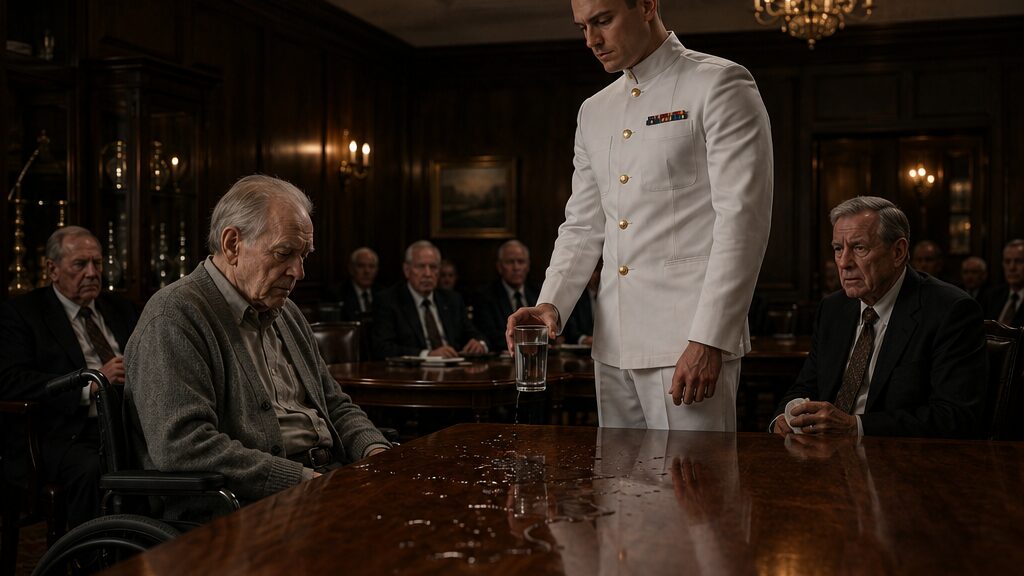
The Officer Pointed at the Spilled Water Before He Learned Why the Old Sailor Stayed Silent
Chapter 1: The Glass Fell Before Anyone Said His Name
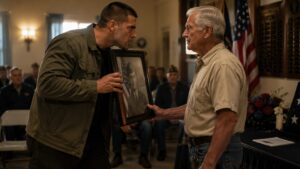
The glass struck the table on its side, rolled half an inch, and sent water spreading across the polished wood toward Ronald Mitchell’s sleeve.
For a moment, nobody moved.
The dining room of the Harbor Veterans’ Club held its breath around him. Forks paused over plates. Coffee cups hovered near mouths. Men who had spent their younger years learning to keep their faces steady now looked anywhere except at the water crawling over the table’s dark shine.
Ronald sat in his wheelchair at the end of the long center table, his left hand still lifted, fingers curved around nothing. The glass had slipped out of that hand so cleanly it looked almost deliberate. The water ran toward the brass edge of the table, caught the afternoon light, and made the room seem to tilt.
Across from him, the club bartender reached for a towel.
Before he could step forward, Michael White’s white sleeve crossed the table.
“Leave it,” Michael said.
The bartender stopped.
Michael stood beside Ronald’s chair in his dress whites, young enough that the uniform still looked like it had chosen him instead of the other way around. His ribbons sat bright and careful on his chest. His jaw was clean, his shoes were polished, and his voice had the flat patience of someone trying not to be embarrassed in public.
He picked up the fallen glass, set it upright, and tapped one finger beside the spreading water.
“Mr. Mitchell,” he said, loud enough for the nearest tables to hear, “this is exactly the sort of thing we are trying to avoid on Saturday.”
Ronald looked at the glass, not at the officer.
The words moved through the room slowly. Saturday. The memorial dinner. The donors. The new name for the dining room. The photographer who would come with a tall black camera and ask men with shaking hands to smile like history had left them whole.
Ronald had known about Saturday. Everyone had. There were folded programs stacked near the service door and white tablecloths hanging in plastic at the far end of the hall. But the tables had not been covered today. The wood was bare, polished to a deep brown that reflected faces without forgiving them.
Michael’s finger stayed near the water.
“We have guests coming,” he continued. “Families. Committee members. Young officers. People who expect a certain standard.”
Ronald’s cardigan sleeve darkened at the cuff. The water touched the worn gray wool and vanished into it.
No one said his name.
The older men along the table sat stiffly, a half circle of witnesses with their soup bowls and coffee and careful eyes. John Thomas was three seats down on Ronald’s right, one hand closed around a napkin he had not used. His mouth had tightened when the glass fell, but he had not spoken.
Ronald could feel John looking at him now. He could feel all of them looking, then looking away.
Michael lifted the glass again. “If you need assistance, you can ask for it. But the main table may not be the best place for you during the dinner if this is going to be an issue.”
The room’s old clock clicked once.
Ronald had heard worse voices in tighter rooms. He had heard men scream under steel, heard water hammer a hatch, heard his own name shouted through smoke and steam until it no longer sounded like his. Michael’s voice was not loud compared to those sounds. It was controlled. Respectable. That was what made it travel.
“I can sit,” Ronald said.
His voice came out rough, but not broken.
Michael leaned closer, not cruelly, not quite. There was something worse in him than cruelty: certainty. “That is not the question, sir.”
Sir. The word landed clean and empty.
Ronald’s right hand moved toward the napkin folded beside his plate. His fingers did not obey quickly anymore. The first two curled, then the thumb followed. He drew the napkin toward himself, careful not to drag it through the water yet.
Around him, the dining room seemed older than it had that morning. The framed photographs on the wall watched from behind their glass: ships at anchor, crews arranged in rows, young men with white hats and unmarked faces. The chandelier above the center table burned soft yellow over the spill. On the far wall, a brass plaque had already been removed, leaving a clean rectangle where the wood had not faded.
Ronald looked at that pale mark.
Michael noticed his gaze. “We’re making changes because this room matters,” he said. “That means we all have to help maintain its dignity.”
Ronald almost smiled then, but not enough for anyone to call it a smile.
He opened the napkin on his lap.
There was a way to fold cloth when water moved in a ship. Not fancy. Not ceremonial. Just useful. Corners inward first, then a narrow ridge along the middle, enough to stop a thin run from widening. It came back to Ronald’s hand before the memory came back to his mind. The fingers remembered what the rest of him tried to leave buried.
He folded once.
Michael glanced toward the donor committee members near the fireplace, as though needing them to see he was managing the situation. One of them stared into his coffee. The other adjusted his glasses and looked at the programs near the service door.
Ronald folded again.
The napkin made a soft, dry sound in his hands.
John Thomas’s chair creaked.
Ronald pressed the folded napkin down along the edge of the spill. Not over the center. Along the run. Stop the spread first. Protect what has not yet been touched. He held it there with two fingers, light but exact.
The water slowed.
Michael’s expression shifted by almost nothing. “The staff can handle that.”
Ronald kept his fingers in place.
“I know,” he said.
The bartender stood frozen with the towel still in his hand. Patricia Hill appeared in the doorway to the office hall, a folder pressed against her chest. She took in the scene quickly: officer in dress whites, old man in a wheelchair, wet table, silent room. Her face tightened with the expression she used when something threatened to become a problem before she could name it.
“Is everything all right?” she asked.
Michael straightened. “A small spill. I’m addressing seating concerns for Saturday.”
Seating concerns. Ronald looked down at the napkin. The water had begun to soak through, turning the white cloth translucent at the edges.
Patricia’s eyes moved from the glass to Ronald’s wet sleeve. “Mr. Mitchell, are you hurt?”
“No.”
“Would you like to move to one of the smaller tables? It may be more comfortable.”
There it was, offered gently. The same removal, wrapped in concern.
Ronald lifted his fingers from the napkin. The water did not move beyond it.
“I sit here,” he said.
Michael’s mouth pressed into a polite line. “That may not be possible for the dinner.”
The old men heard it. Even the ones pretending not to. A spoon struck the side of a bowl and went still.
Ronald rested his hand on the wheel of his chair. The rubber was worn smooth where his palm usually held it. He did not look at Michael. He looked at the pale rectangle on the wall where the old plaque had been.
“This table has room,” he said.
Michael exhaled through his nose, almost a laugh, almost not. “Room is not the issue.”
Ronald nodded once, as if Michael had answered a different question.
He reached for the glass. For one anxious second, everyone watched his fingers approach it, expecting another slip, another spill, another little public proof. Ronald did not lift it. He turned it a quarter inch, aligning it with the table’s edge. Then he withdrew his hand.
The gesture was so small it should not have mattered.
But John Thomas saw it.
John’s face changed. The color left the skin under his eyes. His hand opened around his own unused napkin.
Ronald felt the change in the room before he saw it. Not respect. Not yet. Something more uneasy. Recognition trying to rise and being pushed back down.
Michael looked at John. “Commander Thomas?”
John did not answer him.
Ronald took the folded napkin from the spill. Water dripped once from its corner onto the table. He folded the wet part inward, making a tight square, and set it beside his plate.
John’s voice came out so low that only Ronald and Michael heard it.
“Where did you learn that?”
Chapter 2: The Room Stayed Quiet After the Door Closed
Ronald did not answer John Thomas in the dining room.
He let the question hang there among the coffee cups and polished wood, then turned his chair away from the table before Michael White could decide what kind of answer belonged in a room full of witnesses. The wheels made a dry, soft whisper over the old carpet. Behind him, someone cleared a throat. Someone else moved a plate though lunch was already over.
At the doorway, the club bartender stepped aside and lowered his eyes.
“Mr. Mitchell,” Patricia Hill said, following him into the hall. “Please wait a moment.”
Ronald stopped beneath the framed photograph of a ship he had never served on. The hallway outside the dining room smelled of lemon polish and old wool coats. Voices from inside fell to murmurs, then to silence when the swinging door eased shut behind Patricia.
Michael came through last. The brightness of his uniform looked sharper in the narrow hall.
Patricia held her folder against her ribs. “I’m sorry that became uncomfortable.”
Ronald looked at the folder.
Not at her face. The folder had a printed label: Saturday Memorial Dinner — Seating / Program / Donor Notes.
Uncomfortable. He knew that word too. Men used it when they wanted the wound to be smaller than the knife.
“It was water,” Ronald said.
“Yes,” Patricia said. “Of course. But with the dinner coming up, we have to think about access, visibility, service flow. It might be easier if we place you near the west wall. There’s more room for your chair there.”
Michael stood quietly beside her, not interrupting. That was his way of becoming reasonable after being sharp. Ronald recognized the discipline in it. He did not hate the young man. That made the sting harder to arrange inside himself.
“My table is the center one,” Ronald said.
Patricia’s face softened in a way that made him tired. “It has been. But Saturday is different.”
“Saturday is why.”
She opened her folder, then closed it again without removing anything. “Mr. Mitchell, we are trying to honor everyone.”
Ronald looked past her through the small wired-glass window in the dining room door. From there, the center table was visible in pieces: the wet shine near his plate, Michael’s upright glass, John Thomas still seated with his hands clasped.
“Everyone,” Ronald repeated.
Patricia gave him a professional smile that had no rest in it. “Let’s talk later this week. No decisions have to be final today.”
That meant a decision had already begun walking.
Ronald nodded once and rolled toward the front entrance.
By the time Amy Rivera arrived, the afternoon had turned gray and the air outside smelled of rain waiting above the harbor. Her car pulled up under the club awning too quickly. She got out before the engine settled, dark hair pulled back, work jacket still on, worry already in her eyes.
“What happened?” she asked.
Ronald had been waiting by the glass doors with his hands folded over the damp napkin in his lap. He had not meant to keep it. He had meant to leave it on the table. But when he rolled away, his fingers closed around it, and now the wet cloth rested there like evidence nobody had requested.
“Lunch,” he said.
Amy looked through the lobby windows toward the dining room. “Don’t do that.”
“Do what?”
“Make it small.”
She crouched in front of him, not because he needed it, but because she had learned that standing over him made her angry at herself. Her eyes moved to his sleeve. The cuff had dried stiff and darker than the rest of the cardigan.
“Did someone spill something on you?”
“I did.”
“On yourself?”
“The glass slipped.”
She saw the napkin. “Then why do you look like somebody took something from you?”
Ronald turned his head toward the harbor beyond the parking lot. The water out there was a sheet of dull metal under the clouds. No waves worth naming. No wind strong enough to blame.
Amy stood and rubbed both hands over her face. “I knew this was a bad idea.”
“It was lunch.”
“It is never just lunch in that place.” Her voice dropped when an older veteran came through the lobby behind them. She waited until he passed. “Every time you come here, you leave quieter.”
Ronald looked at his hands. The knuckles had thickened over the years. The fingers bent slightly toward the palm even when he opened them.
“Quiet is not always damage,” he said.
“No, but sometimes it is what people call damage when they don’t want to apologize.”
That reached him. He kept his face still.
Amy pushed the chair toward the parking lot, then stopped when Patricia appeared at the office doorway.
“Ms. Rivera,” Patricia said, hurrying after them. “I’m glad you’re here. I wanted to speak with you about Saturday.”
Amy’s hands tightened on the wheelchair handles. “Why?”
“We’re reviewing seating arrangements. The center table may be crowded, and with servers moving through—”
“Did he ask to move?”
Patricia blinked. “It’s not only about what he asks.”
“It should be mostly about that.”
“Amy,” Ronald said softly.
She stopped, but the anger remained in her shoulders.
Patricia lowered her voice. “We want him included. Truly. But the dinner will be photographed. There are safety considerations, and after today—”
“After today what?”
Ronald felt Amy’s hands tremble once on the handles.
Michael had come no farther than the inner office door, but Ronald saw him there, half in shadow, white uniform bright against the dark wood. Michael did not look smug now. He looked busy. Protected by purpose.
“The glass slipped,” Ronald said.
Patricia looked relieved by his help. Amy looked wounded by it.
Outside, Amy loaded the wheelchair carefully into the car trunk after Ronald transferred into the passenger seat. She had become good at doing it without making him feel like cargo, though some days both of them failed.
They drove in silence for several blocks.
At the first red light, she said, “You don’t have to go Saturday.”
“Yes,” Ronald said. “I do.”
“No. You don’t. You can let them have their dinner and their donors and whatever polished little version of history they’re selling.”
He watched rain begin to dot the windshield. Each drop held its shape for a second, then slid downward.
“They’re changing the room,” he said.
“Rooms change.”
“Names don’t have to.”
Amy glanced at him. “What names?”
Ronald unfolded the damp napkin in his lap. It had dried into creases from the shape he had given it. He pressed the cloth flat over one knee, then folded the corners inward again, slower this time.
Amy saw the movement and said nothing.
He stopped before the final fold.
“Bring me back Friday,” he said.
“Friday?”
“Before they change the names.”
She stared through the windshield at the red light until it turned green and the car behind them tapped its horn. Only then did she drive on.
Chapter 3: A Polished Table Can Hide Old Stains
On Tuesday morning, Michael White stood alone in the dining room and stared at the place where Ronald Mitchell’s glass had fallen.
The table had been cleaned before closing. The bartender had wiped it twice, Patricia Hill had checked it herself, and the maintenance worker had buffed the wood until the chandelier came back in the grain. Still, when Michael leaned close and turned his head slightly, he saw the faintest ring near the edge. Not damage exactly. A ghost of water, visible only from the wrong angle.
He pressed his thumb lightly against it.
Nothing came off.
“Careful,” Patricia said from behind him. “That table is older than half the building.”
Michael straightened. “I was checking the finish.”
“You were checking yesterday.”
He did not answer.
Patricia entered with a stack of revised seating charts and laid them on the next table, safely away from the ring. The dining room looked different in morning light. Less ceremonial. More tired. Without the old men, without lunch plates and coffee steam, the room became a set waiting for people to pretend it had always meant the same thing.
White tablecloths hung from a rolling rack near the kitchen entrance. Centerpieces sat in cardboard boxes on the floor: small glass bowls, smooth stones, artificial greenery that would not wilt under camera flash. The new program proof lay at the head of the table.
Michael picked it up.
At the top, in navy blue letters, was the dinner title. Beneath it, the proposed dedication: The Campbell Memorial Dining Room. There would be a short tribute, a donor acknowledgment, a chaplain’s prayer, and a reading of selected names from the club’s service record.
Selected names. Patricia’s phrase.
“You’ve spoken with the committee?” Michael asked.
“Twice this morning,” she said. “They want the center table for the Campbell family, two donors, the chaplain, and active-duty representatives.”
“And Mitchell?”
“West wall. Easy access. Good sight line. No service congestion.”
Michael nodded, but the nod felt heavier than he expected. “He won’t like it.”
“Most people don’t like seating changes.”
“That’s not what I mean.”
Patricia stopped arranging papers. “Michael, I know yesterday was awkward.”
Awkward again. The room seemed full of careful words.
“I handled it,” he said.
“You handled the spill. I’m not sure you handled the man.”
The correction struck him more sharply because she said it without accusation. Michael looked toward the doorway Ronald had used. He could still see the old man’s hand moving over the napkin, slow and deliberate, as though the rest of the room had disappeared.
“He embarrassed himself,” Michael said, but even to himself it sounded like something recited.
Patricia’s gaze stayed on him. “Did he?”
The question irritated him. He walked to the wall where the old brass plaque had been removed. The pale rectangle stood out clearly now, a clean absence. He touched one of the screw holes with his little finger.
“This dinner matters,” he said. “They asked me here because the Navy wants a visible presence. The club wants younger members. The donors want a room that doesn’t look forgotten. If Saturday goes badly, everyone will remember the wrong thing.”
Patricia came to stand beside him. “That is true.”
“And if an elderly member spills water at the head table while photographs are being taken, that becomes the story.”
“Maybe.”
“Not maybe.”
He turned away from the wall. The certainty returned because he needed it. He had spent years being told that small lapses became large failures when people were watching. A crooked ribbon, a late arrival, a missed name, a chair in the wrong place. Dignity, in his experience, was something maintained from the outside inward. Polish first. Bearing first. Control first. Meaning could follow once the room held still.
Patricia picked up the program proof. “The committee wants the room to feel renewed.”
“It will.”
“They also want the old rescue language shortened.”
Michael frowned. “What rescue language?”
She pointed to a paragraph on the second page. “Something about salvaged wood from a decommissioned ship and members who served in a flooding incident. It’s vague, and no one can verify all of it. The donor committee thinks it distracts from the Campbell dedication.”
Michael scanned the paragraph. The language was faded from repetition: In memory of all who served at sea, and of those whose courage brought others home. No specific names. No dates. No ship listed. Just a polished sentence, worn smooth by ceremonies.
“Remove it,” he said.
Patricia looked relieved and uneasy at once. “That was my thought.”
A chair leg scraped behind them.
Michael turned.
John Thomas stood near the doorway, cap in one hand, coat over his arm. He had entered without either of them hearing. In daylight he looked smaller than he had the day before, but his eyes were steady on the program in Michael’s hand.
“Commander Thomas,” Michael said. “We’re not open for lunch yet.”
“I know.”
Patricia gathered the seating charts. “John, if this is about yesterday, we’re handling it.”
“No,” John said. “You’re arranging it.”
The air changed.
Michael kept his tone even. “Is there something you need?”
John walked slowly toward the center table. He did not touch the ring, but he saw it. Michael could tell by the way his gaze paused there and then moved to the pale rectangle on the wall.
“You moved the plaque,” John said.
“It’s being replaced.”
“With Campbell’s.”
“With the approved dedication.”
John gave a small nod, as if that confirmed something he had hoped was not true. “And Ronald Mitchell?”
“He’ll be seated comfortably,” Patricia said.
“At the wall?”
“It’s more practical.”
John looked at Michael then. “Practical is a word people use when they don’t want to say afraid.”
Michael felt heat rise in his neck. “Afraid of what?”
“Of an old man making you look less clean than the room.”
Patricia said, “John.”
But John did not look away.
Michael set the program down. “With respect, Commander, yesterday Mr. Mitchell created a concern in front of guests.”
“There weren’t guests. There were members.”
“There were committee members.”
“Then they saw something worth seeing.”
Michael stepped closer to the table. “They saw a spill.”
John’s hand rested on the back of a chair. His thumb rubbed a notch in the old wood, a habit so unconscious it seemed borrowed from another year.
“No,” he said. “They saw you point at water like it was evidence.”
Michael’s jaw tightened. “Evidence of what?”
John looked at the ring again.
For a moment Michael thought the older man might tell him. Instead, John picked up his coat and turned toward the door.
Patricia exhaled, frustrated. “John, we’re trying to make this room something people will support.”
John stopped in the doorway.
“This room was supported before any of you asked donors to love it,” he said.
Michael held himself still. “What is that supposed to mean?”
John looked back at the center table, then at the pale place where the old plaque had been.
“You don’t know what that table was b
Chapter 4: The Old Sailor Returned Before the Chairs Were Set
On Wednesday morning, Ronald Mitchell came back before the dining room had learned how to pretend.
No tablecloths yet. No centerpieces. No printed programs arranged beside plates. The room stood bare under the early light, its polished tables reflecting the empty chairs around them. Without the lunch crowd, the place sounded different. Every small motion had a tail: the whisper of Ronald’s wheels over carpet, the click of the front door closing behind him, the faint metallic rattle from the kitchen where someone was stacking trays.
Amy had not wanted to bring him.
She had parked under the awning, set the brake, and sat for a moment with both hands on the wheel. “I can wait,” she had said. “Or I can come in.”
“You can go to work,” Ronald said.
“You always say that when you want me not to see something.”
He had turned toward her then. Rain from the night before still clung to the windshield in small beads. “I’m not hiding from you.”
“No,” she said. “Just from everyone else.”
He had no answer that would not sound like a denial, so he let it pass. She helped him into his chair and pushed him as far as the club entrance. He took the wheels from there, and she watched him through the glass until he disappeared into the hall.
Now, alone in the dining room, Ronald stopped at the center table.
Someone had cleaned the spill. The wood shone dark and smooth. But Ronald knew where the glass had fallen. He could find the spot by memory, the way an old sailor could feel the change in a deck under his boots before looking down. Near the edge. Two hand-widths from where his plate had been. Close enough for water to reach his sleeve.
A single clean glass had been set at each place along the table, probably by habit. Ronald looked at the one in front of his usual chair.
He did not touch it.
His hand rested on the wheel rim, thumb still, fingers curved. The glass caught the window light and threw it in a narrow line across the table. The line trembled when his hand trembled, though the glass itself did not move.
Behind him, a door opened.
“Mr. Mitchell?”
Patricia Hill stood at the entrance with a ring of keys in one hand. She had dressed in a navy suit and low shoes, practical for moving between rooms all day. Her expression carried surprise first, then worry, then the careful calm of someone rearranging a problem.
“We weren’t expecting you this morning.”
Ronald glanced toward the pale rectangle on the wall where the plaque had been. “You open at nine.”
“Yes, but the dining room is being prepared.”
“I won’t disturb it.”
She stepped inside. “It isn’t about disturbance.”
That had become the room’s favorite lie.
Patricia moved to the side of the table, not opposite him, and placed the keys gently on the wood. “I’ve been thinking about Saturday. I found a position near the west wall that gives you more space. You’ll still see everything. The servers won’t have to work around your chair.”
Ronald looked at the west wall. There was a smaller table there, near a framed photograph of a ship at anchor. The chairs were stacked upside down on it. From that spot, he would see the center table from a distance. He would hear the names read after they passed through other people first.
“No,” he said.
Patricia’s mouth tightened. “Mr. Mitchell.”
“No.”
“It’s a safety matter.”
He turned his chair slightly, enough to face her without looking up too sharply. “Then make the room safe.”
She absorbed that. To her credit, she did not answer quickly.
The kitchen door swung open, and the maintenance worker came through carrying a step stool. He stopped when he saw them, then moved quietly toward the far wall. Patricia waited until he was out of hearing.
“There are pressures you may not be aware of,” she said.
Ronald almost laughed. It came out as a breath.
“I know pressure.”
“I’m not questioning that.”
“You are moving me because a glass fell.”
“I am moving you because Saturday is complicated.”
“Saturday is simple.”
Her eyes sharpened slightly. “How?”
Ronald looked at the empty place on the wall.
“Read the names,” he said.
Patricia followed his gaze. “The old plaque is being restored.”
“It is gone.”
“It was removed for cleaning.”
“No.” Ronald’s voice stayed low. “It was removed because the new one comes.”
She did not deny it. The keys lay between them, bright teeth against the table.
“The committee approved the dedication months ago,” she said. “The Campbell family gave a great deal to keep this building open.”
“Good.”
“That kind of support matters.”
“Yes.”
“And the room can honor more than one thing.”
“Then let it.”
Patricia shifted the folder under her arm. “The program includes a general remembrance.”
General. Ronald had spent too many years watching that word turn men into weather. General loss. General courage. General service. Enough fog to hide any one face.
His right hand moved toward the glass before he knew he had decided to move it. He stopped with his fingers hovering beside it.
The water inside was perfectly still.
A steel passageway rose in his mind. Dim red light. A pipe groaning behind the bulkhead. Water not still, never still, running hard around his ankles and then his knees. Someone coughing in smoke. Someone saying, Don’t leave me off it, Mitch. Don’t let them clean it up so much I disappear.
Ronald pulled his hand back.
Patricia saw the motion. “Would you like me to remove the glass?”
“No.”
“You don’t have to force yourself.”
“I’m not.”
But his palm had gone cold.
He turned his chair away from the table and started toward the wall where the plaque had been. Patricia moved as if to help, then stopped herself. That was something, at least.
Up close, the rectangle was clearer. Four screw holes remained. Around them, the darker wood showed where years of smoke and polish had aged everything except the protected space behind the brass. A table could hide old stains, Michael had learned. A wall could show them.
Ronald reached toward the lower right screw hole. His fingers fell short. Patricia stepped forward.
“Please don’t strain.”
He lowered his hand into his lap. “There was a nameplate below it.”
“The small one?”
“Yes.”
“I believe it’s in storage.”
“It belonged with the table.”
Patricia looked back at the center table. “The table?”
Ronald did not answer immediately. He could smell salt again, though the room held only polish and dust. He saw younger hands lifting a damaged panel, heard men arguing that the wood was no good, that it was warped, that it had taken too much water. He remembered saying it would hold if they dried it slowly. He remembered staying after others left, rubbing oil into scarred grain until a dead ship had somewhere to sit among the living.
“That center board,” he said. “Came from below deck.”
Patricia’s face changed, not with understanding, but with the first recognition that she had been walking over a closed door.
“From a ship?”
Ronald nodded.
“Your ship?”
He looked at the table. “Not mine only.”
The maintenance worker folded the step stool quietly and left through the kitchen, pretending he had heard nothing.
Patricia lowered her folder. “Why isn’t this written down clearly?”
Ronald looked at the clean rectangle on the wall. “It was.”
The words left him more sharply than he intended. He felt the cost of them in his chest.
Patricia went still. “Mr. Mitchell, if something has been removed improperly—”
He turned his chair toward the storage hall before she could finish making it official. The hall was narrow, lined with cabinets, old banners, broken frames, boxes labeled by years that had become unreliable. Patricia followed with her keys.
The storage room smelled of paper and dust.
It took her three tries to find the right cabinet. Inside were retired plaques, cracked frames, extra flag stands, old menus, and a cardboard box of brass fittings. Ronald waited in the doorway while she searched. His chair could not pass easily between the shelves.
At last Patricia pulled out a slim rectangular plate wrapped in yellowed tissue.
“This one?”
Ronald held out his hand.
She gave it to him.
The brass was dull, but he knew its weight. He turned it over in his lap. Two screw marks. One rubbed corner. On the front, the engraved letters had darkened with age. Some names were official. Some were not. Beneath the short dedication, a smaller line had been added years later, crowded but legible.
Ronald’s thumb moved over that lower line.
Patricia leaned close enough to read, then stopped before she did.
The plate trembled in his lap.
He did not cry. Crying had never been the hard part. The hard part was keeping a promise long enough that other people mistook it for stubbornness.
He turned the plate slightly and saw what was missing.
The lower strip had been removed.
Four tiny screw holes remained where it had been attached.
Ronald touched the empty marks.
Patricia whispered, “There was another piece?”
Ronald closed his hand over the edge of the plate.
“Yes,” he said.
From the dining room came the faint sound of glass being set on wood, one place after another, preparing for Saturday.
Ronald looked up from the missing strip.
“They took his name.”
Chapter 5: John Thomas Finally Spoke Below His Breath
John Thomas waited until the club had almost emptied before he went looking for the missing strip.
He told himself he was only checking storage. He told himself Patricia had asked too many questions and Michael White had been too certain, and someone ought to know whether the old brass pieces were still where they belonged. He told himself several things on the walk from the lobby to the back hallway, but none of them stayed with him once he saw Ronald Mitchell sitting outside the storage room.
Ronald was alone beneath a buzzing fluorescent light, the old plaque resting across his lap.
The hallway smelled faintly of dust and coffee grounds. From the dining room, volunteers were laughing softly as they arranged chairs for a committee walkthrough. The sound seemed to come from another building.
John stopped a few feet away. “Patricia said you came yesterday.”
Ronald’s thumb moved once over the empty screw holes where the lower strip had been.
“Wednesday,” he said.
“I meant Wednesday.”
Ronald did not correct him. Time had started bending around the dinner. Monday’s spill, Tuesday’s warning, Wednesday’s missing name. By Thursday evening, everything in the club felt like it was leaning toward Saturday.
John took off his cap. “May I sit?”
Ronald looked at the folding chair against the wall. “You can.”
John pulled it over, lowered himself carefully, and rested the cap on his knee. Up close, Ronald looked smaller than he had at the table. Not weak. Condensed. As if he had learned to keep most of himself out of view.
For a while, neither of them spoke.
In the dining room, a glass rang against another glass. John flinched before he could stop himself.
Ronald noticed. “You heard it too.”
“I heard a glass.”
“No.”
John rubbed his thumb along the brim of his cap. “Ronald.”
The name came out with more history than John intended.
Ronald looked at him then.
John had known him for years in the shallow way men sometimes know one another after war. Coffee. Nods. A chair pulled out of the way. Weather talked over instead of nightmares. John had seen Ronald at that center table every week, always near the same spot, always with a glass of water he seldom drank. He had thought the habit was age. Routine. Something small left to control when the body had taken away larger things.
Then on Monday, Ronald had folded the napkin.
Corners in. Ridge forward. Pressure along the run.
John had not seen that done in fifty years.
“I should have said something,” John said.
Ronald returned his gaze to the plaque. “You did.”
“After.”
“After counts some.”
“Not enough.”
Ronald did not argue.
That was worse.
John leaned forward, elbows on his knees. “I knew part of it. Not all. I want that said first.”
“You don’t have to say anything.”
“Yes,” John said. “I do.”
A volunteer passed the hallway entrance carrying a stack of plates, glanced toward them, then kept walking. John waited until the footsteps faded.
“I was on a different ship,” he said. “Same operation. We came in after. By then the story had already been made cleaner.”
Ronald’s hand stilled.
John watched him carefully. “They said there had been flooding below. They said compartments were sealed. They said some men got out because someone stayed long enough to guide them through waist-deep water when the lights failed.”
Ronald’s jaw worked once.
“They said a sailor carried two men to the ladder,” John continued, softer now. “Then went back because one more voice was calling.”
The fluorescent light hummed overhead.
Ronald’s eyes were on the plaque, but John knew he was no longer seeing the hallway.
“I never heard your name,” John said. “Not then. Years later, I saw you here, and I wondered. But wondering is easy. Asking is not.”
Ronald gave the faintest nod. Not forgiveness. Permission to continue.
John swallowed. “The way you folded that napkin. Men did that when water was moving where it shouldn’t. You fold to slow the spread, not soak the middle. I saw damage-control crews do it in training, but only old hands did it like you did. Without looking.”
Ronald’s fingers closed around the plaque.
“That young officer didn’t know,” John said.
“No.”
“But I did enough to stop him.”
Ronald breathed out slowly. “You were not the one pointing.”
“I was the one sitting.”
That stayed between them.
The storage room door opened behind Ronald, and Patricia stepped out carrying a small box of old metal fixtures. She stopped when she saw John.
“I didn’t know you were still here.”
“Neither did I,” John said.
Patricia looked at Ronald. “I checked the lower drawers. No strip.”
Ronald’s expression did not change, but his hand tightened.
“What strip?” John asked.
Patricia set the box down on a storage cart. “There was a secondary name strip attached to the old table plaque. It’s missing.”
John’s face aged in a single second.
“You knew?” Patricia asked him.
“I knew there was talk,” he said.
“What talk?”
John looked at Ronald, then away. “That one name was added later. Unofficially.”
Patricia folded her arms. “Whose?”
Ronald spoke before John could.
“Ryan Perez.”
The name was plain in the narrow hallway. No ceremony. No music. No polished introduction. Just two words Ronald had carried long enough that saying them made him look suddenly tired.
Patricia repeated it quietly. “Ryan Perez.”
John lowered his head.
Ronald looked at the screw holes. “He was nineteen.”
No one moved.
“He wasn’t on the first list,” Ronald said. “Different paperwork. Different command. Different kind of mistake. Men who came home signed what they were told. Men who didn’t come home depended on those signatures.”
Patricia’s face had lost its office calm. “And you added him?”
“Not alone.”
John looked up. “The strip was there. I remember seeing it years ago.”
Ronald nodded. “Small letters. Bottom edge. Not much. Enough.”
“Why would anyone remove it?” Patricia asked.
John’s mouth tightened. “Because unofficial things are always the first to go when people polish.”
Ronald turned the plaque over. The back showed a darker line where the strip’s screws had bitten into metal for years. His thumb found that line and followed it.
John said, “Ronald, tell them.”
“No.”
“Tell Michael. Tell Patricia. Tell the committee.”
“No.”
“This is exactly why they need to know.”
Ronald lifted his eyes. “Need to know what?”
“What happened.”
“To whom?”
John stopped.
Ronald’s voice stayed low, but something in it had hardened. “If I tell it your way, they will hear my name. They will make a place for my chair. They will lower their voices when I pass. They will say I was brave and think the work is done.”
Patricia said, “That may not be fair.”
“No,” Ronald said. “But it is common.”
John pressed his cap between both hands. “Then what do you want?”
Ronald looked toward the dining room. Through the open doorway, he could see the center table. White tablecloths had been draped over half of it now. The old wood disappeared beneath clean fabric, but not completely; one uncovered end still shone in the dim light.
“I want them to read what they removed.”
Patricia’s voice softened. “Ryan Perez.”
Ronald nodded.
“And if they won’t?”
The old man’s hand moved from the plaque to the wheel of his chair. The motion was slow, but not uncertain.
“Then I won’t sit there and help them forget him.”
John looked at him. “You’d stay away?”
Ronald turned his chair toward the dining room, toward the covered table and the hidden wood beneath it.
“No,” he said. “I’d sit where they put me.”
Patricia looked confused.
Ronald’s mouth tightened, not quite a smile.
“At the wall,” he said. “Where erased names belong.”
John closed his eyes.
The hallway seemed to narrow around them. Somewhere in the dining room, another glass was set down, and this time no one flinched but Ronald.
He looked at the old plaque in his lap.
“If they read only the clean names,” he said, “I won’t sit for it.”
Chapter 6: The Officer Found the Name That Was Missing
Michael White found the first version of the program in Patricia Hill’s office, beneath a stack of seating charts and donor envelopes.
He had not meant to search.
That was what he told himself while he stood alone at her desk on Friday afternoon, one hand on the folder marked Archive Copies, the other resting near a glass of water someone had left beside the telephone. He had come in to confirm the final script. He had come in because Patricia was upstairs with the committee and had asked him to make sure the chaplain’s name was spelled correctly.
He had not come in because John Thomas’s warning had followed him for three days.
You don’t know what that table was built from.
Nor because he had seen Ronald Mitchell the day before, sitting in the hall with an old brass plaque across his lap as if it were heavier than metal.
Nor because he had looked at the center table that morning and noticed the water ring again, even under the angle of the chandelier, even after cleaning, even after telling himself it was not there.
The glass beside the telephone caught his eye.
Michael moved it away from the paperwork.
Then he opened the folder.
Inside were old dinner programs, copied dedication texts, photographs of previous memorial nights. Some were recent, printed in clean ink. Others were yellowed at the edges and carried the smell of closed drawers. Michael moved through them quickly at first, looking only for the chaplain’s name.
Then he saw the phrase Patricia had wanted removed.
In memory of all who served at sea, and of those whose courage brought others home.
It appeared in program after program. Sometimes near the top, sometimes beneath the prayer, sometimes in small type on the back page. In older copies, the sentence was followed by names. Four names at first. Then six. Then, in a program from years earlier, a seventh appeared in darker ink, as if added after the main printing.
Ryan Perez.
Michael stopped.
The office sounds became too clear: the tick of the wall clock, the air conditioner’s low rattle, footsteps somewhere above him. He took out the older program and laid it beside Saturday’s proof.
Saturday’s proof had six names.
Ryan Perez was not one of them.
Michael looked at the glass of water he had moved away. A small ring had formed beneath it on Patricia’s desk. He lifted the glass again and wiped the circle with his sleeve before he thought better of it.
A drawer behind him slid open.
Michael turned sharply.
The club bartender stood at the filing cabinet, one hand frozen on the handle. “Sorry, Lieutenant. Didn’t know anyone was in here.”
“It’s fine.” Michael heard the stiffness in his own voice. “Do you know where Patricia keeps the original dedication records?”
The bartender looked at the papers on the desk. “Old ones? Maybe lower archive cabinet. Some of that stuff was moved to storage.”
“Who removed the name strip from the plaque?”
The bartender’s face tightened with the fear of a man being asked a question by someone in uniform. “I don’t know, sir.”
“I’m not accusing you.”
“No, sir.”
Michael softened his tone. “I’m asking because I need to fix the program.”
The bartender glanced toward the hall. “Committee wanted clean copy. Said the bottom strip looked uneven in photos.”
“Who said that?”
“Don’t know. One of the donor men, maybe. I just carried the plaque when they took it down.”
“And the strip?”
“It was loose. Maintenance took it off so it wouldn’t fall.”
“Where is it?”
The bartender shook his head. “I don’t know.”
Michael believed him. That was inconvenient. It was easier when someone lied.
After the bartender left, Michael crouched by the lower archive cabinet. The lock stuck. He had to tug twice before it gave. Inside were hanging folders so old the tabs had faded to pale blue. He found ship histories, donation receipts, building repairs, dedications, and finally a thin file labeled Center Table.
Not Dining Room.
Center Table.
He opened it on the floor.
There were photographs inside. The table before refinishing. Men standing around it in work clothes, sleeves rolled, some smiling, some too tired to smile. A younger Ronald Mitchell stood at one end with both hands on the damaged plank. Michael knew him by the eyes before the face fully arranged itself. He was not in a dress uniform. No ribbons. No grand pose. Just a man beside scarred wood, looking down as though listening to it.
The next photograph showed the underside of the plank before it had been joined into the table. Dark stains. Long scratches. A number burned into the wood.
A handwritten note was paper-clipped to the photo.
Recovered panel section, lower mess compartment. Preserved by request of R. Mitchell and members present. For names not carried cleanly in record.
Michael read the sentence three times.
For names not carried cleanly in record.
He sat back on his heels.
The office door opened again, and Patricia came in mid-sentence, speaking to someone behind her. “I’ll bring the corrected seating chart in five minutes—”
She stopped when she saw Michael on the floor with the archive file open.
“What are you doing?”
He held up the old program. “Why is Ryan Perez missing from Saturday?”
Her face changed. Not guilt exactly. Alarm, then calculation, then regret. “Michael.”
“Why?”
“The committee shortened the remembrance.”
“That’s not shortening. That’s removing one name.”
“It was not on the formal list they approved.”
“It was on these.”
“Those are club programs, not official naval records.”
Michael stood. “Who was he?”
Patricia closed the door behind her. “I don’t know enough.”
“Does Ronald?”
She looked at the photo on the floor. Young Ronald, hands on scarred wood.
“Yes,” she said. “I think he does.”
Michael’s mouth went dry. He looked at Saturday’s clean proof on the desk. Six names. Balanced spacing. Good paper. Everything neat enough to be wrong without looking wrong.
“I told him he might not belong at the main table because he spilled water.”
Patricia did not rescue him from the sentence.
He looked at her. “You let me.”
“I didn’t understand either.”
“But you knew the strip was missing.”
“I found out yesterday.”
“And still the program is wrong.”
She looked tired then, not polished, not prepared. “The committee meets in an hour. The printer already has the final copy. The Campbell family is sensitive about last-minute changes.”
Michael almost laughed. Sensitive. A family with a room being named for them could be sensitive. A dead nineteen-year-old whose name had been lifted from brass had to be practical.
He gathered the programs. “Where is Ronald?”
“Dining room, I think. Amy brought him early.”
Michael left before she could say more.
The dining room was half-dressed for Saturday. White cloth covered the center table now, falling cleanly over the edges. Glasses stood upside down in rows, each one catching light like a small, sealed bell. At the west wall, a single place had been set with extra space beside it.
Ronald sat there.
Not at the center table. At the wall.
His wheelchair fit easily. The sight line was good. The service path was clear. Everything Patricia had promised was true, and that made the arrangement worse.
Ronald was looking at the center table, not resentfully, not sadly. As if keeping watch.
Michael stopped several feet away. For the first time since Monday, he did not know where to put his hands.
“Mr. Mitchell.”
Ronald turned his head.
Michael held up the old program, then lowered it because the gesture felt too much like evidence again.
“I found Ryan Perez,” he said.
The name moved across Ronald’s face without changing it. Only his hand, resting on the wheel, tightened.
Michael stepped closer but did not stand over him. He crouched beside the west-wall table, awkwardly at first, his white trousers pulling at the knee. It put his eyes below Ronald’s.
“I found old programs,” Michael said. “And the center table file. Not everything. Enough to know Saturday’s copy is wrong.”
Ronald looked at him for a long moment.
“Wrong gets printed easily,” he said.
“Yes, sir.”
This time, the word sir had weight in it, and Michael felt ashamed of how recently it had not.
“I can ask Patricia to change the program,” he said. “I can speak to the committee. I can say I reviewed archival material and discovered an omission.”
Ronald’s eyes stayed on him. “And Monday?”
Michael swallowed.
He had imagined this part in the hallway: an apology, direct and clean, accepted or refused. But now, beside the west-wall table, with rows of glasses upside down behind him, any apology he offered felt like another thing designed to make himself look orderly.
“I was wrong,” he said.
Ronald waited.
Michael looked at the old program in his hand. “I treated you like a problem in a room you had more right to than I did.”
Ronald’s expression did not soften. It did not need to.
“You treated water like evidence,” he said.
Michael nodded once. “Yes.”
The word stayed with him.
A door opened at the far end of the dining room. Patricia entered, saw them, and stopped.
Michael looked toward the center table. “What should I say at the dinner?”
Ronald followed his gaze. The white cloth hid the old wood completely now. No stain, no ring, no scars, no marks. Just a clean surface waiting to be believed.
When Ronald spoke, his voice was quiet enough that Michael had to lean closer.
“Not about me.”
Chapter 7: Ronald Mitchell Let the Room Remember Correctly
By Saturday night, the dining room had been made clean enough to forget itself.
White cloth covered the center table from end to end. Glass bowls with smooth stones sat between folded programs. Every water glass stood straight, each one filled to the same quiet line. The old wood showed only at the edges where the cloth did not reach, dark and narrow beneath the brightness, like something hidden but not gone.
Ronald Mitchell waited in the lobby while Amy adjusted the blanket over his knees.
“You want me close?” she asked.
He looked through the doorway into the dining room. Men in suits moved slowly between tables. Families found their seats. The young photographer checked the angle of the chandelier and lifted his camera toward the wall where the new covered plaque waited beneath a navy cloth.
At the west wall, there was still a place set for Ronald.
At the center table, one chair had been removed.
Amy saw it when he did. Her hand stopped on the blanket. “Did they—”
“They made room,” Ronald said.
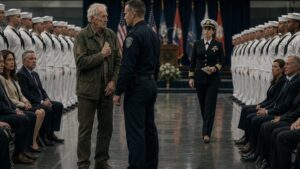
Michael White stood beside that empty space in his dress whites.
He was not smiling. He was not calling attention to himself. He simply stood there, one hand resting lightly on the back of the chair beside the open place, as if keeping the space from closing before Ronald reached it.
Patricia Hill stood near the podium with a stack of programs. Her face was composed, but Ronald noticed the way she glanced at the printed pages, then at him, then at Michael. The committee members near the fireplace spoke in low voices. One of them looked displeased. The Campbell family sat at the head of the table, dignified and uncertain, not yet knowing what kind of night they had entered.
Amy leaned down. “You don’t have to protect anyone in there.”
Ronald touched the folded napkin in his coat pocket. It was dry now, creased from Monday and Wednesday and Thursday, carried too long to be only cloth.
“I’m not protecting them,” he said.
She waited.
He looked toward the covered plaque. “I’m protecting the name.”
Amy’s face softened, but she did not make him explain. She had learned, by then, that some doors opened only when pushed from the inside.
She guided him toward the dining room entrance. The conversations thinned as his wheels crossed the threshold. Not silent all at once. That would have been easier. Instead, voices lowered one by one, like lights going out down a passageway.
Ronald kept his eyes on the center table.
Michael stepped forward. For a moment, Ronald saw him as he had been on Monday: white uniform bright, finger near the spill, voice polished enough to wound cleanly. Then Michael moved to the side, not in front of him, and pulled the removed chair farther away so the wheelchair could fit.
“Mr. Mitchell,” he said.
Ronald nodded.
Michael set a clean water glass in front of Ronald’s place, then removed his hand from it. He did not fill the silence with apology. He did not touch Ronald’s shoulder. He did not lean down as if speaking to a child. He placed the glass carefully beside the folded program and stood back.
The glass caught the chandelier light.
Ronald looked at it. The water inside held still. His fingers moved once on the armrest, then settled.
Amy took her seat along the side wall. John Thomas sat two places down from Ronald at the center table, hands folded, cap nowhere in sight. His eyes met Ronald’s briefly. There was regret in them, and something steadier beneath it.
The naval chaplain gave the opening prayer. Forks moved through salad. Coffee was poured. The photographer circled quietly. The room performed its duties well.
Then Patricia stood at the podium.
“Tonight,” she said, “we gather to dedicate this room anew, and to remember those whose service shaped the life of this club.”
Her voice held. Only Ronald, watching closely, saw her thumb press against the top page.
She spoke of the Campbell family’s support, of keeping doors open, of preserving a place for veterans and their families to gather. It was all true. Ronald listened because truth, even incomplete, deserved better than contempt.
Then she looked at Michael.
He rose from his seat with a single sheet of paper in his hand. Not the glossy program. A plain page.
One of the donor committee members shifted in his chair.
Michael stepped to the podium. The white of his uniform looked less sharp under the warm lights now. More human. He looked down at the page, then at the room.
“There is a correction to tonight’s remembrance,” he said.
A small discomfort moved through the tables.
Michael did not look at Ronald. Ronald was grateful.
“In preparing for this dedication, we found that one name carried by this room for many years was not included in the printed program.”
Patricia’s face lowered a fraction.
Michael continued. “That omission was ours. The correction belongs to the room.”
Ronald’s right hand moved toward the glass. He stopped before touching it.
Michael read the six printed names first.
He read them slowly. Each one landed, was held, and passed into the room without hurry. Ronald watched the faces around the table change as the rhythm became less ceremonial and more personal. The Campbell family listened with heads bowed. The older veterans did not move.
Then Michael paused.
“And Ryan Perez,” he said.
Ronald closed his eyes.
Not long. Only enough to see the boy as he had been before the water rose: nineteen, angry about being called kid, laughing with his whole face when he forgot to prove he was grown. Then another image tried to follow — water in the passage, hands slipping, a voice asking not to be left off the list — but Ronald opened his eyes before the memory could take the room from him.
Michael stepped back from the podium.
The photographer did not lift his camera.
No one applauded.
For once, the silence did not feel like failure.
The donor committee member near the fireplace leaned toward Patricia, whispering sharply enough for Ronald to catch only the shape of disapproval. Patricia listened, then shook her head once. Not dramatically. Not for anyone to notice. The whisper stopped.
The chaplain returned to the podium and continued with the dedication. When the navy cloth was removed from the new plaque, Ronald looked at it without resentment. Campbell Memorial Dining Room, it read in clean brass. Beneath it, smaller, newly attached and not perfectly matched to the shine above, was the old lower strip.
Ryan Perez’s name was there.
So were the others.
The strip looked uneven. It looked rescued.
Ronald heard Amy exhale from the side wall.
After the formal reading, Michael came back to the center table but did not sit. Another older member at the far end glanced toward Ronald’s untouched glass and muttered, not quietly enough, “Maybe someone should move that before we have another accident.”
Michael turned.
“No,” he said.
The word was not loud, but it carried.
The older member blinked.
Michael’s hand rested on the back of his own chair. “The glass stays.”
Ronald looked at him then.
Michael did not ask for approval. He simply took his seat beside Ronald instead of above him.
The dinner resumed, changed in a way no one announced. Plates were cleared. Coffee returned. The room loosened its shoulders. John Thomas leaned close once and said, “Thank you.”
Ronald looked at the glass. “For what?”
John’s eyes shone, but his voice stayed steady. “For not letting us make it clean.”
Ronald reached into his coat pocket and took out the folded napkin.
Amy, watching from the side wall, saw the motion and sat very still.
Ronald unfolded the napkin once, then again. The old creases remained. He did not need it for water tonight. He placed it beside the glass anyway, corners inward, ridge forward, the same quiet pattern that had disturbed the room on Monday.
Michael saw it. So did John. Patricia, from the podium, saw it too.
No one asked him where he had learned it.
When the chaplain read the names one final time, he did not separate the printed from the restored. He did not explain which had almost been left out. He read them all in one steady breath, and when he came to Ryan Perez, Ronald’s hand rested beside the glass, steady at last.
The water did not spill.
It only reflected the room that had finally remembered correctly.
The story has ended.