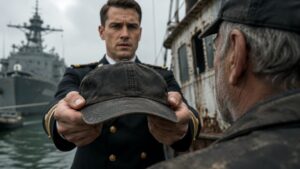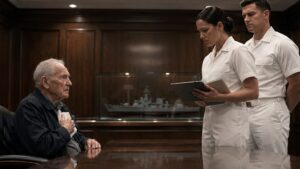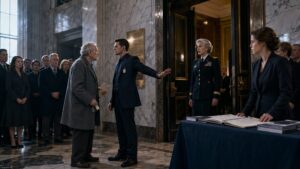
A Young Soldier Mocked The Old Man In A Wheelchair Before His Commander Knelt Beside Him
Chapter 1: The Old Man Waiting Beneath The Fluorescent Lights
The first thing Joseph Carter noticed was that someone had placed his name card upside down.
It lay on the reception counter behind a clear plastic sign that read DEDICATION GUEST CHECK-IN, half-hidden beneath a clipboard, a roll of visitor stickers, and a stack of printed programs with blue covers. From where he sat in his wheelchair, Joseph could see only the corner of the card. The paper was thick, formal, folded once down the middle. His last name showed in black letters.
CART—
Then the receptionist’s elbow covered it.
“I’m sorry, sir,” she said, not unkindly. “I’m not seeing you on the active visitor list.”
Joseph looked up at her through the thin glare of the lobby lights. The military medical training center smelled of floor polish, coffee, and pressed fabric. Young service members moved through the lobby in clean uniforms, their shoes making small disciplined sounds on the waxed tile. Beyond a set of double doors, someone tested a microphone. A low thump came from inside, followed by a burst of static.
Joseph had not been inside this building before. The old training hospital had been torn down twelve years earlier, and this center had risen in its place with clean glass walls, new plaques, and bright screens that changed every few seconds. Yet the air still carried something he recognized. A waiting-room silence. The clipped voice of staff trying not to show urgency. The faint metallic rattle of equipment behind closed doors.
He placed one hand flat on the wheelchair arm.
His fingers had grown thinner than he remembered. The skin showed veins, sun spots, and the pale seam of an old scar near his wrist. He kept the hand still.
“I was invited,” he said.
His voice came out low and dry. He did not repeat himself.
The receptionist gave him the careful smile people used when they believed age had made a person difficult. “Of course. Do you have your current badge?”
Joseph glanced down at his lap.
The packet rested there, held under his left hand. It was cream-colored and creased at the edges, the envelope softened from being opened and closed too many times. A corner had bent during the ride over. On the front, his name had been typed without rank. That had been his request.
Joseph Carter.
No stars. No retired title. No line of honors after it. Just the name his mother had said across a kitchen table long before anyone had saluted him.
“I have this,” he said.
He lifted the packet carefully and placed it on the counter.
The receptionist took it between two fingers, read the front, then turned to her computer. “This looks like an older guest packet.”
“It came three months ago.”
“Yes, sir. We updated access procedures last week. Today’s dedication is a restricted event.”
Joseph looked past her toward the double doors. On the wall beside them, a temporary banner hung from two metal stands.
COMBAT MEDICAL RESPONSE TRAINING DEDICATION
HONORING THE EVACUATION DOCTRINE THAT CHANGED FIELD CARE
The words were clean and official. Too clean. They had sanded the years down to a doctrine, a training module, a thing young officers could learn in two hours between lunch and a briefing.
He had not wanted to come.
He had sat at his kitchen table with the envelope unopened for six days. His nurse aide had placed it beside his pill organizer each morning, and each evening Joseph had moved it farther from him. The last time he opened it, a small note had fallen out. Not formal. Not printed. A single handwritten line from someone at the center who must have found the name in an old file.
Sir, the last medic asked that you be told.
That had been enough.
The receptionist typed again. Her eyes narrowed at the screen. “Do you have a driver waiting?”
“No.”
“Family member?”
“No.”
“Assistance contact?”
Joseph said nothing.
The lobby moved around him. Two junior service members crossed behind his chair carrying a folded display stand. One of them looked down, saw the wheelchair blocking part of the check-in lane, and stepped around him with a small sideways motion. A woman with a tablet passed through the double doors without being stopped. A photographer adjusted a camera strap near the coffee table.
Joseph felt the old, practiced pull to fix the room.
Not command it. Not dominate it. Just read it. Who was hurried. Who was pretending not to be. Which door would clog first in a drill. Which young face had been given responsibility before being given judgment. Which person at a desk had enough authority to say no but not enough confidence to ask why.
He let the pull pass through him.
The receptionist handed the packet back. “Why don’t we have you wait over there for a few minutes?” She pointed toward a row of chairs near a display case. “Someone from coordination can come speak with you.”
Joseph looked at the row.
The chairs were low and modern, arranged beneath a screen scrolling old photographs from field hospitals and evacuation sites. A few cadets sat there already, laughing quietly over something on a phone. Beside the chairs stood a trash can and a rack of folded pamphlets.
The space was not meant for him. It was meant to move him out of the way.
“I can wait here,” Joseph said.
The receptionist’s smile tightened. “Sir, we need to keep the entry clear for invited guests.”
He lowered his eyes to the packet.
There had been years when a word from him could move aircraft, convoys, entire medical teams across hostile ground. There had been years when men and women stopped breathing too loudly when he entered a command tent. There had been years when his hesitation cost minutes, and minutes cost names.
Now a young woman at a counter was asking him to wait beside a pamphlet rack because a computer list had not found him.
He should have felt anger.
Instead, he felt the old weight settle into its familiar place, somewhere below the ribs.
“I understand,” he said.
He slid the packet back into his lap and placed his right hand palm-down over it. The fingers did not curl. They did not grip. They simply rested there, steady and tense, as if holding a map against wind.
The receptionist came around the counter and reached for the wheelchair handles. “I can help you over—”
“No,” Joseph said.
The word was not loud.
It still stopped her hand.
For a second, her face changed. Not fear. Not recognition. Only surprise that the quiet old man had placed a boundary where she expected gratitude.
Joseph turned the chair himself. The wheels responded with the sluggishness he hated. His shoulders burned halfway through the motion, but he did not let the effort show. He moved away from the counter, slowly, each push measured. The packet stayed flat beneath his hand.
At the row of chairs, one cadet glanced at him, then at the wheelchair, then back at the phone. The lobby’s noise resumed. The microphone thumped again behind the double doors.
Joseph stopped near the display case instead of the chairs.
Inside the glass, arranged under soft museum lighting, were old medical kits, field radios, faded maps, and a strip of cloth marked with evacuation arrows. A caption beneath the display read: EARLY TRIAGE CORRIDOR MARKING SYSTEM, ORIGIN UNKNOWN.
Joseph stared at the strip of cloth.
Origin unknown.
A sound moved through him that might have become a laugh in another man.
His right palm stayed flat on the packet.
Behind him, the receptionist spoke quietly into a phone. “There’s an elderly gentleman here with an older invitation. No badge. Says he’s here for the dedication.”
Joseph watched the cloth behind the glass until the reflection of a uniform appeared beside him.
Young. Crisp. Confident. Standing too close.
“Sir?” the young man said brightly. “Having a little trouble finding where you belong today?”
Joseph turned his head.
Kevin Torres smiled down at him like he had already solved the problem.
Chapter 2: Kevin Torres Smiled Like He Already Understood Everything
Kevin Torres had been told three times that morning not to let the dedication become messy.
The first warning had come from the receptionist, who said the guest list had changed after the security update. The second came from Emily Clark, who had walked through the lobby with a tablet under one arm and a headset clipped to her collar, saying, “No wandering visitors near the hall once the commander arrives.” The third came from Kevin himself, silently, while checking his reflection in the dark glass beside the entrance.
Clean uniform. Straight shoulders. Calm face.
He had been trusted with the outer door.
It was not a major assignment. He knew that. But it was visible, and visible things mattered on days when commanders walked through with photographers nearby. A mistake at a doorway could travel faster than a correct report. A confused guest could delay an entire ceremony. A blocked hallway could make someone ask who had been assigned to keep order.
Kevin saw the old man by the display case and decided, quickly, that this was exactly the kind of small problem that became a large problem if no one handled it early.
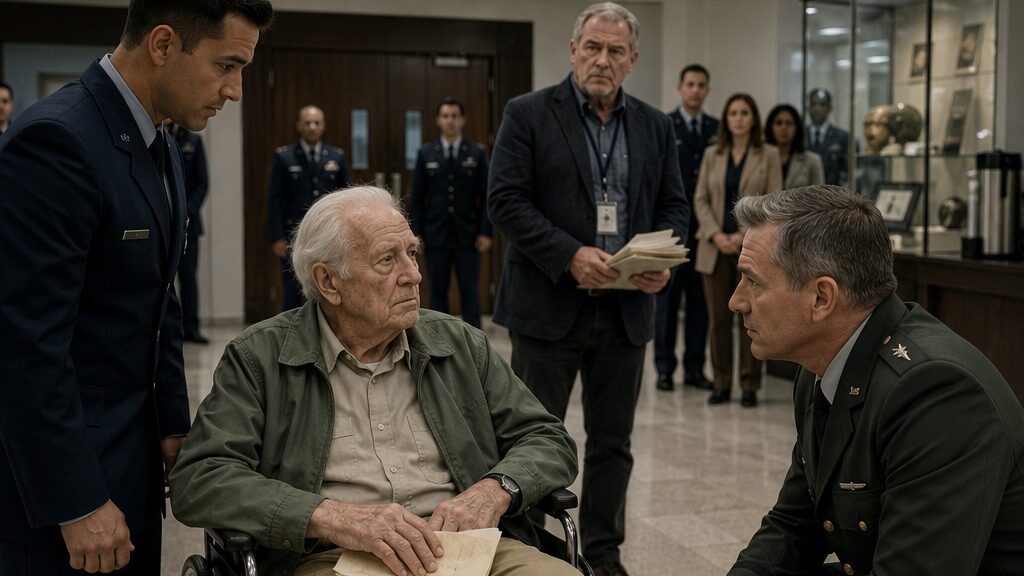
The man sat in a wheelchair, wearing a plain green jacket that looked too soft at the elbows and a light shirt buttoned to the throat. His khaki pants were neatly pressed but old. A dark watch hung loose against one wrist. On his lap lay a creased packet, guarded under a thin hand.
He did not look lost.
That bothered Kevin more than if he had.
“Sir?” Kevin said. “Having a little trouble finding where you belong today?”
The old man turned his head slowly.
His eyes were pale and direct, the kind of eyes that did not search a face for permission. Kevin kept smiling.
“I’m Kevin Torres. Security liaison for the dedication.” He crouched, because people liked that. It made older visitors feel respected. At least, that was what the hospitality briefing had said. “Let’s see if we can get you sorted out.”
“I am sorted,” the old man said.
Kevin gave a soft chuckle, just enough to keep the exchange light. “I’m sure you are, sir. But this section is restricted for invited personnel.”
The old man looked at the double doors.
“I was invited.”
“Right.” Kevin held out his hand. “Can I take a look?”
For a second, Kevin thought the old man would refuse. The hand on the packet did not move. Then the fingers lifted, slowly, and Kevin took the envelope.
The name on it was simple.
Joseph Carter.
No title. No rank. No unit. No designation. The packet had the center’s seal, but the paper had clearly gone through too many hands. Kevin flipped it over and found no updated badge sleeve, no scannable insert, no colored stripe.
“This is an old format,” Kevin said.
“Yes.”
“Do you have the updated credentials?”
“No.”
“Do you know who invited you?”
The old man’s expression did not change. “The center did.”
Kevin breathed in, then out, keeping his patience visible. A pair of junior service members slowed nearby, watching. One of them held a rolled banner against his shoulder. The receptionist looked over from the desk. Kevin could feel the scene becoming something other people noticed.
He lowered his voice. “Sir, sometimes these mailers go out broadly. Former patients, community supporters, local veterans. It doesn’t necessarily mean access to the ceremony floor.”
“It was addressed to me.”
“I understand that, but the main dedication is for command staff, medical leadership, and invited guests with current clearance.”
The old man looked at him then, fully.
“You can check the name again.”
Kevin smiled tighter. “We did.”
“No,” the old man said. “You checked the list.”
Something in the tone made Kevin pause.
Not volume. Not insult. The words landed with the clean edge of correction. For half a second Kevin felt, absurdly, as if he were standing inspection. He pushed the feeling away.
“Sir, I’m not trying to make this difficult.”
“Then don’t.”
The junior service member with the banner looked down quickly, hiding a reaction.
Kevin felt heat under his collar. He shifted closer to the wheelchair. “I’m going to move you to a more comfortable area until Ms. Clark can confirm your packet.”
He reached for the handles.
The old man’s right hand came up.
It was a small movement, not fast enough to seem threatening. Palm outward. Fingers together. Wrist firm despite the tremor in the skin. The hand stopped in the air between Kevin’s chest and the wheelchair handle, and Kevin stopped with it.
Not because he had to.
Because something in the gesture told him to.
For a heartbeat, the lobby thinned around them. The coffee machine hissed near the wall. A microphone popped behind the doors. Somewhere a tablet chimed.
Then an older voice behind Kevin whispered, “No.”
Kevin glanced over his shoulder.
Brian Mitchell stood near the display case with a stack of programs in his hand. He was older than most of the uniformed staff, broad in the shoulders but bent a little at the neck, with the watchful stillness of someone who had spent years being told to wait until spoken to. His volunteer badge hung from a blue lanyard.
His eyes were on the old man’s raised palm.
The programs in his hand had tilted.
“What?” Kevin asked.
Brian did not answer him. He took one step closer, his mouth slightly open.
The old man lowered his hand back to the packet.
Brian’s face had changed. The mild volunteer expression was gone. In its place was something Kevin could not read fast enough: surprise, caution, memory, maybe fear.
“Where did you learn that signal?” Brian asked, barely above a whisper.
The old man looked at him.
For the first time, something moved behind his eyes.
Not softness. Not recognition exactly. A door opening one inch, then stopping against a chain.
Kevin stood. “Mr. Mitchell, I’ve got this handled.”
Brian did not look at him. “That’s not a hospital stop sign.”
Kevin laughed once, short and uncomfortable. “It’s a hand, Brian.”
“No,” Brian said.
The junior service members had stopped pretending not to watch.
Kevin heard the double doors open behind him and close again. More guests were entering from the outer hallway. The dedication was minutes from starting. The last thing he needed was a retired volunteer turning a misplaced visitor into a mystery.
He slipped the packet under his arm. “Sir, I need you to cooperate.”
The old man’s eyes went to the packet.
Kevin noticed too late that taking it had changed the air.
The old man did not raise his voice. He did not reach for it. But the hand that had stopped Kevin from touching the chair now settled palm-down on the empty place in his lap, as if holding something invisible from blowing away.
“That belongs with me,” he said.
“I’ll return it once we confirm access.”
“You can read the name.”
“I did read the name.”
“Then read it as if it matters.”
Kevin’s jaw tightened.
The words were not loud enough for everyone, but enough people heard. The receptionist froze behind the counter. Brian Mitchell looked from Joseph to Kevin as if measuring the distance between a spark and dry grass.
Kevin crouched again, closer this time, trying to regain the shape of the conversation. “Mr. Carter, I respect that you came all this way. But this event is not open seating. We have senior leadership arriving. We have families of honored personnel. We have a program to keep on time. If you’re supposed to be here, we’ll find that out. Until then, you need to let us do our job.”
The old man watched him.
Kevin expected frustration. Embarrassment. Confusion.
Instead, the old man seemed to be deciding whether Kevin was worth the cost of a sentence.
At last he said, “Your job is not to move people before you understand why they came.”
Kevin stood quickly. “All right. We’re going to wait by the side hall.”
He gestured to one of the junior service members. “Clear that corner.”
Brian stepped forward. “Kevin.”
“Not now.”
“You need to listen.”
“I said not now.”
Brian’s voice dropped. “Where did you learn that signal?” he asked again, this time directly to the old man.
The old man did not answer.
Kevin turned between them, blocking the line of sight. “That’s enough. We’re not holding the ceremony because of a hand gesture.”
The old man’s face became still again, closed and stern, but Brian Mitchell looked as if he had just heard a call sign come over a radio after forty years of silence.
Chapter 3: The Guest Packet Nobody Wanted To Open
Emily Clark found the first mistake in the spelling.
Not Joseph Carter. That was clean enough.
The problem was the way the temporary security list had sorted him. Someone had entered him under community invitee, unbadged, assistance required. That category sent his name to a secondary list used for lobby support, not ceremony access. It explained why the receptionist had not found him on the command guest screen.
It did not explain why his packet had been printed on cream stock instead of standard white.
Emily stood behind the counter with Kevin Torres at her shoulder, the old packet open in front of her, and the elderly man in the wheelchair waiting ten feet away near the side hall. She could feel the lobby watching without looking directly. People did that in military spaces. They pretended not to notice discomfort until discomfort became an order.
“See?” Kevin said quietly. “Community invitee. No badge.”
Emily scanned the screen again. “This record is incomplete.”
“It’s incomplete because he isn’t cleared for the ceremony floor.”
“That’s not what incomplete means.”
Kevin exhaled through his nose. “Emily, the commander’s walk-through is in less than ten minutes.”
“I know what time it is.”
“Then help me solve this.”
She looked at him. “Solving it and moving him out of sight are not the same thing.”
Kevin’s eyes flicked toward the wheelchair. “I didn’t say out of sight.”
“You implied it.”
He lowered his voice. “He’s already made this awkward.”
Emily looked back at Joseph Carter.
He sat with his shoulders slightly forward, not collapsed but gathered, as if saving strength. His right hand rested on his lap where the packet had been before Kevin brought it to the counter. The fingers were open, palm-down, pressing against nothing. She had seen elderly men guard pill bottles that way, discharge papers, photographs, old watches. Small objects that held more history than anyone at a desk knew how to process.
Beside him, Brian Mitchell hovered near the display case, gripping a stack of programs too tightly.
Emily turned the packet over. Inside were three sheets: the formal invitation, a parking note, and a folded insert with the dedication schedule. No badge. No QR sticker. But tucked into the back flap was a smaller envelope, sealed with a strip of center tape.
“Did you open this?” she asked.
Kevin frowned. “No. It was like that.”
Emily lifted it.
The tape had not been broken.
Across the front, in block print, someone had written: HOLD FOR ARRIVAL.
Her stomach tightened.
“Why didn’t anyone open this at check-in?” she asked.
Kevin shifted. “Because sealed material isn’t required for access verification. The access list is.”
“This is part of his packet.”
“It might be ceremonial.”
“It says hold for arrival.”
“Then open it.”
Emily looked toward Joseph. “Not without asking him.”
Kevin made a small impatient motion with his hand. “Emily.”
She ignored him and walked around the counter.
Joseph’s eyes followed her, clear and unreadable.
“Mr. Carter,” she said, crouching only slightly, careful not to perform kindness. “There’s a sealed envelope inside your packet. It says it should be held for your arrival. May I open it?”
For a long moment, he said nothing.
Then his gaze moved to the envelope in her hand.
“Who wrote that?” he asked.
“I’m not sure.”
“Is there a note inside?”
“I haven’t opened it yet.”
His hand shifted on his lap. The palm trembled once. He lowered it, steadying the movement against his knee before anyone else could pretend not to see.
“That packet was not meant to be taken from me,” he said.
Emily felt the sentence land like correction, not complaint.
“I’m sorry,” she said.
Behind her, Kevin said, “We needed to verify—”
Emily turned sharply enough to stop him.
Joseph did not look at Kevin. “Open it,” he said.
Emily broke the tape.
Inside was a folded sheet and a smaller blue card. She unfolded the sheet first.
The letterhead belonged to the center director’s office. The message was brief.
Mr. Carter,
At the request of surviving medical personnel and the family of the last medic recovered from the east corridor, this packet confirms your place as an honored attendee at today’s dedication. Commander Johnson has been notified of your expected arrival. A staff escort should bring you directly to the front row before the ceremony begins.
Thank you for agreeing to return.
Emily read the words twice.
The lobby noise seemed to drop behind her.
Kevin leaned in. “What does it say?”
Emily did not hand it to him.
She looked at Joseph instead. The old man’s face had not changed, but his eyes had lowered slightly at one phrase.
The last medic.
“You knew them?” Emily asked before she could stop herself.
Joseph’s hand closed once on his knee, then opened.
“I made a promise,” he said.
It was all he gave her.
Emily folded the sheet carefully. “Mr. Carter, I apologize. You should have been escorted in.”
Kevin’s posture stiffened. “That still doesn’t explain why he wasn’t on the current clearance list.”
Emily turned back toward the counter. “It explains enough to slow down.”
“We don’t have time to slow down.”
“We didn’t have time to get it wrong either.”
His face flushed. “This isn’t about being wrong. It’s about procedure.”
Brian Mitchell spoke from near the display case. “Procedure is supposed to protect the mission, not embarrass the people who carried it.”
Kevin looked at him. “You don’t even know who he is.”
Brian’s gaze remained on Joseph. “No. But I know that signal.”
Emily looked between them. “What signal?”
Brian swallowed. For the first time since she had known him as the quiet volunteer who straightened exhibit cards and corrected dates no one else noticed, he looked genuinely shaken.
“Old field command signal,” he said. “Used when radio silence mattered. Palm up or out, fingers closed. Hold position. Stop movement. Wait for confirmation.”
Kevin stared at him. “A lot of people use a hand like that.”
“Not like that.”
Joseph looked away.
Emily followed his gaze.
Two staff members were carrying a framed photograph from the side hallway toward the dedication hall. The frame was large, almost too wide for the narrow passage, and the glass caught the fluorescent lights in a pale streak. Inside the frame was a grainy field image from decades earlier: a medical corridor made of canvas, stretchers lined beneath a damaged overhang, figures blurred by dust and motion. Near the center stood a much younger officer with one hand raised, palm outward, holding a line of soldiers in place while medics moved past him.
Emily could not see the officer’s face clearly from where she stood.
Joseph could.
The old man turned his face away before the staff members passed close enough for anyone else to compare the photograph to him. His hand settled over his empty lap again, palm down, as if he were holding the glass frame from a distance, keeping it from falling into the room too soon.
Chapter 4: The Commander Entered Before The Door Closed
Michael Johnson heard the wrong tone before he saw the wrong posture.
The dedication hall doors opened just as a staff member inside called for the first row to remain clear. A ribbon had been stretched near the front wall, where the covered plaque waited beneath navy cloth. The room was ready in the way military rooms were ready when too many people had touched the schedule: chairs aligned, programs centered, flags standing still, microphone tested until it sounded thin and lifeless.
Michael stepped into the lobby to check the entrance himself.
He intended only to glance.
Then he saw Kevin Torres standing too close to an elderly man in a wheelchair.
Not speaking to him. Managing him.
There was a difference, and Michael had learned to see it long before he wore the rank he wore now. A person speaking to another person left space for dignity. A person managing a problem leaned forward, controlled the angle, narrowed the distance, and used a voice polished smooth enough to hide impatience.
Kevin held a cream-colored packet in one hand.
Emily Clark stood near the counter with a letter folded between her fingers.
Brian Mitchell had gone pale.
And the old man in the wheelchair had turned his face away from a framed photograph being carried toward the hall.
Michael slowed.
The photograph caught light as the staff members passed him. He saw canvas corridors, dust hanging in the air, a line of stretchers, medics bent over bodies. At the center of the image, a younger officer stood with one hand raised, palm outward, stopping a group from advancing into the corridor.
Michael knew the picture. Everyone assigned to this center knew it, or at least thought they did. It appeared in training slides, leadership seminars, battlefield medicine briefings. It had been copied so many times that the man’s face had softened into history.
The East Corridor Evacuation.
The doctrine had become clean over time. Charts. Arrows. Lessons learned. Case-study questions for officers who had never smelled smoke in a triage tent.
Michael had studied the photograph as a captain.
He had memorized the caption.
Unknown senior field commander directing casualty flow during communications blackout.
Unknown.
He looked from the framed photograph to the old man in the wheelchair.
The resemblance did not arrive all at once. Age did not allow that kindness. It had to be pieced together through what remained: the shape of the brow, the set of the mouth, the stillness of the eyes. The young officer in the photograph stood straight beneath war and dust. The old man sat beneath fluorescent lights with a plain green jacket loose on his shoulders.
But the hand was the same.
Palm outward. Fingers together. No wasted movement.
Michael stopped walking.
Kevin noticed him and straightened too quickly. “Commander Johnson.”
Emily turned, relief and worry crossing her face at the same time.
Michael did not answer immediately. His eyes stayed on the old man.
The man looked back.
A strange quiet passed between them. Michael felt the lobby noise pull away, leaving only the faint buzz of lights and the soft squeak of the framed photograph being carried through the open doors.
He had never met Joseph Carter.
Not in person.
He had heard the name in fragments from men who did not like to speak long about certain years. He had seen it buried in doctrine drafts, stripped of title in later public versions. He knew the reason for that, too. Some commanders fought for credit. Some made sure credit went elsewhere.
But Michael had not expected him to look so ordinary.
That thought shamed him before it finished forming.
Kevin began, “Sir, we had a guest-list issue. Mr. Carter has an older packet and no current badge. We were just moving him to a side area until—”
“Stop,” Michael said.
The word cut cleanly through the lobby.
Kevin stopped.
So did the receptionist, the two junior service members, and the staff member halfway through the dedication doors. Emily lowered the letter to her side.
Michael walked toward the wheelchair.
Each step seemed louder than it should have been. His polished shoes struck the tile with the same sound young officers made when trying not to hurry. He came to stand where Kevin had stood, but he did not lean over the old man.
He lowered himself.
One knee touched the tile.
The movement sent a ripple through the lobby because men in Michael’s position did not kneel in public unless ceremony required it, and this was not ceremony. Not yet.
At eye level, the old man’s face became harder to mistake. Not because age vanished. It did not. The deep lines remained. The exhaustion remained. The body in the wheelchair remained. But the eyes held what the photograph had held: command stripped of theater.
Michael’s voice lowered. “Sir.”
Joseph Carter looked at him without expression.
For one second, Michael almost said the full title in front of everyone. He almost let the room learn the truth in one blow. But he saw something in the old man’s face that stopped him, the same palm without a hand.
Wait.
Confirm before movement.
Michael drew a breath. “I’m Michael Johnson. Current commander of this center.”
“I know who you are,” Joseph said.
The voice was quiet.
Kevin’s eyes shifted from Joseph to Michael.
Michael felt the old shame deepen. Of course he knew. A man did not come to such a place blind. A man like this would have read the names before the building ever opened its doors.
Emily stepped closer, holding the letter. “Commander, his sealed packet says he was to be escorted directly to the front row. The system had him under the wrong category.”
Michael did not look away from Joseph. “Who categorized him?”
“I don’t know yet.”
Kevin spoke quickly. “Sir, with respect, the active list—”
Michael turned his head.
Kevin fell silent.
It was not fear in the young man’s face. Not exactly. It was the first crack in certainty, and certainty resisted cracking. His jaw held tight. His eyes still searched for procedure to stand behind.
Michael said, “Did you read the packet?”
Kevin swallowed. “I checked the exterior and the list.”
“Did you read the packet?”
“No, sir.”
“Did he ask you to check the name again?”
Kevin’s mouth opened, then closed.
Joseph’s right hand rested on the wheelchair arm now, palm down. Michael saw a faint tremor pass through it. The old man pressed once against the chair until the tremor disappeared.
Michael looked at that hand.
When he was young, an instructor had shown his class a grainy training clip from the East Corridor. The voiceover had been flat, academic, almost bored. In the clip, a field commander raised one hand and stopped a line from rushing into a corridor seconds before a secondary collapse. No shouting. No dramatics. Just a palm, held steady until the medics cleared the route.
Michael had watched it again years later after losing men under his own command. He had understood then why the instructor’s voice had been flat. Some moments could not survive ornament.
Brian Mitchell stepped forward. “Commander.”
Michael rose just enough to turn toward him, still low beside Joseph’s chair.
Brian pointed to the photograph being set near the hall entrance. “That’s him, isn’t it?”
The lobby changed.
Not loudly. No one gasped. No one exclaimed. But posture shifted. Eyes moved. The receptionist looked at the old man’s face, then toward the photograph, then down at the counter where his upside-down name card still lay half-covered.
Kevin stared at Brian. “What are you talking about?”
Brian’s voice was rough. “East Corridor.”
Michael closed his eyes briefly.
The ceremony had not begun, and already the room had failed the man it was built to honor.
He turned back to Joseph.
The old man’s expression had tightened. Not with pride. With something closer to pain.
Michael understood then that recognition was not a gift if it was dragged into the room before the man was ready to carry it.
“Mr. Carter,” Michael said carefully.
Joseph looked at him.
Michael lowered his voice further, but the lobby had gone so still that the words seemed to travel anyway.
“I apologize for the delay.”
Joseph studied him. “Is that what happened?”
Michael felt the question strike where rank could not shield him.
A delay was a late door. A delay was a misplaced badge. What had happened here was smaller and worse: a room full of people had accepted the idea that an old man could be moved first and understood later.
Michael nodded once. “No, sir.”
The word slipped out.
Sir.
Kevin heard it. Emily heard it. Brian heard it. The junior service member with the banner lowered his eyes.
Joseph did not react.
Michael remained beside the wheelchair, still not fully standing.
“Would you allow me to escort you inside?” he asked.
Joseph’s gaze moved past him toward the dedication hall. The photograph now stood inside the doors, angled against a chair until someone could mount it on the wall. The younger officer in the image had his palm raised forever, holding back chaos no caption understood.
Joseph looked down at his own hand.
“I came because of a promise,” he said.
Michael nodded. “Then we’ll honor that promise correctly.”
Kevin took a small step back. The packet in his hand looked suddenly wrong there, like an object taken from a place it should never have left.
Emily reached for it. Kevin surrendered it without speaking.
She brought it to Joseph and placed it carefully on his lap.
Joseph’s hand settled over it. Palm down.
Michael rose slowly.
Only then did he face the room.
“Clear the front row,” he said. “And bring the program director here.”
Kevin straightened as if grateful for an order he understood. “Yes, sir.”
Michael stopped him with one look.
“Not you.”
Kevin froze.
Michael turned back to Joseph. He let the room hear the next words, but did not make them theatrical.
“General Carter,” he said quietly, “we have been waiting for you.”
Kevin’s face emptied.
The lobby did not move.
Chapter 5: The Wall Remembered What The Room Forgot
Joseph Carter had spent thirty-eight years learning how not to flinch when people said his title.
General had been a useful word once. It opened doors, ended arguments, carried signatures across oceans, moved people toward danger and sometimes away from it. It belonged to the uniform, the office, the burden of command.
It had never felt like a name.
Now, hearing it in the lobby of a bright medical training center, Joseph felt the old word settle on his shoulders like a coat taken from a closet after decades. Heavy in places no one could see. Still carrying the weather.
Michael Johnson did not push his chair. He walked beside it.
That mattered.
A staff member offered to help, but Michael shook his head and opened the dedication hall doors himself. Joseph rolled forward under his own effort, slowly enough that everyone inside had time to turn.
The hall had been arranged with care. Rows of chairs faced an exhibit wall covered in dark cloth. A podium stood near a covered plaque. Two flags rested in stands beside a screen paused on the title slide: EAST CORRIDOR EVACUATION DOCTRINE: FROM FIELD IMPROVISATION TO MODERN MEDICAL RESPONSE. Programs lay on every seat.
On the front row, a card read HONORED GUEST.
No name.
Joseph saw that first and was grateful.
Then he saw the covered wall and knew gratitude would not last.
The room’s silence followed him. It was not yet recognition. It was confusion trying to become respect fast enough to hide its earlier shape. Officers stood half-risen. Cadets turned their heads in sequence. A photographer lowered her camera without taking the shot.
Kevin entered last and stayed near the door.
Emily moved to the side aisle with the opened packet clutched to her chest. Brian Mitchell stood near the exhibit wall, holding programs as if they had become fragile.
Joseph stopped at the front row.
Michael leaned close. “Would you prefer to sit here or remain in your chair?”
“In the chair.”
Michael nodded. “Of course.”
Someone removed the front-row chair without scraping it. Too careful now. Too aware. Joseph watched the empty space appear, and for one strange second he remembered a different space opening in a canvas corridor, men pulling stretchers back because his hand told them to wait.
He closed his eyes once.
Not here.
Not yet.
The ceremony director approached Michael with a panicked whisper. Michael listened, then said quietly, “Begin with the program as written until I tell you otherwise.”
Joseph heard that and looked at him.
Michael did not look away.
“The program as written may be wrong,” Joseph said.
“I suspect it is incomplete.”
“That is different.”
“Yes, sir.”
The ceremony began five minutes late.
No one mentioned why.
The first speaker welcomed the gathered personnel and guests. He spoke of legacy, innovation, sacrifice, and the importance of training the next generation. Joseph let the words pass over him. He knew the shape of formal language. It existed to approach pain without touching it.
Then the lights dimmed slightly, and the screen changed.
The first image appeared.
Canvas. Dust. Stretchers. The corridor.
Joseph’s right hand tightened on the wheelchair arm.
The speaker continued. “The East Corridor Evacuation has been studied for decades as a turning point in combat medical response. During a communications blackout and structural collapse threat, a field command team improvised a casualty-flow system that saved hundreds of wounded personnel and civilians.”
Saved hundreds.
Joseph watched the photograph.
It showed the corridor before the second collapse. Before the east wall buckled. Before the last medic went back because one more stretcher was still inside.
The speaker clicked to the next slide.
A diagram appeared, clean arrows moving through clean boxes.
Joseph looked down.
The packet on his lap had shifted. He placed his palm over it, steady.
A video began.
The footage was grainy, filmed from behind a stack of crates. Young Joseph appeared in the frame almost by accident, not centered, not heroic. He stood near the corridor mouth with no helmet, dust on one side of his face, sleeves rolled, one hand pressed to an earpiece that had not worked for twenty minutes.
The room watched the younger man raise his palm.
The effect was immediate.
On the screen, soldiers stopped. Medics moved. A stretcher team changed direction without a word. Another team held at the corridor edge. The younger Joseph’s hand did not shake.
In the hall, no one breathed loudly.
The video paused automatically at the archival mark.
The speaker, who had clearly expected the clip to function as background material, looked toward Michael with uncertainty.
Michael gave him no rescue.
Brian Mitchell stepped forward without being asked. His voice, when it came, was rough but controlled.
“That signal,” Brian said, “was taught to us without a name attached. Hold position. Stop movement. Wait for confirmation. We were told it came from East Corridor, from the commander on site.”
The room looked from the screen to Joseph.
It happened slowly, and that made it worse.
Recognition traveled face by face. The younger officer in the video. The old man in the wheelchair. The same brow, the same mouth, the same palm resting now on a creased packet instead of raised against smoke and panic.
The speaker checked his program, suddenly clumsy with the pages.
Michael moved to the podium.
“We need to correct the record,” he said.
His voice carried, firm and quiet. “The commander shown in that footage is Joseph Carter.”
A chair creaked somewhere in the second row.
Michael continued. “Then commanding officer of the East Corridor evacuation response. Later chief architect of the medical evacuation doctrine this center teaches today.”
He did not list all the rest. Joseph was grateful for that.
But the room understood enough.
Kevin stood near the door as if he had forgotten the purpose of his own body. His eyes were fixed on Joseph’s hand, not his face.
Emily covered her mouth briefly, then lowered it, ashamed of the gesture.
The speaker turned a program page. His face had gone pale. “Commander Johnson,” he said softly, “the dedication plaque—”
“I know,” Michael said.
Joseph looked at the covered wall.
There it was. The thing he had feared. Not disrespect. He had endured plenty of that. Disrespect was easy compared with honor arranged incorrectly. A person could ignore insult. Honor had to be answered.
Michael stepped down from the podium and came to Joseph’s side.
“The plaque was prepared from the public record,” he said.
Joseph’s gaze remained on the covered cloth.
“The public record forgets useful things,” Joseph said.
Michael leaned closer. “If you want it removed, I’ll remove it.”
Joseph almost smiled. Almost.
Orders had become very easy to give again in this room. That was the danger. Once people recognized the title, they would hurry to obey and call it respect.
The screen behind them still held the paused image of his younger hand.
Joseph heard, under the silence of the hall, another sound entirely: stretcher wheels over broken flooring, a medic calling for more hands, the final hard crack of the east support. Then a voice younger than the others, calm even with blood on one sleeve.
Sir, if they make it out, tell them we all carried the order.
He had not remembered the exact words in years.
No. That was not true.
He had remembered them every morning and pretended he had not.
The ceremony director whispered to someone near the wall. Two staff members moved toward the covered plaque, awaiting Michael’s instruction.
Joseph raised his hand.
The movement was small, but the room stopped.
This time no one mistook it for frailty.
The staff froze beside the cloth. The speaker fell silent. Michael straightened. Brian bowed his head slightly before he seemed to realize he had done it.
Joseph lowered his hand to the wheel and turned his chair a few inches toward the podium.
The effort cost him. He hated that it did. He hated the thin burn in his arms, the pulse starting under his jaw. But he would not be pushed to the place where this had to be said.
Michael moved as if to help, then stopped himself.
Good, Joseph thought.
He reached the front of the room under his own power.
The microphone stood too high.
Michael adjusted it lower.
Joseph looked at the covered wall, then at the screen, then at the young faces in the back rows who had arrived expecting history and instead found an old man they had almost watched be removed from the lobby.
“I asked not to be listed by rank,” Joseph said.
The microphone caught his voice and made it thinner than it felt in his chest.
No one moved.
“I did not ask to be misplaced.”
The words did not strike loudly. They settled.
Kevin closed his eyes.
Joseph looked at the paused image. “That day has been turned into a doctrine. That is useful. Usefulness is not the same as truth.”
He stopped.
The room waited.
He could feel Michael beside him, ready to steady the microphone if needed and wise enough not to steady Joseph.
“There were names,” Joseph said. “Not arrows. Not systems. Names.”
His hand rested open on the arm of the wheelchair.
“I came because one of them asked me to.”
The ceremony director looked down at the covered plaque again. The cloth had begun to seem less like ceremony and more like concealment.
Michael said softly, “Sir?”
Joseph did not look at him.
“Stop the ceremony,” he said. “Before you uncover my name.”
Chapter 6: Joseph Carter Refused The Honor As Written
The cloth over the plaque did not move.
For several seconds, that was the only answer the room gave Joseph Carter. The dark fabric hung smooth against the wall, hiding whatever polished sentence had been prepared beneath it. A photographer near the aisle slowly lowered her camera to her chest. No one told her to. Some moments asked not to be captured.
Michael Johnson stood beside Joseph at the lowered microphone.
“Stop the ceremony,” Joseph had said.
And because everyone now knew who he was, the easiest thing in the world would have been to obey without understanding.
Joseph could feel that impulse moving through the hall. Chairs held still. Programs rested unread on laps. Officers waited for direction. Kevin Torres stood near the door with his face pale and his posture rigid, as if discipline alone could keep him from disappearing into shame.
Joseph looked at the covered plaque and knew he had almost stayed home because of this exact silence.
Not insult. Not discomfort. Obedience.
A room could misunderstand a man through reverence as completely as it could through contempt.
Michael leaned closer. “Sir, what would you like changed?”
Joseph glanced at him. “Not the cloth first.”
Michael understood enough to step back.
Joseph turned his chair slightly so he faced the room and not only the wall. The motion was slow. No one rushed to help him now, and that, at least, was something.
He rested both hands on the wheelchair arms.
“The last medic was not the last to die,” he said. “He was the last one I spoke to.”
The words tightened the room.
Joseph had not planned to say that. He had planned almost nothing beyond showing up, listening, placing a hand on a wall if he could bear it, and leaving before people asked him to tell a story cleanly. But the photograph had passed him in the lobby. Kevin had taken the packet. The raised palm had returned on the screen like an accusation from a younger body. And now the plaque waited behind cloth with his name beneath it.
He could not leave the room to its mistake.
“The evacuation you teach here was not born from one commander,” Joseph said. “It came from medics who counted faster than I did. From junior soldiers who held a corridor after their arms failed. From a radio operator who kept writing messages after the radio stopped sending. From people who did what needed doing before anyone had language for it.”
His throat dried.
He paused, and Emily Clark moved quietly to the side table, poured water into a paper cup, and brought it to him. She did not fuss. She did not apologize with her eyes. She simply held it where he could take it.
Joseph accepted.
“Thank you,” he said.
The cup trembled slightly. He steadied it with both hands, drank once, and gave it back.
Kevin watched the tremor. This time his face showed no impatience.
Joseph looked toward the back of the hall, where visiting cadets sat straighter than they had when the ceremony began.
“In the corridor, I gave an order to hold position. You saw the signal. That order prevented more people from entering a space about to fail. It also meant others remained inside longer than they should have.”
No one shifted.
“There is no version of command where every saved life cancels every lost one.”
Michael lowered his eyes.
Brian Mitchell stood near the exhibit wall with his programs pressed flat against his chest. Joseph saw that the older man’s lips had moved once during the video, perhaps repeating a name from memory.
Joseph continued. “One medic came back through the east smoke line with three people behind him. He went in again because someone said there was one more. Before he went, he said, ‘If they make it out, tell them we all carried the order.’”
The line seemed to enter the room person by person.
Joseph had carried it privately for decades. He had heard it in hospitals, at retirement ceremonies, in the quiet after phone calls from families who wanted him to say their loved ones had not been afraid. He had never known what to do with it. Orders were signed. Reports filed. Lessons extracted. The dead remained stubbornly individual.
“The people who wrote today’s plaque may have meant respect,” Joseph said. “I do not question that. But if that plaque carries only my name, it teaches the wrong lesson.”
The ceremony director glanced at Michael.
Michael did not move.
Joseph turned toward the covered wall. “Take it down.”
A staff member stepped forward.
Joseph raised his palm.
The staff member stopped.
This time the gesture was not command in the old sense. It was softer, almost weary. Hold. Wait. Let the meaning arrive before the action.
“Not away,” Joseph said. “Down. So it can be corrected.”
Michael nodded once to the staff.
Two staff members carefully lifted the covered plaque from its mounts and lowered it onto a table near the wall. The cloth stayed over it. No one tried to peek.
Joseph looked at Brian. “Mr. Mitchell.”
Brian startled at being addressed. “Sir?”
“You brought the programs?”
“Yes, sir.”
“Do they list the names?”
Brian’s face changed. “Only the command summary.”
Joseph closed his eyes briefly.
Of course.
Michael’s voice was low. “We have the full archival roster in the exhibit file.”
“Then read from that.”
“All of them?” the ceremony director asked before he could stop himself.
Joseph turned toward him.
The man flushed. “I only mean the program timing—”
“Their time ended years ago,” Joseph said. “We can spend some of ours.”
No one argued after that.
Michael gestured to the staff. Emily moved quickly to a side table where exhibit folders had been stacked. Brian joined her, and together they opened the archival binder. Pages turned. A list emerged, longer than the room expected. Brian’s hand hovered over the first page, then steadied.
Michael returned to the microphone. “This dedication will be amended. The training room will not carry one name alone.”
Joseph sat back.
The burn in his shoulders had deepened. The room had blurred at the edges. He kept his face composed and his right palm open on the wheelchair arm.
Brian came to the microphone with the roster.
He did not read loudly at first. His voice needed the first few names to find itself. Then it settled.
Medics. Drivers. Radio staff. Litter teams. Junior officers. Names that had sat in files while doctrine carried only arrows.
Joseph listened.
Some names struck with faces. Some with sounds. One with a glove left on a crate. One with a laugh in bad weather. One with handwriting in the margin of a casualty map. Not all memories came whole. Age had taken pieces. Guilt supplied others. But as Brian read, the room changed from audience to witness.
Kevin Torres stepped away from the door.
He did not come far. Only enough that he no longer seemed to be guarding an exit. His eyes moved from Joseph to the binder, then to the wheelchair, then down to his own hands.
When the list ended, no one applauded.
The silence was better.
Joseph turned his chair slightly toward Michael. “Now you may continue.”
Michael’s jaw worked once before he answered. “Yes, sir.”
The ceremony director wiped at one eye with the back of his hand and pretended he had not. The staff brought a temporary placard from the exhibit supplies. Emily wrote carefully while Michael dictated the corrected wording.
Not dedication to Joseph Carter.
Dedication to the East Corridor Medical Response Team, whose service shaped every life saved by this training.
Joseph watched the letters appear in black marker. Temporary. Imperfect. Human.
It was the first honest thing the wall had carried all morning.
When Emily finished, she looked toward him.
Joseph nodded.
Only then did the room breathe again.
The formal program resumed without its earlier polish. Michael spoke briefly, not about legend, but about institutional memory and the danger of simplifying sacrifice until it became convenient. The speaker returned to the podium and abandoned most of his prepared remarks. The cadets listened harder to fewer words.
Joseph remained at the front, tired beyond what he allowed his face to show.
When the ceremony ended, chairs shifted softly. People stood, but no one rushed him. That, too, was something.
Kevin Torres came down the side aisle.
Every step looked deliberate, as if he had to choose it against the part of himself that wanted to remain at the door. He stopped several feet away from Joseph, then looked at Michael, uncertain whether permission was required.
Michael did not give him rescue.
Kevin removed his cap and held it against his side.
“Mr. Carter,” he began, then stopped. He swallowed. “General Carter, I need to apologize.”
Joseph looked at him for a long moment.
Kevin’s face tightened at the silence, but he did not look away.
Joseph’s hand rested open on the chair arm, palm visible.
“Before you do,” Joseph said, “tell me what you are apologizing for.”
Chapter 7: Do Not Apologize Because I Was A General
Kevin Torres did not answer at once.
He stood in front of Joseph Carter with his cap held against his side and his eyes fixed somewhere near the old man’s shoulder. The dedication hall had begun to empty behind them, but not completely. People moved quietly through the aisles, speaking in low voices that never rose above the soft scrape of chairs and the rustle of programs being folded. The air still held the weight of the names Brian Mitchell had read.
Joseph waited.
He had asked Kevin a simple question.
Tell me what you are apologizing for.
Simple questions had a way of exposing complicated failures.
Kevin swallowed. “For not knowing who you were, sir.”
Joseph’s face did not change.
Michael Johnson, standing a few feet away, lowered his eyes as if he already knew that answer would not be enough.
Kevin seemed to hear the weakness of it after the words left him. His grip tightened around the edge of his cap. “For taking your packet,” he added. “For not checking it properly. For assuming the list was right.”
Joseph rested his right hand on the wheelchair arm, palm open.
“That is closer,” he said.
Kevin’s jaw moved once. “For speaking to you like you were in the way.”
The lobby outside the hall lay beyond the open doors, bright under the same fluorescent lights that had greeted Joseph that morning. The upside-down name card had been removed from the counter. The pamphlet rack still stood near the row of chairs. The display case still held the strip of cloth marked with evacuation arrows, its caption unchanged for now.
Origin unknown.
Joseph looked toward it.
Kevin followed his gaze but did not understand what Joseph saw there. Not fully. Maybe he never would. That was all right. Understanding did not need to be complete to become honest.
“Why did you speak to me that way?” Joseph asked.
Kevin looked back at him. The question seemed to hurt more than accusation would have.
“I thought you were confused,” he said.
“Were you certain?”
“No.”
“Then why did certainty come out of your mouth?”
Kevin breathed in, held it, and let it go. He looked younger now than he had that morning. Not smaller, exactly. Less protected by polish.
“Because I wanted the problem solved before anyone important saw it,” he said.
Joseph nodded once.
There it was.
Not cruelty. Not hatred. Something more common, and therefore more dangerous. A young man with a little authority deciding who counted as a problem and who counted as important.
“Do you understand,” Joseph said, “that those were two different people only because you made them different?”
Kevin’s face tightened. “Yes, sir.”
Joseph lifted his hand slightly.
Kevin stopped.
“Do not answer too quickly.”
The words settled between them.
Beyond Kevin, Emily Clark stood at the reception counter with a tablet and a stack of printed forms. She had been working since the ceremony ended, not with the rushed anxiety of someone covering a mistake, but with the precise focus of someone refusing to let a mistake remain shapeless. The receptionist stood beside her, quiet and attentive.
Emily glanced toward Joseph, then back down at the screen.
Michael noticed and walked over. Emily showed him something on the tablet. He read it, nodded, and signed with his finger. No announcement was made. No grand institutional promise. Just a small correction beginning where a small failure had begun.
Joseph turned back to Kevin.
“When you thought I was nobody,” he said, “what did you believe you were allowed to do?”
Kevin’s eyes dropped.
The answer had already entered the room. He did not want to say it, and Joseph did not rescue him from that.
“I believed I could move you,” Kevin said. “Handle you. Put you somewhere else until someone decided whether you mattered.”
Joseph watched him.
Kevin’s voice roughened. “That was wrong before I knew your rank.”
The old man’s hand came to rest again.
For the first time that day, Joseph allowed himself to lean back into the chair.
“Yes,” he said.
Only that.
Kevin closed his eyes briefly, and when he opened them, he looked directly at Joseph instead of at the uniformed men around him. “I am sorry, Mr. Carter.”
The use of the name without the title changed the apology. Michael heard it. So did Emily, though she did not turn. Brian Mitchell, standing near the exhibit entrance with the binder held against one hip, let out a small breath.
Joseph studied Kevin for a long moment.
There had been officers who apologized beautifully and learned nothing. Men who could shape remorse into language and still repeat the harm in another room with another powerless person. Joseph had commanded enough people to know that shame could become either discipline or self-pity depending on what followed it.
“What will you do differently,” Joseph asked, “when the next old man comes without the right badge?”
Kevin looked toward the reception counter.
Emily was speaking softly to the receptionist now. Joseph caught only pieces.
Secondary verification. Guest packet. Do not move mobility chair without permission. Escalate uncertainty, not the person.
Kevin heard enough.
“I’ll check the person before I check the category,” he said. Then he corrected himself. “No. I’ll do both. But I won’t treat the category like it tells me who the person is.”
Joseph nodded.
“That is a beginning.”
Kevin looked as if he did not know whether he had been forgiven.
Joseph did not offer him the comfort of a clean ending. He had learned long ago that easy forgiveness could become another way to avoid the cost of action. But he did not leave the young man crushed beneath the moment either. Correction was not destruction. Rank was not revenge.
“Mr. Torres,” Joseph said.
Kevin straightened. “Yes, sir.”
“Look at me.”
Kevin did.
Joseph’s voice remained low. “Do not spend the rest of the day performing shame. It will help no one. Learn the lesson while it is still uncomfortable. Then use it.”
Kevin’s eyes reddened, but he held himself still. “Yes, sir.”
“And when you train the next person at that door, teach them this before you teach them where to stand.”
Kevin nodded.
Joseph looked toward the lobby. “Now lower yourself.”
Kevin blinked.
Not in offense. In uncertainty.
Joseph waited.
Slowly, Kevin bent one knee and lowered himself until he was at eye level with the wheelchair. Not crouching above him the way he had earlier, not leaning in with practiced friendliness, but kneeling back far enough to leave space between them.
Joseph saw the difference.
So did Kevin.
The young man’s face changed when he realized how much he had crowded before. His shoulders sank a fraction.
“I didn’t know how much I was standing over you,” he said.
“Most people don’t,” Joseph said.
Kevin stayed there, cap in one hand, the other resting on his knee.
For a moment, the room returned to the first shape of the day: young uniform, old man, wheelchair, watched by people who did not know what would happen next. But the meaning had changed. No one was managing Joseph now. No one was trying to move him before understanding why he had come.
Michael returned from the counter and stopped beside Emily.
“The intake update is approved,” he said.
Emily looked toward Joseph. “It’s temporary until policy review, but it starts today. Any elderly guest, mobility-assisted guest, or veteran with older printed credentials gets a secondary packet review before anyone asks them to relocate. Staff cannot touch a wheelchair or mobility aid without permission unless there is immediate danger.”
The receptionist looked down. “I’m sorry, Mr. Carter.”
Joseph turned toward her.
She looked frightened of saying too little, then too much.
“I thought I was being efficient,” she said.
Joseph considered her.
“You were,” he said. “That was the problem.”
Her face tightened, but she nodded.
Emily held the old cream-colored packet in both hands. It had been returned to order: invitation, parking note, dedication insert, sealed-envelope letter now folded inside. “Would you like this back?”
“Yes.”
She brought it to him, not over him. She placed it in his lap and withdrew her hands.
Joseph rested his palm over it.
The tremor had returned. He let it be seen this time.
No one reached to steady him.
Brian Mitchell stepped forward from the exhibit entrance. “Sir,” he said, then corrected himself. “Mr. Carter. The temporary placard is in place.”
Joseph looked at him. “Read it.”
Brian held himself very still. Then he opened the binder, though he did not need it for the placard, and read from where he stood.
“Dedicated to the East Corridor Medical Response Team, whose courage, judgment, and sacrifice shaped the field-care doctrine taught in this room. Their names are preserved here so command never becomes the whole story.”
The lobby did not answer with applause.
Joseph was grateful.
Applause had its place. It could lift a room. It could also cover pain before anyone had heard it properly.
“Good,” he said.
Brian lowered the binder.
“You remembered the signal,” Joseph said.
Brian’s mouth tightened. “They showed us the clip when I was young. No name attached. We practiced it until we could stop a line without speaking.” He looked toward the exhibit wall. “I used it once. Different place. Smaller moment. It kept two stretcher teams from colliding in a stairwell.”
Joseph absorbed that quietly.
A doctrine did not save lives. People did, using what others had left behind.
“Then the signal did what it was meant to do,” Joseph said.
Brian nodded, and something in his face eased.
Michael came beside Joseph again. “Your ride is being brought around.”
“I said I had no driver.”
“You didn’t. I arranged one from base transport.”
Joseph looked at him.
Michael held up one hand, palm open, not quite the old signal. “With your permission.”
A dry breath moved through Joseph that might have been the edge of amusement.
“You learn quickly,” he said.
“Not quickly enough today.”
“No,” Joseph said. “But perhaps in time.”
Michael accepted that without defense.
Through the open hall doors, Joseph could see the exhibit wall now. The cloth had been removed from the table, but the original plaque remained face down. Above it, the temporary placard had been mounted beside the large framed photograph. The younger man in the image still held his palm outward, commanding a corridor none of the cadets had seen, stopping movement long enough for others to live.
Below that image, the new words looked plain and slightly uneven.
Better, Joseph thought.
A perfect plaque might have lied more beautifully.
Kevin rose from his knee but did not put his cap on yet. “Mr. Carter,” he said. “May I ask one thing?”
Joseph looked at him.
Kevin glanced toward the photograph. “Why didn’t you tell me?”
The question held no accusation now. Only confusion, and something like grief at his own failure.
Joseph rolled the packet’s corner gently beneath his palm.
“Because rank is not the reason you should have listened.”
Kevin lowered his eyes.
Joseph turned his chair toward the lobby doors.
This time Michael did not reach for the handles. Kevin did not move to guide him. Emily stepped aside before the chair needed to pass. The receptionist cleared a small sign from the counter edge so the path widened by a few inches.
Small things.
Joseph had learned to respect small things. A water cup held without fuss. A list corrected before the next person arrived. A young man kneeling after he understood why standing had been wrong. A temporary placard with imperfect letters telling a truer story than polished metal.
He pushed the wheels once, then again.
His shoulders protested. He continued.
At the display case, he stopped.
The strip of cloth with evacuation arrows still lay beneath museum glass. The caption beneath it still read: EARLY TRIAGE CORRIDOR MARKING SYSTEM, ORIGIN UNKNOWN.
Emily noticed where he was looking. “We’ll correct that too.”
Joseph stared at the faded arrows.
“No,” he said.
She hesitated. “No?”
He touched the glass lightly with two fingers.
“Not everything needs one origin,” he said. “Add the team. Not me.”
Emily nodded slowly. “The team.”
Joseph let his hand fall back to the wheel.
Outside the glass doors, afternoon light spread across the entrance drive. A base transport vehicle waited at the curb. The building’s reflection showed him as the lobby had first seen him: an old man in a plain green jacket, seated low, a cream packet on his lap, his white hair thin under the bright institutional lights.
He did not look like the photograph.
That no longer troubled him.
Michael walked beside him to the door. Kevin remained a respectful distance behind. Brian stood near the exhibit hall. Emily returned to the counter, where the next arriving guest, an elderly woman with a cane and an outdated envelope, had just approached the receptionist.
Joseph paused before the automatic doors opened.
He watched the receptionist stand.
Not hurried. Not flustered. She came around the counter, stopped at a respectful distance, and said, “Good afternoon. May I check your packet before we decide where you need to go?”
Emily looked up from her tablet.
Kevin heard it too.
Joseph did not turn around, but his palm rested open on the wheel.
The doors slid apart.
As Michael stepped out with him, the commander lowered his voice. “The room will carry their names by the end of the week.”
Joseph looked at the vehicle, then back once through the glass. The hall beyond the lobby was no longer visible from this angle. Only the reflection remained: uniforms, lights, a wheelchair, people moving more carefully than they had that morning.
“Names are heavy,” Joseph said.
“Yes, sir.”
“Make sure the wall can bear them.”
Michael nodded. “It will.”
The nurse aide waiting by the transport came forward, but stopped when Joseph lifted one hand slightly. Not a command. Not a refusal. A request for a moment.
Everyone waited.
Joseph looked at the building one last time.
He had come because of a promise and found the promise misfiled, mishandled, nearly turned into a plaque with the wrong center. He had also seen the room correct itself while there was still time. Not completely. Institutions never corrected themselves completely in a single day. But enough for one old man to leave without feeling he had abandoned the names a second time.
Kevin stood just inside the lobby now, cap under his arm, speaking quietly to the elderly woman with the cane while the receptionist opened her packet.
He had lowered his head to hear her, not to manage her.
Joseph saw that.
Then he placed both hands on the wheels and moved toward the waiting vehicle in the same plain green jacket he had worn when they mistook him for nobody.
The story has ended.