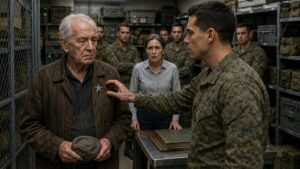
The Officer Pointed at Her Blue Ribbon Before Learning Why She Stayed Silent
Chapter 1: The Finger Pointed Before the Band Finished Playing
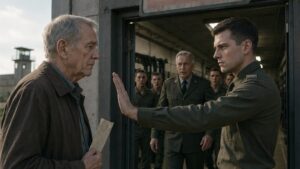
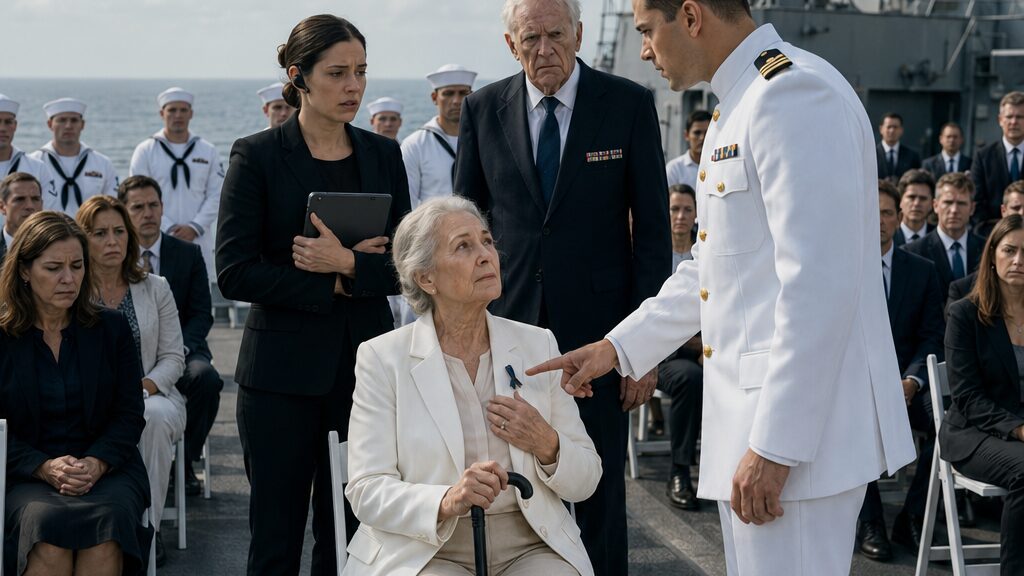
Ryan Martinez’s finger stopped two inches from the blue ribbon pinned to Deborah Carter’s white blazer.
The band was still playing behind him. Brass notes lifted into the morning air and scattered over the deck, bright and formal, but the officer’s voice cut through them low enough that only the front row heard.
“Ma’am, that ribbon is not authorized for this ceremony.”
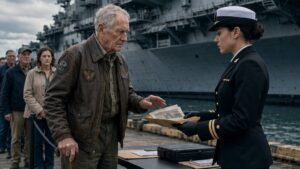
Deborah sat with both hands folded over the handle of her black cane. The cane rested between her knees, its rubber tip planted on the painted deck, steady as a post. Around her, sailors stood in white uniforms in two neat lines, their faces trained forward with the stubborn discipline of people pretending not to see what was happening.
Ryan did not pretend. He leaned closer.
“I need you to remove it before we continue.”
Deborah looked first at his hand, then at his face. He was young enough that his skin still tightened around his jaw when he was embarrassed, though he was trying hard not to show it. His uniform was exact. His ribbons were straight. His cover sat under one arm with the careful grip of a man who trusted objects more than people.
The blue ribbon on Deborah’s lapel was no wider than two fingers. It had no metal attached, no printed name, no rank, no decoration that would explain itself to a stranger. Its edge had been sewn unevenly, and the fabric had faded in one corner from years of being touched.
“It stays,” Deborah said.
Ryan’s eyes sharpened, not with cruelty, but with the quick alarm of someone whose schedule had developed a human problem.
“Ma’am,” he said, “this is a military recognition event. Guests are not permitted to wear unauthorized service ribbons. We have honorees, families, active-duty personnel, and media present. I am asking you respectfully.”
Deborah did not lift her voice. “It is not an award.”
A woman behind her shifted. Deborah had noticed her before the program began: Emma Clark, the civilian coordinator with a tablet pressed to her chest and a headset tucked behind one ear. Emma had the look of someone who had memorized the seating chart and still feared paper could betray her.
Ryan glanced at Emma. “Can you verify her category?”
Emma tapped the tablet awake. Her fingers moved fast, then slowed. Deborah heard the small silence that came before bad news. She had heard that kind of silence in sick bays, in corridors, beside stretchers, over phones.
“Deborah Carter,” Emma said carefully. “Family guest. Section A, seat six.”
Ryan turned back. “Family guest.”
The words seemed to satisfy him and accuse Deborah at the same time.
The ceremony announcer was still speaking near the forward platform, trying to keep his voice moving over the disturbance. A line of guests had begun to glance sideways. A sailor at the end of the front row shifted his weight and looked away. Deborah felt all of it: the sideways eyes, the careful stillness, the small public pressure gathering around her like rope.
Her left hand rose slowly to the ribbon. Not to remove it. To cover it.
Ryan’s face tightened. “Ma’am, please don’t make this difficult.”
Something old and dry moved through Deborah’s chest. Not anger. Anger would have been easier. Anger stood up. Anger explained. Anger made a sound.
She had learned long ago how to keep her hand steady when everything inside her wanted to shake.
“It is not difficult,” she said. “You asked. I answered.”
Ryan lowered his voice further. “You understand how this looks.”
Deborah looked past him for a moment, toward the sailors in white, toward the gray bulk of the ship rising behind them. The deck under her shoes was too clean for memory, too polished for what ships could become when lights failed and alarms tangled with smoke. But the smell of salt was the same. Metal heated under sun the same way. The body remembered what ceremony tried to cover.
“No,” she said. “I understand what it is.”
A family guest two seats down raised a phone just high enough for its black lens to catch the scene. Ryan saw it. His posture changed at once. He straightened, but his hand stayed near Deborah’s lapel, still too close, still making the blue ribbon look like evidence.
Emma stepped in half a pace. “Lieutenant Martinez, maybe we can take this to the side passage.”
Ryan did not look at her. “Not while she’s wearing it in formation view.”
Deborah almost smiled at that. Formation view. A clean phrase. A phrase that turned a person into a disruption on a diagram.
“I am not in formation,” she said.
“No, ma’am. You are in the front row.”
That was his mistake, though neither of them knew yet how large it would become. He had chosen to correct her where everyone could see. He had decided the old woman with the cane was easier to move than the schedule, easier to question than the record, easier to doubt than the ceremony itself.
The band ended. Applause should have followed, but the guests nearest Deborah were watching too closely to begin. A gap opened in the sound, and Ryan’s next words carried farther than he meant them to.
“Remove the ribbon, or I’ll have to mark this as a protocol concern.”
A few heads turned fully now.
Deborah’s thumb pressed against the worn edge of the ribbon. Beneath the faded blue cloth she felt the tiny ridge where she had repaired a loose stitch years ago. She thought of another hand, younger than hers had been then, closing around her wrist in the dark.
She did not say the name.
Emma’s tablet gave a soft chime. She looked down, frowned, and scrolled with growing confusion.
“Lieutenant,” Emma said, quieter now. “Her seating card says family guest, but there’s a note attached to the registration. It’s restricted.”
Ryan’s eyes flicked toward the tablet. “Restricted how?”
“I can’t open it from this view.”
“Then she remains a guest until verified.”
A security staff member had appeared near the aisle, summoned either by Ryan’s hand signal or by the strange instinct institutions had for gathering around small disobediences. Deborah watched the staff member stop a respectful distance away. Even he seemed uncertain whether he was looking at a threat, a mistake, or an old woman being asked to surrender a piece of cloth.
Ryan took one breath through his nose. “Ma’am, last time. Please remove it.”
Deborah’s knees hurt. Her right hand had gone stiff around the cane. She could stand if she needed to, but standing would turn the moment into exactly what Ryan had made it: a contest. So she remained seated and looked up at him.
“No.”
It was not loud. It did not need to be.
Ryan’s expression closed. “Then I’m filing the concern.”
He turned slightly toward Emma. “Flag her badge. Hold access after the ceremony until we verify.”
Emma hesitated. “Lieutenant—”
“Now.”
The word struck harder than his finger had.
Deborah felt the eyes around her settle. Not all unkind. Some embarrassed for her. Some curious. A few irritated that the ceremony had been snagged by an old woman who would not take off a ribbon no one understood.
She had spent most of her life learning the cost of being noticed. Now, on a ship deck bright with uniforms and speeches, the cost had found her anyway.
A shadow fell across the aisle behind Ryan.
The old man who stepped into it wore a dark suit heavy with decorations, but he moved as if the decorations embarrassed him. His hair was white, his shoulders squared by habit rather than strength. Samuel King stopped behind Deborah’s chair and looked first at Ryan’s hand, then at the ribbon beneath Deborah’s palm.
“Lieutenant,” Samuel said, his voice rough enough to stop the nearest row from breathing, “ask her where she was when the deck went dark.”
Chapter 2: The Tablet Said Guest, but the Old Man Said Corpsman
“Hold her access badge until verification,” Ryan said.
Emma Clark looked from the security staff member to Deborah Carter, who still sat with both hands on her cane as if the deck had not just shifted beneath everyone’s feet. The ceremony had been redirected with a practiced announcement about a short technical pause, but the pause had not softened anything. It had only moved the humiliation from the front row to the side passage near the deck entrance, where fewer people could hear and more people could pretend.
The security staff member waited with his hand out.
Deborah unclipped the visitor badge from her blazer without argument. The small plastic card swung once from its cord, catching sunlight. Emma felt an unreasonable urge to stop it from leaving Deborah’s hand.
“It’s temporary,” Ryan said.
Deborah gave him the badge. “Most things are.”
The security staff member did not smile. He looked uncomfortable enough that Emma almost felt sorry for him.
Samuel King stood beside Deborah’s chair, blocking the passage more through will than size. “You don’t hold her badge like she snuck aboard.”
Ryan turned toward him. “Sir, I respect your service, but this is an active event. Her registration identifies her as a family guest.”
“Your tablet says that?”
Emma felt the heat rise into her face. “It does.”
“Then your tablet is missing something.”
Ryan’s jaw moved. “If you have documentation, provide it.”
Samuel gave a short, humorless breath. “Documentation. Of course.”
Deborah’s hand lifted a fraction from the cane. “Samuel.”
Just his name. Nothing more.
It worked. The old man’s anger checked itself at the edge of his mouth. Emma watched it happen and wondered what kind of history could make a man in a decorated suit obey one quiet word from a woman everyone else had mistaken for a guest.
Ryan noticed it too. His eyes narrowed, not suspicious exactly, but guarded.
Emma looked down at her tablet again. Deborah Carter. Family Guest. Section A. Seat 6. Special Handling: Manual Note. She tapped the note. The screen asked for a coordinator override. She entered her code. The system spun, froze, then opened a plain text field attached to the registration.
No title. No introduction. No service listing. Seat with family guests. Do not call forward.
Emma read it twice.
Ryan leaned toward the screen. “What does it say?”
Emma hated that her voice sounded smaller than she intended. “It says, ‘No title, no introduction. No service listing. Seat with family guests. Do not call forward.’”
Ryan looked at Deborah. “You entered that request?”
Deborah did not answer immediately. Her thumb had found the blue ribbon again. Not covering it now. Holding it in place.
“Yes,” she said.
Samuel turned toward her. “Deborah.”
“I asked for what I wanted.”
“You asked to disappear.”
She looked at him then, and Emma saw the first fracture in her calm. It was not weakness. It was warning.
Ryan crossed his arms. “That still doesn’t explain the ribbon.”
“It explains enough for now,” Deborah said.
“No, ma’am, it does not. You specifically requested no service listing, but you wore something resembling a recognition ribbon to a formal ceremony.”
Samuel took a step forward. “Resembling?”
“Sir, I’m trying to prevent a public issue from becoming worse.”
“You already made it public.”
The words landed in the narrow passage. Behind them, the ceremony announcer’s voice drifted faintly over the speakers, stretched and cheerful, filling time. Guests were being offered water. Sailors remained at ease. The ship kept its formal face while the real damage happened out of sight.
Emma scrolled deeper. There was no rank attached to Deborah’s profile. No veteran designation. No next of kin. No unit. No honor line. Just a mailing address, a phone number, and the special handling request. Whoever had processed it had obeyed exactly.
That was the trouble with clean records. They could be wrong without looking wrong.
“Ms. Carter,” Emma said gently, “were you supposed to be included in any part of the memorial roll-call?”
Deborah’s eyes moved to her. They were gray, steady, and tired in a way Emma did not associate with age alone.
“No.”
Samuel said, “Yes.”
Deborah’s cane tip clicked once against the deck. “Samuel.”
He ignored the warning this time. “She was a corpsman. She was there when half the ship didn’t know which way was up. She pulled men through smoke with both hands bleeding. She—”
“Stop.”
The word was barely above a whisper, but Samuel stopped as if a door had closed in his face.
Emma’s tablet felt suddenly heavy. Ryan had heard it too: corpsman. His expression shifted, not into apology, but into calculation. Emma could almost see him rearranging the facts, trying to decide whether this new information corrected the problem or made it more dangerous.
“If that’s true,” Ryan said, “why isn’t it in the file?”
Deborah looked down at her cane. “Because I asked for it not to be.”
“Why?”
“Because I came for the names.”
“What names?”
She did not answer.
A burst of laughter came from the deck as the announcer made some harmless joke to hold the crowd. The sound felt wrong in the passage, too bright against the tightness of Deborah’s face.
Ryan turned to Emma. “Is her name on the final roll-call?”
Emma opened the ceremony program. The roll-call list was sorted by category: honored crew, surviving family representatives, invited veterans, remembrance names. She searched Carter. Nothing. She searched Deborah. Nothing.
“No,” Emma said. “Not on the roll-call.”
Ryan looked almost relieved.
Then Emma noticed a red marker beside Deborah’s registration. “But the protocol concern you just filed may affect her access to the memorial section.”
Ryan’s relief vanished. “What do you mean?”
“If a guest is flagged during ceremony proceedings, the system automatically restricts movement until cleared.”
“For security reasons,” Ryan said.
“Yes, but the memorial section is behind the restricted deck line.”
Samuel stared at him. “You mean because you pointed at her ribbon in front of everyone, she may not be allowed to attend the part she came for?”
Ryan’s shoulders stiffened. “That is not what I intended.”
“No,” Deborah said. “It rarely is.”
Emma looked at her then. There was no accusation in Deborah’s voice, and somehow that made it worse.
Ryan took the tablet from Emma’s offered angle but did not touch it. His face had gone rigid. “Clear it.”
“I can’t clear it alone,” Emma said. “Not after a filed concern. It needs officer review.”
“You’re looking at the officer.”
“The filing officer can’t clear his own report without adding a correction note.”
Ryan’s eyes flashed. Not anger at Emma, exactly. Anger at the machinery that had suddenly required humility as a password.
Samuel folded his arms. “Then add one.”
Deborah shifted forward in her chair. The movement was small, but everyone made room as if she had stood. Her cane tapped once, then settled.
“No.”
Emma blinked. “Ms. Carter?”
“No correction note about me.”
Samuel turned. “Deborah, for God’s sake.”
“I said no.”
Ryan stared at her. “You would rather remain flagged?”
“I would rather you not fix a small mistake by making a larger announcement.”
Emma did not understand. Not fully. She understood only the shape of it: Deborah was protecting something more fragile than her own pride. The blue ribbon was still beneath her fingers, half hidden by her palm, as though the cloth itself might hear too much.
Ryan exhaled through his nose. “Ma’am, if this flag stays in place, someone may have to remove a guest from the restricted memorial area to preserve the count.”
Deborah looked at Emma, not Ryan. “The count matters?”
Emma swallowed. “For seating and escort, yes.”
“How many names are read?”
Emma checked. “Forty-two.”
Deborah’s face changed so slightly that Emma might have missed it if she had not been watching. The number had touched something.
“Forty-two,” Deborah repeated.
Samuel closed his eyes.
Ryan caught that. “What?”
No one answered him.
Emma looked from Deborah to Samuel, then back to the program glowing on her tablet. A horrible thought moved through her, not yet clear enough to say aloud.
Deborah’s hand left the ribbon and rested flat against her blazer, steadying the place where it was pinned.
“If a name has to be removed,” she said quietly, “remove mine.”
Chapter 3: The Ribbon Was Never Sewn for Honor
Samuel King placed the old ship photograph on the glass display case, and Deborah turned it facedown before the light could catch it.
His hand remained above the photograph, spotted and tense. Beneath the display glass, a model of the ship sat frozen in miniature, all clean lines and painted decks, its tiny rails too perfect to have ever held weight. The museum room below deck smelled faintly of polish, metal, and recycled air. Above them, the ceremony continued to pretend it had not been wounded.
“You can’t keep doing this,” Samuel said.
Deborah rested both hands on her cane. The blue ribbon still sat on her lapel, but down here, away from the open deck and Ryan Martinez’s accusing finger, it seemed smaller. A piece of cloth. Nothing more, unless one already knew what cloth could hold.
“I have done it for a long time,” she said.
“That doesn’t make it right.”
“No.”
Samuel waited for more. Deborah gave him nothing.
He looked older in the museum room than he had on the deck. Up there, the suit and decorations had given him shape, made him look like a man history had agreed to remember. Down here, with the photograph facedown between them, he was only Samuel, stubborn and breathing too hard through his nose.
“You heard what he called you,” Samuel said. “Guest.”
“I was invited as one.”
“You were a Navy corpsman.”
“I was many things.”
“You saved my life.”
Deborah’s fingers tightened on the cane handle. “That is not the part I came to hear read.”
Samuel’s mouth closed.
For a moment, the ship’s faint vibrations filled the silence. Deborah felt them through the cane, up into the bones of her hands. Ships were never still. Even docked, dressed, scrubbed, and opened for ceremony, they held motion inside them. She had trusted that once. She had trusted bulkheads, ladders, orders, lights, the human chain of command. Then one night the deck went dark, and trust became a thing counted by who reached the hatch and who did not.
Samuel touched the facedown photograph. “She’s in this one.”
Deborah looked away.
“You know that?”
“Yes.”
“You never told me.”
“There are many things I never told you.”
“That isn’t an answer.”
“It is the only one I have practiced.”
His anger softened then, not gone but bruised. “Deborah.”
She hated when he said her name like that, as if names could open doors she had spent decades keeping shut.
The door to the museum room clicked. Deborah looked up.
Ryan Martinez stood outside in the passage, one hand near the frame. He had not entered fully. His posture said he had been passing by. His eyes said he had heard enough to become more certain of the wrong thing.
Samuel noticed him and straightened. “Lieutenant.”
Ryan’s gaze dropped to the photograph, then to Deborah’s ribbon, then to Samuel’s decorations. “I was told you came below deck.”
Deborah said, “Am I not allowed?”
“You’re allowed in public areas while your access is under review.”
Samuel gave a sharp laugh. “Listen to yourself.”
Ryan ignored him. “I’m trying to resolve this, Ms. Carter. But if you have service history relevant to the ceremony, it needs to be verified through proper channels. It can’t be introduced informally by another guest.”
“Another guest,” Samuel said.
Deborah lifted one hand slightly. Samuel stopped, but the effort cost him.
Ryan stepped into the room. His eyes moved over the displays: old photographs, ship patches, framed citations, a polished bell, a wall of names from different deployments. He seemed more comfortable with the cases than with the people.
“What is the ribbon?” he asked.
Deborah looked at him for a long second. On the deck, his question had been accusation. Here, it was still guarded, but something in it had changed. Not enough. A crack, perhaps.
“It was sewn from a strip of fabric,” she said.
Ryan waited.
“Not issued,” she added. “Not awarded. Not authorized.”
His jaw tightened at the last word, as if she had returned his own language to him and made it smaller.
“Then why wear it to this event?”
Samuel said, “Because someone should have been remembered.”
Ryan turned toward him. “Who?”
Deborah’s cane tapped once against the floor.
Samuel did not answer.
The silence should have ended the exchange. Instead, Ryan’s face settled into a familiar official mask. “This is exactly the problem. Partial claims, emotional statements, no documentation. I have a ceremony to protect.”
Deborah studied him. He was not enjoying this. That was important, though it did not excuse him. His fear stood behind his discipline like a second uniform.
“What happened at your last ceremony?” she asked.
Ryan’s expression flickered. “That is not relevant.”
“It is to you.”
Samuel glanced at her, surprised.
Ryan looked at the facedown photograph. “A family was misidentified during a public recognition. Wrong next of kin. Wrong name on the card. The clip spread before we corrected it.”
“And now every old woman with a ribbon is a threat to your card?”
His face colored. “I did not say that.”
“No,” Deborah said. “You pointed it.”
The words landed quietly. Ryan looked as if he might answer, but the tablet in his hand buzzed. He glanced down.
Emma appeared at the doorway a moment later, slightly breathless, her own tablet hugged against her ribs. “Lieutenant, I need you.”
Ryan did not turn. “What is it?”
Emma’s eyes moved over the room, catching the facedown photograph, Samuel’s stiff shoulders, Deborah’s calm. “There’s a discrepancy in the archived casualty appendix.”
Deborah’s hand went still.
Samuel said, “What discrepancy?”
Emma swallowed. “I searched the old event records attached to Ms. Carter’s registration note. There’s a Susan Flores listed in one archive file.”
The room seemed to lose air around the name.
Ryan looked from Emma to Deborah. “And?”
Emma’s voice lowered. “She isn’t in the ceremony program.”
Chapter 4: The Missing Name Made the Apology Too Easy
Ryan watched himself point at Deborah Carter’s ribbon on a stranger’s phone screen.
The video was only twelve seconds long, but it had already been sent to the ceremony office by a family guest who wanted to know whether the event was “still safe to attend.” Ryan stood in the planning office with the phone held in one hand and his own report open on a terminal in front of him. On the screen, his finger hovered near an old woman’s lapel. In the office, his hand curled into a fist at his side.
It looked worse than it had felt.
No. That was not true. It looked exactly as it had felt to everyone but him.
The ship’s captain stood at the far end of the table, jacket buttoned, face composed with the exhausted patience of someone managing a ceremony, a schedule, a guest list, and now a small public wound.
“How many people have this video?” the captain asked.
Emma Clark held her tablet against her stomach. “Unknown. The guest who sent it said she didn’t post it. She wanted clarification.”
“Clarification,” Samuel King said from the wall. “That’s a kind word.”
Ryan did not look at him.
Deborah sat in the single chair nearest the door. No one had asked her to sit there; she had chosen it because it let her leave without asking anyone to move. Her cane rested between her shoes. The blue ribbon remained pinned to her blazer, now beside the printed ceremony program Emma had placed on the table.
The program looked clean and final. That made the omission harder to forgive.
Ryan closed the video. “We can issue a private correction. Ms. Carter’s access can be restored once I add an explanatory note.”
Deborah looked at him. “Explanatory to whom?”
“To security and event control.”
“Not to the person missing.”
The captain’s eyes moved to Emma.
Emma tapped the screen. “Susan Flores appears in the old casualty appendix attached to a prior ship history file. But she does not appear in today’s memorial roll-call, the public program, or the announcer’s card.”
The captain took off his glasses and rubbed the bridge of his nose. “Why?”
“The record import pulled from the recognized honoree list, not the appendix. The appendix was scanned but never cross-indexed.”
Samuel’s voice hardened. “So she exists in the basement but not on the deck.”
Ryan heard the accusation in it and bristled before he could stop himself. “No one intentionally removed her.”
Deborah’s hand shifted on the cane. “That is not always a comfort.”
The office went quiet.
Ryan had been in rooms like this before, only not with Deborah in them. A wrong name on a card. A family standing under lights while an announcer read another family’s grief. A clipped video spreading before anyone could explain that it was a clerical error, as if the word clerical could soften a mother’s face when she realized the Navy had prepared sympathy for the wrong people.
After that, Ryan had been told to tighten review. He had tightened everything. Badges, seating cards, ribbon protocols, access zones, family categories. He had built a fence out of procedures and stood behind it with both hands clenched.
Now an old woman sat in front of him with a blue ribbon he had treated like contraband, and behind the ribbon was a missing name.
The captain set his glasses down. “What would it take to add Susan Flores before the roll-call?”
Emma did not answer quickly enough.
Ryan knew what that meant.
“Say it,” the captain said.
Emma looked at her tablet. “We would need to update the announcer’s card, the internal memorial count, the escort sequence, and the family representative list. The roll-call begins in less than two hours. Technically, we can do it, but it will delay the ceremony. And since Ms. Flores is not in the public honoree file, someone has to authorize the correction.”
“I can authorize it,” the captain said.
Ryan said, “Sir, with respect, if we alter the roll-call based on an appendix entry without verification, and the change is wrong—”
Samuel pushed away from the wall. “Wrong? Her name is there.”
“In one archive file,” Ryan said. “Not in the program source file. Not in the final packet.”
“She was real,” Samuel said.
“I’m not saying she wasn’t.”
“You are acting like a dead girl needs to pass your formatting test.”
The words struck the office hard enough that Emma lowered her eyes.
Ryan felt heat rise under his collar. “I am trying to keep this ceremony from making another public mistake.”
Samuel stepped closer. “You already made one.”
“Samuel,” Deborah said.
He stopped, but he did not step back.
The captain looked at Deborah. His voice changed, gentler but still official. “Ms. Carter, if we restore your access and offer you a private apology for the earlier misunderstanding, would you be willing to let us review the Susan Flores matter after the ceremony? I don’t want to rush a correction and risk compounding an error.”
Ryan felt a thin relief move through him. It was reasonable. It protected the ceremony. It gave them time. It allowed him to fix his report without dragging the ship’s public program into chaos.
Deborah looked at the printed program on the table.
Her name was not there. That had been her choice.
Susan’s was not there. That had not.
“A private apology,” Deborah said.
“Yes,” the captain said. “From Lieutenant Martinez and from the event staff. We will restore your badge and make sure you may attend the memorial section.”
“And Susan Flores?”
The captain hesitated. “We will review the record.”
Deborah’s thumb touched the blue ribbon. “After everyone leaves.”
“Ms. Carter—”
“After the chairs are stacked. After the band packs up. After the families carry home the program with her name still missing.”
Ryan looked down at the table. He hated that he understood the captain. He hated more that he understood Deborah.
Emma spoke before anyone else could. “There may be a way to insert a correction card without reprinting the programs. The announcer can read from an updated digital card.”
Ryan turned sharply. “The escort sequence still changes.”
“Yes.”
“The count changes.”
“Yes.”
“The captain just said—”
Emma looked at him then, and something in her face had changed. She was still anxious. Still careful. But not deferential.
“The captain asked what it would take,” she said. “I’m answering.”
Ryan closed his mouth.
The captain watched the exchange, then looked at Deborah. “What is your connection to Susan Flores?”
Deborah’s face became still in a way Ryan had begun to recognize. Not empty. Guarded.
“She served,” Deborah said.
“So did many.”
“She was left out.”
“That does not answer my question.”
“No,” Deborah said. “It answers the one I came for.”
Samuel’s hands opened at his sides in frustration. “Deborah, tell them.”
She did not look at him. “No.”
Ryan heard it then: not simple refusal, but fear. The old woman who had looked up at his pointed finger without flinching was afraid of something in this room. Not him. Not the captain. Not even public embarrassment.
Memory.
The captain sighed. “If we delay the roll-call, guests will ask why.”
“Tell them a correction was needed,” Emma said.
Ryan almost laughed. “That will invite questions.”
Deborah’s gaze rose to him. “Questions are not the enemy, Lieutenant. Carelessness is.”
He deserved that. He knew he did. Still, the words found the raw place where his own past mistake lived.
The captain picked up the printed program and looked at the memorial section. “If we do this, we do it cleanly. No speculation. No dramatic introduction. No surprise tribute.”
Deborah’s shoulders eased by the smallest measure.
Ryan noticed. He also noticed the ribbon, blue against white, lying close to the program where Susan Flores did not exist.
The captain turned to him. “Lieutenant Martinez, you filed the concern. Your report is now part of the access restriction. If this correction moves forward, you will need to amend it.”
Ryan felt the room narrow.
An amended report would say he had acted on incomplete information. It would be reviewed. It would sit in the event record. Not career-ending, perhaps. Not disastrous. But visible.
He looked at Deborah. She did not plead. That somehow left him fewer places to hide.
“We can restore Ms. Carter’s access immediately,” he said. “The roll-call correction is a separate issue.”
Deborah leaned forward, both hands on her cane, and for the first time since he had met her, she looked old not because of her body, but because of how long she had been tired.
“No,” she said. “It is the same issue. You saw a ribbon and thought I was asking to be seen. I wore it because someone else was not.”
The office held its breath.
The captain looked once more at the schedule on Emma’s tablet. “If we delay, we risk losing the broadcast window.”
Deborah’s eyes stayed on the program.
“Then delay it,” she said.
Chapter 5: The Deck Went Dark, and Deborah Chose One Stretcher
The ship alarm test began with three short tones, and Deborah’s cane nearly slipped from her hand.
It was only a drill signal, thin and controlled through the modern speakers, but her body did not know modern from memory. Her fingers opened before she could command them closed. The cane tilted, struck the edge of the sick bay display, and clattered once against the floor.
Samuel caught it before it fell flat.
No one spoke.
The sick bay exhibit was smaller than the real one had been. Cleaner, too. The display bed was made with a white sheet no one had bled through. Instruments were arranged behind glass with labels printed in careful black letters. A mannequin wore old medical whites, posed with one hand near a tray, as if care were a posture that could be preserved.
Deborah took the cane back from Samuel. “Thank you.”
Her voice came out steady. That was something, at least.
Emma stood near the doorway with the corrected program draft frozen on her tablet. Ryan lingered behind her, not inside the room but close enough to hear. The captain had gone to authorize a delay statement. The ship above them had begun to shift around the change: footsteps, clipped radio calls, the restless murmur of an audience being asked to wait without being told why.
Samuel looked at the display bed. “You should sit.”
“No.”
“Deborah.”
“If I sit here, I will not stand quickly.”
He did not argue again.
The alarm tones had stopped, but they had opened the old corridor in her mind. She saw it as she always did in pieces: a light blinking and dying, a shoulder slamming into a bulkhead, someone calling for a corpsman though she was already there, already kneeling, already pressing both hands against a wound she could not see until the emergency lamp swung back.
She touched the blue ribbon.
Emma noticed. “Ms. Carter, we don’t have to do this now.”
Deborah looked at the young woman’s tablet, at Susan Flores’s name newly typed into the draft card, unapproved and fragile. A name could vanish so easily. One wrong source file. One unchecked import. One person choosing not to make trouble.
“No,” Deborah said. “You asked what connection I had to her.”
Ryan’s posture changed in the passage.
Samuel closed his eyes.
Deborah turned toward the display case where the old photograph still lay facedown. She did not turn it over.
“Susan Flores was nineteen,” she said. “She had a laugh that carried through metal. That is not in any appendix.”
Emma’s fingers tightened around the tablet.
“She was assigned to damage control that night. I was in sick bay when the first report came in. Smoke in a lower compartment. Electrical failure spreading. Then the deck went dark.”
The exhibit room seemed too small for the memory now. Even the clean white sheet looked like an accusation.
“I had one corpsman with me and more injured than hands. We moved by touch. The emergency lamps came on and went out again. People say chaos is loud, but some parts of it are quiet. The moment before you decide. The moment after.”
Samuel’s voice was low. “I don’t remember her.”
“You were not meant to. You were unconscious most of the time.”
He turned toward her.
Deborah kept her eyes on the glass. “They brought you in first. Smoke inhalation, head wound, pulse irregular. Then they brought Susan. She was awake. That made it worse.”
The room held still.
Emma’s tablet dimmed from inactivity. She did not wake it.
“Susan had burns on one arm and a chest injury I could not properly assess in that light. She kept asking if the others had made it through the hatch. She had a strip of blue cloth tied around her sleeve. Not regulation. Something from a repair locker, I think. She said it helped her team see each other when the lights failed.”
Deborah’s fingers moved over the ribbon’s uneven edge.
Samuel looked at the cloth as if seeing it for the first time.
“I needed another stretcher,” Deborah said. “I needed three more hands. I needed a light that would stay on. What I had was one clear path out before smoke shifted back through the corridor.”
Her throat tightened. She waited until it released.
“I chose the stretcher with the better chance.”
Samuel’s face went pale.
“No,” he said.
Deborah finally looked at him. “Yes.”
“You chose me?”
“I chose the pulse I thought I could keep.”
His mouth opened, but no words came.
“It was the right medical choice,” Ryan said from the doorway.
Deborah turned toward him. His face showed immediate regret, not because he did not mean it, but because he had spoken into a place where correctness was too small.
“Yes,” Deborah said. “That was what they told me.”
Ryan lowered his eyes.
Samuel sat down hard on the edge of a bench near the display wall. The decorations on his suit shifted with a small metallic sound.
“I never knew,” he said.
“You were not supposed to carry it.”
“And you were?”
Deborah had no answer that would not sound practiced. She had carried many answers through the years. They all failed in the room where the ship had built a clean version of suffering for visitors to examine.
Emma stepped closer, careful. “What happened to Susan’s name?”
Deborah looked back at the ribbon. “She was listed in the incident appendix. But her family moved before the first memorial packet went out. There was confusion about whether she belonged in the damage control group or medical evacuation record. Then the ship changed commands. Then years passed. Each time someone made a cleaner list, they left off what did not fit neatly.”
“And you knew?” Ryan asked.
“I found out later.”
“How much later?”
“Long enough to be ashamed that I had not checked sooner.”
Samuel covered his mouth with one hand.
Deborah continued before anyone could comfort her. Comfort would make her stop. “When I found the omission, I wrote letters. Some were answered. Some were not. I called offices. I sent copies. I was told the main record would be corrected during the next formal update.”
Emma looked at her tablet. “It wasn’t.”
“No.”
“Why not bring documentation today?”
Deborah’s hand tightened on the cane. There it was, the question she deserved.
“Because I thought the correction had finally been made. Your invitation said families and survivors connected to the incident. I checked the appendix online. Susan was there. I did not know the ceremony program had been built from a different file until you said her name was missing.”
Ryan looked wounded by that, but he said nothing.
Samuel stood slowly. His voice was rough. “And the ribbon?”
Deborah’s thumb rubbed the cloth. “When they moved you, Susan caught my sleeve. She knew. People often know. She said, ‘Don’t let the ship swallow my name.’ Those were her words.”
Emma made a small sound and looked away.
“The blue strip was still on her sleeve when I came back,” Deborah said. “I should not have taken it. It was not mine. But the corpsman with me cut it loose and put it in my hand because I would not let go of her. Years later, I folded it smaller. Sewed the edge. Wore it only when I went to ask again.”
Samuel stepped toward her, but she lifted a hand.
“No.”
He stopped.
“You want this to make me brave,” Deborah said. “It does not. I hid behind not wanting attention. I told myself I was honoring Susan by keeping myself out of it. But sometimes I think I simply did not want anyone to ask why I came back and she did not.”
The silence after that was not empty. It was crowded with all the things no one in the room could repair.
Ryan moved one step into the room. “Ms. Carter.”
Deborah looked at him.
He stopped, as if her attention were more than he had earned. “I’m sorry.”
She did not soften. “For what?”
His throat worked. “For assuming.”
“That is a beginning,” she said.
Not forgiveness. Not refusal. A line drawn exactly where it belonged.
Emma’s tablet chimed again, startling everyone. She woke the screen and read quickly. “The captain approved a temporary delay. We have thirty minutes to submit the corrected roll-call card.”
Samuel turned to Deborah. “Then let them read your name with hers.”
“No.”
“Deborah—”
“No,” she said again, but this time the word broke a little. She steadied it with both hands on the cane. “Susan asked me for one thing. Not a tribute to me. Not a story about me. Her name.”
Samuel’s eyes were wet now. “I am alive because of you.”
Deborah looked at him with a sorrow so old it no longer trembled. “And she is not.”
Emma held the tablet as if it were something sacred and dangerous. “What should the card say?”
Deborah looked toward the doorway, toward the ladder that led back up to the deck, toward the waiting ceremony and the rows of people who knew nothing about the girl with the blue cloth on her sleeve.
“Write her full name,” Deborah said. “Susan Flores. And do not let the ship swallow it again.”
Chapter 6: The Program Could Be Corrected, but Not the Past
Emma’s corrected program update failed with nine minutes left before the memorial roll-call.
The tablet flashed a red banner across Susan Flores’s newly added name: SOURCE CONFLICT — FIELD LOCKED BY ACTIVE INCIDENT REPORT.
Emma stared at it for one stunned second, then turned the screen toward Ryan.
“It won’t accept the correction.”
Ryan stood at the edge of the ceremony control room with his cover under one arm and his face already drawn tight from the delay. Through the open hatch, they could hear the deck above them restless with waiting guests: chairs scraping, low conversation, the occasional bright laugh that came from people who did not know they were standing near a wound.
“What does field locked mean?” the captain asked.
Emma tapped the warning. “The system is treating Ms. Carter’s access flag as unresolved. Because her registration is attached to the old appendix file, and the incident report questions her credential status, the memorial edit requires review before accepting any record tied to that appendix.”
Samuel, standing near the back wall, looked at Ryan. “Your report blocked Susan.”
Ryan did not answer at once.
Deborah sat beside the communications desk, the blue ribbon pinned again and visible on her blazer. She had taken her hand away from it after leaving the sick bay exhibit, as if touching it too often might weaken her resolve. Her cane rested upright against her knee.
Emma could see how tired she was. Not sleepy. Not fragile. Tired the way a locked door was tired after too many people had tried the wrong key.
Ryan stepped closer to the tablet. “I can amend the report.”
The captain said, “How fast?”
“If the system allows a field note, immediately.”
Emma opened the incident record. Ryan’s original language filled the screen in clean official phrasing.
Guest observed wearing unauthorized ribbon-like item during formal ceremony. Refused request to remove. Access temporarily held pending verification.
No raised voice. No finger. No old woman seated under the eyes of a deck full of sailors. No way to measure what a sentence left out.
Ryan read it too. His expression changed.
Emma handed him the tablet.
He took it, then hesitated with his thumb above the edit field. “If I amend this, the correction becomes part of the permanent event record.”
The captain watched him. “Yes.”
Samuel said, “Good.”
Deborah looked at Samuel. “Let him choose without being cornered.”
The words surprised Emma. After everything, Deborah still refused to let the room become a public trial with fewer witnesses.
Ryan heard it too. His eyes lifted to Deborah.
“You don’t have to protect me,” he said.
“I am not protecting you,” she replied. “I am protecting the difference between repair and punishment.”
The control room went quiet except for the soft crackle of radio traffic.
Ryan looked back at the tablet. For the first time that day, Emma saw him not as the officer who had pointed at a ribbon, but as a man standing in front of the machinery he had trusted to keep him safe. The procedure could still protect him if he let it. He could write a careful note: additional information provided, further review pending. It would be true enough to pass. Empty enough to hide inside.
He began typing.
Emma watched the words appear.
Initial concern filed after I publicly questioned guest Deborah Carter regarding blue ribbon on lapel. Further review shows the item is not an award or service ribbon. It is connected to casualty record appendix involving Susan Flores. My initial report was incomplete and caused unnecessary access restriction.
Ryan stopped. His jaw tightened.
The captain said nothing.
Deborah looked down at her cane.
Ryan added one more sentence.
Correction requested to allow memorial roll-call update before ceremony proceeds.
He submitted it.
For two long seconds, nothing happened. Then the red banner disappeared.
Emma let out a breath she had not meant to hold. “Field unlocked.”
Samuel closed his eyes.
The captain turned toward the communications desk. “Submit the card.”
Emma inserted Susan Flores’s name into the memorial sequence. Not at the end. Not as an addendum. In the correct place, under the incident group, between two names that had waited decades beside an empty space no one had seen.
The system accepted the update.
“Card is live,” Emma said.
The captain looked toward the hatch. “We resume in five minutes.”
Ryan handed the tablet back to Emma. His face had lost the stiff certainty it had carried all morning. “Does it need Ms. Carter’s service status to complete the card?”
Emma checked. “No. Susan’s name can be read without it.”
Samuel turned sharply. “But Deborah’s record—”
“No,” Deborah said.
The old man’s shoulders sagged. “You can’t keep letting them call you guest.”
“I can today.”
“Deborah.”
“I did not say forever.”
That stopped him.
Emma looked at Deborah more closely. The blue ribbon moved slightly with her breathing. The cloth no longer looked like defiance. It looked like a small flag planted on private ground.
Ryan’s voice was cautious. “What do you want recorded?”
Deborah took a moment before answering. “For today, Susan Flores. Correctly. With the others.”
“And after today?”
She looked at Emma’s tablet. “After today, the file may show I served. No speech. No special introduction. No title printed larger than anyone else’s.”
Samuel laughed once, softly, through grief. “You always did give orders like requests.”
Deborah gave him a look. “I remember you ignoring both.”
For the first time all day, Emma saw something almost like warmth pass between them. It lasted only a second, but it changed the air.
Then the loudspeaker chimed.
“Ladies and gentlemen, thank you for your patience. The memorial roll-call will begin shortly.”
The words traveled through the control room and up into the deck above. The ceremony was no longer paused. The correction had become real, which meant the next mistake could not be blamed on software, missing files, or timing.
The captain adjusted his jacket. “Lieutenant Martinez, you’ll escort Ms. Carter back to the front row.”
Ryan nodded.
Deborah stood before he could offer his hand. The movement was slow but firm. She took the cane, set it ahead of her, and stepped toward the hatch.
Ryan moved beside her, not in front this time.
At the base of the deck stairs, Emma caught up with them, tablet held tight against her ribs. “Ms. Carter.”
Deborah turned.
Emma held out the updated card. Susan Flores’s name glowed on the screen in the same plain font as everyone else’s.
Deborah looked at it but did not touch the tablet.
“Thank you,” she said.
Emma felt the words land heavier than praise.
Above them, sunlight poured through the open hatch. The deck waited. The sailors waited. The front row waited with its empty seat and all the eyes that had watched Ryan point.
Ryan climbed first, then stopped at the top and turned back. He had the corrected card printed now, folded once in his hand. He waited until Deborah reached the deck, until her cane found the painted surface, until she stood under the same open sky where he had misjudged her.
Then he walked onto the deck holding the corrected card and
Chapter 7: He Lowered His Hand Before He Used His Voice
Ryan returned to the same place on the deck where he had pointed at Deborah Carter’s ribbon, but this time he kept both hands at his sides.
The front row saw it. So did the sailors standing in formation. So did the family guest who still held a phone low in her lap, its screen dark now but ready. Ryan felt every set of eyes as a weight across his shoulders, and for once he did not try to turn the weight into authority.
Deborah stood in front of him with her cane planted beside her right foot. She had refused to sit when they returned.
“I can stand for a name,” she had said.
Now the blue ribbon rested against her white blazer in the open, no longer covered by her hand. Its faded corner moved faintly in the breeze off the water. Ryan could not look at it without seeing the words he had typed into his amended report.
My initial report was incomplete and caused unnecessary access restriction.
Incomplete. It was a clean word. Too clean. It meant he had not known enough. It did not say he had chosen not to know enough before making the old woman small in front of everyone.
The ceremony announcer waited at the microphone. The captain stood near the platform with the corrected sequence card in his hand. Emma Clark hovered by the control table, tablet clutched close, eyes moving between Ryan and Deborah as if one wrong phrase might make the system lock again.
Samuel King stood behind Deborah, not touching her, though Ryan could see the effort it took him not to. The old man looked ready to catch her, defend her, introduce her, crown her with every word she had spent decades refusing.
Ryan unfolded the printed correction card.
The paper trembled once.
He stopped it.
The captain gave a small nod.
Ryan turned toward the microphone positioned beside the first row. The event staff had not planned for him to speak there. They had moved it quickly when Deborah refused the platform. That too had been her choice.
He began carefully. “Before the memorial roll-call continues, there is a correction to today’s record.”
The deck settled into silence.
Ryan felt Deborah beside him, still as a post.
“A name connected to the incident being remembered today was omitted from the ceremony program. The omission came from an incomplete source file. The record has been corrected for the roll-call.”
He looked down at the card.
Susan Flores.
Plain letters. No decorations. No explanation big enough.
Ryan swallowed. “We also want to acknowledge—”
Deborah’s cane tapped once.
Not loud. Not dramatic. But it cut him off as surely as a hand raised between them.
Ryan turned.
Deborah was looking directly at him. Not angry. Not pleading. Her eyes held the same calm that had unsettled him when he first ordered her to remove the ribbon. Only now he understood that calm was not emptiness. It was a locked room with a light under the door.
Do not use me to fix this.
He heard the words without her saying them.
Ryan lowered the card. “The correction is to the name,” he said.
Deborah’s gaze held him a moment longer, then released.
A small sound moved through the guests, not applause, not whispering exactly. A shifting understanding. Ryan wondered how many people in the front row had expected a dramatic reveal, a rank, a hidden medal, an old photograph held up for proof. He had expected that too, perhaps. Something simple enough to reverse the morning. Something that would let him say: I was wrong because the facts were hidden.
But Deborah did not offer him that comfort.
The captain stepped to the main microphone. “We will now continue the memorial roll-call.”
The announcer began reading.
One by one, the names crossed the deck and went out over the water. Each was given the same space. No music underneath. No flourish. Just a name, a pause, and the quiet bell struck once by a sailor near the platform.
Ryan stood at the side of the first row, no longer the center of the moment, and tried to be grateful for that.
Deborah remained standing.
With every bell, her hand tightened slightly on the cane. Ryan noticed because he was looking now. Not at protocol, not at category, not at the line where guests should stand or sit. At the person in front of him.
Halfway through the roll-call, Samuel leaned close and whispered something to her. Deborah shook her head once.
Ryan did not hear the words, but he saw the old man’s face change. Frustration, grief, love, helplessness. Whatever Samuel wanted, Deborah had refused it.
The announcer reached the corrected section.
“Susan Flores.”
The bell struck.
Deborah’s eyes closed.
That was all. No collapse. No sob. No hand to her mouth. The cane stayed steady. The ribbon stayed visible. But Ryan saw the breath leave her as if she had been holding it not for minutes, but for years.
The announcer moved to the next name.
Ryan looked at Emma across the deck. She was crying silently, though she kept one hand on the tablet and the other near the control switch, still doing her job. The captain’s face remained formal, but his jaw was tight.
Samuel bowed his head.
Deborah opened her eyes before the next bell. She turned slightly toward Ryan, and he understood with a sudden, uncomfortable clarity that she had not wanted him to witness her grief. She had wanted him to witness his own mistake and then step aside.
Instead, because he had forced the first wound into public view, he now stood close enough to see the old one.
The roll-call ended without applause. That had been the captain’s instruction after Deborah spoke with him below deck. Silence held the deck for several seconds after the final bell. It felt less like emptiness than room being made.
Then the captain said, “Thank you.”
People began to move slowly. Chairs scraped. Sailors shifted back into assigned motion. The ceremony continued toward its closing remarks, but the emotional center of it had already passed.
Ryan stayed where he was.
Deborah lowered herself carefully back into the front-row chair. Samuel moved to help, but she held up two fingers, and he stopped. She sat on her own. Only after she was settled did she let the cane rest across her knees.
Ryan approached her from the front, not the side. He stopped far enough away that she would not have to lean back to see him.
“Ms. Carter.”
She looked up.
He had rehearsed three apologies while the names were being read. All of them sounded like statements meant to be overheard. He discarded them.
“I was wrong,” he said.
Deborah waited.
“I treated your silence like evasion. I treated the ribbon like a violation before I asked what it meant. And I did it where everyone could see.”
A guest nearby went still. Ryan felt the phone lens rise again somewhere to his left, but he did not look for it.
Deborah’s thumb touched the cane handle. “Yes.”
The single word was not cruel. It simply refused to polish what had happened.
Ryan nodded once. “I can’t undo that.”
“No.”
“I amended the report.”
“I know.”
“That was not enough.”
“No,” she said again.
He looked down at his hand. The same hand. The one that had pointed. He had used it all morning as if correctness lived in the finger.
“I don’t know what enough is,” he said.
For the first time, Deborah’s expression softened, though not into forgiveness. Into recognition that he had finally arrived at the right kind of ignorance.
“Enough is rarely available,” she said. “You do what is next.”
Behind her, Samuel looked away toward the water.
Ryan reached into his jacket pocket and took out the temporary access badge. The security staff member had returned it to him after the correction. Its plastic sleeve had a faint bend across one corner from where it had been handled too many times in too little time.
He did not hold it out yet.
“This was taken because of my report,” he said. “I would like to return it to you. Not as procedure. If you’ll allow me.”
Deborah looked at the badge, then at the blue ribbon, then at Ryan’s hand.
For a moment he thought she would refuse. A refusal would have been fair. Perhaps easier.
Instead, she reached toward the ribbon and unpinned it.
Ryan went cold. “Ms. Carter—”
She held the ribbon in her palm, the faded blue cloth curved like a small piece of sky cut loose.
“You touched the meaning before you knew the story,” she said.
Ryan could not answer.
She looked at the badge in his hand. “Return that. Then ask before you reach for anything else that belongs to a life you have not lived.”
He gave her the badge with both hands.
Deborah clipped it back onto her blazer beneath the ribbon’s empty place. Then she held the ribbon out, not to him, but between them.
“Can you pin it straight?” she asked.
The deck noise seemed to fall away.
Ryan’s throat tightened. “Yes, ma’am.”
His fingers were careful now. Slow. He took the cloth by its edge, not its center, and pinned it back where it had been. This time his hand did not point. It served.
When he stepped back, Deborah looked down at the ribbon, then up at him.
“Now,” she said, “we can leave the deck without pretending it did not happen.”
Chapter 8: The Ribbon Stayed, but the Silence Changed
Ryan found Deborah alone where the ceremony lights no longer reached.
The deck had emptied slowly after sunset, leaving behind folded chairs, coiled cables, and the faint scuff marks of polished shoes on gray paint. The ship looked less ceremonial now and more honest, its edges dark against the water. Deborah stood at the rail with her cane resting beside her, not in her hand. The blue ribbon remained pinned to her blazer.
Ryan stopped several feet away. “I can leave.”
Deborah did not turn. “You already came this far.”
He accepted that as permission and moved closer, careful not to stand between her and the water.
For a while neither of them spoke. Below, the harbor lights trembled in broken lines. Somewhere behind them, a sailor laughed and a hatch closed. The ordinary sounds of a ship continued after memory had done its work.
Ryan held his cover in both hands. “The corrected roll-call has been saved to the official event record. Emma confirmed it twice.”
“Good.”
“The captain also asked records to review the archive source that missed Susan Flores.”
Deborah nodded once.
“And your file.”
That made her turn.
Ryan did not rush the rest. “Only to reflect that you served. No title in the public summary. No speech. No special profile. Emma wrote the note the way you asked.”
Deborah’s eyes searched his face, as if looking for the hidden ceremony inside the correction. “What did it say?”
“Deborah Carter, retired Navy corpsman, attended as personal witness to the Susan Flores correction.”
She looked back at the water.
Ryan waited.
“That is enough,” she said.
The word did not sound like victory. It sounded like a door closing gently instead of being slammed.
Samuel King appeared from the shadow of the stairwell before Ryan could answer. He had removed his jacket, and without the decorations his white shirt looked plain, almost vulnerable. He carried the old ship photograph in one hand.
“I thought I’d find you here,” he said.
Deborah glanced at him. “You have been finding me in places I did not invite you all day.”
“Yes,” Samuel said. “I am too old to improve quickly.”
Ryan stepped back, but Deborah said, “Stay.”
The word surprised both men.
Samuel came to the rail and laid the photograph facedown on the flat metal ledge between them. He did not turn it over.
“I spoke with the captain,” he said.
Deborah sighed. “Of course you did.”
“He would support a formal recognition later. Small. Private if you want. Your name in the ship history. A statement from surviving crew. Maybe a correction ceremony for Susan and for you together.”
“No.”
He looked pained. “You didn’t even let me finish.”
“I knew where it was going.”
“Deborah, people should know.”
“They know Susan’s name now.”
“They should know yours too.”
“They will know enough.”
Samuel’s hand settled on the facedown photograph. “You still think being named takes something from her.”
Deborah’s mouth tightened.
Ryan looked toward the water, wishing he had left despite her instruction. This was not his place, and yet perhaps that was part of what she wanted him to learn: not every place was his to command, but some were his to witness quietly.
Samuel’s voice lowered. “I lived because you chose the stretcher with the pulse you could keep. That doesn’t make her death your fault.”
Deborah closed her eyes.
For the first time all day, her hand reached for the cane and missed it. Ryan almost moved, then stopped. Samuel saw the same movement and stopped too. Deborah found the cane herself, fingers closing around the handle.
“I know the medical answer,” she said.
“I’m not giving you the medical answer.”
“No. You’re giving me the survivor’s answer. It is kinder. Not necessarily truer.”
Samuel’s face folded with grief. “What would be true enough for you?”
Deborah opened her eyes. “That I was there. That I chose. That I have spent years making silence sound like humility because guilt was easier to carry if no one looked at it.”
Neither man spoke.
She touched the ribbon, not hiding it this time. “When Lieutenant Martinez pointed at this, I wanted to disappear so badly I could taste it.”
Ryan lowered his head.
“But if I had disappeared today, Susan would have disappeared with me again.”
Samuel’s hand tightened on the photograph.
Deborah looked at Ryan. “That is what changed.”
He met her eyes. “I’m sorry it took what I did to force it.”
“So am I.”
There was no cruelty in it. That made it heavier.
Samuel turned the photograph over at last.
The image was old and slightly blurred, a group of young sailors gathered on a deck that looked nothing like the polished ceremony space above them. Some smiled. Some squinted into sun. Near one edge stood a young woman with dark hair pulled back, a strip of blue cloth tied around her sleeve. Beside her, half turned toward someone outside the frame, was a younger Deborah Carter.
Ryan stared at the photograph, then looked away quickly. It felt too private to study.
Deborah did look. She looked for a long time.
“I avoided that picture,” she said.
“I know,” Samuel said.
“She was laughing when they took it.”
“Yes.”
“I had forgotten that part.”
Samuel’s voice shook. “I hadn’t. I just didn’t know her name.”
Deborah touched the corner of the photograph but did not pick it up. “Now you do.”
He nodded.
A crew member crossed the far side of the deck, gathering the last of the ceremony ropes. The ordinary work went on. That seemed right to Deborah. Ships carried memory, but they also carried schedules, repairs, meals, tired feet, young people with places to be. The living had always been inconsiderate that way. It was how they survived.
Ryan said, “There’s one more thing.”
Deborah’s eyebrow lifted slightly.
“The guest who sent the video asked if she could delete it. She was embarrassed after the correction.”
Deborah looked at him. “And what did you tell her?”
“I told her it was hers to decide.”
“Good.”
“I wanted to ask if you wanted me to request it removed.”
Deborah looked back at the harbor lights. “No.”
Samuel frowned. “Deborah.”
“No,” she repeated. “Not because I want it passed around. I do not. But because what happened happened. If someone sees it, let them wonder why an old woman kept still. Maybe next time they will ask before pointing.”
Ryan absorbed that in silence.
Deborah took the visitor badge from her blazer. For a moment Ryan thought she meant to return it, but she only looked at it: the plastic card, the temporary cord, the word GUEST printed across the bottom.
Then she clipped it back on.
“I was a guest today,” she said. “And a corpsman. And a witness. People can survive being more than one thing.”
Samuel smiled sadly. “You planning to teach classes now?”
“No,” Deborah said. “I am planning to go home.”
The answer was so plain that both men almost laughed. Not because it was funny, but because the day had carried them so far from ordinary that ordinary felt like mercy.
Ryan stepped back. “Before you go, Ms. Carter, I’ll make sure security has the corrected access note so no one stops you on the way out.”
Deborah turned fully to him. “Lieutenant.”
He stilled.
“You will remember this day longer if no one praises you for fixing what you broke.”
His face flushed, but he nodded. “Yes, ma’am.”
“That is not punishment. It is instruction.”
“I understand.”
“Not yet,” she said. “But you may.”
Samuel gave a soft cough that might have been a laugh.
Deborah unpinned the ribbon again. Ryan’s chest tightened before he could stop it. But she did not fold it away. She held it to the light from the deck lamp, studying the uneven stitch, the faded corner, the cloth that had been cut from a sleeve and carried through too many offices, too many unanswered letters, too many years of almost giving up.
Then she pinned it back herself.
Not hidden under her hand. Not crooked from another person’s touch. Straight enough.
She picked up her cane and looked once more at the photograph.
“Good night, Susan,” she said.
The name did not vanish into the water. It stayed there among the three of them, ordinary and complete.
Deborah walked toward the stairwell without waiting for help. Samuel followed at her pace, not beside her as a guard, not behind her as a witness, but near enough to be called if she chose. Ryan remained by the rail until she reached the lighted hatch.
Just before stepping inside, Deborah touched the blue ribbon once.
Then she left it visible.
The story has ended.