The Old Man Who Would Not Move Until Someone Finally Listened
Part I — The Boat in the Wrong Place
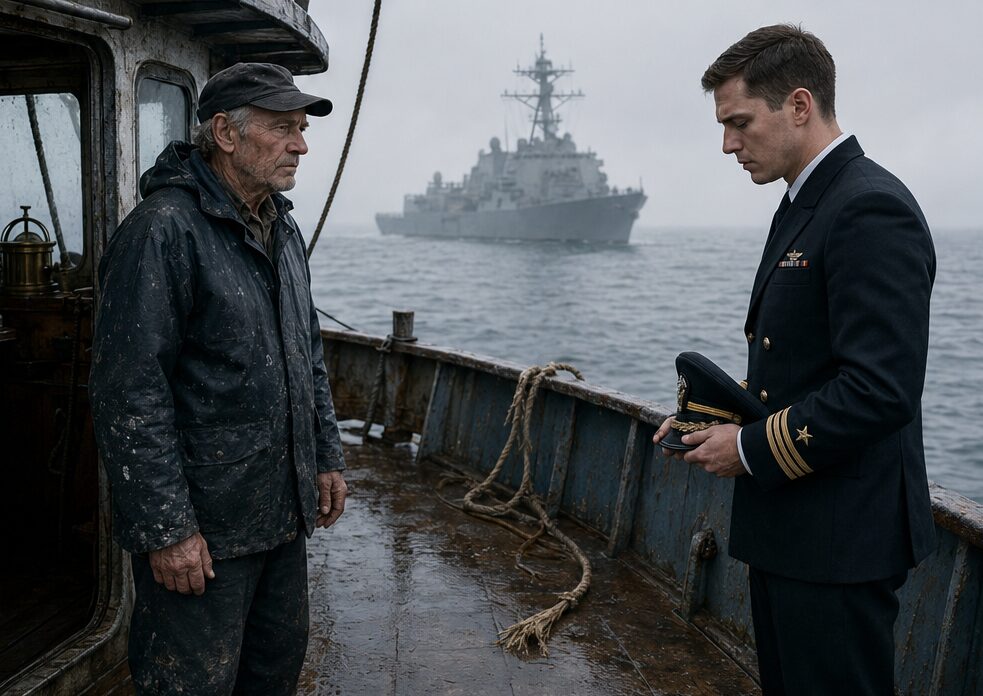
The gray bow of the destroyer came out of the fog like a building that had learned to move, and Joseph Miller sat in his little wheelhouse with one hand on the radio and did not move at all.
His fishing boat, the Brenda Ann, looked almost foolish in front of it.
Thirty-one feet of worn white paint. A patched roof. A tired diesel engine that coughed when the weather changed. Nets stacked against the port rail. A coffee thermos rolling gently beneath the bench seat.
The destroyer behind him carried lights, steel, officers, screens, and enough authority to make the sea itself seem assigned to it.
The radio crackled.
“Fishing vessel off our forward line, this is United States Navy vessel Archer. You are inside a restricted training corridor. Alter course immediately.”
Joseph lifted the microphone.
“You’re the one standing in the wrong place.”
For two seconds, only static answered.
Then, through the open channel, someone laughed.
Not loudly. Not cruelly enough to be reported. Just a quick young laugh from a place with warm lights and dry uniforms.
Joseph heard it anyway.
On the destroyer’s bridge, Lieutenant Brian Hayes leaned toward his console with one hand pressed over his headset. He had the clean face of a man who still believed most problems could be solved by saying the correct words in the correct tone.
“Say again, fishing vessel?”
Joseph looked past the salt-streaked windshield. The destroyer’s shape blurred and sharpened in the fog, closer now, its gray hull swallowing the horizon.
He checked the brass compass mounted beside the wheel.
The compass had not belonged to him at first.
He pressed his thumb against its rim once, then raised the radio.
“I said you’re in the wrong place.”
A few sailors on the bridge turned their heads.
Brian looked toward Captain Emma Bennett, who stood behind him, still as a ruled line. Her uniform looked untouched by the damp that lived on everything outside. Her expression had not changed, but her eyes had narrowed.
“Identify and instruct again,” she said.
Brian nodded and keyed the channel.
“Fishing vessel, identify yourself and clear the corridor. This is an active exercise.”
“My name is Joseph Miller,” the old man said. “Vessel Brenda Ann. Current position forty-three degrees, forty-seven minutes north. Sixty-nine degrees, twelve minutes west. Your chart is wrong by about thirty yards and forty years.”
The bridge went quieter.
That was the first thing Brian did not like.
Old men who wandered into restricted lanes usually swore, apologized, or pretended not to hear. They did not give coordinates like they had been sitting inside the Navy’s own instruments.
Brian glanced at the navigation display.
The fishing boat was exactly where the screen said it was not supposed to be.
“Sir,” Brian said, careful now, “you are obstructing a scheduled Navy operation. You need to move your vessel.”
The word sir came out polished and empty.
Joseph knew that kind of sir.
Men had said it to him at the pharmacy when he counted coins too slowly. At the dock office when they thought he could not hear the clerk whisper, “He’s out there again?” At the marina when boys half his age explained weather to him while wearing shoes that had never held salt.
A sir that meant: please become less inconvenient.
Joseph watched the destroyer grow.
“I’m anchored,” he said.
“Then raise anchor.”
“No.”
Brian’s jaw tightened.
Behind him, one of the younger sailors muttered, “Maybe he thinks we’re the lighthouse.”
Another laugh.
Captain Bennett cut her eyes toward the sailor, and the laughter died.
But it had already crossed the water.
Joseph lowered the microphone for a moment. His hand was spotted and cracked. The knuckles had swollen over the years until they looked like knots in old rope. The hand still worked. That was enough.
He lifted the microphone again.
“Who’s on sonar?”
No one laughed this time.
Part II — The Question Nobody Expected
Brian stopped smiling before he meant to.
The old man’s question seemed to move through the bridge like colder air.
Captain Bennett stepped closer to the console.
“Ask him why,” she said.
Brian keyed the channel. “Fishing vessel, explain your last transmission.”
Joseph looked down at the brass compass again.
The destroyer was slowing, but not stopping. Its engines pressed a deep vibration through the water. The Brenda Ann began to lift and settle in a rhythm she had not made herself.
Joseph knew the feel of another vessel’s arrogance through water.
It had a pulse.
“Ask sonar to sweep below your starboard approach,” he said. “Then tell your captain not to cross my stern.”
Brian looked back at Bennett.
The captain’s face was controlled, but the schedule was already tightening around her. The Archer was not simply out for a morning cruise. Defense observers were aboard. Senior command was monitoring the demonstration. Every minute mattered, and an old fisherman in a rusted boat had just turned a clean exercise into a public delay.
“Sonar,” Bennett said.
A sailor at a nearby station adjusted his headset. “Ma’am?”
“Check under the projected lane. Passive and active.”
“Yes, Captain.”
Brian lowered his voice. “Ma’am, with respect, he may be trying to create a nuisance. We can notify Coast Guard and—”
“I heard him,” Bennett said.
That ended it.
Out in the fog, Joseph let the microphone hang near his knee.
The wheelhouse smelled of diesel, salt, wet wool, and coffee gone bitter in the thermos. A laminated chart lay folded on the dash, but he did not look at it. He had not needed that chart for this patch of water in years.
Every May, he came out before dawn.
Every May, he dropped anchor where no buoy marked anything.
Every May, people onshore called him stubborn, sentimental, confused, lonely, or all four.
They were not entirely wrong.
But they did not know what the water held.
The radio crackled again.
“Mr. Miller,” Brian said. “Our systems show no obstruction in your immediate area. You are creating a safety issue. Raise anchor now.”
Joseph heard the irritation beneath the formality.
Young officer. Clean voice. Probably good grades, good shoes, good grandfather in a framed photograph somewhere.
Joseph almost smiled at that last thought, but it hurt too quickly.
“Your systems are young,” he said.
Brian stared at the radio as if the old man had insulted a person.
Bennett turned to the sonar station. “Report.”
“Nothing confirmed yet, Captain. Some bottom scatter, maybe old debris. Weak return, intermittent.”
“Position?”
The sailor gave it.
Brian’s face changed again.
The return was not far from the old man’s stern.
Joseph heard the pause over the channel, the tiny absence between authority and uncertainty.
He gripped the microphone.
“Do not cross my stern,” he said. “Not today.”
Captain Bennett took the handset from Brian.
“This is Captain Emma Bennett of the Archer. Mr. Miller, you are in a restricted area during an active operation. If there is information relevant to the safety of this vessel, you will provide it now.”
Joseph closed his eyes once.
A gull cried somewhere in the fog. Farther away than it sounded. The sea liked to throw voices.
“So now you want to hear it,” he said.
Bennett did not answer right away.
On the bridge, several people looked down.
Brian did not.
He was looking at the old man’s vessel on the monitor, a small mark almost swallowed by the projected path of the ship.
“Mr. Miller,” Bennett said, “what is beneath us?”
Joseph opened his eyes.
“Old steel,” he said. “Half-buried. Not on the chart you’re using.”
“Are you claiming there is a wreck under this lane?”
“I’m not claiming anything.”
“Then what are you doing?”
“Standing over it.”
“Why?”
Joseph’s hand found the brass compass again.
Because the first time he had heard those men, he was twenty-three and sitting in a Navy listening room with rain hammering the roof.
Because he had told a lieutenant the rescue vessel was drifting east, not north.
Because the lieutenant had told him the official bearing was confirmed.
Because young men had called out into a storm, and Joseph had heard fear turn into static.
He brought the microphone close.
“Because I heard them go quiet there.”
The bridge did not move.
Even the ship seemed to hold its breath.
Part III — The File That Did Not Match
Captain Bennett ordered the Archer to reduce speed further.
Not stop.
Not yet.
There were levels to hesitation in command, and Bennett knew every one. Slowing was caution. Stopping was a statement. Turning was an admission. She had built a career on knowing the difference.
“Pull historical incident records for this grid,” she said.
An officer beside her hesitated. “Captain, our local package is already loaded.”
“Then pull the deeper archive.”
“Ma’am, that may take—”
“Now.”
Brian kept his eyes on the old fishing boat.
The Brenda Ann rose in the destroyer’s wake and dropped again. Too small. Too close. Its old hull disappeared behind spray for a moment, then returned.
The man inside did not wave.
Did not plead.
Did not perform outrage.
That unsettled Brian more than anger would have.
He opened a secondary terminal and searched the coordinates. Training corridor. Updated chart. Past surveys. Nothing that justified an old man risking his life before breakfast.
Then the deeper archive populated.
One file.
Then another.
A restricted training accident. 1979. Cold rain. Mechanical failure. Rescue vessel missing in storm conditions. Official loss location: several miles northeast.
Brian frowned.
“That doesn’t line up,” he said.
Bennett heard him. “What doesn’t?”
“The old loss report. The coordinates are wrong for his claim.”
Joseph’s voice came through, dry and tired.
“Not wrong for theirs.”
Brian’s head snapped up.
The channel was still open.
Bennett took one step closer to the radio. “Mr. Miller, how do you know about that report?”
Static trembled.
When Joseph answered, his voice was lower.
“I wrote to them.”
Brian scanned the file.
Attached statements. Civilian correspondence. Veteran correspondence. Local reports. Rejected. Unverified. Duplicate. Insufficient evidence. Not actionable.
One name repeated across decades.
Joseph Miller.
Brian felt heat climb the back of his neck.
The old man had not wandered into the lane. He had been waiting in it for years.
“Captain,” the sonar operator said, “return is strengthening. There is structure below. Large. Broken outline.”
Bennett’s eyes fixed forward.
“How large?”
“Too large for fishing debris.”
Brian kept scrolling.
The old report opened into a personnel list from the rescue vessel.
Names. Ages. Ratings. Home states.
He skimmed too fast at first.
Then one name locked his hand around the edge of the console.
David Hayes.
He read it again, slowly, because the mind rejects certain truths before the heart has time to suffer them.
David Hayes.
His grandfather.
The story in Brian’s family had always been clean because clean stories were easier to put on mantels.
David Hayes had been lost at sea during a rescue operation. Somewhere farther north. Brave. Quick. Official. Final. Brian’s mother, Susan, had grown up with a folded flag and a photograph of a young man in dress whites. She had spoken of him gently, like someone describing a room she had never entered.
Brian had joined the Navy with that photograph in his head.
And five minutes ago, he had laughed at the man who had been trying to move the grave back to its real place.
His headset suddenly felt too tight.
“Mr. Miller,” Brian said, but his voice caught.
Captain Bennett looked at him.
He swallowed. “This file lists a David Hayes.”
The radio hissed.
Joseph said nothing.
Brian forced the words out. “Was he aboard?”
A long pause.
Then Joseph answered, “Yes.”
The bridge seemed to recede from Brian. The screens, the uniforms, the floor under his boots. All of it became less solid than the old man’s voice through the radio.
Brian asked, “Did you know him?”
“No,” Joseph said. “Not the way families mean.”
Brian closed his eyes.
“Then how—”
“I heard him.”
Captain Bennett did not interrupt.
Joseph’s voice came thinner now, scraped by years.
“He was scared at the end. But he stayed at his post.”
Brian’s mouth opened, but no sound came.
The line was too small to hold what it carried.
He had expected a record, if anything. A number. A correction. A coordinate.
Instead, the old man had handed him a human being.
Behind Brian, Captain Bennett looked at the old fishing boat again. Her face did not soften. But something in her posture changed, as if the weight in the room had shifted from schedule to consequence.
“Captain,” another officer said quietly, “we have Command on the secure line.”
Bennett did not turn.
“Put them through.”
Part IV — The Line Behind the Boat
The voice from Command was calm, which made it worse.
The exercise was visible to observers. The corridor had been cleared. The obstruction was civilian. The vessel should proceed with standard caution unless confirmed hazard required termination.
Confirmed hazard.
Bennett looked at the sonar display.
An irregular shape pulsed below the mapped lane, incomplete but undeniable. Not enough for a clean report yet. Enough to disturb sleep.
“Captain,” the voice said, “are you declaring the corridor unsafe?”
There were questions that were not questions.
Brian watched Bennett.
He had admired her long before this morning. Her discipline. Her exactness. The way she never raised her voice because she never needed to. Now, for the first time, he saw what command cost when the correct answer could not protect you.
Out in the Brenda Ann, Joseph could not hear the secure line, but he knew the shape of the argument.
He had heard it before.
Not these words. Not these people. But the same structure.
A young specialist warning that something was wrong.
A superior explaining what the map said.
Time pressing.
A decision waiting.
The destroyer’s wake lifted the Brenda Ann hard enough to knock the thermos beneath the bench. It hit the wall and rolled back. Joseph planted his boots wider.
The anchor line groaned.
He looked out the side window. The destroyer’s bow was close enough now that he could see streaks of rust beneath the paint and the black openings where the ship watched the water.
He keyed the radio.
“Captain Bennett.”
On the bridge, Bennett held up one hand to silence Command. “Go ahead.”
Joseph gave a bearing. Then another.
Brian wrote them down before anyone told him to.
“If you continue,” Joseph said, “you’ll pass over the broken edge. The water will do the rest.”
Bennett’s jaw tightened. “Mr. Miller, what exactly is unstable?”
“Enough.”
“That is not an answer.”
“It’s the only one you need.”
An officer near Bennett muttered, “We are letting a civilian in a rotting boat direct a destroyer.”
Joseph heard enough of it.
His eyes did not leave the water.
“I’m not asking you to believe me,” he said. “I’m asking you not to make me hear it twice.”
No one spoke.
Even Command went quiet for half a second.
The sentence entered the bridge and changed the room.
Brian looked down at the personnel list again. David Hayes. Age twenty-six. Survived by wife and daughter.
His mother had been three.
He thought of Susan making coffee in her kitchen, telling him once that she did not remember her father’s voice, only the way her mother went silent on rainy days.
Brian reached for the edge of the console.
“Captain,” he said.
Bennett looked at him.
He knew what his voice would cost him. He knew it might sound emotional. He knew officers were not supposed to let family ghosts walk onto the bridge.
He said it anyway.
“We should stop.”
The officer beside them turned. “Lieutenant—”
Brian did not look away from Bennett.
“Not because of me,” he said. “Because the return is real. Because his bearings match it. Because if he’s wrong, we lose an exercise. If he’s right—”
He stopped.
Nobody needed the rest.
Bennett looked forward through the bridge glass.
The old fishing boat appeared and vanished in the fog. Small. Stubborn. Absurd. Exact.
She picked up the command handset.
“All engines back,” she said. “Full stop.”
For one breath, the bridge did not respond.
Then training took over.
Orders snapped across stations. Hands moved. The deep body of the Archer answered with a shudder that ran through steel, deck, bone.
The destroyer slowed against its own momentum.
Out in the water, the change arrived as violence.
The sea bucked around the Brenda Ann. The anchor line pulled tight, singing with strain. Joseph grabbed the wheel with one hand and the rail with the other as the boat yawed.
The destroyer stopped before crossing his stern.
Barely.
But barely was enough.
“Full sonar sweep,” Bennett ordered.
The first image came broken.
The second came clearer.
Steel ribs. Collapsed structure. Debris half-swallowed by silt. A shape too organized to be stone and too old to belong to any modern chart.
The bridge watched the past rise in green light.
The sonar operator whispered, “There’s a vessel down there.”
Brian lowered his head.
Bennett’s face stayed composed, but her eyes closed once.
Only once.
Then the Brenda Ann lurched hard to starboard.
“Captain,” someone said, “the fishing vessel—”
Joseph was already moving.
He had known the anchor line might not survive the disturbed water. He had known the ship’s stop would kick the sea sideways. He had known all of it because the water taught men who listened, and punished those who preferred screens.
He opened the wheelhouse door, braced against the spray, and took the knife from the hook beside the frame.
The line strained like a living thing.
For a moment, the old memory came back whole.
Rain on the listening station roof.
A voice saying, “Hold position.”
Another voice saying, “We’re drifting.”
Joseph, twenty-three, pressing his headset hard against one ear.
Then fear.
Then static.
He cut the anchor line.
The Brenda Ann sprang free.
The boat swung toward the destroyer’s wake, and for one terrible second, it looked as if the old hull would be rolled under the force of it.
Brian stood frozen.
“Come on,” he whispered, though the old man could not hear him.
Joseph threw himself back into the wheelhouse and hit the throttle.
The engine coughed.
Once.
Twice.
Then caught.
The Brenda Ann slipped sideways through a narrow seam of calmer water, so close to the destroyer’s shadow that the gray hull filled every window. Joseph did not look up at it. He watched the chop, the angle, the pull beneath the keel.
He moved like a man reading a sentence he had memorized in grief.
The boat cleared the worst of the wake and settled beyond the destroyer’s bow, battered but upright.
On the bridge, nobody cheered.
That would have been too easy.
Brian simply exhaled, and realized he had been holding his breath since the order to stop.
Joseph brought the radio back to his mouth.
“Now you’re clear,” he said.
Then he set the microphone down.
Part V — The Song Under His Breath
The small Navy boat came across twenty minutes later, after the fog had thinned enough for faces to appear before bodies.
Joseph watched it approach from the deck of the Brenda Ann. His anchor line was gone. His hands were raw where the rope had burned them. The old diesel knocked unevenly beneath his feet, irritated but alive.
Brian climbed aboard first.
He looked younger without the bridge around him.
For a moment he stood on the deck of the fishing boat and seemed not to know what rank should do with shame.
Joseph gave him no help.
Captain Bennett remained in the small boat, allowing the young officer to make the crossing alone. That was either discipline or mercy. Joseph was not sure which.
Brian removed his cap.
“Mr. Miller,” he said, “I owe you an apology.”
Joseph looked at the destroyer behind him. Stopped now. Held at distance. Its authority had not vanished, but it no longer filled the whole sea.
“You owe me nothing,” Joseph said.
Brian flinched as if the words were less kind than anger.
“I do,” he said. “I laughed.”
“Yes.”
The answer was plain. No forgiveness hidden inside it. No cruelty either.
Brian swallowed.
“My mother’s name is Susan. David Hayes was her father.”
Joseph’s eyes moved to him then.
The water slapped softly against the hull. Somewhere behind the fog, the coast existed as a darker line.
Brian’s voice lowered.
“She has a photograph. That’s mostly what we had. A photograph and a place on a record. She used to say she wished she knew one ordinary thing about him.”
Joseph looked away first.
For forty-five years, he had carried voices that did not belong to him. He had carried them badly at times. Angrily. Silently. Some nights he wished memory worked like rope, something a man could cut when the strain became too much.
It did not.
“He sang,” Joseph said.
Brian blinked.
“What?”
“Under his breath. When he was afraid.”
Brian’s face changed.
Not dramatically. Not like a man in a film. It simply loosened, as if something inside him had been braced for years without his knowing.
“What song?”
Joseph’s mouth tightened.
He had not sung it in decades.
He did not sing it now.
But he spoke the first line quietly enough that the sea almost took it.
Brian covered his mouth.
“My grandmother used to hum that,” he said. “My mother still does when she’s washing dishes.”
Joseph nodded once.
That was all.
Brian looked toward the wheelhouse and saw the brass compass mounted beside the wheel. Old. Polished at the edges by someone’s thumb.
“Was that his?” he asked.
“No,” Joseph said. “Belonged to another man that night.”
He did not offer more.
Brian understood, at last, that not every truth had to be taken just because someone wanted it.
Captain Bennett came aboard after that.
She did not apologize in a speech. Joseph respected her for it.
“We confirmed the structure,” she said. “Your reported position was accurate.”
Joseph gave her a tired look. “I know.”
Bennett accepted the answer.
“I will file a correction.”
“How far will it go?”
“As far as I can make it go.”
That was not a promise dressed up as certainty. It was better than that.
Joseph looked at the destroyer, then at the water behind his stern where the anchor line had disappeared.
“For forty-five years,” he said, “I kept thinking someone would come back and ask where they really were.”
Bennett said nothing.
Brian said nothing.
The silence was the only decent thing they had.
Part VI — Before Sunset
By late afternoon, the fog had lifted into a pale, cold sky.
The Archer remained stopped at a respectful distance, no longer looming over the Brenda Ann, no longer pretending the small boat was merely in the way. Its engines idled low. Its wake softened. Its crew moved with less visible certainty.
Joseph stood in the wheelhouse alone again.
Brian had returned to the destroyer. Before leaving, he had asked if he could tell Susan that her father had stayed at his post.
Joseph had said yes.
Then, after a pause, he had added, “Tell her he was not alone.”
That was the sentence Brian carried back across the water with both hands, though there was nothing visible in them.
Captain Bennett sent one final transmission before the destroyer withdrew from the lane.
“Mr. Miller, this is Captain Bennett. We are altering course.”
Joseph picked up the microphone.
“Good.”
A pause.
“Thank you,” she said.
Joseph almost answered that thanks were late things.
Instead he looked at the brass compass.
For years, it had faced the same patch of water every May, as if direction could become prayer if repeated often enough. He had touched it through storms, through arthritis, through mornings when the town thought he was too old to go out, through afternoons when he thought they might be right.
He loosened the screws with a small driver from the drawer.
The compass came free in his hand.
For one strange second, the wheelhouse looked wrong without it.
Joseph set it on the shelf facing the water where the wreck lay beneath silt and tide and forty-five years of official distance.
Not abandoned.
Placed.
He sat down at the wheel.
The Brenda Ann’s engine rattled under him, impatient and familiar. The shoreline waited somewhere ahead. The dock boys would ask questions. The harbor office would pretend it had not doubted him. Someone would probably call the newspaper.
Joseph had no interest in explaining himself to people who had needed a destroyer to make him believable.
He turned the boat toward home.
Behind him, the great gray ship held its distance.
Ahead, the water opened in a narrow silver path.
For the first time in forty-five Mays, Joseph Miller left before sunset.