The Instructor Shot Her Target Before Learning Why She Carried That Old Canvas Bag
Chapter 1: The Shot That Crossed Into Her Lane
The bullet struck Sandra Wilson’s untouched target before she had opened her bag.
The paper face jumped on its clips, snapped backward, then swung beneath the fluorescent lights. A dark hole appeared high in the printed head. The rifle crack rolled down the underground tunnel, struck the concrete walls, and returned as a hard metallic echo.
Laughter followed it.
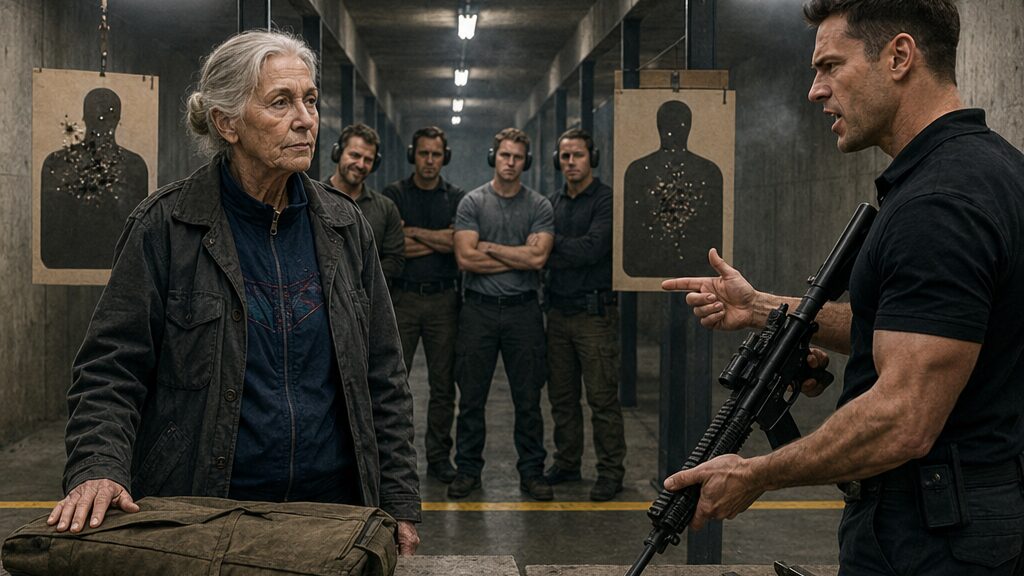
Sandra stopped beside lane twelve, one hand resting on the faded handle of her canvas gun bag. She had not placed it on the floor. She never did.
In the next lane, Brandon Jones lowered a modern black rifle and turned toward the six students gathered behind him.
“That,” he said, raising his voice over the ventilation fans, “is how it’s done, Grandma.”
Another burst of laughter moved through the group. One man near the back laughed only once, then looked away. Sandra noticed him because he was the only one who seemed ashamed of the sound.
She looked at her target, then at the clean bench in front of her. Her ammunition remained sealed. Her hearing protection hung around her neck. The firing line light above her lane was still dark.
Brandon stepped back from his lane as though the tunnel belonged to him.
“You see the stance?” he asked his students.
He pointed at Sandra’s feet.
She wore old black shoes with flat soles and a faded field jacket over dark trousers. Her left leg did not straighten fully anymore. The limp had become more visible during the walk down the concrete ramp, though she had tried not to favor it.
“Weight too far back,” Brandon continued. “Hips locked. No mobility. That is how people get hurt when recoil starts making decisions for them.”
His students shifted for a better view.
Sandra slid her reservation card beneath the edge of the bench and began fastening her hearing protection.
Brandon spoke louder.
“Antique shooter, antique gear, antique habits.”
His eyes settled on the canvas bag. Its corners were rubbed pale. One seam had been repaired with thread that did not quite match. The zipper pull had been replaced with a narrow loop of leather years ago.
“Probably antique junk in there too.”
Sandra checked the overhead clock.
Heather Roberts had told her to arrive at six. It was three minutes before. The private inspection room had been reserved for the evening, and Donald Jackson was supposed to meet them with the transfer documents.
Sandra had chosen the early time because the tunnel was normally quiet between public sessions.
She had not been told about Brandon’s class.
“Ma’am,” he said, “you understand this is an advanced tactical block?”
Sandra clipped her target carrier control into the safe position.
“I reserved this lane.”
Her voice was level, almost lost beneath the fans.
Brandon smiled at his students as if she had delivered the line he expected.
“Having a reservation doesn’t make a person competent.”
He tapped the side of his rifle.
“What I just put on your target would have taken you ten minutes to find.”
Sandra glanced at the hole again.
“No,” she said. “It took you longer than it should have.”
The laughter weakened.
Brandon’s smile remained, but the muscles beside his mouth tightened.
Sandra had watched only the shadow reflected in the lane divider, the brief dip of his shoulder before the shot. She had heard the scrape of his boot against the floor.
“You fired while your weight was shifting,” she said.
One of the students looked toward Brandon’s feet.
Brandon immediately squared them.
“You think so?”
“I heard it.”
The embarrassed student near the rear—Andrew, according to the name printed on his class badge—looked from Sandra to the fresh hole in her target.
Brandon gave a short laugh.
“This is useful,” he told the class. “People who learned bad habits forty years ago often mistake familiarity for expertise. That’s why you correct them early, before they handle something they can’t control.”
Sandra removed her faded jacket but did not take off the thinner garment beneath it. She folded the outer jacket once and set it beside the bag.
Her left knee pulsed. The long ramp had aggravated it more than she expected. She shifted her balance carefully, refusing to give Brandon another movement to narrate.
He noticed anyway.
“There. You see that compensation?”
He moved closer, placing himself partly behind her lane.
“If the body can’t establish a stable platform, no equipment in the world fixes it.”
Sandra turned her head.
“You fired across a lane boundary.”
“It was a controlled demonstration.”
“You fired at a target assigned to someone else.”
“My muzzle never crossed the divider.”
“Your round did.”
For a moment, even the fans seemed quieter.
Brandon’s students stopped smiling.
The rule was too basic to misunderstand. Every person in the tunnel knew it. A shooter owned only the target directly forward of the assigned lane. Crossing into another target, even deliberately, was not instruction. It was interference.
Brandon looked at the group and saw the hesitation.
His expression hardened.
“Let’s settle the question properly,” he said. “Open the bag.”
Sandra’s fingers closed around the handle.
“No.”
“If you brought a firearm into my class area, I need to know whether it’s suitable.”
“This is not your class area.”
“Tonight it is.”
He reached for the zipper.
The movement was quick enough to surprise the students, but not Sandra.
Her right hand left the handle and closed around his wrist before his fingers touched the leather pull.
She did not squeeze hard. She did not need to. Her grip stopped him with his hand suspended inches above the canvas.
Brandon stared down at her fingers.
The tunnel had gone silent behind them.
Sandra could feel the pulse in his wrist. Fast. Faster than it had been before he fired.
She released him only after he stopped pulling forward.
“You have already crossed one line,” she said.
Chapter 2: What the Weathered Canvas Had Protected
When Sandra lowered the zipper, the laughter stopped before the rifle was fully visible.
She opened the bag only far enough to fold back the upper flap. Under the worn canvas lay fitted padding, clean straps, and dark metal preserved without a trace of rust. The walnut furniture held the soft sheen of years of careful oiling. Nothing rattled. Nothing had been thrown inside carelessly.
Brandon leaned closer despite himself.
“FN FAL,” Andrew said from behind him.
Sandra looked at the student. He had identified it without trying to sound impressed.
Brandon recovered quickly.
“An old one.”
“A rare one,” Andrew said.
Brandon glanced back at him.
Sandra removed a clear document sleeve from a narrow pocket inside the bag. She placed it on the bench without handing it to anyone.
“Registration, inspection history, transport authorization,” she said. “You may read them after the range supervisor arrives.”
Brandon picked up none of the papers.
“That rifle was built for another century.”
“So were some rules,” Sandra replied. “They still apply.”
His jaw tightened again.
One of the students stepped closer to the open bag. Sandra folded the flap inward, limiting the view.
The rifle had drawn their attention, but the bag mattered more to her. The canvas had absorbed rain, dust, storage-room cold, and the dry heat of two different continents. The repairs along the inner seam had been made by hands no one in the tunnel would recognize.
Brandon pointed toward the receiver.
“You planning to shoot that here?”
“I planned to have it examined.”
“By whom?”
Sandra said nothing.
She heard a door open behind the firing line.
Heather Roberts came down the tunnel at a fast walk, carrying a clipboard and wearing the dark polo shirt of the range staff. Her gaze moved first to the people crowded between lanes, then to Brandon’s rifle, then to Sandra’s open bag.
“Cease handling,” Heather said.
Her tone cut through the tunnel more effectively than shouting.
Brandon stepped back.
Heather looked at the overhead indicators. Brandon’s lane showed active. Sandra’s did not.
“What happened?”
“A teaching demonstration,” Brandon said immediately. “She entered beside an active class, challenged instruction, and grabbed me when I tried to verify an unsafe firearm.”
Sandra closed the canvas flap but left the zipper open.
Heather turned to her.
“Mrs. Wilson?”
“He fired into my target.”
Heather’s gaze shifted to the paper hanging downrange.
“There’s one impact,” Brandon said. “Controlled, intentional, and called in advance.”
“You did not call it to me,” Sandra said.
“I was addressing my class.”
“You addressed them after the shot.”
Andrew looked at the floor.
Heather noticed.
“Everyone step behind the yellow line,” she ordered. “No one touches a firearm until I clear this.”
The students moved first. Brandon moved last.
Heather checked both rifles visually without handling Sandra’s. Then she walked to the supervisor station and brought up the lane cameras.
The monitor showed a wide view of the firing line. Concrete columns cut the image into partial frames. Sandra could be seen arriving at lane twelve. Brandon was visible from the shoulders down in lane eleven, but the divider blocked his rifle at the moment of the shot.
The target camera showed the paper jumping. It did not show the firing lane.
Heather replayed the clip.
Again the target snapped backward.
Again Brandon’s upper body remained hidden behind the divider.
“There are no individual muzzle feeds?” Sandra asked.
“Not on this section.” Heather’s mouth flattened. “The upgrade was approved. It hasn’t been installed.”
Brandon folded his arms.
“So we have no evidence I violated anything.”
“We have a round in her target,” Heather said.
“And my statement explaining why.”
Sandra looked at Heather. “You consider an explanation permission?”
“No.” Heather shut off the replay. “I consider it one statement.”
The distinction was procedural, and Sandra understood why Heather made it. She had heard the same careful language in military offices where people feared that naming harm too early might create responsibility.
Heather lifted the document sleeve from Sandra’s bench after receiving a nod.
She read each page slowly.
“The rifle was inspected here six months ago.”
Sandra nodded.
Heather checked the serial number without touching the firearm.
“It matches.”
Brandon gave a dismissive breath. “Inspection doesn’t make it appropriate for use in a tactical class.”
“She is not enrolled in your class,” Heather said.
“She entered the lane beside it.”
“She reserved that lane through me.”
That produced the first visible crack in Brandon’s certainty.
Heather turned a page on her clipboard.
“Six o’clock. Private appointment.”
Brandon looked at the clock. “Then why didn’t she say that?”
Heather looked at Sandra too.
Sandra could have answered. She could have explained that the purpose of the appointment belonged to no one standing behind the yellow line. She could have said that Donald was late and that privacy had been part of the arrangement.
Instead she closed the zipper halfway.
“I gave you the reservation card.”
“That told me you had a lane,” Brandon said. “Not that you were qualified to be in it.”
Heather raised a hand before Sandra could answer.
“Both lanes are suspended pending written statements and a full review.”
Brandon stared at her. “You’re suspending my class?”
“I’m suspending lanes eleven and twelve.”
“Because she refuses to explain herself?”
“Because a round entered a target assigned to another shooter.”
“And because she put her hands on me?”
Heather looked at Sandra’s fingers on the bag handle.
“Did you?”
“He reached for the firearm case after I told him not to.”
“I was checking a safety concern.”
“You are not range staff,” Heather said.
Brandon’s students exchanged glances.
For the first time, Sandra felt the cost of what she had not said. Her silence had kept Brandon outside the history of the rifle, but it had also left Heather balancing a clear violation against an incomplete account.
Brandon understood that advantage before Sandra did.
“She may not even know why she’s here,” he said. “Look at her.”
Sandra felt every eye turn toward her left leg.
Heather’s expression changed, but only slightly.
“Classroom alcove,” she told Brandon. “Take your students and wait.”
He collected his rifle, cleared it under Heather’s supervision, and led the group away. Andrew was the last to follow. He looked once at Sandra’s target before disappearing through the side door.
Heather returned to the reservation sheet.
“I need the purpose of your appointment for the incident file.”
Sandra looked at the worn bag.
The answer had seemed simple when she made the booking. Private inspection. No discussion of ownership beyond what the forms required. No names from the past.
Now the word private had become another thing Brandon could use.
Heather read from the note attached to the reservation.
“Private transfer assessment,” she said. Then her voice slowed. “Historic firearm. Final custodian review.”
The fluorescent light hummed above them.
Heather lowered the clipboard.
“You came here to give it up?”
Chapter 3: The Custodian Who Intended to Let Go
Sandra’s hand remained steady over the rifle, but her injured leg failed when she turned away from the inspection bench.
Her knee folded without warning. She caught the steel edge with her palm before her hip struck the floor. The bag stayed upright in her other hand.
Heather moved toward her.
Sandra straightened before she could be touched.
“I’m fine.”
“You nearly went down.”
“I did not.”
Heather closed the inspection-room door behind them. Through its narrow window, the firing tunnel appeared in fragments: white lights, gray partitions, the edge of Brandon’s class gathering in the alcove.
The room smelled of oil, paper, and old carpet instead of lead.
Sandra placed the canvas bag on the padded bench. Only then did she ease weight from her left leg.
Heather watched her carefully.
“Is that why you requested a transfer assessment?”
“It is one reason.”
“What are the others?”
Sandra unzipped the bag and removed a thin maintenance ledger. Its brown cover had softened at the corners. The elastic strap around it had lost most of its tension.
She set it beside the rifle.
Heather opened the first page.
The entries began decades earlier. Dates, inspection marks, replacement parts, storage conditions, and initials filled the pages in small disciplined handwriting. The intervals were nearly exact. Even years when the rifle had not been fired contained cleaning records and preservation checks.
Heather turned three pages, then five.
“This is yours?”
“Most of it.”
“The earlier handwriting is different.”
Sandra did not answer.
Heather continued reading.
Brandon’s voice came faintly through the wall. He was speaking to his students in the measured tone he had not used on the range. The anger had gone from his volume, replaced by something more deliberate.
Sandra recognized that change. Men who could not control an event often tried to control its record.
Heather tapped one entry.
“This rifle was inspected every ninety days for almost thirty years.”
“When storage conditions required it.”
“He called it neglected.”
“He saw canvas.”
Heather looked at the bag, then back at the ledger.
“Why transfer it now?”
Sandra flexed her left knee beneath the bench. Pain moved upward into the old scar along her thigh.
“Because the rifle deserves a custodian who can carry it without calculating the distance to every door.”
“That is not the same as being unable to maintain it.”
“No.”
“Or unable to use it.”
Sandra’s gaze settled on the FN FAL.
“I have not fired it in years.”
Heather looked surprised.
“Then why keep it?”
Sandra ran one finger along the edge of the ledger.
“Ownership is not always use.”
The words left more exposed than she intended.
For years, people had assumed that a weapon mattered only when it was fired, just as they assumed a medal mattered only when it was displayed. They understood possession as appetite and skill as performance. They did not understand custody.
Heather turned toward the bag’s interior. A narrow pocket had been stitched beneath the padding and sealed with an old brass snap.
“What’s in there?”
“Nothing needed for your inspection.”
Heather paused, then withdrew her hand.
That small act of restraint unsettled Sandra more than Brandon’s mockery had. Heather had been given an opportunity to intrude and chose not to take it.
A sheet of paper slid under the inspection-room door.
Heather bent and picked it up.
At the top, in block letters, was written INCIDENT STATEMENT.
The paragraphs below were already typed.
Heather read silently at first. Her expression tightened.
“What does it say?” Sandra asked.
Heather handed it across the bench.
The statement described Sandra as disoriented, physically unstable, verbally confrontational, and unable to maintain safe control of a firearm. It claimed Brandon had fired a supervised demonstration shot only after warning the class and that Sandra had responded by seizing his wrist.
At the bottom were blank signature lines for each student.
Sandra read the phrase physically unstable twice.
Her knee still throbbed from nearly collapsing.
Brandon had seen the weakness she had come to acknowledge privately and turned it into evidence that she should not be trusted with the rifle.
Heather took the page back.
“This isn’t an individual statement.”
“No.”
“It’s a statement for witnesses to adopt.”
“He wants the language settled before the facts are.”
Heather glanced through the window.
Brandon stood at the front of the alcove with the students seated around him. He held several copies.
“I should have stopped the class sooner,” Heather said.
Sandra looked at her.
Heather seemed to hear her own admission and retreat from it.
“I arrived as soon as the front desk called.”
“That is not what you said.”
Heather’s mouth closed.
Sandra secured the maintenance ledger with its loose elastic strap.
She had no interest in being defended by someone who needed first to protect herself. Yet she also knew her silence had made Heather’s caution easier. She had arrived carrying a history no one could see and expected the room to respect boundaries it did not know existed.
Through the wall, Brandon said something that made two students laugh.
The sound was thinner now.
Heather set the prepared statement on the far side of the table.
“I can disprove part of this with the reservation and inspection record.”
“Part.”
“I need your full account for the rest.”
Sandra looked at the sealed pocket inside the canvas bag.
The contents had never been entered into an official range file. She had intended to show them only to Donald after the doors were locked.
“I came for an assessment,” she said.
“I know.”
“I did not come to prove I could still perform.”
Heather waited.
Sandra closed the bag over the rifle but did not zip it.
“I came to decide whether I should stop being responsible for it.”
The handle lay between them, worn smooth where her hand had carried it for years.
A knock sounded at the door.
Before Heather answered, Andrew Lewis stepped inside and shut it behind him.
He no longer wore his hearing protection. Without it, he looked younger and less certain.
He glanced at Sandra, then at the prepared statement.
“Brandon wants all of us to sign that,” he said.
Heather folded her arms. “Will you?”
Andrew looked through the window toward the classroom alcove.
“Not before you see the targets.”
Chapter 4: The Grouping That Refused His Story
Heather stopped the target carrier halfway to the firing line.
A blue ink circle had been drawn around one of the holes in Sandra’s target.
The mark was fresh enough to shine beneath the fluorescent lights.
“That wasn’t there before,” Andrew said.
Brandon stood behind the yellow line with his students gathered around him. His prepared statements were tucked beneath one arm. He looked at the target, then at Heather.
“I marked the demonstration round.”
“When?” Heather asked.
“Before we left the lanes.”
“You touched evidence after I suspended them.”
“I identified my shot.”
Sandra watched the paper sway. Brandon’s circle was not around the hole in the printed head—the first shot, the one that had crossed from his lane. It surrounded a lower impact near the shoulder.
He had marked the wrong hole.
Heather reeled the target the rest of the way forward. Beside it, Brandon’s own target slid out of the dim tunnel. Its pattern had begun tightly near the center and widened toward the right edge. The last impacts were farther apart than the first.
She set both targets side by side.
“Which round did you fire into Mrs. Wilson’s target?” she asked.
Brandon pointed at the ink circle.
“That one.”
Sandra studied the torn paper. The circled hole had entered almost straight. The hole in the head carried a slight lateral tear, the paper stretched toward the right.
“You did not circle your round,” she said.
Brandon looked at her. “You weren’t even watching.”
“I did not need to watch the muzzle.”
Heather glanced between the two holes.
Sandra indicated the upper impact without touching the paper.
“That one came while his balance was moving right. The paper tore with the angle. The circled one came straight from lane twelve.”
“There was no shot from lane twelve,” Brandon said quickly.
“Not tonight,” Sandra replied. “It was already there.”
Heather turned the target over. On the back, faint pencil writing showed the date of a previous session.
The circled impact belonged to an old target that had been reused.
A student near Andrew exhaled through his nose.
Brandon’s face darkened. “So I marked the wrong hole. That doesn’t change why I fired.”
“It changes your claim that you identified it before the review,” Heather said.
He shifted toward her.
“My class contract is being evaluated tonight. I had six people watching me manage an unsafe situation. I made a notation so nobody would confuse the record.”
“You altered it.”
“I clarified it.”
Heather removed the prepared statements from beneath his arm.
He let her take them, but his fingers held on for half a second too long.
She turned to Andrew.
“You said we needed to see the targets.”
Andrew’s attention remained fixed on Brandon’s widening group. “Yes.”
“Tell me why.”
Brandon spoke before he could answer.
“Be accurate. Your certification depends on accurate reporting.”
Andrew looked at him.
The warning had been quiet, almost professional. That made it worse.
Andrew swallowed. “He fired into her target intentionally.”
Heather waited.
“He told us afterward it was a demonstration.”
“Afterward?” Sandra asked.
Andrew’s shoulders tightened. “I thought he meant it was permitted. He was teaching us about correcting bad stance.”
“Did he announce the shot before firing?” Heather asked.
“No.”
The students behind him became very still.
Brandon stared at Andrew with something close to disbelief.
“You know what happens when people develop unsafe habits,” he said. “You froze during your last qualification because no one corrected you early enough. I was trying to show you what hesitation costs.”
Andrew flinched.
Sandra saw how neatly Brandon had found the weak place. Andrew had not followed him because he admired cruelty. He had followed because Brandon had given his shame a name and promised to train it out of him.
“That has nothing to do with her target,” Andrew said, though his voice had thinned.
“It has everything to do with standards.”
Sandra stepped toward Brandon’s paper.
The first three impacts sat close together. The next pair drifted right. The final holes spread wider still.
“You began well,” she said.
Brandon gave a humorless smile. “Thank you.”
“You stopped teaching when you noticed me.”
“I noticed a hazard.”
“You noticed an audience looking somewhere else.”
One of the students lowered his eyes.
Sandra pointed to the widening pattern.
“Your breathing shortened. Your support shoulder rose. Then your right foot shifted because you wanted to turn toward the class before the shot was complete.”
Brandon’s smile vanished.
“You’re reading paper like a fortune teller.”
“No. I heard your boot. I saw the divider shake. The target recorded the rest.”
Heather looked at the grouping again. The pattern did not prove every detail, but it made Brandon’s account harder to hold. His earliest shots were controlled. His later ones were not. The impact in Sandra’s target belonged to the same deterioration he had denied.
Brandon saw the doubt moving through his class.
He stepped into the space between the targets.
“This is absurd. We are allowing an elderly woman who nearly fell in the inspection room to diagnose technique from torn paper.”
Andrew turned sharply. “How do you know she nearly fell?”
The question landed harder than an accusation.
Heather looked toward the inspection-room window. From the alcove, Brandon could not have seen inside.
He had either been told or had watched through the narrow pane while claiming to prepare statements.
Brandon ignored Andrew.
“If she is competent,” he said, “let her demonstrate it. If she isn’t, suspend her access permanently before someone gets hurt.”
Heather’s expression hardened. “You don’t set that condition.”
“The range will have to choose. My class or a shooter who admits she hasn’t used that rifle in years.”
Sandra looked at Heather.
There it was—the trap built from her own silence. If she refused, Brandon would call refusal proof. If she opened the canvas bag and fired the FN FAL, the rifle would become a prop in his contest, its history dragged into a spectacle she had spent decades avoiding.
Behind Brandon, the students waited.
Andrew stood apart from them now, but he had not yet stepped fully away. Sandra recognized the uncertainty in his posture. He wanted someone to tell him whether authority was always this loud.
She returned to the inspection bench and placed one hand on the canvas bag.
Brandon watched, expecting the zipper to open.
Sandra drew it closed instead.
The leather pull made a soft rasp beneath the ventilation fans.
She fastened the flap over the rifle and lifted her hand from it.
Then she turned to Heather.
“Bring me a clean target,” she said, “and the range shotgun.”
Chapter 5: Four Blasts Before the First Shell Fell
Brandon stepped toward Sandra before Heather returned with the shotgun.
“Your left foot is too far forward,” he said.
Sandra did not look at him.
She moved the foot half an inch.
Not backward, as he intended. Outward.
The adjustment eased pressure on her damaged knee and centered her weight without forcing the joint straight. Brandon noticed the refusal concealed inside the movement.
“You’re compensating again.”
Sandra fitted her hearing protection.
“So are you.”
Heather returned carrying the range’s pump shotgun with the action open. A clean paper target traveled down the central lane until the printed silhouette hung beneath the far light.
The tunnel had changed. No one laughed now. Even the students’ equipment seemed quieter as they set bags and magazines on the rear benches.
Heather stopped beside Sandra.
“This is not required,” she said.
“No.”
“You can submit a statement and leave.”
“Yes.”
“Then why do this?”
Sandra looked at Andrew. He stood nearest the yellow boundary, leaning forward without realizing one boot had crossed it.
“Because they are still in class.”
She pointed to his foot.
Andrew looked down and stepped back immediately.
Sandra did not accept the shotgun until he was fully behind the line.
The pause altered something in the room. Brandon had promised the students speed, dominance, and certainty. Sandra’s first lesson was that nothing happened until every person was safe.
Heather presented the shotgun. Sandra inspected it without flourish. Her hands moved slowly enough for everyone to follow and precisely enough that no movement needed repeating.
Brandon folded his arms.
“You planning to stand there all night?”
Sandra checked the lane once more.
“No.”
Heather moved behind the line.
Sandra brought the shotgun to her shoulder.
Pain pressed along her left thigh as she settled. Her body no longer gave her positions freely. Each one had to be negotiated with old damage. She kept the strain from reaching her hands.
The first years after the injury, she had fought the limp as though refusing it might make it temporary. Later she had learned that discipline was not pretending the body had no limits. It was knowing exactly where the limits were and wasting nothing inside them.
Brandon spoke over her shoulder.
“Too rigid.”
Sandra’s eyes remained downrange.
“Your elbow will drive recoil into the joint.”
She did not move.
The students watched Brandon instead of her, waiting to see whether he would keep talking.
He did.
“This is exactly the kind of outdated platform I warned you about. Static, overcommitted, no recovery path.”
Sandra breathed out.
The tunnel narrowed to the clean target, the pressure of the stock, and the familiar mechanical weight held between both hands.
She fired.
The first blast struck the concrete tunnel like a physical blow. Before its echo returned, she cycled the action and fired again.
A shell spun into the fluorescent glare.
The third blast merged with the second.
The fourth came before the first empty shell touched the floor.
Then there was only the metallic clatter of brass-colored hulls bouncing on concrete and the long ringing silence that followed heavy sound underground.
The paper target swung violently at the far end.
Its printed head was gone.
Not perforated by a loose pattern. Gone from the center outward, four impacts driven through nearly the same area until the paper could no longer hold its shape.
Sandra remained still.
She did not turn toward the class.
She opened the action and began the clearing process Heather had required of every shooter who used range equipment.
Behind her, someone whispered, “Four.”
Andrew did not answer. He was staring at the target, then at the scattered holes on Brandon’s paper beside it.
Sandra lowered the shotgun only when the chamber had been verified.
Heather stepped forward.
Before she could receive it, Brandon crossed the yellow line.
“One sequence,” he said. His voice was louder than necessary. “That proves nothing except rehearsed speed.”
Sandra kept the muzzle safely downrange.
“Stay back.”
“You turned a safety review into a stunt.”
He reached for the shotgun.
Sandra shifted it away from him without pointing it anywhere but the lane. Her free hand stopped against his forearm.
“Do not interrupt a clearing procedure.”
The command was quiet, but Brandon froze.
Heather moved between them.
“Behind the line, Brandon.”
He looked at the students.
None of them had moved to support him.
His face tightened with the same pressure Sandra had heard in his breathing earlier. He needed the room to return to its previous arrangement: himself in front, everyone else accepting the meaning he assigned.
“She fired four slugs as fast as she could manipulate the action,” he said. “You want to call that judgment? She selected a head target for spectacle.”
Heather looked downrange.
“The target was already mounted.”
“I didn’t choose it,” Sandra said.
Brandon turned on Andrew.
“You think this makes her an instructor? A trick grouping?”
Andrew’s mouth opened, then closed.
Brandon seized on the hesitation.
“Speed without context gets people killed. You learned that during qualification.”
Sandra saw Andrew’s shoulders pull inward.
Brandon was doing what he had done from the beginning—taking another person’s weakness and arranging it where everyone could see.
Sandra handed the cleared shotgun to Heather.
Only when it was out of her hands did she turn around.
“His qualification is not yours to expose,” she said.
Brandon gave a sharp laugh. “Now you’re protecting him?”
“No. I am correcting you.”
He stepped closer, though Heather remained between them.
“You don’t know what I’ve done for these students.”
“I know you can shoot.”
That stopped him.
Sandra pointed toward his target.
“The first group proves it.”
The students looked at the close impacts near the center.
“Your knowledge is not the problem,” she continued. “Your need to display it is.”
Brandon’s eyes flicked toward the class.
Sandra followed the movement.
“You were stable until they looked at me. Then your shoulders rose, your breath shortened, and your shots moved right.”
“You’re repeating yourself.”
“You have not listened yet.”
The target carriers hummed as Heather brought Sandra’s ruined paper closer. It traveled beside Brandon’s target, the two sheets advancing together through the gunpowder haze.
One held a center erased by concentration.
The other recorded a steady loss of control.
Sandra waited until both stopped beneath the lights.
“Your stance is drifting,” she said, “because you are afraid they will see you without the performance.”
Chapter 6: The Jacket She Had Refused to Wear
“Prove who you are,” Brandon said.
Sandra picked up her faded outer coat.
The students remained behind the yellow line, their faces pale beneath the fluorescent lights. Heather held the cleared shotgun at the supervisor station. Andrew stood nearest the equipment benches, looking at Brandon’s prepared statement as though it belonged to someone he no longer recognized.
Sandra slid one arm into her coat.
Brandon mistook the movement for retreat.
“That’s what I thought,” he said. “A good grouping and a dramatic exit. No credentials. No current certification. Nothing that gives you the right to judge my class.”
Sandra put her other arm into the coat but did not close it.
Beneath the faded fabric, a narrow band of color showed at her shoulder—old red, white, and blue cloth preserved far better than the garment covering it.
Andrew saw it first.
His eyes narrowed.
Before anyone could speak, the tunnel door opened.
Donald Jackson entered carrying a rigid document case under one arm. His gray hair was flattened on one side as if he had driven with the window open. He took three steps into the room, saw the targets, and stopped.
Then he saw Sandra’s canvas bag closed on the inspection bench.
“I came as fast as I could,” he said. “Front desk said there’d been an incident.”
Brandon pointed toward him.
“Good. Another witness. Tell them what she brought in here.”
Donald looked at Sandra, not Brandon.
“Do you want me to?”
“No.”
The answer came immediately.
Donald’s hand remained on the case latch.
“It contains the custody history,” he said carefully. “Inspection records, service provenance, transfer authority—”
“I said no.”
He closed his mouth.
Sandra felt the old instinct tighten inside her. Paper had rescued other people before. Titles, photographs, official seals. Each one had placed her in a frame built by someone else.
The first newspaper photograph after the Games had cropped out her coach. The caption called her a housewife with a surprising eye. Another article described her as proof that women could remain graceful under recoil. Reporters asked who cooked while she trained. Sponsors placed flowers in her hands and removed the tools she actually used.
Her skill became a curiosity. Her discipline became decoration.
She had stopped wearing the jacket because strangers saw the medal before they saw the work.
Brandon nodded toward Donald’s case.
“So there is a record.”
“There is always a record,” Donald said. “The question is whether you deserve to read it.”
“Donald,” Sandra warned.
He lowered the case.
Sandra opened her faded coat.
The garment beneath it was dark blue, carefully preserved, with the old national team insignia stitched over the chest. The year was embroidered below it.
No medal hung around her neck. None was needed.
Andrew read the stitching aloud under his breath.
Brandon stared at the jacket, and for the first time that evening, no answer arrived quickly enough to protect him.
One of the students stepped closer to see.
Sandra closed the faded coat halfway.
“This jacket does not make the shot safer,” she said. “It does not make your conduct worse. You crossed into my lane before you knew it existed.”
Brandon found his voice.
“Olympic competition is not tactical instruction.”
“No.”
“Then this changes nothing.”
“It changes what you demanded.”
He looked around, searching for agreement.
Sandra rested one hand on the canvas bag.
“The rifle belonged to the instructor who prepared me before those Games. He taught military marksmanship before anyone printed the word tactical on a shirt. When he died, he left the rifle in my care.”
Donald’s document case shifted softly against his leg.
“He believed skill was a responsibility,” Sandra continued. “Not a performance. Not permission to humiliate someone who knew less. And never an excuse to become careless because people were watching.”
The room held no applause, only the ventilation fans and the distant hum of a target carrier.
Brandon looked toward his students.
“We’re finishing the class,” he said. “Pack this distraction away and return to lane procedure.”
No one moved.
“Andrew.”
Andrew picked up the prepared incident statement.
For a moment Brandon seemed to believe he would sign it.
Andrew tore the unsigned sheet once through the center.
He did not throw it down. He placed the pieces neatly on the bench, then began packing his hearing protection and magazines.
“You walk out now,” Brandon said, “you don’t receive certification.”
Andrew zipped his range bag.
“I don’t want yours.”
The student beside him began gathering his equipment.
Then another.
There was no argument among them, no dramatic declaration. Cases closed. Straps lifted onto shoulders. Chairs scraped against concrete.
Brandon watched his class disappear one student at a time.
He tried to stop the last man with a hand on his arm. The student looked down at it until Brandon released him.
Andrew paused beside Sandra.
“I laughed,” he said.
“Once.”
“That was enough.”
Sandra did not absolve him.
Andrew nodded as if he understood, then followed the others through the tunnel door.
Brandon remained near his scattered target. Without the class around him, his dark range clothing and expensive equipment seemed smaller, almost ordinary.
Heather removed his instructor access card from the station.
“The contract review is suspended,” she said.
“You’re taking her side because of a jacket.”
“I’m suspending you because you fired into another lane, altered a target, and pressured witnesses.”
His gaze moved to Sandra.
“This is what you wanted.”
Sandra lifted the canvas bag.
“No. I wanted privacy.”
That answer left him with nowhere useful to put his anger.
He collected his equipment and walked out. The tunnel door closed behind him with a heavy mechanical click.
Donald set the document case on the inspection bench.
Heather waited until Brandon’s footsteps faded up the concrete ramp.
Then she looked at Sandra and the rare rifle hidden inside the weathered canvas.
“Do you still want to complete the permanent transfer tonight?”
Chapter 7: What She Chose to Carry Forward
The permanent-transfer form was ready, but Sandra placed the pen across it instead of signing.
Donald had arranged the pages in precise order on the inspection bench. Ownership declaration. Condition report. Historical custody record. Acceptance by the range. Each page carried a yellow tab where Sandra’s name belonged.
The canvas bag rested beside them, closed.
Beyond the inspection-room window, the underground tunnel was almost empty. The ventilation system continued pulling lead dust and gunpowder from the air. Brandon’s target still hung beneath the fluorescent lights, its widening pattern visible even from the room.
Heather stood across from Sandra.
“You don’t have to decide because of what happened tonight,” she said.
“I arranged this before tonight.”
“I know.”
“No,” Sandra said. “You know what the appointment says.”
Donald shifted his document case but remained silent.
Sandra touched the pen with one finger. She had expected relief when the papers appeared. For three months, she had imagined signing them and walking away with one empty hand. The rifle would be catalogued, insured, and stored under controlled conditions. Its history would survive her knee, her declining balance, and the day she could no longer lift the bag without planning each step.
Yet the form reduced custody to possession. It said nothing about judgment.
Heather looked toward the tunnel.
“There’s something I need to put in the incident report.”
Sandra waited.
“I saw Brandon begin using you as part of his lesson before the front desk called me.”
Donald raised his eyes.
Heather continued before either of them could respond.
“I was watching the wide camera feed from the office. I saw him pointing at your stance. I saw the students gathering between the lanes.”
“You did not see the shot,” Sandra said.
“No. The divider blocked it.”
“But you saw enough to come down.”
Heather’s hands tightened around her clipboard.
“Yes.”
“Why didn’t you?”
“The contract evaluation was already behind schedule. Brandon had complained twice that staff interference made his classes look disorganized. Management wanted the evening to run cleanly.”
“So you waited for disorder large enough to justify stopping it.”
Heather accepted the words without defending herself.
“I told myself he was being harsh, not unsafe. I told myself stepping in too early would make me look biased against him.”
“And when you arrived?”
“I treated your silence and his confidence as though they had equal weight.”
The ventilation fan pulsed through the wall.
Sandra looked at the woman who had preserved procedure while Brandon manufactured facts in front of her. Heather’s failure was quieter than his, but quiet failures often lasted longer because institutions knew how to live with them.
“Neutrality does not stand in the middle,” Sandra said. “It usually stands beside whoever has already taken the most ground.”
Heather lowered her clipboard.
“I understand that now.”
“No. You understand what it cost tonight.”
The distinction made Heather flinch, but she nodded.
Sandra turned back to the form.
Donald opened his document case and removed a second folder.
“If you postpone the transfer,” he said, “we need another arrangement.”
“I can continue the maintenance schedule.”
“For now.”
Sandra looked at him.
Donald’s tone remained practical, but the concern beneath it was old.
“The rifle cannot simply return to your house indefinitely with no documented succession plan. That is what this appointment was meant to prevent.”
“I remember.”
“You told me you had decided.”
“I believed I had.”
Donald rested both hands on the folder. “The paperwork is not the enemy, Sandra.”
“No. But it is not the answer either.”
She opened the canvas bag and removed the maintenance ledger. The loose elastic strap slipped from one corner.
Inside the rear cover, in handwriting older than her own entries, was a sentence she had avoided reading for years.
Preserve the standard by passing it on.
Not preserve the rifle.
Not preserve the record.
The standard.
Her instructor had written it after her final training session before the Games. She had interpreted the words as an order to guard what he left behind. It had been easier to oil metal every ninety days than to trust another person with what the rifle represented.
Sandra closed the ledger.
“He did not ask me to keep it forever,” she said.
Donald said nothing.
“He asked me to pass on the discipline attached to it.”
Heather looked at the canvas bag.
Sandra noticed a loose stitch near the handle, the thread lifted where Brandon’s hand had nearly reached the zipper. She removed a small sewing packet from the side pocket. Donald watched her knot the thread and pull the seam tight with two careful movements.
“You carry a needle in there?” Heather asked.
“I carry what the bag requires.”
When the repair was finished, Sandra closed the packet and slid it away.
Then she pushed the canvas bag across the bench toward Heather.
Heather did not touch it.
“Carry it to the other end of the table,” Sandra said.
Heather looked surprised. “Now?”
“Now.”
She placed both hands on the handles and lifted.
“Not like that,” Sandra said.
Heather stopped.
“One hand controls the weight. The other protects the balance. You do not lift history by the weakest point simply because it is convenient.”
Heather adjusted her grip.
This time the bag stayed level.
She carried it three steps and placed it on the padded surface without letting the canvas strike the steel edge.
Sandra watched every movement.
Donald exhaled softly.
“You’re postponing the transfer,” he said.
“I am changing its terms.”
“To what?”
Sandra looked at Heather.
“She learns the maintenance schedule first. Then the records. Then why some parts were left original when replacing them would have been easier.”
Heather kept her hands beside the bag, not on it.
“And after that?” she asked.
“After that, we see whether you understand custody.”
Donald opened the second folder.
“A supervised succession plan can be documented. Temporary retention, named trainee, periodic review.”
“You already brought the forms,” Sandra said.
“I know you.”
For the first time that evening, the corner of her mouth moved.
Donald began replacing the transfer pages with new ones.
Heather looked through the window at Brandon’s target.
“What happens to that?”
“It becomes part of the incident file,” she said. “Unaltered, except for the mark he added.”
Sandra fastened her faded outer coat over the Olympic jacket.
“No display.”
“No.”
“No photograph of mine beside it.”
“No.”
Heather lifted the altered target from its hooks and carried it toward the supervisor station. She removed the prepared statement fragments from the bench as well.
Sandra took up the canvas bag. The repaired handle settled into her palm.
Her knee resisted the first step, then accepted the second.
At the tunnel entrance, she paused and looked back.
Heather stood beneath the fluorescent lights, taking Brandon’s marked target down from the official display board. Donald remained in the inspection room, rewriting the future in terms narrow enough for paperwork and wide enough for trust.
Sandra turned toward the concrete ramp.
Her slight limp followed her up through the fading smell of gunpowder. The weathered bag moved beside her without touching the wall.
Behind her, Brandon’s scattered target swayed once in the ventilation draft, then disappeared into the evidence sleeve.
The story has ended.