They Called His Old Flight-Line Card Worthless Until He Explained Why the Aircraft Came Home
Chapter 1: The Card That Was Never a Pass
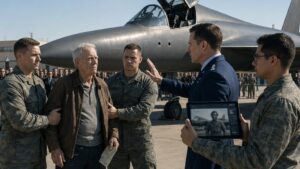
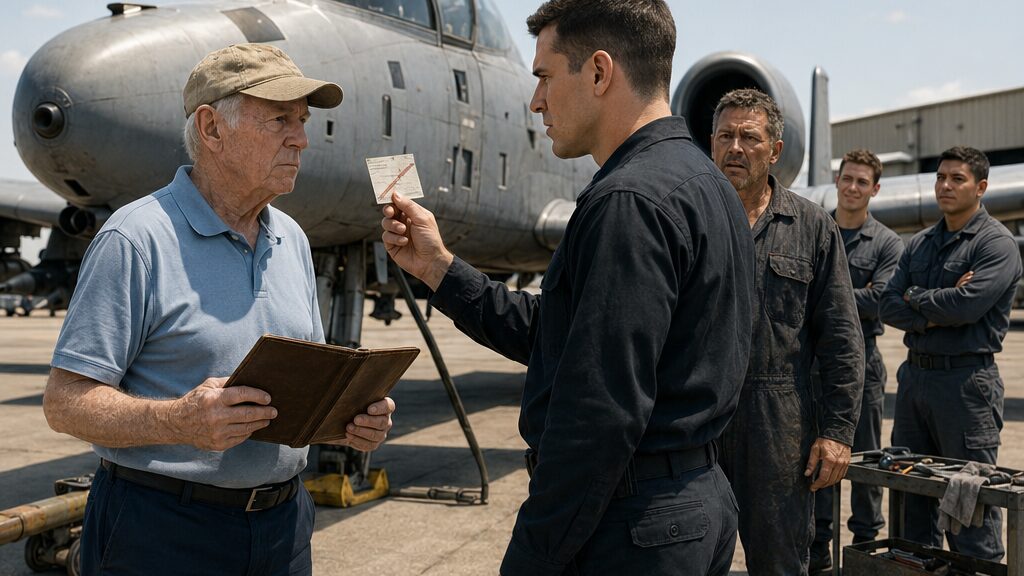
The young officer’s hand entered Daniel Harris’s leather holder before Daniel could close it.
For half a second, Daniel watched the fingers search among the folded papers as if they belonged there. Then the officer drew out the white card with the faded red diagonal line.
“Sir, don’t reach for anything else.”
Daniel had not moved.
The flight line spread behind them in hard late-morning light. Heat shimmered above the concrete, bending the gray attack aircraft at the edges. Its open panels exposed wiring bays Daniel could no longer see clearly from where he stood, though he knew the shape of them. A tow bar rested beneath the nose. Red streamers stirred under the wings.
Two junior airmen had stopped beside a maintenance cart. Another stood near the painted boundary line with his arms folded. Their faces carried the alert curiosity of people who had found something more interesting than work.
The officer turned the card over.
“What is this supposed to be?”
Daniel held out his hand. “Mine.”
“That wasn’t my question.”
The name tape over the officer’s pocket read KING. He was young enough that the skin around his eyes had not yet learned to hide strain. His uniform was exact, his boots clean despite the dust, his voice pitched to carry farther than necessary.
Daniel looked past him toward the aircraft.
Forty-seven years had altered its paint, antennas, and weapons fittings. The bones were the same.
King glanced toward the junior airmen. “This is what I’m talking about. People bring old paperwork, expired credentials, challenge coins, anything that looks official, and think restricted means negotiable.”
One of the airmen smiled before deciding not to.
Daniel’s faded tan cap kept the sun from his eyes, but not the heat from the back of his neck. Amy had told him to wear a better shirt. He had chosen the pale blue polo because it did not cling to him and because nothing about it asked to be noticed.
“I didn’t say it was a credential,” he said.
King lifted the card between two fingers. The old paper looked smaller against the aircraft behind him.
“Then why was it in the same holder as an expired visitor badge?”
“Because that’s where I keep it.”
King gave a short breath through his nose. “You crossed a marked access point with no escort. Your name is not on the current roster. When you were stopped, you opened this thing and started pulling out documents.”
“I opened it to find the invitation.”
“There is no valid invitation.”
“There was one.”
King stepped closer. “Sir, I offered to walk you back to the visitor center. You refused.”
“I said someone was meeting me.”
“Who?”
Daniel’s eyes shifted beyond King.
Jerry Walker stood beside the maintenance stand twenty yards away, dark coveralls stained at the knees and elbows. His weathered face had gone still. He had seen the card. Daniel knew that much from the way Jerry’s gaze fixed not on the red line, but on the lower corner where the form number had nearly faded away.
Jerry had been twenty-two when Daniel first caught him testing a relay with the power still live. He had been quick, embarrassed, and willing to learn. Daniel had liked him for the second quality more than the first.
Now Jerry looked toward the hangar doors.
King followed Daniel’s glance. “Was it one of the maintainers?”
Daniel said nothing.
He had no desire to watch Jerry lose his place over a missed form. A man nearing retirement could be ruined by one badly timed admission. Daniel also had no desire to explain himself to an officer who had already decided what kind of old man stood before him.
King mistook the silence for confusion.
“Do you know where you are?”
Daniel looked at him.
The question landed more cleanly than an insult. It reduced the aircraft, the concrete, and the years between them to a test of whether Daniel’s mind still worked.
“I know exactly where I am.”
“Then you understand why this matters.”
“Yes.”
“Good. So tell me why you came through a restricted maintenance access point without authorization.”
“To see the aircraft before they move it.”
“That doesn’t authorize you.”
“No.”
King’s jaw tightened. Daniel could see the conflict inside him: the security stop had begun correctly, but the watching airmen had turned it into a performance. Retreat now would look like uncertainty. Young supervisors often believed certainty was the same thing as control.
King raised the card again.
“And this? An obsolete maintenance scrap. Was this meant to prove you belonged here?”
The paper bent slightly between his fingers.
Daniel felt the movement in his chest before he felt it in his hands. A quick pressure. A remembered urge to step forward, remove the card, flatten it against his palm.
He did not move.
“That was never a pass,” he said.
King lowered it an inch. “Then what is it?”
Daniel looked at the card, then at the aircraft.
“Because once,” he said, “it stopped that aircraft from leaving.”
The nearest airman unfolded his arms.
King’s expression changed, though only at the edges. “A piece of paper stopped an aircraft?”
“No. A decision did.”
The heat carried the faint metal-on-metal knock of a tool dropped somewhere inside the hangar.
Jerry took one step toward them.
King saw it. “You know this man?”
Jerry’s mouth opened, then closed.
Daniel watched the hesitation become a choice.
“Mr. Walker,” King said, “I asked you a question.”
Jerry wiped his hands on a rag that was already black. “I know the form.”
“That isn’t what I asked.”
“It’s an old grounding discrepancy card.”
King looked at the red diagonal line.
Jerry continued carefully. “They used them before the system went electronic.”
“So it’s what I said. Old maintenance paperwork.”
Jerry’s gaze met Daniel’s for the first time. There was recognition there, but also something smaller and less honorable.
Fear.
Daniel had not expected Jerry to defend his history. He had expected him to acknowledge the invitation.
King turned the card over again. “Whose initials are these?”
Jerry did not answer.
Daniel’s disappointment came quietly. It settled deeper than the humiliation because it had somewhere familiar to go.
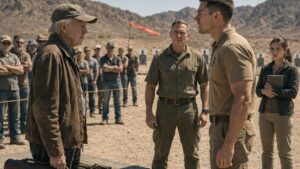
A security vehicle rolled toward them from the edge of the apron. Its roof lights were off, but its arrival changed the posture of everyone nearby. The junior airmen straightened. King shifted from irritated officer to formal authority.
“Sir,” he said, “you’re going to come with us while we verify your identity and determine how you entered the area.”
“You already have my identification.”
“We have an expired visitor badge and a driver’s license. We do not have an explanation.”
“You have one.”
“I have fragments.”
Daniel extended his hand toward the card. “Then return my property.”
King looked at the evidence in his fingers, then at the waiting vehicle.
“It will be logged and returned after review.”
The words were procedural. The way he slid the card behind his clipboard was not.
A security specialist opened the rear door. Daniel walked without assistance, though his left knee objected after the first step. He kept the leather holder in his right hand. Without the card inside, it felt too light.
As he reached the vehicle, Jerry finally moved.
“Captain King.”
King turned.
Jerry’s voice was low, but the concrete carried it.
“His name is Daniel Harris.”
Daniel stopped with one hand on the door frame.
The officer’s eyes narrowed. “You said you knew the form.”
Jerry stared at the gray aircraft instead of at Daniel.
“I know who wrote it.”
Chapter 2: The Invitation Nobody Wanted to Admit
Timothy King sealed the white card inside a clear evidence sleeve as though it might contaminate the desk.
Daniel sat across from him in the flight-line security office, the empty leather holder resting between his hands. A wall-mounted air conditioner rattled above a row of framed regulations. Through the narrow window, the aircraft’s tail rose beyond the hangar like a piece of machinery being slowly erased.
King wrote the time on the sleeve.
“You understand this is temporary custody.”
“I understand you bent it.”
King stopped writing.
Daniel had seen the shallow crease form where the officer’s thumb pressed against the card. It crossed the faded red stripe near the center. The damage was slight. That did not make it invisible.
“I handled it during a security stop,” King said.
“You handled it before you knew what it was.”
“I still don’t know what it is.”
“Then that would have been the time to be careful.”
The security specialist by the door looked down at the tablet in his hands.
King placed the sleeve flat. “Mr. Harris, your name does not appear on today’s access roster. The badge in your possession expired last year. You entered through a maintenance gate after a contractor opened it for equipment movement. Those facts are not in dispute.”
“No.”
“Who told you to use that gate?”
Daniel’s thumb moved along the cracked edge of the leather holder. “Someone said he would meet me there.”
“Jerry Walker?”
Daniel looked at the officer.
King leaned back. “He identified you.”
“He said my name.”
“Did he invite you?”
Daniel could have answered with one word. Instead he watched the air conditioner shake in its housing.
King’s impatience sharpened. “You are protecting someone who did not step forward when you were stopped.”
“That is my decision.”
“No, sir. Not entirely. This is now an access-control investigation.”
The office door opened before Daniel replied.
Amy came in carrying her phone, car keys, and the expression she used when she had already solved a problem for someone who had refused to ask. Her dark hair was pinned back, though strands had escaped around her face.
“Dad.”
“I’m fine.”
“I didn’t ask.”
She looked at King. “I’m Amy Harris. He called me from the vehicle.”
“He was permitted one call.”
Daniel disliked the phrasing. Amy disliked it more visibly.
King stood. “Your father entered a restricted area without current authorization.”
“He was invited.”
“By whom?”
Amy turned her phone toward him. “Jerry Walker.”
Daniel closed his eyes for a moment.
The email showed Jerry’s name at the top and Daniel’s below it.
Mr. Harris, I’ve cleared a visit for Thursday the twenty-second. Meet me at Maintenance Gate Three at ten-thirty. We’ll have time with the aircraft before public affairs starts setting up.
King read it twice.
“Today is the fifteenth.”
“The retirement move was brought forward,” Amy said. “Jerry called my father three days ago and told him to come today instead.”
King looked at Daniel. “Do you have that message?”
“It was a call.”
“Any follow-up email?”
“No.”
“Text?”
“No.”
Amy’s voice cooled. “Jerry told him the date changed.”
King tapped the original date on the screen. “This does not authorize access today.”
“It proves he didn’t wander onto the flight line carrying random old papers.”
Daniel shifted in his chair. “Amy.”
She looked at him. “What?”
“You don’t have to argue every sentence.”
“Apparently somebody does.”
The words struck harder than she intended. He could tell by the way her mouth tightened afterward.
King sat again. Some of his public certainty had left him, but not his caution.
“This changes part of the situation,” he said. “Not all of it. An invitation from a contractor is not authorization unless it is processed through security and public affairs.”
“Then talk to Jerry,” Amy said.
“I am.”
“Where is he?”
King’s gaze flicked toward the door. “Providing a statement.”
Daniel knew what that meant. Jerry was in another room deciding how much truth his job could survive.
Amy sat beside Daniel. “Why didn’t you tell them about the email?”
“I didn’t have it.”
“You knew I did.”
“This wasn’t your problem.”
“You called me.”
“Because they required a contact.”
Her shoulders dropped slightly. “You called because you needed someone.”
Daniel looked down at the holder.
The silence between them was different from the silence on the flight line. There, it had been armor. Here, it felt like a wall he had built and then blamed others for standing outside.
King opened an old technical database on his computer. “Mr. Walker confirmed he had discussed a visit with you.”
Amy leaned forward. “Discussed?”
“He has not yet confirmed instructing your father to use the maintenance gate today.”
Daniel felt the betrayal arrive without surprise.
King enlarged a scanned page filled with obsolete form references. “He did confirm that the card appears to be a maintenance document.”
“Appears?” Daniel said.
“The markings are old. We’re checking.”
Daniel glanced at the evidence sleeve. “You could ask me.”
“I have asked you.”
“You asked what it was supposed to prove.”
King held Daniel’s gaze. “Then let me ask more precisely. What does it record?”
Daniel’s fingers closed around the holder.
He could see the page without opening the sleeve: the date typed near the top, the discrepancy written in block letters, the red line, the small addition in Nicholas’s handwriting beneath Daniel’s initials.
He was not ready to have Nicholas reduced to a field on a scanned form.
“It records a grounding,” Daniel said.
“For this aircraft?”
“For one with the same tail number.”
King turned to the database and entered the faded sequence from the card’s lower corner.
The system returned nothing.
He tried again, changing one character. A scanned technical index appeared, its type uneven and gray. King moved closer to the monitor.
Amy watched his face. “What?”
King did not answer immediately.
His finger traced the form number on-screen, then the matching code for the red diagonal stripe.
When he finally looked at Daniel, the official distance in his expression had narrowed.
“This card is authentic,” he said.
Daniel looked toward the closed door behind which Jerry was giving his statement.
“That,” he said, “was never the question.”
Chapter 3: A Red Line Across Forty-Seven Years
The archivist read Daniel’s initials from the scanned maintenance log before she looked up at him.
“D.H.,” she said. “Electrical systems. Crew chief certification.”
Daniel stood beside the records-room table with Amy on one side and Jerry on the other. Timothy King remained near the door, his arms no longer folded. The evidence sleeve lay beneath the archivist’s lamp.
The room smelled of paper, dust, and the dry heat produced by old equipment. Beyond the interior window, the hangar opened around the gray aircraft. A tow-team member moved under its wing, briefly disappearing behind the landing gear.
The archivist enlarged the scanned log.
“May seventeenth,” she said. “Discrepancy entered during preflight power checks. Intermittent interruption in the primary release-control circuit.”
King glanced at Daniel. “Weapons release?”
“Control circuit,” Daniel said. “The fault could interrupt more than one function. We didn’t know which until we isolated it.”
Jerry cleared his throat. “That kind of intermittent fault could disappear on repeat checks.”
“It did,” Daniel said.
The archivist scrolled farther. “First repeat test passed.”
“So they wanted to clear it,” King said.
Daniel looked at the old typed entries. “They wanted to continue testing.”
“That isn’t the same thing.”
“It was that morning.”
Jerry shifted beside him. “There was a readiness demonstration scheduled.”
Daniel turned his head. “You weren’t there.”
“No. I read about it later.”
“You read a summary.”
Jerry accepted the correction.
The archivist clicked on a linked image. A second maintenance sheet appeared, marked with a red diagonal line matching the card.
“Grounded pending fault isolation,” she read. “Entry signed by D. Harris.”
Amy looked at Daniel. She had heard pieces of his service life, mostly practical ones: nights without sleep, hydraulic fluid that never left clothing, coffee strong enough to stain cups permanently. He had never told her about stopping an aircraft from launching.
King said, “How much authority did a crew chief have to ground it?”
“Enough to sign the card,” Daniel replied.
“That wasn’t my question.”
Daniel almost smiled at the repetition.
“A crew chief could stop a release if the aircraft was unsafe. Whether everyone appreciated it depended on the schedule.”
The archivist brought up the next page. Several entries had been typed within the same hour.
Additional functional checks requested.
Fault not duplicated.
Operational requirement noted.
Daniel remembered the voices more clearly than the words. The maintenance superintendent asking whether he was certain. Operations asking how long. Someone reminding them that visiting officers were already on their way.
He had been thirty then, tired from a night shift, with a cut across one knuckle and no interest in becoming an example of anything.
He had only known that a wire did not become trustworthy because important people were waiting.
“The record says you declined conditional release,” King said.
“There was no condition that made the fault understood.”
“You were pressured?”
Daniel studied him. “People wanted the aircraft available. That was their work. Mine was deciding whether it should be.”
Jerry looked at the card under the lamp. “And you kept the original.”
“I kept a copy.”
The archivist shook her head. “This appears to be the original removable card. The log retained the duplicate sheet.”
Daniel said nothing.
The distinction had mattered once. Over the years, he had stopped asking whether he had carried away something the unit intended to discard or something he had no right to keep.
Amy touched the edge of the evidence sleeve but did not move it.
“What happened after you grounded it?”
Daniel looked through the interior window at the aircraft.
“We opened the wiring run. Found insulation worn through where the harness crossed a bracket. It had been arcing only when vibration moved it far enough.”
“How long did the repair take?”
“Six hours.”
“And if it had flown?”
Daniel’s answer came slowly. “It might have completed the demonstration. It might not have. Maintenance is full of things that never happen because someone refuses to gamble.”
The archivist scrolled again.
A line appeared beneath the corrective action:
Pilot concurs with grounding decision. Aircraft will not be accepted until fault isolation complete.
The signature beside it was written with a quick upward stroke.
N. Martin.
Daniel’s body changed before his face did. His shoulders drew back, not from pride but from impact.
Amy saw it.
“Nicholas Martin,” the archivist said. “Pilot assigned to the aircraft.”
“Close the file,” Daniel said.
No one moved.
Jerry stepped nearer the screen. “That explains the writing on the card.”
Daniel turned toward him. “You’ve explained enough today.”
The words silenced the room.
Jerry’s face tightened. “Daniel, I was trying to help.”
“On the flight line?”
Jerry looked away.
King shifted his weight. For the first time, he seemed uncomfortable occupying authority in the room.
The archivist reduced the image but did not close it. “There’s an additional note on the physical card. It may not appear in the official scan.”
Amy looked down.
Through the clear sleeve, faint handwriting showed beneath the diagonal stripe, partly hidden by an old fold.
“What does it say?” she asked.
Daniel reached for the card, then stopped when the archivist’s hand moved protectively toward the sleeve.
The gesture was proper. It still stung.
King noticed.
He lifted the sleeve carefully and placed it closer to Daniel without opening it. “It belongs to him.”
The archivist hesitated. “Until the access review—”
“It was logged for verification,” King said. “Verification is complete.”
Daniel took the sleeve.
The crease King had made crossed near the center, but Nicholas’s handwriting remained concealed within the second fold. Daniel slid the card back into the leather holder without opening it.
Jerry spoke quietly. “Public affairs will want this for the retirement display.”
“No.”
“It connects the aircraft to a real maintenance decision.”
“It connects me to a morning forty-seven years ago.”
“It connects Nicholas too.”
Daniel’s hand tightened around the holder.
Amy watched him as if a door had opened only wide enough to show another locked door behind it.
“You never told me his name,” she said.
Daniel turned toward the hangar.
The aircraft waited beyond the glass, stripped open for inspection, surrounded by people who knew how to preserve its records but not yet what those records had cost.
Amy’s voice followed him.
“Why did you keep Nicholas’s handwriting hidden from your own family?”
Chapter 4: The Friend Inside the Fold
Amy unfolded the card before Daniel could stop her.
“Don’t.”
His voice crossed the quiet corner of the hangar sharply enough that the archivist, several tables away, looked up.
Amy froze with one edge of the paper between her fingers. Timothy had removed it from the evidence sleeve after verification and returned it to Daniel, but Daniel had left it on the café table while he went to get water. The old card lay open farther than he had permitted in decades, exposing a narrow inner panel darkened along the crease.
“I thought it was already open,” Amy said.
“It wasn’t.”
She released it, but the card did not fold itself closed. A line of blue handwriting remained visible beneath the red diagonal mark.
Daniel set the paper cup down too hard. Water climbed the rim and spilled onto the table.
Amy read the words before he covered them.
You were right to stop us.
The hangar café occupied a partitioned space near the maintenance offices, with vending machines, plastic tables, and a window overlooking the aircraft. The morning’s hard sunlight had softened, but the gray fuselage still reflected enough glare to make Daniel squint.
Amy looked from the handwriting to him.
“Nicholas wrote that?”
Daniel dried the water with a paper napkin. “Yes.”
“When?”
“The same day.”
“You said the card recorded a maintenance decision.”
“It did.”
“You didn’t say he wrote on it.”
“No.”
“Why not?”
Daniel folded the napkin twice, though it no longer absorbed anything.
Across the hangar, a mechanic tested a panel latch. Metal struck metal in a short, repeating rhythm. Daniel recognized the sound instantly. A latch that did not seat properly. Someone would adjust it before the aircraft was moved.
Amy lowered her voice. “Was Nicholas the pilot?”
“One of them.”
“The record named him.”
Daniel refolded the card along its original crease, concealing the note. “Then you have your answer.”
“No, I have a name you never mentioned.”
“He was a man I worked with.”
“You don’t keep a man’s handwriting for forty-seven years because you worked with him.”
Daniel looked toward the aircraft.
Nicholas Martin had laughed with his whole face and argued with only half of it. He could make disagreement sound temporary, as though the two of them would settle it over coffee once the work was done. He had trusted machines less than most pilots and maintainers more than most officers.
None of that belonged in a retirement display.
Amy touched the leather holder. “Was he your friend?”
Daniel’s first instinct was to correct the tense.
Instead he said, “Yes.”
The answer altered her expression. Not surprise exactly. Hurt finding a shape.
“How close?”
“Close enough.”
“To what?”
Daniel looked at her.
She held his gaze. “You have photographs of people I never met. You told me stories about the man who taught you to solder and the supervisor who made everyone redo an inspection because one screw was missing. You never told me about Nicholas.”
“He came to the house.”
“When?”
“When you were little.”
“I don’t remember him.”
“You were four.”
Amy frowned, searching through a childhood built mostly from other people’s retellings. “Was he the one who brought the wooden airplane?”
Daniel did not answer quickly enough.
Her mouth parted. “That was him?”
Nicholas had carved it from scrap pine during a week of bad weather. The wings were uneven, and Daniel had pointed that out. Nicholas had painted Amy’s initials under one wing and told her it would fly straighter because of them.
She had slept with it beside her bed until one wheel broke.
“He was your honorary uncle,” Daniel said.
“Honorary uncle.”
“That’s what he called himself.”
“And then he disappeared?”
Daniel placed the card inside the holder. “People are transferred.”
“That isn’t an answer.”
“It is the answer I have.”
Amy leaned back. The protectiveness she had carried into the security office hardened into something less forgiving.
“You keep doing that.”
“Doing what?”
“Giving the smallest true answer possible and acting like the rest belongs to nobody.”
Daniel’s hand remained on the holder.
She nodded toward it. “You were humiliated because you wouldn’t tell them who invited you. Jerry stood there because he wouldn’t tell them what he had done. Now I find out you carried a message from someone who mattered to both of us, and you still think silence makes you the careful one.”
Daniel felt the accusation reach the place he usually guarded with irritation.
“The past doesn’t become useful because someone asks for it,” he said.
“No. But it doesn’t become irrelevant because you refuse to explain it.”
A public-affairs coordinator appeared at the edge of the café partition, holding a tablet. “Mr. Harris?”
Daniel turned.
“We’re preparing interpretive material for tomorrow’s retirement ceremony. The archivist said your card may connect to a significant maintenance event.”
“It doesn’t belong in the ceremony.”
“We would only need a photograph and a short statement. Perhaps a few lines about your role in preventing—”
“No.”
The coordinator paused. “We could focus on the team rather than you personally.”
“There is no team left to ask.”
Amy looked down at the table.
The coordinator retreated with a professional nod, but the request had reopened the space Daniel had tried to close.
Amy said, “Did Nicholas die?”
Daniel’s throat tightened.
“Yes.”
“During the incident?”
“No.”
“Then when?”
“Later.”
“How much later?”
“Years.”
She waited.
Daniel looked at the folded card inside the open holder. “We stopped speaking before that.”
Amy’s anger softened, but only at the edges. “Why?”
“That has nothing to do with the aircraft.”
“It has everything to do with why you kept this.”
Daniel closed the holder.
Before he could stand, Jerry entered the café. He no longer wore the grease-darkened rag at his belt. His hands were clean, which made him look less like the man from the flight line and more like someone who had come to deliver unwelcome news.
He stopped beside the table.
“Daniel, I need to tell you something about the roster.”
Amy turned toward him. “You told security the date changed?”
Jerry glanced at Daniel. “I told them we discussed it.”
“That isn’t what I asked.”
“No,” Jerry said. “Not yet.”
Daniel’s disappointment settled into certainty.
Jerry pulled out the empty chair but did not sit. “Public affairs wanted a biography before they would approve the visit. Service history, photographs, anything that explained why you needed private flight-line access before the ceremony.”
“I told you I wasn’t providing one,” Daniel said.
“I know.”
“So you submitted the request without it.”
Jerry’s eyes dropped to the holder.
“No,” he said. “I delayed submitting it.”
The hangar sounds seemed to pull away from the table.
Amy stared at him. “His name wasn’t missing because somebody forgot?”
Jerry shook his head.
Daniel’s voice remained quiet. “You told me it was cleared.”
“I thought I could get you through under maintenance access and fix the paperwork afterward.”
“You thought.”
“I thought it was better than making you advertise your life to stand beside an airplane you spent years keeping in the air.”
Daniel studied him.
Jerry had finally admitted the truth. But even now he had arranged it to sound like protection.
“You decided what humiliation I would prefer,” Daniel said.
Jerry did not deny it.
Chapter 5: The Silence Jerry Mistook for Permission
“I thought you would rather be turned away than advertised,” Jerry said.
The maintenance conference room was too cold, and the long table made every admission feel official. Timothy sat at one end with the incident report open on his tablet. Jerry occupied the opposite side. Daniel and Amy sat between them, though the arrangement made it unclear whether they were witnesses, complainants, or the problem being solved.
Daniel placed the leather holder on the table.
“Turned away privately?” he asked.
Jerry’s face tightened. “That was the plan. I was supposed to meet you at the gate.”
“But you didn’t.”
“I got pulled into the retirement inspection.”
“You had a phone.”
“I know.”
“You had three days.”
“I know.”
Jerry’s repeated agreement did not ease anything. It only measured the distance between knowing and acting.
Timothy glanced toward Daniel. “Mr. Walker has accepted responsibility for bypassing the proper visitor process.”
“No,” Daniel said. “He has accepted responsibility for paperwork.”
Jerry looked up.
Daniel continued. “The other part happened outside.”
Timothy set the tablet down. “If you mean my handling of the stop, I have already noted that the interaction became unnecessarily public.”
“Became?”
The younger officer drew a slow breath. “I made it public.”
Amy shifted beside Daniel but did not speak.
Timothy’s expression held less certainty than it had on the flight line. Fatigue showed around his eyes now. “We had an unauthorized access incident last month. A contractor entered a restricted maintenance area under another employee’s escort credentials. My unit is under review. Today, I saw an unlisted visitor pass through a maintenance gate while equipment was moving.”
“You were right to stop me,” Daniel said.
Timothy seemed unprepared for the concession.
“You were right,” Daniel repeated. “Until you decided stopping me wasn’t enough.”
The room remained still.
Timothy looked at the holder. “That’s fair.”
“No. It’s accurate.”
A small change passed over Timothy’s face. Daniel recognized it from younger maintainers who had expected either anger or forgiveness and received neither.
Jerry leaned forward. “Daniel, none of this would have happened if I had submitted the request properly.”
“That doesn’t make you responsible for his hand in my property.”
“No.”
“It makes you responsible for standing there afterward.”
Jerry’s eyes moved to the table. “Yes.”
The admission was quieter than the others and more costly.
For a moment Daniel saw the twenty-two-year-old Jerry again, one hand still near a live relay, waiting to be corrected. Back then, Daniel had made him explain the mistake aloud because embarrassment faded faster than understanding.
Now Daniel had let silence do the work and discovered it worked for nobody.
Timothy opened a different screen on the tablet. “There is an option here.”
Daniel waited.
“I can classify the event as an escort-coordination error. No formal violation against you. Mr. Walker receives an internal administrative finding. Your access record remains clear.”
“And your conduct?”
Timothy’s jaw shifted. “I will document that I mishandled personal property and used inappropriate language.”
“Who reads that?”
“My commander.”
“The airmen who watched?”
“No.”
Jerry looked at Daniel. “It would close the matter.”
Amy’s head turned sharply toward him.
Timothy continued before she could speak. “We can arrange for you to leave through the visitor center. You would not need to attend tomorrow’s rehearsal or ceremony. The report would be complete by the end of the day.”
The offer was neat. It removed Daniel from the base, protected the retirement event, contained Jerry’s failure, and converted Timothy’s public behavior into a private sentence inside a file.
Daniel looked through the conference-room window. Beyond it, maintainers moved around the aircraft with measured purpose. One worker signaled from beneath the wing while another adjusted the tow bar. No movement began until both acknowledged each other.
“Erase the incident,” Daniel said, “and everyone who saw it keeps the version they already have.”
Timothy’s shoulders stiffened. “I’m not offering to erase it.”
“You are offering to store it where it won’t interfere with tomorrow.”
“That is not my intent.”
“It is the result.”
Amy looked at Daniel carefully. “What do you want?”
He disliked the question because he did not know.
He had come to deliver the card, stand beside the aircraft, and leave without ceremony. That path no longer existed. Any action now would be interpreted as a demand for recognition or punishment. Silence would be interpreted too.
Jerry said, “Public affairs already thinks the card is a historical artifact. If you let them use it, they can correct the misunderstanding without discussing the access problem.”
Daniel turned toward him. “You still think the answer is to package me better.”
“That’s not what I meant.”
“It is exactly what you meant.”
Jerry sat back.
Timothy closed the report. “Mr. Harris, I cannot force you to accept an informal resolution. If you want to file a complaint, I will provide the process.”
Daniel looked at him. “Do you think a complaint teaches the airmen what happened?”
“It creates accountability.”
“For you.”
Timothy’s voice cooled. “Accountability is not nothing.”
“No. But it is not the same as understanding.”
The room’s fluorescent lights hummed above them. Daniel felt the weight of the leather holder against the table. For years, it had allowed him to carry the card without deciding what to do with it. He had called that preservation. Perhaps it had only been postponement shaped like care.
Amy said, “Dad, going home won’t make this private again.”
He glanced at her.
She did not urge him to fight. She did not offer to speak for him. The restraint in that choice unsettled him more than her earlier anger.
Daniel opened the holder.
The evidence sleeve had left the white card too smooth against the cracked leather. Through the plastic, he saw the new crease crossing the faded red diagonal. Timothy followed his gaze.
“I did that,” the officer said.
Daniel looked up.
Timothy did not add an excuse.
It was the first useful thing he had said about the damage.
Daniel removed the sleeve and placed it in the center of the table.
“What time is the maintenance-security briefing tomorrow?”
Jerry blinked. “Zero seven thirty.”
“Mandatory?”
“For the maintenance section and flight-line security.”
Timothy studied him. “Why?”
“I need five minutes.”
“At the retirement ceremony?”
“No.”
“Public affairs will want—”
“I am not speaking at the ceremony.”
Daniel closed the holder but left the card on the table between them.
“Five minutes before anyone hangs banners on that aircraft,” he said. “The people who watched should hear what they were actually watching.”
Timothy looked at Jerry, then back at Daniel. “What are you going to say?”
Daniel slid the card into its sleeve.
“That depends,” he said, “on whether I can stop protecting everyone’s silence by tomorrow morning.”
Chapter 6: The Call Daniel Chose Not to Answer
The file on Daniel’s phone was labeled with one letter.
N.
He sat on the edge of the base lodging bed while the screen glowed in his palm. The file had been transferred from an answering machine cassette to a computer, then from one computer to another, surviving each change of technology without ever being opened deliberately.
Amy stood by the window with the curtains parted. Beyond the parking lot, runway lights stretched into the darkness. An aircraft moved somewhere out of sight, its engines building until the glass trembled faintly.
“You still have his voice,” she said.
Daniel locked the phone.
“That doesn’t mean I need to play it.”
“You brought it up.”
“I said there was a call.”
“You said you didn’t answer.”
He placed the phone on the small table. Beside it lay the leather holder and the card inside Timothy’s protective sleeve.
Amy turned from the window. “What happened before he called?”
Daniel removed his cap and rubbed the line it had pressed across his forehead. The room smelled of disinfectant and coffee from the machine near the door.
“Nicholas volunteered for an overseas assignment.”
“How long after the grounding incident?”
“Years. The card had nothing to do with it.”
“I know.”
The gentleness of her reply made it harder to remain exact.
“He had a family by then,” Daniel said. “A wife. Two boys. He’d already been away more than he’d been home.”
“And you thought he shouldn’t go.”
“I thought someone else could.”
“Did he ask what you thought?”
“No.”
“Then how did you end up arguing?”
Daniel looked at the phone.
Nicholas had come to the house without warning. He had stood in Daniel’s garage holding two cups of coffee and talking about the assignment as though it were already settled. Daniel had listened until Nicholas said it was important work. That phrase had broken something open.
“I told him he used duty whenever staying became difficult.”
Amy sat in the chair across from him.
“Was that true?”
“Sometimes.”
“Was it true then?”
Daniel’s hand moved toward the holder, then stopped.
“I didn’t ask.”
The answer stayed between them.
He had accused Nicholas of choosing uniforms, missions, and distance over the people who waited for him. Nicholas had said Daniel understood service better than that. Daniel had replied that understanding a habit did not make it honorable.
Their voices had risen. Nicholas left one coffee untouched on the workbench.
Two nights later, the call came.
Daniel had stood in the kitchen watching the answering machine blink. He knew the number. He let it ring until the machine picked up because anger still felt like a position he needed to defend.
Amy reached for the phone but waited until Daniel nodded.
She unlocked it with the code he gave her and opened the file.
The recording began with tape hiss.
Nicholas’s voice emerged thinner than Daniel remembered, but unmistakable.
“Dan. It’s me.”
A pause followed. Somewhere behind Nicholas, a door shut.
“I’m leaving earlier than planned. I’m not calling to restart the argument.”
Daniel’s fingers tightened against his knee.
Nicholas breathed near the receiver.
“Call me when you’re ready to stop being angry. Doesn’t have to be tonight.”
Another pause.
“And tell Amy I found the other wheel for that little airplane. I’ll bring it next time.”
The recording ended with a click.
No farewell. No declaration. No knowledge that it would become the last invitation Daniel received from him.
Amy lowered the phone.
“What happened to him?”
“Training accident,” Daniel said. “Three months later. Stateside. Different aircraft. Different unit.”
“So you don’t think the grounding card could have saved him.”
“No.”
“You think answering could have.”
Daniel looked toward the runway lights.
“No,” he said. “Answering would only have meant I answered.”
The distinction had taken him decades to say aloud. His guilt had never been that he could have prevented Nicholas’s death. It was smaller, plainer, and therefore harder to escape. He could have refused to let anger become the final word.
Amy placed the phone beside the holder.
“Why keep the voicemail?”
“Because deleting it felt worse.”
“And the card?”
Daniel drew the sleeve toward him.
Under the bedside lamp, Timothy’s crease was easy to see. It crossed Nicholas’s handwritten sentence between the words right and stop.
Daniel opened the sleeve and removed the card. The old paper made a dry sound against the plastic.
“After the grounding,” he said, “Nicholas took pressure for backing me. Operations wanted the aircraft. He told them he would not accept it until I signed it clear.”
“He trusted you.”
“He did.”
“And later you decided he couldn’t be trusted to choose his own assignment.”
Daniel looked at her.
Amy’s face tightened. “I’m not saying you were wrong to be afraid for him.”
“I wasn’t afraid.”
“You were furious because you were afraid.”
He started to deny it, then stopped.
She leaned forward. “Tomorrow, are you going to tell them this?”
“Not all of it.”
“Then what?”
“That the card did not prove I was important.”
“What did it prove?”
“That somebody listened when stopping was harder than continuing.”
Amy glanced toward the phone.
“And you didn’t listen later.”
“No.”
The word left him without defense.
Outside, the unseen aircraft lifted. Its engines changed pitch, climbing until the sound thinned into distance.
Daniel smoothed the card against his thigh, careful not to press the new crease too hard.
Amy said, “You can still refuse the ceremony.”
“I intend to.”
“But refusing will only be dignified if it’s a choice.”
He looked at her.
“If you refuse because you don’t want to be displayed, that’s a choice,” she said. “If you refuse because being seen frightens you, it’s another escape.”
Daniel gave a humorless breath. “You make everything sound simple.”
“No. You make everything sound private.”
The words settled without hostility.
He picked up the leather holder and opened it. Inside were compartments shaped by years of carrying documents no one asked to see. The deepest pocket had protected the card from sunlight, moisture, and nearly every human hand but his own.
Daniel placed the white card on top, where it would be the first thing visible when the holder opened.
He left the inner pocket empty.
Tomorrow, he would not ask anyone to honor the old paper. He would ask them to understand why a person sometimes had to put a red line across momentum—and why silence, once chosen, could become harder to stop than any aircraft.
Chapter 7: What the Grounding Card Actually Proved
Timothy King began reading from a prepared apology, and Daniel stopped him after the first sentence.
“Not yet.”
The maintenance-security briefing area had been cleared of tool carts but not of its working smell: hydraulic fluid, dust, hot wiring insulation, and coffee carried in metal cups. The gray aircraft stood beyond the open partition, its panels closed now, retirement markings waiting beneath a canvas cover near the nose.
The two junior airmen from the flight line sat in the second row. Neither smiled.
Jerry stood near the maintenance superintendent. Amy had chosen a chair against the side wall, close enough for Daniel to see her without having to look for her.
Timothy lowered the paper.
Daniel stepped to the narrow briefing table and placed the leather holder in front of him. His hands shook slightly as he opened it. He did not hide the movement. He removed the white card and laid it flat beneath the overhead lights.
No evidence sleeve. No fingers pinching its corners. No one holding it up for inspection.
The faded red diagonal line crossed the paper like an old warning that had survived after the danger itself was forgotten.
Daniel looked at the assembled maintainers and security personnel.
“Captain King was right to stop me yesterday.”
A few heads turned toward Timothy.
Daniel continued. “My name was not on the roster. My visitor badge was expired. I entered through a controlled access point without an escort standing beside me. If you remember nothing else I say, remember that procedure was not the insult.”
Timothy’s prepared statement remained in his hand.
“The insult came afterward,” Daniel said. “When a question became a performance.”
He did not raise his voice. The hangar carried it anyway.
One of the junior airmen lowered his eyes.
Daniel touched the edge of the card.
“This is a grounding discrepancy card. It was written when your maintenance records still traveled on paper and when mistakes left grease on your fingers instead of alerts on a screen.”
A few of the older workers recognized the description. The younger ones watched the card.
“Forty-seven years ago, during preflight checks, an electrical circuit failed once. Then it passed. We tested it again. It passed again. There was a readiness demonstration scheduled, and people were waiting for that aircraft to move.”
Daniel looked through the partition toward the gray fuselage.
“The easiest interpretation was that the first failure had been a bad connection in the test equipment. The convenient interpretation was that we could release the aircraft and inspect it later.”
He tapped the red line.
“I grounded it.”
No one reacted dramatically. Daniel was grateful.
“We found a wiring harness rubbing against a bracket. The insulation had worn through. Vibration moved it in and out of contact. That is why the fault disappeared when the aircraft sat still.”
The maintenance superintendent gave a small nod, not in admiration but recognition. Intermittent faults were familiar enemies. They embarrassed anyone who wanted certainty quickly.
Daniel said, “The card did not prove I was brave. It proved I was responsible for a decision. There were other people involved. Technicians opened the wiring run. Supervisors found parts. A pilot refused to accept the aircraft until maintenance cleared it.”
He unfolded the second crease.
Nicholas’s handwriting appeared beneath the red line.
You were right to stop us.
The junior airmen leaned forward without seeming to.
“His name was Nicholas Martin,” Daniel said. “He did not write that because I saved his life. No one knows what would have happened if the aircraft had flown. It might have completed the mission without a problem. Maintenance is full of disasters that never occur and mistakes that remain invisible because someone corrected them first.”
He let the silence hold.
“The meaning of this card is not that I was important. The meaning is that stopping was harder than continuing, and someone listened.”
Jerry’s face tightened.
Daniel turned slightly toward him.
“Yesterday, Mr. Walker knew I was expected. He also knew my access had not been approved correctly. He wanted to protect me from being turned into a ceremony display, and he wanted to protect his position from an administrative failure.”
Jerry stepped forward before anyone asked him.
“That is accurate,” he said. “I told Mr. Harris the visit was cleared when it wasn’t. I intended to escort him personally and fix the request afterward. When he was stopped, I hesitated because admitting that could have affected my contract and the inspection.”
The maintenance superintendent looked at him, but Jerry did not retreat.
Daniel faced Timothy.
“Captain King saw a real security problem. He also saw two young airmen watching him. He could have verified the facts quietly. Instead, he decided to demonstrate control.”
Timothy placed his prepared apology on the table.
“That is accurate too,” he said.
Daniel had expected the admission. Hearing it still changed the room.
Timothy looked toward his personnel. “I removed Mr. Harris’s property without asking permission, handled it carelessly, and used his age and appearance as evidence that he did not understand where he was. None of those actions improved security.”
One of the junior airmen raised his eyes.
Daniel said, “Do not learn the wrong lesson from this.”
The room waited.
“An old person is not automatically entitled to restricted access. A veteran is not exempt from verification. History is not a pass.”
His gaze moved across the rows.
“But uncertainty is not permission to humiliate somebody. Verify first. Correct firmly when needed. And do not confuse a person’s silence with a lack of understanding.”
The words reached him as he spoke them.
For years, he had believed his own silence proved control. He had treated explanation as a request for approval. He had never considered how often silence forced others to guess—and how easily those guesses became injuries.
Daniel looked down at Nicholas’s note.
“I need to add something that is not in the maintenance record.”
Amy straightened against the wall.
“Nicholas and I remained friends after this incident. Years later, he volunteered for another assignment. I believed he was leaving his family because duty was easier than staying. I told him so. He called me before he left.”
Daniel’s mouth dried.
“I did not answer.”
The air system started above them, pushing a low current through the hangar.
“He died months later in a training accident unrelated to this aircraft. I did not cause his death. The card did not fail to save him. My regret is simpler than that.”
He pressed one finger beside Nicholas’s words.
“A man asked me to call when I was ready to stop being angry. I preferred silence because silence let me pretend I had not chosen the final distance between us.”
No one shifted.
“Yesterday, Captain King used authority to avoid listening. I used silence the same way for years. The tools were different. The result was not.”
Timothy looked at him, the prepared apology forgotten.
Daniel folded the card once, but left Nicholas’s note visible.
“I did not come here to be honored. I came because the aircraft was leaving and I had carried this long enough without deciding whether I was preserving history or hiding from it.”
The public-affairs coordinator stepped forward from the rear.
“Mr. Harris, the retirement program begins in two hours. We can include this account. There is still time to add your name to the ceremony and acknowledge—”
“No.”
The answer was calm.
The coordinator stopped.
Daniel closed the leather holder.
“This belongs in training, where people make decisions. Not on a stage where decisions are made to look easy.”
The maintenance superintendent glanced toward Timothy. “We can add the incident to tomorrow’s process review.”
“Today,” Daniel said. “Before it becomes easier to postpone.”
Timothy nodded. “Today.”
Jerry said, “I will provide the full access timeline.”
Daniel looked at him. “Without turning your mistake into a favor you tried to do for me.”
Jerry accepted the correction with a small movement of his head.
The briefing did not end with applause. Chairs scraped. Orders resumed. Personnel moved toward tasks that had been waiting before Daniel entered the room.
One of the junior airmen approached the table.
“Mr. Harris?”
Daniel looked at him.
“Yesterday, when Captain King held up the card, I laughed.”
Daniel waited.
“I didn’t know what it was.”
“That was not why you laughed.”
The airman’s face reddened.
“No, sir.”
Daniel did not rescue him from the answer. After a moment, the young man nodded and stepped away.
Timothy remained near the table.
“The ceremony coordinator still wants to reserve a seat for you beside the aircraft,” he said.
Daniel placed the card on top inside the holder.
“Give it to someone who wants to sit there.”
“Will you stay on base?”
“Until the ceremony is over.”
Timothy looked as though he wanted to ask what Daniel intended to do with the card. He did not.
Daniel turned to Amy.
“Meet me beside the aircraft after the crowd leaves.”
She glanced at the holder in his hand.
“Are you giving it to the archive?”
Daniel closed the cover without fastening it.
“I haven’t decided where the original belongs.”
Chapter 8: The Original Stayed With the Living
After the ceremony, the aircraft looked older.
The banners had been removed from the portable stands. Folding chairs sat in uneven rows, their occupants gone. A maintenance crew collected cables and speaker equipment while the gray aircraft remained where it had always been most honest—on concrete, surrounded by tools.
Daniel stood beneath the shadow of its wing.
He had watched the ceremony from inside the hangar, far enough away that no one could bring him forward without making a scene. Names had been read. Missions summarized. Years compressed into clean numbers.
Nicholas had not been mentioned.
Daniel had not expected him to be.
Amy approached from the far side of the aircraft. She carried two paper cups and handed one to him.
“Terrible coffee,” she said.
“Then it’s authentic.”
She smiled, and the expression left without strain.
The leather holder rested under Daniel’s arm. It was still unlatched.
Footsteps sounded behind them.
Timothy came alone.
He no longer carried a clipboard. In both hands, he held a rigid archival sleeve containing the white card.
Daniel looked at the holder beneath his arm, then at the sleeve.
“I thought it was inside.”
“The archivist asked to scan both sides after the briefing,” Timothy said. “I volunteered to return it.”
He stopped several feet away.
The card lay flat inside the sleeve. The old folds remained visible. So did the newer crease crossing Nicholas’s handwriting.
Timothy held it out with both hands.
“I caused that crease.”
Daniel accepted the sleeve but did not immediately lower it.
“Yes.”
“I should have asked before touching anything in your holder. Once I removed it, I should have protected it until it was identified.”
“Yes.”
Timothy waited, perhaps expecting Daniel to say the apology was accepted.
Daniel looked at the crease.
“What changes tomorrow?”
Timothy answered without hesitation. “Any uncertain visitor-contact case gets a second reviewer before public removal unless there is an immediate safety threat. Personal documents are handled only when required and logged in the owner’s presence. Age, disability, or confusion cannot be used as substitutes for verification.”
“And your airmen?”
“They will review yesterday’s stop with me. Including the part where the procedure was correct and my conduct was not.”
Daniel slid the sleeve into the open leather holder.
“That will matter more than whether I forgive you today.”
Timothy’s face tightened, but he nodded.
“I understand.”
“You may later.”
Timothy looked toward the aircraft. “For what it’s worth, I was afraid of losing my position.”
“It was worth knowing yesterday.”
“Yes, sir.”
Daniel studied him.
“Don’t call me sir because you found out I served.”
Timothy met his eyes. “What should I call you?”
“Mr. Harris will do.”
“Yes, Mr. Harris.”
The correction was small. That was why it mattered.
Timothy left them beneath the wing.
Amy watched him cross the empty chair rows. “You could have made that easier for him.”
“He can survive it being difficult.”
“So can you?”
Daniel looked at her.
She lifted one shoulder. “Just checking.”
They walked together to the archive office. The archivist had prepared a folder containing the scanned card, the related maintenance log, and a typed description of the grounding event. Daniel read the description carefully.
It credited the maintenance section, named Nicholas’s concurrence, and described Daniel as the signing crew chief. It did not call anyone heroic.
“This is acceptable,” he said.
The archivist looked relieved. “We would still prefer the original. Paper texture, handwriting pressure, material aging—those cannot be fully captured in a scan.”
Daniel opened the holder.
The card waited on top.
For nearly five decades, it had remained his because he had never chosen otherwise. Now the institution wanted it for proper reasons. The archive could protect it from heat, oil, careless hands, and time.
Amy stood beside him without speaking.
Daniel removed the sleeve and looked through the clear material at Nicholas’s sentence.
You were right to stop us.
For years, he had read the words as proof that he had once made the correct decision. Only now did he see the request hidden inside them.
Trust what mattered enough to stop for.
The archivist placed an empty preservation envelope on the desk.
Daniel looked at Amy. “Do you remember the wooden airplane?”
“Only pieces of it.”
“He found the other wheel.”
Her expression shifted.
Daniel had not told her the voicemail’s final line until that morning, while they waited for the briefing to begin. He had expected the detail to feel childish after so many years. Instead it had given Nicholas back a human size.
“I wish I remembered him,” Amy said.
“So do I.”
She looked at Daniel. “You do remember him.”
“Not always correctly.”
That was the danger of keeping history alone. Memory hardened around regret until one moment became the whole person.
Daniel turned to the archivist.
“Keep the scan. Use the record in training. Include the handwriting if my daughter agrees later.”
The archivist glanced at the empty envelope. “And the original?”
Daniel removed the card from its protective sleeve.
The paper felt dry and thin. The crease Timothy had made was now part of it, no more removable than the older folds or the grease-darkened edge.
“The original stays with the living,” he said.
He handed it to Amy.
She did not take it immediately. “Are you sure?”
“No.”
That made her smile sadly.
Daniel held it out until she accepted it.
“This is not a medal,” he said. “It does not prove I was better than anyone. It records a decision, and a man who stood beside it.”
“I know.”
“And it records what happened after?”
“No,” Amy said. “That part comes from you.”
Daniel nodded.
The archivist withdrew the empty envelope and closed the folder containing the scans.
Outside, the tow team began preparing the aircraft for movement. A warning beeper sounded as a vehicle reversed toward the nose gear.
Daniel and Amy returned to the flight line before the aircraft moved.
He placed one palm against the cool gray skin near an access panel. The metal carried no memory he could feel. Machines did not remember the hands that repaired them or the people who argued beneath their wings. They only carried the evidence others chose to preserve.
Amy stood beside him with the card protected between her palms.
“Why did you really come?” she asked.
“To put that in the archive.”
“You changed your mind.”
“I did.”
“That wasn’t what I asked.”
Daniel looked at her and recognized his own method turned gently back upon him.
He took a breath.
“I came because I was tired of you inheriting things I would not explain.”
Amy’s eyes lowered to the card.
“And because Nicholas asked me to stop being angry,” Daniel said. “I could not call him. I could stop using silence to answer everyone else.”
The tow supervisor gave a signal. The aircraft began to move.
Daniel stepped back with Amy. Neither waved. Neither spoke while the gray fuselage rolled past, its tires crossing the same concrete where Timothy had held the card in the sunlight the day before.
When the tail had cleared them, Amy opened the leather holder.
Daniel watched her place the original card on top rather than inside the deepest pocket. She closed the cover but left the latch undone.
They walked away carrying a history that could finally be opened without permission.
The story has ended.