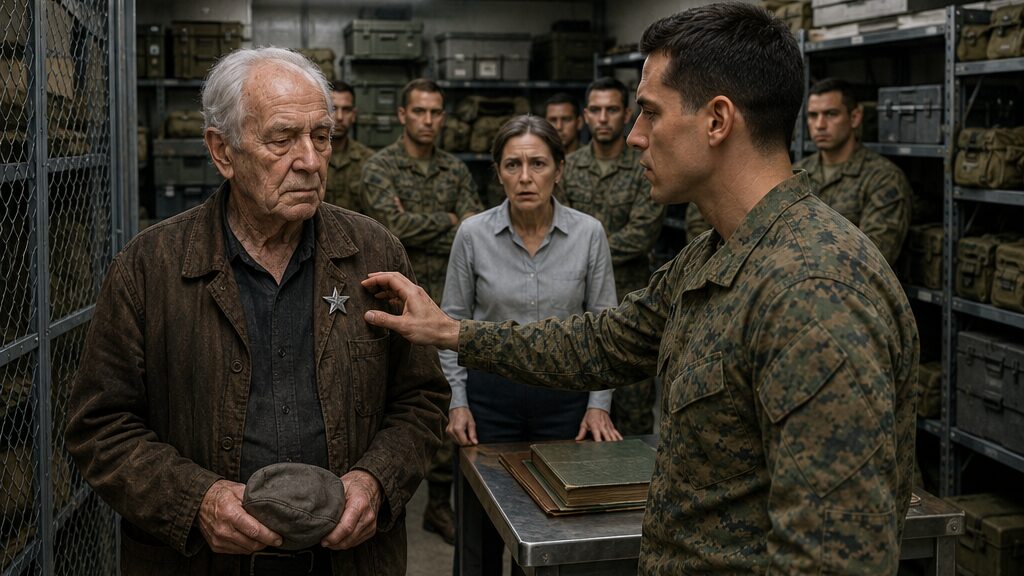
The Young Officer Ripped The Silver Star From An Old Man’s Jacket Before Learning Whose Base He Once Commanded
Chapter 1: The Old Man At The Equipment Cage
The soldiers stopped talking when the old man reached the equipment cage.
He stood beneath the buzzing fluorescent light with one hand on the rail, not because the two steps had defeated him, but because the smell of canvas, gun oil, floor wax, and old metal had struck him harder than he had expected. Behind the wire-mesh door, shelves rose to the ceiling in gray rows. Rucksacks hung from hooks. Crates sat under yellow tags. A clipboard dangled from a chain beside the entrance.
Fort Calder had painted the walls twice since Edward Thompson had last stood here. They had replaced the hinges, the floor tile, even the warning signs. But the room was still narrow in the same way. Still carried sound badly. Still made young soldiers lower their voices around locked things.
One of the soldiers behind the desk noticed the silver star first.
His eyes dropped to Edward’s left lapel, then lifted quickly to Edward’s face. He tried not to stare. Two others failed.
Edward wore a brown jacket polished at the elbows and frayed at one cuff. Under it was a plain dark shirt buttoned high at the throat. His shoes were clean but old. His white-gray hair had been combed with water and flattened by the cap he now held against his chest. The tarnished silver star on his jacket looked too sharp for everything around it, though one point was slightly bent and the clasp sat crooked from age.
A young lieutenant stepped out from behind a row of stacked cases.
“Sir, this is a restricted equipment area,” he said.
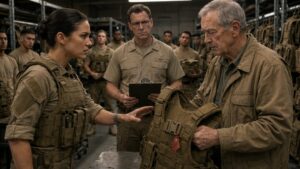
Edward turned toward him. The officer’s uniform was crisp, his sleeves sharp, his boots shined hard enough to catch the light from the cage door. His name tape read Lopez. His posture said he had practiced authority until it became instinct.
“I know,” Edward said.
The lieutenant waited for more. When none came, his eyes went to the old visitor pass clipped to Edward’s jacket pocket. The plastic sleeve had clouded at the edges.
“That pass is expired,” Ryan Lopez said.
“It was issued for today.”
“It doesn’t scan.”
Edward glanced toward the small black scanner mounted near the desk. “They did not have those when the room was built.”
One of the soldiers gave a tiny breath that might have become a laugh if Lopez had not turned his head. Silence returned quickly.
“Sir,” Lopez said, colder now, “I need you to step back into the corridor.”
Edward looked past him into the cage. Along the left wall, beyond a stack of empty footlockers, a row of tall storage cabinets stood where the old map cabinets had been. The third cabinet from the back had once held field telephones, spare batteries, and six metal trays of handwritten forms. The fourth had been where Jerry Robinson kept a coffee tin full of broken buckles nobody was supposed to know about.
“Cage Twelve-B used to keep accession ledgers on the lower shelf,” Edward said.
The lieutenant’s expression tightened.
The soldiers at the desk looked at each other now, no longer amused. One glanced toward the clipboard as if wondering whether the old man had read something he should not have been able to see.
Lopez stepped closer. “Who told you that?”
Edward did not answer at once. He had promised himself he would not explain more than necessary. He had come before the ceremony so he could place the star where it belonged, sign the transfer, and leave before the speeches began. No handshakes. No photographs. No chairs with his name on a folded card.
He had imagined it differently. A clerk, perhaps. A quiet inventory officer. Someone who would accept an old item and let the room keep it without fuss.
Instead, the room was full of soldiers rehearsing for memory.
A banner lay rolled across a table near the back. Display stands waited under canvas covers. A case with new glass had been set up against the wall. The words memorial conversion were printed on a work order taped beside it.
Edward swallowed once.
“I was told the room was being opened today,” he said.
“For authorized personnel and invited guests.”
“I was invited.”
“By who?”
Edward’s hand moved toward the inside pocket of his jacket, slow enough not to startle anyone. Lopez’s hand lifted, not to a weapon, but to stop him.
“Leave it where it is.”
Edward paused.
The words landed too sharply in the small room. Even Lopez seemed to hear it after he had said it. His jaw moved, but pride held him to the line.
“I have a letter,” Edward said.
“You have an expired-looking pass and a piece of rank insignia on civilian clothing.” Lopez’s gaze fixed on the star. “That is what I see.”
Edward felt the old metal against his jacket as if it had grown heavier.
“It is not rank today,” he said quietly.
“No,” Lopez said. “It is not. That’s my concern.”
A maintenance NCO came to the doorway with a folded stand under one arm, saw the tension, and stopped. Behind Edward, two visiting family members in dress clothes slowed in the corridor. A ceremony staff member carrying programs tried to squeeze past and then froze when Lopez raised a hand.
Public attention had a texture. Edward remembered it from command rooms, accident briefings, hospital corridors, tarmacs where bad news waited beside idling aircraft. People did not need to speak for a room to turn into a witness.
Lopez pointed at the star. “Who authorized you to wear that?”
Edward looked down at it, though he did not need to. The star was smaller than people expected when it was not polished and not pinned to a uniform shoulder board. Its surface had gone dull in the grooves. One point leaned inward, the injury visible only from close range.
“No one authorized me today,” Edward said.
“That’s not helping you.”
“No,” Edward said. “I suppose it isn’t.”
Lopez stared at him, searching for nervousness, arrogance, confusion—something he could categorize. Edward gave him none of those. Only a tired face, steady eyes, and a silence that felt almost like refusal.
“Are you a veteran?” Lopez asked.
Edward held his cap in both hands. “Yes.”
“Branch?”
“Army.”
“Rank?”
A soldier behind the desk looked up quickly.
Edward breathed through the question. He heard other voices inside it. Young men asking permission to move. A radio operator repeating grid coordinates with blood on his sleeve. Jerry Robinson saying, General, if you put your name on this one, they’ll forget every truck driver in the line.
“Retired,” Edward said.
Lopez’s mouth hardened. “That is not a rank.”
“No.”
“Then give me your rank.”
Edward’s fingers tightened around the cap. There were easy words. Two words, maybe three, and the whole room would change. Not because the lieutenant had learned kindness, but because he had found power under the old jacket. Edward had spent too many years watching men straighten only after they saw stars.
“I came to return something,” he said.
“You came into a restricted cage wearing unauthorized insignia during a command event.”
“I came early to avoid the event.”
That answer seemed to irritate Lopez more than any boast could have. He looked over his shoulder at the soldiers, at the covered displays, at the temporary order board where his name sat under equipment accountability. Everything in the room carried his responsibility that morning.
“Sir, I don’t know who you are,” Lopez said, “and I’m not letting this unit get embarrassed because someone wandered in wearing things he can’t explain.”
Edward nodded once, as if the sentence had confirmed something sad rather than offensive.
“You can check the ledger,” he said. “Bottom shelf used to be left side. If it was moved, records annex will have the copy.”
Lopez’s eyes narrowed. “You don’t get to direct my soldiers through my equipment room.”
A younger soldier shifted near the desk. The movement drew Lopez’s attention, and the soldier went still.
Edward looked once more toward the shelves. The new glass case waited empty. It had been positioned where the old repair bench used to sit. He had spent a night at that bench with Jerry, sorting tags by flashlight when the generator failed and the convoy reports came in out of order.
He had not meant to remember that.
“I will wait outside,” Edward said.
He turned slightly, not in retreat but in concession, the way a man turns from a closed door he has no wish to break. His shoulder brushed the clipboard chain. The silver star caught on the edge of the metal clip and clicked softly.
Lopez heard it.
“Stop.”
Edward stopped.
The lieutenant stepped closer, close enough now that Edward could see the faint line of strain at his temple.
“Take that star off,” Lopez said.
The corridor held its breath.
Edward looked at the young officer’s hand, then at the star, then at the soldiers watching from behind him. His face remained composed, but something behind his eyes lowered like a flag at dusk.
“I would rather not,” he said.
Lopez’s voice dropped. “Take that star off before I have to.”
Chapter 2: When The Star Came Off
“Everyone stay where you are,” Ryan Lopez said, because the moment had already gone too far to handle quietly.
The old man stood just inside the threshold of the equipment cage, one shoulder angled toward the corridor, his cap held in front of him. Ryan could feel the soldiers watching his back. He could also feel the covered display cases, the inspection clipboard, the printed ceremony schedule, and the accountability roster that had his signature on it.
By noon, Fort Calder’s old equipment room would become a memorial space. By one, families would walk through it. By two, Commander Steven Jackson would bring visiting officers past the wall displays and expect everything tagged, verified, and clean.
Ryan had been warned twice that the room mattered. He had not been told what to do with an old man in worn shoes wearing a silver star on civilian clothing.
“By regulation,” Ryan said, forcing his voice into the calm he used during inventories, “I am documenting unauthorized display of rank insignia in a restricted area.”
One soldier looked down at the floor. Another reached toward the desk phone, then stopped.
The old man did not look frightened. That was part of what bothered Ryan. Men who wandered into places by mistake apologized too much. Men trying to show off became loud. This one stood still, as if he had already been through the worst version of the morning and was only waiting for Ryan to catch up.
“Sir,” Ryan said, “last chance. Remove it yourself.”
The old man’s thumb brushed the edge of his cap. His eyes moved once to the left wall of shelves.
“You can check the name again,” he said.
“What name?”
“Thompson.”
Ryan waited.
“Edward Thompson.”
Nothing in the room moved.
Ryan had heard the name Thompson before, but the Army was full of Thompsons, Jacksons, Robinsons, men whose names lived on file folders and old plaques. He looked at the cloudy visitor pass clipped to the old man’s pocket. The print was faded. The seal looked real enough, but old paper could be copied. Old men could be confused. And stolen symbols were not always worn by young loud frauds in bars. Sometimes they were worn softly, for sympathy.
“You should have led with that at the desk,” Ryan said.
“I gave them the pass.”
“The pass doesn’t scan.”
“The letter will explain.”
“You were told not to reach for it.”
“Yes,” the old man said.
The answer was not defiance. That made it worse.
Ryan stepped in. “Then I’ll remove the item and log it until we verify.”
A woman’s voice from behind the desk said, “Lieutenant—”
Ryan turned. Catherine Lewis stood with a stack of folders held against her gray blouse. She was civilian staff, records annex, always careful with old forms no one else wanted to touch. Her face had lost color.
“This should be done in the office,” she said.
“It is being done where the violation occurred.”
The word violation seemed to strike the old man harder than the threat had. Not visibly. Only in the smallest tightening around his mouth.
Ryan reached for the star.
For one suspended second, he expected the old man to pull back. He expected a hand on his wrist, an angry protest, the sudden confession of someone caught in a lie. Instead, the old man remained still. His chin lifted a fraction, not proud, not submissive. Braced.
The metal was colder than Ryan expected.
The clasp resisted. It had been fastened through thick old cloth, and when Ryan pressed it free, the bent point caught in the weave. The star tugged at the jacket. Two small holes stretched open where it came loose.
A sound moved through the soldiers behind him—barely there, but enough. A breath. A shift. Discomfort finding bodies.
Ryan held the star between thumb and forefinger.
Up close, it did not look like costume brass. It had weight. The surface was dulled by years rather than neglect. One point bent inward, and the clasp on the back had been repaired with a tiny wire loop, the kind of fix no manufacturer would sell and no collector would accept.
The old man looked down at the torn place on his jacket. Not at Ryan. Not at the star. At the two small holes left behind.
For the first time, Ryan felt the room slipping from his control.
He turned quickly to the desk. “Evidence bag.”
No one moved.
“Now.”
A soldier opened a drawer and pulled out a clear plastic bag used for small parts and sensitive items. Ryan dropped the star inside, sealed it, and wrote the time across the label. His pen pressed so hard the plastic wrinkled.
“Name?” the soldier at the desk asked, uncertain.
“Edward Thompson,” Ryan said. “Claimed.”
The old man’s eyes lifted.
Ryan hated that he noticed the word, and hated more that he had chosen it.
Catherine set her folders down. “Lieutenant, if he gave you a name, I can check the room ledger before this becomes a report.”
“It is already a report.”
“It can be an internal notation.”
“No,” Ryan said. “Not during a command event. Not with visiting families on-site. Not when someone enters restricted storage wearing a general officer star and refuses to answer basic questions.”
The words struck the air differently once spoken together.
General officer star.
One of the younger soldiers looked from the bag in Ryan’s hand to the old man’s jacket, then away.
The old man said nothing.
Ryan moved to the desk terminal and opened the incident form. His fingers found the keys too fast. Unauthorized insignia. Restricted area. Unverified visitor pass. Refusal to provide rank. Possible archival property misappropriation. He did not type stolen valor, not yet, though the phrase sat behind his teeth.
Catherine came around the side of the desk. “Let me check the hard ledger.”
Ryan did not look up. “Do it.”
She crossed to the lower shelves near the west wall, then stopped and looked back at the old man.
“Which one?” she asked before she could stop herself.
The old man answered without hesitation. “If it survived the move, green binding. Lower left. It used to have a broken corner.”
Ryan looked up.
Catherine crouched. Her hands moved along the row of binders and ledgers no one used unless the digital system failed. Black, blue, gray. Then green.
She slid one out.
The lower corner had been repaired with tape so old it had gone amber.
The room seemed to draw inward.
Ryan walked over, still holding the bagged star. “Open it on the desk.”
Catherine laid the ledger flat. Dust lifted in a thin line from the pages. She turned carefully through inventory sheets, accession lists, transfers, disposal marks. Her finger stopped once at a page, moved on, then stopped again.
“What?” Ryan asked.
Catherine did not answer at first. She leaned closer.
The old man stood where Ryan had left him, hands folded around his cap. He was not watching Catherine’s face. He was watching the ledger as if it were a grave being opened.
Catherine turned the book slightly toward the light.
“There is an E. Thompson,” she said.
Ryan’s chest tightened, but he kept his voice level. “Context.”
“Old access notation. Cage Twelve-B. Multiple entries. Some transfer authority marks.” She wiped gently near the margin with the side of her hand. “The rank field is smudged.”
Ryan stepped beside her. The page smelled like paper, dust, and dry ink. There it was: E. Thompson. Not once. Several times. Beside equipment groups, movement receipts, sealed items.
The rank column had been blurred by an old water stain.
Ryan looked at the old man. “This proves you knew someone’s name in an old book.”
Edward Thompson met his eyes. The tiredness there did not soften.
“No,” he said. “It proves the room did.”
Ryan felt every soldier waiting for his next sentence. He had wanted a clean rule and a clean violation. Instead, the ledger had given him a name but not an answer.
He sealed the incident form with a hard tap on the keyboard.
“Records annex,” Ryan said to Catherine. “Find the accession number for this star and pull whatever file matches it.”
Catherine looked at the bag in his hand. “And him?”
Ryan turned toward the old man.
The holes in the jacket were small but impossible not to see.
“He stays where I can see him,” Ryan said.
Catherine bent over the ledger again, tracing the entries down the page. Near the bottom, her finger stopped beside a line where the ink had bled into a dark bloom. She tilted the book toward the light and read the faded letters under her breath.
Then she went still.
Ryan saw the change. “What now?”
Catherine looked at the bagged star, then at Edward Thompson, then back to the ledger.
“His name is here,” she said. “Beside a rank field someone tried to wipe clean.”
Chapter 3: The Name In The Smudged Ledger
The accession number on the plastic bag matched a sealed storage entry that was not supposed to exist in the active room.
Catherine Lewis checked it three times before she said anything. Once against the handwritten ledger. Once against the old transfer index. Once against the digitized archive list on the records annex computer, where most entries from that era appeared as pale scans with clipped corners and missing dates.
The number remained the same.
ST-1-GL-47.
She sat under a flickering panel light in the records annex with the bagged silver star on the desk in front of her and Ryan Lopez standing close enough to make every keystroke feel like testimony. Edward Thompson sat in a metal chair against the wall, his cap in his lap, the two holes in his jacket visible even from across the room.
He had not asked for water. He had not asked to call anyone. He had not asked Ryan to stop.
That, more than the ledger, troubled Catherine.
“Read it,” Ryan said.
Catherine looked at the screen. “The entry says the item was transferred from field uniform effects into long-term unit custody.”
“What item?”
“General officer field jacket component set.” Her eyes moved to the bag. “One silver rank device. One repair note. One field jacket, brown, nonstandard wear.”
Ryan gave a short laugh without humor. “Nonstandard wear. That sounds exactly like a museum tag someone could misread.”
“It is not a museum tag,” Catherine said.
“Then what is it?”
She scrolled. The scan jumped, stuttered, and settled on a page with a black diagonal stamp across the corner. “Post-operation retention inventory.”
“Operation what?”
Catherine hesitated. The next line had been partly redacted in the digital copy, not blacked out completely, but softened into gray bars and broken letters.
“Gate Lantern,” Edward said from the wall.
Ryan turned.
Edward’s eyes were on the floor now. His face had changed at the words, not dramatically, but enough. Something in him had drawn back from the room.
Catherine looked from Edward to the screen. “That name is on the entry.”
Ryan’s hand rested on the back of her chair. “You just told him what was on the screen.”
“No,” Catherine said. “He said it first.”
The room held two filing cabinets, three desks, and a printer that clicked to itself when no one was using it. Catherine had always found comfort in records because they waited to be asked. They did not glare. They did not interrupt. They did not make her choose between a lieutenant with authority and an old man with torn fabric over his heart.
Ryan pointed at the screen. “Does it identify him as a general?”
“The rank field in the ledger is damaged.”
“Does this file identify him as a general?”
Catherine scrolled farther. The old scan loaded line by line.
“Attached officer roster unavailable,” she said.
“So no.”
“It identifies the item as a general officer field jacket component.”
“An item,” Ryan said. “Not a person.”
Catherine’s jaw tightened. “The name Thompson appears in the custody chain.”
“First name?”
She enlarged the page. The old ink blurred, then sharpened enough to show an initial. “E.”
“Again, not enough.”
Edward said quietly, “There should be a box.”
Ryan looked at him. “You don’t get to direct this.”
Edward’s gaze lifted. “The star did not travel alone.”
Catherine’s fingers paused above the keyboard. “What else was with it?”
Edward did not answer quickly. His silence had weight, but it was not empty. It felt like a man standing in front of a closed door and deciding whether opening it would release smoke.
“A jacket,” he said at last. “A repair card. A sealed after-action copy. A list.”
“What kind of list?” Catherine asked.
Edward looked at her then, and she regretted the question before he spoke.
“Names.”
Ryan crossed his arms. “Names of who?”
Edward’s hands folded over the cap. “People who were there.”
Ryan let out a controlled breath. “That is vague enough to be useless.”
“It was not vague to them,” Edward said.
For a moment, Catherine thought Ryan might snap back. Instead, his eyes moved to the old man’s jacket and the holes where the star had been. Something uncertain flickered there before he buried it.
The printer clicked and spat out the scan summary. Catherine took the page, read the accession chain, and felt the unease deepen.
“There’s a storage location,” she said. “Archive Shelf C, sealed Box GL-47.”
Ryan nodded once. “Good. Pull it.”
Catherine stood. “It may be in deep storage.”
“Then we go to deep storage.”
“Lieutenant, the ceremony starts soon.”
“That is exactly why we go now.”
Edward pushed himself slowly to his feet. The chair scraped the floor.
Ryan turned sharply. “Sit down.”
Edward stopped, one hand still on the chair back.
Catherine looked at him. “Mr. Thompson, if there is someone we can call to clarify—”
“No.”
The answer was immediate.
Ryan seized on it. “Convenient.”
Edward’s face remained calm, but Catherine saw the flinch this time, not from insult, but from the possibility of being rescued by a phone call.
“No calls,” Edward said.
“Why?” Ryan demanded.
“Because I did not come here to be announced.”
“You came here wearing a star.”
Edward looked down at the empty place on his jacket. “I came here to put it away.”
Catherine felt the room shift. Not enough to solve anything. Enough to make the accusation feel too small for what had entered.
Ryan did not soften. If anything, uncertainty made him stricter.
“Or,” he said, “you came here knowing an old item was being displayed today and tried to attach yourself to it before the commander arrived.”
Catherine turned toward him. “Lieutenant.”
He looked at her. “You said yourself the file proves the item, not him.”
“It proves more than we had ten minutes ago.”
“It proves there is an official item with an old name attached. That old name could be his father, his uncle, someone he served under, someone he found online. We don’t know.”
Edward watched him with a strange sadness. “You have learned to protect things.”
Ryan’s mouth tightened. “Yes, sir. I have.”
“But not yet people.”
The words were not loud. That made them worse.
Ryan’s face changed, not with shame but with anger touched by something more private. “You do not know what I protect.”
Edward lowered his eyes.
Catherine wondered then if Ryan’s fury was not only about protocol. She had seen him correct uniform ribbons on soldiers before inspection, seen him tear down a social media post using a borrowed unit patch, seen how his voice changed when people treated symbols like props. There was injury under the rulebook somewhere, though she did not know its name.
Ryan reached for the bagged star and put it into a lockable evidence pouch.
“I am escalating this to ceremony security,” he said.
Catherine stared at him. “Before we pull the box?”
“While we pull the box. I am not letting an unverified visitor move through memorial prep with a general officer item and a story about missing names.”
Edward’s face closed.
Catherine hated how official it sounded. Hated more that part of it was defensible.
They walked together to the archive shelves at the back of the annex. Catherine carried the printed scan. Ryan carried the evidence pouch. Edward followed several steps behind, escorted by a security corporal who looked increasingly unhappy with his assignment.
Shelf C stood behind a rolling cage near the old supply office door. Catherine unlocked it with a key from her badge reel and counted the boxes.
GL-42. GL-43. GL-44.
The space after GL-46 was empty.
She checked the shelf above, then below. Her stomach dropped with each wrong label.
Ryan noticed before she spoke. “Where is it?”
Catherine read the printed line again, as if the paper might rearrange itself.
“It should be here.”
“Then where is it?”
Edward stepped closer despite the security corporal’s hand lifting toward him. He looked at the empty gap on the shelf. His expression changed more than it had when the star was taken.
Not fear. Not surprise.
Recognition.
Catherine touched the dust mark where a box had recently been removed. A clean rectangle showed on the shelf, brighter than the wood around it.
Ryan leaned in. “Someone pulled it.”
Catherine looked at Edward, then at the accession number, then at the empty space.
The old man whispered, almost too softly to hear, “Jerry.”
Ryan turned on him. “Who is Jerry?”
Edward did not answer.
From the corridor outside, a ceremony staff member called that guests were beginning to arrive at the memorial entrance. The announcement echoed through the annex, too cheerful for the room.
Catherine stood with the empty shelf in front of her and the bagged star locked in Ryan’s hand.
Box GL-47 was gone.
Chapter 4: The Missing Box From Operation Gate Lantern
Edward saw the words on the banner before anyone else noticed him stopping.
OPERATION GATE LANTERN — MEMORIAL ROOM DEDICATION
The cloth had been stretched across two folding stands in the rear hallway, not yet lifted into place. A ceremony staff member was smoothing the corners with careful hands. The letters were clean, even, printed in gold over deep blue. Too clean. Too even. Nothing in them carried the smell of diesel, wet canvas, burned wiring, or the cold mud that had packed itself under the tires for three days while the convoy line waited for clearance that never came.
Edward’s grip tightened on the back of a chair someone had left against the wall.
“Sir?” the security corporal said behind him.
Edward let go of the chair. “I’m fine.”
He was not fine. He had been unsteady on the steps outside the cage, but this was not age. This was the old room finding him through a new banner, the past polished smooth enough for visitors.
At the far end of the hall, Ryan Lopez spoke into a radio with the bagged star tucked under one arm. Catherine Lewis stood near the records annex door, holding the printed accession sheet as if it might protect her from what she had found. Her eyes kept returning to the empty space on Shelf C.
Box GL-47 was gone.
Edward knew where it had gone before he let himself say the name aloud. He had known from the clean rectangle in the dust. Jerry Robinson had never trusted unattended records, especially the kind officers liked to display under glass.
“Mr. Thompson,” Ryan called, lowering the radio. “You are not authorized to move beyond this point.”
Edward looked past him toward the old supply office.
The door was half-open.
That had not changed either. Jerry had always left doors half-open when he wanted someone to know he was inside and angry enough to be found.
Edward took one step.
The security corporal shifted to block him.
Ryan saw it. “Do not make this harder.”
Edward stopped. The two small holes in his jacket felt exposed in the hallway light. Without the star, the fabric seemed older, thinner, more truthful.
“I am not leaving without that box,” Edward said.
Ryan’s eyebrows rose. “That sounds like you know more about missing government property than you’ve admitted.”
Catherine cut in. “Lieutenant, if he knows who pulled it, that matters.”
“What matters is custody,” Ryan said. “And right now, the only person here who named that box before we found it missing is him.”
Edward turned toward Ryan. The younger man’s anger was no longer theatrical. It had settled into something harder, fed by the possibility that he might have been wrong and could not yet afford to be.
“I did not remove it,” Edward said.
“But you know who did.”
“I believe I do.”
“And you chose not to tell us until now.”
Edward had no defense for that. Not one that would sound like duty instead of old shame. He had spent years believing that silence kept the names safe. Now silence had helped make him look like a thief.
“Jerry Robinson,” Edward said at last. “Former supply sergeant. He kept this cage when it mattered.”
Ryan looked to Catherine.
She nodded reluctantly. “There is a Robinson in several old records. Jerry Robinson. Armorer, supply chain control, later civilian contractor. He had access before retirement.”
Ryan turned back to Edward. “Convenient.”
“No,” Edward said. “Predictable.”
Ryan stepped toward the supply office. “Then he can explain it to me.”
The old office smelled of cardboard, machine oil, and stale coffee, though no pot sat anywhere now. File cabinets lined one wall, their labels changed, their drawers dented in familiar places. On the desk lay Box GL-47, gray, sealed tape cut neatly along the top.
Jerry Robinson stood behind it with both palms flat on the cardboard.
He was thinner than Edward remembered and broader in the shoulders than age should have allowed. His hair had gone white, cropped close. He wore a faded field jacket with no patches and a pair of work gloves tucked into one pocket. His eyes went first to Edward’s torn lapel, then to Ryan’s evidence pouch.
“You let him take it off you,” Jerry said.
Edward did not answer.
Ryan entered fully. “Step away from the box.”
Jerry did not move. “You the lieutenant who put the star in a plastic bag?”
“I am the officer responsible for this room.”
Jerry gave a dry, humorless breath. “That room had a heartbeat before you had boots.”
Ryan’s face tightened. “Step away from the box.”
“Not until somebody explains why half the names are missing from that pretty hallway.”
Catherine slipped into the doorway behind Edward. Her face changed when she saw the open box. Inside were folders, a folded cloth packet, a yellowed repair card, and a stack of pages tied with string.
Ryan pointed at the box. “You removed sealed archive material without authorization.”
Jerry’s eyes stayed on Edward. “I removed it before they turned it into decoration.”
Edward felt the accusation land where Ryan’s had not. Jerry was not mistaking him for an impostor. Jerry knew exactly who he was and was angrier for it.
“You should not have taken it,” Edward said.
“You should not have stayed away.”
The room went still.
Ryan looked between them. Catherine lowered the accession sheet slowly.
Jerry opened the cloth packet and drew out an old piece of display foam. A star-shaped indentation sat in it, empty now. Beside the hollow was a handwritten repair card, browned at the edges. Jerry held it up.
“You remember the clasp?” he asked.
Edward’s throat tightened.
Ryan took the card before Edward could respond. His eyes scanned the writing. “Bent point. Wire loop repair. Field damage. Returned with jacket after Gate Lantern.”
He looked at the pouch under his arm.
Jerry leaned forward. “That star wasn’t bent in a display case, Lieutenant. It bent when the general—”
Edward’s voice cut through the room, low but firm. “Enough.”
The word did not sound old.
Even Ryan stopped.
Jerry’s mouth closed, but anger brightened in his eyes. “There it is.”
Edward looked at him. “Do not use me to make a point.”
“I’m trying to keep them from using you to erase one.”
Ryan’s attention sharpened at that. “General?”
Jerry looked at Ryan, then at Edward’s torn jacket, then back to Ryan. “You didn’t even ask him properly, did you?”
Ryan’s jaw worked. “I asked for rank.”
“And he gave you silence. That sounds like him.”
Edward looked down at the open box. The top folder carried the old operation title in faded type. Gate Lantern had been classified when the first reports were written. Later, when the urgency faded and the dead became numbers, it had become a case study. Then an anniversary. Now a room.
He reached toward the folder, then stopped before touching it.
Jerry saw the hesitation. His voice softened just enough to hurt. “They’ve got the banner ready. They’ve got the speech. They’ve got one clean hero line and a big empty case waiting for your star. But they left out the drivers. The mechanics. The two radio boys who kept the route alive. The supply crews who ran tires and water through shell craters because nobody wanted their names in the pretty version.”
Catherine stepped closer. “The ceremony files list casualties and command staff.”
Jerry laughed once. “Exactly.”
Ryan said, “This is not the place to settle an old grievance.”
Jerry turned on him. “You made it the place when you put his star in evidence.”
Edward closed his eyes for one second.
The old memory rose whole: a temporary operations tent lit by a lantern because the generators had failed, maps held down with ammunition boxes, Jerry’s hands black with grease as he argued for three more trucks when no one believed the route could hold. Then the burst of radio traffic. Then the names read too quickly because decisions still had to be made.
Edward opened his eyes.
“Jerry,” he said, “I gave instructions for the full list.”
“You gave instructions to a system that likes short plaques.”
“I should have checked.”
“Yes,” Jerry said. “You should have.”
There it was. Not disrespect. Not suspicion. Truth from someone who had earned the right to say it.
The hallway outside grew louder with arriving visitors. A child’s voice asked if the soldiers were going to open the museum soon. A ceremony staff member answered softly.
Ryan moved to the desk and picked up the folder. “This box is now part of the inquiry.”
Jerry’s hand came down on the lid. “No.”
Ryan stepped closer. “Do not obstruct me.”
Edward moved between them before the security corporal could. The motion was not fast, but it carried enough command that both men paused.
“No one takes the box out of this room until the inventory is checked,” Edward said.
Ryan stared at him. “You don’t give orders here.”
Edward’s silence returned, and with it the flaw that had carried him this far. He could have ended the argument. He could have spoken the rank and watched the room rearrange itself around it. Instead, he looked at the repair card in Ryan’s hand and saw only the way power would swallow the names again if he let it enter too soon.
“No,” Edward said. “I don’t.”
Ryan heard only the concession.
He glanced toward the doorway, where two soldiers had gathered. Beyond them, the memorial corridor was filling.
“Security,” Ryan said, voice hardening into procedure, “escort Mr. Thompson away from the ceremony prep area until Commander Jackson arrives. Mr. Robinson stays with the box under supervision.”
Catherine looked at Ryan. “Lieutenant, wait.”
“No. I have an unverified visitor, missing archive material, and a disputed general officer item five minutes before a public event.” Ryan’s face was flushed now, but his voice stayed controlled. “I’m done letting this drift.”
Edward looked once at Jerry. The old sergeant’s anger faltered as if he had expected Edward to fight now, finally.
Edward did not.
The security corporal stepped beside him, embarrassed but obedient.
As Edward was turned toward the hallway, Jerry called after him, not loudly, but with enough force to follow.
“You can hide from a chair with your name on it, Edward. You can’t hide from theirs.”
Ryan’s head snapped toward Jerry at the first name.
Edward did not look back.
At the memorial entrance, the banner was being lifted into place. Operation Gate Lantern rose above the hallway in clean gold letters as the security corporal guided Edward away from the room that still held the missing box.
Chapter 5: The Photograph Behind The Covered Wall
Catherine pulled back one corner of the covered wall display and found Edward Thompson staring out from thirty-six years ago.
Her hand froze on the cloth. The younger face beneath the plastic covering was leaner, darker-haired, and almost severe from exhaustion, but the eyes were the same. Not the tiredness. The steadiness. In the photograph, he stood beside a row of mud-streaked vehicles under a temporary floodlight, one hand resting on a map board, the other half-raised as if stopping someone outside the frame from interrupting.
On the shoulder of his field jacket was a single star.
The same bent point caught the light.
Catherine let the cloth fall halfway back into place and looked over her shoulder.
The memorial corridor was filling with low conversation. Visiting families read temporary placards. Soldiers adjusted stanchions. The unit chaplain stood near the entrance with a folded program in both hands. Ryan was still in the supply office with Jerry and the box, but he would not stay there long. Edward had been moved to a chair outside the old communications alcove under the watch of a security corporal who looked less certain every time he glanced at him.
Catherine lifted the cloth again.
The caption beneath the photograph had been covered by a strip of protective paper, taped there until the formal unveiling. She peeled back just enough to see the first line.
OPERATION GATE LANTERN COMMAND REVIEW — FORT CALDER LOGISTICS GROUP
The second line remained hidden under tape.
Her pulse beat against her throat.
“Ms. Lewis.”
She dropped the cloth.
Ryan stood ten feet away with the evidence pouch in one hand and the repair card in the other. His face was controlled again, but there was something brittle behind it.
“What are you doing?” he asked.
“Checking display accuracy.”
“By uncovering restricted ceremony materials?”
She almost laughed. She had spent the morning watching him accuse an old man because a pass did not scan, and now she was the one touching restricted materials. The absurdity might have been funny if the old man’s jacket were not still torn.
“I found a photograph,” she said.
“I can see that.”
“You need to look at it.”
Ryan did not move. “Is it labeled?”
“Partly.”
“Does it identify Edward Thompson?”
“The full caption is covered until the unveiling.”
“Then leave it covered.”
Catherine stared at him. “You cannot reject every piece of evidence because it arrives in the wrong order.”
Ryan’s eyes flashed. “Evidence has standards.”
“So does judgment.”
The words surprised them both. Catherine had spent fifteen years in records learning not to sound brave in rooms where uniforms outranked pay grades. Her job was to keep papers straight, not men.
Ryan stepped closer. “Do not turn this into a lecture.”
“I am trying to keep it from becoming a mistake you cannot undo.”
He looked toward the old communications alcove where Edward sat in profile, hands folded over his cap, jacket torn where the star had been.
For a second, Ryan’s face changed.
Then the old anger returned, but quieter. “My father kept a shadow box in our living room. Nothing in it was expensive. A ribbon, a unit patch, a coin from a deployment, one photograph with faces I never learned because he couldn’t talk about them. After he died, a man at a bar wore the same patch and told stories that didn’t fit. Everybody laughed with him. Nobody checked. I did.”
Catherine said nothing.
“He had bought it online,” Ryan said. “Said it didn’t matter because it made people happy. So yes, Ms. Lewis. Evidence has standards.”
For the first time that morning, Catherine saw the wound under Ryan’s rulebook. It did not excuse what he had done. It made it harder to dismiss him.
“And if this old man is not that man?” she asked.
Ryan’s jaw tightened. “Then I’ll answer for it.”
“Will you?”
He did not reply.
She lifted the cloth again, higher this time. “Look.”
Ryan came close enough to see the photograph. His eyes moved from the younger face in the display to the old man seated down the hall. Catherine watched the comparison happen.
The likeness was undeniable, but time had altered enough for pride to resist.
“People resemble people,” Ryan said.
“That is not an argument.”
“It is not conclusive.”
“The star is in the photograph.”
“Could be a different star.”
“It has the bent point.”
“That point is not clear enough from here.”
Catherine looked at him, astonished. “You are moving the line every time the facts get closer.”
Ryan’s hand tightened around the evidence pouch. “Because if I lower the line and I’m wrong, this entire memorial gets turned into a spectacle.”
“It already is one,” Catherine said quietly. “We just haven’t admitted who created it.”
The blow landed. Ryan looked away first.
A junior clerk hurried toward them carrying a stack of programs. “Ms. Lewis, ceremony packets for the commander’s row. They said you had the updated list.”
Catherine took the top program. “I don’t have—”
Then she saw the inside page.
Honored Guest: Major General Edward Thompson, USA, Retired
Her breath caught.
Ryan saw it too.
The line sat cleanly beneath the ceremony order. No smudge. No ambiguity. No broken scan. No old water stain. Beneath the name was a small note: Commander, Operation Gate Lantern Logistics Group.
Ryan took the program from her hand and read it.
The junior clerk shifted uneasily. “Is something wrong?”
Catherine turned the page. Near the back, where RSVP status marks had been printed for internal staff, Edward Thompson’s name appeared again with a handwritten change beside it.
ABSENT.
The handwriting was not old. It was blue ink, fresh enough to show pressure grooves. Someone had crossed through Expected and written Absent.
Catherine looked toward the alcove. Edward sat alone, present and treated as a problem in the very corridor where the program declared him honored.
“Who changed this?” she asked.
The junior clerk blinked. “I don’t know. Ceremony office gave them to me.”
Ryan read the line again. His face had lost color now, not fully, but enough.
Catherine reached for the program. “Lieutenant, this needs to go to Commander Jackson now.”
Ryan did not hand it back.
Instead he looked down the hall, where ceremony staff had begun moving visitors toward the equipment room. The formal walkthrough was moments away. If he took this to the commander quietly, he might contain it. If he admitted it out loud, every person who had watched him remove the star would understand before he was ready.
He slid the program under the repair card in his hand.
Catherine saw the motion. “Ryan.”
His first name came out before she could stop it.
He looked at her sharply.
“Do not bury that.”
“I’m not burying anything.”
“Then call him.”
“I will present the full matter during the commander’s walkthrough.”
“With the star in evidence and Edward under watch?”
“With all available facts.”
“You mean with your accusation first.”
Ryan’s silence answered.
Catherine stepped closer. “You are about to make the order of facts matter more than the facts.”
His face hardened again, but not cleanly this time. It cost him.
“I am responsible for this room,” he said.
“No,” she said. “Today you are responsible for what happens to a person in it.”
Behind them, the unit chaplain called for ceremony staff to take their places. The covered wall waited. The photograph waited. Edward waited, not calling anyone, not defending himself, not forcing the truth to arrive faster than his conscience allowed.
Catherine looked at the program in Ryan’s hand, then at the phone clipped to her belt.
She had avoided conflict her whole career by letting papers speak for themselves. But papers could be delayed. Covered. Reordered. Misread by frightened men.
She took out the phone.
Ryan’s eyes narrowed. “Who are you calling?”
“The commander’s aide.”
“Ms. Lewis—”
She stepped away and dialed before her courage failed.
The line clicked twice. A voice answered from somewhere busy, clipped and formal.
Catherine turned toward the covered photograph and lifted the cloth again until the younger Edward’s face was visible in the corridor light.
“This is Catherine Lewis in records,” she said. “I need Commander Jackson immediately.”
A pause. A transfer tone. Then another voice, older and sharper.
“Jackson.”
Catherine closed her eyes once.
“Sir,” she said, “there is an old man here wearing General Thompson’s star.”
On the other end of the line, Steven Jackson went silent.
Chapter 6: The Room Remembered His Name
Ryan began his report with the star in his hand just as Commander Steven Jackson entered the equipment room.
The timing was so exact that for one brief second Ryan believed he could still control it. The old cage had been opened into a memorial space, its wire door pinned back, its shelves cleaned and lit, its old tags arranged under glass. Visitors stood in a loose semicircle near the entrance. Soldiers lined the wall. Jerry Robinson watched from beside Box GL-47 with his arms folded, jaw set. Catherine stood near the covered display, phone still in her hand.
Edward Thompson sat in a plain chair near the communications alcove because no one had known what else to do with him.
Ryan stepped forward before anyone could speak.
“Sir,” he said, voice formal, “we have a security and property custody issue involving an unverified visitor, missing archival material, and unauthorized possession of a general officer rank device.”
Steven Jackson looked at him only long enough to understand the words, then turned his head.
His eyes found Edward.
The commander stopped walking.
It was not dramatic. He did not gasp. He did not salute at once. His face simply emptied of ceremony and filled with recognition so complete that every person in the room felt the change before they understood it.
Edward stood slowly.
The security corporal near him straightened so fast his chair scraped the wall.
Steven Jackson removed his cap.
“General Thompson,” he said.
The room went silent.
Ryan’s mouth parted, then closed. The evidence pouch crinkled faintly in his hand. Inside it, the silver star caught the display light.
Edward did not look at Ryan. He looked at Steven with the weary courtesy of a man being found when he had tried carefully not to be.
“Commander Jackson.”
Steven came closer, his voice lower now. “Sir, we were told you were unable to attend.”
“I did not want a seat.”
“You were the honored guest.”
Edward’s eyes moved to the covered wall, then to the box on the table. “That was the problem.”
Murmurs began among the visitors, cut off quickly by soldiers who sensed they were standing too close to something they did not yet deserve to discuss. Ryan seemed unable to move. Catherine watched him stare at the old man’s torn lapel.
Steven turned to Ryan. “Lieutenant Lopez.”
Ryan stiffened. “Sir.”
“Why is General Thompson’s star in an evidence pouch?”
The question did not need volume. It needed only the title.
Ryan looked at Edward, then at the pouch, then at the floor for half a second before discipline forced his eyes up again.
“Sir, at the time of contact, I had no verification of identity. The visitor pass failed scan. The insignia was displayed on civilian clothing. He declined to provide rank.”
Steven’s gaze sharpened. “So you removed it?”
Ryan swallowed. “Yes, sir.”
A sound came from the back of the room. Not a word. Not quite. One of the older visiting family members had covered her mouth with her program.
Edward spoke before Steven could answer.
“Commander,” he said, “the lieutenant acted from a concern for the room’s integrity.”
Ryan looked at him as if struck.
Edward continued, “He also acted without enough care for the person standing in front of him. Both things can be true.”
Steven held Edward’s gaze for a moment. Then he nodded once, accepting the limit placed around his anger.
“Ms. Lewis,” Steven said, “the display.”
Catherine’s hand trembled only slightly when she took hold of the cloth. The room turned toward her. She pulled.
The covered photograph emerged under the lights: the younger Edward Thompson standing beside the mud-streaked vehicles of Operation Gate Lantern, one star visible on his field jacket, the same bent point catching the same hard light. Beneath it, the caption read:
Major General Edward Thompson, Commander, Operation Gate Lantern Logistics Group, Fort Calder
No one spoke.
Ryan stared at the photograph. Time rearranged the old man in front of him. The worn jacket became not evidence of poverty but continuity. The silence became not evasion but restraint. The torn holes beside Edward’s lapel became the mark of Ryan’s own hand.
Catherine stepped beside the display with the ledger open on a small stand. “The handwritten ledger matches the accession number on the star. The field jacket component set was retained after Gate Lantern. The smudged rank field corresponds to the command photograph.”
Jerry gave a bitter little nod. “Took enough paper to say what his face already told you.”
Edward glanced at him. “Jerry.”
The warning was soft. Jerry looked away, but did not apologize.
Steven picked up the repair card from the table and read the line about the bent clasp. “Field damage.”
Jerry’s voice changed. Less anger now. More memory. “Truck door slammed into it during the third night. He was pulling a radio operator clear when the line shifted. Wouldn’t let anybody replace it after. Said damaged things that still held should not be thrown out.”
Edward closed his eyes.
The room had become too full. Not with people. With the old night. With wet boots on metal steps. With men waiting for his decision. With a young radio operator looking at him as if generals could promise more than time.
Steven looked at Edward. “Sir, the ceremony was prepared to honor your command of Gate Lantern.”
Edward opened his eyes. “I know.”
“Then why come through the equipment cage?”
“Because this is where the truth was stored.”
Steven frowned and looked toward Box GL-47.
Ryan found his voice, though it came rougher than before. “Sir, the box was removed from archive custody by Mr. Robinson without authorization.”
Jerry lifted his chin. “Because the authorized version was missing half the names.”
Steven turned to Catherine. “Is that accurate?”
Catherine hesitated. “The public program lists command staff, casualties, and selected unit citations. The box contains additional after-action documents and, according to Mr. Robinson, a fuller personnel list. I have not completed verification.”
Ryan seized on the uncertainty, though less fiercely now. “Sir, that is why I requested formal custody before proceeding.”
Edward looked at him, and Ryan stopped.
The commander moved to the table and opened the top folder. The first pages were brittle copies of transport manifests, radio logs, and supply movement records. Beneath them lay a typed sheet with handwritten additions in the margins. Names. Units. Driver numbers. Maintenance detachments. Field clerks. Signal support. People too small for a clean legend and too necessary to omit.
Steven’s expression tightened.
“This list is not in the ceremony program,” Catherine said.
“No,” Edward said. “It never is.”
The room turned back toward him.
For the first time that day, Edward seemed older than all of them and less fragile than any of them. He walked to the table slowly. No one stopped him now. The soldiers parted without being told.
He touched the edge of the box, not the papers.
“I was sent the invitation,” he said. “Honored guest. Front row. A speech, perhaps. A chair with my name. I thought if I returned the star early and left, the room would keep the object and avoid the performance.”
Steven said quietly, “Sir, it was meant as respect.”
“I believe you.” Edward’s hand remained on the box. “But respect can still be arranged badly.”
Ryan flinched at that, but Edward did not look at him.
Steven nodded to the ceremony staff. “Bring the honored chair forward.”
“No,” Edward said.
The single word stopped the staff member mid-step.
Steven looked surprised. “Sir?”
Edward turned toward the memorial wall. The photograph of his younger self looked back at him, too clean now, trapped behind glass and caption.
“This room was not saved by my name.”
A few visitors shifted. Someone near the entrance whispered, “Is that him?” and was hushed.
Edward looked at the soldiers along the wall. Young faces, trying to hide their curiosity, their embarrassment, their sudden awareness that uniforms did not protect them from moral error.
Then he looked at Ryan.
Ryan stood at attention, but it was not enough to hide the damage in his face. He had expected punishment, perhaps anger. Edward gave him neither. That made the shame more exact.
“The lieutenant asked for verification,” Edward said. “Now he has it.”
Ryan’s eyes lowered to the pouch.
“But verification is not the same as understanding.”
Steven said, “General Thompson, what would you have us do?”
Edward looked at the covered second panel beside the main photograph. It had been left blank under cloth, waiting for a unit crest and polished summary. He knew that because he had read the ceremony packet in his kitchen and folded it back into its envelope unread after the first page.
His silence had carried him to this moment. His silence had let Ryan tear the star from his jacket. His silence had let a room prepare to remember him while forgetting the people who made his command possible.
Edward lifted his hand from the box.
“There is a second list,” he said.
Catherine looked down at the papers. Jerry’s face changed. He had known Edward would recognize it. He had perhaps been waiting all morning to see if he would say it.
Steven followed Edward’s gaze. “What second list?”
“The one that was always too long for plaques,” Edward said. “The one Sergeant Robinson kept because he trusted cardboard more than ceremony.”
Jerry looked away quickly.
Ryan’s grip tightened around the evidence pouch until the plastic crackled.
Edward stepped away from the honored chair being carried toward him and faced the room.
“Bring the covered second list forward,” he said. “If this room is going to remember my name, it will remember theirs first.”
Chapter 7: The Star Was Not The Point
Edward pointed to the box, and Ryan Lopez understood before anyone gave him the order.
The room had not forgiven him. It had only gone quiet around him. Soldiers who had watched him remove the star now watched his hands. Visiting families stood near the open displays with programs half-folded. Commander Steven Jackson waited beside the table, face drawn with the strain of a ceremony broken open by truth. Catherine Lewis had placed the old ledger near the box, its pages spread beneath the display light like something recovered from water.
Ryan set the evidence pouch down carefully.
The silver star lay inside it, dulled by plastic, one bent point turned toward the ceiling.
Edward looked at him. Not with anger. That would have been easier to stand under.
“Lieutenant,” Edward said, “read the first name.”
Ryan’s throat moved.
Jerry Robinson unfolded a typed sheet from Box GL-47 and placed it on the table. The paper had yellowed at the edges. Handwritten corrections crowded the margins, some in different ink, some pressed hard enough to leave grooves. It was not ceremonial. It was not clean. It looked like what it was: a list kept because someone had known official memory could become selective.
Ryan stepped forward.
For a moment, the evidence pouch, the torn lapel, the old photograph, and the open box seemed to form a line in front of him. He could feel every decision that had brought him there: the blocked doorway, the demand for rank, the grip on the star, the way the old fabric had tugged before it tore.
He picked up the sheet.
The first name blurred.
He blinked once, hard.
“Sergeant…” His voice caught, and he started again. “Sergeant First Class, transport detachment.”
He read the name printed beside it. Then the next line. Then the next.
The names did not sound like a speech. They sounded like inventory, at first. Unit, assignment, duty. Driver. Mechanic. Radio support. Supply clerk. Recovery crew. But by the sixth name the room had changed. The titles became people because Ryan’s voice changed around them. He slowed without being told. He stopped treating the list as paper.
A woman near the back lowered her program. A soldier along the wall stood straighter. The unit chaplain bowed his head, not theatrically, only enough to show he understood that the ceremony had moved somewhere deeper than its printed order.
Ryan reached a handwritten addition in the margin.
He hesitated.
Jerry said quietly, “That one was missed on the first manifest.”
Ryan read it.
Edward closed his eyes.
There it was again: the old operations tent, the cracked radio table, Jerry’s fingers black with grease as he rewrote names no one had time to type properly. Edward had signed the command summary in the morning because aircraft were waiting and roads were failing and families needed answers that were not yet true. He had told himself there would be time to correct every omission.
There had never been enough time. There had only been quieter years.
Ryan finished the page and set it down with both hands.
No one clapped.
That was good. Edward was grateful for that.
Steven stepped closer. “General Thompson, we can amend the dedication. Today. We can restore you as central honoree and include the supplemental list in the formal record.”
Edward turned toward him. “No.”
Steven stopped.
The old refusal hung in the room, but this time it did not hide.
Edward looked at the chair still waiting near the front, its small reserved sign printed with his name. He had spent the morning trying to escape that chair. Now he understood the cowardice inside the humility. He had not wanted honor, but he had also not wanted the burden of correcting memory in front of living witnesses.
“Do not restore me as the center,” he said. “Correct the room.”
Steven’s expression tightened with recognition. “Yes, sir.”
Edward looked at Catherine. “Can the records be changed?”
Catherine’s eyes were wet, though her voice stayed steady. “Yes. The inventory can be amended. The display captions can be reissued. The personnel list can be entered as supplemental historical record.”
Jerry gave a soft snort. “Supplemental.”
Catherine looked at him. “Permanent.”
That quieted him.
Edward turned to Ryan then.
The lieutenant stood rigidly with the list at his side. His face had gone pale under the room’s attention, but he did not look away.
“Sir,” Ryan said, “I owe you an apology.”
Edward waited.
Ryan looked at the torn place on Edward’s jacket. “For removing the star. For questioning your service. For failing to verify before I acted.”
Edward’s eyes did not move.
Ryan swallowed. “For disrespecting a general.”
Edward’s expression changed then. Not much, but enough that Ryan knew he had reached the wrong door.
“No,” Edward said.
The word was quiet, but it turned the room toward him again.
Ryan’s jaw tightened with confusion. “Sir?”
“Do not apologize because I was a general.”
Ryan stood frozen.
Edward touched the torn holes in his jacket with two fingers. “Apologize because this morning you believed the man standing in front of you was powerless enough to handle roughly.”
Ryan’s face opened as if the sentence had removed the last defense he had left.
Edward did not soften the truth, but neither did he sharpen it for punishment.
“Rank made your mistake visible,” he said. “It did not create it.”
No one spoke.
Ryan looked down at the paper in his hand. His voice came lower. “You’re right.”
Edward nodded once.
Ryan turned, not to Edward first, but to the security corporal who had escorted him away, to Catherine at the ledger, to Jerry beside the box, to the soldiers who had watched him and followed his confidence because it wore a uniform.
“I was wrong before I knew who he was,” Ryan said.
The words cost him. That made them worth hearing.
Then he faced Edward. “I am sorry, sir.”
Edward held his gaze. “Accepted.”
The room released a breath it had been holding for hours.
Steven motioned to the ceremony staff, but Edward lifted a hand.
“One more thing.”
Ryan went still again.
Edward picked up the evidence pouch from the table. The plastic crinkled under his fingers. He opened it slowly and let the silver star fall into his palm.
For the first time since Ryan had taken it, the star was uncovered.
It was smaller than the room had made it. Tarnished, bent, repaired with a wire loop at the back. Not grand. Not flawless. Something that had survived being used.
Edward looked at it for a long time.
Jerry watched him carefully. “You going to wear it?”
Edward shook his head.
He walked to the display case beneath the photograph. The glass had been left open for final placement. Inside, a polished stand waited in the center, clearly meant to hold the star alone.
Edward moved the stand aside.
A ceremony staff member shifted as if to correct him, then thought better of it.
Catherine brought the personnel list forward. Not the clean program version. The marked one from the box. Edward laid it flat inside the case. Jerry stepped beside him and, after a brief hesitation, placed the repair card near the upper corner.
Edward set the silver star beside the list, not above it.
The bent point touched the edge of the paper.
Steven watched in silence, then removed the reserved sign from the honored chair and handed it to a staff member. “Change the dedication order,” he said. “The room opens with the names.”
Catherine closed the ledger gently. “I’ll make the record permanent.”
Jerry looked at Edward. For a moment, the old anger in him returned, but it had lost its blade.
“Took you long enough,” he said.
Edward almost smiled. “Yes.”
Ryan remained near the table, uncertain whether he had any right to move closer. Edward saw it and motioned him forward.
The lieutenant came.
Edward picked up the small torn thread that had clung to the star’s clasp and placed it on the display cloth beside the repair card.
“Leave that too,” he said.
Ryan looked at him. “The torn thread?”
“It belongs to this morning.”
Ryan’s face tightened.
Edward’s voice stayed even. “Rooms should remember what they did wrong as well as what they did well.”
Ryan nodded.
The visitors began moving forward slowly, not in a rush to greet Edward, but to read. That was better. One soldier bent slightly to see the handwritten names. The unit chaplain stood beside a family member and whispered something Edward did not try to hear. Steven remained near the back, letting the room reorganize itself without command.
Edward stepped away from the case.
His lapel was empty now. The two small holes remained.
Ryan noticed. “Sir, I can have someone repair your jacket.”
Edward looked down at it. “No. It has held worse.”
The answer did not invite pity.
Near the door, Catherine held out Edward’s old cap. He had not realized she had picked it up from the chair. He took it and gave her a small nod.
“Thank you,” he said.
“For calling?” she asked.
“For not letting the paper stay quiet.”
Catherine looked toward the case. “I almost did.”
“So did I.”
The admission settled between them, brief and honest.
Jerry walked to the doorway with Edward. They stood shoulder to shoulder beneath the equipment cage sign, two old men framed by shelves, ledgers, tags, and new glass.
“You leaving?” Jerry asked.
“In a minute.”
“You’ll come back?”
Edward looked at the display case where the star no longer stood alone. “If the room needs correcting.”
Jerry accepted that.
Ryan approached last. In his hand was the empty evidence pouch, folded once. He did not offer it. He only stood there, stripped of certainty.
“General Thompson,” he said, then stopped. “Mr. Thompson.”
Edward looked at him.
Ryan held out his hand, palm up, as if returning something invisible. “I’ll remember before I check rank next time.”
Edward took his hand. The lieutenant’s grip was firm, but no longer performative.
“Remember before you decide worth,” Edward said.
Ryan lowered his eyes. “Yes, sir.”
Edward released his hand and stepped into the corridor.
Behind him, the equipment room filled with quiet voices reading names from a list that had waited too long. The silver star remained inside the case, not pinned to his jacket, not held in evidence, not raised above the others. It rested where Edward had placed it, beside the people who had carried the weight with him.
At the outer door, he put on his cap and walked out with the same worn jacket, the same slow step, and no star on his chest.
The story has ended.