The Promise He Would Not Put Down Until Someone Finally Understood
Part I — The Medal in His Hand
“Remove it,” the judge said.
The old man did not move.
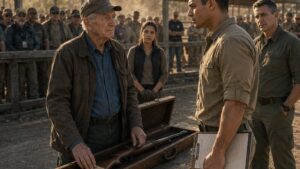
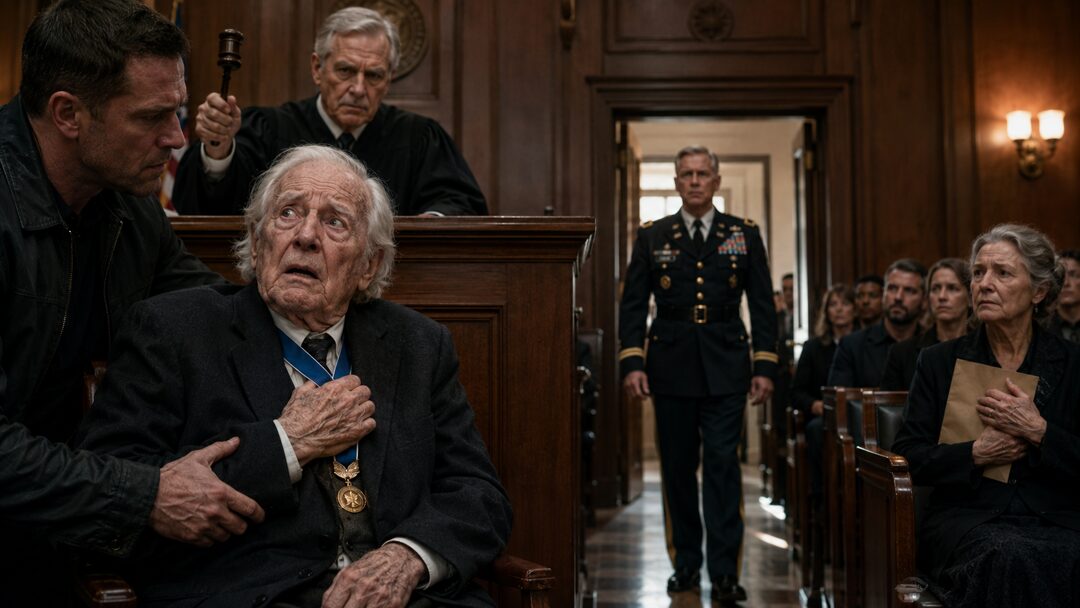
He sat small and pale at the defense table, his dark suit too wide in the shoulders, his white hair combed carefully back as if someone had tried to give him dignity before bringing him into a room determined to take it. One trembling hand was pressed to the blue-ribbon medal around his neck.
Beside him, his son leaned forward with both palms on the wooden rail.
“Dad,” Joshua whispered. “Please.”
The old man’s fingers closed harder around the medal.
Judge Stephen Whitaker looked down from the bench, gavel resting in his right hand, impatience gathering in the sharp lines beside his mouth.
“Mr. William Hayes,” he said, each word clipped, “this court has given you repeated opportunities to comply. That item has been entered into question as possible evidence. You have been ordered to surrender it. You have refused. Do you understand what contempt means?”
William Hayes blinked once.
His eyes were not on the judge.
They were fixed somewhere past the front row, past the clerk’s desk, past the polished seal on the wall. Somewhere no one else in the room could see.
Rain, maybe.
A bridge.
A voice.
Joshua bent closer. He was forty-eight, broad-shouldered, tired in the way caregivers became tired—quietly, permanently, with one ear always listening for a fall in the next room.
“Dad,” he said again, softer. “Give it to me. Just for now. I’ll hold it.”
William’s mouth moved.
At first no sound came.
Then he whispered, “I gave my word.”
The courtroom seemed to shrink around the sentence.
A woman in the gallery lowered her eyes.
The prosecutor glanced at her file.
The judge’s jaw tightened.
Joshua felt heat climb into his face. Not anger at his father. Not exactly shame, either. Something worse than both. The helplessness of watching a room full of strangers decide the man who raised him was stubborn, confused, or guilty—and not knowing which one frightened him more.
“Your Honor,” Joshua said, rising halfway. “He’s eighty-two. He has bad mornings. He doesn’t understand—”
“I understand enough,” William said.
Joshua stopped.
The words had come out thin, but clear.
Judge Whitaker leaned forward.
“Then you understand that this is not a keepsake dispute. This matter concerns an unresolved federal service record and the disappearance of Anthony Ellis, who was last seen in the company of your unit. You have refused to provide a complete statement. You have refused to surrender the object in question. You have refused, repeatedly, to explain how it came into your possession.”
William’s thumb rubbed the edge of the medal.
Joshua had seen that movement for years. At the kitchen table. In doctor’s waiting rooms. During thunderstorms. Once, at three in the morning, when he found his father sitting fully dressed on the side of his bed, whispering to someone who wasn’t there.
He had always thought the medal was his father’s.
He had never asked enough.
“Mr. Hayes,” the judge said, louder now, “remove the medal.”
William looked up at last.
His eyes were watery, but not empty.
“No,” he said.
The gavel struck once.
The sound made William flinch so violently that Joshua reached for him.
“Dad.”
But William’s hand stayed at his chest.
In the second row, the gray-haired woman lifted her face.
She was small, neatly dressed, with an envelope clutched in both hands. She had been quiet all morning. Too quiet. The kind of quiet that had waited years and refused to leave without something to carry home.
Joshua had noticed her when they came in.
Now he understood she had not come to watch.
She had come for his father.
Part II — The Woman With the Envelope
The prosecutor stood.
“Your Honor, the state’s position remains unchanged. The medal bears identifying markings associated with Private Anthony Ellis, listed missing after the evacuation at Briar Ridge in 1968. Mr. Hayes was the last surviving member known to have seen him alive. Multiple requests for voluntary cooperation were declined. A subpoena was issued. Mr. Hayes has now brought the item into court while refusing to relinquish it.”
William’s eyes closed at the words “Briar Ridge.”
Joshua heard his father breathe in sharply.
Not a gasp. Not quite.
More like someone had opened a door inside him and cold air had rushed through.
The prosecutor continued. “We are not suggesting, at this stage, that Mr. Hayes committed an offense in acquiring the medal. But his refusal obstructs identification, chain of custody, and the family’s right to resolution.”
The woman in the second row tightened her grip on the envelope.
The family.
Joshua looked at her again.
She was watching William with a face that held too many years in it. Not rage. Rage would have been easier to meet. This was worse: exhausted hope trying not to become hatred.
Judge Whitaker turned toward William.
“Do you know Nancy Ellis?”
William’s lips parted.
No answer.
“Mr. Hayes?”
A tremor moved through William’s jaw.
“Yellow house,” he whispered.
Joshua frowned. “Dad?”
“White porch. Two steps cracked. Mailbox had blue paint.”
The woman’s eyes widened.
The judge leaned back, annoyed rather than moved.
“Sir, answer the question.”
William swallowed. “I didn’t knock.”
Nancy Ellis rose halfway before catching herself.
The envelope bent in her hands.
Joshua’s stomach turned.
He remembered his father’s silences from childhood. He remembered doors closed too gently. He remembered birthdays where William smiled at the cake like he had forgotten how families were supposed to sit together. He remembered his mother saying, “Your father came home, but not all of him.”
As a boy, Joshua had been angry at that. He had wanted a father who shouted at ball games, who told stories, who looked him in the eye when he said he was proud.
Instead, he got a man who fixed leaky faucets at midnight and never answered questions about the medal.
Now the whole room was asking.
And William was breaking in front of them.
Judge Whitaker tapped the bench with two fingers.
“Mr. Hayes, fragmented recollections will not help this court. If you have information about Anthony Ellis, now is the time to provide it in a coherent manner.”
William’s breathing grew shallow.
“Rain,” he said.
The judge sighed.
“Flares,” William said. “Orange. No, white. It turned the water white.”
The courtroom was silent now.
Even the prosecutor stopped shuffling papers.
“Dad,” Joshua said, but this time he did not reach for the medal. He reached for William’s shoulder.
William flinched from the touch.
“A bridge,” he whispered. “He kept saying he had to get home. Kept saying Nancy would be waiting. I told him—”
His voice stopped.
Nancy took one step into the aisle.
“What did you tell him?”
The bailiff shifted, uncertain whether to ask her to sit.
William did not look at her.
“I told him I’d get him there.”
Nancy’s face folded, not into tears, but into something more controlled and more painful.
Judge Whitaker lifted the gavel again.
“That is enough. Mr. Hayes, this court cannot proceed through fragments and emotional outbursts. You will surrender the medal to the bailiff now, or I will order it removed.”
Joshua rose fully.
“Your Honor, don’t do that.”
“Sit down, Mr. Hayes.”
“He’s not refusing because he wants to disrespect you.”
“Your father has been given every courtesy.”
“No,” Joshua said, voice shaking. “He hasn’t.”
The judge’s eyes sharpened.
Joshua knew he had gone too far. He knew it from the way the bailiff’s shoulders squared, from the prosecutor’s quick glance, from the silent pleasure of a few people in the gallery who always liked a scene more than a truth.
But he was tired.
Tired of doctors talking over his father.
Tired of neighbors calling him difficult.
Tired of trying to carry a man who had carried something heavier for longer than Joshua had been alive.
The judge lifted the gavel.
“Mr. Hayes, I will not allow this proceeding to become—”
The back doors opened.
Not loudly.
Just enough.
But the sound turned every head in the room.
Part III — The Man Who Changed the Room
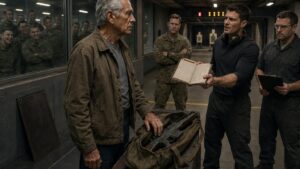
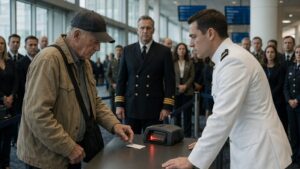
A man in formal dress walked down the center aisle.
He was tall, silver-haired, and straight-backed, with a row of medals across his chest that caught the overhead light without needing it. His face held no performance. No anger. No hurry. Only control.
The courtroom did not know him yet, but it knew what he represented.
Even Judge Whitaker paused.
The man reached the front, stopped beside the first row, and looked at William.
For one moment, something passed between them.
Not surprise.
Recognition.
William’s hand went slack around the medal.
“Richard,” he said.
It was the first name he had spoken all morning without breaking it.
The man turned to the bench.
“Your Honor, my name is Richard Carter. I request permission to address the court.”
Judge Whitaker’s eyes moved over the uniform, the insignia, the chest full of proof. His irritation did not vanish, but it changed shape.
“This is an active hearing, General Carter.”
“I understand.”
“You were not listed as a witness.”
“I was not aware until this morning that Mr. Hayes had been compelled to appear.”
The prosecutor rose. “Your Honor, the state has no objection to hearing from General Carter if he has relevant information regarding the object.”
Richard’s gaze stayed on the judge.
“I do.”
Joshua felt the room lean forward.
Nancy sat down slowly, still holding the envelope.
William looked smaller than ever.
Judge Whitaker set the gavel down.
“Proceed.”
Richard did not look triumphant. That unsettled Joshua. If he had come to save William, why did his face look like someone arriving too late?
“Mr. Hayes has refused official inquiries,” Richard said. “That much is true.”
Joshua looked at him sharply.
William closed his eyes.
Richard continued. “He refused interviews in 1986, 1999, and again six months ago. He declined to sign a sworn clarification of the Briar Ridge evacuation. He returned letters unopened.”
The judge’s expression hardened, as if vindicated.
Nancy’s face went pale.
Joshua stared at his father.
“Dad?”
William said nothing.
Richard turned slightly, enough for his voice to reach the whole room.
“It is also true that William Hayes saved at least four men during that evacuation. Three wounded men were carried from the east side of the bridge under collapsing conditions. One man survived because Mr. Hayes held an airway open for nearly twenty minutes during transport. Another lived because Mr. Hayes gave him the last of his plasma after already being wounded himself.”
A ripple went through the gallery.
Joshua’s mouth opened.
He had known his father served. He had known he was a medic. He had known there were nightmares, prescriptions, old photographs in a box his mother once told him not to touch.
He had not known this.
“He filed no recommendation for himself,” Richard said. “No correction. No appeal. No request for recognition. He gave one statement after returning home. It was incomplete. He never amended it.”
Judge Whitaker frowned.
“General, are you here to excuse noncompliance because Mr. Hayes once performed admirable service?”
“No, Your Honor.”
Richard looked at William then, and the severity in his face softened for the first time.
“I am here because the court is holding the wrong end of the truth.”
No one moved.
Richard reached into a leather folder beneath his arm and withdrew several yellowed copies sealed in plastic sleeves.
“These are field notes from Captain Samuel Reeves, recovered during a records audit. They were misfiled under a transport annex and never attached to Private Anthony Ellis’s file.”
Nancy made a small sound.
Not a sob.
A wound touched by air.
Richard looked toward her.
“Mrs. Ellis.”
“Miss,” she said automatically.
Richard bowed his head once. “Miss Ellis.”
Her fingers trembled around the envelope.
“Is my brother in those papers?”
Richard did not answer quickly.
That was answer enough.
William opened his eyes.
His gaze found Nancy, then dropped.
“I tried,” he said.
The judge spoke more quietly now.
“General Carter, explain the relevance of the medal.”
Richard held the folder at his side.
“The medal was not issued to William Hayes.”
Joshua turned to his father.
William’s face seemed to empty.
Richard said, “It belonged to Anthony Ellis.”
The room changed again.
Not with noise.
With meaning.
The medal at William’s chest was no longer a decoration.
It was no longer evidence.
It was a question that had been hanging there for sixty years.
Part IV — What the Medal Remembered
Nancy stood.
This time no one told her to sit.
“That was Anthony’s?” she asked.
Richard nodded.
She looked at William.
“All these years?”
William’s hand rose to the medal, but did not close around it.
“All these years,” Nancy repeated, barely above a whisper.
Joshua felt something inside him pull in two directions.
He wanted to defend his father.
He wanted to step away from him.
Both feelings stood in the same place, shoulder to shoulder, and neither would move.
Judge Whitaker looked unsettled now, though he tried to hide it behind procedure.
“General, how did Mr. Hayes come into possession of it?”
Richard looked to William.
“This part is his.”
William’s head turned slowly.
“No.”
“Yes,” Richard said.
“I can’t put it right.”
“You don’t have to put it right,” Richard said. “You have to put it down.”
That sentence seemed to strike William harder than the gavel had.
Joshua watched his father’s hands.
The tremor was worse now, but beneath it was something else. Resistance, yes. Fear, certainly. But also the exhaustion of a man who had spent a lifetime standing guard over a door he no longer had the strength to keep closed.
Nancy stepped into the aisle.
“Please,” she said. “I have waited longer than he was alive.”
William looked at her then.
Fully.
The courtroom faded from his face. The judge, the prosecutor, the polished wood, the people pretending not to stare—all of it fell away. He saw only the woman with gray hair and an envelope.
But in his eyes, she was younger.
A girl on a porch.
A mailbox with blue paint.
Two cracked steps.
“I went there,” William said.
Nancy’s lips parted.
“When?”
“After.” His voice scraped. “I had the address. He made me say it back. Three times.”
Nancy pressed the envelope to her chest.
“He talked about me?”
William let out a breath that might have become a laugh if it had not broken first.
“All the time.”
Nancy’s eyes filled, but she did not cry.
William stared at the table.
“He said you made biscuits too hard. Said you cheated at cards. Said if he came home without the medal, you’d say he lost everything not tied to him.”
A sound moved through Nancy, part grief, part recognition.
“He did lose everything,” she said.
William flinched.
Not because she meant to wound him.
Because she had.
Richard remained still.
Joshua understood then that this was why the general had not come in like a rescuer. There was no clean rescue here. No sentence that could make William innocent of silence. No uniform bright enough to light the years Nancy had spent without an answer.
Judge Whitaker spoke carefully.
“Mr. Hayes, are you able to tell the court what happened at Briar Ridge?”
William’s eyes closed.
Rain.
Flares.
The bridge.
He did not describe tactics. He did not name units or coordinates. He did not make the past sound orderly.
He spoke like a man touching broken glass.
“There were too many of them,” he said. “Too many hurt. We were moving back across the bridge. The boards were slick. Someone was yelling my name. I found Anthony under part of the railing. He was hit low. Couldn’t stand.”
Nancy put one hand over her mouth.
William kept going.
“He knew before I did.”
The courtroom held its breath.
“He took the medal off. Put it in my hand. Said, ‘If I don’t get home, Nancy gets this.’ I told him to shut up. Told him I wasn’t taking messages from a man I was carrying out.”
A faint, terrible smile moved across William’s face and vanished.
“He laughed at me. Can you imagine that? He was lying there, and he laughed.”
Nancy’s tears spilled then.
No sound.
Just two clean lines down her face.
William’s voice thinned.
“I got him up. I did. I had him. Then the bridge shook. There were three more on our side. One couldn’t breathe. One was bleeding bad. One kept slipping because his leg—”
He stopped.
No one asked him to finish that sentence.
“I thought I had time,” William whispered. “That’s the lie I’ve lived with. I thought I had time to go back.”
Joshua gripped the rail.
William looked at Nancy.
“I took the three across. I turned around. The bridge was gone.”
Nancy closed her eyes.
The envelope bent in her hands.
Richard looked down.
Judge Whitaker sat very still.
William’s fingers hovered over the medal.
“He was there,” he said. “And then he wasn’t. I had his medal in my fist. I had his words in my head. And I had nothing to bring you that could prove I had tried.”
Nancy’s voice came out quiet and sharp.
“So you brought me nothing.”
William bowed his head.
“Yes.”
The answer was worse than an excuse.
Because it was true.
Part V — The Question No Rank Could Answer
The judge did not reach for the gavel now.
No one in the room seemed eager for authority.
Nancy opened the envelope and pulled out a photograph. Its edges were soft from years of being handled. She held it up, not toward the judge or Richard, but toward William.
Anthony was young in the picture. Too young in the way all old photographs of young men become unbearable. He stood beside a porch rail, hair cut short, one arm around a girl who must have been Nancy before waiting changed her.
“He was nineteen,” she said.
William nodded.
“He said he was twenty whenever cards were involved.”
A faint tremor moved through Nancy’s mouth. It almost became a smile. It failed.
“Why didn’t you knock?” she asked.
The question had been coming since the moment William said yellow house.
Still, when it arrived, it seemed to strip the room bare.
William looked at the photograph.
“I sat outside in a truck,” he said. “Morning. Your porch light was still on. I had the medal in my pocket. I watched a woman come out and sweep the steps. I thought it was your mother.”
“It was.”
“I opened the door.”
Nancy waited.
“I closed it again.”
“Why?”
William’s eyes shone.
“Because I had no body,” he said. “No grave. No last words that didn’t sound like I was making myself feel better. I had a medal and a promise and three living men I had chosen over him. I thought if I waited until I had more to give you, I could come clean.”
He swallowed.
“But time doesn’t make a coward brave. It just gives him better excuses.”
Joshua looked down.
That was the first time he had ever heard his father call himself anything close to afraid.
Not in a nightmare.
Not after his mother’s funeral.
Not when his hands got too weak to button his own shirt and he pretended the cuffs were defective.
Nancy lowered the photograph.
“You thought keeping it protected him?”
William’s gaze fell to the medal.
“I thought keeping it punished me.”
The words landed harder than anything the prosecutor had said.
Joshua felt his throat close.
All those years, he had thought the medal was the one part of service his father could bear to keep.
He understood now it was the part he could not forgive himself for surviving.
Richard stepped forward.
“Miss Ellis,” he said, “the field notes confirm Anthony gave his last morphine ampule to another wounded man before Mr. Hayes reached him. That man survived transport. His statement was also misfiled. It names your brother.”
Nancy turned slowly.
Richard held out the plastic sleeve but did not force it into her hands.
“He was not forgotten by the men there,” he said. “But the record failed him.”
Nancy stared at the papers.
“The record failed all of us,” she said.
Richard accepted that without defense.
“Yes.”
Judge Whitaker removed his glasses.
For the first time, he looked less like a man presiding over disorder and more like a man who had finally understood he had almost made it worse.
“Mr. Hayes,” he said quietly, “the court will take a recess if you need—”
“No.”
William’s voice was weak, but the room obeyed it.
He looked at Nancy.
Then he reached for the ribbon.
Joshua moved instinctively. “Dad, let me—”
William stopped him with one look.
Not harsh.
Not unkind.
A father’s look, after years of being hidden beneath age and fear.
Joshua sat back.
William’s fingers shook so badly that it took him three tries to lift the ribbon over his head. No one helped. No one dared. The whole courtroom watched the slow, painful work of a promise leaving its hiding place.
When the medal came free, William held it in both hands.
Without the blue ribbon at his neck, he looked suddenly unguarded.
Older.
Lighter.
More exposed.
“Nancy,” he said.
She stepped forward.
Each step seemed to cost her.
William held out the medal.
“He made me promise you’d have it,” he said. “I was late.”
Nancy looked at the medal.
Then at him.
For one terrible second, Joshua thought she would refuse it.
Maybe she had the right.
Maybe some promises arrived too late to be received.
But Nancy lifted her hands.
William placed the medal into them.
Her fingers closed around it.
The room remained silent.
No applause.
No easy forgiveness.
No clean ending pretending the years had not happened.
Nancy held the medal to her chest, right over the photograph inside her envelope.
“Was he afraid?” she asked.
William did not look away.
“Yes.”
Her face tightened.
William’s voice softened.
“But he was still himself.”
Nancy waited.
“He told me not to waste the morphine on him. Said the other boy had worse luck and less mouth.”
A broken sound escaped Nancy then.
This one was almost a laugh and almost not.
“That sounds like him.”
William nodded.
“It was raining,” he said. “He was cold. He wanted you to have that. He wanted to get home. He knew I was trying.”
Nancy’s eyes searched his face.
For blame.
For comfort.
For something neither of them could name.
At last she said, “I wish you had knocked.”
William bowed his head.
“So do I.”
Part VI — The Salute Outside
Judge Whitaker withdrew the contempt order in a voice that had lost its sharpness.
He allowed Richard’s field notes to be submitted into the record. He instructed the clerk to forward copies to the proper federal office for correction. He used careful words—review, amendment, recognition, next steps—as if procedure could walk gently if it tried.
William listened to none of it.
He watched Nancy.
She returned to her seat only long enough to collect her purse. The medal stayed in her hand. The photograph went back into the envelope, but not all the way. Anthony’s young face remained visible above the flap, looking out at a room that had finally spoken his name correctly.
As she passed William, she paused.
Joshua stood, uncertain.
Nancy looked at him first.
“You’re his son?”
Joshua nodded. “Yes, ma’am.”
She studied his face as if searching for traces of a man she had known only through absence.
“He carried it a long time,” she said.
Joshua did not know whether she meant the medal, the promise, or the guilt.
Maybe she meant all three.
“Yes,” he said. “He did.”
Nancy turned to William.
For a moment, neither spoke.
Then she reached out and touched his sleeve.
Not forgiveness.
Not accusation.
Contact.
William closed his eyes.
Nancy left the courtroom with the medal in her hand.
Only after the doors shut behind her did Joshua realize his father was shaking.
He moved quickly, but not the way he had before. Not like a man catching something broken before it embarrassed them both.
This time he offered his arm.
William looked at it.
Then took it.
They walked out slowly, with Richard a few steps behind them. The hallway outside the courtroom was too bright. People moved around them in low voices, suddenly polite, suddenly careful, as if William had become fragile only after they learned what had been inside him.
At the courthouse doors, William stopped.
Nancy stood near the bottom of the steps, looking down at the medal in her palm. She had not gone far. Maybe she could not yet.
The afternoon light rested on her gray hair.
For a second, Joshua saw her as his father must have: not old, not young, but waiting.
Richard came to William’s other side.
He stood straight.
Then, without announcing it, without making a ceremony of it, he raised his hand in salute.
The movement was precise.
Quiet.
Complete.
People near the entrance stopped.
William stared at him.
His own hand did not rise.
Not at first.
He looked past Richard to Nancy, who had turned at the stillness. She saw the salute. She saw William. She saw the empty space at his neck where the medal had been.
William’s fingers twitched at his side.
Joshua felt the old man’s weight shift against him.
“You don’t have to,” Joshua whispered.
William’s eyes stayed on Nancy.
“I know,” he said.
Then he lifted his hand.
It shook on the way up.
It was not sharp like Richard’s. Not polished. Not the clean gesture of a man untouched by time.
It was slow, uneven, and late.
But it was returned.
Nancy watched from the steps with the medal held between both hands.
She did not smile.
William did not either.
Some things come back changed. Some things come back too late. Some promises do not heal the years they crossed to arrive.
But as Joshua held his father steady in the courthouse doorway, he understood something he wished he had understood sooner.
His father had not spent his life refusing to speak because there was nothing inside him.
He had been carrying a room no one else could enter.
Now, at last, the door stood open.
And the man beside him, trembling and emptied and seen, was still standing.