The Morning He Finally Shared The Water At The Corner Booth
Part I — The Corner Booth
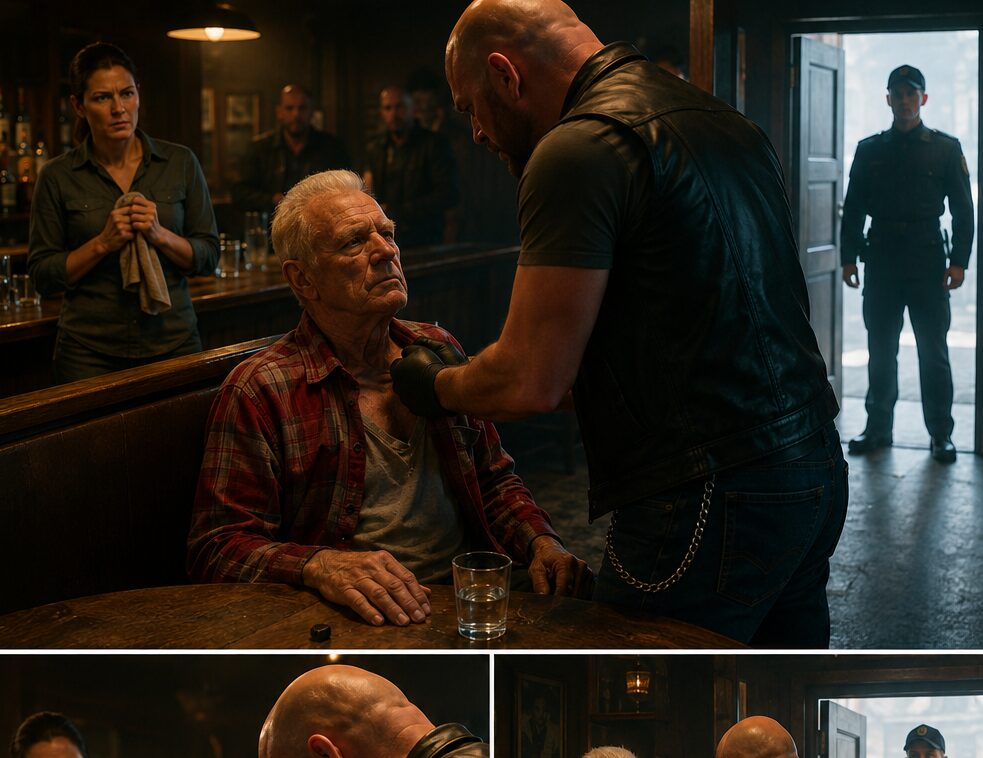
The old man was halfway through buttoning his plaid shirt when Tyler Walker grabbed him by the collar and pulled hard enough to make the fabric snap.
The room stopped.
At The Lantern, silence never came all at once. It usually thinned slowly between pool-table clicks, low music, and men pretending not to listen to one another. But that morning, every sound fell away together.
A button bounced across the worn wood floor.
Donald Miller sat in the corner booth with his hands still on the table. Seventy-eight years had narrowed him but not bent him. His white hair was cut short out of habit. His red plaid shirt, buttoned high despite the July heat, had always made him look like any other old man waiting for lunch.
Now it hung open.
Under the gray undershirt stretched across his chest, a faded tattoo showed through where Tyler had pulled the collar wide: a broken compass, three small stars, and a string of numbers almost blurred by age.
Tyler leaned over him, broad shoulders blocking the light from the front windows. His black riding vest smelled faintly of engine grease and rain. There was oil under his fingernails. There was anger in every inch of him.
“Look at that,” Tyler said, loud enough for the bar to hear. “Cheap ink for men who left better men behind.”
Donald did not cover himself.
That was what made it worse.
He did not curse. He did not shove Tyler away. He did not even look embarrassed. His eyes stayed on Tyler’s face with a stillness that had nothing to do with weakness.
Heather Carter, behind the bar, set down the glass she had been drying.
“Tyler,” she said. “Let him go.”
Tyler did not let go.
“You know what booth you’re sitting in?” he asked Donald.
Donald’s eyes moved, briefly, to the empty bench across from him.
The corner booth was closest to the wall and farthest from the jukebox. It had a small brass screw in the tabletop where a nameplate had once been, long since removed. Every year on this date, Donald came before noon, sat there, ordered one glass of water, and waited until the ice melted.
No one asked why anymore.
Everyone knew enough to stop asking.
Tyler’s grip tightened.
“That’s a dead man’s booth.”
A few regulars shifted. Nobody stood.
Heather came around from behind the bar, her towel still in one hand. “I said let him go.”
Tyler glanced at her, then back at Donald. His eyes were wet, but his voice was hard.
“My father should be sitting there.”
Donald’s jaw worked once. His hands remained flat on the table.
Tyler laughed without humor. “Nothing? That all you’ve got?”
Donald said nothing.
Tyler bent lower until his face was almost level with Donald’s.
“They told my mother you made the call. You ordered the lift. You came home. My father didn’t.” His mouth twisted. “And every year, you sit in his booth like you earned the right.”
Donald’s fingers moved toward the tipped edge of his shirt. Not to hide the tattoo. Only to gather the torn cloth back together.
Tyler slapped his hand away.
Heather stepped closer. “Don’t touch him again.”
“He touched my whole life,” Tyler said. “I’m touching his shirt.”
Donald looked at him then, fully.
For one second, Tyler’s face changed. Not softened. Not sorry. Just uncertain, as if some old command had reached across the years and found the place inside him that still knew when to obey.
Then he remembered who he hated.
“You even remember his name?” Tyler asked.
The question landed harder than the grabbed shirt.
Donald’s eyes dropped to the glass of water in front of him. It was untouched. Clear beads of sweat ran down its side and gathered in a ring on the table.
When he answered, his voice was quiet.
“Every morning.”
Tyler stared.
Then he laughed.
“Every morning,” he repeated, making it ugly. “That what you tell yourself? That you’re some sad old saint?”
Donald did not flinch.
Tyler leaned closer.
“You’re a coward wearing a soldier’s skin.”
That line moved through the bar like smoke.
Heather stopped walking.
A man at the pool table looked down at his cue.
Donald’s face did not break, but something behind his eyes lowered, as if an old door had closed from the inside.
Tyler saw it and mistook it for guilt.
“Yeah,” he said. “There he is.”
Part II — The Envelope
Heather had spent most of her life learning when a bar fight was about pride and when it was about grief.
Pride came loud and stupid. Grief came focused.
Tyler had not come in looking for a drink. He had come in looking for Donald.
His father’s name had been Jack Walker. Everyone in town knew that part. Everyone also knew the shorter story, the one passed along in parking lots, at kitchen tables, and in the soft-voiced corners of memorial events: Jack had died under Donald Miller’s command during a failed extraction. Donald had ordered the helicopter out. Jack had been left behind.
The official words were colder than that.
Command withdrawal under hostile pressure.
People did not repeat the official words. They repeated what they could understand.
He left him.
Heather’s father had never repeated it. Not once.
Before he died, he had shown Heather the envelope under the register.
“If Donald ever needs this,” he had told her, “you’ll know.”
She had hated that instruction. It sounded simple until the day came.
Now Tyler was standing over Donald with the old man’s shirt torn open, and Heather knew.
She went back behind the bar.
Donald saw her reach beneath the register and gave the smallest shake of his head.
No.
It was barely a movement. But Heather had grown up around men who could stop a room with less than that.
Tyler saw it too.
His gaze snapped to her hand. “What’s that?”
Heather froze.
“Nothing you need while you’re acting like this.”
Tyler released Donald’s shirt, but only to turn toward her.
“Is that how it works?” he said. “You all keep little papers for each other? Little stories for when someone asks the wrong question?”
Donald’s voice came sharper than before. “Tyler. Sit down.”
It was not loud.
It did not need to be.
For half a second, Tyler shifted his weight back, like his body had obeyed before his pride could stop it.
Then his face hardened.
“You don’t get to give orders anymore.”
He swept his arm across the table.
The glass of water hit the floor and shattered.
Donald flinched.
Not much. Just a hard blink, one hand tightening flat against the tabletop. But Heather saw it. She saw the old man leave the room for half a breath.
Glass.
A crack in the air.
A sound like a radio handset breaking against stone.
Donald heard the rotor first. He always heard the rotor first, even when he was not remembering. Then the clipped voices. Then the static. Then Jack Walker saying, clear as if he were standing at the booth:
If the compass breaks—
Donald shut the memory down.
The bar came back.
Tyler was watching him.
“That scare you?” he asked.
Donald looked at the water spreading across the floor.
“No,” he said. “It reminded me.”
That answer did not satisfy anyone. It only made the silence heavier.
At the front window, a figure paused in the daylight.
Young. Straight-backed. Dress uniform. One hand on the door handle, then still.
Heather saw him and felt the whole day tilt.
Andrew Reed.
He had come early.
Donald saw the reflection in the mirror behind the bar. His face changed in a way only Heather noticed. Not fear. Not relief.
A plea.
Not yet.
Andrew did not come in. Not yet. He stood outside in the bright Kansas morning, looking through the glass at the corner booth, the torn shirt, the tattoo, the broken water.
Tyler followed Donald’s glance but saw only his own reflection in the window.
“You know what my mother did after the men came to our house?” he asked Donald. “She kept your name out of her mouth for twelve years. Like it was poison. Then one night she said it while washing dishes, and she dropped a plate.”
Donald’s eyes closed.
“Her name was Rebecca,” Tyler said. “You remember that too?”
“Yes.”
“Don’t.”
Donald opened his eyes.
Tyler’s voice cracked, then hardened again. “Don’t say her name like you had any right to know her.”
Heather set the envelope on the bar.
Tyler looked at it like it might bite him.
On the front, in her father’s careful block handwriting, were four words:
Walker Family — If Needed.
Tyler went still.
Donald did not look at the envelope.
He looked at Heather.
And in that look, she understood the cruelty of promises. Sometimes keeping one meant letting people hate you for it.
Part III — The Picture
Heather opened the envelope.
Donald’s voice cut across the bar.
“Heather.”
She paused.
He did not sound angry. That made it worse. He sounded tired in a way she had never heard from him before.
Tyler pointed at the envelope. “No. You don’t get to hide it now.”
Heather did not pull out the papers.
She pulled out one photograph.
It was creased at the corners, soft from years of being handled. She set it on the bar, faceup, and slid it just far enough for Tyler to see.
Four young men stood beside a transport helicopter under a white sky.
Donald was there, thirty years younger, broad-shouldered and unsmiling except at the corners of his eyes. Beside him stood Jack Walker, one arm slung around another man, grinning like the world had not yet asked anything impossible of him. Donald’s hand rested on Jack’s shoulder.
Not formally.
Not distantly.
Like family.
Tyler took one step toward it, then stopped.
“That’s not real.”
Heather said nothing.
Tyler picked up the photograph as if it were evidence of a betrayal. His thumb moved over his father’s face.
Donald looked away.
The room shifted around them. Men who had been pretending not to listen no longer pretended. A woman near the jukebox covered her mouth. The pool cue was laid gently on the table.
Tyler’s voice dropped. “Why do you have this?”
Donald did not answer immediately.
Outside the window, Andrew remained in the glare of morning.
Heather wanted him to come in. She also understood why he waited. Some doors had to be opened from the inside.
Tyler held the photograph toward Donald.
“Why do you have a picture of my father smiling with you?”
Donald looked at the photo then.
His face changed so slightly that most people would have missed it. Heather did not. She saw the old man’s eyes sharpen around something unbearable and tender.
“Because,” Donald said, “he gave me the last good day he had.”
Tyler’s hand trembled.
For the first time that morning, his anger lost its shape.
“What does that mean?”
Donald’s torn shirt had slipped open again. The tattoo showed more clearly now: the broken compass, the three stars, the blurred numbers beneath them.
Tyler looked from the tattoo to the photograph and back again.
Heather saw the moment he noticed it.
On the back of the photograph, faint through the old paper, was a dark smudge of ink.
Tyler turned it over.
There, drawn in black pen by a younger hand, was the same broken compass.
Under it, in slanted writing:
If the compass breaks, Miller gets us home.
Tyler stared at the words.
“Miller,” he said, as if the name belonged to someone else.
Donald’s mouth tightened.
“Put it down,” he said.
Tyler did not.
“You knew him.”
Donald’s gaze lifted.
“Yes.”
“No. I mean—” Tyler swallowed. “You knew him.”
Donald held his eyes for a long second.
“He was the best radio man I ever had.”
That should have been enough. It was not.
Tyler slapped the photograph against the bar. “Then why did you leave him?”
The words hit the room and stayed there.
Donald’s hand curled once on the tabletop.
A memory came without permission.
A mountain relay station. Smoke low on the ground. Wounded men pressed into a transport bay. A civilian interpreter praying in two languages. Nicholas Reed bleeding through both hands and trying not to make noise.
The beacon dead.
The route closing.
Jack Walker, younger than Tyler was now, looking at Donald with that half grin he used when he had already made up his mind.
Don’t give me that face, Captain.
Donald had said, “No.”
Jack had gone anyway.
Donald came back to the booth with the taste of dust in his mouth.
Tyler was waiting.
Donald’s answer was quieter than the room deserved.
“I left with the living.”
Tyler’s face twisted. “That’s all he was to you? Arithmetic?”
Donald stood halfway, then stopped. Age held him. Memory held him harder.
“No,” he said. “That’s what command becomes when all the other words fail.”
Tyler looked as if he wanted to hate that sentence and could not find where to put it.
Then the door opened.
Part IV — The Man In The Doorway
Sunlight filled the front of The Lantern.
Andrew Reed stepped inside in dress uniform, polished shoes picking up dust from the threshold. He was thirty-one, maybe thirty-two, with a young face trained into discipline and eyes that had already learned what gratitude could cost.
He took in the room in pieces.
The broken glass.
The envelope.
The photograph in Tyler’s hand.
Donald’s torn shirt.
The tattoo.
Andrew stopped walking.
His face changed before he could control it.
Tyler saw that change and turned on him because anger needed a new place to stand.
“What?” Tyler said. “You another one of his?”
Andrew did not answer him at first.
He looked at Donald. “Sir.”
Donald’s voice was low. “Not here.”
That made Tyler laugh, but it came out wrong.
“Sir,” he repeated. “Of course.”
Andrew turned toward him.
“You’re Jack Walker’s son.”
Tyler stiffened. “And you are?”
“Andrew Reed.”
The name meant nothing to Tyler. That seemed to hurt Andrew more than he expected.
“My brother was Nicholas Reed.”
Still nothing.
Andrew glanced at Donald, then at the photograph.
“He was on that lift.”
Donald’s eyes warned him.
Andrew ignored the warning for one sentence too long.
“I’m alive because your father disobeyed an order,” Andrew said. “And because Donald Miller took the blame for it.”
The bar went completely still.
Tyler’s mouth opened, but no sound came.
Donald stood.
It took effort. His knees fought him. His hand touched the table once, not for drama, but balance. When he was upright, he was still shorter than Tyler, still thinner, still an old man with a torn shirt.
But the room changed around him.
“Enough,” Donald said.
Andrew’s jaw tightened. “Sir, they should know.”
Donald looked at him, and the old command came back whole.
“They know what I allow.”
Andrew fell silent.
Tyler looked between them. “What does that mean?”
Donald turned to him.
“It means your father saved us. That is what your mother needed to know.”
Tyler shook his head slowly. “No.”
Heather came around the bar with a broom, not to clean, but because her hands needed something honest to hold.
Tyler’s voice grew rougher. “No. Don’t do that. Don’t give me one clean sentence and expect me to carry it.”
Donald looked at him for a long time.
Then he nodded once.
No one moved.
Outside, traffic passed on the road beyond the parking lot. Inside, the air was so tight even the ceiling fan sounded too loud.
Tyler’s eyes were fixed on Donald.
“Did my father die because of you?”
Donald did not look away.
“He died under my command,” he said. “That never stopped being mine.”
Tyler’s face worked.
“Did you leave him?”
Donald looked at the booth. The empty bench. The water on the floor.
Then he said the sentence he had avoided for thirty years.
“I left with the living because he bought them the chance.”
Tyler stared as if Donald had struck him.
Andrew took half a step forward, but Donald lifted one hand. Not to stop Tyler. To stop pity.
Tyler looked down at the photograph again.
“My mother thought he was left calling for help.”
“No,” Donald said.
The word came fast, almost sharp.
That was the first thing he had denied all morning.
Tyler looked up.
Donald’s voice softened, but not much. “He was not calling for help.”
“What was he doing?”
Donald touched the torn edge of his shirt, then let it fall open.
The broken compass sat on his chest in faded ink.
“He was giving us a way home.”
Part V — The Broken Compass
Operation Night Compass had not been called that in the reports people were allowed to read.
Reports liked cleaner language.
Evacuation.
Withdrawal.
Hostile pressure.
They did not say that a ceasefire had collapsed in the middle of a mountain relay station with thirteen people trapped inside. They did not say the sky had closed with smoke, or that the beacon went silent, or that every minute spent waiting took a name from the future.
They did not say Jack Walker had smiled when he was afraid.
Donald did not give the bar all of it.
He gave Tyler only what could be carried.
“The beacon failed,” Donald said. “We had wounded. Civilians. Nicholas Reed was hit bad. We had one lift window, maybe less. Without signal, the aircraft could not hold position long enough.”
Andrew lowered his eyes at his brother’s name.
Tyler barely breathed.
Donald continued, “Your father said he could reconnect the relay.”
“You ordered him to?”
“No.”
The answer came hard.
Donald’s gaze stayed on Tyler’s. “I ordered him not to.”
Tyler blinked.
“He went anyway,” Donald said. “Because Nicholas was alive. Because the interpreters were alive. Because he believed machines listened better when people were too afraid to.”
The line landed.
Tyler’s lips parted.
Donald saw it then. The small recognition. Not of the mission. Of the man.
“He said that?”
Donald’s face tightened.
“Something like it.”
Tyler looked back at the photograph.
The room waited.
Donald’s hand moved toward the back of the booth, where the old brass screw caught a thin strip of light.
“He got the signal back. We lifted with the living. I waited as long as I could.”
His voice did not crack. That made the pain worse.
“When I knew waiting would turn one death into many, I gave the order.”
Tyler’s jaw clenched.
“And then?”
Donald looked down.
“And then I signed the report.”
Heather closed her eyes.
Tyler said, “The report said you withdrew.”
“I did.”
“It said he was separated under pressure.”
“He was.”
“It didn’t say he disobeyed you.”
“No.”
“Why?”
Donald looked at him with a patience that felt almost unbearable.
“Because he had a wife who needed his benefits. Because he had a son who deserved his father whole. Because the men who write reports do not always understand the difference between disobedience and sacrifice.”
Tyler’s face changed again.
He was trying to keep hatred alive. Donald could see it. Hatred had been furniture in the house of his grief. Without it, he had nowhere to sit.
“You let us hate you,” Tyler said.
Donald’s answer was immediate.
“Yes.”
“Why?”
“Because I was grown.”
The sentence went through the room like a bell struck softly.
Tyler’s eyes shone now, and he hated that too.
Donald reached for the photograph. Tyler did not stop him.
The old man turned it over and touched the broken compass drawn on the back.
“Your father drew this two weeks before the operation,” Donald said. “We got dropped six miles off route in weather so bad the map might as well have been a napkin. I got three men out. Your father laughed for two days and said if the compass ever broke, Miller would get them home.”
Donald looked at the tattoo on his own chest.
“After he was gone, I had it put here so I would never mistake surviving for getting home.”
No one spoke.
Tyler’s eyes moved to the three small stars.
“What are those?”
Donald’s thumb touched the edge of the photo.
“The three who came out because of his final transmission.”
Andrew’s shoulders drew tight.
“My brother,” he said quietly. “Two interpreters. One of them named his daughter after your father’s wife.”
Tyler looked at him, stunned by the existence of lives he had never imagined.
Donald shot Andrew a look, but it held no anger now. Only pain at how truth kept widening.
Tyler took one step back from the booth.
His boot crunched glass.
He looked down at it as if noticing the broken water for the first time.
Then he looked at Donald’s shirt.
“I did that,” he said.
Donald did not help him escape it.
“Yes.”
Tyler swallowed.
His hands, which had looked so large around Donald’s collar, now hung useless at his sides.
“I didn’t know.”
Donald stood straighter.
“You were a child. They gave you the story they thought you could survive.”
Tyler’s face folded around that.
Not fully. Not cleanly. But enough.
“What were his last words?” he asked.
Donald looked toward the front window, where the sunlight had gone softer.
For thirty years, he had kept those words away from the boy because they were too intimate, too ordinary, too alive. He had thought withholding them was protection.
Now he saw the other cost.
“He said, ‘Tell Rebecca the boy should learn to fix engines.’”
Tyler went still.
Donald’s voice lowered.
“‘He listens better to machines than people.’”
Tyler’s hand came up to his mouth.
No one in the bar moved.
That detail could not have come from a report. It could not have come from ceremony or rumor or pity. It belonged to a kitchen, a garage, a child under a hood with a wrench too big for his hand.
Tyler had become a mechanic because engines were the first things that made sense after his mother stopped answering questions.
He had never told Donald that.
He had never told anyone in that room.
The photograph trembled in his hand.
“I hated you,” Tyler said.
Donald nodded once. “I know.”
“I needed you to be what they said.”
“I know that too.”
Tyler looked at the tattoo again.
This time, he did not look at it like an insult.
He looked at it like a door.
Part VI — The Shared Water
Andrew raised his right hand.
No announcement. No speech.
Just the clean motion of respect.
His salute was not for the room. It was not for Tyler. It was not meant to make a scene out of Donald’s pain.
It was for the old man standing in a torn plaid shirt beside a booth he had visited for thirty years.
Donald did not return it.
Not at first.
His hands were still at his sides, fingers curled slightly from age and strain. He looked at Andrew with a sadness that carried both gratitude and warning.
Then Donald gave the smallest nod.
Andrew held the salute one second longer, then lowered his hand.
Heather moved before anyone else could decide what to do with the silence. She swept the broken glass carefully into a pan, then went behind the bar and filled a fresh glass with water.
She did not set it in front of Donald.
She set it on the empty side of the booth.
For Jack.
Tyler watched her do it.
The gesture undid more in him than the salute had.
Maybe because he could argue with stories. He could doubt reports. He could fight men.
But he could not fight a glass of water placed gently where his father should have been.
Donald looked at it for a long moment.
Then he buttoned what was left of his shirt.
His hands shook. He did not hide that. He pulled the torn fabric together, leaving the top open where the tattoo still showed in part.
Tyler stepped forward, then stopped before he got too close.
“I’ll pay for the shirt,” he said.
Donald looked down at himself.
“The shirt was old.”
That was not forgiveness. Tyler knew it.
Maybe that was why it meant something.
Heather placed the envelope on the table between them.
Not in Donald’s hands.
Not in Tyler’s.
Between them.
“There are more photographs,” she said. “A letter your father wrote before the operation. My dad kept copies because Donald asked him to.”
Tyler looked at Donald.
“You wrote to us?”
“No,” Donald said. “Your father did.”
“Why didn’t we get it?”
Donald’s face tightened.
“You did. Your mother read it once. Then she asked me to keep the copy.”
Tyler closed his eyes.
All his life, he had thought silence meant absence. Now it seemed there had been silences everywhere, each one trying and failing to protect him.
He looked at the booth.
“Can I sit?”
Donald did not answer right away.
The whole room waited, but the choice belonged only to him.
Tyler’s voice came smaller. “Just for a minute.”
Donald looked across the table at the empty bench, the fresh water, the envelope, the photograph.
Then he said, “Ask him.”
Tyler understood.
Slowly, he slid into the booth across from Donald.
Not where he had stood looming over him.
Across from him.
He placed the photograph on the table and turned it so both of them could see.
The younger Donald. The laughing Jack. The helicopter. The broken compass drawn on the back like a promise nobody had known how to keep without hurting someone.
Andrew remained near the door, no longer trying to correct the record by force. Heather went back to the bar, wiping at a spot that was already clean.
The regulars returned to their drinks, but softly now. The room had changed its volume.
Tyler touched the edge of the envelope.
“I don’t know what to do with this.”
Donald sat down with care. The booth creaked under his weight the way it always had.
“No one does at first.”
Tyler looked at him. “Do you?”
Donald’s eyes moved to the water glass on the empty side.
“No.”
That answer, more than any brave one, made Tyler bow his head.
Donald reached for his own glass.
Heather had replaced it without him noticing.
For thirty years, he had sat in that booth and watched the ice melt. He had come to remember Jack, and to punish himself, and to keep a promise that had grown teeth. He had believed the water belonged to the dead because the living had taken enough.
This time, he lifted it.
His hand trembled, but he did not set it down.
Tyler watched.
Andrew watched.
Heather watched from behind the bar, her towel pressed between both hands.
Donald drank.
Only a small sip.
No one applauded. No one spoke. No one made the moment easier than it was.
Across from him, Tyler covered his face with one hand, not to hide from Donald, but from the years he could not get back.
Donald set the glass down.
The water ring spread slowly across the table, touching the edge of the old photograph.
Tyler lowered his hand.
“I’m sorry,” he said.
Donald looked at him for a long time.
Then he looked at the empty place beside the fresh glass.
“So am I.”
It was not the same apology.
It did not need to be.
Outside, cars passed on the road beyond The Lantern. The day went on with its ordinary indifference. Inside the corner booth, an old man, a grieving son, and a name neither of them could carry alone sat together in the quiet.
Donald did not leave first.
For the first time in thirty years, he did not have to.