The Table That Remembered
Part I — The Seat No One Touched
Ashley Turner sat alone at the long stainless-steel table everyone else treated like it had a name on it.
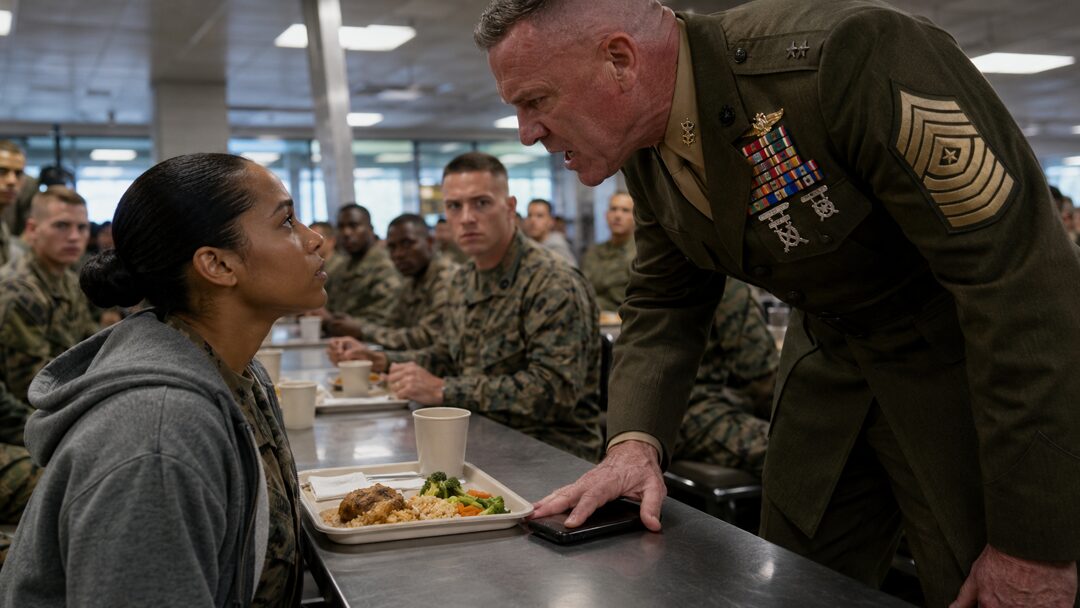
The dining facility was packed tight with lunch noise—trays sliding, boots scraping, chairs squealing, somebody laughing too hard near the drink machine—but the space around her stayed strangely open. Men in camo glanced at her, then away. A few looked twice at the gray zip-up hoodie over her uniform, at the phone lying face-down beside her tray, at the calm way she cut into her food like she had all afternoon.
She did not have all afternoon.
She had chosen this table because Robert Hayes always did.
At 12:17, he walked in.
The room noticed before Ashley looked up. It was a small change, almost nothing. A young Marine straightened his back. Someone stopped talking mid-sentence. A private lifted his tray as if he had just remembered he needed to sit somewhere else.
Sergeant Major Robert Hayes moved through the DFAC like the floor owed him respect. Broad shoulders. Polished boots. Red face. High-and-tight haircut. Decorations pressed flat against his chest. He did not need to raise his voice to make people move, which was why he liked raising it anyway.
Ashley kept eating.
Hayes stopped behind the empty chair across from her.
For three seconds, he said nothing.
Those three seconds did more than shouting could have done. They let the table feel watched. They let every soldier nearby understand that something had gone wrong because someone with less power had sat where power expected to sit.
Then Hayes leaned forward.
“This table’s for Marines,” he said. “Move.”
Ashley’s fork paused over her tray.
She looked at him the way people look at a closed door they already know is locked.
“I don’t see your name on it.”
The nearest conversations died.
A spoon clicked once against a tray and went still.
Hayes blinked, not because he had not heard her, but because he had. His face sharpened. He put both hands on the edge of the table and bent low enough that Ashley could smell coffee on his breath.
“You want to try that again, Specialist?”
Ashley set her fork down neatly beside the tray.
“No, Sergeant Major.”
That made it worse. Her voice was too calm. No tremble. No scramble. No apology dressed as discipline.
His eyes dropped to the patch on her sleeve, then to her face, then to the phone by her tray.
“Name.”
“Turner.”
“Unit.”
She gave it.
“Commanding officer.”
She gave that too.
Hayes smiled, but there was no humor in it.
“You lost?”
“No.”
“This is a Marine table.”
Ashley glanced at the stainless steel beneath her tray. Its surface was scratched from years of elbows, plates, knives, and nervous hands. Nothing about it looked sacred. Nothing about it looked earned.
“It’s a table.”
A young man halfway down the row made a sound like he had swallowed wrong.
Ashley knew him before he knew she had seen him.
Kevin Miller sat four seats away, shoulders tucked in, eyes fixed on a carton of milk he had not opened. He looked younger than she remembered. Or maybe guilt did that to a face. Maybe it sanded the years off and left only the boy who had followed orders because everyone else was moving and the night was loud.
Kevin’s eyes lifted.
Recognition hit him hard.
Ashley saw it.
Hayes saw that Kevin had reacted, but not why.
“What’s funny, Miller?”
“Nothing, Sergeant Major.”
Kevin’s voice broke on the last word.
Hayes turned back to Ashley.
“You think this is a joke?”
“No.”
“Then move.”
Ashley did not.
Hayes slammed his palm down beside her tray.
Coffee jumped out of the paper cup and spread across the compartments of food. The fork rattled. The phone shifted half an inch but stayed face-down.
Ashley’s right hand rose before she could stop it.
Flat against her chest.
Over her heart.
For one thin second, the DFAC vanished.
A different night came back in pieces: dust in the mouth, headlights cut low, someone shouting for a medic, a teenage boy pressing both hands into his own side as if he could keep himself together by will alone.
Ashley pressed her palm harder to her chest.
Not here.
Not yet.
Hayes leaned closer.
“You putting your hand over your heart now? You pledging allegiance to disrespect?”
Ashley lowered her hand.
“No,” she said. “Just keeping count.”
“Of what?”
She looked at the coffee spreading slowly toward the edge of the table.
“Things people think won’t matter later.”
Part II — The Date He Told Them to Forget
Three months earlier, Ashley had been attached to a joint evacuation convoy at a border station no one on the news could pronounce correctly.
The official brief called it a temporary security transfer.
Everyone there called it leaving.
The road out had been jammed with vehicles, families, interpreters, contractors, local police, people with papers, people without papers, people holding babies high over their heads as if that made them more visible to mercy. Ashley remembered a woman in a blue scarf gripping the side mirror of a transport truck. She remembered the smell of overheated engines. She remembered the young guide who kept running ahead of the convoy to clear the next turn, then jogging back with two fingers raised.
His name was not in any report Ashley later saw.
She remembered it anyway.
Samuel.
He was sixteen or seventeen, maybe. Thin wrists. Dusty hair. A grin too quick for the place he was in. He had guided them through a side road after the main route closed. He had carried water to Marines twice his size. He had translated when an old man knelt in front of the lead vehicle and begged for his daughter to be let through.
Then the checkpoint broke open behind them.
Not with a grand cinematic roar. Not the way people imagined such things. It happened in confusion, in overlapping shouts, in too many people moving at once.
Ashley remembered Kevin Miller standing beside Hayes, white around the mouth, waiting for the order that would tell him what kind of man to be.
Hayes gave it.
“Load the equipment. Priority passengers only. We leave now.”
Ashley had turned toward Samuel then.
He was on the ground near the concrete barrier, one hand clamped to his side, eyes open, trying not to make noise. He had understood enough English to know what “leave” meant.
Ashley ran to him.
Hayes caught her by the back of her vest.
“Medic, back in formation.”
“He’s bleeding.”
“He’s not ours.”
The words had done something to her that no explosion ever had. They had made the world clear in the worst way.
Ashley looked at the convoy, at the full vehicles, at the men waiting for permission to be brave and being handed permission not to be.
“Sergeant Major—”
Hayes moved close enough that only the nearest few heard him.
“You question this order, I will end your career before we hit the gate.”
Her phone had already been in her hand because she had been using it to translate names from a paper list. Her thumb had touched the screen. She did not remember deciding to record.
She only remembered Hayes’ voice entering the device.
“Nobody risks the convoy for them. We leave now.”
Kevin had heard it.
Ashley knew because he had looked at her phone, then at Hayes, then at the boy on the ground.
He had not moved.
Later, after the convoy made it out, after the reports softened the edges, after “hostile conditions” and “operational constraints” and “unconfirmed local casualties” replaced the actual faces of people left behind, Ashley watched the video alone in a supply room.
She watched it once.
Then again.
Then she locked it behind a date.
The date Hayes told them to forget.
The date Kevin stopped meeting her eyes.
The date Ashley pressed her palm over Samuel’s hand, then over her own heart, because there had been nothing else left to hold.
For three months, she carried the video like a live wire.
She did not send it because it would burn more than Hayes. It would burn Kevin. It would burn two young drivers who cried afterward in the motor pool. It would burn people who had followed the order because the chain of command had a way of turning panic into obedience before conscience could catch up.
She told herself she was waiting for the right channel.
Then the right review.
Then the right protection.
Then one morning, on a stateside base where the lights were too bright and the food was too hot and the tables were too clean, she heard Hayes laughing behind her in the DFAC.
Same voice.
Same certainty.
Same room rearranging itself around him.
And Ashley finally understood something she had been too tired to admit.
Some men did not hide because they were afraid.
They hid because everyone kept making room.
That morning, she sent one message to Captain Emily Carter in the legal office.
Then she walked to lunch and sat at Hayes’ table.
Part III — Everybody Saw It
Back in the DFAC, Hayes stared at Ashley like she had become a problem too small for paperwork and too public for patience.
Around them, the room pretended to breathe.
A soldier near the condiment station raised his phone, lowered it, then raised it again. Someone else held one under the table. A Marine across the aisle looked toward Hayes, waiting for permission to know what he was seeing.
Hayes noticed.
His voice dropped.
“Put your phones away.”
Three phones vanished.
Ashley’s did not move.
It remained beside the coffee spill, face-down, black case, one corner chipped from the night at the checkpoint.
Hayes’ eyes fixed on it.
“You recording me, Specialist?”
Ashley wiped coffee from the side of her tray with a napkin.
“Are you doing something that needs recording?”
A few faces changed. Not smiles. Not laughter. Something more dangerous. The quick, private look people gave when someone said what they had been thinking and survived the first second after saying it.
Hayes’ jaw flexed.
“You are way out of line.”
“No, Sergeant Major,” Ashley said. “I’m seated.”
Kevin shut his eyes.
Hayes heard that too. The tiny breath from down the table. The small betrayal of a body remembering what the mouth refused to say.
“Miller,” Hayes snapped. “Eyes up.”
Kevin obeyed.
There it was again, Ashley thought. That old reflex. The body moving before the soul voted.
Hayes pointed at her tray.
“You think because you wear that uniform, you can sit anywhere, talk any way, disrespect Marines in their own house?”
Ashley looked around.
The DFAC did not belong to him. It belonged to fluorescent lights, overcooked rice, government chairs, and tired people counting minutes before formation. But Hayes had made it his by repetition. Same table. Same seat. Same laugh. Same invisible border.
His name did not have to be written on it.
Everyone behaved as if it was.
“I’m not disrespecting Marines,” Ashley said.
“No? What do you call this?”
“Eating.”
Hayes’ palm hit the table again, harder.
The spilled coffee reached Ashley’s sleeve.
Her hand rose to her heart.
This time she did not hide it.
A hush moved outward. Kevin watched her hand. His face folded inward, and for a second he was back at the checkpoint too. Ashley saw it happen.
Hayes did not.
He saw only defiance.
“You think calm is going to save you?” he said.
Ashley met his eyes.
“No.”
The answer stopped him for half a beat.
That was the thing about truth. It did not always sound brave. Sometimes it sounded tired.
Hayes straightened and reached for her phone.
Kevin stood halfway up.
“Sergeant Major—”
Hayes turned on him.
“Sit down.”
Kevin sat.
The disappointment that crossed his own face was worse than if someone had struck him.
Hayes grabbed the phone from beside Ashley’s tray and lifted it between two fingers like evidence of a small crime.
“Let’s see what you think you caught.”
Ashley did not reach for it.
That unsettled him. His hand tightened around the phone.
“You got a passcode on here?”
“Yes.”
“Unlock it.”
“No.”
Hayes smiled again.
“You refusing a lawful order?”
Ashley looked at the phone in his hand.
“You really don’t remember what’s on there, do you?”
The room changed.
It was not louder. It was not quieter.
It was sharper.
Kevin’s head snapped toward Ashley.
Hayes looked from her to Kevin, then back again.
“What did you say?”
Ashley’s voice stayed level.
“I said you don’t remember.”
Hayes laughed once, loud enough to tell the room laughter was expected.
No one joined him.
He held up the phone.
“You think this scares me?”
“No.”
“Then what’s the code?”
Ashley folded the coffee-soaked napkin and placed it on the tray.
“The date you told us to forget.”
Kevin’s carton of milk tipped over.
No one moved to pick it up.
Hayes’ face lost a shade of red.
For the first time since entering the room, he looked not angry but interrupted.
Ashley saw the calculation begin. He could throw the phone down. He could walk away. He could call her unstable. He could turn the whole thing into a disciplinary issue and bury it under forms.
But Hayes had a fatal flaw.
He could not leave a challenge unanswered in front of witnesses.
He entered the date.
The phone unlocked.
Part IV — What the Room Heard
The screen lit in Hayes’ hand.
Ashley watched his thumb move.
He found the video because it was where she had left it. Not hidden deep enough to be missed. Not obvious enough to seem planted. One file in a folder marked with numbers.
Hayes tapped it like a man proving a point.
The first sound was wind.
Then a vehicle door slamming.
Then voices layered over each other in the dark.
The DFAC froze.
Not metaphorically. Literally. Forks hovered. Cups stayed lifted. A Marine by the drink machine stopped with ice still falling into his plastic cup.
Ashley did not look at the screen.
She knew every frame.
She knew the angle: low, half-blocked by her sleeve. She knew the blur of headlights. She knew Samuel’s shoe near the concrete barrier, one lace undone. She knew the way Kevin’s voice cracked somewhere off-camera when he asked, “What about the guide?”
Then Hayes’ recorded voice filled the room.
“Nobody risks the convoy for them. We leave now.”
No one breathed normally after that.
The real Hayes stared at the phone as if his past had reached through the glass and taken him by the throat.
Ashley watched Kevin instead.
He looked smaller and older at once. His hands gripped the table edge. His lips moved around words he had not earned yet.
The video continued.
Ashley’s own voice came next, younger by only three months but carrying a lifetime less fatigue.
“He got us through the east road. He’s wounded.”
Hayes again, low and hard.
“He’s not ours.”
A sound moved through the DFAC. Not outrage. Not yet. Outrage required distance. This was recognition, and recognition was uglier.
Hayes stabbed the screen, stopping the video.
“Classified,” he said.
The word cracked across the table like a whip.
Nobody moved.
“This is classified material.” His voice rose. “You have no authorization to possess that. You have no authorization to record operational movement. You just admitted to a violation.”
Ashley finally looked up at him.
“No,” she said. “You played it.”
His nostrils flared.
“You think you’re clever?”
“I think you’re loud.”
That line landed harder than she meant it to.
Not because it was clever.
Because everyone in the room knew exactly what it meant.
Hayes had mistaken volume for command for so long that silence looked like weakness to him. He had mistaken fear for loyalty. He had mistaken people looking away for people agreeing.
He pointed at her face.
“You have no idea what command costs.”
Ashley’s hand twitched toward her heart, but she kept it on the table.
“I know what obedience costs.”
Kevin stood.
This time, Hayes did not immediately turn.
Maybe he assumed the boy would sit again. Maybe he believed shame had a leash.
Kevin’s chair legs scraped backward.
“That’s him,” Kevin said.
His voice was not strong. It shook. Everyone heard it shake.
But he said it.
Hayes turned slowly.
“What?”
Kevin swallowed.
“On the video. That’s your voice.”
Hayes stared at him, and the old room tried to rebuild itself. Rank pressed down. Habit pressed down. The table seemed to wait for Kevin to remember where he belonged.
Kevin looked at Ashley.
She gave him nothing. No smile. No rescue. No forgiveness in advance.
That made him stand straighter.
“I was there,” he said. “She’s telling the truth.”
The words did not make him clean.
Ashley knew that.
Kevin knew it too.
But they made him present.
Sometimes that was the first honest thing a person could be.
Hayes stepped toward him.
“You want to throw your career away with hers?”
Kevin’s face went pale.
Ashley saw the boy at the checkpoint again. Frozen. Waiting. Afraid the wrong choice would make him visible.
This time, he stayed on his feet.
“No, Sergeant Major,” Kevin said. “I’m trying to stop carrying yours.”
The line took the air out of the room.
Hayes’ face shifted. Not guilt. Something closer to exposure.
For one second, Ashley saw the fear under him: not fear of punishment, not exactly, but fear of being renamed. Fear that the story he had told about himself—hard man, necessary man, protector—would collapse into the simpler thing he had done.
Then he buried it.
“Sit down, Miller.”
Kevin did not.
At the DFAC entrance, a woman in a black jacket stepped away from the wall.
Ashley saw her from the corner of her eye.
Captain Emily Carter had arrived earlier than expected.
Or maybe she had been there long enough.
Part V — The Line That Changed the Room
Captain Carter did not hurry.
That was what made people notice her. She moved through the DFAC without drama, a second investigator walking a pace behind her. Her dark hair was pinned tight. A folder rested under one arm. Her expression was not shocked.
That mattered.
Shock could be dismissed as emotion.
Captain Carter looked procedural.
“Sergeant Major Hayes,” she said, “please hand me the phone.”
Hayes laughed under his breath, but it came out wrong.
“Ma’am, this soldier is in possession of unauthorized material from a sensitive operation.”
“I heard what you said.”
“You heard an edited clip.”
“I heard what you said just now.”
The room absorbed that.
Hayes looked around as if searching for the version of the room that used to obey him.
It was gone.
Not completely. Power did not disappear that fast. Some faces were still cautious. Some eyes still avoided his. But the old arrangement had cracked, and everyone could see through it.
Captain Carter extended her hand.
“The phone.”
Hayes held it tighter.
Ashley stood.
Slowly.
No chair scrape. No sudden movement. Just her body rising from the table he had ordered her to leave.
The gray hoodie hung open over her uniform. Coffee marked one sleeve. Her tray sat ruined in front of her. Her right hand came up and rested over her heart.
Hayes saw the gesture.
For the first time, he did not mock it.
Maybe some part of him remembered. Maybe he saw a flash of the checkpoint, the boy on the ground, the medic he had dragged back by the vest, the witnesses he had counted on staying young and scared.
Or maybe he only saw the room watching him lose.
“Sit down,” he said.
Ashley did not.
His voice sharpened.
“I said move.”
There it was.
After everything—after the recording, after Kevin, after Captain Carter, after the past had spoken from his own hand—he still tried to make it about the table.
Ashley looked at him, and the room leaned toward the silence.
“You just ended your career.”
She said it softly.
That made it worse.
No anger for him to fight. No insult to punish. No theatrics to dismiss.
Just a sentence that sounded less like a threat than a fact arriving late.
Hayes’ mouth opened, but nothing useful came out.
Captain Carter took one step closer.
“Phone, Sergeant Major.”
This time, he gave it to her.
The surrender was small. A black rectangle passing from his hand to hers. But everyone saw his fingers hesitate. Everyone saw that he had wanted to keep holding the thing that had already stopped belonging to him.
Captain Carter handed it to the investigator, who placed it into a clear evidence bag.
The plastic made a soft crackling sound.
It was the loudest thing in the room.
Hayes tried one more time.
“You need to understand the context.”
Captain Carter’s face did not change.
“That is what statements are for.”
“I made a command decision.”
“Then you can explain it outside the dining facility.”
His eyes cut to Ashley.
“You think this makes you honorable?”
Ashley did not answer.
She had learned the hard way that some questions were traps with uniforms on. They did not want truth. They wanted you to step close enough to be grabbed.
Kevin moved then.
Not far. Just from his side of the table to hers.
He did it without announcement, without hero music, without the confidence of a man redeemed. His hands were still shaking. His face still carried the checkpoint.
But he moved.
The whole room understood.
Hayes did too.
That was when his face changed completely.
Not broken. Not sorry.
Smaller.
Captain Carter nodded toward the exit.
“Sergeant Major.”
He looked like he might refuse. For a moment, Ashley thought he would choose spectacle, force the room to watch him be dragged through the consequence he had spent years avoiding.
But men like Hayes knew rooms.
This one had turned.
He walked.
The investigator followed. Captain Carter stayed half a step behind him, not chasing, not guiding. Escorting.
As Hayes passed Kevin, his shoulder nearly brushed the younger man’s chest.
Kevin did not move back.
That was not enough to fix anything.
It was not nothing either.
Part VI — Sit If You’re Eating
After Hayes left, the DFAC did not know how to become noisy again.
People tried in pieces.
A chair shifted. Someone cleared a throat. Ice finished dropping from the drink machine into an overfilled cup. A soldier whispered, “Damn,” and nobody told him not to.
Captain Carter returned to Ashley’s table.
For a second, she looked less like an officer and more like a tired woman measuring the distance between procedure and pain.
“Specialist Turner,” she said, “I’ll need a formal statement.”
Ashley nodded.
“Today.”
“I know.”
Captain Carter’s eyes moved to the coffee on Ashley’s sleeve, the tray, the napkin folded too carefully beside it.
“You understood the risk?”
Ashley almost smiled.
“Not all of it.”
That was the most honest thing she had said all day.
Captain Carter accepted it. Maybe respected it. Maybe both.
“We’ll preserve the device properly. You’ll get a receipt before close of business.”
It was such a plain sentence that Ashley nearly laughed.
A receipt.
For three months of not sleeping. For Samuel’s name written nowhere. For Kevin’s silence. For the way Hayes’ voice had lived in her pocket like a second pulse.
But she only nodded.
Captain Carter lowered her voice.
“This will not be simple.”
Ashley looked at the empty doorway where Hayes had disappeared.
“It already wasn’t.”
For the first time, Captain Carter’s expression softened.
Not much.
Enough.
Then she left.
Kevin remained standing near the table, unsure what his body was allowed to do now that the old rules had failed him.
Ashley sat back down.
Her food was ruined. The coffee had soaked into the bread and pooled under the vegetables. She picked up the napkin and wiped the table in slow, firm strokes.
Around her, people began pretending less.
Some looked openly now. Some looked ashamed. Some looked relieved that someone else had done what they had only imagined doing.
Kevin said, “Turner.”
Ashley kept wiping.
“I’m sorry.”
She stopped.
The apology hung between them, too small for what it wanted to cover.
Kevin knew it. His face tightened.
“I should’ve said something earlier.”
“Yes,” Ashley said.
He flinched, but he did not look away.
“I was scared.”
“I know.”
That hurt him more than accusation would have.
Ashley folded the wet napkin around the coffee grounds and set it on the tray.
Kevin’s voice dropped.
“I thought if I said it, they’d say I froze.”
Ashley looked at him then.
“You did.”
His eyes shone, but he held still.
She did not say it cruelly.
That was why it landed.
Kevin nodded once.
“I know.”
Ashley looked down at the table. The stainless steel still held faint streaks where the coffee had been. No matter how hard she wiped, the surface caught the light differently now.
Maybe that was all truth did at first.
Not clean.
Just change what the room could reflect.
Kevin stood there with his tray in both hands, food cold, shoulders hunched under a weight he had finally stopped pretending belonged to someone else.
“Can I sit?” he asked.
Ashley did not answer right away.
The old Ashley—the one in the supply room, watching the video again and again, trying to calculate who deserved damage and who deserved mercy—would have wanted a cleaner moment. A better apology. A way to know whether letting him sit meant forgiving him, whether forgiving him meant betraying the boy at the checkpoint, whether any table could hold that many unfinished things.
But the day had not given her clean.
It had given her public truth. A phone in a plastic bag. A man escorted out. A witness who finally stood.
Ashley moved her tray slightly to the left.
Not far.
Enough.
“Sit if you’re eating,” she said.
Kevin sat.
Not across from her.
Beside her, with one empty chair between them.
It was an awkward distance. Maybe the right one.
The DFAC noise returned slowly, softer than before. Trays moved. People spoke. Somewhere near the back, someone laughed and immediately lowered their voice.
Ashley picked up her fork.
There was nothing on the tray worth eating anymore.
She held it anyway.
Her right hand drifted once toward her chest, then stopped halfway.
She did not need to press it there this time.
Across the room, the table Hayes had claimed still stood under the fluorescent lights, scratched and ordinary and crowded again by people who no longer knew exactly who it belonged to.
That was enough for one lunch.
Not justice.
Not healing.
Enough.