What Remained True
Part I — The Black Screen
At 2:14 a.m., Lisa Carter played the twelve-second file for the seventh time, and the screen stayed black.
No image.
No subtitles.
No final frame.
Just a flat video window in a secure military archive, reflecting her tired face in the glass.
Behind her, Daniel Hayes said, “Play the part they cut out.”
Lisa did not turn around.
“There is no part they cut out,” she said. “There’s no video stream in the file.”
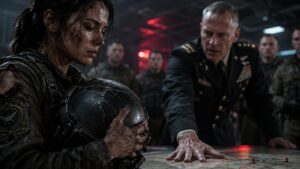
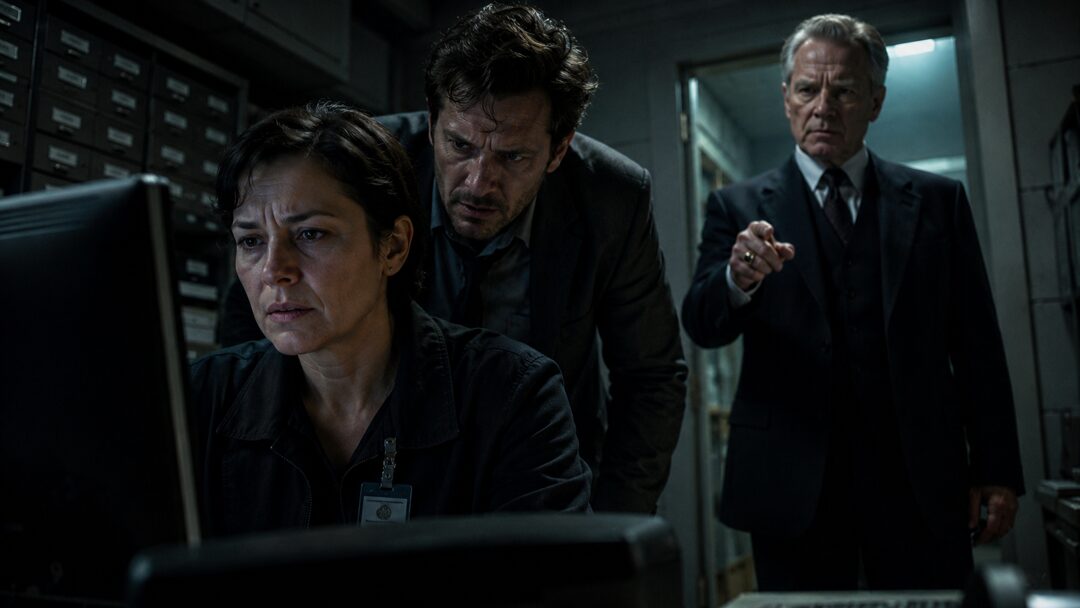
Daniel stepped closer to the workstation. He had not shaved. His suit jacket was wrinkled at the elbows, like he had slept in it or forgotten sleep was an option. In the blue monitor light, he looked less like a captain and more like a brother who had run out of rooms to ask in.
“My sister sent one message before she disappeared,” he said. “If it goes black, listen.”
Lisa’s hand paused over the keyboard.
The file name sat in the corner of her screen, sterile and useless.
Archive Item 7A-13. Recovered media. Duration: 00:00:12.14.
The report called it “corrupted auxiliary footage from a failed border extraction.”
Daniel called it Emily.
Lisa clicked play.
For four seconds, there was almost nothing.
A low hiss.
A faint scrape.
Then, between seconds five and eight, the audio swelled. Not music. Not a clean voice. A hard rise of sound like air being forced into a narrow place, with something beneath it that might have been a breath, or metal, or a word trying to survive damage.
At twelve seconds, the file ended.
The screen remained black.
Daniel leaned forward as if the darkness had refused him personally.
“Again.”
Lisa exhaled through her nose. “Captain Hayes—”
“Again.”
“You’re not going to see anything.”
“I’m not asking to see.”
That stopped her.
For twelve years, Lisa had trusted visible evidence least of all. Video could be clipped, framed, mislabeled, stripped of context. Audio could lie too, but it lied differently. It left pressure in the room.
She played it again.
Nothing. Nothing. Nothing.
Then the swell.
Daniel closed his eyes.
Lisa watched the waveform instead of his face. The spike rose too cleanly for random corruption. It had shape. A beginning. A choke point. A drop.
She had seen destroyed files before. This one bothered her.
The archive door opened behind them.
Retired Colonel James Walker stepped in wearing a dark overcoat over a suit, his gray hair neatly combed, his posture still carrying the old command room. He did not look surprised to find Daniel there.
He looked disappointed to find Lisa still listening.
“Ms. Carter,” Walker said, “this review was supposed to be procedural.”
Daniel turned. “Then why are you here before dawn?”
Walker ignored him.
Lisa closed the file window but left the waveform up.
Walker saw it.
His expression changed only slightly.
Lisa noticed anyway.
“Sir,” she said.
Old habits were dangerous. She had not reported to James Walker in six years.
He heard the word too.
“It’s corrupted,” Walker said. “No video, no transcript, no reliable metadata. Certify it as non-actionable and close the evidence chain.”
Daniel laughed once.
It was not humor. It was damage.
“My sister disappears, the only file comes back blind, and your answer is paperwork?”
Walker finally looked at him.
“Your sister served under difficult conditions. I am sorry for your family’s loss.”
“Don’t say loss like she misplaced herself.”
The archive hummed around them.
Lisa looked back at the waveform.
Twelve seconds.
One black screen.
One sound in the middle that did not want to be nothing.
Part II — Static
By 3:06 a.m., Lisa had confirmed everything the report already said and one thing it did not.
The MP4 contained no visual stream. Not a blank image track. Not missing frames. No video stream at all.
There were no subtitles. No embedded captions. No readable metadata proving an edit. No transcript. No device ID intact enough to tie it to one operator. The file should have been useless.
Should have been.
Daniel stood beside her desk with both hands braced on the metal edge.
Walker stood behind him, still as a locked door.
Lisa replayed the spike through an isolation filter. The sound stretched, thinned, broke apart.
At first it was only pressure.
Then, underneath, something like a breath.
A metallic impact.
A clipped voice.
Not words. Not enough.
Lisa stopped playback.
Daniel looked at her. “You heard that.”
“I heard artifacts.”
“No. You heard a person.”
“I heard something that could be human.”
“That’s what they always say when they don’t want to say who.”
Walker’s voice cut in. “Grief makes families invent patterns.”
Daniel turned on him. “My sister told me to listen if it went black.”
Walker’s jaw tightened. “And you have been listening to twelve seconds of damaged audio for eight months because you cannot accept that some operations end without answers.”
Daniel moved toward him.
Lisa stood before either man could step closer.
“Enough.”
Both looked at her.
She hated that one word from her could still sound like command.
She brought the waveform back on-screen and enlarged the spike. “This isn’t random. That does not mean it is proof of what happened. It means it deserves review.”
Walker’s eyes stayed on the screen. “It has had review.”
“Not mine.”
A silence.
Then Walker said, softer, “Lisa.”
That was worse than Ms. Carter.
Lisa remembered him in a ruined comms room years earlier, making the call no one else could make. She remembered his voice over a channel full of panic, saving thirty-seven people by leaving a corridor they could not hold. She remembered hating him for it until dawn, then understanding by noon.
Her loyalty to him was not blind.
That made it harder.
Daniel reached into his jacket and pulled out a folded paper, soft from being opened too many times.
He placed it beside Lisa’s keyboard.
“My sister’s last message.”
Lisa did not touch it.
The message was printed from a secure family notification portal, three lines of timestamped text.
Signal unstable. Moving wounded. If it goes black, listen.
Lisa read it twice.
Emily Hayes had known.
Or feared.
Or guessed.
The file was black because of corruption, Walker would say.
Because of damage.
Because border extractions were chaos.
Because everyone wanted meaning after loss.
Lisa replayed the audio again.
At second six, the swell rose.
This time, she heard what Daniel heard.
Not words.
Presence.
Walker said, “You are building a story around static.”
Lisa looked at him. “No, sir. I’m checking whether the static was built around a story.”
Daniel went very still.
Walker’s face did not change.
But his right hand closed around the old command ring he wore on his smallest finger.
Lisa saw that too.
Part III — The Clean Report
The official extraction report was too clean.
That was the first real warning.
At 3:42 a.m., Lisa pulled the surrounding mission files from restricted storage. Operation names had been redacted. Coordinates masked. Unit structure reduced to bland phrases. That was normal.
What was not normal was the lack of friction.
No disputed order.
No timing conflict.
No comms breakdown beyond “intermittent signal degradation.”
No mention of Emily Hayes after withdrawal began.
The report read like a hallway after the blood had been mopped, the lights restored, the doors locked.
Lisa leaned closer.
Daniel watched her read. “What?”
“Your sister’s last known position was outside the cleared corridor.”
“I know.”
“No,” Lisa said. “I mean the report knows and doesn’t say it directly.”
Walker stepped forward. “Classified reports are not written for emotional satisfaction.”
Daniel turned, tired and furious. “Were they written for truth?”
Walker did not answer fast enough.
Lisa opened the evidence package history. File 7A-13 had not been included in the first submission.
It appeared two days later.
After the official report had already been drafted.
She said nothing for a moment.
Daniel noticed. “What did you find?”
Walker said, “Lisa.”
She kept her voice level. “The audio-only file was added late.”
Daniel stared at the screen. “How late?”
“Forty-seven hours after the first package.”
Daniel looked at Walker. “You knew?”
Walker’s face hardened into command. “Evidence packages are assembled under operational pressure. Late additions are not unusual.”
Lisa should have agreed.
She had written those words herself in other reviews.
Instead, she clicked open the file history again.
The source field was blank.
Not redacted.
Blank.
That was worse.
Daniel’s voice dropped. “Someone wanted it in there, but not enough to explain it.”
Lisa said, “Or someone wanted it found later.”
Walker looked at her sharply.
There it was again.
A little crack.
Daniel saw it too.
For the first time since entering the archive, his anger shifted direction. It stopped pushing only at Lisa and moved toward the man behind him.
“What happened at that border?”
Walker’s tone went flat. “Your sister was part of a medical support element attached to an extraction team. The team encountered hostile conditions. Withdrawal was ordered. She was unaccounted for during chaotic movement.”
“You make it sound like she wandered off.”
“No.”
“Then say it like a person.”
Walker’s eyes sharpened. “Captain Hayes, I have written letters to families. I have stood beside closed caskets. I do not need instruction in grief.”
Daniel stepped closer.
“No,” he said. “You need instruction in my sister’s name.”
The room went cold.
Lisa looked back at the screen because if she looked at either man, she might choose a side too early.
Emily Hayes.
Junior field medic.
Last known active after signal degradation.
Unaccounted for during withdrawal.
Those were official phrases.
Daniel was right. None of them sounded like a person.
Lisa isolated the spike again and adjusted the spectral view. A band of sound dropped out just before the swell, as if something had covered the microphone.
Not a blast.
Not interference.
A change in room tone.
A hand over a device. Fabric. A pocket. A case closing.
Something had made the world go black and muffled at the same time.
Lisa felt the first clean line of dread.
Walker moved beside her.
“You need to stop widening this.”
“Why?”
“Because there are surviving personnel whose lives still depend on what remains classified.”
“Or whose careers do.”
He looked at her then not as a subordinate, not as a civilian contractor, but as someone who had almost disappointed him enough to matter.
“I saved your unit once,” he said quietly.
Lisa did not move.
“Yes,” she said. “You did.”
His voice softened. “Then believe me when I tell you there are situations where the full truth helps no one.”
Daniel whispered, “It helps the erased.”
Lisa looked at the waveform.
Between seconds five and eight, Emily Hayes had become a shape of sound.
Not enough to bring her home.
Enough to make silence look chosen.
Part IV — The Time That Stayed
Walker sealed the review at 4:18 a.m.
The order came through Lisa’s terminal with no drama.
Access restricted pending board review. All derivative analysis files to be deleted. Unauthorized copies prohibited.
Daniel read it over her shoulder.
His face went slack with a familiar kind of defeat.
“They’re closing it.”
Lisa did not answer.
The system asked her to confirm deletion of her forensic work copy.
Walker stood by the archive door.
“I’ll take responsibility for the board,” he said. “You can state that technical corruption prevented further analysis. That is true.”
Lisa stared at the prompt.
Confirm deletion?
True.
That word had become too small.
The file was corrupted. True.
There was no video stream. True.
No confirmed transcript. True.
No conclusive proof of Emily’s final fate. True.
The official timeline was clean. Also true, because someone had cleaned it.
Daniel’s voice came low beside her. “You’re going to do it.”
Lisa looked at him.
His anger was gone. That was worse.
“You’re going to become another person who tells me nothing can be confirmed.”
She wanted to defend herself.
She wanted to say she had rules. Limits. A career. An obligation not to invent evidence around a family’s pain. A duty not to turn uncertainty into accusation.
All of that was true too.
Then Daniel said, “I don’t need him to be a monster.”
He looked at Walker.
“I need her not to be missing from her own ending.”
Lisa turned back to the screen.
The deletion prompt glowed.
She clicked cancel.
Walker straightened. “Lisa.”
“Board review starts in forty minutes,” she said. “I’m preserving my notes until then.”
“That is not authorized.”
“No. It is not deleted.”
She reopened the raw packet and pulled the timestamps, not the file creation time. The embedded audio clock. The internal drift. The fragment no one had bothered to clean because no one thought a blank file would matter.
Her pulse changed.
She checked it again.
Then a third time.
Daniel heard her breathing shift.
“What?”
Lisa did not answer until she was sure.
The official withdrawal time was 21:07:12.
The audio spike occurred at 21:09:48.
Two minutes and thirty-six seconds later.
Someone had still been recording after the report said the area was abandoned.
Lisa sat very still.
Walker’s face lost color.
Daniel looked between them. “What does that mean?”
“It means,” Lisa said carefully, “the file does not tell us what happened to Emily.”
Daniel’s jaw tightened.
“But it proves the report timeline is false.”
The words landed harder than she expected.
Daniel put one hand on the desk as if he needed the metal to stay upright.
Walker came forward. “That timestamp can be drift. Damage. Packet reconstruction error.”
“It can,” Lisa said. “But the drift is consistent before and after the spike.”
“You cannot build an accusation from a blank screen.”
Lisa looked at him.
Not with anger.
With grief, maybe.
For who he had been when she believed hard choices ended when the order was given.
“No,” she said. “But we built a report from one.”
Walker said nothing.
Daniel closed his eyes.
For the first time all night, he was not asking the file to give him everything.
Only enough.
Part V — What Could Be Said
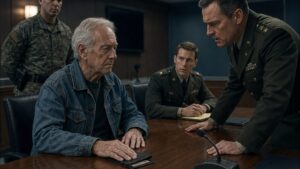
The closed review board met before sunrise in a windowless room three floors above the archive.
Five officials sat along one side of a polished table. Walker sat at the far end. Lisa sat opposite him with her laptop open. Daniel had been allowed in as next of kin after signing two forms and being warned not to interrupt.
He had not laughed when they said that.
That was how Lisa knew he was tired past anger.
The file played on the room’s main screen.
Black.
Four seconds of hiss.
The swell.
The possible breath.
The possible impact.
The possible voice.
The end.
No one moved.
The black screen reflected them all faintly: uniforms, suits, badges, folded hands, controlled faces waiting for language to protect them.
A brigadier general Lisa did not know cleared his throat. “Ms. Carter, your certification?”
Walker looked at her.
Not pleading.
Not threatening.
Worse.
Expecting.
Lisa opened the safe statement first.
File corrupted. No visual stream. Insufficient evidence for narrative reconstruction. Recommend classification as non-actionable.
She could say it and remain accurate.
She could walk out with her badge.
Daniel would hate her.
Walker would approve of her.
Emily Hayes would stay where the report left her, inside a phrase no one had to picture.
Lisa closed the document.
Then she opened the other one.
“The file contains no video stream,” she said. “No subtitles, no transcript, and no recoverable image data. I cannot confirm what happened to Medic Emily Hayes from this recording.”
Daniel’s hands tightened under the table.
Walker’s eyes remained on her.
Lisa continued.
“I also cannot certify it as meaningless.”
The room shifted.
The general leaned forward. “Explain.”
“The audio spike between seconds five and eight is not consistent with random degradation alone. It contains a room-tone shift suggesting the recording device was physically obstructed or enclosed. Beneath that shift are possible human sounds, though not enough for transcript-level identification.”
Walker said, “Possible.”
“Yes,” Lisa said. “Possible. Not conclusive.”
“Then we are done.”
“No, sir.”
She brought up the timestamp overlay.
“The official report places complete withdrawal at 21:07:12. The internal audio clock places the spike at 21:09:48. Even accounting for packet drift, the recording continued after the report says no personnel or devices remained active in that zone.”
No one spoke.
The general looked at Walker.
Walker looked at the screen.
Daniel looked at nothing.
Lisa heard her own heartbeat in the silence.
Walker said, “You are implying misconduct.”
“I am stating a contradiction.”
“You are inviting a family to believe in an answer you do not have.”
Daniel lifted his head.
Lisa looked at him only briefly, then back to the board.
“No,” she said. “I am refusing to let the absence of an image erase the presence of an event.”
Walker’s mouth tightened.
The general asked, “Colonel Walker, was the report timeline simplified?”
There were many ways he could have answered.
Classified.
Operational necessity.
Data conflict.
Fog of mission.
Lisa watched him consider each door.
Then, slowly, Walker removed his glasses and set them on the table.
“Yes.”
Daniel stopped breathing.
Walker did not look at him.
“The extraction was compromised. Withdrawal was ordered before Medic Hayes’s last known position was cleared. The report was simplified to protect surviving personnel, command integrity, and the families from an uncertainty we could not resolve.”
Daniel stood so suddenly his chair scraped backward.
A security officer moved.
Lisa raised one hand without thinking.
Daniel did not shout.
That made it worse.
“You let me think she vanished in chaos.”
Walker looked up at him.
“She did vanish in chaos.”
“No,” Daniel said. “You put the chaos where your choice should have been.”
Walker closed his eyes.
The room did not collapse. No one confessed to murder. No hidden video appeared. Emily did not return through the black screen.
But something changed.
A sentence that had held for eight months finally cracked.
Lisa looked at the frozen waveform on her laptop.
At second six, the line rose.
A little mountain of sound.
Not enough to show Emily’s face.
Enough to prove she had still been there.
Part VI — Listening
The amended record arrived eleven days later.
Not to the public. Not to the news. Not with apology attached.
A secure copy came to Daniel first, then to Lisa for archival certification.
Emily Hayes was no longer listed as unaccounted for during chaotic withdrawal.
The new line read:
Last confirmed active after command withdrawal.
It was a small sentence.
Too small for a sister.
Too large for the old report to survive unchanged.
Walker’s name did not disappear from the board. His medals were not stripped. No dramatic announcement satisfied Daniel’s grief. There were inquiries, careful language, closed rooms, and men learning how to say “timeline discrepancy” as if it had not once been a person waiting past rescue.
Lisa had expected anger to follow.
It did.
Then came something quieter.
A fatigue that sat in her bones after every official email. A knowledge that she had told the truth and still left Daniel with almost everything unanswered.
On the twelfth day, he came back to the archive.
He looked cleaner. Not better.
No one looked better after learning that uncertainty had been managed for them.
Lisa handed him a printed copy of her annotated report. She had marked one line herself before sealing it.
Absence of image does not equal absence of event.
Daniel read it for a long time.
Then he said, “Can I hear it again?”
Lisa hesitated.
Not because she could not play it.
Because she understood now what he was asking.
Not for proof.
Not for a miracle voice.
Not for the part they cut out.
Just twelve seconds where Emily had not yet been made into wording.
Lisa opened the file.
Daniel sat beside her this time instead of standing behind her.
The screen went black.
Neither of them looked away.
The hiss began.
At second five, the sound rose.
Daniel closed his eyes, but not like before. Not reaching. Not begging.
Listening.
There was the breath, maybe.
The impact, maybe.
The clipped voice, still [unclear].
At twelve seconds, the file ended.
For a while, neither of them moved.
“What do you hear?” Lisa asked.
Daniel looked at the blank screen.
“My sister,” he said.
Lisa did not correct him.
Technically, she could not confirm that.
Humanly, she no longer wanted to.
After he left, Lisa stayed in the archive alone. She printed the waveform spike on plain paper and folded it once. She did not put it in the official file. She did not label it evidence.
She placed it in the back of her desk drawer, where only she would know to find it.
Not because it proved everything.
Because it proved something had almost been turned into nothing.
The archive lights hummed above her. The monitor slept black.
Lisa sat with the silence for another minute before closing the drawer.
Some truths did not arrive with faces.
Some came as damaged sound, bad timing, a brother who would not stop listening, and one person finally willing to say the blank space was not empty.