The Day She Stayed
Part I — The Dress Waiting Inside
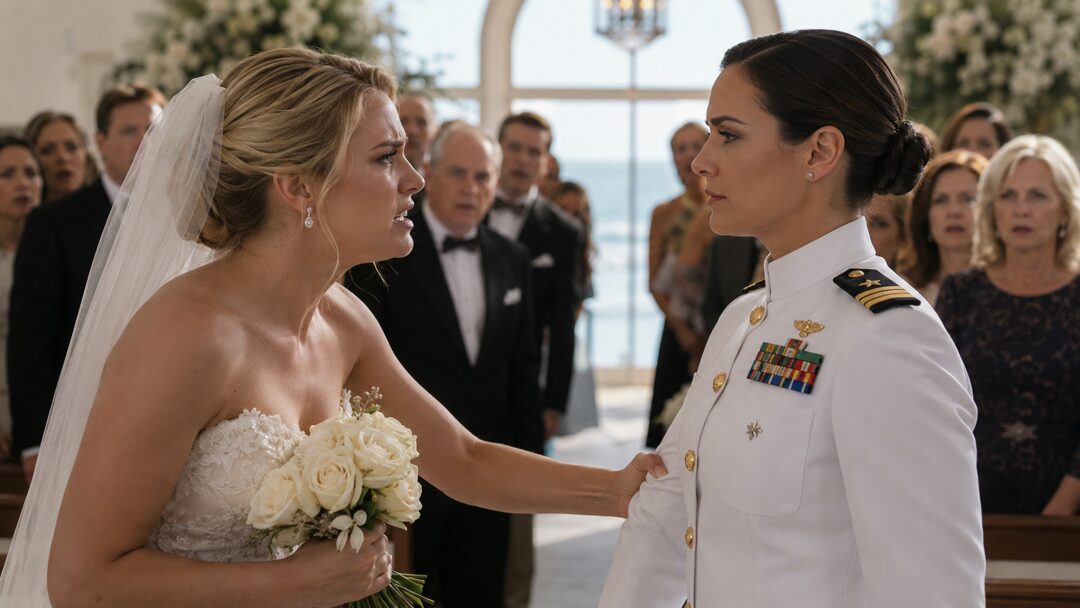
“Not today,” Linda Parker hissed, both hands locked around Sarah Miller’s arms. “You are not doing this today.”
Sarah stood at the edge of the beachside pavilion in full Navy dress whites, the Pacific bright behind her, gold buttons catching the last clean light of afternoon. Guests in linen suits and pastel dresses had already started turning their heads.
That was what Linda feared most.
Not the argument.
The witnesses.
“Let go of me, Aunt Linda,” Sarah said.
Her voice was calm enough to make the grip look worse.
Linda’s pearl necklace shifted against her throat as she leaned closer. Her navy blue dress had sequined cuffs that glittered every time her fingers tightened.
“You had one job,” Linda said. “One. Come here, smile, sit down, and let Emily have her day.”
Emily Parker stood beside them in her wedding gown, one hand crushed around a bouquet of white roses. Her veil lifted in the ocean wind. She looked less like a bride than a woman trying not to scream in front of two hundred people.
“You promised you wouldn’t make this about you,” Emily said.
Sarah looked at her cousin. “I promised I’d come.”
“In that?” Emily’s eyes dropped to the rows of ribbons over Sarah’s chest. “You knew what people would do. You knew they’d stare.”
“They can stare quietly.”
“That’s not funny.”
“It wasn’t meant to be.”
Linda lowered her voice, which only made it sharper. “Go inside. The blue dress is hanging in the changing room. It’s pressed. It’s appropriate. It’s normal.”
Sarah’s face did not move.
But something in her stomach did.
The blue dress.
She had seen it when she arrived. Pale blue, sleeveless, careful. The kind of dress chosen by someone who wanted a woman to look softer from a distance.
It was almost the same color as the civilian shirt Sarah had worn seven years earlier when she came home from deployment and found Robert Parker waiting in her parents’ kitchen, unable to look at her.
That day, he had pressed a small bronze pin into her palm.
Then he had said, “Emily doesn’t need to know how bad it was.”
Sarah had closed her fingers around the pin.
And she had agreed.
Now that same pin sat beneath her ribbons, small enough to be missed by anyone who did not know to look for it.
Linda’s fingers squeezed again. “Robert cannot handle seeing those ribbons.”
At the mention of her father, Emily’s anger sharpened into fear.
“Dad has barely slept all week,” Emily said. “He wanted one peaceful day. I wanted one peaceful day.”
Sarah’s jaw tightened once. Only once.
“I’m not in your bridal party,” she said. “I’m not giving a speech. I’m not asking anyone to thank me. I’m here as family.”
“You’re here as a headline,” Emily snapped.
The words landed harder than Sarah expected.
Behind Emily, the wedding arch trembled in the wind. White flowers shivered loose and slid down the wooden frame. A few guests pretended not to watch. Most failed.
Linda leaned in so close Sarah could smell hairspray and salt air.
“Change,” she said. “Or leave.”
For a moment, Sarah looked past them.
Beyond the arch.
Beyond the aisle lined with white chairs.
Beyond the ocean moving as if none of this mattered.
She had commanded under alarms, under failing engines, under voices on a radio breaking apart. She had watched good people obey impossible orders because there were no better ones. She had learned that panic was contagious, but so was control.
So she did not pull away hard.
She simply removed Linda’s hands from her sleeves.
One finger at a time.
“No,” Sarah said.
Emily’s lips parted.
Linda looked as if Sarah had slapped her.
The wedding coordinator, a thin man with a headset and a clipboard, hurried toward them with panic in his eyes.
“Mrs. Parker?” he said to Linda. “We have to move the ceremony inside. The wind’s lifting the arch. The chapel is ready.”
Linda did not turn. “Give us five minutes.”
“We don’t have five minutes.”
The arch gave a sharp wooden creak behind him.
A bridesmaid gasped.
Guests rose from their seats in a restless wave, unsure whether to look at the collapsing flowers or the woman in white who was not the bride.
Sarah adjusted the edge of her sleeve.
Emily saw the movement and laughed once, bitterly.
“Of course,” she said. “Perfect. Now everyone gets to watch you walk in.”
Sarah looked at her.
There were many things she could have said.
That Robert had asked for silence, not forgiveness.
That the ribbons Emily hated were not decorations.
That the worst day of her life had not ended when the transport doors opened.
But the bride was standing in her lace gown with fear under her anger, and this was still her wedding day.
So Sarah said only, “I’m going inside.”
Linda stepped in front of her.
“If he walks out because of you,” Linda whispered, “that is on you.”
Sarah held her aunt’s gaze.
“No,” she said. “It won’t be.”
Then she walked past them.
The guests parted before they understood they were doing it.
Part II — The Room That Went Quiet
The chapel sat just beyond the pavilion, white stucco and arched windows, polished for weddings and memorials and Sunday mornings. Today it smelled of lilies, floor wax, and ocean air dragged in by nervous guests.
Sarah entered alone.
That was the first thing everyone noticed.
The second was the uniform.
Conversation thinned, then broke into whispers.
Gold buttons. White sleeves. Shoulder boards. Dark hair pinned cleanly at the back of her head. No jewelry except small pearl studs, no softening accessory, nothing borrowed from the bride’s world.
Sarah walked down the side aisle, not the center.
She had no desire to perform.
But attention followed her anyway.
A woman in the third row touched her husband’s wrist and murmured something. Two young men straightened without realizing it. An older guest frowned, trying to place whether Sarah’s presence was formal, rude, or both.
Then Sarah saw Captain James Walker.
He sat near the front on the groom’s side, though Sarah knew he had no connection to the groom. Dark Navy dress uniform. Silver at his temples. Hands folded over his program.
For half a second, his expression did not change.
Then his eyes moved to the bronze pin beneath her ribbons.
Sarah stopped breathing.
Walker had been there seven years ago. Not in the transport, but on the other end of the radio, listening to Sarah report numbers that changed by the minute. He knew what Robert Parker had never told his daughter.
He knew which names had not come home.
Walker rose slightly when he saw Sarah pause.
Not enough to draw attention.
Enough for her to understand the question.
Do you want me to say something?
Sarah gave the smallest shake of her head.
Walker sat back down.
That was the Navy version of an argument.
Silent, complete, and not over.
Sarah took a seat on the aisle, three rows behind Robert Parker.
She had not seen him yet.
Only the back of his head. Gray hair trimmed carefully. Black tuxedo. Bow tie a little too tight. His shoulders were higher than they should have been.
Linda entered next, pulling Emily behind a cluster of bridesmaids.
Emily’s face had been repaired by makeup and discipline. Her bouquet had not recovered. Several rose stems bent at odd angles where her fingers had crushed them.
Linda saw Sarah seated in the aisle and stopped cold.
For one second, her polished face slipped.
Not anger.
Fear.
Then she lifted her chin and resumed her work. She guided relatives, corrected the flower girl’s sash, whispered to the coordinator, touched Robert’s shoulder from behind.
Robert flinched before he knew who it was.
Sarah saw it.
So did Walker.
Emily stood at the chapel entrance with her mother, waiting for the music cue. The groom waited at the altar, pale and helpless in the way good men often looked at weddings when the women they loved were fighting wars they did not understand.
The organ began.
Everyone stood.
Sarah stood too.
The motion made the ribbons shift gently against her chest.
Robert turned.
Not fully. Just enough to glance back at the guests.
His eyes found Sarah.
The chapel did not vanish. The music did not stop. No one gasped yet.
But Robert Parker’s face changed as if someone had opened a door beneath him.
First confusion.
Then recognition.
Then something much worse than anger.
His eyes dropped to the bronze pin.
Sarah did not move.
Robert’s mouth opened slightly.
The pin was small. Tarnished at the edges. Not regulation, not decorative enough for anyone else to admire. He had given it to her with shaking hands in a quiet kitchen because he had not known how else to say thank you.
Now he looked at it like it had followed him here.
Linda saw his face and stepped closer.
“Robert,” she whispered.
He did not answer.
Emily began walking down the aisle.
Every guest turned toward the bride.
Almost every guest.
Robert kept looking at Sarah.
Emily saw it before she reached him.
Her steps faltered.
Just slightly.
Enough.
Sarah watched her cousin’s eyes move from Robert to Sarah, then to the ribbons, then back again.
The anger returned, but now it had a crack in it.
Emily reached her father.
He offered his arm too slowly.
“Dad?” she whispered, smiling for the room.
Robert blinked.
His arm lifted.
The room exhaled.
But Sarah knew the look on his face.
It was not the face of a man embarrassed by a relative.
It was the face of a man who had survived something he had never learned how to remember.
Part III — What She Almost Said
The ceremony should have started then.
It did not.
A junior bridesmaid stepped on Emily’s train. The coordinator hurried forward. The officiant smiled too broadly. Linda whispered instructions with the speed of a woman trying to outrun disaster.
Emily turned her head toward Sarah.
This time she did not look furious.
She looked betrayed.
That was harder.
The coordinator asked everyone to remain standing while the train was adjusted. Chairs scraped. Someone coughed. The groom gave Emily a small encouraging smile.
Emily did not see it.
She handed her bouquet to a bridesmaid and stepped out of line.
“Emily,” Linda whispered sharply.
“I need one minute.”
“Not now.”
Emily walked straight to Sarah.
The chapel watched without pretending anymore.
Sarah stayed beside her pew.
Emily stopped close enough that her veil brushed Sarah’s sleeve.
“You couldn’t even sit in the back?” Emily whispered.
“I am in the third row.”
“You know what I mean.”
“No,” Sarah said softly. “I don’t think you know what you mean.”
Emily’s eyes flashed. “Don’t talk to me like I’m one of your officers.”
“I wouldn’t.”
That landed. Emily’s face tightened.
“You think because you wear that, everyone owes you reverence.”
Sarah looked toward the altar, then back at her cousin.
“No,” she said. “I know they don’t.”
“Then why wear it?”
Sarah’s throat moved.
Behind Emily, Robert stood motionless. Linda’s hand hovered near his elbow, not touching now. Walker sat very still near the front, eyes lowered, as if giving Sarah privacy inside a room full of people.
Emily leaned closer.
“Why today?”
The answer rose so fast Sarah almost let it out.
Because your father asked me to make his survival quiet.
Because he made me promise you would remember him as strong.
Because some people come home and still leave part of themselves behind.
Because I am tired of being treated like the reminder instead of the reason.
But Emily was in a wedding gown.
Her father was ten feet away.
And the whole room was waiting to see whether Sarah would defend herself by destroying someone else’s peace.
Sarah swallowed the truth.
“I came because you invited me,” she said.
Emily let out a small, wounded laugh. “I invited my cousin. Not Commander Miller.”
Sarah’s eyes softened despite herself.
“I don’t know how to separate them anymore.”
Emily had no answer to that.
For a second, her anger looked young. Not childish. Young. Like the twelve-year-old who used to follow Sarah around family barbecues asking if ships had bedrooms and whether Sarah had ever seen dolphins from the deck.
Then Linda appeared at Emily’s shoulder.
“That’s enough,” Linda said, but she was looking at Sarah.
Sarah understood the warning.
Not here.
Not him.
Not the old story.
Linda had not been there in the kitchen when Robert gave Sarah the pin. But she had been there afterward, when the nightmares started and Robert stopped driving at night and Emily learned to speak around her father’s silences.
Linda had built a family system out of avoidance.
She called it peace.
Sarah called it something else, but never out loud.
Emily stepped back.
“I hope it was worth it,” she said.
Sarah held her gaze.
“So do I.”
Emily returned to her father.
The coordinator breathed again. The officiant lifted his program. The guests settled into the uneasy silence of people who had witnessed something intimate without understanding it.
Walker’s eyes met Sarah’s.
This time his face was not asking permission.
It was asking how long she intended to keep bleeding quietly for someone else’s comfort.
Sarah looked away first.
Part IV — The Question at the Front
The chapel ceremony resumed like a glass carried with wet hands.
Every movement seemed careful.
Too careful.
Emily’s groom, Daniel, took her hand at the altar. He whispered something that made her blink hard, but she did not cry. She kept looking at Robert, then at Sarah, then down at the white roses now held by her maid of honor.
Linda sat in the front row with perfect posture.
Her lips moved once.
Maybe a prayer.
Maybe a warning.
Sarah remained standing until everyone else sat. She did nothing unusual. Nothing disrespectful. She folded her hands in front of her and kept her eyes on the officiant.
But still, the room kept returning to her.
That was the thing Emily did not understand.
Sarah could not make herself invisible by wanting it.
The officiant spoke about devotion. About choosing one another in ordinary hours. About families joining, histories meeting, love becoming public.
Sarah almost smiled at that.
Histories meeting.
Some histories did not meet.
They sat in the same room and stared at the floor.
Robert’s hands trembled when the officiant asked him to place Emily’s hand into Daniel’s.
Emily noticed. Her expression changed.
“Dad?”
“I’m all right,” Robert said.
He was not.
Sarah could see the pulse in his neck. She had seen men look steadier with alarms sounding above them.
Walker saw it too.
He leaned forward.
Linda caught the movement and turned her head. Her eyes narrowed at him, quick and defensive. She did not know Walker, but she knew danger when it wore authority.
The officiant smiled gently.
“Robert,” he said, “when you’re ready.”
Robert nodded.
He lifted Emily’s hand.
Then his eyes moved again.
Not to Sarah’s face this time.
To the pin.
Seven years ago, Robert Parker had been a civilian contractor on a transport leaving a coastal evacuation point that had gone bad before sunrise. Sarah had been the officer who got him out when smoke filled the cabin and the manifest stopped matching the people in front of her.
That was all anyone needed to know.
That was all Sarah let herself remember in order.
Not the heat.
Not the voice calling for a medic.
Not Robert gripping her sleeve and saying, “My daughter. My daughter’s twelve.”
Not the moment Sarah shoved him forward and someone behind them did not make it.
Robert’s hand closed around Emily’s.
He looked at his daughter in her white gown and saw, perhaps for the first time that day, the life he had been allowed to keep living.
Her graduation.
Her first apartment.
The call when she got engaged.
This aisle.
This exact impossible aisle.
All the days Sarah had bought him and never named.
The officiant turned toward the guests.
“Who gives this woman to be married?”
It was an old question.
A ceremonial question.
A simple question, if no one in the room was carrying too much truth.
Robert inhaled.
His mouth opened.
Nothing came out.
Emily’s smile froze.
Linda leaned forward. “Robert.”
Daniel’s hand tightened around Emily’s.
The room changed. Not loudly. It became alert in that animal way rooms do when something real slips into ceremony.
Walker began to rise.
Sarah saw the motion from the corner of her eye.
No.
She did not say it.
She only turned her head and looked at him.
Walker stopped halfway out of his seat.
For one stretched second, they were back on the radio. Sarah making a call. Walker waiting to see whether he would override it.
Then he sat down.
Sarah faced forward again.
This was not his truth to tell.
It was not hers either.
Not unless Robert left her no choice.
The silence widened.
Emily whispered, “Dad?”
Robert closed his eyes.
When he opened them, they were wet.
“Her mother and I do,” he said.
The chapel breathed.
Emily’s shoulders eased.
Then Robert turned.
Not fully toward the room.
Just enough that his words reached the third row.
“And the woman who brought me home.”
No one moved.
The sentence was quiet.
It did not belong to a toast. It was not polished enough for public gratitude. It carried no details, no explanation, no grand confession.
That was why it cut cleanly.
Emily’s face changed in stages.
Confusion first.
Then denial.
Then the terrible beginning of understanding.
Her eyes dropped to Sarah’s ribbons.
To the bronze pin.
To her father’s hand, still trembling.
Linda lowered her head.
Not in prayer this time.
Sarah stood very still.
She did not smile.
She did not nod.
She did not rescue Robert from the silence he had finally chosen.
The officiant, wisely, said nothing for three full seconds.
Then he continued.
And the ceremony went on.
But it was not the same ceremony anymore.
Part V — The Sentence That Stayed
Vows were exchanged.
Rings found fingers.
The guests laughed once when Daniel fumbled his line, and the laugh was grateful, almost desperate. Emily smiled at him through tears that were no longer entirely bridal.
Sarah watched without moving.
She should have felt relief.
Instead she felt the old, familiar ache of a door opening onto a room she had kept locked too long.
Robert did not look back again.
That was mercy.
Or shame.
With families, Sarah had learned, it was often both.
When the officiant pronounced Emily and Daniel married, the chapel stood. Applause rose, careful at first, then warmer. The couple turned. Emily’s smile held, but her eyes went straight to Sarah.
Sarah gave her a small nod.
Emily did not return it.
Not yet.
The recessional music began. Daniel led Emily down the aisle. As they passed Sarah’s row, Emily slowed.
For one second, bride and officer stood almost shoulder to shoulder.
Emily’s bouquet brushed Sarah’s sleeve.
“I didn’t know,” Emily whispered.
Sarah kept her face forward.
“I know.”
That was all.
Emily moved on.
The guests followed in bright clusters, eager for sunlight, drinks, anything easier than what had happened in the chapel. Their whispers changed as they passed Sarah. Less judgment now. More curiosity. A little awe. A little embarrassment from those who had enjoyed the wrong version of the story too early.
Sarah stayed seated until the row cleared.
Walker approached first.
He stood beside her pew and did not salute. Not here. Not in front of family.
“You all right, Commander?”
Sarah looked up at him.
“Sir, that’s a complicated question.”
His mouth softened.
“Usually is.”
He glanced toward the open chapel doors, where Robert stood with Linda and Emily, trapped in congratulations.
“I almost said something,” Walker said.
“I know.”
“You would have hated me for it.”
“Yes.”
“But not forever.”
Sarah looked down at her hands.
“No,” she said. “Not forever.”
Walker nodded once. “You carried more than the report asked you to carry.”
Sarah’s eyes lifted.
That was too close.
He knew it and looked away.
“Take care of yourself,” he said.
It was not advice.
It was an order softened by age.
Sarah stood. “Aye, sir.”
Outside, the wind had dropped.
The broken beach arch had been dragged aside. A few flowers lay scattered in the sand, white petals bruised brown at the edges. Staff moved chairs toward the reception lawn as if nothing had happened that could not be fixed with enough hands.
Linda stood near the chapel steps, speaking to no one.
For once, she did not appear to know where to put herself.
When Sarah stepped into the sunlight, Linda looked at her, then away.
No apology.
No command.
Just the absence of another attempt to control her.
That was not forgiveness.
But it was new.
Robert stood a few yards beyond her, one hand pressed against his tuxedo jacket as if steadying something inside it. Emily was beside him now, veil loose, bouquet lowered.
Sarah almost turned toward the reception without speaking.
Then Robert moved.
Slowly, as if every step had been negotiated with old memory.
He stopped in front of her.
For seven years, Robert Parker had been a man Sarah protected by accepting his silence.
Now he looked smaller than he had in the chapel.
Not weak.
Just uncovered.
His eyes dropped to the bronze pin.
His hand lifted, stopped, then continued. He touched the pin with two fingers, careful not to disturb the ribbons above it.
“I didn’t know you still wore it,” he said.
Sarah’s voice came out quieter than she intended.
“I don’t always.”
“But today.”
“Yes.”
He nodded.
His mouth trembled once. He controlled it.
“I should have said it sooner.”
Sarah looked past him to Emily, who was watching with a face full of questions no wedding day could hold.
“Yes,” Sarah said.
Robert accepted the answer like he had earned nothing softer.
“I was ashamed,” he said.
“I know.”
“Not of you.”
This time Sarah looked directly at him.
Robert swallowed.
“Of being the one who came back.”
The wind moved between them.
There it was.
Not the whole truth.
Enough.
Sarah did not tell him he should not feel that way. She had never trusted comfort that tried to erase the wound in order to make the room feel better.
Instead she said, “You came back to her.”
Robert closed his eyes briefly.
When he opened them, Emily was there.
She had walked closer without anyone noticing.
Her voice was unsteady. “Dad?”
Robert turned.
The old habit rose in his face. Protect her. Spare her. Smooth it over.
Then he looked at Sarah.
And this time, he did not ask her to carry it.
“There are things I should have told you,” Robert said to Emily. “Not today. Not all of it. But enough.”
Emily’s eyes filled.
She looked at Sarah.
All the anger from earlier had nowhere to stand now. It had not vanished. It had changed shape. Shame. Confusion. Grief. The beginning of respect.
“You saved him?” she asked.
Sarah did not answer quickly.
The easy word would have been yes.
The honest word was harder.
“I helped bring him home,” Sarah said.
Robert made a small sound behind her.
Emily pressed one hand to her mouth, then dropped it because she was still holding herself together by will.
“I called you selfish,” she said.
Sarah’s expression softened.
“You were angry.”
“That’s not an excuse.”
“No,” Sarah said. “It’s not.”
Emily gave a broken little laugh through her tears. “You’re not going to make this easier for me, are you?”
Sarah almost smiled.
“No.”
That did it.
Emily laughed for real, only once, and cried at the same time.
Then she looked toward the reception lawn, where Daniel was trying not to stare, where guests were pretending not to wait for the next emotional event.
“Will you stay?” Emily asked. “For the first dance?”
Sarah glanced at Linda.
Linda looked down at her clasped hands.
Sarah looked at Robert.
He was still touching the place where the pin had been, even though his hand had fallen to his own chest now.
“I can stay until the toast,” Sarah said. “I have a red-eye to Norfolk.”
Emily nodded quickly, as if asking for more would break something fragile.
“Until the toast, then.”
Sarah adjusted one cuff.
The movement was small. Familiar. Hers.
Emily looked at the uniform again.
This time, she did not flinch from it.
Part VI — Until the Toast
The reception began with too much brightness.
Music rose from the lawn. Glasses clinked. Someone’s uncle told a loud story near the bar because some people believed volume could repair discomfort.
Sarah sat at a table near the edge, where she could see the ocean and the exit.
Old habits.
Linda passed her once with a champagne flute in hand. She paused as if the apology had caught in her throat and become too large to move.
Sarah spared her.
“The flowers look nice,” she said.
Linda blinked.
Then she nodded. “Thank you.”
It was not enough.
It was something.
Across the lawn, Emily danced with Daniel. Her veil had been removed. Her hair had loosened. She looked younger now, less arranged.
When the father-daughter dance began, Robert walked toward Emily like a man approaching both joy and judgment.
The song was gentle.
Safe.
Chosen months before any of them knew the day would ask more than music could hold.
Robert took Emily’s hand.
They began to dance.
Emily said something.
Robert answered.
Then Emily looked over his shoulder at Sarah.
Not with accusation.
Not even with gratitude.
With a question that would take years to ask correctly.
Sarah raised her glass slightly.
Emily saw.
Robert saw too.
His hand lifted from Emily’s back just enough to touch two fingers briefly to his chest, over the place memory lived.
Sarah felt something inside her loosen.
Not heal.
Loosen.
That was enough for one day.
When the first toast began, Sarah stood quietly from her chair. She did not want a farewell scene. She had already been seen more than she knew how to endure gracefully.
She walked along the edge of the reception lawn, white sleeves catching the warm strings of lights, steps steady over the grass.
Behind her, laughter rose.
Then Emily called her name.
“Sarah.”
Sarah stopped.
The whole nearest table turned.
Emily stood near the dance floor, still holding Daniel’s hand. Her face was flushed, her eyes bright, her wedding no longer perfect in the way she had wanted.
Maybe better.
Maybe simply true.
“Thank you for staying,” Emily said.
It was not thank you for saving him.
Not thank you for forgiving us.
Not thank you for letting us misunderstand you until the room made it impossible.
Just staying.
Sarah could accept that.
She nodded.
Robert stood behind Emily, silent. Linda beside him, smaller than she had looked that morning.
No one clapped.
No one needed to.
Sarah turned toward the path.
At the edge of the lawn, she glanced back once.
The chapel doors were open behind the crowd. The ocean wind moved through the flowers. The family stood together, not repaired, not ruined, simply rearranged around a truth that had finally entered the room.
Sarah touched the bronze pin beneath her ribbons.
For seven years, it had felt like a promise she could not put down.
Tonight, it felt like something else.
Not freedom.
Not yet.
But permission.
She walked toward the waiting car in her dress whites, shoulders straight, face calm.
And just before the path curved out of view, Sarah smiled.
Not because she had won.
Because she had stayed long enough to be seen.