What the Room Finally Heard
Part I — One Second Late
The first thing Drill Sergeant James Walker saw was the pause.
Not the sweat on Recruit Emily Carter’s face. Not the way her eyes tracked his mouth through the harsh white glare of the barracks lights. Not the fact that every other recruit had moved because they had heard him from behind, while she had only felt the room shift around her.
Just the pause.
One second.
That was all it took for him to turn on her.
The barracks at Fort Reed had gone still except for the hum of the fluorescent lights and the soft metallic rattle of a locker door still swinging from where Walker had slammed it open. A poorly packed duffel lay overturned at his boots, socks and undershirts spilled across the polished floor like evidence.
“Platoon, face left!”
Forty bodies snapped into motion.
Emily did not.
She turned half a heartbeat after the others, late enough for the movement to stand out. Late enough for Robert Hayes, the recruit platoon leader, to glance sideways and then quickly forward again. Late enough for Sarah Miller, two bunks down, to notice Emily’s eyes had been on Walker’s face, not his hands, not the room.
Walker noticed too.
His head came around slowly.
The silence changed.
It became the kind of silence that made everyone hold their breath because someone else was about to lose theirs.
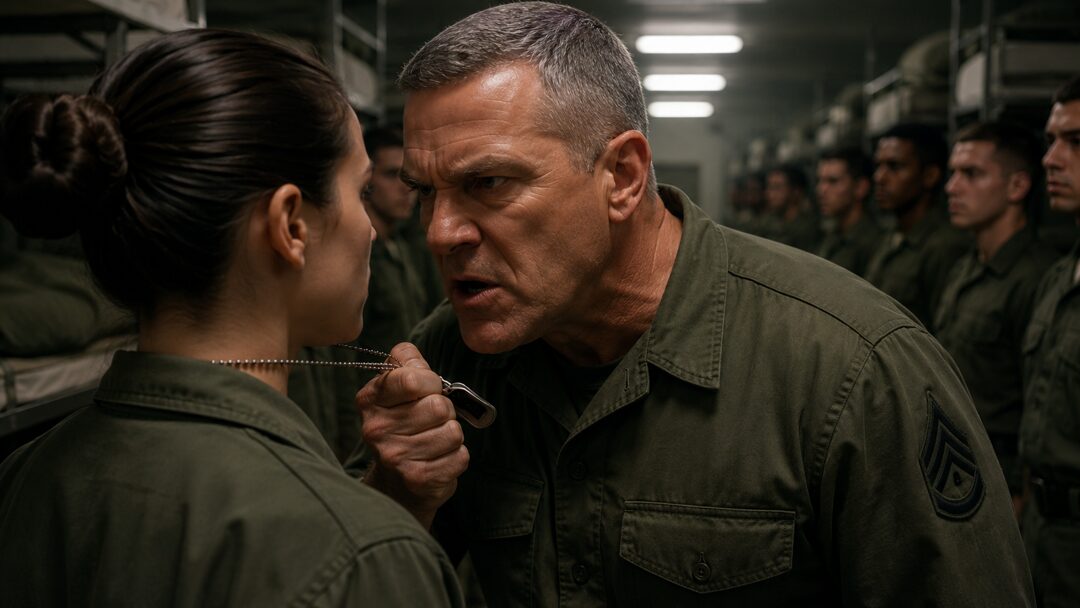
Walker crossed the aisle with the heavy, deliberate steps of a man who never needed to hurry to be frightening. He was broad through the shoulders, close-cropped gray at the temples, jaw dark with stubble even at midnight. His voice had already filled the room before he reached her.
Now it dropped.
“Carter.”
Emily straightened.
“Yes, Drill Sergeant.”
His face stopped inches from hers.
“What makes you special?”
No one moved.
Emily looked at his mouth. Then his eyes. Then his mouth again.
“Nothing, Drill Sergeant.”
“Then why,” Walker said, each word clipped hard enough to cut, “are you moving on your own schedule?”
Her throat worked once.
“I’m not, Drill Sergeant.”
“Wrong answer.”
His voice cracked through the room.
Several recruits flinched. Emily did not.
That made it worse.
Walker leaned closer until the brim of his campaign hat nearly touched her forehead. “When I give a command, you obey the command. You do not consider it. You do not taste it. You do not take it home and write it a letter. You move.”
“Yes, Drill Sergeant.”
The answer came clean, but just late enough.
Walker’s eyes sharpened.
Behind him, Sarah’s fingers curled against her trouser seam. She had seen that delay before. At chow, when Emily watched the server’s lips before choosing a tray. In formation, when she positioned herself where she could see the person giving instructions. During lights-out whispers, when she smiled at jokes a fraction too late, then looked away before anyone could notice.
Sarah had almost asked.
She had not.
In basic training, noticing too much could be dangerous.
Walker took one step back.
“Repeat my command.”
Emily’s eyes fixed on him.
“Platoon, face left, Drill Sergeant.”
“Again.”
“Platoon, face left, Drill Sergeant.”
“Again.”
Her jaw tightened. “Platoon, face left, Drill Sergeant.”
Walker began to pace.
Not in front of her.
Behind her.
Sarah saw Emily’s shoulders change. Not slump. Not shake. Just tighten, as if every muscle had suddenly been asked to listen.
Walker’s voice came from behind her left shoulder.
“Right face.”
Emily turned right, but after the platoon.
A few recruits breathed in sharply.
Walker stopped.
“There it is.”
Emily faced forward again. Her cheeks were damp, but her eyes were steady.
“There what is, Drill Sergeant?”
The question was quiet. It was also a mistake.
Walker smiled without warmth.
“Attitude.”
Emily swallowed.
“No, Drill Sergeant.”
“Arrogance.”
“No, Drill Sergeant.”
“Disrespect.”
“No, Drill Sergeant.”
Walker’s face hardened.
“Stand in the center aisle.”
Emily stepped out from beside her bunk.
The room watched her go.
No one wanted to watch. Everyone did.
There were rules about what you did when someone was being broken down. Eyes forward. Mouth shut. Body still. Gratitude that it was not you.
Emily stopped in the aisle beneath the worst of the fluorescent light. Her dark hair was pulled tight into a bun. Her uniform collar was damp with sweat. Under the edge of her shirt, a silver ball chain caught the light for one brief second and disappeared again.
Walker saw the glint.
He stored it away without thinking.
“Since Recruit Carter needs personal attention,” he said, turning to the rest of the room, “the whole platoon will benefit from her education.”
Robert Hayes stiffened at the front row of bunks. His bunk was perfect. His boots lined like a display. His jaw locked with the resentment of a man who believed one person’s failure became everyone’s burden.
Walker pointed at him.
“Hayes. What is a unit?”
Robert answered instantly. “One body, Drill Sergeant.”
“What happens when one part of the body refuses to respond?”
“It fails, Drill Sergeant.”
Walker looked back at Emily.
“And what happens when the body fails?”
Robert hesitated only because he knew the answer would hurt someone.
Walker barked, “Speak.”
“People pay for it, Drill Sergeant.”
Emily did not look at Robert.
That restraint landed harder than anger would have.
Walker stepped close again. “You hear that, Carter?”
She looked at his mouth.
“Yes, Drill Sergeant.”
“You hear me?”
“Yes, Drill Sergeant.”
For half a second, Sarah thought Emily might say more.
She did not.
Emily Carter had learned a long time ago that explaining yourself too soon made people stop seeing what you could do. They saw the explanation first. They lowered their voices. They widened their eyes. They said things like brave when they meant broken.
So she stood in the aisle and took the weight of the room.
Silence had protected her for years.
Tonight, it started closing around her.
Part II — The Things People Notice Too Late
At 0400, the barracks woke to boots, breath, and fear.
Walker had given them three hours of sleep after the inspection, if anyone could call it sleep. The platoon moved through the dark with the stunned efficiency of people who knew punishment could start before sunrise.
Emily dressed faster than most.
She always did.
Routine was safer than surprise. Laces, collar, bun, belt, tags tucked flat under the shirt where they belonged. Every item in the same place. Every motion memorized. The world could be loud, uneven, careless. Her hands did not have to be.
Sarah sat on the edge of her bunk, watching.
Emily felt the stare before she turned.
“You okay?” Sarah whispered.
Emily read the shape of it more than she heard it. The room was a mess of muffled movement, lockers, boots, fabric, coughs. Sound reached her as vibration, pressure, fragments. Faces gave her the rest.
“I’m fine,” Emily said.
Sarah looked toward the aisle where Walker had stood over her hours before. “He was on you hard.”
Emily buttoned her cuff. “He’s hard on everybody.”
“Not like that.”
Emily’s hands paused.
Sarah lowered her voice even more. “Do you want me to say something?”
Emily turned fully then.
The answer in her face came before the words.
“No.”
Sarah blinked. “I just mean—”
“No.”
It was not sharp. That almost made it sharper.
Emily tucked her tags deeper beneath her shirt. “Don’t help me like that.”
Sarah looked hurt, then ashamed of looking hurt.
Across the aisle, Robert Hayes closed his locker with careful control.
“You two done?” he asked. “We step off in seven.”
Sarah’s mouth closed.
Emily shouldered her pack.
Robert looked at her the way men looked at weak links when they wanted to be fair but did not know how. Like she was a problem he had inherited and might be blamed for.
“Carter,” he said, “whatever happened last night, keep it clean today. We can’t all eat dirt because you’re proving a point.”
Emily met his eyes.
“I’m not proving a point.”
“Then don’t make yourself one.”
That line found its mark. She hated that it did.
Walker appeared at the doorway before anyone could answer. The room snapped to attention.
“Outside. Two minutes.”
No one hesitated.
Emily made sure she could see his face before she moved.
The field evaluation began under a gray sky, with Texas heat already waiting under the morning cool. It was not meant to be complicated. Move as a team. Respond to changing instructions. Recover a simulated casualty. Carry equipment under pressure. Keep your head when the environment tried to take it.
Walker liked that kind of exercise.
Pressure told the truth.
At least, that was what he believed.
Years earlier, at a checkpoint in a place that still visited him when the room got too quiet, one young man had paused at the wrong time. Not long. Not cowardly. Just long enough to look back for confirmation when a command came through dust and shouting.
Walker still remembered the turn of that young man’s head.
Not his last words. Not a lesson. Just the turn.
Delay had weight. Delay had names.
So Walker built recruits who moved before fear could ask a question.
That was the story he told himself.
The first half of the exercise went clean.
Emily was fast over the low wall. Faster than Robert expected. She spotted a loose strap on a supply litter before it failed. She pulled Sarah clear when Sarah’s boot caught in a rut. She did not complain. She did not ask anyone to repeat anything.
But she kept turning her head toward whoever spoke.
Walker saw it.
Not as adaptation.
As doubt.
“Carter!” he called from behind the group.
Emily did not turn at once.
Robert did.
Sarah did.
Emily turned when she saw Sarah’s face shift.
Walker’s jaw set.
“Too slow.”
Emily’s chest rose once.
“Yes, Drill Sergeant.”
“Again.”
They ran the drill again.
This time Walker moved harder, faster, letting instructions come from different angles. He wanted instinct. He wanted immediate response. He wanted to see the gap close.
Instead, he saw Emily scanning.
Watching lips. Watching hands. Watching shoulders. Tracking movement with an intensity that looked, to him, like distrust.
Then the smoke canisters started.
They were training smoke, thin and bitter, enough to blur the lane and turn shapes uncertain. Recruits coughed. Someone swore and got corrected for it. Walker’s voice cut through the haze, then another instructor’s voice overlapped it from the far side.
Emily lost Walker’s face.
For the first time that morning, panic touched the edge of her control.
She turned toward the nearest mouth. Robert was shouting something, but his head was half turned. Sarah was pointing toward the simulated casualty. Another command came from behind, swallowed by smoke and bodies.
Emily froze.
Not completely. Not visibly enough for most people.
But Walker saw it.
His face went blank.
There it was again.
A second.
A dangerous second.
Robert moved toward the casualty.
He missed the red marker staked low near the path, partly hidden under scrub. Emily saw it because she was looking everywhere but where people expected her to look. A visual signal. Wrong route. Hazard zone.
She lunged and caught Robert’s sleeve.
He jerked back. “What the—”
Emily pointed.
Robert saw the marker.
His face changed.
The team corrected course and reached the casualty from the side. They completed the carry. Time was not perfect. But the error did not compound.
Sarah looked at Emily with something like awe.
Robert looked as if he hated owing her anything.
Walker saw the hesitation.
He did not see the save.
Or maybe he saw it and could not make it fit the shape of the lesson he had already chosen.
By the time they returned to the barracks, sweat had dried and returned twice on their uniforms. The platoon smelled of dust, metal, and exhaustion. No one spoke unless spoken to.
Walker let them line up beside their bunks.
He walked the aisle slowly.
Emily stood near the middle, eyes forward, tags hidden beneath her shirt.
Walker stopped in front of Robert first.
“Hayes. Assessment.”
Robert hesitated.
Walker’s eyes narrowed.
Robert corrected fast. “Platoon completed the casualty movement, Drill Sergeant.”
“Not what I asked.”
Robert’s throat worked. “Communication broke down under smoke.”
“Why?”
No one wanted the answer.
Robert looked straight ahead. “Delayed response, Drill Sergeant.”
Walker turned.
Emily felt his attention like heat.
“Carter.”
Her stomach dropped.
“Yes, Drill Sergeant.”
He walked toward her.
This time, everyone knew.
The room had been waiting since midnight.
Part III — The Chain Between Them
Walker stopped close enough that Emily could see the tiny broken red veins in his eyes.
“You froze.”
“No, Drill Sergeant.”
The answer came too fast, because she had prepared it. Walker heard defiance.
The platoon heard danger.
Sarah’s hands curled again.
Robert stared forward, but his face had gone tight. He had seen the marker. He had felt Emily’s hand on his sleeve. He knew the team might have blown the lane without her.
He said nothing.
Walker’s voice dropped. “You telling me I didn’t see what I saw?”
Emily focused on his mouth.
“No, Drill Sergeant.”
“Then explain.”
The room shifted around that word.
Explain.
It sounded like an opening.
It was a trap.
Emily knew it. Explanations in rooms like this were not bridges. They were rope. Someone handed you one end and waited to see if you would hang yourself with it.
She kept her voice level. “I corrected the route, Drill Sergeant.”
Walker’s nostrils flared. “After you hesitated.”
“Yes, Drill Sergeant.”
“Why?”
Emily’s jaw locked.
Sarah looked at her.
Say it, Sarah thought.
Please just say it.
But Sarah also remembered Emily’s face that morning.
Don’t help me like that.
Emily said nothing.
Walker stepped closer.
“You know what hesitation does?”
Emily watched his mouth.
“Yes, Drill Sergeant.”
“No, I don’t think you do.”
His voice rose.
“Hesitation gets people hurt. Hesitation gets people depending on you when you are not there. Hesitation makes the whole unit pay for one person’s pride.”
That word struck her.
Pride.
Emily’s eyes flickered.
Walker saw it and pressed.
“That’s what this is, isn’t it? Pride. You don’t like being corrected. You don’t like taking orders. You think because you can climb a wall and drag a litter, the rules bend around you.”
“No, Drill Sergeant.”
“Then what is your problem?”
Emily did not answer.
Walker’s face hardened into something colder than anger.
“When I ask you a question, you answer.”
“Yes, Drill Sergeant.”
“What is your problem?”
The whole barracks waited.
Emily stood in the center of it, surrounded by faces that would not look directly at her but would remember everything.
Her tags pressed against her skin beneath the shirt.
Small. Cold. Known.
She had worn them every day since intake. She had requested the engraving before she arrived, because rules required identification, and some truths became dangerous if nobody could find them quickly.
But she had kept them hidden.
Not because she was ashamed.
Because she knew what people did with labels.
They made a cage and called it concern.
Walker moved before she could brace.
His hand shot out and caught the silver chain at her collar.
The metal snapped taut against the back of her neck.
Sarah inhaled.
Robert’s eyes widened.
Emily’s chin lifted involuntarily as Walker yanked the tags forward, dragging them from beneath her shirt into the fluorescent light.
“What’s this?” he barked. “You need a reminder of who you are?”
The tags swung between them.
Emily’s face changed then.
Not much.
Just enough.
Her eyes closed for half a second.
Inside that half second, she was twelve again, sitting in a classroom where a teacher kept talking while turned to the board. Sixteen, laughing late at a joke and watching the laughter change direction toward her. Twenty-four, signing paperwork with a recruiter who said, “You understand this may be difficult,” as if difficulty had not been her native language for years.
Then the moment passed.
She opened her eyes.
Walker was still holding the chain.
The room was still watching.
Emily raised both hands.
Slowly.
Not to pull away. Not to fight him.
She lifted the chain over her head herself.
Walker’s grip loosened out of surprise, and the tags dropped against her palm.
No one breathed.
Emily held them out.
Walker stared at her hand.
“Take them,” she said.
Her voice was not loud.
It did not need to be.
Walker’s eyes flashed. “What did you say?”
She moved her hand closer.
“Take them, Drill Sergeant.”
It was the first order she had given him, though neither of them would have called it that.
For one second, he did not move.
Then he opened his palm.
Emily placed the tags there.
The chain pooled across his skin, silver on callused flesh.
The first side he saw was not the engraving.
It was texture.
Raised dots, neat and deliberate, catching light across the metal.
His brow pulled down.
He turned the tag over.
The room waited with him.
Three words.
I AM DEAF.
The barracks did not go quiet.
It became something beyond quiet.
Walker’s face held onto anger for a moment, because anger was faster than shame. Then his eyes moved again over the words. He looked at the Braille. Back to the engraving. Back to Emily.
His mouth opened.
Nothing came out.
Emily stood in front of him, bare throat marked faintly red where the chain had pulled. Her shoulders were squared. Her eyes were wet but not broken.
She gave him one sentence.
“I’ve been reading your lips the whole time, Drill Sergeant.”
It landed harder than if she had yelled.
Sarah looked down.
Robert looked at the floor.
Walker looked at the tags in his hand as if they had become heavier than metal.
For the first time since Emily had met him, he seemed smaller than his voice.
He closed his fist around nothing. Then opened it again, because the tags were still there, and he did not know how to hold them anymore.
Emily held out her hand.
“My tags, Drill Sergeant.”
Walker returned them.
Not smoothly. Not proudly.
He placed them into her palm without meeting her eyes.
Emily pulled the chain back over her head. The metal settled against her chest.
No one spoke.
Walker turned to the platoon.
“Dismissed.”
The word came out rough.
No one moved at first.
Then bunks creaked. Boots shifted. The room returned to motion, but not to normal.
Normal had been broken.
It would not come back just because someone ordered it to.
Part IV — After the Room Changed
Emily made it to the washroom before her hands started shaking.
She locked herself in the last stall, sat fully dressed on the closed lid, and pressed her palms flat against her knees until the tremor became small enough to hide.
She did not cry.
She refused to give the barracks that too.
Outside, water ran. Someone cleared her throat. Someone else whispered, “Did you know?”
Emily closed her eyes.
That was the part people never understood.
Once they knew, they wanted to know when everyone else had known. They wanted a timeline, a confession, a reason they had not been cruel on purpose.
As if accidental harm arrived softer.
The door opened.
Footsteps. Light ones.
Sarah.
Emily knew before Sarah spoke.
“Carter?”
Emily looked at the gap under the stall door.
Sarah’s boots stopped two tiles away.
“I’m sorry.”
Emily stared at the floor.
“For what?”
“For not saying anything.”
Emily almost laughed, but it came out as breath.
“You didn’t know.”
“I knew something.”
That sat between them.
Emily unlocked the stall.
Sarah stepped back.
For a moment they looked at each other in the mirror. Emily’s eyes were clear. Too clear. Her throat still carried the red line from the chain.
Sarah saw it and looked away.
Emily noticed.
“Don’t do that.”
Sarah’s face tightened. “Do what?”
“Look at it like it’s worse than it is.”
“It looked bad.”
“It was bad.”
Sarah had no answer.
That was better than a bad one.
Emily washed her hands though they were not dirty. She watched water run over her knuckles.
Sarah spoke carefully. “Why didn’t you tell us?”
Emily turned off the faucet.
“Because then this happens.”
Sarah shook her head. “This happened because he didn’t know.”
“No.” Emily took a paper towel and dried her hands slowly. “This happened because he thought he knew enough.”
Sarah flinched.
Not because Emily was wrong.
Because she wasn’t.
In Walker’s office, the light was softer, but nothing else was.
He stood over Emily Carter’s file with both hands on the desk.
The accommodation note was there.
Plain. Stamped. Signed.
Not hidden.
Not missing.
Present.
He had initialed the intake review on a day when three platoons were processing, two instructors were out, and a captain wanted numbers before noon. He remembered the stack of folders. He remembered thinking he would review the flagged details later.
Later had become a chain in his hand.
Walker sat down.
For a long moment, he stared at the page without reading.
A delayed response may occur in conditions of low visibility, overlapping verbal command, or when speaker is positioned outside visual range.
He read that line three times.
Outside visual range.
Behind her.
He had done that on purpose.
His jaw flexed.
From the far wall, a framed photo watched him: a younger Walker, dust on his face, arm around men whose names he still did not say out loud. One of them had turned his head one second too late.
Walker looked away.
The memory did not excuse him.
That was the worst part.
It explained him just enough to remove the comfort of thinking he had simply lost his temper.
He had built a rule from grief and called it leadership.
Then he had used it on someone who had spent her whole life surviving rules made for other people.
Walker shut the file.
He did not sleep.
By morning, the platoon had reorganized itself around the thing everyone knew and no one knew how to mention.
Some recruits treated Emily like glass.
That irritated her.
Some treated her like a liar.
That was worse.
Robert Hayes did neither. He kept looking at her as if the math had changed but he refused to show his work.
At formation, Sarah stood close enough for Emily to see her if she spoke.
Robert noticed.
“You her translator now?” he muttered.
Sarah’s face went red.
Emily turned before Sarah could answer.
“No.”
Robert looked at her.
Emily held his gaze. “She’s standing where I can see her. There’s a difference.”
Robert’s mouth tightened.
A recruit behind them, Mark Dalton, snorted under his breath. “Must be nice.”
Emily heard only the shape of it. Sarah heard the words and turned sharply.
“What?”
Mark shrugged. “Nothing.”
Walker arrived before it could grow.
The platoon snapped still.
He looked the same. Same hat. Same boots. Same hard face. Same body built like an order.
But he did not start with volume.
He walked the line once, slow.
His eyes paused on Emily for less than a second.
Then on Mark.
“Today’s exercise,” Walker said, “will be team movement under restricted communication.”
A ripple moved through the formation.
Walker caught it.
“Problem?”
No one answered.
He looked at Mark. “Dalton. You got something forming behind that face?”
Mark straightened. “No, Drill Sergeant.”
Walker held him there.
“Good. I would hate to interrupt whatever deep thought was trying to escape.”
A few recruits almost smiled. None did.
Walker continued. “You will use hand signals. You will use visual confirmation. You will not move until your teammate confirms understanding.”
Robert’s brow twitched.
Mark’s mouth barely moved. “Special treatment.”
Walker heard that.
Everyone did.
The air changed again.
Walker stepped toward him.
“What was that?”
Mark froze.
“Nothing, Drill Sergeant.”
Walker’s voice stayed calm.
That made it worse.
“You think communication is special treatment?”
Mark swallowed. “No, Drill Sergeant.”
“You think the standard changed?”
“No, Drill Sergeant.”
Walker looked down the line.
“The standard is the same. The route is the same. The time is the same. The weight is the same. The only thing changing is whether you bother to know your unit understood the order before you blame them for failing it.”
No one moved.
Walker’s eyes returned to Mark.
“The world does not care how the message travels. It cares whether it arrives.”
Emily’s throat tightened.
She looked away before anyone could see.
Walker did not look at her when he said the next part.
“If that offends you, you are not tough. You are just loud.”
That line stayed in the formation like heat.
Robert’s face changed first.
Not dramatically.
Just enough.
Like a man realizing the thing he had called efficiency had been laziness wearing polished boots.
Walker turned.
“Carter.”
Emily stepped forward.
“Yes, Drill Sergeant.”
He did not move behind her.
He stood where she could see him.
“Front position.”
For a second, she thought she had misread him.
Then Robert stepped aside.
Emily moved to the front.
Every eye followed.
This time, she let them.
Part V — A Different Kind of Order
The exercise began without shouting.
That was the strangest part.
The absence of Walker’s voice did not soften the morning. It sharpened it.
Hands mattered now. Eyes mattered. Distance mattered. Carelessness showed faster when no one could cover it with volume.
Emily felt the platoon watching her differently.
Not kindly. Not yet.
But differently.
That was enough.
Walker signaled the first movement with a sharp sweep of his hand. Robert saw it. Emily saw it. Sarah saw Emily see it. The line moved.
At the first obstacle, Mark rushed half a step early.
Robert caught him with a hand against his chest.
“Confirm,” Robert said.
Mark’s jaw tightened, but he looked back.
Emily gave the signal.
Move.
They moved.
No one praised it. No one needed to.
The route tightened through a low ditch and around a blind corner marked with strips of faded tape. The team had to transfer a weighted dummy from one carry position to another without verbal command. The old version of the exercise rewarded the loudest person who sounded certain. This version exposed everyone who only pretended to listen.
Sarah fumbled one signal and cursed under her breath.
Emily corrected it with two fingers and a quick motion.
Sarah copied her.
Good.
It was such a small word. Emily did not say it aloud.
Sarah smiled anyway, because this time she understood.
Halfway through, Walker introduced confusion. Two instructors crossed the far lane. A whistle blew. A clipboard dropped. Someone shouted from behind them.
Emily’s body reacted before her mind could stop it.
Her shoulders tightened.
The old panic reached for her.
No mouth. No face. No clear direction.
Then Robert stepped into her line of sight and pointed to Walker.
Not impatiently.
Not as a correction.
As information.
Emily found Walker’s face.
He was not speaking.
He was waiting.
His hand rose.
Two fingers. Hold.
Then a flat palm. Shift left.
Then the signal Emily had shown Sarah once near the bunks, when she thought no one important was watching.
Check behind.
Emily’s breath caught.
Walker’s version was stiff. Imperfect. Almost ugly.
But it was clear.
She checked behind.
The red marker was there again, half hidden near the left lane.
This time, Walker saw her see it.
Emily signaled Robert.
Robert shifted the team without hesitation.
Mark started to object, then saw the marker and shut his mouth.
The platoon moved around the hazard in one body.
Not perfect.
Together.
At the final carry, the weighted dummy slipped. Sarah stumbled, and the line buckled. For half a second, the old rhythm threatened to return: shouting, blame, scramble, panic.
Emily slapped the side of the litter twice.
Everyone stopped.
She pointed. Robert adjusted. Sarah reset her grip. Mark moved to the rear brace without being told twice.
They lifted together.
The time was close.
Too close.
Walker stood at the finish line with a stopwatch in one hand.
The platoon crossed together, breathing hard, uniforms soaked, faces streaked with dust.
Walker looked at the watch.
No one spoke.
Robert’s chest heaved beside Emily.
Sarah’s hands were trembling.
Mark stared at the ground.
Walker clicked the stopwatch off.
“Pass.”
One word.
No celebration followed.
It was not that kind of victory.
Emily felt something in her chest loosen anyway. Not pride exactly. Not relief either.
More like a door opening in a room she had stopped trying to leave.
Walker walked toward them.
His eyes moved over the platoon and stopped on Emily.
For a moment, everyone expected him to say something to her.
A public apology, maybe. A correction. A speech.
He did not.
Instead, he looked at Robert.
“What changed?”
Robert swallowed.
“We confirmed the order before moving, Drill Sergeant.”
“And?”
Robert glanced at Emily.
This time, he did not look away quickly.
“We used the person who saw the most.”
Walker nodded once.
That was all.
But Robert had said it in front of everyone.
Emily looked down, not because she was ashamed, but because if she kept looking at him, the room might see too much.
Walker dismissed them for reset.
As the platoon broke apart, Sarah bumped Emily’s shoulder lightly.
Not pity.
Not comfort.
Just contact.
“You were fast,” Sarah said.
Emily gave her a look.
Sarah corrected herself. “We were fast.”
Emily almost smiled.
Almost.
Mark passed them without speaking.
Robert lingered.
For a second, Emily thought he might apologize. She braced for it, unsure whether she wanted it or dreaded it.
Instead, he said, “That marker yesterday. I missed it.”
Emily waited.
Robert nodded toward the course. “You didn’t.”
It was not enough to erase anything.
It was enough to begin.
Emily nodded back.
Walker watched from a distance and said nothing.
Some lessons had to be left alone long enough to become real.
Part VI — The Open Palm
That evening, the barracks felt different in the way a room feels different after everyone has heard a truth and failed to decide what kind of people they are going to be about it.
No one asked Emily loud, careful questions.
No one leaned in and over-enunciated.
No one told her she was inspiring, which was good, because she might have thrown a boot.
Sarah sat beside her on the floor between their bunks, cleaning dust from a strap. Robert worked silently across the aisle. Mark kept to himself.
It was not acceptance.
Not yet.
But it was space.
Emily could work with space.
She changed quickly after showers, folded her uniform, and set her dog tags on the edge of her bunk while she pulled on a clean shirt. The tags lay there for less than a minute.
Long enough for Walker to appear in the doorway.
The room snapped to attention.
Emily turned too fast.
Her eyes went to the bunk.
The tags were gone.
Her stomach tightened before she saw them.
Walker had them.
For one sharp instant, the night before returned so completely that her throat remembered the chain.
But Walker was not holding them by the chain.
He held both tags flat in his open palm.
The difference was small.
It was everything.
“At ease,” he said.
The platoon relaxed only in the technical sense.
Walker crossed the aisle toward Emily.
Every recruit watched. This time they did not pretend not to.
He stopped at a distance that did not force her to look up.
Then he held out his hand.
Emily looked at the tags. Then at him.
He did not speak at first. His mouth tightened once, like there were words in it he did not trust.
Finally he said, quietly, “These were on your bunk.”
Emily took them.
Their fingers did not touch.
“Thank you, Drill Sergeant.”
He nodded.
That could have been the end.
A clean exchange. A safe retreat. A way for both of them to avoid the thing still standing between them.
Walker did not retreat.
He looked at her directly, making sure she could see his mouth.
“I reviewed your file.”
Emily’s face closed.
“Yes, Drill Sergeant.”
“I should have reviewed it before.”
She said nothing.
He accepted that.
Behind them, the barracks held still.
Walker’s jaw worked once.
“I was wrong.”
The words were plain. No decoration. No performance.
Some apologies ask to be admired.
This one looked like it hurt to carry.
Emily kept her face steady.
Walker continued, “That does not undo what happened.”
“No, Drill Sergeant.”
Sarah looked down at her hands.
Robert stood very still.
Walker nodded once, as if the answer was deserved.
“No, it does not.”
He could have stopped there too.
Instead, he lifted his right hand, awkwardly shaping two fingers the way he had that morning.
The signal was almost correct.
Almost.
“Teach me that again,” he said.
The room seemed to lean toward them.
Emily looked at his hand.
Then at his face.
There were a dozen things she could have said. That he should have asked before. That she was not there to teach him. That knowing one sign did not make him absolved. That the mark on her throat had faded but not vanished from memory.
All of them were true.
None of them were the thing she chose.
She stepped closer.
“Your wrist is wrong,” she said.
Walker looked at his wrist.
For the first time since she had known him, he looked uncertain in front of the platoon and did not punish anyone for seeing it.
Emily lifted her own hand and demonstrated.
Two fingers. Angle. Motion. Hold.
Again.
Walker copied her.
Still wrong.
Sarah’s mouth pressed tight, not quite a smile.
Emily corrected him. “Less force.”
Walker paused.
Something passed across his face.
Less force.
He adjusted.
This time, the signal was clear.
Emily nodded.
Walker repeated it once more, slower.
The barracks stayed quiet, but it was not the same quiet as before. Not the silence of fear. Not the silence after harm. Something else. Something unfinished, but listening.
Walker lowered his hand.
Emily slipped the chain over her head. The tags settled against her chest, hidden again beneath the fabric.
Not gone.
Not exposed.
Hers.
Walker stepped back.
“Lights out in ten,” he said.
His voice returned to its usual weight, but not its old carelessness.
Recruits moved around them, softer than before.
Sarah leaned close as Emily folded the edge of her blanket.
“You okay?”
Emily looked across the aisle.
Walker was at the door now. Robert was watching the floor. Mark was pretending to fix a bootlace that had nothing wrong with it.
Emily touched the place beneath her shirt where the tags rested.
For years, she had thought being understood meant being reduced.
Maybe sometimes it did.
Maybe sometimes being seen still hurt first.
But tonight, the same room that had watched her get pulled open had also watched a man in power learn to ask with his hands.
That did not make it right.
It made it different.
Emily looked at Sarah.
“I’m here,” she said.
Across the room, Walker turned off the lights.
Darkness settled over the rows of bunks, over the polished floor, over the lockers and folded uniforms and all the things no one knew how to say yet.
In the dark, Emily could not read anyone’s lips.
For once, she did not feel alone in the silence.