The Old Cap on the Counter Changed How They Saw Him
Part I — The Hand on the Counter
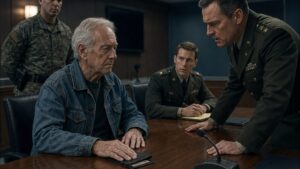
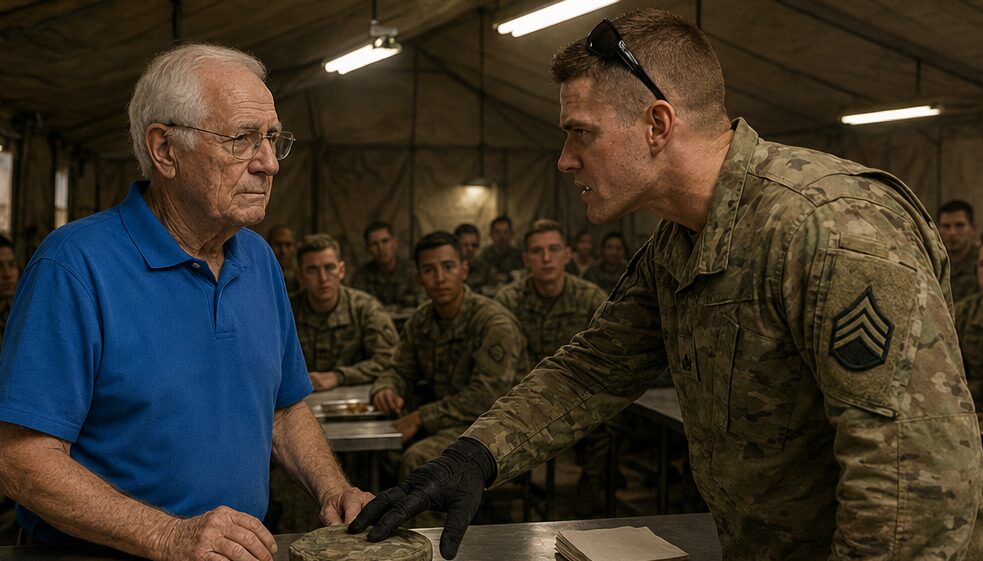
The young sergeant leaned over the stainless-steel counter until his face was close enough for Benjamin Miller to smell sweat, mint gum, and the dust from the morning drill.
“You buy that at a surplus store, sir,” Patrick asked, “or did somebody leave it behind?”
The dining tent went quiet in the way rooms go quiet when people want to hear cruelty clearly.
Benjamin kept folding napkins.
His hands were old, the veins raised, the knuckles bent slightly from years of weather and work. He wore a bright blue polo with the catering company logo stitched over the pocket, plain black shoes, and wire-frame glasses that slid down his nose whenever the steam tables ran hot.
Beside his left elbow sat the cap.
It was faded camouflage, soft at the brim, clean but worn in a way no store could fake. The fabric had lost its stiffness years ago. One side dipped where a hand had folded it too many times. There was no name tape visible, no rank, no badge, nothing that announced anything to the room.
Still, Benjamin kept one hand near it.
That was what Patrick noticed.
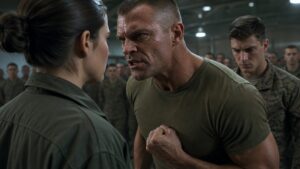
Patrick was twenty-seven, hard-built, sharp-jawed, and still wearing black tactical gloves though breakfast service had ended an hour ago. His sunglasses were pushed up on his head. He had the restless confidence of a man who had learned that a uniform could make people step aside before he opened his mouth.
Behind him, half a dozen younger men watched from the tables. Some had trays in front of them. Some had stopped eating. One private lowered his fork, waiting.
Patrick smiled.
“Didn’t hear me?”
Benjamin placed one napkin on top of another and squared the corners.
“I heard you.”
A few soldiers laughed softly.
Patrick’s smile widened. He turned his head just enough to let the room know he was performing for them, then looked back at Benjamin.
“You understand what that pattern means to people who earned it?”
Benjamin did not look at the cap.
He looked at Patrick.
There was no anger in his face. That made Patrick push harder.
“Because from where I’m standing, it looks like you’re playing dress-up behind a lunch counter.”
The laugh came louder this time.
Benjamin’s fingers moved to the cap.
Not grabbing it.
Protecting it.
Patrick saw that too.
He reached across the counter.
The black glove came down over the faded brim.
The room stopped laughing.
For one second, nobody moved. The refrigerator hummed behind Benjamin. Rain threatened somewhere beyond the canvas walls, tapping softly against the tent roof. The metal counter held the cold between them.
Patrick’s gloved hand covered half the cap.
Benjamin’s bare fingers tightened around the edge.
Not enough to pull it away.
Enough to say, silently, that Patrick had touched something he did not understand.
Patrick lowered his voice, but the room could still hear him.
“Who gave you the right to wear that?”
Benjamin looked at the glove.
Then at the young man’s face.
“More than you do.”
The sentence landed like a dropped tray.
Patrick’s smile disappeared.
One of the privates stared at the floor. Another looked at Patrick, waiting for the explosion.
Patrick lifted his hand from the cap slowly.
“You want to say that again?”
Benjamin picked up another napkin.
“No.”
Patrick straightened, his jaw tight now, the performance gone but the audience still there.
“Good. Then you can explain it to the duty officer.”
Benjamin said nothing.
He had learned, long before any of the men in that room were born, that silence could hold a line longer than anger.
But silence had a cost.
He felt it in his chest when Patrick walked out.
He felt it when the younger soldiers looked at him differently now—not as a man, not even as an old worker, but as someone caught.
And he felt it most when he lifted the cap from the counter and held it under the stainless edge, out of sight.
The fabric bent around his fingers like it knew his hand.
Part II — Colonel Lunch Line
Captain Brenda Bennett arrived before lunch rush.
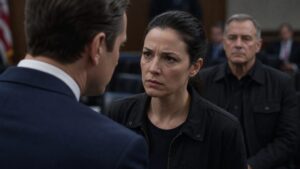
She came through the side entrance with a notebook in one hand and her cover tucked under the other arm. Her hair was pulled tight, her uniform clean, her expression careful. She had the tired eyes of someone who spent most of her day keeping small problems from becoming official problems.
“Mr. Miller?”
Benjamin looked up from replacing a tray of rolls.
“Yes, ma’am.”
Patrick stood behind her, arms folded. He had taken off his sunglasses but not the gloves.
That told Benjamin something.
Brenda glanced toward the soldiers eating at the far tables, then back at Benjamin.
“There’s been a complaint.”
“I figured.”
Patrick stepped forward. “He had unauthorized military gear on the serving counter. When questioned, he got disrespectful.”
Benjamin slid the tray into place.
Brenda’s eyes moved to his hands.
“Do you have prior service, Mr. Miller?”
The question was polite.
The silence after it was not.
Benjamin wiped one thumb along the edge of the serving spoon. There was nothing on it. He wiped it anyway.
“I’m a contractor,” he said.
“That isn’t what I asked.”
“No, ma’am.”
Patrick gave a short laugh. “See?”
Brenda lifted one hand without looking at him. He stopped.
Benjamin respected that.
She was young compared to him, but not careless.
“Do you have documentation giving you authorization to wear or display military items on base?”
Benjamin looked down.
The cardboard box under the counter was half open. Inside were extra gloves, plastic wrap, a roll of trash bags, and the cap.
“No.”
The answer tightened the room around him.
Patrick said, “Exactly.”
Brenda’s mouth drew into a line. Not satisfaction. Not accusation. Procedure.
“Until I can verify this, I need you to put the item away and keep it away during service.”
Benjamin did not move for a moment.
It was not the order that hurt.
He had obeyed orders that cut deeper.
It was the way the younger men watched to see whether he would obey this one.
He bent slowly, reached into the box, and picked up the cap. For half a second he held it in both hands.
A memory flickered—not a full one, never a full one unless he let it. A voice hoarse from smoke. A hand gripping his sleeve. A promise he had not known he was making until the man asking for it could no longer hear the answer.
Benjamin folded the cap once along its softened seam and placed it at the bottom of the box.
Then he shut the flaps.
Patrick watched him do it.
Brenda noticed Patrick watching.
“Thank you, Mr. Miller,” she said.
Benjamin nodded.
“Lunch starts in eight minutes.”
Brenda looked like she wanted to say something else, but a line had already formed near the tent entrance. Soldiers came in wet from the coming weather, shaking water from their sleeves, laughing, complaining, alive in the careless way young men could be alive when they had never had to count who was missing from a room.
By noon, the name had started.
“Colonel Lunch Line.”
The first soldier said it too softly for Benjamin to respond.
The second made sure he heard.
“Can I get extra potatoes, Colonel?”
A few laughed.
Patrick did not say it. He did not have to. He sat with his platoon near the middle of the tent, eating slowly, watching Benjamin over the rim of his cup.
Benjamin served everyone.
He gave extra potatoes to the soldier who had asked.
He refilled the coffee urn when it jammed.
He noticed a young private near the end of the line whose hand trembled when he reached for a tray. Benjamin set the tray down for him before anyone else could see.
“You eat first,” Benjamin said quietly.
The private blinked. “I’m fine.”
“I know.”
The boy took the tray.
Later, when the rain came harder, Benjamin shifted two stacks of dry rations away from the side wall before the leak appeared. He propped the rear flap open a few inches to keep condensation from dripping into the electrical strip. He moved the coffee station without being told.
Brenda saw all of it.
She also saw the way Benjamin’s eyes went to the evacuation map taped near the entrance. Not once. Not casually.
He studied it like a man checking whether someone had drawn the exits wrong.
That evening, after dinner, she found him wiping down tables alone.
“Mr. Miller.”
“Yes, ma’am.”
“How long have you worked on base?”
“Seven years.”
“And before that?”
“Other kitchens.”
She waited.
He kept wiping.
“Is there a reason your file is so thin?”
Benjamin’s hand stopped.
Only for a second.
Then the cloth moved again.
“Most people my age have thin files because nobody wants to keep the thick ones.”
“That’s not an answer.”
“No, ma’am.”
Brenda looked at him carefully.
“You’re making this harder than it needs to be.”
Benjamin rinsed the cloth in a bucket and wrung it out.
“No,” he said. “I’m trying not to make it harder than it already is.”
Brenda did not understand that.
Not yet.
Part III — The Voice in the Rain
The storm broke over the base during evening readiness drills.
It came fast and ugly, a wall of rain that turned the dirt paths black and flattened the grass around the training field. Wind shoved against the dining tent until the canvas snapped. Lights flickered once, then again.
Benjamin had just finished stacking clean trays when the first group of soldiers came in from the rain.
“Temporary shelter,” one of them called. “Radio’s down near the east lane.”
Then the power cut on the left side of the tent.
Half the room fell into shadow.
Someone cursed. Someone laughed. Water ran under the canvas wall in a thin, steady sheet.
Benjamin looked toward the generator.
A gray ribbon of smoke curled from the unit near the rear service flap.
Too close to the fuel cans.
Too close to the warmer line.
For one second, everyone saw it.
No one moved.
Patrick was there, soaked through, one sleeve muddy, his gloves dark with rain. He turned toward the entrance as if waiting for an order from outside.
The radio on his shoulder spat static.
The smoke thickened.
A young private began coughing near the back.
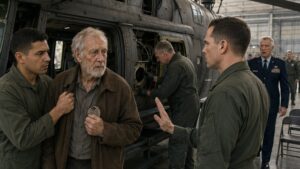
Benjamin stepped out from behind the counter.
“Move the cans.”
The voice was not loud.
It cut through everything.
Three soldiers turned toward him.
Benjamin pointed. “You and you. Fuel cans. Outside, ten yards from the tent. Not there—upwind.”
No one laughed.
“Open the rear flap all the way. Kill power to the warmer. Don’t touch the strip with wet hands. Use the broom handle.”
Patrick stared at him.
Benjamin did not look back.
“You,” he said to the coughing private, “out the side. Keep low. Take him with you.”
The private moved.
The men moved.
The room moved because Benjamin’s voice left no space for argument.
He crossed to the generator, pulled a dry towel from a stack, wrapped it around the hot metal latch, and shoved the flap wider to vent the smoke. He did not rush. Rushing made men clumsy. Rushing made them die in groups.
“Clear the center aisle,” he said. “Trays under the tables. Nobody blocks the exit.”
Patrick finally found his feet.
“You heard him,” he snapped, though everyone already had.
Within two minutes, the smoke had thinned. The fuel cans were outside. The coughing private was under the awning with a blanket around his shoulders. The backup lights came on in dull yellow strips.
Rain hammered the tent roof.
No one spoke for a while.
Then one of the soldiers whispered, “Who the hell is that?”
Benjamin walked back behind the counter and picked up the towel he had dropped.
His hands shook now.
Only slightly.
He folded the towel once, twice, and placed it in the used bin.
Patrick saw the tremor.
So did Brenda, who had come in through the side flap just as the danger passed.
She took in the scene: soldiers breathing hard, fuel cans relocated, generator cooling, the old contractor back at the counter as if nothing had happened.
Her eyes went to Benjamin.
This time, he did not meet them.
The next morning, Brenda opened his personnel file again.
The file gave her almost nothing.
Benjamin Miller. Contractor access. Food service clearance. Emergency contact blank. Prior employment listed but unverified beyond seven years. No disciplinary record. No commendations. No military status.
Then she found the attachment.
It had been scanned badly, tilted and faded, linked under an old base archive tag.
MILLER, B.
Cross-reference: Operation Gray Lantern.
Access restricted.
Brenda stared at the screen until the letters blurred.
She should have stopped there.
She did not.
By late afternoon, she found Benjamin outside the storage trailer, breaking down cardboard boxes.
“Mr. Miller.”
He heard the difference in her voice.
He kept working.
“Operation Gray Lantern,” she said.
The box collapsed under his hands.
Rainwater dripped from the trailer roof between them.
Benjamin set the flattened cardboard against the wall.
“Don’t dig there,” he said.
Brenda’s grip tightened around her notebook.
“There’s a formal complaint. If I can’t verify your connection, you may lose access.”
“That would be easier.”
“For whom?”
He looked at her then.
For the first time since she had known him, Brenda saw something raw beneath the restraint.
“For everyone who thinks a record tells the whole truth.”
She lowered her voice.
“The cap belonged to someone, didn’t it?”
Benjamin looked toward the dining tent.
The box under the counter. The folded fabric. The room full of boys who thought history began when they put on boots.
“Yes.”
“Who?”
For a long time, he said nothing.
Then: “Ronald Walker.”
Brenda knew the name. Everyone on base knew the name that week. The anniversary display was being arranged in the administration tent. Colonel Ronald Walker’s dress uniform. Photographs. A polished summary of Operation Gray Lantern. Words like courage, sacrifice, legacy.
“You served with him?” she asked.
Benjamin’s face closed again.
“I was there.”
“That’s all?”
“That’s all I’m giving you.”
“Why?”
His answer came so quietly she almost missed it.
“Because names don’t come back just because you say them right.”
Part IV — The Name on the List
Patrick learned about Operation Gray Lantern from a printed rehearsal program left on Brenda’s desk.
He had gone in to check on the complaint. That was what he told himself. He saw Benjamin’s name handwritten in the margin beside a note: possible witness, verify archive.
The word witness hooked him.
Then he saw the operation name.
The room seemed to tilt.
He read it twice.
Operation Gray Lantern.
His father’s operation.
Patrick had been seven when his mother received the folded flag. He remembered only pieces: adults speaking softly in the kitchen, a photograph on the mantel, his mother sitting on the bed still wearing her work shoes. He grew up with an official story that had been repeated until it hardened into family scripture.
There had been an evacuation.
There had been hesitation.
There had been men left waiting for help that did not arrive.
His father, Kevin Hayes, had been one of them.
By the time Patrick reached the dining tent, the lunch crowd had thinned. Benjamin was restocking cups.
The cap was nowhere in sight.
Patrick did not lean over the counter this time.
He came around the side.
Benjamin saw him coming and set the sleeve of cups down.
“You knew him,” Patrick said.
Benjamin did not ask who.
Patrick’s face was pale beneath the anger.
“You knew my father.”
The name moved through Benjamin before the sound reached the room.
Hayes.
Kevin Hayes had written with a dull pencil on a field map because the rain had ruined every pen. He had carried two wounded men under each arm across a broken loading lane. He had kept joking even when his breathing went bad. He had asked Benjamin, at the end, whether his boy liked baseball.
Benjamin remembered lying.
He had said yes.
He had not known.
Patrick stepped closer.
“My whole life, I heard men like you talk around what happened there. Operational failure. Broken chain. Weather disruption. Enemy pressure. All those clean phrases.”
Benjamin’s hand rested on the counter.
Patrick’s voice cracked once and hardened to cover it.
“You came home.”
“Yes.”
“My father didn’t.”
“No.”
A soldier near the door stopped moving. Another slowly backed out.
Patrick’s eyes shone, but he would not let tears have the room.
“You carry Walker’s cap like it belongs to you. Like you earned the right to stand next to his name.”
Benjamin stayed still.
Patrick leaned in, not smirking now.
“You know what I think? I think better men stayed behind while men like you found a way out.”
The sentence struck something old.
Benjamin closed his eyes.
Not long.
Long enough to see the loading lane. Rain. Smoke. A hand slipping out of his. A voice shouting over rotors that were not close enough, not fast enough, not enough.
When he opened his eyes, Patrick was waiting for denial.
Benjamin gave him truth instead.
“Your father was the last man I tried to reach.”
Patrick’s mouth opened.
No sound came.
Benjamin continued, each word placed carefully because careless words could dishonor the dead.
“He was alive when I left him.”
Patrick recoiled as if Benjamin had shoved him.
“You left him?”
Benjamin’s fingers curled against the metal edge.
“I was ordered out.”
“And you obeyed?”
This was the place where Benjamin had lived for twenty years.
In that question.
In the space between order and failure.
“No,” he said. “Not at first.”
Patrick’s anger faltered.
Benjamin looked past him, toward the tent opening, where rain had begun again in a thin silver line.
“I got seventeen men across before the second collapse.”
Patrick said nothing.
“Your father kept the line moving longer than anyone. He carried men who outranked him and men who didn’t know his name.”
Benjamin swallowed once.
“When I went back for him, the route was gone.”
Patrick stared at him like he hated every word because every word mattered.
“Why didn’t anyone say that?”
Benjamin’s face changed.
Not much. Enough.
“Because the official version was easier to survive.”
Before Patrick could answer, Brenda appeared at the entrance.
She had heard enough to know the room had changed.
In her hand was a sealed folder.
Her face was different now too.
Not softer.
Less certain.
“Mr. Miller,” she said. “I found Colonel Walker’s statement.”
Benjamin looked at the folder.
For the first time, Patrick saw fear in the old man’s eyes.
Not fear of punishment.
Fear of memory being opened in public.
Part V — What the Record Left Out
The memorial tent had been arranged with careful respect.
Rows of folding chairs faced a small display at the front. A dark dress uniform stood behind glass, pressed and perfect, with medals aligned beneath a photograph of Colonel Ronald Walker. Beside it sat a printed summary of Operation Gray Lantern, polished into sentences that could fit on a plaque.
Benjamin stood at the back in his blue polo.
He held the cap in both hands.
He did not wear it.
Several soldiers noticed him and whispered. One of them looked embarrassed. Another looked away. The name “Colonel Lunch Line” did not appear, but it moved through the room anyway, shame traveling without sound.
Patrick sat near the aisle.
He had not slept. There were shadows under his eyes, and his gloves were folded in his lap. He kept looking at Benjamin, then at the display, then at the folder Brenda carried to the podium.
Brenda began the ceremony with the steady voice of a woman trained not to let emotion alter procedure.
“Today we recognize the legacy of those connected to Operation Gray Lantern, and the leadership of Colonel Ronald Walker, whose actions—”
Benjamin stepped into the aisle.
Brenda stopped.
Every head turned.
For a second, he almost returned to the back.
Silence had protected the dead for so long that speaking felt like betrayal.
Then his thumb moved over the cap’s softened brim.
He heard Ronald’s voice, not as thunder, not as command, but as it had been near the end—hoarse, human, almost annoyed.
Don’t let them make this clean.
Benjamin walked to the display.
Nobody stopped him.
He stood before the dark uniform. The glass reflected his blue polo, his bent shoulders, his old hands holding the cap that had outlived too many men.
Then he placed the cap beside the uniform.
Not on top.
Beside it.
The room held its breath.
“I carried this too long,” Benjamin said.
His voice was quiet. People leaned forward to hear.
He did not introduce himself by rank. He did not list medals. He did not say what he had once been called.
“Colonel Walker stayed at the extraction line when he was ordered to fall back. He kept men moving when the route was failing. He knew command had made a mistake, and he chose the men in front of him over the record that would be written after.”
Brenda lowered her eyes to the folder.
Patrick stared at the cap.
Benjamin turned slightly toward him.
“Kevin Hayes carried wounded men until his legs gave out. He argued with me because he wanted to go back for one more. He was still arguing when the smoke took half the lane.”
Patrick’s face broke open, but he did not look away.
Benjamin reached into his back pocket and removed a folded piece of plastic-wrapped paper. It was creased so deeply it looked like cloth.
He held it out to Patrick.
“This was his.”
Patrick stood slowly.
The room watched him walk forward.
He took the map.
His fingers shook as he unfolded it.
There were lines across it in faded pencil. Arrows. Circles. Initials. A section marked with his father’s handwriting.
If delayed, move wounded through service wash.
Under that, almost too faint to read:
Tell Pat I tried.
Patrick’s breath left him.
Not a sob.
Something smaller.
Something that had waited twenty years for a place to go.
Benjamin looked at him, and for once he did not hide all of his grief.
“He did,” Benjamin said.
Patrick pressed the map flat with both hands.
Brenda spoke from behind the podium, but not into the microphone.
“The statement confirms it.”
Benjamin glanced at her.
She opened the folder.
“Colonel Walker identified then-Sergeant Major Benjamin Miller as the man who disobeyed withdrawal long enough to recover seventeen personnel.”
A low movement passed through the tent.
Brenda continued, her voice tighter now.
“The omission from the public summary appears to have been part of a classified command review.”
Benjamin closed his eyes.
There it was.
Not vindication.
Not victory.
Just a door opening onto a room he had kept locked.
He lifted one hand slightly.
“No more,” he said.
Brenda stopped.
He did not want the room filled with numbers.
Numbers made men easier to arrange.
He looked at the young faces in front of him.
“What happened there was not clean. Good men made brave choices. Good men made wrong ones. Some came home with praise. Some came home with silence. Some didn’t come home at all.”
His gaze returned to Patrick.
“I failed to bring everyone back. That part is true.”
Patrick gripped the map.
“But I did not abandon them.”
The room stayed silent.
No applause came.
Benjamin was grateful for that.
Applause would have been too easy.
He turned back to the display and adjusted the cap with two fingers so the brim faced forward.
For twenty years, he had kept it folded away, hidden in boxes, under counters, behind ordinary work.
Now it sat beside the uniform where it belonged.
Not because the record had earned it.
Because the memory had.
Part VI — Permission
After the memorial, Benjamin returned to the dining tent.
The lunch rush had passed. Someone had wiped the tables. The coffee urn was unplugged. Rain tapped softly against the canvas roof again, gentler now, as if the storm had used up its anger.
Benjamin stood behind the counter and looked at the empty space where the cap usually sat.
For a moment, his hands did not know what to do.
Then he heard footsteps.
Patrick came in alone.
He stopped on the public side of the counter.
Not too close.
That was the first apology.
He placed his gloves on the metal surface between them.
That was the second.
Benjamin looked at them, then at him.
Patrick’s voice was low.
“I didn’t know.”
Benjamin let the words sit there.
The younger man looked worse than he had during the confrontation. Smaller, somehow. Not weak. Just stripped of the certainty he had worn like armor.
Benjamin picked up a towel and folded it once.
“That was the problem,” he said.
Patrick nodded as if the sentence had weight and he deserved to carry it.
“I thought I was defending him,” he said.
“Your father?”
“My father. Walker. All of it.” Patrick swallowed. “I thought if I came down hard enough on anything that looked false, I could keep what was real safe.”
Benjamin looked toward the memorial tent through the open flap.
“You can’t protect the past by mistreating the living.”
Patrick absorbed that without defense.
A few soldiers entered, then stopped when they saw the two of them. The same young private with the trembling hand stood near the doorway. Nobody joked. Nobody asked for food. Nobody said Colonel Lunch Line.
Patrick looked at the empty counter.
“May I see it?”
Benjamin studied him.
This time Patrick had asked.
This time his hands were bare.
Benjamin stepped away from the counter and walked to the storage shelf where Brenda had left the cap after the ceremony. He carried it back with both hands and placed it on the stainless steel between them.
Patrick did not touch it right away.
He looked at the worn brim, the softened crown, the faded fabric that had once seemed to him like stolen pride.
“I’m sorry,” he said.
The words were plain.
That made them better.
Benjamin nodded once.
Patrick reached forward slowly, then stopped an inch above the cap.
Benjamin gave the smallest nod.
Only then did Patrick touch it.
Not with ownership.
Not with accusation.
With care.
His fingertips rested where his glove had pressed the day before.
The reversal was so small no official record would ever hold it.
But everyone in the tent saw.
Patrick withdrew his hand.
Benjamin picked up the cap.
For twenty years, he had carried it as a promise to someone else. For seven years on that base, he had kept it near him like a thing he was allowed to protect but not allowed to claim.
He turned it once in his hands.
Then he put it on.
No one saluted.
No one clapped.
No one turned the moment into a performance.
The young soldiers simply moved.
One stepped away from the nearest table.
Another pulled out a chair.
The private who used to shake when he reached for trays set a cup of coffee down at the open place.
Benjamin looked at the chair.
Then at Patrick.
Patrick did not smile. Neither did Benjamin.
Some things did not ask for smiles.
Benjamin walked around the counter and sat with them.
The cap rested low on his white hair, old fabric against old memory, no longer hidden under cardboard, no longer trapped behind glass.
Outside, the rain softened over the tent.
Inside, the room made space.