The Quiet Table Where Everyone Learned What A Promise Can Carry
Part I — The Pin on His Jacket
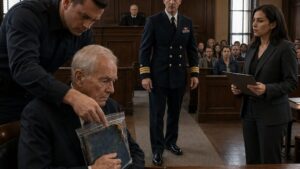
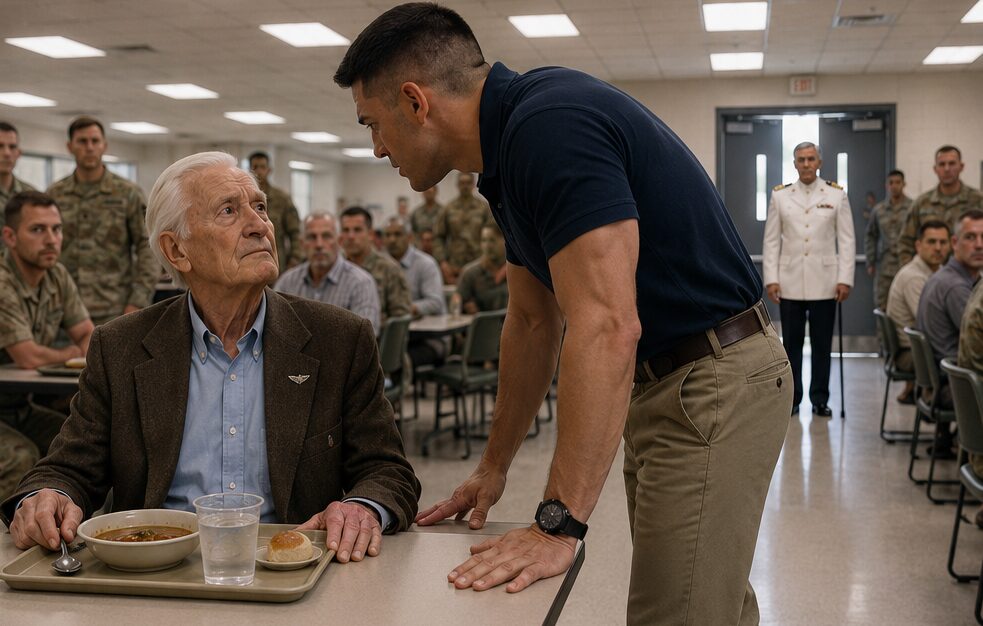
Lieutenant Justin put both hands on the old man’s table hard enough to rattle the plastic cup of water.
The spoon stopped halfway between the bowl and Dr. Raymond’s mouth. A little soup slipped from it and fell back without a sound anyone should have noticed. But the dining hall had gone quiet enough for small things to become large.
Justin pointed at the tarnished wing-shaped pin on Raymond’s brown blazer.
“Where did you buy that?”
Raymond looked up slowly.
He was seventy-eight, thin in the shoulders, with white hair combed back from a face that had learned not to ask for gentleness. His pale blue shirt was buttoned neatly under the blazer. In front of him sat a tray, a bowl of soup, a roll he had not touched, and a cup of water sweating under the cafeteria lights.
Around them, young officers, medical residents, and hospital staff pretended not to stare.
Justin did not pretend.
“I asked you a question,” he said.
Raymond’s eyes moved from Justin’s hands to his face. The lieutenant was young, fit, clean-cut, dressed in a navy polo and pressed khakis. Everything about him looked sharpened: jaw, posture, anger.
Raymond set the spoon down.
“I heard you.”
“Then answer.”
Raymond touched the pin, not to hide it, but as if steadying something that had shifted inside him.
Justin leaned closer. His voice carried just enough.
“Men earned wings like that. Men did not pick them up in gift shops.”
A young corpsman at the next table lowered his fork. Someone near the soda machine stopped filling a cup. The dining hall, built for noise, held its breath.
Raymond looked down at the soup. The surface trembled, not from his hand now, but from the table Justin still owned with both palms.
“I know,” Raymond said.
The words were so quiet they made Justin angrier.
“You know?”
“Yes.”
Justin gave a short laugh, but there was no humor in it. “This dining hall is for staff, patients, and invited military family. Not old men playing dress-up.”
A few faces turned away at that.
The insult hung low and ugly over the tray.
Raymond did not flinch. That almost made it worse. He sat there in his brown blazer, his visitor badge clipped crookedly to his pocket, looking like someone’s grandfather who had wandered into the wrong building and decided pride was the last thing he could afford to lose.
Nancy, the cafeteria worker behind the counter, saw what was happening and came around with a towel still in her hand.
“Lieutenant,” she said gently, “Dr. Raymond comes in most Thursdays. He’s cleared.”
Justin did not take his eyes off the old man. “Cleared by who?”
Raymond reached into the inside pocket of his blazer. The movement was slow enough that Justin watched every inch of it.
He pulled out an old visitor badge and a folded letter. The paper had been opened and closed so many times the creases had gone soft.
Justin snatched neither. He waited for Raymond to place them on the table, then picked them up.
Nancy stepped closer. “He’s not bothering anybody.”
“He is wearing something that means something,” Justin said.
Raymond looked at the pin again.
“It does,” he said.
Justin read the letter. His expression tightened. It was signed by the hospital commander. It granted Dr. Raymond access to the facility archives and attendance at the noon dedication. It used official language, but not enough of it. It named him without explaining him.
Justin folded it once and placed it down.
“This proves you were allowed past the desk,” he said. “It does not prove that belongs to you.”
Raymond’s hand rested beside the tray. His fingers were long, veined, and steady now.
“No,” he said. “It does not.”
Justin stared at him.
That answer should have given him victory. Instead, it opened a door he did not want to look through.
Raymond asked, “Does the name Scott mean anything to you?”
The room changed.
It was not loud. No one gasped. No chair scraped. But Justin’s face shifted, and everybody close enough to see it understood that Raymond had touched something private.
“My grandfather’s name was Scott,” Justin said.
“I know.”
Justin’s mouth hardened. “Do not.”
Raymond waited.
“Do not use him to get yourself out of this,” Justin said. “You don’t get to pull a dead man’s name from a plaque and wear it like a shield.”
Raymond closed his eyes for one second.
When he opened them, he looked older, but not weaker.
“I stood beside him when the rain came through the ceiling,” he said.
Justin’s hand came down flat on the table again.
“My grandfather died with honor.”
“Yes,” Raymond said.
“You don’t know anything about it.”
Raymond looked past him, toward the far double doors of the dining hall.
For one heartbeat, he seemed to be waiting for someone.
No one came.
So he turned back to Justin and said, “I know what he asked me to carry.”
Part II — The Letter That Wasn’t Enough
Captain Christine arrived in a white medical coat over her uniform, and with her came the kind of silence that obeyed rank before it understood facts.
She took in the scene quickly: Justin standing over an elderly visitor, Nancy beside the table with a worried towel in her hand, the folded letter, the pin, the tray of soup cooling under the lights.
“Lieutenant,” she said.
Justin straightened. “Ma’am.”
Raymond remained seated.
Christine looked at him, and something like recognition flickered across her face, but it was incomplete. She knew his name. She did not yet know the weight of it.
“Dr. Raymond,” she said. “There seems to be some confusion.”
“There usually is,” Raymond said.
Justin’s jaw moved.
Christine held out her hand for the letter. Justin gave it to her. She read it once, then again.
“You were expected for the dedication,” she said.
Raymond nodded.
Justin said, “He claims he was invited privately.”
Christine looked at Raymond. “Were you?”
“Yes.”
“By whom?”
Raymond’s eyes went again to the far doors.
“The man who still remembers the rain.”
That answer traveled poorly through the room. It sounded like evasion. Or grief. Or the sort of sentence old men said when people had stopped asking them direct questions.
Justin heard only evasion.
“The noon dedication is for my grandfather,” he said to Christine. “For the new trauma wing. If he came here to attach himself to that—”
“I came because I was asked,” Raymond said.
“By a ghost?”
Raymond’s face did not change, but Nancy did. She looked at Justin as if he had stepped on something he could not see.
Christine’s voice lowered. “Lieutenant.”
Justin swallowed the next sentence. Barely.
Christine turned to Raymond. “Sir, perhaps we could step into a side room. Continue this out of the dining hall.”
Raymond looked at the soup, then at the young faces watching him over their trays.
“No,” he said.
Christine paused.
“I have hidden in hallways long enough,” Raymond said. “If I leave this table now, they will remember only what he called me.”
Justin’s face flushed.
Raymond did not look at him. That made the shame sharper.
Christine folded the letter again. “You understand this is a formal event.”
“I do.”
“And you understand the family is present.”
Raymond’s hand moved to the pin. “That is why I came.”
Justin stepped forward again. “My family doesn’t need anything from you.”
Raymond looked at him then.
“Maybe not,” he said. “But your grandfather asked something of me.”
Justin almost laughed. “My grandfather died before I was born.”
“Yes.”
“You expect me to believe he gave you that pin?”
“No.”
That stopped him.
Raymond’s voice stayed even. “I expect you not to believe anything until you see what was sealed.”
Christine’s attention sharpened.
“Sealed where?” she asked.
“The archive.”
The word worked on the room differently than grief had. It was practical. Real. It had a door, a key card, a logbook, a chain of custody.
Justin looked from Raymond to Christine. “Ma’am, this is exactly the problem. He has just enough official language to make people hesitate.”
Raymond picked up the folded letter, but did not open it.
“Lieutenant,” he said, “have you ever stood beside someone who could not speak and promised him you would do it later?”
Justin’s eyes narrowed.
“I have stood beside living men who needed discipline,” he said. “Not stories.”
The sentence struck harder than he meant it to. Or maybe exactly as hard.
Raymond’s fingers closed over the letter.
Christine made her decision.
“We’re going to the archive,” she said.
Justin turned. “Ma’am?”
“You raised the challenge,” Christine said. “Now we follow it to the end.”
Nancy looked at Raymond’s untouched tray. “Doctor, your soup—”
“It will wait,” Raymond said.
But the soup did not look like it would wait. It had already begun to gather a skin at the edge of the bowl.
Raymond pushed back his chair.
For the first time, Justin saw how carefully the old man rose. Not fragile exactly. Measured. As if some rooms had to be crossed with the body one had left, not the one one remembered.
Nobody spoke as they left the dining hall.
But the rumor moved faster than they did.
The old man with the pin.
The lieutenant’s grandfather.
The archive.
The rain.
Part III — The Room of Paper Names
The archive room sat two floors below the dining hall, behind a coded door and a sign asking visitors to keep food, drinks, and impatience outside.
Christine swiped her badge.
Raymond stepped in like a man entering a place he had avoided and needed in equal measure.
The room smelled of paper, toner, and climate-controlled forgetting.
Nancy had come with them without being invited. She carried the towel folded over one arm, as if it still gave her a reason to be there. Christine noticed, but did not send her away.
Justin stood by the door.
He had stopped looming, but anger had not left him. It had simply put on a uniform.
“What file?” Christine asked.
Raymond answered immediately.
“Operation Lantern Bay.”
Christine typed the name into the archive terminal.
A red restriction notice appeared.
Justin saw it and seized on it. “Restricted.”
“Sealed,” Raymond corrected.
Christine’s eyes moved across the screen. “There’s a physical packet.”
“Yes.”
“You know the box number?”
Raymond gave it.
Justin looked at him despite himself.
Christine disappeared between the shelves. No one spoke until she returned with a gray archival box and set it on the table.
Inside was a packet bound with cloth tape, a water-damaged medical log, a folded casualty list, and a photograph in a clear sleeve.
Christine put on gloves.
Raymond did not.
His hands hovered over the photograph before he touched it.
In the picture, a younger Raymond stood in a flight suit beside a broad-shouldered man with an easy grin and a wing-shaped pin bright on his chest. Around them were tired men squinting into sun, some bandaged, some laughing too hard at nothing.
Justin leaned in.
The young doctor in the photograph had Raymond’s eyes.
The grinning man had Justin’s.
Nobody had to say it.
Still, Justin did.
“That’s my grandfather.”
Raymond nodded.
Justin pointed at the younger Raymond. “And that’s you.”
“Yes.”
The truth landed, but not gently. Justin did not apologize. He looked for the next place to stand.
“A photograph means you knew him,” he said. “It does not mean that pin belongs to you.”
Raymond looked down at the faded image.
“No,” he said. “It means I was there before it did.”
Christine opened the medical log. The ink had blurred in places where water had touched it. Some names were clear. Others were ghosts.
Raymond’s finger moved to one entry, then stopped short of touching it.
“Scott gave me the pin on the deck,” he said. “Not as an award. Not because I had earned what he had earned.”
Justin’s face tightened at the old first name, but he said nothing.
“He pressed it into my hand during the evacuation,” Raymond continued. “He said if I got off that ship and he did not, I was to bring home the names.”
Nancy’s breath caught softly.
“What names?” Christine asked.
Raymond looked at the casualty list.
“The men who were not useful to the official version.”
Justin shook his head. “What does that mean?”
Raymond did not answer at once. His eyes had gone somewhere else.
Not far away. Down.
Below deck.
Rain hitting metal overhead though there was no sky. Smoke folding itself into the corridor. A young man begging with his eyes because the rest of him had stopped obeying. Scott laughing once, unbelievably, because fear had cornered them and he refused to give it the satisfaction.
Raymond came back to the archive room with effort.
Christine saw it.
“Doctor,” she said quietly.
Raymond opened the medical log.
“The report said your grandfather died during evacuation procedures.”
“He did,” Justin said.
“Yes. But not the way your family was told.”
Justin stepped away from the table as if the paper had moved.
Raymond’s voice remained controlled. “He was ordered to leave with the last flight group. He disobeyed. He went back below with me because two men were trapped in the forward compartment.”
Justin’s anger shifted into something more dangerous.
“You’re saying he disobeyed orders?”
“I’m saying he refused to call wounded men cargo.”
Christine looked up.
Raymond turned one page.
“I was a flight surgeon. Young enough to think training was the same as courage.” His mouth tightened. “One man had internal injuries. One had burns and smoke inhalation. Both were conscious when we reached them. Neither could be moved easily.”
Justin’s voice was low. “Stop.”
Raymond did not.
“I sedated them. It was the only way to move them through the corridor. One lived.”
His finger found the name.
“Stephen.”
At the far end of the archive room, something clicked.
A cane tip.
Once.
Then again.
Everyone turned toward the doorway.
An elderly man in a white dress uniform stood there, silver-haired and straight-backed, his cover tucked under his arm. The uniform made the archive room seem smaller.
Justin snapped upright before thought caught up with him.
“Admiral.”
The man did not look at Justin first.
He looked at Raymond.
“Doctor,” Admiral Stephen said.
Raymond closed the log.
For the first time all morning, his face broke.
Not much.
Just enough.
Part IV — The Man Who Remembered the Rain
Admiral Stephen walked into the archive room with the slow authority of someone who had been obeyed for so long that he no longer needed to ask for it.
But when he reached Raymond, he removed his cover.
That did more than rank could have done.
Justin saw it. Christine saw it. Nancy’s eyes filled immediately, though she tried to blink the tears away before anyone could accuse them of being useful.
Stephen looked at the medical log.
“You opened it,” he said.
Raymond answered, “It was time.”
“No,” Stephen said. “It was past time.”
Justin looked between them. “Sir, with respect—”
Stephen turned then. His voice was quiet, but it took the room.
“I have been alive for fifty-one years because that man refused to leave me under the water.”
Justin’s mouth opened, then closed.
The sentence did not accuse him. It did not need to.
Stephen looked back at Raymond. “And because Scott Carter went back when no one would have blamed him for leaving.”
Justin’s eyes flashed. “My grandfather’s name was Scott.”
“I know,” Stephen said. “He pulled me by the collar until his hand stopped working.”
The archive room held still.
Raymond’s gaze dropped.
Stephen touched the edge of the table. “You never told them.”
“His wife asked me not to.”
Justin looked up sharply.
Raymond said, “She had a baby daughter. A folded flag. A house full of officers telling her her husband had died cleanly. She said she could not survive a version with smoke and screaming and doubt.”
Justin looked wounded by the word doubt.
Raymond saw it and softened his voice.
“Your grandfather did not lose honor because he broke an order. Sometimes an order arrives after the human thing has already begun.”
Christine looked at the dedication program in her hand. The printed remarks had Scott’s name in bold. A clean paragraph. A clean story. A clean room waiting upstairs.
Justin pointed at the log. “You said two men.”
Raymond did not move.
Stephen closed his eyes.
Raymond said, “Jerry did not survive the transfer.”
Nancy turned her face away.
“I gave him the same medication,” Raymond said. “The same dose. The same chance. But he did not wake again.”
Justin’s anger had nowhere simple left to go.
“So you blame yourself.”
Raymond gave a faint, humorless smile.
“A doctor who stops counting becomes dangerous.”
“You saved one man.”
“I silenced another before he could say goodbye.”
No one answered that.
There were sentences no rank could outrank.
Christine set the dedication program down on the table. “The ceremony begins in twelve minutes.”
The practical fact struck everyone because it had no respect for revelation.
Guests were seated upstairs. The new trauma wing had a ribbon across its entrance. A plaque under a cloth waited for clean words.
Christine looked at Raymond. “We can amend the remarks privately. Add language later. We don’t have to make this public today.”
Justin seized on that. “Yes. Exactly. My family is upstairs.”
Raymond looked at him.
Justin’s voice cracked, then hardened to hide it. “You cannot walk in there and change my grandfather in front of people who came to honor him.”
“I did not come to take his honor,” Raymond said.
“Then what did you come for?”
Raymond opened the casualty list and turned it so Justin could see.
Names.
Not many. Enough.
“I came because they are naming a place of healing after a man whose final act was not dying bravely,” Raymond said. “It was refusing to let the wounded be treated as already gone.”
Justin stared at the list.
Raymond added, “You may keep a clean legend if you want. Or you may inherit the truth.”
Justin looked at the photograph again.
His grandfather’s grin was still there. Young. Unbothered. Unaware that someday his grandson would stand in a basement archive and be asked to love him more honestly.
“Did he know?” Justin asked.
Raymond understood.
“About the pin?”
Justin nodded.
Raymond touched the lapel of his blazer. “He pressed it into my hand and said, ‘If I don’t make it, don’t let them make it simple.’”
Justin looked away.
Stephen’s voice came softly. “And then he laughed.”
Raymond looked at him.
Stephen’s mouth trembled once. “I had forgotten that.”
“No,” Raymond said. “You hadn’t.”
The room fell quiet again.
Then Christine picked up the program.
“We have to go upstairs,” she said.
Raymond looked at the sealed packet, the photograph, the log, the names.
For decades, silence had looked like loyalty.
Now it looked like one more omission.
He put the photograph back into the sleeve and picked up the pin between two fingers.
Justin watched him.
Raymond did not pin it to his jacket.
He carried it in his palm.
Part V — The Names That Would Not Stay Quiet
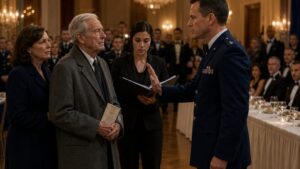
The dedication hall was already full.
Rows of chairs faced the covered plaque. Officers, doctors, nurses, families, and donors sat beneath bright lights. At the front, a ribbon stretched across the entrance to the renovated wing.
Justin’s mother sat in the second row. She looked proud and nervous and unaware that her son had just come upstairs carrying a changed version of the man she had mourned all her life.
Justin stood at the lectern first.
His notes were there. Printed. Neat.
He saw the first line: Today we honor my grandfather, Scott, whose courage has guided this institution for generations.
His mouth went dry.
Raymond sat in the front row with Stephen on one side and Nancy at the back wall as if she had come only to refill coffee. Christine stood near the plaque, the revised program folded in her hand but not yet used.
Justin began.
“Thank you all for being here.”
His voice sounded correct. That was the problem. Everything about the room was correct.
“The man we honor today has been, for my family, a symbol of service and courage.”
He looked down.
The next sentence would have been easy yesterday.
It would have been easy one hour ago.
He saw Raymond’s hand closed around the wing-shaped pin.
Justin stopped.
The silence spread through the hall, uncomfortable and alive.
He looked at his mother. Then at the plaque. Then at the old man he had insulted over a bowl of soup.
“I thought I knew why we were here,” Justin said.
A murmur moved.
Christine shifted, ready to step in.
But Raymond stood.
He did it without drama. One hand on the chair, one hand closed around the pin, his body obeying after a moment’s negotiation.
Justin stepped back from the lectern.
Raymond walked to it slowly.
Nobody clapped. Nobody understood whether they should.
That was better.
Raymond placed the pin on the lectern.
The small metal wings made almost no sound.
“This was never my decoration,” he said. “It was my debt.”
The room tightened around the sentence.
Raymond did not look at the notes. He did not look at the photographers. He looked at Justin’s mother, then at Justin, then at the covered plaque.
“Scott gave this to me during an evacuation called Lantern Bay. He gave it to me because he believed one of us would have to remember what the report could not carry.”
Christine looked down.
Stephen’s hand closed around the top of his cane.
Raymond continued, “Your father, your grandfather, your friend—however you knew him—went back for men who could not leave on their own. That is the truth. He disobeyed an order. That is also the truth.”
Someone in the front row inhaled sharply.
Raymond did not apologize for the second truth.
“He helped me carry Stephen out. Stephen lived. Another sailor, Jerry, did not. I was the doctor who made the decision that allowed both men to be moved. I have never known whether mercy and necessity were the same thing that day.”
The sentence landed with no decoration.
Justin’s mother covered her mouth.
Raymond’s voice stayed calm, but each word cost him something visible now.
“I am not here to correct grief. Grief does not owe history perfect language. I am here because this wing will hold people on the worst day of their lives, and no one who enters it should be treated as already gone.”
He touched the pin.
“I ask that the plaque remember not only the name easy to honor, but the names harder to carry. The wounded. The medical crew. The ones who lived. The one who did not. All of them made this place possible.”
No applause came.
For a moment, the room had too much truth in it for applause.
Then Justin stepped forward.
Every eye moved to him.
For one terrible second, Raymond thought the young man would defend the clean version. Not because Justin was cruel, but because clean grief is easier to hold in public.
Justin picked up the pin.
His hand was not steady.
He faced Raymond.
“May I?”
Raymond’s eyes searched his face.
Then he nodded.
Justin fastened the pin back onto the brown blazer. His fingers fumbled once with the clasp. He fixed it carefully, as if the small act had become too important to rush.
When he finished, he did not step away immediately.
He said, quietly enough that the room had to lean in, “Then you carried it longer than any of us.”
Raymond closed his eyes.
Not to hide.
To remain standing.
Christine walked to the covered plaque. She did not unveil it.
Not yet.
“We will amend it,” she said to the room. Her voice was controlled, but not cold. “Before it is uncovered.”
That was when the first person stood.
It was not Stephen.
It was Nancy at the back wall, still holding a coffee pot she had forgotten to set down.
Then Stephen stood.
Then Justin’s mother.
Then the room.
Raymond did not look around for approval.
He looked at the pin, touched it once, and let his hand fall.
Part VI — A Fresh Bowl
When it was over, Raymond returned to the dining hall.
The room was almost empty now. The lunch rush had passed. Chairs sat crooked at tables. A few trays waited to be collected. The far double doors opened and closed with the soft tired rhythm of an ordinary afternoon.
His soup was still there.
Cold.
A skin had formed across the top.
Raymond stood beside it for a moment, looking down at the meal that had been interrupted before the world changed around it.
Then Nancy appeared and took the tray without asking.
“Don’t you dare eat that,” she said.
Raymond looked up.
The corner of his mouth moved. “Doctor’s orders?”
“Common sense.”
She returned with a fresh bowl, a new roll, and water without ice.
She set them down as if this were the only ceremony that mattered.
Raymond sat.
For the first time all day, nobody watched him like a question.
Justin approached from the doorway. He stopped at the edge of the table.
He did not put his hands on it.
“May I sit?” he asked.
Raymond looked at the chair across from him.
Then he nodded.
Justin sat carefully, leaving space between himself and the tray.
For a while, neither spoke.
That was all right. Some silences were empty. This one was working.
Finally Justin said, “My mother wants to meet you.”
Raymond stirred the soup.
“She should have time first.”
Justin nodded.
Another silence.
Then, lower, “Did he know?”
Raymond looked at him.
“My grandfather,” Justin said. “Did he know you kept the pin?”
Raymond’s eyes moved toward the far doors, as if seeing a deck washed silver with rain.
“He knew I would try.”
Justin swallowed.
“What was the rain like?”
Raymond’s spoon paused.
The question could have opened a door too wide. Instead, Raymond opened it only enough.
“It sounded like coins thrown against a coffin lid,” he said.
Justin looked down.
Raymond added, “Your grandfather laughed once before he went back below. Said fear was easier to carry if you made it angry.”
Justin gave a broken little breath that was not quite a laugh.
“That sounds like him,” he said, though he had never heard the man’s voice.
“Yes,” Raymond said. “It does.”
Across the hall, Admiral Stephen passed the doorway in his white uniform. He stopped when he saw them.
For a moment, he seemed ready to come in.
Instead, he gave Raymond a small nod.
Not a salute. Not a performance.
A witness recognizing another witness.
Raymond nodded back.
Justin saw the exchange and did not interrupt it.
Raymond touched the pin once. The metal was still warm from Justin’s hands.
Then he picked up his spoon and took a mouthful of soup.
It was ordinary.
It was hot.
It was enough.