The Old Man Kept a Gold Case Beside His Coffee for Years
Part I — The Case on the Table
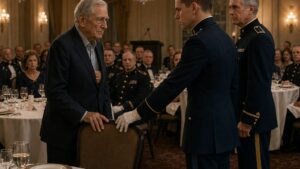
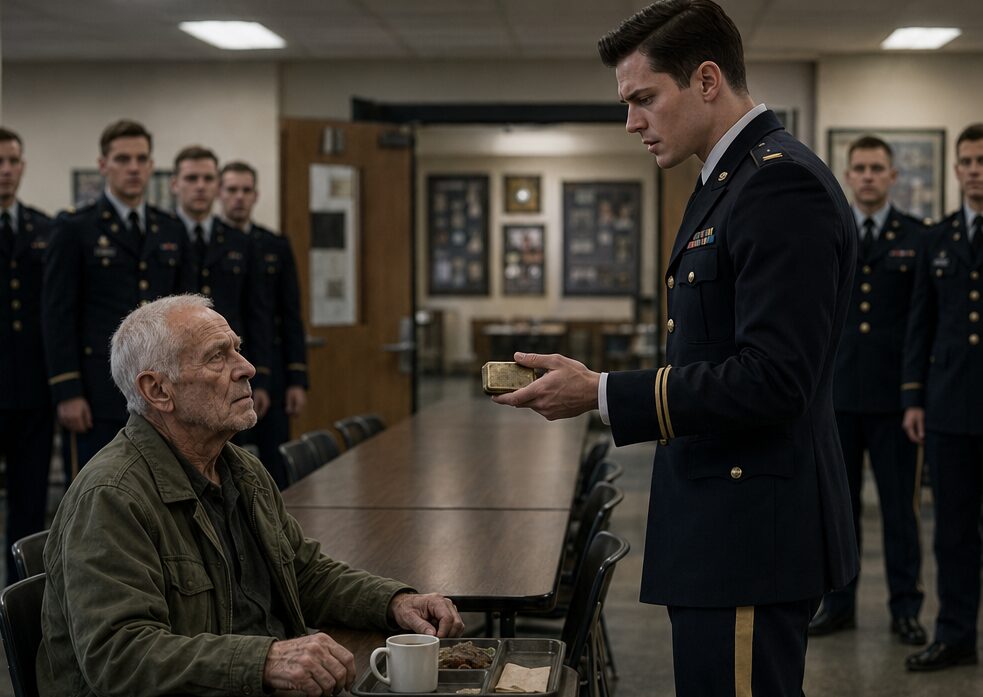
The young lieutenant picked up the gold case before the old man could stop him.
It had been resting beside a white coffee mug and a plastic tray of untouched food, small enough to fit in a closed fist, dull at the edges from years of being carried. The old man’s hand moved toward it, slow and thin and veined, but the lieutenant was faster.
“Where’d you get this?” Jacob asked, holding it up between two fingers.
Three other young men in dress blues turned to look.
The dining hall noise thinned around them.
The old man sat alone at the end of a long table, his green field jacket folded around his shoulders like it belonged to another decade. His hair was white and close-cropped. His shoes were plain. His shirt had no insignia, no ribbon, no sign that he belonged anywhere near the ceremony being set up beyond the double doors.
Jacob smiled, not quite cruelly.
That made it worse.
“Gift shop?” he asked. “Or did you lift it from one of the display cases?”
One of the young men behind him gave a short laugh and then swallowed it when the old man looked down at his tray.
The old man did not answer.
He stared at the case in Jacob’s hand, at the worn gold lid catching the fluorescent light. His fingers remained near the tray, hovering beside a paper napkin and a fork he had not used.
Jacob turned the case over.
It was heavier than it looked.
On the back, almost erased by time, was a faded emblem: a gull above a narrow inlet, two crossed lines beneath it, and a number so worn Jacob had to tilt it toward the light.
“Looks official,” he said.
The old man finally lifted his eyes.
They were pale, steady, and tired in a way Jacob did not know how to read.
“That doesn’t open for you,” the old man said.
The room seemed to hear that.
Not loudly. Not all at once. But enough that several heads turned. Enough that Jacob felt the small heat of being challenged while wearing a uniform that had never failed him in public.
He closed his fingers around the case.
“Excuse me?”
The old man’s voice stayed flat. “Put it back.”
Jacob glanced at the men behind him. They were watching him now, waiting to see whether he would let an old man in a stained field jacket tell him what to do.
That was all it took.
“You know,” Jacob said, softer now, “this is a closed event. Alumni, families, invited guests. We’ve got ceremonial items out there for the Gray Harbor display. People get sentimental. Things go missing.”
The old man’s jaw moved once.
He said nothing.
Jacob placed the case on his open palm, out of reach.
“Want to tell me your name?”
The old man looked at the case, not at him.
“Larry,” he said.
“Larry what?”
The old man breathed in through his nose. “Larry Dennis.”
Jacob waited for more. A rank. A unit. A reason.
Nothing came.
A woman in a navy blazer hurried through the dining hall with a clipboard pressed to her chest. Her event badge swung from a red cord. She saw the circle forming around the table and changed direction at once.
“Lieutenant,” she said. “Is there a problem?”
Jacob did not look away from Larry.
“Maybe. This gentleman has an item that may belong to the display.”
The woman checked the old man’s face, then the clipboard.
“Mr. Dennis?” she asked.
Larry nodded once.
“You’re on the guest list,” she said. “I checked you in twenty minutes ago.”
Jacob’s smile thinned.
“Anyone can write veteran on a sign-in sheet, Nicole.”
Nicole’s face tightened, but she kept her voice calm. “That isn’t what happened.”
“It’s what I’m looking at.”
Larry reached again for the case.
His hand trembled.
Not much. Just enough for Jacob to notice. Just enough for the young men behind him to notice too.
Jacob pulled the case back.
Larry’s hand stopped in the air, empty.
For one second, all the ceremony posters, polished shoes, folded flags, and framed photographs in the corridor seemed to lean toward that hand.
Then Larry lowered it to the table.
He did not plead.
He did not explain.
He looked at Jacob and asked, “What patch is on the back?”
Jacob blinked.
“What?”
“The engraving,” Larry said. “Tell me what patch is on the back.”
Jacob turned the case again, irritated despite himself. The old emblem stared up from the metal.
A gull. A narrow inlet. Two crossed lines.
His throat changed before his face did.
He knew that insignia.
His father had kept it on a faded photograph in the den. A group of younger men standing shoulder to shoulder under a gray sky, all of them half-starved, sunken-eyed, alive. His father had pointed once, when Jacob was twelve, and said, That was Gray Harbor.
Jacob closed his fingers over the emblem.
“It’s an old mark,” he said.
Larry kept watching him.
“It was your father’s,” Larry said quietly.
The dining hall went still.
Jacob’s smile vanished.
“My father’s name isn’t on your guest list,” he said.
“No,” Larry said. “It’s on the wall.”
Beyond the double doors, someone tested a microphone. A low thump rolled through the hall.
Nicole looked from Larry to Jacob.
Jacob leaned closer.
“How do you know my father?”
Larry’s eyes dropped to the gold case again.
“I knew the route he didn’t take.”
Part II — The Name on the Wall
The tribute hall beyond the dining room had been arranged with careful reverence.
Framed photographs stood on easels. A polished map of Operation Gray Harbor sat under glass at the center display. Beneath it were names, dates, unit numbers, and a short paragraph about discipline, courage, and command under pressure.
At the far end of the room, a lectern waited for Jacob.
His speech was folded in the inside pocket of his jacket.
He had written three drafts and hated all of them.
His father, Captain Donald Miller, had been dead for nine years. The stories left behind him were clean stories. The kind told at dinners and ceremonies. The kind men lowered their voices for.
Donald Miller had led survivors out.
Donald Miller had kept discipline when communications failed.
Donald Miller had known the route home.
But there had always been a pause.
Jacob remembered it from childhood. His father would describe the cold rain, the broken radios, the marsh swallowing boots to the ankle. He would describe telling the men to keep moving when some of them wanted to sit down and not get up again.
Then he would stop.
Not long. Just long enough to make the room shift.
Jacob had once asked, “What happened next?”
His father had stared at the carpet and said, “We followed the wrong map.”
Jacob had laughed because he thought it was a joke.
His father had not laughed with him.
Now that sentence returned to him with Larry Dennis sitting under the dining hall lights, his coffee cooling beside an untouched meal.
Nicole lowered her voice. “Lieutenant, we should resolve this quietly.”
Jacob heard the warning in it.
Quietly meant without witnesses.
Quietly meant before families arrived.
Quietly meant before the old man made the ceremony messy.
Jacob did not want messy. He wanted order. He wanted the speech to land. He wanted his father’s photograph to sit beneath the lights without an old stranger dragging shadows across it.
He set the gold case on the table but kept one hand near it.
“What do you mean, the route he didn’t take?”
Larry did not reach for the case again. His restraint was becoming a form of accusation.
“There were two routes out of Gray Harbor,” he said.
Jacob waited.
Larry’s gaze moved toward the double doors, toward the display being assembled.
“One was official.”
“And the other?”
Larry touched the paper napkin beside his tray and folded one corner into a hard crease.
“The other got men home.”
A laugh escaped one of Jacob’s friends, nervous and sharp. “So now he planned the whole operation?”
Larry did not look at him.
Jacob should have ended it there. He should have told Nicole to call security or asked Larry to step into an office. He should have returned the case and walked away if he wanted mercy, or confiscated it if he wanted control.
Instead, he said the one thing pride always says when it feels something shifting under its feet.
“Prove it.”
Nicole inhaled.
Larry looked at him for a long moment.
Then he said, “I already did.”
The words did not land like a boast. They landed like something old and heavy set down with care.
Nicole flipped through her binder. Her fingers moved quickly now. Guest list. Seating. Donor names. Alumni confirmations. Historical participants.
“Dennis,” she murmured. “Larry Dennis…”
Jacob looked toward the tribute hall.
Families were beginning to gather beyond the doors. Elderly spouses. Middle-aged sons and daughters. Grandchildren wearing stiff shoes. They moved slowly past the framed photographs, pausing before names they had heard all their lives.
In fifteen minutes, Jacob was supposed to stand before them and say his father had represented the best of service.
He knew that was true.
He needed that to be true.
Nicole stopped turning pages.
Her face changed.
“What?” Jacob asked.
She did not answer right away.
“Nicole.”
She looked at Larry, then back at the binder. “He was attached to the reconnaissance mapping section.”
Jacob frowned. “Who?”
She swallowed. “Mr. Dennis.”
Larry closed his eyes for half a second.
Nicole read quietly, “Technical Sergeant Larry Dennis.”
The rank moved through the air like a correction.
Jacob felt the young men behind him shift.
Nicole kept reading, slower now. “Operation Gray Harbor. Cartographic support. Field route assessment. Removed from formal commendation pending review.”
Jacob seized on the last words.
“Pending review,” he said. “For what?”
Nicole did not answer.
Larry opened his eyes.
Jacob’s hand went to the gold case again.
“What’s inside?”
Larry’s voice hardened. “No.”
“That sounds like an answer.”
“That is an answer.”
Jacob picked up the case.
Nicole stepped forward. “Lieutenant, don’t.”
Larry’s hand went flat on the table.
For the first time, anger showed in him. Not loud. Not hot. Just visible beneath the skin.
“That doesn’t open for you,” he said again.
Jacob heard the tremor in his voice now.
It was not fear.
It was memory.
But pride had already moved his thumb to the latch.
The case opened with a small, dry click.
There was no compass inside.
No polished needle. No glass face. No ceremonial inscription.
Only a folded strip of waterproof paper, browned at the creases, thin from age and careful handling.
Two routes had been drawn across it.
One in black.
One in blue.
Jacob stared at the paper.
Larry looked away.
Nicole whispered, “Oh.”
The room behind them clapped politely as someone tested the first slide on the screen.
Jacob unfolded the paper with the care of someone who suddenly knew he had touched something he had no right to touch.
The black line ran through a marked pass near the inlet.
The blue line cut wide, ugly, and indirect through marshland, then circled back toward a ridge.
At the bottom, in a hand that had nearly faded away, were three letters.
D.M.
Jacob’s father’s initials.
Part III — The Second Map
Jacob did not recognize his own voice when he spoke.
“What is this?”
Larry kept his eyes on the tray.
“The second map.”
“That’s not an explanation.”
“No,” Larry said. “It’s what you asked for.”
Jacob looked at the initials again.
D.M.
His father’s hand had been large and square, the nails always clipped too short. Jacob remembered that hand resting on the back of his bicycle seat. Signing school forms. Holding a glass too tightly the night he told one story about Gray Harbor and then stopped in the middle of it.
The wrong map.
Jacob looked at Larry.
“You knew my father.”
Larry’s mouth pulled slightly, almost a smile, almost pain.
“I knew him when he was younger than you.”
The line should have softened the room. It did not. It made it worse.
Because now Jacob could see it: his father as a young man, hungry and afraid but responsible for men who were more afraid than he could admit. He could see Larry too, not old, not seated under fluorescent lights, but bent over a wet board somewhere in the dark, drawing a line that no one had authorized him to draw.
Jacob’s grip tightened on the case.
“Tell me what happened.”
Larry looked toward the tribute hall. “Not here.”
“You don’t get to drop my father’s initials on a map and then say not here.”
Larry’s face sharpened.
“I didn’t drop anything. You opened it.”
The words hit clean.
Jacob had no answer.
Nicole closed the binder slowly. “Lieutenant, the ceremony starts in ten minutes.”
Jacob ignored her.
“Was my father lying?”
Larry looked at him then, fully.
“No.”
“Then what was he?”
“A man who chose fast enough that other men lived.”
Jacob held the map fragment between both hands. “And you?”
Larry’s eyes moved to the folded display poster beyond the doors.
“I was the wrong man.”
Nicole’s expression tightened. “Mr. Dennis…”
“No,” Larry said. “He should know what he’s holding.”
Jacob waited.
Larry did not tell the whole story. He gave only pieces, as if too much at once would cheapen it.
Gray Harbor had gone wrong before dawn. The official maps had not caught the inlet shift after three days of rain. A road marked passable had become a channel of black water. Communications failed. Command sent the same withdrawal route twice.
Larry had been attached to mapping, not command. He had no authority to change a route.
He changed it anyway.
He drew the blue line.
A longer path. A worse path. A path that made no sense unless someone had walked the ridgeline two days earlier and remembered the marsh grass bent west in the wind. Larry had.
Donald Miller had looked at both maps.
“He knew the official route would look better in a report,” Larry said.
Jacob’s eyes stung, but he did not move.
“He took mine.”
Nicole’s hand covered her mouth.
Jacob looked again at the initials.
“Then why wasn’t that the story?”
Larry folded the napkin tighter.
“Because the official route killed the first group.”
The dining hall seemed to lose all sound.
Larry’s voice did not break.
“Command didn’t need another story. They needed one story. Your father’s men made it out. The others didn’t. My map made their report impossible.”
Jacob heard a chair scrape somewhere behind him.
Larry continued, “Your father tried to say so. More than once. Wrote statements. Put his initials on that piece so no one could say he hadn’t seen it. But the review board decided altered field maps were a discipline issue.”
“You were punished for saving them?”
Larry’s eyes were flat now. “I was punished for making the wrong people wrong.”
The line stayed in the air.
One of the young men behind Jacob stopped staring at Larry and looked down at his polished shoes.
Jacob felt the heat rise in his neck. He wanted to reject it. Wanted to call it incomplete. Wanted to say old men remembered themselves kindly when institutions forgot them for a reason.
But the paper was real.
The initials were real.
And his father’s pause had always been real.
Before Jacob could speak, another voice entered the dining hall.
“Lieutenant.”
Everyone straightened.
Major Samuel Gaines stood near the doorway in an immaculate uniform, silvering hair neat, face composed in the way of men who used calm like a closed door.
His eyes moved from Jacob to Nicole, then to the open case and the map fragment.
Only then did he look at Larry.
Not surprised.
Not confused.
Just displeased.
“Mr. Dennis,” he said.
Larry’s shoulders settled a little lower.
There it was again.
Not Sergeant.
Not even sir.
Mr.
Jacob noticed.
For the first time, he noticed.
Major Gaines walked toward the table. “This is not the place.”
Larry looked up at him. “It never is.”
Samuel’s jaw tightened.
Nicole lowered the binder against her side. “Major, he’s on the list.”
“I’m aware.”
Jacob turned to him. “You know him?”
Samuel’s eyes remained on Larry. “I know of him.”
Larry gave a short breath that might have been a laugh.
“That’s what they settled on.”
Samuel’s voice dropped. “We are not reopening a historical review in a dining facility.”
“No,” Larry said. “You reopened it when you invited me and put the wrong map under glass.”
Jacob looked through the double doors.
At the center display, volunteers were adjusting the polished map.
The black line shone beneath the lights.
The blue line was nowhere.
Part IV — The Approved Remarks
Samuel took one step closer to Jacob.
“Lieutenant,” he said, “your remarks are in five minutes. Return the item to Mr. Dennis and report to the lectern.”
Jacob looked down at the gold case.
The command was simple.
That was its power.
Return the case. Walk away. Give the speech. Protect the room from discomfort. Protect his father from complication. Protect himself from the consequences of having laughed first.
Larry slowly stood.
It took effort. Not dramatic effort. Just the ordinary negotiation of an old body rising when it would rather remain seated.
Nicole moved to help him, but he lifted one hand.
He did not want to be helped into the truth.
Jacob saw that too.
Larry held out his palm.
Jacob placed the case there.
Not because Samuel had ordered it.
Because his own hand suddenly felt wrong holding it.
Larry closed his fingers around the gold case and turned toward the doors.
Samuel blocked him without making it look like a block.
“Mr. Dennis,” he said, “the families are assembled.”
“Yes.”
“This is a commemorative event.”
“Yes.”
“It is not a hearing.”
Larry’s pale eyes lifted. “Your father said the same thing.”
The room changed again.
Samuel’s composure held, but only because he had built it to hold.
Jacob stared at him. “Your father?”
Samuel did not look at Jacob.
Larry answered anyway. “Colonel Gaines chaired the review.”
Nicole’s clipboard slipped slightly in her hand.
Jacob felt the story widen beyond his father, beyond Larry, beyond the case. It had roots under the floor.
Samuel’s voice remained low. “The record was settled before most of the people in that room were born.”
“Then it has had plenty of time to be wrong,” Larry said.
No one moved.
The double doors opened behind Samuel. An older woman peered in.
“Major? They’re ready for Lieutenant Miller.”
Jacob almost corrected the name before remembering it was his own.
Miller.
The name he had carried like polished metal.
The name Larry had not accused.
The name Larry had protected even now.
Samuel turned to him. “Lieutenant. Stay with the approved remarks.”
Jacob heard the warning beneath the instruction.
He looked through the open doors.
His father’s photograph stood near the map. Captain Donald Miller, young and unsmiling, eyes fixed somewhere past the camera. Jacob had studied that image his whole life, searching for the man he remembered in the man history displayed.
Now he saw something he had never seen before.
His father’s left hand was tucked against his jacket pocket.
Like he was holding something flat.
Like paper.
Larry moved toward the hall.
Each step was careful. The gold case rested in his hand, not hidden, not displayed.
Nicole walked beside him but did not touch him.
Jacob stayed behind for half a second, long enough for Samuel to say, “Do not turn this into a spectacle.”
Jacob looked at him.
“What do I turn it into?”
Samuel’s answer came too fast. “A tribute.”
Jacob almost laughed.
A tribute, he understood then, was sometimes just a room where the living agreed not to disturb the dead.
He walked past Samuel into the hall.
The families quieted when they saw him.
Rows of chairs had been filled. Children leaned against grandparents. Sons stood with folded programs. Daughters held framed photographs against their laps. The room smelled faintly of floor polish and coffee.
Jacob stepped to the lectern.
His speech waited there in clean black print.
Service. Honor. Discipline. Legacy.
All the safe words.
Larry stood near the back beside a chair, one hand resting on it for balance. He did not look like a man trying to be honored. He looked like a man trying not to leave before the thing he came for was finished.
Jacob unfolded his speech.
His mouth went dry.
“Good afternoon,” he began.
The room settled.
“My father, Captain Donald Miller, believed that duty was not something you announced. It was something you carried.”
He stopped.
The sentence had sounded noble when he wrote it.
Now it sounded borrowed from a man he had not fully known.
Jacob looked at his father’s photograph.
Then at the official map.
Then at Larry.
The old man’s fingers were closed around the gold case.
Jacob took the speech in both hands.
For a moment, he saw the easy road. Read. Finish. Shake hands. Let Larry be quietly escorted to an office where someone would promise to review what no one intended to change.
He saw his career continue unstained by inconvenience.
He saw his father remain simple.
Then he remembered his own voice in the dining hall.
Gift shop? Or did you lift it?
Shame moved through him with a force no command had ever managed.
He folded the speech once.
Then again.
Samuel shifted near the side wall.
Jacob looked at the room.
“There is a correction that should have been made before I was born,” he said.
The silence was immediate.
Samuel’s face hardened.
Jacob continued before he could be stopped.
“And the man who can make it is standing at the back of this room.”
Part V — The Blue Line
No one clapped when Larry came forward.
That saved him.
Applause would have made it unbearable.
He walked slowly between the rows, passing faces that did not yet know whether to pity him, doubt him, or recognize him. He kept his eyes on the display table.
Jacob stepped away from the lectern.
When Larry reached the front, Jacob held out the microphone.
Larry looked at it and shook his head.
Not that.
Not a performance.
Jacob understood and lowered it.
Larry opened the gold case himself.
His hand trembled, but the latch obeyed him.
He removed the folded map fragment and placed it on the table beside the polished official version. The old paper looked almost ugly under the lights. Small. Creased. Brown at the edges. Nothing like the clean display map with its printed line and polished frame.
But people leaned forward.
The old paper had something the clean one did not.
A second route.
A blue route.
Jacob saw an elderly man in the second row grip the armrest of his chair. A woman behind him whispered, “What is that?”
Larry placed one finger near the blue line.
Not on it. Near it.
As if even now he would not claim more than he had done.
“The black route was the one printed,” he said.
His voice was not strong, but the room listened.
“The blue route was the one Captain Miller took.”
A murmur moved through the families.
Jacob watched Samuel step forward slightly, then stop. There were too many witnesses now. Too many eyes. Too much paper.
Larry looked at the faces in the room, but not for approval.
“I drew it without permission,” he said.
Nicole stood near the aisle, one hand pressed to the binder.
Larry continued. “Captain Miller followed it without permission.”
An older woman in the front row began to cry silently, though no one had yet said why.
Larry swallowed.
“The first group took the printed route. They did what they were told.”
He stopped there.
That was enough.
The room understood the shape of what he would not describe.
Jacob felt it too. The dead entered without being named.
Larry’s hand remained beside the map.
“Your fathers came home,” he said, “because Captain Miller trusted the wrong man at the right time.”
The sentence went through the room like a door opening.
Jacob could not tell who moved first.
Maybe no one did.
Maybe everyone simply changed at once.
The official map under glass no longer looked complete. His father’s photograph no longer looked less honorable. It looked heavier. More human. Braver because the choice had cost something.
Larry reached for the old paper.
Samuel spoke. “Mr. Dennis, we can have this properly reviewed—”
Larry did not look at him.
“You had years.”
Samuel fell silent.
Larry folded the map fragment once, along its oldest crease.
Jacob stepped forward.
For a second, he was back in the dining hall, standing over an old man, holding what did not belong to him.
This time he bent.
Not deeply. Not theatrically. Just enough to put his hands lower than Larry’s.
Larry looked at him.
Jacob placed the gold case back into Larry’s palm with both hands.
“I’m sorry,” Jacob said.
Larry did not absolve him quickly.
That mattered.
Forgiveness given too fast would have made the hurt smaller than it was.
Jacob held his gaze.
Then he said the words he should have used from the beginning.
“Sergeant Dennis.”
Larry’s face changed only a little.
The smallest release. The kind a man allows himself when he has learned not to trust large gestures.
Behind them, Samuel did not correct the rank.
The room heard that too.
A few people stood.
Not all at once. Not as spectacle. One man first, then a woman, then another family member near the back. The sound of chairs moving was rough and awkward and human.
Larry looked almost pained by it.
Jacob wondered whether recognition could hurt when it arrived too late.
Larry closed the gold case.
The click was small.
It seemed louder than the applause that followed.
Part VI — Across the Table
Afterward, people wanted to surround him.
They came with shaking hands and wet eyes and sentences that began with, “My father always said…” or “My husband never talked about…” or “We didn’t know…”
Larry accepted each one carefully.
He did not let them make him larger than he was.
He corrected one man who called him a hero.
“No,” Larry said. “I was a map man.”
The man tried to insist.
Larry’s eyes moved toward the display.
“Maps don’t save anyone unless someone chooses the line.”
That was as much as he would give them.
Nicole saw when he had reached his limit. She stepped in with the gentle authority of someone who had learned that kindness sometimes meant clearing a room.
Ten minutes later, Jacob found Larry back in the dining hall.
Same table.
Same chair.
The tray had gone cold. The coffee was untouched. The white mug sat exactly where it had been when Jacob first picked up the case.
Only the case was different now.
Not in shape. Not in color.
In the room’s understanding of it.
Larry held it in his hand, thumb resting on the latch.
Jacob stopped beside the table.
He did not sit until Larry looked up.
“May I?”
Larry considered him.
Then he nodded.
Jacob pulled out the chair across from him.
Across, not above.
For a while, neither of them spoke.
The dining hall had emptied. From the tribute hall came the muffled sound of frames being moved, programs gathered, chairs stacked. Public honor was being packed away.
Jacob looked at the old man’s hand around the case.
“My father used to leave a blank spot,” he said.
Larry watched him.
“When he told the story. He’d get to the part where the radios failed, then the rain, then…” Jacob searched for the right words. “Then nothing. Like he stepped around something in his own memory.”
Larry’s thumb moved once over the gold lid.
“That was where the dead were.”
Jacob looked down.
The sentence did not accuse him.
It did not comfort him either.
It simply put the missing thing where it belonged.
“Did he know?” Jacob asked. “About your review?”
“Yes.”
“Did he try?”
“Yes.”
Jacob waited, but Larry did not soften the answer with details.
That, too, was a kind of mercy. He let Jacob keep a father who had tried. He did not make him carry every failed letter, every rejected statement, every door closed by men who preferred clean reports.
Larry reached into the inside pocket of his old green jacket and removed a folded envelope.
He slid it across the table.
Jacob did not touch it at first.
“What is it?”
“A copy,” Larry said. “Of the fragment. For your family.”
Jacob looked at the gold case in Larry’s other hand.
“And the original?”
Larry slipped the case into his jacket pocket.
“That stays with me.”
There was no bitterness in it.
Only boundary.
Jacob nodded.
He deserved no more.
From the doorway, Nicole watched quietly, then turned away before either man could feel observed.
Jacob opened the envelope.
Inside was a clean copy of the old paper. The black route. The blue route. His father’s initials.
D.M.
He thought of the speech in his pocket, folded and useless.
He thought of all the safe words he had planned to say.
Service. Honor. Discipline. Legacy.
The old man across from him had carried all four without needing any of them printed on a program.
“I should have asked,” Jacob said.
Larry looked at the cold coffee.
“Yes.”
It was not cruel.
That made it harder.
Jacob folded the copy carefully. “Will you donate it?”
“One day.”
“To the archive?”
Larry’s eyes lifted toward the tribute hall. “When I know they’ve made room for the blue line.”
Jacob sat with that.
Not corrected history. Not repaired loss. Not some perfect ending that made the old wound useful.
Just room.
A place beside the polished version for the line that had been drawn by a man no one wanted to name.
Larry pushed his chair back.
Jacob stood, then caught himself and stepped aside instead of reaching for him.
Larry noticed.
The faintest smile touched his mouth and vanished.
He lifted the tray with both hands. It took effort, but he did it. He carried it to the return window, set it down, and came back for his mug.
Jacob watched without offering help.
Some dignity had to be witnessed without being interrupted.
At the doorway, Larry paused.
The green jacket hung loosely from his shoulders. The gold case made a small shape in his pocket. He looked like an old man leaving a dining hall after a long day.
But he was not small.
The room had been.
Jacob held the envelope against his chest as Larry walked out into the corridor, past the display where a clean black route waited under glass and, beside it now, a copied blue line that would make people ask questions for years.
Larry did not look back.
He had come for the truth.
He left with his name.