The Night They Grabbed His Old Leather Jacket Before Learning Why He Never Took It Off
Chapter 1: The Hand On The Old Leather Collar
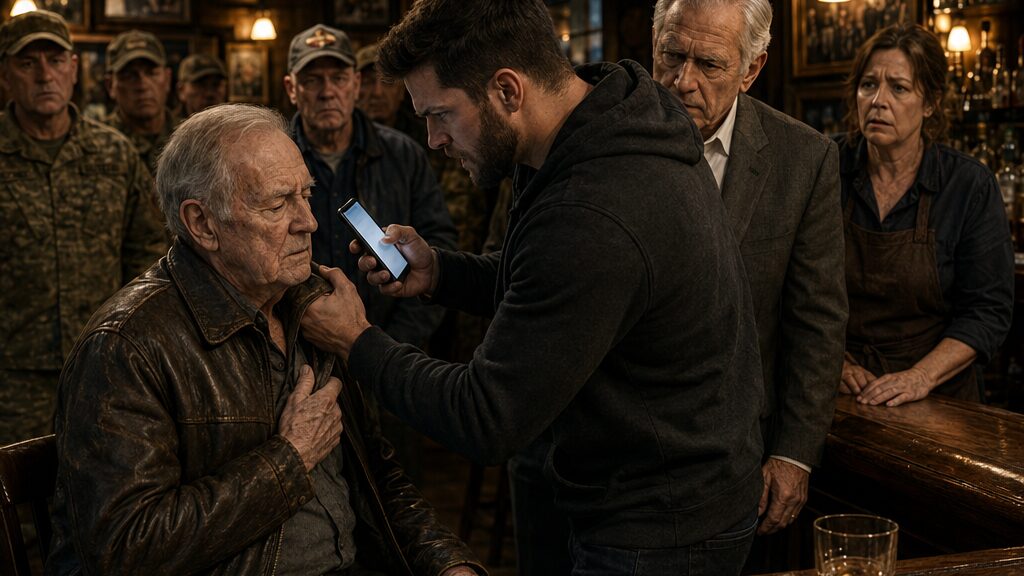
Kevin Baker’s hand closed around the collar of Stephen Clark’s leather jacket before Stephen had finished touching the rim of his glass.
The old seam gave a small, tired sound.
Not a tear. Not yet. Just the complaint of leather that had survived too much handling and too many winters. Stephen heard it beneath the low music, beneath the scrape of boots on the bar floor, beneath the laughter that had been thinning around him for the last five minutes.
“Don’t pull that seam,” Stephen said.
His voice was low enough that the bartender almost missed it. Kevin did not.
Kevin leaned closer, phone raised in his other hand, the glow of the screen turning his face blue-white under the amber bar lights. He was young, square-shouldered, with a trimmed beard and a dark hoodie zipped halfway over a benefit-night T-shirt. Behind him, uniformed reservists stood near the wall beneath framed flags and old photographs, cups in hand, suddenly unsure whether they were watching an argument or a show.
Stephen stayed seated.
That seemed to bother Kevin most.
“You hear that?” Kevin said toward the phone. “Man’s worried about his jacket, not the fact he’s sitting in a veterans’ benefit pretending he belongs here.”
The room tightened.
Rebecca Moore’s bar had been loud a minute earlier. The Friday-night benefit had filled every table: old regulars in caps, younger soldiers on weekend leave, town families who came because the donation jar sat beside the register and the local reporter had promised a photo spread. The place smelled of beer, wood polish, fryer oil, and wet wool coats. A half-filled glass of whiskey sat in front of Stephen, untouched for so long that the ice had melted into a pale ring.
Stephen looked at Kevin’s hand on his collar.
Not at the phone. Not at the boys in uniform behind him. Not at the faces pretending not to stare.
Only at the hand.
Kevin tugged again, not hard enough to drag him off the stool, but hard enough to make the old jacket shift open. “You come in here every year,” Kevin said. “Same drink, same sad face, same beat-up jacket. Folks buy you rounds because they think you’re one of them.”
Stephen’s fingers moved.
They were thin now, knuckled and spotted, but steady. He placed two fingers over the inner fold of the collar where the lining had been stitched and restitched. The gesture was small. Protective. Almost private.
Kevin saw it and smirked.
“Oh, that’s it?” he said. “That little patch? That what you flash when someone asks questions?”
Stephen did not answer.
The phone came closer. Kevin angled it toward the collar as if he had found contraband. “Let’s see what we’ve got here.”
The seam complained again.
Stephen’s left hand remained on the bar, palm down beside the glass. The right stayed at the collar, not gripping Kevin’s wrist, not pushing him away, just guarding that narrow strip of cloth hidden inside the jacket’s worn throat. He had been struck before, pulled before, shouted over by men who thought volume was courage. He knew how fast a room could become a road, a bunker, a ward, a place with too many bodies and not enough hands.
But it was only a bar.
Only Friday.
Only an old jacket.
“Kevin,” Rebecca said from behind the counter.
She did not sound like an owner. She sounded like someone who had waited too long and now wished she had spoken sooner.
Kevin did not look back. “No, Rebecca, people should know. My dad served. Half the guys in this room served. We raise money for real veterans, not barstool ghosts who won’t even answer a simple question.”
A murmur moved through the room. One of the older regulars looked down into his beer. A young soldier near the jukebox shifted his weight. Stephen noticed the movement the way he noticed all movement in tense rooms: heel first, shoulder next, eyes last.
Kevin’s phone captured everything.
The half-lit bottles. The old man’s weathered face. The young man’s hand. The leather collar twisted just enough to expose the inside fold.
Stephen looked older on the phone screen than he felt in his own body. Smaller too. That was the cruelty of screens. They flattened a man into evidence for strangers.
“Say something,” Kevin said.
Stephen’s fingers pressed more firmly over the patch.
“Don’t pull that seam.”
Kevin’s smile flickered with irritation. “That all you’ve got?”
A chair scraped near the back.
This time the room truly quieted.
Larry Thompson came through the narrow lane between tables with the careful stride of a man whose knees hurt but whose purpose did not. His white hair was combed back, his gray suit a little loose at the shoulders, his black overcoat folded across one arm. Most people in town knew him as the retired chaplain who gave prayers at Memorial Day events and visited hospital rooms without being asked twice.
Stephen had not seen him come in.
He wished he had.
Larry stopped two feet from Kevin. He did not raise his voice. He did not touch him.
“Let go of Mr. Clark’s jacket,” Larry said.
Kevin turned, annoyed first, then cautious. “I’m just asking him a question.”
“No,” Larry said. “You’re handling something you don’t understand.”
Kevin glanced back at the phone, as if the audience inside it might protect him. “Then maybe he can explain it.”
Larry’s eyes moved past Kevin’s hand to the inner collar.
Stephen felt the old instinct to close the jacket. Too late. The lining had shifted. The faded patch, no larger than two fingers, showed through the worn fold: darkened cloth, old stitching, letters so pale they were almost gone. A blood type. A unit mark. A small bar of red thread at the edge where heat had once kissed the fabric.
Larry’s expression changed so quietly that only Stephen saw the first part of it.
Recognition did not come like thunder. It came like a man finding a name on a grave he thought had been lost.
“Stephen,” Larry said.
Not Mr. Clark now. Stephen.
The sound of it pulled something in Stephen’s chest.
Kevin frowned. “You know him?”
Larry looked at Kevin’s hand until Kevin noticed and released the collar. The jacket settled back onto Stephen’s shoulders. Stephen’s fingers remained over the patch.
“I said let go,” Larry said, though Kevin already had.
The phone was still up.
Jacob King, the young National Guard soldier standing near the wall, lowered his cup. The bartender stopped wiping the same clean spot on the counter. Rebecca moved around the end of the bar but did not come closer. No one laughed now.
Kevin swallowed, then tried to recover. “Chaplain, I respect you, but if he served, why won’t he say it? Why sit here taking drinks from people and acting like—”
“He did not take a drink from anyone,” Rebecca said.
The words surprised Stephen. He looked at her for the first time.
Rebecca’s face colored. “He paid cash.”
Kevin’s jaw tightened. “That’s not the point.”
“No,” Larry said. “It is not.”
Larry reached slowly, not toward Stephen, but toward the air near the jacket, asking without words.
Stephen did not move.
That was answer enough.
Larry lowered his hand. “That patch was sewn into evacuation jackets after a field station fire near the coast. Only a few men came out wearing them.”
Kevin’s phone dipped an inch.
Stephen could feel the room leaning in. That was worse than mockery in some ways. Mockery made a wall. Curiosity opened doors he had spent years keeping shut.
Larry did not look away from him. “May I?”
Stephen’s mouth had gone dry. The whiskey sat there, diluted and useless. He nodded once, barely.
Larry turned toward Kevin and the surrounding room. “This is not decoration. This is not a costume piece. And it is not yours to pull at.”
Kevin’s face changed, but not enough. Shame had not reached him yet. Only confusion had.
Stephen slid off the stool.
His knees protested. His hand found the bar edge for the briefest second, then left it before anyone could offer help. He took a folded bill from his shirt pocket and placed it beside the glass.
Rebecca said, “Stephen, you don’t have to—”
“I do,” he said.
The old leather creaked as he pulled it closed.
Kevin lowered the phone fully now. “Look, if there’s some story, I didn’t know.”
Stephen turned toward him.
For the first time, Kevin met his eyes without the screen between them.
“No,” Stephen said. “You didn’t.”
It was not forgiveness. It was not accusation. It was a fact laid down gently enough to cut deeper.
He walked past Kevin, past the uniformed young men who shifted back to give him room. Jacob straightened without seeming to mean to. Stephen noticed but did not acknowledge it. Respect offered too late could still become another burden if a man had to carry it publicly.
At the door, Larry spoke again.
“Stephen.”
Stephen stopped with one hand on the brass push plate.
Larry stood beside the bar, his eyes still on the old collar where the patch had disappeared.
“That patch,” Larry said, voice rougher than before, “was never issued twice.”
Stephen did not turn around.
For a moment, the bar held its breath behind him.
Then Stephen pushed the door open and stepped into the cold night, carrying the unfinished drink’s reflection in the glass behind him.
Chapter 2: The Man Who Would Not Finish His Drink
Rebecca Moore watched the video replay for the fourth time and hated a different part of herself with each viewing.
On the first replay, she hated that she had not moved when Kevin first raised his phone.
On the second, she hated the way the room had gone quiet in that hungry way rooms did when cruelty promised a clean story.
On the third, she hated that her bar looked beautiful in the background.
The amber lights. The flags. The polished wood. The donation jar with folded bills pressed against the glass. All of it framed Kevin’s hand on Stephen Clark’s collar as if the moment belonged on a poster for everything she claimed the bar was not.
“Turn it off,” she said.
Kevin stood in the back office with his arms crossed, phone in hand, jaw set like a man holding a door shut against weather. The office was barely large enough for a desk, a file cabinet, and two people trying not to shout. Outside, the benefit had not recovered its noise. The jukebox played low, and conversations rose and fell in guilty pockets.
“I already took it down from the bar page,” Kevin said.
“Your page?”
He looked away.
Rebecca closed her eyes briefly. “Kevin.”
“It’s not going anywhere,” he said. “People saved it. Somebody from the Guard table shared it before I deleted anything. And I didn’t even post the whole thing.”
“The whole thing being what? You putting your hand on an old man?”
“He wouldn’t answer.”
“That is not a crime.”
Kevin’s mouth opened, then closed. He rubbed at his forehead with the heel of his hand. Under anger, he looked younger than she had noticed before. Not young enough to excuse him. Just young enough to make his certainty feel borrowed.
Rebecca sat on the edge of the desk. The old wood pressed into her palms. Her father had built this office when the building was still a feed store. He had kept invoices in cigar boxes and believed every room needed one good lamp. After he died, she had turned the place into Moore’s Landing because the town had no veterans’ bar anymore, only a chain restaurant with a flag mural and discounted appetizers.
She had told herself she was preserving something.
Tonight, she was not sure what.
“He comes every year,” she said.
Kevin looked up.
“Stephen,” she said. “Same date. Same seat if it’s open. Same whiskey, no ice if the new bartender remembers, though he never complains if they don’t. Pays cash. Leaves before ten. Never finishes the glass.”
Kevin’s expression twitched. “That supposed to prove something?”
“No.” Rebecca heard the fatigue in her own voice. “That’s the point. Not everything is proof.”
Outside the office, someone knocked once and opened the door without waiting. Larry Thompson stood there, overcoat still folded over one arm. His face had settled back into its usual lines, but there was something in his eyes Rebecca had seen only in hospital corridors.
“How bad?” he asked.
Rebecca held out her hand for Kevin’s phone. Kevin hesitated, then gave it to her.
Larry watched the video without speaking. Once, when Kevin’s hand twisted the jacket, Larry’s eyelids lowered. When his own voice came through the tiny speaker—Let go of Mr. Clark’s jacket—he looked away.
Rebecca stopped the video before the end.
“I need to know what happened,” she said. “Not everything. But enough to decide what to do before this turns into the whole town choosing sides in the comments.”
Kevin gave a short, humorless laugh. “They already are.”
Larry looked at him.
Kevin’s laugh died.
“No one gets Stephen’s story because the internet wants one,” Larry said.
Rebecca nodded. “I understand that.”
“Do you?”
The question landed harder than she expected.
She looked past him into the bar. A local reporter stood near the front window, pretending to check messages. Two older regulars spoke with their caps in their hands. Jacob King stood by the memorial wall where Rebecca had hung framed photographs from local families: fathers in dress uniform, brothers in desert camouflage, grandfathers at training camps, sons in formal portraits taken before shipping out. His eyes were on the empty space near the end of the wall where she had meant to add another row.
She had built a room full of memory and still let an old man be handled like a prop.
“I didn’t stop it fast enough,” she said.
“No,” Larry said. Not cruelly. Worse. Honestly.
Kevin shifted. “I said I didn’t know.”
Larry turned to him. “That is where many bad things begin.”
Kevin’s face reddened. “So what do you want me to do? Go out there and salute him? He left.”
“No,” Larry said. “I want you to stop performing long enough to think.”
The office went quiet.
Rebecca handed the phone back to Kevin. “Delete what you can. Don’t post another word. Don’t answer comments. Don’t defend yourself.”
Kevin stared at the phone as if it had betrayed him. “People are calling him a fake and me a patriot. Other people are calling me garbage. If I don’t say something—”
“You will survive being misunderstood for one night,” Larry said.
Rebecca saw Kevin flinch, though he tried to hide it.
A bartender appeared in the doorway. “Stephen’s still outside.”
Rebecca stood.
The cold hit her before she reached the sidewalk. Stephen stood beneath the faded awning, leather jacket folded over one arm instead of worn. That was the first thing she noticed. The second was that he looked smaller without it. The third was that he was not waiting for anyone. He had simply stopped near the window, perhaps to button his shirt cuff, perhaps because the night air had taken the breath out of him.
His glass sat inside on the bar where he had left it, half full.
Rebecca stepped out carefully, as if approaching a bird that might startle.
“Stephen.”
He turned. His face held no anger she could use. Anger would have allowed her to apologize cleanly and receive whatever came. Instead he looked tired, and that made her feel clumsy.
“I’m sorry,” she said.
He nodded once.
It was not acceptance. It was acknowledgment that words had been spoken.
“I should have stopped him sooner.”
“Yes,” he said.
The single word moved through her ribs.
Behind her, the bar door opened again. Larry came out but stayed a respectful distance back. Kevin did not follow.
Rebecca wrapped her arms around herself. “Can I call you a cab?”
“I can walk.”
“It’s cold.”
“It’s been cold before.”
She almost smiled because it sounded like something her father would have said. Then she saw Stephen’s hand tighten on the folded jacket, thumb resting over the hidden collar.
“Larry said you come every year,” she said. “I should have noticed.”
Stephen looked through the window toward the bar. From this angle the room was layered in reflection: lights, faces, flags, the memorial wall, his own faint outline standing outside it all.
“I noticed enough for both of us,” he said.
Rebecca did not know what that meant.
Larry stepped closer then. “Stephen, the date—”
Stephen’s gaze moved to him, and Larry stopped.
“No sermons tonight,” Stephen said.
Larry’s mouth softened. “No sermons.”
Rebecca glanced between them. The two men held a silence older than her questions.
Stephen unfolded the jacket and put it back on with careful movements. He did not wince, but she saw stiffness in his right shoulder. He adjusted the collar last, pressing the seam flat with two fingers.
“Your drink,” Rebecca said suddenly. “Do you want me to—”
“No.”
He said it too quickly. Then, softer, “Leave it.”
“You never finish it.”
His eyes shifted to her.
Rebecca wished she could pull the sentence back. She had meant it as observation, but it sounded like accusation in the cold.
Stephen looked through the window again at the half-filled glass.
“No,” he said. “I don’t.”
The bar door opened a third time. Kevin stood in the light behind them, phone no longer in his hand. He looked at Stephen’s jacket, then at Stephen’s face.
“I didn’t know,” he said.
Stephen studied him for a moment.
“No,” Stephen said again. “You didn’t.”
Then he stepped off the curb and walked down the sidewalk, leather shoulders hunched against the wind, not quickly, not weakly, just steadily enough that no one could pretend he needed escorting.
Rebecca watched until he turned the corner.
Only then did Larry speak.
“He comes for someone who never made it home on paper.”
Rebecca turned to him. “What does that mean?”
Larry looked through the window at the half-finished whiskey, the donation jar, the watching room, and Kevin standing alone in the doorway.
“It means,” he said, “the date is not random.”
Chapter 3: The Name Missing From The Wall
By morning, the video had reached people who had never set foot in Moore’s Landing and still felt entitled to name everyone inside it.
Larry Thompson saw it before sunrise because old men who had sat beside too many hospital beds rarely slept past dawn. His phone blinked on the kitchen table while the coffee maker coughed and spat. At first he ignored it. Then it blinked again, and again, and at the fifth message he lifted it with the uneasy knowledge that trouble multiplied fastest when carried by strangers.
The first message was from a deacon.
Is this your bar?
The second was from a former lieutenant.
Chaplain, do you know the older gentleman?
The third contained no words, only a link.
Larry did not press play. He had seen the scene once in person. He did not need the little screen to shrink it into entertainment.
He set the phone face down and poured coffee into a mug from an Army hospital chapel he had left thirty years ago. The mug had a hairline crack near the handle. He never used it for guests. Some things were not fragile because they could break, but because they already had.
At seven-thirty he parked across from the town memorial.
The morning was pale and windless. Flags along the square hung heavy from their poles. The memorial wall stood at the edge of the courthouse lawn, built from smooth gray stone with bronze nameplates arranged by war and service period. On Memorial Day, children placed small flags in the grass. On Veterans Day, men like Larry stood before it and spoke of gratitude while trying not to look too closely at what gratitude failed to repair.
He walked slowly along the Vietnam-era section.
Some names he knew by face. Some by family. Some by the stories wives had told him in grocery aisles decades later when they mistook his collar for permission to grieve. Near the lower right edge was a space where the bronze alignment faltered. Not a true blank to anyone else. Just a place where another plate could have fit.
Larry stood before it with his hands folded.
“Still missing,” he said.
A groundskeeper across the lawn looked up, then went back to work.
Larry closed his eyes and saw the patch inside Stephen’s collar.
Not the whole night. He would not let himself take the whole night in broad daylight. Only the patch: scorched edge, faded blood type, the red thread bar that marked men transferred through the temporary evacuation station after the fire. It had not been official in the way clerks loved things to be official. It had been field logic. Quick marks. Quick stitching. Cloth that said, This one has been moved, this one has been typed, this one has been counted.
Except some had not been counted.
The records office opened at eight. Larry was waiting when the town clerk unlocked the side door.
“Morning, Chaplain,” the clerk said, surprised. “You’re early.”
“I need to look at the Vietnam memorial files.”
The clerk’s smile thinned into professional caution. “Is this about that video?”
Larry removed his hat. “It is about a name.”
That changed the clerk’s face. Names made things official. Videos only made them loud.
Inside, the records office smelled of paper, dust, and lemon cleaner. Fluorescent lights hummed above rows of cabinets. Larry signed the visitor log, accepted the clipboard of request rules, and waited while the clerk disappeared into the back room.
His phone buzzed twice. He did not look.
When the clerk returned, she brought a slim folder and a thicker archival box. “Public memorial documents are here. Supporting submissions are in the box. Some of the older files are incomplete.”
“Yes,” Larry said. “They are.”
She glanced at him but did not ask.
He sat at the long table beneath a framed photograph of the courthouse in 1948. His fingers moved carefully through forms, typed letters, photocopied discharge papers, newspaper clippings, family submissions, corrections, denials, approvals. The town had rules for names. Residency. Service verification. Circumstances. Documentation. Rules protected truth, but they also protected absence when truth arrived wounded.
After twenty minutes, he found Stephen Clark’s name.
Not on the wall, because Stephen was living, but in a supporting statement from years earlier. The paper was a copy of a copy, pale at the edges. Stephen’s signature sat at the bottom, angular and restrained. The statement confirmed the death of a local man during evacuation from a temporary medical station.
The name had been typed as unreadable in one section, then handwritten in pencil above it.
Larry stared at the pencil marks.
The clerk approached. “Did you find something?”
“Maybe.”
“That file was reviewed years ago,” she said. “There wasn’t enough verification. The family had moved away, and the Army record listed him as transferred, not deceased.”
Larry nodded. “I remember.”
“You were involved?”
“I was present for part of the aftermath.”
The clerk sat across from him, now less official. “What name are you looking for?”
Larry touched the penciled line but did not say it aloud immediately. He could hear Stephen’s voice from the night before. No sermons. Beneath that: no graveside heroics, no borrowed grief, no making a man’s worst memory useful for a room that had failed him.
“I am looking for the man Stephen Clark has been drinking with every year,” Larry said.
The clerk did not understand, but she was kind enough not to pretend she did.
Larry turned another page and found a hospital transfer list. Names in columns. Blood types. Injury notes reduced to abbreviations. Some lines stamped complete. Others marked uncertain. Near the bottom was an entry half blacked by poor copying. The typed surname had blurred. The first initial remained. The blood type matched the old patch.
His stomach tightened.
“Is there an original?” he asked.
“For that era?” The clerk made a doubtful sound. “Maybe in county storage. Maybe scanned from the VA hospital archive. But if this was rejected once, we would need a new statement or a clearer record.”
Larry sat back.
A new statement.
He knew what that meant. It meant Stephen would have to put his hand back into the place he had spent decades surviving. It meant signatures and dates and a clerk asking for clarity where memory had protected itself with fog. It meant turning the half-filled glass into testimony.
His phone buzzed again. This time he looked.
A message from Rebecca.
People are asking if Stephen is really a veteran. I don’t know what I’m allowed to say.
Larry typed slowly.
Say nothing about his story. Say the bar failed him.
He waited, then added:
And take down anything that makes him prove himself.
The clerk was reading the side of the archival box. “There may be one more related file,” she said. “Not filed under the memorial wall. It would be in unresolved witness statements.”
Larry looked up.
She walked to the back again. He listened to cabinet drawers open and close. Somewhere in the building, a printer started. Outside, a truck passed along the square, its tires whispering against the curb.
When the clerk returned, she carried a thin manila folder with a red-edged label.
“This was never completed,” she said. “No final verification. No denial either.”
She placed it on the table.
Larry read the label.
UNVERIFIED SURVIVOR STATEMENT.
For a moment, he did not touch it.
He thought of Stephen standing under the awning with his jacket folded over one arm, looking through the glass at a room full of people who had almost demanded his pain as admission price. He thought of the space on the memorial wall where a bronze plate could have fit. He thought of the patch Kevin had nearly torn.
Then Larry opened the folder.
Inside was a form with Stephen Clark’s name printed at the top and an unfinished line at the bottom where a signature should have been.
The clerk leaned closer. “Chaplain?”
Larry’s throat had tightened.
There, clipped to the back, was a faded hospital copy of an evacuation list. One name had been circled in pencil. Beside it, in handwriting Larry recognized even after all these years, someone had written:
Ask Clark. He carried him last.
Chapter 4: The Daughter Who Wanted Silence
Elizabeth Hall knew her father had gone back to Moore’s Landing before he told her.
The proof was on the kitchen chair.
Stephen Clark’s leather jacket lay across it with the collar turned inward, one sleeve hanging toward the floor as if the jacket had tried to leave on its own and failed. He never left it there. He hung it on the back of his bedroom door or wore it, even inside, when the house held the damp chill that came through the old window frames. Seeing it abandoned in the kitchen made Elizabeth stop with her hand still on the grocery bag.
Her father stood at the sink, washing a cup that was already clean.
The small house was quiet except for water running over ceramic and the hum of the refrigerator. Afternoon light fell across the faded linoleum in pale squares. On the table sat his reading glasses, a folded dish towel, and a needle threaded with dark brown thread.
Elizabeth set the groceries down carefully.
“Dad.”
He turned off the water.
Neither of them spoke for a moment. Stephen dried the cup with more attention than it needed, then placed it in the cabinet. His movements were precise and slow. Not fragile. Controlled. That was how he moved when something hurt and he did not want her to measure it.
“I saw the video,” she said.
His shoulders lowered almost imperceptibly.
“Who sent it?”
“That is not the part that matters.”
He folded the towel once, then again. “It matters some.”
Elizabeth walked to the chair and lifted the jacket. The leather was heavier than it looked, stiff in places, soft in others from years of wear. Near the inside collar, the seam had been stretched. Not torn open, but strained enough that the old thread showed pale against the dark leather.
Her throat tightened.
“He put his hands on you.”
Stephen looked toward the window above the sink. Outside, the narrow yard held a birdbath, two winter-browned shrubs, and the garage he no longer drove into because backing out made his neck ache.
“He put his hands on the jacket,” Stephen said.
Elizabeth turned the collar toward the light. “That is not better.”
“It is different.”
“No, it is what you say when you want me to stop talking.”
He did not answer.
She sat at the table and spread the collar across her lap. The patch inside was almost hidden unless someone knew where to look. She had seen it a thousand times growing up and never been allowed to ask more than once. As a child she thought it was a laundry tag. Later she understood it was not. Her father stitched around it every few years with the concentration of a man repairing a roof before rain.
She touched the strained seam, then pulled her hand back before touching the patch itself.
“Why do you keep going there?” she asked.
Stephen came to the table, but did not sit. “It was a benefit.”
“You hate benefits.”
“I don’t hate benefits.”
“You hate being thanked by strangers who want to feel better before dessert.”
His mouth moved as if resisting a smile, but it did not reach his eyes.
Elizabeth picked up the needle. “Take it off next year.”
“No.”
The answer came before she finished breathing.
“It’s just a jacket.”
Stephen’s gaze moved to her hands.
She regretted the words immediately.
“No,” he said. “It isn’t.”
She put the needle down. “Then tell me what it is.”
The silence filled the kitchen as if someone had opened a door to weather.
Elizabeth had learned young that her father’s silence had shapes. There was the easy silence of morning coffee. The listening silence when she was upset. The stubborn silence when doctors asked about pain. And then there was this one, the oldest one, the silence that seemed to put him farther away while he stood three feet in front of her.
“I’m not asking for a war story,” she said, softer. “I’m asking why you let people do this to you.”
“I didn’t let him.”
“You stood there.”
“I sat.”
“That is not funny.”
“No.”
He finally pulled out the chair opposite her and lowered himself into it. The movement took effort. He rested both hands on the table, palms down, fingers slightly curled. His nails were clean, cut short. A small nick near his thumb had dried dark.
Elizabeth saw him in the video again: Kevin’s hand at his collar, her father’s two fingers guarding the seam, the phone close enough to turn his face into spectacle.
“I wanted to go down there,” she said.
“I’m glad you didn’t.”
“I wanted to make him understand.”
Stephen looked at her then. “That’s a dangerous want.”
She laughed once, bitterly. “From you?”
“Especially from me.”
She looked back at the jacket. “Mr. Thompson called this morning.”
Stephen’s face changed, not much, but enough.
“What did Larry say?”
“He asked if you were home. Asked if you were all right. I said you were in the garage pretending not to be home.”
“I was fixing the latch.”
“You were hiding from the phone.”
Stephen lowered his eyes.
Elizabeth softened despite herself. “He didn’t tell me anything. He only asked whether we still had old hospital papers from Grandma’s cedar chest. I said I didn’t know.”
Stephen’s hand moved once on the table.
There it was. Not fear. Not exactly. A door inside him recognizing a key.
Elizabeth straightened. “Dad?”
He looked toward the hallway.
The cedar chest sat in the spare room, beneath quilts and the box of Christmas ornaments. Her mother had kept birth certificates there, school drawings, insurance papers, the flag from Stephen’s brother’s funeral, and envelopes Elizabeth had never opened because her father had never said she could.
“I thought those papers were gone,” he said.
“You told me to put them away after Mom died.”
“Yes.”
“And I did.”
He stood too quickly. The chair leg scraped the floor. Elizabeth rose with him.
“Wait,” she said. “What papers?”
Stephen did not answer. He went down the hall with one hand brushing the wall, not for balance exactly, but as if the house had become narrower. Elizabeth followed.
The spare room smelled faintly of dust and cedar. Afternoon light pressed through the blinds in thin stripes. Stephen knelt before the chest before she could stop him, jaw tightening at the strain. She knelt beside him and lifted the folded quilts out one by one.
At the bottom was a flat envelope wrapped in plastic.
Stephen did not touch it at first.
Elizabeth read the faded label in her mother’s handwriting.
Hospital copies. Do not discard.
Her father’s breath changed.
“Dad,” she said quietly. “Is this about the man from the wall?”
He looked at her sharply.
So Larry had told her less than he could have, but more than Stephen expected.
Elizabeth swallowed. “There is a missing name, isn’t there?”
Stephen took the envelope, holding it the way he held the jacket seam. Not tightly. Carefully.
“For years,” he said.
“Was he your friend?”
Stephen’s fingers slid over the plastic edge. “He was somebody’s son.”
The answer struck her harder than a name would have.
They returned to the kitchen. Stephen placed the envelope beside the jacket but did not open it. He sat again, suddenly looking every one of his seventy-four years. Elizabeth threaded the needle properly and began repairing the strained seam because her hands needed something to do.
The first stitch went in crooked. She pulled it out and tried again.
“You kept fixing this yourself,” she said.
“Your mother did it better.”
“I know.”
“She said I made stitches like a man closing a feed sack.”
Elizabeth almost smiled. “She was right.”
Stephen’s eyes stayed on the jacket. “She knew what it was.”
“And she still let you keep going back?”
“She knew why.”
Elizabeth tied off the thread and smoothed the collar flat. The patch disappeared again into shadow.
For the first time, she understood that hiding it had not been shame. It had been shelter.
Stephen reached for the envelope, then stopped.
“Where did you put the old hospital copy of the evacuation list?” he asked.
Elizabeth touched the plastic folder.
“Right here,” she said.
Chapter 5: The Post Kevin Could Not Delete
Kevin Baker deleted the video at 2:14 in the morning.
At 2:17, someone sent it back to him with laughing emojis.
At 2:23, another person posted a cropped version where his hand looked even larger on Stephen Clark’s collar than Kevin remembered. At 2:41, a stranger wrote, This is what real accountability looks like. At 2:45, another wrote, This is what bullying an old man looks like.
By noon Saturday, Kevin had stopped deleting anything because deleting felt like trying to bail floodwater with his hands.
He sat on the edge of his bed in the apartment above a closed hardware store, phone in his lap, curtains still drawn. The room smelled of stale coffee and laundry he had forgotten in the washer. His work boots sat by the door with dried mud along the soles. On the dresser was a photograph of his father in uniform, young and unsmiling, one hand resting awkwardly on Kevin’s shoulder when Kevin was nine.
Kevin turned the phone face down.
A second later he turned it back over.
The frozen image waited for him: his own hand gripping the old leather collar, Stephen’s face turned slightly away, two fingers pressed over the inside seam.
That was the part he had not noticed in the moment.
The fingers.
Not curled into a fist. Not clawing at Kevin’s wrist. Just protecting that one small place in the jacket as if the rest of him did not matter.
Kevin zoomed in until the image blurred. The patch inside the collar was nothing but a smear of dark cloth and faded thread. Online, people had invented a dozen stories for it. Secret unit. Fake unit. Prison camp. Hospital tag. Costume-shop garbage. Everyone sounded certain. Everyone sounded like him.
He threw the phone onto the bed.
It bounced once and landed beside his father’s folded flag case on the floor.
He had never mounted the case. It had leaned against the dresser for six years, too important to put away and too heavy to hang. His father had not died in combat. He had died in a county hospital with a bad liver and a bitterness that came out mean when the pain pills wore off. He served one enlistment, came home, worked loading docks, and spent the rest of his life angry at men who wore veteran caps for discounts and men who never wore anything at all.
“Nobody respects the ones who don’t talk,” his father used to say.
Kevin had believed him.
At Moore’s Landing, surrounded by uniforms and donation jars and framed photographs, he had felt that old belief rise in him hot and clean. Protect the room. Protect the real ones. Make the fraud answer.
Only Stephen had not answered.
That should have felt like victory.
Instead it had followed Kevin home and sat beside the bed like a patient dog.
By evening, he went back to the bar because the apartment had become too small for his own face on the screen. Moore’s Landing was not open for normal service yet, but the front lights were on. Rebecca stood at the bar with a stack of printed signs. She looked up when he entered.
“No phone out,” she said.
He lifted both hands. “It’s in my pocket.”
“Keep it there.”
The room looked different without the crowd. Chairs sat upside down on tables. The memorial wall seemed larger. Stephen’s glass was gone, but the ring it had left remained on the bar, a faint circle in the polish near the corner seat.
Kevin saw it and looked away.
Rebecca followed his gaze. “I left it there until morning.”
“Why?”
“I don’t know.” She set the signs down. “Maybe because clearing it felt like pretending nothing happened.”
Kevin leaned against a table. “People are still tagging the bar.”
“I know.”
“Some say you let a fake sit here. Some say you let me assault a veteran.”
Rebecca’s eyes hardened. “You put your hand on him.”
“I know that.”
“Do you?”
He looked down.
The door opened behind him. Jacob King stepped inside in civilian clothes, though he still stood like a soldier waiting to be corrected. He nodded to Rebecca, then to Kevin.
Kevin groaned. “You here to lecture me too?”
Jacob’s face stayed still. “No.”
“Good.”
“I should have said something last night.”
Kevin had no answer for that.
Jacob walked to the memorial wall, hands in his jacket pockets. “I watched you do it. I thought maybe you knew something. Then Chaplain Thompson came in, and I thought he would handle it.”
“He did.”
“No,” Jacob said. “He stopped it. That’s not the same.”
Rebecca went quiet behind the bar.
Kevin hated how calm Jacob sounded. It made anger harder to use.
“You know what that patch means?” Kevin asked.
Jacob shook his head. “No. But I know what it looked like when Mr. Clark covered it.”
Kevin looked toward the corner seat again.
Jacob took out his own phone. Kevin stiffened.
“I’m not recording.” Jacob held it low and showed him a message thread. “Guys from last night are asking what to say. Some want to pile on. Some want to make jokes. Some want to post a salute emoji and call it done.”
Kevin gave a humorless laugh. “Sounds about right.”
“I told them to stop.”
Kevin looked at him.
Jacob put the phone away. “Not because I understand everything. Because I don’t.”
The words irritated Kevin more than they should have. “So now not knowing is noble?”
“No. But pretending to know is what started this.”
Kevin pushed away from the table. “You think I don’t get that?”
Rebecca said, “Kevin.”
“No, really.” He pointed toward the memorial wall. “Everybody keeps acting like I woke up and decided to pick on an old man. He comes in, sits under that wall, lets people assume whatever they want, and I’m the only bad guy because I asked?”
“You didn’t ask,” Rebecca said.
Kevin’s voice rose. “He could have said one sentence.”
Jacob looked at him. “Maybe he already paid for that sentence.”
The room went still.
Kevin’s anger drained unevenly, leaving embarrassment behind.
He pulled out his phone despite Rebecca’s warning and opened the video again. His thumb hovered over the frozen frame.
Stephen’s fingers. The seam. The small pressure of a man protecting cloth from a young man protecting pride.
Kevin heard his father’s voice again. Nobody respects the ones who don’t talk.
For the first time, Kevin wondered whether his father had been asking for respect or explaining why he had never received it.
A message came through while the video was still open.
Jacob had sent it, though he stood only a few feet away.
You need to ask what that patch means.
Kevin read it twice.
Then he locked the phone and slipped it into his pocket.
“Who do I ask?” he said.
Rebecca looked toward the door as if Stephen might appear there by force of guilt.
Jacob answered quietly.
“Not the internet.”
Chapter 6: The Record Stephen Refused To Sign
Stephen Clark wore the leather jacket to the records office because leaving it home would have been a kind of lie.
Sunday morning had come cold and clear. The courthouse square was nearly empty when Elizabeth parked near the side entrance. Frost still clung to the shaded grass around the memorial wall. Stephen looked at the bronze plates through the windshield and did not get out.
Elizabeth kept both hands on the steering wheel. She had not played the radio. She had not asked questions on the drive. The envelope lay between them on the seat, its plastic edges curled from age, the hospital copy inside flattened beneath Stephen’s palm.
“You don’t have to do this today,” she said.
Stephen watched a flag stir against the pale sky.
“Yes,” he said. “I do.”
Inside, the records office smelled the same as all rooms where paper outlived people: dust, toner, dry cardboard, and coffee gone bitter on a warmer. Larry Thompson was already there, hat in his hands, standing beside the clerk’s long table. He did not greet Stephen loudly. He only nodded, then pulled out a chair.
Stephen appreciated that more than he could say.
The clerk placed the manila folder on the table. UNVERIFIED SURVIVOR STATEMENT showed along the red-edged label. A hospital records assistant had joined them by speakerphone, her voice tinny and careful from somewhere across the county.
“We found the scan,” she said. “It matches the copy Mr. Clark brought. But the original transfer page was water-damaged. The casualty notation is incomplete.”
The clerk looked at Stephen. “A signed survivor statement would allow the review board to reopen the memorial request.”
Elizabeth sat beside him. Her knee touched his under the table once, then moved away.
Stephen opened the plastic envelope.
The paper inside had yellowed around the folds. At the top was a stamped line from a military hospital processing unit. Beneath it, columns of names, numbers, blood types, injuries, transfer marks. Some letters had faded to ghosts. One name near the bottom had been circled in pencil so long ago the graphite had dulled into the paper.
Stephen did not touch the circled name.
The room changed anyway.
The hum of fluorescent lights thinned. The table beneath his hands became a stretcher rail slick with rain. The clerk’s pen clicking became metal snaps on canvas. The coffee smell turned sharp, smoky, mixed with antiseptic and wet earth.
He closed his eyes once.
When he opened them, Elizabeth was watching him.
“Dad?”
“I’m here.”
Larry’s voice came from the far side of the table. “Take your time.”
Time, Stephen thought, had been the problem all along.
There had not been enough of it that night. Not enough time to carry everyone. Not enough time to argue with orders. Not enough time to write names correctly before the station moved again and the rain took half the ink with it.
He saw the evacuation station as it had been: canvas roofs sagging under water, lantern light shaking in the wind, men laid shoulder to shoulder on ponchos because the cots were full. He had been twenty-two and already older than he should have been. The fire had started near the supply tent after shelling, not large at first, then everywhere at once because panic moved faster than flame.
They had marked men quickly then. Blood type. Injury. Transfer group. Those cloth patches had been ugly, improvised things, stitched or pinned wherever fabric would hold. Stephen’s had been sewn inside his jacket collar after he gave his outer tag to a man whose own had burned unreadable.
He remembered hands grabbing at his sleeve.
Doc, don’t leave me.
He had not known the man’s name then. Not fully. There were too many names, and pain changed voices. Later, there was a name on a partial list, circled because Stephen had carried him last. He remembered the weight. That was what stayed when other things blurred. The weight of a man who was alive when lifted and silent when set down.
The hospital records assistant spoke again. “Mr. Clark, the form does not require a full narrative. Only confirmation that you witnessed the transfer status and final disposition to the best of your memory.”
Final disposition.
Stephen looked at the blank line where his signature should have gone years earlier.
He had refused then because the language was wrong. Because the form asked him to reduce a man to boxes and certainty. Because some part of him believed signing would make the night stop changing. Because another part believed he had no right to testify about a man he had failed to save.
“His name was on the intake sheet,” Stephen said.
Everyone looked at him.
His voice sounded rough, unused in that room.
“The first copy. Not this one. The first copy had it clearer.”
The clerk leaned forward. “Do you remember it?”
Stephen kept his eyes on the paper. “I remember what he asked me.”
Elizabeth’s hand moved toward his, then stopped.
“He asked whether somebody would tell his mother he didn’t lose the watch.” Stephen swallowed. “He had a watch in his left boot. I thought he was confused. Men asked for strange things when they were hurting.”
Larry lowered his head.
“I told him I would see to it,” Stephen said. “Then the roof canvas came down on the far side, and we had to move. I carried him to the second truck. He was breathing when I lifted him.”
No one interrupted.
“He was not breathing when we reached the road.”
The hospital records assistant was silent now.
Stephen touched the penciled circle at last. “Afterward they said transferred. Then missing from one list. Then unverified. His family moved before the correction. The town asked for proof. I had my name, my memory, and a copy so bad half of it looked like smoke.”
The clerk’s voice was gentle. “Why didn’t you complete the statement then?”
Stephen looked at the memorial wall through the office window. Only the edge of it was visible from where he sat.
“Because the form said survivor statement,” he said. “And I was tired of that word.”
Elizabeth made a small sound beside him.
He did not look at her yet. If he did, he might stop.
Larry placed a new copy of the statement in front of him. “Stephen, this does not have to say more than you choose.”
Stephen read the typed paragraph.
I, Stephen Clark, confirm that I served as a combat medic during the evacuation event referenced in attached records. I further confirm that the individual identified in the attached materials died during transfer following injuries sustained before evacuation. My statement supports correction of local memorial records.
There was a second paragraph beneath it, drafted by someone trying to be kind and failing.
Mr. Clark’s heroic actions under dangerous conditions resulted in the survival of multiple wounded service members.
Stephen took the pen.
His hand did not shake until the point touched paper.
Elizabeth noticed. She covered his wrist with her fingers, not guiding him, only warming the place where age and memory met.
“You don’t have to let them call you that,” she said.
Stephen looked at her then.
Her eyes were wet, but she did not ask him to stop.
He drew a slow line through the second paragraph.
The clerk inhaled softly.
Stephen wrote in the margin, hand cramped but legible:
Statement is for memorial correction only.
Then he signed his name at the bottom.
Stephen Clark.
The letters looked smaller than they used to.
The clerk took the paper only after he lifted his hand away. She handled it carefully, as if it had weight beyond paper.
“This will reopen the request,” she said. “I cannot promise final approval today, but with the hospital scan and your statement—”
“It isn’t for today,” Stephen said.
The clerk nodded.
Larry stood beside the table, eyes lowered. “Thank you.”
Stephen put the hospital copy back in the plastic envelope. His fingers brushed the circled name once before closing it away.
Outside, a car passed. Somewhere in the building, a phone rang and stopped. Ordinary sounds returned piece by piece.
Elizabeth helped him stand, though he pretended she did not.
At the door, the clerk called after him. “Mr. Clark?”
He turned.
She held the crossed-out statement with both hands. “For what it is worth, I will make sure the review board sees it exactly as you wrote it.”
Stephen nodded.
In the hallway, Larry walked beside him but did not speak until they reached the courthouse steps.
“Rebecca asked if you might come by tonight,” Larry said.
Stephen looked toward the square, toward the memorial wall, toward the space where a name had been waiting longer than some people lived.
“Did she ask,” he said, “or did the room ask?”
Larry considered that. “Both, I expect.”
Stephen adjusted his jacket collar. The repaired seam held beneath his fingers.
“Then tell the room no,” he said.
Larry nodded, but Stephen was not finished.
He looked down at the envelope in his hand.
“Tell Rebecca I’ll come for the glass.”
Chapter 7: The Glass Left Full Enough For Two Names
Stephen Clark came back to Moore’s Landing at dusk, when the bar lights had just begun to warm the windows and the memorial wall inside was still only half visible from the street.
Elizabeth parked across from the entrance and left the engine running for a moment.
“You want me to come in?” she asked.
Stephen looked at the front door.
Through the glass, he could see Rebecca moving behind the bar, slower than usual, placing clean glasses where they belonged. The room was open, but quiet. No music yet. No benefit-night crowd. No local reporter by the window. A few older regulars sat at back tables with their caps resting beside their hands. Jacob King stood near the memorial wall in civilian clothes, speaking low to another young man, then stopped when he saw Stephen through the window.
The old leather jacket sat across Stephen’s knees.
He had worn it to the records office that morning, then taken it off at home and left it on the kitchen table while Elizabeth made sandwiches neither of them finished. Now he held it folded, collar inward, repaired seam hidden from view.
“I’ll go in,” he said.
“That wasn’t what I asked.”
He turned to her.
Elizabeth had her mother’s way of holding sadness steady until it became useful. Her eyes moved from his face to the jacket and back again.
“I can sit in the corner,” she said. “I won’t say anything.”
Stephen almost told her no. The word rose naturally after years of protecting her from rooms he could barely enter himself. But the envelope had been on the table that morning. She had seen the copy. She had heard enough to know silence was not the same as safety.
He looked down at the jacket.
“No,” he said, then softened it before it hurt her. “Not this time.”
She nodded.
He touched the door handle but did not open it.
“Dad.”
He waited.
“If it gets too much, leave.”
A thin smile crossed his mouth. “That was my plan at twenty-two.”
“It worked?”
“Not often.”
For one brief second, her face changed with a laugh she did not let out. Then it passed, and she watched him step from the car with the folded jacket over his arm.
The cold air met him gently. He crossed the sidewalk without hurrying. His knees hurt from the morning, and his right shoulder carried the old ache that always came after signing anything important. Through the window, he saw Rebecca notice him. She said something to the bartender, then came around the end of the bar, wiping her hands on a towel though they were already dry.
Stephen opened the door.
No bell rang. Rebecca had removed it after the night before because she said it sounded too cheerful.
The room turned toward him.
Not all at once. Not like a crowd. Like people becoming aware of a draft.
Stephen did not look for Kevin, but he found him anyway.
Kevin stood near the corner seat, hands empty, phone nowhere visible. He wore no hoodie tonight, only a plain dark shirt. The arrogance had gone out of his shoulders, but discomfort had not yet become humility. He looked like a man still learning where to put his hands when they had done harm.
Rebecca spoke first.
“Stephen.”
He nodded.
She did not ask if he was all right. She did not apologize again in front of everyone. She stepped aside, leaving his usual seat open.
On the bar sat one glass.
Empty.
Beside it rested a small folded card, blank side up.
Stephen stopped.
Rebecca followed his gaze. “I didn’t pour anything. I thought I should ask.”
It was a small thing. Almost nothing. But it changed the room more than any announcement could have.
Stephen set his jacket on the stool beside him, not on the bar. He sat slowly. The wood beneath him felt exactly as it had Friday night, which seemed both wrong and necessary.
“Same as before,” he said.
Rebecca reached for the bottle.
Kevin moved then. Only one step.
“Mr. Clark.”
Stephen did not turn fully. “Yes.”
Kevin swallowed. “May I speak to you?”
That word—may—settled between them. Not enough to repair anything, but enough to mark where repair might begin.
Stephen looked at Rebecca. She had stopped pouring, bottle tilted but still.
“After,” Stephen said.
Kevin nodded and stepped back.
Rebecca poured the whiskey carefully. No ice. She set it in front of him without sliding it. The glass caught the amber light and held it.
Stephen did not drink.
He reached into the inside pocket of his shirt and took out a folded paper the clerk had given him before he left the office. It was not the signed statement. That remained in the file. This was a receipt of submission, plain and bureaucratic, stamped with the date. Attached to it was a temporary name card the clerk had typed for review placement until the bronze order could be approved.
Rebecca saw the paper but did not reach for it.
Stephen turned the small card over.
The name on it looked strange in fresh ink.
Not because it was unfamiliar. Because it had waited so long to be printed cleanly.
Jacob stepped closer to the memorial wall, then stopped himself. He looked to Stephen for permission.
Stephen gave the slightest nod.
Jacob took the card with both hands. No salute. No performance. He walked to the wall and stood before the small open space near the Vietnam-era section. Rebecca had cleared it that afternoon. Stephen noticed the faint rectangle where dust had been wiped away.
Jacob did not tape the card crookedly or pin it like a flyer. He placed it in a small holder Rebecca had fixed beneath the blank space. Then he stepped back.
No one clapped.
The absence of applause was a mercy.
Stephen looked at the name. The room blurred, not from tears exactly, but from the distance between a road in the rain and a bar on a Sunday evening.
Rebecca placed a second glass beside the first.
Empty.
Stephen looked at her.
“I wasn’t sure,” she said quietly. “You can tell me to move it.”
He looked at the two glasses: one with whiskey, one waiting.
“No,” he said.
Rebecca poured a finger into the second glass, less than his, then set the bottle away.
Kevin stood where he had stopped, watching the glasses with a confusion that had finally lost its defensiveness. He looked at the jacket on the stool, then at Stephen.
“I took down what I could,” he said. “I posted a correction. Not your story. Just that I was wrong. That I put my hands on you. That no one should share the video.”
Stephen kept his eyes on the wall. “Did you write it so they would forgive you?”
Kevin’s face tightened. For a moment, the old anger threatened to rise. Then he looked at the floor.
“At first,” he said. “Then I deleted that one.”
Stephen turned.
Kevin forced himself to continue. “I wrote another. Shorter. I said I was wrong and that I had no right to ask you to prove anything. I said if people wanted to respect veterans, they could start by not making them perform pain for strangers.”
Rebecca’s eyes moved to Kevin, surprised.
Stephen said nothing.
Kevin took a breath. “I also asked Rebecca if I could stop working benefit nights for a while. Not because I’m quitting. Because I think I liked the room looking at me like I was guarding something.”
Jacob lowered his eyes.
“And I wasn’t guarding anything,” Kevin said. “I was grabbing it.”
The words entered the room and stayed there.
Stephen looked at him for a long moment. Then he reached for the jacket and lifted it from the stool. Kevin stiffened, as if expecting to be dismissed.
Instead, Stephen held the jacket out.
Kevin did not move.
“Chair back,” Stephen said.
Kevin looked at him, unsure he had heard correctly.
Stephen nodded toward the chair beside him. “Not the bar. Not the floor.”
Kevin stepped forward slowly. He took the jacket as if accepting something breakable, though it was only old leather, old stitching, old weather. His hands found the shoulders first. He kept them away from the collar. He turned the jacket carefully and placed it over the back of the chair, smoothing one sleeve so it would not hang into the aisle.
His fingers stopped short of the repaired seam.
“Thank you,” Stephen said.
Kevin’s face changed.
It was not relief. Relief would have been too easy. It was the pain of being given a small task after failing a larger one, and understanding the difference.
He stepped back. “Mr. Clark, I’m sorry.”
Stephen looked at the second glass.
“So am I,” he said.
Kevin did not understand, and Stephen did not explain.
Larry Thompson entered late, as Stephen suspected he would. He came in without his overcoat this time, gray suit buttoned, white hair wind-touched. He saw the two glasses, the name card, the jacket placed carefully on the chair. His eyes moved to Stephen.
Stephen lifted his glass but did not drink.
Larry walked over and stood at his side. He did not touch his shoulder. “The clerk called?”
“She’ll send it up tomorrow.”
“That’s good.”
“It’s paper.”
“It’s a beginning.”
Stephen looked at the card on the wall. “Beginnings shouldn’t take this long.”
“No,” Larry said. “They shouldn’t.”
A few feet away, Jacob spoke quietly to the young men near the wall. Stephen caught only pieces.
Give him room.
Don’t take pictures.
Not tonight.
Respect was becoming instructions. That seemed better than applause.
Rebecca moved to the register and removed the donation jar from its proud place near the front. She carried it to the bar and set it below the counter. When Stephen raised an eyebrow, she answered before he asked.
“I’m moving it by the door tomorrow with a sign that says where the money goes and who handles it,” she said. “No more using faces on the wall to make people drop bills without asking questions.”
Stephen nodded once.
The bar remained quiet, but not frozen now. Chairs shifted. Someone murmured. The room learned how to breathe around the new card.
Stephen looked at Kevin. “Your father served?”
Kevin glanced toward the flag case in his memory, though Stephen could not know that.
“Yes.”
“Did he talk about it?”
“No. Not really.”
Stephen held the glass between both hands. The whiskey warmed the thin skin of his fingers. “Then don’t make his silence mean only what hurts you.”
Kevin’s mouth opened, but no words came.
Stephen lifted his glass toward the second one, not touching rims, only raising his drink enough for the light to pass through it.
“I carried him last,” he said.
No one asked who.
The room knew enough not to.
Stephen set the glass down, still half full.
The second glass remained untouched.
Later, when he stood to leave, no one blocked his path. No one asked for a photo. No one saluted him into discomfort. Kevin picked up the jacket from the chair back and held it open without touching the collar, then stopped, uncertain whether the gesture was too much.
Stephen let him wait one second longer than necessary.
Then he put his arms into the sleeves.
Kevin eased the jacket onto his shoulders as carefully as he had placed it on the chair. The repaired seam held. The hidden patch stayed hidden.
At the door, Stephen turned back once.
Rebecca stood behind the bar with both hands resting on the wood. Larry stood near the wall. Jacob had moved a young man away from taking a picture. Kevin remained beside the empty chair, hands at his sides.
The two glasses sat beneath the new name card, one half full, one untouched.
Stephen stepped outside into the cold.
Elizabeth’s car waited at the curb, headlights low. He walked to it without hurry. Before opening the door, he looked once through the window at the wall inside Moore’s Landing.
For years he had come to leave part of a drink for a man the town had misplaced.
Tonight, for the first time, the man had a place to receive it.
Stephen got into the car.
Elizabeth looked at his face, then at the bar behind him. “Did they listen?”
Stephen settled the jacket around himself, fingers smoothing the collar once.
“Some did,” he said.
She put the car in gear.
As they pulled away, the bar window slid past him in amber and shadow. No cheers followed. No voices called his name. Only the quiet shape of changed behavior remained behind the glass, small and imperfect, but real enough to begin with.
The story has ended.