The Old Man With The Invalid Pass Touched The Plane Like It Remembered Him
Chapter 1: The Old Pass At The Rope Line
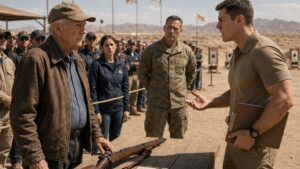
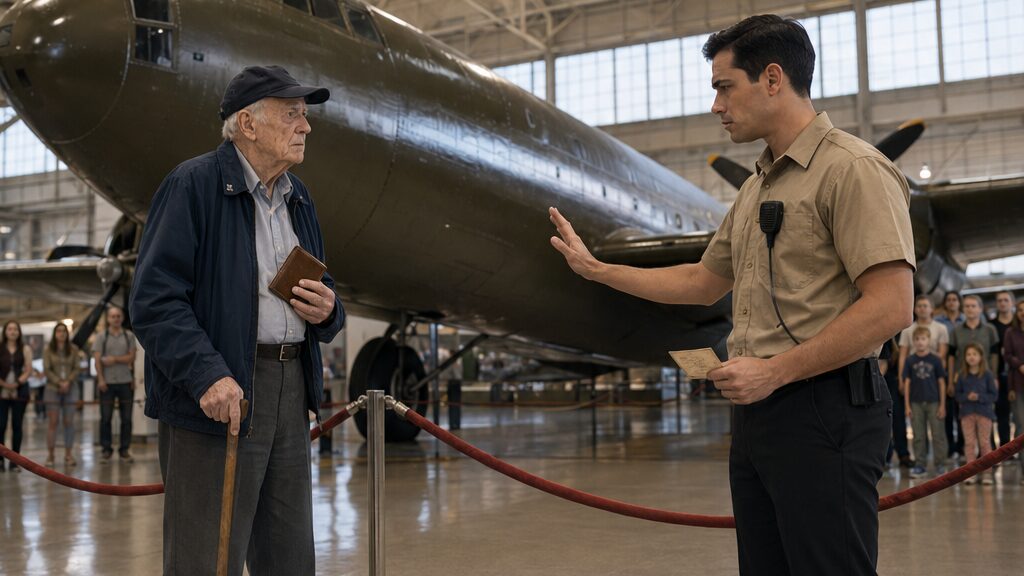
The young man’s hand came down in front of David Miller’s cane before the cane crossed the red rope.
“Sir, you can’t go past this point.”
The words were polite enough. The palm was not. It hovered between David and the aircraft like a small gate someone had decided was stronger than memory.
David stopped. The rubber tip of his cane settled on the polished hangar floor with a soft click. Beyond the rope, the old aircraft rested under museum lights, its silver skin cleaned and painted until it looked almost too young. Visitors moved around it in slow circles, reading panels, raising phones, pointing children toward the cockpit windows. Their voices softened under the high roof, swallowed by steel beams and the faint smell of floor wax, dust, and old oil.
David looked past the staff member’s shoulder.
The tail number was still there.
Not exactly as it had been. Too crisp now. Too clean. But there.
He breathed in carefully. His chest resisted. At eighty-two, his body had become an unreliable piece of equipment, always asking for more attention than he wanted to give it. His right knee clicked when he shifted weight. His fingers had thickened around the cane handle. The blue jacket Margaret had insisted he wear felt too warm across his shoulders.
But his eyes were steady.
“I won’t be long,” he said.
The staff member was young, maybe late twenties, with a dark museum security shirt tucked neatly into his pants and a radio clipped high on his chest. His name tag read Kevin Torres. He glanced once at David’s cap, then at the cane, then at the rope.
“I understand, sir, but this is a restricted aircraft zone. No visitors past the line.”
David heard the word visitors.
He had been called worse. He had been called things by officers half-asleep on flight lines, by mechanics burned out from heat, by men frightened enough to snap at whoever stood closest. Visitors should have been easy to accept.
Still, the word reached him wrong.
A boy in a school group leaned sideways to look at David. The chaperone pulled him back. Two older tourists slowed as if expecting a scene. David did not give them one.
“I used to have access,” he said.
Kevin’s expression changed only a little. Not impatience exactly. More like the careful look workers used with old men who might be confused, men who carried yesterday’s rules into today’s buildings.
“Things are different now,” Kevin said. “The restoration team has liability rules. If you want a closer tour, the front desk can check available times.”
David nodded once, as if this were useful information.
The aircraft behind Kevin seemed impossibly quiet. There had been years when David could tell where a problem sat inside a machine by sound alone: the wrong pitch in a starter, the lazy cough before ignition, the tiny complaint of metal that had been asked to do too much. Now the plane sat beneath lights, washed and still, protected by signs that told strangers what it had been.
He moved his left hand slowly inside his jacket.
Kevin stiffened. Not dramatically. Just enough.
David noticed. His fingers paused.
“It’s only a wallet,” David said.
Kevin’s face tightened with embarrassment. “Take your time, sir.”
David drew out the brown leather wallet. It was not a billfold, though it had once held money, receipts, and a photograph that had faded until Margaret had taken it away to preserve it. The leather was cracked along the fold. The edges had darkened from his thumb. A thin strap, repaired twice, kept it closed.
He opened it with both hands.
Inside, behind a cloudy plastic sleeve, lay a faded card.
The card had yellowed around the corners. The laminated surface had bubbled in one place where heat had found it long ago. The print was small, worn, and partly ghosted by age. David slid it free with more care than the card deserved, except that it deserved all of it.
Kevin looked at the card and almost smiled.
The almost was worse than a laugh would have been.
“Sir,” he said gently, “this is not a current pass.”
“I know.”
“It looks like—” Kevin tilted it toward the light. “I mean, this is old.”
“Yes.”
“We can’t accept something like this for access.”
“I’m not asking you to accept it for access.”
Kevin blinked. “Then what are you asking?”
David looked past him again. He had imagined this moment differently during the ride over. He had imagined arriving early, finding the hangar quiet, asking one person in a back office for a few minutes. He had not imagined a rope line. He had not imagined a radio clipped to a young man’s chest. He had not imagined being watched by a boy with a museum sticker on his shirt and a woman holding a paper cup of coffee.
“I’m asking you to look at it,” David said.
Kevin took the card between two fingers.
It was a small thing, that grip. Careless, almost clean. He held it the way someone might hold a coupon found in a drawer.
David watched his own name pass into another man’s hand.
Kevin read the front. His mouth moved slightly.
“David Miller,” he said. “Maintenance crew authorization.” He glanced up. “Mr. Miller, I don’t doubt this belonged to you, but this building has only been open as a museum for eleven years.”
“I know.”
“This card isn’t from the museum.”
“No.”
Kevin gave the small smile then, unable to help it. “Then I’m not sure what you expect me to do with it.”
David felt no anger. Anger would have been easier. He could have used anger like a cane, struck the floor with it, made everyone turn. But anger had never kept an engine alive. Anger had never brought a boy back from a bad night. Anger had never repaired what silence broke.
So he waited.
Kevin’s radio crackled. He lowered the card slightly, ready to hand it back.
David said, “Turn it over.”
Kevin hesitated, then did.
On the back, in faded blue ink, beneath a stamp almost rubbed away, was a line David had not looked at directly in years. Not because he had forgotten it. Because he had not.
Aircraft 7349. Crew Maintenance Clearance. Temporary Forward Assignment.
Kevin’s thumb shifted.
Behind him, the restored aircraft carried the same number beneath its tail.
At first Kevin did not see it. His eyes moved over the ink, impatient with old abbreviations and half-dead stamps. Then something in him slowed. His gaze left the card, went to the aircraft, came back to the card.
The boy from the school group whispered, “What is it?”
Kevin did not answer.
David saw the young man read again.
Aircraft 7349.
Kevin turned his head fully this time. The museum lights shone along the aircraft’s side, touching the clean paint, the rivet lines, the careful restoration work. The number waited there in silence.
Kevin’s smile faded as if someone had wiped it away.
He looked down again and found the small print near the bottom. Crew chief initials. Clearance category. A name stamped faintly above a signature.
D. Miller.
Kevin’s fingers changed around the card. They closed more carefully, not tight, not loose. The card no longer looked like trash in his hand.
“Sir,” he said, and the word had become different. Not louder. Lower.
David kept his cane planted. His shoulders had begun to ache. The aircraft filled the space beyond Kevin, large enough to carry men through weather and fear, fragile enough to be reduced to a display if no one remembered correctly.
Kevin swallowed.
“Sir…” He looked from the card to David’s face, then to the aircraft again. “Were you assigned to this aircraft?”
Chapter 2: The Name Kevin Almost Missed
Kevin Torres had been trained to notice the wrong things.
Hands near barriers. Children ducking under ropes. Visitors leaning too close with phones. Loose bags. Trip hazards. Coffee cups near exhibits. Men who argued about rules because they had paid twelve dollars and believed admission included exception.
He had not been trained to notice an old man’s silence changing the air around an aircraft.
The card rested in his palm now, not pinched between fingers. He could feel its bowed stiffness, the worn laminate, the softened edge where someone had handled it again and again. It seemed suddenly impossible that he had almost handed it back with a smile.
David Miller did not answer right away.
Kevin looked at him more carefully. The man’s cap was plain and dark, no embroidered unit, no loud veteran patch. His blue jacket had a small lapel pin, tarnished and easy to miss. Not a medal. Not even something Kevin recognized. Just a narrow metal shape, dulled by years, pinned above the heart as if it belonged there but did not want attention.
“Mr. Miller?” Kevin said.
David’s eyes stayed on the aircraft. “I was crew chief on her for a while.”
Her.
Kevin heard it. The way mechanics at the museum sometimes spoke about restored machines after months underneath them, knuckles split, tempers short, pride hidden behind complaints. But David’s word carried something older than pride.
Kevin looked down at the card again. “Aircraft 7349.”
David nodded.
“This is the same plane.”
“Yes.”
Kevin’s face warmed. He remembered his own almost-smile. The careless way he had held the card. The school group was moving on now, the chaperone steering them toward a display about flight suits, but a few visitors still looked over. Kevin wished they would stop.
He lifted the radio from his chest, then stopped. Calling his supervisor too quickly felt wrong, like turning a private wound into a procedure before understanding it.
“I’m sorry,” he said.
David glanced at him. “You were doing your job.”
Kevin had said that to himself many times. Usually it had been true enough. Now it sounded small.
“I still should have handled this better.”
David’s expression did not change much. Maybe his mouth softened. Maybe Kevin only hoped it did.
The rope line stood between them and the aircraft. Red fabric, brass hooks, a small sign that read Please remain behind barrier. Kevin had stepped over and around that rope a hundred times without thinking. Now it looked absurdly theatrical, a museum’s thin red line drawn between a man and part of his own life.
Kevin turned the card over once more. “May I ask what kind of clearance this was?”
“Maintenance access. Temporary forward assignment.”
“You worked on engines?”
“Engines. Hydraulics. Whatever needed hands.”
Kevin looked at David’s hands. They were old hands, veined and bent, one wrapped around a cane, the other resting against the closed wallet. But their stillness had discipline in it. They did not flutter, beg, or perform.
“We have a restoration binder,” Kevin said. “I’ve seen volunteers use it. Old photos. Parts lists. Service history. I don’t know how complete it is.”
David’s gaze sharpened slightly. “You still have the binder?”
“I think so. In archives or the restoration office.” Kevin glanced toward the far side of the hangar, where a staff-only door sat behind a low partition. “I can ask.”
David looked at the aircraft again. For a moment Kevin expected relief. Instead he saw something heavier pass across the old man’s face.
Not victory.
Not satisfaction.
Pain, maybe. Or the return of something long postponed.
Kevin held the card out. Halfway through the motion, he realized he was about to give it back the same way he had taken it. He stopped, adjusted his grip, and placed it across both palms, the way his grandfather had once handed over a folded flag at a family funeral when Kevin was too young to understand why no one spoke.
David noticed.
That was the worst and best of it. He noticed everything.
“Thank you,” David said.
Kevin waited until David took the card before letting go.
The old man slid it back toward the wallet but did not immediately put it away. His thumb rested over the faded number on the back. Kevin saw then that there was something tucked behind the plastic sleeve. A folded paper, old and thin, hidden behind the card.
He looked away before it became staring.
“Would you like me to call the restoration manager?” Kevin asked.
“If he has time.”
“I’ll make time.”
The answer came out before Kevin thought about whether he had the authority to say it. David looked at him then, really looked, and the quiet in his eyes made Kevin stand a little straighter.
Kevin unclipped the radio. “Base to office,” he said, then winced inwardly. The museum used plain channels, not base anything. He had picked up the habit from older volunteers, half joke, half nostalgia. Today it did not feel like a joke.
The radio crackled. “Office.”
“I need Mr. Johnson near aircraft seven-three-four-nine. Visitor with historical documentation.”
There was a pause. “Can it wait? We’re setting up for the donor walk-through.”
Kevin looked at David, at the cane, at the old card disappearing back into leather.
“No,” Kevin said. “I don’t think it should.”
Another pause.
“Copy. Five minutes.”
Kevin clipped the radio back. “Mr. Johnson is the restoration manager. He’ll know the records better than I do.”
David nodded. He shifted his weight, and the movement was small but costly. Kevin saw the tightening around his mouth.
“There’s a bench just inside the rope line,” Kevin said. “It’s for staff, but—”
“No.”
Kevin stopped.
David’s voice was not sharp. “Not yet.”
Kevin followed his gaze to the aircraft. “Would you like to stand closer?”
David’s hand closed around the wallet.
“I’d like to stand where I can see the left side.”
Kevin did not ask why. Not because he wasn’t curious, but because he was beginning to understand that curiosity could be another kind of trespass.
He unhooked the rope.
The red fabric sagged open.
A woman near the display frowned as if a rule had been broken in front of her. Kevin turned slightly, not aggressive, only firm.
“Please give him space,” he said.
David stepped through slowly. One step. Cane. Another step. The polished floor reflected the dark tip of the cane and the old man’s shoes. He stopped several feet from the aircraft, still not close enough to touch it.
Kevin remained behind and to the side, near enough to help if needed, far enough not to crowd him.
David lifted his chin.
From here, Kevin could see the plane differently. Not as exhibit, not as restoration project, not as school-trip background. He saw the seam lines under the wing, the dark hollow near the landing gear, the worn places the museum had painted over but not erased. He imagined, unwillingly, this old man younger, moving under that wing without a cane, knowing where every panel opened.
David did not smile.
That troubled Kevin more than tears would have.
“You came to see her,” Kevin said.
David kept looking at the aircraft. “Partly.”
The word landed between them.
Kevin waited.
David’s thumb moved once along the edge of the wallet.
“Do you still keep the old maintenance binder?” he asked.
Chapter 3: Margaret Wants Him To Leave
Margaret Miller found her father on the wrong side of the rope and felt her stomach drop.
For one second she was a child again, watching him climb a ladder with a toolbox in one hand and no patience for anyone telling him to be careful. Then the image broke. He was eighty-two now, his shoulders narrower under the blue jacket, his right hand clamped around a cane, his breath held in that measured way he used when pain had become a private negotiation.
“Dad.”
He turned only his head.
Margaret moved quickly across the hangar, past a display of old helmets and a family taking pictures near the wing. A young staff member stood nearby, stiff with concern. The rope was unhooked. People were looking.
Of course people were looking.
“Dad, what happened?” she asked. “Why are you in there?”
“I’m all right.”
“That isn’t what I asked.”
The young staff member stepped forward. “Ma’am, I opened the barrier for him.”
Margaret looked at his name tag. Kevin Torres. Young enough to think saying that fixed the problem. “Why?”
Kevin’s eyes flicked to her father. “Mr. Miller has documentation connecting him to the aircraft.”
“Documentation?” She heard the tired edge in her own voice and hated it. She had used that tone with doctors, insurance people, pharmacy clerks, anyone who treated her father like a file moving slowly through a system. She had not meant to use it here.
David slid the old wallet into his jacket.
Margaret saw the movement. She knew that wallet. She had found it in drawers, in coat pockets, once under his pillow after a night when thunder had shaken the windows and he had insisted nothing was wrong. He never explained it. He only said, “Old papers,” and closed it before she could see.
“This is too much,” she said quietly. “You said we were coming for an hour. You said you wanted to look around.”
“I am looking around.”
“You know what I mean.”
A museum visitor turned toward them. Kevin noticed and shifted his body slightly, blocking the sightline without making a show of it. Margaret caught the gesture. It disarmed her more than an apology would have.
“Mr. Johnson is coming,” Kevin said. “The restoration manager.”
Margaret stared at him. “For what?”
David answered. “The binder.”
The word meant nothing to her, but it meant something to him. She heard it in the way he said it. Not loud. Not dramatic. Precise.
“Dad,” she said, softer, “you’re pale.”
“I’ve been pale since 1942.”
“This isn’t funny.”
“No.”
The simple agreement drained some of the anger out of her. She stepped closer, lowering her voice. “You don’t have to prove anything to these people.”
His eyes moved to hers then. Tired, clear, and more distant than she wanted them to be.
“I didn’t come to prove anything.”
“Then why are we here?”
He did not answer.
That silence was familiar. It had lived in their house longer than most furniture. It had sat at the dinner table when she was young and asked why he never came to school Veterans Day programs. It had stood behind him in the garage when he tuned old engines by ear but changed the subject if an aircraft passed overhead. It had followed him after her mother died, growing quieter but heavier, until Margaret sometimes felt she was caring not only for her father but for a room inside him no one had ever been allowed to enter.
She looked at the aircraft. It was beautiful in the way restored things were beautiful: cleaned of weather, arranged for reverence, made safe for children. A plaque stood near its nose. Visitors leaned in to read names and dates. Margaret had read none of it. She had been watching David watch the plane.
“You never talked about this one,” she said.
David’s fingers tightened on the cane.
Kevin, to his credit, looked away.
Margaret stepped beside her father rather than in front of him. From there, the aircraft seemed larger. Its wing stretched above them like a roof. The left side, the side he had asked to see, carried a row of panel seams and a restored marking near the fuselage.
“Was this yours?” she asked.
“No aircraft belongs to one man.”
“That isn’t an answer.”
“It was one I knew.”
She almost laughed, but the sound would have come out wrong. “That’s all?”
“For a long time, that was enough.”
A man in a blazer emerged from the staff door at the far end of the hangar, walking briskly with a tablet tucked under one arm. Kevin straightened. David saw him too and placed the wallet deeper inside his jacket, as if preparing for weather.
Margaret noticed the motion.
“Dad, listen to me. If this is going to turn into some argument over old records, we can go home. I’ll call later. I’ll make an appointment. You don’t need to stand here while people decide whether they believe you.”
David did not look offended. That hurt more. He seemed to understand exactly why she said it.
“I left it too long,” he said.
Margaret’s irritation faltered. “Left what?”
The man in the blazer was closer now. Kevin moved to meet him, speaking quietly before he reached them. Margaret caught only pieces.
Old card. Tail number. Crew chief. Maintenance binder.
The manager looked at David with professional caution, not disrespect exactly, but not trust either. Margaret recognized that look too. It was the look of someone preparing to be polite while saying no.
David’s face remained composed.
Margaret wanted to take his arm and guide him away before another stranger could reduce him to a misunderstanding.
“Dad,” she whispered, “please.”
He turned to her. His eyes were wet, but not with weakness. With effort.
“One name is missing,” he said. “And I should have fixed it sooner.”
Chapter 4: The Binder Behind The Locked Door
Kevin had never noticed how many locked doors a museum kept behind its displays.
To visitors, the hangar seemed open and reverent, all polished aircraft skin, wide walkways, careful lighting, and printed history panels written in clean paragraphs. Behind the staff door, the place narrowed. The air changed. It smelled less like wax and more like cardboard, old paper, machine oil, and the stale coffee someone had forgotten on a filing cabinet.
Paul Johnson walked ahead of them with the strained patience of a man whose schedule had been rearranged by someone else’s conscience.
“I’m not saying we won’t look,” Paul said, using the same measured tone he had used on donors, vendors, and school administrators. “I’m saying we have a process for historical claims.”
David followed slowly, cane tapping once for every two steps. Margaret stayed close enough to catch him if he stumbled, far enough not to insult him by reaching too soon. Kevin walked behind them with the uneasy sense that he had opened more than a rope line.
“It isn’t a claim,” David said.
Paul glanced back. “Mr. Miller, I mean no disrespect.”
“No?”
The word was quiet. It stopped Paul for half a second.
Kevin looked at the floor.
Paul adjusted the tablet under his arm. “What I mean is, our records are compiled from official service histories, restoration notes, donated materials, and verified archives. We can’t alter or reinterpret displays because someone arrives with an old card.”
David said nothing.
Kevin wished he would say more. Some part of him wanted David to defend himself, to make this easier, to give Paul a story large enough to compete with policy. But David only walked, one hand on the cane, the other inside his jacket over the wallet.
They reached the archive room at the end of a short corridor. Paul entered a code, turned a key, and pushed open a heavy door. Inside, rows of metal shelves held gray boxes and binders with white labels. The room was cooler than the hallway. A small desk lamp glowed over a scanner. The archive volunteer looked up from a stack of photographs and immediately read the tension in the doorway.
“Paul?”
“We need the restoration binder for aircraft seven-three-four-nine,” Paul said.
The volunteer’s eyebrows rose. “The big one?”
“If there’s more than one, bring whatever we have.”
Kevin stood aside as David entered. The old man paused just over the threshold. His eyes moved across the shelves, not searching randomly but measuring. Kevin recognized the look from the hangar: David was listening to a place that made no sound.
The volunteer lifted a thick black binder from a lower shelf and set it on the table with a heavy slap. Dust rose from its edges.
Kevin saw David flinch.
Not from the dust. From the sound.
Margaret saw it too. “Dad?”
“I’m fine.”
The phrase had become a door of its own.
Paul opened the binder. Inside were plastic sleeves full of photographs, typed pages, handwritten inventories, copied forms, and restoration notes. Some were modern, printed in clean fonts. Others were yellowed, crooked from photocopying, marked by hands long gone.
“Here,” Paul said. “Acquisition history. Transport. Restoration phases. Exterior markings. Engine work. Crew notes where available.”
David remained standing until Margaret pulled out a chair. He gave her one brief look, then sat. The cane rested against his knee.
Kevin stood opposite him, unsure where to put his hands.
Paul turned pages quickly. Too quickly, Kevin thought. He was looking for a reason to finish, not a reason to find something.
David said, “There should be a section before the restoration notes.”
Paul stopped. “Before acquisition?”
“No. Before your restoration notes. Original field maintenance copies, if they survived.”
The volunteer leaned in. “There are some older sheets in the back pocket. We never cataloged every line. They came with the donation.”
Paul turned to the back. A large brown envelope was tucked into the binder cover. He slid it out and loosened the string.
Kevin felt the room tighten.
Inside were folded photocopies, a brittle checklist, and several small black-and-white photographs. Paul spread them carefully. One showed the aircraft outdoors under a hard white sky. Men stood near the wing, shirts dark with sweat, faces turned away from the camera. The plane looked rougher there. Alive, somehow. Not ruined, not restored. Working.
David leaned forward.
His hand trembled once above the table, then settled.
“That was after the hydraulic leak,” he said.
Paul looked up. “You recognize this?”
David pointed, not touching the photograph. “That panel. We had it open half the night. Someone wrote the wrong replacement time on the form because the clock in the operations tent was six minutes slow.”
The archive volunteer looked from David to the photograph. “You can tell that from the panel?”
“No,” David said. “I can tell because I was the one who argued about the clock.”
For the first time, the volunteer smiled.
Paul did not.
“Memories can be very strong,” he said. “They can also attach themselves to photographs.”
Kevin felt heat move up his neck. “Mr. Johnson.”
Paul’s eyes flicked to him. “I’m doing my job.”
Kevin almost answered, You told me that was no excuse when I mishandled a donor badge last month. He did not. This was not about winning.
David reached into his jacket and took out the wallet. He opened it, slid out the old card, and placed it on the table. Not dramatically. Not as a challenge. Just beside the photograph.
The room fell quiet.
The card’s faded back faced up. Aircraft 7349. Crew Maintenance Clearance. Temporary Forward Assignment. The same number typed across the old maintenance sheet Paul had just unfolded.
The archive volunteer moved closer. “May I?”
David nodded.
She did not pick up the card. She bent over it where it lay, then compared it to the maintenance sheet. “Same tail number. The stamp style matches the period.” She looked at Paul. “There’s a crew chief line here.”
Paul pulled the sheet toward him.
Kevin watched his expression change not into belief, but into inconvenience.
“D. Miller,” the volunteer read softly. “Maintenance lead, temporary forward assignment.”
Margaret’s lips parted. She looked at her father as if a familiar room had opened into another room behind it.
David kept his eyes on the table.
Paul tapped one finger beside the line. “This confirms a D. Miller was assigned in a maintenance capacity.”
Kevin heard the thinness of it.
David did too, but he only nodded. “That is what the card says.”
Paul exhaled through his nose. “Mr. Miller, you understand I can’t simply—”
“I didn’t ask you to simply anything.”
“Then what exactly are you asking?”
David looked at the photograph again. His face had gone still in a way that made Kevin think of doors sealed before storms.
“There was another name with mine,” he said.
Paul turned back to the sheets. “Crew roster?”
“Not flight crew. Maintenance and recovery support. He was often left off the neat versions.”
“Name?”
David’s hand moved to the wallet, then stopped. “Gary Campbell.”
The archive volunteer began searching. She moved through the photocopies with the careful speed of someone who knew paper could answer slowly if handled well. Kevin stepped closer when she passed him a sheet. Names appeared in columns, some typed, some handwritten into margins. David’s name surfaced twice. Campbell did not.
“Could be in the personnel cross-reference,” the volunteer murmured.
Paul opened another section of the binder. “There are photographs from the restoration team’s reference display.” He pulled out a laminated copy of the public plaque text. “These are the names currently listed with the aircraft.”
Kevin looked over his shoulder.
David did not rise. He did not need to. The absence seemed to reach him from across the table.
The list was short, clean, complete-looking.
No Gary Campbell.
Margaret whispered, “Dad.”
David’s thumb pressed once against the edge of the old wallet.
Paul held the plaque copy in both hands and looked from the paper to David. The professional caution remained on his face, but beneath it something had shifted. Not enough. Not yet.
“I don’t see that name,” Paul said.
David closed his eyes for one second.
When he opened them, they were steady.
“That,” he said, “is why I came.”
Chapter 5: The Plaque That Left Him Out
David had thought the name would hurt less if someone else failed to see it first.
It did not.
The public plaque stood near the aircraft’s nose, angled for visitors to read without crossing the rope. The museum had mounted it on brushed metal, with a small photograph at the top and neat blocks of text below. People liked neat blocks. They suggested that history could be held still if the lines were straight enough.
David stood before it with Margaret on one side and Kevin on the other. Paul Johnson held the archive copy against his tablet, comparing the printed text to the display as though the missing name might appear if he checked from enough angles.
The hangar had grown busier. Afternoon visitors moved around them in quiet currents. A local veterans’ group representative stood near another exhibit, speaking with a maintenance volunteer. A child pointed at the cockpit glass. Someone laughed near the gift shop entrance.
No one at the plaque knew what had just been found missing.
David preferred it that way.
The plaque listed aircraft specifications, deployment history, restoration donors, and selected associated personnel. The flight crew names were there. A few maintenance supervisors. One logistics officer who, David remembered, had never once put his hand inside that aircraft but had signed excellent memos.
D. Miller appeared in a smaller line near the bottom.
Crew maintenance lead, temporary forward support.
David stared at the letter D. It looked less like his name than a placeholder.
Gary Campbell was nowhere.
Paul cleared his throat. “These plaques are based on available documentation at the time of installation.”
David nodded.
“We can add a note to the research file if new documentation comes forward.”
“New?” David asked.
Paul heard the weight in the word and shifted. “Previously unreviewed documentation.”
Kevin stepped closer to the plaque. “Mr. Johnson, if the binder has missing field support sheets, shouldn’t the display be reviewed?”
“It can be reviewed,” Paul said. “That doesn’t mean altered today.”
Margaret turned sharply. “No one asked you to melt the plaque down in front of us.”
“Margaret,” David said.
She stopped, breathing hard through her nose.
Paul’s expression tightened. “I understand this is personal.”
David looked at him then.
Paul seemed to realize, too late, that personal was not the smaller word.
David said, “It was personal before it became a display.”
The hangar noise softened around the sentence. Kevin looked down. Margaret’s anger lost its edge and became something closer to grief.
Paul held his tablet against his side. “Mr. Miller, if Gary Campbell was connected to the aircraft, we need more than memory. That’s all I’m saying.”
David looked back at the plaque. He had known Paul would say that. Some version of it had followed him for decades. Forms needed signatures. Lists needed ranks. The dead needed someone living to insist correctly.
Gary had not been good at forms. He had been good at getting into places other men were too broad-shouldered to reach. He could slide under a wing with a flashlight in his teeth and come out with a diagnosis before David had finished cursing the panel screws. He had sung badly and quietly while working, never enough for a commander to hear, always enough to annoy the man beside him. He had written letters home on scrap paper and folded them with the care of a man afraid paper might vanish if treated roughly.
The last time David saw him clearly, Gary’s face had been streaked with oil and rain.
Not blood. David never let the memory begin there if he could stop it.
“There was a mission incident,” David said.
Paul waited. Kevin waited. Margaret did not move.
David kept his eyes on the plaque. “Aircraft came in damaged. Not destroyed. Damaged enough. Weather was bad. The crew had to move fast. Maintenance had to move faster.”
“You were there?” Kevin asked softly.
“Yes.”
“And Gary Campbell?”
David’s jaw tightened. “He was with me.”
The words were plain. They cost more than they showed.
A group of visitors drifted closer, slowing near the plaque. Kevin noticed and stepped back, creating a quiet boundary with his body. He did not tell them to move. He only stood in a way that made privacy around an old man feel like part of his job.
David saw it.
He wished he had not, because gratitude was another thing that weakened the hands.
Paul said, “Was he military personnel?”
“Attached support,” David said. “Temporary, like me. Things were not always filed cleanly where we were.”
“That complicates verification.”
Margaret made a small sound.
David lifted one hand slightly. Not to silence her exactly. To spare them all from making Paul the enemy.
“It should be complicated,” David said. “Men were complicated.”
Paul looked at the plaque. “If his name was omitted from the original materials, there may have been a reason.”
The sentence did not sound cruel until it had already landed.
David felt it enter him.
Kevin’s head snapped toward Paul. Margaret’s face went pale with anger.
Paul closed his mouth. He knew. The regret appeared quickly, but regret did not recall the words.
David’s hand moved inside his jacket and found the wallet. He pressed the old card through the leather, feeling the raised edge of it, the hidden fold of paper behind it. The paper had lived there so long it seemed part of the wallet’s body. He had carried it through moves, through Margaret’s childhood, through his wife’s illness, through long afternoons when he nearly opened it and did not.
“If there was a reason,” David said, “it was not shame.”
His voice did not rise.
That made it worse.
Paul lowered his eyes. “I apologize.”
David nodded once. He had accepted apologies that meant less and refusals that meant more.
Margaret touched his sleeve. “Dad, you don’t have to do this here.”
“I know.”
“We can leave. We can bring whatever you have another day.”
David looked at her hand on his sleeve. She had her mother’s hands now, though she would not like hearing it. Stronger than they looked. Always reaching for what might fall.
“If I leave,” he said, “I may find a reason not to come back.”
Her fingers tightened.
The aircraft waited behind the rope. From where he stood, David could see the left side panel line where rainwater had streamed down that night, where Gary had slapped the metal and said, She’ll hold if you stop arguing with her.
David had laughed then.
A terrible thing, laughter. It survived where men did not.
Paul said carefully, “Do you have documentation related to Mr. Campbell?”
David did not answer.
Instead, he opened the wallet.
Kevin looked away first, then back when David placed the old access card against the leather, holding both in one hand. With the other, he slid a folded paper from behind the card sleeve.
It was small, creased into quarters, yellow at the folds, thin enough that the light almost passed through it. The edges were soft from years of not being opened. There was writing on the outside. Not much. Just enough.
David held it between two fingers.
Margaret stared at it. “What is that?”
David looked at the aircraft.
For a moment he was not in the hangar. He was under weather. He was younger and soaked through, one hand numb, the other gripping metal slick with rain. Gary was beside him, talking too fast because silence frightened him more than danger. There had been a promise made in fragments, not ceremony. Men made promises that way when they did not want death to overhear.
David returned to the museum with the paper still folded.
Paul’s voice was gentle now. “Mr. Miller?”
David looked at the note, then at the plaque.
“Not here,” he said.
Margaret’s eyes filled. Kevin lowered his head.
David slid his thumb beneath the top fold but did not open it.
“Not until his name is beside the plane.”
Chapter 6: The Note He Never Used
Margaret had never been afraid of paper before.
She had feared phone calls after midnight, medical forms with small boxes, envelopes from insurance companies, prescription instructions written in type too small for tired eyes. But the folded note on the staff office table frightened her in a different way. It seemed too light to carry what it carried. Too ordinary. Four tired creases. Yellowing edges. Her father’s hand resting beside it, not touching.
The office was hardly a room. A desk, two chairs, a filing cabinet, a humming printer, and a window that looked into the archive corridor instead of outside. Paul Johnson had brought them there after David refused to open the note at the display. Kevin stood near the door as if guarding against interruption. The archive volunteer had returned to the binder, searching for whatever the old records might still surrender.
Margaret sat across from her father.
He had not looked so old in the hangar. There, beside the aircraft, his stillness had seemed almost like strength. Under the office light, she saw the gray under his skin, the tremor in the hand he had placed flat on the table, the careful way he breathed before speaking.
“Dad,” she said. “We don’t have to do this right now.”
David looked at the note.
“No,” he said. “I do.”
Paul stood by the filing cabinet, tablet held loosely now. He no longer looked like a man protecting a schedule. He looked like a man unsure where to put his authority.
“If the note is personal,” Paul said, “we can document its existence without reading it in front of everyone.”
David nodded. “It is personal.”
“Then we can make copies later. With permission.”
David’s mouth moved faintly. Not quite a smile. “Everything is with permission once a man is old.”
Margaret winced. “That’s not fair.”
“No,” he said. “It isn’t.”
The sentence could have meant her. It could have meant him. It could have meant the plaque, the paper, the long machinery of years that had brought them into a staff office behind a museum display while strangers waited to decide whether memory was admissible.
Margaret folded her hands in her lap. “Why didn’t you tell me?”
David did not pretend not to understand. “About Gary?”
“About any of it.”
He leaned back slowly. The chair creaked beneath him. “Your mother knew some.”
“Some?”
“As much as I could give her without bringing it home every night.”
Margaret looked down. She remembered childhood evenings when her father sat in the garage with the door open, turning a wrench over in his hand while the radio played baseball too softly to hear. She had thought he liked being alone. Later she had thought he was difficult. Later still, after her mother died, she had thought loneliness had simply hardened around him.
Maybe all of that had been true. Maybe none of it had been enough.
David touched the edge of the old wallet. “Gary Campbell was twenty-three. Maybe twenty-four. He lied about it depending on who asked. He said age was bad luck if written down too often.”
Kevin looked toward the floor.
“He worked support,” David continued. “Not the kind that made clean rosters. He could fix a jammed access panel with two bad tools and a piece of wire. He could remember every man’s coffee preference and forget where he left his own boots.”
The words came evenly, but Margaret heard the care in them. Her father was not telling a story. He was setting tools in order.
“The night he died,” David said, “we were trying to get seven-three-four-nine turned around after damage. Weather had closed in. There was pressure to move wounded out before morning. Everything was behind. Everything mattered.”
Paul lowered his tablet.
David looked at the note again. “Gary found a fault I missed.”
Margaret’s chest tightened.
“I was lead,” David said. “My initials on the sheet. My responsibility. I checked a line too quickly because another alarm came in. Gary saw the problem, crawled back under, and fixed enough to keep the system from failing on takeoff.”
No one interrupted.
“He was hurt after that. Not right away. That is the part people never understand. They want one clean moment. There wasn’t one. There was rain, noise, someone shouting for a light, someone else saying the aircraft had to move. Gary was conscious when we carried him clear.”
David’s fingers curled once against the tabletop.
Margaret wanted to reach for him but did not. For once, she understood that comfort could become interference.
“He gave me that note,” David said. “It was already written. For his mother first, I think. Then he changed the outside.” He looked at the folded paper. “He told me if the crew made it home, if the aircraft made it, if anyone wrote it down later, make sure they remembered the ground hands too. Not just pilots. Not just names that fit on clean forms.”
Paul’s face had gone still.
Margaret whispered, “You carried it all this time?”
“Yes.”
“Did you send it?”
David closed his eyes briefly. “I sent his mother a letter. Not this.”
“Why?”
“Because this one had names. Details. Men still there. Mistakes. Things I thought would make trouble. Things I thought I had no right to put in a grieving mother’s mailbox.” He opened his eyes. “I told myself I was protecting people.”
“And later?”
“Later became later.”
The printer hummed though no one had sent anything to it.
Margaret stared at the note until it blurred. She had spent years thinking her father refused help because pride had made him stubborn. Now she saw another possibility: he had mistaken silence for protection so long that breaking it felt like betrayal.
“You should have told someone,” she said.
“Yes.”
The answer was immediate. No defense. No excuse. It hurt more than denial would have.
David turned to Paul. “I’m not asking you to put a story on your plaque because an old man feels guilty.”
Paul spoke carefully. “What are you asking?”
“I’m asking you to check the records you didn’t check. Support logs. Temporary assignments. Incident reports if you have them. If Gary’s name belongs there, put it there. If it does not, tell me so plainly.”
Margaret looked at him. “And the note?”
David placed his fingertips beside it. “The note is not proof by itself.”
Kevin looked up then, surprised perhaps by the precision.
David continued, “It is a reason to look harder.”
Paul absorbed that. Something in his posture changed, not into surrender, but into attention. Real attention.
“I can authorize an archive addendum pending verification,” Paul said. “Not a permanent plaque change today. But an addendum can state that additional field support records are under review. If the binder confirms Campbell’s role, we can submit a formal correction.”
David shook his head once. “Not enough.”
Margaret held her breath.
Paul’s mouth tightened. “Mr. Miller—”
“His name beside the aircraft,” David said. “Not in a drawer while people pass by a clean list.”
Paul looked toward the door, toward the hangar beyond it. “A temporary insert. Clearly marked pending archival review. I could do that.”
Kevin said, “I can print it.”
Paul glanced at him, then back at David. “It would be modest.”
“Good.”
“No ceremony.”
“Better.”
Margaret almost smiled through tears.
David looked at her then, and whatever he saw on her face made his own soften.
“I didn’t come here to be thanked,” he said.
“I know,” she answered, and for the first time that day she did.
The archive volunteer appeared at the doorway, holding two copied sheets with both hands.
“I found another support log,” she said. “It lists Campbell. Initial only on one page, full surname on the second.”
Paul stepped forward quickly, then stopped himself and looked at David. “May I?”
David nodded.
The papers changed hands.
Paul read in silence. Kevin leaned just enough to see but not crowd. Margaret watched her father instead. His eyes stayed on Paul, but his hand had moved, very slowly, onto the old wallet.
Not the note.
The wallet.
The card inside it had opened the door. The note had explained why the door mattered.
Paul lowered the sheets. “This is enough for a temporary correction.”
David’s shoulders seemed to drop by a fraction.
“Not the final plaque,” Paul said. “Not today. But beside the aircraft, yes.”
David’s hand moved from the wallet to the folded note. He slid it closer to himself but still did not open it.
“When the name is there,” he said, “you may read this aloud. Not before.”
Chapter 7: Respect Becomes A Decision
Paul Johnson had spent twelve years learning how to protect a museum from mistakes.
Mistakes entered quietly. A mislabeled photograph. A donor’s family story polished by pride. A veteran’s memory reshaped by time. A local newspaper clipping that got a unit wrong and was then copied into three other articles until error dressed itself as fact. Paul had built his career on caution because caution kept history from becoming decoration.
But caution, he was beginning to understand, could also become a locked room.
He stood in the archive office doorway with the copied support log in one hand and the temporary display insert in the other. Kevin had typed it at the small staff computer while the printer warmed and clicked. The wording was plain, almost severe:
Additional field support records identify Gary Campbell as attached maintenance and recovery support connected to aircraft 7349. Formal archival review pending.
Paul had chosen every word like a man crossing thin ice. Identify, not confirm beyond all possible dispute. Attached, not permanently assigned. Review pending, not final correction. It was honest. It was careful.
It also felt insufficient.
Through the office window, he could see David Miller seated at the table, the old wallet near his hand. Margaret sat beside him, not speaking. The note remained folded. Kevin stood just inside the room, holding a clear protective sleeve he had retrieved from the archive supplies.
Paul watched Kevin ask David something. David nodded. Kevin picked up the access card with both hands and slid it into the sleeve as though touching it incorrectly might bruise it.
That was not procedure. No staff manual had taught him that.
Paul looked down at the insert again.
Museums were supposed to preserve what mattered. But what if the preserving itself trained everyone to trust the object and mistrust the person who had carried it?
A group of donors waited near the lobby. Paul’s phone had vibrated three times with messages from the ticket desk clerk asking whether the afternoon walk-through was still happening. A local veterans’ group representative had asked if aircraft 7349 would be available for photographs before closing. Everything in the museum day wanted to continue as planned.
David Miller had interrupted all of it by being inconveniently alive.
Paul walked back into the office.
Kevin looked up. “I sleeved the card. With permission.”
David’s eyes rested on the card inside its clear cover. “It looks more official now.”
Kevin seemed unsure whether David was joking. “It was official before, sir.”
The correction was small. Paul heard it.
He set the temporary insert on the table. “This can go beside the plaque today.”
Margaret leaned forward. “Today meaning before we leave?”
“Yes.”
David did not reach for the paper. “And after today?”
“After today, I’ll start a formal review. We’ll scan the card, the support log, the note if you authorize it, and the related binder pages. I’ll submit the correction to the archive committee.”
Margaret’s face tightened. “Committee.”
Paul accepted the judgment in her voice. “That is how permanent changes are approved.”
David said, “And if they decide no?”
“They may ask for additional verification.”
“Is that a no?”
Paul looked at the old man’s hand, at the swollen knuckles and the faint oil-dark shadow that seemed still to live in the creases despite all the years since the work. “Not from me.”
Kevin’s eyes shifted toward him.
Paul exhaled. “I can’t promise what the committee will do. But I can promise the review will not be buried. I’ll attach my own recommendation.”
David studied him. “Why?”
It was not suspicion exactly. It was the question of a man who had watched institutions move slowly enough for promises to die on desks.
Paul placed the copied support log beside the insert. “Because the record we have is incomplete.”
David waited.
“And because,” Paul added, “you came here with more restraint than I deserved.”
Kevin lowered his gaze.
Margaret looked at Paul for a long moment, then looked away first.
David’s expression did not change, but something around his eyes eased. Not forgiveness. Not yet. Perhaps only acknowledgment that Paul had finally said something without hiding behind process.
The museum lights outside the office began their late-afternoon shift, dimming slightly over side exhibits while the main aircraft remained bright. Closing announcements would begin soon. Visitors still moved through the hangar, but their voices had thinned. The day was draining away.
Paul turned to Kevin. “Print a second copy. One for the plaque, one for the archive intake.”
Kevin nodded and moved to the printer.
“And make a scan of the card,” Paul said.
Kevin stopped. “I’ll ask first.”
Paul felt the quiet rebuke land exactly where it should. “Yes. Ask first.”
David lifted the sleeved card between two fingers and looked at it through the plastic. The card seemed smaller now, trapped and protected at once.
“You may scan it,” he said. “But I want it back.”
“Of course,” Kevin said.
“No,” David said, not harshly. “Not of course. Say it like a thing you mean.”
Kevin straightened. “I’ll scan it and return it to you personally.”
David handed it over.
Paul watched the exchange and understood, more clearly than he wanted to, that respect was not the posture taken after discovery. It was the next choice. And the next.
They moved back toward the hangar together. Paul carried the temporary insert in a clean acrylic holder. Kevin carried the sleeved card and copied log against a folder, careful not to bend either. Margaret walked near David, offering no arm, but matching her pace to his. David’s cane struck the floor in measured clicks that seemed louder now that Paul was listening for them.
At aircraft 7349, the public plaque waited beneath its polished text.
The local veterans’ group representative saw them approach and stepped aside. A maintenance volunteer stopped wiping fingerprints from a nearby display case. A few visitors lingered, curious, but Paul lifted one hand gently.
“We’re making a small archive update,” he said. “We’ll need a little room.”
No speech. No announcement. No attention drawn to David.
Kevin noticed and gave Paul the briefest nod.
Paul placed the acrylic holder beside the plaque, not above it, not hidden behind it. The temporary insert caught the light. Gary Campbell’s name appeared in black letters, modest but unmistakable.
David stood several feet away.
Paul turned. “Mr. Miller, would you like to check the placement?”
David looked at the insert. He did not move.
Margaret whispered, “Dad?”
David swallowed once. “I can see it from here.”
Paul had expected relief. Instead he felt the ache of how little the action was compared with how long it had taken.
Kevin returned from the office with the old access card sealed in its sleeve. He did not interrupt. He waited until David looked at him.
“Mr. Miller,” Kevin said, “your card.”
He held it out with both hands.
David took it. The plastic sleeve reflected the aircraft lights. For a moment, old paper and polished display belonged to the same room.
Paul said, “When you’re ready, we can read the note privately.”
David looked at the temporary insert, then at the aircraft, then at Paul.
“Not in the office,” he said.
Paul nodded. “Where?”
David’s gaze moved to the rope line.
Kevin understood first.
The museum closing announcement began overhead, gentle and recorded, asking visitors to make their way toward the exits. Around them, people gathered coats and brochures. The hangar’s public noise loosened and thinned until the aircraft seemed to emerge from it.
When the last school group left and the ticket desk clerk locked the front doors, Kevin walked to the rope line. He did not unhook it immediately. He turned back.
“Only if Mr. Miller wants the room quiet,” he said.
Chapter 8: The Plane Remembered Both Of Them
The empty hangar sounded more like the past.
Not because it was the same. Nothing was the same. The floor was too smooth, the lights too clean, the air too still. No rain beat against metal. No men shouted over engines. No one cursed a stuck fastener or called for another flashlight. The aircraft stood restored beneath museum beams, roped and labeled and safe from the weather that had once made every hour uncertain.
But once the visitors were gone, silence gathered beneath the wings in a way David recognized.
Kevin unhooked the rope and stepped aside.
David looked at the opening for a long moment before he moved. He could feel Margaret watching him. Paul stood near the plaque with the folded note in his hand, waiting as if the paper itself had become an order he dared not rush. The temporary insert beside the display caught the light.
Gary Campbell.
There it was.
Not carved yet. Not permanent. Not enough.
But visible.
David stepped through.
His cane clicked once inside the boundary. Then again. He stopped near the aircraft’s left side, close enough now to see the fine lines beneath the restoration paint, the places where new work covered old scars without fully erasing them. He had expected to want to touch it immediately. Instead he stood with his hand at his side.
Margaret came no farther than the rope. She had asked him, quietly, whether he wanted her beside him. He had said, “Stay where I can see you.” She had understood more than he meant to say.
Kevin remained near the opening, hands clasped in front of him. Not stiff now. Attentive.
Paul approached the plaque. “Mr. Miller?”
David nodded.
Paul unfolded the note carefully. The old paper made a dry whisper. David looked at the aircraft, not the note. He did not need to see it open. He had known its weight closed.
Paul read the outside first, because that was where Gary had changed it.
“For the ones who make it home.”
His voice caught slightly on the last word. He waited, then opened the page.
The note was short. Shorter than memory had made it. Gary had never wasted words on paper, only in conversation. He had written to his mother in the first lines, telling her not to worry if this reached her late, telling her he had eaten, telling her a story about bad coffee that sounded almost cheerful. Then, lower down, the handwriting changed angle, hurried by interruption or fear or both.
If anyone writes about this bird, write all of us. Not just the ones with seats up front. Miller knows. Tell him not to get noble and quiet about it. We kept her up together.
Paul stopped.
David closed his eyes.
There was more, but not much. A line about a photograph Gary had meant to send. A joke about owing someone five dollars. A final uneven sentence that seemed to have been written after the page had been folded once already.
If I don’t get to say it, tell them I was here.
Paul lowered the note.
No one spoke.
David had imagined this moment many times and always refused it before it could finish. In his imagination, the note accused him. In the museum, under the wing of aircraft 7349, it did something worse. It trusted him.
Margaret covered her mouth with one hand.
Kevin looked at the floor, but David saw the young man’s shoulders lift once, then settle. Paul folded the note along its old creases, slower than before.
David opened his eyes. The aircraft waited.
“I thought I had time,” he said.
His voice was so low that only the quiet room allowed it to carry.
Margaret stepped forward, then stopped at the rope. “For what?”
“To make it right without making it hurt.”
She shook her head, tears bright but unshed. “Dad.”
“I was wrong.”
The admission did not free him. It simply stood beside him, another old thing finally brought into the light.
Paul held the note out. “Would you like this placed in the archive?”
David looked at the paper. For more than fifty years, it had lived behind the card, close to his name, hidden because he had told himself the world was not ready, or he was not ready, or trouble would come from truth written too plainly. Now the note looked tired of waiting.
“Yes,” he said. “A copy for the archive. The original stays with me until the final correction.”
Paul nodded. “Agreed.”
Kevin looked up. “And the card?”
David held the sleeved access card in his left hand. Through the plastic, the faded number remained legible.
“The card stays with me too.”
“Yes, sir.”
There was no salute. Kevin did not raise his hand. Paul did not turn the room into ceremony. Margaret did not ask her father to explain more than he had given.
That was what made it bearable.
David turned toward the aircraft. He took one step closer, then another. His cane tip stopped just short of the shadow beneath the wing.
The left side panel was smooth now. Repainted. Restored. But his hand knew where to go before his eyes decided. He lifted it slowly. The movement hurt his shoulder. His fingers hovered an inch from the metal.
For a terrible second, he thought he would not be able to touch it.
Then his palm settled against the aircraft skin.
Cool metal. Smooth paint. A faint tremor from his own hand.
He waited for memory to strike. Instead it arrived gently: Gary singing under his breath; rain running down a panel seam; a flashlight beam shaking because someone was laughing when he should have been scared; young hands passing tools in the dark; the stubborn belief that if they worked fast enough, carefully enough, no name would be left behind.
David did not cry.
He leaned the smallest amount of weight into his palm, not enough for support, only enough for contact.
“Gary,” he said, barely more than breath. “You were here.”
Behind him, Margaret let out a sound that might have been a sob if she had not caught it.
David lowered his hand after a moment. He looked at the aircraft, then at the temporary insert by the plaque. The name was still there. The room had not rejected it. No alarm sounded. No one came to remove it because it complicated the clean version.
Paul stepped closer, leaving respectful distance. “I’ll begin the formal correction first thing tomorrow.”
David looked at him. “No first thing promises unless you mean them.”
“I mean it.”
“Then write it down before you go home.”
Paul accepted that with a small nod. “I will.”
Kevin moved to the rope, but he did not close it yet. “Mr. Miller, would you like a chair?”
David almost said no. The word rose automatically, old and proud and useless.
Then he looked at Margaret.
“Yes,” he said.
Kevin brought the staff bench from near the wall. Not quickly, not fussing, just bringing what was needed. David sat with care, the aircraft at his side, the old card in his hand, his daughter near enough that their shoulders almost touched.
The next morning, the museum opened with the temporary insert still beside the plaque.
Most visitors read it quickly and moved on. A few paused. One older man touched the brim of his cap. A child asked the school group chaperone what field support meant, and the chaperone bent closer to read before answering.
Paul watched from the edge of the hangar with a clipboard in his hand. On it was the written review order, signed and dated. The card had been scanned. The support log copied. The note recorded with permission. Not finished, but begun properly.
Kevin stood near aircraft 7349. When visitors drifted too close to the rope, he corrected them politely. When someone asked whether the temporary insert was new, he said yes, and added, “We’re still learning how many people it took to bring her home.”
Late that morning, David returned with Margaret.
He had not promised he would. He had said only, “Maybe.” But there he was in the blue jacket, cane in one hand, old wallet in the other. Kevin saw him from across the hangar and straightened.
Not for show.
Not for a photograph.
For recognition.
David noticed. He gave the smallest nod.
Margaret walked with him to the plaque. She read Gary Campbell’s name, then her father’s smaller line near the bottom, then the temporary correction again. Her hand found David’s sleeve.
“Both of you,” she said.
David looked at the aircraft.
“No,” he said softly. “All of us.”
Kevin opened the rope line only after David looked at him.
This time, he did not ask whether David had access.
He asked, “Would you like a few minutes?”
David held the old card in its protective sleeve, then slid it back into the worn brown wallet where it had lived for so long. The plastic made it look preserved, but the leather made it look known.
“Yes,” he said. “A few.”
He stepped through slowly and placed his hand once more against the aircraft.
The hangar carried on around him. Visitors read. Children whispered. Staff moved through their duties. No crowd gathered. No one applauded. Nothing dramatic happened for anyone who did not know what had changed.
But Kevin stood at the rope and guarded the quiet.
Paul went to his office and filed the first correction.
Margaret watched her father touch the plane not like a man asking history to remember him, but like a man finally allowing history to remember someone else too.
And David, with his palm against the cool metal, felt the old aircraft hold both names without speaking.
The story has ended.