The Young Sailor Blocked An Old Man Until His Access Card Opened The Admiral’s Door
Chapter 1: The Old Card At The Restricted Door
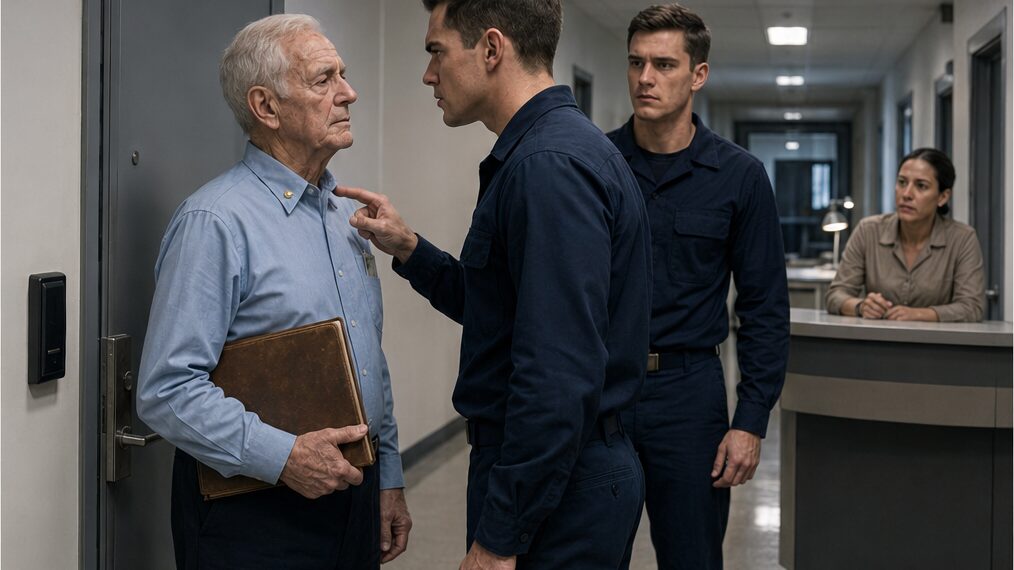
The young sailor’s finger stopped less than an inch from the gold pin on Thomas Davis’s collar.
“Sir,” the sailor said, loud enough for the front desk clerk to look up, “you don’t get to walk through a restricted corridor because you found an old shirt.”
Thomas looked down at the finger first, not at the face behind it.
The pin was small, worn at the edges, and polished so carefully that it looked older than the shirt itself. His light-blue uniform-style shirt hung a little loose across his shoulders. The cuffs had been pressed, but the cloth had softened from years of use. His shoes were black, clean, and plain. In his left hand, held flat against his ribs, was a brown folder sealed with a thin strip of aging tape.
The sailor blocking him was young enough to still stand like every camera in the building might be watching. Dark-blue uniform. Sharp creases. Fresh haircut. Name tape: Garcia.
Behind him stood another sailor, silent, hands clasped behind his back, eyes moving from Thomas’s lined face to the folder and then to the corridor beyond them.
Thomas had arrived fifteen minutes early because old habits had never learned retirement. The front entrance of the Navy facility had changed since he last walked through it. New glass panels. New scanner gates. New screens glowing over the reception counter. But the smell had remained: floor polish, filtered air, coffee from somewhere too far away, and that faint metallic chill of secure buildings built to keep secrets from warming.
He had given his name at the desk.
The clerk had asked him to repeat it.
He had.
She had typed slowly, frowned, and said there was an event later in the day, but visitors needed escorts. Thomas had said he was not there for the event. He was there for the archive office beside the restricted corridor. Then he had shown the card.
That was when Benjamin Garcia had been called over.
Now the young sailor stood close enough that Thomas could see the pale nick near his chin where he had shaved too quickly.
“Sir,” Benjamin said again, and the word had stopped meaning respect. “That access card is expired. That corridor is not for visitors.”
Thomas shifted the brown folder slightly higher against his side. His fingers were steady, though the joint at his thumb ached. The folder had rested in the top drawer of his desk for years. Some mornings he had taken it out and placed it on the kitchen table. Some mornings he had put it back before opening it. This morning, before sunrise, he had sat in silence for twenty minutes with the folder in front of him before sliding it into a worn leather case and driving to the facility alone.
“I was told to bring this to records,” Thomas said.
“By who?”
Thomas glanced past him, toward the corridor.
At the far end, beyond a turn in the white wall, was a restricted archive room that had not existed under that name when he knew it. Back then, it had been a communications annex with three desks, two secure phones, and a window that rattled in bad weather. Back then, men had shouted coordinates from wet paper and officers had stopped looking at clocks because clocks had nothing useful to say.
“Records,” Thomas said.
Benjamin’s mouth tightened. “That’s not a name.”
“No.”
The second sailor looked away, uncomfortable. The clerk’s typing stopped.
Benjamin held out his hand. “Let me see the folder.”
Thomas did not move.
“It is sealed,” he said.
“Then it can stay sealed at the front desk until someone confirms you’re supposed to be here.”
Thomas looked at the desk. A plastic visitor tray sat beside the sign-in tablet. A woman’s purse rested on the floor near a chair. A younger enlisted man walked by carrying a stack of printed programs for the afternoon event. On the top page, Thomas caught only part of a title before it shifted out of sight: remembrance, service, sacrifice. Words institutions printed when the living were not sure what to do with the dead.
“I cannot leave it there,” Thomas said.
Benjamin gave a short laugh, not amused, just impatient. “Sir, with respect, you don’t decide that.”
The words struck softly, but they struck.
Thomas had heard men shout in storms. He had heard officers try not to cry over radio static. He had heard a mother’s silence over a phone line after being told her son was not coming home. This young man’s voice was nothing compared with those sounds.
Still, the hallway had grown quiet.
The clerk was watching now. So was the second sailor. So was the enlisted man with the programs, paused halfway to the lobby.
Thomas felt their attention settle on his shoulders, on his age, on the folder, on the old card clipped inside his breast pocket. People made decisions quickly in hallways. They looked at the slow walk, the white hair, the careful grip. They decided whether someone belonged before asking why he had come.
Benjamin’s eyes dropped to the card.
It was not clipped in a modern badge holder. It had no bright color band, no new barcode, no fresh photo with a digital shine. The laminate had clouded faintly at the corners. The edge near the magnetic strip had worn thin. Thomas had kept it not because it opened doors—he had assumed it opened none anymore—but because the last man who handed it to him had done so with trembling hands after three days without sleep.
Benjamin reached toward it.
Thomas stepped back once.
Not quickly. Not fearfully. Just enough.
The movement changed the air between them.
“Sir,” Benjamin said, lower now, “are you refusing a security instruction?”
Thomas looked at him fully for the first time.
Benjamin’s eyes were hard, but not cruel. Young pride could look like cruelty when it wore a uniform. So could fear. Thomas saw both. The sailor wanted the corridor controlled. He wanted the clerk to see he was firm. He wanted the second sailor to see he was not someone an old man could confuse.
“I am asking you,” Thomas said, “to check the name again.”
“We checked the visitor list.”
“I did not say visitor list.”
Benjamin stared at him.
The clerk shifted behind the desk. “Petty Officer Garcia, there is a legacy field in the system, but it’s not populating cleanly.”
Benjamin did not turn around. “Legacy field?”
“It looks old,” she said. “Maybe imported from the previous database.”
Benjamin exhaled through his nose. “That’s exactly the problem.”
Thomas felt the folder press against his ribs with each breath. Inside it was a name that had waited too long. Not his name. The name that should have been there when the facility prepared its memorial wall. The name that should have appeared in the program. The name that had lived for decades in footnotes and after-action language, softened until sacrifice became procedure.
Benjamin pointed down the hallway, past Thomas’s shoulder, toward the exit seating.
“You can wait over there until records sends someone. Away from the restricted corridor.”
Thomas did not look where he pointed.
“I have waited in worse places,” he said.
The second sailor’s eyes flicked up.
For a moment, Benjamin seemed uncertain whether he had been insulted. He chose to hear defiance.
“This isn’t a museum tour,” he said. “And it isn’t a place to act important because you wore something once.”
Thomas’s hand tightened once on the folder, then relaxed.
The young sailor’s finger rose again, this time tapping the air near Thomas’s collar pin.
“You can’t just walk around wearing that.”
The clerk whispered something under her breath. The second sailor shifted his weight. The enlisted man with the programs disappeared into the lobby, embarrassed to be seen watching.
Thomas looked at the pin. He remembered another hand fastening it years ago, not for ceremony but because the person doing it had missed the hook twice from exhaustion. He remembered saying there was no time for straight lines. He remembered being told, “Then stand still for one second, sir.”
One second.
Sometimes a life turned on less.
He raised his eyes to Benjamin.
“You can check the name again,” he said.
Benjamin’s jaw set. “The card won’t open anything that matters anymore.”
Chapter 2: The Door Opens Before Anyone Apologizes
Benjamin Garcia regretted the sentence as soon as he said it, but not enough to take it back.
The old man did not flinch. That made it worse. Most visitors either apologized too much or became loud. They searched for phones, names, threats, someone important they knew. This one simply stood there with the brown folder under his arm and the old card visible in his pocket, as if the hallway could do what it wanted and he would still have somewhere to be.
Benjamin disliked that calm.
It made him feel like the childish one.
He turned toward the access panel mounted beside the restricted corridor door. “Fine,” he said. “Try it.”
The clerk behind the desk made a small noise. “Petty Officer—”
Benjamin lifted a hand without looking back. “If it fails, we’re done.”
The second sailor straightened, relieved there would be some conclusion.
The old man took the access card from his breast pocket. He did it carefully, pinching the cloudy laminate between two fingers, as if removing a photograph from a frame. Benjamin noticed the card trembled only when the old man’s fingers cleared the pocket seam. Not from fear, he thought. From age. Maybe from stubbornness.
The corridor camera above the door blinked red.
The door itself was unremarkable. Gray metal. No window. A small black reader with a narrow slot and a screen no wider than two fingers. Above it, a sign read: AUTHORIZED PERSONNEL ONLY. The paint around the sign was newer than the door.
Benjamin stood to the side, arms crossed. He told himself he was doing his job. He had been assigned to corridor support because senior staff were preparing for the afternoon memorial event, and he was not going to be the sailor who let an unverified elderly man wander into restricted records carrying a sealed package.
He had seen enough people try confidence as a credential.
The old man approached the reader.
For half a second, Benjamin expected him to hesitate. He did not.
The card slid into the slot with a dry plastic scrape.
The reader remained dark.
Benjamin almost spoke.
Then the screen flickered.
A line of pale green text appeared, fragmented at first, then reassembled into a string of old system language. Benjamin leaned closer before he could stop himself.
LEGACY COMMAND ACCESS — DAVIS T.
Below it, another line blinked.
ARCHIVE ANNEX: AUTHORIZED.
The lock clicked.
It was not loud. That was the part Benjamin would remember later. No dramatic alarm. No burst of sound. Just a small mechanical release, quiet as a throat clearing.
The gray door opened an inch.
The second sailor whispered, “What the—”
Benjamin snapped, “Stand by.”
The old man withdrew the card and held it in his palm. He did not smile. He did not look at Benjamin with triumph. He placed the card back into his pocket and waited.
That irritated Benjamin more than if he had gloated.
“System error,” Benjamin said.
The clerk had come around the desk. “That door doesn’t open on error.”
“It’s an old database line.”
“It authenticated.”
Benjamin looked at her sharply. She looked back, unsure but honest.
The old man turned slightly toward the open door. The brown folder remained tucked against him. He made no move to enter fully, only stepped to the threshold and stopped with one shoe crossing the line.
Benjamin moved fast, placing himself beside him. “Sir, do not proceed farther.”
The old man paused.
“I have no intention of wandering,” he said.
“Then step back.”
He did, without argument. The door remained open behind him, revealing a short vestibule and another corridor with softer lighting. On the wall inside, Benjamin could see rows of framed black-and-white photographs, too distant to read.
The sight unsettled him. The facility was modernized almost everywhere visitors could see. That inner corridor looked preserved. Not abandoned. Preserved.
The clerk checked the screen at the desk. “Petty Officer Garcia, the system is showing a command access category I don’t recognize.”
“Then don’t recognize it,” Benjamin said, too quickly.
She frowned. “That’s not how access control works.”
Benjamin felt heat rise under his collar. The second sailor was watching him now, not the old man.
He lowered his voice. “We don’t allow unknown categories into restricted archives during a scheduled event.”
The clerk glanced at Thomas. “Sir, what office issued that card?”
The old man’s hand rested near his pocket. “The office had a different name then.”
“What name?”
He looked down the inner corridor, not at her. “Communications Annex Three.”
The clerk blinked.
Benjamin almost laughed again, but the words caught before they left him. He had never heard of Communications Annex Three. That did not mean it was nonsense. The base was old. Older than most of the buildings looked. Half the hallways had been renamed after people whose portraits no one stopped to study.
“Sir,” Benjamin said, trying to recover a professional tone, “that doesn’t answer the question.”
“It was the answer when the card was issued.”
“And when was that?”
The old man was silent long enough that Benjamin thought he would refuse.
“After the storm,” he said.
The words meant nothing to Benjamin. But the clerk’s expression changed. Not recognition exactly. More like she had heard a phrase from a file.
“What storm?” Benjamin asked.
The old man looked at him.
The eyes were pale and tired. Not weak. That distinction reached Benjamin before he had language for it.
“The one this building remembers when it wants donations,” the old man said. “And forgets when it writes names.”
The hallway seemed to grow colder.
Benjamin looked toward the brown folder. For the first time, it did not look like a prop carried by an old man trying to get past security. It looked heavy.
The clerk retreated to the desk and typed faster. “I’m calling records.”
“Call the security office,” Benjamin said.
“I’m calling records first.”
He heard the difference in her voice. She was no longer treating the old man as a routine interruption.
Benjamin turned back toward Thomas. “Sir, I need that folder placed on the desk until this is resolved.”
“No.”
It was the first word Thomas had spoken that held iron.
Benjamin stiffened. “That wasn’t a request.”
“No,” Thomas said again, not louder. “It was not.”
The second sailor took a half step forward, then stopped. No one touched the folder.
The open door waited beside them.
Benjamin stared at the green text still glowing on the small reader. DAVIS T. The last name was ordinary. The first initial told him nothing. The command category told him less. Yet the door had opened, and every second it stayed open made Benjamin feel less in control of the corridor he had been assigned to guard.
The clerk spoke into the phone. “This is front access. I need Kimberly White from records at restricted archive. We have a legacy command authentication at Annex door.”
A pause.
“No, not a visitor badge. An old access card.”
Another pause.
Her eyes lifted to Thomas.
“Yes,” she said. “The name is Davis.”
Benjamin looked from the clerk to the old man.
Thomas had lowered his hand from the folder. His fingers rested against the brown paper as if feeling for something through it: a shape, a crease, a memory.
The clerk listened a few seconds longer, then said, “She’s on her way.”
Benjamin heard himself ask, “What did records say?”
The clerk swallowed.
“They said not to close the door until she gets here.”
Chapter 3: The Folder No One Wants To Touch
Kimberly White hated old records that arrived by hand.
Digital records failed politely. They displayed errors, produced logs, gave dates and access histories and user IDs. Paper arrived with silence and forced everyone near it to become responsible for what they touched.
When the call came from the front desk, she was in the records office reviewing seating corrections for the afternoon memorial event. A donor’s surname had been misspelled twice. A retired captain’s title had been entered into the wrong column. The program printer had jammed once already, leaving a gray stripe across the words honoring sacrifice. Kimberly had been fixing other people’s carelessness since seven that morning.
Then the clerk said, “Legacy command authentication.”
Kimberly stopped typing.
By the time she reached the restricted corridor, the gray archive door stood open, and four people were arranged around it as if no one wanted to be the first to admit what had happened.
Petty Officer Benjamin Garcia stood nearest the reader, shoulders squared too hard. Another sailor stood behind him. The clerk remained halfway between desk and corridor. And an elderly man in a light-blue shirt waited with a brown folder held flat against his side.
Kimberly noticed the folder before she noticed his face.
It was not standard issue. No printed barcode. No intake sticker. No modern classification cover. Just old brown stock, reinforced along one edge, sealed with thin aging tape that had darkened in the center. Someone had written on it once in black ink, but the visible part had faded to a few uneven marks. The man’s hand covered most of it.
“Who opened the door?” Kimberly asked.
Benjamin answered too quickly. “The card did.”
Kimberly turned to the reader. The green text still showed the authenticated line. She leaned close enough to read it, then straightened.
Legacy command categories had been migrated into the system years before she started working there. Most were inactive. Some were retained for historical continuity. A few were supposed to be locked behind dual verification and command review. None were supposed to walk in through the front entrance in the breast pocket of an old man.
She looked at him.
“Mr. Davis?”
He inclined his head once. “Yes.”
“Thomas Davis?”
“Yes.”
Benjamin’s jaw tightened at the confirmation, as if the old man having a first name made him more suspicious.
Kimberly kept her voice even. “Sir, I’m Kimberly White, records administrator for restricted archives. I understand you’re asking to deposit a sealed folder.”
“I was asked to bring it here.”
“By whom?”
The old man looked down at the folder. “By a promise.”
Benjamin made a small sound.
Kimberly gave him a warning glance. She had no patience for theatrics from either direction.
“Mr. Davis,” she said, “I can’t accept a sealed document without chain-of-custody paperwork, digital intake authorization, and content identification.”
The old man’s expression did not change. “The contents identify themselves.”
“That isn’t procedure.”
“No,” he said. “It is not.”
She waited for him to explain. He did not.
Kimberly folded her hands at her waist. “Sir, I need you to understand that this office protects records. We don’t take unknown files from private individuals and place them into restricted archives because a door recognized an old credential.”
“That is wise.”
Benjamin looked almost relieved.
Then the old man added, “But it is incomplete.”
Kimberly studied him more carefully.
His face was lined by more than age. That was her first thought. Some people wore years as softening. Others wore them as weather. This man looked weathered by decisions made indoors while other people suffered outdoors. His shirt was modest, but not careless. His shoes had been polished by habit, not vanity. The card in his pocket had been preserved the way some people preserved photographs.
“What is the folder related to?” she asked.
The old man’s fingers moved once over the taped edge.
“An evacuation review.”
Kimberly felt the day narrow.
The facility held many kinds of records: personnel, communications, command logs, old weather maps, declassified fragments, ceremony materials. But the memorial event that afternoon centered on one operation above all—the rescue operation from decades earlier, the one every hallway display called a defining act of naval coordination and courage.
She kept her voice neutral. “Which evacuation?”
The old man looked toward the open door.
“The one your program calls Harbor Lantern.”
Behind her, Benjamin shifted. “Harbor Lantern is the memorial event today.”
“I know.”
“You’re here for the event, then,” Benjamin said, seizing the simpler explanation.
“No.”
Kimberly heard the quiet finality in it.
She glanced toward the folder again. “If this concerns Harbor Lantern, there should be an existing archive file.”
“There is.”
“Then why bring this?”
“Because the existing file is missing a name.”
The second sailor looked up.
Benjamin frowned. “A name?”
Thomas did not answer him.
Kimberly’s professional caution returned. Old men with old grief could be sincere and still wrong. Families arrived with letters, photographs, personal corrections, claims that official records had failed them. Sometimes they were right. Sometimes memory had rearranged pain into certainty. Her job was not to feel the weight of every folder. Her job was to prevent the archive from becoming rumor.
“I can review a copy,” she said. “Not the original. Not sealed. And not without intake.”
“This is the original.”
“Then I definitely cannot accept it in the hallway.”
“Then take me to the place where you can.”
The request was calm. Not demanding. That made it harder to refuse.
Kimberly turned to the clerk. “Print a temporary hold form.”
The old man said, “No.”
Everyone looked at him.
Kimberly’s patience thinned. “Sir, if you refuse intake, there is nothing I can do.”
“I will not have it logged as an unverified visitor submission.”
“That is what it is.”
For the first time, something like pain crossed his face. It was gone almost immediately, but Kimberly saw it.
“No,” he said. “It is what remains.”
The words settled into the corridor.
Kimberly looked at the reader again. DAVIS T. Legacy command access. Archive Annex authorized.
She walked to the records terminal beside the desk and signed in with her administrator code. The screen took too long to load. Benjamin watched her, restless, but did not interrupt.
She searched DAVIS T.
Too many results.
She narrowed by legacy access.
One result appeared, then blinked behind a restriction flag. The first name was visible. Thomas. The surname visible. Davis. The middle field redacted. Rank field redacted. Command designation redacted. Associated operation: HARBOR LANTERN.
Kimberly’s mouth went dry.
She clicked the associated file. Another restriction message appeared, older in format than the rest of the system.
COMMAND REVIEW SEALED — PARTIAL INDEX ONLY.
Under the index, one line displayed before the rest dissolved into blocks of gray:
DAVIS, THOMAS — AUTHORITY: [REDACTED] — FINAL ACCOUNT PENDING.
Kimberly stared at the last three words.
Final account pending.
For years, she had seen Harbor Lantern listed as closed.
She looked back at the old man.
Thomas Davis stood beside the open archive door, the brown folder still untouched by anyone but him. Benjamin Garcia had stopped looking certain. The clerk held the blank temporary form in both hands.
Kimberly closed the terminal window halfway, not enough to erase the line, only enough to keep others from reading over her shoulder.
“Mr. Davis,” she said carefully, “where did you get that folder?”
He did not answer at once.
When he did, his voice was quiet enough that everyone had to listen.
“I carried it out before the roof came down.”
Chapter 4: The Photograph Behind The Memorial Glass
Thomas had not expected the memorial hallway to be brighter than the rest of the building.
He stood just beyond the records office while Kimberly White secured her terminal and spoke in low, controlled phrases to someone on the internal line. Benjamin Garcia remained near the archive door, pretending not to watch the old man. The second sailor had been sent back toward the front desk, but not before glancing at Thomas with the uneasy curiosity of someone who had seen a locked door open and wanted the world to explain itself.
The explanation, Thomas knew, would not come from him.
Not yet.
The hallway leading toward the conference wing had been renovated with polished glass and muted blue light. Along one wall stretched a memorial display, each section arranged with photographs, engraved dates, diagrams of ships and aircraft, and carefully chosen words. It was the kind of institutional memory that looked clean because no one included the smell of wet insulation, diesel, blood, burned wiring, or seawater forced through metal seams.
Benjamin stepped to Thomas’s side.
“Records asked us to wait in the conference area,” he said.
Thomas looked at him.
The young sailor’s voice had changed since the door opened. Still guarded. Still stiff. But the sharpness had been filed down by uncertainty.
“Did they?” Thomas asked.
Benjamin’s face colored slightly. “Ms. White said she needs to pull a restricted index. You can’t remain in the records office while she does that.”
“That is reasonable.”
Benjamin seemed prepared for resistance. When none came, he gestured down the hall. “This way.”
Thomas adjusted the brown folder under his arm. The folder had warmed against his side, as if it had become part of him. His old access card rested again in his breast pocket, its edge touching the fabric each time he breathed. He could feel it there more keenly now than he had at the front desk. The building had accepted it. The people had not.
They began walking.
Thomas moved slowly, not because he wanted to, but because his right knee had stiffened during the drive and the corridor floor offered no mercy. Benjamin noticed. Thomas could tell by the shortened stride, the half pause after every few steps, the impatient restraint of a young man trying not to look impatient.
“You don’t have to slow down,” Thomas said.
Benjamin looked straight ahead. “I’m escorting you.”
“Yes.”
The word hung there without accusation.
They reached the memorial wall.
Thomas saw the title first.
HARBOR LANTERN: COORDINATION, COURAGE, RETURN.
The phrase had the smoothness of committee language. It did not offend him. He knew why institutions used words like that. They had to make room for visitors, students, donors, families, officers, politicians, and children who might not be ready for what really happened. But some words, if polished too long, stopped reflecting the people beneath them.
The first photograph showed the facility as it had been decades earlier: low buildings, storm shutters, antenna arrays, a parking lot half under standing water. Another showed sailors carrying equipment through knee-deep flooding. Another showed a helicopter deck under rain so hard it blurred the figures into gray shapes.
Thomas kept walking until one photograph stopped him.
It was near the center of the display, enlarged behind glass. A group of officers and enlisted men stood inside the old communications annex. Their uniforms were wrinkled, sleeves rolled, faces drawn from exhaustion. A map covered one wall. Someone had marked lines across it in grease pencil. On a table sat three radios, two coffee cups, and a stack of message sheets held down with a wrench.
Near the rear of the photograph, half turned away from the camera, stood a younger Thomas Davis.
His hair had been dark then. His face narrower. One hand rested on the table. The other held a field phone to his ear. He was not looking at the camera. He was looking at a sailor pointing toward the map. Thomas remembered that moment not as a photograph but as a sound: rain striking the roof in sheets, voices overlapping, a generator coughing twice before it held.
Benjamin stopped beside him.
Thomas did not move.
The brown folder pressed against the glass when he shifted closer. He pulled it back quickly, as if the folder itself might disturb the dead.
Benjamin followed his gaze to the photograph.
“Those are the Harbor Lantern command staff,” he said.
Thomas said nothing.
“My instructor at technical school talked about this operation,” Benjamin added, perhaps because silence made him nervous. “Coastal evacuation after the storm surge. Communications were failing. They coordinated rescue routes from here.”
“Yes,” Thomas said.
Benjamin looked at him. “You know about it?”
Thomas kept his eyes on the photograph. “Some.”
The young version of himself behind the glass seemed like a stranger. Thomas remembered his hands from that day more than his face. He remembered writing names on a board because the printer had failed. He remembered crossing out the word delayed and replacing it with missing when the reports became too long to deny. He remembered one young communications specialist who kept asking for two more minutes because two more minutes, in his mind, could still become a life.
On the display beneath the photograph, a line of engraved names listed command personnel. Thomas’s eyes moved over them slowly.
Some were there.
Some were not.
He found the gap where one name should have rested. The absence was not visible to anyone else. It was only space between names, only history arranged around a hole.
His fingers tightened over the folder.
Benjamin noticed. “Are you all right?”
The question surprised both of them.
Thomas looked at him briefly. “No.”
Benjamin’s posture changed, just slightly. The practiced guard stance loosened.
Before he could answer, footsteps approached from the conference wing. Visitors had begun gathering for the afternoon program: older men in suits, women wearing service pins, a few uniformed personnel guiding them toward a reception area. Their voices softened as they entered the memorial hall.
A woman stopped near the Harbor Lantern display.
She was in her seventies, perhaps younger, though grief made some faces difficult to date. She wore a dark blue dress and held a folded program in both hands. Her hair was silver and neatly pinned. On her lapel was a small photograph button, the kind families wore at memorials when the person in the picture remained younger than everyone who remembered him.
Thomas saw the photograph on the button before he saw her face clearly.
The young man in it had a narrow smile and hopeful eyes.
Thomas looked away too late.
The woman noticed him.
“You knew them?” she asked.
Benjamin straightened at once. “Ma’am, please continue toward the reception area.”
She did not move. Her eyes remained on Thomas.
“The men in the photograph,” she said. “You were looking like you knew them.”
Thomas’s mouth felt dry.
“I knew some,” he said.
The woman came closer, studying him with a directness that did not feel rude. Unlike Benjamin, she did not look at his age first. She looked at his face as if searching through years.
“My husband was connected to Harbor Lantern,” she said. “Patricia Clark.”
Thomas closed his eyes once.
When he opened them, the photograph behind the glass seemed brighter than before.
Benjamin looked between them. “Mrs. Clark, the reception—”
“It’s all right,” Patricia said, not taking her eyes from Thomas. “I’ve been waiting a long time for someone who knew anything real.”
Thomas heard the last word.
Real.
The folder under his arm might have grown heavier.
Patricia turned slightly toward the display. “They told me my husband’s relay team was accounted for in the final report. Then they told me the final report was sealed. Then they told me to be proud.” Her voice did not break. That made it harder to hear. “People say that when they don’t have answers.”
Thomas looked at the engraved names.
“Pride is a poor substitute,” he said.
Patricia’s eyes sharpened.
Benjamin looked uncomfortable now, not with suspicion but with the intimacy of grief he had not been invited to witness.
Patricia glanced at the brown folder. “Is that why you’re here?”
Thomas did not answer.
The memorial hall continued around them: polished glass, framed heroism, ceremony guests murmuring near the doors. Somewhere beyond the wall, a microphone was being tested. A dull pop of sound moved through the ceiling speakers.
Patricia stepped closer to the photograph and looked where Thomas had been looking.
“My husband’s name was Stephen Clark,” she said. “Most of the time they say he was support personnel. As if that means he stood somewhere safe.”
Thomas’s throat tightened.
“He did not,” he said.
Patricia turned toward him fully.
Benjamin’s face changed. The name had reached him too. Not because he knew it, but because Thomas did.
“You knew my husband?” Patricia asked.
Thomas held the folder against his chest.
“I knew what he did,” he said.
The words were too small. They failed as soon as he spoke them.
Patricia searched his face. Behind her, younger officers guided guests past the memorial hall, but the three of them stood still beside the photograph, caught between public memory and private truth.
“Were you there?” she asked.
Thomas looked at the young man in the button on her lapel. Then he looked at the photograph behind the glass, at the younger version of himself holding a field phone while rain erased the windows.
“Yes,” he said.
Patricia’s grip tightened around her folded program.
Benjamin’s eyes moved from Thomas to the photograph, then back again. For the first time, Thomas saw the young sailor compare the old face in front of him with one of the faces behind the glass.
The resemblance was not obvious. Time had taken too much and left too little. But it was there in the posture. In the way the younger man in the photograph stood slightly turned, listening to someone outside the frame. In the set of the mouth. In the hand resting near the map as if afraid to move too soon.
Benjamin leaned closer to the glass.
Thomas did not stop him.
Patricia saw it too. Her lips parted, but no question came.
From the records office entrance, Kimberly White appeared, holding a printed sheet in one hand. Her face had lost its administrative armor. She stopped when she saw the group at the memorial wall.
“Mr. Davis,” she said carefully.
Thomas turned.
Kimberly looked from him to Patricia, then to Benjamin. “We found a partial index match. I need you in the command conference room.”
“Why there?” Benjamin asked.
Kimberly did not look at him.
“Because Commander Hill is on his way.”
Thomas lowered his eyes.
He had known John Hill as a lieutenant who wrote too small in margins and never slept when someone might need a second set of hands. Commander now. Time promoted those who survived it.
Patricia’s voice was quiet beside him.
“Mr. Davis,” she said, “did you know the men in that picture?”
Thomas looked back once more at the glass.
There were many honest ways to answer, and none of them were enough.
“I gave some of them orders,” he said.
Chapter 5: The Officer Who Remembered His Name
John Hill entered the command conference room already irritated with the building.
The microphone in the event hall had failed twice. A guest list had been printed with old titles and current ranks mixed together. Someone had moved the Harbor Lantern family seating to the wrong side of the room because a donor’s assistant wanted easier access to the aisle. John had spent the morning correcting small indignities before they became public ones.
Then Kimberly White had called.
Legacy command authentication. Thomas Davis. Harbor Lantern. Final account pending.
John had not heard the name spoken inside that building in years.
He had heard it in his own house, sometimes. Quietly. Mostly when rain hit hard enough against the windows to bring back the old annex roof and the voice on the radio saying the relay was still transmitting.
He reached the conference room and pushed the door open.
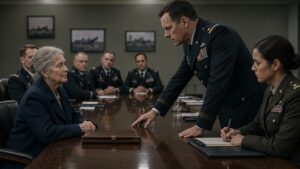
The first person he saw was Benjamin Garcia standing too rigidly near the wall. The second was Kimberly at the table with a printed index sheet held flat beneath one hand. Patricia Clark sat near the end, folded program in her lap, face pale with controlled expectation.
Then John saw the old man by the window.
For one unguarded second, he did not see age.
He saw the officer who had stood over a ruined map and made impossible decisions without raising his voice. He saw the man who had said, “Send the last route twice,” when everyone else thought once was enough. He saw a hand reaching across a radio table to steady a young lieutenant who had just read the wrong casualty number aloud.
John stopped just inside the door.
The room noticed.
Thomas turned from the window.
John’s throat tightened before rank, protocol, or caution could arrange his face.
“Admiral Davis,” he said.
The room went silent.
Not dramatic silence. Not ceremony silence. The smaller kind. The kind that comes when chairs stop creaking and breath catches because everyone understands that something has been wrong for longer than the past few minutes.
Benjamin’s eyes moved sharply to Thomas.
Kimberly lowered her gaze to the printed sheet, then back up again.
Patricia did not move at all.
Thomas looked at John for a long moment. The old admiral’s expression held neither welcome nor displeasure. Only recognition touched by fatigue.
“John Hill,” Thomas said. “You used to lose pens.”
John laughed once, softly, because if he did not laugh he might do something less useful. “Only the cheap ones, sir.”
“I remember better.”
“Yes, sir.”
The word sir changed the room again.
Benjamin had used it all morning like a tool. John used it like memory.
Thomas glanced toward the door. “I was told you were on your way.”
“I should have been here when you arrived.”
“No,” Thomas said. “You had other duties.”
John looked at Benjamin then. The young sailor’s face had gone still, the blood drained from his earlier certainty. He looked like someone standing in the wreckage of his own assumptions and trying not to step on anything sharp.
“What happened?” John asked.
Kimberly answered before Benjamin could. Her voice stayed professional, but each sentence carried weight. “Mr. Davis arrived with a sealed folder related to Harbor Lantern. His old access card authenticated at the archive annex under a legacy command category. We found a partial index entry: Davis, Thomas. Authority redacted. Final account pending.”
“Admiral Davis,” John said.
Kimberly’s mouth tightened. “Yes.”
Benjamin stared at the floor.
Thomas moved away from the window. “Mr. Garcia was doing his assigned work.”
The defense came so quietly that Benjamin looked up in surprise.
John did not miss it. “Was he?”
Thomas did not answer directly. “He was guarding a door he did not understand.”
Benjamin flinched.
John stepped farther into the room. “There’s a difference between guarding a door and humiliating a man in front of one.”
The words were not loud. They did not need to be.
Benjamin’s hands curled at his sides. “Sir, I didn’t know who he was.”
Thomas turned his head slightly.
John looked at the young sailor for a long second. “That is not the defense you think it is.”
Benjamin’s face reddened.
Patricia Clark closed her eyes briefly, as if those words had touched more than this room.
Thomas placed the brown folder on the conference table. He did not release it right away. His fingers remained on the top edge, covering the faded writing.
John saw the folder and stopped thinking about Benjamin.
He knew that folder.
Not exactly. Not every crease. But he knew the type. Old command stock from the annex. Reinforced edges. Tape used when secure envelopes ran out. Black ink that bled when humidity got in.
He remembered a night when there had been no proper folders left and Thomas Davis had said, “Then use what keeps the pages together.”
John approached slowly. “Is that the missing packet?”
Thomas’s hand remained on it. “It is the final account.”
Kimberly sat down as if her knees had chosen the chair before her mind did. “The system lists it as pending.”
“It was pending because I never submitted it.”
John looked at him. “Sir…”
Thomas’s eyes moved to Patricia.
She had not spoken since John entered. Her program had bent slightly in her grip.
Thomas said, “Not because I wanted it hidden.”
Patricia’s voice was careful. “Then why?”
The question seemed to travel around the room before reaching him.
Thomas lifted his hand from the folder.
Under his fingers, the faded writing became partly visible. Most of it had blurred with age, but one word could be made out: Lantern. Beneath it, smaller, a handwritten note had been cut off by the tape line.
John sat slowly across from him.
Benjamin stayed near the wall, no longer guarding anything.
Thomas looked at the folder as if it were not paper but a door more difficult than the one outside.
“The official record was prepared after the inquiry,” he said. “It described the evacuation, the relay failure, the personnel accounted for, the coordination decisions. It did not include everything.”
“Why not?” Patricia asked.
Thomas folded his hands on the table. They looked older there beneath the conference room lights. “Because some parts of command look cleaner when written without the names of the people who made them possible.”
John looked down.
He remembered the inquiry. He had been too junior to sit in the closed sessions, but not too junior to hear what was not said afterward. Harbor Lantern became success. Success became saved numbers. Saved numbers became plaques and lectures and annual language. The missing became honored in general phrases. The specific disappeared into the machinery.
Patricia leaned forward. “My husband?”
Thomas looked at her fully. “Yes.”
A sound moved through the room, not quite a breath, not quite a word.
Benjamin stared at the brown folder now with the expression of someone watching an object change shape.
Kimberly touched the printed index. “Admiral Davis, I need to understand what authority attaches to this record.”
Thomas almost smiled, though there was no humor in it. “That is the first practical question anyone has asked me today.”
Kimberly accepted the rebuke without looking away.
John answered for him, not because Thomas could not, but because the room needed someone else to say what Thomas would not use for himself.
“Thomas Davis was the commanding officer assigned emergency operational authority during Harbor Lantern,” John said. “The annex reported through him after regional communications failed. For thirty-six hours, routing, evacuation priority, and relay authorization came through his command.”
Benjamin looked sick.
John continued, quieter. “He later served as a fleet commander and retired as an admiral.”
The title entered the room and did what titles do. It rearranged posture. Kimberly sat straighter. Benjamin’s shoulders lowered. The clerk visible through the glass side panel stopped outside the door and then moved away quickly, as if she had overheard too much.
Thomas did not look larger because of it.
If anything, he looked more tired.
Patricia stared at him. “You were the one who decided which boats moved first.”
“Yes.”
“You were the one who signed the report.”
“Yes.”
“And you kept a missing part of it for all these years?”
Thomas accepted the accusation because part of it was true.
“I kept the part I did not have permission to file,” he said. “Then the men who could grant that permission died, retired, or decided silence was easier. Eventually the operation became history. History is difficult to correct once it has a display case.”
Patricia’s eyes shone, but she did not cry.
John watched Thomas. “Why now?”
Thomas looked toward the window. Beyond it, the memorial hall’s blue-lit glass reflected faintly in the conference room wall.
“Because Mrs. Clark is here,” he said. “Because the program will speak of sacrifice again. Because I am tired of hearing that word used without the name it cost.”
Patricia’s fingers loosened around the folded program.
Benjamin took one step forward, then stopped. “Admiral—”
Thomas’s gaze came to him.
The word died in Benjamin’s mouth.
John saw the young sailor swallow. There was apology gathering in him now, but apology, John knew, could also be selfish when offered too soon. It could ask the injured person to clean the room before the dust settled.
Thomas spared him from speaking.
“I did not come for that,” he said.
Benjamin’s face tightened.
“No, sir.”
Thomas looked back to John and Kimberly.
“I did not come for the event either,” he said. “I came for the name missing from the record.”
Chapter 6: The Name Missing From The Record
Thomas had opened the brown folder only once before that day.
He remembered the first time clearly because he had been alone at his kitchen table, long after midnight, with rain clicking against the window and a cup of coffee gone cold beside his hand. The tape had made a soft tearing sound as it lifted. He had stopped halfway through and pressed it back down.
Not yet, he had told himself.
Years passed inside those two words.
Now, in the archive room beyond the restricted door, the folder lay under brighter lights than it had ever known. The room smelled of paper, metal shelving, and filtered dryness. Kimberly White had cleared a table and placed cotton gloves beside it. John Hill stood at the far end with his hands folded in front of him. Patricia Clark sat opposite Thomas, the photograph button on her lapel catching small glints of light whenever she breathed. Benjamin Garcia remained near the door because no one had told him to leave, and perhaps because leaving would have been easier than staying.
Thomas placed his old access card beside the folder.
The card looked small there. Clouded plastic. Worn edge. A strip of old authority that had opened a door but could not open what mattered.
Kimberly spoke softly. “Admiral Davis, once this is entered, it becomes part of the restricted historical record pending review. I need your verbal confirmation that you are submitting it willingly.”
Thomas looked at the folder.
“I am.”
“And that the contents relate to Operation Harbor Lantern.”
“They do.”
“And that the materials were retained by you after the emergency command period.”
“Yes.”
Kimberly’s pen paused. “Were they classified at the time?”
Thomas looked up.
“At the time, everything was.”
She nodded once and wrote.
The careful process helped him. Procedure gave pain something to lean against.
When Kimberly finished, she slid the intake sheet toward him. Thomas signed where she indicated. His signature had changed over the years. The letters were less firm, the line thinner. But it was still his name.
Then he lifted the tape.
No one spoke.
The old adhesive resisted, then gave. The sound was small, almost indecent in the quiet room.
Inside were six message sheets, a folded map with grease-pencil marks faded to ghost lines, two handwritten pages, and a narrow strip of radio log paper sealed separately in a transparent sleeve. The papers smelled faintly of damp even after all these years, as if memory had its own weather.
Patricia leaned forward, then stopped herself.
Thomas took the top page and placed it in the center of the table.
“Most of Harbor Lantern is recorded accurately,” he said. “The storm surge cut land routes faster than predicted. Civilian evacuation points lost power. Local channels collapsed under traffic. We used this annex as a relay center because it still had partial generator support and line-of-sight equipment.”
His voice did not become dramatic. It became precise. That old command habit returned not as pride but as discipline.
“Mrs. Clark, your husband was assigned to a temporary relay team near the south basin.”
Patricia’s hands folded tightly in her lap.
“They told me he repaired equipment,” she said.
“He did.”
“And then?”
Thomas touched the map.
“And then the primary relay failed. Without a second transmission point, two evacuation boats would have moved into debris lanes. We had families waiting on rooftops, medical patients at the clinic, and one shelter reporting water at the second-floor stairwell.”
He remembered the voices.
A child crying near an open radio. A medic shouting for route clearance. Someone asking if the word proceed meant now or when safe. No one ever meant when safe in those hours. Safe had become a place they were trying to reach, not a condition they possessed.
“Your husband’s team restored a temporary relay,” Thomas said.
Patricia nodded faintly. “That part was in a letter.”
Thomas looked at the separate sleeve with the radio log strip inside.
“The official record says the relay was restored by the team.”
“Yes.”
“That is incomplete.”
Patricia’s eyes met his.
Thomas took a breath. It did not go deep enough.
“Stephen Clark remained after the rest of his team was ordered out.”
The room stilled.
John closed his eyes.
“He stayed?” Patricia whispered.
“Yes.”
“Why?”
Thomas looked down at the log strip. “Because the signal kept dropping whenever the antenna was unmanned. He found a way to hold the line manually against the brace while transmitting the route correction.”
Kimberly stopped writing.
Benjamin stared at the table, his young face stripped of every earlier certainty.
Patricia shook her head once, almost angrily. “No one told me that.”
“No,” Thomas said.
“Why?”
He could have blamed classification. He could have blamed chaos, damaged records, the inquiry, men above him who wanted the successful portions emphasized and the unresolved portions compressed. All of that would have been true. None of it would have been the whole truth.
“Because I allowed the summary to stand,” he said.
Patricia’s mouth tightened.
Thomas accepted that too.
He lifted one handwritten page. The paper had browned at the edges. His handwriting covered most of it, sharper then, written in the exhaustion after the rescue.
“This was my final account,” he said. “It named him. It stated that the route correction he held open redirected two evacuation boats and prevented the loss of the clinic group.”
“How many?” Patricia asked.
Thomas’s fingers pressed lightly into the page.
“Forty-three confirmed aboard the first boat. Twenty-eight on the second. More if counting the clinic staff who moved afterward because the route stayed clear.”
Patricia looked at the table as if the numbers had weight.
Seventy-one lives did not fit easily into a room.
Benjamin breathed out slowly.
Thomas continued. “The account also stated that I ordered the relay team withdrawn before confirming his position. I believed he had moved with them.”
John’s eyes opened.
Patricia looked up.
Thomas met her gaze. “That belief was wrong.”
Silence held.
In that silence, Thomas was no longer in the archive room. He was in the annex with water pushing under the door, the roof groaning, a young lieutenant asking whether to repeat the south basin correction, and Thomas saying yes, repeat it until acknowledged. He remembered asking where Clark was. He remembered someone saying he was with the team. He remembered accepting it because three other voices were shouting for decisions and the map was changing faster than men could move.
“I signed the order that sent the boats through,” Thomas said. “I also signed the report that did not fully state what your husband did.”
Patricia’s face had gone very still. “Did he know he was saving them?”
Thomas looked at the radio log strip.
The last transmitted line was incomplete. He had memorized it decades ago.
“He knew the correction had gone through,” Thomas said. “The final signal confirmed it.”
“Did he say anything?”
Thomas hesitated.
Kimberly looked at the sleeve but did not touch it.
Thomas slid it toward Patricia without letting go completely. “This is the final strip recovered from the relay log.”
Patricia stared at it.
The letters were faded and broken in places. Kimberly gently angled the archival light.
Patricia read silently. Her lips moved once over the words.
ROUTE CLEAR. TELL P—
The rest was torn away.
Patricia’s hand rose to her mouth.
Thomas looked down. “The message was never delivered. Not properly.”
“TELL P,” Patricia whispered.
Thomas nodded. “Your name was in his field notes. Patricia.”
A small sound escaped her then. Not a sob. Something smaller and more controlled, which made John look away.
Thomas took the second handwritten page.
“I wrote a letter to you after the inquiry,” he said. “I was advised not to send it while the review remained sealed. Later, I was told a revised family notification had been issued.”
“It wasn’t,” Patricia said.
Thomas closed his eyes.
When he opened them, she was looking at him not with forgiveness, not with hatred, but with the terrible attention of someone finally receiving the shape of a loss.
“I cannot repair that,” he said.
“No,” she answered.
The truth of it moved through him.
He had commanded ships, task groups, rooms full of people who expected certainty from his voice. He had learned the cruel economy of emergency decisions: this road, not that one; this boat now, that one later; this risk acceptable, that risk not. He had spent a life accepting that command did not permit clean hands.
But he had not accepted Stephen Clark’s missing name.
He had only delayed facing the woman who deserved it.
Kimberly’s voice came softly. “Admiral Davis, with your permission, I can scan and index the final account today. The original would remain secured pending review.”
Thomas looked at Patricia.
“It is not my permission alone that matters.”
Patricia stared at the papers. “You’re asking me?”
“I am asking whether you want his final account entered with his name visible to the review board.”
Her eyes flashed. “Why wouldn’t I?”
“Because once the record changes, people may use his sacrifice in speeches. Programs. Displays. The same way they used others.”
Patricia looked toward the archive door, toward the memorial hallway beyond it. When she answered, her voice was steadier.
“Then make them say his name correctly.”
Thomas bowed his head.
John turned away for a moment, one hand pressed against the back of a chair.
Benjamin stepped forward. “Mrs. Clark…”
Patricia looked at him.
Whatever apology he had prepared disappeared under the force of what the room had become.
He lowered his eyes. “I’m sorry.”
She did not answer. She did not need to.
Thomas gathered the pages carefully and placed them in the order they had waited in for decades. Kimberly prepared the archival sleeve. John signed as command witness. Patricia signed as next-of-kin acknowledgment with a hand that shook only at the end of her surname.
When Kimberly lifted the final account to the scanner tray, Thomas felt something in him resist. Not because he wanted to keep it. Because some burdens, carried long enough, taught the body to mistake their weight for balance.
His hand moved toward the access card beside the folder.
He stopped before touching it.
The card had opened the door. It had done its part.
Kimberly began the scan.
The machine’s light passed under the first page, slow and white.
Patricia watched the paper disappear beneath glass. Then she looked at Thomas.
“Did my husband die forgotten?” she asked.
The question struck harder than accusation.
Thomas looked at the old folder, open now, emptied of its power to hide.
“No,” he said. “But he was recorded as if he had.”
Patricia’s eyes filled.
Then came the second question, the one Thomas had driven all morning to face and dreaded every mile.
“Was he deliberately erased?”
Chapter 7: The Admiral Leaves With The Same Old Card
Thomas did not answer Patricia Clark quickly.
The archive room held the question with a cruelty no official inquiry had ever managed. Was he deliberately erased? The scanner light had finished passing under the final page. Kimberly White had not moved to retrieve it. John Hill stood with his head slightly lowered, as if listening for the answer from another time. Benjamin Garcia remained by the door, young and silent, finally understanding that some rooms were guarded by truth, not rank.
Thomas looked at the empty brown folder.
It had protected the pages. It had also hidden them.
“No,” he said at last. “Not at first.”
Patricia’s eyes stayed fixed on him.
He owed her more than a short answer.
“In the first report, his name was there,” Thomas said. “In my account, it was there. In the relay notes, it was there. But the inquiry wanted a clean sequence. Equipment failed. Team restored relay. Evacuation continued. Casualty recorded. That was easier to preserve than the truth that one man stayed behind after withdrawal orders because he understood the signal would fail without him.”
Patricia’s face hardened with pain. “Easier for whom?”
Thomas accepted the blow. “For the institution. For the officers who wanted the operation remembered as control, not improvisation. For the men who wanted saved lives counted without asking who held the line long enough to save them.”
“And for you?”
The room seemed to lose its air.
John shifted, but Thomas raised one hand slightly. Not to stop Patricia. To stop anyone from protecting him from her.
“For me too,” Thomas said.
Patricia’s lips trembled once.
Thomas placed both hands flat on the table. The old access card lay between them, its cloudy plastic catching the overhead light.
“I told myself I was waiting for clearance. Then for the inquiry to close. Then for the right officer to sign the correction. Then for the right year, the right event, the right moment.” He looked at the scanned pages now resting in Kimberly’s tray. “Delay can dress itself as procedure. Sometimes it is only fear wearing a better uniform.”
Benjamin lowered his eyes.
Patricia did not forgive him. Thomas had not asked her to.
“What were you afraid of?” she asked.
“Seeing your face,” Thomas said.
No one spoke.
The answer was smaller than the machinery of command, smaller than classification and review boards and sealed annexes. It was also truer.
Patricia looked down at the photograph button on her lapel. Her thumb passed once over her husband’s young face.
“He used to fix the radio in our kitchen,” she said. “It never stayed fixed. He said machines had moods.” Her voice steadied around the memory. “When the notification came, they said he served honorably in support of evacuation efforts. Support. That was the word they gave me.”
Thomas closed his eyes briefly.
When he opened them, Patricia had pushed the folded program toward him.
“Read where his name is,” she said.
Thomas opened it.
The program listed honored personnel in columns. Command staff. Rescue crews. Communications teams. Support personnel. Stephen Clark was not listed under any of them. His name appeared only in a small paragraph of collective acknowledgment, folded into “additional service members whose efforts contributed to mission success.”
Thomas set the program down carefully.
Kimberly had gone pale. “Mrs. Clark, I can submit an immediate correction request for the digital archive. The printed programs are already—”
“Wrong,” Patricia said.
Kimberly stopped.
The word did not come with anger. It came with exhaustion.
John looked toward the conference wing beyond the archive. “The event starts in twenty minutes.”
“I did not come to interrupt it,” Thomas said.
Patricia turned to him. “Neither did I. But I am tired of sitting quietly while they say almost enough.”
Almost enough.
Thomas had lived too long among those words.
He picked up the access card and held it in his palm. It had opened the door that morning because an old system remembered what people had forgotten. A machine had read his name without judgment. A young sailor had not. A records office had hesitated because paper lacked the right path. A widow had carried a wrong sentence for decades because no one wanted to disturb the clean version.
Thomas slipped the card into his pocket.
Then he stood.
His knee protested. John moved as if to help him, then stopped when Thomas glanced over. Not sharply. Just enough.
“Commander Hill,” Thomas said.
“Yes, sir.”
“Is there a printed addendum table?”
John understood at once. “There can be.”
“Not a speech.”
“No, sir.”
“Not a ceremony around me.”
John’s jaw tightened with emotion he kept in check. “Understood.”
Thomas turned to Kimberly. “Can the scanned account be entered under restricted historical correction today?”
“Yes,” Kimberly said. “I’ll mark it as command-witnessed, next-of-kin acknowledged, pending board review.”
“Add the original to the archive.”
“I will.”
“Not as a visitor submission.”
Her face flushed. “No, Admiral.”
Thomas looked at her.
Kimberly corrected herself quietly. “No, Mr. Davis.”
He nodded once.
Patricia rose more slowly than he had. For the first time that day, she looked older than when he had met her at the memorial wall. Not weaker. Only less protected by the hard surface of waiting.
Thomas held the program out to her.
“I should have come sooner,” he said.
“Yes,” she answered.
The honesty did not spare him. It did not need to.
He bowed his head. “I am sorry.”
Patricia took the program from his hand.
“I believe you,” she said. “That is not the same as being done with it.”
“No.”
She looked toward the folder. “Make them say his name correctly.”
“They will.”
Thomas did not make promises lightly. This one settled into him with the weight of an order received too late and still requiring action.
They left the archive room together.
Benjamin stepped aside from the door before anyone asked him to. He stood straighter than before, but not with pride. His face had changed in a way Thomas recognized from young officers after their first real failure. Some tried to excuse it. Some tried to bury it. A few let it teach them.
In the corridor, voices drifted from the event hall. Guests were finding seats. A microphone clicked. Someone tested the first line of a welcome and then stopped.
The memorial wall glowed blue-white beneath its clean glass. Thomas passed the photograph of Harbor Lantern without stopping this time. Patricia did. Her hand rose toward the display, not touching it, only hovering near the space where Stephen Clark’s name was not yet engraved.
John walked ahead to speak with the event staff. Kimberly moved briskly toward the front desk, already giving instructions to an archive technician carrying a tablet. The building, which had resisted memory all morning, had begun to rearrange itself around a correction.
Thomas remained in the hallway with Benjamin.
For several seconds, neither spoke.
Then Benjamin said, “Admiral Davis.”
Thomas stopped.
The title sounded different in the young man’s mouth now. Not sharp. Not performative. Heavy.
Benjamin swallowed. “I owe you an apology.”
Thomas looked at him.
Benjamin’s hands were at his sides. He did not point now. He did not hold the corridor like property. His eyes flicked once to the collar pin he had mocked, then dropped.
“I was disrespectful,” he said. “I assumed you didn’t belong here. I treated you like you were trying to be someone you weren’t.”
Thomas waited.
Benjamin drew a breath. “I’m sorry, sir.”
The apology was sincere. It was also incomplete.
“Because I was an admiral?” Thomas asked.
Benjamin looked up, startled.
“No, sir. I mean—” He struggled, then stopped himself from reaching for the easy answer. “At first, yes. When I found out. But that’s not…” His face tightened. “That’s not why I was wrong.”
Thomas said nothing.
Benjamin looked toward the front entrance, where the morning confrontation had begun. “I should have checked. I should have listened. Even if the card hadn’t worked.”
Thomas studied him for a long moment.
“You were guarding a door,” he said.
“Yes, sir.”
“You forgot there was a person in front of it.”
Benjamin absorbed that as if it had been spoken louder.
“Yes, sir.”
Thomas’s voice softened, but not enough to remove the edge. “Do not apologize because of who I was. Apologize because of who you thought I was.”
Benjamin’s mouth tightened. He nodded once.
“Yes, Mr. Davis.”
That was better.
A call came from the event hall. John stood at the entrance, looking back toward Thomas. He did not gesture grandly. He simply waited.
Thomas walked with Benjamin toward the front corridor. The event would proceed, but not as planned. An addendum sheet would be placed on chairs before the Harbor Lantern segment. John would make one correction at the podium, brief and exact. Stephen Clark’s name would be spoken in the right place. The archive would hold the final account. Patricia would hear the word support replaced by something closer to truth.
It was not enough.
It was something.
Near the front desk, the clerk was speaking to an elderly visitor who stood with a cane and an envelope. The visitor’s hand shook slightly as he tried to remove an identification card from his wallet. Behind the desk, the clerk looked overwhelmed, torn between the event traffic and the slow search for a visitor record.
Benjamin saw him before Thomas did.
The old pattern almost returned to the young sailor’s body: the quick step, the official tone ready on his tongue, the impatience of a busy corridor.
Then he stopped.
Thomas watched without speaking.
Benjamin approached the visitor slowly.
“Sir,” he said, “take your time.”
The elderly visitor looked up, surprised.
Benjamin moved a chair closer with his foot, then caught himself and placed it properly by hand. “You can sit while we check the name.”
The clerk glanced at Benjamin. He gave a small nod, not command, only reminder.
Thomas stood several paces away, his old access card in his pocket, the brown folder no longer under his arm.
For the first time all day, his left hand was empty.
The sensation unsettled him. He flexed his fingers once, feeling the absence. For years, the folder had existed somewhere near him even when hidden in a drawer. Its weight had shaped mornings, letters unwritten, invitations declined, names avoided. Now the folder remained behind a restricted door, where it should have been all along.
Patricia appeared at the corridor entrance with Kimberly. She held a new printed sheet, still warm from the printer. Her eyes found Thomas’s. She did not smile. But she nodded.
That was enough.
From the event hall, John’s voice came through the speakers, calm and formal.
“Before we begin, there is a correction to today’s record.”
The corridor quieted.
Thomas did not go in.
He stood near the wall, listening as Stephen Clark’s name was read aloud. Not hidden in a paragraph. Not folded into a phrase. Spoken plainly, with his role corrected and his action named.
Patricia closed her eyes.
Benjamin bowed his head.
Thomas looked at the memorial hallway, at the door his card had opened, at the young sailor now waiting patiently beside another old man.
When the correction ended, there was no burst of applause. Only silence, then the low movement of a room understanding that remembrance had become less comfortable and more honest.
Thomas took the access card from his pocket.
The cloudy plastic caught the light. For a moment he considered leaving it with Kimberly, letting the archive swallow that too. But the card was not proof anymore. Not the proof that mattered. It was only a piece of old plastic that had opened a door when the people around it would not.
He slid it back into his pocket.
Benjamin returned to him, stopping at a respectful distance.
“Mr. Davis,” he said, “Commander Hill asked if you’ll take a seat inside.”
Thomas looked toward the event hall.
Rows of chairs. Corrected programs. A widow with a name finally restored. Officers waiting to stand because they had learned who he was, when they should have stood in decency before knowing.
“No,” Thomas said.
Benjamin accepted it. “Do you need an escort out?”
Thomas looked at the young man’s face. The pride had not vanished. It had been humbled, which was different. Pride could still become service if taught early enough.
“You may walk with me,” Thomas said.
They moved toward the exit together.
At the glass doors, morning had become evening without asking permission. The sky outside was pale, the parking lot washed in flat coastal light. Thomas paused before stepping out.
Benjamin held the door open.
Not because of rank.
At least, Thomas hoped not only because of that.
The old man with the cane was seated now, speaking calmly with the clerk. Kimberly’s archive technician hurried past with a corrected packet. Patricia stood beside the memorial hall doors, holding the addendum page against her heart. John watched from a distance and did not interfere.
Thomas stepped through the doorway.
The air outside smelled faintly of salt and pavement warmed by sun. He took three steps, then stopped beside the railing.
Benjamin waited.
Thomas looked back once at the building. For decades, he had imagined returning would feel like entering a courtroom. Instead, it felt like leaving a weight in the right room.
“Mr. Garcia,” he said.
“Yes, sir.” Then, after a quick correction, “Mr. Davis.”
Thomas gave the smallest nod.
“Remember today before you know who someone used to be.”
Benjamin’s eyes held his. “I will.”
Thomas believed him as much as age allowed him to believe young promises: not completely, but enough to let the moment stand.
He walked toward his car without ceremony. No escort followed. No room rose for him. No one called after him by title.
In his pocket, the old access card rested against his shirt, quiet and worn.
Behind him, through the glass, Benjamin Garcia stepped aside for another visitor before being asked.
Thomas saw it in the reflection, and kept walking.
The story has ended.