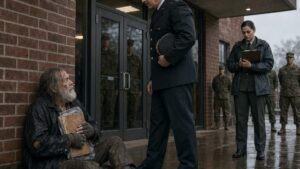
They Turned Away The Old Man In The Worn Brown Coat From The Center Bearing His Name
Chapter 1: The Invitation Softened From Being Read Too Often
William Mercer stood in his kitchen with his hand on the light switch, staring at the invitation he had almost left behind.
The envelope lay on the table beside the wooden box, both of them exactly where Margaret had placed them in his mind every morning since her death, though her hands had not touched that table in eight months. The invitation had once been stiff and cream-colored, the kind of paper chosen by committees that believed thickness could make a promise official. Now its edges were soft from being opened, folded, opened again, and held too long.
Outside the window, rain tapped against the glass. Across town, people were already arriving beneath the bright new lights of the Mercer Veterans Recovery Center.
William had put on his old brown coat because it was closest to the door. One button was missing near the collar. Margaret had once threatened to replace all of them just to make the coat stop looking ashamed of itself. He had told her the coat had survived worse criticism than hers. She had laughed, then fixed only the loose button at the sleeve, because she knew some battles were not worth winning.
Now the sleeve button remained, tight and dark, the only one that still looked new.
He touched the invitation but did not pick it up.
The ceremony would begin at seven. The ribbon would be stretched across the auditorium entrance. Officials would stand under the lights. Donors would shake hands in front of cameras. Someone would speak too long about vision. Someone else would say sacrifice with the soft voice people used when they had not had to make one.
William turned toward the sink, where one cup sat upside down on a towel. He had washed it that morning, though it had not been dirty. Since Margaret died, he had discovered that a man could fill a day with small unnecessary tasks and still feel time staring at him.
He looked back at the invitation.
Keynote Honoree.
He had never liked the phrase. It sounded like a chair pulled too far into the center of a room.
His eyes dropped to the wooden box.
It was small enough to carry under one arm, walnut darkened with age, its brass latch dulled by Margaret’s fingers. She had kept it in the top drawer of her sewing cabinet, wrapped in a blue scarf he had not seen since the winter after the commission hearings. When she became too weak to climb the stairs, she made him bring the whole drawer down and set it beside her bed.
“Open it,” she had said.
He had known what was inside before the latch clicked.
The brass key lay on faded blue ribbon, heavier than it looked, its teeth cut for a lock that no longer existed. Beneath it was her note, folded once.
He had not wanted to read it then. She had made him.
Now, standing in the kitchen in his brown coat, William opened the box again.
The key gave off a faint metallic smell, like rain on old railings. The note beneath it was written in Margaret’s careful hand, the letters still steady though her body had not been.
Do not let them open it without remembering who it is for.
He read the sentence twice, though he knew it by heart.
Behind it came her voice, thin from illness but still with the firmness that had outlasted every general he had ever known.
“When they open that place, William, don’t hide from it.”
“I am not hiding,” he had said, sitting beside her bed.
She had looked at him over the blanket. Even sick, Margaret Mercer could make silence feel like testimony.
“You have not answered Richard’s calls.”
“Richard likes ceremonies.”
“You used to like men who kept promises.”
“That is unfair.”
“Yes,” she had said. “It is.”
The memory tightened something below his ribs. William closed the box carefully, as if sound might disturb her.
He had been invited. More than invited. Jennifer Scott had called three times. Richard Reeves had written twice. The board had sent a car, which William declined. The driver called again that afternoon, and William had told him he would make his own way if he came at all.
If he came at all.
That had been his private escape hatch, the little phrase he used to leave a door open to cowardice.
He took his cap from the peg. The cloth was worn at the brim from years of his thumb worrying the same spot. It was not military, not formal, not anything a man should wear to an event where the program would likely have embossed lettering. But he put it on anyway.
On the refrigerator, beneath a magnet shaped like a lighthouse, was a photograph of Margaret standing in front of a temporary ward. She was younger there, her hair pinned back, sleeves rolled above the wrist, one hand on her hip as if daring the world to close the doors again. Behind her, men sat in folding chairs, some with bandaged hands, some with blank faces turned toward a television no one was watching. William stood at the edge of the photo in uniform, half cut off by whoever had taken it. Margaret was at the center, where she belonged.
He removed the photograph from the refrigerator and looked at it.
“You should be the one going,” he said.
The kitchen answered with the hum of the refrigerator.
He folded the photo once, then stopped himself. No. That was not what she had asked him to carry.
He put the photograph back beneath the lighthouse.
The bus stop was three blocks away. He could have called a taxi. He could have called Richard. He could have accepted the car. But the thought of a driver stepping out, taking the box, calling him sir before knowing why, made him tired in advance. A bus allowed a man to be old in peace.
William slipped the invitation into his inside coat pocket and tucked the wooden box beneath his arm. At the door, he checked the stove, though he had not cooked. He checked the lock on the back window. He checked the light over the sink.
Then he looked once more at the empty kitchen.
“I am going,” he said, though no one had asked.
By the time he reached the bus stop, the rain had worked through the shoulders of his coat. A young woman under the shelter glanced at the box, then at his shoes, and looked away. William stood outside the shelter because she had a stroller and two grocery bags, and there was not much room.
The bus arrived with a sigh of brakes. The driver lowered the step without being asked. William nodded his thanks and paid in coins. Halfway down the aisle, a boy with headphones shifted his knees just enough for William to pass but not enough to offer the seat beside him.
That was all right. William held the pole and watched the city slide by in streaks of water and reflected headlights.
At a red light near the hospital district, the bus paused across from a construction fence. Beyond it rose the pale stone face of the new center. Even in the rain, the building glowed. Tall glass doors. Wide entrance. Flags snapping wetly from silver poles. A temporary canopy stretched from curb to lobby, where men in dark suits hurried beneath umbrellas.
MERCER VETERANS RECOVERY CENTER, the letters read above the entrance.
William looked at his own name until the bus moved.
He had argued against it. When Jennifer first told him the board had voted, he asked them to name it after the first patient transferred into the temporary ward. Or after Margaret. Or after no person at all.
“People need a name to hold on to,” Jennifer had said.
“They can hold on to the mission.”
“The mission has your fingerprints on it.”
“So do mistakes,” he had replied, and ended the call before she could be kind.
The bus let him off one block down. By then the ceremony traffic had thickened. A black car rolled toward the curb. A photographer bent beneath the canopy, trying to keep his camera dry. Two volunteers held clipboards near the doors, checking names and attaching badges to lapels. A banner near the entrance read: PRIVATE DEDICATION CEREMONY — INVITED GUESTS ONLY.
William stood at the edge of the sidewalk and watched a laughing couple step out of a sedan. The man handed his umbrella to a staff member without looking at him. The woman’s necklace flashed in the lobby lights.
William adjusted the wooden box under his arm.
He could still leave. He could turn down the side street, catch the next bus home, set the box back on the kitchen table, and tell Margaret he had tried. No one inside would know. The ceremony would proceed. Speeches would be made. A ribbon would be cut. His absence would be explained as age, illness, grief, some polite word that meant unwilling.
But then he saw the glass doors open, and for one second the lobby beyond them came into view.
Polished marble. Framed photographs. White flowers. A reception table.
And near the far wall, not yet fully visible from where he stood, a black-and-white image in a silver frame.
A field hospital tent.
William’s hand tightened around the box.
He stepped under the canopy.
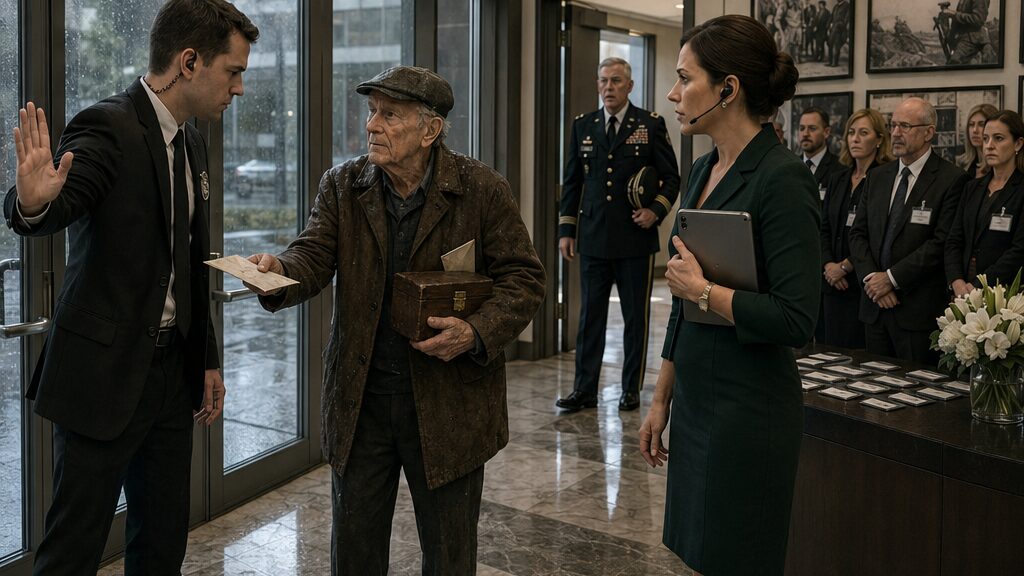
Rain dripped from the brim of his cap onto his cheek. A volunteer looked up from the badge table, saw the old coat, and hesitated. Before she could speak, a young guard moved in front of the glass door. He was broad-shouldered, clean-shaven, and trying very hard to look older than he was.
William drew the invitation from his pocket.
The guard put one hand on the door.
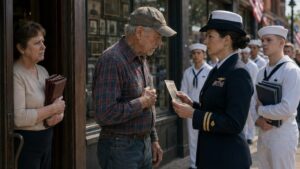
“Sir,” he said, loud enough for people inside to hear, “this event is for invited guests only.”
Chapter 2: There Was No Mercer Under General Admission
The word invited hung in the lobby as if William had arrived carrying the opposite.
A few people near the reception table turned. Someone’s laugh faded halfway through. Rainwater slid from the hem of William’s coat and gathered on the marble in small dark drops. The young guard’s palm remained flat against the glass door, not pushing William yet, but making clear that the door belonged to him.
William held out the invitation.
“I was invited,” he said.
The guard took the card with two fingers. His name badge read KEVIN. He lowered his eyes to the paper, then lifted them almost immediately to William’s shoes. They were black, old, and polished, but the leather had cracked across the toes.
Behind Kevin, the lobby shone with money. Men in dark suits stood beneath a wall of framed photographs. Women in tailored coats leaned over the reception table while volunteers clipped white badges to their lapels. A news crew adjusted lights near the auditorium entrance, where a ribbon waited across two brass stands. The flowers were too white. The floor smelled of polish.
Kevin glanced back at the invitation as though it might change into something more convincing if he stared at it with enough suspicion.
“Sir, this is a private dedication,” he said. “The public open house is next week.”
“I understand.”
“There’s no general admission tonight.”
William’s mouth tightened, not quite into a smile.
“No,” he said. “I expect not.”
Kevin did not hear the edge beneath it. He was looking now at the wooden box tucked against William’s ribs.
“What’s in there?”
“Something for the director.”
“You can leave packages at the desk.”
“I was asked to carry it inside.”
Kevin shifted his weight. A volunteer at the reception table stopped sorting badges. She looked as though she wanted to help but had been trained not to cross whatever lines were invisible in events like this.
“Sir,” Kevin said, lowering his voice in a way that made it more public, not less, “we’ve had people trying to get in for the meal. You understand.”
William looked past him. On the photo wall, the black-and-white image he had seen from outside was clearer now. A younger man in uniform stood beside a canvas field hospital tent. Beside him, a woman with her sleeves rolled up held a clipboard and laughed at something outside the frame.
Margaret.
The sight of her struck him harder than Kevin’s suspicion.
The caption beneath the photograph was too small to read from the doorway, but William did not need it. He knew the mud at the bottom of that tent. He knew the portable heater that had failed three times in one night. He knew the key that opened the supply cage before anyone had remembered to issue proper locks.
“Sir?”
William looked back.
“You can check the name,” he said.
Kevin turned toward the reception table and skimmed the top sheet on a clipboard. His finger ran down a column too quickly.
“What name?”
“William Mercer.”
Kevin’s finger stopped, then moved again.
The receptionist’s head lifted.
Kevin frowned. “I don’t see it.”
“There may be another list.”
“This is the check-in list.”
“For which category?”
“For guests.”
William waited.
Kevin’s jaw tightened. He had the expression of a man who felt a trap he did not understand and resented the person who might have set it.
“There’s no Mercer under general admission,” he said.
“I would not be under general admission.”
The receptionist looked at William more closely. Kevin stared.
“What is that supposed to mean?”
Before William could answer, a woman in a dark green dress came quickly across the lobby with a tablet pressed to her chest. Her hair was pinned neatly, her heels clicked with the sharp rhythm of someone keeping an event from falling apart by will alone. A small headset curved behind her ear.
“What’s going on here?” she asked.
Kevin straightened. “He says he’s invited. Name isn’t on my list.”
William held out the invitation again.
The woman took it. Her badge read PAMELA PRICE. She looked at the front, then at the wet sleeve of his coat, then at the box. She did not open the invitation all the way.
“Mr. Mercer,” she said, voice softening into practiced patience, “the dedication tonight is a closed event.”
“I know.”
“For officials, board members, major donors, staff leadership, honored families.”
“Yes.”
“The public tour is next Saturday.”
William folded his hands around the box. “I am not here for the tour.”
Pamela’s eyes flicked toward the doors, where another black car had stopped under the canopy. A man in a tailored overcoat was stepping out while two photographers shifted position.
“Do you have a guest badge?” she asked.
“No.”
“Did someone from our office confirm your arrival time?”
“I was told to come before the ceremony.”
“By whom?”
William hesitated.
That was where he could have ended it. He could have said Jennifer Scott. He could have said Richard Reeves. He could have said enough words to turn suspicion into panic. But the thought rose in him like a bitter taste: if a man needed to recite credentials before receiving common courtesy, then the courtesy was not common at all.
He had spent too many years in rooms where titles opened doors faster than need.
“My invitation should be enough,” he said.
Pamela’s face tightened. Not much. Enough.
Behind her, the man from the black car entered the lobby, shaking rain from his umbrella. Pamela saw him and went still for half a second.
“Mr. Campbell,” she called brightly. “Welcome. We’re so glad you made it.”
John Campbell did not stop fully. He glanced at William, then at the wet marks on the floor.
“Everything all right?”
“Just sorting a check-in issue,” Pamela said.
Campbell’s eyes moved over William’s coat, the box, the cap. “Big night. Can’t be too careful.”
“No, sir,” Kevin said quickly.
Pamela’s smile held until Campbell moved toward the reception table. Then it disappeared.
“Mr. Mercer,” she said, quieter now, “I need you to step aside.”
“I need to give this to Director Scott.”
“Director Scott is preparing to welcome state officials and donors. She isn’t available for unscheduled drop-offs.”
“It is not a drop-off.”
Kevin looked at Pamela. Pamela looked at the box again.
“What exactly is it?”
“A key.”
The answer seemed to make things worse.
“A key to what?”
William glanced once more toward Margaret’s photograph. “To a door that was supposed to matter.”
Pamela exhaled through her nose. “Sir, I can’t have this tonight.”
“This?”
“A confusing situation in the lobby.”
“I believe the confusion came after I showed the invitation.”
The receptionist lowered her eyes. Kevin’s face reddened.
Pamela stepped closer, keeping her voice even. “You may not realize how this works, but an event like this has security procedures. We have donors, officials, press. We cannot simply let anyone walk in because they carry an old invitation and a box.”
William took the invitation from her hand and folded it once along the old crease.
“It was not old when you sent it.”
Pamela blinked.
A camera light flared near the auditorium doors. Someone called for the mayor’s arrival in five minutes. Pamela’s shoulders rose, then settled as if she had pressed them down by force.
“Kevin,” she said, “please escort Mr. Mercer to the bench by the entrance until we can sort this out.”
William looked at her for a long second.
“You are moving me out of the way.”
“I am asking you to wait.”
“You are moving me out of the way before you check the right list.”
Pamela’s expression hardened with embarrassment. “Sir, you’re creating a scene.”
William’s voice remained low. “I believe that was not my doing.”
A man near the elevators coughed into his hand. The receptionist stopped pretending not to listen.
Kevin reached for William’s elbow. His fingers touched the sleeve of the brown coat, right beside the button Margaret had sewn.
William looked down at the hand.
Kevin removed it.
For the first time, uncertainty crossed the guard’s face. Not recognition. Not apology. Only the faint discomfort of a man realizing that the person he had decided was small did not feel small under his hand.
William adjusted the wooden box against his ribs.
“I have waited in worse places,” he said.
He walked to the bench himself.
It stood beneath a framed announcement board near the glass doors, close enough to feel the drafts of arrivals, far enough to be out of the path of important shoes. He sat with the box on his knees and the folded invitation in his coat pocket. Rain dripped from his cap onto the floor between his feet.
Pamela turned away at once.
“Keep the lobby clear before the mayor walks in,” she told Kevin.
Kevin nodded, though his eyes flicked once toward the old man on the bench.
William opened the box just enough to see the brass key.
Margaret’s note rested beneath it, waiting.
Chapter 3: The Wall Remembered What The Staff Forgot
The janitor stepped backward with his mop bucket so quickly that dirty water sloshed over the rim.
John Campbell did not seem to notice. He came through the lobby with two board members at his side, one hand lifted in greeting toward the cameras, the other guiding his wife past the wet floor sign as if the building had arranged itself for his convenience. The janitor pulled the bucket close to his legs and lowered his head.
From the bench by the doors, William watched the movement without turning his face.
It was not cruelty, exactly. That was what made it familiar. Cruelty usually announced itself. This was only the easy habit of rooms built around important people: the less important learned to shrink before anyone asked them to.
Pamela noticed the near spill and hurried over.
“Please keep this area clear,” she told the janitor under her breath.
“Yes, ma’am.”
“And dry by the entrance. We have officials arriving.”
The janitor looked toward the dark drops beneath William’s shoes.
“I’ll get that.”
William bent as if to reach for his own handkerchief, but the janitor had already turned his mop. Their eyes met for a brief second. The janitor gave a small nod—not respect for rank, not knowledge, just one tired man acknowledging another.
William returned it.
Across the lobby, Pamela was losing pieces of the evening faster than she could collect them. The mayor’s aide wanted to know where the mayor should stand for the ribbon photo. The news crew wanted permission to film the photo wall. John Campbell wanted assurance that his family would be seated in the first row. The caterer had set up coffee in the wrong corridor. Someone from the board was asking whether the program had been revised to remove “legal language” from the center’s origin story.
Pamela pressed two fingers to her headset.
“No, not that version,” she said. “Use the clean program. The one with the donor acknowledgments before the historical remarks.”
At the reception table, a volunteer searched through stacks of badges. “Pamela?”
Pamela turned.
“There’s a sealed packet here with Mercer on it.”
The name carried no farther than the table, but William heard it. Years of hearing his name said behind doors had trained him to catch it in rooms full of noise.
Pamela crossed quickly. “Which Mercer?”
“It just says William Mercer. Keynote. But I thought—”
Pamela snatched the packet lightly, not rudely enough to draw attention. “This should have gone backstage.”
“Should I take it to Director Scott?”
“No. She’s with the senator’s office. I’ll handle it.”
The volunteer glanced toward the bench. Her voice dropped. “There’s an old man by the door. He said his name was—”
“I know what he said.”
Pamela looked down at the sealed packet. The paper was thick, official, marked with a gold sticker. For one uncomfortable second, her eyes moved from the packet to William.
He sat with both hands resting on the wooden box. He looked less confused now that he was not standing in the doorway. Still wet. Still plainly dressed. Still wrong for the photograph Pamela needed the lobby to become.
She told herself there could be two Mercers. Or a family member. Or a mistake in printing. The building name had drawn calls all month from people claiming some connection to the general. Veterans who had served under him. Nieces of men he had helped. A retired nurse who said his wife once slept in a chair beside a patient because there were no beds. Some stories were real. Some were impossible to verify.
Tonight was not the night to untangle them.
“Put this with the speaker packets,” Pamela said.
“The backstage folders are already in the auditorium.”
Pamela looked toward the auditorium doors. A photographer was blocking the path. Campbell was laughing too loudly beside the ribbon. Jennifer Scott, the center director, was speaking with a state official near the stage entrance, her face composed but tight around the eyes.
Pamela tucked the packet under her tablet.
“I’ll bring it.”
She did not.
A donor’s wife touched her arm to complain that the photo wall had “too much hospital sadness” near the entrance.
“Couldn’t those be moved farther down the hall?” the woman asked. “Tonight should feel hopeful.”
Pamela followed her gaze.
The wall had been Jennifer’s insistence. No center without memory, she had said. The photographs showed the chain of the place: neglected hallways in the old veterans hospital, folding cots in a borrowed gym, the first temporary ward, the commission hearings, construction workers breaking ground. Pamela had understood the purpose, but she also understood donors. Donors liked gratitude. They liked resilience. They did not like being reminded that their money often arrived after shame had done the harder work.
“We can adjust the tour flow after tonight,” Pamela said.
From the bench, William slowly stood.
Kevin, stationed near the door again, noticed at once. “Sir?”
William did not approach the auditorium. He walked only to the photo wall, the box tucked against his side, his steps careful on the polished floor. Kevin looked at Pamela, but she was trapped by the donor’s wife and a board member asking about seating.
William stopped before the black-and-white photograph.
Now he could read the caption.
Temporary Recovery Ward, Building C Annex. First Week of Operations.
No names.
He looked at Margaret’s younger face in the photograph. The caption did not say she had organized the first volunteer schedule on the back of a grocery receipt. It did not say she had boiled coffee in a dented pot because the machine had failed. It did not say she had argued with a colonel twice her size about blankets and won by refusing to move from the supply door.
The younger William stood at the edge of the image, half turned toward a soldier whose bandaged hands were curled in his lap. His own face was stern in the way men looked when they knew fury would only waste time.
The blue ribbon tied to the brass key in the box had come from that ward. Margaret had cut it from a bundle of donated bed linens to mark the key because there had been too many keys and no labels.
William opened the box with his thumb.
The ribbon lay faded but still blue.
“Please don’t open that here.”
Pamela’s voice came from behind him.
William closed the lid.
“I was looking at the photograph.”
“I understand, but we can’t have guests handling personal items near the display.”
He turned. “The item is not near the display. I am.”
The donor’s wife had gone silent. Kevin shifted by the door. The receptionist stared at the sealed packet now half hidden under Pamela’s tablet.
Pamela’s cheeks colored. “Mr. Mercer, I asked you to wait.”
“And I did.”
“You’re walking around.”
“To a wall with photographs.”
“This is a controlled event.”
William’s eyes moved past her to where the janitor was again easing his bucket away from a cluster of officials.
“So I see,” he said.
Pamela lowered her voice. “Sir, I am trying to be respectful.”
William looked at the packet under her tablet. His name was visible on the corner now. Not much. Enough.
“No,” he said quietly. “You are trying to be orderly.”
The words landed differently from an accusation. Pamela’s mouth opened, then closed.
Before she could answer, Jennifer Scott appeared at the auditorium doors with a program in her hand and worry finally breaking through her professional calm.
“Pamela,” she said, “where is General Mercer’s packet? Colonel Reeves just called. He came in through the side entrance, but he says the general isn’t backstage.”
Pamela went still.
The reception volunteer looked at the packet. Kevin looked at William. William looked once more at Margaret’s photograph.
From the far side entrance, a man in dress uniform stepped into the lobby. His silver-templed head turned toward Jennifer first, then swept across the donors, the ribbon, the reception table, and the glass doors.
Colonel Richard Reeves stopped when he saw the old man standing beside the photo wall with the wooden box under his arm.
His face changed before he took another step.
Chapter 4: At Ease, Richard, Before They All Stare
Colonel Richard Reeves came to attention in the middle of the lobby so sharply that the sound of his heels seemed to cut through every conversation at once.
His right hand rose to the brim of his dress cap.
“General Mercer,” he said.
The lobby did not go silent all at once. It emptied of sound in pieces. First the receptionist stopped speaking. Then Kevin, by the glass door, forgot to greet the couple entering beneath the canopy. Then Pamela’s tablet dipped an inch in her hand. Even John Campbell’s laugh faded when he realized the uniformed colonel was not saluting a flag, a mayor, or a donor.
He was saluting the old man in the worn brown coat.
William looked at Richard for one long second, and the hardness that had settled around his mouth softened with something close to regret.
“At ease, Richard,” he said quietly, “before they all stare.”
But they were already staring.
Richard lowered his hand, though not his posture. He crossed the lobby in three quick strides, the ribbons on his jacket catching the light. When he reached William, he did not reach for the box or the old man’s arm. He stopped at a respectful distance, the way men did when they remembered who had once taught them that carelessness with rank was not the same thing as humility.
“Sir,” Richard said, voice lower now, “we’ve been looking for you. Jennifer thought you came through the north entrance.”
“I came through the front door.”
Richard’s eyes moved to Kevin, then Pamela, then the packet under Pamela’s tablet.
The movement was small, but it changed the room.
Pamela’s face had gone pale beneath her makeup. She looked from Richard to William, trying to assemble the pieces in an order that would spare her from the conclusion already forming.
“Colonel Reeves,” Jennifer Scott said, stepping forward from the auditorium entrance, “what—”
Richard turned to her, then back to William, as if unwilling to explain a man in front of himself. But the room demanded it now. The donors demanded it. Kevin’s open mouth demanded it. Pamela’s silence demanded it most of all.
“This is Lieutenant General William Mercer,” Richard said. “Retired. Former chair of the Veterans Recovery Commission.”
No one moved.
Richard continued, his voice controlled, but William heard the strain beneath it. “He led the inquiry after the old hospital failures. He secured the emergency authority that created the first temporary ward. The funding for this center came through the commission he chaired.”
Jennifer pressed a hand against the program she carried.
“General Mercer,” she said, and the title seemed to cost her breath. “I am so sorry. We thought—”
William looked at her.
She stopped.
The unfinished sentence stood in the lobby, more honest than whatever would have followed. We thought you were somewhere important. We thought you would arrive in a car. We thought you would look like the name over the door.
Kevin stepped back from the entrance. “Sir, I didn’t know.”
William did not look angry. That made Kevin look worse.
“No,” William said. “You did not.”
Pamela found her voice, but not all of it. “General Mercer, I—there must have been a mix-up with the list.”
William held the folded invitation between two fingers and looked at it as though it belonged to someone else.
“There was no mix-up with the invitation.”
The receptionist, cheeks flushed, reached under Pamela’s tablet and carefully pulled the sealed packet free.
“Director Scott,” she said, almost whispering, “I found this a few minutes ago.”
Jennifer took it. The gold sticker broke under her thumb. Inside was a badge, a seating card, and a copy of the ceremony program printed on thick cream paper. The front bore the center’s name above a sepia photograph: a younger William in uniform standing beside wounded soldiers outside a temporary ward before dawn.
Jennifer opened it.
The words inside were large enough for Pamela to read where she stood.
Keynote Honoree: Lt. Gen. William Mercer, Ret.
Pamela closed her eyes once, briefly, as though the paper itself had struck her.
John Campbell approached, his smile reassembled but thinner. “Well. General Mercer. An honor. We were just wondering where they’d hidden you.”
William looked at him with quiet curiosity. “Not very far.”
The line did not sound like a joke, and Campbell’s smile weakened.
Jennifer moved closer. “General, please come backstage. The program begins in six minutes. We have your seat ready, and your remarks are at the podium.”
“My remarks,” William said.
“Yes. The draft your office approved.”
“I have no office.”
Jennifer faltered.
Richard’s jaw tightened. “Sir, I sent them the background materials. I assumed you had reviewed the final version.”
William turned his head toward the auditorium doors. Beyond them, the crowd was taking seats beneath warm lights. The ribbon waited at the front. A screen displayed the center’s logo. Beneath it, in smaller lettering, were the words Honoring Service, Healing Tomorrow.
William looked back toward the lobby wall.
“Where is the first ward?” he asked.
Jennifer followed his gaze. “The photograph is there.”
“The ward,” William said. “The reason for it.”
A board member near Campbell shifted. Pamela heard her own pulse.
Jennifer opened the program again, scanning with sudden unease. “There’s a historical note.”
William took the program when she offered it. His hands were steady, but Richard saw the small pause before he touched the paper.
He read quickly.
A message from the board chair. A welcome from the mayor. A donor acknowledgment. A paragraph about shared commitment. Another about healing. A page of names. The old hospital appeared only once, softened into “service gaps.” The commission became “a collaborative review.” The first temporary ward became “early care efforts.”
Margaret was not named.
William closed the program.
Jennifer’s face changed before he spoke. She knew.
“We had to balance the tone,” she said quietly. “Tonight is also about keeping support behind the center.”
“Support for what?”
“For the work.”
“What work is left if no one can say who was left outside the door?”
No one answered.
Pamela flinched. Kevin looked at the wet marks still visible near the entrance. The janitor had not mopped them yet. He stood with his hands folded over the handle, eyes lowered but listening.
Richard stepped closer to William. “Sir, we can fix the introduction. I’ll speak to Jennifer. We can—”
William lifted one hand, and Richard stopped instantly.
The old command had not disappeared. It had only been unused.
William looked toward the glass doors. Above one entrance, a temporary sign hung from two silver hooks.
VIP ENTRANCE ONLY.
The rain beyond it blurred the letters, but did not hide them.
He pointed with the folded program.
“Why is that there?”
Pamela answered before Jennifer could. “It’s only for tonight. For traffic flow. We needed a way to separate invited guests from the public and press.”
“The public was not invited.”
“No, but people still try to come in. We had concerns about protests, confusion, people without badges—”
“People like me.”
Pamela’s mouth closed.
Jennifer looked at the sign as though seeing it for the first time. “General, I didn’t approve that wording.”
“But it is hanging on the door of a building with my name on it.”
The room held still.
William opened the wooden box. Richard’s eyes dropped to the brass key and widened—not in surprise at the object, but recognition of its age. He had seen it once, years ago, in Margaret’s hand, when the first temporary ward was closing and everyone else was too exhausted to understand that endings also needed witnesses.
“You kept it,” Richard said.
“Margaret kept it.”
The name entered the lobby with more force than any title. Richard’s expression changed. Jennifer looked down.
William touched the faded blue ribbon.
“She said buildings forget unless people help them remember.”
Pamela’s eyes moved from the key to the photo wall. For the first time, the photograph was not decoration. It was accusation.
A stage manager appeared at the auditorium doors. “Director Scott, they’re ready.”
Jennifer did not turn. “One minute.”
“Mayor is seated. Cameras are live in two.”
Campbell’s face tightened. “Jennifer, we need to begin. This is not the time to renegotiate messaging in the lobby.”
William looked at him. “No. The lobby seems exactly the place.”
Campbell’s nostrils flared, but Richard took half a step, not between them, only enough to remind the room that William was not alone.
Jennifer lowered her voice. “General, please. Come with me to the holding room. We can talk there.”
William glanced once more at the program in his hand, then at the sign over the door, then at Pamela and Kevin standing beneath the weight of what they had done without yet understanding all of it.
He allowed Jennifer to lead him toward the side corridor.
Richard walked beside him. Pamela followed several steps behind, still holding her tablet against her chest like a shield. Kevin remained at the door, unable to decide whether to stand guard or disappear.
In the holding room near the auditorium, the sound of the crowd became a low, muffled hum. A pitcher of water stood beside three clean glasses. On a small table lay a printed speech with William’s name at the top.
William did not touch it.
Jennifer closed the door halfway but not fully, as if she did not deserve privacy.
“General Mercer,” she said, “I failed you tonight.”
William looked at the paper.
“You failed them before I arrived.”
Jennifer swallowed. “Them?”
He tapped the program once.
“The men who made this necessary.”
Richard picked up the printed speech and scanned it. His expression hardened.
“They removed the hearing testimony,” he said.
Jennifer’s eyes flicked toward Pamela. Pamela looked down.
“The board asked for a more forward-looking dedication,” Jennifer said.
“And you agreed.”
“I compromised.”
William turned toward her. His wet coat hung heavily from his shoulders. In that small room, with the applause beginning faintly beyond the wall, he looked suddenly older than he had in the lobby.
“That is often what we call surrender when we are embarrassed by the word.”
Jennifer had no answer.
The stage manager appeared again at the door. “Director Scott. Now.”
Jennifer looked at William.
He closed the wooden box with a soft click.
“If this place cannot say why it was built,” he said, “I should not be the one opening it.”
Chapter 5: The Key That Opened The First Ward
William opened the wooden box again only after Jennifer shut the holding room door all the way.
For a moment, no one spoke. The ceremony music swelled faintly beyond the wall, then softened as someone at a microphone welcomed the guests and asked them to take their seats. The sound was cheerful, practiced, and wrong for the little room where William stood with rain drying into the seams of his old coat.
The brass key lay in its shallow cradle of worn velvet. Beneath it, Margaret’s note waited.
William lifted the key first. Its weight pulled at the faded blue ribbon looped through its head. Richard stared at it as if the years between then and now had collapsed into one night of fluorescent lights, folding cots, and men trying not to cry where others could see.
“That’s the ward key,” Richard said.
William nodded. “Supply cage first. Front room later. Margaret said if one key opened too many things, at least someone would have to remember which doors mattered.”
Jennifer stepped closer. Her voice was low. “May I see it?”
William placed it in her palm.
She took it with both hands.
There was nothing grand about it. No engraving. No polished plaque. No ceremonial shine. Just brass worn smooth near the teeth, blue ribbon faded almost gray, and a small scratch along the stem where someone had once forced it through a stubborn lock.
Pamela stood near the door, tablet hanging at her side now. She seemed smaller without motion to protect her.
“I thought it was…” She stopped.
William looked at her.
Pamela forced herself to finish. “I thought it was some personal item that might disrupt the event.”
“It is a personal item.”
Her face colored.
“It was also the first working key to a place where men could sleep without being told they had already been processed.”
Jennifer closed her fingers around it and looked down at the program in her other hand.
“We have an archive alcove,” she said suddenly. “Down the corridor. Some of the original objects are there. The temporary ward log, early badges, photographs. I wanted the key for that display, but your office never—”
William’s eyebrows lifted.
Jennifer corrected herself. “You never answered.”
“No.”
The honesty hung there.
Richard looked at him. “Sir.”
William placed Margaret’s note on the table, still folded.
“She asked me to bring it. I nearly did not.”
No one moved toward the note. It had the intimacy of a closed door.
From outside, applause rose. A speaker had said something that satisfied the room.
Jennifer looked toward the wall as if she could see through it to the auditorium. “They’re introducing the mayor.”
“Then we have a few minutes,” Richard said.
Pamela’s headset crackled. She flinched but did not answer.
Jennifer led them through a narrow backstage corridor, away from the applause and toward a quieter wing. The archive alcove was tucked behind glass near the staff offices, not yet open to visitors. Its lights were dim. A temporary label read ORIGINS OF CARE, though half the case remained empty.
Inside were photographs, a clipboard with yellowed edges, a dented coffee tin, and a sign that read BUILDING C ANNEX in peeling black letters.
William stopped before the case.
Margaret would have hated the label. Origins of Care. Too clean. She would have said care began when someone stopped making excuses.
Jennifer unlocked the back panel and lifted out a thin archival tag attached to a faded inventory card.
“Temporary Recovery Ward, Building C Annex,” she read. “Primary supply and front-room access key. Blue cloth marker. Recorded by Margaret Mercer during closure transfer.”
Pamela inhaled quietly.
Margaret’s name. Not on the ceremony program. Not on the lobby caption. But here, in small black type on an inventory card, because Margaret had labeled what everyone else was too tired to preserve.
William took the card.
His thumb paused over her name.
For a few seconds, the room around him became a different one: cinderblock walls, a broken heater, coffee boiled too long, a young soldier refusing to sleep because he said every time he closed his eyes he heard the hospital intercom calling names no one answered. Margaret had sat beside him until dawn, reading aloud from a grocery flyer because he did not care what the words were, only that someone stayed.
“People think institutions fail all at once,” William said. “Usually, they fail one ignored person at a time.”
Jennifer did not speak.
Richard’s voice was rough. “You paid for speaking up, sir.”
William set the inventory card down. “Others paid more for our delay.”
Pamela looked at him then, really looked. Not at his coat, not at his age, not at the title she had learned too late.
“I was told to keep unvetted walk-ins away from the lobby,” she said.
Jennifer turned. “By whom?”
Pamela’s throat worked. “The board’s event committee. Mr. Campbell was worried about protesters. Families from the old hospital case. Reporters asking about lawsuits. People who might turn tonight into something negative.”
William watched her carefully.
“And you agreed.”
“I thought…” Pamela’s voice tightened. “I thought I was protecting the center.”
“From whom?”
She did not answer quickly enough.
“From the people it was built because of,” William said.
Pamela’s eyes filled, but she blinked the tears back with visible effort. “I’m newly in this position. I was told one mistake tonight could cost us the next funding round. I know that doesn’t excuse what I did.”
“No,” William said. “It explains the shape of it.”
The line landed harder than anger would have.
A door opened down the corridor. John Campbell entered without knocking, followed by a board member who looked as though he wished he had chosen another hallway.
“There you are,” Campbell said, his smile gone now. “Jennifer, the mayor is stretching. We need the keynote.”
Jennifer stepped forward. “We’re discussing a change to the remarks.”
“A change.”
“The program minimized too much.”
Campbell’s gaze shifted to William. “General, with respect, tonight is a dedication, not a hearing.”
William said nothing.
Campbell seemed to take that as permission. “Everyone here knows there were problems years ago. That’s why we’re here. But donors did not come to be scolded for failures they didn’t cause.”
“No,” William said. “Some came to be thanked for money they have not yet understood.”
The board member stared at the floor.
Campbell’s face hardened. “I committed three million dollars to the outpatient wing.”
“And I hope it heals many people.”
“It won’t if tonight becomes a guilt session on live cameras. People support success. They do not support shame.”
William looked through the glass case at the dented coffee tin. He remembered Margaret dropping coins into it for bus fare when a patient’s wife could not afford to come across town.
“Shame built the first ward,” he said. “Not because we enjoyed it. Because it was honest.”
Campbell leaned closer, lowering his voice. “You want honesty? Fine. If you turn this dedication into an indictment, I will reconsider my pledge. The board can explain tomorrow why the Mercer Center lost its largest donor on opening night.”
Jennifer went pale.
Pamela’s eyes snapped toward her. Richard’s hands curled once, then relaxed.
The hallway seemed to narrow.
William studied Campbell for a long moment. He saw vanity, yes. Pride. But also fear. Men like Campbell believed money could control memory because money was the tool they had chosen to matter. Strip that away, and there was only a man terrified of being told his generosity had arrived late.
“You may do as you think right,” William said.
Campbell blinked. He had expected argument. Perhaps pleading.
Jennifer spoke quickly. “General, we can thread this carefully. We can honor the origin without alienating—”
“The truth does not need decoration,” William said. “But it does need discipline.”
He turned back to the archive case. On the bottom shelf, beneath the photographs, was an empty mount where the key was meant to rest.
Margaret had known, somehow, that if he handed it over quietly, the key would become an object. Interesting, labeled, harmless. She had asked him to carry it inside because she wanted him to decide whether the building had earned it.
He unfolded her note.
Do not let them open it without remembering who it is for.
Below that, in smaller letters he had not let himself read often, she had written:
And do not hide behind humility when the wounded need your voice.
William closed his eyes.
There it was. The order he had been avoiding because it came from the only person whose command he had never outranked.
When he opened his eyes, Richard was watching him.
“Sir?”
William folded the note and placed it back beneath the velvet lining of the box. He set the key on top.
Then he turned to Jennifer.
“You may introduce me as planned.”
Relief crossed her face too soon.
William saw it. So did Pamela.
“But I will not read that speech.”
Jennifer’s relief vanished.
Campbell said, “General—”
William closed the wooden box. The latch clicked in the narrow corridor.
“Then tonight,” he said, “they will hear why the first key was made before they see the ribbon cut.”
Chapter 6: This Place Was Built For Tired People
Jennifer Scott introduced him with a voice that almost held steady.
“Ladies and gentlemen,” she said, standing beneath the auditorium lights, “it is my honor to welcome the keynote honoree for tonight’s dedication. Retired Lieutenant General William Mercer, former chair of the Veterans Recovery Commission, and the man whose work made this center possible.”
The applause began before William reached the podium, but it faltered as people saw him.
Not because he looked weak. Because he looked familiar for the wrong reason.
The old man in the worn brown coat from the lobby. The one Kevin had blocked. The one Pamela had moved aside. The one some had watched with curiosity and others had carefully ignored. Now he walked slowly across the stage carrying the wooden box, while Colonel Richard Reeves stood at the side with his jaw set and his hands folded behind his back.
William did not hurry to rescue the room from its discomfort.
He set the box on the podium.
The applause thinned, then stopped.
From the first row, John Campbell sat stiffly beside the mayor. Pamela stood near the side aisle, headset removed, tablet held against her stomach. Kevin had taken a place at the back wall near the doors, his security posture gone loose around the shoulders.
William looked at the prepared speech waiting on the podium.
He moved it aside.
The paper made a soft whisper against the wood, and somehow everyone heard it.
“I was given remarks for tonight,” he said. “They are gracious. Polished. Brief enough to please the people watching the clock.”
A nervous ripple moved through the room.
William opened the wooden box.
“But my wife did not send me here to be gracious first.”
He lifted the brass key by its faded blue ribbon. The auditorium lights caught the dull metal without making it shine.
“She kept this in a drawer for twenty-two years. It opened the first temporary recovery ward before this building had a name, before it had a donor wall, before anyone had decided what kind of language would make failure sound less painful.”
No one shifted now.
“It was not made for a ceremony. It opened a supply cage because the hospital had misplaced blankets. It opened a front room because men were being discharged into confusion faster than anyone could learn their names. It opened a door Margaret Mercer refused to let close because she had watched one too many wounded people be told to wait somewhere else.”
At Margaret’s name, Richard lowered his head.
William placed the key flat on the podium. His hand remained over it for a moment.
“I chaired the commission that followed. Some of you know that. Some of you have read the clean version. I prefer the unclean one.”
Jennifer stood very still beside the stage curtain.
“The unclean version is this: people were hurt because a system learned how to process them without seeing them. Papers moved. Calls were transferred. Rooms filled. Men and women who had given more than most were treated as interruptions to schedules, budgets, and appearances.”
His eyes moved briefly to Pamela, then away. He did not need to name her. That mercy was more difficult to bear than accusation.
“I signed orders. I demanded hearings. I made enemies. I also arrived late to the truth. That is not modesty. It is fact.”
The room changed at that. William felt it. The audience had expected honor, perhaps even humility, but not confession.
“I have been praised for the recovery commission. I accept less praise than people offer because praise has a way of sanding down the edges. The first ward did not begin as a success. It began as an embarrassment. It began because we had failed enough people that shame finally became useful.”
John Campbell shifted in his seat.
William saw him. He also saw Campbell’s hand close around the armrest, preparing to stand.
Before he could, a man three rows behind him rose slowly. He used a cane. One sleeve of his suit hung looser than the other around a prosthetic arm. Then a woman in the same row stood, her service dog settling at her feet. A nurse near the aisle stood next. Not applauding. Not interrupting. Simply refusing to let the moment belong only to donors and officials.
Campbell remained seated.
William waited until the room was still again.
“When I arrived tonight,” he said, “I came through the front door.”
Pamela closed her eyes.
“I was wet. I was late. I wore this coat because it was by the door and because, if I am honest, I did not want to come looking like a man asking to be honored.”
His fingers touched the worn lapel.
“That was my mistake.”
The admission drew Pamela’s eyes open.
“I thought if I came quietly, the evening would be about the work and not about me. But silence is not always humility. Sometimes it is a way to avoid pain. Sometimes it leaves others to carry what you refused to say.”
He looked toward the back of the room. Kevin stood rigid now, face pale.
“At the door, a young guard asked for proof that I belonged. An event coordinator asked me to wait where I would not be in the way. They were wrong.”
The room tightened.
“But they were not wrong because I had once held rank.”
His voice sharpened just enough to make the sentence land.
“They were wrong before they knew my name.”
No one breathed loudly.
“If the only reason an old man deserves patience is that he used to command soldiers, then this place has already failed. If the only reason a wet coat becomes respectable is that a program says keynote honoree, then this building should not open yet.”
Pamela’s grip on the tablet loosened. It slid slightly in her hands, but she caught it.
“This center was not built for impressive people,” William said. “It was built for tired people. Injured people. People who come in badly dressed because pain does not wait for formal clothing. People who forget papers. People who smell of rain, medicine, fear, or too many nights without sleep. People who are angry because anger is sometimes the last piece of dignity they can still lift.”
The service dog raised its head, then settled again.
William touched the key.
“If they must prove they matter before they are treated with dignity, then we have failed before the doors open.”
For a long moment, the silence was too full to be called silence. It held shame, recognition, grief, and something less comfortable than applause.
Then Richard stood.
He did not clap. He stood at attention.
Others rose after him. The nurse. The veteran with the cane. The woman with the dog. Jennifer. Then, slowly, row by row, the room came to its feet. Some applauded. Some did not. The ones who did seemed careful with it, as if noise could break what had just been placed before them.
William did not smile broadly. He looked almost tired.
He lifted the key and held it where the room could see.
“This belongs here only if the doors remember what it means.”
He turned slightly toward Jennifer.
She stepped forward, face wet now but composed. “They will.”
William looked past her to the auditorium doors at the back.
“Before the first patient arrives,” he said into the microphone, “will the sign over the front entrance still say VIP Entrance Only?”
Chapter 7: The Door Was Changed Before Morning
Pamela found William beside the photo wall after the auditorium had emptied enough for shame to move around without bumping into applause.
He stood before the black-and-white image of the temporary ward, the wooden box tucked beneath one arm, now lighter by the weight of the key. In the photograph, younger Margaret held her clipboard with her chin lifted toward someone out of frame. The younger William stood half visible at the edge, already looking like a man prepared to disappear behind the work.
Pamela stopped several steps away.
For the first time that night, she did not have her tablet.
“General Mercer,” she said.
William did not turn immediately. “Pamela.”
The use of her first name was not warm, but it was not cruel. That made it harder.
The lobby behind them had changed in strange little ways. The flowers were still white. The marble still shone. The donors still spoke in careful voices near the exit. But no one moved through the room quite as easily now. The janitor crossed the floor without being rushed. A volunteer offered him a fresh cloth without being asked. Kevin stood near the glass doors, hands clasped in front of him instead of folded like a barrier.
Pamela looked at the photograph because looking at William felt like asking for a verdict.
“I was wrong,” she said.
“Yes.”
The word was plain. No anger. No mercy added to make it easier.
“I judged you.”
“Yes.”
“I treated you like a problem.”
William’s eyes remained on the photograph. “You treated what you did not understand like a problem.”
Pamela swallowed. “I am sorry.”
Only then did he turn.
Her face had the raw look of someone who had spent the last hour replaying every choice and finding no version that saved her. She had cried at some point. Not dramatically. Her eyes were red, and the edges of her careful makeup had blurred.
William had seen apologies like hers before. Some people apologized to escape consequences. Some apologized because they were frightened by authority. Some apologized because the story they told about themselves had cracked, and they wanted the broken pieces put back in place quickly.
Pamela did not look quick.
Still, William did not rescue her.
“Are you sorry because I was a general,” he asked, “or because you moved an old man out of sight?”
Her lips parted.
Behind her, a board member lowered his voice and hurried away, as if the question might spill onto him too.
Pamela looked toward the entrance. The temporary sign still hung above the door.
VIP ENTRANCE ONLY.
“No,” she said. “Not because of your rank.”
William waited.
She forced herself to continue. “Because if you had not been important, I would have thought the night went well.”
That was the first honest thing she had said to him without dressing it.
William nodded once.
“Then begin there.”
Pamela followed his gaze to Kevin.
The young guard had just opened the door for a couple leaving under one umbrella. He stood aside too far, almost overcorrecting, as if distance itself could apologize. When the couple passed, he looked toward William and Pamela, then quickly down.
“He’s terrified he’ll be fired,” Pamela said.
“Should he be?”
The question startled her. “I don’t know.”
“That is different from no.”
Pamela took a breath. “He followed my lead.”
“He also chose how to follow it.”
“Yes.”
“Then he should learn from it before anyone decides whether punishment is easier than repair.”
Pamela looked at him then. “You would do that?”
“I am not in charge here.”
“No,” Jennifer Scott said from behind them. “But I am.”
She approached with the brass key in both hands, wrapped now in a clean white cloth. Richard walked beside her, his dress cap tucked beneath one arm. John Campbell was several yards behind, speaking tensely with two board members, but he did not interrupt.
Jennifer stopped before William.
“We removed the ribbon from the schedule,” she said. “There will be no photograph of donors cutting it tonight.”
William glanced toward the auditorium.
Jennifer’s mouth tightened. “The official opening remains tomorrow morning. Patients and families will enter through the front doors. No separate entrance. No donor preview line.”
Pamela looked at her sharply. “The board approved that?”
“Not yet.”
Richard almost smiled.
Jennifer held William’s gaze. “They will by morning, or they can explain why the building is not ready to carry its name.”
William did not answer at once.
Jennifer lifted the wrapped key slightly. “I want to place this in the lobby display tonight. Not in the archive alcove. Here, beside the entrance.”
Pamela looked from the key to the front doors. “Where people will see it when they come in.”
“Where staff will see it before they decide who belongs,” Jennifer said.
William looked back at Margaret’s photograph.
“What will the label say?”
Jennifer reached into the folder under her arm and handed him a small card. It had been printed quickly; one edge was slightly crooked.
The First Ward Key
Carried by Margaret Mercer during the opening of the temporary recovery ward that led to this center.
No person seeking care should have to prove dignity before receiving it.
William read it twice.
Margaret Mercer.
Not wife of. Not supporter of. Not beside.
Carried by.
His thumb rested lightly on her name. For a moment, the lobby went soft at the edges. He saw her in the old ward again, standing at the supply cage with that key in her hand and a line of exhausted nurses waiting behind her. He remembered telling her she should go home. He remembered her saying, “I will, when the last blanket stops being theoretical.”
“She would object to the wording,” he said.
Jennifer’s face fell.
“She disliked should,” William added. “Said it let people admire an idea without obeying it.”
Richard looked away to hide the brief movement of his mouth.
Jennifer took the card back. “Then?”
William looked at the entrance, where Kevin had turned toward an elderly woman approaching slowly under the canopy. She used a walker with tennis balls on the front legs. A younger relative hovered behind her, trying to help too much. The woman paused before the glass doors as if uncertain whether this shining place was meant for someone like her.
Kevin saw her.
For half a second, his old training showed. He looked toward the badge table. Toward Pamela. Toward the sign.
Then he moved.
He opened the door fully and stepped back.
“Good evening, ma’am,” he said. His voice shook, but he did not make it small. “Please take your time.”
The woman looked surprised. Then she smiled at him, not with gratitude for a favor, but with relief at not being hurried.
Kevin held the door until she crossed the threshold. He did not touch her walker. He did not speak to the relative over her head. He waited until she was ready.
William watched the whole thing.
Pamela covered her mouth with one hand.
Jennifer saw it too. So did Richard.
The elderly woman moved toward the reception table, where the volunteer came around from behind it instead of pointing from a distance.
William handed the card back to Jennifer.
“Say this,” he said. “‘All who enter will be treated with dignity.’”
Jennifer repeated it quietly, testing the words not as a slogan but as an order.
“All who enter will be treated with dignity.”
“Yes.”
John Campbell approached then, slower than before. His face still carried pride, but not enough to cover the dent in it.
“General Mercer,” he said. “Jennifer tells me the entrance language is changing.”
“It appears so.”
Campbell looked at the wrapped key. “My pledge will remain.”
No one thanked him quickly enough. He seemed to notice.
“I don’t want the outpatient wing delayed,” he added. “Whatever else was said tonight, the work matters.”
William studied him. “Then let the work matter more than your name on it.”
Campbell’s jaw moved once. For a moment, the old habit of offense rose in him. Then his eyes shifted to the woman with the walker, now seated near the reception table while someone brought her water.
“I can live with that,” he said, though the words cost him something.
“That will be useful,” William replied.
It was not forgiveness. It was room to do better.
Workers came with a small ladder just before midnight. The lobby had emptied of guests. The news crew had packed up. The flowers remained, but someone had moved half of them away from the entrance so the photo wall could be seen clearly from the doors.
Kevin stood below the VIP sign with his hands at his sides.
Pamela approached him. “Help them take it down.”
He looked at her, startled. “Me?”
“Yes.”
Together with a maintenance worker, Kevin climbed the first two steps of the ladder and unhooked the silver chain. The sign tilted, then came free. For a second, he held it awkwardly in both hands.
VIP ENTRANCE ONLY.
The words that had seemed practical an hour before now looked ugly under the lobby lights.
Pamela took it from him.
“I approved it,” she said quietly.
Kevin shook his head. “I enforced it.”
Neither of them looked at William, but both knew he heard.
Jennifer supervised the installation of the display near the entrance. The brass key rested upright in a small glass case, the faded blue ribbon curved beside it. Beneath it, a temporary printed card bore the new sentence. The permanent plaque would come later, Jennifer said. William did not care about the material. He cared that the words were there before morning.
When the case was locked, Jennifer turned to him.
“General Mercer,” she said, “may the center keep your name?”
The question settled over the lobby.
William looked up at the letters above the inner wall, where his name had been carved large enough for strangers to photograph. He had avoided looking at it directly all night. Now he did.
Mercer Veterans Recovery Center.
For years, he had believed refusing honor was the same as guarding humility. But Margaret had known the difference between vanity and responsibility. A hidden name could not protect anyone. A name on a door could, if it was made to answer for what happened beneath it.
“Only if the first policy under it is this one,” he said.
Jennifer nodded. “It will be.”
“Not as a motto.”
“No.”
“As a practice.”
“Yes.”
He looked at Pamela.
She straightened. Not defensively. Carefully.
“I’ll rewrite the arrival procedure tonight,” she said. “No one gets moved out of sight because they look inconvenient. If there is a verification issue, they are seated, spoken to respectfully, and checked through the full list before anyone makes an assumption.”
William waited.
Pamela added, “And staff will be trained to help before they screen for status.”
Kevin said, “I’d like to be part of that training.”
Pamela turned toward him.
His face reddened, but he did not look away. “Not leading it. Just… in it. First.”
William nodded.
“That is a beginning.”
Later, when the doors were finally locked for the night and the rain had stopped, Richard walked William to the entrance.
“You need a ride home, sir.”
“I took the bus here.”
“I know.”
William looked at him.
Richard held the look with the courage of a man who had once feared disappointing him and now feared leaving him alone.
“Margaret would have called me stubborn,” William said.
“Margaret called everyone stubborn when they were wrong.”
That drew the smallest breath of a laugh from William. It vanished quickly, but not before Richard saw it.
At the door, William paused and looked back.
The key stood in its case near the entrance. Margaret’s name faced the lobby. The new sentence, printed on temporary card stock, waited beneath it with more authority than the old sign had ever carried.
All who enter will be treated with dignity.
William touched the empty wooden box under his arm. Without the key, it felt less like a burden and more like something completed.
Pamela stood near the reception table, watching him with an expression that no longer asked him to absolve her. Kevin held the door open. Not too wide. Not too ceremoniously. Just open.
“Good night, General Mercer,” Kevin said.
William stepped beneath the canopy. The air smelled clean after rain.
At the curb, Richard opened the passenger door of his car. William looked once down the street toward the bus stop, then at the old box in his hands.
This time, he did not mistake accepting help for surrender.
He got in.
The next morning, before the first patient arrived, workers replaced the temporary card with a simple plaque beside the brass key. Outside, above the glass doors where the old sign had hung, a new one had taken its place.
ALL WHO ENTER WILL BE TREATED WITH DIGNITY.
The story has ended.