They Thought the Old Sailor Wanted His Own Name Remembered, but He Had Carried Another Man’s for Fifty-Six Years
Chapter 1: The Scrap They Had Already Marked for Disposal
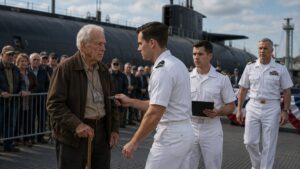
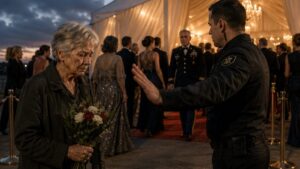
The security officer placed a clear plastic disposal bag beside Frank Allen’s elbow and asked whether the burned object inside his coat was hazardous.
Frank looked at the red warning stripe printed across the bag. UNKNOWN INDUSTRIAL DEBRIS. Beneath it, someone had already written a case number in black marker.
The object was still against his chest, wrapped in a white handkerchief inside the worn brown leather jacket Brenda had told him not to wear. His scraped fingers rested over it through the lining.
“It hasn’t hurt anybody in fifty-six years,” he said.
The security officer shifted his weight. He was young enough that the machinery-space fire existed for him only as a date in a database. “Commander Roberts asked that any unverified material be secured before the review.”
“Then she can secure it after she sees it.”
Frank kept his voice low. Raising it would have helped them. An angry old man could be managed. A confused one could be escorted out. He intended to be neither.
Beyond the checkpoint, the naval heritage building smelled of polished wood and filtered air. Framed photographs hung in even rows: ships at commissioning, crews in formation, officers standing beneath clean banners. The machinery spaces were invisible in all of them.
A junior sailor in immaculate white led Frank to the conference room. His name strip read WILSON. He carried a tablet against his forearm and walked half a step too quickly, forcing Frank to choose between hurrying and making the young man notice he could not.
Frank did not hurry.
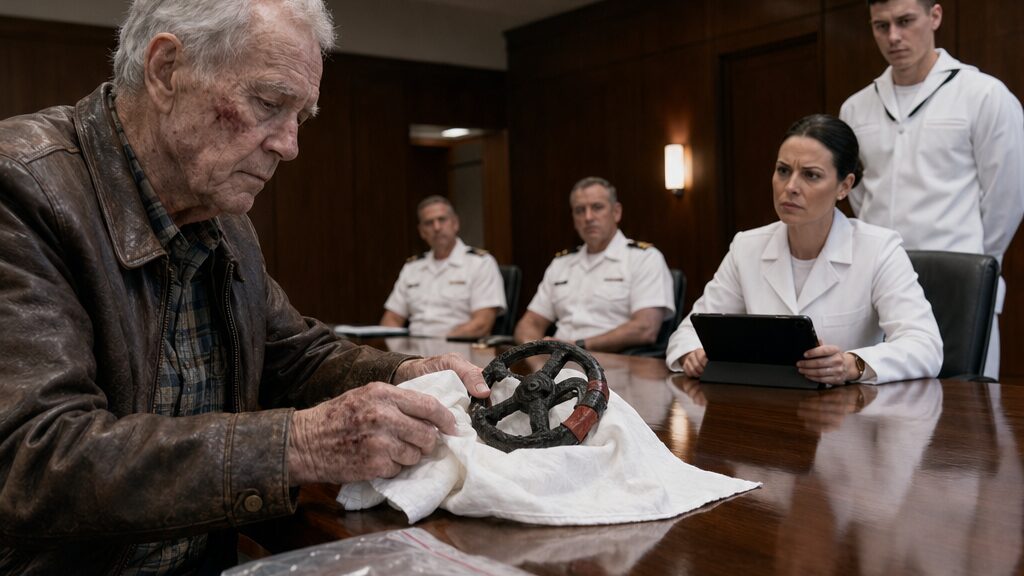
Inside, three review-board members stood near the windows while Commander Michelle Roberts waited at the far side of a long polished table. Her uniform was so precise it seemed to belong to the room. A tablet lay open before her, displaying the memorial exhibit schedule.
Beside it was the disposal form.
Frank saw the words before he sat down.
ITEM CLAIMED TO BE ASSOCIATED WITH 1970 MACHINERY-SPACE CASUALTY. PROVENANCE INSUFFICIENT.
Commander Roberts gestured to the chair opposite her. “Mr. Allen.”
“Commander.”
“Thank you for coming again.”
Again was the word she chose instead of four times.
Frank lowered himself into the chair. Wilson remained standing near the wall. The board members sat only after Roberts did, leaving Frank briefly beneath a ring of white uniforms.
Roberts folded her hands. “We have reviewed your latest correction request concerning Fireman Nicholas Green, service number—”
She recited it without looking down.
Frank’s gaze moved from her face to the tablet and back.
Roberts noticed. “I have read the file.”
“More than the people who wrote it, maybe.”
One board member adjusted his glasses. Another turned a page in a folder.
Roberts did not react. “The permanent entry currently states that Fireman Green was lost during a machinery-space casualty on June seventeenth, 1970. His name will appear with the other casualties.”
“Lost,” Frank repeated.
“That is the terminology in the surviving report.”
“He wasn’t a wrench that rolled under a deck plate.”
“No one here believes he was.”
“Then write what he did.”
Roberts drew a breath through her nose. “Your proposed language states that Fireman Green deliberately reentered the affected compartment, closed an emergency fuel valve, and prevented the fire from spreading beyond the auxiliary machinery space.”
“He didn’t reenter. He never got all the way out.”
“That distinction does not make the claim easier to verify.”
Frank felt the edge of the wrapped fragment beneath his palm. “The valve was found shut.”
“The post-casualty inspection confirms that.”
“And Green was found beside it.”
“The report places him near it.”
“His hand was burned around the grip.”
“That detail does not appear in the medical summary.”
“Because the summary was written by someone who saw him after they opened his hand.”
Silence tightened across the table.
Roberts’s voice remained measured. “Mr. Allen, I am not accusing you of inventing his death. I am asking whether the exhibit can responsibly present your interpretation as established fact.”
“I was there.”
“And your signed statement from 1970 does not contain the account you are giving us now.”
Frank stared at the grain of the polished table. A thin pale line ran through the wood, disappearing beneath Roberts’s tablet.
The statement had been four pages. He had signed the last one with a bandaged hand while morphine made the walls lean. An officer had asked where Green was when the alarm sounded, whether Green obeyed evacuation orders, whether Frank had seen him after the smoke thickened.
Nobody had asked why the smoke thickened.
Roberts continued. “The annex is scheduled for demolition in seventy-two hours. The exhibit approval is due before demolition begins. After that point, no new physical material can be accepted without reopening the accession process.”
Frank looked up. “You knew I went there.”
“The security report says you entered a condemned section two nights ago.”
“I entered a room I helped build into a training space after the ship was decommissioned.”
“You entered through a maintenance opening and injured both hands.”
“I retrieved what your demolition crew was going to put in a landfill.”
Wilson glanced down. The corner of his mouth moved, not quite a smile.
Roberts tapped the disposal form. “The object has not been authenticated. Even if it is what you say, it cannot prove who operated the valve.”
“It belongs beside his name.”
This time Wilson made a small sound. A breath pushed through his nose before he could stop it. He looked immediately at Roberts, then at the floor.
Frank turned his head.
The sailor’s face reddened. “Sir, I’m sorry.”
“For what part?”
Wilson swallowed. “I thought—when you said it belonged beside the name—I thought perhaps you expected the board to display whatever scrap you recovered.”
Whatever scrap.
Frank slid his hand inside his jacket.
The security officer at the door straightened, but Roberts lifted two fingers, stopping him.
Frank drew out the white handkerchief. A brown-red stain marked one corner where blood from his knuckles had soaked through. He placed it in front of him and unfolded the first corner.
Then the second.
The third fold revealed blackened metal no longer than his palm, warped by heat and crusted with old scale. A narrow strip of red rubber clung to one side, melted into the steel as if the two materials had tried to become a single thing.
The fourth fold laid the object bare upon the white cloth.
No one moved.
Frank rotated it until the red strip faced Commander Roberts.
Her eyes narrowed. Not in disbelief now. Recognition.
She knew enough machinery to understand that the red was not paint.
Frank withdrew his hands. The scraped skin across his knuckles pulled tight as he folded them together.
“His hand was on this,” he said. “Mine wasn’t.”
Wilson’s embarrassment vanished. Something colder replaced it.
Roberts looked at the fragment, then at Frank. “Is this part of the emergency valve wheel?”
“The grip. What was left of it.”
“How did it come to be in the annex?”
“They used the salvaged wheel in casualty-control training. Mounted it on a demonstration board. Told recruits what happens when fuel gets ahead of discipline.”
One review-board member leaned forward. “Without identifying Green?”
“Without identifying anybody.”
Roberts’s gaze stayed on the red strip. “And you removed it from the condemned structure.”
“I took it off the wall before the wall came down.”
“With a pry bar?”
“With my hands first.”
That explained the torn skin better than he wanted it to.
Roberts closed the disposal form on her tablet. “Chief Wilson, contact the base archivist. Request the engineering diagrams for the vessel’s emergency fuel-isolation system and photographs of the annex training board.”
Wilson answered without the nervous brightness he had carried into the room. “Yes, Commander.”
She turned to the security officer. “The item is not to be bagged or discarded. Place a temporary preservation hold on it.”
Frank began folding the cloth around the fragment.
“Leave it open, please,” Roberts said.
His hands stopped.
The artifact looked smaller under the conference-room lights than it had in his workshop. Here it was merely damaged metal. It did not carry the heat, the coughing, or Nicholas’s fingers slipping through Frank’s grip.
Roberts pulled up another document. “Mr. Allen, there is an eleven-minute interval between the evacuation order and the fuel-isolation notation. The same interval is missing from your original statement.”
Frank tucked one corner of the handkerchief over the red strip.
“Your revised account describes Green at the valve,” she said, “but it does not explain where you were during those eleven minutes.”
He covered the metal completely.
“Until it does,” Roberts continued, “I cannot determine whether your omission protects his reputation, your own, or both.”
Frank pressed the four folds flat.
“That part,” he said, “is not for your wall.”
Chapter 2: Every Year He Cleaned What Fire Could Not Erase
Brenda found fresh blood on the white handkerchief before Frank could hide it beneath the workshop lamp.
She caught his wrist, turned his hand over, and saw the split skin across his knuckles.
“You went inside that annex.”
Frank pulled back. “You’re squeezing.”
“You climbed into a condemned building alone.”
“I didn’t climb.”
“That is not the comforting distinction you think it is.”
The workshop behind his house was barely wide enough for the bench, two metal cabinets, and the old stool he refused to replace. Jars of machine oil stood in a careful row beneath the pegboard. On the wall hung wrenches older than Brenda, their silhouettes marked in pencil so he could see when one was missing.
The scorched fragment lay beneath the lamp.
Brenda stared at it. “That is what you nearly tore your hands open for?”
“It was bolted to a board.”
“You said the Navy had it.”
“The Navy forgot it.”
She released his wrist and reached toward the handkerchief. Frank moved it away before she touched the stain.
Her face changed—not anger leaving, but anger finding somewhere deeper to stand.
“I work in an emergency room,” she said. “I know what hands look like after somebody crawls through broken metal. You could have severed a tendon.”
“I didn’t.”
“You could have fallen where no one knew to look.”
“I knew where I was.”
“That has never been the problem.”
Frank sat on the stool. He dipped the corner of a clean cloth into oil and worked it along the fragment’s blackened edge. He did this every year before the anniversary, never enough to brighten the steel, only enough to keep new rust from consuming what fire had spared.
The fused red strip received no oil. He cleaned around it with a cotton swab, careful not to disturb the blistered rubber.
Brenda watched him. “Commander Roberts called.”
He kept working.
“She said you refused to explain part of your statement.”
“She calls you now?”
“She called because your blood pressure was high at the base clinic and you left before the corpsman cleared you.”
“They always want to clear something. Rooms. People. Records.”
“She also said demolition starts the day after tomorrow.”
Frank turned the fragment in the light. The curved inner edge still held a shallow groove where it had fitted over the wheel’s spoke.
“I’m coming with you tonight,” Brenda said.
“No.”
“You are not going back to that fence alone.”
“I’m not going inside.”
“You said that last night.”
“I didn’t tell you where I was last night.”
“You didn’t have to. You came home with insulation in your hair.”
He set down the swab.
Brenda folded her arms. “Either I come, or I tell Commander Roberts you are medically unfit to continue this fight without supervision.”
He looked at her then. “You’d use my age to take this away.”
“I would use your pulse, your bleeding hands, and your talent for pretending pain is an administrative error.”
For a moment, she sounded like her mother. The resemblance was not in the voice but in the steadiness after it.
Frank returned to the fragment. “You never knew Green.”
“No. You made sure of that.”
The words landed without force and therefore went deeper.
Brenda turned toward the metal cabinet, searching for fresh gauze. When she opened the upper drawer, an envelope slid from behind a stack of maintenance manuals and fell to the floor.
Frank stood too quickly. The workshop tilted.
Brenda picked it up.
The paper was yellow at the edges. On the front, in Frank’s handwriting, was an address in Ohio and the name Mrs. Green. A date had been written in the corner.
Twenty-eight years earlier.
“Give me that.”
Brenda looked at the unsealed flap. “You never mailed it.”
“It was returned.”
“There’s no stamp.”
“Give it here.”
She held it against her chest. “Is this why you won’t tell them about the eleven minutes?”
Frank reached for it, but his fingers closed on air. Brenda stepped back, shocked by the movement more than threatened by it.
He lowered his hand.
“You want them to put his name on a wall,” she said, “but you couldn’t put this in a mailbox.”
“You don’t know what’s in it.”
“Then tell me.”
“No.”
Her jaw tightened. “Was he trapped?”
Frank looked down at the valve fragment.
That had been the word used in the first telegram. Trapped. Later, incapacitated. Then lost. Each word made Nicholas smaller and the machinery larger, as though a ship had swallowed him by accident and nobody had made a choice.
“He wasn’t trapped,” Frank said.
Brenda waited.
“He went back.”
“To the valve?”
Frank nodded once.
“Why?”
He laid the fragment in the center of the handkerchief. The old cloth had been washed so many times that the threads were nearly transparent along the folds.
“Because the fuel was still running.”
“Why was it still running?”
He folded one corner over the metal.
“Dad.”
Second corner.
“Did someone fail to close it?”
Third.
“Did you?”
He made the fourth fold and pressed it flat. “We’re going to the annex.”
The fence surrounded an empty stretch behind the heritage complex where the obsolete training annex crouched beneath demolition netting. Its windows had been removed. Through the open frames, Frank could see pale rectangles where equipment boards had once hung.
Brenda stood beside him in her hospital shoes and dark jacket, angry enough not to mention the cold.
A padlock secured the gate. The demolition notice had been laminated against rain and bolted to the chain mesh.
Frank carried the wrapped fragment inside his coat.
“You used to bring me here when I was little,” Brenda said. “You told me you were checking the fence.”
“I was.”
“You never told me what was behind it.”
He followed the perimeter until they reached the side door. The metal had been painted gray over older Navy blue. A red X marked it for removal.
Frank pressed two fingers against the locked door.
His fingers shook, so he steadied them with his thumb.
“Nicholas Green,” he said.
Not Fireman Green. Not casualty. Not Green.
The full name entered the empty annex through the seam beneath the door.
Frank waited.
Brenda had seen him perform small rituals all her life without understanding them: four folds in a handkerchief, one empty place on the workshop shelf, the annual disappearance after supper every June seventeenth. She had mistaken repetition for stubbornness.
Now she noticed the space he left after speaking, long enough for an answer that never came.
She looked away first.
On the walk back to the car, Frank’s breath shortened. Brenda offered her arm. He pretended not to see it until the gravel shifted beneath his shoe. Then he took it without thanking her.
At home, he went straight to wash the dust from his hands.
The envelope remained in Brenda’s pocket.
She sat alone at the kitchen table, listening to water run through the pipes. The flap had never been sealed. It opened with almost no pressure.
Inside were three pages covered in Frank’s narrow block lettering.
She read the first line twice.
Your brother died because I gave the wrong order.
Chapter 3: The Report Proved a Death but Not the Choice Before It
“The eleven-minute gap appears in every surviving version,” the base archivist told Michelle Roberts. “Including Allen’s signed statement.”
He laid three reproductions across the records-room table. Each contained different stamps and routing marks, but the blank interval remained identical: evacuation ordered at 1412, fuel isolation recorded at 1423.
Between those times, the official history became smoke.
Michelle stood beneath the archive’s fluorescent lights, jacket buttoned, cap tucked under one arm. She had arrived before seven and had already postponed two exhibit meetings.
“Is there an original engineering log?” she asked.
“Water damage destroyed most of it in storage. These are carbon copies made for the casualty investigation.”
“And the investigation appendix?”
“Missing.”
“Missing as in destroyed?”
“Missing as in no transfer record.”
The distinction was familiar. Destruction ended a search. Missing records extended it until deadlines made surrender appear responsible.
Chief Ryan Wilson sat at the next table with a maintenance diagram enlarged on his screen. He had spoken little since the conference. When Michelle assigned him to research the valve, he accepted the task without the eager confidence he usually brought to visible work.
He turned the tablet toward her. “Commander, the red material on Allen’s fragment matches the specified coating for the emergency handles. Heat-resistant rubber over a steel grip.”
“Could it have come from another valve?”
“Yes, ma’am. Same model was installed in three compartments.”
The archivist placed an annex photograph beside the diagram. It showed a training board covered in salvaged machinery. Near the center hung a fire-darkened valve wheel with one grip missing.
Michelle studied the mounting holes and the curved break visible on the remaining spoke.
“Probably authentic,” she said.
“Probably,” the archivist agreed. “But it proves the object came from the system. It does not prove whose hand was on it.”
Michelle knew that. Frank knew it too. That was what troubled her.
Men seeking recognition usually polished uncertainty until it reflected only them. Frank had placed the fragment on the table and used it to accuse himself.
His hand was on this. Mine wasn’t.
She opened his revised statement. The pages contained precise sensory details—the sound of a pump losing pressure, the angle of the access hatch, the way hot paint bubbled along a bulkhead—but became strangely vague at the moment of decision.
At 1411, Frank reported seeing Nicholas near the auxiliary pump.
At 1424, Frank remembered being in the passage outside the compartment.
Nothing connected the two.
The casualty report filled the gap with a cleaner account. It stated that smoke had incapacitated Nicholas before evacuation and that his body was recovered adjacent to the emergency fuel-isolation station.
Michelle read the sentence again.
Adjacent did not mean operating. It did not mean returning. It did not mean choosing.
The report proved where Nicholas died. Frank was asking her to preserve why.
A review-board member entered carrying coffee and impatience. “You reopened the Green file.”
“I placed a temporary hold on one artifact.”
“You redirected the archivist and a project sailor during final approvals.”
“The artifact appears genuine.”
“Then display it as a valve component.”
“Its significance depends on Allen’s account.”
“Which contradicts the official investigation.”
“It complicates it.”
The board member set the coffee down. “Commander, this exhibit includes one hundred and eighty years of engineering casualties. We cannot rebuild every investigation because a survivor remembers more at seventy-nine than he reported at twenty-three.”
Michelle looked toward Wilson. He had gone still over the tablet.
“What is it?” she asked.
He enlarged a handwritten line at the bottom of a faded maintenance sheet.
The notation was squeezed between two printed entries and initialed with an unreadable mark.
AUX FUEL ISO CONFIRMED—1423.
Michelle compared it with the evacuation order.
Eleven minutes later.
The board member leaned over the screen. “That is already reflected in the report.”
“The report says the compartment was evacuated before fourteen fifteen,” Wilson said.
His voice carried no trace of yesterday’s nervous amusement.
“Maybe the time was entered late,” the board member replied.
“Maybe,” Michelle said.
“Or the clock was wrong.”
“Maybe.”
“Or the notation was copied inaccurately.”
“Also possible.”
He straightened. “Which is precisely why we do not revise memorial history around maybes.”
Michelle closed Frank’s statement.
Her father’s photograph had once hung in a community center beneath a caption describing him as fearless in every crisis. She had been twelve the first time she heard him wake from sleep shouting because a hatch would not open. After his death, men who had barely known him turned fearlessness into his defining virtue.
The lie had been intended as praise.
That had not made it harmless.
She understood the board member’s caution. A memorial could flatten the dead as efficiently as an omission. Nicholas Green might become the brave young sailor who knowingly sacrificed himself because an aging survivor needed that version to live with his own guilt.
But Frank’s omissions were not shaped like self-protection alone. He refused the easy sentence available to him: Green saved me.
Instead, he had said only that Nicholas’s hand reached the valve and his own did not.
“Commander,” Wilson said, “there’s another detail.”
He opened a second diagram. “The safest route out was through the port access hatch. According to the damage map, it remained usable until the ventilation intake opened.”
Michelle looked at him. “Opened by whom?”
“No surviving log says.”
The archivist slid Frank’s original statement closer. “He was the boiler technician on watch. Ventilation response would have been within his duties.”
The missing eleven minutes shifted again.
Perhaps Frank was not withholding a heroic story from skeptical officials.
Perhaps he was withholding the reason heroism became necessary.
The door opened. Brenda Allen entered without waiting to be announced. She still wore hospital identification clipped to her waistband. In one hand she carried an old envelope inside a clear document sleeve.
Michelle recognized Frank’s handwriting on the front.
“Ms. Allen, this is a restricted records area.”
“I know. The clerk tried telling me three times.”
The archivist frowned. “You cannot bring outside material—”
“It’s not for the archive yet.”
Brenda placed the envelope on the table between Frank’s statement and the late fuel-isolation notation.
Her eyes were tired, but her grip on the sleeve was steady.
“My father wrote this to Nicholas Green’s family twenty-eight years ago,” she said. “He never sent it.”
Michelle did not touch the envelope. “Does he know you have it?”
“No.”
“That matters.”
“So does what’s inside.”
The review-board member stepped back from the table as if the letter might contaminate the official records merely by proximity.
Michelle looked at the yellowed pages through the clear sleeve. The first line was visible beneath the fold, though not enough to read in full.
Brenda watched her.
“Are you trying to prove he lied,” she asked, “or are you willing to learn why?”
Chapter 4: His Daughter Read the Confession He Had Practiced for Decades
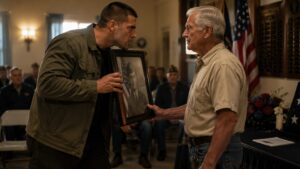
Brenda placed the old confession on the polished table before Frank had fully entered the room.
For one second, he saw only the envelope.
Then he saw the clear sleeve around it, Michelle standing beside the window, Ryan near the records cart, and the scorched fragment still wrapped in white cloth at the far end of the table. Everything he had kept separate had been arranged in one straight line.
“You took that from my house,” he said.
Brenda did not sit. “I took it from the workshop floor after it fell out of a cabinet.”
“You opened it.”
“Yes.”
His cane struck the chair leg when he moved around it. He had brought the cane because Brenda insisted, then resented it each time it touched something before he did.
Michelle remained standing. “Mr. Allen, I have not read the letter.”
“Yet.”
“I told your daughter I would not without your permission.”
Frank looked at Brenda.
She held his gaze. “I told her the first line.”
The first line had taken him six attempts. He had written it in the workshop long after midnight while Brenda and her mother slept in the house. Each discarded version began with an explanation. Only the final one began with blame.
Your brother died because I gave the wrong order.
Frank lowered himself into the chair.
Michelle sat opposite him. “The review board meets tomorrow morning. The current proposal includes Nicholas Green’s name as a casualty. Your additional account remains unapproved.”
“Then you’ve brought me here to say no again.”
“I brought you here because the maintenance records support part of what you told us. The emergency fuel supply was isolated eleven minutes after the evacuation order. Your artifact is consistent with the valve assembly.”
“Consistent,” Frank repeated.
“It cannot prove who operated it.”
“Nicholas did.”
“The official report says smoke incapacitated him near the station.”
“The official report was written to make the sequence fit.”
“And your statement helped it fit.”
Frank’s hands tightened over the cane handle.
Brenda slid the letter closer to him. “Tell her why.”
He stared at the envelope but did not touch it.
Michelle opened a folder. “The damage map shows the port access hatch remained usable until the ventilation intake was opened. You were responsible for that system.”
Ryan’s eyes stayed on the records cart.
Frank said, “I was qualified on it.”
“Did you open the intake?”
No one in the room moved.
He had imagined this question in a dozen voices over fifty-six years: an investigator’s, Nicholas’s sister’s, Brenda’s, his own. In every imagining, he had found a way to answer without returning to the heat.
Now the scorched fragment lay six feet away, hidden but present.
“Yes,” he said.
Brenda exhaled, almost silently.
Frank looked at Michelle. “The smoke was banking down. The exhaust fan had lost power, and the passage was filling. I thought opening the supply intake would push enough clean air through to keep the hatch clear.”
“What happened?”
“It fed the fire.”
The words did not change the room. The lights remained steady. The ventilation hummed overhead with the controlled softness of a building that had never burned.
Frank continued because stopping would make them ask.
“The fuel had sprayed beneath the auxiliary pump. We didn’t know how far it had spread. When I opened the intake, flame rolled across the overhead and into the port passage. The safest exit became the worst one.”
“Was Nicholas with you?” Michelle asked.
“He was at the pump controls.”
“Did he tell you not to open the intake?”
Frank rubbed his thumb across the worn curve of the cane. “He asked if I was sure.”
Brenda closed her eyes.
“I said I was senior watch,” Frank added. “I told him to do his job and let me do mine.”
“How much senior?” Ryan asked before catching himself.
Frank looked at him. “Three years. One pay grade. Enough to sound certain.”
Michelle did not rebuke Ryan. “What did Nicholas do after the fire spread?”
Frank’s mouth went dry. “He came to get me.”
The memory arrived first as pressure: Nicholas’s forearm beneath his shoulder, the deck hot through Frank’s knees, alarm bells shivering inside the steel. Frank had been crouched beneath the intake control when the flash burned his neck and right arm. He remembered trying to stand and discovering that his body no longer obeyed instructions he could explain.
“He pulled me to the access hatch,” Frank said. “The starboard one. Smaller opening. Manual dog.”
“You were conscious?”
“Enough to be useless.”
“Were you trapped?”
“No. I froze.”
The admission was quieter than the machinery in his memory.
“I could hear the pumps,” he said. “I knew the fuel line was still open. I knew what the fire would reach if it crossed the bulkhead. But my hands wouldn’t work. Nicholas got the hatch open. He pushed me through.”
Brenda looked toward the white handkerchief.
“And then?” Michelle asked.
“He turned back.”
“For the valve.”
“Yes.”
“Did you order him to return?”
“No.”
“Did you try to stop him?”
Frank saw Nicholas glance over his shoulder, his face dark with soot except where sweat had cut two clean lines beneath his eyes.
“I said his name.”
“That was all?”
“That was all I had.”
Michelle let the silence remain.
Then she turned her tablet around.
The proposed exhibit entry was only four lines.
FIREMAN NICHOLAS GREEN
LOST DURING MACHINERY-SPACE CASUALTY, 17 JUNE 1970
ONE OF FOUR CREW MEMBERS WHO DIED IN THE INCIDENT
REMEMBERED WITH HONOR
“We can approve this language today,” Michelle said. “His name will be included before final installation. The broader account could remain under review for a later oral-history addition.”
Frank read the four lines twice.
There was no accusation in them. No lie obvious enough to reject. Nicholas would have a name, a date, and the same polished sentence given to every dead sailor whose story had exceeded the available space.
It was what Frank had claimed to want.
Brenda sat beside him. “Dad.”
Michelle’s voice softened without becoming kind. “This guarantees he is not omitted.”
Frank looked at the line that said lost.
“You’ll put him in with no reason he was beside the valve.”
“We do not have enough evidence to state his actions as fact.”
“You have my statement.”
“An incomplete statement.”
“You have the fuel notation.”
“It supports the possibility that the valve was operated after evacuation. It does not identify the operator.”
“You have that.” Frank pointed toward the wrapped fragment.
“It establishes a physical connection to the valve, not to Nicholas.”
“Then you have his body where they found it.”
“Near the station.”
“He did not die near something. He died doing something.”
Michelle’s jaw tightened. “And if I publish a definitive version that cannot be established, I turn him into an institutional story rather than preserve him as a person.”
Frank pushed the tablet back.
Brenda caught its edge before it slid too far. “You’re refusing?”
“If those four lines go up, they become the end of it.”
“They could be the beginning,” Michelle said.
“No. Walls make beginnings look finished.”
The review-board member near the door shifted impatiently. “Mr. Allen, the alternative is that the entry may miss this exhibit cycle entirely.”
Frank’s hand moved to the folded cloth. He gripped it but did not open it.
“Then leave the space blank,” he said.
Brenda stared at him. “You fought for months to get his name included.”
“I fought to keep them from losing him again.”
“His name would be there.”
“With the same sentence that buried him the first time.”
Michelle studied Frank across the table. “You would risk his exclusion rather than accept an account you believe is incomplete.”
“No.” He glanced at the letter. “I’m risking my exclusion.”
He pulled the envelope from its sleeve.
The paper trembled in his hand. He did not read it. He laid it beside the closed white handkerchief, two objects shaped by the same silence.
“I’ll tell you the eleven minutes,” he said.
Brenda leaned forward, but Frank raised a finger.
“Not so you can turn him into a fearless boy who saved a ship. He wasn’t fearless. He complained. He made bad coffee. He was scared of deep water and slept six decks above the waterline when he could.”
Michelle did not write anything.
“And I won’t record it,” Frank continued, “until you contact his family.”
“We have identified a surviving niece,” she said. “No immediate family members remain.”
“Ask her if she wants to hear it.”
“That may delay approval.”
“Then delay it.”
The review-board member began to object, but Michelle lifted a hand.
Frank slid the letter toward her without releasing it. “If his family says no, the letter stays closed, the recording does not happen, and you use whatever line your rules allow.”
“And if she says yes?”
Frank let go of the envelope.
“Then you record all of it,” he said. “Nothing cut out to make the Navy look better. Nothing cut out to make me look better.”
Chapter 5: The Family Had Inherited Silence Instead of the Man They Lost
Nicholas’s niece began the call by saying, “My mother waited forty years for someone from that ship to tell her the truth.”
Frank sat at his kitchen table with the telephone speaker between his hands. Brenda occupied the chair beside him, while Michelle’s voice came from a conference line connected at the naval office.
No one had offered greetings beyond names.
The niece had not given permission for the call to be recorded.
“I should have contacted her,” Frank said.
“You knew where she lived.”
“Yes.”
“You wrote a letter.”
Brenda had told her about it. Frank looked at his daughter, but she did not apologize.
“I wrote more than one,” he said.
“How many did you send?”
“None.”
The line remained quiet long enough for the refrigerator motor to stop and leave the room without cover.
Michelle spoke first. “The purpose of this call is to determine whether you wish to receive Mr. Allen’s complete account before any oral history is added to the memorial archive.”
“I read the draft you sent.”
“The current draft is limited to verified information.”
“It says my uncle died during a casualty. That is the same thing we have known since before I was born.”
Frank saw Brenda’s fingers flatten against the table.
The niece continued. “My mother was twelve when he died. They told my grandmother he may have failed to follow procedure. Later, someone from the ship said he panicked in the smoke. That became the family version because nobody gave us another one.”
Frank closed his eyes.
He knew who had carried the first rumor home. Not the name, but the shape of it. Investigators had asked whether Nicholas remained in the compartment because he misunderstood the evacuation order. Sailors repeated questions until questions hardened into claims.
“I never heard that,” he said.
“You never asked.”
“No.”
“Was it true?”
“No.”
The answer came so fast that Brenda looked at him.
Frank leaned closer to the speaker. “Nicholas did not panic and cause that accident.”
“Then what did he do?”
Michelle intervened. “The complete sequence has not yet been formally recorded. There are unresolved inconsistencies.”
“I am not asking for a polished sequence, Commander. I am asking the man who was there.”
Frank stared at the maintenance ledger lying near the edge of the table.
He had brought it from the workshop after Brenda found it while searching for bandages. Its cover was oil-darkened, its original equipment entries ending decades ago. After the final maintenance page, Frank had written one line every June seventeenth.
Nicholas Green.
Fifty-six lines, the ink changing from black to blue and back again.
“He worked beside me,” Frank said. “Boiler and auxiliary systems. He could repair a radio with parts everybody else threw out.”
The niece did not respond.
“He sent money home every month. Not much. Twenty dollars, sometimes thirty. He said his sister was going to nursing school.”
“My mother became a nurse.”
Frank looked at Brenda. She was staring at the speaker now.
“He talked about that,” Frank said. “He kept a photograph of her in a school uniform inside his locker. Told everybody she was smarter than he was.”
“She said he teased her for reading medical books at supper.”
“He teased everyone.”
A faint sound came across the line, not laughter but the memory of its possibility.
Frank continued carefully. “He wanted to leave the Navy after his enlistment and train as an electrician. He thought houses would be easier because they stayed still.”
“My mother said he loved ships.”
“He liked machinery. He hated deep water.”
The niece’s breathing changed.
“He served aboard a vessel,” she said.
“He avoided looking over the rail at night. Slept high when he could. First week aboard, he asked me how much steel had to fail before the ocean got in. I told him not enough steel existed to keep out everything.”
“That sounds like a cruel thing to tell a frightened twenty-year-old.”
“It was. He poured salt into my coffee the next morning.”
Brenda lowered her head, and Frank realized she was smiling.
For several minutes, Nicholas existed in the kitchen without fire around him.
Frank spoke of a broken portable radio repaired for a homesick sailor, of Nicholas carrying extra socks because someone always forgot them, of his impatience with instructions he considered foolish. He told the niece that Nicholas whistled only the first half of songs because he never learned the rest.
The ordinary details entered the silence her family had inherited.
Then Michelle returned them to the purpose of the call.
“The official report states that smoke incapacitated Fireman Green before evacuation,” she said. “Mr. Allen disputes that account. Maintenance evidence indicates the fuel valve was isolated later than the report’s timeline suggests, but we cannot establish the full sequence independently.”
“Do you believe him?” the niece asked.
Michelle answered after a pause. “I believe he has withheld material information. I also believe the surviving report may be incomplete.”
“That is not what I asked.”
“No,” Michelle said. “It is the most honest answer I can give.”
The niece turned back to Frank. “Did my uncle go to that valve because of something you did?”
Brenda’s hand moved toward his, stopping before contact.
“Yes,” Frank said.
“What?”
“I opened a ventilation intake. It worsened the fire and blocked the safer exit.”
“Was that in your original statement?”
“No.”
“Did you let them blame him?”
“I did not know your family had been told he caused it.”
“That is not an answer.”
Frank looked at the fifty-six written names in the ledger.
“I let the official account stand,” he said.
“Why?”
“Because correcting it meant saying why he had to go back.”
“And that would make you responsible.”
“Yes.”
The single syllable stayed in the room.
The niece’s voice became quieter. “Commander Roberts offered me a summary. It said there was survivor testimony suggesting Nicholas may have attempted to isolate the fuel supply.”
Frank recognized institutional caution in every word. May have attempted. A sentence built to survive review while telling no one where courage had entered.
“I won’t approve that,” the niece said.
Michelle replied, “Without the recorded statement, it is the strongest contextual language available.”
“Then record him.”
Frank’s fingers curled around the ledger.
“Unedited,” she added. “I want the entire eleven minutes. I want what he did wrong. I want what my uncle did. I want what nobody can prove marked as uncertain, not removed.”
“The archive can preserve an unabridged oral history,” Michelle said, “but the public exhibit label will still require contextual limits.”
“Fine. I am not asking you to declare him a hero.”
Frank looked up.
The niece continued. “Heroes are what institutions make when they want a death to become useful. I want my uncle.”
Brenda’s hand covered Frank’s.
This time he did not withdraw.
Michelle arranged the recording for that evening.
Before ending the call, the niece said, “Mr. Allen.”
“Frank.”
She did not use the name. “Did he say anything about my mother?”
Frank’s throat closed before he could prepare it.
The kitchen seemed to tilt toward the telephone.
He could hear Nicholas at the hatch, voice torn by smoke, speaking of his sister. The true words had survived intact. Frank had repeated them incorrectly so many times in private that the altered version had almost formed a second memory.
Tell her I wasn’t scared.
That was what Frank had wanted Nicholas to say.
It was not what Nicholas had said.
Brenda tightened her hand around his. “Dad?”
Frank opened his mouth.
Nothing came.
The niece waited, and in that waiting Frank understood that his silence had answered her more clearly than any sentence.
“You have something else,” she said.
The call ended before he could deny it.
Chapter 6: Eleven Missing Minutes Could Not Stay Buried in One Man
Michelle turned on the recorder and asked Frank to state whose story he was giving.
The red light came alive beside the scorched valve fragment.
Frank had unwrapped it himself and placed it near the microphone. The white handkerchief lay open beneath the black metal, its four corners spread across the polished table. For the first time in fifty-six years, he kept both hands away from it.
“Nicholas Green’s,” he said, “and the part of mine that damaged his.”
Michelle sat across from him without her tablet. Ryan monitored the audio equipment near the wall. Brenda waited outside at Frank’s request.
A small speaker on the table connected Nicholas’s niece to the room. She had agreed to listen remotely but had not agreed to speak.
Michelle stated the date, the purpose of the oral history, and the limits of the surviving record. Her language was precise. She described Frank as a witness, not an authority, and the artifact as associated material, not proof.
Then she said, “Begin at the evacuation order.”
Frank looked at the red strip fused to the metal.
“The alarm sounded at fourteen twelve,” he said. “By then, we had fuel spraying beneath the auxiliary pump. A coupling had failed. Nicholas Green was at the local control station. I was at the ventilation panel.”
He described the first flames low across the deck, blue at the edges. Someone in the passage shouted to isolate the fuel. The remote shutoff did not respond.
“Did you understand the compartment was being evacuated?” Michelle asked.
“Yes.”
“Why did you remain?”
“I believed I could clear the smoke from the port access route long enough for Green and me to exit.”
“Why did you believe that?”
“Because I had seen forced air hold smoke back in drills.”
“Was the fire condition in those drills comparable?”
“No.”
“Did Nicholas question the decision?”
Frank heard the voice again.
You sure about that, Allen?
“He asked whether I was sure.”
“What did you say?”
“I told him I was senior watch. I told him to stay on the pump controls.”
“Did you consult the engineering officer?”
“No time, I thought.”
“Did you attempt the remote fuel isolation again?”
“Nicholas did. It failed.”
“What happened when you opened the intake?”
Frank’s burned arm ached with an old pain that no longer belonged to tissue.
“The fire found the air.”
He described the overhead flashing bright. Paint blistered. Smoke reversed direction and rolled toward the hatch he had intended to protect. The pressure slammed a loose panel against the bulkhead hard enough to sound like a second alarm.
“The safest exit was cut off,” he said. “That was my doing.”
Michelle let several seconds pass.
“Where was Nicholas?”
“He left the controls and came toward me.”
“Was he following an order?”
“No.”
“Did he attempt to evacuate?”
“He attempted to evacuate me.”
Frank’s voice roughened. He took water from the glass Brenda had placed near his chair, but his hand shook against it. He set it down before drinking.
“The flash caught my right side. Not enough to knock me unconscious. Enough to make me stop. I knew where the starboard access hatch was. I knew how to open it. My body would not move.”
“Were you disoriented?”
“I was afraid.”
The word entered the recording without defense.
“Nicholas got under my arm. He was smaller than me, but he dragged me across the deck. We reached the hatch. The wheel was hot. He wrapped his sleeve around it and turned it.”
Frank saw Nicholas’s face at the opening, teeth clenched, hair dark with sweat.
“He pushed me through headfirst. I landed in the passage. When I turned around, he was still inside.”
“Why?”
“The fuel was running.”
“Could the ship have been evacuated without isolating it?”
“The fire might have spread into the adjoining space. We didn’t know. He didn’t know.”
“Did he say he intended to close the valve?”
“He said, ‘It’s still feeding.’”
“And then?”
“I told him to come through.”
“Exact words, if you remember.”
“Green, get out.”
“Did he answer?”
“He said, ‘You know what it reaches.’”
The fuel line ran toward equipment and storage beyond the compartment. Later assessments disagreed about whether the fire would have crossed the boundary. Frank had spent half a century refusing to turn possibility into certainty merely because sacrifice demanded a result.
“We did not know what it would reach,” he said. “Nicholas went back without knowing.”
Michelle leaned slightly toward the microphone. “Was he calm?”
“No.”
Frank’s answer came hard enough that Ryan looked up.
“No,” Frank repeated. “He was afraid.”
The speaker on the table remained silent.
“He kept wiping his mouth with his sleeve. His eyes were wide. He looked at the fire, then at me. He said he didn’t want to go.”
Frank stopped.
The recorder continued. Its red light did not soften or look away.
Michelle’s voice was quiet. “But he went.”
“Yes.”
“Why?”
“Because the fuel was still feeding and I was burned and he thought there wasn’t anyone else close enough.”
“Did he believe he would die?”
“I don’t know.”
“Did he behave as though he was fearless?”
“No. He behaved as though fear had not changed what needed doing.”
Frank finally drank the water.
He described Nicholas turning from the hatch. He crossed the compartment low, one arm over his face. Frank crawled back toward the opening despite the sailor in the passage pulling at his belt. Through smoke, Frank saw Nicholas reach the red-handled valve.
“His first grip slipped,” Frank said. “The rubber was burning. He used both hands.”
The fragment beside the microphone seemed to hold the shape of those hands without showing them.
“The wheel started to turn. Then smoke covered him. I heard the line pressure change. The flame lowered. Someone pulled me away from the hatch.”
“Did you see Nicholas again alive?”
“No.”
The word was almost too small to contain the answer.
Michelle glanced at the time display. “That accounts for the fuel-isolation notation at fourteen twenty-three.”
“It may,” Frank said. “The notation could have been entered late. The clock could have been wrong. I’m telling you what I saw, not what the paper proves.”
“What happened afterward?”
Frank returned to the investigation room in memory. Bandages covered his arm. A medical corpsman had placed a pencil between his fingers because he could not grip a pen.
“They asked whether Nicholas obeyed the evacuation order. I said I had sent him to the controls before the fire spread. They asked when I last saw him. I said near the pump.”
“You omitted the hatch and the valve.”
“Yes.”
“Why?”
“Because I had opened the intake.”
“Were you ordered to conceal that?”
“No.”
“Did anyone threaten disciplinary action?”
“No.”
“Did investigators know the intake had been opened?”
“They knew. The control position showed it. But they treated it as part of the mechanical sequence. They did not ask who decided.”
“And you did not volunteer it.”
“No.”
Michelle’s father had been praised into simplicity. Frank could see that history in the restraint of her face now. She was not asking him to make Nicholas heroic. She was making him refuse every convenient lie.
“Did Nicholas speak to you before he turned back?” she asked.
Frank’s eyes moved to the speaker.
The niece was still listening.
“Yes.”
“What did he say?”
“He asked me to tell his sister something.”
The room narrowed around the live microphone.
“What were his exact words?”
Frank had reached the place he had guarded more closely than the operational mistake. The mistake made him culpable. The message made his silence personal.
“He said, ‘Tell her I was afraid.’”
The speaker made a faint sound.
Frank continued before shame could close him again.
“He said, ‘Tell her I was afraid, but I went back anyway.’”
Michelle did not move.
“In my head,” Frank said, “I changed it. Not that day. Later. A little at a time. I made it, ‘Tell her I wasn’t scared.’ That sounded cleaner. It sounded like something a dead sailor’s family could live with.”
“Did you ever deliver either version?”
“No.”
“Why not?”
“Because if I told his sister what he said, I would have to explain why he went back. If I explained that, I would have to tell her what I did.”
Frank looked at the fifty-six-year-old burn on the fragment.
“I called that protecting him,” he said. “It was also protecting me.”
The admission left nothing polished enough for a wall.
He told the recorder about the annual visits to the annex, the oiling of the fragment, the four folds of the handkerchief. He explained how salvaged machinery from the vessel had been mounted in the training space and how he had recognized the damaged valve wheel years later.
“Every anniversary, I said his name at the door,” he said.
“Why at the door?” Michelle asked.
“Because the last time I said it to him, he was on one side of a hatch and I was on the other.”
“Did the ritual help you remember him accurately?”
Frank looked at her.
“No,” he said. “It helped me remember him the way I could bear.”
That answer seemed to alter the room more than the confession of error.
Michelle asked him to describe Nicholas outside the accident. Frank spoke of radios, salted coffee, unfinished songs, his fear of the sea, and the money sent home for nursing school. He described impatience, generosity, and a habit of taking on work before anyone requested it.
“He was not always careful,” Frank said. “He liked being needed. That may be part of why he went back. I do not know. Do not write that he sacrificed himself because I cannot know what he thought all the way to the valve.”
The recording reached its final question.
“Mr. Allen,” Michelle said, “what do you want preserved?”
Frank had once thought the answer was proof. Then a corrected report. Then a sentence declaring that Nicholas saved lives.
Now he looked at the red strip and understood that the object had never carried certainty. It had carried contact.
“That he was afraid,” he said. “That he went back anyway. That my failure is part of why he had to choose. That nobody knows exactly what the fire would have done if he hadn’t closed the valve. And that uncertainty does not mean he did nothing.”
Michelle reached toward the recorder.
“Anything else?”
Frank placed his palms flat on the table, away from the artifact.
“His name,” he said. “Nicholas Green.”
Michelle switched off the recorder.
The red light vanished.
For several seconds, none of them spoke. Ryan removed his headphones slowly. Frank could hear the ventilation, the building settling, a cart moving somewhere beyond the door.
Then the speaker crackled.
Nicholas’s niece said, “I’m still here.”
Frank’s hands began to close, searching for the fragment.
He stopped them before they reached it.
Michelle folded her hands beside the silent recorder. “She asked that you remain in the room.”
Chapter 7: She Did Not Ask for an Apology Until He Finished Saying the Name
The niece’s first response was not forgiveness.
“You let my mother carry the wrong shame.”
Her voice came through the speaker with no tremor and no raised volume. That made it harder for Frank to mistake pain for anger and defend himself against the easier thing.
He remained seated across from Michelle. The recorder was off, but the scorched valve fragment still lay exposed beside it. Ryan stood near the wall with his headphones hanging from one hand.
“Yes,” Frank said.
“My mother thought Nicholas panicked. She thought he disobeyed an order and made the fire worse. She spent her whole life defending him without knowing what she was defending.”
Frank looked at the darkened metal.
“I did not know they told her that.”
“You knew they had not been told the truth.”
“Yes.”
“And you decided the difference mattered.”
“No.” His voice caught. “I decided it was enough to excuse me.”
The speaker remained silent.
Frank could feel Michelle watching him, but she did not interrupt. This was no longer her interview.
The niece said, “My mother kept his photograph in a drawer because my grandmother could not bear to see it. Every June she took it out, cleaned the glass, and put it back. She said he had been a good brother before the Navy made him into a mistake.”
Frank’s hands closed on the edge of the table.
He had imagined Nicholas’s sister remembering a brave final sentence delivered by someone better than him. He had never imagined a drawer.
“I’m sorry,” he said.
“I did not ask for that yet.”
Frank lowered his head.
“Say his name.”
He looked toward the speaker.
“His full name.”
“Nicholas Green.”
“Again.”
“Nicholas Green.”
Only after the second time did she speak.
“Now tell me exactly what he said about my mother.”
Frank’s gaze moved to the fragment, but he did not reach for it.
“He said, ‘Tell her I was afraid, but I went back anyway.’”
“No changes?”
“No.”
“No cleaner version?”
“No.”
“Was he crying?”
Frank returned to the hatch. Smoke moved behind Nicholas in thick folds. His face had been wet, but the heat had made every source of water uncertain.
“I don’t know,” Frank said. “His eyes were watering. Mine were too.”
“Was he brave?”
Frank took longer with that answer.
“He was scared enough to tell the truth about it. Then he turned around.”
The niece breathed out against the telephone.
“That is the version I want preserved,” she said.
Michelle leaned toward the speaker. “The review board may not approve it as a definitive finding. The most likely outcome is a contextualized oral-history entry. It would state that Frank’s testimony conflicts with portions of the surviving report and that complete corroboration is not possible.”
“Will the recording remain unedited?”
“Yes.”
“Will it include what Frank did?”
“Yes.”
“Will it include what Nicholas said?”
“Yes.”
“Then leave the uncertainty in.”
Frank looked up.
The niece continued. “Do not make my uncle flawless to compensate for forgetting him. Do not make Frank disappear to make the story easier either.”
Frank’s chair creaked as he shifted. “My name doesn’t belong beside his.”
“Your name is why anyone knows where his hand was.”
“My mistake is why his hand had to be there.”
“That is also part of the story.”
Frank pressed his knuckles against the table. “Then put me in the recording. Leave me off the exhibit.”
“No.”
The word came from the speaker and Michelle at nearly the same moment.
Michelle glanced toward it, then continued. “Removing you would falsely imply the account appeared independently. The artifact has meaning because you preserved it. The testimony has limits because it is yours.”
Frank heard institutional language, but not evasion.
The niece said, “You carried his name for fifty-six years. You also withheld it from us. Both things are true.”
There it was: neither absolution nor condemnation, only a shape large enough to contain what he had done.
Frank looked toward Ryan. The young sailor’s face held no admiration. Frank was grateful for that.
“What do you want from me?” he asked the speaker.
“I want the recording in the archive. I want the public text to say my uncle did not cause the accident. I want the false story corrected without pretending every detail is proven.”
“And from me?”
A pause followed.
“I want the apology now.”
Frank placed both palms flat on the table.
“I am sorry I let your mother believe Nicholas failed,” he said. “I am sorry I turned his final words into something easier because I was ashamed. I am sorry I made my remembering private when the truth belonged to your family too.”
The niece did not say she forgave him.
“Send me a copy of the recording,” she said.
“I will,” Michelle replied.
“And a photograph of the object.”
Frank looked at the blackened grip.
“The object can enter the permanent collection if Mr. Allen formally transfers it,” Michelle said. “Its label would identify it as a salvaged valve component associated with his testimony, not as conclusive evidence.”
“Partly wrapped,” Frank said.
Michelle turned to him. “What?”
“The display. Leave part of the cloth around it.”
The request surprised him as he made it. For decades, the handkerchief had hidden the fragment from everyone else. In the archive, its folds could show that the metal had not arrived as neutral evidence. Someone had carried it close.
Michelle nodded. “We can propose that.”
The next afternoon, the exhibit workshop smelled of cut acrylic, fresh paint, and adhesive. The fragment rested inside a temporary conservation tray while a technician measured its warped edges. The white handkerchief lay beside it under protective tissue.
A review-board decision waited on Michelle’s tablet.
She read it to Frank, Brenda, and Ryan without ceremony.
The board approved Nicholas’s photograph and name for the exhibit. The label would state that survivor testimony placed him at the emergency fuel-isolation valve after the evacuation order, while surviving records could not fully establish the sequence. The complete oral history would be preserved permanently, linked to the artifact and maintenance documentation.
No official declaration of heroism.
No amended finding that every word was proven.
No removal of the contradiction.
Frank listened to the limitations and felt no defeat in them. Certainty had been the thing he demanded when he still believed memory could be protected by closing his fist.
Ryan brought over the proposed final label.
NICHOLAS GREEN, FIREMAN
DIED DURING THE MACHINERY-SPACE FIRE OF 17 JUNE 1970.
SURVIVOR TESTIMONY STATES THAT GREEN RETURNED TO THE EMERGENCY FUEL-ISOLATION VALVE AFTER HELPING ANOTHER SAILOR REACH AN ACCESS HATCH. SURVIVING RECORDS CONFIRM LATE FUEL ISOLATION BUT DO NOT FULLY RESOLVE THE EVENT SEQUENCE.
RECORD PRESERVED THROUGH THE TESTIMONY OF FRANK ALLEN.
Frank read the last line.
He took the pencil from behind Ryan’s ear and drew one firm line through his own name.
Ryan watched him. “Mr. Allen.”
“The testimony can keep it.”
“The label needs the source.”
“Call me a survivor.”
“That could be anyone.”
“Good.”
Michelle stepped beside them. “It would also hide the relationship that explains why this object survived.”
Frank handed her the pencil. “Then find another way.”
She did not take it.
Ryan looked from the crossed-out name to Frank’s face. “You told us not to erase the reason something happened.”
Frank’s fingers tightened around the pencil.
“That applies to you too,” Ryan said.
Chapter 8: Someone Else Spoke Nicholas Green’s Name When Frank Fell Silent
Frank arrived for the anniversary and found the annex gone.
Beyond the fence lay a leveled foundation, pale concrete marked by darker rectangles where walls had stood. No gray door remained. No seam waited beneath it. There was nowhere to place two fingers after speaking Nicholas’s name.
He stopped beside the locked gate.
Demolition machinery had been removed, but small things remained: a broken cable tie, powdered brick, one bent bolt half buried in dust. The emptiness felt less like destruction than an instruction he had not prepared to follow.
Brenda stood several paces behind him holding the old maintenance ledger. Frank had given it to her that morning without explanation. She carried it against her chest the way he had once carried the wrapped fragment.
The artifact itself was now inside the memorial archive.
Two weeks earlier, it had been beneath his jacket. Now it rested in a climate-controlled case, partly enclosed by a new conservation cloth patterned after the handkerchief’s folds. Beside it appeared Nicholas’s photograph, the contextualized label, and a listening station containing Frank’s unedited account.
The final line named Frank Allen as the surviving witness and custodian of the artifact.
He had objected twice.
The niece had approved it once.
That had ended the argument.
Brenda touched the fence. “They could let us inside the foundation area.”
“There’s nothing inside.”
“There’s exactly what was here yesterday.”
He looked at her.
She opened the ledger to the last written page. Fifty-six lines of Nicholas Green’s name descended through decades of changing ink.
“You missed one year,” she said.
Frank leaned closer. The page for the year after Brenda’s mother died was blank.
“I came here.”
“You didn’t write it down.”
“I said the name.”
“I know.”
She had begun to understand that records and memory failed in different ways.
Footsteps approached along the service road.
Ryan Wilson came toward them in civilian clothes beneath a Navy jacket. He carried no wreath, no folded flag, no ceremonial object. Under his arm was a photocopy of the ledger.
Frank frowned. “Who gave you that?”
“Brenda.”
“She had it less than a day.”
“She uses a scanner faster than you use a pencil.”
Brenda gave Ryan a warning look, but Frank saw the nervousness behind his attempt at humor. It was not the careless amusement from the conference room. This time Ryan understood the weight of getting the tone wrong.
He stopped outside Frank’s reach. “Commander Roberts told me the archive opened this morning.”
“I was there.”
“Did you listen to the recording?”
“No.”
Ryan nodded, accepting the answer. “Three recruits did.”
Frank looked toward him sharply.
“They stayed through the whole thing,” Ryan said. “One went back to hear the part about Nicholas repairing radios.”
Not the valve. Not the fire.
The radios.
Brenda opened the ledger to a page where Frank had added a rare note beneath the name.
“He repaired a receiver for a sailor who couldn’t sleep without hearing a station from home,” she read. “Used wire taken from a broken fan and complained the whole time.”
Frank remembered Nicholas muttering over the opened radio while pretending not to notice the sailor waiting nearby.
“That fan worked,” Frank said.
“According to your recording, it did not.”
“It turned once.”
Ryan almost smiled, then let the expression settle into something gentler.
The three of them faced the empty foundation.
For fifty-six years, Frank’s ritual had required a door. He touched it, said Nicholas’s full name, and waited through a silence that belonged only to him.
Now the door was gone, the artifact was gone, and the ledger rested in Brenda’s hands.
He still had the handkerchief.
The original cloth had not entered the display. Conservation staff had judged it too weakened for continued wrapping. They had documented it, reproduced the fold pattern, and returned it to Frank inside a protective sleeve.
He had removed it that morning.
It lay empty in his coat pocket.
Frank stepped closer to the fence. He raised two fingers, then stopped before touching the metal mesh. This was not the door. Pretending otherwise would make the ritual another altered memory.
He lowered his hand.
“Nicholas Green,” he said.
The name crossed the fence and entered open air.
Frank waited.
No wall contained the silence now. It spread over the concrete, along the service road, toward the building where Nicholas’s voice did not exist but his story did.
Frank attempted the next line.
The words had changed after the recording. For decades, he had told the locked door, Nicholas Green was not afraid.
The new line was true.
His throat closed before he could say it.
Brenda moved beside him, but she did not speak. She held the ledger open and waited without taking the moment away.
Frank tried again.
Nothing emerged.
His chest tightened. He had spent years fearing that failing memory would steal Nicholas’s name. He had not expected grief to stop his voice after memory had finally been preserved.
Ryan opened his photocopy. “Mr. Allen.”
Frank shook his head.
Ryan fell silent.
The old instinct rose in Frank: protect the ritual, control the words, return alone when his body obeyed. He could dismiss them both and come back tomorrow. He could keep one thing that belonged only to him.
Then he saw the open ledger in Brenda’s hands.
He saw Ryan waiting, not eager to perform, not looking toward any audience.
Frank reached into his coat.
The handkerchief came out in a small white square. Faint brown stains remained along one corner. Without the fragment inside, it weighed almost nothing.
He unfolded it once.
Twice.
Three times.
Four.
The cloth opened over his palms, empty and nearly transparent in the daylight.
Brenda watched him smooth the old creases. “You don’t have to give that away.”
“I know.”
He folded the first corner inward.
The second.
The third.
The fourth.
Then he turned toward Ryan.
The younger man understood before Frank spoke. His hands remained at his sides.
“Open one,” Frank said.
Ryan held out his right hand.
“Both.”
Ryan opened both palms.
Frank placed the folded handkerchief across them.
Ryan did not close his fingers immediately. He looked down at the cloth as though its lightness required more care than weight would have.
“This doesn’t belong in the archive?” he asked.
“The object belongs there.”
“And this?”
Frank glanced at the empty foundation. “That depends what you do with it.”
Ryan folded his hands carefully around the cloth.
Brenda passed Frank the ledger. He held it for a moment, feeling the stiff cover and the shallow grooves made by years of writing the same name. Then he returned it to her.
“You keep the original,” he said.
Her eyes lifted. “Why me?”
“Because you asked what was behind the fence.”
“I asked too late.”
“So did I.”
She held the ledger more tightly.
Frank turned back toward the foundation. The ritual no longer had one custodian. The realization did not comfort him. Comfort was too simple a word for the fear of being unnecessary and the relief of no longer being indispensable.
Brenda read from the oral history, not from the accident account.
“Nicholas Green knew only half of every song he whistled.”
A small laugh escaped Ryan before he could stop it.
Frank looked at him.
Ryan’s face reddened, as it had in the conference room fifty-six days of grief ago, though only weeks had passed.
This time Frank did not ask what part he found amusing.
“He ruined the second half,” Frank said. “Better he stopped.”
The empty site held Nicholas as a man who repaired radios badly, feared deep water, sent money home, salted coffee, and went back toward a fuel valve while afraid.
Frank looked at Ryan’s closed hands.
He tried once more to complete the ritual, but the sentence pressed painfully behind his throat.
Ryan waited until Frank met his eyes.
Then, without prompting, he spoke toward the vanished door.
“Nicholas Green was afraid, and he went back anyway.”
Frank heard no imitation in the line. Ryan did not borrow his cadence or try to sound older. The words belonged to someone who had never met Nicholas and had nevertheless agreed to remember him truthfully.
Frank did not correct him.
The story has ended.