They Made an Old Medic Crawl Through Dirt Before Learning What Her Pack Carried
Chapter 1: The Woman Who Crawled Beside the Pack
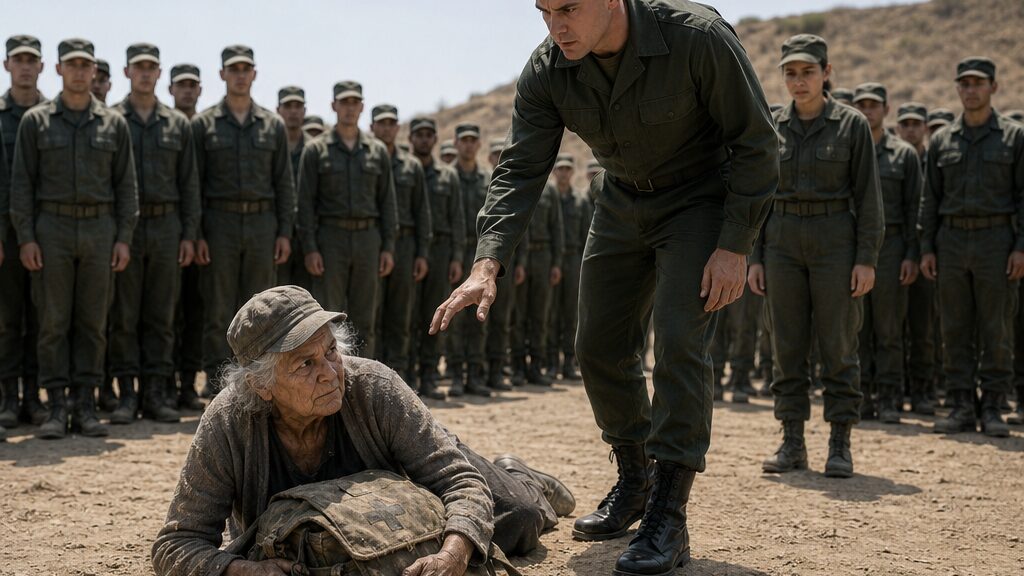
Karen Torres was already on her elbows when the first row of recruits stopped laughing.
The dirt had worked its way into the creases of her palms and the thin skin above her wrists. It clung to the sleeve of her gray cardigan, to the knees of her dark trousers, to the side of her cheek where she had turned once to breathe. Beside her, an old canvas pack scraped over the training lane with a dry, dragging sound. One strap had been repaired with brown thread. One corner was darker than the rest, as if it had absorbed years of weather and hands and things never said.
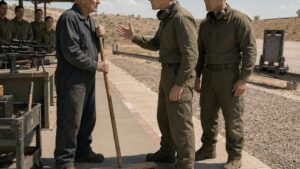
“Ma’am,” Captain Daniel Hill said, standing over her, “this is a restricted lane.”
Karen paused long enough to pull air into her chest. Behind him, two platoons stood in formation at Fort Briar’s casualty-training ground, boots aligned along the edge of the dust. The young faces watched from under caps and helmets, not sure whether the moment was punishment, mistake, or instruction.
Daniel’s uniform was clean except for a line of dust at one boot. He looked too young to Karen and too tired to be as hard as he sounded. He had the clipped patience of a man whose morning had been measured in schedules, inspection routes, and people who might judge him for anything out of place.
“You need to move off the lane,” he said.
Karen’s fingers tightened around the frayed strap of the pack.
“I am moving,” she said.
A few recruits shifted. No one spoke.
Daniel glanced toward the inspection placards set up near the medical shed, then toward the base road where a vehicle had slowed to look. His jaw tightened. Karen saw that before she saw anything else: not cruelty first, but embarrassment. Then the embarrassment hardened.
“You are disrupting a training evolution,” he said. “You came through the wrong gate, ignored the guard, and walked into a restricted area carrying unknown property.”
Karen lifted her head. Dust trembled off her chin.
“I came through the gate they told me to use.”
“The gate guard said you refused assistance.”
“He offered me a cart.”
“And you refused it.”
“Yes.”
“Why?”
Karen looked past him, toward the low rise at the center of the lane. It was hardly a hill now, only a dusty swell cut by boot tracks and littered with yellow training markers. Beyond it stood the old signboard, faded and half-covered by a newer laminated notice about heat safety and inspection procedures.
“Because a cart does not belong here,” she said.
Daniel exhaled sharply. “Ma’am, this is not a memorial walk.”
Karen placed one hand forward, then the other, and pulled herself another few inches through the dirt.
The formation changed around her without moving. Pity entered first. Then discomfort. Then something more uncertain. A woman near the second row—Private Rachel Miller, though Karen did not know her name yet—kept her eyes not on Daniel, but on the pack. Rachel had the stiff posture of someone trying to obey in two directions at once: the captain’s command and whatever her conscience had just noticed.
Daniel stepped closer.
“That’s enough.”
Karen stopped again. The breath in her chest made a faint clicking sound. Her left knee ached where it pressed into an old rut. Her back had warned her twice already not to continue. She ignored it with the old discipline of someone who knew the body always complained before it failed.
Daniel crouched suddenly and reached for the pack strap.
The movement was small. The reaction in the formation was not. A thin silence passed through the line, sharper than any order. Karen’s right hand came down over his before he could pull the pack away.
“Don’t,” she said.
It was not loud. It did not need to be. Daniel looked at her hand on his—a narrow hand, spotted with age, nails cut short, knuckles swollen—and seemed more offended by its steadiness than by the word.
“This property may need to be inspected.”
“It has been inspected enough.”
“By whom?”
Karen did not answer.
Daniel rose with the strap still partly in his grip. The pack shifted, and the flap fell open by half an inch. Dust slid off the canvas. For a moment, Karen saw the inside seam and the faded square of cloth near the fold, the place where the old marking had nearly disappeared.
Rachel saw it too.
A faded red cross, almost rubbed into nothing.
Her eyes sharpened.
Daniel tugged. Karen held.
“You’re making this harder than it needs to be,” he said.
“No,” Karen said. “You are.”
The words landed in the open space between them. A recruit somewhere in formation swallowed audibly. Daniel’s face flushed, not bright, but enough. He looked at the line of soldiers, at the medical trainer near the shed, at the vehicle still idling on the road. He had authority, but authority felt different when everyone saw it being tested by an old woman in the dirt.
“You insisted on crossing a soldier training lane,” he said, voice lower now. “Then cross it the way soldiers cross it.”
Karen looked at the ground ahead of her. The dust was familiar in the worst way. Not this dust exactly. Not this base as it stood now, with fresh paint on the shed and laminated safety cards clipped to boards. But the smell of hot canvas, dry earth, bodies under weight, the little sounds people made when they were trying not to show pain—those had not changed.
She could have said her name.
She could have said retired combat medic.
She could have said more than that.
Instead, she slid one elbow forward and pulled the pack close.
The first few feet were clumsy. Her shoe dragged sideways. The pack snagged against a clump of hardened dirt, and she had to stop, breathe, and work it loose with two fingers. The recruits watched her body betray her in small humiliations. Her shoulder shook. Her hair, thin and white beneath a plain cap, came loose near one ear. Daniel stood above her like a post planted in clean ground.
Rachel’s hands curled at her sides.
Karen felt the eyes. She had felt worse eyes. Pitying nurses. Angry mothers. Young soldiers trying not to beg. Officers who wanted reports finished before bodies cooled. The eyes on her now were only young and confused, and that made it harder.
At the midpoint of the lane, Daniel walked beside her.
“Do you know where you are?” he asked.
Karen stopped. Her cheek was close enough to the dirt that a small pebble pressed into the skin beneath her eye. She turned her head and looked up at him.
“I know this ground.”
The formation seemed to loosen by one breath.
Daniel’s expression flickered.
“What did you say?”
“I said I know this ground.”
For the first time, Daniel did not answer immediately. His eyes moved to the pack, to her hands, then back to her face. Something in him was looking for the easiest explanation and not finding one quickly enough.
Rachel took half a step before catching herself.
Daniel saw it. “Private Miller.”
Rachel snapped straight. “Sir.”
“Hold formation.”
“Yes, sir.”
But her gaze had already dropped again to the pack flap. The fall of the canvas had opened a little wider. Under the faded medic mark, another piece of stitching showed along the inner seam. The letters were not clear at first beneath the grime, but Rachel had always been good at noticing small things—the safety pin missing from a pouch, the blood-pressure cuff placed on the wrong hook, the difference between a patch sewn by machine and one sewn by hand.
She mouthed the letters once, silently.
T-O-R-R-E-S.
Karen dragged herself another foot.
Daniel stepped aside, less certain now but unwilling to show it. The recruits did not laugh anymore. They watched the old woman and the pack and the dust, and none of them knew what kind of lesson they had been given.
Rachel looked from the stitched name to Karen’s face.
Then, so quietly that only the recruit beside her might have heard, she whispered, “Torres?”
Chapter 2: The Name Under the Dust
Captain Daniel Hill filed the trespass report before anyone asked Karen Torres why she had come.
Rachel watched him do it from the edge of the medic shed, where she had been ordered to inventory training supplies as punishment for stepping out of formation by half a pace. The captain stood at a folding table with a clipboard angled against his palm. His pen moved fast. Too fast, Rachel thought, for a man recording the truth.
“Unidentified elderly civilian entered restricted casualty lane,” he said to the medical trainer, who stood beside him with a tablet. “Refused assistance. Refused to comply. Created training delay and safety risk.”
Karen sat on a metal bench ten yards away, the old canvas pack between her feet. Someone had brought her a paper cup of water. She had not touched it. Dust had settled into the seams of her cardigan and along the side of her face. She looked smaller sitting upright than she had looked crawling. That bothered Rachel more than it should have.
“Sir,” Rachel said.
Daniel did not look up. “Private Miller, you have inventory.”
“Yes, sir. But she said she knew the ground.”
Now he looked up.
Rachel knew at once she had made a mistake. Not because she was wrong, but because she had said it where others could hear. Daniel’s eyes narrowed slightly, and the medical trainer became suddenly interested in the tablet.
“Many people say many things when they’re confused,” Daniel said.
Karen turned her head.
“I am not confused.”
Her voice was dry, but it carried.
Daniel placed the pen down with care. “Ma’am, no one is accusing you of anything beyond entering a restricted training area.”
“You wrote trespass.”
“That is the administrative category.”
“You wrote unidentified.”
“You have not provided military ID.”
“I was not asked for it.”
The medical trainer shifted his weight.
Daniel’s face did not change much, but Rachel saw the pressure move through his jaw. He was a captain with an inspection coming in two days, an old woman covered in training dust, a report already half-written, and a formation of recruits who had seen too much.
“Do you have identification?” he asked.
Karen reached slowly into the pocket of her cardigan and took out a worn leather holder. She opened it but did not hand it to him. Daniel stepped forward and read.
For a moment his pen hand stopped.
“Retired,” he said.
“Yes.”
“Army medical corps?”
“Yes.”
He glanced at the pack. “Why didn’t you say that before?”
Karen closed the holder. “You asked me to leave the lane. You did not ask who taught on it.”
The words did not hit like an accusation. They hit worse, like a measurement.
Daniel looked toward the road again, toward the base buildings, toward the bright inspection banners that had been put up that morning. “Private Miller,” he said without turning. “Inventory.”
Rachel obeyed because she had been trained to obey. She entered the medic shed, but the door did not close all the way. Through the gap, she could see Karen sitting still, one hand resting on the pack as if steadying a living thing.
The shed smelled of rubber mats, antiseptic wipes, and plastic training limbs. Rachel counted tourniquets, pressure dressings, splints. Her hands moved through the work while her mind stayed outside. Torres. The name did not mean anything exactly, and yet it had struck something in her with the force of an almost-remembered song.
On the back wall of the shed, above a dented cabinet, hung a row of old photographs no one studied unless they were bored. Rachel had seen them during orientation: black-and-white training images, faded color shots from decades past, medics kneeling beside stretchers, recruits practicing carries before the current course had been standardized.
She stepped closer.
The fifth photo showed the same lane before the new shed, before the laminated signs, before the ground had been graded. A younger woman knelt beside a prone soldier, her sleeves rolled, a canvas pack open at her knee. The pack was not identical to Karen’s. It could not be. And yet Rachel’s throat tightened. Same square flap. Same side pocket. Same dark seam near the lower corner.
A paper label beneath the photo had yellowed under the glass.
Casualty Lane Training Revision, Fort Briar.
No names.
Rachel took the photo down carefully, telling herself she only needed to check the frame because dust had collected behind it. Behind the photograph, tucked against the backing board, was a brittle inventory card, probably hidden there years ago by accident or laziness.
MEDICAL TRAINING PACK, FIELD USE
LANE DEMONSTRATION SET
RETURN TO MEDIC SHED AFTER BROWN REVIEW
The word Brown seemed to rise from the card.
Outside, Daniel’s voice sharpened.
“Until this is cleared, you will not reenter the lane.”
Rachel moved back to the door.
Karen had finally lifted the cup of water, but she had not drunk from it. “Cleared by whom?”
“Command.”
“I did not come for command.”
“That is exactly the problem,” Daniel said. “You are on an active installation. There are protocols.”
Karen looked down at the pack. “There were protocols then too.”
“Then?”
She did not answer.
Rachel stepped out with the old inventory card in her hand before she could talk herself out of it. “Sir.”
Daniel turned. “Private.”
“This was behind one of the old photographs.”
He took the card, read it, and for the first time that morning, something like unease crossed his face.
Karen saw the card from the bench.
Her hand moved, barely, toward the pack.
Daniel noticed. That seemed to decide him. He clipped the trespass report to the pack strap with a black binder clip and straightened as if the act itself settled the matter.
“This pack will be held as property related to the incident until command reviews it. Mrs. Torres, you will remain off the training lane until after inspection.”
Karen looked at the report hanging from the old strap. White paper on dark canvas. Fresh ink against old dust.
“Do not call me Mrs. Torres when you mean problem,” she said.
No one moved.
Daniel’s ears reddened. “Private Miller, take that card to records. Ask whether there is a current property number. Nothing else.”
“Yes, sir.”
Rachel took the card back, but her eyes went to Karen. For one second, the old woman’s expression changed—not pleading, not grateful. Warning. As if Rachel had stepped near a closed door and Karen wanted it to stay closed.
The base records office was in a low building that smelled like copy paper and old air-conditioning. The records clerk behind the counter took the inventory card, frowned, and typed with two fingers.
“Brown Review,” the clerk murmured.
Rachel leaned forward. “Is that a person?”
The clerk did not answer at first. He clicked through another screen, then another. His face grew less bored.
“Huh,” he said.
Rachel waited, pulse tapping under her collar.
The clerk looked up from the screen. “Before they called it Casualty Lane Three, that strip had another name.”
Rachel’s hand tightened around the edge of the counter.
“What name?”
The clerk turned the monitor slightly, just enough for her to see the old scanned header.
Samuel Brown Lane.
Chapter 3: The Report That Made Her Smaller
The statement they placed in front of Karen used the word misunderstanding three times.
She counted them before she touched the pen.
Misunderstanding regarding entry point. Misunderstanding regarding restricted access. Misunderstanding regarding property handling. The language sat neat and harmless on the page, polished until no one’s hands were visible in it. Not Daniel’s hand on the pack strap. Not her hands in the dust. Not the hands of the recruits who had stayed at their sides because no order had freed them to move.
Karen sat in the administrative waiting area outside the command office with the old pack under her chair. Daniel had allowed it there only because she had refused to enter without it. Refused was his word. Declined was hers. Neither word changed the fact that two soldiers had watched as if she might steal from herself.
“You can add a note if you feel something is missing,” Daniel said.
He stood across from her, report folder tucked under one arm. His voice was more controlled now than it had been on the lane. That made it worse. Anger could sometimes be forgiven as heat. Control meant a person had chosen the shape of the harm.
Karen looked at the pen.
“What happens if I sign?”
“The incident is closed as administrative confusion. You stay clear of the lane until the inspection is complete. Command avoids escalation. You avoid formal restriction from the installation.”
“And if I do not?”
Daniel looked toward the closed door of the base commander’s office. “Then it remains open.”
“Open to what?”
“Review.”
Karen almost smiled. Almost. Review was a word people used when they wanted to bury something carefully.
She shifted in the chair and felt the catch in her hip where the crawl had punished an old injury. Beneath the chair, the pack leaned against her ankle. She reached down and wiped a small patch of dust from the lower corner with her thumb. The canvas beneath was still dark. It had always been dark there. She had cleaned that corner more times than she could count and never all the way.
Daniel watched her hand.
“Why that pack?” he asked.
Karen stopped rubbing.
“It belongs here.”
“That doesn’t answer the question.”
“It answers mine.”
His mouth tightened. “Mrs. Torres—”
“Karen.”
He paused.
“If you are going to make me smaller on paper,” she said, “do not do it with the polite name.”
Daniel looked at the statement again. For a moment, something human tried to surface in his expression. Then a door opened behind him, and he remembered where he was.
The base commander called him in first.
Karen remained in the waiting area with two chairs, a water cooler, a wall clock, and a framed poster about readiness. The poster showed a young soldier carrying another across a training field. The carried soldier’s face was turned away. The carrier looked determined and clean.
Nobody ever painted the part after determination, Karen thought. Nobody painted the shaking hands. The smell of copper. The terrible lightness of a body once the fight had gone out of it.
She looked down at the pack.
A few minutes later, Rachel appeared at the far end of the hall with the records clerk’s printed page folded in her hand. She stopped when she saw Karen.
Karen gave one small shake of her head.
Rachel stopped walking.
That was the trouble with young soldiers who still had a conscience. They thought truth was a door that should always be opened. They did not yet know some doors led to rooms full of people who could not leave.
Daniel came out of the office holding a different folder.
“Private Miller,” he said. “Why are you here?”
Rachel straightened. “Records sent over the lane reference, sir.”
“I asked for a property number.”
“They found an old lane file attached to the card.”
Daniel held out his hand. Rachel gave him the printout.
Karen watched his face when he saw the name.
Samuel Brown.
He stiffened so quickly that most people might have missed it. Karen did not. Old medics knew how a body betrayed pain before the mouth found discipline.
Daniel read only the top page. His eyes stopped halfway down. He did not turn the paper. He did not ask who Samuel was.
“You can return to your unit,” he said.
“Sir, the clerk said there may be more pages in storage.”
“Return to your unit.”
Rachel hesitated. “Yes, sir.”
When she passed Karen, the folded edge of the paper brushed her sleeve. Karen did not reach for it.
Daniel waited until Rachel was gone before speaking.
“You knew this name was in the file.”
Karen looked at him. “I knew the name before it was a file.”
His face changed again, too little for anyone who had not spent years reading men who did not want to be read.
“What was he to you?”
“A soldier.”
“That’s all?”
Karen’s gaze dropped to the statement. “No soldier is all.”
He glanced toward the office door. “The commander is scheduling a closed review tomorrow afternoon. The lane nomenclature and inspection materials were already under review before today. Your arrival complicates that.”
“Does the ground complicate it too?”
Daniel ignored that. “If this is about a memorial designation, there is a process.”
“It is not about a sign.”
“Then what is it about?”
Karen’s hand moved to the pack strap, thumb settling into the old groove where the fabric had thinned. She had promised herself on the bus that morning she would not say Samuel’s name more than necessary. She had promised herself she would not turn a mother’s grief into leverage. She had promised herself she could cross the lane, leave the pack where it belonged, and go home before anyone had to look too closely.
Then Daniel had made her crawl.
And still, the worst part was not crawling. It was how easy it would be now to make him crawl in another way.
She pushed the statement back across the table.
“I won’t sign that.”
Daniel’s face hardened with relief, as if her refusal confirmed the version of her he needed.
“Then the pack will be held until property status is verified.”
Karen’s fingers closed around the strap. “No.”
“It is tied to an open incident.”
“It is tied to a boy.”
Daniel froze.
Karen heard the word after she said it. Boy. She had not meant to let that one out. Samuel had been twenty-two and proud of his shoulders and embarrassed by how much he wrote home. He would have hated being called boy. His mother never had.
Daniel bent and lifted the report clipped to the strap. For the first time, he looked past the surface of the canvas. The flap had fallen open again. Inside, beneath the faded medic marking and the stitched Torres name, another tag lay half-hidden.
S. BROWN.
Daniel stared.
His voice was quieter when he spoke. “This belonged to him?”
Karen did not answer fast enough.
That was answer enough.
The door behind Daniel opened. The base commander stepped out, reading from a tablet.
“Captain Hill, secure the property until tomorrow’s review. We’ll keep this contained until after the inspection route is finalized.”
Karen stood too quickly. Pain struck her hip, but she kept her face still.
“Contained,” she said.
The commander looked at her with the distant courtesy of a man already thinking about the next meeting. “Ma’am, this is temporary.”
Daniel reached down.
Karen did not let go of the strap until his hand touched the place where hers had been.
Then she released it.
The pack left the floor with a dull weight, not heavy enough for what it carried. Daniel handed it to the soldier at the door.
“Temporary storage,” he said. “Unverified property.”
Karen watched the old canvas disappear down the hallway with a fresh white report still clipped to its strap, and for the first time since the dirt, she looked afraid.
Chapter 4: The Lane They Wanted Clean
Karen reached the old lane marker just as two workers lifted it out of the ground.
The sign came free with a dry wooden groan, its posts leaving two narrow wounds in the dust. One worker carried it under his arm as if it were scrap from a shed. The faded lettering faced Karen for only a second before turning away, but she saw enough: the ghost of old paint beneath newer layers, the shape of words half-covered by years of official corrections.
“Wait,” she said.
The workers did not stop. They looked instead toward Captain Daniel Hill, who stood near the inspection route with a clipboard pressed against his side.
Karen crossed the last few yards slowly, her hip catching with each step. Without the pack in her hand, her balance felt wrong. Her body had arranged itself around that weight for so long that its absence made the air beside her seem hollow.
Daniel stepped between her and the workers.
“This area is being prepared for inspection.”
“It was prepared before you were born,” Karen said.
His face tightened. “That sign was outdated.”
“It had a name.”
“It had several names. The current designation is Casualty Lane Three.”
Karen looked past him as the workers carried the sign toward a maintenance cart. Dust dropped from the lower edge in a thin trail.
“Names are not clutter.”
Daniel lowered his voice. “You are not authorized to be here this morning.”
“I was told to stay off the lane until review. I am off the lane.”
“You’re interfering with preparation.”
Karen turned her eyes to him then. She saw the clean uniform, the shaved jaw, the clipboard held like a shield. She also saw the slight shadows under his eyes. He had not slept well. Men who were only cruel slept better than that.
“What are you afraid the inspection officer will see?” she asked.
Daniel’s mouth opened, then closed.
Behind them, recruits were being moved through a shortened heat-casualty drill. No pack carries today. No dust crawls. No long approach to the low rise. Just clean demonstrations near the shed, where the ground had been swept and the training mannequins had been lined in rows.
“Real inspection means real training,” Karen said.
“You’re not in a position to evaluate my lane.”
“No,” she said. “I am in a position to remember it.”
A whistle blew. The medical trainer called for the next rotation. Recruits moved in pairs, kneeling beside training dummies, speaking rehearsed words in rehearsed voices. Daniel looked toward them, visibly grateful for the interruption.
Karen followed his gaze.
One recruit near the end of the line moved too fast in the heat. His knees hit the ground hard beside a dummy. He fumbled with a strap, blinked, and wiped his mouth with the back of his hand. The medical trainer kept speaking.
Karen took one step forward.
The recruit swayed.
“Stop him,” she said.
Daniel glanced at her. “They’re fine.”
“Stop him.”
The recruit stood with the dummy’s strap in hand and turned pale beneath his cap. His partner laughed once, uncertain, thinking it was part of the exercise. Then the recruit’s knees softened.
Karen was already moving.
Not fast. She could not be fast anymore. But the shape of the motion was old and exact. Her hand lifted before she reached him, palm down, signaling the partner back. “Sit him. Not flat. Shade his neck.”
The medical trainer looked startled, then saw the recruit’s face and moved.
Daniel caught Karen by the arm before she crossed fully into the lane. “I said you’re not authorized.”
Karen looked at his hand. He released her, but too late to pretend he had not done it.
The recruit was lowered to the ground. The medical trainer knelt beside him. Water came. A cooling towel came. The partner stopped laughing.
Karen stayed where Daniel had stopped her, breathing through the pain in her hip.
“That,” she said, “is why the lane was never supposed to be clean.”
Daniel watched the recruit recover enough to answer questions. His face had lost some color. For one moment, Karen thought he might ask.
Then a vehicle with an inspection placard rolled past the far road, and the moment shut inside him.
“You are barred from tomorrow’s closed review,” he said.
Karen turned slowly.
Daniel did not look at her. “Your presence is becoming disruptive to training and preparation. Command will review the property and lane history without additional interference.”
“Property,” she repeated.
“The pack is secure.”
“Secure from whom?”
His eyes came back to hers. “From becoming part of an uncontrolled scene.”
The words told her enough. He thought she wanted spectacle. He thought old people came back to military posts because they wanted someone to stand, salute, and make their endings clean. She had known veterans like that. Some deserved every ceremony they never received. But that was not why she had come.
“The first uncontrolled scene happened when no one listened,” she said.
Daniel’s gaze sharpened.
“What does that mean?”
Karen almost answered.
There were ways to cut a man with truth. She had used scalpels, not knives, and she knew the difference. Behind Daniel’s hard face, something had already flinched at Samuel’s name. Something with the shape of family. Something inherited and not chosen, perhaps, but held too tightly now.
She said only, “Ask your files.”
Daniel’s silence followed her as she turned away.
The records office was dim after the brightness of the lane. Rachel Miller stood near the counter, helmet tucked under one arm, trying not to look like a private doing something above her rank. The records clerk had a box open between them and the weary look of a person who had touched paper old enough to cause trouble.
When Karen entered, Rachel stiffened.
“Ma’am.”
Karen stopped at the doorway. “You should be with your unit.”
“I know.”
“Then go.”
Rachel’s face flushed, but she did not move. “They’re taking the sign down.”
“I saw.”
“They’re renaming the training block for the inspection.”
Karen looked at the box. “That is not your burden.”
Rachel reached into the papers and withdrew a thin sheet sealed in a plastic sleeve. Her hands were not steady now.
“The clerk found this in the lane file,” she said. “It was misfiled under heat casualty revisions.”
Karen did not need to see the signature to feel the room narrow around her.
Rachel turned the page enough for Karen to read the old header.
Medic Safety Advisory. Fort Briar Casualty Lane. Submitted by Specialist Karen Torres.
Below it, in faded type, were the warnings Karen had written when her hands still shook too badly to sleep: reduce timed carries during high heat, require buddy checks before low-crawl evacuation drills, never treat a downed trainee as an obstacle to complete the lane.
Rachel’s voice dropped. “You warned them.”
Karen looked at the paper, then at the young woman holding it as if it might burn.
“Not loudly enough,” Karen said.
Rachel glanced toward the bottom of the page. Her mouth tightened around the next words.
“There’s a response attached. It was dismissed by a training officer.”
Karen did not ask whose name was on it.
Rachel looked up anyway.
“The signature line says Hill.”
Chapter 5: The Promise Inside the Pack
Karen broke the storage-room seal with the edge of a chapel key she had no right to use.
The strip of red plastic snapped softly, almost politely, and dropped against the metal door. For a second she stood still in the service hallway behind the chapel, listening for boots, voices, anything that would give her time to change her mind. Nothing came except the low hum of a vending machine and the distant cadence of recruits crossing the evening road.
Rachel stood behind her with the old memo folded inside her blouse pocket.
“Ma’am,” she whispered, “this is going to make it worse.”
Karen put the broken seal in her cardigan pocket. “It already is.”
The room smelled of floor wax, canvas, and cold concrete. Temporary storage was a narrow place with gray shelves and tagged property bags. The old pack sat on a lower shelf beneath a white evidence-style label that made Karen’s mouth harden.
UNVERIFIED PROPERTY.
She knelt slowly, using the shelf for balance. Her hip protested. Her hands did not.
Rachel moved as if to help, then stopped. She had learned something since the lane.
Karen drew the pack toward her. The canvas made the same dry scrape it had made in the dirt, and the sound opened a place in her chest she had spent years keeping closed. She unfastened the flap.
There were no medals inside. No folded flag. No framed photograph meant to prove anything to anyone.
Rachel leaned closer and saw plain things: a cracked field stethoscope, two old triangular bandages, a rusted buckle wrapped in cloth, a training tag with Samuel Brown’s name, a faded casualty card, and a small roll of tape that had yellowed at the edges. Each item had been wrapped, unwrapped, and wrapped again so many times that the cloth held the shape of Karen’s fingers.
“This was his?” Rachel asked.
“The pack was assigned to the lane,” Karen said. “Then to me. Then to him for training. Then to no one.”
Rachel waited.
Karen touched the training tag but did not pick it up. “Samuel Brown wrote his mother every Sunday. Even in the field. Even when he had nothing to say but that he had eaten and his socks were dry.”
A small sound came from Rachel. Not a question. Just the beginning of one.
“He was not famous,” Karen said. “He was not the best. He complained about the heat. He taped his boots wrong. He was kind to men who mocked him for it.”
The hallway outside remained empty.
Rachel looked at the cracked stethoscope. “What happened?”
Karen’s fingers closed around the edge of the flap.
A more generous woman might have answered. A braver one might have opened the whole wound and let the young soldier see what rushing looked like when it stopped being a training metric and became a body that did not rise. Karen had spent years calling her silence mercy. Some days it was. Some days it was only fear with better posture.
“He went down on this lane,” she said. “Not in combat. Not under fire. In training. Heat, speed, bad judgment, pride. Things men call accidents after they finish ignoring warnings.”
“And you were there?”
“I was the medic who reached him.”
Rachel’s eyes dropped to the old memo hidden in her pocket.
Karen saw the movement. “Do not make a weapon out of that paper.”
“Ma’am, Captain Hill barred you from the review. He’s using procedure to erase what happened.”
“He is not the first.”
“That doesn’t make it right.”
“No,” Karen said. “It only makes it old.”
Rachel’s frustration cracked through her discipline. “Then why protect him?”
Karen looked up.
The question hung between them, young and sharp. Karen had once asked the same kind. Why protect men who wrote bad orders? Why protect officers who called grief unprofessional? Why protect the living from the truth when the dead had no protection at all?
She reached deeper into the pack and took out a folded envelope, softened at the corners. Rachel saw the handwriting before Karen drew it back.
To Samuel’s mother.
Rachel’s face changed. “You wrote to her?”
“I tried.”
“You never sent it?”
Karen slipped the envelope beneath the bandages again. “I went instead.”
The hallway seemed to narrow. Outside, a cadence call rose, then faded.
Karen’s voice lowered. “She did not ask me for a report. She did not ask who signed what. She asked me one thing.”
Rachel did not move.
“She asked if he had been treated like a burden.”
Karen shut her eyes once. Not long. Long enough to see a woman’s hands folded around a teacup she never drank from. Long enough to hear herself, younger and still smelling of antiseptic, promising what no one had given her authority to promise.
“I told her no,” Karen said. “Then I promised this lane would teach the opposite.”
Rachel’s throat moved. “That’s why you came back.”
“They were taking the name off the lesson. Turning it into clean movement and inspection language. Samuel would have disappeared into ‘updated training module.’”
“So tell them.”
Karen gave a tired smile with no warmth in it. “You think telling fixes forgetting.”
“It can start.”
“It can also shame people who inherited names before they inherited choices.”
Rachel knew then Karen had seen the signature. Hill. Not Daniel, maybe. A father, an uncle, some older officer whose ink still lived in the file. But Daniel carried the name now with the tense shoulders of someone who had been taught that family reputation was another uniform.
A sound came from the doorway.
Daniel stood there.
His eyes went first to the broken seal, then to the open pack, then to Karen kneeling on the floor with Samuel’s tag beneath her hand.
For once, he did not speak immediately.
Rachel straightened. “Sir, I—”
“Do not,” he said.
Karen began placing the items back into the pack one by one.
Daniel stepped into the room. “This is secured property tied to an open review.”
“It is a pack,” Karen said.
“It is evidence now.”
She looked at him. “Of what?”
His jaw worked. “Tampering, if command wants to make it that.”
Rachel’s hands curled.
Karen fastened the flap. Her thumb paused over the frayed strap Daniel had grabbed on the lane. “Then write another report.”
Daniel’s face tightened, but there was no satisfaction in it. Only pressure. The kind that came from a door closing behind a man who could still choose not to lock it.
“You will be permitted at the review tomorrow,” he said.
Rachel’s head turned sharply toward him.
Karen waited.
Daniel looked at the open shelf, the broken seal, the old pack. “You will sit in the designated area. You will not address the formation, the inspection officer, or command unless asked a direct question. You will not introduce unauthorized documents. You will not turn this into a public accusation.”
Karen rose slowly, using the shelf.
“And if I speak?”
His eyes met hers.
“Then I will have you removed.”
Rachel whispered, “Sir—”
Daniel cut her off without looking away from Karen. “You wanted the lane reviewed. It will be reviewed. But you will attend it silently.”
Karen lifted the pack from the shelf and held it against her side for one breath before Daniel reached for it.
This time, she let him take it.
But as his hand closed over the strap, she said, “Silence is not the same as agreement, Captain.”
Daniel held the pack between them.
“No,” he said. “But tomorrow it may be the condition for your being in the room.”
Chapter 6: The Review Before the Formation
Captain Daniel Hill introduced Karen Torres as “the civilian involved in yesterday’s incident” while her old medic pack sat on the review table between them, still dusted from the lane.
The words moved through the assembled recruits with no visible reaction, but Karen felt them land. Civilian. Incident. The clean language had returned in dress uniform. Daniel stood near the table, shoulders squared, report folder beneath his hand. The base commander stood to one side with the inspection officer and the medical trainer. Rachel was in the first row of formation, chin level, eyes fixed on the pack.
Karen sat in the chair assigned to her at the edge of the training lane. Not at the table. Not with the reviewers. Close enough to see the frayed strap, far enough to be reminded that permission had boundaries.
Daniel continued.
“The event raised questions regarding restricted-lane access, property handling, and historical nomenclature. We will address those questions briefly before resuming inspection preparation.”
Briefly, Karen thought. The army had always been good at asking grief to fit inside available time.
The base commander nodded toward the table. “Captain Hill, summarize.”
Daniel opened the folder. His report lay on top, the same white pages clipped and neat. Beneath it, Karen could see the old memo in its plastic sleeve. Rachel must have found a way to submit it. Karen looked at her.
Rachel’s face held a plea and an apology at once.
Daniel saw the exchange. His mouth tightened.
“The individual entered the lane with an unverified pack containing outdated medical training materials and personal effects linked to prior training files,” he said. “The previous lane name, Samuel Brown Lane, appears in older records. Current records reflect Casualty Lane Three.”
“Who was Samuel Brown?” the inspection officer asked.
Daniel hesitated.
Karen felt the air change.
Rachel shifted in formation, almost stepping forward. Karen lifted one hand from the arm of her chair and placed it on the table’s edge, not touching the pack but close enough for Rachel to see.
Stay.
Rachel froze.
Daniel looked at Karen then, and something passed between them that was not forgiveness, not understanding, but recognition of a choice being made in real time. He could still answer with the thinnest version. He could make Samuel a file number. He could make Karen a disruption. He could make the inspection officer impatient and move them all along.
“Samuel Brown was a trainee,” Daniel said. “He died after a heat-related collapse during an earlier version of this lane.”
The commander looked down. The medical trainer’s face tightened.
The inspection officer turned toward the old memo. “And this advisory?”
Daniel’s hand rested on the folder. “Submitted by then-Specialist Karen Torres, Army medical corps.”
For the first time, he said her name correctly in front of them.
Karen stood.
The chair legs made a short scrape against the ground. Daniel’s eyes sharpened at once.
“Mrs. Torres,” he said quietly.
“Karen,” she said.
The correction was not loud. It did not have to travel far. It still reached the formation.
Daniel lowered his voice. “You agreed—”
“I agreed not to accuse.”
The commander looked from Daniel to Karen. “Ma’am, if you have a brief clarification—”
“I was a medic on this lane,” Karen said.
The words were plain. They had no decoration. That was why they held.
She stepped toward the table. Her body objected, but not enough to stop her. The recruits watched, and she thought of them watching her in the dirt, how young pity could become either memory or habit depending on what was done with it.
“I did not come here for a ceremony,” she said. “I did not come for a correction to my name. I came because that pack was assigned to a lesson this place used to teach.”
She placed her hand on the frayed strap.
Daniel looked at the hand. He remembered gripping that same strap. She saw it in his face.
The inspection officer asked, “What lesson?”
Karen looked at Samuel’s training tag beneath the loosened flap. She did not open the pack. Not yet.
“That a body on the ground is not an obstacle,” she said. “Not in training. Not in war. Not when it slows your time. Not when it embarrasses your command. Not when it belongs to someone old enough to be inconvenient.”
No one spoke.
Daniel’s report lay under his hand. The old memo lay beneath it, waiting like a blade. Karen could have reached for it. She could have read the attached dismissal. She could have said the name Hill and watched Daniel take the blow meant for a man who was not standing there. It would have been easy in the terrible way easy things sometimes are.
Rachel’s eyes flicked to the folder.
Karen saw the hope there. Use it, the young woman’s face said. Make them listen.
Karen kept her hand on the pack.
“When Samuel Brown went down,” she said, “there were warnings before it. Mine were among them. Others too. Some written. Some spoken. Some ignored because training was behind schedule and men did not like being told to slow down.”
Daniel’s face went pale.
Karen did not look at him.
“I reached him,” she said. “I did not save him.”
The words left no drama behind them. Only space.
The base commander removed his cap.
Karen heard Rachel breathe in and hold it.
“His mother asked me if he had been treated like a burden,” Karen continued. “I told her no. I told her soldiers carried soldiers. Then I came back here and helped build a lane where every recruit had to learn that before they learned speed.”
The medical trainer lowered his eyes.
“That pack stayed with the lesson,” Karen said. “It was never supposed to prove anyone important. It was supposed to remind people that the person you carry is not equipment.”
The inspection officer looked toward Daniel. “Why was the lane name removed?”
Daniel’s hand tightened on the folder.
Karen could feel the old memo beneath his report as if her own palm rested on it. Daniel’s family name was there. The dismissed warning. The old arrogance. The inheritance of paper. She saw in his face that he knew she knew.
He waited for her to use it.
She did not.
“Names get removed when they make rooms uncomfortable,” Karen said. “That is not one man’s fault. But keeping them removed is a choice.”
Daniel looked at her then, fully.
There it was—the surprise she had not meant to give him. Not mercy exactly. Mercy was too high a word. She only refused to do to him what had been done to her: reduce a person in public to the smallest useful version.
The commander cleared his throat. “Captain Hill, your recommendation?”
Daniel did not answer.
The inspection officer waited.
Rachel stood so rigid that Karen feared she might faint before any recruit did.
Daniel looked down at his report. The fresh pages, the official words, the harmless repetitions: misunderstanding, disruption, unidentified. His thumb moved once over the corner.
Then he lifted the report from the folder.
For a second, Karen thought he meant to read it.
Instead, he removed the clip, separated his report from the old memo, and set his own pages facedown on the far side of the table.
The sound was small. The choice was not.
He looked at Karen, and there was no polish left in his voice.
“What was the lane supposed to teach?” he asked.
Chapter 7: What the Dust Was Supposed to Teach
Karen returned to the lane one week later and found no chairs, no podium, no folded program, no ceremony waiting to make the living feel better.
That almost made her turn around.
Then she saw the recruits.
They were kneeling in pairs along the restored casualty lane, not in polished rows for inspection, but low in the dust, hands placed carefully beneath shoulders and knees, learning how to lift a downed body without jerking it like equipment. The medical trainer moved among them, correcting grip and pace. No one barked for speed. No one called the person on the ground an obstacle. Beside the low rise, a smaller version of the old sign had been set back into the dirt.
Samuel Brown Lane Training Point
Carry the soldier. Learn before you hurry.
Karen stood at the edge of the lane with both hands around the handle of her cane.
The words were plain. Maybe too plain. Maybe exactly plain enough.
Dust lifted around the recruits’ boots and settled on their knees, their sleeves, their palms. One recruit lay still while another practiced rolling him with care. The one playing casualty started to laugh, then stopped when the medical trainer said quietly, “If he cannot help you, you still owe him patience.”
Karen looked away.
The old pack was not with her. That had been the arrangement, or almost the arrangement. It waited inside the training room until she decided whether it would stay. Daniel Hill had sent the message through the records clerk, not through Rachel: Mrs. Torres may review the proposed placement before final approval. Karen had read the line three times, then folded it into her purse.
Mrs. Torres.
Still wrong, but no longer used to make her smaller.
Rachel saw her first. She was standing beside a pair of recruits, helmet under one arm, watching the drill with a seriousness that made her look older than she had a week before. When her eyes found Karen, she did not wave. She only straightened, then walked over.
“Ma’am,” Rachel said.
Karen looked at the dust on Rachel’s trousers. “You were allowed to train?”
“Yes, ma’am.”
“Not punished?”
Rachel glanced toward the shed. “Not the way I expected.”
“That is not an answer.”
“No, ma’am.” A small, nervous smile touched her mouth and left. “Captain Hill said if I was interested in old lane procedure, I could start by learning current lane procedure correctly.”
Karen studied her. “That sounds like him trying to call discipline something else.”
“I think it was both.”
That was honest enough.
Across the lane, Daniel stood near the restored sign with the base commander and the inspection officer. He was not smiling. He did not look relieved. When he saw Karen, his shoulders shifted once, as if he had prepared himself and still found the preparation lacking.
He walked toward her alone.
Rachel stepped back, not far, but enough.
“Karen,” Daniel said.
The name stood bare between them. No title to hide in. No ma’am to soften it.
Karen inclined her head.
He looked toward the recruits, then back at her. “The training order was changed yesterday. Heat checks before every timed carry. No low-crawl casualty movement without buddy confirmation. The old advisory is attached as historical reference.”
Karen waited.
Daniel swallowed once. “Samuel Brown’s name is restored to the lane lesson. Not the whole course. Just the point tied to casualty handling and heat discipline.”
“That is where it belongs,” Karen said.
“I know that now.”
She did not help him with the silence that followed.
Daniel’s hands were at his sides. He looked like a man trying not to fold a report he was not holding. “I owe you an apology.”
Karen watched two recruits practice the carry again. The one lifting moved too quickly. His partner said, “Slow,” and he did.
Daniel saw her see it.
“I saw an old woman where I should have seen a soldier,” he said. “And when you made me feel unsure in front of my formation, I chose control over respect.”
Karen looked at him then.
His face had none of the public hardness from the first day. It also had none of the clean satisfaction of a man who believed one apology settled the account.
“My family name was on that dismissal,” he said.
“Yes.”
“You could have read it out.”
“Yes.”
“Why didn’t you?”
Karen rested both hands on the cane. The answer had seemed clearer at the review than it did now. At the review, mercy had been action. Here, in the quieter aftermath, it felt more complicated.
“Because shame teaches badly when it is the only lesson,” she said.
Daniel lowered his eyes.
“That does not mean you were spared,” Karen added. “It means you are responsible for what you do with the chance.”
He took that as he should have, without gratitude.
“The pack is inside,” he said. “Nothing has been finalized.”
The training room had been rearranged since Karen last saw it. The old photographs remained on the wall, but the fifth frame had been cleaned, and beneath it sat a narrow display case with no glass top yet. The pack rested on a plain table beside the cracked stethoscope, the training tag, the old casualty card, and a small printed note explaining that the items were training materials retained for instruction.
Karen stood in the doorway.
Her first instinct was anger.
Not because they had handled it badly. Because they had handled it carefully. That made the leaving harder.
The canvas looked smaller on the table than it had in her hands. Without the weight against her side, it could have been only an old object. A museum thing. A lesson thing. Something people could look at and leave behind.
Karen stepped close and touched the strap.
The frayed groove met her thumb as it always had.
Rachel remained near the door. Daniel stood outside in the hall, giving her the room. That, too, was new behavior. Karen wished she disliked it more.
“They want to put it at eye level,” Rachel said softly. “So recruits see it before the lane.”
Karen nodded but did not speak.
In the quiet, she saw Samuel at twenty-two, rolling his eyes when she corrected his boot tape, grinning when he got a carry right, writing his mother on paper balanced over his knee. She saw him as he had been on the lane. She saw his mother’s hands around the untouched teacup. She saw herself, younger and so certain that carrying the pack meant keeping the promise alive.
Maybe it had.
Maybe it had also let her punish herself in a way no one could question because it looked like loyalty.
Rachel came closer, stopping a step away. “May I?”
Karen looked at her.
Rachel’s hand hovered near the pack, not touching.
“For the case,” Rachel said. “Just one step.”
Karen almost said no.
The word rose from old habit, from fear, from the sharp need to keep one thing in the world where she had placed it. Her hand closed tighter around the strap. The canvas bunched under her fingers.
Rachel waited.
That was what changed it. She did not reach. She did not ask again. She did not turn Karen’s grief into a test of generosity.
Karen released the strap.
She nodded once.
Rachel lifted the pack with both hands. Its weight surprised her; Karen saw that in the slight bend of her arms. Rachel carried it one step to the display case and set it down carefully, not as evidence, not as a relic, but as something borrowed from someone still in the room.
Karen let out a breath she had not known she was holding.
Daniel appeared in the doorway but did not enter. “The wording can still be changed.”
Karen looked at the note beside the pack.
Samuel Brown Lane Training Point. This pack reminds every soldier: the person you carry is never a burden.
She touched the edge of the paper.
“Leave it,” she said.
Outside, the drill ended without command ceremony. Recruits dusted off their knees. One helped another stand. The restored sign remained low in the ground, not grand, not polished, just present.
Karen walked back to the lane alone.
At the edge of the dust, she paused and looked down at her shoes. Some of the first day’s dirt was still caught along the seam near one sole, or maybe it was new dust. It did not matter. The ground had never been clean. It was not meant to be.
Behind her, in the training room, the old canvas pack stayed where young soldiers would have to meet it before they crossed the lane.
Karen stepped onto the road with dust on her shoes and nothing in her hands.
The story has ended.