They Treated Her Old Leather Case Like Evidence, Then Found The General Inside It
Chapter 1: The Visitor Badge On The Wrong Woman
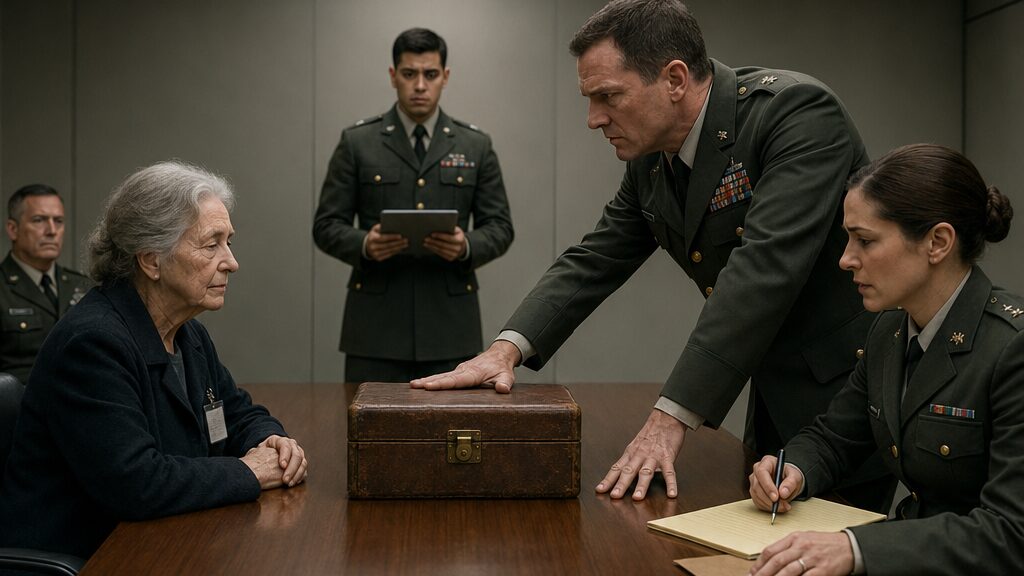
Colonel Anthony Baker put his palm on the old leather case before Carolyn Mitchell could open it.
The sound was small, just skin against worn brown leather, but it changed the room. The brass clasp gave a faint click under the pressure. Across the long table, two background officers stopped shifting in their chairs. Samantha Lewis paused with her pen hovering over a legal pad. A young records officer near the wall lowered his tablet slightly, as if the case itself had become more interesting than the woman who had carried it in.
Carolyn kept both hands folded on the table.
The visitor badge clipped to her dark coat hung crooked, its plastic sleeve cloudy from being handled at the front desk. The security clerk had written her name in black marker beneath the printed word VISITOR, then had asked twice whether she needed assistance finding the elevators.
She had said no.
Now she sat in a conference room with no windows, beneath a framed photograph of the base from a decade she remembered too well, and watched a colonel nearly thirty years younger hold her case in place as if it might flee.
“Mrs. Mitchell,” Anthony said, making the name sound procedural, “before anything comes out of this case, I need you to understand the nature of this review.”
“It was explained to me,” Carolyn said.
His eyes flicked to the badge. “By whom?”
Carolyn looked at the case, then back to him. “The invitation came from this command.”
Anthony’s jaw tightened. His dress uniform was immaculate, every ribbon straight, every crease controlled. He carried himself like a man who had learned that order could protect him from embarrassment if he applied enough of it to other people.
“That is part of the issue,” he said. “The current guest system does not show you as a cleared attendee for tonight’s anniversary ceremony. It shows you entered this morning as a visitor seeking an administrative appointment.”
“That is also true.”
Samantha’s pen touched paper.
Anthony leaned back only enough to take Carolyn in more fully: gray hair pulled back without ceremony, lined face, steady eyes, practical black shoes under the chair, coat buttoned high despite the room’s stale heat. Nothing about her announced importance. Nothing about her asked for it.
That seemed to bother him.
“You understand why we have to be careful,” he said. “This week brings former officials, donors, veterans’ families, press, and senior command staff onto the installation. We have already had three people attempt to attach themselves to the ceremony guest list using outdated correspondence.”
“I am not attached to it,” Carolyn said. “I was invited.”
“Then we will verify that.”
“You can check the name again.”
Anthony’s hand remained on the leather case.
Carolyn could feel the old habit in her shoulders: remain still, let the room speak first, do not spend authority on pride. Once, that habit had steadied rooms with maps on walls and casualty numbers arriving by the hour. Here, in a smaller room with polished chairs and stale coffee, it had a different effect. Her silence was being measured and found inconvenient.
Samantha set her pen down. “Ma’am, do you have the invitation with you?”
Carolyn nodded toward the case. “Inside.”
Anthony lifted his hand halfway, then stopped. “Before we open it, I want to establish chain of custody.”
A corner of Carolyn’s mouth moved, not quite a smile.
Anthony saw it. “Is something amusing?”
“No, Colonel.”
“Then why the expression?”
“I was remembering another room where people also wanted the papers in the right order.”
The answer did not help her.
Anthony glanced toward the young records officer by the wall. “Garcia, pull up the visitor log and the anniversary attendance list again.”
“Yes, sir.” Jacob Garcia tapped quickly at his tablet.
The room settled into the thin silence of electronic searching. Carolyn looked past Anthony to the wall photograph: rows of buildings, a training field, a flagpole caught at noon. The base had grown since then. New glass, new signs, new layers of command memory placed over old ground. But some of the older buildings remained. She knew which one had held the temporary operations cell. She knew where the communications trailer had sat before the renovation erased it.
She had not come to remember the building.
She had come because a name was wrong.
Anthony turned a paper toward Samantha. “This is what we have. Carolyn Mitchell. Visitor appointment, records correction office, zero-nine-hundred. No listed sponsor. No VIP flag. No ceremony access.”
“I did not ask for VIP access,” Carolyn said.
“Yet you requested a records correction during anniversary week.”
“It was the date your office gave me.”
“You expect me to believe that was coincidence?”
Carolyn lowered her gaze to the case. The leather was cracked near the handle. The brass clasp had darkened where her thumb had touched it for years. It had belonged to no museum, no display, no aide. It had sat in closets, under beds, beside hospital chairs, in the trunk of a car during moves she had not wanted to make. It held less paper than memory, and memory weighed more.
“I expect you to verify before deciding,” she said.
Samantha’s pen stopped again.
Anthony looked at her. “Major Lewis?”
Samantha slid a hand across the table. “May I see the invitation first, Colonel? Without removing anything else from the case.”
Anthony hesitated, then released the case with a small, unwilling movement. Carolyn opened the clasp. The old brass gave a dry click that seemed louder than it should have.
Inside, the papers were arranged in labeled sleeves. Not messy. Not desperate. Carolyn removed a cream-colored envelope and placed it on the table.
Samantha leaned closer.
The envelope had no modern glossy letterhead. Its paper was heavy, almost formal, with an embossed seal faintly visible above Carolyn’s typed name. Samantha angled it toward the light.
Anthony noticed her expression change.
“What?” he asked.
“This seal,” Samantha said carefully. “It is not the current command seal.”
“I know that,” Anthony replied.
“No,” Samantha said. “It is older than that. This is the pre-reorganization seal. We stopped using it before the consolidation.”
Anthony reached for the envelope. Samantha let him take it, but her eyes remained on Carolyn.
Anthony read the first page, then the second. His brow lowered.
“This states you were requested to attend a preliminary review concerning Operation North Pass and a casualty record amendment,” he said.
Carolyn said nothing.
“Who sent this?”
“The signature is on the second page.”
Anthony looked. “The signature block is administrative. It does not name an individual sponsor.”
“That is how those requests sometimes come.”
“Not anymore.”
“No,” Carolyn said. “Not anymore.”
Jacob cleared his throat softly near the wall. “Sir?”
Anthony turned. “What is it?”
Jacob held the tablet closer to his chest as if the device had suddenly become fragile. “The anniversary list still does not show Mrs. Mitchell as a guest. But the records request is real. It was entered six weeks ago.”
Anthony’s face hardened. “By whose office?”
“That is where it gets strange.”
The background officers shifted again.
Jacob swallowed. “The sponsor field is blocked. I cannot open it with standard records access.”
Anthony stood straighter. “Blocked how?”
Jacob tapped once, then twice. “Archived clearance code. Not active classification, exactly. More like a legacy lock.”
Samantha looked from the tablet to Carolyn.
Anthony said, “Read the code.”
Jacob hesitated. “Sir, I have never seen this prefix.”
“Read it.”
Jacob’s voice came out quieter than before.
“Command Eyes Only. Retired authority hold. Code C-M-Three.”
The room went still.
Anthony stared at the tablet as if the device had insulted him. Samantha’s pen lay forgotten beside her pad. The two background officers watched Carolyn now, not the case.
Carolyn did not move.
Anthony’s eyes returned to her visitor badge, to the hand-lettered name beneath the printed word, then to the old leather case sitting open between them.
“Mrs. Mitchell,” he said slowly, “what clearance code is attached to your file?”
Carolyn folded her hands again.
“You can check the name again,” she said.
Chapter 2: The Case They Would Not Let Her Open
Anthony Baker did not like the way the room had begun waiting for the old woman to speak.
The clearance code sat on Jacob Garcia’s tablet like a stain no one could wipe away. Command Eyes Only. Retired authority hold. Code C-M-Three. It was the kind of phrase that belonged in old binders, sealed archives, and offices where senior officers lowered their voices. It did not belong beside a visitor badge and a woman in a plain dark coat.
Anthony took the tablet from Jacob and looked at the screen himself.
The code remained there.
He handed it back with more force than necessary. “Legacy records produce legacy errors.”
Samantha Lewis looked up. “They can. But not usually with restricted prefixes.”
Anthony ignored the caution in her voice. Tonight’s anniversary ceremony had been planned for months. The auditorium seats were tagged. The program had been approved. Families were coming. Retired commanders, donors, press staff, regional officials. A clean event. A disciplined event. His event, though no one had said it that bluntly.
The last thing he needed was an elderly visitor with sealed papers and a clearance code no one in the room understood.
He looked at Carolyn Mitchell. “I am going to open the materials in this case for review. Before I do, you need to understand that knowingly presenting false, altered, or misrepresented military documents can lead to formal reporting.”
Carolyn’s gaze rested on him, steady but not challenging.
“I understand false documents,” she said.
Anthony waited for more.
She gave him nothing.
He reached for the leather case. This time she did not move to help. Her hands stayed folded, the skin thin over the bones, the fingers slightly bent with age. That stillness irritated him more than resistance would have.
He opened the case wider.
Inside were folders, envelopes, and one sealed packet wrapped in protective paper. Everything was old but precise. The labels were handwritten in small block letters. Dates. File numbers. Initials. Not the frantic collection of a person trying to prove a fantasy. That was worse. Fantasies were easy to dismiss. Order required explanation.
Anthony removed the first sleeve.
Samantha leaned closer. Jacob stood behind her with the tablet, trying to see without appearing eager.
Anthony read aloud only the header. “Operation North Pass. After-action correspondence. Restricted historical review copy.”
One of the background officers muttered, “North Pass?”
Samantha shot him a glance, and he fell silent.
Anthony opened the sleeve. Redactions cut across the page in thick black bars. Some paragraphs were reduced to fragments: convoy delay, evacuation window, signal intercept, civilian corridor, casualty discrepancy.
He flipped to the next page.
More redactions.
At the bottom, a note had been stamped in faded ink: REVIEW PENDING AUTHORITY CONFIRMATION.
Anthony seized on it. “This was never finalized.”
“No,” Carolyn said.
“Then why bring it here as if it proves anything?”
“I brought it because it was never finalized.”
The sentence was quiet, but it landed harder than he wanted it to.
Samantha wrote that down.
Anthony looked at her. “Major.”
She stopped writing.
He lifted another page, turning it toward Carolyn. “This operation is more than twenty-five years old. The base has undergone two reorganizations since then. If there was a legitimate correction, there were channels.”
“There were channels,” Carolyn said.
“And yet you waited until anniversary week?”
“I requested the review when I learned the ceremony program had been drafted.”
Anthony frowned. “How would you know the contents of a draft program?”
Carolyn’s eyes shifted, just for a moment, toward the leather case.
Anthony caught it. “Is there something else in there?”
“Yes.”
“What?”
“The reason I came.”
He almost laughed, but the sound would have made him look less controlled, so he swallowed it. “That is not an answer.”
“It is the only one I can give before the file is verified.”
Anthony placed the page down sharply. “You are not in a position to dictate sequence.”
Carolyn looked at his hand on the paper. “No.”
Again, that almost-smile, not amused. Remembering, perhaps. Judging, perhaps. He disliked not knowing which.
Jacob shifted near the wall. “Sir, may I cross-check the operation date?”
Anthony nodded without looking at him.
Jacob tapped. The tablet’s faint clicks filled the room.
Carolyn said, “It was the seventeenth.”
Anthony looked up. “Excuse me?”
“The evacuation window,” she said. “It opened on the seventeenth. The first draft will say the sixteenth because that was the planning date. The execution log should correct it.”
Jacob’s fingers froze.
Samantha’s head lifted slowly. “The document in Colonel Baker’s hand does say sixteenth.”
Anthony looked down. The visible fragment did show the sixteenth.
Jacob spoke from behind Samantha. “The declassified public summary says seventeenth.”
Anthony kept his expression still. “That does not prove firsthand knowledge. Public summaries are available.”
Carolyn nodded once. “Some are.”
“How did you know the draft would be wrong?”
She did not answer immediately. The room waited again, and Anthony hated it.
Finally she said, “Because the first message was sent before the road opened.”
Samantha’s pen moved again, despite herself.
Anthony turned to the sealed packet. Its label was simple: NORTH PASS — CASUALTY CORRECTION — T. CLARK. The edges were worn but intact. Two old security seals crossed the flap. One had been broken years ago; the other remained untouched.
Anthony pointed to it. “Who is T. Clark?”
Carolyn’s face changed so slightly most people might have missed it. Anthony did not. He had spent his career reading rooms, catching flinches, spotting weakness in testimony.
This was not weakness.
It was pain under orders.
“Timothy Clark,” she said.
“Relationship?”
“He served.”
“That is not what I asked.”
“It is the answer that matters.”
Anthony sat back. For the first time, the old woman had frustrated him in a way that felt deliberate.
He turned to Samantha. “Log the contents as disputed historical material pending identity verification. The case remains in review custody until we determine whether Mrs. Mitchell has standing.”
Carolyn’s hands tightened once.
Only once.
Samantha noticed. So did Anthony.
“Colonel,” Samantha said, “with respect, the invitation and clearance code establish some standing.”
“They establish confusion,” Anthony said. “And confusion is exactly what we are here to prevent.”
Carolyn’s eyes moved from Samantha to Jacob, then back to Anthony. “Colonel Baker, you are careful with rooms.”
He blinked. “What?”
“You keep them neat. You keep the chairs straight. You keep names in the proper places.”
Anthony felt heat rise in his neck. “This is a military review, not a personal observation.”
“No,” Carolyn said softly. “It is both.”
The words struck too close to something he did not want inspected. His father had kept every program from every ceremony he had ever attended, tucked flat in a drawer, edges aligned. He had believed ceremony was how institutions remembered people who would otherwise disappear. Anthony had believed that too. He still did. That was why this woman’s arrival felt like a threat, not only to procedure, but to the fragile order he had built around the night.
He closed the first folder.
“Major Lewis,” he said, “continue the document inventory.”
Samantha took the folder. Her fingers moved carefully over the pages. Anthony watched her read, expecting the same frustration he felt, the same procedural wall.
Instead, her face became still.
“What is it?” Anthony asked.
Samantha did not answer right away. She turned one page back, then forward again. At the bottom of a witness certification line, faded but legible, was a signature.
Carolyn Mitchell.
Beside it was a block of black ink covering the title field.
Samantha looked across the table at Carolyn, then down again.
“The signature is hers,” Samantha said.
Anthony leaned over her shoulder.
Samantha’s voice lowered. “But someone blacked out the rank.”
Chapter 3: The Blacked-Out Rank On The Old Order
The redaction was not hiding a sentence.
Samantha Lewis saw that immediately, and the realization made her hand go cold around the edge of the page. The black bar sat beside Carolyn Mitchell’s signature with too much precision. It did not cover a paragraph, a location, a source, or an operational detail. It covered the title field. Only the last faint curve of a letter had escaped the ink.
Not Mrs.
Not Ms.
Something longer.
Across the table, Carolyn watched the page as if she had known this moment would come and had dreaded it anyway.
Anthony Baker stood too close behind Samantha’s chair. “That copy may be corrupted.”
Samantha kept her eyes on the document. “It is not a digital copy.”
“Then mishandled.”
“Maybe.”
But she did not believe it. Not yet. The black ink was official. Old, but official. The stamp pattern matched historical redaction procedures she had seen in legal training: field-specific, not casual. Someone had not spilled ink over Carolyn Mitchell’s rank. Someone had removed it with care.
Jacob Garcia hovered by the wall, tablet clutched in both hands. “Major, should I request archive access?”
Anthony answered first. “No. We do not expand access until we know what we are handling.”
Samantha turned slightly. “Colonel, we cannot know what we are handling without expanding access.”
The room tightened.
Anthony’s eyes narrowed. “Careful, Major.”
There it was: the line she had been trained not to cross unless she had proof. Procedure depended on rank, and rank depended on obedience, and obedience often looked like silence until the paperwork caught up. Samantha had built her career by being exact, cautious, and difficult to accuse of overreach.
Carolyn’s visitor badge lay against her coat, the word VISITOR bright and absurd.
Samantha looked at it and felt the first clean fracture in her neutrality.
“Sir,” she said, “the archive can produce a custody history. That is procedural.”
Anthony held her gaze. He wanted the matter contained. She could see it now. Not buried exactly; he was not careless enough for that. Contained. Smoothed. Kept from leaking into the ceremony waiting beyond the conference room walls.
After a moment, he said, “Fine. Limited access. Garcia, request custody history only.”
Jacob moved quickly, relieved to have an order.
Carolyn remained silent.
Samantha wished, suddenly and sharply, that the old woman would simply say what rank had been covered. A colonel, perhaps. A general? Some retired command official? The room was already beginning to lean toward her; one clear statement would tip it.
But Carolyn said nothing.
That silence no longer felt merely dignified. It felt like a locked door.
The records-room archivist arrived fifteen minutes later with a rolling cart and a portable scanner. She was role-only in the way many people became role-only on military installations: efficient, under-acknowledged, and deeply aware that uniformed people thought their urgency outranked everyone else’s.
She examined the page beneath a light strip.
“This redaction is valid,” she said.
Anthony seized on the wrong word. “Valid.”
“Valid as in properly applied at the time,” the archivist said. “Not necessarily valid now.”
Samantha asked, “Can you identify the redacted field?”
“Title and authority line.” The archivist adjusted the light. “Possibly command role.”
Anthony folded his arms. “Possibly.”
The archivist did not look impressed. “I said possibly because I am not authorized to guess in front of you.”
Jacob looked down to hide a reaction.
Samantha almost smiled, then caught herself.
The archivist connected Jacob’s tablet to a secure archive window. Several file paths appeared, most grayed out. One folder opened with a warning: HISTORICAL IMAGE INDEX — NORTH PASS ANNEX.
Jacob tapped it.
A photograph loaded slowly.
At first it seemed like nothing useful: a grainy operations room, folding tables, maps taped to concrete walls, men and women in uniform blurred by age and poor lighting. Then Jacob zoomed.
A younger woman stood near the center of the frame, half turned toward a map board. Her hair was dark then, pulled back in the same severe line. Her posture was different—stronger, broader, carrying the weight of command before age had narrowed her shoulders—but the face was the same.
Carolyn Mitchell.
No caption appeared beneath the image.
Jacob zoomed again. The name fields below the photograph read: UNIDENTIFIED SENIOR STAFF. OPERATION NORTH PASS. TEMPORARY COMMAND CELL.
Samantha looked up.
Carolyn’s expression did not change, but her eyes had gone distant. Not toward the photograph. Through it.
Anthony stepped closer to the tablet. “An uncaptained photo does not establish identity or standing.”
Samantha heard the strain beneath his control.
“It establishes presence,” she said.
“At an unknown level.”
Carolyn finally spoke. “Levels mattered less in that room than the road.”
Anthony turned on her. “With respect, Mrs. Mitchell, vague remarks are not helping you.”
Carolyn’s eyes settled on him. “They are not meant to help me.”
“Then who are they meant to help?”
For the first time, Samantha saw Carolyn hesitate.
Not fear. Not confusion.
Restraint pushed to the edge of harm.
Before Carolyn could answer, the conference room door opened. A ceremony staff member stepped in holding a folder and wearing the harried expression of someone who had been sent into a room without knowing the temperature inside it.
“Colonel Baker? Sorry to interrupt. Final program proof needs signoff. They said legal should see the revised honoree line too.”
Anthony’s face tightened. “This is not the time.”
“The printer deadline is in forty minutes, sir.”
Samantha extended a hand. “I can review it.”
Anthony looked as if he might object, but the staff member had already crossed the room and placed the folder on the table.
Samantha opened it.
The anniversary program was glossy, modern, and carefully designed. The base crest sat at the top. Beneath the schedule, there was a section marked Honored Guests and Historical Remarks.
One line had been struck through in red pencil.
General C. Mitchell — Historical Command Witness
In the margin, someone had written: REMOVE UNTIL VERIFIED.
Samantha felt the room tilt.
Jacob saw it over her shoulder. His eyes widened.
Anthony reached for the proof. “That was a draft error.”
Carolyn looked at the crossed-out line, and something in her face softened—not for herself, Samantha realized, but for the word witness.
“Who ordered the removal?” Samantha asked.
The ceremony staff member shifted. “It came from command coordination.”
Anthony said, “I made the appropriate recommendation pending review.”
Samantha closed the folder halfway, keeping her hand on the page. “You removed her from the program before the review was complete?”
“I prevented an unverified title from going to print.”
Carolyn’s gaze dropped to the leather case. An evidence tag now hung from its handle, white string looped around the worn leather like an accusation.
Samantha saw Carolyn notice it. Saw her absorb it. Saw her say nothing.
The silence shamed the room more than anger would have.
Jacob’s tablet chimed.
He looked down. “Major.”
Samantha turned.
Jacob swallowed. “The archive returned a restricted note attached to the program file. Someone had originally approved the honoree line before it was removed.”
Anthony’s voice went flat. “Who?”
Jacob looked once at Carolyn, then at the crossed-out title.
“The note does not show a name,” he said. “It only says the approval came from current command authority.”
Samantha looked toward the door, toward the hallway leading to the auditorium where chairs were being arranged for a ceremony already forgetting its guest.
Anthony reached for the program folder, but Samantha did not release it.
On the glossy page, the red line through General C. Mitchell looked less like caution now and m
Chapter 4: The Ceremony That Forgot Its Guest
Jacob Garcia saw Carolyn Mitchell standing in front of the memorial wall with the white evidence tag still tied to the handle of her leather case.
No one had told him she could leave the conference room. No one had told him she could not. The review had broken apart after the program proof arrived, Colonel Baker taking two calls in the hallway while Major Lewis kept the glossy pages under her hand like she was afraid they might be corrected out of existence. Then Carolyn had risen quietly, picked up her case, and walked toward the auditorium with the visitor badge swinging from her coat.
Jacob followed because no one else did.
The hallway outside the auditorium had been transformed for the anniversary. Easels held framed photographs. A display table carried old unit patches, laminated mission summaries, and folded programs waiting for final approval. Ceremony staff moved with tight faces and clipboards, placing name cards and checking flags. Everything looked polished enough to hide the seams.
Carolyn stopped before the memorial wall.
At first Jacob thought she was reading all the names. Then he noticed she had gone still before one line near the lower right corner, a small brass plate fitted among larger citations.
T. CLARK — COMMUNICATIONS SUPPORT — ROUTINE SIGNAL RELAY
Her face did not change.
That was what made Jacob step closer.
The name had been polished recently, but the engraving looked older than the surrounding plates. The spacing was slightly wrong, as though a shorter description had been forced into a place meant for something else.
Carolyn lifted one hand. Her fingers hovered above the letters but did not touch them.
Jacob’s tablet chimed with another restricted-access denial. He muted it quickly.
Carolyn heard anyway. “It still will not open?”
“No, ma’am.” He hesitated. “I mean, not at my level.”
She looked at the wall. “That is often where people stop.”
Jacob felt the words land where they were meant to land. He had stopped plenty of times because a database told him to. He had been trained to stop. But the tablet suddenly felt less like authority and more like a locked door he kept mistaking for a wall.
“Was he why you came?” Jacob asked.
Carolyn’s hand lowered. “Yes.”
The answer was so simple that it unsettled him more than another evasion would have.
Before Jacob could ask anything else, a ceremony staff member approached with a stack of programs clutched to his chest. He saw Carolyn, then the visitor badge, then Jacob’s uniform.
“Is she supposed to be out here?” he asked Jacob.
Jacob stiffened. “She is part of the records review.”
“That is not what I asked.”
Carolyn turned from the wall. “I can return to the room.”
The staff member looked relieved by the idea. “That might be best. The families start arriving in less than two hours, and we cannot have unresolved review participants in the reception path.”
“Unresolved review participants,” Carolyn repeated softly.
Jacob felt heat move into his face.
The staff member did not seem to hear the weight in the phrase. “The Clark family representative is scheduled to arrive early for seating. They were told there would be a historical acknowledgment. Nothing complicated.”
Carolyn’s eyes returned to the brass plate.
Jacob looked at the line again.
Routine signal relay.
Something moved through Carolyn’s face then—not anger, not shock, but an old ache pressed down so hard it had become part of her posture.
“He was not routine,” she said.
The staff member blinked. “Ma’am?”
“Timothy Clark was not routine.”
The staff member shifted, uncomfortable. “I only have what is in the ceremony summary.”
“That is the problem,” Carolyn said.
Jacob held his breath.
Colonel Baker’s voice cut across the hallway. “Mrs. Mitchell.”
He came toward them fast, his phone still in one hand, his expression controlled for the benefit of everyone watching. Major Lewis followed several steps behind, carrying the program proof.
“Colonel,” Carolyn said.
“This area is not open for review discussion.”
“I was looking at the wall.”
“Yes,” Anthony said. “And that is exactly why I asked you to remain in the conference room.”
Carolyn looked at the brass plate again. “Your wall is wrong.”
A few ceremony staff glanced over.
Anthony lowered his voice. “This is not the place.”
“It appears to be the only place where his name is visible.”
Jacob saw the line strike Anthony harder than he expected. For a second the colonel looked not angry but cornered. Then the anger came because it was easier.
“You requested a records correction. That request is being processed. But walking into a public ceremony space and challenging a memorial display during anniversary preparations makes this look less like a correction and more like an attempt to force old grievances into tonight’s program.”
Major Lewis said, “Colonel.”
Anthony ignored her. “We have families arriving. We have a schedule. We have an approved ceremony narrative. You cannot expect an institution to rewrite historical language in a hallway because you brought a case of old papers.”
Carolyn’s hand closed around the leather handle. The evidence tag fluttered against her knuckles.
Jacob wanted her to tell him. Tell them all. Say what the blacked-out title meant. Say why the program had called her General C. Mitchell. Say why an old clearance code had made the tablet lock him out of his own confidence.
Instead, Carolyn looked at Anthony and said, “Institutions do not remember by staying neat.”
The hallway quieted.
Anthony’s phone buzzed again. He looked down, silenced it, and spoke through his teeth. “Return to the conference room.”
Carolyn did not move at first.
Jacob stepped forward without deciding to. “Sir, the Clark line on the wall does not match the restricted casualty correction label. It might be better if—”
“Lieutenant,” Anthony said, “your job is to retrieve records, not interpret grief.”
Jacob stopped.
The words hit him with humiliating accuracy because he had been doing both and pretending he had not.
Carolyn turned toward him. “He is doing what the record asks him to do.”
Anthony’s face tightened. “Mrs. Mitchell, enough.”
Major Lewis walked to the wall and read the line herself. “Routine signal relay,” she said. Then she looked at the packet label visible inside Carolyn’s open case. “Casualty correction. T. Clark.”
Anthony exhaled sharply. “Major, not here.”
From the far end of the hallway, the heavy auditorium doors opened.
A tall officer in service dress stepped through with two staff members beside him. The motion in the hallway changed at once. People straightened. Clipboards lowered. Voices thinned.
Jacob recognized him immediately from command updates: Andrew Davis, current base commander.
Anthony turned, relief and dread crossing his face so quickly Jacob almost missed it.
Andrew’s gaze moved from Anthony to Major Lewis, then to Jacob, then to the old woman standing beside the memorial wall with a visitor badge on her coat and a tagged leather case in her hand.
He stopped.
For one full second, he looked much younger than his rank.
Then he came forward slowly.
“Why,” Andrew Davis asked, his voice carrying through the hallway, “is the woman who trained my first commander wearing a visitor badge?”
Chapter 5: The Commander No One Recognized
“General Mitchell,” Andrew Davis said before anyone else in the hallway could speak.
The title struck the polished air like a dropped glass.
Anthony Baker’s face emptied. Jacob Garcia looked down at his tablet as if it might suddenly confirm what a living commander had already said. Samantha Lewis did not move, but her grip on the program folder loosened.
Carolyn Mitchell did not correct Andrew.
That was what unsettled him most.
He had expected shock from others. He had expected confusion. He had not expected the old woman herself to receive the title like something heavy being placed back into her hands.
“Andrew,” she said.
Not General Davis. Not Commander. Andrew.
The informality reached back across years he had only heard about from people who spoke of her in lowered voices. Andrew had been a junior officer once, standing near the rear of rooms where decisions were made by people with steadier eyes. He had not served directly under Carolyn Mitchell for long, but his first commander had. That man had kept one rule framed in his office: Never mistake quiet for absence. He had attributed it to her.
Now she stood beneath a memorial wall, wearing the wrong badge.
Andrew turned to Anthony. “Explain.”
Anthony recovered enough to stand straighter. “Sir, Mrs.—General Mitchell arrived for a records correction review. Her current guest status was unclear, her documentation contained redactions, and her ceremony program line had not been verified through the active system.”
Andrew’s eyes moved to the evidence tag on the case. “Why is her personal archive tagged as disputed material?”
Anthony’s jaw worked once. “Pending identity confirmation.”
“You had her identity confirmed by whom?”
“The database did not—”
“The database,” Andrew said quietly, “does not outrank history.”
No one answered.
Carolyn looked toward the memorial wall. “Do not make this about me yet.”
Yet.
Andrew heard it. So did Samantha.
He stepped closer to the brass plate. T. CLARK — COMMUNICATIONS SUPPORT — ROUTINE SIGNAL RELAY. The name meant little to him beyond what the wall offered. But Carolyn’s face told him the wall was not offering enough.
“General,” he said, “what did you come to correct?”
Carolyn’s fingers rested on the handle of the leather case. “A sentence.”
Anthony gave a small, incredulous breath. “A sentence?”
Carolyn looked at him. “Sometimes that is all it takes to bury a man.”
The hallway held still.
Andrew turned to the ceremony staff. “Clear this area for ten minutes. Families wait in reception until I approve entry.”
The staff member hesitated. “Sir, the schedule—”
“Moves.”
People scattered into motion.
Anthony looked pained by the disruption, and Andrew noticed it. He had seen officers like Anthony before: competent, exact, ambitious in a way that was not shameful until fear entered it. Men who believed a ceremony could fail if one unapproved truth stepped into the aisle.
Andrew knew that fear. He had felt it too often since taking command.
“Conference room,” he said.
They returned in a tight group. Carolyn walked without help, carrying the leather case herself. Andrew watched the way everyone now made space for her. The change was immediate, almost embarrassing. The same staff who had glanced at her badge before now stepped back as if invisible authority had become visible only because someone had named it.
Inside the conference room, the program proof still lay on the table.
General C. Mitchell — Historical Command Witness
A red line through it.
Andrew looked at Anthony.
Anthony did not look away. “Sir, I made that call based on available verification.”
“You made it before the verification was complete.”
“Yes, sir.”
There was no excuse in the answer, but no full admission either.
Samantha placed the historical photograph on the screen from Jacob’s tablet. The grainy command cell filled the wall monitor: maps, tables, blurred officers, and a younger Carolyn Mitchell at the center, half turned toward the board.
Andrew stared at it.
He had seen a cleaner version once in an old training presentation. The caption had been different then. Senior leadership, Operation North Pass. No names. No titles. The institution had used her image without giving her identity, and now its own officers had failed to recognize the woman standing in front of them.
Jacob zoomed in.
Anthony’s eyes moved between the photograph and Carolyn. The resemblance was no longer deniable. Younger face, same eyes. Same stillness, though the body had changed around it.
Andrew said, “Carolyn Mitchell retired as a lieutenant general after serving as theater evacuation commander during North Pass and later as senior command advisor during the reorganization that created this base structure.”
Jacob’s tablet nearly slipped in his hands.
One of the background officers straightened as if waking into trouble.
Anthony said nothing.
Andrew continued, controlled but not loud. “She is one of the reasons this installation exists in its current form.”
Carolyn closed her eyes briefly.
Andrew realized then that even this truth was not the one she wanted spoken.
He turned to her. “Your program line will be restored. Your visitor badge will be removed. You will take the honored seat tonight.”
“No,” Carolyn said.
The refusal was quiet, but it stopped him.
Anthony looked up, startled. Samantha’s expression shifted, as if a hidden shape in the room had finally shown its edge.
Carolyn reached for the visitor badge clipped to her coat. Her fingers were slow with the plastic clasp. Jacob stepped forward instinctively, then stopped when she glanced at him. She removed it herself and placed it beside the leather case.
The badge looked smaller on the table than it had on her coat.
“I did not come to sit in a chair with my title printed correctly,” she said.
Andrew folded his hands behind his back. “Then tell me what you require.”
Anthony’s eyes flicked toward him. Require. The word had changed the whole room.
Carolyn looked at the program proof. “Timothy Clark’s citation is wrong. His family was invited under a sentence that makes his last act sound clerical. If that sentence is read tonight, the base will honor him by repeating the mistake.”
Samantha opened the packet label again. “The casualty correction supports a possible amendment, sir. But the sealed section is still intact.”
Andrew looked at Carolyn. “Can it be opened?”
“Yes.”
“By whom?”
Carolyn did not answer immediately.
Anthony’s voice was lower now, almost cautious. “General Mitchell, if this is still sealed under old authority, we need to know who has release standing.”
Carolyn looked at him, and for the first time Andrew saw Anthony shrink—not physically, but inwardly, as if he finally understood that every earlier demand had been made from the wrong side of the table.
“I do,” Carolyn said.
The room absorbed that.
Andrew nodded. “Then we will review it.”
Carolyn’s hand moved to the leather case. She opened the main compartment, removed the visible folders, then pressed her thumb beneath the inner seam near the brass clasp. The leather gave a soft, tired sound.
A hidden panel loosened.
Jacob stepped closer despite himself.
From inside, Carolyn drew a narrow sealed envelope, darker with age than the rest. It bore no decorative letterhead, no medal ribbon, no dramatic emblem. Only an old control number, a faded classification stamp, and one signature across the flap.
Carolyn Mitchell.
Andrew looked at the signature, then at her face.
“What is it?” he asked.
Carolyn placed the envelope on the table between the removed visitor badge and the program line crossed through in red.
“The order I signed,” she said, “when I let Timothy Clark’s name stay buried.”
Chapter 6: The Name She Let Stay Buried
“The record is incomplete,” Carolyn said, “because I allowed it to remain incomplete.”
No one reached for the envelope after that.
The conference room had changed shape around her. Earlier, the long table had belonged to Anthony Baker, to procedure, to the clean pressure of rank moving downward. Now everyone seemed careful not to touch anything without permission. The leather case sat open before Carolyn, its hidden compartment exposed, its brass clasp dulled by decades of use. The visitor badge lay beside it like something shed.
Carolyn did not feel free of it.
Andrew Davis stood at the end of the table. Samantha Lewis had a legal pad open but was not writing. Jacob Garcia held the tablet against his chest. Anthony stood near the wall, no longer leaning over anyone, his face controlled but stripped of certainty.
Carolyn put two fingers on the sealed envelope.
“Timothy Clark was not assigned to routine signal relay,” she said. “He intercepted a change in road control six hours before the evacuation window. The route we had planned was no longer safe. He found the pattern before anyone else accepted it.”
Samantha’s pen moved once, then stopped again.
Carolyn saw the young man in her mind not as a name on brass but as he had been: tired eyes, headset crooked, one hand pressed against an earcup while the room argued over maps. He had been younger than Jacob. He had spoken twice before anyone listened.
The third time, Carolyn had listened.
“He warned us the convoy would be trapped if we moved on the planned road,” she said. “Changing the route risked delay. Delay risked exposure. The intelligence source behind his warning could not be named. The intercept method could not be acknowledged. If the correction had been filed honestly, the source would have been burned and people still outside the corridor would have died.”
Andrew’s expression had gone still.
Anthony said, carefully, “So the official citation was altered for operational security.”
“The official citation was reduced for operational security,” Carolyn said. “There is a difference.”
She broke the first seal.
The sound was barely audible, but Carolyn felt it in her chest.
Inside was an order, thin paper, folded twice. The ink had faded but held. Her own signature sat near the bottom, younger and sharper than the one her hand could make now.
She unfolded it.
“I signed the authority to withhold the full action summary for twenty-five years,” she said. “The review window opened last year. No one initiated it.”
Samantha looked up. “You could have requested review then.”
“Yes.”
The room waited.
Carolyn looked at Timothy’s name on the packet label.
“I did not.”
No one softened the silence for her.
Good, she thought. It should not be softened.
Anthony’s voice came from near the wall. “Why not?”
It was the first question he had asked that did not sound like a challenge.
Carolyn kept her eyes on the order. “Because the public version put the burden where command said it belonged. On me. The route delay, the confusion, the missing citation. I told myself that was acceptable. Command carries weight downward only when it fails. Upward when it must protect.”
“That sounds noble,” Anthony said.
Carolyn looked at him.
He swallowed, but did not retreat from the words. “I mean—sir, ma’am—General. It sounds noble. But Timothy Clark’s family read that sentence for twenty-five years.”
The words found the place she had kept locked harder than the envelope.
“Yes,” she said. “They did.”
Andrew shifted, but did not interrupt.
Carolyn had expected anger from Anthony once he understood. She had not expected him to hand her the truth so plainly. He had treated her badly because he feared disorder. She had allowed a greater disorder because it had once worn the name of duty.
Samantha finally wrote something down. Not much. One line.
Jacob’s tablet chimed. He glanced at it, then lifted his eyes. “Sir, ceremony reception reports the Clark family representative has arrived early.”
Carolyn’s hand tightened over the order.
Anthony looked toward the door. “Already?”
Jacob nodded. “They are asking where to place the family for the historical acknowledgment.”
The room’s practical machinery returned at once: schedule, seating, program, printer, public timing. Carolyn could almost hear the institution trying to protect itself from what had just been opened.
Anthony stepped toward Andrew, lowering his voice but not enough. “Sir, correcting this live would be ceremonially inconvenient. We would need legal language, command approval, revised remarks, and the program is already in production. We can acknowledge the pending review tonight and issue a formal correction later.”
The door had not fully latched.
A figure stood just beyond it, partly visible through the narrow vertical window: an older civilian guest with a reception folder in hand, paused as if the words had reached before the usher did.
Carolyn saw the guest’s face change at Timothy’s name on the table.
Samantha saw it too. She rose and opened the door.
The surviving relative did not step in fully. The guest looked first at the uniforms, then at Carolyn, then at the exposed order.
“Was he inconvenient then too?” the relative asked.
Anthony’s face went pale.
Carolyn closed her eyes for one second. When she opened them, the room had become North Pass again in the only way that mattered: someone younger than the system had done the right thing, and the system was deciding how much truth it could afford.
“No,” Carolyn said. Her voice held. “He was necessary.”
The relative’s eyes filled, but no tears fell. “They told us he kept communications open.”
“He did more than that.”
“Then why did no one say so?”
Carolyn looked at the order bearing her signature.
Because I signed the silence.
Because I accepted the version that kept others safe.
Because after enough years, duty can become a hiding place if no one forces you out of it.
She did not say all of that. Not yet. Not as explanation. Explanation would not give back twenty-five years.
“I am saying so now,” Carolyn said.
Andrew stepped toward the door. “We will correct the citation tonight.”
Anthony turned sharply. “Sir, with respect, the ceremony starts in under an hour.”
Andrew looked at Carolyn, not Anthony. “General?”
Carolyn folded the order once along its old crease, then placed it beside the leather case. Her hands shook slightly. She did not hide it.
“If you read my title first,” she said, “the room will hear Timothy’s name as an addition to my story.”
Andrew did not answer.
“If you read his corrected citation first, they will understand why I came.”
Anthony stared at the table. “The public program will be wrong.”
“The public program is already wrong,” Samantha said.
Jacob looked at his tablet. “I can push an insert to the printers. A single-page correction. If legal gives me the language.”
Samantha was already writing.
Anthony rubbed a hand over his mouth. For a moment he looked exhausted, and younger than his rank, and ashamed in a way Carolyn recognized because shame had been sitting with her for years.
“My father kept ceremony programs,” he said suddenly.
No one spoke.
Anthony looked at Carolyn, not defending himself now, only exposing the small human mechanism behind a larger failure. “Every one he attended. He said if a name was printed, it meant the person had not disappeared. I thought keeping tonight clean protected that.”
Carolyn’s voice softened. “Clean is not the same as true.”
Anthony nodded once, the motion stiff.
The surviving relative remained in the doorway, waiting for an answer that could not be postponed into procedure.
Carolyn picked up the old order and held it out to Andrew.
“You can have the authority,” she said. “You can have the program. You can have the room, the stage, the microphones, and the title you just returned to me.”
Andrew accepted the paper with both hands.
Carolyn lifted the leather case from the table. Without the hidden envelope inside, it felt lighter and more accusing.
“But I will not walk onto that stage,” she said, “unless Timothy Clark’s corrected citation is read before my name.”
Chapter 7: The Seat She Would Not Take Alone
The audience waited for Carolyn Mitchell to sit down, and Carolyn remained standing.
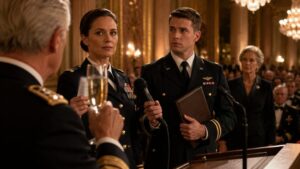
On the stage beside her, the honored chair had been placed at the center, angled toward the lectern, its name card freshly printed: Lieutenant General Carolyn Mitchell, U.S. Army, Retired. The ink was still crisp. The correction insert lay on every seat in the auditorium, a single sheet tucked inside the glossy program that had almost gone to print without the truth.
Carolyn held her old leather case at her side.
No evidence tag hung from it now.
In the front row, Timothy Clark’s surviving relative sat with both hands folded around the correction insert. The paper trembled only once, when the announcer stepped to the microphone and looked back toward Andrew Davis for approval.
Andrew gave a small nod.
The auditorium lights were too bright. Carolyn could feel them on her face, warming the lines age had cut there. Rows of uniforms, civilian suits, families, staff, and retired officers looked toward the stage with the kind of expectation she had spent most of her life distrusting. Expectation could turn a person into a symbol too quickly. It could smooth away the parts that had cost the most.
Anthony Baker stood near the side aisle, not on stage, not hidden. His posture was formal, but his face carried the strain of a man who had spent the last hour watching his clean ceremony become honest.
The announcer unfolded the insert.
“Before tonight’s historical remarks,” he said, his voice catching just enough for the whole room to hear, “the command will read a corrected citation for Staff Sergeant Timothy Clark.”
A stir moved through the auditorium.
Carolyn looked down at the leather case. The brass clasp rested against her knuckles, familiar and cool. For twenty-five years, the case had carried the truth in a compartment no one saw. Earlier that morning, Anthony’s palm had held it against the table as if it were suspect. Now it sat beside her chair like a witness.
The announcer continued.
“Staff Sergeant Timothy Clark did not merely perform routine signal relay during Operation North Pass. He identified and reported a critical change in road control during the evacuation window, enabling command to reroute the convoy and preserve the civilian corridor under conditions that could not then be publicly disclosed.”
The relative in the front row lowered their head.
Carolyn did not look away.
“His action materially contributed to the survival of those moved through the corridor and to the success of the evacuation. The prior public citation was incomplete. Tonight, this command corrects that record.”
No applause came at first.
The silence was better.
It was not confusion. It was absorption. The room had been asked to take in a name before celebrating a rank, to hold a buried act without rushing to cover it in noise. Carolyn felt something inside her loosen and resist loosening at the same time.
Then the relative stood.
Not dramatically. Not to perform grief. Simply because sitting had become impossible.
The audience followed, row by row, until the auditorium was standing for Timothy Clark.
Carolyn remained still.
Andrew moved to the lectern after the applause settled into quiet. “Tonight’s correction is entered into the installation record, the historical archive, and the memorial wall file. A revised plate has been ordered. Until it arrives, the temporary correction will be displayed beside the existing entry.”
He turned slightly toward Carolyn. “This correction was made possible because General Carolyn Mitchell came here today with records this institution should have reviewed before she had to carry them back through our doors.”
Carolyn’s jaw tightened.
The honor was accurate and still not the whole truth. She had carried the records, yes. She had also let them sleep.
Andrew seemed to understand enough not to continue.
He stepped back.
Anthony walked from the side aisle toward the stage.
A quiet unease moved through the front rows. Carolyn watched him approach, and for a moment she saw again the man from the morning: controlled, suspicious, his hand pressing down on her case. Now his uniform was still immaculate, but the certainty had gone out of it.
He stopped at the lectern and did not look at Carolyn first.
He looked at Timothy Clark’s relative.
“I owe your family an apology,” Anthony said.
The room held.
“I called a correction ceremonially inconvenient. That was wrong. Worse than wrong. It showed the same failure that made this correction necessary. I treated a name as a disruption because it did not fit the event I wanted to protect.”
He drew a careful breath.
Then he turned toward Carolyn.
“And General Mitchell, I owe you an apology too. Not because of the rank I failed to recognize. Because before I knew it, I believed I could treat you as a problem to be managed instead of a person to be heard.”
Carolyn felt the words settle differently than the apologies she had imagined and dreaded. He had not hidden behind her title. He had not made his shame flattering. He had named the smaller wrong before the larger revelation could rescue him from it.
She gave him one nod.
It was not absolution. It was permission to continue standing in the room with the truth.
Anthony stepped away from the lectern.
For the first time that day, no one rushed to fill the silence.
Carolyn placed the leather case beside the honored chair but did not sit. She walked to the microphone with both hands free. The lights made the audience blur at the edges. The front row remained clear: the relative, Samantha Lewis with the corrected file folder in her lap, Jacob Garcia standing near the wall with his tablet lowered, Andrew watching from the side, Anthony still near the steps.
“I was taught,” Carolyn said, “that command means carrying what others should not have to carry.”
Her voice was not loud. The room leaned toward it anyway.
“For many years, I believed that meant silence. There are silences that protect lives. I have signed them. I would sign them again if lives depended on it.”
She looked toward the front row.
“But there are silences that continue after their purpose has ended. Those silences do not protect. They erase.”
The relative’s hands closed around the insert.
Carolyn let herself feel the tremor in her own fingers. She did not hide them behind the lectern.
“Timothy Clark spoke when the room did not want another complication. He was young. He was tired. His information was inconvenient. He was right.”
Her eyes moved to Anthony for a moment, then away. Enough. Not a punishment. A connection.
“I came today because his name was still carrying less than his deed. I should have come sooner.”
The sentence cost more than she expected.
No one rescued her from it.
Good.
“This base did not owe me a better chair before it owed him a better sentence. And none of us should need a title, a uniform, a clearance code, or an old photograph on a wall before we decide someone deserves to be treated with care.”
The room stayed silent.
Carolyn stepped back from the microphone.
Andrew came forward, but she lifted one hand slightly, and he stopped. She picked up the old leather case herself. Then she turned to the honored chair.
For a moment, the audience seemed to think she would finally sit.
Instead, she moved the case from beside the chair to the floor in front of the front row, near Timothy Clark’s relative. Not giving it away. Not surrendering it. Placing it where the story had belonged all along.
Then she returned to the chair and sat only after the corrected citation lay open on the seat beside her.
The ceremony continued, but changed. The historical remarks were shorter than planned. The photographs on the screen no longer felt like decoration. When Carolyn’s younger face appeared in the old command cell, the caption beneath it had been corrected: Lieutenant General Carolyn Mitchell, Operation North Pass Command Authority. No one cheered at the reveal. They had already learned how easily recognition could arrive late.
After the ceremony, people approached slowly. Some wanted to shake Carolyn’s hand. Some could not find words. She accepted only a few before exhaustion moved through her shoulders.
Jacob came last with the tablet under one arm.
“The archive entry is updated,” he said. “Major Lewis confirmed the legal language.”
Carolyn looked at him. “And the wall?”
“Temporary correction posted tonight. Permanent plate ordered.”
She nodded.
Anthony stood a few steps behind him. He did not ask for another apology. He simply said, “The visitor intake policy changes tomorrow. Records review guests with legacy codes will not be routed through public visitor processing until verified.”
Carolyn studied him.
“That will help some,” she said.
“I know it is not enough.”
“No,” she said. “But it is a start.”
He accepted that without flinching.
Near the auditorium doors, Timothy Clark’s relative waited. Carolyn walked over, carrying the leather case in her left hand. For a moment they stood facing each other without the protection of procedure, rank, or ceremony.
“He was necessary,” the relative said.
Carolyn nodded. “Yes.”
“And now people know.”
“Now the record knows,” Carolyn said. “People will have to keep up with it.”
The relative touched the correction insert once, folded it carefully, and held it against their chest.
Carolyn left the auditorium without an escort.
The hallway was quieter now. The memorial wall had a temporary printed correction placed beside Timothy Clark’s brass plate. It was not beautiful. It was not permanent. White paper, clear tape, official signature, corrected words. But it told the truth.
Carolyn stopped long enough to read it.
Then she clipped nothing to her coat, announced nothing to the empty hall, and walked toward the exit with the same old leather case in her hand.
The story has ended.