The Politician’s Aide Tried to Cover His Brother’s Name Until the Cemetery Fell Silent
Chapter 1: The Sticker Stopped One Inch Above His Name
The first steel pole struck the ground while Ronald Harris’s palm was still resting over his brother’s name.
The impact traveled through the soil and into the brass plaque beneath his fingers. A second pole hit three feet to his left. Then came the scrape of metal feet across stone, a burst of clipped instructions, and the crackle of fabric being unfurled.
Ronald did not turn immediately.
He finished drawing the cloth over the last letter in CARTER, working a thin line of moisture from the engraved edge. The plaque had been dulled by rain and pollen, but George’s name now shone clearly enough to hold Ronald’s reflection: silver hair, lined face, dark coat buttoned high against the morning chill.
Between his knees rested a triangular folded flag inside a plain canvas sleeve.
He had carried it to the plot every year on this date for six years. He had never opened it.
“Bring that side forward,” a man said behind him. “The trees need to frame the seal.”
Ronald folded the polishing cloth into quarters and placed it beside the flag.
The family plot was set apart from the public lawn by a low granite border. Four graves lay beneath an old maple, each marked with brass instead of stone. George’s was nearest the path because he had once joked that he hated making people walk farther than necessary.
A boot stepped over the granite edge.
Ronald looked up.
The man entering the plot wore a tailored navy coat and held a phone in one hand, a laminated schedule in the other. He was younger than Ronald by at least thirty years, clean-shaven, restless, and already speaking before their eyes met.
“Sir, we need this area cleared.”
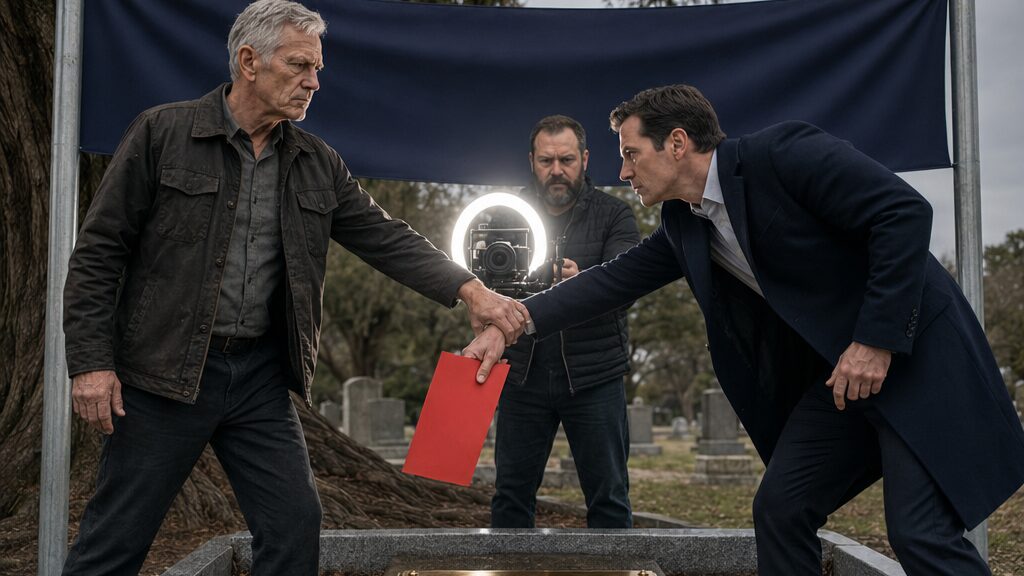
Ronald glanced beyond him. Two crew members were raising a white promotional banner between thick steel poles. A circular light had been mounted above a black DSLR enclosed in a heavy metal cage. The ring’s cold glare was still off, but its face aimed directly toward George’s grave.
“This is a private plot,” Ronald said.
The man checked his phone. “The cemetery authorized the event.”
“The public lawn is behind you.”
“We’re using this section for the principal angle.”
Ronald looked at the pole sunk beside his mother’s marker.
“Move it.”
The man’s mouth tightened, not with anger yet, but with the irritation of someone discovering an object had spoken.
“We have fifteen minutes before advance staff arrive. I’m Benjamin Clark, operations for the senator. We’re doing a short remembrance segment tied to local restoration funding.”
Ronald picked up the cloth again and rubbed a faint smudge from George’s first name.
Benjamin glanced toward the camera crew.
“Sir, I’m asking politely.”
“No,” Ronald said. “You’re informing me badly.”
One of the crew members looked down to hide a reaction.
Benjamin stepped closer. “This event could bring significant funding to this cemetery.”
“That doesn’t make this plot public.”
“The shot requires depth. The stonework, the older trees, the markers—it communicates history.”
Ronald’s eyes moved to the banner. Across it, in blue lettering, was a slogan about remembering sacrifice and rebuilding together.
The bottom edge dragged over the grave beside George’s.
“Your history is standing on my family.”
Benjamin exhaled through his nose. “You can return when we’re finished.”
Ronald rose slowly. He was not tall enough to loom over Benjamin, and age had narrowed him through the shoulders, but he stood straight. The movement made Benjamin take half a step back before correcting himself.
“I return today,” Ronald said. “Every year. Same hour.”
He lifted the folded flag from the grass and tucked it under his left arm.
Benjamin’s gaze caught on it, then dismissed it. “I respect that. Truly. But we’re under a hard deadline.”
“You heard me say the plot is private.”
“Yes.”
“And you heard me tell you to move the equipment.”
Benjamin glanced toward the path, as if expecting someone with greater authority to appear and translate the conversation into obedience.
Then he raised two fingers at the photographer.
“Larry, keep rolling.”
The man behind the DSLR hesitated. He was broad-shouldered, with a graying beard and a black equipment vest. “We haven’t started the official feed.”
“Start the secondary card.”
Larry touched the camera controls.
The ring light exploded on.
White glare washed across Ronald’s face and struck the plaque at his feet. George’s name flashed bright, then vanished inside the reflection.
Ronald’s right hand closed around the canvas sleeve.
Benjamin’s voice changed when the camera began recording. It grew slower, cleaner, designed for an audience not yet present.
“Sir, we are conducting an authorized public-interest event. You are obstructing permitted work and creating a safety concern.”
Ronald looked directly into the glass of the lens.
Behind his own pale reflection, he could see Larry’s eyes.
“Turn it off,” Ronald said.
Benjamin gave a small, almost sympathetic smile. “The recording protects everyone.”
“Not when you decide where to point it.”
A crew member carried the second banner pole deeper into the plot. Its metal base caught the corner of George’s plaque with a dull tap.
Ronald’s head turned.
The crew member froze.
“Back it out,” Ronald said.
Benjamin spoke without looking at him. “Set it where I marked.”
The pole moved again.
Ronald stepped across the grave and placed his shoe against the base. He did not shove. He did not raise his voice.
“Outside the granite.”
For three seconds, no one moved.
Then the crew member looked to Benjamin.
Benjamin’s face had reddened along the jaw. “Do you know how many people are depending on this event?”
“No.”
“The cemetery has deferred maintenance. The east wall is failing. Families have complained. The restoration package could cover all of it.”
“And your camera cannot see that from the public lawn?”
“The public lawn looks empty.”
Ronald looked around at the four graves.
“That is what you wanted.”
Benjamin’s eyes hardened.
He motioned sharply. The crew member pulled the pole free from Ronald’s shoe, carried it around him, and planted it inside the granite border near the maple.
The banner rose.
Its shadow passed over George’s plaque and cut across the surname, leaving only GEORGE visible beneath the fabric.
Something in Ronald’s face changed so slightly that only Larry seemed to notice. The photographer lowered his chin behind the camera.
Ronald stepped to the banner and lifted its edge off the brass.
Benjamin moved between him and the pole.
“Do not touch campaign property.”
“Remove it from family property.”
“The senator will be here in less than twelve minutes.”
“Then he can wait on the path.”
Benjamin stared at him. For the first time, the practiced patience fell away completely.
“You are not going to ruin this because you chose today to make a point.”
Ronald shifted the folded flag against his ribs.
“I chose today six years ago.”
Benjamin looked down at the plaque.
Not at the name. At its shape. Its shine. The way it interrupted the clean line beneath the banner.
He turned to an open equipment case near the camera. Inside were rolls of tape, cable ties, spare batteries, and several official-looking red notices.
Benjamin reached in and removed a rectangular sticker as wide as both his hands.
Across its face, in heavy black letters, were the words CONDEMNED / VIOLATION.
He peeled one corner from its backing.
Then he crouched beside George Carter’s plaque and held the sticker above it, measuring how much of the engraved name it would cover.
Chapter 2: A Perfect Background Built Across the Graves
“Keep recording,” Benjamin told Larry. “Resistance makes useful footage.”
The red sticker hovered in his hand.
Ronald stood between the camera and the plaque, the folded flag pressed beneath his arm. The ring light bleached the color from his skin and threw a hard white circle across the brass at his feet.
Larry did not move closer.
Benjamin looked back at him. “Did you hear me?”
“I’m rolling.”
“Then frame him properly.”
Larry adjusted the lens, though Ronald noticed the camera angle widen rather than tighten. It now included the granite border, the banner pole planted inside it, and the sticker in Benjamin’s hand.
Benjamin rose. “This marker is creating a trip hazard inside an active production area.”
“It was here before your production area.”
“And now the conditions have changed.”
“You changed them.”
Benjamin slipped into the calm tone again. “Sir, step away from the equipment.”
Ronald lowered his gaze to the narrow strip of shade cast by the banner. It crossed George’s plaque exactly through the surname. The bright ring light above made the first name glow while CARTER disappeared.
That, Ronald understood, was the frame Benjamin wanted: sacrifice without identity, grief without ownership, the dead reduced to atmosphere.
A utility cart rattled down the path.
The woman driving it braked so hard that a folder slid from the passenger seat. Deborah Wright climbed out before the motor had stopped. Her gray cardigan was buttoned unevenly, and she carried a ring of keys heavy enough to pull one side of her belt.
“Benjamin,” she called. “Why is your crew inside the Carter plot?”
Benjamin turned with visible relief, as though the arrival of an administrator would finally place the world back in order.
“Deborah, good. Please explain the scope of our authorization.”
She approached the granite border and saw the pole sunk beside the grave. Her expression tightened.
“Your permit covers the central lawn and the memorial path.”
“We discussed alternate angles.”
“We discussed weather contingencies.”
“This is a weather contingency.”
“The sky is clear.”
“The east lawn is unusable.”
Deborah looked at Ronald.
“Mr. Harris.”
Benjamin’s head turned sharply.
The simple use of Ronald’s name broke the version of events he had been building for the camera.
“Morning, Deborah,” Ronald said.
“I didn’t know you were here already.”
“You did last year.”
She glanced at the folded flag, then at the date on her watch. Shame touched her face.
“Yes,” she said quietly. “I did.”
Benjamin stepped between them. “Then you can confirm he has been informed of the event.”
“I informed families with plots beside the central lawn. This plot is privately deeded.”
“Which still sits inside cemetery grounds.”
“And remains under family access protections.”
Benjamin’s lips compressed. “We’re talking about seven minutes of photography.”
“We’re talking about graves,” Ronald said.
The ring light buzzed faintly. One of the banner clips snapped in the breeze, making the fabric jump over George’s plaque.
Deborah crossed the granite border and pulled the pole free herself.
“Move this outside.”
The crew member took it from her. Benjamin raised one hand.
“Hold.”
Everyone stopped.
Benjamin lowered his voice. “Before you make a decision that affects the entire property, you may want to remember why this event is happening.”
Deborah stared at him.
“The restoration grant is not guaranteed,” she said.
“No,” Benjamin replied. “It is not.”
The words landed harder than a shout.
Ronald watched Deborah’s fingers tighten around her keys.
Benjamin continued. “The senator’s office is willing to prioritize the cemetery because today’s segment demonstrates public value. If we cannot produce a usable segment, the funding committee will ask why.”
“The grant request predates your visit.”
“And requests get prioritized every day.”
Deborah looked toward the east wall, invisible beyond the trees. Ronald knew the section. Two stones had shifted after winter runoff. The cemetery had placed temporary braces along the masonry and delayed repairs twice.
Benjamin saw her hesitation and stepped closer.
“I’m trying to help you,” he said. “But I cannot take responsibility for a site that is uncooperative or potentially unsafe.”
Ronald looked at Deborah.
“This is how he received permission?”
She did not answer immediately.
“Not exactly.”
“How, exactly?”
Her eyes remained on the ground. “The cemetery needs the wall repaired. The drainage too. We were told the appearance could bring attention to both.”
Benjamin gave a restrained shrug. “And it can.”
Ronald glanced at the banner slogan. Remembering sacrifice. Rebuilding together.
“You thought they would show the wall.”
Deborah’s face said enough.
“They asked for the oldest-looking section,” she said.
“The most emotional section,” Benjamin corrected. “Donors respond to emotional clarity.”
Ronald’s grip shifted on the flag sleeve.
Benjamin turned toward Larry. “Get the lower angle. Include the brass but not the lettering.”
Larry stayed behind the camera. “The lettering catches the light.”
“Then flag it.”
“We don’t have a matte cover.”
Benjamin looked at the sticker in his hand.
Deborah saw it.
“What is that?”
“A safety notice.”
“For what?”
“This marker.”
Her confusion sharpened. “There is no notice on this marker.”
“There is now.”
“Benjamin.”
He faced her with a kind of exhausted anger. “You want the wall fixed. I need the frame clean. He wants to stand here. These problems can all be solved if everyone stops treating a temporary adjustment like a moral crisis.”
Ronald stepped closer.
“Put the sticker back.”
Benjamin did not retreat. “Once the shot is finished, it comes off.”
“Adhesive stains brass.”
“Then we’ll clean it.”
Ronald’s eyes dropped to the notice. The lower corner had curled where Benjamin had peeled it from the backing.
“Who authorized it?”
Benjamin pointed vaguely toward the cemetery office. “Facilities.”
Deborah’s face changed.
Ronald saw it.
Benjamin saw him see it.
The aide turned at once to the crew. “Let’s reset. Two minutes.”
Deborah reached for the sticker. Benjamin moved it behind his back.
“That notice does not belong here,” she said.
“Then provide another method.”
“My office did not authorize covering a grave.”
“Your office authorized a safe production environment.”
Ronald placed himself beside George’s plaque.
“No one covers it.”
Benjamin checked his phone. A message flashed across the screen. His eyes moved quickly, and whatever he read drained the last of his patience.
“The senator’s car is eight minutes out,” he said.
Then another message appeared. He dismissed it before anyone else could see.
Larry adjusted the focus. “We can move twenty feet left and keep the trees.”
“No,” Benjamin said. “The background falls apart.”
“The wall would show.”
“Exactly.”
Deborah folded her arms. “Then show the wall. It is why you claim you are here.”
Benjamin’s gaze cut to her.
For a moment, Ronald saw the fear beneath the man’s arrogance: not fear of the cemetery, nor of Ronald, but of returning to someone powerful without the image he had promised.
Benjamin looked toward the road. Then at the banner. Then at George’s plaque.
His next decision settled over his face before he spoke.
“Larry, narrow the frame.”
Larry did not respond.
Benjamin pointed directly at the brass marker.
“Crop low enough that the stone border reads as historic. Raise the banner edge. And make sure that dead man’s name disappears.”
Chapter 3: The Order That Never Belonged to the Grave
Ronald read the number printed along the sticker’s bottom edge.
“C-seventeen-four-two,” he said. “What structure does that order condemn?”
Benjamin’s thumb covered the number.
“It’s an internal code.”
“No,” Ronald said. “It’s a work-order code.”
Deborah had gone still beside the granite border.
Ronald looked at her. “What does it belong to?”
Benjamin stepped between them. “We are not conducting a facilities audit.”
Ronald did not take his eyes off Deborah.
Her keys clicked softly as they shifted in her hand.
“Deborah.”
She glanced toward the maintenance lane. At the far end, behind a hedge, a low utility building sat with orange fencing around one wall.
“The storage shed,” she said.
Benjamin’s jaw tightened.
Deborah continued, each word more difficult than the last. “The north storage shed. The foundation shifted. That notice was printed yesterday for the side entrance.”
Larry’s camera remained fixed on them.
The red sticker in Benjamin’s hand looked suddenly different. Not authority. A stolen costume of authority.
Ronald nodded toward it. “Then why is it here?”
“I brought the facilities packet,” Benjamin said quickly. “It was in the wrong case.”
“You peeled the backing.”
“To make a point about site control.”
“You told me the marker was condemned.”
“I said it created a safety issue.”
“You measured the sticker against my brother’s name.”
Benjamin’s face sharpened. “Your brother’s identity is irrelevant to the operational problem.”
The ring light hummed between them.
Ronald moved one step to the side, placing George’s plaque fully in view of the camera.
“Then put the notice on the shed.”
Benjamin glanced at Larry. “Cut.”
Larry’s hand remained on the focus ring.
“Cut,” Benjamin repeated.
“The secondary card is still writing.”
“Stop it.”
Larry touched a control. A tiny red light on the camera body went dark.
Ronald noticed his other hand did not move from the metal cage.
Benjamin folded the sticker against its backing, but not completely. Dust had already adhered to the exposed adhesive along one edge.
“There,” he said. “No one is recording. We can resolve this without theatrics.”
“You brought the theater.”
Benjamin stepped close enough that Ronald could smell coffee and mint on his breath.
“Listen to me. I have a principal in transit, press on standby, and a cemetery manager who knows this visit may be the only reason her wall gets repaired before winter. I am not here to insult your family.”
“Then leave the plot.”
“I cannot move the production in eight minutes.”
“You could have moved it thirty minutes ago.”
Benjamin looked toward Deborah. “Tell him.”
She said nothing.
“Tell him what losing the grant means.”
Deborah’s eyes stayed on Ronald. “We may have to close the east section.”
Benjamin opened his hands as if the answer settled everything.
Ronald looked at her. “And this makes the wall safe?”
“No.”
“Does the camera fix it?”
“No.”
“Does covering George’s name?”
Her mouth tightened. “No.”
Benjamin turned on her. “You called my office. You asked for attention.”
“I asked for support.”
“This is how support is built.”
“Not across his grave.”
For the first time, Benjamin’s control cracked visibly.
“Then where?” he demanded. “On the broken wall? Beside caution fencing? With weeds behind the senator? You think a committee funds decay because it sees decay? It funds a story. It funds dignity. Memory. Continuity.”
Ronald looked at the ring light and banner.
“You removed all three.”
Benjamin stared at him.
A vibration sounded from his phone. He checked it and went pale for half a second.
Another delay he could not afford.
He shoved the phone into his coat and pointed at Larry.
“Camera up.”
Larry hesitated. “You said we were resolving it.”
“We are. Record from his right side.”
“Why?”
“Because his left hand is holding the flag.”
Ronald understood before Larry did.
Benjamin wanted an image of him with one hand free. A hand that could be framed as raised, reaching, threatening.
Larry’s expression changed.
Benjamin noticed. “Do your job.”
The red recording light came on again.
Benjamin turned toward the lens, his shoulders squared.
“Sir, this is your final warning. You have repeatedly entered an active work zone, interfered with authorized equipment, and physically obstructed staff.”
Ronald said nothing.
“Please lower your hand.”
Ronald’s right hand rested at his side.
Benjamin looked at it pointedly.
Ronald raised it only far enough to indicate the granite border.
“This is the boundary.”
Larry’s lens tightened.
Benjamin’s voice rose. “Do not threaten me.”
“I pointed at the ground.”
“You advanced on staff.”
“I stood beside my brother.”
“You made physical contact with equipment.”
“A pole struck his plaque.”
Ronald could hear the shape Benjamin was building. A quiet man reduced to selected gestures. A grave erased from the frame. A hand without its reason.
He turned toward Larry.
“You have the whole scene?”
Larry looked through the viewfinder. “Yes.”
“Keep it whole.”
Benjamin snapped, “He does not direct the recording.”
“No,” Ronald said. “You direct the lie.”
The sentence landed in the silence beneath the maple.
Benjamin’s face emptied.
He walked to the equipment case, took the sticker from its loose backing, and pressed the backing against the lid. The adhesive edge picked up grit as he crossed the plot.
Deborah moved to intercept him.
“Benjamin, stop.”
He raised one hand without looking at her. “The senator’s office will receive a full safety report on this property.”
“You cannot threaten the cemetery because I won’t let you misuse a notice.”
“I’m documenting noncompliance.”
“With what order?”
“The event permit.”
“The permit does not include this plot.”
Benjamin stopped beside Ronald. The sticker hung at his side, red against his dark coat.
“Move,” he said.
“No.”
“You have been given every chance.”
“So have you.”
Benjamin glanced toward Larry’s camera. Ronald saw calculation return to his eyes.
The aide lowered his voice.
“Touch me again and the whole country sees what you are.”
Ronald looked at the lens, then at the sticker, then down at George’s polished name.
The ring light burned white across the brass, but beneath the glare the letters remained.
Benjamin lifted the sticker.
Ronald raised his right hand.
And Benjamin reached straight toward George Carter’s name.
Chapter 4: The Moment Ronald Chose What Not to Break
The sticker’s lower edge touched the brass before Ronald caught Benjamin’s wrist.
Not hard enough to injure him. Hard enough to stop him.
The adhesive kissed the final letters of CARTER and lifted again, leaving a gray smear where Ronald had polished the metal minutes before.
Benjamin stared at the hand around his wrist.
“Release me.”
Ronald’s grip remained steady. “Take it away.”
Larry’s camera kept recording. The ring light burned into Ronald’s eyes, turning Benjamin’s face pale and flat.
“You’re assaulting a government representative,” Benjamin said.
“You are not the government.”
“Larry, get his hand.”
The lens shifted closer.
Ronald could see what the frame would show: his weathered fingers locked around a younger man’s wrist, the red warning notice between them, none of the graves beyond the edge.
He released Benjamin.
The aide stumbled back half a step, then immediately raised his free hand toward the camera.
“You saw that.”
Larry did not answer.
“Call security,” Benjamin told one of the crew members. “Tell them we have an aggressive trespasser.”
Deborah stepped forward. “Do not make that call.”
Benjamin rounded on her. “He put his hands on me.”
“You tried to paste a shed notice over a grave.”
“He interfered with an authorized event.”
“You are outside the authorized area.”
Benjamin looked toward the road, where the senator’s vehicle had still not appeared. The absence seemed to tighten something inside him.
Ronald knelt beside the plaque.
The adhesive smear dulled George’s surname. He rubbed it gently with his thumb, but the residue only spread.
Behind him, Benjamin said, “This can still be fixed.”
Ronald looked up.
Benjamin held the sticker by one corner. “You step onto the path. We finish the photographs. The notice never touches the marker again.”
“Remove everything.”
“We don’t have time.”
“Then you don’t have a photograph.”
Benjamin’s nostrils flared. “You think this is about a photograph?”
“It has been since you arrived.”
“This is about keeping commitments. Staff jobs. A restoration grant. A senator walking into a meeting this afternoon with enough public momentum to secure private investment.”
Ronald stood.
“And my brother?”
Benjamin’s gaze flicked toward the plaque.
“He is not part of this.”
“You made him part of it when you crossed the border.”
Benjamin looked at the red sticker, then at the camera.
The choice came across his face without disguise.
He lunged toward the plaque again.
Ronald moved between them.
Benjamin jerked his arm upward to avoid Ronald’s hand. His elbow struck the folded flag beneath Ronald’s left arm.
The canvas sleeve fell.
It hit the edge of the granite border and rolled open into the dirt.
Ronald stopped breathing.
The triangular flag remained folded, but the sleeve’s flap had come loose. From inside, the corner of an old photograph showed against the soil, along with the edge of a cream-colored page.
Benjamin saw only an object in his way.
He kicked the sleeve aside.
Not hard. Not deliberately cruel.
Carelessly.
That was worse.
The flag slid beneath the campaign banner.
Larry lowered the camera an inch.
Deborah whispered, “Benjamin.”
Ronald looked down at the dirt on the blue canvas.
For six years he had placed that sleeve beside George’s name and taken it home unopened. He had protected it from rain, dust, curious hands, and his own need to know.
Now Benjamin stood over it with the sticker still raised.
Ronald bent, picked up the sleeve, and brushed the dirt from it. His thumb paused over the exposed paper.
He pushed it back inside without reading.
Then he placed the flag behind the granite border, beyond Benjamin’s reach.
When Ronald straightened, his voice was quieter than before.
“This is the last warning.”
Benjamin laughed once, but there was no amusement in it. “You’ve been warning me for twenty minutes.”
“I was giving you room to choose.”
“I chose to do my job.”
“No. You chose what your job permits you to become.”
Benjamin’s face tightened. He thrust the sticker toward Larry.
“Get closer. I want the plaque, his hand, and the contact in one frame.”
Larry stayed where he was.
“Closer,” Benjamin repeated.
“The whole scene is already recorded.”
“I said closer.”
Larry rolled the camera rig forward on its short tripod. The metal cage crossed the granite line. The ring light came with it, sweeping its glare over the grave like a search beam.
Benjamin grabbed the banner frame with both hands and shoved it deeper into the plot.
One support pole scraped across George’s plaque.
The sound was thin and metallic.
Ronald heard something inside himself become simple.
Not angry.
Simple.
He stepped past Benjamin and seized the banner fabric near its center.
Benjamin caught at his sleeve. “Do not touch that.”
Ronald pulled once.
The banner tore free from its clips with a sound like a sail splitting in a storm. One side collapsed across the graves. The steel poles rocked in their bases.
The crew scattered backward.
Ronald gripped the first pole with both hands and tore it from the ground. Its weighted foot struck the granite border, sending dirt across Benjamin’s shoes.
“Security!” Benjamin shouted.
Ronald planted one end of the pole against the stone and drove his weight down.
The steel bowed.
For an instant it resisted, trembling beneath his hands. Then it folded sharply in the center with a deep metallic groan.
No one spoke.
Ronald picked up the second pole.
Benjamin backed toward the camera. “You’re finished. Do you understand me? You are finished.”
Ronald bent the second support until its ends nearly touched.
He did not look at Benjamin.
He looked at the ring light still shining across George’s name.
With one controlled swing, Ronald brought the folded steel down through the circular light.
Plastic burst outward. The white glare vanished.
The cemetery returned to morning.
Larry jumped away as Ronald hooked the twisted pole through the DSLR’s metal cage and pulled it from the tripod. The camera struck the ground. Its lens shattered. The cage split at one joint, batteries scattering through the grass.
Ronald released the pole.
It landed among the broken equipment.
Benjamin stood untouched three feet away.
The only sound was the faint tick of cooling electronics.
Ronald’s chest rose once, then settled.
He turned to George’s plaque and crouched beside it. In the natural light, the adhesive smear across CARTER looked darker.
Behind him, Benjamin fumbled for his phone.
“I’m calling the police.”
Ronald rubbed the residue with the cloth.
“You should.”
Benjamin’s screen lit before he could dial.
A notification filled it.
CARTER MEETING ADVANCED TO NOON.
His eyes moved from the message to the brass beneath Ronald’s hand.
GEORGE CARTER.
Benjamin’s mouth opened, but no sound came.
He looked again at the name.
Then at Ronald.
Recognition entered his face like fear.
Chapter 5: The Dead Man Behind the Meeting on Benjamin’s Phone
Benjamin’s phone chimed a second time while he stood over George Carter’s grave.
Carter Foundation counsel confirmed.
Angela Carter attending personally.
No substitutions.
The aide read the message twice. Then he looked down at the plaque as if the letters might rearrange themselves into someone less dangerous.
“George Carter,” he said.
Ronald continued working the cloth over the adhesive stain.
Benjamin swallowed. “The George Carter?”
“There was only one in this family.”
“The founder of Carter Systems.”
Ronald’s hand paused.
Benjamin’s eyes moved across the graves, the granite border, the folded flag placed safely behind it. When he spoke again, the anger had been replaced by urgent calculation.
“This is a family plot.”
“I told you that.”
“And you’re—”
“His brother.”
Benjamin lowered the phone.
The transformation in him was almost graceful. His shoulders relaxed. His voice softened. The hard edges of command disappeared beneath concern.
“Mr. Harris, I think we need to slow this down.”
Ronald looked at the broken ring light.
“You had twenty minutes.”
“There has clearly been a breakdown in communication.”
“No.”
Benjamin glanced at Larry and Deborah. “The permit boundaries were not adequately conveyed to the production team.”
“They were conveyed,” Deborah said. “Repeatedly.”
Benjamin ignored her.
“We can repair the plaque,” he told Ronald. “Professionally. Today. We can replace any damaged property belonging to the family.”
“You damaged your own property.”
“I’m trying to resolve this.”
“You’re trying to rename it.”
Benjamin stepped nearer, careful not to cross the granite border this time.
“The senator has enormous respect for George Carter’s work.”
Ronald looked up. “Did he know him?”
“The senator’s policy team has worked closely with the corporation.”
“That was not my question.”
Benjamin’s mouth tightened.
His phone vibrated again. Ronald saw a briefing document open beneath the notifications. At the top was the senator’s photograph beside the Carter corporate seal. Below it, a heading read CIVIC PARTNERSHIP DISCUSSION.
Benjamin turned the screen inward.
Ronald rose.
“You came here to manufacture sympathy before meeting George’s company.”
“We came here to highlight restoration needs.”
“You hid the wall.”
“We needed a coherent message.”
“You tried to hide his name too.”
Benjamin lowered his voice. “Mr. Harris, neither of us benefits from turning this into something larger.”
Ronald glanced at the shattered lens.
“It became larger when you pointed that at me.”
“The camera was there for everyone’s protection.”
“Then keep the recording.”
Benjamin looked toward Larry.
The photographer had knelt beside the broken DSLR. He lifted the camera body carefully and opened a side compartment.
“The external monitor’s gone,” Larry said. “Lens mount too.”
Benjamin’s attention sharpened. “The card?”
Larry removed a small black memory card.
“The internal one survived.”
“Give it to me.”
Larry remained crouched.
“Now,” Benjamin said.
Larry closed his fingers around the card.
“You said the recording protected everyone,” Ronald said.
Benjamin turned on him. “This is campaign property.”
“The scene is evidence,” Deborah replied.
“Of deliberate destruction.”
“And misuse of a condemnation notice.”
Benjamin pointed at the bent poles. “Look around you.”
Deborah did.
Ronald saw the conflict in her face. Broken equipment lay across the grass. The banner had been torn in half. Whatever Benjamin had done, Ronald had made the damage visible.
That was the risk he had accepted.
“Call the police,” Ronald said again.
Benjamin stared at him. “You think your brother’s name makes you immune?”
“No.”
“Then why are you so calm?”
“Because I chose what to break.”
The words drew Benjamin’s eyes toward the twisted steel.
Ronald had not struck him. Had not shoved Larry. Had not threatened Deborah. Every damaged object belonged to the apparatus that had crossed the boundary.
Benjamin understood the distinction.
He hated it.
His voice dropped. “You could be charged.”
“Yes.”
“The footage could destroy your reputation.”
Ronald looked at George’s name.
“My reputation is not buried here.”
Larry stood and slid the card into a zippered pocket on his vest.
Benjamin stepped toward him. “You are contracted to my office.”
“I’m contracted to deliver footage.”
“You will deliver the card.”
“When there’s a receipt.”
“I am your receipt.”
Larry shook his head.
It was a small movement, but it changed the balance of the plot more than Ronald’s destruction had.
Benjamin’s expression went cold. “You will not work another campaign in this state.”
Larry’s hand rested over the pocket. “Maybe not.”
His voice was unsteady.
He did not move it.
A dark sedan turned through the cemetery gates.
Benjamin saw it first.
“No,” he said under his breath.
The vehicle followed the curved path toward the family plot. Its tires passed the temporary signs directing visitors toward the campaign event, then slowed beside Deborah’s utility cart.
The rear door opened.
Angela Carter stepped out wearing a charcoal coat, her dark hair pinned back, a leather folder tucked beneath one arm. She took in the torn banner, the broken camera, the bent steel poles, and Benjamin standing beside George’s grave.
Then she saw Ronald.
She stopped.
Ronald had last seen his niece at the funeral, across a room crowded with executives, attorneys, and people who spoke about George as though he had been a building they all owned part of.
Angela’s face had hardened since then. Or perhaps Ronald had only forgotten how closely she resembled her father when she was angry.
“Uncle Ronald.”
He inclined his head. “Angela.”
Benjamin moved quickly toward her.
“Ms. Carter, I can explain. There was an unauthorized individual inside the production area, and the situation escalated before cemetery management—”
Angela walked past him.
She crossed the granite border and looked down at the plaque.
A streak of adhesive dulled her father’s surname. One corner of the red sticker lay in the dirt nearby.
Her gaze moved to the folded flag behind the marker.
Then back to Ronald.
“Why are you here?” he asked.
“I moved the meeting here when the senator’s office said they were filming a memorial segment.” Her eyes remained on the damage. “I thought I should see what they considered respectful before sitting across from them.”
Benjamin’s face lost color.
Angela looked at him. “Apparently I have.”
“This is not what it appears to be.”
Larry reached into his vest.
“It’s recorded,” he said.
Benjamin turned sharply. “Do not.”
Angela’s gaze settled on Larry, then on Deborah.
Deborah lifted her folder of cemetery papers. “The crew was never authorized inside this plot.”
Benjamin began speaking again, but Angela raised one hand.
He stopped.
The gesture was not forceful. It did not need to be.
Angela looked down at the canvas sleeve. The flap had opened again, exposing the cream-colored paper and the corner of the photograph.
She crouched and touched neither.
“I know that paper,” she said.
Ronald’s shoulders tightened.
Angela looked up at him.
“That’s my father’s stationery.”
The air seemed to narrow around the folded flag.
Her voice became quieter.
“Why was his private rejection of this politician never shown to the board?”
Chapter 6: The Letter Ronald Protected by Refusing to Read
Angela recognized her father’s handwriting before Ronald pulled the page from the flag.
Only three words were visible along the folded edge, written in George’s slanted black script.
Ron—
I should have—
Angela stared at them.
“You had this all along.”
Ronald held the canvas sleeve against his chest.
“I had an envelope.”
“That is not what I asked.”
Benjamin stood near the path, listening now rather than interrupting. The threat of the recording had changed shape. So had the value of every word spoken beside the grave.
Ronald looked at George’s plaque.
The name he had defended was easier to face than the paper.
“Your father sent it through a military liaison,” he said. “It reached me after the funeral.”
“And you never opened it?”
“No.”
Angela’s expression tightened with disbelief. “You carried it here every year.”
“Yes.”
“Why?”
Ronald’s thumb pressed into the canvas seam.
“Because carrying it was not the same as reading it.”
For a moment, Angela said nothing.
Then she looked away, toward the broken camera.
“My father’s company has spent six years answering questions about what he would have supported. Which candidates. Which causes. Which public partnerships. You let strangers answer for him while his own words sat inside a flag.”
“I did not want him used.”
“So you allowed everyone to use the silence.”
The sentence struck more cleanly than anything Benjamin had said.
Ronald accepted it without defense.
A drop of rain darkened the granite near George’s plaque. Another struck the torn campaign banner. The crew began gathering loose batteries and broken plastic from the grass.
Deborah pointed toward a small stone shelter beside the maintenance lane.
“We should move the papers out of the rain.”
Ronald remained beside the grave.
Angela waited.
At last he carried the flag beneath the shelter. Its roof was low, supported by four square pillars, with a bench running along the back wall. The cemetery remained visible through the open sides: George’s plaque, the twisted poles, Benjamin speaking urgently into a phone that no longer seemed to connect him to power.
Ronald set the sleeve on the bench.
His fingers worked the old snap.
Inside lay the folded flag, the photograph, and two pages creased together.
The photograph came free first.
George stood beside Ronald outside a military hospital many years earlier. Ronald wore field fatigues. George wore a business suit with the tie pulled loose. They were both looking away from the camera, laughing at something no one had written down.
Angela took one breath through her nose.
“I’ve never seen that.”
“Your father hated the picture.”
“Why?”
“Said his hair looked dishonest.”
A faint, unwilling smile touched her mouth and disappeared.
Ronald unfolded the first page.
It was not the personal message. It bore a typed heading from George’s office and several handwritten corrections in the margins.
Angela leaned closer.
Ronald read silently.
The letter declined a request from the senator’s political committee for George’s endorsement and use of Carter Systems’ veteran-employment program in campaign materials. George’s revisions were blunt.
No graves as backgrounds.
No uniformed employees positioned as symbols.
No grieving families asked to validate policy they did not write.
At the bottom, in George’s handwriting, one final line had been added:
Service is not scenery, and grief does not belong to the highest bidder.
Angela closed her eyes.
“I asked the legal department for this,” she said. “They told me the final draft had never been returned.”
“It was folded with the other page.”
“You knew what it said?”
“George told me enough during our last conversation.”
Benjamin appeared at the edge of the shelter.
“That document is private correspondence,” he said. Rain dotted his coat. “Without authentication or context, releasing it would be irresponsible.”
Angela turned.
Benjamin continued carefully. “I understand emotions are high, but political communications require verification. A handwritten page produced after property destruction will not be viewed as neutral evidence.”
Deborah entered behind him carrying a plastic document sleeve.
“This is neutral,” she said.
She removed the original work order for the north storage shed. The number matched the sticker. Attached was a copy of the event permit, its boundary map clearly excluding the Carter plot.
Benjamin looked at the pages.
Deborah’s hands trembled, but her voice did not.
“I should have stopped your crew the moment they crossed the granite. I did not. But I will not alter the record now.”
Larry came beneath the shelter next. Rain ran from his beard.
He held the memory card between two fingers.
Benjamin looked at him. “Think carefully.”
“I am.”
“You were instructed to stop recording.”
“I stopped the visible indicator.”
Benjamin’s eyes narrowed.
Larry tapped the camera cage hanging broken from one hand. “Secondary capture kept running to the internal card.”
The photographer looked at Ronald.
“It has the whole boundary discussion. The sticker. The work-order number. Everything.”
Benjamin’s face hardened. “You are violating your contract.”
“Maybe.”
Larry handed the card to Deborah, not Angela.
“Log it with the cemetery incident report.”
Deborah placed it inside the document sleeve.
The proof was complete enough to expose Benjamin.
It did nothing to open the second page.
Ronald could feel it beneath his hand.
Angela took out her phone.
“I’m sending the letter to corporate counsel,” she said. “We’ll release it with the footage and cancel every pending discussion with the senator’s office.”
Benjamin stepped forward. “Ms. Carter, that would be a grave mistake.”
She looked at him. “You tried to paste a condemnation notice over my father’s name.”
“And I will answer for that. But a public attack based on a deceased executive’s private language could create legal exposure for the corporation.”
Angela’s thumb moved over the screen.
Ronald placed his hand over the phone.
She looked at him sharply.
“No,” he said.
“You do not get to hide it again.”
“I’m not hiding it.”
“Then move your hand.”
“George refused to let them use graves as campaign scenery.”
“Yes.”
“He would not want his grave used as corporate artillery either.”
Angela’s face changed.
Not softened. Wounded.
“You think I’m exploiting him?”
“I think you are angry.”
“I am.”
“So am I.”
“You had six years to be angry with me.”
Ronald removed his hand from the phone.
“I had six years to speak. I did not.”
Rain rattled harder on the shelter roof.
Angela’s eyes stayed on him.
“I thought you stayed away because you resented him,” she said. “The company. The funeral. All of us.”
“I stayed away because he called me before he died.”
She waited.
“I was overseas. The message reached me during an operation. I told myself I would call when the team was secure.” Ronald looked down at the unopened page. “By the time I did, he was gone.”
Angela’s voice fell. “So you never heard what he wanted to say.”
“No.”
“And you never read it.”
“No.”
Ronald’s fingers rested on the crease.
“I kept watch instead.”
The words sounded smaller outside him.
Angela sat on the bench, leaving space beside her.
For the first time since arriving, she looked less like George’s successor and more like his daughter.
“We release the facts,” Ronald said. “The permit. The false sticker. The footage. George’s refusal, authenticated through the company records.”
“And the rest?”
“No campaign language. No praise for me. No photograph of this grave beneath a corporate logo.”
Angela studied the public letter.
Then she nodded once.
“Agreed.”
Benjamin’s shoulders dropped, though whether from relief or defeat Ronald could not tell.
Angela held out her hand.
Ronald separated the two pages.
He gave her George’s political refusal.
The second remained folded.
On its outer face was only his name.
Ronald.
Angela looked at the page, then at him.
He did not open it.
Not yet.
Chapter 7: When the Brass Reflected Nothing but the Open Sky
Benjamin tried to leave while everyone was watching Ronald.
He stepped backward from the stone shelter, turned toward the path, and caught his shoe inside the broken metal cage of Larry’s camera.
The cage twisted around his ankle.
Benjamin lurched forward, reached for the torn campaign banner, and pulled half of it down with him. He landed face-first in the soft dirt beside the granite border, one hand buried among shattered pieces of the ring light.
The surviving camera continued recording from the grass.
No one laughed.
Ronald did not turn.
He stood beneath the shelter with George’s final page folded in his hand.
Benjamin pushed himself upright, mud streaking one cheek. For a second he looked less like a political operator than a man who had run out of explanations. He freed his shoe from the camera cage and looked toward Larry.
“Turn that off.”
Larry glanced at Deborah.
She held the memory card and work order inside the clear evidence sleeve.
“Leave it running,” she said.
Benjamin stared at her.
“The senator’s car has been redirected,” he said. “The event is canceled. You have what you wanted.”
Deborah looked toward the damaged family plot. “No. I have what I allowed.”
Rainwater gathered along the torn edge of the banner.
She removed the campaign permit from her folder, folded it once, and placed it beneath the work order.
“There will be no future political staging inside privately deeded plots,” she said. “Not for grants. Not for publicity. Not for anyone.”
Benjamin wiped his mouth with the back of his hand.
“You cannot afford that decision.”
“Then we repair the wall more slowly.”
His eyes moved to Angela. “This does not need to become public.”
Angela stood beside Ronald with George’s rejection letter protected inside her leather folder.
“It already became public when you turned on the camera,” she said.
Benjamin looked at Ronald, searching perhaps for anger he could negotiate with.
Ronald gave him none.
“We will release the permit boundaries,” Angela continued. “The false condemnation notice. The complete recording. My father’s written refusal to permit his company’s veteran programs or memorial sites to be used in campaign material.”
Benjamin’s shoulders sank.
“You’ll destroy years of cooperation over one mistake.”
Ronald finally looked at him.
“It stopped being a mistake when you learned what the sticker was.”
Benjamin had no answer.
He crossed the path alone, dirt on his coat and broken equipment crunching beneath his shoes. At the waiting vehicle, he paused as though expecting someone to call him back.
No one did.
The door closed behind him.
The car left without ceremony.
Larry retrieved the camera from the grass. The lens was ruined, but a small red indicator still blinked within the damaged body.
“I’ll make copies before I surrender anything,” he said. “One for the cemetery. One for the Carter counsel. One for myself.”
Angela nodded. “No edited release.”
Larry looked at Ronald.
“No music. No close-ups. No slow motion.”
Ronald understood what he was asking.
“Only what happened,” Ronald said.
Larry switched off the camera.
The sudden absence of its red light felt larger than the silence that followed.
A vehicle from Carter Systems arrived near the main path. An employee approached Angela carrying a phone and a slim folder, but remained outside the family plot.
“The communications team has drafted a statement,” Angela said after reading the screen. “They want to identify you. Military history, relationship to my father, the fact that you defended the memorial.”
“No.”
“They think the public will respond to it.”
“That is the problem.”
Angela studied him for a moment, then deleted several lines with her thumb.
“What stays?”
“The event was outside its permitted boundary. The notice was false. George had already refused political use of his name and company programs. The cemetery will receive the full recording.”
“And you?”
“I was visiting my brother.”
“That is all?”
“That is enough.”
She handed the phone back to the employee.
“No photographs of the grave,” she instructed. “No biography of Ronald. No praise language. Release only the documents and the relevant unedited section.”
The employee nodded and withdrew.
Deborah crossed into the family plot with a bucket of warm water and a softer cloth than the one Ronald had brought.
“The adhesive remover may discolor the brass,” she said. “Water first.”
Ronald accepted the bucket.
“I can do it.”
“I know.”
She remained beside the granite border.
“I should have stopped them before you had to.”
“Yes.”
Deborah took the answer without flinching.
“I kept thinking about the wall,” she said.
“So did Benjamin.”
“I thought accepting one performance might preserve the rest of this place.”
Ronald dipped the cloth into the water.
“What did it preserve?”
Her gaze traveled across the torn banner, the disturbed dirt, and George’s stained name.
“Nothing worth the price.”
She left him to the work.
The rain thinned. Clouds separated above the maple, and pale afternoon light moved across the plot.
Ronald knelt before the plaque.
The adhesive residue softened beneath the wet cloth. He worked slowly, drawing it away from each engraved letter. George’s surname emerged in stages: the C first, then the A, the sharp cross of the T.
Angela sat on the granite border.
The folded flag lay open between them now, its blue field and white stars no longer sealed into a triangle. The old photograph rested on top.
Ronald still held the second page.
“You do not have to read it aloud,” Angela said.
“For six years, I did not read it at all.”
He unfolded it.
The paper had absorbed the shape of the flag. The creases passed through George’s handwriting, dividing the message into sections Ronald had carried without seeing.
He read the first lines silently.
Ron—
I should have called sooner, and you should have called back. That makes us brothers, not enemies.
Ronald stopped.
His thumb pressed against the edge of the page.
Angela waited without looking at him.
He continued.
I never blamed you for being where duty placed you. I only wanted you to know I was proud of the man you became, even when you made silence do work that words should have done.
Ronald’s breath caught once.
The cemetery blurred, then returned.
At the bottom, George had written one final sentence in darker ink, as though the pen had paused before committing it to the page.
Do not spend the rest of your life standing guard over what is already loved.
Ronald read that sentence aloud.
Angela bowed her head.
For a while, the two of them listened to water falling from the maple leaves.
“I thought you hated us,” she said.
“I hated that the world kept moving.”
“That is not the same.”
“No.”
Ronald folded the page once, but not along its old creases.
He placed it beside the photograph on the opened flag.
Then he returned to the plaque.
The last adhesive stain lifted beneath his cloth. He polished the brass until the surface no longer held the white circle of a ring light or the shadow of a campaign banner.
George Carter’s name became clear.
Angela knelt beside Ronald and took the dry end of the cloth.
Together they worked along the edges where dirt had gathered.
When Ronald finally sat back, the clouds had opened completely above the family plot.
The brass reflected nothing but the sky.
The story has ended.