They Laughed at the Old Man Kneeling Beside the Rifle Until the Desert Wind Changed
Chapter 1: The Old Man Inside Lane Seven
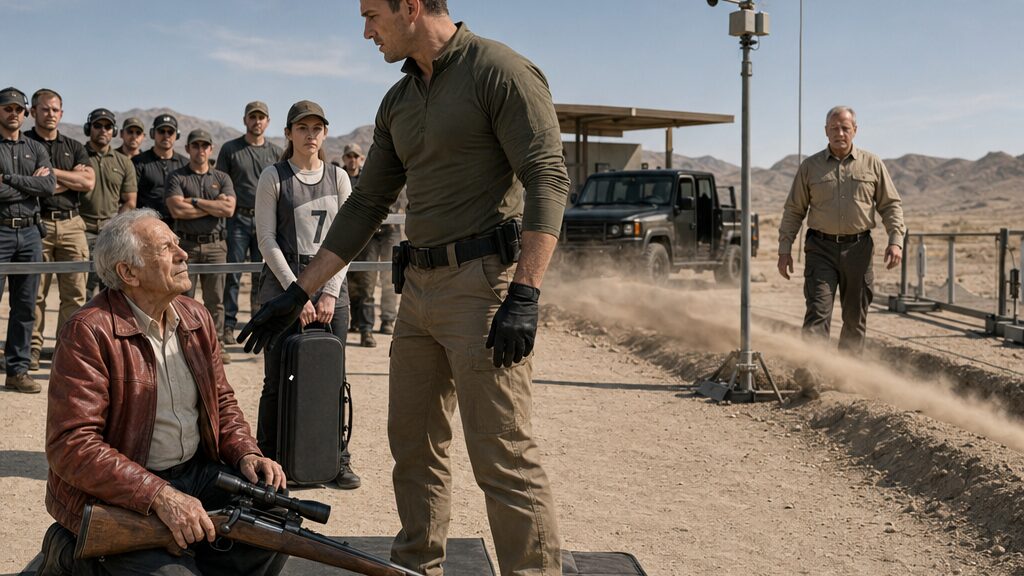
Tyler Moore’s shadow fell across the rifle before Raymond Walker heard the young instructor’s boots stop behind him.
Raymond remained kneeling on the edge of the black shooting mat, one knee planted and the other raised carefully beneath his red leather jacket. The wooden-stock bolt-action rifle lay across his thighs. Its action was open. The chamber flag stood bright against the steel, and the muzzle pointed downrange.
Beyond the rifle, a narrow thread of pale dust slid sideways over the hard ground.
It moved from right to left.
Thirty feet above it, the electronic wind tower showed almost nothing.
“Sir.”
Raymond kept watching the dust.
“Sir, look at me.”
The command had the hard brightness of someone accustomed to being obeyed quickly. Raymond lifted his eyes.
Tyler wore an olive tactical shirt fitted close across his shoulders, tan trousers, a black utility belt, and gloves despite the heat. A radio wire curved from his collar. Behind him, two assistant instructors had paused beside the equipment carts.
One of them glanced at Raymond’s old rifle case and smiled.
“You’re inside a restricted firing lane,” Tyler said. “How did you get past the barrier?”
Raymond looked toward the orange mesh gate. It stood half open where a technician had wheeled through a replacement target motor.
“The gate was open.”
“That doesn’t make the lane public.”
“No.”
Tyler waited, apparently expecting more. When Raymond offered none, his gaze moved over the red jacket, dark trousers, worn black boots, and the faint tremor in Raymond’s right hand.
“Are you with one of the finalists?”
Raymond looked past him.
Under the shade structure, four young shooters in numbered vests stood beside their cases. Rebecca Taylor was among them, her dark hair tied back beneath a range cap. She had not yet noticed him. Or she had decided not to.
“I’m observing,” Raymond said.
“Not from here.”
A gust moved higher across the range. The fabric streamers fixed to the target frames lifted and settled. The electronic board beside Lane Seven displayed a steady three-mile-per-hour reading.
At ground level, the dust continued sideways.
Raymond leaned forward slightly.
Tyler stepped between him and the lane. “I’m going to need you to stand up and come with me.”
“In a minute.”
The younger man’s expression changed.
It was not anger yet. It was surprise that a man with white hair and an unsteady hand had answered without apology.
“This demonstration starts in twelve minutes,” Tyler said. “We’ve got scholarship finalists, sponsors, and a live feed waiting. You don’t get a minute.”
Raymond rested his right thumb in the smooth hollow worn into the rifle stock. The wood had darkened there through decades of handling. He could feel the slight rise where the grain changed beneath the finish.
“Lane Seven should stay closed.”
One assistant instructor laughed under his breath.
Tyler turned his head. The laugh stopped, but not the smile.
“What did you say?”
“Keep the junior line closed.”
Tyler looked toward the tower, then at the digital tablet clipped to his belt. “The system cleared the line twenty minutes ago.”
“It’s reading high.”
“It’s reading from three calibrated stations.”
Raymond nodded once. “High stations.”
Tyler folded his arms. “Do you work here?”
“No.”
“Are you certified on this system?”
“No.”
“Then I don’t know what you think you’re doing.”
Raymond did not answer. He had learned years ago that men who asked three questions without waiting for one answer were usually listening to themselves.
The scholarship finalists had begun watching now. Rebecca stood slightly apart from the others, one hand gripping the strap of her rifle case. Her face was still, but Raymond saw the recognition in it.
She knew him.
She also knew enough not to say so.
Tyler followed Raymond’s gaze and misunderstood it.
“You came with Miss Taylor?”
Raymond’s silence lasted one second too long.
The sponsor representative emerged from the control shelter holding a headset in one hand. “Tyler, we need the line picture in five.”
“We’ll have it.”
The representative noticed Raymond and frowned. “Who’s that?”
“A visitor who wandered into a hot area.”
“The line isn’t hot,” Raymond said.
Tyler looked down at him. “That is not the point.”
“No,” Raymond said. “It isn’t.”
The assistant instructor who had laughed covered a grin by looking away.
Tyler’s jaw tightened. He reached down and took the rifle near the receiver, lifting it from Raymond’s knees.
Raymond released it at once.
The movement seemed to surprise Tyler more than resistance would have. He checked the open action, saw the chamber flag, verified the muzzle direction, and held the rifle horizontally.
“At least you remembered to clear it,” he said.
A few spectators had drifted closer to the barrier. Phones appeared in their hands. The sponsor representative remained near the shelter, watching the delay gather an audience.
Tyler raised his voice just enough for everyone to hear.
“Do you remember the rest of the basic range rules, sir?”
The question landed differently in public.
Raymond felt Rebecca look at him. He could have answered with the years. He could have named the schools, the courses, the units, the instructors he had trained and the instructors they had trained after him.
He could have told Tyler who had first marked the wind channels through this basin before the control shelter had windows.
Instead, Raymond looked at the rifle.
“Keep the action open,” he said. “Keep the muzzle downrange. Keep your finger clear.”
Tyler’s gloved hand was already positioned correctly, but his eyes dropped toward it anyway.
The laughter behind him disappeared.
Raymond placed his palm on his raised knee and stood. The motion took time. Pain tightened beneath his left hip, and the tremor showed more clearly when he reached for the edge of the equipment table.
Tyler saw it.
So did everyone else.
His voice softened, but not kindly. “Can you stand without help?”
“Yes.”
“You sure?”
Raymond straightened until he was as tall as his back allowed. “I’m standing.”
A few spectators murmured. Tyler turned toward the assistants.
“Escort him behind the public barrier.”
Raymond looked toward the lane again.
The dust had thinned, but it had not stopped. It slipped along a shallow depression between the firing line and the first berm, moving in a direction the higher streamers did not show.
“Before you open Seven,” he said, “roll an empty carrier halfway down.”
Tyler gave a short laugh. “Visitors don’t diagnose a computerized range.”
“No,” Raymond said. “They usually trust the people who do.”
That struck harder than he intended.
Tyler placed the rifle on the inspection table, action still open. “Move him.”
One assistant came forward. He was younger than Tyler and less certain. He reached toward Raymond’s elbow without touching it.
Raymond lifted one finger.
Not at the assistant.
At the wind tower.
“Your screen is reading above the problem.”
The electronic-target technician, perhaps eager to end the argument, tapped his control pad. An empty carrier moved out from the berm with a metallic hum.
It traveled fifty yards cleanly.
At seventy, it shuddered.
At ninety, the frame kicked sharply sideways on its cable.
The technician stopped the motor.
No one laughed.
Raymond watched the pale dust slide beneath the tower and said nothing more.
Chapter 2: The Wind Their Screens Could Not See
The empty target frame was still swinging when Tyler checked the tablet again.
Three miles per hour. Right quartering. Stable.
The number glowed in a green box as if nothing unusual had happened.
“Cable tension,” the technician said.
Raymond stood beside the inspection table, his old rifle resting where Tyler had placed it. “No.”
Tyler looked up. “You don’t know that.”
“The frame moved before the cable pulled.”
“The system would have flagged a gust.”
“It will.”
Tyler hated the certainty in the answer—not because it sounded arrogant, but because it did not. Raymond spoke as if he were describing something that had already happened.
The spectators had become quiet. That was worse than laughter. Silence allowed them to choose their own explanation, and Tyler could feel the story turning against him while the live feed clock ran down.
He keyed his radio. “Control, confirm readings for Seven.”
A voice answered through static. “Tower one, three-point-two. Tower two, two-point-eight. Berm station, three-point-four. All within limit.”
Tyler faced Raymond. “There.”
Raymond looked toward the low ground.
Tyler followed his gaze despite himself.
Nothing moved now except a scrap of dry brush caught against a marker stake.
The sponsor representative approached with the headset pressed to one ear. “We have six minutes before the opening segment. Can the lane run or not?”
“Yes,” Tyler said.
“No,” Raymond said.
The single word seemed louder.
Tyler stepped closer. “You are not in charge of this line.”
“I didn’t say I was.”
“Then stop acting like it.”
Raymond’s eyes shifted toward the finalists. Rebecca had moved away from the shade structure and stood at the barrier. She kept her expression controlled, but Tyler saw concern in her posture.
Not concern about the wind.
Concern about the old man.
“You know her,” Tyler said.
Raymond did not answer.
The sponsor representative followed his gaze. “Is this a family issue?”
“No,” Rebecca called before either man could respond.
Her answer came too quickly.
Tyler felt the crowd register it.
He took the rifle case from beneath the table and opened the side pocket, looking for identification. Raymond did not stop him. Inside lay a box of factory ammunition, hearing protection, a cleaning cloth, and a folded sheet of stiff yellowed paper.
Tyler pulled it free.
It was a range card, hand-marked in pencil. The printed grid belonged to an older format, the kind used before digital mapping. Small arrows crossed the page at different yard lines. Some were doubled. Others curved along the edge of shallow depressions.
Lane Seven was written across the top.
Tyler set it beside his tablet.
The shapes matched the ground.
Not approximately. Precisely.
A long pencil arrow began near the low trench Raymond had been watching, crossed beneath the current wind tower, and turned near the target cable at ninety yards.
Beside it, someone had written: LOWER FLOW LATE TO REGISTER.
Tyler looked at Raymond. “Where did you get this?”
“Made it.”
One of the assistants leaned closer. “When?”
“A while ago.”
“That facility map is old,” Tyler said. “The berm was rebuilt.”
“Twice.”
“The sensor network didn’t exist.”
“No.”
“Then this proves nothing about the current system.”
Raymond folded his arms loosely. “Wait thirty seconds.”
The sponsor representative exhaled. “We do not have thirty seconds.”
“Then use them wisely,” Raymond said.
Tyler saw the representative’s face harden. He saw the assistants glance at each other. He saw two spectators raise their phones higher.
He also saw his own promotion, three months old, balanced on an event that was supposed to demonstrate the facility’s modernization.
He had defended the sensor upgrade in every meeting. He had told the board the old flags and hand charts were backup tools, not operational necessities. He had persuaded the sponsor that Desert Line could present precision shooting as modern, controlled, measurable.
Now an elderly stranger in a faded red jacket had brought a paper card that made the new system look blind.
Tyler checked the timer on his watch.
Twenty seconds.
The tablet chimed.
The green box turned amber.
Berm station: seven-point-one miles per hour, left crosswind.
A warning icon appeared.
No one spoke.
Raymond reached over and touched one penciled mark on the card. “It curls around the first berm. The lower flow gets there before the station feels it.”
Tyler stared at the new reading. “A delayed update doesn’t mean the system failed.”
“No.”
The agreement caught him off guard.
Raymond continued, “It means the system needs someone watching below it.”
The sponsor representative lowered the headset. “Can we shift the finalists to Lanes Four through Six?”
The technician shook his head. “Four’s under maintenance. Five and Six share the same target bank. We’d have to reset the whole course.”
“How long?”
“Forty minutes. Maybe an hour.”
“We lose the broadcast window.”
Tyler pressed his lips together. “The gust passed. We can run Seven with an additional hold.”
Raymond’s eyes sharpened. “Not with juniors.”
“They’re finalists, not beginners.”
“They’re still learning this ground.”
Tyler tapped the card. “And you think this gives you authority to close a certified lane?”
“No.”
“Then what exactly do you want?”
“Keep them off Seven until the lower flow is tested.”
“By whom?”
Raymond looked at him without answering.
The omission felt deliberate now.
Tyler picked up the rifle case again and searched the outer pocket. His fingers found a laminated pass with rounded, cloudy edges.
The photograph showed Raymond years younger, though unmistakably the same man. The printed access category had faded almost completely. Across the bottom was a signature in blue ink.
Patrick Green.
Tyler knew the name before he finished reading it. Everyone at Desert Line did. Patrick was the operations director, the man who signed range closures, instructor certifications, equipment budgets, and disciplinary notices.
The pass had expired seventeen years ago.
Tyler held it up. “This is obsolete.”
“Yes.”
“Why do you have Patrick Green’s signature?”
Raymond took the pass from him, studied it briefly, and returned it to the pocket. “Because he signed it.”
The assistant instructor looked away to hide another reaction.
Tyler stepped between Raymond and the crowd. He lowered his voice. “You’re enjoying this.”
“No.”
“You could have explained who you were ten minutes ago.”
“I told you what mattered.”
“You told me a screen was wrong.”
“I told you where it was not looking.”
The distinction irritated Tyler because it was accurate.
The sponsor representative moved close enough that only the four of them could hear. “I need a decision now. Either clear the line or postpone the event.”
Tyler looked at the finalists. Rebecca stood rigid at the barrier. The other three watched him, waiting for the confidence he had shown all morning.
If he postponed because of an old card, the board would ask why the new system had been trusted.
If he continued and Raymond was right, the question would be worse.
Tyler reached for his radio.
A dark utility vehicle turned off the access road and came toward the firing line, trailing a low plume of dust. It stopped behind the control shelter.
Patrick Green stepped out before the engine had fully gone quiet.
Chapter 3: The Name Patrick Refused to Announce
Patrick did not ask why the event had stopped.
He looked at the folded range card beside Tyler’s tablet, then at Raymond.
“Why is that card back here?”
Raymond heard the strain beneath the question. Not surprise. Recognition.
Patrick had grown heavier through the shoulders and thinner through the face. His gray hair was clipped close, and his tan operations shirt bore none of the decorative patches favored by the younger instructors. He closed the vehicle door and approached with the deliberate pace of a man entering a room where everyone had already chosen sides.
Tyler moved to meet him. “We had an unauthorized visitor inside Lane Seven. He claims the wind system is missing a lower crosscurrent.”
Patrick’s eyes stayed on Raymond. “Claims?”
“The system updated late,” Tyler said. “One target carrier shifted.”
Patrick picked up the old card by its edges.
His thumb paused beside a short double mark near the first berm.
“You still use two strokes for a returning current,” he said.
Raymond looked downrange. “One stroke gets overlooked.”
Patrick’s mouth tightened, almost a smile and not quite. “You could have called.”
“I did.”
“When?”
“Last month.”
Patrick glanced at the sponsor representative.
The representative shook his head. “Nothing reached my office.”
“It wouldn’t,” Raymond said. “I left a message with reception.”
Patrick folded the card along its old crease. “And when no one called back, you came through an open service gate.”
“The public gate sent me to the shade area.”
“Where you were meant to stay.”
“Yes.”
Tyler looked between them. “You know him.”
Patrick finally faced the group.
The assistants, finalists, and spectators had drawn into a rough half circle. Several phones remained raised. Rebecca stood nearest the barrier, her attention fixed on Raymond.
Patrick could have ended the uncertainty with one sentence. Raymond saw that he wanted to. A title, a unit, a record—any of those would have changed the crowd’s posture instantly.
Instead Patrick said, “Mr. Walker worked on this range before the current system was installed.”
A murmur moved through the spectators.
Tyler’s eyebrows lifted. “Worked here how?”
“He helped document the original wind channels.”
“For the Army?” one assistant asked.
Patrick ignored the question. “His field notes were part of the old safety file.”
The answer gave them something, but not enough.
Raymond was grateful for that.
Then Tyler said, “How old are those notes?”
Patrick looked at the card. “Nearly thirty years.”
The murmuring changed.
The sponsor representative folded the headset cord around one hand. “So the range knew about this lower current?”
“We knew the terrain could produce one,” Patrick said. “The modernization review concluded the new stations covered the operational risk.”
“Concluded?” Raymond asked.
Patrick’s eyes met his.
There it was—the old disagreement neither of them had spoken about in years.
Patrick lowered the card. “The file was retired.”
“You signed the retirement.”
“I signed the review.”
“You signed the page.”
Tyler stepped in before Patrick could answer. “Then the current facility is operating under approved procedure.”
“Yes,” Patrick said.
The word silenced the crowd more effectively than a defense would have.
Tyler looked at Raymond. “And old consulting work does not make someone authorized to enter a restricted lane.”
“No,” Patrick said.
Raymond watched Tyler’s shoulders settle. The young man had expected Patrick to crush him with hidden history. Instead, Patrick had confirmed the rule.
It was the right thing to do.
That did not make it painless.
The sponsor representative pointed toward the control shelter. “Can the event continue?”
Patrick considered the wind tower, the low trench, and the amber reading on Tyler’s tablet.
“Not until we test the discrepancy.”
“With what procedure?” Tyler asked.
“Manual observation against system data.”
“Who conducts it?”
“You do.”
Tyler’s expression changed slightly.
Patrick placed the card on the equipment table. “Mr. Walker may observe.”
“Observe?” Rebecca said from the barrier.
Every head turned toward her.
She looked immediately as though she regretted speaking.
Patrick studied her. “Do you have a concern, Miss Taylor?”
“No, sir.”
Raymond saw her fingers tighten around the strap of her case.
Tyler did too.
“If Mr. Walker is only an observer,” Tyler said, “then his judgment cannot override the certified instructor.”
Patrick nodded. “Correct.”
The answer sharpened the divide rather than resolving it.
Raymond had wanted the junior line held closed. Patrick had done that, temporarily. But once the manual test ended, Tyler would control the decision unless a measurable fault appeared.
The lower current did not always return on command.
Patrick motioned Raymond toward the shade beside the control shelter. “Let’s speak privately.”
Raymond remained where he was. “Test Seven first.”
“We will.”
“Before the other lanes.”
Patrick’s voice dropped. “Raymond.”
The use of his first name carried farther than Patrick intended. The spectators caught it. So did Tyler.
“You don’t have to do this in front of everyone,” Patrick said.
Raymond looked at the young shooters.
Rebecca had turned her face away.
“Yes,” he said. “I do.”
Patrick drew a breath through his nose. “What are you asking for?”
“A ground streamer at twenty yards. Another at seventy-five. Empty carrier through the full track. Compare both with the stations.”
Tyler answered before Patrick could. “That tests the system. It does not test your claim that the lane is unsuitable for the finalists.”
“The current changes the hold before the display changes.”
“Then demonstrate the hold.”
Patrick looked at Tyler. “Careful.”
“No, he’s right,” Raymond said.
Tyler’s confidence returned by degrees. “If Mr. Walker wants his judgment treated as operational, he should meet the same present-day standard as anyone else giving firing guidance.”
The sponsor representative nodded reluctantly. “That would settle the credibility issue.”
Patrick did not agree at once.
Raymond could feel the weight of attention shift toward his right hand. The tremor had returned. It moved through his fingers in small, visible pulses while they hung at his side.
Tyler saw it.
His tone remained formal now, stripped of the earlier mockery. “Current vision check. Equipment inspection. Safety review. Zero confirmation. Three-round wind qualification under facility rules.”
A reasonable test.
That made refusal harder to explain.
Patrick stepped closer to Raymond. “You don’t owe anyone a performance.”
Raymond looked at the wooden rifle on the table. The polished groove in the stock caught a narrow line of sun.
For years he had told himself that walking away had been restraint.
No arguments. No demonstrations. No stories about what his hands once knew.
Silence kept pride from taking over.
Silence also kept questions unanswered.
He thought of the last command he had given on a training line and the shot that followed it anyway. He thought of hospital corridors, a young man’s ruined leg, and the way every range had sounded afterward.
The sponsor representative checked the time. “We need an answer.”
Raymond folded the range card and slid it into his jacket.
“No,” he said.
Rebecca looked at him then.
Not surprised.
Wounded.
Patrick’s face remained controlled. Tyler lowered his gaze briefly, perhaps out of relief, perhaps disappointment.
Raymond picked up the old rifle case and closed it around the wooden-stock rifle.
Patrick spoke quietly. “If you will not qualify, I cannot give your judgment operational authority.”
“I know.”
“Then after the manual test, Tyler decides whether the course reopens.”
Raymond latched the case.
Across the range, Rebecca lifted her own rifle case and walked away from the finalists without looking back.
Raymond watched her go, knowing his refusal had answered the wrong question.
Chapter 4: The Promise Hidden Behind His Silence
Rebecca caught up with Raymond beneath the spectator shade before he reached the parking area.
“Everyone thinks I brought you here to influence the judges.”
Her voice was low, but the anger in it stopped him more effectively than a shout.
Raymond set the rifle case on a wooden bench. The old latches clicked softly against the metal edge. Beyond the shade, the range staff stretched orange streamers at twenty and seventy-five yards while Tyler stood with the technician near the control shelter.
Rebecca remained between Raymond and the parking lot.
“You walked into my lane with an expired pass,” she said. “Patrick knows you. Your card has information their system missed. Now half the people here think this whole delay was arranged for me.”
“It wasn’t.”
“I know that.”
“Then let them be wrong.”
Her mouth tightened. “That works for you.”
Raymond looked at her.
She wore the numbered vest over a pale shooting shirt, the same calm colors her father had preferred. Her rifle case stood against one leg. The fingers around its handle had gone white.
“I have been trying for this scholarship for two years,” she said. “No family name. No favors. No one whispering to an official before I shoot.”
“Patrick won’t favor you.”
“That isn’t what it looks like.”
A phone camera turned toward them from the edge of the shade. Rebecca noticed it and stepped closer, lowering her voice further.
“You could have stayed with the spectators.”
“Yes.”
“You could have told me you were coming.”
“Yes.”
“You could have told Tyler why you knew the range.”
Raymond looked toward Lane Seven. An assistant instructor was fixing the lower streamer to a short stake. It hung limp for the moment.
Rebecca laughed once without humor. “That is all you have?”
“No.”
“Then say something.”
The demand touched the place in him that had remained closed for years. He felt the old instinct rise: give only what was necessary, never make his experience the center of a room, never ask anyone to accept his word because of a past they could not examine.
He had once called that discipline.
Rebecca waited.
“I came to watch,” he said.
“You said that already.”
“I came to watch you.”
The anger left her face so quickly that the hurt beneath it became visible.
“Why?”
Raymond unzipped the rifle case’s outer pocket and removed the folded range card. He opened it over the bench, flattening the creases with two fingers.
Rebecca glanced at the wind marks, then at him. “What does this have to do with me?”
He turned the card over.
Near one corner, beneath years of smudging, two penciled initials remained.
Rebecca stopped breathing for a moment.
She touched them with the tip of one finger. “Those are Dad’s.”
“Yes.”
“You made this with him?”
“He carried the poles. Complained about the heat. Marked the distances wrong twice.”
A brief unwilling smile appeared, then vanished.
“My father never told me he worked out here with you.”
“He was nineteen.”
“He told me you taught him.”
“Some.”
“He said you were the reason he learned to slow down.”
Raymond folded the card halfway.
Rebecca held it open. “Why is his name on this?”
“He asked me to keep it.”
“That is not an answer.”
Across the range, the technician started the empty carrier. Its motor hummed through the heat. The low streamer lifted right to left while the higher tower vane barely moved.
Raymond watched it travel.
“Your father asked me to be here when you took your first long-range qualification.”
Rebecca’s hand dropped from the card.
“When?”
“Before he got sick.”
The range sounds seemed to separate around them: cable wheels, radio static, a case zipper, the muted voice of the sponsor representative arguing near the shelter.
Rebecca stared at the initials again. “He knew I was going to do this?”
“He knew you wanted to.”
“I was fifteen.”
“He said you were stubborn enough to wait.”
Her eyes shone, but her voice remained hard. “And you waited until today to tell me.”
“He asked me to watch. Not interfere.”
“You walked into Lane Seven.”
“I saw something wrong.”
“You still could have told me.”
Raymond refolded the card. “I thought it would make it harder.”
“You thought wrong.”
The words were clean and deserved.
She sat on the far end of the bench, leaving the rifle case between them. For several seconds she said nothing. Then she pulled the numbered vest away from her chest as if it had become too tight.
“Did Patrick know about the promise?”
“No.”
“Does anyone?”
“No.”
“Then keep it that way.”
Raymond nodded.
Rebecca looked toward the firing line. “If Patrick gives you some unofficial role, I am not shooting.”
“He won’t.”
“If he lets you decide the wind because you knew Dad, I walk.”
“He won’t do that either.”
“And if they qualify you?”
Raymond’s right hand trembled against his knee.
Rebecca saw it. Her gaze stayed there longer than Tyler’s had, not with contempt but with a question she was afraid to ask.
“You said no,” she said.
“Yes.”
“Why?”
“The test is not necessary to prove the system is late.”
“It is necessary if you want them to trust you.”
“They can test the ground current.”
“They are testing it now. Tyler still decides what it means.”
Raymond looked away.
Rebecca stood. “You came because of a promise, but you will not do the one thing that could protect me without making me look favored.”
“It is not that simple.”
“No. It is easier for you not to explain.”
He felt the words settle where the old guilt lived.
She picked up her case.
“I remember when Dad asked you to help me with my first competition,” she said. “You gave me a book and left before I opened it.”
“You had a coach.”
“I had questions.”
“You learned.”
“That does not mean you were right to disappear.”
The carrier reached the end of the track. The lower streamer snapped sideways. A second later the tower vane turned.
Rebecca watched the delayed movement.
“I believe you about the wind,” she said. “That is not the problem anymore.”
“What is?”
“You keep deciding that silence is good for everyone else.”
She lifted her case.
“Qualify under the same rules I have to follow, or leave before they attach your name to mine.”
Raymond looked at her father’s initials through the thin paper in his hand.
Rebecca walked back toward the finalists without waiting for his answer.
Patrick stood outside the control shelter while Tyler reviewed the manual test data on a tablet. Both men looked up when Raymond approached.
Raymond placed the rifle case on the inspection table.
Tyler’s expression gave nothing away. “Have you reconsidered?”
Raymond opened the case. The worn wooden stock lay inside, the polished thumb groove catching a narrow stripe of sun.
“Yes.”
Patrick studied him. “You are accepting the current qualification standard?”
“All of it.”
Tyler straightened. “No exemptions?”
“None.”
“No old procedures substituted for ours?”
“None.”
Tyler reached for the inspection form.
Raymond kept one hand on the rifle case and looked directly at him.
“But if I call the line unsafe,” he said, “you stop it before you ask me why.”
Chapter 5: Three Rules Before a Single Shot
Tyler placed the red rejection tag beside Raymond’s rifle before he began the inspection.
The tag was small, bright, and visible from the spectator line. A white box on it read PENDING SAFETY REVIEW.
Raymond looked at it once, then removed his red jacket and folded it over the back of a chair.
Without the jacket, he appeared narrower. His pale shirt hung loosely at the shoulders. The tremor in his right hand became easier to see as he removed the rifle from its case and laid it on the padded bench with the action open and muzzle oriented toward the clearing barrel.
Tyler had inspected hundreds of firearms. He knew the difference between nervous handling and deliberate handling.
Raymond touched nothing without first looking at where it would move.
That did not erase the tremor.
“Identification,” Tyler said.
Raymond handed him a current driver’s license.
“Eye protection.”
Raymond put it on.
“Hearing protection.”
He set the plugs on the bench for later use.
Tyler checked the rifle’s serial number, action, trigger guard, sling attachments, ammunition, and scope mounting points. The rifle was old but maintained. The stock carried shallow scratches, not neglect. The bolt ran smoothly. The safety engaged positively.
“Factory ammunition only today,” Tyler said.
“That is what I brought.”
“No handloads.”
“I heard you.”
Tyler glanced at him. The answer held no irritation.
He lifted the rifle and felt its weight. “This is heavier than most current field setups.”
“Yes.”
“You still use it often?”
“No.”
“How long since you fired a formal qualification?”
Raymond’s eyes remained on the bench. “Long enough.”
“That is not a date.”
“Six years.”
Tyler wrote it down.
Patrick stood several feet away with the sponsor representative. He had refused to participate in the inspection, saying the result had to belong to the current range staff. Rebecca and the other finalists watched from beneath the shade.
Tyler felt every pause being measured.
He set the rifle down. “Three rules before we proceed. You follow my range commands. You do not handle the rifle unless directed. If I see loss of control, confusion, or an unsafe condition, the test ends.”
Raymond nodded.
“Repeat them.”
The old man did, word for word.
One assistant instructor shifted his weight as though disappointed that the exchange contained no conflict.
Tyler picked up the red tag. For a moment he considered clipping it to the trigger guard. The tremor was visible. The six-year gap was real. No matter what Raymond had known thirty years ago, present control had not been established.
He placed the tag back on the table instead.
“Show me your unsupported standing position without ammunition.”
Raymond’s eyebrow moved slightly. “The qualification begins prone.”
“The safety review does not.”
Raymond lifted the rifle only after Tyler stepped back. His right hand shook as it wrapped around the grip. The muzzle wavered several inches against the berm.
Tyler saw Rebecca lower her eyes.
Then Raymond shifted his feet, eased his support elbow against his ribs, and exhaled. The movement narrowed. Not perfectly. Not magically. The rifle settled into a controlled arc.
“Safe direction,” Tyler said.
“Berm center.”
“Finger?”
“Indexed.”
“Action?”
“Open.”
Tyler walked around him. Raymond’s balance was careful, his left leg carrying less weight than his right. Age had taken speed from him. It had not taken sequence.
“Lower it.”
Raymond did.
The tremor returned the moment the rifle’s weight left his shoulder.
Tyler wrote another note. His earlier certainty had begun to divide into smaller, less comfortable judgments.
Old did not mean unsafe.
Controlled did not yet mean qualified.
He moved to the scope inspection and leaned close to the receiver. Raymond watched his hands.
“What?” Tyler asked.
“Nothing.”
“You looked at the mount.”
Raymond remained silent.
Tyler pressed his thumb against the rear ring, then checked the screws with a torque driver. The first held. The second moved before reaching specification.
He stopped.
The assistant instructor beside him leaned in. “Loose?”
“Below torque.”
Tyler looked at Raymond. “You knew.”
“I suspected.”
“Why didn’t you say so?”
“You were inspecting it.”
“You could have caught me missing it.”
Raymond’s face stayed neutral. “I asked you to inspect the rifle. Embarrassing you would not tighten the screw.”
Tyler felt heat rise beneath his collar.
Not humiliation. Something worse.
Fairness.
He retorqued the ring, checked the remaining mounts, and marked the correction on the form. The looseness might have shifted the zero under recoil. It was small, ordinary, and exactly the kind of fault that turned certainty into error.
The sponsor representative called from behind Patrick, “How much longer?”
“Inspection is not a performance,” Tyler said without turning.
The words sounded like something Raymond might have said.
Tyler removed the red rejection tag and slid it beneath the paperwork.
Raymond noticed, but offered no sign of satisfaction.
They moved to the zeroing lane. A sand-filled rest sat on the bench, and an official paper target had been fixed at one hundred yards. Tyler issued three cartridges and placed them in a tray.
“Load only on command.”
Raymond sat slowly and adjusted the bench height. His right knee resisted the angle. He changed position without complaint, settling the rifle into the front rest and drawing the stock into his shoulder.
The instant his cheek met the comb, the visible tremor diminished.
Tyler watched the old man’s breathing.
In. Out. Pause.
Not a theatrical stillness. A working rhythm.
The tablet at Tyler’s side chimed as the wind rose from four to six miles per hour, then dropped to three. The lower streamers moved at different times.
The manual test had confirmed a lag of several seconds, but the technician insisted the system remained within certification tolerance. Patrick had ordered both methods used for the qualification.
Tyler called the first dry sequence.
Raymond followed every command.
Open action. Verify chamber. Close on empty. Establish position. Disengage safety only on instruction. Hold. Reengage. Open action.
No wasted movement.
Tyler stepped behind him. “Your eye relief is short.”
“It is where I need it.”
“That scope may punish you under recoil.”
“It hasn’t yet.”
A faint edge entered the old man’s voice. Pride, Tyler realized. Not absent. Controlled.
He checked the wind display. The late afternoon air had become uneven, small currents crossing one another between the line and berm.
“This standard was designed for current instructors,” Tyler said. “Not as a demonstration.”
“Good.”
“You understand a poor group ends this.”
“Yes.”
“You also understand a good group does not prove your card is operationally valid.”
“Yes.”
Tyler studied him. “Then what are you proving?”
Raymond looked through the scope. “That you can listen without surrendering your authority.”
The answer struck close enough that Tyler did not respond.
He called the range ready.
Spectators moved behind the marked line. The finalists put on hearing protection. Rebecca stood at the end of the row with her arms folded, watching Raymond rather than the target.
Tyler checked the rifle’s chamber, placed one cartridge in the loading tray, and stepped back.
“Load.”
Raymond inserted the round and closed the bolt.
The wind display showed four miles per hour.
The high streamers agreed.
Tyler lifted his hand.
“Shooter ready?”
“Ready.”
“Commence fire.”
Raymond’s thumb settled into the polished hollow of the wooden stock.
Then it lifted.
He opened the bolt, ejected the unfired cartridge into his palm, and set it on the bench.
“Cease fire,” he said.
Chapter 6: The Shot Raymond Chose Not to Take
The command had already been given, but Raymond left the bolt open.
For half a second no one moved.
Then Tyler’s voice cut across the lane. “I did not call a cease-fire.”
Raymond kept the muzzle downrange and his finger clear. The unfired cartridge lay beside his left hand.
“Call it now.”
A murmur moved through the spectators.
The sponsor representative pulled one side of the headset away from his ear. One assistant instructor stared at Raymond as though the refusal had confirmed everything he had believed from the beginning.
Tyler stepped to the bench. “Explain.”
“Stop Rebecca’s lane.”
The junior finalists were preparing on the adjacent line. Rebecca had lowered herself behind her rifle, the bolt still open while an assistant checked positions.
“The junior line has not been commanded to load,” Tyler said.
“Keep it that way.”
“Why?”
Raymond looked beyond the first berm.
At target height, the electronic streamers leaned only slightly. The tower display held steady at four miles per hour.
Near the ground, beneath the frames, a gray-brown veil of grit had begun to crawl from right to left.
It was thin enough to disappear when seen directly. Raymond found it by watching the shadowed base of the target supports.
“The lower current returned.”
Tyler checked the tablet. “The system is stable.”
“It will not be in a few seconds.”
“You accepted the procedure.”
“I accepted safe procedure.”
A spectator laughed nervously. “He got to the shot and changed his mind.”
Another voice answered, “Maybe his hands won’t hold.”
Raymond heard both. He also heard Rebecca’s assistant instructor asking her to settle into position.
The old pressure gathered behind his ribs—the need to explain, the urge to retreat, the memory of a command spoken once and ignored.
Wait.
One word, years ago.
Then the shot.
Tyler leaned closer. “If you refuse the qualification, the test ends.”
Raymond looked up at him. “Then end it. Keep the junior line cold.”
The sponsor representative approached Patrick behind the firing line. Their conversation was too low to hear, but the representative’s gestures were sharp. The sunlight had begun to slope. The broadcast window and qualification period were both narrowing.
Tyler’s face hardened.
“You do not get to create a condition no one else can verify and use it to control the line.”
Raymond pointed toward the target bank. “Watch beneath the third frame.”
“I’m watching the instruments.”
“That is the problem.”
Tyler’s mouth opened.
Then he looked.
Not at the tower. At the ground.
For several seconds nothing changed.
The audience’s impatience became physical: shifting boots, lowered phones, someone whispering near the barrier.
Raymond could feel the tremor in his right hand. It was stronger now. He placed the hand flat on the bench.
The grit appeared again.
A narrow ribbon slipped under the third target frame and struck the base of the fourth. It did not lift high enough to reach the sensor vane. It traveled toward the junior line, carrying loose dust across the shallow depression.
Tyler saw it.
His eyes moved at once to Rebecca.
The assistant beside her had placed a cartridge tray on the mat.
Patrick had not spoken.
Raymond had not repeated himself.
Tyler seized his radio. “Junior line, hold position. Do not load.”
The assistant looked up. “We’re not at command yet.”
“Keep it that way. All lanes remain cold.”
The sponsor representative called, “Tyler, the display is still green.”
“I said cold.”
His voice carried across the entire range.
Rebecca opened her hand and moved it away from the cartridge tray.
The tablet chimed.
Four miles per hour became eight. The arrow reversed direction. An amber warning appeared, followed by a second alarm from the target control station.
The low streamers snapped hard.
Dust struck the junior mats.
The spectators fell silent.
Raymond looked at Tyler. The young instructor was still holding the radio near his mouth. His earlier embarrassment had returned, but something had changed inside it. He had stopped the line before Patrick ordered him to. He had chosen the visible ground over the screen and accepted the public cost.
The technician hurried toward the control shelter. “The berm station just jumped. Tower two is lagging.”
“Log the time difference,” Tyler said.
The sponsor representative stepped closer. “We’ve lost another segment.”
Tyler lowered the radio. “Then we lose it.”
“You said the system was within tolerance.”
“I said the line is cold.”
There was no performance in his voice now.
Patrick said nothing. He looked once at Raymond, then stepped back, leaving Tyler’s decision intact.
The assistant instructors began clearing the junior mats. Rebecca remained prone until her rifle had been verified empty, then rose and looked toward Raymond.
She did not smile.
She nodded.
It was enough to make his chest ache.
Tyler turned to the spectators. “The qualification is suspended until the lower current passes and the stations stabilize.”
One of the men near the barrier said, “So the old guy was right.”
Tyler’s gaze moved to him. “The line was stopped because a condition was observed and verified.”
He did not say Raymond had been right.
He did not need to.
The official target remained untouched downrange. Raymond’s cartridge remained unfired on the bench. No group existed to defend him. No present ability had been proven.
Yet the air around him had changed.
The assistant who had laughed in Lane Seven approached the bench and began to collect the ammunition tray. He avoided Raymond’s eyes.
Tyler stopped him. “Leave the cartridge.”
The assistant withdrew.
Tyler picked it up himself, checked it, and returned it to the original box. His black glove rested for a moment beside the worn wooden stock.
“You saw the dust before it crossed the frame,” he said.
“Yes.”
“How?”
“Light under the supports. The shadow changed.”
“The display had not moved.”
“No.”
Tyler looked toward the low trench. “I should have checked it sooner.”
Raymond could have agreed.
Instead he said, “You checked it before the line loaded.”
Tyler’s jaw shifted. “After you forced me to.”
“You still checked.”
The sponsor representative called Patrick toward the shelter. The technician had produced a graph showing the delayed spike. Patrick took it without celebration, studying the time marks.
Rebecca approached from the junior lane with her rifle case closed.
“Does this mean the test is over?” she asked.
Tyler looked at Raymond.
“It means the range condition interrupted it,” he said. “He may resume if the wind settles and if he chooses.”
Rebecca’s eyes moved to the unfired target. “Will you?”
Raymond sat back from the bench.
His thumb found the polished groove in the stock, then stopped. The wood beneath it was warm from the sun.
He remembered another range and another student. A younger voice saying the condition was fine. A rifle closing after Raymond had called wait. The crack of the shot. Men running. A body on the ground, conscious and furious, one leg damaged beyond repair by equipment failure and bad judgment joined in the same second.
The student had survived.
Raymond had left teaching anyway.
Tyler watched his face. “What happened?”
Raymond looked at the open bolt.
“The last time a student fired after I said wait,” he said, “I stopped teaching.”
Chapter 7: When the Target Finally Spoke
Raymond closed the bolt only after Tyler checked the line a second time.
“Main lane clear,” Tyler said into the radio.
The reply came from the target station. “Clear.”
“Junior lane cold?”
“Cold and verified.”
Tyler looked toward the lower streamers, then at the electronic display. “Ground current is moving left at six. Upper station reads five-point-four. Both stable for twenty seconds.”
Raymond kept his cheek away from the stock.
“Your call,” Tyler said.
It was not permission dressed as a challenge anymore. It was a transfer of responsibility made in front of everyone.
Raymond looked through the scope without touching the trigger. The late sun had flattened the desert colors and set a copper edge along the target frames. Heat still rose from the ground, but the mirage no longer climbed straight. It drifted left in slow horizontal folds.
Rebecca stood behind the marked line with her hearing protection on. Patrick remained near the control shelter. The sponsor representative had stopped checking the time.
No one appeared interested in the broadcast now.
Tyler lowered his voice. “You said a student fired after you told him to wait.”
Raymond kept watching the mirage. “Yes.”
“What happened?”
The question reached him through the hearing protection as a dull, close sound.
“He believed he could beat the condition.”
Raymond adjusted the rear bag by less than an inch.
“The rifle had a damaged support part we had not found. The position shifted when he fired. The round went safely into the berm, but the equipment came apart under recoil.”
Tyler said nothing.
“A section struck his leg. He lost enough of it that he never returned to duty.”
The words had become smoother over the years. The memory had not.
“Was he following your command?” Tyler asked.
“No.”
“Did you clear the equipment?”
“I was responsible for the line.”
“That isn’t what I asked.”
Raymond lifted his face from the stock.
Tyler’s expression held no accusation. Only the same demand for precision he had applied to the rifle.
“No,” Raymond said. “He was not following my command.”
“And you stopped teaching.”
“Yes.”
Tyler glanced toward Rebecca. “Did that make the next student safer?”
Raymond felt the question enter where reassurance never had.
Patrick had told him the investigation found no fault in his conduct. Others had said the student made his own choice. None of it mattered because Raymond had known the man, had seen his impatience, and had failed to find the hidden damage before the command.
He had treated guilt as proof of responsibility.
Then he had treated absence as proof of humility.
Downrange, the mirage slowed.
Raymond settled behind the rifle again.
“Wind call,” Tyler said.
“Five left at the muzzle. Six across the low ground. Falling near the berm.”
Tyler checked both readings. “Agreed.”
Raymond moved the adjustment by measured clicks. He did not use the full correction from the old card. The new berm changed the last portion of the path, and the electronic station caught that section better than memory could.
The old method and the new system met in the middle.
“Shooter ready?” Tyler asked.
“Ready.”
“Commence fire.”
Raymond inhaled, released half the breath, and allowed the rifle to settle. The tremor remained in his hand, but the stock rested inside bone, support, and practiced pressure. His finger met the trigger without hurry.
The first shot cracked across the range.
The rifle moved into his shoulder and returned.
He opened the bolt, kept the muzzle downrange, and waited for Tyler’s confirmation.
“Impact,” came the radio call. “Slight right of center.”
Tyler looked at the display. “Wind increased at the upper station after the shot.”
Raymond had felt it in the cheek of air against his ear. He adjusted one click.
The second round entered the chamber.
Behind him, no one whispered.
Raymond found the polished groove beneath his thumb. It no longer felt like evidence of what he had once been. It was simply the place his hand belonged while he did the work in front of him.
“Commence.”
The second shot followed.
The target station answered. “Impact. Close to first. Half inch lower, quarter inch left.”
A tight group. Credible. Not miraculous.
Tyler’s shoulders loosened slightly.
“One round remains,” he said.
Raymond opened the bolt and looked downrange.
The mirage had changed.
It no longer moved evenly. Near seventy-five yards, it leaned left, straightened, then leaned again. The ground streamer beside the low trench fluttered twice while the tower vane held steady.
The sun had dropped close to the berm. Shadow crossed the lowest portion of the target bank.
The sponsor representative stepped toward Patrick. “We have maybe four minutes before the official light limit.”
Patrick did not answer.
Tyler checked his watch. “Three minutes, forty seconds.”
Raymond left the bolt open.
A familiar tension moved through the crowd, but no one laughed this time.
Tyler studied the ground. “Returning current?”
“Trying to.”
“The system shows stable.”
“It is stable where it is reading.”
Tyler crouched beside the bench, not over Raymond but level with him. Together they watched the target supports.
A streak of dust lifted and vanished.
Tyler keyed his radio. “Target station, any movement at the base of frame three?”
A pause.
Then: “Light grit right to left. Intermittent.”
Tyler looked at Raymond. “Your card predicts the curl, but the modern berm shortens it.”
“Yes.”
“Hold?”
“Less than the card. More than the tower.”
Tyler considered the numbers. “Agreed.”
The answer mattered more than either man acknowledged.
Raymond chambered the third round.
The fading light narrowed the target inside the scope. He could see the first two marks only as a darkened pair near the center.
His heartbeat pressed against the stock.
For one instant the memory returned: the command ignored, the mechanical crack after the shot, the running feet.
Raymond lifted his finger from the trigger.
He could still stop.
He could leave with the line safe and his warning proven. No one could honestly call him a coward now.
Rebecca stood beyond the bench, waiting.
Not for a show.
For him to finish the choice he had begun when he opened the rifle case.
Raymond breathed out.
The mirage leaned, paused, and softened.
“Now,” Tyler said quietly.
Raymond pressed the trigger.
The third shot crossed the range.
He kept his face against the stock until the target station called.
“Impact. Center group.”
The breath left Tyler first.
Raymond opened the bolt, removed the magazine, verified the chamber, and inserted the flag. Only then did he sit back.
The official target carrier began its return.
Its motor seemed louder than the shot had been.
Spectators moved toward the barrier, but Patrick raised one hand and kept them behind it. Rebecca remained still.
When the target arrived, the technician released the paper and carried it to Tyler.
Three holes formed a compact triangle just off the center mark. The third sat between the first two, narrowing the group after the corrected hold.
Tyler checked the target, then checked it again.
He handed it to Patrick.
Patrick barely looked at the holes before returning it. “Current qualification standard?”
Tyler swallowed. “Passed.”
No one cheered.
The silence held more weight than applause could have.
Raymond rose slowly from the bench. His right hand trembled again as soon as it left the rifle. The target did not erase that. It did not return his youth, repair the injured student’s leg, or make thirty years of wind notes infallible.
It proved only what had happened today.
That was enough.
The sponsor representative offered him a marker. “You should sign it.”
Raymond took the marker, then looked toward Rebecca.
Her qualification target remained blank downrange.
He set the marker aside and reached for the pencil tucked into the fold of his range card.
Rebecca stepped forward when he held it out.
“This belongs with the person who still has a course to finish,” he said.
She looked at the three-shot group. “You passed.”
“Yes.”
“And now?”
Raymond placed the pencil in her hand.
“Now your qualification is still unfinished.”
Chapter 8: The Lesson That Outlasted the Apology
Rebecca closed her fingers around the pencil but refused the number Raymond offered her.
“Do not tell me the hold,” she said. “Teach me how to find it.”
The last safe light lay across the junior lane in a narrowing band. The range clock allowed less than nine minutes before Patrick would have to close all official firing for the day.
Raymond looked at her rifle, still cased on the mat.
“You understand that learning takes longer than being given an answer.”
“I understand.”
“You may lose the qualification window.”
“Then I lose it honestly.”
There was her father in that answer—not the voice or the face, but the stubborn refusal to accept a result she had not earned.
Raymond nodded.
“Uncase under Tyler’s command.”
Rebecca turned to the lead instructor.
Tyler had lowered his gaze after announcing Raymond’s pass. Now he looked back up.
“Junior lane preparation authorized,” he said. “One shooter. Full verification.”
The assistants cleared the remaining finalists from the immediate area. There was no time to run all four before the light limit. The others would return under a revised schedule.
Rebecca placed her rifle on the mat with the action open. Tyler checked it, then stepped away.
Raymond lowered himself beside her.
The movement brought him back to the image that had begun the day: an old man kneeling beside a rifle while younger people watched. But no one stood over him now.
His wooden-stock rifle rested safely across his own knees, action open and flagged. Rebecca’s modern rifle remained pointed downrange on its supports.
“Do not look at the screen yet,” Raymond said.
Rebecca glanced toward the electronic board anyway.
He waited.
She looked away from it.
“What moves first?” he asked.
“The high streamer?”
“Watch.”
She studied the range.
The tower vane turned gently. The streamers near the targets followed. At ground level, the dust remained still.
“Those agree,” she said.
“For now.”
“What am I waiting for?”
“If I tell you, you will watch for my answer.”
Her jaw tightened. “That sounds like something you would say instead of helping.”
“It is.”
She turned her head toward him.
Raymond held her gaze. “I have done too much of that.”
The admission quieted her.
He unfolded the old range card on the mat between them. Her father’s initials faced upward on the reverse.
“When he asked me to attend today,” Raymond said, “he did not ask me to make sure you passed.”
Rebecca touched the edge of the card. “What did he ask?”
“To make sure you learned when not to shoot.”
Her eyes moved toward the target.
“He said you would always want the result badly enough to rush the last step.”
“That sounds like him.”
“It sounded like you.”
A faint smile reached her mouth.
The range clock showed seven minutes.
Tyler stood behind them with the radio. Patrick remained near the shelter, holding Raymond’s official target beneath one arm. The sponsor representative had stopped trying to direct the scene.
Raymond pointed toward the base of the frames.
“Do not chase every grain of dust. Compare places. Shadow under the supports. Brush near the trench. Mirage above the berm. Then check the instruments.”
Rebecca studied each in turn.
“The ground is moving left,” she said. “The mirage is nearly straight.”
“What does that mean?”
“Different layers.”
“Which matters most?”
“All of them.”
“Which reaches the bullet first?”
Her eyes narrowed. “The ground current.”
“Good.”
She checked the electronic display. “It has not updated.”
“Then do you trust your eyes or the screen?”
“Both, but not at the same time.”
Raymond felt something loosen inside him.
Tyler heard the answer. His expression changed, almost imperceptibly.
Rebecca calculated aloud, stopping twice to correct herself. Raymond did not supply the missing numbers. He asked where the current began, where it weakened, and what the rebuilt berm changed.
Five minutes remained.
She gave a hold smaller than the old paper card but larger than the electronic recommendation.
Tyler checked her reasoning. “Within safe course limits.”
Raymond nodded. “Prepare.”
Rebecca settled behind the rifle. Her breathing was too fast at first. She shifted her support elbow, adjusted the rear bag, and found the target.
Tyler called the line ready.
The ground dust moved.
Rebecca saw it before Raymond spoke.
Her hand came away from the grip. She opened the bolt.
“Hold,” she said.
The word crossed the range in her own voice.
Two seconds later the low streamer snapped left. The electronic board remained green.
Then it changed to amber.
Rebecca stayed behind the rifle, watching rather than firing.
Raymond looked at the open bolt.
That was the lesson.
Not the shot. Not the score.
The choice before it.
Tyler keyed his radio. “Junior line remains cold pending stabilization.”
He had seen it too.
Patrick glanced at the range clock. “Three minutes.”
Rebecca’s face tightened. “We are going to run out.”
“Maybe,” Raymond said.
She looked through the scope again without closing the bolt.
The dust thinned. The low streamer slowed. The mirage above the berm began to lean in the same direction as the ground current.
“What changed?” Raymond asked.
“The layers are joining.”
“Is that better?”
“More predictable.”
“Is predictable the same as easy?”
“No.”
The electronic board updated. Both tower and berm stations moved within half a mile per hour of her visual estimate.
Tyler confirmed the condition. “Two minutes.”
Rebecca closed the bolt only after his command.
Raymond sat back on his heel. He did not touch her rifle. He did not adjust her shoulder or move her hand. He had spent years believing responsibility meant controlling every variable or leaving entirely.
Now he remained present without taking the choice from her.
“Shooter ready?” Tyler asked.
Rebecca took one breath.
“Ready.”
“Commence fire.”
She did not fire immediately.
She watched the dust beneath the third frame, then the mirage, then allowed her cheek to settle against the stock.
The shot broke cleanly.
The target station answered after a pause. “Impact. Inside qualification ring, left of center.”
Rebecca opened the bolt and verified the rifle safe.
She did not celebrate. She looked at Raymond.
“Too much correction?”
“A little.”
“But safe?”
“Yes.”
“Qualified?”
Tyler listened to the target station’s measurement. “Qualified.”
Rebecca closed her eyes for one second. When she opened them, she placed Raymond’s pencil on the paper range card instead of keeping it.
“I want to try again another day,” she said.
“You passed.”
“I want to understand why I was left.”
Raymond looked at her.
She meant the shot.
She also did not.
“I thought staying away kept my mistake from becoming someone else’s burden,” he said.
“Was the injured student your mistake?”
“I was responsible for him.”
“That was not my question.”
Tyler stood behind them, silent.
Raymond looked down at the old card. “He ignored my command. The equipment failure was missed by more than one person. I still believed that if I had been better, none of it would have happened.”
“And leaving made it better?”
“No.”
The answer came without defense.
Rebecca nodded once. “Then do not leave again.”
The range-closing signal sounded from the control shelter.
Tyler waited until both rifles were verified, flagged, and cased. Then he turned toward the spectators, finalists, and staff.
“I treated a safety concern as a challenge to my authority,” he said. “I made that personal, and I did it publicly.”
His voice was steady, but his hands had locked behind his back.
He looked at Raymond.
“I was wrong.”
Raymond did not rescue him from the silence.
Tyler continued. “You did not owe me proof after the way I spoke to you. You gave it under our rules anyway.”
“The rules mattered,” Raymond said.
“They did. So did the warning before the proof.”
Tyler glanced at the old target Patrick still held, then back at Raymond. “I do not want your record.”
Raymond waited.
“I want the first rule I should teach new instructors.”
The assistant who had laughed earlier lowered his head. The finalists stood beside their closed cases. Rebecca remained near Raymond, her qualification target rolled carefully in one hand.
Raymond looked downrange.
The last light had left the paper targets, but a thin line of dust still moved beneath the silent sensor tower.
“Respect the line before you ask it to respect you,” he said.
Tyler repeated it quietly, as if testing the weight.
Patrick approached with a clean copy sheet clipped to a board. “The ground-current method needs to go back into the training notes.”
He placed Raymond’s old card beside it. “May we copy this?”
Raymond looked at the worn folds, the penciled arrows, and Rebecca’s father’s initials.
“Yes.”
Patrick began transferring the markings while Tyler added the current sensor heights and rebuilt-berm measurements. Old observations and new equipment shared the same page.
When they finished, Patrick returned the original.
Raymond folded it along its familiar creases and tucked it into the side pocket of the rifle case.
“Monthly review,” Patrick said. “Wind observation and instructor judgment. No ceremonies.”
Raymond fastened the case.
“Monthly is too often.”
Rebecca folded her arms.
Raymond saw her expression and amended, “For a full day.”
Patrick allowed himself a small smile. “Half day.”
Tyler extended his hand.
Raymond looked at it, then took it.
The younger man’s grip was no longer a demonstration. His eyes did not drop this time.
Rebecca lifted her case and started toward the parking area beside Raymond. After a few steps, she slowed to match his pace without making the adjustment obvious.
Behind them, the range staff lowered the electronic displays and collected the ground streamers.
Raymond carried the same old rifle case he had brought through the open gate.
Only now, when Rebecca asked what the double pencil mark meant, he answered.
The story has ended.