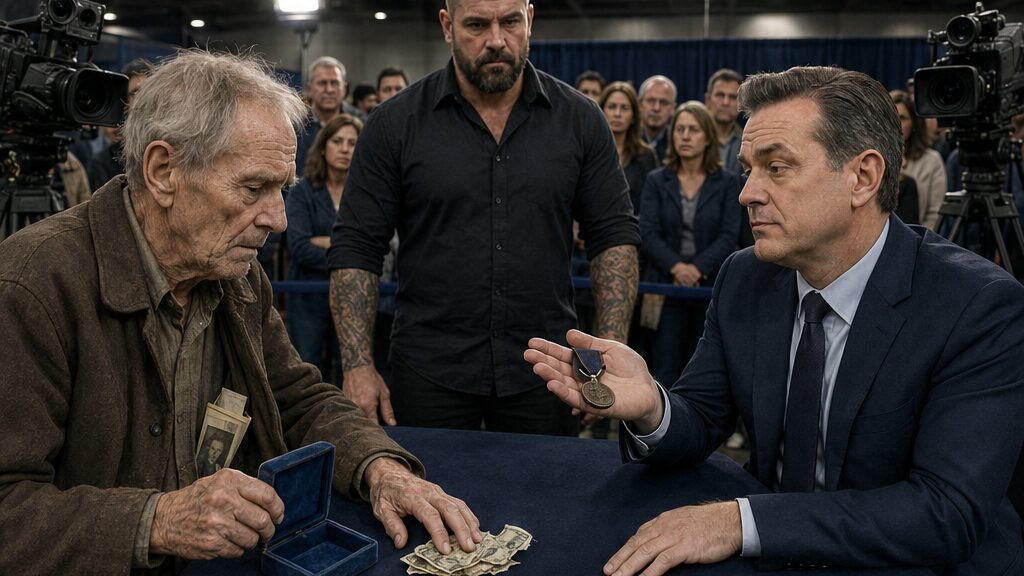
The Hungry Veteran Offered His POW Medal Before the Cameras Stopped Rolling
Chapter 1: The Velvet Box Beneath His Coat
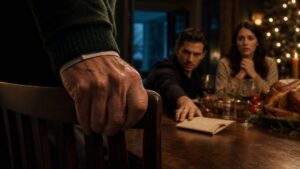
The eviction notice slid beneath the apartment door while Anna was packing her lunch.
Its white edge crossed the worn linoleum like a blade.
Raymond Harris saw the red block letters before she did. He moved faster than his knees wanted, crossing the narrow living room with one hand against the wall. The envelope stopped beneath his shoe.
“Mail?” Anna called from the kitchen.
“Advertisement.”
He bent carefully, fighting the black spots that gathered at the edges of his vision. The paper inside was heavier than an advertisement. He folded it once without reading it, though he already knew every line.
FINAL NOTICE.
BALANCE DUE WITHIN FORTY-EIGHT HOURS.
POSSESSION WILL BE RETURNED TO THE PROPERTY OWNER.
He slipped it inside his coat.
Anna appeared carrying two paper bags. At sixteen, she had learned to make concern look casual.
“I made you one.”
Raymond glanced at the smaller bag. “Not hungry yet.”
“You said that yesterday.”
“I ate after you went to bed.”
Her eyes rested on him a second too long. Raymond adjusted the collar of his shirt, though it was already straight. The apartment smelled of toasted bread, but there were only two slices left in the loaf. He had heard Anna counting them that morning.
She held the bag out.
“Take half.”
“I’m going across town. I’ll get something there.”
“At the antiques event?”
“Roadshow.”
“That sounds expensive.”
“Looking is free.”
Anna placed the bag beside his keys instead of arguing. She had become skilled at leaving things where pride might accidentally find them.
On the table lay a yellow appointment card with the words EMERGENCY HOUSING ASSISTANCE printed across the top.
“Our meeting is tomorrow at four,” she said. “I got them to move it after the school counselor called.”
Raymond’s fingers tightened around the eviction notice inside his coat.
There had been another appointment three days earlier. He had stood outside the assistance office for nearly twenty minutes, watching families enter beneath a sign promising help. Then he had turned around.
The required notice for that appointment remained hidden beneath old newspapers in his bedroom drawer.
“Tomorrow,” he said. “We’ll see.”
“We have to go.”
“I said we’ll see.”
Anna’s mouth hardened. “That usually means no.”
“It means I have something to handle first.”
Her gaze drifted toward the hallway and stopped on the high shelf inside his open bedroom. A clear rectangle showed in the dust where the velvet box had rested for years.
“What did you take down?”
Raymond followed her eyes.
“An old item.”
“The box?”
“I’m having it valued.”
She looked at the coat buttoned over his chest. “You never let me touch that box.”
“Which is why I’m taking it myself.”
“What’s inside?”
“Nothing that helps by sitting on a shelf.”
The answer came sharper than he intended. Anna looked away first. Raymond felt the small victory as shame.
She picked up her school bag. A childhood photograph was clipped to one strap: Anna at seven, missing a front tooth, sitting on Raymond’s shoulders at a county fair. He had printed a second copy years ago and placed it inside the velvet box.
“Be home before dark,” she said.
“You’re giving me a curfew now?”
“Somebody has to.”
The door closed behind her.
Raymond remained still until her footsteps disappeared down the stairs.
Then he returned to the bedroom.
The faded velvet box had once been deep blue. Time had rubbed the corners gray. He drew it from beneath his coat and set it on the bed beside his late wife’s ring.
The ring might have brought enough for groceries, perhaps part of the electric bill. Not rent. He lifted it, feeling the slight groove worn inside the band, then placed it back in the chipped porcelain dish.
The box hinge clicked softly when he opened it.
The POW Medal lay against pale satin. The eagle’s wings spread above a ring of barbed wire. Beneath it, the black ribbon carried narrow stripes of red, white, and blue. The metal had darkened slightly around the edges.
Raymond did not touch the face of it.
His fingers moved instead to the photograph tucked into the lid. Anna’s seven-year-old grin stared back at him. Behind her, his own face looked fuller, his shoulders broader, as if age had not yet begun collecting payment.
He shut the box.
At the roadshow, he told himself, there would be experts. Collectors paid for things whose meaning they did not understand. That had always seemed obscene to him.
Today, obscenity had a use.
The convention hall occupied an old train depot renovated with polished glass and bright banners. People queued outside carrying paintings, clocks, porcelain figures, and objects wrapped in towels. Raymond joined them with the velvet box hidden beneath his coat.
By the time he reached security, his legs trembled.
An attendant asked him to open his coat.
Raymond hesitated.
“Venue policy, sir.”
He removed the box. The lid shifted as he placed it in the inspection tray, opening no more than an inch.
The attendant saw the striped ribbon.
His expression changed.
“Is that what I think it is?”
“I need a valuation.”
The attendant leaned toward another worker. “Military collectibles has a live table open.”
“I don’t need television.”
“It’s the right specialist. This way.”
Before Raymond could object, a blue wristband was fastened around him and a staff member was waving him past the ordinary appraisal lines.
People turned as he was guided through the hall.
The velvet box felt suddenly exposed in his hands.
Ahead, beyond a security rope and a bank of white lights, cameras surrounded a polished table. A man in a tailored jacket sat beneath a sign reading MILITARY HISTORY AND DECORATIONS.
A producer saw the box and lifted one finger toward the camera crew.
The red light above the nearest camera came on.
Chapter 2: A Price Placed on Survival
A woman clipped a microphone to Raymond’s lapel before telling him the broadcast had already begun.
“Just answer naturally,” she said.
Raymond stared at the black foam head of the microphone. “I didn’t agree to be filmed.”
“The entrance release covers incidental recording. I’m Cynthia Roberts, the segment producer.” Her smile was brisk rather than unkind. “We can keep the appraisal brief.”
“I want it private.”
“The military table is live for another seven minutes. You’ll receive the best specialist available.”
Across the lights, the appraiser straightened his cuffs.
Dennis White had silver at his temples, a blue silk tie, and the smooth hands of a man whose work required other people to trust his touch. He smiled toward the center camera before looking at Raymond.
“And what have you brought us today?”
Raymond remained standing.
“A medal.”
Dennis waited, encouraging more.
“That’s all.”
The smile tightened. “Please sit.”
The studio chair was low. Raymond lowered himself into it with care, keeping the box in both hands.
Dennis extended one palm.
Raymond set the box on the table but did not release it.
For a moment, their hands occupied opposite sides of the faded velvet—Dennis’s open and expectant, Raymond’s knotted around the corners.
“We’ll need to see it,” Dennis said.
Raymond opened the lid.
The overhead camera moved closer. On a monitor beyond the table, the medal filled the screen, every scratch enlarged.
Dennis’s eyes sharpened for less than a second.
Then he recovered.
“Interesting.”
He rotated the box toward the cameras.
The satin lining pulled away from Raymond’s side of the table. The medal seemed to leave with it.
Dennis lifted it by the ribbon.
“There are many commemorative medals in circulation,” he said. “Some official, some privately produced. This design became associated with prisoner recognition in the late twentieth century.”
“It was authorized in 1985,” Raymond said.
Dennis glanced at him.
“The formal program developed around that period.”
“November eighth, 1985. The first presentations were later.”
A faint movement stirred among the spectators.
Dennis smiled as though Raymond had supplied an entertaining footnote. “You’ve done some research.”
Raymond looked at the medal hanging from Dennis’s fingers.
“I was there.”
The camera operator shifted.
Dennis lowered the medal. “At a presentation?”
Raymond did not answer.
Behind the table, a black curtain separated the public floor from the inventory area. A man was moving cases there, visible only in fragments when the fabric parted. Thick tattoos covered his forearms. At Raymond’s words, the man stopped.
Dennis examined the ribbon.
“There is wear here,” he said. “Some oxidation. No original paperwork visible.”
“It didn’t come with paperwork.”
“Most collectors prefer provenance.”
“It has a name.”
Dennis turned the medal over.
The engraved letters caught the light.
RAYMOND HARRIS.
His thumb moved across the name before the overhead camera could focus.
“Personal engraving can sometimes be added later,” he said.
Raymond watched the thumb.
“You know that one wasn’t.”
Dennis looked up.
Nothing changed in his expression, but his next breath came through his nose.
“Our role is to remain cautious. Television creates assumptions. Authentication requires careful review.”
“Then review it.”
Cynthia made a small circling motion from beside the camera. Keep moving.
Dennis set the medal on a square of black cloth, apart from the velvet box. “May I ask how you obtained it?”
Raymond’s stomach tightened. Under the lights, the room had grown too warm.
“It belongs to me.”
“Family inheritance?”
“No.”
“Purchased?”
“No.”
Dennis leaned back slightly. “You understand why documentation matters.”
Raymond reached for the medal. Dennis placed two fingers lightly over the ribbon.
The touch was polite. The claim inside it was not.
“I came to find out what someone would pay,” Raymond said.
“Ah.” Dennis’s attention shifted. “So this isn’t merely an appraisal.”
“No.”
“A sale changes the discussion.”
Raymond saw calculation replace caution.
“How soon would you need payment?”
“Today.”
Behind the curtain, the tattooed man looked up again.
Dennis lowered his voice, though the microphone carried every word.
“Immediate liquidity narrows the buyer pool. A scheduled auction might produce a different result, but that requires fees, verification, and time.”
“How much today?”
“Before we discuss numbers, it would help to understand your expectations.”
“I don’t have expectations.”
“Everyone does.”
Raymond’s hand drifted to his coat pocket, touching the folded edge of the eviction notice.
Dennis noticed.
“Is there a deadline?”
Raymond withdrew his hand. “There’s always a deadline.”
Dennis gave the camera a sympathetic look. “Collectors often come to us at emotional moments. We try to separate sentiment from market reality.”
The word sentiment landed harder than Raymond expected.
Not captivity. Not survival. Sentiment.
Dennis picked up the medal again and weighed it in his palm.
The man behind the curtain stepped closer. He was broad-shouldered, with cropped dark hair and black ink climbing both arms. A laminated military identification card showed briefly inside the wallet clipped near his workbench.
Dennis did not see him.
“This is not gold,” Dennis said. “Nor is it especially rare in pure production terms.”
“It wasn’t made to be rare.”
“No. But the market does not price intention.”
“The market wasn’t in the room where it was earned.”
Cynthia lowered her hand. For the first time, she looked directly at Raymond rather than the clock.
Dennis’s smile disappeared.
He turned the medal over once more. His thumb covered the engraving again.
“Given the condition, missing documentation, and need for an immediate transaction, I could make a modest acquisition offer.”
Raymond’s mouth had gone dry.
“How modest?”
Dennis looked at him, then at the cameras, judging which answer served him better.
He laid the medal flat, name down, and kept his thumb pressed over the engraved edge.
“Scrap-based,” he said.
Chapter 3: The Offer Beneath the Studio Lights
Dennis slid four crumpled bills across the polished table before Raymond had agreed to sell.
“One hundred and twenty dollars,” he said. “Cash-equivalent. Final offer.”
The bills stopped against Raymond’s empty velvet box.
For a moment, no one spoke.
The cameras hummed softly. Somewhere beyond the ropes, a child asked a question and was hushed.
Raymond looked at the money.
It would not stop the eviction.
It would not even delay it.
“You said scrap-based,” he said.
“That is the practical floor for an object without confirmed provenance.”
“My name is on it.”
“A name is not provenance.”
“You asked where it came from.”
“And you declined to provide a verifiable chain of ownership.”
Raymond lifted his eyes. “I said it was mine.”
Dennis spread his hands. “People come here with family stories every day. Some are true. Some have changed through generations. My responsibility is to value the object, not the emotion attached to it.”
The tattooed man had emerged partly from behind the curtain now. He stood motionless near a stack of display cases.
Raymond noticed him, then looked away.
Dennis picked up the medal without its box and balanced it against his palm as though estimating loose hardware.
Raymond kept one hand on the faded velvet.
“What would you sell it for?” he asked.
Dennis’s eyebrows rose. “That would depend on authentication, presentation, and the eventual buyer.”
“So not one hundred and twenty.”
“Resale involves risk.”
“Whose?”
A murmur passed through the spectators.
Cynthia raised two fingers at Dennis. Two minutes.
Dennis leaned forward.
“I’m trying to help you complete the transaction you requested.”
“You’re trying to learn how little I can afford to refuse.”
The appraiser’s jaw tightened. “Mr. Harris, this is a rich man’s hobby.”
Raymond felt every lens move closer.
Dennis glanced at his hollow cheeks, then at the paper bag corner protruding from his coat pocket where Anna had left his lunch.
“You clearly haven’t eaten today,” he said, “so you’ll take whatever I throw at you.”
Silence struck the table.
Even Dennis seemed to hear the sentence after it had left him.
Cynthia’s hand dropped. Her eyes went to the control booth, but she did not call for the cameras to stop.
Raymond thought of a metal cup pushed beneath a door. Of learning to divide one swallow into two. Of men who waited until darkness to ask whether anyone else was still breathing.
His fingers trembled against the velvet.
He closed them until the shaking slowed.
“Tell me something,” he said.
Dennis’s confidence had returned in pieces. “What?”
“Is that your offer for the medal?”
“Yes.”
“Or for my hunger?”
Dennis did not answer immediately.
“That is an emotional distinction, not a market one.”
“It sounds important to me.”
“You came here to sell.”
“I did.”
“Then we are negotiating.”
“No.” Raymond looked at the money. “You decided what I was before you named the price.”
Cynthia stepped closer, speaking low enough that the spectators could not hear, though Raymond’s microphone caught it.
“We need to close the segment.”
Dennis nodded without looking at her. “Mr. Harris, I’ll keep the offer open for thirty seconds.”
Raymond’s hand slipped into his coat.
The eviction notice came out with the yellow appointment letter folded behind it. He had not meant to reveal either. The red words showed plainly beneath the studio lights.
Dennis’s eyes found them.
“So there is urgency,” he said.
Raymond pushed the papers back into his pocket, but the camera had already captured them.
“My grandchild needs a home.”
The sentence left him smaller than he intended.
A woman among the spectators covered her mouth.
Dennis’s expression softened into something manufactured for television.
“I’m sorry to hear that. Which is why immediate cash may be more useful than a theoretical auction value months from now.”
“One hundred and twenty dollars won’t pay the rent.”
“It is one hundred and twenty more than you had when you walked in.”
Raymond looked at the medal.
The black ribbon lay across Dennis’s palm. The narrow colored stripes seemed brighter beneath the lights than they had in his bedroom. The barbed-wire ring around the eagle caught a white reflection.
He remembered receiving it years after coming home. A formal room. A hand he had not wanted to shake. Words like recognition and sacrifice spoken by men who slept well.
The medal had never fed anyone.
It had never paid a bill.
It had sat in the dark while Anna grew.
Dennis nudged the bills closer.
“If you walk away now, I cannot guarantee another buyer. Not today.”
Cynthia lifted one finger.
Raymond heard the clock inside himself.
Forty-eight hours.
Then less.
Anna standing on the curb with two bags.
The promise he had repeated when days had no names: Get home. Keep them safe. Get home.
He opened his hand over the velvet box.
“What do I sign?”
Dennis reached beneath the table and produced a purchase form with practiced speed.
“Standard transfer. You affirm ownership and accept the stated amount.”
Raymond scanned the first line. The words blurred. Hunger and heat pressed behind his eyes.
Dennis placed a pen beside the cash.
From behind the curtain came the scrape of a case being shoved aside.
Cynthia whispered, “Ten seconds.”
Raymond did not pick up the pen.
He touched the edge of Anna’s photograph inside the box lid. Her seven-year-old face smiled up at him, unaware that someday he might sell the one object he had never explained.
The photograph did not ask him to keep it.
The eviction notice did.
Dennis held the medal over the velvet lining.
“Once you sign, it stays here.”
Raymond nodded.
His hand moved toward the bills.
A heavily tattooed palm slammed onto the table between his fingers and the money.
The impact knocked the pen to the floor and rattled the medal against the wood.
The man from behind the curtain stood over Dennis, his face controlled and his arm rigid.
“Take your hand off that medal,” he said.
Chapter 4: The Hand That Stopped the Sale
“Take your hand off that medal.”
The command traveled through Raymond’s open microphone and across the convention hall.
Dennis’s fingers remained on the ribbon.
The tattooed man leaned closer. Dark lines of ink moved over his forearm as the muscles tightened beneath them.
“I said take your hand off it.”
Dennis released the medal. “Nicholas, this is a live appraisal.”
“I know exactly what it is.”
Cynthia stepped between the nearest camera and the table, one hand pressed to her headset. “Cut the audio.”
A technician behind the lights shook his head and pointed at the active broadcast indicator. The red light remained on.
Nicholas Moore picked up the medal by its edges. Unlike Dennis, he did not weigh it. He turned it once beneath the overhead light, examining the ribbon, the suspension ring, and the engraving on the reverse.
Then he looked at Raymond.
“Mr. Harris?”
Raymond nodded.
Nicholas’s posture changed—not softened, exactly, but corrected. His shoulders drew back.
Dennis pushed away from the table. “The gentleman requested an immediate purchase offer. I provided one.”
“You called this commemorative.”
“I said further authentication was necessary.”
“You knew what it was.”
“I knew what it appeared to be.”
Nicholas placed the medal inside the velvet box and closed the lid. His palm stayed over it.
“This ribbon is correct for an authorized Prisoner of War Medal. The planchet, the edge, the period engraving—none of that is scrap. You saw his name.”
Dennis glanced toward the cameras. “Visual consistency does not establish provenance.”
“You covered the engraving with your thumb.”
“That is an accusation.”
“No. It’s on camera.”
A low murmur moved through the crowd.
Dennis’s face flushed beneath the studio powder. “You are the booth owner, not the assigned appraiser. I have professional obligations.”
Nicholas pointed at the bills. “Repeat the offer.”
“This is inappropriate.”
“You made it on live television. Say it again.”
Cynthia reached for Nicholas’s arm, then stopped before touching him. “Mr. Moore, we need to move this away from the broadcast table.”
Nicholas did not look at her. “How much?”
Dennis’s gaze darted toward the control booth. “One hundred and twenty dollars, contingent on immediate transfer.”
“For a named POW Medal.”
“For an unverified item presented without documentation.”
“You didn’t offer an authentication hold. You didn’t call the military specialist standing twenty feet behind you. You saw a hungry old man and offered him grocery money.”
Dennis’s mouth hardened. “Urgency affects every transaction. That may sound unpleasant, but markets are not memorial services.”
Nicholas struck the table again, less loudly but with more danger in the restraint.
Raymond pulled the velvet box from beneath his palm.
Both men turned.
“No,” Raymond said.
Nicholas blinked. “Sir, I’m trying to—”
“I heard what you’re trying to do.”
Raymond drew the box against his chest. The sudden movement made the room tilt, but he kept his feet planted.
Dennis adjusted his jacket as if order had returned. “Mr. Harris understands that he came here voluntarily.”
Raymond looked at him. “You don’t speak for me either.”
Dennis went still.
Raymond turned to Nicholas. “And neither do you.”
The anger in Nicholas’s face changed first to surprise, then to something like embarrassment.
“I apologize,” he said. “But that medal cannot leave your hands for one hundred and twenty dollars.”
“That decision is mine.”
“Yes, sir.”
“Don’t call me that because you saw a ribbon.”
Nicholas’s jaw shifted. “Understood.”
Raymond looked down at the box. The worn velvet had collected a faint crescent of Dennis’s studio powder. He brushed it away with his thumb.
“What is your role here?” he asked.
“I own this booth. My family’s business contracts with the roadshow for military collectibles.” Nicholas opened the wallet clipped at his side. Behind a driver’s license sat an active-duty military identification card. “I’m still serving. I handle the shop when I’m home.”
Dennis gave a humorless laugh. “And he has an obvious financial interest in discrediting my valuation.”
Nicholas faced him. “My financial interest is in not having my business used to rob people.”
“Robbery requires coercion.”
“You used the deadline.”
“I used disclosed circumstances.”
“You used his hunger.”
Dennis looked toward Raymond, searching for support. “You asked what someone would pay today. I gave you the number I could justify under the conditions.”
Raymond heard the fear beneath Dennis’s precision. Not regret. Fear that the cameras had captured him losing command.
Cynthia finally stepped forward. “The segment is over. We’re moving everyone off the floor.”
Two staff members began guiding spectators back from the rope. The red camera light went dark, but the room did not feel private. Phones remained raised beyond the barriers.
Dennis gathered the transfer form. “There is no transaction, then.”
Raymond’s eyes dropped to the bills.
No transaction meant no money.
One hundred and twenty dollars had been an insult. It had also been more than the thirteen dollars in his wallet.
Dennis noticed his glance. “The offer remains available until you leave the venue.”
Nicholas moved toward him.
Raymond lifted one hand. “Enough.”
The word stopped them both.
He placed the velvet box inside his coat.
“I’ll decide what happens next.”
Cynthia led them through the black curtain into a narrow service corridor lined with equipment cases and coiled cables. The noise of the roadshow dulled behind the fabric. Without the studio lights, Raymond’s vision darkened at the edges again.
Nicholas pulled a folding chair from the wall.
Raymond ignored it.
“Sit down,” Nicholas said.
“That sounded like another order.”
Nicholas released the chair. “Would you like to sit?”
“No.”
Cynthia removed her headset. “Mr. Harris, I need to ask whether you want to file a complaint about the appraisal.”
“I need to know whether the medal can pay my rent.”
Nicholas answered before she could. “It’s not a question of what the medal can pay.”
“That is exactly the question.”
“I can help.”
Raymond’s hand tightened over the box beneath his coat. “You don’t know what I need.”
“I heard you.”
“You heard one sentence.”
Nicholas’s expression tightened, but he held his silence.
Dennis remained near the curtain, arms folded. “He needs an immediate buyer. Moral outrage does not change that.”
Nicholas took one step toward him.
Raymond stepped between them.
The movement cost him. His knee nearly folded, and Nicholas reached out, but Raymond caught himself against an equipment case.
“I have spent enough time today with men deciding what I can bear,” Raymond said. “No one touches that box. No one names its price. No one makes my choice for me.”
The corridor quieted.
Nicholas lowered his hand.
“All right,” he said. “Your choice.”
A door opened at the far end.
Anna stood there with her school bag hanging from one shoulder. Her face was pale, and in her right hand she held a second copy of the eviction notice.
Her eyes moved from Dennis to Nicholas, then stopped on the shape beneath Raymond’s coat.
“Grandpa,” she said. “Why was your medal on live television?”
Chapter 5: The Promise He Never Explained
Anna placed the missed appointment letter beside Dennis’s crumpled cash.
They lay together on the folding table in the private holding room: one hundred and twenty dollars, an emergency housing form stamped MISSED, and the eviction notice she had carried across town.
“Which one,” she asked, “were you never going to show me?”
Raymond stood opposite her. The velvet box remained inside his coat.
Nicholas waited near the closed door. Cynthia had brought water and then retreated to the corner, still holding her headset. Dennis had not been allowed into the room.
“The notice came this morning,” Raymond said.
Anna tapped the stamped letter. “This one didn’t.”
“I was handling it.”
“You missed the appointment.”
“I went there.”
“You signed in?”
“No.”
“Then you didn’t go.”
Raymond’s throat tightened. “I stood outside.”
Anna stared at him. Anger steadied her voice better than tears would have.
“I filled out those forms because you kept saying the rent was late but manageable. I asked the counselor to call. I got the meeting. All you had to do was walk inside.”
“There were people who needed it more.”
“We are being evicted.”
“I had another way.”
Her gaze dropped to his coat. “By selling that?”
Raymond did not answer.
Anna crossed the room before he could stop her and pulled the velvet box from beneath his lapel. She did not open it. She held it with both hands, as carefully as she had once held an injured bird.
“You wouldn’t let me dust this shelf.”
“It wasn’t for you to worry about.”
“You were going to give it to a stranger for one hundred and twenty dollars.”
“That wasn’t the amount I expected.”
“But you were reaching for it.”
Raymond looked toward Cynthia. The producer lowered her eyes. Nicholas remained motionless, though a muscle moved in his jaw.
“This is family business,” Raymond said.
Anna turned on him. “Then why am I always the last person in the family to know?”
The question struck where Dennis’s insult had not.
Raymond took the chair Nicholas had offered earlier. His legs no longer gave him a choice.
Anna placed the box on the table between the notice and the money.
“What is it?” she asked. “Not the medal. The box. Why do you hide it?”
“It’s an award.”
“For what?”
“You know what POW means.”
“I know what the letters mean.”
Raymond reached for the water. The cup clicked against his teeth, so he set it down untouched.
The holding room had no windows. Fluorescent light flattened every face. Somewhere beyond the wall, an audience applauded another appraisal, the sound faint and misplaced.
“I didn’t tell your mother much either,” he said.
“That doesn’t make it better.”
“No.”
Anna waited.
Raymond looked at the closed box. “There were days when I stopped knowing the date. Then days when I stopped caring. You learn to make the world very small.”
Nicholas shifted, but Raymond did not look at him.
“A crack in a wall. A cup. The sound of footsteps. You don’t think about a lifetime. A lifetime is too large. You think about getting through the next door opening.”
Anna’s anger loosened, though she held on to it.
“What did you think about?”
“Home.”
“Whose?”
“At first, my parents’. Later, a home that didn’t exist yet.”
His thumb pressed into the heel of his palm.
“I promised myself that if I came back, nobody under my roof would ever wonder whether someone was coming for them. No child would wait alone. No one would be put out because I failed to provide.”
Anna’s eyes shone. “You did come back.”
“Yes.”
“And now you think protecting me means selling the reason you survived?”
“The medal isn’t the reason.”
“Then what is?”
Raymond looked at her and could not answer.
The reason had not been metal. It had been an imagined child at a table. A light in a window. Someone expecting his key in the door. Years later that imagined promise had taken Anna’s face.
She pushed the money toward him.
“I would rather leave the apartment.”
“No.”
“I would.”
“You don’t know what that means.”
“I know what this means.” She touched the box. “It means you keep cutting pieces off yourself and calling it shelter.”
Raymond flinched.
Nicholas turned toward the wall, granting him the dignity of not being watched.
Anna sat across from Raymond. “You should have told me.”
“I was trying to keep you from carrying it.”
“You made me carry it without knowing what it was.”
Before Raymond could respond, Cynthia’s headset crackled. She listened, her expression changing.
“What?” Nicholas asked.
Cynthia removed the earpiece. “Dennis has filed an incident report.”
Nicholas gave a short, disbelieving laugh. “Against whom?”
“He says the appraisal was interrupted by a financially interested booth owner and that Mr. Harris misunderstood a routine preliminary offer.”
Anna looked at the cash. “He said Grandpa would take whatever he threw at him.”
“It’s recorded,” Cynthia said. “But the unedited feed is temporary production media. Unless there is a formal complaint, it may be cleared when the event closes.”
“May be?” Nicholas asked.
Cynthia’s face tightened. “Dennis has requested that the segment be marked unusable because consent is disputed.”
Raymond studied her. “Do you agree with him?”
“I think I kept the cameras rolling because I was worried about schedule and liability.” She swallowed. “I told myself recording everything was neutral. It wasn’t.”
Nicholas stepped toward Raymond. “File the complaint. I’ll give a statement.”
Raymond shook his head. “I came for rent, not a hearing.”
“If you stay quiet, he gets to call it confusion,” Anna said.
“Complaints don’t stop evictions.”
“No,” she replied. “But selling the medal for almost nothing won’t stop it either.”
Raymond looked at the table.
Dennis’s cash.
The missed appointment.
The velvet box.
Each object proved a different failure, and all of them were his.
He had believed silence kept Anna safe. Instead, it had cost them an appointment, brought her across town in fear, and left Dennis free to turn exploitation into misunderstanding.
Cynthia’s headset crackled again. “They need a decision now.”
Raymond stood slowly.
He picked up the money first and folded it once. Then he took the velvet box.
Anna’s face tightened. “What are you doing?”
“Finishing what I started.”
Nicholas moved toward the door. “I’ll handle Dennis.”
Raymond blocked him with the box held against his chest.
“No.”
Nicholas stopped.
Raymond looked at Cynthia. His hand no longer trembled.
“Take me back to the live table.”
“To complete the sale?” she asked.
Raymond opened the door.
“To answer him.”
Chapter 6: What the Medal Could Never Buy
Raymond pulled the crumpled bills toward himself as though he had returned to accept them.
Dennis watched from across the appraisal table, relief appearing too quickly behind his professional smile.
The cameras were live again. Cynthia had insisted on that condition before allowing Dennis to resume the segment. The spectators stood farther back now, but the silence around the table felt closer than before.
Anna waited beside the rope.
Nicholas stood behind her with his arms folded, visibly resisting the urge to take control.
Dennis addressed the camera. “Mr. Harris has chosen to continue after an unfortunate misunderstanding during our preliminary discussion.”
Raymond flattened the four bills with his palm.
“There was no misunderstanding.”
Dennis’s smile held. “Perhaps disagreement is the better word.”
“You knew my name was engraved on the medal.”
“I observed an engraving.”
“You covered it from the camera.”
“That is your interpretation.”
Raymond opened the faded velvet box.
The medal lay where Nicholas had returned it. Raymond lifted it himself, holding the ribbon between fingers that had steadied since Anna entered the holding room.
Dennis extended a hand.
Raymond did not give it to him.
“This medal came years after I came home,” he said. “The government was late recognizing some things.”
Dennis shifted. “Its historical context is not in dispute.”
“You disputed everything that made your price inconvenient.”
“I offered what I could justify without documentation.”
Raymond placed the medal faceup on the table.
Then he laid Dennis’s one hundred and twenty dollars over it.
Only the edges of the black ribbon remained visible beneath the bills.
“Can that buy the days?” Raymond asked.
Dennis frowned. “I’m sorry?”
“The money. Can it buy the days represented underneath it?”
“This is not how appraisal works.”
“How many days does twenty dollars buy?”
“Mr. Harris—”
“How many nights?”
Dennis glanced toward Cynthia.
She did not intervene.
Raymond lifted one bill and exposed the eagle surrounded by barbed wire.
“I learned to count time by footsteps. I learned the difference between a man bringing water and a man coming to ask the same question again. I learned how long you could stay awake when sleep gave people access to your mind.”
Anna’s fingers tightened around the security rope.
Raymond did not look at her. Not yet.
“I came here because my rent is overdue. I missed an appointment that might have helped because I was ashamed to stand in a room and admit I could not keep my promise.”
Dennis leaned forward. “None of that alters the commercial assessment.”
“No. It alters mine.”
Raymond removed the bills from the medal.
“I thought this was the only thing left that I could turn into shelter. I told myself the medal was metal, the box was cloth, and a roof mattered more.”
He looked at Anna.
“She told me a home bought by erasing someone is not much of a home.”
Anna lowered her head, crying without sound.
Dennis’s voice sharpened. “If you have decided not to sell, then this segment has become something other than an appraisal.”
“It became that when you priced my hunger.”
A murmur rose beyond the ropes.
Raymond turned toward the spectators and the cameras, not inviting their approval, only refusing to hide from them.
“I brought this medal here. I asked for a price. That part belongs to me. So does the decision I’m making now.”
He returned the medal to the velvet box and closed the lid.
“It is not for sale.”
Dennis pushed back his chair. “Then we are done.”
“Not yet.”
Raymond took the complaint form Cynthia had placed at the edge of the table. He signed his name beneath the statement she had prepared from the recording.
“I want the original footage preserved.”
Dennis’s face lost color. “This is an ambush.”
“No,” Raymond said. “An ambush requires the other man not to see what you’re doing.”
Nicholas looked down, hiding the brief movement at the corner of his mouth.
Raymond handed the form to Cynthia. She accepted it with both hands.
“I’ll preserve the feed and attach the complete transcript,” she said.
Dennis turned toward her. “You are exceeding your authority.”
“For once,” Cynthia replied, “I may have used too little of it.”
She signaled the camera operator.
The red broadcast light went dark.
The crowd did not applaud. A few people lowered their phones. Others moved away, uncomfortable now that the event had ceased to feel like entertainment.
Dennis gathered his papers with stiff, exact movements.
“One hundred and twenty was a legitimate conditional offer,” he said to no one in particular. “Urgency affects value. That is not cruelty. That is commerce.”
Raymond looked at him. “You keep saying the market made you do it.”
Dennis paused.
“It didn’t choose your words.”
He left without replying.
The appraisal floor began returning to motion. A staff member rolled another table into place. Someone tested a microphone. The ordinary machinery of the event resumed around the space where Raymond’s life had briefly become content.
Nicholas approached.
“How much is the rent shortfall?”
Raymond closed the box and tucked it under his arm. “That is not your concern.”
“It became my concern when my booth was used for that.”
“You stopped him. We’re square.”
“We are not.”
Nicholas pulled out his wallet.
Raymond’s body tightened. “Put it away.”
“I have enough cash to cover whatever he offered and more.”
“I said put it away.”
“This isn’t pity.”
“It looks the same from this side of the table.”
Nicholas’s expression hardened. “You would have taken his money.”
“I was selling something.”
“You were being robbed.”
“It was still a transaction. I knew what I was giving up.”
“And you think that makes it cleaner?”
Raymond turned away.
Nicholas stepped after him. “Sir—”
“Don’t.”
Nicholas stopped.
The old command in his posture faded. He looked at Anna, then at the box beneath Raymond’s arm.
When he spoke again, his voice was lower.
“All right. Tell me what it would have to mean.”
Raymond faced him.
“What?”
“For you to accept help. Not what I think it means. What would it have to mean to you?”
The question unsettled Raymond more than the wallet had.
Anna came closer but did not answer for him.
Raymond looked down at his hands. He had spent years defining the conditions under which he would give. No one had asked him to define how he might receive.
“It cannot buy the medal,” he said.
“It won’t.”
“It cannot buy my story.”
“No.”
“And Anna hears the whole truth from me. Not from a broadcast. Not from you.”
Nicholas nodded. “Agreed.”
Raymond’s throat tightened. “No speeches. No collection. No people passing a hat because they saw an old man under bright lights.”
“Then none.”
Nicholas opened his wallet and removed the bills inside. He counted them on the table, stopping only to ask Anna for the exact shortfall.
She named the amount from the notice.
Nicholas separated that sum and pushed the rest back into his wallet.
Then he placed the rent money on the table—not on the velvet box, not over the medal, but in the open space before Raymond.
Raymond did not reach for it.
Nicholas closed the box and slid it toward him first.
Then he stepped back from the table and came to attention.
Chapter 7: The Salute That Sent It Home
Raymond pushed Nicholas’s money back across the table.
“I came here to sell something,” he said, “not to become something you display.”
Nicholas remained at attention, but his eyes moved toward the silent cameras.
“They’re off.”
“Cameras don’t have to be running for people to make a show.”
Cynthia stood near the control station with Raymond’s signed complaint in her hand. Beyond the ropes, a few spectators lingered, pretending to study nearby exhibits while watching the appraisal table.
“I can clear the floor,” she said.
Raymond shook his head. “I don’t need another room.”
Nicholas relaxed his stance, though only slightly. “Then tell me what I’m doing wrong.”
“You’re standing there like I’m a ceremony.”
The words landed harder than Raymond intended. Nicholas lowered his arms.
“My apologies.”
He looked suddenly younger without the authority in his posture. The tattoos still covered both forearms, but his hands rested open at his sides.
Raymond glanced at the cash between them. It was more money than he had held at once in months. Enough to stop the eviction. Not enough to change what came after.
Nicholas followed his gaze.
“A man who trained me had been held overseas,” he said. “Not where you were. Not as long.”
Raymond said nothing.
“He hated being thanked. Said most people thanked him because it was easier than understanding him.”
“That sounds familiar.”
“He also said coming home creates debts nobody writes down. The people who survive carry some. The people who inherit what they protected carry others.”
Nicholas placed two fingers on the edge of the money but did not move it toward Raymond again.
“I’m not buying your medal. I’m not buying your story. I’m paying a debt I didn’t create but still owe.”
Raymond looked at him.
“That is a dangerous way to live.”
“Maybe.”
“You’ll run out of money before the country runs out of debts.”
Nicholas’s mouth shifted. “Then today I’ll settle one.”
Anna stepped beside Raymond. She did not touch the money either.
“The exact rent amount,” she said quietly. “Nothing extra.”
Nicholas nodded. “That was the agreement.”
Raymond looked at her. “You think that makes it different?”
“No,” Anna said. “I think you choosing the terms makes it different.”
Cynthia approached with her headset hanging around her neck.
“The network wants to know whether you would permit us to air a revised segment,” she said. “The full confrontation. Nicholas’s intervention. Your statement.”
Raymond’s face hardened.
“They believe it could become one of the event’s strongest pieces,” Cynthia continued. “They would frame it around respect for veterans and accountability.”
“You mean they would sell advertisements around it.”
Cynthia did not defend the request. “Yes.”
Anna looked toward the cameras.
Raymond closed one hand over the velvet box.
“My complaint stays.”
“It will.”
“The unedited recording stays with it.”
“Yes.”
“No promotion using Anna. No photograph. No footage about where we live.”
Cynthia nodded.
“And nothing about what happened in captivity beyond what I chose to say at that table.”
“I can mark the material restricted while the complaint is reviewed.”
“Can you stop every copy?”
“No,” she said. “Some people recorded the broadcast. I can control what the roadshow uses, not what is already outside.”
Raymond absorbed that without surprise. Once a thing was exposed, putting it back in darkness did not restore it.
“Then control what belongs to you,” he said.
Cynthia folded the complaint and placed it inside a clear evidence envelope. “I will.”
Her admission carried no request for forgiveness. Raymond respected her more for that.
Nicholas took a small card from his wallet and set it beside the rent money.
“This is a veterans’ housing office. Not a promise. Not a favor. They know the deadlines and the appeals process.”
Raymond almost refused it on instinct.
Anna picked it up first.
“We’ll call,” she said.
“We’ll go,” Raymond corrected.
Her eyes met his.
“Together?”
He nodded.
Only then did Raymond take the money.
The bills felt ordinary. That helped.
There was no ribbon beneath them, no medal covered by their weight, no transfer form waiting for his signature. He counted the amount once and placed it inside the envelope with the eviction notice.
Nicholas lifted the velvet box.
Raymond’s shoulders tightened, but Nicholas did not open it. He stepped around the table and pressed the closed box gently against Raymond’s chest.
Raymond raised one hand to hold it there.
Nicholas stepped back.
His heels came together.
The crowded appraisal hall seemed to recede—not because it quieted, but because Raymond stopped listening to it.
Nicholas raised his right hand in a precise salute.
“Sir,” he said, “your blood paid for my freedom. Keep your medal.”
Raymond’s throat closed.
For years, strangers had thanked him without knowing what they were thanking him for. Others had looked away. Dennis had looked directly at the medal and seen leverage.
Nicholas was not saluting the object.
He was saluting the choice to keep it.
Raymond shifted the velvet box beneath his left arm. His right hand rose slowly. The tremor returned at first, then settled as his fingers reached his brow.
He returned the salute.
There was no applause.
Cynthia looked down. Anna covered her mouth. Around them, the roadshow continued in softened fragments: wheels crossing the floor, a microphone being tested, someone laughing too loudly at another table.
Nicholas lowered his hand first.
Raymond lowered his a moment later.
The next morning, sunlight reached the apartment table through the bent blinds.
The eviction receipt lay beside the yellow housing appointment card. Nicholas’s contact card rested beneath Anna’s phone. The rent had been paid before the property office closed, but the following month remained a question neither of them pretended was solved.
Anna placed two slices of toast on separate plates.
Raymond did not tell her he was not hungry.
The faded velvet box sat open between them.
For the first time in years, it was not hidden on a shelf or beneath folded clothes. The POW Medal rested against the pale satin. Anna’s childhood photograph remained tucked inside the lid.
She touched the photograph, not the medal.
“You said you made a promise,” she said.
Raymond looked at the eagle, the barbed wire, and the worn black ribbon.
“Yes.”
“To come home?”
“At first.”
“And after that?”
He folded his hands on the table. They were steadier than they had been beneath the studio lights.
“After that,” he said, “the promise changed.”
Anna waited.
Raymond looked at her fully.
Then he began telling her why he survived.
The story has ended.