The Silent Recruit Offered His Hand After The Mess Hall Learned What He Could Do
Chapter 1: The Specialist Chose His Audience Before He Chose His Target
“I’ll make him beg before he reaches that table.”
Alexander Carter said it loudly enough to cut through the mess hall’s noon roar.
Forks scraped metal trays. Boots knocked chair legs. Someone near the drink station laughed before understanding what he had agreed was funny. By the time David Lee stepped away from the serving line, six soldiers had already turned to watch him carry his lunch.
David kept walking.
His tray had a shallow dent in one corner. Rice leaned against a scoop of vegetables, and thin gravy trembled around a piece of chicken each time someone brushed past him. He held the tray with both hands, elbows close to his ribs, his face still.
Alexander moved into the aisle.
He wore his decorations even at lunch because the day’s inspection had ended less than an hour earlier. The ribbons gave the other soldiers something bright to look at when he spoke. He had a broad chest, a heavy neck, and the easy posture of a man accustomed to seeing space open around him.
“Recruit Lee,” he called.
David stopped because rank and custom required him to stop.
“Yes, Specialist?”
The answer drew a second laugh. Not because of the words, but because David delivered them without irritation, fear, or challenge. Alexander had been testing him for six days—shouldering him at a doorway, dropping his folded uniform from a bunk, asking whether his voice had been issued separately from the rest of him. David had responded only when rules demanded it.
Alexander turned to the widening circle.
“You hear that? He does speak.”
Steven Harris stood near Alexander’s right side, smiling too quickly. Two others shifted tables aside to improve the view. Nobody had ordered them to do it, which made the obedience worse.
Alexander tapped one of David’s tray handles with two fingers.
“You’ve been here two weeks. You don’t joke. You don’t complain. You don’t even look people in the eye.”
David looked at him then.
Alexander’s right shoulder sat half an inch lower than the left. When he pointed, the elbow stayed closer to his body than it needed to. A healing strain, probably from training. His weight favored the left leg. His right hand opened and closed after each broad gesture, hiding stiffness.
David lowered his gaze to Alexander’s chest.
“I’m here to train.”
“Everyone’s here to train.” Alexander leaned nearer. “But in the field, silence like yours gets people killed. A man freezes, somebody else pays for it.”
There was enough truth in the words to keep the crowd comfortable.
David adjusted his grip on the tray. He turned the dented corner inward, away from Alexander. Metal edges could split skin. A tray swung flat could damage a throat. He did not want either possibility between them.
Alexander noticed the movement and smiled.
“You protecting your lunch?”
“I’m taking it to the table.”
“There.” Alexander glanced around as if David had proven something. “That’s what cowardice sounds like. Makes everything small. Makes every decision about getting away.”
Ashley Wilson stood at the end of a nearby table with a cup halfway to her mouth. David had seen her in first-aid drills. She knew how to watch an injury without staring at it. Her eyes went briefly to Alexander’s shoulder, then to David’s hands.
She lowered the cup but did not move.
David stepped left.
Alexander stepped with him.
The soldiers behind Alexander closed the opposite side of the aisle. Chairs scraped. The mess-hall noise did not disappear, but it altered, separating into two layers: ordinary lunch beyond the circle and expectant quiet inside it.
“I need to pass,” David said.
Alexander’s grin tightened.
“Ask properly.”
David’s hands remained level beneath the tray.
“Move, Specialist.”
A few soldiers made low sounds of approval. Not support for David. Interest. The target had finally moved.
Alexander heard the change. His right hand touched the ribbon above his pocket as though confirming it was still there.
“You think because you can stand still, you’re tough?”
“No.”
“Then what do you think?”
David looked toward the empty table six steps away. “That my food is getting cold.”
The laughter came before anyone could decide which man it belonged to.
Alexander’s face changed.
It was slight: the corners of his mouth remained raised, but the skin around his eyes went flat. He slapped the underside of David’s tray.
Metal jumped. Gravy spilled over David’s knuckles. The chicken slid to the floor. The tray struck the edge of a chair and spun away, scattering utensils beneath the tables.
Someone cheered.
David stared at the gravy running between his fingers.
His hands had not shaken when Alexander blocked him. They did not shake now. He opened them once, slowly, letting the heat sting instead of closing them into fists.
Alexander spread his arms to the crowd.
“Lesson one. If losing lunch breaks his concentration, imagine what incoming fire does.”
David bent to retrieve the tray.
Alexander put a boot on it.
“Leave it.”
David straightened.
He could smell detergent from the recently wiped tables, pepper from the serving line, and the faint metallic scent of his own skin where hot gravy had reddened it. Alexander stood within reach. Behind him, Steven clapped once and stopped when nobody joined him immediately.
David turned his body a few degrees. Not enough to look threatening. Enough to keep Alexander’s injured shoulder in sight and the nearest table out of any fall line.
“Specialist,” David said, “this needs to stop.”
Alexander looked almost pleased.
“Or what?”
“I’ll report it.”
The answer disappointed the crowd. Alexander let out a theatrical breath and shook his head.
“That’s the problem with recruits like you. First pressure, you look for protection.”
David could have said he had not reported the shoulder checks, the missing bootlaces, the wet blanket left on his bunk, or the whispered promise that the mess hall would eventually see what he was made of.
Instead he said, “I asked you to stop.”
Alexander stepped close enough that the ribbons on his chest nearly touched David’s shirt.
“And I’m telling you this is training.”
“No. It isn’t.”
The words landed harder than David intended.
Alexander’s jaw shifted. He glanced at Steven, then at the others who had gathered. Too many people had heard the distinction. Too many were waiting to see whether his authority required permission.
He shoved David once in the chest.
David absorbed it without stepping back.
Alexander shoved him again, harder.
David moved with the force, letting one foot slide rather than resisting. The crowd read it as retreat.
Alexander read it as success.
“That’s it,” he said. “You don’t know what to do unless someone gives you an order.”
David looked at Alexander’s hands. One remained low. The other flexed near his side. He heard chairs moving behind him.
A narrowness formed inside his chest, colder than fear.
There had been a room years ago with no windows. A rubber floor. A voice telling him that warnings were gifts weak men wasted. He pushed the memory away before it could gain shape.
Alexander circled half a step.
David turned with him.
The crowd laughed again, pleased by the resemblance to an animal avoiding capture.
Alexander motioned toward Steven. “Watch this. Ten seconds and he’ll tap.”
David’s pulse slowed.
He did not want anyone behind him. Not Alexander. Not Steven. Not the soldiers who believed this remained a joke because no blood had been spilled.
“Don’t,” he said.
Alexander paused.
It was the first word David had spoken without rank or explanation attached to it.
“What was that?”
David kept his voice low.
“Do not touch me from behind.”
For one moment Alexander studied him. The room’s fluorescent light reflected across the decorations on his chest. Something uncertain moved behind his expression, an instinct perhaps, warning him that David’s silence had never been empty.
Then Steven laughed.
Alexander smiled for his audience and stepped out of David’s sight.
Chapter 2: The Chokehold Ended Before The Laughter Did
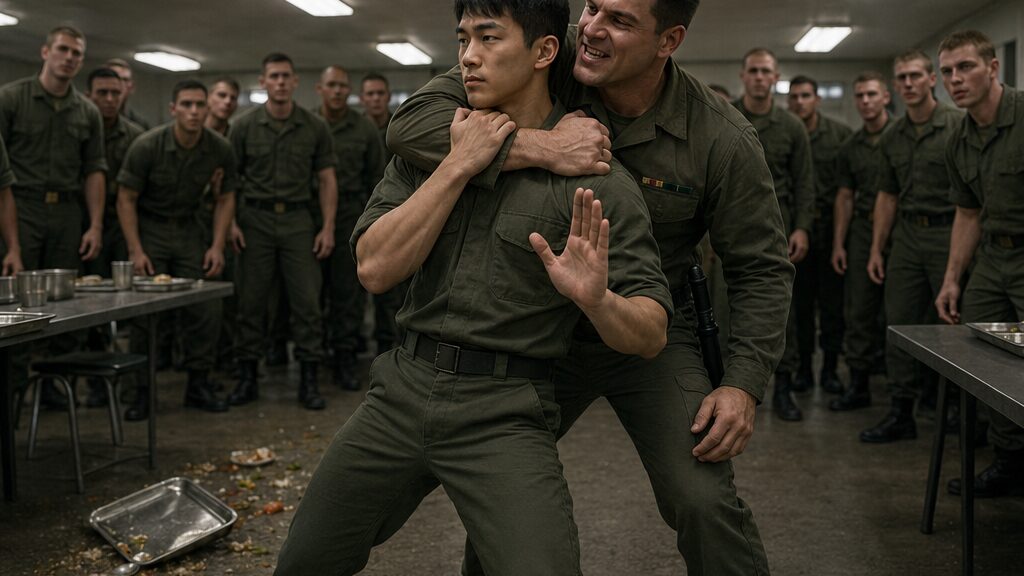
Alexander’s forearm locked beneath David’s jaw before the fallen tray stopped spinning.
The circle tightened at once.
David felt Alexander’s chest against his back, the hard ridge of a wrist pressing toward his throat, and a second hand forcing the first arm closed. Alexander pulled him backward to break his balance.
“Count it!” someone shouted.
Steven began. “One—”
David lowered his chin before the pressure sealed. He drew one measured breath through the narrow space he had preserved, widened his stance, and placed his left hand on Alexander’s forearm.
Not pulling. Measuring.
“Release me,” David said.
Alexander squeezed harder.
“Two!”
The mess hall fractured into details.
The slick patch beneath David’s right boot where gravy had spilled. The table corner three feet ahead. Ashley moving around the end of a bench. Alexander’s injured shoulder pressing unevenly against the back of David’s head. Steven’s hands raised as though conducting the crowd.
David lifted his right hand, palm open.
A signal to stop.
Alexander mistook it for surrender.
“You tapping already?”
“Release me.”
“Three!”
Alexander jerked backward, trying to drag him off his feet. David stepped with the pull rather than fighting it. His fingers settled over the gripping hand. His hips shifted a few inches.
Raymond’s voice came from nowhere and everywhere.
If a man reaches your throat, he has decided what your next breath costs.
David pressed his thumb into the hinge of Alexander’s grip, turned toward the weakened shoulder, and dropped his weight beneath the hold.
The lock opened.
Alexander’s damaged arm folded across his own chest. David rotated out, guided the wrist past him, and released it before the joint reached its limit.
He took two steps away.
No strike. No throw. No retaliation.
Alexander stood with one arm hanging awkwardly and his mouth open.
The count had stopped at three.
For half a second, nobody understood what had happened. Then a soldier near the back laughed.
It was a small sound, surprised rather than cruel.
Alexander heard it.
David saw the humiliation arrive before the anger. Alexander’s eyes moved across the faces around him, searching for the admiration that had been there moments earlier. Steven’s raised hands came down.
David opened both palms.
“It’s over.”
Alexander rolled his right shoulder and winced.
“You planned that.”
“No.”
“You made me look stupid.”
David glanced at the tray on the floor. “You did this for people to watch.”
A few faces turned away, suddenly interested in spilled food.
Alexander stepped forward. “You think one little escape makes you something?”
David did not answer.
Silence had protected him before. It had ended arguments by refusing to feed them. Now it worked differently. Each second David withheld a response left Alexander alone with the crowd.
A voice near the drink station said, “Let it go.”
Alexander looked toward it, but whoever had spoken remained hidden.
His hand dropped to his belt.
David noticed the motion before he saw the object.
The training baton came free with a scrape of hard polymer. It was meant for controlled drills, not mess-hall demonstrations. Alexander snapped it into a forward grip.
Ashley moved first. “Carter, stop.”
Alexander did not look at her.
He raised the baton.
The crowd broke outward, boots colliding with chair legs. Steven backed toward a table, no longer smiling.
David watched Alexander’s shoulder, not the weapon. The body moved before the hand. The injured joint limited the angle, so the strike would come wide and fast, powered by rage rather than control.
“Put it down,” David said.
Alexander swung at his head.
The baton cut the air beside David’s temple.
David’s left forearm rose. Pain flashed as polymer struck bone, but his right hand closed over Alexander’s wrist before the swing could rebound. He stepped inside the next attack, turned the gripping hand outward, and peeled the baton free.
Alexander tried to drive a shoulder into him.
David could have forced the arm straight and broken it.
He could have sent Alexander face-first into the table.
He saw both endings with the terrible clarity Raymond had trained into him.
He chose neither.
David moved the captured baton behind his own hip, placed his foot outside Alexander’s planted leg, and drew Alexander’s upper body across the empty space where balance had been.
The specialist’s feet left the floor.
His eyes widened toward the fluorescent lights.
A table corner waited beneath the path of his skull.
David released the baton, caught the back of Alexander’s uniform with his free hand, and altered the fall by inches.
Alexander struck flat across the shoulder blades. Air burst from him. The back of his head stopped just short of the steel table support.
The room became silent.
The baton bounced once.
David kicked it away from both of them.
Alexander stared upward, unable to make his body obey him. His decorations had twisted across his chest. One ribbon hung crooked. The bright proof of everything he wanted the room to believe looked suddenly small beneath the mess-hall lights.
David stood over him, breathing through his nose.
The old training demanded continuation.
Control the arm. Break the structure. Remove the threat.
His hands knew where to go.
He opened them.
Alexander dragged one elbow beneath himself and failed to rise. His eyes found Steven.
“Grab him.”
Steven did not move.
“I said grab him.”
The others who had formed the circle stepped back. One struck a chair with the backs of his knees and nearly fell over it. Another raised both hands, refusing without speaking.
Steven looked at David’s bruised forearm, then at the baton several feet away.
He retreated one step.
Alexander’s face tightened with something worse than pain.
“Help me up.”
No one approached.
The same men who had laughed when his arm closed around David’s throat now seemed afraid even to cross the space David had vacated.
David turned away.
He made it three steps before stopping.
The crowd parted in front of him. Not out of respect. Not yet. They moved because they had seen how quickly his hands could change a room.
That fear felt too familiar.
David looked back.
Alexander had rolled partly onto one side. His right hand pressed against the floor, but the injured shoulder would not bear his weight. He saw David returning and tried to push himself backward.
David stopped beyond kicking distance.
Then he extended one hand.
Alexander stared at it.
No fist. No weapon. No demand.
Just an open palm.
“You wanted an audience,” David said.
The words did not carry far, but the room was quiet enough for everyone to hear them.
Alexander’s gaze moved from David’s hand to his face. Terror replaced anger. He pressed himself closer to the floor, as though the offered hand concealed another throw.
David waited one breath.
Alexander did not take it.
Behind them, the mess-hall doors slammed open.
Chapter 3: The Hand Nobody Dared To Take
Alexander recoiled from David’s open hand as though mercy were the final strike.
“Back away!”
The command came from the mess-hall entrance.
Drill Sergeant Joseph Martin crossed the room with two duty personnel behind him. His eyes passed over the scattered food, the overturned chairs, the baton on the floor, and Alexander lying beneath David’s outstretched arm.
David lowered his hand.
Joseph pointed toward the wall. “Recruit Lee. Move.”
David obeyed.
One of the duty personnel collected the baton with a folded cloth while the other knelt beside Alexander. The room began to speak all at once.
“He attacked the specialist.”
“Carter had him first.”
“Lee threw him.”
“There was a baton—”
Joseph turned.
“Anyone who talks before I ask a question will spend the evening explaining why silence was beyond their training.”
The noise died.
David stood against the wall with his palms visible. Gravy had dried across one hand. A dark mark was rising along his left forearm where the baton had landed.
Ashley crouched near Alexander. “Don’t move your shoulder.”
“I’m fine,” Alexander said.
“You’re not.”
His eyes remained fixed on David.
Joseph saw it. He also saw Steven and the others standing several steps from their fallen leader, their faces emptied of the confidence they had worn minutes earlier.
“Who drew the baton?” Joseph asked.
No one answered immediately.
Alexander tried to sit up. Pain stopped him. “He set me up.”
Joseph’s expression did not change. “That was not my question.”
Ashley looked toward the baton, then at David. “Specialist Carter drew it.”
Steven shifted his weight.
Alexander snapped, “Stay out of this.”
Ashley’s face tightened, but she continued. “He swung toward Lee’s head.”
“He threatened me.”
David said nothing.
Joseph looked at him. “Did you?”
“No, Drill Sergeant.”
“What did you say?”
David remembered every word. He always remembered what was spoken before violence.
“I told him to release me. Then I told him to put the baton down.”
Alexander gave a dry laugh that turned into a wince. “He warned me before I touched him. Like he knew exactly what he was going to do.”
Joseph’s gaze sharpened. “What warning?”
David looked at the floor.
Joseph waited.
“I told him not to touch me from behind.”
The answer moved through the witnesses without sound.
Joseph ordered the crowd separated and names recorded. Alexander was taken through the side door toward the medical room. As the duty personnel lifted him, his decorations shifted again. He tried to straighten them with his uninjured hand.
No one from his group offered assistance.
David remained where he was until Joseph motioned him forward.
In the adjacent medical room, a medic cleaned the gravy from David’s hand and examined his forearm. David watched the medic’s fingers move over the swelling.
“Any numbness?”
“No.”
“Can you close your hand?”
David did.
The fingers obeyed smoothly. That seemed to trouble Joseph more than if they had shaken.
Alexander sat on the opposite cot with his shoulder wrapped and his wrist supported. A curtain had been drawn between them, but his voice carried through it.
“He wasn’t surprised. Nobody catches a strike like that by accident.”
Joseph stood beside David. “How did Carter land?”
“On his back.”
“That isn’t what I asked.”
David flexed his bruised fingers once.
“I changed the fall.”
“Why?”
“There was a table support behind his head.”
The curtain rings scraped. Ashley had entered with a written statement in her hand.
“He did,” she said. “Lee caught the back of Carter’s uniform before impact. If he hadn’t, Carter’s head would have hit the lower brace.”
Joseph took the statement but did not read it yet.
“You saw the whole exchange?”
“Most of it.”
“Did you intervene?”
Ashley’s mouth opened, then closed. “Not soon enough.”
It was not the answer of a clean witness, and Joseph seemed to respect it more for that.
He turned back to David. “You escaped the hold without striking. Then you disarmed him, redirected his fall, and stopped.”
“Yes, Drill Sergeant.”
“Where did you learn to do that?”
David looked at his hands.
The medic had wiped them clean. Without the gravy, they looked ordinary again—narrow palms, short nails, a pale scar at the base of one thumb.
“I’ve had some training.”
“What kind?”
“Informal.”
“From whom?”
David’s fingers closed.
Joseph noticed.
The questions continued in a small office after the medical examination. David sat across from Joseph at a metal desk while the recovered baton lay sealed in a clear evidence sleeve between them.
Witness statements arrived in uneven stacks. Some claimed David had moved before Alexander swung. Others said Alexander had intended only a demonstration. Three used the same phrase: Lee baited him.
Joseph read that line twice.
“Interesting,” he said.
David waited.
“Three different soldiers, identical wording. Either accuracy has improved since this morning, or somebody helped them remember.”
He pulled David’s intake file from a folder.
David’s chest tightened more than it had in the chokehold.
Joseph opened the file to a page marked with a yellow tab. “No martial-arts certification. No school athletics. No private security employment. No documented combat instruction.”
“I didn’t have certificates.”
“But you had instruction.”
David said nothing.
Joseph turned another page.
“Your records are consistent until age fourteen. Then school attendance becomes irregular. Medical history disappears. No employment records, no organized programs, no reliable address confirmation for almost three years.”
David focused on the baton’s outline inside the plastic sleeve.
“What happened during those years?”
“Family circumstances.”
“That answer might satisfy a clerk. It does not satisfy me after what happened today.”
“I defended myself.”
“You did. That may be exactly what the evidence shows.” Joseph leaned forward. “But disciplined defense and concealed dangerousness can look identical for the first five seconds. What separates them is judgment, history, and honesty.”
David’s hands remained in his lap.
Joseph lowered his voice.
“Who trained you?”
The room had no windows.
For one instant, David felt rubber flooring beneath his feet instead of tile. He heard Raymond telling him that hesitation was simply fear asking permission to survive.
David forced his fingers open.
“I don’t want to discuss him.”
“That is not your decision alone anymore.”
Joseph closed the file.
“Effective immediately, you are removed from training pending inquiry. No drills. No weapons access. No unsupervised physical instruction.”
David had known consequences were coming. Hearing them made the loss concrete.
Joseph tapped the yellow-marked page.
“You came here asking this institution to trust you under pressure. Today you showed skill no one can explain and a history you will not account for.”
David met his eyes.
Joseph’s final question came without anger.
“Why are three years of your life missing, Recruit Lee?”
David looked down at his open hands and said nothing.
Chapter 4: The Missing Years Were Not Empty
Joseph placed the recovered baton on the interview table between them.
It remained sealed in clear plastic, but David could still see the shallow smear where his palm had torn it from Alexander’s grip.
“Where,” Joseph asked, “does a twenty-year-old recruit learn to catch a full-force strike?”
David kept his bruised left hand beneath the table.
“I told you. Informal training.”
“That describes someone teaching you in a garage on weekends.” Joseph opened David’s file again. “What happened in that garage?”
“There wasn’t a garage.”
Joseph waited.
The interview room was barely large enough for the desk and two chairs. Every sound seemed sharpened inside it: the hum of the ceiling vent, paper sliding under Joseph’s fingers, the faint scrape of David’s thumb across his swollen knuckle.
“Raymond Lee,” Joseph said.
David’s hand stopped moving.
“Listed as your guardian after your mother died. Former combat instructor. Several addresses associated with him, none matching the address you gave for those missing years.”
David looked at the sealed baton.
“He moved often.”
“Why?”
“He didn’t like people knowing where he lived.”
“That include schools?”
“Yes.”
“Doctors?”
“Yes.”
“Police?”
David lifted his eyes.
Joseph leaned back. “That last question produced more of an answer than anything you’ve said.”
“There were no charges.”
“I didn’t ask whether there were charges.”
David’s silence returned, but it no longer felt protective. It felt like a door he was holding shut while Joseph tested the hinges.
From the infirmary across the corridor came the muted sound of Alexander arguing with someone.
“I can walk.”
“You can walk after the examination.”
“I said I’m fine.”
The voice had lost its mess-hall confidence. Pain had narrowed it.
Joseph glanced toward the door, then back at David.
“Alexander Carter earned his decoration during a vehicle fire eighteen months ago. Two injured soldiers were trapped. He went back through smoke when he could have waited for support.”
David said nothing.
“I’m telling you because I do not intend to turn either of you into something simple. Carter has been brave. Today he was reckless and cruel. Both can be true.”
Joseph tapped the file.
“The same applies to you.”
David’s fingers tightened under the table.
“Did Raymond teach you restraint?”
A memory surfaced before he could block it: Raymond standing barefoot on black matting, telling a fourteen-year-old David to rise before the count reached five. Blood in David’s mouth. Raymond’s hand extended, not to help, but to drag him upright for another attempt.
“No,” David said.
It was the first direct answer he had given about him.
Joseph heard the change. “What did he teach you?”
“To stay conscious.”
The door opened before Joseph could respond.
A duty clerk handed him a group of witness statements. Joseph read the first page, then the second. His expression settled into something harder.
“Carter says you threatened to put him on the floor before he touched you.”
“I didn’t.”
“He says you deliberately invited the hold so you could embarrass him.”
“No.”
Joseph placed one statement beside another.
“Steven Harris says he heard you say, ‘Come from behind and see what happens.’”
David remembered Steven’s face as Alexander lay staring at the ceiling. The terror had been real. So had the relief when someone else began shaping the story.
“I said, ‘Do not touch me from behind.’”
“Three witnesses use the same version as Carter.”
“They were standing with him.”
“That does not automatically make them liars.”
“No.”
Joseph studied him. “You aren’t angry?”
“I am.”
“You don’t show it.”
“I try not to.”
“Because of Raymond?”
David looked away.
Joseph closed the witness statements. “You understand the position you’ve created. Your movements suggest years of serious training. Your records conceal where those years occurred. You refuse to identify what happened. Meanwhile, multiple witnesses claim you provoked an assault.”
“They’re afraid of Alexander.”
“Perhaps. Or perhaps they are afraid of you.”
The sentence landed with more force than the baton had.
David pictured the soldiers parting as he walked away. Steven backing toward the table. Alexander shrinking from an open hand.
He had wanted to avoid being known. Instead, he had given them an empty space to fill with whatever frightened them most.
Joseph pushed the file across the table. “Write a complete account. You have until tomorrow morning.”
David did not touch the paper.
“What happens if I don’t?”
“You may be discharged for concealing relevant history and refusing a lawful inquiry.”
The answer was calm, which made it final.
David was escorted to the infirmary corridor while Joseph interviewed Alexander. Through the partially open door, David saw him sitting upright on a cot, his right arm supported in a sling. White tape wrapped his wrist. With his left hand, he kept adjusting the decoration ribbon that had twisted during the fall.
Joseph placed the sealed baton on a side table.
“Tell me again why you drew it.”
Alexander looked at the floor. “He came at me.”
David stopped beyond the doorway, unseen.
“You stated earlier that he was three steps away.”
“He had already attacked me.”
“He escaped a chokehold.”
“He humiliated me in front of my people.”
Joseph’s silence followed.
Alexander rubbed the edge of his ribbon.
“I meant he challenged my authority.”
“Your authority does not include choking recruits in the mess hall.”
“He needed pressure. Men like him freeze when nobody pushes them.”
“And after he escaped?”
Alexander’s mouth tightened. “He looked at me like I was nothing.”
David walked on before the answer could continue.
In the barracks corridor, soldiers stopped talking when he passed. A few watched his hands. One moved his boots out of the aisle without being asked.
David reached his bunk and found his training schedule removed from the board. The empty hook beneath his name seemed more official than Joseph’s words.
He sat and examined his bruised palm.
At fourteen, Raymond had called bruises proof that the body was learning. At seventeen, he had called fear proof that the lesson remained incomplete.
David had once put him in the hospital.
That fact could be made to fit any version of the missing years.
Late that afternoon, Joseph summoned him again.
The baton was still on the table.
“Did you seriously injure Raymond Lee?” Joseph asked.
“Yes.”
Joseph’s expression did not shift. “How seriously?”
“Broken wrist. Dislocated shoulder. Damage to his knee.”
“All during one incident?”
“Yes.”
“Why?”
David’s thumb moved over the bruise in his palm.
“He wouldn’t stop.”
“Stop what?”
David looked at the sealed baton, then at Joseph.
“I’m not ready to answer that.”
Joseph exhaled through his nose. “Readiness is becoming a luxury you do not have.”
Outside, Ashley stood near the infirmary door with a stack of medical forms. Steven appeared at the far end of the corridor and motioned urgently to her.
She followed him into an alcove.
David could not hear everything, only fragments carried by the vent.
“He decided before lunch…”
“…told us to gather people…”
Ashley’s voice, sharper: “Then say it officially.”
Steven looked toward Joseph’s office.
“I can’t.”
“You watched him swing that baton.”
“You didn’t see what Lee did.”
“I saw exactly what he did.”
Steven’s hands would not stay still. He rubbed them together, shoved them into his pockets, then pulled them out again.
“Alexander planned it,” he whispered. “Before Lee even walked into the mess hall. He said the quiet one would be easy.”
Ashley held out a blank statement form.
Steven stared at it as though it were a weapon.
Then he stepped back.
“I said I can’t.”
Chapter 5: The Witness Who Wanted No Part Of The Truth
“Alexander asked us to gather people before David even picked up his tray.”
Steven’s confession came in the empty mess hall after evening cleanup, spoken so softly Ashley had to lean across the table to hear it.
Overturned chairs had been righted. The spilled food was gone. A pale stain remained where gravy had dried between the floor tiles.
“Then tell Joseph,” Ashley said.
Steven stared at his hands. “You think this stays private once I do?”
“It shouldn’t stay private.”
“You weren’t with us.”
“I was standing ten feet away.”
“That isn’t what I mean.” He rubbed his palms against his trousers. “Carter has people here. People who remember what he did in that vehicle fire. You speak against him, you’re the one who betrayed the man who saved two soldiers.”
Ashley set the statement form between them. “Saving someone once doesn’t give him permission to hurt someone later.”
“He said Lee needed testing.”
“He wanted a crowd.”
Steven looked toward the dark serving line.
“He had a bad evaluation last week. The instructor said he relied on aggression when judgment was required. People heard about it. Alexander pretended he didn’t care, but he kept asking who knew.”
“And David looked safe.”
Steven nodded once.
“He said the quiet recruit wouldn’t fight back. Said he’d remind everyone what real pressure looked like.”
Ashley’s jaw tightened. “What did he tell you to do?”
“Laugh.”
“That’s all?”
Steven’s fingers curled against the tabletop.
“He said keep laughing even if Lee panicked. Even if he passed out. Said stopping early would ruin the lesson.”
The refrigeration units hummed behind the serving line.
Ashley pushed the form closer.
“You were the first one to step away when Alexander asked for help.”
“I was scared.”
“Of David?”
Steven shook his head, then stopped as if uncertain.
“Of what we had done.”
At the far end of the mess hall, a metal tray scraped across a table.
Both turned.
David stood alone near the wall, stacking the last of the trays left from the inquiry’s evidence photographs. Joseph had assigned him no formal duty, but David had returned after evening formation and begun putting the room back in order.
He lifted one tray, checked its bent corner, and set it aside.
Steven rose immediately.
“How much did he hear?”
Ashley watched David straighten a chair Alexander’s fall had knocked sideways.
“Enough to know you’re still hiding.”
Steven backed from the table. “I need time.”
“David has until morning.”
“That isn’t my fault.”
Ashley looked at him.
Steven’s face reddened. “I know how that sounded.”
“It sounded accurate.”
He left through the side door without taking the statement form.
David continued working until the final chair aligned with the table. Ashley approached, but he did not look up.
“Steven knows Alexander planned it,” she said.
“I heard.”
“He may testify.”
“He may not.”
“You could tell Joseph what you heard.”
“Secondhand.”
“You’re willing to lose your place here rather than explain Raymond, but you won’t use a fact that might help you because the source is imperfect?”
David placed the dented tray on top of the stack.
“I don’t want Steven forced into a version he’ll deny later.”
Ashley folded her arms. “You think silence makes you fair.”
David met her gaze.
“It gives everyone else room to lie,” she said.
The words held him still.
She took the statement form and left it on the table before walking away.
David remained in the empty mess hall. Without the lunch crowd, the fluorescent lights seemed harsher. Every scrape carried. Every empty seat marked where someone had watched.
He picked up the tray Alexander had struck from his hands.
The dented corner had deepened.
David pressed his thumb against it, though he knew he could not flatten it without tools.
Joseph found him there ten minutes later.
“You were told to return to barracks.”
“I was cleaning.”
“You were avoiding.”
David set the tray down.
Joseph carried a single sheet of paper. “Preliminary review. Unless you provide a full account by zero seven hundred, I am recommending separation proceedings for material omission and refusal to cooperate.”
“Even if the fight was self-defense?”
“These are separate questions. Carter’s wrongdoing does not erase yours.”
David nodded.
Joseph seemed almost irritated by the acceptance. “You wanted to be here.”
“Yes.”
“Then act like losing it matters.”
“It does.”
“I cannot tell.”
David’s hands closed around the tray.
Joseph noticed. “That right there. You think showing nothing is control. Sometimes it is only another way of refusing responsibility.”
David released the metal.
Joseph lowered the paper onto the table.
“Carter’s witnesses are changing details to protect him. That concerns me. Your missing history concerns me too. I will not ignore one because the other is convenient.”
“What do you want me to say?”
“The truth.”
“You may decide it proves what they think.”
“That is possible.”
The honesty struck harder than reassurance would have.
Joseph left the notice on the table and walked out.
David read it twice.
Separation proceedings.
He had joined because the rules here were written down. Training schedules were posted. Orders had limits. Instructors could demand effort, but not invent punishment in locked rooms. He had believed an institution could teach his body a new purpose.
Now the door out stood open, and his own silence was pushing him through it.
A sound came from the entrance.
Steven stood there.
For a moment David thought he had returned to speak. Instead Steven looked at the notice, then away.
“I didn’t know Alexander would use the baton.”
David waited.
Steven shifted. “We thought he’d scare you.”
“You counted.”
Steven flinched.
“I know.”
“You kept counting after I asked him to release me.”
“I know.”
David picked up the dented tray.
Steven glanced at his hands. “Why didn’t you keep hitting him?”
“I didn’t need to.”
“That’s not what people like Alexander do.”
“I’m not Alexander.”
Steven’s face tightened with shame. He placed the blank statement form on the nearest table but did not sign it.
Then he left again.
David carried the tray to the return window. In its warped reflection, his face looked like Raymond’s had after years of teaching him that fear was the only honest language.
Silence had once kept Raymond from learning where David hurt.
Here, it was hurting people who had tried to tell the truth.
Ashley had placed herself inside the inquiry. Steven’s fear had become another weapon Alexander could use. Joseph had been forced to judge movements without history.
David set the tray down.
At 2230, Joseph was still in his office when David knocked.
“Enter.”
The preliminary notice lay beside the sealed baton. Joseph removed his glasses and waited.
David sat without being told.
For several seconds, he watched his own hands resting on his knees. One was bruised from the baton. The other bore the pale scar Raymond had left years before.
He opened both palms.
“Raymond did not teach me to fight,” David said.
Joseph remained silent.
David drew a breath.
“He taught me what happened if I failed.”
Chapter 6: What David Had Been Trained To Become
“The first time I saw Raymond afraid of me, he was lying on the floor.”
David said it without looking at Joseph.
The office clock moved past eleven. The sealed baton had been placed in a cabinet, leaving the desk empty except for David’s file and a recording device Joseph had activated with his permission.
“What put him there?” Joseph asked.
“I did.”
David’s left hand trembled against his knee.
He covered it with the right, then stopped. Concealment was what had brought him here. He separated his hands and placed them on the desk where Joseph could see them.
“Raymond started training me after my mother died. He said nobody would protect me once she was gone. At first it was running, balance drills, learning how to fall.”
“How old were you?”
“Fourteen.”
“And later?”
“He said scheduled training made people weak because real attacks didn’t happen on schedule.”
David kept his eyes on his fingers.
Raymond had begun entering his room without warning. A hand over the mouth. A forearm across the throat. A blow to the ribs if David froze. Sometimes Raymond praised him afterward. Sometimes he made him repeat the defense until sunrise.
“He moved us because teachers asked about bruises,” David said. “He stopped enrolling me regularly. Said school taught people to wait for instructions.”
Joseph’s voice remained controlled. “Why didn’t you leave?”
“He was my family.”
The answer sounded smaller aloud than it had in David’s mind for years.
“He told me the pain meant he was making sure no one could ever own my fear. I believed him for a while.”
“When did that change?”
“When he stopped caring whether I understood the lesson. He only cared whether he could still surprise me.”
David’s hands shook harder.
He opened them wider against the metal desk.
“At seventeen, I told him I was leaving. He locked the outside door. I waited until he slept. He wasn’t asleep.”
Joseph did not interrupt.
“He came from behind in the hallway. Same kind of hold Alexander used. I asked him to stop. Raymond said asking was proof I had learned nothing.”
David saw the narrow hall again. A bare bulb. Raymond’s breath beside his ear. The pressure closing until the edges of the room darkened.
“I broke the grip. He came again. I put him down.”
“The wrist, shoulder, and knee injuries?”
“Yes.”
“Did you continue after he stopped attacking?”
David’s throat tightened.
“For one movement.”
Joseph leaned slightly forward.
“I had his arm,” David said. “The joint was already finished. I knew it. He knew it. I could have released him.”
“But you didn’t.”
“Not immediately.”
The recording device’s small red light remained steady.
“I wanted him afraid,” David said. “For one second, I liked that he was.”
There it was. The part no medical record could explain.
“Then I let go and called for help. But when I saw his face, I knew how easy it would be to become exactly what he had trained.”
Joseph looked at David’s open hands.
“So you decided never to use the skill again.”
“I decided never to enjoy it.”
“And when Carter recoiled from your hand?”
David’s fingers curled before he forced them open.
“I saw Raymond.”
Joseph switched off the recorder.
“That explains your fear. It does not excuse leaving three years out of your history.”
“I know.”
“Do you?”
David met his eyes. “I thought if I never spoke about it, it could not control what I did here.”
“But it controlled what you withheld.”
“Yes.”
The answer cost him more than resistance would have.
Joseph closed the file. “Get two hours of rest. At 0600, training room three.”
“For what?”
“To see whether your control exists outside your account.”
The controlled evaluation began beneath white ceiling panels in a room lined with padded walls. No crowd. No decorations. No lunch trays.
Ashley stood beside the medical kit. Two duty personnel waited near the door. Joseph wore protective gear over his uniform.
David had been given no weapon.
“Recreate the beginning,” Joseph said.
David positioned himself with his back partly turned.
Joseph approached from behind and placed an arm loosely across David’s upper chest.
David’s body reacted before thought. His pulse dropped. His right hand found the wrist. His hips prepared to turn.
“Stop,” Joseph said.
David released him instantly.
Joseph stepped away. “Again. More pressure.”
The hold closed higher, near David’s throat.
His hands moved. Chin down. Space preserved. Weight lowered.
Joseph changed his footing without warning and removed the pressure.
David’s counter stopped halfway through the turn.
Ashley watched his hand hover inches from Joseph’s elbow.
David opened it and stepped back.
Joseph’s face revealed nothing. “Why did you stop?”
“The threat changed.”
“Raymond teach you that?”
“No.”
Again.
This time Joseph pushed from the front, then reached toward David’s shoulder. David redirected the hand but did not seize it.
Again.
A duty person swung a padded baton toward his head. David blocked, took the wrist, and stripped the weapon away.
The man stumbled.
David could have swept him.
He did not.
Joseph pointed to the padded baton in David’s grip. “Why not finish?”
“He released control of the weapon and moved out of range.”
“Carter did not.”
“No.”
“What made the fall necessary?”
“He drove forward after the disarm. His weight was committed. The table was behind him.”
Joseph moved a padded training table into position.
“Show me.”
David hesitated.
“Slowly.”
The duty person reproduced Alexander’s forward drive. David stepped outside the planted leg, guided the upper body, and stopped before completing the sweep.
“Where was Carter’s head going?”
David indicated the corner.
“And your hand?”
David placed it at the back of the duty person’s uniform.
“To change the angle.”
Joseph nodded to the duty person, who abruptly stopped pushing and raised both palms.
David released him at once.
“Again,” Joseph said.
They repeated the sequence faster.
At the moment David caught the padded baton, Joseph shouted, “He is no longer attacking.”
David froze.
The weapon remained suspended between them. His forearm was tense. His breathing had shortened.
But the strike did not continue.
David stepped back and laid the baton on the floor.
Ashley released a breath.
Joseph removed his protective gloves. “You demonstrated judgment.”
David waited.
“That does not settle the omission.”
“I understand.”
“Self-defense and trustworthiness are separate findings. You may be cleared of one and sanctioned for the other.”
David looked at the padded baton on the mat.
“What happens now?”
“You stop asking to be believed without giving anyone the truth required to believe you.”
Joseph’s words were not gentle, but they no longer felt like a threat.
David nodded.
“I will accept the finding.”
“Even if it ends your training?”
His desire to say no rose immediately. He had not endured two weeks of being watched, tested, and treated as weak just to leave through an administrative door. Yet demanding a clean result would repeat the same mistake: wanting judgment without exposure.
“Yes,” David said. “Even then.”
Joseph studied him for a long moment.
A knock sounded at the door.
A duty clerk entered with a folded statement.
“Specialist Carter requested this be added to the review.”
Joseph read the first lines. His expression shifted, not toward relief, but attention.
“What?” Ashley asked.
Joseph looked at David.
“Carter says he remembers the fall.”
David’s bruised hand tightened.
Joseph continued reading.
“He remembers the table support behind his head. He remembers you catching his uniform before impact.”
The room seemed to narrow around the statement.
“Is that all?” David asked.
“No.” Joseph folded the page. “He has requested to give a private account before the disciplinary review.”
David looked at the baton lying harmless on the mat.
Alexander had built his standing on never appearing weak. Telling the truth would require him to admit not only that he had lost, but that the man he attacked had protected him while doing it.
Joseph placed the statement inside David’s file.
“We will find out,” he said, “whether he remembers enough to lose his audience.”
Chapter 7: The Decorated Man Finally Lost His Audience
Alexander entered the disciplinary room alone.
No soldiers followed him. No one shifted a chair to make space. The sling had been removed, but his right hand remained partly closed against his chest, and white tape still circled his wrist.
The recovered baton lay sealed on the table between his seat and David’s.
Alexander stopped when he saw it.
David sat opposite him with both hands resting openly on the tabletop. The bruising along his left forearm had turned dark at the center. Joseph occupied the end of the table, David’s file to one side and the collected witness statements to the other.
Ashley and Steven waited against the wall.
Steven had signed his statement that morning.
He had also admitted that he had counted while Alexander tightened the chokehold, encouraged the crowd, and repeated a false version of David’s warning afterward. His confession had not transformed him into an ally. It had only made him responsible in his own name.
Joseph indicated the empty chair.
“Sit down, Specialist Carter.”
Alexander sat carefully. His eyes moved from David’s hands to the baton.
Joseph activated the recorder.
“This review concerns the physical confrontation in the mess hall, the statements given afterward, and Recruit Lee’s omissions during intake. Each issue will be judged separately.”
Alexander looked toward Steven.
Steven did not meet his gaze.
Joseph began with the chokehold.
“Was it ordered training?”
“No.”
“Was Recruit Lee informed or consenting?”
“No.”
“Did you gather an audience beforehand?”
Alexander’s injured hand closed tighter.
“Yes.”
“Why?”
“To demonstrate pressure response.”
Joseph’s expression hardened. “That is the answer you gave yesterday. It does not explain the audience.”
Alexander looked at the ribbons on his chest. He wore fewer than he had in the mess hall, but the decoration from the vehicle fire remained.
“I wanted people to see.”
“See what?”
“That I could handle him.”
“Why did that need proving?”
Alexander’s jaw worked.
Steven shifted near the wall. The faint movement drew Alexander’s attention. For the first time, he seemed to understand that the men he had gathered as witnesses had become evidence.
“My evaluation was poor,” he said.
Joseph waited.
“The instructor said I pushed when I should have assessed. That I treated every problem like resistance.” Alexander rubbed his taped wrist with his thumb. “People heard.”
“So you selected the quietest recruit in the unit.”
“I thought he was afraid.”
David spoke before Joseph could.
“You hoped I was.”
Alexander looked at him.
The room held still around the sentence.
“Yes,” Alexander said at last.
Joseph continued. “After Recruit Lee escaped the hold, was he attacking you?”
“No.”
“Did he strike you?”
“No.”
“Did he threaten you?”
Alexander glanced toward Steven, then lowered his eyes.
“No.”
“Why did you draw the baton?”
The answer took longer.
“Because they laughed.”
No one asked who they were.
Alexander’s hand moved to the decoration above his pocket.
“I went into that vehicle because nobody else was close enough,” he said. “There wasn’t time to think. Afterward, people treated me differently. They listened. They moved when I told them to move.”
His voice had lost its performance. What remained sounded younger and more tired.
“I kept thinking they would realize I had just been the nearest person. That if the same thing happened again, maybe I would freeze.”
Joseph said, “So you made fear your evidence.”
Alexander looked at David.
“If people were afraid of me, they didn’t question whether the first time was luck.”
The admission did not soften what he had done. It made the choice clearer.
Joseph slid the sealed baton several inches toward him.
“Describe the strike.”
Alexander stared through the plastic.
“I aimed high.”
“At the shoulder?”
Alexander swallowed.
“At his head.”
Ashley’s eyes lowered.
“What happened next?” Joseph asked.
“He blocked it. Took the baton.”
“And then?”
Alexander’s closed hand trembled once.
“He had my wrist. He could have straightened my arm.”
David remembered the angle, the joint waiting beneath his grip, the old certainty telling him how little force would be required.
Alexander continued.
“He could have put me into the table. Instead, he moved his foot behind mine and turned me.”
“Why?”
“To put me down.”
“Was it the most damaging option available to him?”
“No.”
Alexander looked toward the baton again.
“It was the safer one.”
The room remained silent.
“My head was going toward the table support,” he said. “He caught my uniform and changed the fall.”
David watched the fingers of Alexander’s injured hand loosen.
“He protected you,” Joseph said.
Alexander’s face tightened. “Yes.”
“And when he offered his hand?”
“I thought he was going to do something else.”
“Why?”
Alexander gave a humorless breath.
“Because it’s what I would have done.”
The statement ended the last excuse more completely than denial ever could.
Joseph switched off the recorder.
The findings were delivered without ceremony.
David’s use of force was judged defensive and proportionate. He had stopped when the threat ended, moved the weapon away, and prevented additional injury.
He was not cleared without consequence.
His concealed history and incomplete intake account would remain in his record. He would undergo supervised evaluation, counseling, and a probationary training period. Any further omission would end his service.
David listened without protest.
When Joseph asked whether he understood, he said, “Yes, Drill Sergeant.”
Alexander lost his specialist privileges pending formal retraining and further review. The baton attack, coordinated witness statements, and misuse of status would be referred upward. He would remain assigned, but not as a leader.
Steven and the others faced separate discipline for participation and false statements. Ashley received a warning for delaying intervention, paired with acknowledgment that she had later given accurate medical evidence.
No one applauded.
No one looked victorious.
As the room emptied, Joseph stopped David at the door.
“You were right to defend yourself.”
David waited.
“You were wrong to believe no one had the right to ask who taught your hands.”
“I know.”
“Do something with that knowledge.”
David nodded and left.
The mess hall had reopened for the late meal, but the main rush had not begun. Fluorescent lights reflected off clean tables. The room looked almost ordinary again.
A tray struck the floor near the far wall.
David turned.
Alexander stood alone beside a table. His injured arm hung stiffly while he tried to lift the tray with his left hand. The edge caught against a chair leg, slipped from his fingers, and spun across the tiles.
The sound traveled through the nearly empty room.
Alexander saw David watching.
Neither man moved.
Chapter 8: Strength Looked Different Without The Crowd
The tray spun twice before settling between them.
Alexander stared at it as if the metal held every sound from the fight: the counting, the baton strike, the boots retreating when he reached for help.
David stood at the entrance with his hands at his sides.
There was no circle now. No laughter to recover from. A few soldiers ate at distant tables, speaking quietly enough that the serving-line machinery covered their voices.
Alexander bent for the tray.
Pain stopped him halfway down.
He straightened too quickly and caught the table with his left hand. His face tightened, but he made no sound.
David walked toward him.
Alexander’s shoulders drew back.
“Don’t,” he said.
David stopped beyond reach.
The word was the same one David had used before Alexander stepped behind him. Hearing it from the other side did not feel satisfying.
“You dropped something,” David said.
“I can see that.”
David crouched, lifted the tray, and set it on the table.
Alexander watched both of his hands.
“I don’t need you making another point.”
“I’m not.”
“That’s what the hand was, wasn’t it? In front of everybody.”
David looked at him.
“At first, I wanted you to understand I had stopped.”
“And after?”
David remembered Alexander shrinking from him, the whole mess hall watching fear replace command.
“After, I wanted them to see the difference between us.”
Alexander gave a short, bitter laugh. “So it was humiliation.”
“Partly.”
The answer seemed to unsettle him more than denial would have.
David rested one hand on the back of a chair. “That was wrong.”
Alexander looked toward the distant tables.
“You still had the right to put me down.”
“Yes.”
“You don’t have to keep saying it like that.”
“Like what?”
“Like it doesn’t make you feel anything.”
David’s fingers tightened on the chair.
“It made me feel too much.”
Alexander finally faced him.
David did not describe Raymond’s hallway or the second before he released the damaged arm. Those details did not belong to Alexander. But he could give him the truth that mattered here.
“When you were on the floor, I knew exactly how much more I could do. Part of me wanted you afraid.”
Alexander’s expression changed.
“Why didn’t you?”
“Because wanting it wasn’t the same as choosing it.”
The serving line clattered as a worker stacked utensils. Neither man looked away.
Alexander lowered himself into a chair. Without the crowd, his reduced posture seemed less like defeat than exhaustion.
“They’re going to test you now,” he said.
“Joseph already did.”
“Not like that.” Alexander nodded toward the room. “People heard what happened. Some think you’re dangerous. Some think you’re a challenge. There will be someone else who wants to be the man who proves the story was exaggerated.”
David had already noticed the looks. Fear in one face, fascination in another. The same empty space around him, filled with a different assumption.
“What would you do?” David asked.
Alexander looked at his taped wrist.
“Before this?”
“Yes.”
“I’d wait for him to try.”
“And now?”
Alexander’s mouth tightened. “Report it early.”
The advice cost him something.
David pulled out the chair opposite him but did not sit.
“That’s what I should have done with you.”
“You think it would have mattered?”
“It would have made your choices visible before they became mine to stop.”
Alexander looked at the tray.
For a moment, neither spoke.
David extended his hand.
Alexander flinched.
The movement was smaller than before, but it was there.
David kept his palm open. He did not move closer.
“This is not forgiveness,” he said.
“I didn’t ask for it.”
“I know.”
“And it doesn’t make us even.”
“No.”
Alexander studied the hand. There was still bruising near the wrist and a pale scar at the base of the thumb. An ordinary hand carrying a history neither strength nor silence could erase.
“What is it, then?” he asked.
“Help standing up.”
Alexander looked around the mess hall.
No one was watching closely. No gang waited to judge him for accepting. No circle would turn the gesture into victory or weakness.
His injured hand remained against his chest.
Slowly, he reached with the other.
Their palms met.
David pulled only enough to assist. Alexander rose, found his balance, and released him immediately.
No friendship passed between them. No promise that the damage would disappear.
But Alexander had taken the hand.
David collected a clean tray from the stack near the serving line. He chose his meal and carried it toward an open table.
Conversation dipped as he passed, then began again.
A soldier near the aisle moved a chair out of his way. David paused.
“You don’t have to do that,” he said.
The soldier looked surprised, then pushed the chair back where it had been.
David continued.
His hands rested beneath the tray, steady but no longer hidden by stillness. The dented metal did not resemble a weapon. It was only something he was carrying to a table.
Behind him, Alexander lifted his own tray carefully with one hand.
The mess hall filled again with ordinary noise.
The story has ended.