They Put a Gun to the Old Man at Gate Four, Then Heard Who Answered His Call
Chapter 1: The Old Pickup Stopped Beneath Gate Four
The barrier arm dropped fast enough to strike the hood of Frank Harris’s pickup.
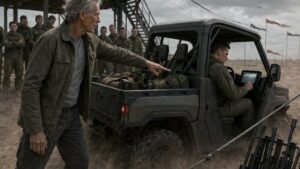
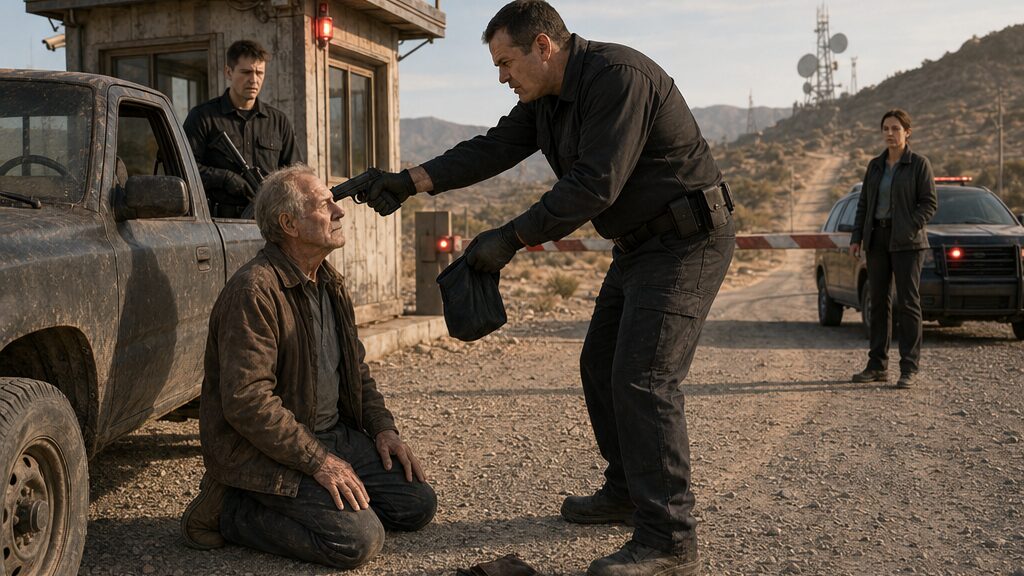
Metal cracked against faded paint. Frank braked, and the truck stopped crooked in the inspection lane with its front tires biting into loose gravel. Before the engine had settled into its uneven idle, a broad man in a dark private-security uniform stepped from the guard booth with one hand resting on his holster.
Frank looked at the white-and-red barrier lying across his hood, then at the man approaching him.
The checkpoint stood alone among scrub grass and low hills, guarding the narrow road to a government communications site barely visible beyond a second fence. There were no nearby houses, no passing traffic, and no reason for anyone to hear an argument unless the guards permitted it over the radio.
The man slapped the driver’s window with two fingers.
“Engine off. Hands where I can see them.”
Frank turned the key. The old engine shuddered into silence.
He lowered the window.
“You dropped the arm early,” he said.
The guard’s eyes moved over Frank’s lined face, thinning gray hair, and worn brown jacket. Frank had spent the drive leaning slightly toward the wheel to ease the ache under his left shoulder. Now the posture made him look smaller than he was.
“I gave you an order.”
Frank placed both hands on the steering wheel. “And I followed it.”
A younger guard emerged from the booth. His name strip read HALL. He carried a rifle diagonally across his chest, but his grip looked too careful, as if he had learned every safety rule and trusted none of the men around him to do the same.
The older guard pointed toward Frank without looking back.
“Eric, close the rear lane.”
Eric Hall hesitated. A civilian van had turned onto the approach road behind Frank and was slowing toward the checkpoint.
“Chief, they’ve got a scheduled—”
“Close it.”
Eric pressed a control. A second barrier descended behind the pickup, trapping Frank between the two arms.
The chief leaned closer to the open window. His name strip read TORRES.
“Identification.”
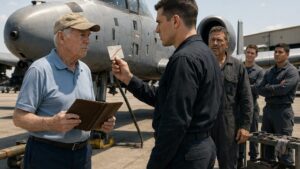
Frank took his wallet from the dashboard and handed over his driver’s license. Beneath it lay a thick cream envelope with a red seal, bent slightly from the drive.
“That authorization is for the site director,” Frank said.
Mark Torres took both.
He glanced at the license but not the sealed envelope.
“Retired?”
“Yes.”
“Retired from what?”
Frank watched Eric walk toward the van and motion for its driver to stop. “Is my former employment relevant to entry?”
“It becomes relevant when you answer a question with another question.”
Mark turned the envelope over. The seal carried no agency name, only a reference number and a raised security mark.
“You expect me to let you through because you brought fancy stationery?”
“I expect you to verify it.”
Mark slipped the envelope into the front of his uniform jacket.
Frank’s fingers tightened once around the steering wheel, then relaxed. “Open it or call the number printed beneath the seal.”
“I’ll determine whether it’s forged first.”
Without examining it, Mark stepped back and looked toward the guard booth. One camera covered the inbound lane. Another sat above a steel search table near the fence.
The second camera was angled toward the road.
Not the table.
Frank had noticed that before he reached the barrier. He had also noticed the black gap between time stamps in the monthly logs, the detention numbers that rose whenever equipment audits approached, and a pattern of camera outages recorded as wind damage on days without wind.
Those details had brought him to Gate 4.
He had chosen the old pickup and his oldest jacket for the same reason he had told no one he was coming. A checkpoint behaved differently when it expected inspection. He needed to see what happened when the guards believed no one important was watching.
Mark keyed his radio.
“Possible access violation at Gate 4. One male detained.”
The reply came through static. “Nature of violation?”
Mark’s gaze remained on Frank.
“Pending.”
He released the button.
Frank said, “You had my appointment reference before I reached the lane.”
“I had a vehicle description.”
“Then you knew I was expected.”
“What I know is that you entered a controlled approach during an active inventory alert.”
Eric returned from the van. “Driver says they’re maintenance support. Scheduled for eleven-thirty.”
“They can wait.”
Mark opened Frank’s door.
“Step out.”
Frank moved slowly, not from fear but because the ache in his shoulder sharpened when he twisted. His boots settled into gravel. He straightened as far as comfort allowed, though Mark still stood several inches taller.
Eric’s attention flicked toward the pickup hood, where the barrier had left a pale mark across the paint.
Mark held out a hand. “Keys.”
Frank gave them to him.
“What inventory alert?” Frank asked.
Mark smiled without warmth. “Now you’re interested.”
“You said equipment was missing.”
“I said this was an active alert.”
“Those aren’t the same statement.”
The smile vanished.
Mark turned to Eric. “Search the cab.”
Eric shifted his rifle behind his shoulder and pulled on gloves.
“Is there probable cause?” Frank asked.
“This is restricted property.”
“I’m outside the controlled perimeter.”
“You entered the approach lane.”
“On invitation.”
“That document hasn’t been authenticated.”
“You refused to authenticate it.”
Eric paused with one hand on the passenger door.
Mark looked at him. “Something confusing you?”
“No, Chief.”
“Then search.”
Eric began with the glove compartment. Frank watched him remove a road map, two pens, a pair of reading glasses, and a packet of peppermint candies. Everything went onto the steel search table.
The misaligned camera captured none of it.
Mark moved around the pickup, studying the bed and wheel wells. His manner was no longer merely suspicious. It was performative. He kept turning just enough for Eric to see him taking charge.
“Restricted communications equipment disappeared from the transfer cage twelve minutes ago,” Mark said. “Then you arrived in an unlisted truck with questionable authorization.”
Frank looked beyond the lowered barrier at the distant communications compound.
“What equipment?”
“Portable encryption module.”
“Size?”
Mark’s eyes narrowed. “Why?”
“If you believe it’s in the truck, you should know what volume you’re searching for.”
“A man who came here innocently wouldn’t need that explained.”
“A man conducting a competent search would.”
Eric lowered his head and continued through the cab.
Mark stepped close enough that Frank could smell coffee on his breath.
“You think age buys you patience?”
“No.”
“You think the jacket makes you look harmless?”
Frank glanced down at the frayed cuff. “It usually makes me look cold.”
For an instant, Eric’s mouth tightened as if suppressing a reaction.
Mark saw it.
“Search the bed,” he snapped.
Eric climbed onto the rear tire and leaned over the side. The truck bed held a canvas tarp, a rusted toolbox, and two empty fuel cans. He checked beneath each object, then looked toward Mark.
“Nothing.”
Mark walked to the passenger side and opened the toolbox himself. Wrenches. Electrical tape. A tire gauge. No module.
Frank studied the angle of Mark’s shoulders, the speed of his breathing, the way his eyes kept returning to Eric rather than the truck.
The search had ceased to be about finding anything.
It was about producing an outcome.
Frank had seen that posture before, years ago, in a checkpoint report that ended with a dead civilian described as noncompliant. The cameras had failed then too. Every officer had remembered the same words in the same order.
He had spent four years building rules meant to make that kind of lie impossible.
At Gate 4, the evidence camera stared uselessly at an empty road.
Mark slammed the toolbox shut.
“Move him to the holding line.”
Eric climbed down. “Chief, the truck’s clear.”
“I heard you.”
“There’s nowhere else to check except underneath.”
“Then check underneath.”
Mark circled behind the pickup. He crouched briefly beside the left rear wheel, hidden from Eric by the tailgate.
Frank saw his right hand enter his jacket pocket.
When it came out, it held something flat and black.
Mark let the object fall into the gravel behind the tire.
He stood and called sharply, “Eric. Get over here.”
Eric approached.
Mark pointed at the ground.
A small security pouch lay beside the wheel, its numbered seal broken.
Mark looked at Frank, and satisfaction settled into his face.
“Well,” he said. “Now we have something to discuss.”
Chapter 2: The Evidence Mark Dropped in Gravel
Mark pulled on a pair of black gloves before lifting the pouch.
He held it by one corner, turning it so Eric could see the broken seal.
“Tell me where you saw it,” he said.
Eric stared at the gravel.
“Behind the rear tire.”
“That’s where it is now. Tell me where you saw it come from.”
Eric looked at Mark, then at Frank.
“I didn’t see it come from anywhere.”
Mark’s voice remained controlled. “You were assigned to observe the search.”
“Yes, Chief.”
“So you observed the pouch fall from the vehicle.”
“No.” Eric swallowed. “I observed it on the ground.”
The civilian van idled beyond the rear barrier. Its driver and passenger watched through the windshield, their faces pale ovals behind reflected sunlight.
Mark stepped between them and Eric’s line of sight.
“Say it correctly for the incident record.”
Eric tightened his jaw. “I saw the pouch behind the truck.”
Frank kept his hands visible beside his worn jacket.
That answer had cost the young guard something. Not enough to challenge Mark, but enough to avoid surrendering the entire truth.
Mark slipped the pouch into a clear evidence bag.
“You recognize this?” he asked Frank.
“No.”
“It belongs to the transfer cage.”
“You just said an encryption module disappeared.”
“It was transported in this pouch.”
Frank looked at the bag. “Then the pouch should have shape memory.”
Mark’s expression changed by less than a blink.
Frank continued. “Foam-lined carriers hold their edges even when empty. That one folds at the center. It never carried the device you described.”
Eric’s eyes dropped to the pouch. Its lower half sagged over Mark’s fingers.
Mark gripped it more firmly.
“You know a lot about secure transport for a retired man in an old truck.”
“I know what an empty bag looks like.”
“You know the camera angles too.”
Frank glanced toward the evidence camera above the table. “Anyone can see where it’s pointed.”
“Most people don’t inspect surveillance coverage while being detained.”
“Most people assume it works.”
Mark moved closer. “Maybe the device was removed from the pouch before you reached the gate.”
“Then finding the pouch proves nothing.”
“It proves you had access.”
“No. It proves you found a pouch.”
Mark looked toward Eric. “Open the fuel cans.”
“They’re empty,” Eric said.
“Open them.”
Eric crossed to the truck bed.
The rear barrier remained down, trapping the maintenance van on the approach road. The passenger had taken out a phone.
Mark noticed.
He strode toward the barrier and pointed down the road.
“Reverse out.”
The driver lowered his window. “We have a service authorization.”
“Gate closed.”
“We can wait.”
“You can leave.”
“We’re due at the cooling station.”
Mark placed a hand on his holster. “Reverse the vehicle.”
The passenger slowly lowered the phone.
The van backed away until dust swallowed it. Eric watched it go, and Frank saw the lesson land exactly as Mark intended: witnesses existed only while Mark allowed them to remain.
When Mark returned, he carried Frank’s sealed authorization inside his jacket and the planted pouch in his hand.
“Last chance to save us time,” he said. “Tell me who you planned to deliver the module to.”
Frank’s shoulder ached more sharply now. He shifted his weight.
Mark mistook it for weakening.
“Your hands are steady,” Mark said. “But your legs won’t be for long.”
“Is that part of the interview procedure?”
“It’s advice.”
Eric unscrewed both fuel caps and tipped the cans. Nothing fell out.
“Clear,” he said.
Mark ignored him.
“Empty his pockets.”
Eric looked at Frank. “Sir, place everything on the table.”
Frank did not move.
“You don’t have lawful grounds for a personal search,” he said.
Mark raised the evidence bag. “This is lawful ground.”
“That was not in my vehicle.”
“You accusing me of planting evidence?”
“I’m describing what happened.”
The air seemed to contract around them.
Eric’s gaze went to the ground.
Mark spoke slowly. “You arrived during an inventory discrepancy carrying a questionable document. A restricted security pouch was found behind your vehicle. You have specialized knowledge of transport equipment and surveillance placement.”
“None of which establishes theft.”
“It establishes preparation.”
“For what?”
“Espionage.”
The word was so disproportionate that Eric looked up.
Mark saw the reaction and hardened his voice. “A hostile collector studies cameras, tests access procedures, and removes secure equipment for transfer. That is exactly what we have.”
Frank looked beyond Mark to the guard booth. A terminal screen glowed behind the glass. Beside it hung a laminated reporting chart.
He could read only the headings from where he stood, but he knew their order. He had helped approve the original sequence: local supervisor, site security manager, regional compliance, Internal Affairs.
A clean chain on paper.
A wall in practice, if the local supervisor controlled the first report.
“Eric,” Frank said, “when did the inventory alert begin?”
Eric glanced at Mark.
“I asked you a direct question,” Frank said.
The young guard stiffened. “You don’t give me orders.”
“No. I’m asking whether the alert began before or after my vehicle appeared on camera.”
Mark cut in. “Don’t answer him.”
Frank’s tone stayed clipped. “Was the transfer cage sealed at shift change? Was there a dual signature? Did you personally see an item missing?”
Eric’s face flushed. “Stop questioning me.”
Frank heard the fear beneath the irritation, but too late. He had addressed Eric as if the young guard were already inside a formal inquiry, protected by rules and distance.
Here, Eric stood ten feet from the man who controlled his schedule, evaluations, and continued employment.
Mark gave a small, approving nod. “You heard him. Empty your pockets.”
Frank removed his wallet first. Then a ring of keys, a handkerchief, two peppermints, and a narrow notebook. He laid them on the search table outside the camera’s view.
Eric patted the jacket carefully.
“Inside pocket,” he said.
Frank reached toward it.
Mark seized his wrist. “Slowly.”
Frank drew out a folded sheet of paper.
The wind caught one edge. Before he could secure it, the page slipped from his fingers and skated across the gravel.
Mark stepped on it.
For the first time since the barrier had struck the truck, Frank saw something other than contempt enter Mark’s face.
Recognition.
Mark bent, picked up the page, and read the number typed across its upper corner.
G4-17-042.
His eyes moved to the name beneath it.
Sharon Perez.
The color left his cheeks.
“Where did you get this?” he asked.
Frank said nothing.
Mark folded the paper once, very carefully.
The planted pouch no longer seemed to matter.
Chapter 3: The Complaint They Said Was Withdrawn
Mark read Sharon Perez’s case number twice before crushing the page in his fist.
His confidence returned too quickly, assembled rather than felt.
“This is restricted incident material.”
“It was provided to a reviewer,” Frank said.
“By whom?”
“The person who kept the part your report omitted.”
Eric stood beside the pickup, rifle hanging motionless across his chest. At the sound of Sharon’s name, he had looked toward the guard booth.
Mark noticed.
“You know the file?” Frank asked him.
Mark stepped between them. “He knows not to discuss protected information with a hostile subject.”
Frank’s gaze stayed on Eric. “The report says Sharon voluntarily withdrew her complaint two days after detention.”
Eric’s lips parted.
Mark said, “The report is accurate.”
“It also says she retained unrestricted contractor access.”
“She did.”
“Her access badge was canceled six hours after she withdrew.”
“That was an administrative matter.”
“The unsigned note attached to this copy says she was told her maintenance contract would be terminated unless she withdrew.”
Mark tore the page in half.
Eric flinched.
Frank did not.
Mark tore it again, dropping the pieces into the dirt. “Now your copy says nothing.”
“The original exists.”
“Then whoever stole it has a problem.”
“It wasn’t stolen.”
“You arrived with internal complaint material, forged authorization, and a pouch from a missing security device. You’ve done a remarkable job building the case against yourself.”
Frank looked down at the four paper fragments near Mark’s boots.
The note had come from someone inside the administrative chain, someone frightened enough to omit a name but not frightened enough to let Sharon’s complaint disappear completely. Frank had treated the note as a system anomaly. A thread to be tested.
Standing at Gate 4, he understood what the page had cost the person who copied it.
He also understood what his own secrecy had cost Eric.
“Bring up the Perez report,” Mark ordered.
Eric did not move.
“Now.”
Eric entered the booth and sat at the terminal. Mark followed him to the doorway, keeping Frank in view.
The barrier remained lowered. Beyond it, the restricted site’s antenna structures rose against the pale sky, orderly and distant. Frank stood outside them with his own authorization hidden in Mark’s jacket.
Eric typed.
“Open the incident timeline,” Frank said.
Mark turned. “You don’t direct this review.”
“So there is a review?”
“There is an active security investigation.”
“Into a theft without a missing-item confirmation.”
Mark’s hand returned to his holster. “Keep talking.”
The terminal chimed.
Eric read from the screen. “Perez, Sharon. Civilian maintenance contractor. Detained for refusal of inspection. Complaint filed, then withdrawn.”
“Camera record?” Frank asked.
Eric scrolled. “Unavailable.”
“Reason?”
“System failure.”
“What kind?”
Eric leaned closer. “Power interruption.”
Frank glanced at the booth lights, the barrier controls, the cameras, and the backup antenna mounted above the roof.
“Duration?”
“Twenty-three minutes.”
“Only during her detention?”
Eric did not answer immediately.
Mark said, “The report speaks for itself.”
Frank looked at Eric. “Did you work that shift?”
A muscle moved in Eric’s cheek.
“Yes.”
Mark’s voice sharpened. “Hall.”
Frank waited.
Eric stared at the screen. “I was on outer-lane duty.”
“Did the power fail?”
“The camera feed went dark.”
“That wasn’t the question.”
Mark entered the booth. “You’ve answered enough.”
Eric looked from him to Frank.
“The booth lights stayed on,” Eric said.
Silence followed.
Mark’s face hardened.
Frank asked, “Who escorted Sharon from the site?”
Eric’s hand remained on the mouse. “Chief Torres.”
“The report says she departed unassisted after signing the withdrawal.”
“She didn’t sign anything that day.”
Mark grabbed the back of Eric’s chair and turned it away from the window.
“You were new. You remember fragments and confuse dates.”
“I remember her asking for her toolbox.”
“She was agitated.”
“She asked three times.”
“And I removed a disruptive contractor from a restricted site. That is what security chiefs do.”
For a moment, Mark’s justification sounded almost sincere. He looked toward the distant compound as though it belonged to him and he had been abandoned to protect it with inadequate staff, unreliable equipment, and rules written by people who never stood at the gate.
Then he looked back at Frank and chose the lie again.
“She endangered operations,” he said. “Her complaint was retaliation.”
“Why cancel her access after she withdrew it?” Frank asked.
“Because I judged her unreliable.”
“Then the complaint was not voluntarily resolved.”
“I don’t need a civilian’s permission to protect this facility.”
“No. But you need lawful grounds to destroy her livelihood.”
Mark stepped out of the booth.
“What exactly are you?” he asked.
Frank saw no advantage in continuing the fiction. Not all of it.
“I’m conducting an integrity review.”
Eric’s chair creaked behind the glass.
Mark studied the old jacket again, searching for some visible confirmation of authority and finding none.
“On whose authorization?”
“The document in your pocket.”
“You expect me to believe an inspector arrives alone in a truck that should’ve been scrapped ten years ago?”
“I expected the gate to follow its own authentication procedure.”
“You wanted to trap us.”
“I wanted to observe normal operations.”
Mark gave a humorless laugh. “So this was a test.”
“No. Tests announce the standard. This was an inquiry.”
“And you concealed your identity.”
“Yes.”
The admission tasted different now.
Frank had believed anonymity would reveal whether the system worked. He had not accounted for the burden it would place on anyone trapped beneath Mark. He had come prepared to watch procedures, not people. Even now, Eric sat inside the booth with Mark between him and every official channel on the reporting chart.
Frank had built that chart.
Mark saw the pause and mistook it for uncertainty.
“You heard him,” he told Eric. “He entered under false pretenses to collect information about secure operations.”
Eric turned slowly. “He has authorization.”
“Unverified authorization.”
“You didn’t open it.”
Mark’s eyes narrowed.
Eric looked away at once, but the sentence remained in the booth.
Mark reached inside his jacket, removed the sealed envelope, and held it beside Frank’s phone.
For one second Frank thought he might finally break the seal.
Instead, Mark walked to the search table and swept everything onto the gravel.
The phone struck a stone. The envelope landed faceup, its red seal unbroken. Frank’s wallet opened beside it, spilling his license into the dust.
Mark pointed toward the ground.
“Knees.”
Eric stood. “Chief—”
“Classify him as a hostile intelligence collector. Note attempted unauthorized surveillance, possession of restricted case material, and suspected theft of encryption equipment.”
“That isn’t what happened.”
Mark turned toward him. “Are you refusing a direct reporting order?”
Eric’s face went still.
Frank saw the trap close around the young guard. Defy Mark and lose the job before any distant office heard his name. Obey and become part of the record Mark was constructing.
Frank had arrived believing the written chain would protect an honest man.
Now his sealed authority lay unopened in the dirt.
He lowered himself onto one knee, then the other. Gravel pressed through his trousers. The barrier’s shadow cut across his jacket and hands.
Mark stepped behind him.
Leather creaked.
Frank heard the holster snap release.
Chapter 4: One Call Before the Report Was Written
The handgun’s front sight touched Frank’s temple.
Mark stood behind him, close enough that the fabric of his uniform brushed Frank’s shoulder whenever the wind shifted. The barrel was cold at first. Then Frank’s skin warmed the metal.
Eric remained in the booth doorway.
“Chief,” he said, “we have no reason to—”
“We have a hostile collector with restricted material and evidence from a missing device.” Mark’s voice carried the polished certainty of a report already written. “You need to understand the situation before you speak.”
Frank looked at his belongings scattered across the gravel. His phone lay three feet ahead of him. The sealed envelope rested beside it, still unopened.
Mark pushed the barrel harder against his head.
“Hands on your thighs.”
Frank obeyed.
The gravel under his knees was coarse enough to cut through the thin fabric of his trousers. His left shoulder burned. He allowed the slight stoop to remain. Sudden movement would give Mark what he wanted.
A shape to call aggression.
A reason to turn the final report into something tidy.
Mark drew a small incident pad from his pocket and tossed it in front of Frank.
“You’re going to write a statement.”
“I have nothing to confess.”
“You entered restricted property under false pretenses. You conducted surveillance. You removed secured equipment and concealed the carrier behind your vehicle.”
“The carrier was empty.”
“You transferred the device.”
“To whom?”
“That is the part you’re going to tell us.”
Frank glanced toward Eric. The young guard’s face had gone pale, but his rifle remained pointed at the ground.
Mark saw the glance.
“Hall is not going to rescue you.”
“I’m not asking him to.”
“No, you’re trying to confuse him. That’s what men like you do. You find the least experienced officer and make him doubt procedure.”
Frank almost answered that procedure had already been abandoned. Instead, he studied Mark’s breathing and the pressure of the barrel.
Mark was frightened now.
Not of Frank’s body or the old pickup. Of the complaint page. Of the sealed document he had refused to open. Of a possibility he could not yet name.
Fear made some men cautious. It made Mark accelerate.
“Write,” Mark said.
Frank reached slowly for the pad.
“First line: I entered Gate 4 without authorization.”
Frank left the pen where it was.
Mark’s finger settled along the trigger guard. “Write it.”
Years earlier, another man had been ordered onto his knees at a remote checkpoint. He had protested when guards searched his vehicle. One officer later claimed the man reached for a weapon. The others repeated the claim until repetition became a record.
There had been no working camera.
By the time Frank reached the site, the body had been removed and the statements aligned.
He remembered sitting across from the dead man’s family and promising that no officer would ever again be able to manufacture an ending without leaving a trail.
The system Frank helped build afterward required redundant video, independent retention, dual reporting and automatic review of use-of-force incidents.
At Gate 4, the camera watched an empty road.
Frank had believed the architecture was enough.
He looked at Eric. “Is the evidence camera recording audio?”
Mark struck the back of Frank’s head with the side of the weapon—not hard enough to knock him down, but hard enough to force his chin toward his chest.
“I told you to stop questioning my guard.”
Eric took one step forward.
Mark turned the weapon slightly, not away from Frank, but enough to include Eric in its line.
“Stay where you are.”
Eric stopped.
Frank lifted his head.
“You’ve alleged theft,” he said. “Then espionage. Now unauthorized entry. Which one will appear first?”
“All of them.”
“And when did you discover the module missing?”
“Before you arrived.”
“Who confirmed it?”
Mark hesitated.
Frank continued. “Was the transfer cage opened under two-person control?”
“You don’t conduct this interview.”
“Did Eric witness the inventory?”
Mark’s jaw tightened. “Write the statement.”
“If I reached for your weapon now, what would Eric say?”
Eric’s face changed.
Mark leaned close. “You want to find out?”
Frank looked at the incident pad. “You already know what you want him to say.”
For several seconds, only radio static came from the booth.
Mark’s gun remained against Frank’s temple, but the pressure became uneven. His hand was tiring.
“You get one call,” Mark said at last.
Eric stared at him. “Why?”
“Because when this becomes official, no one can say I denied him access to counsel.”
Frank understood immediately. The call was not mercy. Mark wanted another line for the report.
Subject permitted communication before escalation.
Mark kicked Frank’s phone closer.
“One call,” he repeated. “Then you sign.”
Frank picked it up slowly. The screen was cracked where it had struck the stone, but it still responded.
He did not call an attorney.
He selected Catherine Moore.
She answered before the second ring.
“Frank?”
Mark’s eyes narrowed at the familiarity in her voice.
Frank held the phone low enough that the screen remained visible to him, but Mark could see the name at the top.
Catherine Moore.
Below it, in smaller letters, was the title attached to her secured contact entry.
Chief Internal Affairs Investigator.
Frank spoke with the same tone he had once used in rooms where panic could kill people faster than bad information.
“Did you train the guards at Gate 4?”
Silence on the line.
Catherine understood the phrasing.
Frank continued.
“Come down here and fix your mistake.”
Mark’s eyes moved from the screen to Frank’s face.
Catherine’s response came quietly. “Are you under armed control?”
Frank did not answer directly.
“The evidence camera is misaligned,” he said. “Local command has fabricated a theft and destroyed complaint material.”
A chair scraped on Catherine’s end of the call.
“Keep this line open.”
Mark grabbed for the phone.
Frank lowered it, forcing Mark either to reach around him or step into the camera’s possible field of view. Mark chose neither.
“What did she say?” he demanded.
Frank placed the phone on the gravel with the microphone uncovered.
“She asked me not to disconnect.”
The radio inside the booth chirped.
Then every channel opened at once.
“Gate 4 personnel, maintain present position. Do not alter local systems. Do not remove evidence. Central preservation protocol initiated.”
Eric turned toward the terminal.
Mark looked at his own radio as though it had betrayed him.
“Disregard,” he said into it. “Gate 4 has an active hostile subject. Local command retains operational authority.”
The reply came immediately.
“Local authority suspended pending Internal Affairs response.”
A mechanical thud sounded beyond them.
The rear barrier locked into its base. Then the forward barrier pressed tighter against the pickup hood. Indicator lights along the fence changed from green to red.
No one could enter.
No one could leave.
Mark’s breathing shortened.
He looked again at Frank’s phone. Catherine’s title remained visible through the cracked glass.
“Who are you?”
Frank did not answer.
Mark pressed the gun against him again, but the gesture had changed. It was no longer an instrument of control. It was the only piece of authority Mark still possessed.
“You came here to set me up,” he said.
“You planted the pouch.”
“You brought restricted records.”
“You destroyed one.”
“You concealed your status.”
“Yes.”
That answer stopped Mark.
Frank’s secrecy was not innocent, and he would not pretend otherwise.
“I came without notice,” Frank said. “I wanted normal operations.”
“You wanted failure.”
“I wanted the truth.”
“You walked into a restricted checkpoint dressed like a drifter and expected us to treat you like an official.”
“I expected you to authenticate a document before inventing a crime.”
Mark’s face flushed. “You people sit in distant offices and demand perfect numbers. No losses. No delays. No access errors. Then when something goes wrong, you arrive afterward and ask why we didn’t control it.”
There it was—a piece of the truth Mark had buried beneath the lie.
Not justification. Pressure.
Frank kept his voice even. “Was the module ever missing?”
Mark did not answer.
“Or did your inventory fail?”
“Shut up.”
“Was the pouch already empty?”
“Shut up.”
“Did you need a suspect before the next audit?”
Mark’s mouth tightened.
The phone on the gravel carried every word to Catherine.
Frank had stopped enduring the interview.
Now he was conducting one.
Mark seemed to realize it. He stepped back and looked toward the evidence camera. Its lens still faced the road, but the other cameras above the gate remained fixed on the lane.
“Eric,” he said.
The young guard stood beside the booth, frozen.
“Open the camera cabinet.”
Eric looked toward Frank.
Mark’s voice became colder. “Disable every local feed.”
Central control came over the radio. “All personnel are ordered not to interfere with recording or retention systems.”
Mark raised the handgun from Frank’s head and pointed it toward Eric.
“That order came from people who are not here,” he said. “Mine came from the man standing in front of you.”
Eric’s eyes fixed on the weapon.
Frank’s phone remained open between them.
Mark gestured toward the steel cabinet mounted beside the booth.
“Do it.”
Eric moved slowly toward the cabinet.
Mark followed him with the gun.
“When this man reaches for me,” Mark said, loud enough for Catherine to hear, “you confirm it.”
Chapter 5: The Guard Who Would Not Look Away
Eric opened the camera cabinet.
“Five,” Mark said.
Inside, rows of indicator lights blinked above labeled switches. Eric rested one hand on the cabinet door and the other near the main recording breaker.
“Four.”
Frank remained on his knees. Mark had shifted the handgun toward Eric, but only by a few degrees. One movement could bring it back.
“Three.”
Eric looked at the reporting chart through the booth window.
The route was printed in large black arrows: employee concern to local supervisor, local supervisor to site manager, site manager to regional review. Mark’s position sat at the first gate through which every complaint had to pass.
“Two.”
Eric’s fingers touched the breaker.
Frank said, “If you switch that off, the system will record who did it.”
Mark swung the gun toward him. “Quiet.”
Frank did not look away from Eric. “It will record the time, your credentials and the preservation order you overrode.”
Eric’s hand stopped.
Mark said, “One.”
Nothing happened.
The indicator lights continued blinking.
“Do it,” Mark said.
Eric slowly removed his hand from the breaker.
“I can’t.”
Mark stepped closer. “You can, and you will.”
“It’s an unlawful order.”
The words were barely louder than the wind, but they changed the checkpoint.
Mark had commanded Gate 4 as if obedience were a natural force. Now the youngest guard had refused him, and nothing in the world had collapsed except the illusion that he could not be refused.
Mark pointed the weapon directly at Eric’s chest.
“Say that again.”
Eric closed the cabinet.
“The preservation order is active. Disabling those cameras would be evidence tampering.”
“You think the people on that radio will protect you?”
Eric swallowed.
Mark took another step. “You’re probationary. One report from me and you never work security again.”
Frank saw the young guard’s courage falter. Mark understood the pressure point because he had used it before.
“How many reports did you try to send?” Frank asked.
Eric did not respond.
Mark’s gaze snapped toward Frank. “This doesn’t concern you.”
“It concerns the reporting system.”
“You don’t know anything about our system.”
Frank looked at the laminated chart. “I approved its original sequence.”
Eric turned from the cabinet.
Mark gave a short laugh. “Of course you did.”
Frank let the words settle.
“I helped write the rule requiring employee complaints to move through local command before escalation.”
Eric stared at him.
“You built that?”
“Yes.”
The answer did not impress him. It wounded him.
“I filed one,” Eric said. “After the Perez detention.”
Mark’s face hardened. “Be careful.”
Eric’s eyes remained on Frank. “I entered it as a conduct concern. By the next shift, it was gone. Chief Torres said I had used the wrong form. He made me rewrite it as a training question.”
Frank felt the gravel press deeper into his knees.
“Why didn’t you send it directly to Internal Affairs?”
Eric pointed toward the chart.
“Because the policy says local resolution first. Because external reporting without supervisor review is insubordination unless there’s confirmed criminal conduct. And because he writes my evaluation.”
Mark said, “You had no confirmed facts.”
“I watched you escort her out after the cameras went dark.”
“She refused screening.”
“You told her she’d never work the site again.”
“She was a security risk.”
“You told me to leave that out.”
Mark moved the weapon toward Eric’s face.
Frank’s voice cut across the lane. “Look at me, Eric.”
Eric did.
Frank abandoned the measured cadence of an investigator.
“I wrote a rule that put the man you feared between you and the people meant to hear you. That was a failure.”
Mark glanced at the phone on the ground. He understood that Catherine had heard the admission.
“So the old man finally confesses,” he said.
Frank ignored him.
Eric’s expression remained guarded. “You expect that to fix it?”
“No.”
“You think because you admit it, none of us are responsible?”
“No.”
The answer landed harder than reassurance would have.
“You helped restrain me,” Frank said. “You stayed silent when he planted the pouch. You knew what happened to Sharon and let the report stand.”
Eric looked down.
“Courage now does not erase that,” Frank said. “But it can stop the next lie.”
Mark’s gun trembled.
“You don’t get to judge him,” he said. “You designed the trap.”
“Yes.”
The word deprived Mark of the defense he wanted. Frank would not protect his pride by denying the system’s flaw.
“But you chose to use it,” Frank added.
Mark’s eyes narrowed.
“You could have reported the inventory error,” Frank said. “You could have authenticated my authorization. You could have preserved Sharon’s complaint. You chose a suspect because a suspect was easier than a failure.”
“You don’t know what they do to failed contracts.”
“No. I know what you did to avoid one.”
A radio transmission interrupted them.
“Central archive copy at thirty percent. Gate 4 local index and incident history included.”
Mark turned toward the booth.
The terminal screen had changed. A progress bar moved slowly beneath a list of stored video and report files.
He lowered the gun from Eric and strode toward the door.
Eric stepped into his path.
Mark stopped inches from him.
“Move.”
Eric’s breathing became audible.
Mark lifted the handgun until its barrel touched the front of Eric’s vest.
“Move.”
Frank shifted one foot beneath himself, preparing to rise if Mark’s attention broke completely.
Eric saw the movement.
So did Mark.
The gun snapped back toward Frank.
“There,” Mark said. “He’s reaching.”
Frank froze.
“Confirm it,” Mark ordered.
Eric looked at Frank’s hands, still open and visible. Then at Mark’s weapon.
“He adjusted his leg.”
“He prepared to attack.”
“No.”
Mark’s face twisted. “You are destroying your own career for a stranger.”
Eric’s voice shook. “I’m not confirming something that didn’t happen.”
For the first time, Mark looked alone.
Not defeated. More dangerous.
He shoved Eric aside and entered the booth.
The terminal displayed folders arranged by date, including archived incidents that should already have been transferred off-site. Several bore manual-edit flags.
Mark seized the mouse.
A red message appeared.
LOCAL PRIVILEGES SUSPENDED.
He struck the keyboard.
“Restore administrative control,” he barked into the radio.
No one answered him.
The archive progress reached forty-two percent.
Mark opened a lower cabinet and pulled out a maintenance key attached to a yellow tag.
Frank recognized the type. A physical override for the local storage unit.
“Eric,” he said, “does that key disconnect the index?”
Eric looked through the booth window.
“Yes.”
Mark jammed it into the terminal housing.
The radio crackled.
“Archive copy at forty-five percent. Do not interrupt local power or indexing.”
Mark turned the key.
Nothing happened.
He twisted harder, then struck the side of the unit with his palm.
The screen flickered.
The progress bar stalled.
Mark looked back at Frank, and whatever remained of restraint disappeared.
Then the terminal chimed.
A new message filled the screen.
CREDENTIALS REVOKED — MARK TORRES.
Beneath it, preserved report numbers began appearing one after another.
Mark lunged across the desk for the emergency shutdown switch.
Chapter 6: The Man Who Built the Broken System
Mark’s hand struck the shutdown cover, but it would not open.
A magnetic lock held it closed.
On the terminal, his name appeared beside a growing list of altered incident files.
G4-17-042.
G4-18-011.
G4-18-036.
The numbers continued downward.
Mark pulled the maintenance key out and drove it back into the housing. The screen did not change.
“Remote lockout,” Eric said.
Mark spun toward him. “Get me the manual release.”
Eric stayed outside the booth.
“Now.”
“No.”
The archive progress resumed at forty-six percent.
Frank pushed himself upright.
Pain ran through his knees and shoulder. For a moment the barrier’s shadow seemed to tilt with him, but he planted both feet and let his body unfold slowly.
His stoop disappeared.
It had never been entirely an act. Age had taken speed from him and left old injuries behind. But the diminished posture Mark had judged was not the whole man.
Frank straightened beneath the Gate 4 sign.
Eric stared.
Mark came out of the booth with the handgun still in his hand.
“You stay down.”
Frank did not.
He stepped to the edge of the barrier’s shadow but did not cross into the restricted side.
“What was missing?” he asked.
Mark pointed the weapon at him. “Back on your knees.”
“The module was never missing.”
“You don’t know that.”
“The transfer pouch was empty. No dual-signature alarm was issued. The local index shows administrative edits before my arrival.”
Mark’s face tightened with each statement.
Frank continued. “You had a logging discrepancy.”
“A logging discrepancy can conceal a breach.”
“So you should have reported it.”
“To whom? The same reviewers who failed us last quarter?”
The question came out with genuine anger.
Mark gestured toward the communications site with the gun.
“They demand uninterrupted coverage with equipment older than half the guards working here. They reduce staffing, shorten inspection windows, then threaten the contract when the numbers slip. One inventory mistake and the site manager calls us unreliable.”
“So you created a theft.”
“I contained a vulnerability.”
“You invented a suspect.”
“I needed time to locate the device.”
“There was no missing device.”
“There was an unverified record.”
“And an old man arrived.”
Mark’s mouth moved, but no answer came.
Frank looked through the booth window. “The irregular detention spikes match the audit dates. Civilians became explanations for your failures.”
“You think those people were harmless because they carried toolboxes and work orders? You were not here when a contractor entered the wrong lane with an unsealed case. You were not here when a driver ignored three commands.”
“No. I was in an office approving standards that punished error more visibly than dishonesty.”
Eric looked at him.
Mark’s weapon lowered an inch.
Frank said, “That was my failure.”
Mark seized on it. “Exactly.”
“But it did not make you plant the pouch.”
The gun rose again.
“It did not make you destroy Sharon Perez’s complaint. It did not make you order Eric to disable cameras. It did not make you put that weapon against my head.”
“You designed a system where one bad report can end a contract.”
“And you turned that pressure into permission.”
Mark’s eyes flicked toward the terminal.
The archive reached sixty-one percent.
“You think an admission protects you?” Mark said. “You came here alone and concealed your identity. You manipulated the guards into failing an inspection. Every action after that is contaminated.”
“My actions will be reviewed.”
The certainty of Frank’s answer unsettled him.
“You’ll review yourself?”
“No.”
“Your former subordinate will protect you.”
“Catherine will preserve the evidence. Someone outside her chain will examine my decision to come here.”
Eric looked from Frank to Mark. The contrast was not in rank. It was in what each man did when his own conduct came under question.
Mark stepped closer to Eric.
“This archive needs an inside explanation,” he said. “Someone altered the reports. Someone mishandled the inventory. A probationary guard with access to both systems.”
Eric’s face drained.
Mark lifted the gun toward him.
“You wanted a truth?” Mark said. “Here it is. When this finishes copying, they will need a name. Mine carries the contract. Yours does not.”
Eric backed against the camera cabinet.
Frank moved one step forward.
Mark swung the weapon between them. “Stop.”
Frank stopped.
The phone remained on the gravel several feet away. Catherine’s voice came faintly through it.
“Frank, response vehicles are four minutes out.”
Mark glanced toward the narrow approach road.
No vehicles were visible yet.
Four minutes could be an hour with a frightened man holding a loaded weapon.
Frank looked at Eric. “Do not reach for your rifle.”
Eric’s hand was nowhere near it, but he nodded.
Mark laughed once. “Still giving commands.”
“No. Removing choices you might misreport.”
Mark’s face hardened.
Frank spoke without raising his voice.
“You fabricated a theft to conceal an inventory failure. You planted evidence. You seized and destroyed protected complaint material. You ordered a guard to alter a report and disable recording systems. You threatened to create a false account of a shooting.”
“You’re recording a version.”
“Your version is on the open line.”
Mark looked down at the phone.
He could shoot it. He could shoot Frank. He could shoot Eric and construct something from the pieces.
But the cameras were live. The archive was copying. Central control had revoked his access. The road behind the gate would soon fill with people he could not command.
His authority had narrowed to the gun.
Frank saw the realization reach him.
“Place it in the gravel,” Frank said.
“You don’t have command here.”
“Neither do you.”
“I am still security chief.”
“Your credentials are revoked.”
“That is administrative.”
“The weapon is not.”
Mark’s hand trembled.
Frank stepped just far enough into the light that Mark could see his empty hands.
“There is one lawful action left to you,” he said. “Set the gun down. Step away from it. Preserve the part of the record you have not yet falsified.”
Mark’s gaze shifted toward Eric.
The young guard remained against the cabinet, frightened but no longer looking away.
Mark looked toward the road.
A dark shape appeared beyond the scrubland, then another. Vehicles moving fast enough to raise a pale trail of dust.
The gun lowered slightly.
Frank did not advance.
“On the ground,” he said.
Mark’s jaw clenched. For one second, Frank thought pride might outweigh survival.
Then Mark bent and placed the handgun in the gravel.
He straightened without it.
Eric released a breath that sounded almost like pain.
Frank said, “Step behind the search table.”
Mark obeyed, though his eyes remained fixed on Frank.
The barrier stayed down between the checkpoint and the approaching vehicles. Red lights pulsed along its base.
Inside the booth, the archive reached one hundred percent.
A final list appeared on the terminal.
Seventeen incident files carried alteration flags.
Eric saw the number first.
“Seventeen,” he said.
Frank crossed to the booth window and read the case numbers. Sharon Perez’s file was among them, but it was not the earliest and not the latest.
Seventeen civilians had entered Gate 4 and left with official records that no longer matched what had happened to them.
Catherine’s voice came from the phone.
“Archive secured. We can raise the barrier for response entry.”
Frank looked at the old pickup trapped beneath the forward arm, at Mark’s weapon in the gravel, and at the files glowing on the terminal.
“No,” he said.
The first Internal Affairs vehicle crested the final rise.
“Keep Gate 4 closed until every one of those names is copied outside the local chain.”
Chapter 7: No One Passed Until Every Name Returned
Catherine Moore arrived expecting to find Frank on a stretcher.
Instead, she found him standing beneath the Gate 4 sign beside a handgun lying in the gravel, refusing to let the ambulance crew touch him.
“Not until the manifests are signed,” he said.
Behind her, two dark Internal Affairs vehicles and an evidence van waited outside the lowered barrier. Red warning lights washed across the guard booth, Frank’s old pickup, and Mark Torres, who stood behind the search table with his hands visible.
Catherine stopped several feet from Frank.
She wore a dark field jacket over office clothes, her hair pulled back as if she had done it while running. She looked first at the dust on his knees, then at the reddened mark near his temple.
Her expression tightened.
“You made me open the barrier for the medical team,” she said.
“I authorized access to the lane. I did not authorize removal of evidence.”
“You are evidence.”
“So are seventeen other people who aren’t standing here.”
An investigator placed Mark in restraints while another photographed the weapon. Eric remained near the camera cabinet, rigid and pale, his rifle already secured inside the booth.
Catherine lowered her voice.
“You could have been killed.”
“Yes.”
“You conducted an armed-risk inspection without notifying my office.”
“It was not supposed to become armed.”
“That is why professionals plan for what is not supposed to happen.”
Frank looked toward the terminal. The copied files were being transferred onto two independent drives. An evidence technician read each case number aloud while a second technician checked it against a printed manifest.
G4-17-042.
Sharon Perez.
The number that had brought Frank to the gate.
It was followed by sixteen more.
Catherine stepped into his line of sight.
“Sit down.”
“When the transfer is complete.”
“That is not a request.”
Frank met her eyes. Years earlier, she had been the young investigator who challenged his first checkpoint reform draft because it protected recordings better than witnesses. He had praised her objection, amended two paragraphs, and left the larger reporting chain unchanged.
Now she carried authority he had once taught her to use.
He moved to the edge of the search table and sat.
The ambulance worker approached, but Frank held up one finger.
“Examine me here.”
Catherine nearly argued. Then she saw what he was watching.
The evidence technician had reached the seventh altered file.
“Here,” she told the medical worker.
The worker checked Frank’s pupils, cleaned a shallow cut behind his ear, and wrapped a pressure cuff around his arm. Frank answered each question without taking his eyes off the manifest.
Across the lane, Mark spoke to the investigator restraining him.
“This inquiry is compromised.”
Catherine turned.
Mark’s voice grew firmer now that the gun was gone and procedure had returned.
“Harris concealed his identity, entered under false pretenses and provoked a security response. Moore is his former subordinate. Every decision made here is contaminated by personal loyalty.”
The investigator looked toward Catherine.
Mark saw the hesitation and pressed harder.
“He admits he designed the reporting rules. He admits he came alone. You cannot let him control the investigation into his own operation.”
Frank removed the blood-pressure cuff himself.
“He’s right about one part.”
Catherine looked at him sharply.
“My conduct cannot be reviewed by your chain,” Frank said.
Mark’s face changed. He had expected denial.
Frank continued. “Secure the evidence. Then refer my authorization, inspection plan and contact with this site to an independent office.”
“You had an inspection plan?” Catherine asked.
“A poor one.”
“You had no support team.”
“No.”
“No advance medical protocol.”
“No.”
“You didn’t even tell me where you were going.”
Frank looked toward Eric.
“I believed notice would change what I came to observe.”
“It would also have kept a probationary guard from choosing between a handgun and a policy failure you helped create.”
Frank accepted the words without looking away.
“Yes.”
Catherine’s anger did not soften.
“What did you call it in your head? Operational independence?”
“Caution.”
“No.”
Frank glanced down at the dust embedded in his jacket sleeve.
“Pride,” he said. “Disguised as caution.”
The admission settled between them.
Catherine exhaled and turned to an investigator. “Document Mr. Harris’s statement. His authorization and inspection decisions go to independent review. My office handles only immediate evidence preservation until jurisdiction is reassigned.”
Mark watched her give away control he had assumed she would protect.
For the first time since lowering his weapon, he seemed to understand that Frank’s authority would not erase Frank’s exposure.
Eric approached slowly.
An investigator held a recorder near him, but he addressed Frank.
“I need to give a statement.”
Catherine said, “You’ll have protected interview status.”
Eric nodded, though the phrase offered little comfort.
“I saw Chief Torres drop the pouch,” he said. “I didn’t say it when he asked me what I saw.”
The investigator asked, “Why not?”
“Because I wanted to keep my job.”
He swallowed.
“I also knew the Perez report was wrong. Not all of it. Enough. I filed a concern, then rewrote it when he ordered me to. After that, I stopped filing anything.”
No one praised him.
Frank was grateful for that.
“What changed today?” Catherine asked.
Eric looked at the camera cabinet.
“He ordered me to turn off the record. I realized that if I did it, there would always be another report saying nothing happened.”
Catherine told the investigator to record Eric’s probationary status, Mark’s control over evaluations, and the absence of a direct protected reporting route.
“You will not be promised immunity,” she said to Eric. “You will be protected from retaliation while your conduct is reviewed.”
Eric nodded. It was not forgiveness. It was something sturdier.
At the evidence van, a technician called Catherine over.
The altered complaints shared a pattern. Contractor badges canceled within hours of withdrawal. Temporary workers reassigned. Delivery drivers marked for enhanced screening after disputing searches. Each person’s livelihood or access depended on the same local command they would have needed to accuse.
Catherine read the summaries in silence.
“Sharon stopped answering us,” she said.
“Because your office asked whether she wished to reopen the complaint,” Frank replied. “It did not tell her who would protect her contract if she did.”
Catherine looked at the names.
“We gave them a channel.”
“You gave them a risk.”
She closed the folder.
A call was placed through an independent contractor-protection office. Sharon answered only after the official on the line confirmed that her site access and maintenance contract would remain outside Gate 4 control.
Catherine put the call on speaker.
Sharon’s voice was cautious.
“Is Mark Torres still there?”
“He has been removed from command,” Catherine said.
A pause followed.
“Removed for today?”
“Removed pending investigation. He cannot alter your access.”
Another pause.
Then Sharon said, “I’ll reopen it.”
Frank closed his eyes briefly.
Not relief. A measure of what should have happened the first time.
The final case number was transferred after sunset. Both evidence drives were sealed, signed, and carried to separate vehicles. Catherine checked the manifest herself, then handed it to Frank.
He read every line.
“All names accounted for,” she said.
Frank returned the document.
“Raise the barrier.”
The mechanism groaned.
The arm that had struck his pickup lifted slowly from the hood. Its warning lights went dark one by one. Beyond it, the road into the communications site remained closed under new security control, but the outer lane opened.
The maintenance van that had been forced away earlier had returned. It waited at a distance until an investigator waved it forward.
No applause followed. No one saluted Frank. Mark was placed in a vehicle, Eric entered the evidence van to finish his statement, and the ambulance worker reminded Frank that he still needed a hospital examination.
Frank gathered his wallet and phone from the gravel.
Catherine picked up the sealed authorization.
“You’ll need this for the independent review.”
Frank looked at the unbroken red seal.
“No. They will.”
He left it in her hand.
The envelope would not enter the record as proof that Gate 4 had mistreated an important man. It would enter as evidence that an important man had designed an inspection badly, trusted procedure too completely, and placed others inside a danger he thought rules could contain.
Frank climbed into his old pickup. His shoulder resisted when he reached for the wheel, and the stoop returned slightly as he settled into the seat.
This time, it concealed nothing.
Catherine stood beside the open window.
“The reporting chain will change,” she said.
“Change the protection around the person reporting.”
“I know.”
“Make sure you do.”
She nodded once.
Frank started the engine. The first civilian vehicle passed beneath the raised Gate 4 arm before him.
Only then did he ease the pickup forward.
He drove under the barrier without looking up at it. In the mirror, Catherine remained in the lane holding the sealed authorization while investigators worked beneath portable lights and every altered name stayed safely beyond the reach of the man who had tried to erase it.
The story has ended.