He Dropped the Old Veteran’s Cap Beside a Grave—Then Learned Whose Promise It Carried
Chapter 1: The Cap Fell Beside the Three White Flowers
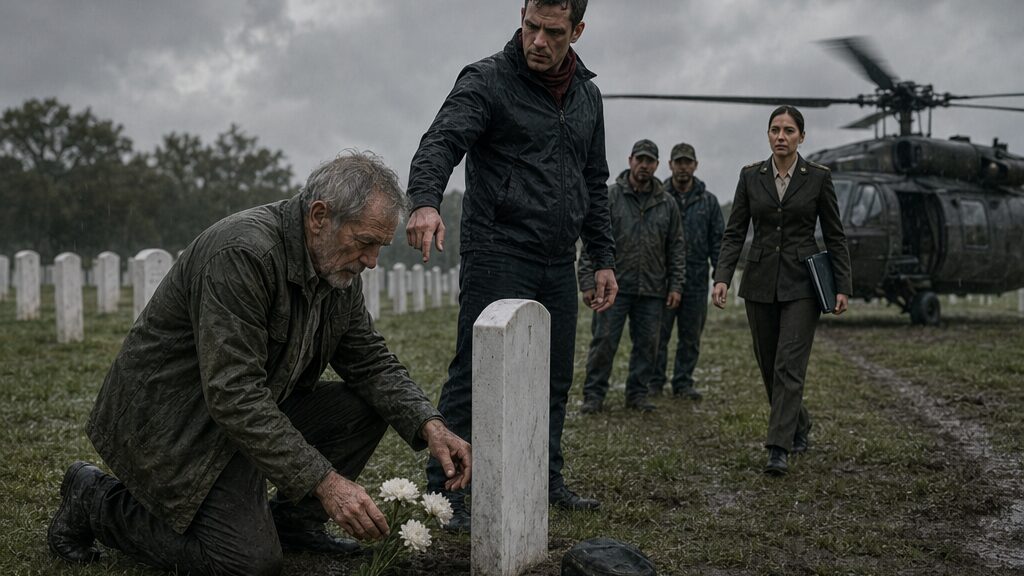
Jacob Allen’s hand closed around the old cap just as the helicopter appeared above the eastern line of trees.
David felt the cloth pull against his scalp. He did not reach up. At seventy-eight, sudden movements cost more than they used to, and the ground beneath his right knee had already softened into mud.
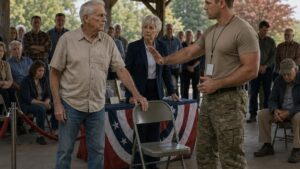
“Sir, I’ve asked you twice.” Jacob held the cap away from him. “This section is closed.”
The rotor beat rolled across the cemetery in deep, regular blows. Beyond the white headstones, two grounds workers were securing a canvas barrier around the landing zone. Loose leaves lifted, settled, then lifted again.
David placed the first white flower against Kevin Allen’s headstone.
The stone was cold beneath his fingertips. He had expected that. It was always cold on this date, even in years when the sun came out.
Jacob stepped closer. He wore a black rain jacket over a cemetery badge and a red scarf tucked too neatly at the throat. He was young enough to stand without thinking about his knees and anxious enough to keep checking the helicopter’s approach.
“You came through a marked gate,” Jacob said. “There are signs. There’s a security closure. I need you on the path now.”
David set down the second flower.
One of the workers glanced over. The other pretended not to.
“I need one minute,” David said.
“You’ve had a minute.”
The third flower remained inside David’s jacket, its stem wrapped in damp paper. He could feel it pressing against his ribs when he breathed.
Jacob looked toward the landing field. A crew member in a bright vest was waving the helicopter into position. The machine had dropped low enough that its rotor wash bent the grass between the graves.
“Sir, this isn’t optional.”
David reached toward the cap.
Jacob pulled it farther away.
For the first time, David looked directly at him.
The young man’s face was tight, not cruel exactly. Frightened of failure, David thought. Frightened someone would report that he had allowed an old man to kneel inside a restricted zone while an Army aircraft landed.
David knew that kind of fear. It often wore authority because authority was easier to explain afterward.
A grounds worker approached and spoke near Jacob’s shoulder.
“He’s in the visitor book,” the worker said. “Same date every year. Goes back a long way.”
Jacob did not turn. “That doesn’t change the landing order.”
“He never causes trouble.”
“He’s causing it now.”
David’s hand remained open between them.
Jacob looked at the worn cap. Its black cloth had faded nearly brown at the crown. The stitching above the brim had loosened years ago, and one side had been repaired by hand with dark green thread.
“People put on old gear and think rules don’t apply,” Jacob said.
The worker’s face changed. “That isn’t what I said.”
The helicopter’s nose swung toward them. Wind struck the grave markers and sent a paper wrapper tumbling between the rows.
David lowered his hand.
Jacob mistook the movement for surrender.
“Good,” he said. “Stand up. We’ll escort you out.”
David took the third flower from his jacket.
Jacob stared at it as if it were another act of defiance.
“Sir.”
David placed the flower beside the others.
Three white blossoms. No ribbon. No flag. No card.
He adjusted them until their stems touched.
Jacob stepped between David and the headstone. “Old stories don’t override safety orders.”
Then he dropped the cap.
It landed brim-first in the wet soil beside the flowers.
For a moment, David heard only the rotor beat and the small inner sound of his own breathing.
The two grounds workers stopped moving.
Jacob’s jaw shifted. Perhaps he had meant to toss the cap toward the path. Perhaps he had meant only to shock David into standing. But the cap lay where it had fallen, one side sinking into mud.
David placed his palm against the ground and rose halfway before his knee refused him. He paused, gathered his weight, then lowered himself again.
No one offered help.
He reached for the cap.
Mud had entered the hand-stitched seam. David wiped it with the sleeve of his olive field jacket, carefully, from crown to brim. The stain spread rather than disappeared.
He could have told Jacob then.
He could have said whose hands had once shaped the brim. He could have named the place where he had found it. He could have explained why the thread inside was green, why three flowers mattered, why he had crossed a chained gate despite the signs.
Instead, he placed the cap beside the flowers.
“It was never mine,” he said.
Jacob’s expression changed, but only slightly.
The helicopter settled onto the landing field. The grass flattened under it. A side door opened before the skids had fully taken the weight.
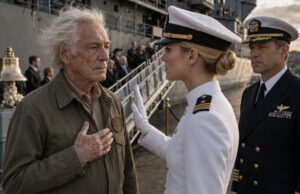
A woman in an Army service uniform stepped down, one hand holding her cap in place. Behind her, the crew chief passed out a hard-sided case and a sealed transport tube. She gave both to another officer, then walked quickly between the headstones.
Jacob straightened.
“Ma’am,” he called. “We’re clearing the restricted area.”
The woman did not look at him.
Her attention had fixed on David.
She slowed when she saw the cap in the mud, then looked from the three white flowers to the old man’s face.
“Mr. Miller?”
David’s fingers tightened against his knee.
Jacob turned toward him.
The officer came closer. She was in her early forties, with rain beading on her shoulders and a folder tucked under one arm.
“David Miller?” she asked.
He nodded once.
Her expression held relief for less than a second. Then something more cautious replaced it.
“I’m Michelle Sanchez, Army Casualty and Memorial Affairs.”
“I know.”
“You know my name?”
“It was on the letters.”
A gust from the helicopter lifted the edges of the flowers. David put one hand over their stems.
Michelle looked down at him. “Why did you stop answering us?”
Jacob glanced between them. The authority he had gathered around himself seemed to loosen.
David looked at the sealed tube being carried from the aircraft. Two uniformed personnel walked beside it, their steps measured and careful.
“I answered enough,” he said.
“No, sir. You answered around it.”
The word sir did not sound ceremonial. It sounded like distance being held respectfully.
Michelle knelt beside him.
She did not salute. She did not announce his service. She simply set her folder on the damp grass and placed a steady hand on his shoulder when the rotor wash pushed against his narrow frame.
David flinched before he could stop himself.
Her eyes followed his to the hard-sided case.
“We confirmed the recovery inventory six months ago,” she said. “Then you stopped returning calls.”
“Six months is not a long time.”
“It is when a family has already waited fifty years.”
Jacob heard that. David saw the question form in his face.
Michelle lowered her voice. “We need your identification before the memorial correction can proceed.”
David looked at Kevin’s name cut into stone.
SPECIALIST KEVIN ALLEN.
The dates beneath it had once seemed impossible. Now they looked smaller every year.
“I identified him once,” David said.
Michelle’s hand left his shoulder. “The remains were not the only thing they identified.”
Chapter 2: The Officer Knew His Name, Not His Story
Michelle placed a sealed brown envelope beside the mud-stained cap on the metal table.
“Which one are you more afraid to touch?” she asked.
The cemetery service building trembled faintly each time the helicopter changed pitch outside. The room had once been used for grounds equipment; hooks still lined one wall, and the air smelled of wet concrete and machine oil.
David sat in a folding chair near the door. His knee had stiffened during the walk from the grave. He had refused Jacob’s arm and accepted Michelle’s only after the third step made refusal look more theatrical than dignified.
The cap now rested inside a clear evidence sleeve. Michelle had offered it to protect the fabric from rain. The plastic made the old cloth look preserved and distant, like something behind museum glass.
David pointed at the envelope. “That one isn’t mine either.”
“You were named in it.”
“That doesn’t make it mine.”
Michelle remained standing. “The mission amendment was recovered with the revised flight log. It was never entered into the final casualty packet.”
“Then someone failed to file it.”
“Yes.”
“That happens.”
“It also changes the official sequence.”
David looked toward the small window. The helicopter sat beyond the headstones, rotors slowing. Personnel moved around the sealed transport tube.
He had corresponded with offices like Michelle’s for years. Names changed. Letterhead changed. The questions did not.
Did Specialist Allen reach the southern extraction path?
Did Sergeant Miller observe the second landing attempt?
Were the recovered personal effects in Specialist Allen’s possession?
David had answered dates, distances, weather, equipment. He had drawn maps with a ruler. He had identified buckles, straps, a damaged medical pouch, and once a partial boot tread from a photograph so poor it might have shown anything.
Six months ago, Michelle had sent him one question without a form attached.
Why did Kevin turn back?
David had folded the letter and put it in the kitchen drawer beneath the batteries.
Jacob stood near the opposite wall with the two grounds workers. His arms were no longer crossed. He kept looking at the evidence sleeve.
Michelle slid the envelope closer.
“You don’t have to open it alone,” she said.
“I’m not alone.”
Her gaze moved briefly to Jacob.
“No,” she said. “You aren’t.”
A records technician entered carrying a clipboard. “Ma’am, we need a signature on the recovered-material inventory.”
Michelle took the clipboard. The top sheet shifted as she signed.
Jacob saw the name halfway down the page.
KEVIN ALLEN.
His face went still.
“Where did that come from?” he asked.
The technician looked at Michelle.
She closed the clipboard. “The inventory was recovered during a site review tied to Specialist Allen’s case.”
Jacob took one step toward the table. “Kevin Allen?”
David watched his hand rise and stop before touching the plastic sleeve.
“That cap,” Jacob said. “You said it wasn’t yours.”
David said nothing.
Michelle answered for him. “It belonged to Specialist Allen.”
The room seemed to lose its air.
Jacob’s eyes moved to the mud line darkening the edge of the brim. His own act returned to him in a new shape. The cap was no longer an old man’s costume, no longer an obstacle, no longer something he could drop to prove control.
One of the workers looked away.
Jacob swallowed. “How do you know?”
“The stitching,” Michelle said. “The interior identification marks. Photographs from the recovery file.”
David’s mouth hardened. “And because I told them.”
Jacob looked at him. “You had his cap?”
“I had it.”
“Why?”
David turned toward the door.
His knee protested when he stood, but he kept his face blank. “I’ve answered what you needed.”
Michelle moved between him and the exit without blocking it. “You haven’t.”
“The aircraft landed. Your materials arrived. The cemetery is still standing.”
“This is not about the landing.”
“It was to him.”
Jacob’s color rose. “You entered a secured zone.”
“Yes.”
“You wouldn’t tell me who you were.”
“You did not ask who I was. You told me what you thought I was.”
Jacob opened his mouth, then closed it.
David took one step. The brown envelope remained on the table. He could leave it there. The Army could revise the record using whatever it had found. It would become another careful paragraph written by people who had not smelled burning insulation or held pressure on a wound while a helicopter counted seconds.
Michelle lifted the envelope.
“Mr. Miller, the correction ceremony is scheduled for this evening.”
David stopped.
“Ceremony,” he repeated.
“A small memorial update. Family only, cemetery staff, liaison personnel.”
“No.”
“The family requested it.”
“They requested a clean sentence.”
Michelle’s face tightened. “You don’t know what they requested.”
“I know what families are given.”
Jacob stepped nearer the table. “What family?”
No one answered at first.
Outside, the helicopter’s engine wound down. The sudden reduction in sound made every movement inside the room distinct: rain at the window, plastic shifting around the cap, David’s breath catching high in his chest.
Jacob looked again at Kevin’s name on the inventory.
“My mother’s father was Kevin Allen,” he said.
David turned fully toward him.
The resemblance was not in the face. Kevin had been broader, heavier through the shoulders, incapable of standing still when somebody else was working.
But Jacob held anger the same way—behind his teeth, as if releasing it would cost him something.
“You’re Angela’s boy,” David said.
Jacob’s expression sharpened. “You know my mother?”
David looked at the cap.
The hand-stitched seam had begun to dry. Mud remained caught beneath the thread.
“Not well.”
Jacob gave a short, humorless laugh. “You carry my grandfather’s cap for fifty years, but you don’t know us well?”
Michelle set the envelope down again. “Jacob.”
“No. He stood at the grave like he owned the place. He ignored the closure. He made us all look—”
He stopped before saying foolish.
David could hear the missing word anyway.
Jacob pointed toward the cap. “How did you get that?”
David’s hand closed around the back of the folding chair.
There were answers that sounded like claims.
I recovered it.
I carried it out.
I brought him home.
Each one removed Kevin from the sentence and placed David at its center.
“I kept it dry,” David said.
Jacob stared at him. “What does that mean?”
Michelle studied David’s face. She had seen enough written statements to recognize language used as cover.
The brown envelope lay unopened between them.
A vehicle door slammed outside. A woman’s voice spoke near the entrance, demanding to know why she had been called to the cemetery with less than an hour’s notice.
David’s grip tightened.
Jacob looked toward the hallway, then back at him.
“My mother is here.”
David reached for the cap, but the plastic sleeve slid against the table and Michelle steadied it first.
Jacob saw the motion.
“Were you with him?” he asked.
David did not answer.
Jacob stepped closer. His voice lowered.
“Were you the man who left him there?”
Chapter 3: The Family Had Lived With One Sentence
Angela Allen entered the records room, saw the cap inside the clear sleeve, and stopped so abruptly that the gate clerk nearly walked into her.
“Why,” she asked, “is a stranger carrying my father’s property?”
She was sixty-two, with gray threaded through dark hair cut to her jaw. Rain marked the shoulders of her coat. She did not look at Jacob first. She looked only at the cap.
David remained beside the folding chair.
“I’m not a stranger,” he said.
Angela’s eyes lifted to his face. “Then tell me your name.”
“David Miller.”
Recognition came without warmth.
Her mouth parted, and for one second she looked younger than Jacob. Not softer—only caught between the version of a man she had imagined and the old body standing before her.
“Miller,” she said. “The medic.”
David nodded.
Jacob moved toward her. “Mom, I didn’t know who he was. He was inside the closure, and he wouldn’t—”
Angela held up one hand.
Her gaze dropped again to the cap. “Where did you get it?”
David could have used the official phrasing.
Recovered personal effect.
Post-action identification.
Item transferred from site.
Instead he said, “I brought it back.”
Angela crossed the room and stopped at the table. Through the plastic she examined the crown, the broken line of stitching, and the green thread inside the band.
“My grandmother repaired that,” she said. “She used green because it was all she had.”
Her fingertip hovered over the sleeve without touching it.
“There’s a photograph,” she continued. “My father is holding me with one arm, and the cap is on his knee. I used to think the stitching looked like a little road.”
David remembered the seam under red light inside a transport cabin. Kevin had complained that the thread scratched his forehead and then refused to let anyone cut it loose.
Angela looked at David. “You had this all these years?”
“Yes.”
“Why?”
He looked toward Michelle. She had opened a file but had not removed the sealed amendment. The official answer was still waiting to become useful.
“It was among the effects,” David said.
Angela’s face closed.
“Among the effects,” she repeated. “That is exactly how the Army wrote to my mother.”
David felt the room narrowing around him.
Michelle gestured toward a chair. “Mrs. Allen, there are materials we need to review before the memorial correction.”
Angela did not sit. “You called me because you found another page.”
“A mission amendment and revised flight timing.”
“And you called him because?”
“He is the surviving witness named in the amendment.”
Angela’s attention returned to David. “Surviving witness.”
He heard the accusation inside the title.
Jacob stood near the wall, quieter now. The two grounds workers had left, but their absence did not make the earlier scene private. The mud remained on the cap. Jacob’s hand had put it there.
Angela opened her handbag and removed a thick envelope held together with a rubber band.
“I brought these because your office told me the case involved annual correspondence.”
Michelle looked surprised. “Those are the notes?”
“They arrived every year for twenty-three years. No return address.”
Angela removed the band.
The papers were not identical. Some were written on stationery, some on plain index cards, one on the back of a pharmacy receipt. David recognized his handwriting before she spread them across the table.
Three came back because he turned around.
The sentence appeared again and again.
Sometimes alone.
Sometimes beneath the date.
Once beside a rough drawing of three white flowers.
Jacob read the nearest card. “You sent these?”
David looked at Angela.
“Yes.”
The word seemed smaller than the room required.
Angela’s fingers pressed against the table. “You sent flowers too.”
“Yes.”
“Every year?”
“Yes.”
“But you never signed your name.”
“No.”
“Why?”
David studied the cap. The mud at its brim had begun to dry into a pale crust.
“A name would have made it about the sender.”
Angela laughed once, but there was no amusement in it. “You decided that for us?”
David said nothing.
“You decided we should receive a sentence from a stranger every year and wonder whether it came from someone who saw him die, someone he saved, someone who blamed him, someone who wanted forgiveness?”
“I did not ask for forgiveness.”
“That may be the problem.”
Jacob shifted. “Mom—”
“No.” Angela looked at him. “You wanted to know why I came so quickly? Because this office told me David Miller had finally appeared.”
Finally.
The word struck harder than Jacob’s hand on the cap.
Angela opened the official file Michelle had placed on the table. She turned past casualty notices, maps, and identification summaries until she found a thin page protected in plastic.
“My mother read this until the fold split,” she said. “It was all we had from the man who came home.”
She slid the page toward David.
His old statement had been typed from notes taken while he was sedated. His signature leaned badly at the bottom.
Most of the page concerned weather, radio failure, casualty numbers, and landing conditions.
One sentence had been underlined in blue ink.
Specialist Allen failed to reach the extraction point.
Angela touched the line.
“That was your account.”
“It was part of it.”
“It was the part they sent us.”
“I did not choose what they sent.”
“But you knew.”
David’s throat tightened.
He had known after Angela’s grandmother wrote to him. He had read the letter in a barracks room and placed it beneath the cap. She had asked whether Kevin had been alone.
David had answered that Kevin had performed his duty.
A true sentence.
A useless one.
Angela gathered the unsigned notes and held them against her chest.
“For years, I thought these meant my father turned around and went back for other men after you had already left.”
David’s eyes remained on the statement.
She continued, “Then I thought maybe you were telling us three came home because he stayed behind. That he traded himself for you.”
Jacob looked at David. Suspicion had returned, but it was no longer the careless contempt from the grave. It had found a personal place to stand.
Angela’s voice lowered. “Did he?”
David’s answer lodged behind his teeth.
There were facts he could give them. Kevin had crossed the drainage cut. Kevin had ignored the final withdrawal signal. Kevin had placed both hands on David’s vest and pulled until David’s boots moved.
But each fact led to the moment David had spent fifty years refusing to name.
Michelle removed the brown envelope from her folder and set it beside the statement.
“The amendment may clarify the sequence,” she said.
Angela did not look at it. “I’m asking him.”
David’s knee shook once beneath the table. He pressed his palm against it.
“I was responsible for the medical position,” he said.
“That isn’t an answer.”
“The extraction failed in stages.”
“That isn’t an answer either.”
Jacob’s impatience broke through. “Did you leave him?”
David looked at the young man who had dropped Kevin’s cap into the soil.
He should have been angry. Anger would have been easier. Instead, he saw Kevin’s daughter and grandson standing inside a story David had helped build by leaving out its center.
His silence had not protected them from pain. It had only forced them to shape pain around an empty place.
Angela pushed the old statement closer.
“Read it,” she said.
David did.
His own younger voice stared back at him in official type, precise enough to survive and incomplete enough to wound.
Specialist Allen failed to reach the extraction point.
Angela placed one finger beneath the sentence.
“Read what you let us believe.”
Chapter 4: The Record Proved Less Than Everyone Hoped
The recovered amendment listed both men beneath a single line:
MOVEMENT CONTRARY TO EXTRACTION ORDER.
Michelle placed the page in the center of the conference table. The plastic cover caught the gray light from the windows, making the words appear and disappear whenever anyone shifted.
David sat closest to the glass wall overlooking the landing field. The helicopter remained on the grass, its rotors still. Beyond it, white headstones descended in straight rows toward the trees.
Angela stood behind the chair opposite him. Jacob remained near the door as if uncertain whether he belonged with the family or the cemetery staff.
Michelle pointed to a time written in faded pencil.
“This was added by the flight operations officer,” she said. “Fourteen twenty-six. Final withdrawal order issued.”
Her finger moved down the page.
“Fourteen twenty-nine. Miller observed on the southern extraction path.”
Jacob looked at David.
David rubbed the dried mud line along the cap’s brim through the open evidence sleeve. The soil broke beneath his thumb but did not come free from the green stitching.
Michelle continued.
“Fourteen thirty-one. Allen observed moving north toward the damaged aid position.”
Angela lowered herself slowly into the chair.
“So my father had reached the path,” she said.
“The record does not confirm that,” Michelle replied. “It confirms that he was seen near it earlier.”
“Then he turned around.”
“Yes.”
“For what?”
Michelle looked at David.
He kept rubbing the same place on the cap.
The conference room had been designed to make difficult matters appear manageable. Beige walls. Identical chairs. A clock without a second hand. A framed photograph of the cemetery in sunlight.
Nothing in it belonged to the place described on the page.
Jacob approached the table.
“If David was already on the extraction path, why would Kevin go back for him?”
Michelle slid a flight log beside the amendment. “The pilot’s notes mention two visible personnel at the southern marker before the second approach.”
“Two,” Jacob said. “David and somebody else?”
“The notes don’t identify them.”
David knew who the second man had been.
He also knew the pilot had seen shapes, not faces. Smoke had covered the lower slope. Anyone writing from the air would have believed the two figures were moving.
One had been.
One had not.
Angela read farther down the flight log. “Fourteen thirty-three. Aircraft began final approach.”
Michelle nodded.
“Fourteen thirty-five,” Angela continued. “Approach aborted due to ground fire and obstruction.”
Her voice thinned over the last word.
“Fourteen thirty-eight. Fuel limit reached. Aircraft departed.”
Jacob leaned closer. “And Kevin was still north of the path.”
“The amendment suggests that.”
“Suggests?”
“It was written during an investigation that never received a complete witness statement.”
Everyone looked at David.
He stopped rubbing the cap.
“My statement was complete enough for the conditions,” he said.
Angela’s chair scraped against the floor. “Complete enough for whom?”
David did not answer.
Michelle removed another sheet. It was a copied sketch of the aid position and extraction route. The lines were crude, drawn under pressure by someone trying to turn confusion into direction.
“This mark indicates the first point where you were seen,” she said to David.
He glanced at the page. “The slope is wrong.”
“The slope?”
“It was steeper on the west side.”
“This came from the flight officer.”
“He was above it.”
Michelle waited.
David pulled the map toward himself and rotated it. His finger found a line representing a drainage cut.
“This was deeper. The rain had opened it. You couldn’t cross here carrying weight.”
Jacob bent over the table. “Then how did you get to the path?”
David’s finger remained on the line.
“By going south.”
“And Kevin?”
David withdrew his hand.
Michelle pointed to a second notation. “The flight timing gives Specialist Allen approximately four minutes between the withdrawal order and the final approach.”
“Enough time to get out?” Angela asked.
“If he had continued south,” Michelle said, “probably.”
Probably.
David had spent fifty years inside that word.
Probably enough time.
Probably enough fuel.
Probably visible.
Probably alive.
Jacob read the page again. “So he chose to go north.”
“Yes,” Michelle said.
“And David was already south.”
Michelle did not correct him.
The first small truth settled over the room: Kevin had not simply been stranded by bad luck. He had turned away from the route that might have saved him.
Angela stared at the old statement beside the map.
“Failed to reach the extraction point,” she said. “That sounds as if he couldn’t find it.”
David looked through the window at the landing field.
“That was the language used.”
“You used it.”
“It was typed for me.”
“You signed it.”
His signature had been made with his left hand because the right was wrapped. He remembered the pen slipping twice. He remembered an officer tapping the blank line and telling him they could revise details later.
Later had become fifty years.
Jacob moved around the table until he stood across from David.
“My grandfather turned back after you reached safety.”
David looked up.
Jacob’s face no longer held the embarrassment of a supervisor who had mistreated the wrong visitor. Something colder had replaced it.
“You carried his cap,” Jacob said. “You sent notes. You left flowers. You came here every year. Was that guilt?”
“Yes.”
Angela inhaled sharply.
The answer surprised them because David had given it without defense.
Jacob placed both hands on the table. “Because he went back and you didn’t?”
David felt the room begin to tilt—not physically, but in the old way, when sounds separated from their sources and distance became unreliable.
He pressed his thumb into the mud stain.
Michelle noticed. “Mr. Miller, we can pause.”
“No.”
“You don’t need to answer this in front of—”
“Yes,” Angela said. “He does.”
Michelle turned toward her. “He needs to answer accurately. Pressure does not guarantee accuracy.”
“Silence hasn’t done much for us either.”
David closed his eyes for one breath.
When he opened them, Angela was holding the unsigned notes. Jacob stood beneath the framed cemetery photograph. Michelle’s recovered amendment lay between them, full of times and movements but empty of reasons.
A document could prove Kevin turned north.
It could not prove why.
Jacob tapped the notation showing David on the southern path.
“He had a way out,” he said. “You had already taken yours.”
“That is what the page says.”
“Is it wrong?”
“No.”
“Then what are we missing?”
David looked at the line marked southern extraction path.
He saw no ink.
He saw a wounded crewman dragging one leg. He saw smoke folding against the ground. He saw Kevin’s mouth moving through the noise. He saw his own boots planted in mud.
Angela’s voice came quietly now.
“Did my father go back for someone?”
David nodded.
“Who?”
He tried to form the sentence in the passive language he had used for decades.
Movement was delayed.
Medical personnel became separated.
Extraction discipline deteriorated.
The words would not come.
Jacob waited, anger tightening his shoulders.
David placed the cap flat on the table. The mud-darkened brim pointed toward him like an accusation.
“He came back,” David said, “because I stopped moving.”
Chapter 5: What Kevin Chose After David Froze
“I was already outside when I became useless.”
No one interrupted him.
They had moved to the cemetery chapel because the conference room’s glass wall made David feel watched by every white stone beyond it. The chapel was empty except for four wooden benches, a lectern, and a narrow window behind the altar.
David sat on the front bench with Kevin’s cap in both hands. He did not wear it.
Angela sat across the aisle. Jacob stood near the rear doors. Michelle remained beside the lectern with the amendment closed inside her folder.
David looked down at the cap.
“The aid position had been hit twice,” he said. “The second strike took the roof and most of the radio equipment. Kevin and I moved the wounded through the south opening.”
His voice sounded too steady. He distrusted it.
“There were three who could walk with help. Two who could not. One crewman had a chest wound. I kept pressure on it while Kevin cleared the route.”
Angela’s hands were locked together.
“Was that the third man?” she asked.
“No.”
David ran a finger along the green repair thread.
“The chest wound was too deep. I knew that. I kept working anyway.”
He had never told anyone the sound the crewman made when the pressure stopped. Not a cry. More like a breath of surprise.
“The withdrawal signal came,” David continued. “Kevin told me to leave him. The man was already dead.”
“But you didn’t,” Michelle said.
David shook his head.
“I kept compressing the wound. Kevin pulled my hand away. I put it back.”
The chapel’s air system clicked on. A faint current moved through the room, lifting the corner of a paper on the lectern.
David looked toward the narrow window. The light had begun to lower.
“Kevin dragged another wounded crewman through the south opening. I followed. We reached the drainage cut.”
He paused.
The memory no longer arrived as one complete scene. It came in pieces: a bent stretcher handle, blood on Kevin’s sleeve, the bitter taste of smoke, water running over his boots.
“The surviving crewman could not cross the cut alone. Kevin went first and pulled him over. I climbed after them.”
Jacob shifted near the doors.
“The flight log says two people were seen on the path,” he said.
“Kevin and the crewman.”
“Not you?”
“I was beside them.”
“Then why weren’t you visible?”
David looked at him. “Because I was on my knees.”
The words quieted even the air system.
David had reached the southern path. The helicopter was somewhere beyond the smoke. The crewman had crawled toward the marker. Kevin had been shouting at David to stand.
David had understood every word.
His body had not obeyed.
“I heard the aircraft,” David said. “I knew how much time we had. I knew the route. I had no wound that prevented me from moving.”
Angela’s face tightened.
“What happened?”
“I looked at my hands.”
He could still see the blood beneath his nails.
“I thought of the man I had left in the aid position. I thought if I moved, I was agreeing he was dead. Then I thought of every person we had not reached that week. My legs stopped taking orders.”
He gave a small, bitter breath.
“We had phrases for it afterward. Acute stress. Combat exhaustion. None of them mattered at the time. Kevin told me to get up. I told him to leave.”
“Did he?” Angela asked.
David almost smiled.
“No.”
Kevin had pushed the cap into David’s hands before turning north. It had been raining then, too—not gently, but hard enough to make the ground jump.
“Keep it dry,” Kevin had said.
David had thought he was making a joke. Kevin always removed the cap before working, then complained when he misplaced it.
But he had shoved it against David’s chest and closed David’s fingers around it.
“He gave me this,” David said, lifting the cap slightly. “Then he went back toward the aid position.”
Jacob’s voice came from the rear. “For the dead man?”
“For the last crewman.”
Michelle opened the flight log. “The casualty list shows one additional survivor recovered after the first extraction attempt.”
“He had been listed as dead,” David said. “No pulse found during the first check. Kevin had seen his hand move under a torn section of canvas.”
Angela looked at the three flowers in her mind; David could see the recognition arrive.
“The third flower,” she said.
David nodded.
“That crewman lived?”
“For thirty-seven more years.”
“And my father went back for him.”
“Yes.”
The small payoff did not bring comfort. It only sharpened the cost.
Michelle consulted the timing. “Specialist Allen returned with the survivor at approximately fourteen thirty-four.”
“He had him over one shoulder,” David said. “The aircraft was making the final approach.”
Jacob stepped away from the door. “Then they could have boarded.”
“The approach failed.”
“Because of the ground fire?”
“And debris on the path. The crewman had reached the marker. Kevin was farther north.”
“Where were you?”
David’s grip tightened around the cap.
“Moving again.”
Kevin had returned, seized David by the vest, and dragged him upright so hard that one of the straps tore.
You do not get to become cargo, he had shouted.
David had stumbled south with the surviving crewman. Kevin had turned once more toward the aid position to clear loose canvas from the landing route.
The helicopter descended, rose, and descended again.
Then the fuel warning came over the radio.
“Kevin had a final chance to board,” David said. “He put the crewman ahead of him.”
Angela’s eyes filled, but her voice remained controlled. “And then?”
“The aircraft lifted.”
“With you on it.”
“Yes.”
“And him on the ground.”
“Yes.”
The answer lay between them without protection.
Angela looked away.
Jacob’s expression hardened again, but differently. The anger now had grief inside it.
“You let him put you on.”
“I did.”
“You knew he had a daughter.”
“Yes.”
“You knew he might not get another chance.”
“Yes.”
David looked at the cap. “And I was angry with him.”
Angela turned back.
“You were angry?”
“For coming back. For making his choice into something I had to live inside. For deciding the other crewman mattered more than you did.”
Her face changed.
David forced himself to continue.
“I loved him. I owed him my life. I also hated him for choosing everybody else over his own child.”
Angela stood.
The movement echoed through the chapel.
“You don’t get to say that.”
“No,” David said. “I didn’t think I did.”
“You carried his cap. You sent those notes. You came to his grave and decided you understood what he owed me?”
“I decided I would not tell you that your father chose a dead man, a frozen medic, and a wounded stranger over the chance to come home.”
“He didn’t choose against me.”
David looked at her.
“I know that now.”
“Do you?”
“I know he believed no one should be left as a burden for someone else to abandon.”
Angela’s anger did not disappear. It settled into something less clean.
At the back of the chapel, Jacob had lowered his head.
David turned the cap in his hands. “I went back four days later with the recovery team.”
Michelle looked up sharply. “That detail is not in your casualty statement.”
“It was a separate operation.”
“You were medically restricted.”
“I went anyway.”
Angela’s voice was almost a whisper. “You found him?”
David did not answer yet.
The hardest part remained ahead, and he had already said more than he intended.
The chapel door opened. A cemetery staff member stepped inside and held up a printed sheet.
“Ma’am,” the worker said to Michelle, “the memorial language needs approval before sunset. The detail is assembling.”
Michelle accepted the page.
Her eyes moved across it, then stopped.
“What does it say?” Angela asked.
Michelle hesitated.
David held out his hand.
She gave him the draft.
The proposed correction was six sentences long. It cited recovered timing, newly confirmed materials, and Specialist Kevin Allen’s service under hazardous conditions.
The last line read:
SPECIALIST ALLEN BECAME ACCIDENTALLY SEPARATED FROM HIS UNIT DURING THE FINAL WITHDRAWAL.
David read it twice.
Accidentally separated.
A clean phrase. A blameless phrase. A phrase that removed Kevin’s choice, David’s failure, the survivor’s life, and the years that followed.
Michelle checked the chapel clock.
“We have forty minutes,” she said.
Chapter 6: David Refused the Heroic Lie
The printed memorial wording tore free from Michelle’s hand as the helicopter lifted beyond the headstones.
The page rose in the rotor wash, struck the side of Kevin’s grave marker, and folded around the three white flowers. Jacob caught it before it could blow into the next row.
No one spoke until the aircraft turned toward the trees.
The memorial group was small: Angela, Jacob, Michelle, the cemetery superintendent, two liaison personnel, the grounds workers, and three members of the military detail. No spectators had gathered. No one had been invited to witness a correction that had not yet found the right words.
David stood beside Kevin’s grave with the cap under one arm. His knee ached sharply, but he refused the folding chair placed behind him.
Jacob handed the draft back to Michelle.
She smoothed it against her folder.
“We can postpone,” she said.
“No,” David replied.
Angela stood on the opposite side of the headstone. “Then don’t let them read that.”
Michelle looked at David. “I prepared an alternative.”
She removed another sheet.
“This version states that Specialist Allen deliberately returned under hostile conditions to assist wounded personnel despite the withdrawal order. It describes the action as heroic defiance.”
David held out his hand.
Michelle gave him the page.
He read the phrase once.
Heroic defiance.
It was better than accidental separation. It was also too simple.
“No,” he said.
Michelle’s professional composure thinned. “Mr. Miller, we have confirmed that he returned voluntarily.”
“Yes.”
“That he assisted the surviving crewman.”
“Yes.”
“That his actions placed him at greater risk.”
“Yes.”
“Then which part is inaccurate?”
“The part that makes the choice clean.”
The superintendent glanced toward the military detail. The three service members remained at rest, eyes forward.
Michelle lowered her voice. “This is a memorial correction, not an investigative hearing.”
“That is why the words matter.”
David placed the alternative draft against the headstone. The rotor wash had disturbed the flowers. One lay sideways in the grass.
He bent carefully and set it back with the others.
Then he placed Kevin’s cap on top of the stone.
The mud stain remained along the brim.
David removed the recovered amendment from Michelle’s folder. He did not read the official language. Instead, he turned to a copied page from Kevin’s field log.
The phrase appeared several times in cramped handwriting.
Nobody becomes cargo.
David touched the line.
“He used to say this when men complained about carrying someone,” David said. “Wounded, frightened, dead—it did not matter. He meant nobody becomes a thing you leave because moving them is inconvenient.”
Angela looked at the page.
Jacob looked at the cap.
David faced the small group.
“I froze on the southern path,” he said. “There was no injury preventing me from moving. Kevin returned contrary to the extraction order and pulled me to my feet.”
The superintendent shifted, but David continued before anyone could reduce the moment to procedure.
“He then returned for a crewman listed as dead. The crewman was alive. Kevin brought him to the extraction route and placed him ahead of himself.”
Michelle held the original draft against her side.
“The final approach failed,” David said. “Kevin remained on the ground. I left on the aircraft.”
Angela’s gaze did not leave him.
Four days later, David had returned with a recovery team while his right hand was still bandaged. They had moved through burned canvas and broken equipment until they found Kevin beneath part of the collapsed aid shelter.
The cap had been the only object David carried from the first flight.
Kevin had been the weight he carried on the second.
“I went back with the recovery team,” David said. “I found him. I helped place him on the litter, and I carried the forward handle until we reached the aircraft.”
He paused.
“I brought him home after I failed to keep him alive.”
No one corrected the sentence.
Michelle said, “The recovery report lists four personnel.”
“It does.”
“It doesn’t identify you.”
“I asked that it not.”
Angela closed her eyes briefly.
David understood what she heard: another omission, another choice made for other people.
He looked at her.
“That was not humility,” he said. “I told myself it was. I did not want my name near his because I feared people would ask why he had to come back for me.”
Angela’s expression held no forgiveness. But it held attention.
David turned toward Michelle.
“Do not write accidental separation.”
“I won’t.”
“Do not write heroic defiance either.”
She glanced at the service members, then back at him. “What should it say?”
David considered Kevin’s headstone.
“Write that he returned against an extraction order to assist two men who could not reach safety without him.”
Michelle nodded slowly.
“And the record of your actions?”
“Include them.”
Angela spoke from across the grave.
“All of them?”
David looked at her.
She was not asking whether he wanted punishment. She was asking whether the truth he demanded for Kevin would also apply to him.
“Yes,” he said. “Write that I became unable to continue. Write that he returned for me. Write that I departed while he remained.”
Jacob’s face tightened.
“That makes it sound like you abandoned him.”
David turned toward him. “I did leave without him.”
“But you went back.”
“Four days later.”
“You recovered him.”
“That does not erase the first aircraft.”
Jacob looked down.
David continued, “A record should not be written to protect the living from the dead.”
Michelle removed a pen.
On the back of the rejected draft, she wrote while David dictated concise sentences. No grand language. No claim that Kevin had felt no fear. No suggestion that disobeying orders was automatically noble.
The correction stated what he had done, whom he had helped, and what the choice had cost.
At the bottom, Michelle added the field-log phrase at Angela’s request:
Nobody becomes cargo.
When she finished, she handed the page to Angela first.
Angela read it. Her lips pressed together at the sentence naming David’s incapacity. She did not soften it.
Then she gave it to Jacob.
He read more slowly.
The military detail did not present arms. There was no command to salute. One liaison officer attached the corrected page to the memorial folder while another secured the recovered amendment beneath it.
The ceremony lasted less than five minutes.
Kevin’s name was spoken once.
The surviving crewman’s life was acknowledged without turning him into evidence.
David’s failure was entered without becoming the whole story.
When it ended, the small group began to separate. The grounds workers returned toward the landing field. The superintendent spoke quietly with Michelle about replacing the temporary memorial insert.
Angela remained beside the grave.
“So you hated him,” she said.
David looked at Kevin’s cap.
“Sometimes.”
“And loved him.”
“Yes.”
She nodded once, as if accepting only that both things could occupy the same sentence.
“That is more than the Army ever gave us.”
It was not forgiveness, and David did not treat it as such.
Jacob stood several steps away. His hands were empty. The red scarf at his throat had come loose in the wind.
He approached the headstone but stopped before entering the narrow space between David and Angela.
“I don’t want to do this in front of everyone,” he said.
The others were far enough away not to hear.
David waited.
Jacob looked at the mud stain along the brim.
“I thought you were using the place,” he said. “The cap. The grave. I thought you expected rules to bend because you looked like someone people would be afraid to question.”
“That was convenient for you.”
“Yes.”
“You had a safety order.”
“Yes.”
“You did not have an order to take the cap.”
“No.”
Jacob’s jaw tightened. “I know.”
David did not rescue him from the silence.
Jacob looked at Angela, then back at the grave.
His hand lifted slightly before he stopped it.
“Does the cap belong here,” he asked, “or should it go home with the family?”
Chapter 7: The Cap Stayed, but the Promise Changed
David found Jacob kneeling where he himself had knelt the day before.
The younger man had spread a folded cloth across the wet grass to protect his trousers. With a second cloth, he was cleaning the narrow stone base beneath Kevin’s name. He worked slowly around the carved letters, lifting soil from the grooves rather than smearing it across them.
The cemetery had not officially opened. Mist sat low between the rows, and the entrance gate remained chained on one side. David had arrived through the service entrance after Michelle arranged temporary access.
Jacob heard the tap of David’s cane and stopped.
“I wasn’t touching the cap,” he said.
David looked toward the headstone.
The cap rested inside a clear temporary case placed beside the three white flowers. Angela had found the case in the cemetery office the previous evening. It was not meant for permanent display, but it kept dew from settling into the cloth.
The mud stain remained on the brim.
“I can see that,” David said.
Jacob rose too quickly, then seemed to remember David’s age and slowed as though speed itself might be disrespectful.
“I thought the stone should be clean before you got here.”
“It was clean yesterday.”
“There was soil along the base.”
“There is usually soil near the ground.”
Jacob looked at the cloth in his hand. “I know.”
David stopped beside the grave. His knee had stiffened overnight, and the walk from the service entrance had taken longer than he expected. He rested both hands on his cane.
The three flowers had been rearranged. Their stems no longer touched.
Jacob noticed him looking.
“The wind moved them,” he said. “I put them back, but I didn’t know the order.”
“There is no order.”
“There seemed to be.”
David studied the blossoms. For years he had placed them with their stems meeting at one point. Kevin. David. The crewman who lived.
A formation of the living and the dead, arranged so no one appeared separate.
He reached down but stopped when pain tightened behind his knee.
Jacob moved instinctively, then held himself back.
“May I?” he asked.
David pointed toward the flowers.
Jacob crouched and placed the stems together.
“Not too tight,” David said.
Jacob loosened them.
For a while they listened to water dripping from the trees.
Angela had left the cemetery after the memorial correction without deciding whether the cap should remain at the grave. She had taken copies of the amendment, David’s revised account, and Kevin’s field-log page.
She had not taken David’s hand.
At the entrance to the chapel, she had said, “I need time to know which part I’m angry about.”
David had answered, “Take all of it.”
He had meant all the time. She may have heard all the anger.
Both were true enough.
Jacob folded the cleaning cloth into quarters. “My mother called this morning.”
David waited.
“She wants the cap left here.”
“Does she?”
“She said she spent her life wanting something of his that no one else had touched. Then she realized this had been touched by everyone who brought him home.”
David looked at the case.
The cap was faded, repaired, stained, and too small for the story people had built around Kevin.
Jacob continued, “She asked the superintendent about a weatherproof memorial box. Not large. Nothing ceremonial. Just enough to protect it.”
“The cemetery may not allow that.”
“They will if the family loans it to the historical collection and requests placement at the grave on the anniversary.”
Jacob looked almost embarrassed by how quickly he had learned the procedure.
David said, “You have been busy.”
“I didn’t sleep.”
“That is not the same thing.”
“No.”
The answer came without defense.
Jacob placed the folded cloth beside his knee. “I owe you an apology.”
“You owed me one yesterday.”
“I know.”
“And today?”
“I still owe it.”
David looked at him.
Jacob did not begin with reasons. That was something.
“I took the cap because I wanted you to obey me,” he said. “Not because of the landing order. I could have called security. I could have given you another minute. One of the workers told me you came every year, and I ignored him because I’d already decided what you were.”
“What was I?”
“An old man using a grave to make rules bend.”
David absorbed the accuracy of it. Jacob had not thought him important enough to hate. Only inconvenient enough to humiliate.
Jacob’s eyes moved to the headstone.
“I grew up with him everywhere,” he said.
“Kevin?”
“His photograph. His name. The story about what he did. My mother never compared me to him out loud, but she didn’t have to.”
David shifted his weight against the cane.
Jacob continued. “He died saving people. I managed grounds schedules. He disobeyed an order for wounded men. I wrote up employees for being late. Every decent thing I did felt small beside him.”
“So you resented him.”
“Yes.”
“Without knowing him.”
“Yes.”
David looked at Kevin’s name.
“That is one way legends damage people.”
Jacob’s mouth tightened. “When I saw you in that jacket and cap, kneeling there like you had some private claim, I thought you were another person using him to feel important.”
“And that made it easier to drop the cap.”
“It made it easier to tell myself you deserved it.”
There it was: not an excuse, but the shape of the failure.
David lowered himself carefully toward the stone border. His knee faltered halfway. Jacob stepped forward, then stopped with his hands open.
“May I help you sit?”
David considered him.
Yesterday, Jacob had taken without asking. The cap. The minute. The right to be understood.
Today he waited.
David nodded.
Jacob supported his elbow, bearing only enough weight to steady him. When David was seated, Jacob released him immediately.
The gesture recalled Michelle’s hand on his shoulder in the rotor wash, but this time David had chosen it.
Jacob crouched nearby.
“I am sorry,” he said. “Not because I learned who you were. Because of what I did before I knew.”
David looked at the mud stain.
“That is the correct reason.”
Jacob waited for more.
David did not give him forgiveness simply because the apology had been properly formed.
Instead he said, “There is something you can change.”
Jacob straightened. “What?”
“The visitor procedure during closures.”
“The safety rules are federal.”
“I did not say remove the rules.”
David pointed toward the service entrance.
“Train staff to ask why someone is there before deciding why they are difficult. Add a contact step for elderly visitors. Give the grounds workers authority to pause an escort when they recognize a regular mourner.”
Jacob listened without interrupting.
“And keep a chair near the closed sections,” David said. “Not everyone who moves slowly is refusing.”
Jacob nodded. “I can draft that.”
“Drafting is not changing.”
“I’ll take it to the superintendent.”
“If it is rejected?”
“I’ll bring it back with revisions.”
David looked at him. “Then do that.”
Jacob reached toward the temporary case and stopped.
“May I touch it?”
David’s first instinct was no.
The answer rose from fifty years of habit. The cap had remained with him through apartments, hospital stays, funerals, and every annual visit. Other people had handled it only under evidence procedures or because David’s hands were occupied.
Keeping it safe had once been a promise.
Then it had become a sentence.
David looked at Jacob’s waiting hand.
“Yes,” he said.
Jacob lifted the case by its edges and set it on the headstone. He did not try to wipe away the dried mud.
“My mother said the stain should stay,” he said.
“She is right.”
“It shows what happened.”
“It shows several things.”
Jacob looked at him but did not ask which ones.
A cemetery vehicle approached along the service road. Michelle sat in the passenger seat, a folder on her lap. The superintendent drove.
They stopped far enough away to leave the grave quiet.
Michelle walked over carrying a printed copy of the revised memorial entry. She handed it first to David.
The language had not been improved into grandeur overnight.
It named Kevin’s return. It named the two men who needed him. It named David’s inability to continue and the failed extraction. It stated that Kevin’s remains were recovered four days later by a team that included David.
At the bottom appeared the line from the field logs:
Nobody becomes cargo.
David read it twice.
Michelle said, “Angela approved the placement request for the cap. The permanent case will be ready next month.”
“Good.”
“She also asked me to give you this.”
Michelle handed him one of the old unsigned cards.
Three came back because he turned around.
Angela had written beneath it in blue ink:
Next year, sign your name.
David folded the card once and placed it inside his jacket.
He did not ask whether that was forgiveness. He had spent too many years demanding certainty from silence.
Michelle and the superintendent moved away to discuss the memorial case. Jacob collected the cleaning cloths and rose.
David remained beside the grave.
Three flowers lay beneath Kevin’s name.
He reached for them and separated one from the others.
For years, he had believed all three had to remain there: Kevin for the man who died, one for the crewman who lived, and one for David, who had survived without knowing where survival belonged.
Now he placed two flowers back against the stone.
Jacob noticed the third in David’s hand.
“Is that supposed to stay?” he asked.
David looked down the long path toward the cemetery entrance.
“No.”
He planted the cane, and Jacob again waited before offering help.
David nodded.
Jacob brought him carefully to his feet.
At the service road, David paused and looked back.
The cap remained inside the clear case, its green stitching visible beneath the crown and the mud stain dark across the brim. It no longer looked abandoned. It no longer looked like evidence.
It looked like something entrusted.
David turned toward the gate with one white flower in his hand.
The story has ended.