They Scattered Her Coins in the Rain Before Learning What the Old Can Was For
Chapter 1: The Coins Reached the Drain Before Anyone Moved
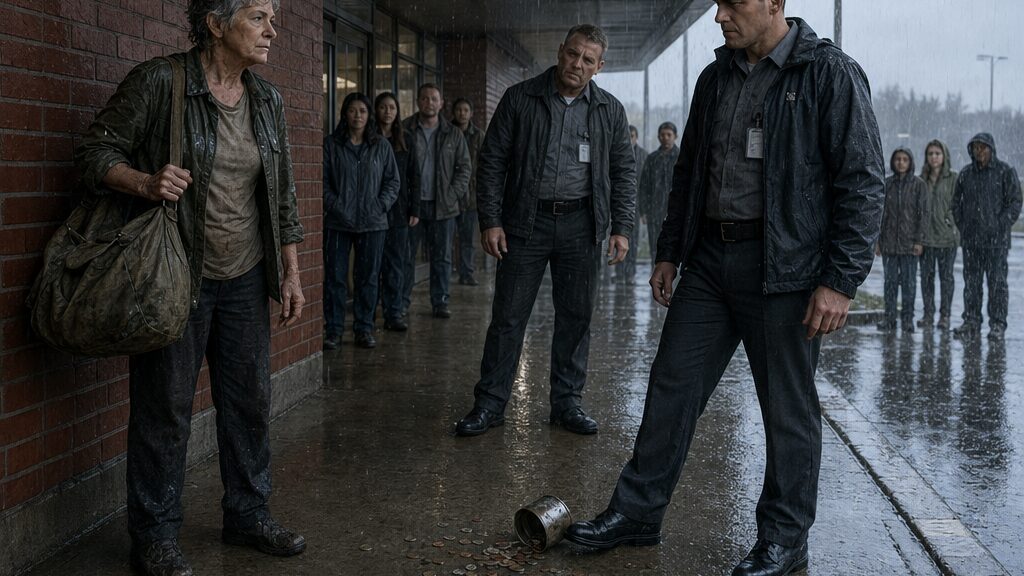
Timothy Harris’s boot stopped inches from the dented metal can.
“Can you read the sign?”
Anna Rivera looked past the polished black toe to the red lettering bolted above the service entrance.
RESTRICTED ACCESS. AUTHORIZED PERSONNEL ONLY.
Rain struck the covered walkway hard enough to mist beneath the awning. It had darkened Anna’s olive field jacket nearly black at the shoulders. Water had crept through one shoe during the walk from the bus depot and settled cold around her toes. She had been sitting against the red-brick wall for twenty-three minutes, her duffel tucked under one hand, waiting for the memorial office to open.
“Yes,” she said.
Timothy glanced at the metal can between her feet. Several quarters and nickels lay inside it, silver against the scorched bottom.
“Then why are you still here?”
“The office opens at seven.”
“This entrance doesn’t.”
A gate officer stood behind Timothy near the security desk, watching without appearing to watch. Beyond the chain-link fence, headlights moved through the rain as employees arrived. A transport van stopped beneath the patient canopy, and two recovery-center patients came slowly down the ramp with a nurse.
Anna tightened her fingers around the duffel strap.
“I was told the memorial coordinator works in this building.”
“Do you have an appointment?”
“No.”
“Identification?”
“In the bag.”
“Take it out.”
Anna did not move.
The duffel held copied casualty-routing sheets wrapped in wax paper, a photograph with a broken corner, an empty cassette sleeve, and three envelopes of coins collected over seven years. It also held Linda White’s folded flight scarf, though Anna had not yet decided whether she would surrender it to the archive.
Timothy’s expression changed when she hesitated. Not much. A slight narrowing around the eyes. The satisfaction of a suspicion taking shape.
“You were here before shift change,” he said. “Night security logged you at six thirteen.”
“My bus came early.”
“They said you were sitting against the wall.”
“I still am.”
One of the arriving employees slowed. Anna recognized the reflex: curiosity disguised as concern. Timothy noticed the audience too. His shoulders squared beneath his rain shell.
“You can’t camp here,” he said.
“I’m not camping.”
“You can’t solicit from patients or staff.”
Anna followed his gaze to the can.
“That money isn’t mine.”
“Then whose is it?”
She could have answered.
The money belonged to former patients who had left quarters in a jar beside the church kitchen register. It belonged to a mechanic who had put in twelve dollars after Anna told him the bench seat had split. It belonged to three widows who had mailed folded bills with no return addresses. It belonged to a child who had dropped seven nickels into the can because his grandfather used to sit on that bench after therapy.
But Anna had learned that explanations offered to a man already certain of himself became exhibits against you.
“It is for the memorial office,” she said.
Timothy gave a humorless breath. “Of course it is.”
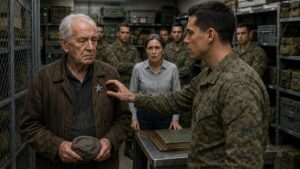
A younger security officer emerged from the side door. His name plate read WILSON. He wore the same gray uniform as Timothy, but his walk carried a slight unevenness, as though one leg had once been taught to move again.
“Everything all right?” Jeffrey Wilson asked.
“Unauthorized person refusing to clear the entrance,” Timothy said.
Anna looked at Jeffrey. His eyes went first to her face, then the soaked jacket, the duffel, the can. He did not look away quickly enough to hide that he had reached the same first conclusion.
“I’m waiting for Rebecca Mitchell,” Anna said.
Timothy turned toward the security desk. “Call county transit outreach. Tell them we have a probable trespasser at the service entrance.”
“I’m not asking for a ride.”
“No, you’re asking people for money.”
“I told you, the money isn’t mine.”
“And I asked whose it was.”
The transport van doors closed behind the patients. One of them, a thin man with a brace visible beneath his trousers, looked back toward Anna before the nurse guided him inside.
Timothy shifted his weight. “You have one chance to pick up your things and leave voluntarily.”
Anna’s knees ached from the overnight bus and the wet concrete. She pressed one palm to the wall and rose slowly. Timothy watched the effort without offering space.
She lifted the duffel.
“Keep your boot away from the can,” she said.
The words were quiet. That made him glance down.
There were four surnames scratched into the can’s side, worn shallow with age. RIVERA. BAKER. KING. WHITE. Beneath them ran a dark ring from old heat. Beside WHITE was a bare patch where someone had begun another mark and stopped.
Timothy used the edge of his boot to slide the can away.
It struck the curb.
The sound was small, almost delicate.
Then the can tipped, and the coins came out.
Quarters spun beneath the awning. Nickels skipped over wet concrete. Pennies struck the curb and rolled into the rain channel. A folded five-dollar bill opened in the water like a leaf. Several coins vanished beneath the iron lip of the storm drain before anyone moved.
Anna heard someone behind her whisper, “Sir.”
Timothy’s boot remained beside the overturned can.
For one second, Anna was no longer seventy-two.
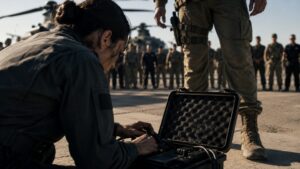
She was kneeling in red mud with a utility can balanced over a blue flame. Metal instruments rattled in boiling water. Rotor wash drove grit against her face. Linda was shouting numbers she could not hear. Four patients were alive because four women had kept their hands steady. A fifth person had gone back when she had been ordered not to.
The memory passed without changing Anna’s face.
She set down the duffel.
Jeffrey took one step forward. “Supervisor—”
“Call it in,” Timothy said.
Anna bent only far enough to right the can. Her right knee trembled. She placed it upright beside the wall, empty now except for rainwater and one dime stuck against the scorched bottom.
She did not gather the money.
That seemed to trouble the witnesses more than if she had shouted.
Her sleeve had caught at the elbow. As she straightened, the wet fabric pulled back from her left forearm.
Five short lines showed against her skin.
Four were complete, darkened by age but still clear. The fifth ended halfway, a stroke interrupted before it reached the same length as the others.
Jeffrey’s attention fixed on them.
“Where did you get that?” he asked.
Anna covered the marks with her sleeve.
“The can,” Jeffrey said. “Where did you get it?”
Timothy turned on him. “Wilson.”
But Jeffrey was staring at the scratched names. His face had lost its uncertainty.
“I’ve seen that arrangement,” he said. “The names and the burn ring.”
Anna lifted the duffel again.
“From the night the fifth name disappeared,” she said.
Rainwater carried another penny into the drain.
Timothy reached for the radio clipped to his shoulder. “Dispatch, I need county assistance at the east service entrance. Elderly female, refusing lawful direction, possible aggressive behavior.”
Anna looked directly at him then.
“Aggressive?”
“You were warned.”
Jeffrey stepped between Timothy and the radio desk, not enough to challenge him, only enough to delay the next motion.
“Give me five minutes,” he said.
“For what?”
Jeffrey glanced through the security glass toward the records wing upstairs.
“I think that can is in the photograph upstairs.”
Chapter 2: The Photograph Proved Less Than Jeffrey Hoped
Jeffrey brought the framed photograph into the security office while Timothy kept Anna’s duffel behind the desk.
He carried the frame with both hands. Rain had once reached the image; a brown stain clouded one lower corner, and the paper beneath the glass had buckled into shallow waves.
Timothy had allowed Anna inside only because county transit outreach had not yet arrived and because Jeffrey had said, twice, that the photograph might establish a legitimate reason for her presence.
Anna sat in a molded plastic chair facing the desk. The overturned can rested near her shoes. Jeffrey had recovered it from the walkway, though he had left the scattered coins where they lay.
“That’s it,” he said.
He placed the photograph beneath the fluorescent light.
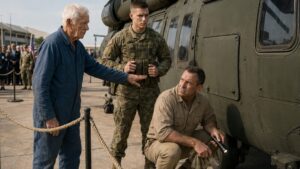
Five medical personnel stood beside a utility vehicle on a rough landing field. Their uniforms were stained. One woman held a bandage roll. Another leaned against the vehicle with both hands braced on the hood. A younger Anna crouched beside a dented can set over a portable burner.
The burn ring was already visible.
Three typed surnames appeared beneath the photograph. A fourth had been added later in faded ink.
The woman at the far edge had no name beneath her at all.
Jeffrey looked at Anna, expecting recognition to settle the matter.
Instead, she stared at the unnamed woman.
Linda’s face was turned partly away from the camera. Her hair had escaped beneath her cap. Even in the damaged photograph, Anna could see the crease at the corner of her mouth—the expression Linda wore when someone had told her to stand still and she had no intention of obeying for long.
Timothy tapped the glass.
“This proves an old can resembles another old can.”
Jeffrey pointed to the scratched side. “The names are in the same order.”
“Four common surnames.”
“White, King, Baker, Rivera. On the same container.”
Timothy folded his arms. “And the picture was displayed in a public corridor. Anyone could have seen it.”
Anna’s gaze stayed on Linda.
Jeffrey turned the frame toward her. “That’s you, isn’t it?”
“Yes.”
“Which one?”
Anna touched the glass above the crouching figure.
Jeffrey’s shoulders eased. “There.”
Timothy did not. “A verbal identification from the person trying to gain access.”
“You asked for a reason to delay removal,” Jeffrey said. “That’s a reason.”
“It isn’t authorization.”
Anna looked toward the duffel behind the desk. “My identification is inside.”
Timothy retrieved her wallet himself. He checked the state card, then a worn veterans’ health identification card. His mouth tightened, but he did not apologize.
“Military service doesn’t grant access to secured areas.”
“I didn’t say it did.”
“You said almost nothing.”
Anna took the cards from his hand.
“That isn’t the same as saying nothing.”
The side door opened. Rain blew across the threshold before a gate officer pulled it shut. Through the glass, several coins still glinted in the channel beside the drain.
Jeffrey lowered his voice. “What is the money for?”
Anna looked at the can.
“For a bench.”
Timothy gave a sharp laugh. “A bench.”
“The seat is split. The frame is rusting underneath. It stands in the memorial alcove on the west side.”
Jeffrey knew the place. His expression showed it.
“The recovery bench,” he said.
“People sit there between appointments,” Anna replied. “Some of them don’t want to go inside yet. Some don’t want to go home.”
“And you collected money to repair it?” Jeffrey asked.
“Other people collected it. I carried it.”
Timothy looked toward the rain-dark walkway. “In an open container.”
“The envelopes are in the duffel. What was in the can came from the church kitchen jar yesterday.”
“How much?”
“Three hundred forty-two dollars before your boot reached it.”
Silence entered the office.
The gate officer near the monitors lowered his eyes.
Timothy pulled an incident form toward him. “She was instructed to leave and refused. She made a hostile statement regarding physical contact with property.”
Anna watched him write.
“What statement?”
“‘Keep your boot away from the can.’”
“That was a request.”
“It was confrontational.”
Jeffrey leaned over the desk. “She didn’t raise her voice.”
“I’m documenting my assessment.”
“You should document the coins.”
Timothy’s pen paused.
Then he wrote again.
Anna could not see the page, but she saw the pressure of the pen tip through the paper.
At eight twelve, Rebecca Mitchell arrived through the lobby carrying a leather folio beneath her coat. She was a compact woman with silver beginning at her temples and the alert expression of someone accustomed to finding mistakes after others had signed their names beneath them.
Timothy met her at the security door.
“We have an access issue,” he said. “Possible fraudulent fundraising and disruptive conduct.”
Rebecca looked past him to Anna, then to the photograph on the desk.
“Mrs. Rivera?” she asked.
Anna stood.
Rebecca’s recognition was cautious, based on a name rather than a face.
“You received my letters,” Anna said.
“I received copies of several letters. None included a confirmed appointment.”
“I called Friday.”
“The office was closed.”
“The bench is being removed today.”
Rebecca glanced at the wall clock. “Facilities begins at noon.”
“That is why I came.”
Rebecca placed her folio on the desk. “The renovation schedule was published for sixty days. I sent a response explaining what documentation we require.”
“You sent it to my old address.”
“That was the address on your original submission.”
“My building was condemned after the pipe break.”
Rebecca’s expression shifted, but only briefly. “I’m sorry. That does not change the verification requirement.”
Jeffrey turned the photograph toward her.
Rebecca studied it. “This came from the third-floor display.”
“She’s in it,” Jeffrey said.
“I can see that.”
“And the same can.”
Rebecca examined the scratches and scorch ring. She did not dismiss the resemblance, but neither did she allow it to become proof.
“The photograph establishes that Mrs. Rivera served with the evacuation team,” she said. “That was never the disputed point.”
Anna heard the old words beneath the new ones. Never the disputed point. As though the undisputed portion should satisfy her. As though history had granted enough.
Rebecca looked at the unnamed woman.
“The plaque review concerns Linda White,” she continued. “Her name was added to the bench years after installation without supporting authorization. The current renovation requires us to correct unverified language.”
“Correct it,” Anna said. “Do not erase her.”
“That depends on the record.”
“The record was written by people who were not on the ground.”
“And some of the materials you submitted are copies with unclear provenance.”
“They are accurate.”
Rebecca met her eyes. “Accuracy and verification are not interchangeable.”
Timothy slid the incident report onto a clipboard.
“Until this is resolved, I recommend she remain outside controlled areas.”
Jeffrey looked at the page. “You wrote that she advanced on staff.”
“She stood after being ordered to leave.”
“She stood because you told her to.”
Timothy clipped the form shut. “Your statement can be attached separately.”
Anna saw Jeffrey hesitate. He had recognized the can. He had delayed the removal. But now the disagreement had become official, and official things followed a person longer than courage did.
Rebecca picked up the photograph.
“I can give you twenty minutes in the public lobby,” she told Anna. “You may show me what you brought. That is not an archival review, and it does not authorize access beyond reception.”
“Stop the bench removal first.”
“I cannot halt contracted work based on material I have not examined.”
“The bolts have waited forty-eight years.”
“The contractor will not.”
Anna looked once more at Linda’s unnamed face.
“Then examine it.”
Rebecca nodded toward the duffel.
Timothy kept one hand on it.
Before releasing the strap, he said, “Bag inspection.”
Anna almost refused. The impulse rose hot and familiar. Her documents had passed through too many indifferent hands already. Linda’s scarf was not security material. The cassette sleeve was not evidence for strangers to turn over beneath fluorescent lights.
But outside, rain continued to push coins toward the drain.
Anna let go.
Timothy unzipped the duffel.
Rebecca checked the wall clock again.
“The bench will be removed at noon,” she said, “because the current plaque contains an unverified name.”
Chapter 3: The Bench Had One Name Too Few
The contractor loosened the first bench bolt while Anna watched from behind a yellow security line.
The memorial alcove stood beneath a shallow extension of the red-brick wall. Rain drifted in at an angle, spotting the stone floor and darkening the split wooden seat. Two recovery-center patients had already been turned away from the area by a temporary barrier.
A facilities foreman knelt beside the bench with a socket wrench. Each metallic click tightened something in Anna’s chest.
Rebecca stood beside her holding the copied routing sheets.
“I asked them to pause for thirty minutes,” she said. “That is all I can authorize without a basis for formal review.”
“Thirty minutes is not a review.”
“It is more than the contract requires.”
Anna looked at the plaque fixed to the bench back.
IN HONOR OF THE EVACUATION MEDICAL TEAM
Four names had been engraved in the original type. Linda White’s name appeared beneath them on a narrower strip of metal, added years later by a former facilities director after Anna had begun writing letters.
Now the added strip had been marked with blue removal tape.
One name too few, Anna thought, though five names were visible.
Because Linda’s name had never been part of the bench. It had only been attached to it—temporary, challengeable, waiting for someone more careful to remove.
Rebecca arranged the documents on a portable worktable. “These are casualty-routing copies. Two are from your personal files. One appears to be a later transcription.”
“The originals were wet before they reached command.”
“That may be true.”
“It is true.”
Rebecca’s eyes lifted. “Mrs. Rivera, every time you treat a question as an insult, you make this harder.”
Anna felt the rebuke land because it was not entirely wrong.
She placed the dented can on the table.
The scratched surnames faced outward. RIVERA. BAKER. KING. WHITE.
Rebecca touched none of them.
“The four personnel named on the original plaque match the official team roster,” she said.
“The roster was made before the last flight.”
“The final manifest lists four medical personnel.”
“The manifest was typed after Linda was dead.”
“And the photograph shows five people but identifies only four.”
“The woman without a typed name is Linda.”
“How do you establish that?”
Anna opened the duffel and removed the broken-corner photograph she had carried. It was not the same image as the framed one. In this photograph, Linda stood closer to the camera, holding the utility can by its wire handle.
On the reverse, five surnames had been written in pencil.
Water damage had washed most of the final surname away.
Only the first two letters remained.
WH.
Rebecca examined it beneath the alcove light.
“This supports your claim,” she said.
“Supports.”
“It does not conclusively establish it.”
Anna nearly took the photograph back. Instead, she made herself leave it in Rebecca’s hands.
A socket wrench clicked behind them.
Jeffrey stood near the security line, officially assigned to observe. Timothy had remained at the service entrance to complete his report and speak with county personnel. Jeffrey’s presence should have helped. Yet he watched the proceedings with the careful neutrality of a man afraid that one correct instinct had already carried him too far.
Anna opened one of the envelopes from the duffel.
Coins shifted inside.
“The bench seat can be repaired,” she said. “A carpenter from my church priced the wood. The money is enough if the center keeps the existing frame.”
Rebecca looked toward the rusted supports. “The renovation plan replaces it with a display case.”
“A display case cannot hold a person who has just been told he will not walk the same way again.”
“The corridor design includes seating inside.”
“Inside is not the same.”
The facilities foreman glanced up, then returned to the bolt.
Rebecca studied Anna for a moment. “This is about more than Linda’s name.”
“It was always about more.”
That answer seemed to unsettle her.
Rebecca turned to the routing sheets. “Walk me through the sequence.”
Anna pointed to the first page. “Initial lift at twenty-one forty. Two casualties and one medic aboard.”
“Named medic?”
“Baker.”
“Second lift?”
“Twenty-two sixteen. King aboard with three casualties.”
“And you?”
“Third lift. I stayed at the field station until the last two patients were stable enough to move.”
“Linda?”
“Flight nurse. She was ordered out after the second lift because fuel was below reserve.”
“But she returned.”
“Yes.”
“Where is that documented?”
Anna pointed to a handwritten notation beside a casualty number.
Rebecca leaned closer.
A time had been overwritten. Darker pencil lay across the original entry. The newer numerals were narrow and upright.
Anna’s handwriting.
Rebecca compared it to the notes on Anna’s earlier letter.
“When was this changed?”
The rain seemed suddenly louder beyond the alcove.
“It was corrected in the field,” Anna said.
“By whom?”
Anna did not answer.
Rebecca turned the sheet toward the light. “The underlying time appears to read twenty-three eleven. The overwritten entry reads twenty-three forty-seven.”
“The patient was still receiving treatment.”
“That was not my question.”
Jeffrey shifted near the security line.
The facilities foreman stopped turning the wrench.
Rebecca’s voice remained level. “Did you alter this entry?”
Anna looked toward the plaque.
Linda’s added strip waited beneath the blue tape.
“Yes.”
Rebecca set the sheet down carefully.
“Why?”
“It does not change who was there.”
“It changes the chronology.”
“No.”
“It changes when the final casualty was recorded as deceased. That affects the departure sequence, the treatment interval, and the timeline you are using to place Linda on the return flight.”
“The aircraft came back.”
“What independent record shows that?”
“Fuel notes. The photograph. The casualty count.”
“The fuel notes do not identify personnel. The photograph is undated. The casualty count was compiled from these routing sheets.”
Anna felt the ground beneath her certainty shift, not because Rebecca had discovered something false, but because she had found the weakness Anna had spent decades walking around.
“The time was changed for a reason,” Anna said.
“Then tell me the reason.”
“Not here.”
Rebecca glanced toward the workers and security officers. “You demanded review before noon.”
“I demanded that you stop removing her name.”
“And you presented an altered record without disclosing the alteration.”
The words traveled across the alcove. The foreman heard them. Jeffrey heard them. A records clerk approaching with a folder slowed at the edge of the barrier.
Anna closed the envelope of coins.
Rebecca rubbed one thumb along the edge of the copied sheet. Her expression held no triumph, only concern sharpened by experience.
“I cannot submit this as reliable evidence until the alteration is explained,” she said.
“The rest of it remains true.”
“Perhaps. But I am responsible for distinguishing what can be confirmed from what is believed.”
“You think I came through the rain with three hundred dollars in nickels to lie about a dead woman?”
“I think people can tell the truth about one thing and conceal the truth about another.”
Anna looked away.
The answer struck too close.
At eleven forty-two, Rebecca told the facilities foreman to remove the bench but place it in storage rather than disposal. The original plaque would be retained. Linda’s added strip would be catalogued separately pending review.
It was not the victory Anna had come for.
It was not even a proper delay.
The workers removed the wooden seat first. The split board lifted from the frame with a groan. Rust flaked onto the stone. Beneath the bench lay two cigarette filters, a plastic hospital bracelet, and a quarter blackened at the edge.
Jeffrey stepped across the line and picked up the coin.
He brought it to Anna.
She held out the can.
The quarter struck the bottom with a lonely metallic note.
Rebecca gathered the routing sheets. “I will reserve an interview room this afternoon. We will discuss the altered entry privately.”
Anna’s fingers tightened around the can handle. “And the bench?”
“Storage.”
“And Linda’s name?”
“Unverified.”
The word had become a blade made harmless by office tone.
Footsteps approached from the corridor.
Timothy entered the alcove carrying a printed report. He handed it to Rebecca.
“For the access file,” he said. “County removal is on hold pending your review, but I recommend a formal bar notice. She threatened staff, refused multiple lawful instructions, and advanced toward me in an aggressive manner.”
Jeffrey stared at him. “That is not what happened.”
Timothy did not look his way. “Submit your own statement.”
Rebecca read the first page.
Anna watched the memorial contractor peel the blue tape from Linda’s added nameplate. He slid a flat tool beneath the metal strip.
It came away with one clean motion.
Rebecca looked up from Timothy’s report.
“If this account is sustained,” she said, “you may be prohibited from returning to the property.”
Anna saw then how easily one false present-day record could reinforce an incomplete old one. Timothy’s typed sentences would enter a file. The file would outlive the wet footprints, the scattered coins, the witnesses who had looked away.
The contractor placed Linda’s name in a plastic evidence sleeve.
Timothy signed the bottom of his report.
Chapter 4: Anna Had Changed One Line Forty-Eight Years Earlier
Rebecca placed the enlarged routing sheet between Anna and the interview-room door.
The overwritten time occupied half the page now. Under magnification, the darker pencil strokes looked less like a correction and more like a confession waiting for a signature.
“Twenty-three eleven became twenty-three forty-seven,” Rebecca said. “Your handwriting.”
Anna sat with the dented can beside her chair. One recovered quarter lay at the bottom. Every movement made it slide against the scorched metal.
Jeffrey stood near the wall. Timothy had been told to remain outside while Rebecca conducted the records interview, though his report lay on the table beside the enlargement.
Anna looked at the door.
Rebecca noticed. “You may leave. If you do, the evidence review ends, the bench remains in storage, and the bar recommendation proceeds on the current record.”
“That is not much of a choice.”
“It is still yours.”
Anna rubbed her left forearm through the damp sleeve. The unfinished fifth line lay beneath her fingers.
“The boy was nineteen,” she said.
Rebecca did not reach for her pen at once.
“Which boy?”
“The casualty on that line. His name is on the routing number.”
“The record says he was declared dead at twenty-three eleven.”
“He stopped breathing at twenty-three eleven.”
Rebecca waited.
Anna heard the old field station around her: canvas snapping under rotor wash, a lantern hissing, someone calling for plasma that was already gone. The boy’s face had been gray beneath the mud. He had carried a photograph of his mother inside a plastic cigarette wrapper.
“He had no pulse,” Anna said. “We continued treatment.”
“For thirty-six minutes?”
“Yes.”
“Was there any response?”
“No.”
Jeffrey lowered his gaze.
Rebecca’s voice remained careful. “Then why alter the time?”
“His mother was at the base hospital.”
The room seemed smaller once Anna said it.
“She had driven six hours after receiving notice that he was critical. A chaplain told us she was ten minutes away. The duty officer wanted the death entry transmitted immediately.”
“And you changed it.”
“I delayed it.”
“You recorded him alive when he was not.”
“I recorded the end of treatment.”
“That is not what the field means.”
“I knew what the field meant.”
Rebecca leaned back. “Did the mother arrive before the revised time?”
Anna watched the quarter roll as someone passed in the corridor.
“Yes.”
“Did she see him?”
“They cleaned his face. She held his hand before the notification officer entered.”
Jeffrey shifted his injured leg. “Did she believe he was alive?”
“No. Not by then.”
“But the Army record—”
“The Army record allowed her to enter the ward as his mother before she became his next of kin.”
Rebecca’s expression changed, though not toward forgiveness. Something harder and sadder replaced professional suspicion.
“You took that authority on yourself.”
“Yes.”
“And the revised time was later incorporated into the evacuation chronology.”
“I did not know that would happen.”
“You signed the sheet.”
“I signed hundreds of sheets.”
“This one supports your claim that the last aircraft returned after the official cutoff.”
“The aircraft did return.”
“Because you remember it?”
“Because I was on it.”
Rebecca turned the enlarged page. “The fuel ledger shows an additional engine cycle, but no authorized flight after twenty-three twenty. The final manifest was completed at twenty-three thirty-two. Your altered time makes it appear that treatment continued until an aircraft could have returned.”
“It did continue.”
“Then we need something independent of a record you changed.”
Anna’s hand tightened over her forearm.
There had once been something independent.
A voice on magnetic tape. Linda’s voice, tired and furious, naming the order she had ignored and the reason she had ignored it. Anna had kept that voice in a cardboard sleeve through three moves, two floods, and the winter her hands had begun to shake.
She said nothing.
Rebecca slid Timothy’s report aside and placed the copied fuel notes beside the routing sheet.
“Your alteration may have been compassionate,” she said. “It may even have given that family something the system would not. But it weakens the exact chronology you are asking me to certify.”
“I am not asking you to certify me.”
“You are asking me to restore Linda White’s name on the basis of your account.”
“Her name was there.”
“On an unofficial strip added without archival approval.”
Anna stood so quickly the quarter struck the can wall.
Jeffrey moved away from the door, giving her space.
“Do you know what official approval looked like there?” Anna asked. “It looked like a clerk typing four names from a manifest made before the last flight. It looked like a commander calling disobedience a deviation because he could not commend an order he had forbidden. It looked like forty-eight years of people telling me the missing line was procedure.”
Rebecca did not rise.
“And now,” Anna continued, “you remove a name because the paper that omitted her does not prove she existed.”
“I am trying not to replace one inaccurate account with another.”
“You think uncertainty belongs only to the person without a file.”
“No.” Rebecca’s reply came sharper than before. “I think uncertainty must be named wherever it exists. Including in your memory.”
The words stopped Anna.
She looked at the enlarged numerals. Her own hand had made them. Her own hand had also removed the cassette years later. She had spent decades condemning the clean official version while protecting a cleaner version of herself.
Rebecca gathered the papers into separate piles.
“I am not accusing you of inventing Linda’s role,” she said. “I am telling you that your undisclosed alteration makes every adjacent claim harder to establish.”
A knock sounded.
The records clerk entered carrying a narrow archive box and a chain-of-custody ledger.
“This was listed under the evacuation display accession,” the clerk said. “The inventory references an audio item.”
Rebecca opened the box.
Inside lay a faded flight patch, a length of medical tubing gone yellow with age, two typed debrief fragments, and a paper cassette sleeve.
No cassette.
The sleeve bore a handwritten label: FIELD DEBRIEF—WHITE, L.
Below it, in a different ink, was Anna Rivera’s signature.
Rebecca looked from the sleeve to Anna.
“Did you transfer this item?”
Anna’s mouth went dry.
“I signed for the box.”
“The chain card says one cassette was removed from temporary storage and not returned.”
Jeffrey stepped closer. “When?”
The clerk checked the ledger. “Twenty-one years ago.”
Rebecca lifted the empty sleeve by its edges.
“Mrs. Rivera, do you know where the recording is?”
Anna remembered a kitchen sink after midnight, brown tape unspooling between her fingers. She remembered Linda’s voice catching on the words came back for Rivera. She remembered cutting away a section, then another, telling herself grief had no place in an official archive.
“I knew,” Anna said.
The past tense changed the room.
Rebecca set the sleeve beside the enlarged log.
“Then before we discuss the bench again,” she said, “you need to tell us what happened to it.”
Chapter 5: The Missing Recording Was Never the Whole Truth
The archive box contained Anna’s signature, Linda’s empty cassette sleeve, and enough unused space to show exactly what was gone.
Rebecca carried it to the basement workroom before the administrative offices closed. Jeffrey followed with the accession ledger. Anna brought the can, the quarter sliding inside at each stair.
Timothy’s request for a formal exclusion remained active upstairs.
“He wants the bar notice issued before five,” Jeffrey said.
Rebecca unlocked a bank of gray cabinets. “It will remain pending until this review is complete.”
“That is not what he told dispatch.”
Rebecca paused. “What did he tell them?”
“That the subject fabricated a military connection after being confronted.”
Anna let out one dry breath.
Rebecca’s mouth tightened. “I will address the present report. First, the cassette.”
They searched the accession file, transfer forms, and a box of obsolete media logs. The records clerk found a typed transcript fragment folded behind an inventory card.
Rebecca read it aloud.
“‘Five medical personnel remained during the final casualty movement. Visibility poor. Fuel below planned reserve. Instructions conflicted after—’”
The fragment ended at the torn edge of the page.
“Five,” Jeffrey said.
“Five personnel,” Rebecca replied. “Not five on the final aircraft.”
“It still contradicts the four-person summary.”
“It complicates it. That matters, but it does not prove the return flight.”
Anna took the page.
The type had come from an old manual machine. Linda had hated typing. She struck every key as though it had personally delayed her.
Rebecca touched the empty sleeve. “What was on the recording?”
“A field debrief.”
“We know that.”
“Linda described the evacuation.”
“Did she say she returned after being ordered out?”
Anna did not answer.
Jeffrey leaned against the cabinet. “You removed it after Linda’s mother died.”
Anna looked at the date on the chain card.
“Yes.”
“Why then?”
“Her mother had asked me to keep Linda’s things until she could bear to hear them. She never could. After the funeral, I told myself the promise belonged to me.”
“What promise?” Rebecca asked.
Anna folded the transcript fragment along an existing crease.
“To tell her how Linda died.”
“You did not?”
“I sent letters. I visited the town once. I sat in a diner across from the bus station until the return bus came.”
Rebecca’s face remained still.
Anna continued before the silence could become judgment.
“Linda’s mother believed her daughter died during the authorized evacuation. Cleanly. In service. She did not know Linda disobeyed an order. She did not know why.”
“Because she returned for you,” Jeffrey said.
The words landed with the force Anna had avoided for decades.
“And two patients,” she replied.
“But for you too.”
“Yes.”
Rebecca lowered her voice. “What did Linda say on the tape?”
Anna could hear it with cruel accuracy.
Command can write whatever keeps its shoes clean. We went back because Rivera was still there, and Rivera would have stayed until those boys stopped breathing or the ground took all of them.
“She criticized the command restrictions,” Anna said. “She named officers. She said the fuel order had abandoned people still alive.”
“That would explain why the debrief was not incorporated,” Rebecca said.
“No. It was incorporated selectively. They kept the casualty totals. They kept the portions that supported the weather delay. They removed the return as unauthorized.”
“And you removed the cassette from the archive.”
“I intended to keep it private.”
“Did you destroy it?”
Anna stared at the empty sleeve.
“I destroyed part of it.”
Jeffrey straightened. “Part?”
“The tape had been copied onto a second reel for transcription. I cut the sections where Linda named officers and where she spoke about returning.”
“Where is the rest?”
“Gone. The original coating had begun to shed. I kept pieces for years, then threw them out during a move.”
Rebecca closed the ledger.
“Then the missing recording cannot resolve this.”
“It was never going to resolve it,” Anna said. “Linda’s debrief was angry. She gave times from memory. She contradicted herself about the first landing. She laughed halfway through because Baker dropped a tray during the recording.”
The laugh returned to Anna more vividly than any date.
Linda had been exhausted, her cheek taped over a cut, one boot missing. She had laughed when the tray fell, then gone silent when asked who authorized the last flight.
No one, she had said. That was the trouble.
Rebecca studied the transcript fragment. “Why remove the part about returning for you?”
Anna touched the can.
The dark scorch ring encircled its lower half. During the evacuation, it had held boiling water and instruments because their sterilizer failed. Linda had fed scraps of packing wood beneath it while Anna worked.
“Because I did not want her choice reduced to me,” Anna said.
Jeffrey’s eyes narrowed. “Or because you did not want to hear it.”
Anna looked at him.
He did not look away this time.
“Yes,” she said.
The admission left no relief behind.
She had told herself she protected Linda from disciplinary language. She had told herself she protected Linda’s mother from an uglier truth. She had even told herself the tape was too fragile for careless hands.
But the words she cut were the words that made Anna’s survival personal.
Rebecca wrapped the transcript fragment in archival tissue.
“You have spent years arguing that the institution acted as gatekeeper to Linda’s memory,” she said.
“I know.”
“You did too.”
“I know.”
It was the first time Anna had said it without defense.
Upstairs, a door shut hard enough to carry through the basement ceiling.
Jeffrey checked his phone. “Timothy filed the bar recommendation.”
Rebecca held out her hand. He gave her the device.
She read the message, then looked toward Anna. “He states again that the container had no identifying marks.”
Jeffrey frowned. “It has four names scratched into it.”
“He may mean no official markings.”
“He looked at the names.”
“Did he?”
Jeffrey’s expression shifted.
At the service entrance, a camera had been mounted above the security glass. Anna remembered its red indicator, the angle of its housing, Timothy bending after the can overturned.
Jeffrey left the workroom without explanation.
Rebecca began sealing the archive box. “Where are you staying tonight?”
“The bus depot opens until eleven.”
“That was not my question.”
“There is temporary veterans’ lodging across the county road.”
“You have a reservation?”
“No.”
Rebecca exhaled, then made a call. She did not offer sympathy. She confirmed a room, arranged a shuttle, and told the lodging clerk Anna would arrive with archival materials that were not to be taken from her.
The practical kindness unsettled Anna more than an apology would have.
In the small lodging room that evening, Anna placed Linda’s scarf over the back of a chair. She washed rain grit from the can and found two more pennies caught beneath its rolled rim.
At eight forty, Jeffrey knocked.
He held a tablet.
“Security footage,” he said. “I copied the relevant segment before the system rolled over.”
He played it without sound.
Timothy’s boot sent the can into the curb. Coins scattered. Anna stood. Jeffrey entered the frame. Then Timothy bent to retrieve the can.
The video showed him turning it slowly in his hand.
His thumb passed over each scratched surname.
He looked toward Anna before setting the can down.
A time stamp in the corner showed that this happened twelve minutes before he wrote “unmarked container” and described her military connection as fabricated.
Jeffrey stopped the footage.
“He knew the names were there,” he said.
Anna watched Timothy’s frozen face on the screen.
The old records had omitted Linda through procedure, fear, and obedience. Timothy had made his omission in less than a minute.
“Send it to Rebecca,” Anna said.
“I already did.”
“And attach your statement.”
Jeffrey’s jaw tightened. “I will.”
This time, he did not hesitate.
Chapter 6: Timothy Corrected Nothing Until the Footage Played
The footage showed Timothy pausing over the scratched names before he wrote the words unmarked container.
No one spoke while the recording played.
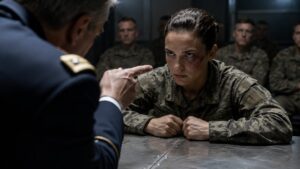
The administrative review room had no windows. Anna sat across from Timothy beneath flat fluorescent light. Rebecca occupied the end of the table with a facilities representative and the center’s compliance officer. Jeffrey sat near the door, his signed statement before him.
Between Anna and Timothy lay a clear evidence envelope holding seven wet coins.
The video ended.
Rebecca pressed pause on the final frame.
“Supervisor Harris,” the compliance officer said, “did you examine the can before completing your report?”
Timothy kept his hands folded. “I checked it for hazards.”
“Did you see the names?”
“I saw scratches.”
“Four legible surnames,” Jeffrey said.
Timothy looked at him. “You are not conducting this review.”
“No,” Jeffrey replied. “I am correcting what I failed to say yesterday.”
The compliance officer raised one hand.
Timothy faced forward again. His uniform was immaculate. Anna wondered whether he had chosen a new shirt because the previous one had been marked by rain.
“I did not consider the scratches official identification,” he said.
“That was not the question,” Rebecca replied.
A muscle moved along Timothy’s jaw.
“Yes. I saw them.”
“And Mrs. Rivera told you the money was not hers?”
“Yes.”
“Your report states she refused to explain the money.”
“She did refuse.”
“She said it was for the memorial office,” Jeffrey said.
“She gave vague, inconsistent answers.”
Anna watched Timothy assemble each defense as though building a wall from approved materials. None was entirely false. That was what made the report dangerous.
The compliance officer turned a page. “You described her as advancing aggressively.”
“She rose after a lawful instruction.”
“She was seventy-two years old, seated on wet concrete, and using the wall to stand,” Jeffrey said.
Timothy’s voice sharpened. “Age does not eliminate risk.”
“No,” Anna said. “It only made the risk easier for you to imagine in one direction.”
Everyone looked at her.
Timothy’s face colored, but he did not answer.
Rebecca opened a second file. “Why did you omit the scattered donations?”
“I documented the container being moved.”
“You kicked it.”
“I used my foot to clear an obstruction.”
“The obstruction was beside her chair.”
“She had been instructed to leave.”
The compliance officer stopped writing.
Timothy looked down at his hands. When he spoke again, his voice had changed.
“Three months ago, a man entered through that service door wearing a contractor badge copied from an online photograph. He reached the patient wing before staff challenged him. I was acting supervisor.”
Rebecca nodded. “That breach is in your performance file.”
“I was told another failure would end my assignment. Yesterday there was a donor inspection, two patient transports, and an unknown person outside a restricted entrance before opening. She would not provide identification when asked. She had a cash container. She invoked the memorial office without an appointment.”
“You had options,” the compliance officer said.
“I made a decision.”
“You made several,” Anna replied.
Timothy met her eyes.
For the first time, she saw the fear beneath his certainty. Not fear of her. Fear of being exposed as a man whose authority could fail in public.
“I thought hesitation would cost me my job,” he said.
“So you made certainty out of me.”
His gaze dropped to the evidence envelope.
Pressure explained the speed of his judgment. It did not explain the boot. It did not explain why he had called her aggressive after watching coins disappear into a drain. It did not explain the names he had seen and erased from his own account.
The compliance officer asked Anna whether she sought Timothy’s dismissal.
Timothy looked up quickly.
Anna had imagined this moment during the night. In one version, she said yes before anyone finished the question. In another, she demanded he stand outside in the rain while strangers decided what kind of person he was.
Neither version had survived morning.
“No,” she said.
Jeffrey turned toward her.
Timothy’s expression did not soften. It became wary.
“That does not mean I excuse him,” Anna continued. “And it does not mean I forgive him because he was frightened.”
“What remedy are you requesting?” the compliance officer asked.
“A truthful report first.”
Timothy leaned back. “I can amend wording.”
“Not wording. Events.”
Anna pointed to the evidence envelope.
“You will state that I identified the money as belonging to the memorial effort. You will state that the can carried four surnames. You will state that you moved it with your boot and that coins entered the drain. You will remove the claim that I advanced aggressively.”
“If the review requires those changes—”
“I require them before you ask me to discuss forgiveness.”
Timothy’s mouth closed.
Rebecca placed a printed correction form in front of him.
The room remained silent while he read it.
His pen hovered over the first line.
A facilities representative cleared his throat. “There is another issue. Maintenance inspected the storm channel this morning. The coins passed into a locked drainage trap. Several may have traveled beyond it during the overnight flow.”
“How many were recovered?” Anna asked.
“Seven from the walkway. None from the trap yet.”
“And the bench?”
“Dismantled. The frame is in storage. One support fractured during removal.”
Rebecca looked displeased. “The foreman reported surface corrosion.”
“It failed when lifted.”
Anna pictured the empty alcove, Linda’s name sealed separately in plastic, the split seat stacked against a wall.
Timothy signed the first correction.
The scratch of his pen sounded louder than the rain had.
He added the names. He added Anna’s statement about the donations. He replaced advanced aggressively with stood and objected to handling of personal property.
When he reached the description of the can, he paused.
Then he crossed out unmarked.
The compliance officer collected the amended report.
“Supervisor Harris will remain on administrative duty pending corrective review,” he said. “Training and disciplinary recommendations will follow.”
Timothy nodded once.
No apology came.
Anna had not expected one.
Rebecca opened the archive file. “Now we must decide whether the memorial review can proceed. The surviving evidence confirms five medical personnel were present during at least part of the evacuation. It does not conclusively establish the final flight sequence.”
“The photograph, fuel notes, and transcript align,” Jeffrey said.
“They align partially,” Rebecca replied. “Mrs. Rivera’s altered casualty time and the destruction of part of the debrief must also be included.”
Timothy glanced at Anna.
She felt the old instinct rise—to reveal only what was necessary, to guard Linda’s memory from people who might misuse it, to keep her own guilt outside the record.
That instinct had already cost too much.
“Not here,” Anna said.
Rebecca frowned. “Mrs. Rivera—”
“Not in this room.”
She stood and placed the dented can on the table between the amended incident report and the archive box.
“The first incomplete report happened forty-eight years ago,” she said. “Timothy’s is only the newest.”
Timothy went still.
Anna looked toward Rebecca.
“Put the bench pieces back in the memorial alcove. Bring the photograph, the fuel ledger, the transcript fragment, and my altered routing sheet. Bring Linda’s nameplate too.”
“For what purpose?” the compliance officer asked.
“A complete account.”
Rebecca studied her. “You said the recording was gone.”
“It is.”
“Then what remains to disclose?”
“The reason Linda went back.”
Jeffrey’s face changed, but he said nothing.
Anna took the can from the table. The seven recovered coins stayed behind in their clear envelope.
“I will tell it beside the bench,” she said. “And when I am finished, you may decide what the record can bear.”
Chapter 7: The Fifth Line Belonged to the Woman Who Went Back
Anna began before anyone had settled into place.
“Timothy’s report is not the first incomplete report connected to this bench.”
The dismantled frame lay on two work stands beneath the covered memorial alcove. Its broken support had been placed beside the split wooden seat. Linda’s removed nameplate rested in a clear sleeve on Rebecca’s document case.
Rain drifted beyond the open side of the alcove, lighter than the day before but persistent enough to darken the outer bricks.
Rebecca arranged the photograph, fuel ledger, transcript fragment, and enlarged routing sheet on the table. Jeffrey stood near the security line. Timothy remained several feet away in administrative uniform without his radio.
Anna set the dented can in the empty space where the plaque had been.
The sound of metal against wood made everyone look at it.
“You know I changed the casualty time,” she said. “You know I removed Linda’s recording and destroyed parts of it. Those facts belong in whatever record you make.”
Rebecca opened a notebook but did not yet write.
Anna touched the unfinished line beneath her sleeve.
“The last authorized aircraft left with fuel below reserve. Linda was aboard as flight nurse. I stayed because two patients could not be moved without bleeding out.”
She saw the landing zone as she spoke, though she kept her eyes on the bench.
One patient had shrapnel beneath his ribs. The other had lost blood faster than the field station could replace it. Anna had sent the remaining orderly toward the extraction point, then stayed beneath canvas that had begun to tear loose from its stakes.
“I believed another aircraft would come,” she said. “Command believed the position would be abandoned.”
“Were you ordered to leave?” Rebecca asked.
“Yes.”
“And you refused?”
“I delayed until refusal became the only honest word for it.”
Timothy shifted his weight.
Anna continued.
“The aircraft carrying Linda lifted at twenty-two sixteen. The fuel ledger shows the engine cycle. The official account treats that as the final departure.”
Rebecca nodded. “That is the confirmed portion.”
“It was not the final departure.”
“What happened?”
“Linda argued with the pilot.”
Jeffrey glanced toward the transcript fragment.
Anna could almost hear Linda’s voice, low and furious beneath the engines.
There are still three people down there.
The pilot had answered that there was fuel for one return only if they landed light and did not circle. Command denied permission. Linda had removed medical crates from the aircraft herself, leaving supplies on the tarmac to reduce weight.
“She told the pilot Anna Rivera had two living casualties at the field station,” Anna said. “She said if he would not return, she would find someone who would.”
“Did he agree voluntarily?” Rebecca asked.
“He agreed after Linda stood in front of the aircraft until he did.”
A small sound escaped Jeffrey, not quite laughter.
Anna looked at him. “She was not easy to command.”
“That should be in the record too,” Rebecca said.
“It should.”
The word cost less than Anna expected.
She had spent years polishing Linda into someone institutions might accept: brave, selfless, obedient except when necessity forced otherwise. The real Linda had been impatient, sharp-tongued, reckless with her own safety, and certain that regulations became cowardice when used to abandon the living.
“She came back with the aircraft at twenty-three four,” Anna said. “The landing lights were off. They touched down once and damaged the rear strut.”
Rebecca checked the fuel note. “There is a maintenance entry for the strut the next morning.”
“Yes.”
“It does not identify the flight.”
“No.”
“What happened on the ground?”
“Linda came into the field station with a litter team. We moved the first patient. The second stopped breathing before we reached the aircraft.”
“The nineteen-year-old?”
“No. He was already dead. That was the time I later changed.”
Rebecca’s pencil stopped.
Anna forced herself onward.
“The second patient was older. We regained a pulse before loading him. Linda stayed at the door while I climbed in. Then there was incoming fire beyond the perimeter.”
No one moved in the alcove.
“Linda was hit?” Jeffrey asked.
“Not then.”
Anna remembered Linda’s hand catching the frame of the aircraft, her face turned toward the abandoned field station.
“She went back for the medical bag.”
Rebecca looked at the can. “The bag containing the instruments sterilized in this?”
“Yes.”
“Why?”
“Because there were records inside. Morphine counts. Casualty tags. She said if command wanted the night erased, she would not leave it easy for them.”
The corner of Anna’s mouth tightened at the memory. It was exactly the sort of thing Linda would say when frightened.
“She reached the aircraft again,” Anna said. “She was struck before she climbed inside.”
The rain clicked against the metal gutter overhead.
“Did she die at the landing zone?” Rebecca asked.
“No. She was alive during the flight.”
Anna had once promised Linda’s mother she would say that much.
She had never promised to say the rest.
“Linda knew she would not survive,” Anna said. “She asked whether the two patients were aboard. I told her yes. Then she asked whether I was angry.”
“Angry?” Jeffrey said.
“She knew why.”
Anna pulled back her sleeve.
Four complete lines and one unfinished mark showed on her forearm.
“We made those marks after difficult evacuations. One line for each person brought out alive when command had counted them lost.”
Rebecca looked closely. “Four complete.”
“Four evacuations before that night.”
“And the fifth?”
“I started it after Linda died. Then I stopped because she was not someone we brought out alive.”
The unfinished mark trembled beneath Anna’s fingers.
“For years I told myself it belonged to Linda because I had failed to save her. That was easier than admitting what she told me.”
Rebecca’s voice softened. “What did she say?”
Anna looked at the empty cassette sleeve.
“She said, ‘Do not turn this into a debt.’”
The words entered the alcove without the static that had once surrounded them.
“She said she went back because she chose to. She said I would have gone back for her. She told me not to spend the rest of my life making her decision into my punishment.”
Jeffrey lowered his head.
Anna’s throat tightened, but her voice held.
“I destroyed that portion because every time I heard it, she took the blame away from me. I thought guilt was the only thing I still had that belonged entirely to her.”
Rebecca closed her notebook.
Timothy stared at the broken support beneath the bench.
Anna turned toward him. “Your report tried to make you innocent. Mine did too, only more carefully.”
He looked up.
“I changed the boy’s time for his mother,” Anna said. “That part is true. But keeping the change secret also protected me from questions about the final flight. Destroying the recording protected Linda from discipline after death. It also protected me from hearing that she had chosen her own actions.”
She faced Rebecca again.
“I cannot give you perfect proof. I can give you the record that survived, the record I damaged, and the truth I withheld.”
Rebecca opened the fuel ledger beside the photograph. She aligned the typed fragment with the maintenance note and the casualty-routing pages.
“The evidence supports five medical personnel present,” she said. “It supports an unplanned additional engine cycle, a damaged strut, and a final casualty movement after the authorized departure. It does not conclusively identify every person on the return aircraft.”
“Then say that.”
“The plaque cannot present disputed details as absolute fact.”
“Then do not.”
Rebecca studied Anna as though testing whether she understood the price of that answer.
“Linda’s name might appear within qualified wording, not as an officially confirmed manifest entry.”
“I did not come for a cleaner lie.”
The facilities representative stepped forward. “The original plaque can be remade. The alcove design would need revision if the bench stays.”
“The bench stays,” Anna said.
He looked toward Rebecca.
Anna placed one hand on the split seat.
“It stays for the patients who use it. Not as a ceremonial object. Repair the frame. Replace only what cannot carry weight.”
The compliance officer asked, “And your requested policy change?”
“No removal-first response for distressed visitors who present a plausible connection to the center. Verify before escalating when safety permits. Offer a place to wait. Record what was actually said.”
Timothy’s face tightened at the last sentence.
Anna looked at him. “You will recover what remains of the money.”
“The drainage trap requires maintenance access,” he said.
“Then ask maintenance.”
He nodded.
It was not an apology. It was the first unguarded acceptance she had seen from him.
Rebecca lifted Linda’s nameplate from its sleeve.
“We could state that the official surviving manifest identifies four medical personnel,” she said. “Then acknowledge credible evidence and testimony establishing the presence and service of a fifth.”
Anna waited.
Rebecca took a blank sheet and wrote slowly.
When she finished, she turned it around.
“Five medical personnel completed the evacuation; the surviving record names only four.”
Below that, in smaller wording, she had proposed listing all five names with separate notation identifying the evidentiary basis for Linda White.
Anna read the sentence twice.
It did not say Linda flew the aircraft back. It did not say she defied command, carried the records, or died after returning for Anna and two patients.
It did not pretend certainty where certainty had been damaged.
The old part of Anna wanted to reject it. Linda deserved a sentence without caution. Linda deserved every missing detail restored.
But that desire had already led Anna to guard memory like private property.
“Add that the record remains incomplete,” she said.
Rebecca wrote the words.
“And preserve the transcript fragment beside my statement.”
“I will.”
“Include what I altered.”
“Yes.”
Anna nodded.
The compromise hurt.
That was how she knew it was not another polished story.
Rebecca placed the proposed wording on the dismantled bench. Linda’s nameplate lay beside it, no longer attached unofficially and no longer hidden.
Timothy stepped closer to the can.
“I will begin with the drainage trap,” he said.
Anna looked at him.
“No speech,” she replied. “Bring back what you can.”
Chapter 8: No One Asked Anna to Sit Outside Again
Six weeks later, Anna arrived in light rain and found the service door propped open.
She stopped beneath the awning where she had once sat against the brick wall. The restricted-access sign remained. So did the curb and the iron storm drain.
But there was now a narrow bench beneath the covered walkway for visitors awaiting verification, and a printed notice beside the intercom explained how to request memorial and records assistance.
No one asked Anna to move.
Jeffrey opened the door from inside.
“You are early,” he said.
“The bus was not.”
He smiled and took neither her duffel nor her arm. He simply held the door wide enough for her to enter at her own pace.
The memorial alcove had been rebuilt without becoming new.
Facilities staff had repaired the original frame and replaced the split seat with dark wood matched to the surviving slats. Beneath a clear strip along the underside, recovered coins had been embedded in a single uneven line. Tarnished pennies sat beside bright quarters, each exactly as it had come from the drain.
The corrected plaque stood on the brick wall.
Five names appeared beneath the cautious wording Rebecca had proposed.
LINDA WHITE was not smaller than the others.
Below the plaque, inside a plain protective case, rested the dented metal can. Its scorch ring and four scratched surnames remained visible. A small archival label described it as a utility vessel used for field sterilization and later for memorial donations.
It held no money.
Anna’s duffel seemed heavier because of what remained inside.
There was no ceremony. Three visiting veterans sat at the far end of the alcove. Two recovery-center patients spoke quietly near the entrance. The facilities foreman checked a bolt, then left without introducing himself.
Rebecca approached with an archive receipt.
“The statement, routing copies, photograph, scarf, and transcript fragment have been accessioned,” she said. “The record distinguishes confirmed documentation, credible testimony, and unresolved details.”
“And the altered time?”
“Included.”
Anna nodded.
Rebecca looked toward the duffel. “The cassette sleeve?”
Anna had kept it.
For six weeks, it had rested in the drawer beside her bed. Each morning she had told herself she would surrender it when the corrected plaque was installed. Each evening she had found another reason to wait.
She opened the duffel.
The sleeve lay wrapped in Linda’s flight scarf.
Anna removed it but did not extend her hand.
Rebecca waited without reaching.
Across the alcove, Timothy stood beside the repaired bench wearing work clothes rather than a security uniform. His corrective review had left him employed, reassigned temporarily, and required to complete retraining before returning to supervisory duty.
He carried something between his fingers.
He approached Anna and opened his palm.
A quarter lay there, dark at one edge.
“The last one,” he said.
Anna looked at it.
“Where?”
“Wedged behind the second trap gate. Maintenance found it after the first cleaning. I went back when the water level dropped.”
No apology followed.
He had amended the report. He had worked with the maintenance worker inside the drainage channel. He had spent two Saturdays helping rebuild the bench seat after facilities discovered the fractured support could be reinforced instead of discarded.
Anna took the quarter.
“Did you count them all?”
“Yes.”
“Were they enough?”
“The recovered money, the sealed envelopes, and staff donations covered the repair.”
She glanced at him. “Staff donations?”
“Anonymous.”
“Nothing is anonymous in a small building.”
A faint, uncomfortable smile crossed his face and disappeared.
Anna turned toward the can beneath the plaque.
Rebecca unlocked the case.
Anna placed the final quarter inside. It struck the scorched bottom with the same lonely note she remembered from the dismantled alcove, but this time it did not sound abandoned.
Timothy stepped back.
“I should have verified before I decided who you were,” he said.
Anna looked at him.
The sentence was plain. It asked for nothing.
“Yes,” she replied.
He accepted that answer.
Anna held the cassette sleeve against her palm. The cardboard had softened at its corners from years of handling. Her signature remained on the chain-of-custody line, proof of removal and proof of return.
She offered it to Rebecca.
“Do not hide what is missing,” Anna said.
“I won’t.”
“And do not make Linda obedient in the summary.”
Rebecca almost smiled. “The statement makes that impossible.”
She placed the sleeve in an archival folder.
Anna folded Linda’s scarf and surrendered that too.
When the duffel closed, nothing remained inside except the wax paper that had protected the routing sheets from rain.
She sat on the restored bench.
The wood held her weight without shifting.
One of the recovery-center patients took the other end. He did not ask who she was. He leaned forward with his hands clasped and watched rain gather along the alcove edge.
Anna rested her empty duffel beside her shoes.
Later that afternoon, in a small room above the church kitchen, she cleaned the skin of her left forearm. Her hand was not steady, so she waited until it was.
The fifth line required only a short stroke.
She completed it to match the other four.
Not because Linda had been saved.
Not because Anna had repaid her.
Because Linda had gone back by choice, and because a life remembered honestly did not need Anna’s guilt to make it matter.
The mark was small. It did not correct the past. It did not make the surviving record whole.
It finished what Anna had once been too afraid to finish.
Before dusk, she returned through the same gate to deliver one final signed archive page. The service door opened when she pressed the intercom.
She left carrying the empty duffel.
Behind her, the dented can remained beneath the corrected plaque, and all five names stayed on the wall.
The story has ended.