They Broke the Medal at Security, but Not the Promise He Carried Home
Chapter 1: The Moment the Old Clasp Snapped
“Why are you carrying loose metal through security?”
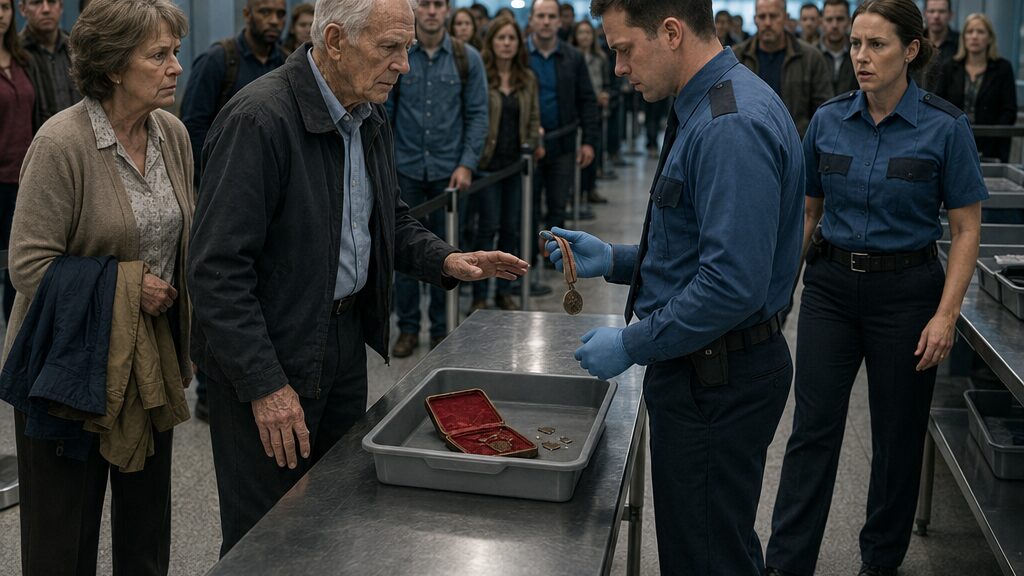
The officer held the medal by its ribbon above a gray plastic tray.
George Adams watched it turn slowly beneath the white checkpoint lights. The metal had darkened unevenly with age. One edge caught the light; the rest remained dull, as if it had carried dust inside its surface for fifty years.
“It isn’t loose,” George said. “It belongs in that case.”
The red-lined presentation case sat open beside his wallet and belt. Its velvet had faded almost brown along the hinge. A shallow impression marked the place where the medal had rested.
The officer glanced at the case, then at George. He was young enough that his uniform still looked new at the seams. His badge read WRIGHT.
“Sir, I need to inspect it.”
“You can inspect it,” George said. “Just don’t pull the clasp.”
Behind him, bins struck rollers. Shoes squeaked against the floor. A child cried because his stuffed bear had gone through the scanner without him. Farther back, an impatient business traveler checked his watch and released a long breath meant to be heard.
Carolyn stood beside George in her socks, holding both their jackets over one arm.
“He told you it’s fragile,” she said.
Officer Wright’s mouth tightened. “Ma’am, I heard him.”
George could see the line building behind them. A supervisor at the adjacent lane lifted two fingers toward Wright, signaling him to move things along.
Wright examined the medal’s upper bar. “This part opens?”
“No.”
“It looks hinged.”
“It was repaired years ago.”
Wright turned it over. His thumb found the small attachment beneath the ribbon.
George’s right hand rose from the edge of the inspection table.
For one second, he saw exactly what he would have to do to stop him: close his fingers around the young man’s wrist, pull the medal free, accept the alarm that would follow. He saw the nearby officers turn. He saw Carolyn pushed back. He saw himself, an old man without shoes, pinned beside a conveyor belt.
His hand stopped between them.
“Please,” he said. “Don’t pull that.”
Wright looked at George’s raised hand, not at his face.
“Let me handle it.”
The words were ordinary. The tone was not cruel. That made them worse.
Wright pressed his thumbnail beneath the clasp and tugged.
The first sound was small—a dry click, no louder than a shirt button striking a floor.
Then the lower ring split.
The medal dropped against the tray. A narrow metal piece jumped once and disappeared beneath George’s wallet. The ribbon remained in Wright’s hand.
Nobody spoke.
The business traveler behind them stopped sighing.
George lowered his hand.
Wright stared at the empty ribbon hanging from his fingers. “I—”
“May I have the rest of it?” George asked.
Wright placed the ribbon in the tray with great care, as if gentleness applied afterward could travel backward.
George reached for the medal. His fingers did not close properly on the first attempt. The tremor had been slight that morning, barely enough for Carolyn to notice while he buttoned his shirt. Now the star-shaped piece clicked against the plastic when he lifted it.
Carolyn set the jackets down.
“What did you do?” she asked.
“Ma’am, the attachment failed during inspection.”
“It failed because you pulled it.”
“I followed procedure.”
“You were warned.”
A supervisor approached from the next lane. Her name badge read CAMPBELL. Her expression held the controlled urgency of someone who had already noticed the stalled line, the watching passengers, and the officer’s face.
“What happened?”
Wright held up the separated ribbon. “An item came apart during examination.”
“An item?” Carolyn said. “You call that an item?”
George moved his wallet aside. The missing fragment lay beneath it, curved and dark, no larger than a fingernail. He picked it up and placed it beside the medal.
Three pieces now rested in the tray: ribbon, body, broken ring.
The supervisor looked at George. “Sir, we can document any damage after you clear screening.”
“Our flight boards in thirty-five minutes,” Carolyn said.
“We’ll try to make this efficient.”
George touched the inside of the presentation case. The velvet near the lower edge had lifted. When the medal fell, one broken point must have caught the lining and torn it away from the base.
Something pale showed beneath it.
He pressed the velvet down.
Carolyn saw the movement. “What is that?”
“Nothing.”
The supervisor extended a clear evidence pouch. “We need to secure the pieces until the incident report is initiated.”
George closed the case, but the warped hinge resisted. He pressed harder. The lid shut with a soft snap that sounded too much like the clasp breaking.
Wright reached toward it.
George placed his palm over the case.
This time he did not move his hand away.
“I’ll put it in the bag,” he said.
Wright stepped back.
George slid the case into the pouch himself. The supervisor sealed it, flattening the soft red lid under clear plastic. She wrote a number across the white strip at the top.
Carolyn leaned close to George. “Was that paper under the lining?”
“We need to get through the checkpoint.”
“You said the case was empty except for the medal.”
“It is.”
“I saw something.”
The supervisor gestured toward a bench beyond the screening lanes. “Please collect your belongings and wait there. Someone will escort you to the incident office.”
The line began moving again around them.
Passengers avoided George’s eyes with the awkwardness of people who had witnessed harm but did not know what responsibility came with witnessing it. The mother with two children gave him a brief, helpless look before following her bins.
George sat on the bench to put on his shoes.
His hands had treated wounds under canvas, in dust, under rain that turned the ground red and slick. They had tied arteries, pressed gauze into places no hand should enter, and written names on tags when there was no time for anything else. Now they struggled with a shoelace.
Carolyn knelt and tied it before he could stop her.
“I can do that.”
“I know.”
Her voice had gone quiet, which meant her anger had found a deeper place.
The evidence pouch lay between them. Through the plastic, the red case looked sealed away from him, confiscated from its own history.
A corner of yellowed paper had pushed through the torn lining and the imperfectly closed lid.
Carolyn lifted the pouch.
There was handwriting on the exposed corner. The ink had faded to a thin blue-gray, but one word remained clear.
Betty.
Carolyn looked at George.
He kept his gaze on the moving conveyor belt.
“Why is Betty’s name inside that case?”
“Carolyn.”
“You told me there was nothing else in it.”
Around them, bins continued to strike the rollers, one after another, each collision sharp and hollow.
Carolyn held the pouch between both hands.
“What else have you been carrying?”
Chapter 2: The Flight He Almost Let Leave
“How much would you say the medal is worth?”
Amy Campbell asked the question from behind a desk in a windowless airport office.
The evidence pouch lay beneath the fluorescent light. Its sealed edge covered part of the red case, and the broken medal pieces had shifted into one corner like loose change.
George looked at Amy.
“In dollars,” she added.
Carolyn gave a short, disbelieving laugh.
Amy folded her hands. “I understand that sentimental value may be involved. The form requires an estimated replacement value.”
“It can’t be replaced,” George said.
“Then an approximate market value.”
“It isn’t mine to sell.”
Amy’s pen paused. “The officer’s report identifies you as the owner.”
“The officer’s report is wrong.”
George saw Brian Wright through the narrow window in the office door. He stood at the end of the corridor speaking to another uniformed employee. His face was stiff, his hands clasped behind his back.
Amy turned the form toward George. “We can amend ownership later. For now, we need enough information to process the claim.”
Carolyn leaned over the desk. “Your officer ignored a direct warning, broke it, and now you want George to price it like damaged luggage.”
“I want to create a record that allows the airport to respond.”
“You already have a record. There are cameras everywhere.”
“Carolyn,” George said.
She sat back, but only because he had said her name.
Amy’s expression softened by a degree. “The airline has moved you to the four-ten departure. They’ve waived the change fee and offered meal vouchers.”
“That solves the travel problem,” George said.
Carolyn turned toward him. “No, it doesn’t.”
Amy slid a printed incident statement across the desk.
George read slowly.
During inspection, decorative metal item separated at preexisting weak point. Passenger became concerned. All components recovered. No injury reported.
He read it again.
There was nothing about his warning.
Nothing about Brian saying he would handle it.
Nothing about George raising his hand and lowering it because he understood how quickly an old man could become a threat in the wrong room.
“Is this Officer Wright’s statement?” he asked.
“It is the preliminary summary.”
“He heard me tell him not to pull the clasp.”
Amy glanced toward the door. “The video will be reviewed.”
“Does the video have sound?”
“No.”
Carolyn pushed the page back. “Then his words matter.”
“Everyone’s words matter.”
“That sentence is doing a lot of work for you.”
Amy’s jaw tightened, but her voice remained level. “Mrs. Moore, I am trying to keep this from becoming more difficult than necessary.”
“It became difficult when he broke it.”
George put one hand over Carolyn’s.
“We’re done,” he said.
Amy looked surprised. “You haven’t signed.”
“I don’t need compensation.”
“George,” Carolyn said.
He stood. His knees resisted after the long wait. “Thank you for arranging the later flight.”
Outside the office, the terminal’s glass walls flooded the concourse with afternoon light. An aircraft pulled away from a nearby gate. Its white tail passed slowly across the windows.
Their original flight.
Carolyn stopped beside a row of metal seats.
“You’re not getting away with that.”
“With what?”
“Pretending you ended that meeting because you’re above arguing.”
“I ended it because we have another flight.”
“No. You ended it because the broken medal gives you an excuse.”
George looked toward the departure board. Their new gate had not yet been assigned.
“We should go home,” he said.
Carolyn stared at him.
“The case is damaged. The medal needs repair. We can reschedule.”
“Betty has already driven six hours.”
“She can drive back.”
“She booked a room near the community center. She took time off work. Her son rearranged his schedule.”
George picked up his carry-on.
Carolyn did not move. “This is the third time.”
“Not here.”
“You canceled in March because your blood pressure was high. You canceled in May because the car made a noise. Now an airport officer breaks the medal, and suddenly the whole trip is impossible.”
“It isn’t the right condition to give it to her.”
“It was never going to arrive in the right condition, George. Neither were you.”
People moved around them, dragging suitcases, carrying coffees, arguing into phones. Nobody paid attention now. The public moment had ended, but Carolyn’s anger had not.
George looked at the sealed pouch.
The broken medal had slid against the clear plastic. Beneath the red lid, the corner of the hidden paper remained visible.
“It should be repaired first,” he said.
Carolyn’s eyes followed his.
“Is that what you’ve been telling yourself about the letter?”
He did not answer.
A gate agent approached and confirmed their rebooking. She handed Carolyn two boarding passes and apologized with the practiced sympathy of someone assigned to a problem she had not caused.
When she left, George said, “We can still cancel.”
Carolyn folded the boarding passes into her purse. “You can. I’m going.”
“To meet a woman you don’t know?”
“I know she has been waiting longer than either of us has a right to ask.”
George turned toward the windows.
Carolyn picked up his dark travel wallet from the seat where he had left it. The leather flap had not closed properly. A folded printout protruded from the inner pocket.
She pulled it free.
George reached for it too late.
It was an email, printed three weeks earlier.
Mr. Adams, I received your message about bringing my father’s things. I will meet you whenever you are ready. Please do not disappear again without telling me why.
Below it were two earlier messages in the same thread.
Carolyn read the dates.
“You said she never answered.”
George watched a baggage vehicle cross the concrete below.
“You stood in our kitchen,” Carolyn said, “and told me she had not answered.”
“I didn’t say that.”
“You said there was no reply.”
“That isn’t the same thing.”
Her face changed—not into outrage, but into something quieter and more injured.
“You made me help you cancel on a woman who was waiting for her father’s things.”
“I was going to explain.”
“When?”
He had no answer that would survive being spoken.
Carolyn folded the pages carefully, aligning the creases. Then she placed them on top of the sealed evidence pouch.
“Your officer left one warning out of his report,” she said. “You’ve left whole years out of yours.”
Chapter 3: The Name Beneath the Torn Lining
The strip of yellowed paper slid from under the velvet and landed face down on the hotel carpet.
George bent for it.
Carolyn’s hand reached it first.
“Don’t,” he said.
She stayed crouched beside the low table, the damaged presentation case open between them. The airport had released it after photographing every piece. The medal lay in three sections on a folded white towel provided by the hotel desk clerk.
Carolyn turned the paper over.
It was not a strip. It was the corner of an envelope, folded twice to fit beneath the lining. The rest remained trapped inside the base of the case.
Across the visible portion, in faded handwriting, were the words:
For Betty, when she is old enough—
Carolyn looked up.
“Old enough for what?”
George sat on the edge of the bed. His jacket hung over the chair, his light-blue shirt wrinkled from travel and waiting. He had carried the case into the room as though it contained something injured, then placed it on the table and refused to touch it.
“Put it back.”
“The lining is torn.”
“Then leave it.”
“You hid a letter beneath it.”
“I didn’t hide it.”
Carolyn touched the velvet where the glue had dried and cracked. “It did not crawl under there by itself.”
George looked toward the hotel window. Their room faced the airport access road. Shuttle buses moved through the dusk, their brakes sighing at the curb below.
“Joseph’s mother put it there,” he said.
The name entered the room without force, but Carolyn went still.
“Joseph King?”
George nodded.
She had heard the name before, though never in a complete story. Joseph had appeared in fragments over forty-three years of marriage: a joke about powdered coffee, a complaint about wet socks, a memory of someone singing off-key while cleaning equipment. George spoke of him the way people mentioned a town they had once lived in but could never visit again.
Carolyn sat opposite him.
“The medal was his.”
“Yes.”
“And Betty is his daughter.”
“Yes.”
“Then why did you let me believe we were taking it to a museum?”
“I said the community center had a display room.”
“You said they might want it.”
“They might.”
“George.”
He rubbed his thumb across the side of his forefinger, an old habit that appeared when his hands wanted work.
“Joseph’s mother gave me the case after I came home,” he said. “She kept it at first. Then she got sick. Betty was young, and there were family problems. Moves. A divorce. I was supposed to hold it until things settled.”
“How young was Betty?”
“Eight.”
Carolyn looked at the envelope.
“She is fifty-eight.”
“I know how old she is.”
“Do you?”
The question landed harder than if she had raised her voice.
George stood and walked to the table. He reached for the case, but Carolyn placed her palm on the loose velvet.
“No.”
“It belongs closed.”
“It belongs to Betty.”
“You don’t know what’s in there.”
“That is exactly the problem.”
George’s shoulders tightened.
Carolyn studied him. “Did Joseph write it?”
“Yes.”
“Did you read it?”
“No.”
She looked again at the envelope, then at him. “It is still sealed?”
“I believe so.”
“You believe so?”
“I never opened it.”
Carolyn lifted the velvet carefully. The old adhesive released with a faint ripping sound. George flinched.
More of the envelope emerged. Its paper had darkened along the edges, but the flap remained sealed. Joseph King’s name was written in the upper left corner in block letters. No formal rank. No unit. Just a man’s name.
Carolyn held it without unfolding it.
“How did he give this to you?”
George looked at the three medal pieces on the towel.
“He was with me when he died.”
The hotel room seemed to contract around the sentence.
Carolyn lowered herself into the chair.
“You never told me that.”
“I told you we served together.”
“You told me he didn’t come home.”
“That was true.”
“That is not the same as this.”
George picked up the broken ring from the towel. It weighed almost nothing.
“There was an attack,” he said. “He was brought to where I was working. I treated him.”
Carolyn waited.
George put the ring down.
“He died.”
“While you were treating him?”
“Yes.”
The answer was too clean. Carolyn heard it.
“What are you leaving out?”
His face closed.
She had watched that closing for years: when news showed a field hospital, when fireworks sounded too close, when a doctor asked about sleep and George changed the subject to blood pressure. She had once mistaken it for strength. Later she called it privacy. Only now did she see the cost of always accepting the locked door.
“His mother gave you the medal,” she said. “You kept the letter. You kept both from his daughter. And every time she agreed to meet, you found a reason not to go.”
“I was protecting her.”
“From her father’s words?”
“From what came with them.”
“You mean from you.”
George’s head lifted.
Carolyn’s anger softened, but she did not withdraw the words.
“You have spent half a century deciding what everyone else can survive.”
The hotel phone rang.
Neither moved.
It rang again.
Carolyn glanced at the display. “Front desk?”
George’s cell phone began vibrating on the table at the same time.
The name on the screen was BETTY HERNANDEZ.
He stared at it until the vibration stopped.
A second later, it began again.
Carolyn held the phone out to him.
“You answer.”
“I don’t know what to say.”
“Start with the truth.”
George took the phone. His thumb hovered above the screen. For a moment Carolyn thought he would let it stop again.
Then he accepted the call.
“Hello?”
A woman’s voice came through, low and steady. “Mr. Adams?”
“Yes.”
“This is Betty Hernandez.”
“I know.”
“I heard there was trouble at the airport.”
George looked at the broken medal.
“The clasp was damaged.”
“The clasp.”
“Yes.”
A pause followed.
“Are you still coming?”
George looked toward Carolyn. She did not nod or prompt him.
“Our flight was moved,” he said.
“That wasn’t my question.”
His fingers tightened around the phone.
Betty continued. “I’ve waited through three cancellations. I can wait through a delayed flight. I cannot keep waiting through silence.”
George sat down.
“There are things I should explain.”
“I know.”
“You may not want to hear them.”
“That is for me to decide.”
He closed his eyes.
Betty’s voice changed—not gentler, but less guarded.
“I know you were with my father when he died, Mr. Adams.”
George opened his eyes.
Across the table, Carolyn held Joseph’s sealed letter between both hands.
Betty said, “That isn’t the question I need answered.”
Chapter 4: The Report That Left Out One Warning
Brian watched the silent footage for the fourth time.
On the monitor, George Adams raised one hand toward him. The movement looked uncertain without sound, almost apologetic. Brian appeared calm, focused, professional. He examined the medal, turned it beneath the checkpoint lights, and pulled at the clasp.
The metal separated.
George’s hand dropped.
From the camera’s high angle, nothing showed the warning that had come first.
“Don’t pull that.”
Brian could hear the words anyway.
Amy Campbell stood behind him with a paper cup of coffee. “The review team has the same recording.”
“They can’t hear him.”
“No.”
“They’ll think I didn’t know.”
Amy set the cup on the desk. “The report says the item separated at a preexisting weak point. That is accurate.”
“It leaves something out.”
“It is preliminary.”
Brian paused the video on George’s lowered hand. The old man’s face was partly obscured by the camera angle, but Brian remembered it clearly. Not anger. Not confusion. Recognition—the look of someone who had seen damage coming and understood he could not prevent it.
“I heard him,” Brian said.
Amy drew a chair closer but did not sit. “You had a line backing up. You were handling an unusual object. You made a judgment call.”
“I pulled after he told me not to.”
“He also attempted to interrupt the inspection.”
“He raised his hand.”
“That is an interruption.”
Brian turned from the monitor. “He didn’t touch me.”
“No one said he did.”
The distinction sounded prepared.
Brian had been on probation since failing an internal test six weeks earlier. A training officer had hidden a prohibited blade inside a hollowed grooming kit. Brian had cleared it. Nobody had been hurt, but the failure had followed him into every shift briefing. Be thorough. Do not allow passenger pressure to compromise procedure. Hesitation creates vulnerability.
Yesterday, George’s warning had felt like pressure. The line, Amy’s signal, Carolyn’s anger, the old man’s hovering hand—all of it had narrowed into one thought: do not look uncertain again.
Amy picked up her coffee.
“If you revise the statement,” she said, “you create a problem that compensation can solve.”
Brian stared at her.
“The property claim is already being handled. They were rebooked. There were no injuries.”
“It wasn’t just property.”
“That is not our determination to make.”
His phone vibrated on the desk.
A message from his wife showed a photograph of their daughter holding a cereal spoon upside down. Beneath it: Daycare payment went through. We’re short again.
Brian turned the screen facedown.
Amy noticed but said nothing.
“What happens if I correct it?” he asked.
“There will be another interview. Your probation may be extended. They could remove you from passenger screening pending review.”
“And if I don’t?”
Amy’s expression hardened. “Then the existing report remains the existing report.”
Brian looked back at the frozen image of George’s hand.
At the hotel breakfast area, George discovered that strangers had begun deciding what had happened to him.
Carolyn placed her phone beside his untouched oatmeal. A vertical video filled the screen. It began with Brian holding the medal over the tray and ended just after the clasp snapped. Someone had added large white words across the top:
SECURITY BREAKS ELDERLY VETERAN’S MEDAL.
The video had no sound except terminal noise and the person filming whispering, “Oh my God.”
Comments slid beneath it faster than George could read.
Fire him.
That old man should sue.
No respect anymore.
What medal is it?
Bet he was a war hero.
George pushed the phone away.
“It has seventy thousand views,” Carolyn said.
“Then seventy thousand people know nothing.”
“They know he broke it.”
“They think they know why it mattered.”
Carolyn sat opposite him. Joseph’s sealed letter rested inside her purse. George had not asked for it back.
“The airport called while you were getting coffee,” she said. “They want to make a public apology.”
“No.”
“They suggested a statement and a photograph.”
“No.”
“They also offered to have the medal evaluated.”
George stirred oatmeal he had no intention of eating. “We’ll find someone ourselves.”
Carolyn studied him. “You could use the attention to make them tell the truth.”
“Whose truth?”
“Yours.”
“It isn’t theirs to put on a podium.”
A television above the breakfast counter showed airport traffic and local news. George kept expecting to see the video appear there, the moment of his helplessness enlarged above people eating toast.
Carolyn picked up her phone.
“You don’t have to let them use you,” she said. “But silence lets everyone else write the story.”
George looked at her. “You think I don’t know that?”
“I think you know it better than anyone.”
The words brought Betty’s voice back to him.
That isn’t the question I need answered.
He had asked what question she meant. Betty had said she would ask him face-to-face. Then she had ended the call before he could retreat into logistics.
Carolyn softened. “We have the new flight at noon.”
“I know.”
“Are you getting on it?”
George looked through the hotel windows toward the terminal. Aircraft tails moved above the parking structure.
“Yes.”
Carolyn’s relief was small and guarded.
His phone rang.
Amy Campbell’s name appeared on the screen.
George answered.
“Mr. Adams,” she said, “I’m calling because the officer involved has submitted an amended statement.”
George listened without speaking.
“He now states that you warned him the attachment was fragile before he manipulated it.”
Across the table, Carolyn watched his face.
Amy continued, “That correction may require us to reopen parts of the incident review. It may also increase public interest, given the video circulating online.”
“Public interest,” George repeated.
“We would like to coordinate any response.”
“I don’t have a response.”
“Sir, the officer’s correction supports your account.”
“My account was true before he supported it.”
Amy fell silent.
George looked at Carolyn’s phone, where the video had looped back to his raised hand.
“Tell Officer Wright I received the correction,” he said.
“Would you like him to contact you?”
“No.”
He ended the call.
Carolyn waited. “Well?”
“He admitted I warned him.”
“That matters.”
“It matters to his report.”
“It matters that he chose to say it.”
George looked again at the frozen image of himself, an old man with one hand suspended between intervention and surrender.
Somewhere in the airport offices, Brian Wright had finally refused the safer version of the truth.
George wondered whether telling the truth would make either of them more exposed than silence had.
Chapter 5: What George Chose in the Dust
The medal fragments struck plastic in George’s sleep.
Click.
Click.
Click.
He opened his eyes to the hotel room, but for several seconds he smelled dust, hot canvas, and the sharp medicinal sting of iodine.
Carolyn sat near the window, already dressed. Joseph’s unopened letter lay on the table beside the damaged red case.
“You were saying his name,” she said.
George pushed himself upright. His shirt clung damply to his back.
“What time is it?”
“Three in the afternoon.”
They had taken the noon flight, landed, rented a car, and reached the hotel near the veterans’ community center. George remembered each step as a sequence of tickets, doors, and instructions. He did not remember falling asleep.
Carolyn poured water into a paper cup.
“Betty called,” she said. “She moved the meeting to tomorrow morning.”
George drank. His hand shook against the rim.
“You told her about the letter?”
“I told her we found something in the case. I did not tell her what it was.”
“You shouldn’t have said anything.”
Carolyn set the cup down harder than necessary.
“There. That is exactly what you do.”
“What?”
“You decide the truth is dangerous, then appoint yourself its guard.”
George swung his feet to the floor.
“She has lived with this for fifty years.”
“So have you.”
“That doesn’t mean she should carry what I carry.”
“No. It means she should carry what belongs to her.”
The red case was open. Without the medal in its fitted place, the velvet hollow resembled a shallow tray. George looked away, but the room had already shifted.
Canvas walls snapped in hot wind.
Someone shouted for plasma that was not there.
Three wounded men had been brought in within minutes of one another, all bleeding, all young. Joseph came last, laid on a litter by two soldiers whose sleeves were dark to the elbows.
George had known before he touched him.
He had still worked.
“You said he was conscious,” Carolyn said.
George’s eyes returned to the hotel room.
“When?”
“Last night. You said Joseph spoke to you.”
George pressed both palms against his knees.
“What did he say?”
“Carolyn.”
“What did he say?”
The question was not gentle, but neither was it cruel. She had reached the point where gentleness would become cooperation with his silence.
George looked at the empty shape in the case.
“There were four of them,” he said.
Carolyn waited.
“Joseph and three others. One had a chest wound but was breathing. One had lost most of his lower leg. One had abdominal bleeding. Joseph had shrapnel through the side and back.”
His voice became flatter as he spoke, the old clinical language arranging itself between him and the memory.
“I stopped the chest wound first. Joseph was conscious. He kept asking how many.”
“How many what?”
“How many others.”
George rubbed his thumb against his forefinger.
“I told him three.”
The wind had pushed dust beneath the canvas. It settled on wet skin, instruments, bandages. Joseph’s face had looked gray under it.
George had pressed both hands against the dressing at Joseph’s side.
Joseph had watched him for a moment.
Then he said, Go.
Not loudly. There had been no strength for that.
George had pretended not to hear.
Joseph caught his sleeve.
They can wait, George had said.
No, Joseph answered. They can’t.
In the hotel room, Carolyn pulled the chair closer but did not touch him.
“I left him,” George said.
“You went to the others.”
“I left him.”
“Because he told you to?”
“Because I knew he was right.”
The first soldier’s lung had expanded after George sealed the wound. The second had lived because George controlled the bleeding before the evacuation helicopter came. The third survived surgery.
Joseph died before George returned to his litter.
“That is the part everyone likes,” George said. “Three men lived. It makes the choice neat.”
“Was it neat?”
“No.”
“Was there another medic?”
“Not close enough.”
“Could Joseph have survived if you stayed?”
George’s jaw tightened. “That isn’t a question anyone can answer.”
“But you answered it for yourself.”
He looked at her.
“For fifty years,” Carolyn said, “you answered it the same way.”
George stood and crossed to the window. Below, cars entered and left the hotel lot. Ordinary people carried bags, checked phones, argued over directions.
“His mother asked me how he died,” he said. “I told her I was with him.”
“That was true.”
“I told her he wasn’t alone.”
“Was that true?”
George’s reflection in the glass looked older than the man who had raised his hand at the checkpoint.
“When he died, no.”
Carolyn closed her eyes briefly.
“I went back,” he said. “But he was already gone.”
The dust returned in flashes: Joseph’s unmoving hand, the letter tucked inside his shirt, the medal later gathered with the rest of his effects.
“What did his mother say?”
“She thanked me for staying with him.”
“And you never corrected her.”
“No.”
The word entered the silence and remained there.
Carolyn looked at the sealed envelope.
“Is that why you never opened it?”
George did not answer.
“George.”
“I thought he might have written about me.”
“What about you?”
“That I left.”
Carolyn lifted the letter but kept it on her open palm.
“You were afraid he blamed you.”
“I didn’t know.”
“So you kept his daughter from reading it.”
“She was eight.”
“She stopped being eight.”
“Her mother moved them. We lost contact.”
“And when you found her?”
George stared through the window.
The first time had been twelve years earlier. An obituary for Joseph’s sister had led him to Betty’s married name. He had written a letter, then left it unmailed.
The second time, Carolyn found an address through a veterans’ association. George telephoned and hung up before anyone answered.
Three years ago, Betty contacted him herself.
Each time, he told himself the delay was temporary.
“I thought I needed to explain first,” he said.
“You did not explain.”
“I tried.”
“No. You rehearsed. You planned. You postponed. That is not trying.”
Her voice broke on the final word, and that hurt more than anger.
George turned.
Carolyn had spent decades waking beside him when his breathing changed, accepting the names he never explained, moving carefully around locked rooms inside a marriage she had believed was open.
“I was protecting her,” he said, but the sentence sounded weak now.
Carolyn shook her head.
“You were protecting the version of yourself that never had to hear what she thought.”
George sat again.
The letter lay between them.
It had survived sweat, war, a journey home, Joseph’s grieving mother, moves, storage boxes, heat, cold, and half a century beneath red velvet. The airport officer’s careless hand had done what George never could. It had exposed it.
Carolyn picked it up.
She did not offer it immediately.
“Betty may hate you,” she said.
“I know.”
“She may forgive you. She may do neither.”
He nodded.
“She may read this and discover Joseph blamed you.”
George’s breathing stopped for a beat.
Carolyn’s eyes stayed on his.
“And if he did, that truth still belongs to her.”
She extended the envelope.
George’s hand rose, then hovered above it.
At the checkpoint, he had lowered that hand because touching the officer would have made everything worse. Here, lowering it would only continue what he had already done.
His fingers closed around the letter.
The paper was lighter than the broken ring and heavier than anything he had carried through the airport.
Carolyn released it.
“Betty decides whether it is opened,” she said. “Not you.”
Chapter 6: Betty Refused the Easy Version
Betty Hernandez did not touch the medal.
George placed the damaged red case on the folding table between them. The three separated pieces rested inside, each wrapped in white tissue. Joseph’s sealed letter lay beneath George’s right hand.
Betty looked at the case, then at him.
“Which part were you planning to leave out this time?”
The veterans’ community center had given them a small meeting room away from the display hall. A coffeemaker hummed on a side table. Through the wall came the faint scrape of chairs being arranged for an afternoon gathering.
Carolyn sat beside George. Betty’s adult son waited in the courtyard at her request.
“I wasn’t planning to leave anything out,” George said.
Betty’s expression did not change.
Carolyn shifted forward. “He—”
“Let me handle it,” George said.
The phrase stopped all three of them.
Carolyn studied him, then leaned back.
George removed his hand from the letter.
“The medal belonged to your father,” he began. “Your grandmother gave it to me after I came home. She asked me to keep it safe until you were old enough.”
“I know that part.”
“You do?”
“She told my mother there was a box. She never said who had it.”
George looked down at the torn lining.
“I should have found you sooner.”
“You did find me sooner.”
He met her eyes.
“Twelve years ago,” Betty said. “You called my aunt. She gave you my address.”
George said nothing.
“Then three years ago, I found you. So let’s not make this a story about lost addresses.”
Carolyn’s hand tightened in her lap.
George nodded once. “All right.”
Betty pointed toward the letter. “Is that his?”
“Yes.”
“Unopened?”
“Yes.”
Her eyes closed briefly. When she opened them, anger had sharpened the grief rather than replaced it.
“You had my father’s last letter for fifty years.”
“I was afraid of what it said.”
“To you?”
“Yes.”
“And because you were afraid, I was not allowed to read it.”
George could have told her about Joseph’s mother, the moves, the years without contact. Each fact was true. Together, they would have formed another wall.
“Yes,” he said.
Betty looked toward Carolyn, perhaps expecting correction or defense. Carolyn offered neither.
“What happened?” Betty asked.
George drew a breath.
“Your father was brought to our aid station after an attack. He had wounds to his side and back. Three other men arrived close to the same time.”
“Was he conscious?”
“Yes.”
“Did he know he was dying?”
“I don’t know what he knew. He knew he was badly hurt.”
“Were you treating him?”
“Yes.”
Betty waited.
George felt the old instinct to use medical terms, to make the scene precise enough that precision would replace confession.
He resisted it.
“I left him,” he said.
Carolyn’s gaze remained on him.
George continued. “The other three had injuries I believed I could treat. Your father told me to go to them. I went.”
Betty’s face tightened, but not with surprise.
“He told you?”
“Yes.”
“Those exact words?”
“He asked how many others there were. I told him three. He said, ‘Go.’ I told him they could wait. He said they couldn’t.”
“And you saved them.”
“Three men survived.”
Betty’s mouth pressed into a thin line.
George did not say because of me.
“When did my father die?”
“Before I got back.”
“Was anyone with him?”
“No.”
The coffeemaker clicked off.
Betty lowered her eyes to the case. “That is what you told my grandmother differently.”
“Yes.”
“You told her he wasn’t alone.”
“Yes.”
“Why?”
“She was standing in her kitchen holding his picture. I could not tell her I had walked away.”
“You did not walk away.”
“I left.”
“To treat wounded men after he told you to.”
George’s voice hardened despite himself. “That does not change where I was when he died.”
Betty leaned forward.
“You think I brought you here to decide whether you were a hero or a coward?”
George did not answer.
“I already knew he told you to help the others.”
The words struck him more cleanly than accusation.
“How?”
“My grandmother recorded part of your first visit.”
George stared at her.
“She had a little tape recorder. She recorded family calls, birthdays, anything she was afraid of forgetting. It was running in the kitchen. You told her Joseph kept saying there were others.”
“I don’t remember that.”
“You were crying. She asked if he suffered. You said he told you to go.”
George’s hands went cold.
Betty’s voice trembled now, though she kept it controlled.
“I have known since I was twenty-seven that you made a battlefield choice. I have known since I was twenty-seven that my father told you to make it.”
“Then what did you need from me?”
“The rest.”
She tapped one finger against the table beside the case.
“I needed you to tell me what his voice sounded like. Whether he knew you heard him. Whether he was afraid. I needed the letter he wrote to me. I needed you to stop treating me like the eight-year-old girl my grandmother was trying to protect.”
George looked at the envelope beneath his hand.
Betty continued. “Do you understand? The wound was not that I did not know how he died. The wound was that you decided I could not be trusted with him.”
George’s first response rose automatically: I was trying to spare you.
He let it die before it reached his mouth.
“I was ashamed,” he said.
Betty waited.
“I told myself it was protection. It was not. I did not want to hear what you thought of me.”
The anger in her face shifted. It did not disappear. It became grief with somewhere to go.
George moved the letter across the table.
Betty did not take it.
“You open it,” she said.
His hand stopped.
“It is addressed to you.”
“It came through you.”
“I have no right.”
“You had no right to keep it, either. We passed that point a long time ago.”
George looked at Carolyn.
She remained still, making him continue without rescue.
He lifted the envelope. The flap had sealed itself more firmly with age. Betty handed him a small letter opener from the community center desk.
His fingers shook as he slid it beneath the paper.
The seal parted with a dry whisper.
Inside was a single sheet folded around a smaller scrap. George opened the larger page but could not focus on the handwriting.
“Read it,” Betty said.
“Out loud?”
“Yes.”
He found the first line.
Dear Betty,
His voice failed.
He began again.
“Dear Betty, if this reaches you without me, listen to George even when he does not know how to speak.”
George stopped.
Betty’s eyes filled, but she did not look away.
He forced himself to continue.
“George will blame himself if I do not come home.”
Chapter 7: The Letter Did Not Set Him Free
Betty folded the letter along its original crease.
“He forgave you before I ever knew you,” she said. “That does not mean you were allowed to disappear.”
George looked at the page in her hands.
They had read the rest of it twice.
Joseph had written about small things first: the sound Betty made when she laughed too hard, the red shoes she refused to remove at bedtime, the way she called every airplane his airplane. Then the letter shifted.
If I do not come home, George will remember every decision and forget every reason. Do not let him turn surviving into a punishment. He is family, even if he is too stubborn to understand that.
George had expected accusation for fifty years. Instead, Joseph had left him a place at a table George had never approached.
“I thought the letter would settle it,” he said.
Betty’s eyes lifted. “Settle what?”
“What I should have done.”
“My father wrote that before the attack.”
“I know.”
“He did not know the choice you would make.”
“No.”
“Then it is not a verdict.”
George looked through the community center window. In the courtyard, Betty’s son sat on a low wall, pretending not to watch the door.
Betty placed the letter beside the damaged case.
“You want a dead man to tell you that you are innocent,” she said. “I wanted a living man to tell me what happened.”
George accepted the difference without arguing.
“I am sorry,” he said.
“For which part?”
“For keeping the letter. For staying away. For telling myself it was for you.”
Betty’s face remained guarded.
He continued. “It was easier to imagine your anger than to hear it.”
“That does not sound like protection.”
“No.”
Carolyn sat near the wall, silent. George knew how difficult that silence was for her. She had spent years filling the spaces he left empty, then resenting him for requiring it.
Betty touched one of the tissue-wrapped medal pieces.
“Tell me something about him that has nothing to do with dying.”
George had prepared for questions about blood, pain, last words, and blame. This one reached him unguarded.
“He could not sing,” he said.
Betty almost smiled. “My mother said he sang all the time.”
“That does not mean he could.”
“What did he sing?”
“Anything he only knew half of. He would start loud, forget the middle, and replace it with words about whoever was nearby.”
“What did he sing about you?”
“My coffee.”
Betty waited.
George could hear Joseph again, banging a spoon against a metal cup and inventing a verse about medic Adams making coffee strong enough to remove paint.
“He said I brewed it with engine oil,” George said. “Then he drank two cups.”
Betty’s smile appeared and vanished, but the room changed around it.
An hour later, they carried the case to a small repair workshop two blocks from the center. The military-object conservator worked beneath a magnifying lamp at a bench covered with fine tools.
He examined the broken ring, the ribbon mount, and the torn velvet.
“The medal can be stabilized,” he said. “The attachment can be reinforced from behind. It will hold for display, but it should not be suspended by the ribbon again.”
“And the case?” Betty asked.
He ran a gloved finger beside the tear.
“I can lift the lining, clean the old adhesive, and secure it. The seam will remain visible.”
George looked at the exposed base where Joseph’s letter had rested.
“Leave it visible,” he said.
The conservator glanced up. “Some people prefer the repair concealed.”
“It was concealed long enough.”
The door opened behind them.
Brian Wright entered carrying a document envelope.
He was not in uniform. Without it, he looked younger and less certain. He stopped when he saw Betty.
“I was told Mr. Adams might be here,” he said.
George’s body tightened before he could prevent it.
Carolyn stepped between the workbench and the door. “Who told you?”
“The airport investigator. Mr. Adams gave permission for the repair location to receive the claim paperwork.”
“I did not give permission for you to come.”
“No, sir.”
Brian held the envelope with both hands. “I should have called first.”
“Yes.”
Brian nodded and remained near the door.
The conservator quietly moved to another bench. Betty studied Brian without introduction.
“You broke it,” she said.
“Yes.”
“My father’s medal.”
“Yes.”
Brian looked toward the three pieces beneath the lamp, then forced himself to look back at her.
“I corrected my report. I wrote that Mr. Adams warned me and that I continued handling the clasp.”
“That repairs paperwork,” Betty said.
“I know.”
George noticed Brian’s fingers pressing into the envelope. The young man had come prepared to endure anger, perhaps believing endurance itself counted as accountability.
“What do you want?” George asked.
“To ask what would help.”
“Help whom?”
Brian took a breath. “You. Your family. The next person.”
The answer was better than George expected, which made him suspicious of it.
“Are you still working?” he asked.
“Yes. I have been removed from primary screening while the review is open.”
“Do you expect me to ask them to put you back?”
“No.”
“Do you expect forgiveness?”
Brian’s face reddened. “No, sir.”
“Then why come?”
Brian looked at the medal.
“Because I kept hearing you warn me. I heard you then, too. I acted like I did not because I was afraid of looking unsure.”
No one rescued him from the admission.
He continued. “They offered to settle the property claim and close the review. I told them I would not sign the earlier account.”
George saw something familiar in Brian then—not nobility, not equivalence, but the moment when a man discovered that protecting himself had become another form of harm.
The conservator returned with a tray of tools. He placed the medal fragments in a row beneath the lamp.
Brian approached only when George nodded.
“What would help?” Brian asked again.
George looked at the pieces, the letter, Betty, and Carolyn.
He did not want Brian dismissed simply so strangers online could feel justice had been completed. He did not want the incident reduced to a photograph of an old veteran accepting an apology. He also would not allow pressure, probation, or fear to make the breakage harmless.
“Owners should handle fragile personal items when possible,” George said. “If inspection requires more, move them to secondary screening. Explain before touching. Ask before pulling.”
Brian listened.
“No grabbing things from old people because they are slower than your line.”
“Yes, sir.”
“And stop calling something replaceable because you can find another one that looks like it.”
Brian lowered his eyes. “I understand.”
“No,” George said. “You are beginning to.”
Brian accepted the correction.
George pointed toward the document envelope. “Leave the report. Take no photographs. Tell your supervisor I will not attend a press event.”
“I will.”
“And if they change the procedure, you help teach it.”
Brian nodded. “I will.”
George looked directly at him.
“You said, ‘Let me handle it.’”
Brian’s jaw tightened.
“This time,” George said, “you’re going to listen while I tell you how.”
Chapter 8: The Seam They Chose to Leave Visible
One month later, George returned to the same checkpoint carrying the repaired red case.
The gray trays were unchanged. The conveyor still rattled. Shoes still squeaked against the floor, and impatient travelers still measured delay in visible breaths.
But when the case reached the front of the line, Brian Wright did not touch it.
“Mr. Adams,” he said.
He was back in uniform, assigned beside a secondary-inspection table. His probation had been extended. The decision appeared in the final report along with retraining, supervised duty, and a formal reprimand.
George placed the case on the table.
A new laminated card stood beside the inspection area:
FRAGILE OR IRREPLACEABLE PERSONAL ITEMS
PLEASE INFORM AN OFFICER BEFORE SCREENING
OWNER-ASSISTED INSPECTION MAY BE AVAILABLE
The wording was plain. No mention of veterans. No photograph of George. No slogan.
That pleased him.
Amy Campbell approached with an airport communications employee and a photographer carrying a camera against his chest.
“We appreciate you returning,” Amy said. “Before the demonstration, we wondered whether you might stand with Officer Wright beside the new notice.”
George looked at the photographer.
“No.”
Amy maintained her professional expression. “It could help passengers understand the change.”
“The sign will help them.”
“A photograph would show cooperation.”
“It would show you solved a public problem.”
Amy opened her mouth, then closed it.
George rested one hand on the red case. A narrow stitched seam crossed the lining where the velvet had torn. The conservator had matched the faded fabric as closely as possible, but the repair remained visible whenever the lid opened.
“I came to see the procedure,” George said. “Not to become part of your announcement.”
Amy glanced toward Brian.
He did not intervene on her behalf.
After a moment, she signaled the photographer to lower the camera.
“All right,” she said. “Please proceed.”
Brian gestured toward the table. “Mr. Adams, would you open the case?”
George released the latch.
Inside, the medal lay flat against the restored lining. The broken ring had been reinforced from behind. A fine line remained where the metal had separated.
Brian explained each step before it occurred. George lifted the medal himself. He turned it over while Brian inspected the underside without taking it from his hands.
A second officer observed.
“If additional examination were needed,” Brian said, “we would move the item to the padded station and ask the owner how it can be safely handled.”
The officer nodded.
A passenger waiting nearby watched with interest. No one applauded. No one saluted. The line continued moving.
When the inspection ended, Brian stepped back.
“You may close it,” he said.
George’s right hand rested on the lid.
For weeks, he had remembered that hand suspended above the gray tray, uncertain whether restraint meant surrender. Now there was nothing to stop except an old habit of withdrawing.
He closed the case along its visible seam.
“Thank you,” Brian said.
George picked it up.
Brian hesitated. “The report says the procedure will be reviewed again in six months.”
“Then make sure it survives six months.”
“I will.”
George believed he intended to. That was not the same as certainty, but it was enough for the moment.
Carolyn waited beyond the checkpoint with her shoes back on and both jackets folded over her arm.
“How was it?” she asked.
“Slower.”
“That is not always an insult.”
“No.”
Amy approached them once more, alone.
“The claim payment remains available,” she said. “Even if you do not want compensation for the medal, travel expenses can be reimbursed.”
George considered refusing. The instinct came quickly: accept nothing, need nothing, leave no debt that might be mistaken for weakness.
Carolyn watched him recognize it.
“The missed flight and hotel,” George said. “Nothing assigned to sentimental value.”
Amy nodded. “That can be arranged.”
“And send the final training procedure to me.”
“I will.”
It was a small exchange, almost administrative. Yet George felt the difference between silence and a boundary spoken aloud.
Later that afternoon, he and Carolyn drove to Betty’s house.
Betty had placed Joseph’s letter in an archival sleeve on the dining-room table. Beside it sat a photograph of Joseph holding her as a toddler. His face was younger than George remembered because memory had allowed Joseph to age alongside him.
The repaired medal remained in the red case.
Betty lifted it carefully.
“The seam does not bother me,” she said.
“It should not be hidden,” George answered.
She studied the repaired attachment. “The conservator found one small fragment that could not be used.”
George had almost forgotten it. A curved piece of the original ring rested in a tiny envelope beneath the case insert.
Betty removed it and held it toward him.
“You keep this.”
“It belongs with the medal.”
“It belongs with both of us.”
George did not take it.
Betty’s expression sharpened. “Do not start deciding for me again.”
Carolyn looked away to conceal a smile.
George accepted the fragment.
It sat in the center of his palm, nearly weightless.
Betty closed the case. “My son wants to record you telling the coffee story.”
“Why?”
“Because my father apparently used engine oil.”
“He used worse language than that.”
“Then you can clean it up.”
They sat at the dining table for nearly two hours. George told Betty about Joseph trading socks with a soldier who had larger feet, losing at cards and accusing the deck, and carrying a photograph of red shoes inside his shirt pocket.
He did not make Joseph into a symbol. He let him remain irritating, funny, frightened, generous, and unfinished.
When George and Carolyn returned home the next day, he placed the small metal fragment on the shelf beside a family photograph.
The photograph showed George and Carolyn at a backyard table, both squinting into sunlight. For years, there had been no sign of Joseph in their home except the case hidden in a drawer.
Now the fragment caught the afternoon light.
Carolyn entered the room carrying laundry.
“Do you want me to remind you to call Betty next week?”
George took out his phone.
“No.”
He called before the old instinct could invent a better time.
Betty answered after two rings.
“Hello?”
“It’s George.”
“I know. Your name is on the screen.”
He looked at the fragment beside the photograph.
“I remembered another story about your father.”
There was a brief pause.
Then Betty said, “I’m listening.”
The story has ended.