They Mocked the Old Veteran’s Trembling Hands Until His Scarred Rifle Answered for Him
Chapter 1: The Old Rifle at the New Range
The volunteer reached for Donald Hall’s rifle case before asking.
“Leave it,” Donald said.
He did not raise his voice. He did not need to. Something in the flatness of the command stopped the young man’s hand two inches above the cracked leather handle.
The case had been laid across the registration table with its brass latches facing Donald and its muzzle end pointed toward the empty berm. One latch had already caught against the edge of a wooden rack. Had the volunteer lifted it carelessly, the case would have swung sideways into the people waiting behind them.
The volunteer withdrew his hand. “I was just moving it out of the way.”
“I know.”
Donald steadied the case with his right palm. His fingers trembled against the leather, a small irregular movement he could no longer hide by making a fist.
The volunteer noticed.
So did the man approaching from the firing line.
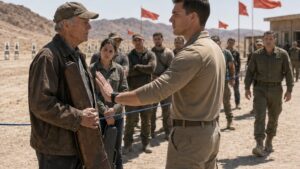
Eric Moore wore dark range pants, wraparound glasses, and a polo shirt embroidered with the Red Mesa Rifle Club emblem. He moved with the contained hurry of someone responsible for too many things and determined to let everyone see he was handling them.
“Problem?” Eric asked.
“No problem,” the volunteer said quickly.
Donald unfastened the case himself.
Inside lay a bolt-action rifle with a dark barrel and a wooden stock worn pale at the edges. The finish was scratched near the sling swivel. A shallow scar crossed the right side of the stock, and below it was a smooth oval polished by years of the same thumb resting in the same place.
Eric looked from the rifle to Donald’s hand.
“That firearm cleared inspection?”
“Not yet,” Donald said.
“Then it stays cased until the inspection table.”
Donald looked toward the line. “Bolt is open. Chamber was checked before I entered the gate.”
Eric’s expression tightened slightly. “That isn’t the same as inspection.”
“No.”
The answer seemed to irritate him more than an argument would have.
Beyond the registration pavilion, Red Mesa spread across the desert in bands of tan earth and red stone. White-painted lane numbers faced the firing points. Wind flags snapped along the berms. Farther north, beyond the modern covered benches, stood an older firing line with sun-bleached posts and rough wooden rests.
A chain-link panel had been erected across its entrance. A sign wired to it read:
NORTH RANGE CLOSED AFTER TODAY
DEMOLITION BEGINS SUNDAY
Donald had known about the demolition for six weeks.
Seeing the sign still struck him like unexpected recoil.
Anna stepped up beside him carrying two bottles of water and the canvas bag she had insisted on packing. At forty-five, she had inherited her mother’s direct gaze and none of Donald’s talent for pretending not to feel something.
“You said we were here to watch,” she murmured.
“We are watching.”
“You brought a rifle.”
“I noticed.”
Anna’s mouth drew tight. She had driven him nearly two hours from Tucson after he told her the veterans’ charity match would be his last chance to see the old club. He had not told her the case had been cleaned, oiled, and placed beside his front door the night before.
Eric heard enough to turn back.
“You haven’t registered as a competitor,” he said.
Donald closed the empty case and kept the rifle pointed toward the berm, bolt still open. “I’m not here for the main match.”
“What are you here for?”
“The north lane.”
Eric followed his gaze to the chained entrance. “That lane is closed except for scheduled demonstrations.”
“I need twenty minutes.”
“For what?”
Donald’s thumb found the smooth oval in the stock.
The wood felt warmer than it should have.
“For an old course.”
Eric waited.
When Donald offered nothing more, he gave a short breath through his nose. “We’ve got a sponsor review today, a full charity relay, junior shooters, veterans’ groups, and an insurance inspector somewhere in the crowd. I can’t open a condemned lane because somebody remembers shooting there.”
Donald’s fingers moved faintly against the stock.
Eric looked at them again.
Thomas Allen arrived from the safety table carrying a stack of registration cards. He was younger than Eric, lean, with hearing protection resting around his neck.
“This is Mr. Hall,” the volunteer said. “He says he checked the chamber before coming through.”
Thomas glanced at the rifle. His eyes paused on the open bolt and the empty magazine well.
“You also ran a chamber flag at the gate?” he asked.
Donald nodded toward the case. A bright plastic flag lay in a side pocket beside a folded sling.
Thomas looked up. “Most people don’t remove it until inspection.”
“It catches on that bolt if you close the lid.”
Thomas examined the worn recess inside the case. The mark was old and exact. His expression changed—not admiration, but attention.
Eric noticed.
“Inspection table is there,” he said. “Then Mr. Hall can observe from behind the yellow line.”
Donald lifted the rifle, keeping the muzzle downrange. A club member had left another rifle angled carelessly in the wooden rack, its muzzle pointed toward the corner of the pavilion where three spectators stood talking.
Donald stopped.
He set his own rifle securely into an empty slot. Then he grasped the other rifle by the stock, without touching its trigger, and rotated it until the muzzle faced the berm.
Eric turned just as Donald released it.
“Don’t handle another shooter’s firearm,” he said sharply.
“It was pointed at people.”
“It was unloaded.”
Donald met his eyes. “That doesn’t change where it was pointed.”
The nearby conversation faded.
The club member who owned the rifle flushed and stepped forward. “He’s right. That was mine.”
Eric’s jaw shifted. For a moment he looked less like a range director than a man who had been corrected in front of people whose opinion mattered.
Then the charity coordinator called his name from across the pavilion, waving beside two visitors in sponsor badges.
Eric lowered his voice.
“We have procedures here.”
“So did we,” Donald said.
“We?”
Donald looked back at the north lane.
He could almost see Joseph there beside the old spotting bench, one elbow planted on the wood, hat brim pushed back, grinning because the wind had changed exactly when he said it would.
The image vanished when Anna touched Donald’s sleeve.
“Dad,” she said, “tell him what you mean.”
He could have.
He could have said Army marksmanship instructor. He could have said civilian safety teacher. He could have named years, courses, students, and certifications. He could have explained that the north lane’s faded distance markers had once been measured by two men with a steel tape, a notebook, and more stubbornness than sense.
Instead, he said, “I need twenty minutes.”
Eric stared at him.
Anna spoke before Donald could stop her. “He hasn’t fired that rifle in nine years.”
Thomas’s gaze shifted to the weapon.
Eric’s expression settled into certainty.
“Then the answer is no.”
Anna looked at Donald, regret arriving too late.
“He’s seventy-four,” she continued, softer now. “I don’t want him pushed into anything.”
“I’m not pushing him,” Eric said. “I’m making sure everyone goes home safely.”
Donald heard the reason beneath the words. It was not entirely false. That made it harder to answer.
A whistle sounded from the main line. Volunteers began calling competitors toward the safety briefing.
Eric took a plastic tag from the registration box. It was bright orange, printed with the words BEGINNER LANE—SUPERVISED.
He clipped it to the pocket of Donald’s faded plaid shirt.
“The fifty-yard line is open after briefing,” Eric said. “Club rifle only. If you still want to shoot, we’ll see whether that’s appropriate.”
Donald looked down at the tag.
A few people nearby pretended not to watch.
Eric nodded toward the chained north lane. “That range is for qualified competitors.”
Donald’s hand trembled once against the scarred stock.
He left the tag where it was.
Chapter 2: The Safety Rule Nobody Else Noticed
The target frame turned sideways just as the junior shooter began raising her rifle.
A gust swept across the fifty-yard berm, caught the unsecured cardboard backing, and twisted it until one wooden leg lifted from the dirt. The white paper target disappeared edge-on.
The girl at the bench did not see it. Her cheek was already lowering toward the stock.
Donald saw the frame.
He also saw the red ceasefire flag wrapped twice around its pole instead of hanging free.
“Cease fire,” he called.
The command crossed the range without strain, each word separated and hard enough to stop movement.
The girl froze.
Thomas, halfway through checking another lane, raised his arm. “Cease fire! Benches clear!”
Bolts opened along the line. Shooters stepped back.
Eric turned from a conversation near the sponsor pavilion. His hand went immediately to the radio clipped at his belt.
“What happened?”
Donald pointed downrange.
The target frame toppled fully a second later.
Dust lifted around it.
Thomas stared at the fallen frame, then at the girl, whose finger had remained outside the trigger guard. Her instructor placed a steadying hand near her shoulder.
“No shot fired,” Thomas reported.
Eric looked at Donald. “I run the line.”
“The frame was moving.”
“You call an officer. You don’t issue commands unless you’re assigned.”
“There wasn’t time.”
Eric’s face tightened, but the wind had made Donald’s case for him. The loose backing dragged several feet before catching against a marker stake.
The charity coordinator had stopped beside the sponsor visitors. Club members along the covered benches were watching again.
Eric keyed his radio. “Target crew, secure lane four. Check every frame before the line goes hot.”
Donald turned away from the attention.
His rifle remained on the rack behind the yellow safety line, bolt open, muzzle toward the berm. He had not touched it since arriving. His thumb passed once over the scar in the stock, then withdrew.
Thomas came to stand beside him.
“That command cadence,” he said quietly. “Where did you learn it?”
Donald watched the target crew walk downrange.
“Somewhere it mattered.”
Thomas waited for more.
Donald gave him none.
Across the range, Eric spoke to the sponsor representative with one hand on his hip. His smile was controlled, but his shoulders were not. Donald recognized the posture. He had seen young instructors wear it after being corrected by a recruit in front of a senior officer.
Pride had a stance of its own.
When the target crew returned, Thomas checked the line personally. He also unwrapped the red ceasefire flag and repositioned its base where every firing point could see it.
Donald noticed. Thomas noticed him noticing.
“The flag should’ve been checked,” Thomas said.
“Yes.”
“That was on us.”
Donald nodded once.
It was a small thing, an admission with no audience. He respected it more than a public apology would have meant.
Eric approached carrying a modern club rifle with an adjustable stock and mounted optic.
“This is what you’ll use,” he told Donald. “The controls are straightforward.”
Donald glanced at the rifle but did not take it. “Mine passed inspection?”
“The gunsmith says it’s mechanically sound.”
“Then I’ll use mine.”
“The optic on this one will be easier for you.”
“I didn’t ask for easier.”
Eric lowered his voice. “Your daughter told me you haven’t fired in nine years.”
“She did.”
“And your hand is visibly shaking.”
“At rest.”
“You expect me to gamble on the distinction?”
“No.”
That answer checked Eric for half a second.
Donald continued, “I expect you to watch what I do.”
The nearest benches had gone quiet again. The orange beginner tag stood out against Donald’s plaid shirt like a warning label.
Eric set the club rifle on the rack. “Fine. One supervised shot at fifty yards. If I see anything unsafe, you’re done.”
Donald looked downrange.
The target crew had raised a fresh paper bull’s-eye. Behind it, the desert opened toward the north berm. Three hundred yards away, half-obscured by sun glare and age, hung a round steel plate darkened by years of impacts.
“That plate still active?” Donald asked.
Eric followed his gaze. “The three-hundred-yard steel?”
“Yes.”
“Not for the beginner relay.”
“I’m not asking about the relay.”
“You asked for the north lane. I’m offering you a controlled way to show you can handle the rifle.”
“At fifty yards.”
“It’s forgiving.”
A few people smiled.
Eric smiled too, just enough to make the word an insult.
Donald’s hand rested on the stock. The tremor moved through his fingers, small but undeniable.
Anna stood beyond the yellow line with both arms folded. She did not look angry now. She looked afraid.
Donald knew what she saw: an old man being offered a clean way to retreat.
He also knew why he had not fired the rifle for nine years.
Joseph had left it to him with no ceremony, only a case, two boxes of hand-loaded ammunition, and a message Donald had not been ready to hear. For nine years the rifle had stood in a locked cabinet while dust gathered along the case hinges.
Donald looked toward the steel plate.
“One shot,” he said.
Eric nodded. “At fifty.”
“No. At three hundred.”
The smiles disappeared.
Thomas looked from Donald to the wind flags.
Eric gave a brief laugh. “You haven’t fired in nine years, and you want to start on old steel with iron sights?”
“The plate is larger than the paper center.”
“That isn’t the point.”
“It is if you want to know whether I can handle the rifle.”
Eric crossed his arms. “You hit it, we discuss the north lane. You miss, you accept the beginner restriction and stop interrupting my officers.”
Anna stepped forward. “Dad, you don’t have to—”
Donald raised one hand, not to silence her but to ask for a moment.
The wind flag nearest the north lane snapped west, then twisted back. Dust moved in thin sheets across the low ground. The gusts were uneven, passing from right to left before flattening near the berm.
Donald studied the loose paper backing at fifty yards.
It shuddered against one corner.
“No shot yet,” he said.
Eric glanced at his watch. “The line is clear.”
“The backing isn’t secure.”
A target-line attendant looked through binoculars. “Lane four is tied.”
“Bottom right corner,” Donald said.
Thomas lifted his spotting scope.
The corner pulled free as he watched.
For the second time that morning, the line waited because Donald had seen what everyone else had missed.
Eric’s mouth became a hard line. He ordered the target crew downrange.
Phones began appearing in spectators’ hands.
Donald wished they would put them away.
This was already becoming something it had never been meant to be.
When the crew returned and the red flag came down, Eric stood directly behind Donald’s assigned firing point.
“One safe shot,” he said. “Then we’re finished.”
Donald opened the rifle case.
The smell of oil and old walnut rose from it.
His hand trembled as he reached for the scarred stock.
“Mr. Hall,” Eric said, loud enough for the people filming to hear, “the first rule is control.”
Donald lifted the rifle with the muzzle toward the berm and the bolt open.
“No,” he said. “The first rule is respect.”
He stepped toward the line.
Chapter 3: The Shot That Silenced the Firing Line
“The fifty-yard target is ready,” Eric announced.
Donald stopped at the firing point and looked past it.
“I asked for the steel.”
A murmur moved along the covered benches.
Eric had arranged the moment to be simple: an old man, one easy target, one public failure or one harmless concession. Donald’s request had changed the shape of it.
“The steel hasn’t been painted for scoring,” Eric said.
“I’m not asking for a score.”
“You expect us to take your word if it rings?”
“Thomas has a scope.”
Thomas looked at Eric but did not speak.
Eric’s arms folded across his chest. “One round. Supervised. You follow every line command.”
Donald set the rifle on the bench with the muzzle downrange. He removed the chamber flag, opened the bolt fully, and inspected the chamber again.
The movements were slow.
Not uncertain. Slow.
His fingers trembled while they were empty. Once they closed around the bolt handle, the motion narrowed into purpose.
Behind him, someone whispered, “Look at his hands.”
Donald heard.
He had heard versions of it in grocery lines, at the doctor’s office, while signing receipts. People lowered their voices as though age had damaged hearing before dignity.
He did not turn.
The ammunition box held ten cartridges in yellowed cardboard. Joseph’s handwriting marked the lid: NORTH COURSE—FINAL LOAD.
Donald had nearly thrown the box away twice.
He selected one round.
“Range is hot,” Thomas called.
Donald paused before inserting it.
The red ceasefire flag had been lowered, but the target-line attendant was still walking behind the side barrier, gathering a coil of rope.
“Hold the line,” Donald said.
Eric’s head snapped toward him. “The range is hot.”
“Attendant hasn’t cleared the barrier.”
Thomas checked.
A boot appeared briefly through the gap between the panels.
“Cease fire,” Thomas called immediately. “Hold all firearms open.”
The attendant emerged, startled, then hurried behind the protected line.
A few spectators lowered their phones.
Eric looked toward the sponsor pavilion. The representative was watching.
“You satisfied?” Eric asked.
“When the range is clear.”
The attendant raised both hands from safety.
Thomas checked left and right. “Range is hot.”
Only then did Donald chamber the round.
He knelt.
The movement pulled sharply at his right knee, and for one humiliating second he needed the bench edge to lower himself under control. He heard a short laugh behind him.
Eric did not laugh. He did not stop it either.
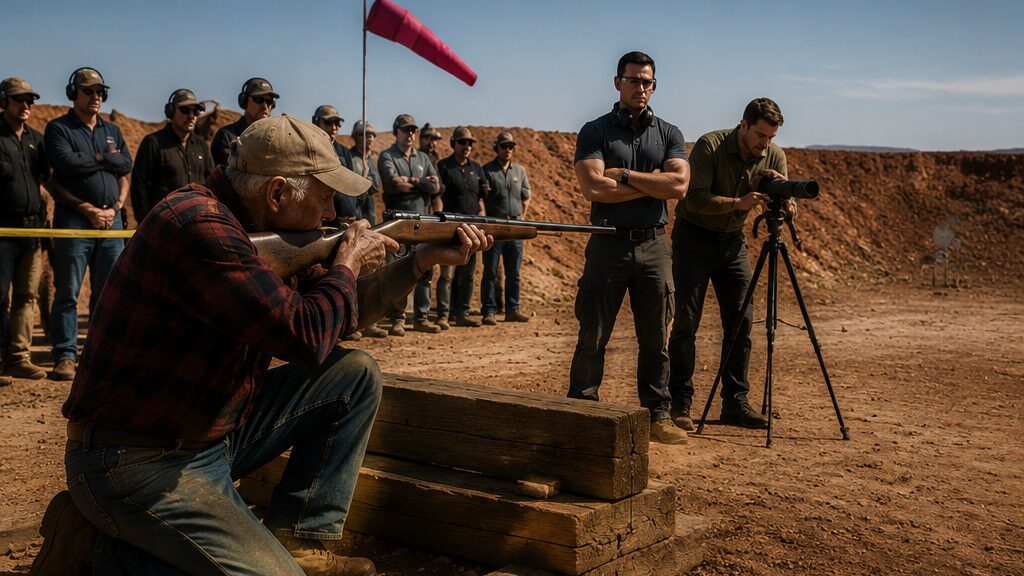
Donald set one knee in the dust and brought the stock to his shoulder.
The wood found him.
The cheek rest had been shaped down years ago, a fraction at a time, until his eye aligned naturally with the sights. Joseph had complained through every adjustment.
You’re sanding a good rifle into an ugly one.
Ugly works.
Then it’s got that in common with you.
Donald’s throat tightened.
The sight picture blurred.
He lifted his face from the stock.
“Problem?” Eric asked.
Donald breathed once through his nose.
“No.”
But there was.
The rifle fit exactly as it had nine years earlier. His shoulder remembered the pressure. His hand remembered the bolt. His cheek remembered the worn wood.
And for one dangerous moment, he expected Joseph’s voice at his left ear.
Wind half value. Let it come down.
There was only the snapping flag and the faint electronic chirp of phones recording him.
Donald settled again.
The steel plate shimmered in the heat. Three hundred yards was not a remarkable distance for a trained marksman, but he had no intention of pretending nine silent years meant nothing. His vision had changed. His knee hurt. The tremor remained in the muscles of his hand even when it no longer showed.
He watched the wind flags rather than the plate.
The nearest flag pulled hard left. The middle flag flickered. Farther downrange, dust curled and fell.
Eric shifted behind him.
“You planning to shoot today?”
Donald kept his eye on the sights.
“You don’t beat the wind by rushing it.”
The nearest flag snapped once, then began folding toward the pole.
The middle flag followed.
Donald drew a breath, released half of it, and held what remained without strain.
The tremor diminished.
Not vanished. Organized.
His finger took up the trigger.
The rifle fired.
Recoil pressed into his shoulder. Dust lifted beside his knee. The report rolled out across the berms and faded into the open desert.
For a fraction of a second, nothing happened.
Then the steel plate rang.
The sound came back thin and bright.
No one spoke.
Thomas bent over the spotting scope. “Impact,” he said. “Center-left.”
Eric did not move.
Donald opened the bolt. The empty casing spun onto the mat and landed near his boot. He engaged the safety, verified the chamber, and inserted the flag before lowering the rifle from his shoulder.
Only then did the noise begin.
A few claps. A burst of voices. Someone laughed in disbelief. Phones rose higher.
The sponsor representative said, “Did you get that?”
Donald remained kneeling.
His hand closed around the stock.
The tremor returned at once, stronger now.
Anna came to the yellow line. “Dad?”
He heard Joseph again—not as a voice this time, but as memory shaped by silence.
You waited too long.
The plate had rung exactly as it should have.
That was the trouble.
For nine years Donald had told himself he was protecting the rifle, the ammunition, the memory. The truth was smaller and harder. He had been protecting himself from finding out whether the part of him Joseph trusted was still there.
Now he knew it was.
And the knowledge hurt more than uncertainty had.
Eric stepped closer. The color had changed in his face.
“Cold-bore hit,” he said. “Old iron sights.”
Donald stood carefully, using the bench only at the end. “The rifle was zeroed.”
“Nine years ago.”
“Good work lasts.”
Thomas hid something that might have been a smile.
The crowd drew nearer until the yellow line officer ordered them back. The charity coordinator appeared beside the sponsor guests, speaking quickly about the afternoon relay.
“We could add a special exhibition,” she said. “Veteran versus club champion. It would be perfect for the fundraiser.”
Donald returned the rifle to the rack.
“No.”
The coordinator blinked. “No?”
“I came for the north lane.”
Eric looked toward the distant plate, then at the orange tag still clipped to Donald’s shirt.
He removed it.
The gesture was quiet, but every nearby camera caught it.
“We can discuss the lane,” he said.
Donald expected satisfaction.
Instead, his chest felt hollow.
The sponsor representative approached with one hand extended. “Sir, that was something. What unit were you with?”
Donald did not take the hand. He was looking at the rifle.
A thin seam showed near the buttplate, where the wood met an old rubber pad Joseph had installed after Donald injured his shoulder. One screw sat slightly proud.
Donald frowned.
It had not been that way when he cleaned the rifle.
He lifted it from the rack, opened the bolt, verified the chamber, and carried it to the inspection table. Using the gunsmith’s screwdriver, he loosened the screw and eased back the buttplate.
Something pale pressed against the hollow inside the stock.
Folded paper.
Donald drew it out carefully.
The creases were dark with oil. Pencil marks showed through the outer layer. At the top, in a slanted hand he had not seen in nine years, were two words:
North Course.
Donald stopped breathing.
Anna came close enough to see over his shoulder.
“That’s Joseph’s writing,” she said.
Donald unfolded the first panel.
Distances. Positions. Wind notes. A sequence of shots across the old lane.
At the bottom, the final instruction had been written, crossed through, and begun again.
Donald touched the unfinished line with one trembling finger.
Joseph had left him more than a rifle.
He had left him a course they had never completed.
Chapter 4: The Promise Hidden Beneath the Stock
Anna saw Joseph’s handwriting and went still.
Not the polite stillness she used when she was trying not to embarrass Donald in public. This was sharper. Her eyes moved from the words North Course to the oil-darkened creases, then to the rifle lying open on the inspection table.
“You knew that was in there?”
“No.”
“But you knew something was.”
Donald refolded the card along its oldest crease. The paper resisted. Joseph had always folded maps badly, never matching corners, trusting pressure to make up for precision.
“I knew why I came.”
“That isn’t what I asked.”
People still crowded the firing line behind them. The steel hit had become a story before Donald had even left the bench. He could hear pieces of it changing as it traveled.
First shot.
Nine years.
Old iron sights.
Somebody said former sniper. Somebody else said competition champion. Donald had been both less dramatic and more useful than either of those guesses.
He picked up the rifle and carried it toward the shade structure behind the north lane. Anna followed.
The structure had three corrugated panels and one old picnic table marked by initials, cartridge rings, and years of sun. Through the chain-link barrier, the closed lane stretched toward the red berm. The spotting bench remained where Donald remembered it, though one leg had sunk into the dirt.
He set the rifle down with the bolt open.
Anna placed both hands on the table. “You told me we were coming to watch.”
“We watched.”
“You brought ammunition marked for a course that was hidden inside the rifle.”
“I didn’t know about the card.”
“You cleaned the rifle.”
“Yes.”
“You packed the ammunition.”
“Yes.”
“And you still expect me to believe you didn’t plan to shoot?”
Donald ran his thumb over the oil stain spreading across the lower corner of the card. It matched the dark patch beneath the rifle’s buttplate.
“No,” he said.
Anna’s anger faltered because he had not defended himself.
The wind pushed dry grit through the open side of the shelter. Somewhere on the main line, a range officer called shooters forward for the next relay.
Anna lowered her voice. “Why didn’t you tell me?”
Donald looked toward the old lane.
The first marker stood at fifty yards, crooked now. Beyond it, faded stakes marked kneeling and prone stages that had not been used in years. Joseph had measured every one twice and argued over each foot.
“He wanted to shoot the course again,” Donald said.
“Joseph?”
Donald nodded.
“When?”
“Before he got sick enough to stop asking.”
Anna pulled out the bench opposite him. “What course?”
Donald unfolded the card.
The pencil had faded, but the structure remained clear: five rounds from the bench at one hundred yards, five kneeling at two hundred, three from a supported position at three hundred, then a final paper stage after a wind call. Beside each line Joseph had written brief notes.
No chasing the sight.
Make the shooter wait.
Wind owns the first move.
Anna touched none of it.
“You made this together?”
“Mostly him. I corrected the parts that were wrong.”
A small breath escaped her. It might have been the beginning of a laugh if grief had not reached it first.
“Sounds like him.”
Donald remembered Joseph at the kitchen table, drawing target shapes on the back of an electric bill while insisting that modern shooters had forgotten how to slow down. Donald had told him the course was too long for civilians. Joseph had called him soft. They had settled the disagreement by adding a rest period and making it harder.
“You never talked about this,” Anna said.
“There wasn’t much to say.”
“There’s always something to say. You just decide nobody needs to hear it.”
Donald looked down.
That landed because it was true.
The lower half of the card held a date from nine years earlier. Two days before Joseph’s last call.
Donald had seen the call come through. He had been cleaning the garage, irritated because Joseph had canceled another range trip that morning. He let the phone ring. Told himself he would call after dinner.
Joseph entered the hospital that night.
They never spoke again.
Anna studied his face. “You didn’t answer him.”
Donald’s eyes lifted.
She had guessed, perhaps because she had known him too long.
“No.”
“Why?”
“He had canceled three times.”
“Because he was sick.”
“He didn’t tell me how sick.”
“Would it have mattered?”
Donald folded the card once. “It should have.”
The words came out rougher than he intended.
Anna’s expression softened, but she did not rescue him from the silence. That was one of the things she had learned from her mother: sometimes kindness meant leaving a man inside the truth long enough to recognize it.
Donald opened the final panel.
The writing became less steady there. Joseph’s pencil line slanted downward, pressing hard in places and fading in others.
Before they tear down north lane, teach—
The sentence stopped.
Anna leaned closer.
“That’s all?”
Donald turned the card over. Blank except for an old thumbprint in oil.
“He didn’t finish it.”
“Or the rest is somewhere else.”
“Maybe.”
“What do you think he meant?”
Donald refolded the paper. “Complete the course.”
“That isn’t what it says.”
“He wrote the course above it.”
“He wrote teach.”
Donald slid the card into his shirt pocket.
Anna’s jaw tightened again. “You always do that.”
“Do what?”
“Choose the part of a sentence that lets you avoid the rest.”
He looked at her.
She held his gaze, hurt now more than angry.
“I would have driven you here if you’d told me the truth,” she said. “I might have argued. I might have asked a doctor whether kneeling in the dirt for an hour was smart. But I still would have brought you.”
“I knew.”
“Then why lie?”
Because if he told her, the promise would become real outside his own mind. Because she might say he was too old. Because she might say Joseph would not care anymore. Because she might look at the tremor and be right to worry.
Donald said, “I didn’t want permission.”
Anna pushed away from the table.
“I’m your daughter, not your commanding officer.”
“I know.”
“No, you know how to say that. You don’t know how to act like it.”
Before Donald could answer, footsteps approached through the gravel.
The charity coordinator entered the shelter with the sponsor representative behind her. She wore a bright event badge and the strained smile of a person carrying good news that had not been requested.
“Mr. Hall, there you are. That shot has everybody talking.”
Donald placed one hand over his shirt pocket.
“We’ve already adjusted the afternoon schedule,” she continued. “The sponsor would love to feature you in the precision relay. Just a friendly exhibition. Experience versus modern competition.”
“No.”
The sponsor representative’s smile held. “You haven’t heard the full idea.”
“I heard enough.”
“It would be wonderful for the veterans’ program. The clip is already being shared. We could use that attention.”
Donald looked beyond them.
At the edge of the shelter, Eric stood with a microphone in one hand, speaking to the crowd near the registration pavilion. Thomas was beside him, not smiling.
The loudspeaker crackled.
“Afternoon precision relay begins at one-thirty,” Eric announced. “And by special request, we’ll be joined by Red Mesa’s surprise marksman, Mr. Donald Hall.”
The crowd reacted with cheers and scattered applause.
Anna turned toward Donald.
He had said no.
Eric had announced him anyway.
Chapter 5: When Respect Became a Public Performance
“The old-man miracle,” the sponsor representative said, testing the phrase as though it belonged on a banner.
Eric heard it from ten feet away.
So did Donald.
Donald’s face did not change, but his right hand closed around the rifle case handle until the tremor disappeared inside the grip.
The registration pavilion had been reorganized for photographs. A sponsor backdrop stood behind the scoring table. Someone had moved Donald’s rifle from the inspection bench to the wooden rack in front of it, placing the scarred stock where the event logo would show over his shoulder.
A photographer crouched near the rack.
“Don’t touch that rifle,” Donald said.
The photographer lifted both hands.
Eric stepped between them. “Nobody’s touching it. We’re arranging the presentation.”
Donald walked past him, opened the bolt, verified the chamber, inserted the flag, and lifted the rifle from the display.
“It isn’t a presentation.”
The sponsor representative looked to Eric.
Eric felt the day slipping sideways again.
He had spent eleven months convincing the sponsor that Red Mesa was worth saving. The old roof leaked. Two electronic target systems had failed. Membership had fallen after a competing facility opened closer to the interstate. The insurer had already threatened higher premiums over inconsistent screening procedures.
The sponsor’s proposed renovation would replace the condemned north lane, repair the junior range, and keep three employees from losing their jobs.
A clean event mattered.
A memorable event mattered more.
Donald’s shot had given them both, until Donald refused to cooperate.
“We’re trying to honor you,” Eric said.
Donald secured the rifle in its case. “You’re trying to use me.”
The words were quiet, forcing Eric to step closer if he wanted the disagreement kept private.
“This fundraiser supports veterans and youth instruction.”
“So ask before turning somebody into an attraction.”
“You walked onto a public range and asked for a public challenge.”
“I asked for one shot.”
“And now people care.”
“That doesn’t make me yours.”
Thomas had approached without Eric noticing. He held two scoring sheets and a radio.
“He’s right,” Thomas said.
Eric turned. “About what?”
“You announced him after he refused.”
“We had a scheduling misunderstanding.”
“No. He said no.”
The sponsor representative shifted away, suddenly interested in the event brochure.
Eric lowered his voice. “You want to discuss staff decisions, we do it later.”
Thomas’s mouth tightened. He wanted the senior range officer position opening after the renovation. Everyone knew it. Until that moment, Eric had expected that ambition to keep him agreeable.
“Using the shot without his consent isn’t a range decision,” Thomas said.
“It is when the attention pays for the range.”
Donald closed the case latches.
The click sounded final.
Anna stood beside him, arms folded, watching Eric with no attempt to hide her dislike.
Eric looked across the pavilion at the junior shooters eating lunch under the shade canopy. The smallest girl—the one stopped before the target frame fell—was laughing with two others, hearing protection crooked over her cap.
“If the sponsor walks,” Eric said, “the youth program loses its building. The club cuts staff. Maybe the whole property gets sold within a year.”
Donald glanced toward the children.
Eric saw that the words had reached him and hated himself slightly for using them.
He continued anyway.
“I’m not protecting a trophy case. I’m trying to keep this place open.”
“That doesn’t give you permission,” Anna said.
“No,” Eric replied. “It gives me a reason.”
Donald studied him.
For the first time all day, Eric wished the old man would raise his voice. Anger would have been easier to answer than that steady examination.
“My father served,” Eric said, though he had not intended to. “Every disagreement in our house ended with what he had done and what the rest of us hadn’t. So I don’t hand out authority because someone wears an old hat and lets people guess at a past.”
Donald’s gaze did not move.
“I didn’t ask you to.”
“No. You just show up, refuse to explain anything, correct my staff in front of sponsors, and expect access to a closed lane.”
“He corrected a dangerous condition,” Thomas said.
“And I fixed it.”
“After he called it.”
Eric’s anger flared, then settled under the weight of the sponsor representative watching from a polite distance.
He looked at Donald’s hand. The tremor was visible again.
“The insurance carrier warned us about inconsistent screening,” Eric said. “If anyone came in after nine years away, with a visible tremor, carrying an old rifle and asking for access to a condemned lane, I would inspect them.”
“That part is fair,” Donald said.
Eric had not expected agreement.
Donald continued, “The joke wasn’t. The tag wasn’t. Announcing my name after I refused wasn’t.”
Each item landed separately.
Eric could justify the inspection. He could justify the restriction. He could not justify making the restriction entertaining.
The charity coordinator approached with a clipboard. “We need a decision. The precision relay starts in twenty minutes.”
Eric looked at Donald.
“The north lane can be opened for an official scored stage,” he said. “Not for a private session. Complete the sponsor relay under normal rules, and I’ll authorize the old course afterward.”
Anna shook her head. “That’s coercion.”
“It’s the only way I can open a closed section under the event permit.”
Donald looked toward the chained lane.
The old spotting bench sat behind it, half in shadow.
Eric pressed the advantage. “You wanted twenty minutes. Earn the qualification in front of an official, and you get them.”
Donald’s eyes returned to him. “You still think this is about qualification.”
“What else would it be?”
Donald removed the folded range card from his pocket and set it on the table. He did not open it fully, only enough to reveal the hand-drawn lane marks.
Thomas leaned in.
Eric recognized the old property layout. The distances did not match the modern relay.
“Who drew that?” he asked.
“Joseph Mitchell.”
The name meant nothing to Eric, but Thomas’s expression changed.
“My grandfather mentioned him,” Thomas said. “He helped run civilian classes here.”
Donald nodded. “Joseph designed a course for the north lane. We never finished it.”
The charity coordinator checked her watch. “Can it be adapted to today’s scoring?”
“No,” Donald said.
Eric exhaled. “Then we’re back where we started.”
“No. We aren’t.”
Donald unfolded the full card and placed one finger beside the sequence of positions.
“I’ll enter your relay,” he said. “Official score. Same inspection and commands as everyone else.”
The sponsor representative stepped closer.
Donald did not look at him.
“But if I complete it safely, the north lane is restored exactly as this card shows. Distances. Positions. Paper targets. No exhibition commentary. No cameras forward of the yellow line.”
Eric studied the course.
It would delay the schedule. Staff would have to move target stands and reopen storage. The sponsor might dislike losing control of the presentation.
But refusing now, after Donald had accepted his terms, would look worse.
“After the relay,” Eric said.
“Before sunset.”
“Agreed.”
Donald refolded the card.
Eric extended his hand.
Donald looked at it, then at Eric.
“This isn’t respect,” Donald said. “It’s an arrangement.”
He shook once and released.
Chapter 6: The Warning Donald Did Not Have to Give
The optic moved when Eric tightened the front ring.
Only a fraction—less than the width of a pencil line—but Donald saw the mount shift against the rail before settling back.
Eric did not.
He lifted the competition rifle from the inspection bench and worked the action with quick confidence.
Donald stood two places away while the gunsmith checked the old bolt-action rifle. The north lane target crew had begun carrying wooden frames from storage, matching them to the distances on Joseph’s card. Each frame looked heavier than Donald remembered.
Thomas supervised the work personally.
Eric raised his rifle toward the berm and looked through the optic. “Clear.”
The gunsmith signed his inspection sheet.
Donald said, “Your front mount is moving.”
Eric lowered the rifle.
“What?”
“Front ring. Base may be loose.”
Eric examined it, thumb pressing the metal. “It’s torqued.”
“It shifted.”
“You saw that from there?”
“Yes.”
The sponsor representative stood nearby speaking with the charity coordinator. Eric glanced toward them before checking the screws again.
Nothing moved under his thumb.
“This rifle was zeroed yesterday,” he said.
“Check it anyway.”
Eric’s expression hardened. “Worried I’ll beat you?”
Donald looked at the rifle, not the man. “I’m worried your point of impact won’t be where you think it is.”
Thomas had stopped beside a stack of target boards. He had heard.
Eric lowered his voice. “You got your lane. Don’t start playing instructor now.”
Donald almost walked away.
There would have been satisfaction in letting the target answer Eric twice in one day. No danger, perhaps. Only a poor score and public embarrassment created by pride.
Then Donald remembered Joseph beside a firing bench, slapping a young soldier’s hand away from a loose sight screw.
You don’t let a man fail from a problem you saw first. That makes it partly yours.
Donald pointed without touching the rifle.
“Hold the stock still and press the optic forward. Watch the gap beneath the front base.”
Eric’s jaw worked.
For a moment Donald saw something beneath the arrogance: not fear of losing, exactly, but fear of pausing. Eric had built himself around forward motion. Inspect, command, announce, advance. To stop now would mean admitting uncertainty in front of people whose money he needed.
“The relay begins in twelve minutes,” Eric said.
“Then you have twelve minutes.”
“I’m not delaying the line because you think you saw movement.”
Thomas came closer. “I can check it.”
Eric looked at him. “You have targets to set.”
Thomas held his gaze for a second, then returned to the north lane.
Donald felt no victory in it.
He turned back to his own rifle.
The gunsmith had removed the buttplate completely and placed it beside the folded range card. Donald lifted the rifle and settled it lightly against his shoulder.
The cheek rest met his face at the old angle.
He frowned and checked the adjustment.
Joseph had preserved it.
Nine years earlier, Donald had loosened the rest after his shoulder injury, intending to reset it when they returned to the range. Joseph must have changed it back before storing the rifle. The two tiny witness marks aligned exactly.
Donald ran his thumb over them.
“You all right?” Anna asked.
She stood beyond the inspection rope holding the canvas bag. Her anger from noon had not disappeared, but it had made room for something more careful.
“He reset the cheek piece,” Donald said.
“Joseph?”
Donald nodded.
Anna looked at the small marks. “How can you tell?”
“He used a knife point. I used pencil.”
She leaned closer. One mark was dark gray. The other cut faintly into the wood.
“He expected you to shoot it again.”
Donald set the rifle down.
“He expected a lot of things.”
“That doesn’t mean he expected perfection.”
Donald gave her a look.
Anna almost smiled. “I knew him too.”
The target crew raised the first north-lane frame. Wind caught the blank paper and flattened it hard against the backing.
Thomas walked over carrying the range card.
“I need the stage commands,” he said.
Donald took the card and pointed to the notes.
“Bench first. Five rounds. Then clear and move. Kneeling at two hundred. Supported at three. Final paper after a wind call.”
“You wrote this?”
“Joseph drew it. I corrected it.”
Thomas studied the margin. “Make the shooter wait.”
“That was his part.”
“What did it mean?”
“He thought too many courses rewarded speed before judgment.”
Thomas looked toward Eric, who was dry-firing into the berm with the optic still unchecked.
“Sounds current.”
Donald folded the card.
Thomas hesitated. “My grandfather took a class here when I was a kid. He used to repeat a command exactly the way you said it this morning.”
Donald waited.
“Slow enough to hear. Loud enough to obey.”
“That was the idea.”
“You taught here?”
“For a while.”
“Military before that?”
Donald nodded.
“What did you teach?”
“Fundamentals.”
Thomas glanced at Donald’s trembling hand. “You stopped?”
“When Joseph got sick.”
It was the most Donald had said about himself all day.
Thomas accepted it without asking for rank, unit, or record.
“Then I’ll run the old course exactly as written,” he said.
Across the pavilion, Eric called for competitors to take their places.
The modern relay used covered benches, electronic timers, and fresh paper targets. Donald’s old rifle looked narrow and plain among adjustable stocks, large optics, and polished chassis systems.
He did not resent any of it. Good equipment was good equipment. Trouble began when people expected it to replace judgment.
Anna handed him a bottle of water.
His fingers shook badly enough that the cap clicked against the plastic.
Her eyes dropped to his hand.
“Dad.”
“It settles.”
“It didn’t settle just now.”
“I’m not on the line.”
“That isn’t an answer.”
Donald drank and put the bottle down.
Anna stepped closer. “You’ve done enough. You hit the steel. Nobody thinks Eric was right anymore.”
“This was never about Eric.”
“I know. That’s what scares me.”
The first relay shooters began moving toward their benches.
Donald looked past them to the restored north lane. The frames stood at Joseph’s distances. The old spotting bench had been leveled with a block of wood. For the first time in nine years, the course existed outside Donald’s memory.
His hand trembled harder.
Anna placed her palm over it.
“Are you finishing a promise,” she asked, “or punishing yourself for missing a phone call?”
Donald tried to pull his hand away.
She held it.
The question reached a place Eric’s mockery had not touched.
Donald looked at the rifle. At the witness marks. At Joseph’s unfinished sentence folded in his pocket.
He had always known how to tell a frightened shooter from a reckless one. The frightened shooter respected the cost of error. The reckless one refused to admit fear existed.
He was no longer certain which one he had become.
The loudspeaker clicked.
“Precision relay competitors to the line.”
Anna released his hand.
“Tell me to take you home,” she said, “and I will.”
Donald’s fingers shook against the scarred stock.
For the first time that day, he could not make them stop.
Chapter 7: The Target Came Back Without an Argument
Eric’s first shot struck high and right.
The second landed farther right.
Through the spotting scope, Thomas watched the group drift across the paper in a line too consistent to be caused by poor trigger control alone.
Eric lowered the rifle, checked the wind flag, and adjusted the optic.
Donald saw him turn the elevation dial.
“Wrong correction,” he said.
Eric did not look back. “I know my rifle.”
Donald stood behind the yellow line with Joseph’s bolt-action held vertically, muzzle above the berm and bolt open. His fingers trembled around the scarred stock. Anna remained beside him, close enough to intervene and disciplined enough not to.
The range officer called the next command.
Eric settled behind his rifle again.
His third shot moved left but dropped below the center. The fourth returned high. The group no longer had a pattern. The optic was shifting under recoil exactly as Donald had warned.
Several spectators stared at the electronic scoring monitor. The sponsor representative spoke quickly to the charity coordinator, his voice low but urgent.
Eric fired a fifth round.
It landed near the outer scoring ring.
The timer sounded.
He sat back slowly.
No one laughed.
That silence was different from the one after Donald’s steel hit. This one held discomfort. Everyone had watched Eric reject a warning, and now the target had recorded the cost.
Thomas approached the firing point. “We need to inspect the mount.”
Eric removed his hearing protection. “After Hall’s relay.”
“The rifle may not hold zero.”
“It’s still safe.”
Donald looked toward the north lane, where the restored paper targets stood in the late light. He could have stepped forward. He could have taken his turn while Eric’s failure remained fresh in every mind.
Instead, he set his rifle on the rack.
“Hold the line,” Donald said.
Eric turned. “You wanted this course before sunset.”
“I want a fair line.”
“This has nothing to do with your rifle.”
“It has to do with the range.”
Donald pointed to Eric’s front optic base. “If equipment is questioned, it gets checked. Pride doesn’t change the procedure.”
The words carried farther than he intended.
Eric’s face tightened.
For one second Donald thought he might refuse again. Then Thomas placed the torque tool on the bench between them without speaking.
The choice became visible.
Eric removed the bolt from his rifle and stepped back.
“Check it.”
Thomas braced the stock while the gunsmith tested the front base. At first nothing happened. Then the gunsmith pressed forward against the optic.
A thin line opened between the mount and rail.
The sponsor representative looked away.
Thomas tightened one screw, then stopped. “Threads aren’t holding properly.”
Eric stared at the gap.
Donald felt no satisfaction. Only the tired recognition of a man watching another arrive at a truth by the longest possible route.
“I should have checked it,” Eric said.
“Yes,” Donald replied.
It was not forgiveness. It was not punishment. It was the answer.
The rifle was removed from competition. Eric signed the equipment-failure note himself.
Thomas then walked to the center of the firing line and raised his arm.
“North-course relay. Competitor Donald Hall. Commands will follow the written stage card. No commentary during live fire.”
The charity coordinator started toward the microphone.
Thomas shook his head.
For once, she obeyed.
Donald lifted Joseph’s rifle.
His hand was still trembling.
Anna touched his forearm. “You don’t have to prove anything to them.”
“I know.”
“Do you?”
He looked at her.
The question remained between them: promise or punishment?
Donald turned toward the old lane.
“I need to find out.”
“That isn’t the same as finishing.”
“No.”
He had spent nine years pretending those two things were identical.
At the first bench, he opened the ammunition box. Joseph’s cartridges sat in two neat rows. Donald selected five and placed them beside the mat.
Thomas checked the chamber and target numbers.
“Shooter ready?”
Donald looked downrange.
The nearest wind flag stretched left. The middle flag wavered. Dust moved low across the two-hundred-yard marker.
“Not yet.”
Thomas waited.
So did everyone else.
The old course had begun with waiting. Donald remembered arguing that no timed event should reward hesitation. Joseph had leaned back from the kitchen table and said hesitation was fear without a decision, while waiting was judgment with one.
The nearest flag eased.
“Ready.”
Thomas gave the command.
Donald chambered the first round, settled at the bench, and fired.
The recoil was familiar. The absence beside him was not.
Thomas watched the paper through the scope.
Donald did not ask where the shot landed.
He fired the next four according to the wind, clearing the rifle between position changes exactly as the card required.
At the kneeling stage, pain tightened across his right knee. His hand shook as he reached for the sling.
A spectator whispered that he was losing control.
Donald heard the words and nearly believed them.
He lowered himself slowly, using the bench support until his knee settled into the dirt. The scarred stock touched his cheek.
His first kneeling shot broke before he was fully centered.
He knew it at once.
The error was not large, but he felt it in the trigger, a fraction too much pressure arriving before the breath had finished leaving him.
Thomas studied the scope.
“Impact. Seven ring, left.”
The number passed through the crowd.
Donald’s chest constricted.
Joseph had despised sevens.
Not because they lost points. Because they usually came from a shooter trying to force the shot before doubt could grow.
Donald stared at the dirt beneath the rifle.
Nine years had narrowed into one imperfect hole.
The old fear returned with brutal simplicity: this was what remained. A steel hit when the wind cooperated, then failure when memory demanded more.
His fingers began trembling against the stock.
He could hear Joseph at the spotting bench.
Don’t chase it.
Donald closed his eyes.
The voice was memory, nothing more. But the instruction was sound.
He opened the bolt, cleared the chamber, and lowered the rifle.
Thomas waited. “Do you need a medical pause?”
“No.”
Eric stood behind the line, no rifle in his hands now.
Donald looked toward him. Eric’s score remained glowing on the monitor, public and poor. He understood what it meant to have error enlarged before a crowd.
Donald looked at Anna.
She did not tell him to continue. She did not tell him to stop.
For the first time that day, she left the choice entirely his.
Donald touched the polished oval beneath his thumb.
He had come expecting the rifle to restore what time had taken. That was the mistake. The stock still fit, but his body was not the same. His knee needed support. His eyes needed longer. His breath arrived differently.
Joseph was gone.
Donald was old.
Neither truth made the next shot impossible.
He adjusted the sling one notch, shifted his weight away from the knee, and waited for the flag.
The next round landed inside the center ring.
So did the one after it.
At three hundred yards, he used the old wooden support instead of forcing the unsupported position his younger body had preferred. The rifle settled. Three controlled shots formed a narrow group just below center.
The final stage required a wind call.
Thomas read from the card. “Shooter will state correction before loading.”
Donald studied the flags.
“Half value from the right. Hold left edge.”
Thomas repeated it for the record.
Donald loaded the final cartridges.
The wind rose, then softened in waves. He waited through the first opening because the middle flag disagreed with the nearest one. A few spectators shifted impatiently.
Eric did not.
“Let him wait,” he said.
Donald heard that too.
When all three flags aligned, he fired.
The last rounds went with measured intervals, neither slow nor hurried. Each empty casing landed near the previous one.
After the final shot, Donald opened the bolt, checked the chamber, inserted the safety flag, and stepped back.
Thomas called the line cold.
The target-line attendant walked downrange.
No one spoke while the paper was released from the frame.
Donald watched it come back through the distance.
At first the holes were too small to distinguish. Then the group took shape: a tight cluster through the center, three close impacts below it, and one solitary opening in the seven ring.
The imperfect shot.
The honest shot.
Eric took the target from the attendant.
He looked at it twice.
The competition official checked the card, then signed the bottom. “Course complete.”
There was scattered applause, but it faded quickly. The target required no noise.
Eric carried it toward Donald through the opening crowd. The same people who had watched him clip the beginner tag to Donald’s shirt now moved aside without being asked.
He stopped at the yellow line.
“You warned me,” Eric said.
Donald looked at the target. “You heard me.”
Eric held it out.
Donald accepted the paper by its clean edges.
The tight group did not draw his eye. The wide first shot did.
The charity coordinator approached carrying a small trophy.
Donald did not reach for it.
“Do you have scissors?” he asked.
Chapter 8: What the Old Hands Chose to Pass On
Donald cut around the seven-ring hole.
The charity coordinator stood beside the award table holding the trophy while he turned the paper carefully beneath a pair of blunt office scissors. The center group remained untouched. He removed only a small square containing the imperfect first shot.
People watched in puzzled silence.
Eric stood opposite him with his hands empty.
Donald placed the square of paper on the table.
“That one is yours,” he said.
Eric looked down. “Why?”
“Because that’s the shot pride moved.”
Eric’s face hardened briefly, then eased. “Yours or mine?”
“Both.”
Donald slid the square toward him.
“The rifle doesn’t know why you made an error. The target doesn’t care. You admit what moved, correct it, and take the next shot properly.”
Eric picked up the paper.
Behind them, volunteers began dismantling the restored course. The old target frames came down one at a time. Tomorrow, machinery would arrive to remove the posts and level the north firing line.
The lane had survived long enough for the promise.
It would not survive the morning.
Anna brought Donald the rifle case. “There’s something in the side pocket.”
She handed him a narrow folded note he had not seen earlier. It had been wedged beneath the old sling, its edge hidden by the canvas seam.
Donald recognized Joseph’s handwriting before opening it.
The message was shorter than the unfinished line inside the stock.
Don—
If they ever tear down north lane, don’t waste time defending the dirt. Teach the course to one impatient shooter. Make him wait for the wind.
—J
Donald read it twice.
Anna stood close enough to see.
“So that’s the rest,” she said.
Donald looked toward the lane, where Thomas was lowering the final wind flag.
For years Donald had imagined the promise as a private debt: return, shoot, prove nothing had vanished. Joseph had understood him better. He had known Donald would try to preserve memory by locking it away and repeating it alone.
Teach one impatient shooter.
Eric unfolded the square of target paper.
“I owe you an apology,” he said.
Donald refolded Joseph’s note.
“Yes.”
Eric glanced toward the sponsor guests, then back to Donald. “I had a safety concern. That part was real.”
“Yes.”
“I made it public because I wanted control of the room. I used the policy to make you look foolish before you could make me look uncertain.”
Donald waited.
“The beginner tag was wrong,” Eric continued. “The joke was wrong. Announcing you after you refused was worse.”
The apology was not smooth. That gave it weight.
Donald nodded once. “Don’t do it again.”
“I won’t.”
“Not just to me.”
Eric looked at the paper in his hand. “Understood.”
The charity coordinator lifted the trophy. “Mr. Hall, the individual prize includes a donation in your name. We can present it now, or—”
“Put it into the junior safety program.”
The sponsor representative opened his mouth, probably to suggest a photograph.
Donald looked at him.
The man closed it again.
Thomas returned carrying the rolled wind flag. Three junior shooters followed at a respectful distance, including the girl whose target frame had fallen that morning.
She stopped near the wooden rack.
“Mr. Hall?”
Donald turned.
“Can you teach that course again?”
The question hurt in a cleaner way than the steel ring had.
“The lane comes down tomorrow,” he said.
She looked toward the old posts. “Could you teach the waiting part somewhere else?”
Joseph would have laughed.
Not loudly. Just enough to make Donald irritated before he understood why.
Donald set the rifle case on the bench and opened it. The bolt-action rifle lay inside with its scarred stock catching the last light.
He lifted it and checked the chamber.
“First,” he said, “you learn how not to touch it.”
The girl immediately moved her hands behind her back.
Donald placed the rifle on the wooden rack, muzzle toward the berm, bolt open and chamber flag visible.
He knelt beside the rack rather than standing over her. His knee protested, but this time he used the low bench without shame.
“Show me where your trigger finger goes before you’re ready to fire.”
She pointed along the outside of an imaginary stock.
“Good.”
Thomas unrolled the wind flag and fixed it into the nearest base.
Eric remained beside the award table.
Donald looked at him. “You too.”
A few spectators smiled.
Donald did not.
Eric walked over and knelt on the other side of the rack.
The position placed Donald below the standing crowd again, just as he had been when Eric first challenged him. But the shape of the moment had changed. No one looked down on him now. They watched his hands.
They still trembled.
Donald guided the girl’s palm toward the rifle’s fore-end, then stopped her before her finger drifted near the trigger guard.
“Not yet.”
She corrected it.
“Why?” he asked.
“Because we’re not ready to fire.”
“And because?”
She glanced at Eric.
Eric answered first. “The rifle deserves respect before it gives you anything.”
Donald looked at him.
“Close enough.”
The wind flag snapped hard to the left.
Donald nodded toward it. “What do you see?”
“Wind,” the girl said.
“What kind?”
She hesitated.
Eric began to answer, then stopped himself.
They waited.
The flag eased, lifted, then wrapped partly around the pole before opening again.
Donald felt Joseph’s note in his shirt pocket. He felt the old rifle under his hand, not as a sealed thing now, but as an object in a living lesson.
Anna stood behind the yellow line watching him. When their eyes met, Donald said, “Monthly might be enough.”
“For what?”
“To volunteer.”
Her expression shifted from surprise to suspicion. “You’re going to tell me before you schedule it?”
“I’ll try.”
“That isn’t good enough.”
“I’ll tell you.”
She smiled then, but did not let him see too much of it.
The charity coordinator confirmed that the youth program could use a monthly fundamentals instructor. Thomas offered to handle the paperwork. Eric said nothing until Donald looked at him.
“I’d like to attend,” Eric said.
“As director?”
“As a student.”
Donald considered him.
“Bring the target square.”
The sun lowered behind the pavilion, turning the berms dark red. Volunteers carried the old frames toward storage. The north lane sign remained wired to the fence, its demolition notice fluttering at one corner.
Donald did not ask anyone to save the posts.
Joseph had told him not to defend the dirt.
When the lesson ended, Donald returned the rifle to its case. The girl asked permission before touching the leather handle to help him close it.
He let her steady the far end.
Together they lowered the lid.
Donald and Anna walked toward the parking area with the scarred case between them. His hand trembled around the handle, but he did not shift it out of sight.
Behind them, Eric stood with the junior shooters at the main line. Thomas raised the red ceasefire flag.
Eric waited until every face had turned toward him.
Then, in Donald’s slower cadence, he gave the command.
“Cease fire. Bolts open. Step behind the line.”
Donald kept walking.
The old lane was still going away.
Joseph was still gone.
But the lesson remained behind him, spoken clearly enough to obey.
The story has ended.