The Old Man With The Black Mug Picked Up What The Army Forgot
Chapter 1: The Day The Silverware Hit The Floor
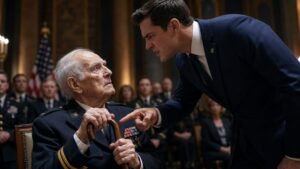
Stephanie Wright’s shadow fell across Edward Hall’s tray before he had taken his first sip of coffee.
It stretched over the scrambled eggs, the square of toast, the metal fork lined neatly beside the knife, and the black mug he had set exactly two inches from the tray’s upper right corner. Edward noticed the shadow before he noticed the soldier. Shadows had always told him when a room changed. In aid stations, in field tents, in doorways where bad news waited, a shadow came first.
He did not look up immediately.
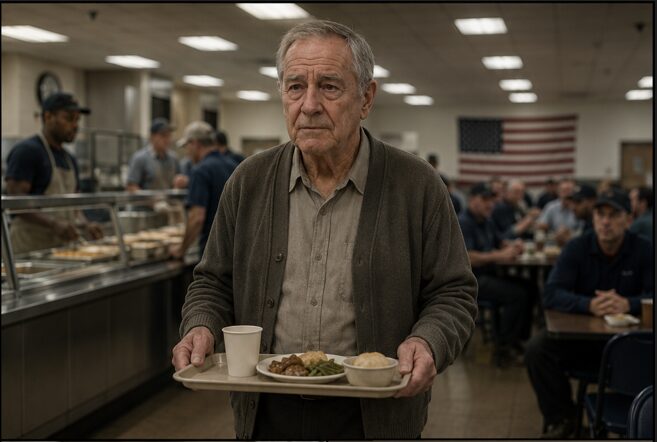
The dining facility was louder than usual. Inspection week always made young soldiers eat like they were being watched, even when they were only watching each other. Metal chairs scraped against polished concrete. Trays clicked down too hard. Somewhere near the serving line, a worker called for more coffee filters. At the dish-return window, steam breathed out in white bursts every time the rack came through.
Edward touched the handle of his mug.
“Sir,” the soldier said.
Not soft. Not rude yet. Just pointed.
Edward lifted his eyes.
She stood on the other side of Table Six in a pressed camouflage uniform, sleeves sharp, jaw set, a clipboard tucked beneath one arm. Staff sergeant stripes. Young enough to still believe a room obeyed the person who looked most certain. Behind her, two privates paused with their trays, waiting to see whether this was official enough to stop traffic.
Edward knew her by sight. Stephanie Wright. She had been assigned to dining facility traffic and conduct during the inspection window. For three days she had walked the room as if every coffee spill were evidence.
“You can’t sit here,” she said.
Edward rested his left hand on his knee. His right stayed beside the mug.
The black ceramic had a small pale chip along the rim. He always turned the chip away from himself.
“This table is for active personnel during peak meal period,” Stephanie said. “There are signs posted at the entrance.”
Edward glanced toward the entrance. The signs were new, laminated, taped at eye level beside the hand sanitizer station. He had read them when he came in. He read all posted signs. A man did not spend years in the Army and ignore paper taped to a wall.
His lanyard lay against his blue work shirt, faded at the edges where his thumb had rubbed it over the years. The plastic sleeve held an access card with his name, a blurred photograph, and a colored stripe that used to mean something quickly understood.
He lifted it slightly. “I have a pass.”
Stephanie looked at the card without leaning closer. “That pass doesn’t authorize you to take up a soldier-designated table during inspection hours.”
The words carried. They were not shouted, but the dining hall had a way of lowering itself around conflict. A fork stopped tapping. Someone at the next table pretended to study a packet of hot sauce. Edward could feel the attention moving toward him, cautious and hungry.
He had been looked at in worse rooms. By men missing parts of themselves. By boys trying not to cry. By officers deciding which mother would be called first. This room was only steel tables and fluorescent lights.
He slid his tray a little closer to himself. “I’ll be finished soon.”
“That’s not the point, sir.”
The last word had lost its courtesy.
Stephanie set the clipboard down on the end of Table Six and reached toward his tray, not to take it exactly, but to move it, to make the table obey her hand. Edward’s fingers tightened around the mug handle. He did not raise his voice. He did not touch her wrist.
The edge of the clipboard struck his fork.
Silverware hit the floor.
The sound was small and enormous. Fork, knife, spoon, one after another, bright against concrete. The spoon spun once and came to rest near Stephanie’s right boot.
For a moment no one moved.
Edward looked at the spoon. Then at her boot. Then at the black mug, untouched beside his tray.
Stephanie’s face changed in a way most people would have missed. Not regret. Not yet. Annoyance first, because the room had seen the mistake before she could control what it meant.
“I didn’t—” she started.
Edward pushed his chair back.
The legs scraped. Several heads turned fully now. He felt his knees complain before he bent. His left hand found the edge of the table, then the air, then his own thigh. He lowered himself slowly, not because he wanted sympathy, but because age had made speed an unreliable witness.
The fork lay under the table lip. The knife near his shoe. The spoon beside her boot.
No one spoke.
He picked up the fork first. He wiped it with a napkin though he would not use it again. Then the knife. When he reached for the spoon, Stephanie shifted her boot half an inch back. Not enough to help. Enough to show she knew it was there.
Edward’s fingers closed around the spoon.
He remembered another floor, not concrete, not polished, but packed earth gone dark beneath canvas. He remembered a young soldier apologizing because his hands would not stop shaking and he had dropped a tin cup. Edward had picked that up too.
He stood carefully.
A private near the beverage station had his phone low against his chest, camera tilted in that cowardly way young people thought made them invisible. Edward saw the lens. The private looked away too late.
Edward placed the silverware on the tray. Then he lifted the black mug and set it farther from the clipboard.
Stephanie stared at him now. Her cheeks had color in them.
“Sir, I need you to move to the civilian seating area,” she said, quieter.
Edward looked at the empty chair across from him at Table Six.
There had been days when that chair seemed louder than the whole dining facility. Today, with all these living bodies and all this food, it seemed almost hidden.
He picked up the tray.
The black mug remained on the table.
Stephanie’s eyes flicked to it. “You forgot your cup.”
Edward held the tray against his chest with both hands. His lanyard swung forward, plastic tapping the tray’s edge.
“This table was never mine to take,” he said.
The sentence landed strangely. He saw it strike her, saw her try to sort it into apology, excuse, confusion, defiance. It fit none of those boxes.
He reached for the mug with two fingers through the handle and placed it carefully on the tray. He did not look around to see who had heard. He did not ask the private to stop recording. He did not tell Stephanie what years she was standing in.
He walked toward the dish-return window.
The room resumed badly behind him. Forks moved too loudly. Conversations restarted in pieces. Someone coughed. Someone laughed once and stopped when no one joined.
At the dish area, Charles Roberts stood behind the counter with sleeves rolled, watching through the steam. Charles had the heavy shoulders of a man who had spent half his life carrying boxes and the other half carrying things no one wrote down. His eyes dropped from Edward’s face to the tray.
“Edward,” he said under his breath.
Edward set the tray on the return belt. “Eggs were cold.”
Charles did not smile. “You all right?”
Edward turned the black mug in his hand so the chipped side faced his palm. “Coffee’s still hot.”
“You want me to say something?”
Edward looked back into the dining room. Stephanie had not moved. The private with the phone was whispering to another soldier now, both of them pretending not to glance at him.
“No,” Edward said.
“That wasn’t right.”
Edward rinsed the mug himself at the small side sink, though the sign above it said STAFF ONLY. He did not use soap. He never used soap on that mug in the dining facility. Hot water, his thumb around the rim, the chipped place wiped twice. That was enough for today.
Behind him, a tray clattered into the wrong bin, and a dining worker snapped at someone to separate plastics.
Charles leaned closer. “That pass is still good as far as I’m concerned.”
“As far as you’re concerned isn’t printed on it.”
Charles had no answer for that.
Edward dried the mug with a brown paper towel and tucked it against his ribs. He could have gone back to Table Six. He could have stood in the center of the room and said enough to turn every eye away from him in shame. There were words that still worked when spoken plainly. Names. Dates. Places. Promises.
He had spent years not using them.
At the exit, he paused beside the bulletin board. The new dining policy was pinned above a flyer for a transition workshop. Active personnel priority seating during peak meal period. Valid exceptions must be listed with facility command prior to inspection.
Valid exceptions.
Edward rubbed his thumb once over the lanyard sleeve. The plastic had cracked at one corner. He had meant to ask Charles for a new sleeve two months ago and had not. A man could put off small repairs until they became explanations.
Behind him, Stephanie’s voice returned, clipped and official.
“Private, put the phone away.”
Edward did not turn.
He stepped into the hallway that smelled of floor wax and old coffee and moved toward the side corridor, the mug warm beneath his arm.
Inside the dining facility, Stephanie Wright picked up her clipboard from Table Six. She stared at the empty place where the black mug had been, then wrote the first line of an incident note.
Unauthorized civilian occupying soldier-designated seating, Table Six.
Chapter 2: The Lanyard Proved Less Than It Promised
Stephanie expected the record to prove the old man wrong.
That was the cleanest version of the afternoon, and she needed a clean version. The inspection officer had already walked through the facility twice that morning with a face like a locked filing cabinet. The base commander wanted no surprises. Charles Roberts wanted everyone to “use common sense,” which in Stephanie’s experience meant no one wanted to write down what the actual rule was.
So she stood in the cramped dining office with Edward Hall’s faded lanyard number copied onto a yellow sticky note and waited while the administrative clerk searched the access database.
The clerk frowned.
Stephanie felt the first unwelcome shift in the day.
“What?” she asked.
“There’s a Hall, Edward,” the clerk said. “But the category is old.”
“Old how?”
“Old as in I haven’t seen this code before.”
The office smelled of printer heat and onions from the kitchen. A fan clicked in the corner without moving much air. On the wall above the desk, a laminated inspection checklist hung beside a photo of the dining facility staff from years before. Stephanie saw Charles in the back row, heavier then, smiling like someone had caught him off guard.
She leaned toward the screen. “Is he authorized or not?”
The clerk clicked another tab. “He has facility access.”
“For dining?”
“That part’s not clear.”
“Peak meal period?”
“Definitely not clear.”
Stephanie straightened. Her jaw tightened before she could stop it. “Then I was right to question him.”
The clerk gave her a look that was not disagreement exactly. More like caution.
Question him. That was the safe phrase. It left out the silverware. It left out the way he had bent down while the whole room breathed around him. It left out his line about the table not being his.
The office door opened before Stephanie could ask for a printout.
Charles Roberts filled the doorway. He had a towel over one shoulder and a look on his face that made the clerk suddenly interested in the keyboard.
“You looking up Edward?” Charles asked.
Stephanie kept her tone even. “I filed an incident note. I’m verifying access.”
“Should’ve verified before you moved his tray.”
Heat went up her neck. “I did not move his tray.”
Charles looked at her.
She heard the silverware again.
“I attempted to clear a soldier-designated table during peak meal period,” she said. “His utensils fell. That was accidental.”
“And after they fell?”
Stephanie said nothing.
Charles stepped inside and shut the door behind him. “Edward Hall isn’t just a civilian.”
“Then what is he?”
Charles glanced at the clerk. The clerk immediately stood. “I need to check the freezer log.”
When the door closed again, Stephanie folded her arms. “I’m not asking for gossip. I’m asking for status.”
“He’s retired Army.”
“Lots of retirees come through base. That doesn’t mean they sit wherever they want during inspection.”
“No,” Charles said. “It doesn’t.”
The answer irritated her because it gave her no place to put her anger. “Then explain the pass.”
Charles walked to a file cabinet with one drawer that didn’t match the others. He put a hand on it, then seemed to decide against opening it.
“That lanyard came out of a transition meal program,” he said.
“What program?”
“Old one.”
“Current policy?”
“Not exactly.”
Stephanie exhaled through her nose. “That’s not an answer.”
“It’s the answer I have.”
“No, it’s the answer people give when they want exceptions without responsibility.” She regretted how sharp it sounded, but not enough to take it back. “I have inspection staff asking about unauthorized bodies in controlled spaces. I have soldiers being told one standard and civilians apparently operating under another. If there is an exception, it needs to be documented.”
Charles’s eyes hardened, but his voice stayed low. “You think Edward is trying to get away with something?”
“I think nobody wants to say what he is allowed to do.”
That stopped him.
Outside the office, a dish rack slammed into place. Someone laughed in the kitchen, then lowered their voice.
Charles removed the towel from his shoulder and folded it once, twice, too carefully. “He comes Tuesdays and Thursdays. Sometimes Fridays if the chapel has a veterans group. He sits at Table Six. Drinks coffee. Eats whatever isn’t too salty. If we’re short in dish return, he helps until I tell him to stop pretending he works here.”
“That’s routine,” Stephanie said. “Not authorization.”
“You always talk like a checklist?”
“When checklists are what keep people from getting relieved.”
Charles looked at her then with something closer to understanding. Not forgiveness. Understanding was more uncomfortable.
“Inspection got you spooked,” he said.
“It has everyone spooked.”
“No. It’s got you spooked.”
Stephanie looked away first. On the desk, Edward’s access record glowed in pale blue boxes. Name. Old photo. Facility access. Legacy code. No clear expiration date on the main screen, but no active program title either.
She had seen soldiers use confusion like a weapon. Contractors too. Retirees sometimes. Everyone knew someone. Everyone had a story. Rules collapsed first through sympathy, then through habit, and by the time something went wrong, the person who failed to enforce the line was the one standing alone.
“Print the record,” she said.
Charles did not move. “Stephanie.”
The use of her first name made her look at him sharply.
He lowered his voice. “You embarrassed him.”
“He was out of compliance.”
“You embarrassed him first.”
The words landed harder than the accusation in the dining hall because they came without witnesses. Stephanie wanted to defend herself, but the room gave her back the memory in pieces: the spoon by her boot, Edward’s careful hand, the old man’s knees bending while young soldiers watched.
She reached for the sticky note. “Then help me fix the record.”
Charles gave a short laugh without humor. “You think that’s what fixes it?”
“I think if he’s authorized, it protects him. If he’s not, we need to know that too.”
Charles finally opened the mismatched drawer. Inside were hanging folders labeled in old marker. Meal Cards. Volunteer Access. Transition Group. Legacy Exceptions.
He pulled one halfway, then stopped as if the paper itself had weight.
“I’ll look,” he said.
“You’ll look now.”
He shut the drawer again.
Stephanie stared at him. “Why is everyone careful when his name comes up?”
Charles did not answer quickly. When he did, his voice was flat. “Because some people earned more than the paper kept up with.”
“That sounds meaningful. It isn’t usable.”
“No,” Charles said. “It isn’t.”
Her radio clicked at her shoulder. A voice from the inspection team asked for the dining facility access exception list by close of business. Stephanie pressed the button.
“Copy. I’ll provide it.”
Charles closed his eyes briefly.
“What list?” he asked.
“All nonstandard dining access. Civilian, retiree, volunteer, legacy. Anyone not active personnel using meal-period seating or facility privileges.”
“That’s half the informal kindness on this base.”
“Then maybe kindness should have forms.”
The sentence sounded colder outside her head than it had inside.
Charles opened the drawer again and removed a thinner folder from the back. He didn’t hand it to her. He set it on the desk between them.
On the tab, in faded block letters, someone had written: TABLE SIX.
Stephanie’s pulse gave one hard beat.
She opened the folder. The top page was a photocopy of an old facility memo, edges blurred from too many copies. Beneath it was a roster of names, some crossed out, some marked transferred, discharged, deceased. Edward Hall’s name appeared near the bottom in blue ink, added after the typed list had been made.
Beside his name was a note in smaller writing.
Table Six accommodation — legacy status pending.
Stephanie read it twice.
Pending.
The word made everything worse. Pending meant unfinished. Pending meant someone had meant to decide and had not. Pending meant Edward Hall might belong there in every human way and still be indefensible on a report.
Charles watched her read.
“Now you see the problem,” he said.
Stephanie closed the folder slowly. She thought of Edward’s black mug sitting near the dish-return rack after he left, unwashed for several minutes because none of the workers had touched it. She had noticed it then and told herself it was just a cup.
“What is the accommodation?” she asked.
Charles looked toward the dining room, where lunch had thinned into scattered trays and the uneasy shine of wiped tables.
“I was hoping,” he said, “you wouldn’t make me find out on paper.”
Chapter 3: A Video Without The Quiet Part
Edward heard the whispering before he saw the phone.
Two young soldiers stood near the dining facility entrance the next morning, shoulders angled inward, heads bowed over a screen. Their voices were low, but age had left Edward with hearing that failed at soft kindness and sharpened around trouble.
“That’s him,” one said.
The other glanced up too quickly.
Edward stopped with his hand inside his coat pocket, fingers around the black mug. He had brought it wrapped in a clean paper towel, not swinging loose from his hand the way he usually did. He had told himself the towel was because the morning was cold. The truth sat heavier than ceramic.
The soldiers straightened.
“Morning, sir,” one muttered.
Edward nodded.
On the phone screen, frozen for half a second before the soldier locked it, was a crooked image of the dining room floor. His hand reaching for a spoon. Stephanie’s boot beside it. The edge of his blue sleeve.
Not the line he had said after.
Not the empty chair.
Not the mug.
Only the old man bending.
Edward looked at the locked phone until the soldier slipped it behind his thigh.
“Private,” Edward said.
The soldier’s ears reddened. “Sir?”
“What’s your name?”
“Jason Scott, sir.”
Edward glanced at the other soldier, who found sudden purpose in the posted breakfast menu and moved away.
Jason stayed because he had been addressed, and the Army had at least taught him that much.
“Did you take that video?” Edward asked.
Jason swallowed. “Not exactly.”
Edward waited.
“I mean, I got part of it. But I didn’t post it public. Just sent it to a couple guys because—” He stopped, then rushed on. “Because what she did was wrong.”
Edward removed his hand from his coat pocket. The mug stayed hidden.
“What did she do?”
Jason blinked. “She made you pick up your silverware.”
“She dropped them?”
“Well, her clipboard did.”
“Then say that.”
Jason’s mouth opened, but no answer came out.
Behind them, breakfast traffic moved around the bottleneck they had created. Soldiers carried trays stacked with pancakes. A dining worker replaced a tub of plastic-wrapped muffins. The smell of burned coffee drifted from the beverage station.
Jason lowered his voice. “I was trying to help you.”
Edward looked at him then, really looked. The private’s face was young in the way soldiers’ faces became young when they were caught between shame and wanting credit. He was not cruel. That almost made it more dangerous.
“By showing people the worst part without the rest?”
Jason shifted. “The rest was hard to hear.”
“Then maybe it wasn’t yours to carry.”
The private flinched as if Edward had raised his voice.
Edward had not.
Inside the dining facility, Table Six was empty. Wiped clean. Four chairs tucked in. A laminated sign at the entrance now read PEAK HOURS: ACTIVE PERSONNEL PRIORITY. He did not know whether it had been there yesterday morning or whether he only hated it today.
His usual path would have taken him through the line, past the oatmeal, past the eggs, coffee last, then Table Six. He had walked that path so many times his feet knew the turns before his eyes did. Today he stood outside the entrance as if he needed permission from the floor.
Jason glanced toward the serving line. “You want me to delete it?”
“Yes.”
The answer came too fast. Edward heard the pride in it. Not pride in being right. Pride in hiding.
Jason unlocked the phone, tapped, hesitated.
Edward knew that hesitation. Men hesitated before pulling bandages. Before opening letters. Before saying the thing that changed the room.
“It’s already in the barracks chat,” Jason said.
Edward closed his eyes briefly.
“Then take down what you can.”
“I can tell them what happened.”
“No.”
“But if they only see that part—”
“They already only see that part.”
Jason looked confused. Edward did not have the energy to teach him that defense could become another kind of handling. The young always believed exposure was justice because they had not yet been exposed by people who claimed to mean well.
The dining facility doors opened behind them.
Stephanie Wright stepped out with a folder under one arm.
She saw Edward, then Jason, then Jason’s phone. Her face tightened, but not with the clean anger from yesterday. This was something messier. Alarm, maybe. Embarrassment. Sleep lost.
“Private Scott,” she said. “Why are you blocking the entrance?”
Jason locked his phone again. “I’m not, Staff Sergeant.”
“You are.”
He moved.
Stephanie’s eyes came to Edward. “Mr. Hall.”
He noticed the change. Mr. Hall, not sir, not unauthorized civilian. Her voice had edges sanded down by a night of thinking. But the folder under her arm told him thinking had not stopped paperwork.
Edward nodded once. “Staff Sergeant.”
Jason looked between them, hungry for the next scene.
Edward turned to him. “Delete what you can.”
Jason’s face fell. “Yes, sir.”
Stephanie waited until he had gone inside. Then she lowered her voice.
“I need to ask you a few questions about your access status.”
“No.”
She inhaled, held it, released it. “This isn’t optional.”
“Most things are.”
“Not when inspection staff are requesting documentation.”
Edward looked past her through the glass. Table Six waited beneath fluorescent light, innocent as furniture. He could walk in, set the mug down, force the issue simply by sitting. Instead, he kept the mug in his pocket like contraband.
Stephanie followed his gaze. “I found your name in a folder.”
He did not ask which one.
“It says legacy status pending,” she continued. “It references Table Six. I need to know what that means.”
Edward’s hand tightened around the mug.
“You should ask Charles.”
“I did.”
“Then you know what he knows.”
“I know he’s avoiding something.”
Edward almost smiled. “Charles has made a life of that.”
“This could affect your access to the facility.”
“There it is,” Edward said softly.
Stephanie’s expression sharpened. “There what is?”
“The part where concern becomes a door.”
She looked wounded for half a second, then angry because wounded was not useful to her. “You think I want to do this?”
“I think you already did.”
Her mouth closed.
The hallway seemed to narrow around them. A tray cart rattled somewhere inside. Over Stephanie’s shoulder, Jason had rejoined two soldiers near the drink station. One of them glanced at Edward, then down at his own phone.
Public property, Edward thought.
That was what happened when a private thing entered a room and no one knew how to leave it alone.
Stephanie lowered the folder. “I made an incident note yesterday. I may have to attach a statement today.”
“Then write what you saw.”
“I saw an unclear pass, a restricted table, and a situation I should have handled differently.”
It was the last part that made him look at her.
She did not look away.
He could have helped her then. A few sentences. A date. A program name. Charles would confirm it. Ruth would confirm what Charles could not. The mess hall would remain open to him, perhaps. Table Six would stay a table.
But the words rose with other things attached. A young man’s hand gripping his sleeve. Coffee gone cold in a black mug. The shame of surviving long enough to explain the dead to people who wanted clean categories.
Edward stepped aside from the entrance.
“I’m not eating today,” he said.
Stephanie’s face changed. “Mr. Hall—”
“Tell Charles the eggs can be cold without me.”
He walked past her down the hallway.
The black mug knocked gently against his hip inside the coat pocket with each step. Its weight was familiar, but today it felt hidden in the wrong way. Not protected. Smuggled.
He made it as far as the side corridor before Ruth Campbell appeared from the chapel hallway carrying a stack of folded programs against her chest. She took one look at his empty hands and then at his coat pocket.
“You didn’t sit,” she said.
Edward stopped. “Morning, Ruth.”
“Don’t morning me when you’re walking like that.”
He looked back toward the dining facility. Stephanie was still by the entrance, watching him with the folder held flat against her side.
Ruth followed his glance. “Something happened.”
“Something small.”
“Small things don’t make men carry cups in their pockets.”
He had no answer that would not become larger than he could bear in a hallway.
A door opened at the far end. The administrative clerk hurried out with two printed sheets and called for Staff Sergeant Wright. Stephanie turned. The clerk spoke quietly, but the corridor carried enough.
“Command wants your written statement before fourteen hundred. They’re reviewing whether Hall’s access should be suspended until the exception list is cleared.”
Ruth’s fingers tightened around the chapel programs.
Edward stood very still.
Stephanie looked down at the papers, then across the corridor at him. For the first time since he had met her shadow over his tray, she looked less like someone giving an order than someone realizing the order had already moved beyond her hand.
Edward touched the mug through his coat.
He had spent years keeping the story off paper.
Now paper was coming for the table.
Chapter 4: The Table No One Wanted To Explain
Charles Roberts unlocked the storage cabinet with a key he had carried for seven years and avoided using for six.
The lock stuck on the first turn. It always did. He had told himself that was why he never opened it, that the old metal cabinet was more trouble than it was worth, that the dining facility had newer records, newer policies, newer problems. But when the administrative clerk slid the inspection request onto his desk and pointed to the line marked “nonstandard dining access,” Charles knew the cabinet had been waiting for him.
Behind him, Stephanie Wright stood with Edward’s folder against her chest.
“Is that where the Table Six records are?” she asked.
Charles twisted the key harder. The lock snapped loose.
“Some of them.”
“Some?”
“The Army moves paper like it moves people. Not always in one piece.”
He opened the cabinet.
The smell came out first. Old file folders, dust, cardboard, and the faint stale edge of coffee that had soaked into paper years ago. Inside were stacked meal cards, retired visitor badges, volunteer rosters, training memos, chapel luncheon lists, and unlabeled envelopes with rubber bands gone brittle.
Stephanie stepped closer but did not reach in. Charles noticed that. Yesterday she would have reached. Today she waited.
On the top shelf, beside a box of faded name tents, sat a black ceramic mug.
Charles stared at it.
It was not Edward’s mug, not the one he carried now. This one had the same shape, same plain glaze, same heavy handle, but a crack ran down from the rim like a dark vein. A small piece of masking tape clung to the bottom. Charles lifted it carefully and turned it over.
TABLE SIX – DO NOT DISCARD.
Stephanie saw the label. “Why is there another one?”
Charles set the mug on the desk like it might break from being looked at too hard. “There used to be more than one.”
“Mugs?”
“Seats.”
She frowned. “For the transition program?”
He pulled the folder marked TABLE SIX and opened it beside the mug. The top memo was dated long before her assignment to the base. It described a pilot meal access arrangement for wounded service members transitioning out, recently retired veterans attached to medical follow-up, and certain volunteers approved through the chapel and dining office. Table Six had been designated informal seating during non-peak hours. A place where men and women who were no longer fully in the Army but not yet steady outside it could eat without explaining themselves.
Stephanie read over his shoulder. “This expired.”
“Yes.”
“Years ago.”
“Yes.”
Her face tightened, but not with satisfaction. “Then why was he still using it?”
Charles turned a page. Several names were crossed out. A few had notes beside them. Transferred. No longer local. Deceased. Requested removal. Edward Hall’s name appeared at the bottom, added in blue ink after the typed roster had ended.
“Because the program ended on paper before the need ended in the room,” Charles said.
“That’s not an authorization.”
“No.”
She looked at him. “You knew?”
“I knew enough to leave him alone.”
“That isn’t the same.”
He almost snapped at her. The words rose hot and old. You think I don’t know that? You think I haven’t watched the paper rot while the man kept showing up with his cup? But anger would be easy, and Charles had spent years hiding behind easy silence.
He opened another folder. “When the program was active, Edward helped with it. He was retired by then but still working part-time here. Dish return, inventory, coffee station, whatever needed doing. He could talk to the ones who wouldn’t talk to counselors. Mostly because he didn’t ask them to.”
Stephanie’s eyes moved to the cracked mug.
“He was a medic?”
Charles nodded. “Before my time here. Before most people’s time.”
“Then why not just document him properly?”
The question was fair. That made it worse.
Charles took out a stack of meal cards held together by a binder clip. “Because the chaplain changed. The commander changed. Dining contracts changed. The transition office moved buildings twice and then folded into something with a longer name. Every time someone said, ‘We’ll clean it up after the next inspection.’”
“And no one did.”
“No one did.”
Stephanie set Edward’s current folder on the desk. The printed access record looked clean and useless beside the old papers.
The office phone rang. Charles ignored it. It rang three times, stopped, then his radio crackled from the desk.
“Dining manager, command office requesting status on exception list.”
Stephanie looked at the radio. “They asked me for the same.”
Charles pressed the button. “Working it.”
“Command wants preliminary names within the hour.”
“Copy.”
The radio went quiet.
Stephanie rubbed one hand over her forehead, then caught herself and dropped it. Charles saw the soldier come back over the woman. Straight spine. Controlled jaw. Clipboard face.
“We have to report this,” she said.
“We have to report accurately.”
“Accurately is that Edward Hall has no current written authorization for peak meal seating.”
Charles shut the folder.
Stephanie held his gaze. “I’m not saying he deserves what happened.”
“No,” Charles said. “You’re saying the paper makes you less wrong.”
Her face flushed. For a moment she looked as young as Jason Scott. “I’m saying if someone had maintained the records, I would have known what I was looking at.”
“You saw an old man with a pass.”
“I saw an unclear exception during an inspection I was assigned to control.”
“You saw him bend.”
The room went silent.
Stephanie looked down at the cracked mug. When she spoke again, the force had gone out of her voice. “I know.”
Charles believed her. He did not know what to do with that either.
He gathered the Table Six folder, the legacy roster, and the current access printout. “Command needs to understand this isn’t a trespass problem.”
“It may still be an access problem.”
“It’s a memory problem.”
“That won’t fit in the form.”
“No,” Charles said. “Most true things don’t.”
The inspection officer arrived ten minutes later with the base commander on speakerphone and a patience level that had already expired. Charles laid out the records on the desk. Stephanie stood beside him, arms at her sides, not behind her back, not crossed.
The inspection officer skimmed the memo. “This program is inactive.”
“It was never properly closed,” Charles said.
“Inactive is inactive.”
Stephanie glanced at him but said nothing.
The commander’s voice came through the phone, thin and official. “We cannot have undocumented access exceptions during inspection. Suspend all informal veteran dining accommodations until the list is reconciled.”
Charles felt the words hit harder than he expected.
“All?” he asked.
“Temporarily.”
“Sir, Edward Hall has been using this facility for years.”
“Then a week will not harm him.”
Charles looked at the cracked mug. A week could harm a man if it took the only place where he still knew how to sit.
Stephanie spoke before Charles could. “Sir, my incident yesterday contributed to the urgency. I recommend we review Hall’s file before issuing a blanket suspension.”
The speaker gave a brief pause. “Staff Sergeant Wright, your written statement is pending. Submit it by fourteen hundred. Dining manager, send preliminary names. Until then, no legacy seating privileges during peak meal hours.”
The call ended.
Stephanie stared at the dead phone.
Charles wanted to blame her. It would have been simple and partly true. But he had left the folder in a drawer. He had let Edward carry the whole explanation in a cracked system because Edward preferred silence and Charles preferred peace.
He turned back to the cabinet.
“What else is in there?” Stephanie asked.
“Things I should have dealt with.”
On the bottom shelf, beneath a box of unused visitor badges, he found a plain white envelope with Edward’s handwriting on the front. Charles knew the hand at once: squared letters, hard pressure, no wasted curves.
For Charles – if anyone tries to make a display of it.
His throat tightened.
Stephanie did not move closer. “Is that from him?”
Charles opened the envelope with his thumb. Inside was one sheet of lined paper, folded twice. No date. No greeting beyond his name.
The message was only one sentence.
Do not use the table for ceremony.
Charles read it once, then again.
Stephanie’s voice was almost a whisper. “What happened at that table?”
Charles folded the paper along its old creases and looked through the office window toward the dining room, where Table Six sat empty under fluorescent lights, clean enough for inspection and stripped of every reason it mattered.
“I think,” he said, “Edward has been trying to keep us from finding out the wrong way.”
Chapter 5: The Promise Inside The Black Mug
Ruth Campbell found Edward in the dark dining hall setting the black mug on Table Six even though the entrance sign now said legacy seating was suspended.
He had not turned on the overhead lights. Only the emergency strips glowed above the exits, laying pale lines across the polished floor. The serving stations were closed behind metal shutters. Chairs had been placed upside down on most tables for mopping, but not on Table Six. Edward had lowered those chairs himself and set one across from him.
Ruth stopped just inside the doorway with her chapel keys still in her hand.
“Edward.”
He did not startle. “Door was unlocked.”
“That is not an answer.”
“No.”
She walked in slowly. The room smelled of disinfectant and old fryer oil. At night, without soldiers and trays and voices, the dining facility became too large for what it held. Every sound carried. Ruth’s shoes tapped lightly until she reached the table.
The black mug sat in the place he always put it, two inches from the upper right corner. The chip faced away from him.
“You know they suspended access,” Ruth said.
“I’m not eating.”
“That is also not an answer.”
He pulled a paper napkin from his coat pocket and wiped a circle on the table that was already clean.
Ruth watched the motion. “Charles called me.”
“Charles talks too much when he feels guilty.”
“He said command is asking about Table Six.”
Edward folded the napkin once, then again. “Command asks about many things.”
“Stephanie Wright was in the records room.”
His hand stopped.
Ruth sat across from him, in the chair he had left empty. He looked at her then. Not sharply, but with a tiredness that made the space between them feel old.
“That seat’s taken,” he said.
“I know.”
For a moment neither of them moved.
Ruth had known Edward long enough to understand that silence could be a door or a wall, and he rarely labeled which one. She set her chapel keys on the table, not too near the mug.
“They may erase the accommodation,” she said.
“It was erased years ago.”
“Not while you kept coming.”
He looked toward the dark serving line. “That isn’t the same as keeping it alive.”
“No. It is the same as refusing to let it disappear without witness.”
Edward gave a faint, humorless breath. “You sound like a chaplain.”
“I work near one. Sometimes it rubs off.”
He did not smile.
Ruth reached into her bag and took out a folded copy of the temporary suspension notice. She placed it on the table. Edward did not look down.
“If you tell them nothing,” she said, “they will make their own story.”
“They already have.”
“Then tell enough.”
His eyes came back to her.
That was the argument they had circled for years. Tell enough. Not everything. Not the worst parts. Not the names if he could not bear them. Enough to keep careless people from replacing truth with convenience.
Edward lifted the mug. “You remember the first one?”
“The cracked one?”
He nodded.
“Charles found it.”
Edward’s thumb moved over the rim. “I told him not to keep that.”
“You told Charles many things he did not obey. Usually for your own good.”
“No one asked him to do that.”
“No one asked you to sit here twice a week either.”
The words were gentle. They still struck.
Edward stood with the mug and walked to the side sink near the dish-return area. Ruth followed but stayed several feet back. He turned on the hot water. The pipes knocked once in the wall before the stream ran steady. He washed the mug by hand, thumb around the chip, the same slow circle repeated three times.
“There was a kid,” he said.
Ruth did not move.
Edward kept his eyes on the water. “They’re all kids when you get old enough. But he really was. Couldn’t grow a full mustache. Tried anyway.”
The water ran over the black ceramic.
“He sat there?” Ruth asked.
Edward turned the mug in his hands. “Not here at first.”
He did not say where at first. Ruth did not ask.
“He used to complain about the coffee. Said Army coffee tasted like somebody boiled a boot and lost the boot.” Edward’s mouth shifted, not quite a smile. “Still drank it.”
The dining hall hummed around them, refrigerators, vents, old electricity.
“He was scared of going home,” Edward said. “Not of dying. That part had already come and gone by then, at least in his head. He was scared of sitting at his mother’s kitchen table and having everybody look at him like he was supposed to be grateful for being alive.”
Ruth felt her throat tighten but kept her face still.
Edward shut off the water. He dried the mug with a brown paper towel from the dispenser.
“He made me promise something foolish.”
“Was it foolish?”
“At the time, yes.”
“What was it?”
Edward came back to Table Six and set the mug down. He did not sit.
“He said if he didn’t make it all the way back, someone should leave coffee for the ones who got close.” His fingers rested on the chair back. “Not a monument. Not a speech. Just a cup. A chair. A place where nobody asked them to explain why being home didn’t feel like home.”
Ruth looked at the empty chair she had taken. Slowly, she stood.
Edward’s jaw tightened. “I didn’t mean you had to—”
“I know.”
She moved to the side of the table.
Edward stared at the chair.
“He died?” Ruth asked.
Edward’s answer took time. “Not that night.”
That was all he gave her, and it was enough to tell her there were worse rooms behind this room.
He sat down heavily. “When the transition program started, it made sense. They had paperwork for it then. Meal cards. A list. A chaplain who understood quiet. Some of them came once. Some came for months. Some sat and said nothing. That was allowed here.”
“And when the program ended?”
He looked at the mug. “People stopped coming. Or they moved on. Or they didn’t. The Army changed the name of the office. Charles kept the table. I kept the cup.”
Ruth placed her hand on the back of the empty chair. “And you kept the promise.”
“I kept a routine.”
“That is how some promises survive.”
Edward’s face hardened. “If they hear it, they’ll turn it into something.”
“They might.”
“They’ll print a sign. Put a ribbon around the table. Make some young soldier read a paragraph off a card.” His voice stayed low, but Ruth heard the break in the restraint. “They’ll make him useful to them. He was tired of being useful.”
The words filled the room and stayed there.
Ruth understood then why the note had said no ceremony. Edward was not guarding a secret because he wanted reverence. He was guarding it because reverence could become another kind of taking.
A soft sound came from the hallway.
Edward turned.
Stephanie Wright stood just beyond the dining room entrance, half in shadow, the folder held against her chest. Her eyes were wet, though she had not let anything fall. She looked not like a soldier catching a violation but like a person who had opened the wrong door and found herself inside someone else’s grief.
Ruth’s hand tightened on the chair.
Edward stood.
Stephanie stepped forward only one pace. “I’m sorry,” she said, but the words came out too quickly, too small for the room. She seemed to know it because she swallowed and started again. “I heard enough to know I shouldn’t have heard it that way.”
Edward said nothing.
Stephanie looked at the mug, then at the empty chair, then back to him. “I have to submit my statement before morning.”
“That’s your duty.”
“No,” she said. “My duty was to ask before I made you bend.”
The room held still.
Edward’s face changed by almost nothing. But Ruth saw his fingers release the chair back.
Stephanie lifted the folder slightly. “Mr. Hall, I need to correct what I wrote. Not to protect myself. Not to make this a story for command. I need to correct it because if I don’t, they’ll use my words to close this table.”
Edward looked at the black mug.
For years, silence had kept the promise small enough to survive.
Now silence had become the thing pressing its hands over the cup.
Stephanie took one more step into the dining hall.
“Please,” she said. “Tell me what I’m allowed to say.”
Chapter 6: The Apology He Would Not Let Become A Show
Stephanie entered the command conference room expecting punishment, but the apology had already been written for her.
A printed statement sat at each place around the table, aligned with the precision of people who believed neat paper could make an untidy thing behave. The base commander stood near the window with the inspection officer beside him. Charles Roberts was already seated, hands clasped so tightly his knuckles had gone pale. Ruth Campbell stood at the back wall, not invited exactly, but present in the way she had learned to be present when no one wanted to admit they needed a witness.
Edward Hall sat at the far end of the table.
The black mug was in Stephanie’s hands.
She had carried it from the dining facility wrapped in a clean towel because Edward had allowed her to carry it and nothing more. He had not told her the young soldier’s name. He had not told her where the first promise had been made. He had given her only a narrow truth: Table Six began as a place for service members who were not ready to explain themselves; the mug was not a symbol for display; the accommodation had been neglected, not invented.
She had written her statement at 0300 with those boundaries in mind.
The paper on the conference table ignored all of them.
The top line read: PUBLIC APOLOGY AND RECOGNITION MOMENT – DINING FACILITY INCIDENT.
Stephanie’s stomach tightened.
The commander gestured toward the empty chair near Charles. “Staff Sergeant Wright.”
She remained standing. “Sir, what is this?”
“A controlled correction,” the commander said. “The video has circulated beyond the barracks chat. We need to address perception before inspection staff receive a distorted account.”
Edward did not look at the paper. He looked at Stephanie’s hands around the towel-wrapped mug.
The inspection officer spoke briskly. “At lunch, you will apologize to Mr. Hall in the dining facility. The commander will clarify that the base honors veteran service. Mr. Hall will be acknowledged as a respected retiree with historic ties to the facility. We will remove ambiguity.”
Charles muttered, “By creating a show.”
The commander’s eyes cut to him. “By preventing a larger problem.”
Stephanie set the mug gently on the table, still wrapped. “Sir, my statement does not recommend a public event.”
“No,” the inspection officer said. “Your statement is personal accountability. This is institutional response.”
Edward finally touched the paper in front of him. He slid it closer, read the first paragraph, and stopped at the phrase honored guest.
His mouth pressed into a thin line.
“Sir,” Stephanie said, “Mr. Hall specifically asked that Table Six not be used for ceremony.”
The commander looked at Edward. “Mr. Hall, with respect, the installation needs to demonstrate that we value our veterans.”
Edward folded the printed statement once.
Stephanie saw Charles close his eyes.
“With respect,” Edward said, “you’re holding the demonstration in the wrong hand.”
The room went still.
The commander’s face remained polite. “I understand this is sensitive.”
“No,” Edward said. “You understand it is visible.”
Stephanie felt the words move through the room. Not loud. Not angry. Worse for being precise.
The commander straightened. “A young staff sergeant publicly mishandled a situation involving a retiree. A partial video is circulating. Inspection is tomorrow. We are trying to restore dignity.”
Edward looked at the towel around the mug. “Whose?”
No one answered.
Stephanie forced herself to speak. “Sir, I did mishandle it.”
The commander turned to her. “That will be addressed.”
“I don’t mean in general.” Her hands wanted to clasp behind her back. She kept them at her sides. “I questioned him publicly when I could have asked privately. I treated uncertainty like misconduct. I let him pick up utensils I helped knock down. I called it control because I was worried about inspection.”
The admission did not free her. It made the room sharper.
The inspection officer studied her. “Staff Sergeant, this is not the time to overstate your fault.”
“I’m not overstating it.”
Edward looked at her then, and the look held neither comfort nor condemnation. It required her to stand inside what she had said without using his forgiveness as cover.
The commander sighed. “The point remains. We need a solution that satisfies policy.”
“I agree,” Edward said.
Everyone looked at him.
He unfolded the apology statement and laid it flat. “This does not.”
The commander’s patience thinned. “What would you suggest?”
Edward’s eyes went to the window. Beyond it, the dining facility roofline sat low and square beneath the morning light. Delivery trucks moved near the loading dock. Soldiers crossed the walkway in pairs, unaware that a table inside had become a problem too old for their schedules.
“I will not stand in that room while you tell young soldiers what to feel,” Edward said. “I will not have my name put on a sign. I will not have that table roped off like a display. And I will not let Staff Sergeant Wright become the neat answer to a mess she did not create alone.”
Stephanie stared at him.
She had expected anger. She had prepared for it, even welcomed it as something earned. She had not prepared for protection.
Charles leaned forward. “Edward—”
Edward raised one hand slightly, and Charles stopped.
“She did wrong,” Edward said. “She has said so. Let that stand. But the Army misplaced the table before she ever walked up to it.”
The commander’s expression changed, not softened, but checked. “What are you asking for?”
“A current written policy for transition and legacy meal access. Quietly posted. No ceremony. No announcement beyond what is needed. Table Six remains a table. If someone qualifies, they sit. If someone does not, they are spoken to privately first.”
The inspection officer began, “That may require—”
“Work,” Edward said. “Yes.”
Ruth lowered her eyes, but Stephanie saw the small movement at the corner of her mouth.
The commander looked at Charles. “Can dining support such a policy?”
Charles answered too quickly. “Yes.”
The commander held up a hand. “With proper verification.”
“Yes,” Charles said again, steadier. “We can coordinate with the chapel and transition office. We can make the category current. We should have done it years ago.”
The commander turned to Stephanie. “And you?”
She looked at Edward, then at the mug. “I’ll rewrite my statement to include my conduct and the access ambiguity. I’ll help draft the seating guidance. And I’ll speak to the soldiers on dining duty about private verification before public correction.”
The inspection officer frowned. “That is not a public apology.”
“No,” Edward said. “It is more useful.”
The room did not like that sentence. Institutions preferred visible repair. Useful repair left fewer photographs.
The commander walked to the table and picked up the printed apology plan. For a moment Stephanie thought he would insist. Then he tore it once down the middle, not dramatically, just enough to make it unusable.
“No ceremony,” he said. “But there will be documentation.”
Edward nodded. “Documentation is not the enemy.”
Charles gave a quiet breath that might have been relief.
Stephanie reached for the towel-wrapped mug. “Mr. Hall, where do you want this?”
Edward’s answer came after a pause.
“Not in here.”
She understood. The mug did not belong in a conference room beneath fluorescent lights and official seals. It had already been carried too far from its purpose.
The commander checked his watch. “Lunch begins in forty minutes. We will hold Table Six until the policy language is drafted.”
Edward stood slowly. “Hold it how?”
The inspection officer glanced at the commander. “Temporarily reserved.”
Edward’s face went unreadable.
No one noticed but Stephanie. Or perhaps Ruth did, because she moved away from the wall.
They left the conference room together, not as a group exactly, but as people tied to the same unresolved thing. Stephanie carried the mug beside her, uncovered now, one hand through the handle and one beneath the base. She did not swing it. She did not clutch it to her chest. She carried it as if careless motion might change its meaning.
At the dining facility entrance, the lunch line had not yet formed. Workers moved behind the serving stations. Charles went ahead to speak with the shift lead. Ruth remained near the doorway.
Edward stepped inside and stopped.
Table Six had been taped off.
A strip of blue painter’s tape ran from chair to chair, blocking the seats. At the center of the table stood a folded white card, written in thick black marker.
RESERVED DISPLAY – DO NOT USE.
Stephanie felt the mug grow heavier in her hand.
Edward looked at the card for a long moment. Then he looked at the empty chairs, the clean tabletop, the space where ordinary coffee should have been.
No one spoke.
The institution had obeyed the letter of his refusal and missed the whole of it.
Chapter 7: The Seat Was Left Open Without Applause
Edward removed the blue tape himself before anyone could decide whether stopping him would look worse than letting him do it.
The first strip came away with a soft tearing sound. It pulled a fleck of old varnish from the chair back and curled around his fingers like something that had been put there in a hurry and trusted too much. The dining facility had gone quiet at the wrong time. Lunch had begun, trays were moving, coffee was being poured, but the room had noticed the old man at Table Six again.
Stephanie stood two steps behind him with the black mug in both hands.
Charles had frozen near the dish-return window. Ruth waited by the entrance, chapel badge clipped to her sweater, watching as if she were prepared to step forward but knew she must not. The base commander was not in the room. The inspection officer was somewhere near the serving line, speaking into a phone and pretending not to watch.
Edward peeled the second strip from the chair.
A young soldier at the next table whispered, “Is that allowed?”
Edward did not look over.
Allowed was a small word that had done a great deal of damage.
The folded card remained in the middle of the table. RESERVED DISPLAY – DO NOT USE. The marker had bled slightly into the paper. Someone had meant well with a thick pen and no understanding.
Edward picked up the card, folded it once, and handed it to Stephanie.
Her face tightened as she took it. “I didn’t put it there.”
“I know.”
That seemed to make it harder for her.
He pulled out the chair he always used. The legs scraped across the floor, and several people flinched as if the sound were an announcement. Edward sat slowly. His knees gave their usual complaint. His right hand brushed the edge of the table, testing the steadiness of it.
Stephanie stepped closer and set the black mug down beside him.
He noticed she placed it exactly where he always did, two inches from the tray’s upper right corner, chip turned away. Not displayed. Not centered. Not offered like evidence. Just placed where it belonged.
“Thank you,” he said.
She gave a small nod, then remained standing.
Across the room, Jason Scott hovered near the beverage station with an empty tray and a phone in his hand. He lifted it slightly, not fully, just enough that Edward saw the old impulse rise. A record. A correction. A new version to replace the old one.
Edward looked at him.
Jason lowered the phone.
No one applauded. No one needed to.
Charles came from the dish-return area carrying a tray. “Eggs are gone,” he said, voice rougher than usual. “Meatloaf today.”
Edward looked at the tray. “That a warning?”
“It’s an apology from the kitchen.”
“Kitchen didn’t wrong me.”
“No. But the meatloaf might.”
A few soldiers nearby smiled into their cups. The room breathed a little easier, but not enough to forget.
Charles set the tray in front of him. Meatloaf, potatoes, green beans, a roll, and a small paper cup of butter. The utensils were wrapped in a napkin this time. Edward opened the napkin slowly. Fork. Knife. Spoon. All in order.
Stephanie watched his hands.
He knew what she was seeing. The same hands on the floor yesterday. The same fingers closing around a spoon near her boot. She had written that in her statement. Not the soft version. Not the official fog. She had written: I allowed Mr. Hall to retrieve utensils from the floor after my own action caused them to fall. I should have helped immediately. I did not.
Edward had read it once. Then he had given it back.
A dining worker hurried past with a tub of clean forks. One slipped loose from the top and struck the floor near Stephanie’s right boot.
The sound was small and enormous.
The room stopped again.
Stephanie moved before anyone else could decide what the moment meant. She bent at once, picked up the fork, and held it not by the eating end but by the handle. She did not make a joke. She did not look around to see who had noticed. She carried it to the dirty utensil bin and dropped it in.
When she returned, Edward’s hand was still beside his tray.
She stood opposite him. “Mr. Hall.”
He looked up.
“I’m sorry.”
The words were quiet enough that only the nearest tables could hear. That was right. Shame did not need a microphone to become accountability.
Edward waited.
“I’m sorry for questioning you in front of the room,” she said. “I’m sorry for treating your silence like you had no answer. And I’m sorry I made you bend for something I should have picked up.”
His fingers rested beside the black mug.
“Accepted,” he said.
The word did not erase anything. It did not try to. It simply gave the apology a place to stand.
Stephanie swallowed. “The new guidance is drafted. Charles has the list. Chapel and transition services will verify access. It says questions about eligibility are to be handled privately unless there is a safety issue.”
Edward glanced toward Charles, who nodded once from the dish area.
“And Table Six?” Edward asked.
Stephanie looked at the empty chair across from him. “It stays available. Not reserved. Not displayed. Available.”
That word sat better.
Ruth moved then, crossing the room with a small stack of plain cards in her hand. She handed one to Edward. It was not laminated. Not framed. Just typed in black letters, no emblem, no ceremony language.
Table Six is available during posted hours for approved transition, legacy, and veteran meal access. For questions, please see dining staff privately.
Edward read it twice.
“No honored guest?” he asked.
Ruth’s mouth curved. “I restrained myself.”
“No remembrance language?”
“Also restrained.”
He handed the card back. “Post it by the entrance. Not on the table.”
Ruth nodded.
Jason approached slowly from the beverage station. His phone was gone, or at least hidden. He held a fresh cup of coffee in a paper cup because he did not yet know what else to do with his hands.
“Mr. Hall,” he said. “I deleted what I could. I told the group chat to stop sharing it.”
Edward looked at him. “Did they?”
“Some did.” Jason’s ears reddened. “Some didn’t.”
“That is how it goes.”
Jason looked down at the paper cup. “I thought I was helping.”
“I know.”
“That doesn’t make it better.”
“No.”
Jason lifted his eyes. “What should I have done?”
Edward looked at the black mug, then at Stephanie, then at the room full of young faces trying not to appear as if they were listening. He could have said many things. Ask first. Put the phone away. Pick up the spoon. Learn the difference between defending someone and using them.
Instead he said, “Next time, help the person before you capture the moment.”
Jason nodded as if the sentence had more weight than he expected. “Yes, sir.”
Edward took the paper coffee cup from him and set it across the table, in front of the empty chair.
Stephanie noticed. So did Ruth. Charles looked away.
The paper cup was not the promise. It was not the old black mug. It was not the first cracked cup from the cabinet. It was only coffee, too hot and probably bad, placed where a living boy could understand that some seats were open because someone had once needed them.
Edward picked up his fork.
The meatloaf was not good, but it was warm.
Conversation returned in careful layers. Trays moved. Chairs scraped. A soldier asked another to pass the pepper. The inspection officer walked past Table Six, glanced at the plain card Ruth was taping near the entrance, and kept walking.
Stephanie took the extra tray Charles had left on the table and carried it toward the dish-return window. Halfway there, she stopped, turned back, and cleared the empty paper cup only after Edward gave the smallest nod.
He lifted the black mug.
The coffee inside had cooled enough to drink. He turned the chip away, as always, and took one sip.
Across from him, the chair remained empty.
Not displayed. Not guarded. Not explained to death.
Left open.
The story has ended.