She Put a Price Tag on the Watch That Still Remembered His Last Promise
Chapter 1: The Price Tag Beside the Yellowed Envelope
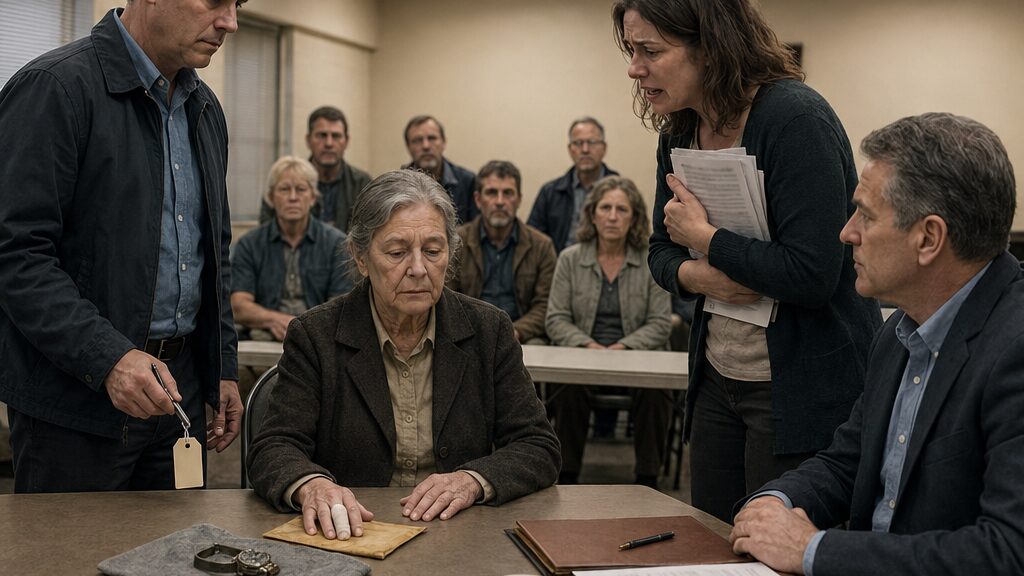
Mark Clark slid the white price tag across the folding table before Virginia Walker had said she was ready.
It stopped beside the yellowed envelope, its string tie darkened by age, its corners soft from too many years in the same drawer. The tag was no bigger than a postage stamp, but in the county veterans-services meeting room it looked like a verdict.
Virginia kept her bandaged finger on the envelope.
Mark glanced at the tag, then at the dented field watch resting on a square of gray cloth. “That’s the number I can justify,” he said, careful and businesslike. “The crystal is scratched, the movement is unreliable, and military pieces without full provenance don’t move as quickly as people think.”
Across the table, Kathleen Hill made a sound too small to be a laugh and too sharp to be a sob.
Daniel Green, the county mediator, looked up from the brown folder open in front of him. Beige walls, fluorescent lights, two paper cups, four witnesses, one official clock that clicked louder than it needed to. It was not a courtroom, but everyone had begun acting as if a sentence was about to be passed.
Virginia did not pick up the tag.
She did not look at the number.
She looked at Mark’s hand, still close to the watch, and said, “Don’t touch the crown unless you mean to wind it.”
Mark paused. “Ma’am?”
“The crown.” Virginia’s voice stayed level. “Small knob on the side. Don’t pull it hard.”
Mark withdrew his hand with a controlled politeness that almost hid his irritation. “I understand it has sentimental value.”
Kathleen stood so quickly her chair legs scraped the floor. “Sentimental?”
The older woman witness near the wall lifted a hand to her mouth. One of the seated county witnesses shifted in his chair. Daniel leaned forward as if he could press the room flat with his palms.
Kathleen held a thin stack of printed pages against her chest. The top one showed a blurry photograph of the watch from Mark’s shop listing. Even from where Virginia sat, she could see the enlarged dent on the side of the case, the strap replaced with a plain brown band, the initials on the backplate too faint to read in the picture.
“That was my father’s watch,” Kathleen said.
No one moved.
Virginia’s finger tightened on the envelope string. Beneath the bandage, the knuckle throbbed from where she had caught it in the kitchen drawer three days earlier. She had not bothered changing the dressing before coming. A medic knew which wounds mattered.
Mark looked from Kathleen to Virginia. “That’s what we’re here to determine.”
“No,” Kathleen said, still facing Virginia. “We’re here because she tried to sell it before anyone could ask why she had it.”
Daniel’s expression hardened, not unkindly. “Ms. Hill, this is a mediation. You’ll have a chance to make your claim.”
“My claim?” Kathleen’s voice shook. “My claim is that my mother had to sell our dining table when I was eleven, and this woman kept the only thing my father wore every day.”
Virginia heard the words land around the room. Not loudly. Worse than loudly. They landed with sense.
She could have answered then. She could have said that a dining table and a field watch were not opposite sides of the same betrayal. She could have said William Lewis had put the watch in her hand himself. She could have said a man could leave more behind than furniture and still not leave enough.
Instead, she kept her finger on the envelope and looked at the price tag.
Mark cleared his throat. “I wasn’t aware there was a family dispute when Mrs. Walker brought it in.”
“Ms. Walker,” Virginia said.
“Ms. Walker,” he corrected.
Kathleen turned toward him. “And you just put it online?”
“It was a preliminary consignment listing.”
“You photographed it before she even signed?”
Mark’s jaw shifted. “That is standard procedure for assessment.”
“Standard procedure,” Kathleen repeated, as if the words had a taste. “For my father’s watch.”
Daniel lifted one page from the brown folder. “The issue right now is whether Ms. Walker has standing to consign or transfer the item. Mr. Clark has paused the listing. No sale is final.”
Virginia’s mouth dried. The official words made everything sound cleaner than it was. Standing. Consign. Transfer. Item. None of them made space for what a watch sounded like in the dark when it stopped ticking.
Kathleen leaned across the table. “Tell him. Tell him it belonged to William Lewis.”
Virginia looked at her then.
Kathleen had her father’s eyes. Not the color exactly, but the same impatient brightness when pain came too close to anger. Virginia had seen that look once under dust and smoke, when William had tried to joke through a cracked rib because the younger soldier beside him was scared.
“It belonged to William,” Virginia said.
Kathleen blinked as if the admission hurt more than denial would have.
Mark reached for his appraisal slip. “Then the ownership question—”
Virginia’s hand moved fast enough that the paper cup beside the folder trembled. She placed her palm over the yellowed envelope and the watch together.
“That watch is not junk,” she said. “Don’t price it like it never kept anyone alive.”
The room went still.
Mark’s eyes dropped to the watch. For the first time, he seemed to notice the dent not as damage but as a mark left by force. Kathleen’s lips parted. Daniel stopped turning pages.
Virginia regretted the sentence as soon as it left her mouth. Not because it was untrue. Because it opened a door, and she had spent more than thirty years keeping one hand on that door.
Kathleen whispered, “What does that mean?”
Virginia reached for the price tag. She turned it over so the number faced down.
“It means you should let Mr. Green do his job.”
Kathleen flinched. “You can’t say something like that and then hide behind paperwork.”
“I can do many things behind paperwork,” Virginia said quietly. “That is usually what paperwork is for.”
It was sharper than she meant it to be. The older woman witness looked down. Daniel drew a slow breath through his nose. Mark tucked the appraisal slip beneath his clipboard, but not before Virginia saw the printed amount again. Too little to buy a month of safety. Too much to dismiss if time had already run out.
Daniel folded his hands on the brown folder. “Ms. Walker, if you continue with consignment while Ms. Hill contests ownership, we need a signed declaration stating the basis of your claim. If you choose to withdraw the item, that also needs to be recorded. If you transfer it to Ms. Hill, that requires a different statement.”
“I’m not transferring it,” Kathleen said. “She is giving it back.”
Virginia looked at the watch.
The minute hand had stopped between twelve and one. It had done that for years, even after two repairs. Sometimes, if she wound it gently, it gave a few dry ticks, like an old man clearing his throat before deciding silence was easier.
“It was never a question of giving,” Virginia said.
Kathleen’s face tightened. “Then what was it?”
Virginia could feel the answer behind her teeth. Rent. Repairs. A county deadline. A woman in a care facility who still asked for William on bad afternoons. A promise made beside a torn stretcher strap. A child she had watched grow up from a distance because closeness would have required explanations.
She said none of it.
Mark lifted both hands slightly. “For what it’s worth, I have not completed any purchase. The item is still here.”
“The item,” Kathleen said.
Daniel turned a page in the folder. “We are not resolving history in one morning. We are resolving whether this watch can legally move before the emergency account deadline.”
Virginia closed her eyes for half a second.
Kathleen heard it. “Emergency account?”
Daniel’s face changed. He had said too much, or enough.
Virginia opened her eyes. “That part isn’t yours.”
Kathleen stared at her. “My father’s watch is being sold because of an emergency account, and you think that part isn’t mine?”
Virginia pulled the envelope closer. “I think there are some things a person can pay without putting another person’s name on the debt.”
“Debt?” Kathleen’s voice broke.
Mark looked down at the table. He was beginning, Virginia could see, to understand that he had walked into something no appraisal manual covered. But understanding late did not stop the clock.
The official clock clicked again.
Daniel tapped the signature line with his pen. “Ms. Walker, I need your decision. If the account is to be credited today, the paperwork has to move before noon. If there’s a dispute, this declaration is the only way to proceed.”
Kathleen stepped closer to Virginia. “Don’t sign that.”
Virginia picked up the pen.
The old plastic barrel was warm from Daniel’s hand. She hated that. She wanted her own pen, her own table, her own quiet room where no one watched her decide what kind of loss she could afford.
Kathleen’s voice lowered. “Please. If it meant anything to him, don’t.”
Virginia looked at the young woman’s fingers clutching the printed listing until the paper creased. Then she looked at the envelope beneath her bandaged hand.
“It meant enough,” Virginia said, “that I kept it when I should have given it away.”
Daniel opened the brown folder wider and turned the declaration toward her.
“Virginia,” he said, his voice softer now, “are you ready to sign away your claim to the watch?”
Chapter 2: The Watch That Stayed in the Drawer
Virginia counted the cash twice and came up short both times.
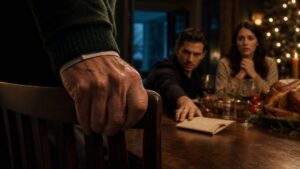
On the third count, she stopped at the same number and let the bills lie on the kitchen table beside the utility notice, the repair estimate, and the county letter with the red box around the deadline. Her coffee had gone cold. The small house clicked and settled around her as if it, too, was waiting to hear which bill would be betrayed.
She had forty-three dollars in cash, a checking balance she knew without looking, and a roof repair estimate folded so many times the crease had gone soft. The corner above the back bedroom had leaked again during the last rain. She had set a pot under it, the same aluminum pot she used for soup, and listened to water strike metal through half the night.
The repair contractor had circled the deposit amount in blue ink.
Virginia touched the number with one finger, then moved the letter from the county on top of it.
Final contribution required by Friday noon.
Below that, in smaller print, was the line that had kept her awake.
Emergency housing and care stabilization account: Hill family case.
She folded the county letter before the name could look back at her too long.
Her phone buzzed on the counter. She let it ring once, twice, three times. The screen showed the county office number. When it stopped, she waited for the voicemail tone, then pressed play.
The benefits clerk’s voice filled the kitchen, too bright for the hour.
“Ms. Walker, this is the county veterans-services desk calling about the emergency account connected to Kathleen Hill’s family case. We received your last partial payment. Thank you. The remaining balance must be posted before noon Friday or the account will close and the hold on transition services may be released. Please call if—”
Virginia deleted the message before the clerk could finish being kind.
She stood, then sat again because the room shifted in a way she did not trust. At seventy-four, she had learned the difference between weakness and warning. She pressed two fingers to the table and waited. The clock over the stove ticked evenly. The refrigerator hummed. Outside, a truck passed too fast for the narrow street.
There were things she could sell that would not hurt.
The old television in the spare room. The wedding china she never used. A toolbox with two missing sockets. Her late husband’s fishing rods, if she could bring herself to open the garage.
But she had already sold the television last winter. The china had gone to a church sale after the first care bill. The toolbox was worth less than the gas it would take to haul it anywhere. The fishing rods had belonged to a different grief, and even grief had ranks.
Virginia pushed herself up and went to the hallway.
The drawer was in the small cabinet beneath the linen shelf. No one would look for anything valuable there. That had been the point. She moved a stack of folded towels, lifted a packet of old medical records, and found the yellowed envelope exactly where it had been for years.
The string tie resisted her thumb.
“Don’t start,” she murmured.
Her voice sounded foolish in the hallway. She took the envelope to the kitchen anyway and placed it between the county letter and the repair estimate. It looked wrong there, like a person brought into a room where strangers were discussing cost.
She unwound the string.
Inside was the watch, wrapped in a piece of faded cloth. Beneath it lay an old repair receipt, a folded note she had not read in years, and a photograph cut from a larger picture. Three soldiers stood in front of a transport vehicle, their faces blurred by sun glare and age. William Lewis was the one on the left. Virginia was the one with her hand raised, blocking the light, pretending annoyance because William had made the youngest soldier laugh just as the camera clicked.
She did not touch the photograph.
She took out the watch.
The case was scratched dull. One side bore the dent that had made the first repairman whistle softly and ask, “What happened to this thing?” Virginia had told him, “It kept time.” He had known enough not to ask again.
The crown caught under her thumbnail. She wound it gently.
For three seconds, the watch ticked.
Then it stopped.
She closed her fingers around it and felt no pulse. Foolish, to expect one. Foolish, to be disappointed after all these years.
The phone buzzed again. This time it was the repair contractor.
Virginia answered before pride could make another bad decision.
“Ms. Walker,” the contractor said, “I hate to press, but I’ve got to order materials by tomorrow. If the deposit isn’t in, I have to push you out two weeks.”
“I understand.”
“That back bedroom ceiling’s already soft. I don’t want you waiting.”
“I said I understand.”
He went quiet. Not offended. Calculating whether kindness would make her hang up.
“I can maybe hold the price,” he said. “But not the schedule.”
Virginia looked at the county letter. “Do what you need to do.”
“I’m trying to do right by you.”
“So am I,” she said, and ended the call before either of them could ask what she meant.
The house seemed smaller after that.
She went to the sink and rinsed her coffee cup, though it was already clean enough. Then she wiped the table around the bills, avoiding the envelope. She had spent a lifetime making small tasks stand between herself and harder ones.
At noon, she put on her dark coat.
At twelve-ten, she took it off again.
At twelve-twenty, she sat at the table and opened the folded note. Not fully. Just enough to see the first line in William’s uneven hand.
Ginny, if you are reading this, I probably made you mad.
She shut it.
“No,” she said.
The word cracked against the kitchen cabinets.
She slid the note back into the envelope, then the photograph, then the receipt. The watch last. She tied the string and pressed the envelope flat with both hands.
There were rules to carrying a thing like that. Do not open it when lonely. Do not open it when tired. Do not use it to prove pain. Do not let anyone see you measure the present against the dead.
She had broken all but the last.
The county letter still lay folded beside the repair estimate. She opened it one more time and read the deadline as if it might have changed out of pity.
Friday noon.
Kathleen Hill’s name sat in the body of the letter, formal and exposed.
Virginia had seen Kathleen last month in the parking lot outside the care facility, though Kathleen had not seen her. The young woman had been arguing with someone on the phone, one hand pressed to her forehead, her voice low and furious. Virginia had caught only pieces. Mom can’t move twice. I know what the deposit is. No, I don’t have it.
Virginia had stayed behind the steering wheel until Kathleen went inside.
That had been the correct thing to do then. Distance preserved dignity. Distance kept William’s name from being used like a receipt.
Now distance had produced a balance due.
Virginia pulled a notepad from the drawer and wrote the name she had avoided all morning.
W. Lewis.
The W leaned too hard to the left. The period was a dark puncture in the paper.
She stared at it until the letters stopped being letters and became a field, a torn strap, a hand gripping her sleeve.
Then she drew one line through the name.
Not enough to hide it. Just enough to stop it looking unfinished.
She tucked the yellowed envelope inside her coat, picked up the county letter, and locked the house behind her.
Chapter 3: Fair Market Value for a Broken Promise
Mark Clark had the watch under a camera before Virginia had finished unbuttoning her coat.
“Just for the file,” he said, angling the small light over the display pad. “I photograph everything that might go into consignment. Saves confusion later.”
Virginia stood on the customer side of the glass counter and watched the lens hover above William’s watch.
The shop smelled of furniture polish, old paper, and metal warmed by dust. Military patches lay framed on one wall beside railroad lanterns and pocket compasses. A glass case near the register held rings, pins, tie clips, and watches arranged on velvet as if their former owners had stepped away politely and never returned.
Virginia did not like the case.
“I haven’t agreed to consign it,” she said.
Mark looked up. He was in his late forties, clean shirt, tired eyes, professional hands. Not greedy hands. That almost made it worse. A greedy man could be dismissed. A careful man could still do damage while believing he had behaved well.
“Of course,” he said. “Assessment first.”
He took three photographs. Front, side, back. The camera clicked once for each angle. Virginia felt every click between her shoulder blades.
“You said it was a field watch?” he asked.
“I said it was worn in the field.”
He smiled faintly, accepting the correction as the quirk of an old customer. “Do you have service documentation?”
“No.”
“Box? Original strap? Manufacturer papers?”
“No.”
“Any written provenance?”
Virginia’s hand moved toward the inside of her coat, where the yellowed envelope pressed against her ribs. She stopped before touching it.
“No,” she said.
Mark made a note. “That affects value.”
“I assumed it would.”
He lifted the watch with a cloth and turned it toward the light. “Crystal is heavily scratched. Crown is stiff. Replacement strap. Movement?”
“Unreliable.”
“Does it run?”
“When it wants to.”
That earned another quick smile. “Don’t we all.”
Virginia said nothing.
Mark’s smile faded. He turned the watch over, then paused. “Initials here. W.L., maybe?”
Virginia felt the shop narrow around her.
He reached for a magnifying glass. “Could be W.H., but I think the second letter is an L. There’s also something under it. Date, maybe. Hard to see with the repair marks.”
“W.L.,” Virginia said.
Mark glanced at her. “You know whose?”
“Yes.”
He waited.
Virginia did not help him.
After a moment, he set the watch down and pulled a printed appraisal form from beneath the counter. “Without documentation, I have to treat it as a worn military-style wristwatch with personal engraving. The engraving may help with interest if we can identify the service connection, but condition hurts it.”
“How much?”
Mark named a number.
Virginia looked at the watch so she would not look at him.
The number was both insult and possibility. Too low for what the watch had cost. Enough to close most of the county balance if she added the cash at home. Enough to make the roof wait. Enough to make shame practical.
“No,” she said.
Mark nodded as if he had expected that. “I understand. People often come in with an emotional number in mind.”
Virginia looked up. “I came in with a deadline.”
That changed his face. Not much. Enough.
He lowered his pen. “If there’s urgency, consignment may not be your best option. A direct purchase is faster, but lower.”
“How much lower?”
He hesitated, then named the second number.
Virginia laughed once.
The sound startled them both.
Mark set the pen down. “Ms. Walker, I’m not trying to offend you.”
“You didn’t make the number,” she said. “You just said it out loud.”
He took that in carefully. “I can list it at the higher estimate, but there’s no guarantee it sells quickly.”
“What would you write?”
“Pardon?”
“In the listing.”
He slid his keyboard closer and spoke while typing. “Vintage military wristwatch, engraved initials, visible wear, replacement band, likely mid-to-late twentieth century. Untested reliability. Sold as is.”
Virginia’s throat closed around the last phrase.
Sold as is.
She looked at the old repair scar crossing the backplate. The first repair had been done overseas. The second in a strip-mall watch shop by a man who had asked no questions. The scar remained because the case had never sat quite right again.
“Not untested,” she said.
Mark stopped typing.
“It was tested.”
He waited. “How would you like me to phrase it?”
She could have walked out. She should have. Pride rose in her like a clean, hard thing.
Then she saw the county letter folded in her purse. The red box around Friday noon. Kathleen in the parking lot with her hand pressed to her forehead. William’s note sealed in the envelope, still accusing her of being alive enough to choose.
“Write that it was repaired,” Virginia said. “Backplate. Internal damage.”
“Do you know when?”
“Yes.”
Mark’s fingers hovered above the keys.
Virginia did not give him the date.
He typed only what she had allowed. “Repaired backplate. Internal damage visible.”
Then he printed a preliminary appraisal slip and turned it toward her. The number looked worse in ink.
She did not touch it.
A younger veteran browsing near the patches glanced over, then away. Virginia wondered what he saw: an old woman selling a watch because the world had narrowed to bills. That was close enough to truth to be dangerous.
Mark placed the watch beside the slip. “I can hold it off the public floor until you decide.”
“No display case.”
“Fine.”
“No one handles it by the crown.”
He nodded. “Fine.”
“No polishing.”
His brow tightened. “Polishing could improve—”
“No polishing.”
“All right.”
Virginia took the yellowed envelope from inside her coat. Mark noticed it immediately.
“That part goes with it?” he asked.
“No.”
“If there’s a receipt or note, it might improve value.”
Virginia slid the watch into the cloth, then into the envelope, before he could see inside. “Some things lower value when strangers read them.”
Mark leaned back. For the first time, irritation showed through. “I can only appraise what you let me examine.”
“And I can only sell what I can stand to lose.”
The sentence settled between them.
Mark looked at her then not as a customer, but as a person standing at the edge of a decision she despised. It did not make him kind. It made him slower.
“I’ll create a private listing first,” he said. “Collectors I know. Not the open site. If someone is interested, I’ll call before anything moves.”
Virginia should have refused. The watch should have gone back into the drawer. The roof should have leaked. The account should have closed. Kathleen should have hated some faceless system instead of a woman she barely knew.
But Virginia had already learned that doing the bearable thing often meant leaving the necessary thing undone.
“Private,” she said.
Mark nodded and began entering the listing.
Virginia watched him type. Each word made the watch smaller. Vintage. Military. Engraved. Worn. As is.
When he asked for contact information, she wrote carefully. Her hand did not shake until the final digit of her phone number, and then only once.
Mark tore off the appraisal slip and placed it in front of her.
She folded it without reading it again.
At the door, she turned back. “The initials are W.L.”
Mark looked up from his screen.
“William Lewis,” she said. “Not unknown owner. Not unidentified engraving. William Lewis.”
He typed the correction.
Virginia left before he could ask who William had been.
Behind her, the shop bell gave one thin ring.
By the time she reached her car, Mark’s phone buzzed on the counter. He read the message twice before touching the watch again.
That watch is not hers to sell.
Chapter 4: The Daughter Who Thought She Had Been Robbed
Kathleen Hill came into the veterans hall with a printed screenshot clenched so tightly that the watch in the photograph had a crease through its face.
The veterans hall volunteer looked up from the records desk. “Can I help you?”
“I need to know who has the right to sell this.”
The volunteer took one look at the page and then at Kathleen’s face. Her voice gentled, which made Kathleen angrier.
“Ma’am, if this is about a personal item—”
“It’s not personal to the person selling it.”
The words came out too loud. Two men near the coffee urn turned. A woman pinning notices to the bulletin board stopped with a tack still between her fingers.
Kathleen forced herself to lower the page. She had driven there with her hands locked on the steering wheel, Mark Clark’s message still open on her phone.
A consignor named Virginia Walker brought this in. Because you claim family connection, I’ve paused the listing. County veterans services may need to mediate.
Consignor. Listing. Family connection.
Her father’s name had appeared on the back of a watch in an antique shop post, as if William Lewis had been misplaced in someone else’s drawer and discovered only when he became sellable.
The volunteer came around the desk. “You said someone is selling it?”
Kathleen pushed the screenshot toward her. “That watch belonged to William Lewis. My father. He died before I was born.”
The volunteer’s mouth changed shape around a question she decided not to ask. She looked again at the photo. “I can check whether we have unit records, but ownership of personal effects isn’t always—”
“His initials are on it.”
“That helps. It doesn’t always settle it.”
Kathleen laughed once. “That’s what everyone keeps saying.”
She turned away from the desk before the volunteer could answer. In the hallway beyond the records room, framed photographs hung in rows: barbecues, fundraisers, memorial breakfasts, uniformed faces behind glass. Men and women smiled from decades Kathleen had never been invited into. She had grown up with a shoebox of paperwork, two blurry pictures, and a mother who went quiet whenever Kathleen asked what her father sounded like.
Now there was a watch.
There had been a watch all along.
She found Virginia near the bulletin board.
The older woman wore the same dark coat from the listing photo Mark had sent in a follow-up, though the coat itself had not been in the picture. Kathleen knew her anyway. She had seen Virginia at the edge of things for years: standing near the last row at memorial events, dropping off envelopes at the care facility desk, leaving before anyone could speak to her too long. She had been “Ms. Walker,” “your father’s friend,” “a woman from his unit,” never enough to become family and never gone enough to be a stranger.
Virginia had a stack of forms under one arm. When she saw Kathleen, she stopped walking.
Kathleen held up the screenshot. “You were going to sell it without telling me.”
Virginia’s eyes went first to the printed watch, then to Kathleen’s face. “Mr. Clark shouldn’t have posted that publicly.”
“That’s your answer?”
“No. That is one answer.”
Kathleen stepped closer. “How long did you have it?”
The volunteer behind the desk went still.
Virginia did not look around. “A long time.”
“How long?”
“Kathleen.”
“No.” Kathleen’s throat tightened around the name. “You don’t get to say my name like you’re trying not to wake someone. How long did you have my father’s watch?”
Virginia’s fingers tightened around the forms. The movement was small, but Kathleen saw it.
“Since he gave it to me,” Virginia said.
The hallway narrowed.
Kathleen had imagined denial. She had imagined confusion. She had imagined some story about buying it at a flea market and not knowing. She had not imagined this plain admission.
“He gave it to you,” she repeated.
“Yes.”
“Before he died?”
Virginia’s answer was silence.
Kathleen looked down the hallway at the wall of photographs. Men shaking hands. Women holding flags. Children in paper hats at some picnic she had not attended. Her father had belonged to a world that had kept records of breakfasts and raffles and plaques, but not of what a daughter might need thirty years later.
“My mother sold our dining table when I was eleven,” Kathleen said.
Virginia closed her eyes briefly.
“She sold her wedding ring two years after that. She kept saying paperwork was delayed, benefits were delayed, people were trying. She kept a box with his letters, but there were only three. Three. And you had the thing he wore every day?”
“It wasn’t mine to show.”
Kathleen stared at her. “That doesn’t even make sense.”
“It did to me.”
“And now it’s yours to sell?”
Virginia took that without flinching, which somehow made it worse.
Kathleen shook the screenshot once. “The listing said ‘William Lewis’ like he was a selling point. Did you tell the dealer that? Did you hand him my father’s name so it would bring more money?”
“No.”
“Then why is his name on it?”
“Because I corrected him.”
Kathleen stopped. “What?”
“He was going to write unidentified engraving. I told him the initials belonged to William Lewis.”
Kathleen wanted that to make Virginia look better. It did not. It made everything more tangled.
The volunteer came closer, holding a photocopy from a file. “Ms. Hill, I found a unit record listing William Lewis. It confirms service connection, but it does not document disposition of personal effects.”
Kathleen took the paper. Her father’s name sat in a line of type between dates and abbreviations. Thin proof. Official, bloodless.
Virginia glanced at the page and looked away.
“You knew him,” Kathleen said.
“Yes.”
“You knew him enough that he gave you his watch.”
“Yes.”
“You knew him enough to keep it from his wife and daughter.”
Virginia’s face tightened at last. It was not anger. It was an old wound refusing pressure.
“I kept it because he asked me to.”
Kathleen’s hand dropped to her side.
The volunteer made a quiet sound behind them. The hallway seemed to hold its breath.
“What did he ask?” Kathleen said.
Virginia looked toward the records desk, the bulletin board, the framed photographs. Too many ears. Too much history hung badly on public walls.
“Not here.”
Kathleen stepped closer. “You don’t get to decide that anymore.”
“I made that mistake,” Virginia said softly.
The sentence disarmed Kathleen for half a second, and in that half second she saw the age in Virginia’s face. Not frailty. Wear. Like something folded too many times but still refusing to tear.
Then she remembered the screenshot.
“You were still going to sell it.”
Virginia’s mouth pressed flat. “Yes.”
“Why?”
Virginia looked at the papers under her arm. “Because it has value.”
Kathleen almost struck the bulletin board with the screenshot. “It has value because he wore it. Because it was his. Because my mother could have held it when she had nothing else.”
“I know.”
“No, you don’t. You had it.”
Virginia did not answer.
That silence did what every other silence had done in Kathleen’s life. It made a wall. On the far side of it stood adults who knew things and called not telling her protection.
She turned to the volunteer. “How do I stop the sale?”
Virginia’s head lifted.
The volunteer hesitated. “If you’re asserting family ownership, you can file a dispute with county veterans services. It will pause transfer until mediation. But if Ms. Walker has a claim of entrusted possession, she’ll be asked to sign a statement.”
“I’ll file it.”
“Kathleen,” Virginia said.
The sound of her name this time carried warning, maybe pleading. Kathleen could not bear either.
“No. You had thirty years to explain. Now you can do it with witnesses.”
The volunteer led her back to the desk and handed her a form. Kathleen filled it out with a pen that skipped twice. Her address looked childish. Her father’s name looked unreal. Under nature of claim, she wrote: personal effect of deceased parent, held without family knowledge.
When she signed, her hand shook so badly the last letters of Hill slanted down.
Virginia stood in the hallway, still holding her own forms. She did not leave. She did not come closer.
A few minutes later, Daniel Green arrived from the county office next door, carrying a brown folder and a tablet. He looked from Kathleen to Virginia and then at the screenshot on the desk.
“I was hoping this would not become formal,” he said.
“So was I,” Virginia said.
Kathleen turned on her. “You don’t get to sound tired of the trouble you caused.”
Daniel raised a hand. “Ms. Hill.”
“No, let her hear it.” Kathleen’s face burned. “She kept his watch, let us have nothing, and now she’s selling it because some dealer said it had ‘fair market value.’”
Virginia’s eyes flickered at the phrase, as if it had struck somewhere tender.
Daniel opened the brown folder. “Until this is resolved, the watch cannot be sold, returned, or transferred. Ms. Walker, if you maintain that William Lewis entrusted the item to you, I’ll need a signed statement. Ms. Hill, if you maintain family claim, that will be entered as well.”
Kathleen gripped the counter.
Virginia looked at the form Daniel placed before her, but she did not take the pen.
“What statement?” she asked.
Daniel’s voice stayed careful. “One that says exactly why you believe the watch was yours to hold, and whether you still intend to consign it.”
Kathleen watched Virginia’s face.
For one brief, dangerous moment, she thought the older woman might finally tell the truth.
Instead, Virginia reached for the yellowed envelope inside her coat and held it there, hidden but present.
“Then schedule it,” she said.
Chapter 5: The Name Inside the Backplate
Mark Clark said the backplate had been repaired from the inside, and Virginia’s hand moved before anyone read the inscription aloud.
She did not reach for the watch. That would have told them too much. She reached for the yellowed envelope instead, pressing one bandaged finger against the string tie as if the envelope might open of its own accord.
Mark noticed.
So did Kathleen.
Daniel had called them back into the meeting room after ten minutes of hallway phone calls and quiet paperwork. The official clock now read eleven-thirteen. The noon deadline had begun to feel less like a time and more like a person standing at the door.
Mark bent over the watch with a small loupe held to one eye. He had removed his jacket. His sleeves were rolled once, and the professional polish he had worn at the shop had thinned under the fluorescent lights.
“There’s a solder line here,” he said. “Not cosmetic. Someone opened the case and repaired damage under the backplate. It’s crude work, but old.”
Kathleen stood beside the table, arms folded tight. “What kind of damage?”
Mark hesitated.
Virginia answered. “Pressure.”
Kathleen looked at her. “Pressure from what?”
Virginia kept her eyes on the watch. “Something heavier than a hand.”
Mark lowered the loupe. “There’s an inscription under the repair mark. I can make out W. Lewis. Then below it, maybe a date. And a word. Looks like—”
“Don’t,” Virginia said.
The word cut sharper than she intended. The older woman witness near the wall drew her hand to her mouth again.
Mark froze.
Daniel’s pen stopped halfway across his notes. “Ms. Walker?”
Virginia heard herself breathing. Too measured. Medic breathing. Count in, count out, keep the hands useful.
“It was not written for this room,” she said.
Kathleen’s anger had changed shape. “Was it written for me?”
Virginia looked up.
That question found a place her defenses did not cover.
“No,” she said.
Kathleen’s eyes shone. “Then who?”
The watch lay between them. Small. Dented. Obediently silent.
Mark set the loupe beside it. “For what it’s worth, the repair changes the appraisal.”
Kathleen turned on him. “You’re still talking about appraisal?”
He absorbed that, reddening slightly. “I’m saying I was wrong to treat the damage as ordinary wear.”
“That makes it better?”
“No,” Mark said. “It makes it worse that I did.”
The admission landed quietly. Virginia looked at him then. He was not rescued by it. He knew that. He had the face of a man who had discovered late that his ordinary language had been careless.
Daniel tapped the brown folder. “We need to establish enough context to proceed.”
“No,” Kathleen said. “I need to establish why she had my father’s watch.”
Virginia turned the price tag over again, though the number was already hidden. Her fingers needed the task.
“Your father was hit during an evacuation,” she said.
The room lost its small noises.
Kathleen’s face went still.
Virginia did not look at her directly. She looked past her shoulder to the beige wall, where a framed county seal hung slightly crooked. It was easier than seeing William’s eyes in his daughter’s face.
“We were moving two men out. Roadside damage, blocked route, bad radio, worse timing. Your father was conscious when I reached him.”
No one interrupted.
“He kept trying to take the watch off. I told him to leave it alone because his hand was slick and he was wasting strength. He told me I was bossy for someone shorter than his mother.”
A tiny breath moved through the room. Not humor. Recognition of a living man where a name had been.
Kathleen’s lips parted.
Virginia stopped there. She had not meant to give even that much.
“What happened?” Kathleen asked.
Virginia looked down. The minute hand on the watch remained trapped between twelve and one. Of course it did. Some objects knew how to accuse without moving.
“The watch caught under the stretcher strap when we shifted him,” Virginia said. “The case cracked against the frame. I thought that was all.”
Mark’s eyes moved to the dent.
“It stopped then?” he asked quietly.
Virginia heard the question twice: once in the room, once from a young repairman years later turning the watch over beneath a lamp.
“Yes.”
Kathleen sat down slowly.
Virginia wished she had remained standing. Anger had protected her. Sitting made her look younger, and younger made her look like the baby William had never held.
“He gave it to you after that?” Kathleen asked.
Virginia closed her hand. “He made me take it.”
“Why?”
The answer pressed against the back of her teeth.
Because he knew he would not carry it out.
Because he knew she might.
Because men in that condition asked for impossible things in small voices, and medics, being fools, nodded.
Virginia said, “He was afraid it would get lost.”
Kathleen flinched. “That’s all?”
“No.”
“Then say the rest.”
Daniel shifted. “Ms. Walker, you don’t have to—”
“Yes, she does,” Kathleen said, but her voice had lost some of its force. “Not legally. Just—” She swallowed. “Please.”
Virginia looked at the yellowed envelope. The folded note inside seemed to have weight beyond paper. She could feel its first line like a bruise.
Ginny, if you are reading this, I probably made you mad.
“He asked me to make sure it got where it needed to go,” Virginia said.
“To my mother?”
Virginia did not answer quickly enough.
Kathleen’s face tightened again. “So you didn’t.”
“I tried.”
“How? By putting it in a drawer?”
Virginia took the blow because it was not entirely false.
Mark moved the watch a fraction away from the edge of the table. The gesture was careful. He used the cloth. Virginia noticed and hated that noticing softened her toward him.
Daniel opened another form. “The question before us remains whether Ms. Walker has authority to consign it. Her statement that William Lewis entrusted the watch to her is relevant, but Ms. Hill’s family claim is also relevant. If the item is sold before the dispute is settled, proceeds may need to be held.”
“No sale,” Kathleen said.
Virginia looked at Daniel. “If proceeds are held, can they be directed today?”
Daniel’s expression closed.
Kathleen turned toward her slowly. “Directed where?”
“That is not part of this claim.”
“It is if you’re selling his watch.”
Virginia’s bandaged finger began to pulse again. She pressed it harder to the envelope until the pain steadied her.
Daniel spoke carefully. “Ms. Walker has been attempting to meet a time-sensitive account balance. That is the emergency account I mentioned earlier.”
Kathleen stared at him, then at Virginia. “For yourself?”
Virginia said nothing.
Kathleen read the silence as pride. Virginia saw it happen. The girl—no, the woman—put together a story that was close, wrong, and easier to hate.
“You need money,” Kathleen said. “So you took the one thing of my father’s that might sell.”
Virginia did not correct her.
Mark did. “Ms. Hill, she almost walked out over the appraisal. She didn’t bring this in like someone trying to make a profit.”
“Then why bring it in at all?”
No one answered.
The official clock clicked toward eleven-thirty.
Daniel slid the declaration closer to Virginia. “If you want the account credited before noon, we need to either complete the consignment paperwork or change the direction of this hearing.”
“What does that mean?” Kathleen asked.
“It means someone has to decide what this object is for.”
Virginia almost laughed. The whole room had finally arrived at the question she had been failing to answer for thirty years.
Kathleen leaned both hands on the table, facing her. “If it mattered that much—if it was with him when he died, if he gave it to you, if you kept it all this time—why would you sell it to him?”
The room waited.
Virginia picked up the pen, then set it down again.
Her voice, when it came, was steady enough to fool strangers.
“Because sometimes the last thing you have left is still not the last thing someone else needs.”
Chapter 6: The Bill She Paid Without a Name
“The anonymous payer is right here,” the benefits clerk said, and then her face went white as she realized the hallway had gone silent.
Kathleen stood outside the meeting room with one hand on the counter and the other still gripping the printed screenshot of the watch. Virginia was three steps behind her, close enough to hear, too far to stop the sentence. Daniel had sent them into recess so he could call the county account office. Mark had stayed inside with the watch, or maybe Daniel had kept him there to prevent another argument from finding fresh oxygen.
The clerk looked from Kathleen to Virginia. “I’m sorry. I thought—”
Virginia stepped forward. “You thought wrong out loud.”
It was not cruel, but it ended the apology.
Kathleen turned slowly. “Anonymous payer?”
Virginia looked at the row of pamphlets on the counter: housing assistance, caregiver support, utility relief, veterans transportation. Bright paper promises, all folded into neat racks.
“Clerks use names loosely,” Virginia said.
The clerk’s eyes filled with panic. “Ms. Walker, I really can’t discuss account details unless—”
“Unless what?” Kathleen asked. “Unless I’m the family case?”
The clerk swallowed.
Daniel came out of the meeting room at exactly the wrong time. Or the right one. He took in the clerk’s face, Kathleen’s posture, Virginia’s stillness, and stopped.
“Kathleen,” he said, “let’s step back inside.”
“No.” Kathleen reached for the counter. “I want to see the account.”
“There are privacy rules.”
“It has my name on it.”
“It has your family case attached to it,” Daniel said. “That doesn’t mean every donor or contributor—”
“Donor?” Kathleen looked at Virginia. “Is that what you are now?”
Virginia’s jaw tightened. “No.”
The clerk, desperate to repair what she had broken, pulled a folder from beneath the desk. “There are receipts I can show Ms. Hill if Ms. Walker consents.”
“I do not,” Virginia said.
Kathleen’s expression changed. Not anger first. Hurt first, then anger covering it. “You’d rather sell my father’s watch than let me see a receipt?”
Virginia looked at the clerk. “Show her the account balance. Nothing else.”
“That won’t explain—” the clerk began.
“It will explain enough.”
Kathleen gave a short, bitter laugh. “Enough for who?”
Daniel lowered his voice. “Ms. Walker, at this point withholding everything may complicate the mediation.”
Virginia turned on him. “This is not mediation. This is people peeling labels off another person’s life because the county printed a deadline.”
Daniel took the rebuke without moving. “The deadline is real.”
“I know it’s real. I’m the one who came here with something to lose.”
The words struck harder than she intended. Kathleen looked away as if slapped.
Virginia almost reached toward her. Almost.
That was the trouble with silence. Once it cracked, everything that came through had edges.
The clerk placed a page on the counter and covered the lower half with her hand. “Current account balance. Required amount to preserve transition services. Last four payments, amounts only.”
Kathleen leaned over the page.
Virginia watched her read.
The first number made Kathleen blink. The second drew her brows together. The third was smaller, almost embarrassingly small. The fourth had been posted the same week Virginia had put a pot under the ceiling leak and called the repair contractor to ask how long wood could stay damp before it became dangerous.
Kathleen’s finger hovered above the dates. “These payments came from her?”
The clerk looked at Virginia.
Virginia stared at the clock over the hallway door.
Kathleen turned. “Answer me.”
“Some of them,” Virginia said.
“How many?”
“That is not useful.”
“It is to me.”
“No,” Virginia said. “It is useful to your guilt. That’s different.”
Kathleen recoiled.
Daniel murmured, “Virginia.”
She had done it again. Used precision like a blade. It was a habit from field medicine: cut only where necessary, keep emotion out of the wound. But people were not wounds. They remembered the knife.
Kathleen looked back at the receipt page. “This date. You paid this the same week Mark said you came in about the watch.”
Virginia did not answer.
The clerk, who had lost all confidence in silence, said softly, “There were earlier contributions, too. Over time.”
Kathleen gripped the counter. “How long?”
Virginia closed her eyes.
“Ms. Walker contributed through different channels,” Daniel said. “Not always this office.”
Kathleen looked as if the floor had moved. “My mother’s care facility. The transportation vouchers. The deposit extension.”
Virginia opened her eyes. “You were handling enough.”
“You don’t know what I was handling.”
“I know more than you think.”
“That’s the problem.” Kathleen’s voice broke. “You know things and vanish. You pay things and vanish. You keep his watch and vanish. Did it ever occur to you that we might have needed the truth more than your money?”
Virginia’s hand went to the envelope inside her coat, then stopped. The motion did not escape Kathleen.
“Don’t,” Kathleen said. “Don’t hide behind it.”
Virginia lowered her hand.
The hallway had emptied without anyone announcing it. The older woman witness lingered near the far wall, pretending to read a flyer. Mark stood in the meeting room doorway now, watch cloth in hand, not crossing the threshold.
Kathleen looked at him, then back at Virginia. “If this account closes, what happens?”
Daniel answered when Virginia would not. “The temporary hold on relocation and care transition services releases. Her mother could lose the reserved placement. There may be another option later, but not guaranteed and not immediate.”
Kathleen pressed her fingertips to her eyes.
Virginia hated Daniel for saying it plainly. She hated herself more for making plainness necessary.
“How much is left?” Kathleen asked.
The clerk showed her.
Kathleen’s shoulders dropped.
It was not a giant number. That almost made it crueler. A manageable number for someone with savings. An impossible number for people already selling pieces of their lives.
“I can call the facility,” Kathleen said. “Ask for more time.”
“I did,” Virginia said.
Kathleen stared at her.
Virginia wished the words back.
“When?”
“Yesterday.”
“You called about my mother?”
“I called about the account.”
“My mother,” Kathleen said, sharper now because shame needed somewhere to go. “Say it right.”
Virginia accepted the correction. “Your mother.”
Kathleen folded the receipt page once, then unfolded it as if she did not know what to do with proof that would not stay flat.
“I can stop the sale,” she said. “I’ll withdraw the dispute. You don’t have to do this.”
“If you withdraw the dispute, the watch sells faster.”
“No. I mean stop all of it. Keep the watch.”
“And the account?”
“I’ll figure it out.”
Virginia looked at her then with a weariness she could not hide. “That sentence has ruined many good people.”
Kathleen’s face crumpled for one second before she pulled it back together. “So what do you want me to do? Thank you for secretly paying bills I didn’t know existed? Apologize for being angry you kept my father’s watch? Let you sell it because you made yourself responsible for us?”
“No.”
“What, then?”
Virginia looked down the hall toward the closed meeting room, where the brown folder waited, where the signature line waited, where William’s watch lay on county property for the first time in its life.
“Let me finish what I failed to finish.”
Kathleen shook her head. “What does that mean?”
Virginia drew a breath. The hallway smelled faintly of toner and old coffee. A normal place. A terrible place.
“Your father asked me to get you home safe,” she said. “I am late, not generous.”
Chapter 7: The Promise She Turned Into Punishment
Virginia placed the watch on the table without the envelope for the first time, and the bare sound of metal against wood made Kathleen draw in a breath.
It was not loud. It was barely more than a click. But after years of cloth, paper, string, and drawer-darkness, the watch seemed exposed under the fluorescent lights. Its cracked crystal caught the room in pieces: Daniel’s brown folder, Mark’s lowered eyes, Kathleen’s trembling hand, Virginia’s bandaged finger resting beside the stopped minute hand.
“No more envelope for a minute,” Virginia said.
Kathleen stood across from her, pale from what she had learned in the hallway. “You don’t have to do this.”
Virginia looked at the watch. “That sentence keeps changing what it means.”
Daniel took his seat slowly. “We have twenty-seven minutes before the account window closes.”
“Then we should stop wasting them,” Virginia said.
Mark came back to the table with his appraisal slip folded in half. He had written on it since the recess. The paper looked less certain than it had that morning.
“I need to say something before you sign anything,” he said.
Virginia did not invite him to continue. He did anyway.
“My first number was wrong.”
Kathleen’s mouth tightened. “Convenient timing.”
“It is,” Mark said. “And it’s still true.”
He unfolded the slip and turned it toward Daniel, not Virginia. “The repair, the inscription, the service context, the documented family connection—those change value. I can make a corrected offer. Higher. Much higher than what I said before.”
Virginia did not look at the number. “No.”
Mark blinked. “You haven’t heard it.”
“I heard enough this morning.”
“This isn’t charity.”
“Not yet.”
His face reddened, but he held his temper. “Ms. Walker, I treated something important like inventory. I am trying to correct that.”
“You are trying to correct it with a larger price tag.”
Kathleen turned toward her. “Would that be so terrible if it fixes the account?”
Virginia looked at her then. The question was fair. That made it harder.
“Yes,” Virginia said. “If the room gets to feel clean afterward.”
Silence moved across the table.
Daniel folded his hands over the folder. “There may be another way.”
Virginia’s eyes shifted to him.
“The county can accept a documented emergency contribution from a third party. It does not have to be listed as purchase proceeds from the watch.”
Mark straightened. “I can do that.”
Virginia shook her head once. “No.”
Daniel held up one hand. “Let me finish. The watch would remain under disputed-property hold unless both parties sign a transfer statement. Mr. Clark’s contribution would be recorded separately as a corrected appraisal-related contribution to the Hill family emergency account, with no ownership claim.”
“That sounds like a donation,” Virginia said.
“It sounds,” Daniel replied carefully, “like paperwork doing what paperwork should have done earlier—preventing humiliation instead of creating it.”
Virginia almost smiled. Almost.
Kathleen stepped closer to the table. “Please let him pay it.”
Virginia kept her eyes on Daniel. “And the watch?”
“That depends on what you decide.”
There it was. Not the county. Not Mark. Not Kathleen. Her.
For thirty years, Virginia had arranged her life to avoid exactly that: the moment when keeping the promise required admitting she had made herself its jailer.
She touched the watch with one finger, not the crown, only the dented side.
The meeting room changed.
For one breath she was not at the folding table. She was crouched beside a torn stretcher strap, her left sleeve dark, William Lewis breathing through his teeth because he refused to scare the younger men. His watch had caught under the frame. He had laughed once when she swore at it.
“Ginny,” he had said, using the name no one in this room knew.
“Save your air.”
“You always order people around when you’re scared.”
“I order people around when they’re stupid.”
His hand had closed over hers with surprising force. The watch had been between their palms, warm from his skin, cracked at the edge.
“Get them home,” he had said.
“You’re going with them.”
He had looked at her then. Not afraid. Worse. Certain.
“My girl,” he said. “Make sure she gets home safe.”
Virginia had told him yes because medics lied when truth would waste a dying man’s strength.
For years afterward, she had treated that yes like a sentence passed by a better court than any county office. She sent small checks when she could. She attended ceremonies from the back. She learned Kathleen’s milestones through newsletters, obituaries, care notices, and the occasional conversation with someone who did not know they were carrying messages to an old soldier’s ghost.
The watch stayed with her because she could not give it to a child and say, Your father handed me this while dying, and I failed to bring him home.
So she kept it.
Then she kept keeping it.
“Virginia?”
Daniel’s voice brought the beige walls back.
She realized her fingers were closed around the watch. Kathleen was watching her hand, not her face.
“Your father did not ask me to pay bills for the rest of my life,” Virginia said.
Kathleen did not move.
“He asked me to make sure you got home safe. That was all. Three words, maybe four, depending on how much breath you count.” Virginia swallowed. “I turned it into more because more was all I had left to offer him.”
Kathleen’s eyes filled again, but she did not speak.
“I was supposed to bring him home,” Virginia said. “I brought home a watch.”
Mark looked down.
The older woman witness closed her eyes.
Daniel kept his pen still, waiting.
Kathleen whispered, “You were there when he died.”
Virginia nodded once.
“And you thought I would blame you.”
“No,” Virginia said. “I thought I would deserve it.”
The words emptied something in the room. Not pain. Pain remained. But the shape of it changed. Kathleen lowered herself into the chair across from Virginia, as if her knees had stopped being trustworthy.
“My mother asked about you,” she said. “Sometimes. She said there was a woman from his unit who sent cards but never stayed.”
“I stayed as long as I could.”
“You stayed outside.”
“Yes.”
Kathleen wiped her face with the heel of her hand. “That hurt us.”
Virginia accepted it. “I know that now.”
“Did you know it then?”
Virginia looked at the watch. “I knew many things then and used none of them well.”
Daniel slid a new form from the brown folder. “Virginia, if you want, I can draft a transfer statement that separates three things: Mr. Clark’s emergency contribution, your release of ownership claim, and Kathleen’s acceptance of the watch as family property.”
“No,” Virginia said.
Kathleen stiffened.
Virginia reached for the yellowed envelope and untied the string halfway. “Not family property.”
Daniel’s pen hovered.
Virginia removed the folded note but did not open it. She placed it beside the watch.
“Family property is what courts call things when they don’t know what else to call them. This was a promise. I carried it badly, but I carried it.” She looked at Kathleen. “If it leaves my hands today, it leaves as that. Not as evidence. Not as repayment. Not as something you won from me.”
Kathleen’s lips trembled. “Then what am I supposed to do with it?”
“That is what we write down.”
Mark spoke carefully. “My contribution can be sent now. No purchase, no claim, no display, no resale.”
Virginia glanced at him. “And no story for your customers.”
He nodded. “No story.”
Daniel turned the final page toward himself. “Tell me the terms.”
Virginia looked at the watch once more. The stopped hands. The repair scar. The old dent that had outlasted every explanation she had refused to give.
Then she turned the page back toward herself.
“Write it exactly,” she said.
Chapter 8: The Signature That Gave the Watch a Home
“Don’t sign until I understand what I’m accepting,” Kathleen said, and her hand came down over the bottom of the page before Virginia could reach the signature line.
No one scolded her.
Not Daniel, with the county seal stamp waiting beside his folder. Not Mark, who had already given the benefits clerk his payment card and stood now with the receipt folded in his palm. Not the witnesses, who had stopped pretending they were only there for procedure.
Virginia looked at Kathleen’s hand covering the line. Young hand. William’s daughter’s hand. No ring, bitten thumbnail, ink smudge from the dispute form she had filled out in anger the day before.
“You’re accepting the watch,” Virginia said.
“No.” Kathleen shook her head. “That’s not all. I know that now. So don’t make it small again.”
Virginia sat back.
The yellowed envelope lay open between them. The watch rested on the faded cloth, and beside it was William’s folded note. Virginia had not yet let Kathleen read it. Not because she meant to keep it hidden. Because some things deserved a slower hand.
Daniel turned the document toward Kathleen. “The terms say Mr. Clark’s contribution satisfies the emergency account balance as a documented correction unrelated to purchase. Ms. Walker releases her claim to the watch and envelope. Ms. Hill accepts custody under the condition that the watch not be sold for personal profit.”
Kathleen kept her hand on the page. “Custody sounds temporary.”
“It can be changed.”
“No,” Virginia said. “Custody is right.”
Kathleen looked at her.
Virginia touched the cloth, smoothing one corner. “Ownership makes people careless. Custody reminds them something was trusted to them.”
Mark lowered his eyes to the receipt in his hand.
The benefits clerk appeared in the doorway. She looked relieved and frightened to interrupt. “The account posted.”
Kathleen turned.
The clerk held up a printed confirmation. “The transition hold remains in place. The facility will receive notice today.”
Kathleen’s face folded before she could stop it. She covered her mouth, then dropped her hand as if she refused to be seen as collapsing. “My mother can stay?”
Daniel nodded. “The placement remains active.”
Kathleen gripped the back of the chair. “Thank you.”
She said it toward the room, but not to anyone in particular. Maybe she did not yet know where gratitude could land without becoming debt.
Virginia did not rescue her from that.
Mark placed the receipt on the table, far from the watch. “For the record, no purchase has occurred.”
Virginia looked at him. “Good.”
He accepted the small mercy in the word.
Daniel uncapped his pen. “We still need signatures.”
Kathleen lifted her hand from the page, but her eyes stayed on Virginia. “If I sign this, I’m not saying what you did was all right.”
“No.”
“I’m not saying it didn’t hurt.”
“I know.”
“And I’m not taking charity.”
Virginia’s mouth softened at the edge. “No. You are taking custody.”
Kathleen looked down at the watch. “Of him?”
Virginia shook her head. “Of what he asked us to do with what was left.”
That was the closest she could come without breaking.
Kathleen picked up the folded note. “May I?”
Virginia’s first instinct was to say no. It rose swift and old. The note had lived in the envelope so long it had begun to feel like part of Virginia’s body: private, scarred, not for public handling.
But that instinct had already cost too much.
“Yes,” she said.
Kathleen unfolded it with both hands.
The paper was thin, the creases nearly white. William’s handwriting slanted unevenly across the page.
Ginny, if you are reading this, I probably made you mad.
Kathleen laughed once, a broken little sound.
Virginia closed her eyes.
Kathleen read silently. Her face changed with each line. Confusion. Pain. Something warmer and worse. At the bottom, her thumb stopped over the final sentence.
She looked at Virginia. “He wrote, ‘Don’t let my girl grow up thinking the world only takes.’”
Virginia could not answer.
Kathleen lowered the note. “You thought that meant you had to be the one who gave everything?”
Virginia looked at the watch. “I thought it meant I had to make up for what I failed to bring back.”
“He didn’t write that.”
“No.”
“He didn’t ask you to disappear.”
Virginia’s bandaged finger curled inward. “No.”
Kathleen wiped her cheek with the back of her wrist. “Then we don’t write that into the terms either.”
Daniel’s pen paused.
Kathleen turned the document toward herself. “Add that the envelope and note stay with the watch. Add that I can ask Virginia to tell me what she knows when she is ready, and she can say no when she needs to.”
Virginia stared at her.
Kathleen did not look away. “Custody goes both directions, right?”
For a moment, the room seemed too bright.
Daniel wrote the addition in careful, plain language. No speeches. No grand tribute. Just a sentence about the note, the envelope, and shared access to memory by mutual consent.
It was the most merciful paperwork Virginia had ever seen.
Mark signed first, confirming no ownership claim. His signature was quick, almost ashamed.
Daniel signed as witness.
Kathleen signed next. Her hand shook, but the letters held.
Then the pen came to Virginia.
She looked at the signature line. All morning, it had threatened to turn the watch into something lost. Now it waited to record something she had not known how to choose: not keeping, not selling, not surrendering. Rehoming.
Virginia signed her name.
The ink took a second to dry.
No one applauded. The clock kept ticking its useless county-office tick. A paper cup rolled slightly when the air conditioner came on. The older woman witness wiped her eyes and pretended not to.
Virginia folded William’s note along its old creases and held it out to Kathleen.
Kathleen did not snatch it. She received it.
Then Virginia wrapped the watch in the faded cloth and placed it inside the yellowed envelope one final time. She tied the string slowly, loop by loop, then slid the envelope across the table.
Kathleen clutched it to her chest exactly as if someone had handed her something alive.
Virginia looked away first.
Later, after the clerk had made copies and Daniel had placed the corrected forms in the brown folder, Kathleen asked if the watch could sit for a while in the veterans hall display alcove. Not forever. Not as a donation. Just long enough for her mother to see it somewhere safe before it came home.
Virginia considered refusing. The old habit rose again, guarding grief by hiding it.
Then she took Daniel’s pen and wrote one condition on a small white card.
One month. Then it goes home.
The veterans hall volunteer placed the card beside the watch in the display alcove. The yellowed envelope lay beneath it. William’s note stayed folded inside. Kathleen stood close enough that her shoulder nearly touched Virginia’s, but not quite.
Behind the glass, the watch still did not run.
Virginia found that she no longer needed it to.
Kathleen looked at the stopped hands. “Will you tell me sometime what his voice sounded like?”
Virginia kept her eyes on the watch.
“Yes,” she said. “But not all at once.”
Kathleen nodded. “Not all at once.”
They stood there until the hallway emptied, until the fluorescent lights hummed louder than footsteps, until the watch behind the glass became neither merchandise nor proof nor punishment.
Only a promise, finally set down where two people could carry it.
The story has ended.