The Old Veteran Asked Them Not To Fix The Parts Of The Video They Couldn’t Hear
Chapter 1: The Old Man Holding Up The Media Counter
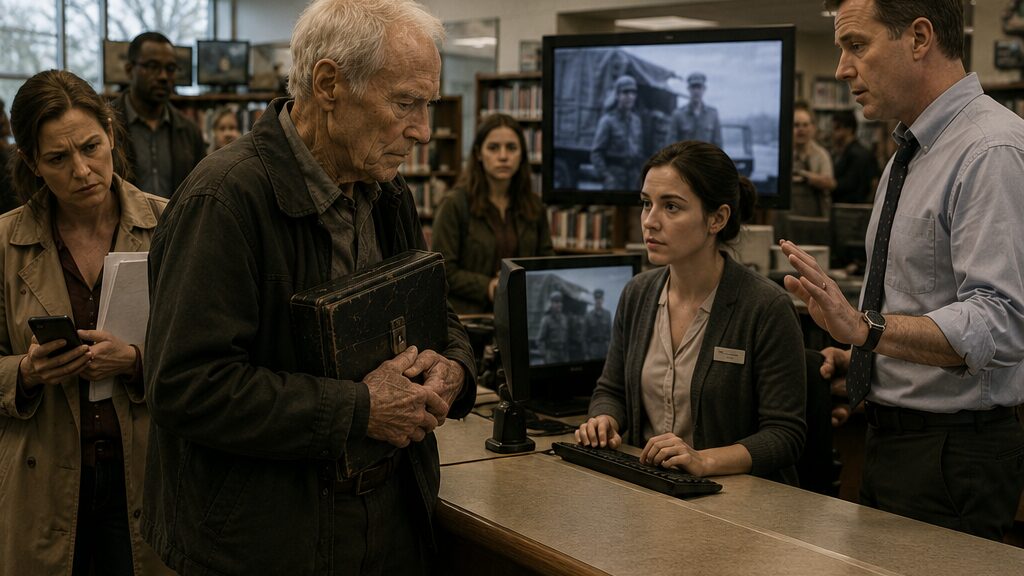
“Just hurry him up,” the woman behind Robert Carter said, loud enough for the whole media counter to hear. “Some of us only need to print one thing.”
Robert kept both hands on the old black tape case, thumbs resting over the cracked latch as if it might open by itself and spill something he could not put back. The case had a strip of yellowed masking tape across the front. The writing on it had faded until it looked less like words than a bruise.
The young clerk behind the counter looked from the woman to Robert. Her name badge said Kimberly Lewis. She had already explained twice that the public library’s media station could convert “some older formats,” but not all, and that damaged files might need a specialty service.
Robert had nodded both times. Nodding was easier than explaining.
“I’m not asking you to fix it,” he said.
Kimberly’s fingers paused over the keyboard. “Sir?”
“I’m asking you to copy it. And write down what it says.”
The woman behind him made a sound through her nose.
Robert did not turn around. He had learned, years ago, that turning toward impatience only gave it a face.
Kimberly’s eyes softened with effort, not yet with understanding. “We can try. But if the audio is bad, the captions may not be accurate.”
“That’s why I brought the notebook.”
He opened the tape case. Inside was a small digital cassette in a plastic sleeve, a folded sheet of handwritten notes, and a thumb drive wrapped in a paper towel. The cassette looked out of place in the clean white light of the library, among charging cords, laminated signs, and a jar of dull pencils.
Kimberly glanced at the line behind him. Two patrons stood with phones in their hands. A teen volunteer hovered near the copier, pretending not to listen.
“We have a twenty-minute limit if other people are waiting,” Kimberly said.
“I’ll take ten.”
The woman behind him muttered, “That’s generous.”
Robert slid the cassette forward with two fingers. His hands were brown and knotted, the nails trimmed short, the skin around his knuckles polished thin by age. He wore a gray work shirt under a plain jacket, no cap, no pins, no little flags stitched over his heart. Nothing that asked anybody to know anything about him.
Kimberly took the cassette carefully, which Robert noticed. Most people took old things as if they were either trash or treasure. She took it as if it could still break.
“That’s an old one,” she said.
“So am I.”
The teen volunteer smiled before he could stop himself. The woman in line did not.
Kimberly led Robert to the media station at the end of the counter. A scanner sat beside a small deck with too many cables. She fitted the cassette in after checking the label twice, then turned the monitor toward him.
The first image shook into view: gray static, then a room with harsh fluorescent lights, then a blur of faces. The sound came through as a low grind, like wind in a tunnel.
Robert leaned forward.
Kimberly adjusted the volume. “Do you know the date?”
“July seventh.”
“What year?”
Robert’s mouth tightened. “Put unclear.”
She looked at him. “For the year?”
“If it isn’t on the tape.”
“But if you know—”
“If it isn’t on the tape,” he said, sharper than he meant to, “don’t write it like it is.”
The woman behind him sighed so hard that her keys jingled.
Robert lowered his eyes to the tape case. “Sorry.”
Kimberly did not answer at once. On the screen, the image rolled, settled, then showed a line of men standing near a long table. Someone laughed. The audio split and clipped. A voice said something that might have been “tell her” or “Taylor” or nothing at all.
Kimberly typed a trial caption.
Robert saw it before she finished.
“No.”
She froze.
The caption read: I need you to tell her I’m fine.
“No,” Robert said again, quieter, but with more force. “He didn’t say fine.”
Kimberly deleted the last word. “What did he say?”
Robert’s thumb pressed into the tape case until the latch creaked. “I don’t know.”
The impatient woman behind him gave a small laugh. “Then why are we all standing here?”
This time Robert turned halfway. Not all the way. Just enough for the woman to see his profile and the line at his jaw.
“Because not knowing is not the same as making it up,” he said.
The copier beeped. The teen volunteer looked down at his shoes.
From the glass office near the reference shelves, a man in a rolled-up shirt and tie stepped out. Jonathan Miller, the branch manager, had the expression of someone who had already been interrupted three times before lunch and was trying not to make this the fourth.
“Kimberly,” he called, “everything all right?”
“Yes,” she said too quickly.
The woman behind Robert lifted her phone. “I just need to print one return label.”
Jonathan came over, took in the cassette, the line, Robert’s hand on the case, the halted caption on the screen.
“Sir,” Jonathan said, his voice smooth from practice, “we’re happy to help, but if this is a longer restoration project, you may need to make an appointment.”
“It’s not restoration.”
Jonathan smiled without showing teeth. “Right. But old media can be time-consuming.”
Robert nodded once. “Give me my tape.”
Kimberly looked at him. “I can still—”
“No.” He reached for the cassette, but his hand did not close around it. For one foolish second, he stared at the screen instead.
The video had shifted. The static cleared just enough to show two young men in faded service clothing standing near a military transport truck. One had his arm braced against the truck bed, face turned slightly away. The other looked straight toward the camera, younger and thinner but with Robert’s same narrow eyes, the same guarded mouth.
Kimberly stopped moving.
Jonathan leaned closer. “Is that you?”
Robert’s throat worked once.
On the screen, the other young man grinned, then pointed at someone behind the camera. The subtitle line beneath him, half typed and half empty, sat like a wound waiting to be closed.
I need you to tell her I—
Kimberly’s cursor blinked after the dash.
The woman in line said nothing now.
Robert reached past the keyboard and touched the lower edge of the monitor, not the face, not the caption, just the plastic frame beneath it.
“If you can’t hear it,” he said, “don’t write it.”
Then he lifted the cassette from the deck with hands that had become too careful, placed it back in its sleeve, and shut the tape case.
Kimberly glanced at the paused frame, then at him. “Sir, I didn’t realize—”
“No reason you should.”
Jonathan checked the wall clock. “Mr.—”
“Carter,” Robert said.
“Mr. Carter, Kimberly can help you schedule a longer appointment.”
Robert slid the case under his arm. The latch clicked against his ribs. “No. I’ve taken enough time.”
He turned away from the monitor before the young man beside the truck could become any clearer.
Behind him, the printer began spitting out someone else’s label.
But as Robert walked toward the front doors, he heard Kimberly call softly after him, not loudly enough for the room, but enough for him.
“Mr. Carter?”
He stopped.
She was still looking at the frozen frame on the screen.
“Who’s standing beside you?”
Robert’s fingers tightened on the old black case.
He did not answer.
Chapter 2: The Subtitle Nobody Was Allowed To Guess
Kimberly replayed the clip after Robert Carter left and heard a man’s voice buried under the static.
It was faint, almost swallowed by the squeal of damaged tape. The media station had gone quiet except for the printer warming itself and the distant sound of a child dragging chair legs across the reading area. The impatient woman had printed her return label and left. Jonathan had returned to his office, where he was visible through the glass, talking into the phone with one hand pressed against his forehead.
Kimberly should have ejected the tape copy from the capture deck, closed the software, and logged the session as incomplete.
Instead, she leaned closer.
The screen showed the young Robert beside the transport truck, shoulders squared, face half in shadow. The other man stood beside him, thinner, smiling in the restless way people smiled when a camera made them embarrassed. His name came later, after Kimberly slowed the image and found a handwritten sign taped to the wall behind them.
J. Martinez – motor pool
The sign was crooked. Part of it vanished behind a shoulder. But the letters were clear enough.
Kimberly wrote Joseph Martinez on a sticky note.
She played the audio again.
“I need you to tell her I—”
Then static. A scrape. Someone laughing too close to the microphone. The voice came back for half a syllable, then disappeared.
Kimberly typed the line into the caption box.
I need you to tell her I— [UNCLEAR]
She stared at the word.
It looked ugly. It looked unfinished. It looked honest.
From the office, Jonathan’s door opened.
“Kimberly.”
She clicked pause, too late.
Jonathan came toward her with a folder in his hand and an expression that had already decided what he wanted to find. “You’re still on that?”
“It’s only a sample.”
“That was not an appointment. That was walk-up help.”
“I know.”
“We have a waiting list for scanner time, a broken microfilm reader, and three complaints from people who think the printer eats their money on purpose.” He lowered his voice when a patron passed. “We cannot become a private restoration service for one patron.”
“I’m not restoring it.”
Jonathan looked at the screen. The frame had stopped again on the two young men by the truck.
Kimberly saw the recognition flicker across his face, then watched him put it away.
“Is that him?” he asked.
“Yes.”
Jonathan breathed through his nose. “That’s unfortunate.”
Kimberly turned. “Unfortunate?”
“I mean it changes how this feels. It doesn’t change what we can do.” He tapped the folder against his palm. “People bring in old family things all the time. Wedding tapes. funeral slides. immigration papers. letters. If we treat one as special, someone else will ask why theirs isn’t.”
“Maybe this one is special.”
“To him, yes.”
She looked back at the screen. “Maybe that’s enough.”
Jonathan’s jaw shifted. He was not an unkind man. Kimberly had seen him cover bus fare for a teenager whose card had been declined. She had seen him stay late to help an elderly woman fill out a housing form. But kindness, with Jonathan, always seemed to pass through a doorway marked policy before it was allowed to enter the room.
“We close in forty minutes,” he said. “Do not promise him anything.”
“He left.”
“Then let it be left.”
Kimberly placed her fingers on the keyboard and did not type.
Jonathan softened his tone. “I’m not trying to be harsh. You’re good at this job because you care. But caring without limits turns into a line out the door and staff crying in the break room.”
She knew that was true enough to hurt. On Wednesday nights, when the public computers filled with people applying for benefits, jobs, housing, forgiveness, permission, proof of themselves, Kimberly often left with a headache behind her eyes. Everybody’s emergency arrived wearing a different coat.
Still, the paused frame would not leave her alone.
“He told me not to guess,” she said.
Jonathan glanced at the caption line. “Then don’t.”
“I mean, everyone thought he was being difficult.”
“He was being difficult.”
“He was being exact.”
Jonathan said nothing to that.
Kimberly put on headphones after he returned to the office. She played the clip again, then again, each time making notes. She did not add what she could not hear. She marked every gap. She captured still frames where the picture cleared: Robert near the truck; Joseph holding a paper cup; both men turning toward someone off camera; a brief shot of Robert laughing before he noticed the lens.
That one stopped her.
The old man at the counter had not looked like a man who laughed easily. The young man in the footage laughed with his head lowered, as if trying to hide it and failing.
Kimberly saved the frame.
Then she noticed the detail on Robert’s sleeve. Not a medal. Not anything showy. A worn unit patch half folded by the angle of his arm. She enlarged the image, but the patch blurred before it became readable.
She typed: patch visible, unit unclear.
The phrase made her think of Robert’s hand on the tape case. If you can’t hear it, don’t write it.
At the copier, the teen volunteer gathered abandoned printouts. “Is he famous?”
Kimberly startled. “What?”
“The old man. Is he someone famous?”
“No.”
The teen came closer, looking at the screen. “Then why are you still doing it?”
Kimberly considered saying Because he served. But that felt too large and too easy, and Robert had not asked for large or easy.
“Because he asked us not to make it wrong,” she said.
The teen nodded like he understood more than he probably did, then returned to the copier.
By closing time, Kimberly had made a low-resolution copy, three still frames, and a rough caption track that was mostly brackets and restraint. She printed one still: Robert and Joseph beside the transport truck. Beneath it she wrote by hand: I did not fill in what I could not verify.
Jonathan came out with his keys. “Kimberly.”
“I’m clocked out in two minutes.”
“You’re already over.”
“I know.”
He saw the envelope before she could slide it under the keyboard. Plain white, unsealed. Robert Carter written across the front.
Jonathan sighed. “Don’t make this a habit.”
“It isn’t a habit.”
“That’s what habits say when they start.”
She almost smiled. He did not.
He stood there for a moment, looking tired instead of annoyed. “I got two emails this afternoon. One from a patron who said we let one person monopolize staff. One from the city office reminding me our quarterly numbers are down. I have to answer those with something better than ‘the tape felt important.’”
Kimberly sealed the envelope.
“What if you answer that we helped someone preserve public memory?”
Jonathan gave her a weary look. “That is not a category on the report.”
“No,” she said. “It probably should be.”
He shook his head, but he did not take the envelope away.
When the lights clicked to closing level and the front doors locked, Kimberly sat for one more minute in the blue glow of the monitor. Joseph Martinez smiled out from the paused frame, his sentence still broken beneath him.
I need you to tell her I— [UNCLEAR]
Kimberly wrote one more note on a small card, slower than the first.
Mr. Carter,
I left the unclear parts unclear.
She put the card on top of the still frame, then tucked both inside the envelope with the copied file.
For a moment, it felt like too little. A paper envelope, a copied clip, one word left unfinished on purpose.
Then Kimberly remembered Robert walking away rather than accept a lie.
She placed the envelope in the top drawer and locked it there for morning.
Chapter 3: The Gift Was Not A Finished Video
Kimberly was waiting with a plain white envelope when Robert came through the library doors the next morning, and Jonathan Miller was watching from his office as if the envelope might turn into a complaint.
Robert saw both of them before either spoke.
He nearly turned around.
The tape case was under his arm again, though he had told himself not to bring it. He had stood in his kitchen for twenty minutes with the case on the table, one hand on the back of a chair, the other on the latch. Then he had put on his jacket, taken the bus, and carried it anyway.
Kimberly stepped from behind the counter. “Mr. Carter.”
He looked at the envelope in her hands. “I didn’t make an appointment.”
“I know.”
“If this is a form, I can fill it out later.”
“It isn’t a form.”
Jonathan appeared at his office door but did not come out. Robert noticed that too. Managers liked doorways. They could be present and absent at the same time.
Kimberly held the envelope with both hands. “I worked a little after closing. Not much. I didn’t repair the tape. I didn’t change the sound.”
Robert’s eyes went to the envelope, then back to her. “You had no permission.”
Her face reddened. “You’re right.”
That answer unsettled him more than an excuse would have.
“I made a copy only from the captured section,” she said. “And a few still frames. There are captions, but only where I could hear the words. I marked the rest.”
Robert did not move.
Kimberly lowered her voice. “I left the unclear parts unclear.”
Something in his chest shifted, small and dangerous.
He took the envelope because she was still holding it out and because refusing it would have required more strength than he had. The paper was warm from her hands. His name was written neatly across the front, Robert Carter, each letter separate and careful.
He opened it at the media counter.
Inside was a thumb drive, a printed still frame, and a note card.
The still frame came out first.
Robert had seen the image on the monitor yesterday, blurred and flickering. On paper it looked quieter, less like a machine’s accident and more like a thing that had waited. There he was, young and narrow-shouldered, standing beside Joseph Martinez near the transport truck. The truck’s rear canvas sagged in the heat. Joseph had one hand raised, not waving exactly, more like warning the camera not to catch him laughing.
Robert’s thumb landed on Joseph’s sleeve.
For one second the library disappeared. No counter. No printer. No city notices on the board. Only dust, fuel, hot metal, and Joseph saying, “Don’t let me sound stupid when you tell it.”
Robert’s hand trembled.
He moved it quickly, but Kimberly saw.
“I’m sorry,” she said.
“For what?”
“For yesterday. For everyone rushing you.”
Robert slid the still frame back into the envelope. “You didn’t rush me.”
“I almost did.”
“That’s different.”
She gave a faint smile, but it did not last. “There’s a file on the drive. I put the captions in a separate document too. Some lines are just marked unclear.”
Robert pulled out the note card.
Mr. Carter,
I left the unclear parts unclear.
He read it twice.
The words should not have mattered. They were plain words. A clerk’s note. A sentence that did not solve anything. Yet his throat tightened as if someone had put a hand there.
Kimberly said, “It didn’t feel right to guess.”
Robert folded the card once, then unfolded it because folding it felt disrespectful. “Most people guess.”
“I know.”
“No, you don’t.”
The words came out harsher than he intended. Her face changed, not wounded exactly, but closed a little. He regretted it and did not know how to take it back without opening the larger thing behind it.
So he said nothing.
Jonathan finally came out. “Mr. Carter, I understand Kimberly did some extra work for you.”
Robert turned the envelope in his hands. “She did.”
“I need to be clear that our staff time is limited. We can help you schedule formal media time, but we can’t guarantee extended restoration.”
Robert slid the note card into the envelope. “I didn’t ask for a guarantee.”
Jonathan’s mouth tightened. “I’m trying to prevent confusion.”
“There’s plenty already.”
The teen volunteer at the copier glanced over. Kimberly looked down. Robert heard himself and hated the old habit in it: the clean cut, the shutting door.
Jonathan held his ground, but his voice stayed controlled. “I respect that the material matters to you.”
Robert looked at him then. “Do you?”
Jonathan did not answer quickly enough.
The front doors opened, and Elizabeth Wilson walked in carrying her purse tight under one arm. She stopped when she saw her father at the media counter with the envelope in his hand.
“Dad.”
Robert closed the envelope at once.
Elizabeth’s eyes moved from him to Kimberly to Jonathan. She took in the tape case, the counter, the way everyone stood too still.
“I called your house,” she said. “You didn’t answer.”
“I was on the bus.”
“I can see that.”
“I left a note.”
“You wrote ‘library.’ That is not a note. That is a location.”
Kimberly stepped back as if she could make room for a family conversation by surrendering a square of carpet.
Elizabeth turned to her. “Are you the person helping him with the tape?”
Kimberly hesitated. “Yes.”
“I appreciate your kindness,” Elizabeth said, in the tone people used when kindness had become a problem. “But my father doesn’t need encouragement with this.”
Robert felt the envelope bend in his hand.
Kimberly looked at him, then at Elizabeth. “I only made a copy of a short section.”
“That’s how it starts.” Elizabeth’s voice lowered. “He’ll sit with it all day. Then all night. He’ll stop eating properly. He’ll call people who don’t want to be called. He’ll make himself sick over words nobody can hear anymore.”
Robert said, “Elizabeth.”
She faced him. “No. You don’t get to disappear to a public library with that thing and make me the unreasonable one for worrying.”
Jonathan stepped in carefully. “Maybe we should move this conversation—”
“This conversation has been moving for years,” Elizabeth said, then stopped, embarrassed by her own volume.
A patron near the new books shelf pretended to read a dust jacket.
Robert placed the envelope flat on the counter. His palm stayed on it.
Kimberly’s note was inside. Joseph’s face was inside. The line still broken. The unclear parts still unclear.
Elizabeth saw his hand over the envelope and her expression changed from irritation to something closer to fear.
“Dad,” she said, softer now, “you promised Mom.”
The library seemed to narrow around him.
Robert looked at his daughter, at the worry around her mouth that had not been there when she was young, at Kimberly standing uncertainly beside the media station, at Jonathan with one hand half raised as if policy could steady the air.
He picked up the envelope.
“I’ll take it home,” he said.
Elizabeth exhaled. “Good.”
But he did not hand her the tape case. He tucked it back under his arm.
Kimberly noticed.
Elizabeth did too.
“Dad.”
Robert looked toward the doors, where the morning light lay flat on the floor.
“You promised Mom you’d stop doing this,” Elizabeth said.
He kept his hand around the tape case latch.
“I promised your mother,” he said, “I would stop doing it wrong.”
Chapter 4: The Daughter Who Wanted The Past Quiet
Elizabeth found the crossed-out subtitles in the kitchen drawer while looking for her father’s blood pressure log.
They were folded under a stack of takeout menus he never used, behind a packet of batteries and three envelopes from the utility company. At first she thought they were old receipts, the kind he kept long after the ink had faded. Then she saw the same sentence repeated down the page in his careful block letters.
I need you to tell her I’m fine.
A thick line through fine.
I need you to tell her I made it.
A harder line through made it.
I need you to tell her I’m sorry.
That one was crossed out so many times the paper had nearly torn.
Elizabeth stood with the drawer open against her hip, listening to her father move slowly in the living room. The library envelope lay on the kitchen table beside his glasses, a pile of unopened mail, and the printed still frame Kimberly had given him. Robert had placed the still frame face down when they got home, but Elizabeth had seen enough at the library: two young men beside a transport truck, one of them her father before age had narrowed him into silence.
“Dad,” she called.
No answer.
She pulled out another sheet. More fragments. More brackets.
[UNCLEAR]
[STATIC]
[LAUGHTER]
[VOICE TOO LOW]
Her first feeling was anger. Not the hot kind. The tired kind that came from finding proof that something had been happening under her roof of concern while she had been told it was nothing.
She carried the papers to the living room.
Robert sat in his chair near the window, the old tape case on his lap. The television was off. The remote lay beside him untouched. His thumb rested on the cracked latch the way some people held a rosary.
“Were you doing these at night?” Elizabeth asked.
His eyes moved to the papers, then away. “Sometimes.”
“How many times is sometimes?”
“Enough to know I wasn’t hearing it right.”
She let out a breath and put the papers on the coffee table. “Dad.”
He closed his hand around the tape case. “Don’t start.”
“I’m not starting anything. I’m already in the middle of it, apparently.”
He looked at the window.
Elizabeth hated that window. Not the glass itself, but the way he used it. Whenever she got too close to a subject he did not want opened, he sent his eyes out through that pane toward the small parking lot and the maple tree near the curb. It was a soldier’s retreat disguised as an old man’s habit.
She sat across from him. “You told me this was just an old video.”
“It is.”
“No, it’s not. Old videos don’t make you forget dinner. Old videos don’t have three versions of the same sentence crossed out in a drawer.”
He adjusted the tape case by an inch. “You went through my drawer.”
“I was looking for your blood pressure log because you said the doctor wanted numbers. You remember the doctor? The one you promised you’d listen to?”
“I remember.”
“Do you remember promising Mom?”
That made his eyes come back to her. Not sharply, not angrily. Worse. Carefully.
Elizabeth lowered her voice. “You promised her you would stop letting the past eat the house.”
He looked down at the case. “That isn’t what I promised.”
“It was close enough.”
“No,” he said. “It wasn’t.”
She picked up the still frame from the table and turned it over. The paper was ordinary printer paper, slightly curled at one corner. There was her father, young enough to be almost a stranger, standing beside another soldier whose smile had been caught halfway between joking and asking not to be seen.
“Is this Joseph Martinez?” she asked.
Robert’s hand tightened.
She had not expected the name to land so visibly.
“I saw it on one of your drafts,” she said. “And I remember Mom saying it once. Years ago. She stopped when I walked into the room.”
Robert’s mouth moved, but no sound came.
Elizabeth studied the still frame. “Who was he?”
“A friend.”
“A friend from the Army?”
“Yes.”
“Was he the reason you kept calling that veterans’ office after Mom died?”
Robert leaned forward and took the still frame from her, not roughly, but with a finality that made her feel twelve years old for one second. “You don’t need to dig up everything.”
“I’m not digging. I’m living here with what you won’t say.”
He put the still frame on the arm of his chair. Joseph’s face pointed toward the ceiling.
Elizabeth softened despite herself. Her father’s jacket looked too big at the shoulders. His hair, once a clean gray, had gone white at the edges. When her mother was alive, he had still moved through rooms with a steadiness that made him seem built into them. Now he seemed to be guarding corners nobody else could see.
“I’m scared for you,” she said.
“I know.”
“Do you?”
He gave the smallest nod.
“Then help me understand why a tape matters more than your sleep.”
“It doesn’t.”
“You’re lying.”
His gaze flicked to her.
She almost apologized. She did not.
Robert opened the tape case, then shut it again without taking anything out. The click sounded too loud.
“I told your mother I would put things away,” he said. “After she got sick, she didn’t want the house full of old paper. Old names. Old calls. She said grief had enough rooms without me building more.”
Elizabeth swallowed. That sounded like her mother. Gentle and firm, soft enough to hold a hand while she took away a knife.
“So you promised her,” Elizabeth said.
“I promised I would stop doing it wrong.”
“What does that mean?”
Robert’s eyes went back to the still frame.
“It means there was a story,” he said. “About Joseph. People liked it.”
Elizabeth waited.
He did not continue.
She stood, sudden and desperate, and reached for the tape case. “Then maybe I should take this for a while.”
Robert’s hand came down on it.
“No.”
“I’m not throwing it away.”
“No.”
“I’ll keep it safe.”
“It is safe.”
“It is not safe if it’s keeping you like this.”
His voice hardened. “You’re not taking it.”
There it was: not the aging father whose pill bottles she arranged, not the widower who forgot coupons, but the man who had once given orders and expected the world to understand the cost of disobeying them. Elizabeth saw him and flinched inwardly, then hated herself for it.
“You can’t keep locking everyone out,” she said.
“I’m not locking anyone out.”
“You just did.”
He looked at his hand on the case. Slowly, as if it embarrassed him, he lifted it.
Elizabeth did not take the tape.
For several seconds neither spoke. The refrigerator hummed. Outside, a car door slammed. On the coffee table, one of the crossed-out sheets had slid partly over the utility bill, covering the red overdue notice.
Elizabeth noticed it. Robert did too.
She reached for the bill, but he got there first and turned it face down.
“Dad.”
“It’s paid tomorrow.”
“Is it?”
“Yes.”
She did not believe him, and he knew it. The tape was not the only thing he had been hiding under paper.
Elizabeth sat again. Her anger had thinned into fear. “This is what I mean. You make everything a locked drawer. Then you act surprised when I open one.”
Robert picked up the subtitle draft with the three completed versions.
He looked at the crossed-out apology.
“I don’t know what he said,” he murmured.
Elizabeth leaned closer.
“I thought I did,” he said. “Then I thought I remembered it different. Then I thought maybe I remembered what I wanted him to say.”
“Joseph?”
Robert nodded.
“What happened?”
He rubbed one thumb over the paper until the edge bent. “There was an article. Years ago. After the reunion tape. They asked me about him because I was the one still around.”
“A newspaper article?”
“Local piece. Veterans Day. They wanted something clean.”
Elizabeth waited, barely breathing.
“I gave them clean.”
His face changed then. Not crumpled, not dramatic. Just older, all at once.
She reached toward him, but stopped before touching his sleeve.
“What did you tell them?”
Robert folded the paper along an old crease.
“Not enough,” he said.
“That isn’t an answer.”
“No.”
He stared at the crossed-out lines as if one of them might finally hold still.
Then he said, so quietly she almost missed it, “I let them print it wrong once.”
Chapter 5: The Story That Was Easier Than The Truth
Kimberly had the old article spread on the records-room table when Robert arrived, and the first line she pointed to was already wrong.
He knew it before his eyes finished crossing the page.
LOCAL VETERAN REMEMBERS FALLEN FRIEND’S FINAL COURAGE
The paper was a photocopy, the edges gray from age and machine dust. Kimberly had found it in a binder of local history clippings that smelled faintly of cardboard and basement air. She stood beside the table with both hands folded, as if the article might accuse her of something if she touched it again.
Robert did not sit.
“This wasn’t the final anything,” he said.
Kimberly’s eyes lifted. “I’m sorry.”
He hated that she kept saying sorry when she had done the least wrong of anyone.
The records room was small, more closet than room, with metal shelves full of binders labeled by year. A humming fluorescent light flickered above them. Beyond the closed door, the library moved in soft pieces: wheels of a book cart, low voices, a printer starting and stopping like an uncertain breath.
Elizabeth stood near the shelf behind him. She had driven him there after a morning of silence so thick it had made even the turn signal sound rude. She had not asked many questions in the car. That worried him more than questions would have.
Kimberly tapped a paragraph halfway down the page. “This part mentions Joseph Martinez.”
Robert looked.
Carter recalls Martinez as cheerful to the end, telling his fellow soldiers not to worry and asking that his family remember him smiling.
Robert’s jaw tightened.
Elizabeth read over his shoulder. “Is that the part?”
He did not answer.
Kimberly said, “There’s also a note in the library catalog that the article was used in a Veterans Day display later. Maybe more than once.”
Robert laughed once without humor. “Of course it was.”
Elizabeth touched the back of a chair. “Dad, what was wrong about it?”
The answer sat behind his teeth, old and stubborn.
He had spoken to reporters before. Not often. Not because he liked it. After he came home, people occasionally wanted a veteran voice for a holiday piece or a school program. They never wanted the full weight. They wanted a sentence that could fit under a photo.
Joseph smiling made a good sentence.
Joseph afraid did not.
Kimberly slid another sheet toward him. “There’s a transcript draft from when we captured the clip. Not much. But enough to compare.”
She had printed the line large.
JOSEPH: I need you to tell her I— [UNCLEAR]
Below that, in smaller type:
ROBERT: Say it yourself when you get back.
Then static.
Robert had forgotten that part.
No. He had not forgotten. He had stepped around it for so long that it had become furniture in the room of his mind.
His knees felt unreliable. He sat.
Elizabeth moved, but he lifted one hand before she could help him. The gesture came too sharp. She stopped. He regretted that too.
Kimberly waited.
Robert looked at the article again. “He wasn’t cheerful to the end. Not that day.”
“On the tape?” Kimberly asked.
“On the tape.”
Elizabeth’s voice was careful. “But he didn’t die that day?”
“No. That was years after the worst of it. Reunion at a reserve center. Someone brought an old camera. Men who hadn’t seen each other in too long started acting like boys because that was easier than acting like what we were.”
He could see it now: coffee in paper cups, folding chairs, a transport truck parked outside for display, men touching its side like it was an animal that had survived with them. Joseph had been thinner than Robert remembered and louder than he needed to be. He had joked for an hour. Then the camera caught him near the truck when his face had changed.
“He asked about his wife,” Robert said. “About what she knew. About what I had told her back then.”
Elizabeth sat slowly across from him.
Kimberly’s eyes had gone still.
“I had told her he was steady,” Robert continued. “That he kept everyone’s spirits up. That he wasn’t scared. People like that. Families especially. They need something to stand on.”
He pressed his thumb into the edge of the photocopy. “Joseph read the article years later. He didn’t yell. That would’ve been easier. He just said, ‘You made me braver than I was.’”
Elizabeth’s face tightened.
Robert looked away from her. “I told him people needed comfort.”
“What did he say?” Kimberly asked.
The fluorescent light buzzed.
“He said comfort that uses a man up is not comfort.”
No one spoke for a while.
Then a knock came at the records-room door, and Jonathan stepped in with a folder tucked under his arm. He stopped when he saw the article, the transcript, the three of them around the table.
“I’m interrupting,” he said.
“Yes,” Robert said.
Kimberly gave him a look.
Jonathan took the hit and stayed. “Kimberly, can I speak with you for a moment?”
She followed him into the hall but left the door open enough that Robert could hear most of it. He suspected Jonathan wanted him to hear.
“You cannot keep using work time for this,” Jonathan said quietly.
“I’m on lunch.”
“You were on lunch twenty minutes ago.”
“I’ll make it up.”
“That is not the point.”
“What is the point?”
“The point is boundaries. A patron’s personal history is not automatically a library project.”
“It’s already in the library.” Kimberly’s voice stayed low but firm. “The article is in our records. The display used it.”
Jonathan paused. “That doesn’t make us responsible for correcting it.”
“No. But maybe it makes us responsible for not repeating it.”
Robert stared at the transcript.
Elizabeth whispered, “She didn’t have to do this.”
“No,” Robert said.
In the hall, Jonathan lowered his voice further. “I got an email from the local veterans’ group. Someone told them we were working on old service footage. They’re interested in showing it Saturday in the community room.”
Kimberly said, “I didn’t tell them.”
“I know. The teen volunteer mentioned it to his grandfather.”
Robert closed his eyes.
There it was. Memory, once touched, moving without permission.
Jonathan continued, “They think it might be a nice small program. Oral history, local veterans, that sort of thing. The city loves that language. But I need to know what this is before it becomes something we can’t manage.”
Kimberly looked back through the doorway at Robert.
He opened his eyes.
Jonathan followed her gaze. For the first time since Robert had met him, the manager looked less like a man defending rules and more like a man realizing rules had placed him in front of something alive.
“I’m not trying to exploit anyone,” Jonathan said, now to Robert. “But if this becomes public, there need to be permissions. Context. A plan.”
Robert rose slowly.
Elizabeth stood too. “Dad, you don’t have to—”
“Yes,” he said. “I do.”
The word surprised all of them, himself most of all.
He took the photocopied article and folded it once, carefully, wrong headline hidden inside. Then he picked up Kimberly’s transcript page. The bracketed word sat in the middle, plain and unadorned.
[UNCLEAR]
For years, he had thought of unclear as failure. The missing word. The broken sound. The thing that kept him from finishing.
Now it looked like the only honest place left to stand.
“What does the veterans’ group want?” he asked Jonathan.
“A short showing. Maybe a discussion. Nothing formal.”
“Everything is formal when people are listening.”
Jonathan absorbed that. “Then we can cancel.”
Robert looked at Elizabeth. Her eyes were wet, but she did not tell him to stop. Not this time.
He looked at Kimberly, who had left the unclear parts unclear.
“No,” Robert said. “Don’t cancel.”
Jonathan’s shoulders eased a fraction.
“But you don’t show that video like it’s finished,” Robert said. “You don’t introduce Joseph with that article. You don’t call him cheerful. You don’t call him fearless. And you don’t let anyone else put words where the tape has none.”
Jonathan nodded slowly. “All right.”
Robert picked up the transcript.
“And before it plays,” he said, feeling every locked drawer in him open at once, “I speak first.”
Chapter 6: The Listening Table At The Back Of The Room
Jonathan nearly canceled the showing when the second complaint came in, and Kimberly found him standing in the community room with one hand on the light switch and the other holding his phone.
The chairs were already arranged in three short rows. Not many. Twenty at most. A portable screen stood at the front, its white surface slightly wrinkled. On the side table, Kimberly had placed the library laptop, a small speaker, the USB copy, and a printed caption sheet. Beside them sat a folded card she had made that morning.
Bring what you have. We won’t guess the rest.
Jonathan looked at it as if it were a match near dry grass.
“Take that down for now,” he said.
Kimberly stopped beside the table. “Why?”
“Because one person says we’re turning public space into private therapy, and another says we’re favoring veterans over other community groups.”
“We haven’t even started.”
“That rarely stops complaints.”
Through the open door, she saw Robert in the hallway with Elizabeth. He wore the same plain jacket, but he had shaved carefully. The tape case was under his arm. He looked smaller among the bulletin boards and children’s artwork, yet harder to move.
Kimberly lowered her voice. “If you cancel with him standing right there, you’ll make yesterday look kind.”
Jonathan’s face tightened. “Do you think I don’t know that?”
“Then don’t.”
He glanced at the chairs. “You have no idea how fast a small thing becomes a policy problem.”
“No,” she said. “But I know how fast a person becomes a problem when everyone calls him one.”
That landed. She saw it.
Jonathan looked toward the hall. Robert had not entered. He stood just beyond the door, waiting as if he had been told all his life not to cross thresholds until invited. Elizabeth stood beside him, arms folded, not in anger now but in bracing.
Jonathan put the phone in his pocket.
“Fine,” he said. “We proceed. But no recording. No posting. No speeches from the audience.”
“No applause sign too?” Kimberly asked.
He looked at her.
“Sorry,” she said, though she was not entirely.
By two o’clock, the room had filled unevenly. A few older men from the local veterans’ group sat together but did not make a show of it. One had a cane hooked over his chair. Another held a folder of photographs on his knees. The teen volunteer slipped into the back row beside a gray-haired man who must have been his grandfather. A couple of regular patrons came because the sign near the front desk had said local history film clip. The impatient woman from Tuesday did not come, which Kimberly considered a mercy.
Robert sat in the front row with Elizabeth.
At first, Elizabeth had chosen a seat near the aisle, half turned toward him, ready to leave if he asked. Then, just before Jonathan walked to the front, she moved one chair closer. Her shoulder nearly touched Robert’s.
Robert noticed. Kimberly saw him notice. He did not look at his daughter, but his right hand loosened on the tape case.
Jonathan cleared his throat. “Thank you for coming. This is a small community viewing of a local historical clip brought in by Mr. Robert Carter.”
Robert’s jaw shifted at the word historical, but he let it pass.
Jonathan continued, “Before we play it, Mr. Carter has asked to say a few words.”
Robert rose too quickly, then steadied himself on the back of the chair. Elizabeth’s hand moved but stopped before touching him. He walked to the front carrying one sheet of paper. When he reached the laptop table, he folded the paper and put it down without reading from it.
Kimberly stood near the speaker, close enough to help, far enough not to become part of his moment.
Robert faced the room.
He did not thank them for coming. He did not tell them his rank. He did not describe service as noble, hard, proud, or anything else that might fit on a poster.
He pointed to the caption sheet.
“There are places in this tape where the words are missing,” he said. “You’ll see unclear written there. That doesn’t mean nobody tried. It means somebody tried not to lie.”
A chair creaked.
Robert looked at the floor for half a second, then back up.
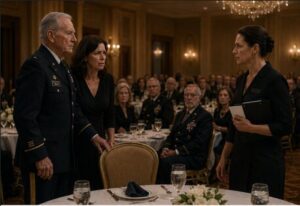
“The man beside me in the video is Joseph Martinez. He was my friend. Years ago, I let people tell a clean story about him because it made them feel better. I helped them do it.”
Elizabeth’s hand went to her mouth.
Robert saw her but kept going.
“They said he was cheerful. Fearless. Easy with what happened. Joseph was many good things, but he was not easy with it. He had fear in him. He had anger. He loved his wife and didn’t always know how to come home with what he carried. That doesn’t make him less. It makes him true.”
The room had gone still in the particular way of people who knew better than to rescue a silence too soon.
Robert turned slightly toward the screen. “On this tape, he says something I can’t hear all the way. I have spent years trying to make the missing part become a word I could live with.”
His voice did not break. It roughened, which was worse.
“I won’t do that today.”
Kimberly pressed play.
The image flickered up: static, fluorescent light, men moving through a reunion room long ago. The transport truck appeared in the frame, its canvas back dusty and familiar. Young Robert stood beside it. Joseph Martinez came into view smiling, embarrassed by the camera.
A low laugh filled the speaker, warped by age.
Joseph’s voice came through.
“I need you to tell her I—”
The speaker hissed.
On the screen, the caption appeared.
[UNCLEAR]
Then young Robert, half laughing, half warning him away from seriousness, said, “Say it yourself when you get back.”
A few people shifted. Not restless. Struck.
The clip ended less than three minutes later.
No one applauded.
Kimberly was grateful for that.
Robert stood beside the screen, looking at Joseph’s frozen face. “I don’t know the missing word,” he said. “I know what came before it. I know what came after. I know he was scared that the people who loved him would only be allowed the brave parts. So if you remember him from this, remember that the unclear part belongs to him too.”
Elizabeth wiped her cheek once, quickly, like she was angry at the tear for appearing in public.
From the second row, a man from the veterans’ group lifted a hand but did not stand. “Mr. Carter,” he said, “I’ve got a box of cassettes from my brother. Some of them are bad. I never brought them anywhere because I didn’t want somebody cleaning them up wrong.”
Jonathan, at the back of the room, closed his eyes briefly.
The man continued, “Could someone here show me how to mark what can’t be heard?”
Kimberly looked at Jonathan.
Robert looked at the little card on the side table.
Bring what you have. We won’t guess the rest.
He picked it up. For a moment Kimberly thought he might hand it back to her, might say it was too much, too public, too close to turning pain into a program. Instead he set it upright against the empty tissue box beside the laptop.
“Start with one tape,” Robert said. “Then stop before you start wanting it to be better than it is.”
A soft sound moved through the room. Not applause. Recognition, maybe. Relief.
Elizabeth stood and came to the table. She did not touch Robert’s arm. She touched the tape case instead, laying two fingers gently on the cracked latch.
“Could I sit with you for the next one?” she asked.
Robert looked at her hand on the case. Then at her.
“Yes,” he said.
After the room cleared, Jonathan stayed behind while Kimberly gathered cords. The veterans’ group member had left his phone number on a scrap of paper. The teen volunteer had offered to make a simple sign-up sheet. Elizabeth was helping Robert place the caption sheets back into the envelope, handling each page as if it had become breakable.
Jonathan took down the room reservation notice from the door. Kimberly watched him, waiting for the usual speech about limits.
Instead, he walked to the media counter outside the room.
On the counter stood a laminated sign he had put there months before.
ONE TAPE OR DEVICE PER PATRON. MEDIA HELP LIMITED TO TWENTY MINUTES.
Jonathan looked at it for a long moment.
Then he lifted the sign from its plastic holder, slid it into a drawer, and shut the drawer quietly.
Chapter 7: What They Left Unclear On Purpose
Robert found the media counter crowded with old tapes, phones, envelopes, and one shoebox tied with kitchen string, and for a moment he thought he had come on the wrong day.
Kimberly looked up from behind the counter with a roll of blank labels in one hand. The teen volunteer stood beside her, writing numbers on slips of paper. An older man held a cassette player against his chest. A woman near the copier clutched a stack of photographs in both hands as if someone might ask her to prove they were hers.
On the counter, where the old time-limit sign had once stood, sat a new card in a plastic holder.
Bring what you have. We won’t guess the rest.
Robert stopped just inside the entrance.
He had meant to return the caption sheets, thank Kimberly properly, and go home before anyone asked him to be useful. He had even rehearsed the sentence on the bus: You did good work. That was all. Plain, acceptable, not too much.
But the room had changed without asking him.
Kimberly saw him standing there and came around the counter. “Mr. Carter.”
The people waiting turned, not all at once, but enough.
Robert felt it immediately: the danger of being recognized as the reason something had started. He tightened his grip on the envelope under his arm.
“I can come back,” he said.
“No.” Kimberly’s answer came too quickly. She softened it. “Please don’t.”
The teen volunteer held up the numbered slips. “We’re just sorting who has what. Not doing everything today.”
“Good,” Robert said.
The boy blinked.
Robert nodded toward the card. “Stop before you promise too much.”
Kimberly smiled faintly. “I wrote that on the back.”
Behind her, Jonathan stepped out of his office carrying a clipboard. He had removed his tie and rolled his sleeves, which made him look less like the keeper of limits and more like someone pressed into service by his own conscience.
“Mr. Carter,” he said. “We are trying this as a monthly media memory help session. Small scale.”
Robert looked at the crowded counter.
Jonathan followed his gaze. “Smaller than it looks.”
“It always is,” Robert said, “until it isn’t.”
Jonathan accepted that without defense. “That’s why Kimberly made rules.”
“Rules can help,” Robert said. “If they don’t get lonely.”
Jonathan looked at him carefully, then wrote something on the clipboard.
Kimberly touched Robert’s sleeve, lightly enough that he could pretend not to feel it if he needed to. “I have something for you.”
She reached under the counter and brought out his original tape case.
For a second Robert did not understand what he was seeing. The same old black case, the same cracked latch, the same faded strip of masking tape. But the broken hinge had been reinforced with a thin strip of clear archival tape, not enough to make it new, only enough to keep it from falling apart. Inside, when Kimberly opened it, the cassette rested in a clean sleeve. Beside it was a folded caption sheet and a small note card.
“We didn’t change the outside,” she said. “I thought you’d want it to still look like itself.”
Robert took the case.
The repaired latch closed with a softer sound than before.
His fingers stayed on it too long.
“Copy-room assistant had the archival tape,” Kimberly said, perhaps because silence frightened her a little. “The sleeve came from a donation box. Nothing fancy.”
“Good,” Robert said.
She looked worried.
He cleared his throat. “Fancy would’ve been wrong.”
Relief moved across her face.
The woman with photographs approached the counter and then hesitated when she saw Robert holding the case. “Are you the man from the video?”
Robert’s first instinct was to say no. Not because it was untrue, but because it was too small a question for what people usually wanted after it.
Kimberly stepped half a pace closer, not in front of him. Beside him.
Robert looked at the woman’s photographs. They were old color prints, edges curled, a child’s birthday cake in one, a man in a work uniform in another.
“I’m one of them,” he said.
The woman nodded as if that answer made more sense than yes. “My father left messages on a phone we can’t unlock. We know some of it’s probably gone.” She looked toward the card in the plastic holder. “I just don’t want somebody making him sound better than he was.”
Robert glanced at Kimberly.
There it was again. Not heroism. Not praise. The smaller, harder request: let the person remain whole.
“Better usually means easier,” he said.
The woman held the photographs tighter. “He wasn’t easy.”
“Then don’t let them make him easy.”
Her eyes filled, but she nodded once and returned to the line.
Kimberly said nothing. That was one of the things Robert had begun to trust about her. She did not rush to cover every open place with words.
Elizabeth arrived ten minutes later, carrying two coffees and pretending she had not dressed carefully for a library errand. She stopped when she saw the line.
“Oh,” she said.
Robert waited for worry to take her face. Some of it did, out of habit. But then she saw the card, the numbered slips, the way nobody was crowding Kimberly, the way Jonathan was explaining limits before help began.
Elizabeth handed Robert one coffee. “I thought you might need this.”
“I didn’t say I was staying.”
“No,” she said. “You didn’t.”
He looked at her.
She looked back, steady and tired and kind in a way that reminded him painfully of her mother without copying her.
“I can stay too,” she said. “If you want.”
The old answer rose in him: no need.
He almost said it. His mouth even shaped the first part.
Then the man with the cassette player stepped forward and asked Kimberly, “Where do I write if the voice drops out?”
Kimberly turned to Robert. Not helplessly. Not making him responsible. Simply making room.
Robert looked at the repaired tape case in his hands.
At home, there was a quiet kitchen waiting. A chair by the window. Unpaid bills now clipped together in plain sight because Elizabeth had insisted and he had let her. Joseph’s still frame on the table, no longer face down. He could go back to all of it. Nobody would stop him.
But the man with the cassette player was holding a pencil like it might break.
Robert set his coffee on the counter.
“Show me the sheet,” he said.
Kimberly slid one over.
At the top, in clean type, it read: What can be heard. What cannot be confirmed. What should be left alone.
Robert read it twice. “That last line is good.”
“I borrowed the idea,” Kimberly said.
“No,” he said. “You listened for it.”
Elizabeth pulled a chair from the reading table and set it near the end of the counter. Not at the front. Not like a throne. Just close enough for Robert to sit if his legs asked.
He did not sit immediately.
He helped the man with the cassette player mark the first column. He told the woman with the photographs to write names on the back only if she knew them, and to use maybe only where maybe belonged. He told the teen volunteer that unclear was not a trash bin for lazy listening. “You earn that word,” he said, and the boy wrote it down as if Robert had given him a rule from a manual.
After an hour, Robert sat.
Not because he was finished. Because the chair was there, and Elizabeth had placed it there without making him ask.
Kimberly brought over the final caption sheet from his own video. “I printed this for your copy.”
Robert unfolded it across his knees.
Most of the lines were ordinary. Men greeting each other. Someone joking about bad coffee. A scrape of static. Joseph’s half-laugh. Then the sentence.
I need you to tell her I— [UNCLEAR]
Say it yourself when you get back.
Robert rested one finger under the bracketed word.
Elizabeth sat beside him. “Does it still bother you?”
“Yes.”
She nodded.
He waited for her to ask if he wished they could fix it. She didn’t.
After a while she said, “Maybe it’s the part we’re supposed to take care of.”
Robert looked at her then.
Across the room, Kimberly was helping the woman with the locked phone write “voice present, words unclear” on a yellow slip. Jonathan was at the copier, showing the teen volunteer how to make extra forms. The library sounded like itself again, but changed underneath: printers, murmurs, chair legs, old voices being handled with care.
That evening, at Robert’s kitchen table, the video played on his small laptop. Elizabeth sat across from him with her hands wrapped around a mug. The repaired tape case lay open beside the still frame of two young men by a transport truck.
Joseph smiled from the screen.
“I need you to tell her I—”
The static rose.
The caption appeared.
[UNCLEAR]
Robert did not reach for the keyboard. He did not pause it, rewind it, sharpen the sound, or punish the empty space until it surrendered a word.
He let the line stand.
The story has ended.